Created by the Evergreen Writing Center
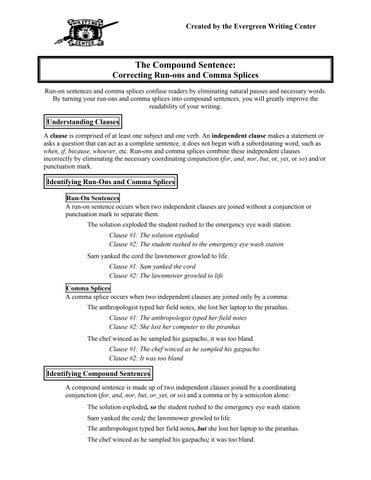
The Compound Sentence: Correcting Run-ons and Comma Splices Run-on sentences and comma splices confuse readers by eliminating natural pauses and necessary words. By turning your run-ons and comma splices into compound sentences, you will greatly improve the readability of your writing.
Understanding Clauses A clause is comprised of at least one subject and one verb. An independent clause makes a statement or asks a question that can act as a complete sentence; it does not begin with a subordinating word, such as when, if, because, whoever, etc. Run-ons and comma splices combine these independent clauses incorrectly by eliminating the necessary coordinating conjunction (for, and, nor, but, or, yet, or so) and/or punctuation mark.
Identifying Run-Ons and Comma Splices Run-On Sentences A run-on sentence occurs when two independent clauses are joined without a conjunction or punctuation mark to separate them: The solution exploded the student rushed to the emergency eye wash station. Clause #1: The solution exploded Clause #2: The student rushed to the emergency eye wash station Sam yanked the cord the lawnmower growled to life. Clause #1: Sam yanked the cord Clause #2: The lawnmower growled to life Comma Splices A comma splice occurs when two independent clauses are joined only by a comma: The anthropologist typed her field notes, she lost her laptop to the piranhas. Clause #1: The anthropologist typed her field notes Clause #2: She lost her computer to the piranhas The chef winced as he sampled his gazpacho, it was too bland. Clause #1: The chef winced as he sampled his gazpacho Clause #2: It was too bland
Identifying Compound Sentences A compound sentence is made up of two independent clauses joined by a coordinating conjunction (for, and, nor, but, or, yet, or so) and a comma or by a semicolon alone: The solution exploded, so the student rushed to the emergency eye wash station. Sam yanked the cord; the lawnmower growled to life. The anthropologist typed her field notes, but she lost her laptop to the piranhas. The chef winced as he sampled his gazpacho; it was too bland.
Exercise Part One Read the following example paragraph. Note all run-ons and comma splices, and use what you know about compound sentences to revise them. Pirates of the ancient Greco-Roman world are rarely romanticized. In fact, they are usually forgotten altogether they did pose a serious threat to ancient Mediterranean cultures. Most Greco-Roman pirates were not employed solely as pirates. They were merchants, farmers, and fishermen, they often sailed on day trips to pillage neighboring villages. In short, they were opportunistic sailors who used piracy as a means of supporting their families. However, piracy was not highly regarded in the GrecoRoman world, and many rulers tried to eliminate all piratical activity in the Mediterranean. Most attempts were futile in 67 B.C.E., the Roman general Pompey led a sweeping campaign against a bevy of active pirate bases and nearly wiped out Mediterranean piracy entirely. However, pirates remained. Eradicating piracy in the Greco-Roman world was a top priority for many rulers; nevertheless, pirates endured, they plundered, pillaged, and continued to terrorize towns and villages.
Part Two Now, pair up the independent clauses below with a coordinating conjunction and a comma-or a semicolon alone--to make five compound sentences. My elephant has the flu
Frida wanders aimlessly in the garden
The woods are very peaceful
The local zookeeper is sickly
She enjoys identifying insects
The black rain clouds look menacing
They dropped the table
A malicious badger is hiding in the trees
Gordon and I are planning a picnic
The movers tripped over the dog’s leash
The Compound-Complex Sentence The compound-complex sentence combines elements of compound and complex sentences. It is the most sophisticated type of sentence you can use. Understanding how to construct the compound-complex sentence will help you take your writing to a new level of complexity.
Understanding Clauses A clause is comprised of at least one subject and one verb. There are two types of clauses: the independent clause and the dependent clause. Independent Clause An independent clause makes a statement or asks a question that can act as a complete sentence. Example: The dog barks. Dependent Clause A dependent clause cannot act as a complete sentence because it begins with a subordinating word, such as when, because, if, whoever, etc. Example: When the dog barks. All grammatically correct sentences have at least one independent clause, and, therefore, they have at least one subject and one verb.
Identifying Compound and Complex Sentences The Compound Sentence A compound sentence is made up of two independent clauses joined by a coordinating conjunction (for, and, nor, but, or, yet, or so) and a comma or by a semicolon alone. Example: The pirate captain lost her treasure map, but she still found the buried treasure. The Complex Sentence A complex sentence combines a dependent clause with an independent clause. When the dependent clause is placed before the independent clause, the two clauses are divided by a comma; otherwise, no punctuation is necessary. Example: Because the soup was too cold, I warmed it in the microwave.
Constructing Compound-Complex Sentences A compound-complex sentence is comprised of at least two independent clauses and one or more dependent clauses. Example: Though Mitchell prefers watching romantic films, he rented the latest spy thriller, and he enjoyed it very much. Example: Laura forgot her friend's birthday, so she sent her a card when she finally remembered. Because compound-complex sentences are normally longer than other sentences, it is very important to punctuate them correctly. Refer to your Commas 101 handout for tips on correct comma usage.
Exercise With a partner or on your own, write five of your own compound-complex sentences in the space provided. Use the example below to help guide your writing. After you are finished, write one of your sentences on the board. As a group, we will determine if they are, in fact, compound-complex sentences. Example: Begin with two independent clauses: The team captain jumped for joy. The fans cheered. Then combine the independent clauses to form a compound sentence: The team captain jumped for joy, and the fans cheered. Now, add a dependent clause to your compound sentence to create a compound-complex sentence. The team captain jumped for joy, and the fans cheered because we won the state championship. OR When we won the state championship, the team captain jumped for joy, and the fans cheered.
For more practice, choose a passage from a book, newspaper, or magazine you are reading. Identify compound, complex, and compound-complex sentences. By understanding how other writers use these types of sentences, you can improve your ability to craft your own compound-complex sentences.