A Conversation with Donny of Donny's Diamond Gallery
When Donny Maleknia and Fatemeh Nazarieh sat down for their first date on December 5, 1993, Donny shared two dreams: to visit his family in Iran, whom he hadn’t seen in 18 years, and to open his very own jewelry store.
By Heather Price - Page 2
EDUCATION
Higher Education Powers Huntsville's Economy, but May Face Headwinds
At the 2025 State of Higher Education event hosted by the Huntsville/Madison County Chamber, presidents from the University of Alabama in Huntsville (UAH), Alabama A&M University, Calhoun Community College, and Drake State Community & Technical College outlined how their institutions are fueling Huntsville’s economic engine while also a knowledging new challenges on the horizon. By Kaith Thursday - Page 14
ADDITIONAL STORIES
• Sit Down With Success: A Conversation with Brett Pierce of The Masters Salon By Heather Price • Page 3
• Greenway Expansion, Ditto Landing Project Gain -Momentum with Council Support By Mike Easterling • Page 5
• For Alabama A&M Students, a Data Challenge Opens Doors to Careers in AI By Mike Easterling • Page 16
A Conversation with Donny of Donny’s Diamond Gallery
When Donny Maleknia and Fatemeh Nazarieh sat down for their first date on December 5, 1993, Donny shared two dreams: to visit his family in Iran, whom he hadn’t seen in 18 years, and to open his very own jewelry store.
That conversation became the beginning of their love story and the foundation of a family business that has become a Huntsville treasure.
Born in Shiraz, Iran, one of eleven children, Donny’s path to becoming a Huntsville jeweler began in 1977 when he moved from Iran to Gainesville, Florida, to pursue a degree in computer science. When the Iranian Revolution happened, his finances were strained, and he relocated to Huntsville, where college was more affordable.
“Design has always been a passion of mine,” Donny recalled, “and I originally planned to study architecture; however, due to my family's insistence, I pursued a degree in computer science, a field that never truly ignited my enthusiasm.”
After landing his first job in computer science, an acquaintance suggested that his personality and demeanor would be well-suited for a role in the jewelry industry. He encouraged Donny to start as a jewelry salesperson, and he eventually hired him as a traveling jewelry salesman.
“From the very beginning,” Donny shared, “I fell in love with the profession. Before long, I decided to quit my programming job and pursue a fulltime career as an independent jewelry salesperson, to own my own jewelry store eventually.”
Donny’s career in jewelry sales led to his introduction to Fatemeh in 1993 through one of his loyal customers at
Service Merchandise on South Parkway, where Donny was the top diamond consultant.
Fatemeh came from Iran to Oklahoma City in the summer of 1977, as a teenager, for medical reasons. She attended high school in Oklahoma City and college at Oklahoma State University, where she earned bachelor’s and
master’s degrees. She moved to Huntsville in 1990, met Donny in 1993, and the couple was married on the anniversary of their first date in 1994.
Once married, Donny and Fatemeh set out to make Donny’s dream of owning his own jewelry store come true.
Fatemeh worked full-time as a registered dietitian and took on a second consult-
By: Heather Price
ing job, while Donny put in extra hours at Service Merchandise.
The couple delayed having children for two years, lived frugally, worked hard, and saved every penny, Donny said. They opened Donny’s Diamond Gallery at 2510 Memorial Parkway right after Labor Day in 1999.
Reflecting on more than two decades of creating custom jewelry, Donny shared that he and Fatemeh have a genuine love for their job and their customers. They believe everyone who enters their store is a gift from God who deserves to be treated as such.
“Shopping with us is not just a transaction,” Donny said, “it's an experience. We strive to make each customer feel special and welcome. By the time our customers leave, we want them to feel like royalty or part of our family, knowing they can stop by for any reason and leave with a smile on their face. That is our goal every day.”
When asked what inspires his jewelry creations, Donny said inspiration is everywhere–the beautiful sky, a lovely printed shirt, a customer story, a painting, a photograph, or traveling to a new place.
Some of the most memorable projects are also the most emotional. Over the years, customers have brought in their deceased husband's rings or ashes to create a necklace in their memory, or they’ve created mother-daughter pendants or more modern, unique pieces from a customer's grandmother's jewelry collection.
“We have a deep passion for jewelry,” Donny said, “especially pieces that tell a story. Each piece we design is exceptional.” w
/ Photos by Steve Babin
A Conversation with Brett Pierce of The Masters Salon
Brett Pierce grew up in the world of hairstyling as the son of awardwinning hair artists Gary and Ann Bray, who opened The Masters Salon in 1973 inside Huntsville’s old Dunnavant’s Mall.
More than 50 years later, Pierce is leading The Masters Salon in its next era, carrying forward a legacy of excellence while introducing an innovative, team-based business model that’s reshaping the salon industry in Huntsville and beyond. In addition to serving as CEO of The Masters, Pierce and his wife Barbara own Strategies, a company that coaches salon, spa, and medspa owners on how to build strong, sustainable businesses.
Pierce recently sat down with the Huntsville Business Journal to share his insights on the evolving salon industry and how he’s helping owners nationwide rethink the way they operate.
What do you enjoy most about
owning your own business?
I want people to be able to reach their goals, but I want to do it in a way that we help support each other's goals to get there. Those goals might be just as simple as wanting to buy a house or wanting to buy a car. Helping others achieve their goals and being a part of that is my favorite part.
How do you balance personal and professional life?
A good friend of mine pointed this out to me years ago. He said, The important things that you're putting on the calendar to make sure you don't miss, like that meeting, put on your calendar to call me too, as your friend. Put on your calendar any event that your grandchildren have, and make sure to do those things because you only get this time. So if I have a Grandparents Day, it's on my calendar, and I go and do that.
What is it like to be part of a family business?
When it comes to family business, on the business side of it, it is still a partnership, so you have to treat it like a legitimate partnership. It's no different than going into business with somebody that you were friends with or somebody that you've actually just met that has similar interests and goals.
What is the secret to your success?
I have two things that I say on this. First, recognize luck when it's there. I think all of us have luck in front of us. It's just recognizing it. Sometimes things present themselves to you, and your ability to make a decision and do something about it is where your luck lives.
Then, remember when things occur–things that are fighting against you–you have to say it out loud, you can't say it to yourself, you have to say it out loud, especially if there's other people around–“It always works out.” There's only one time it doesn't work
By: Heather Price
out, and we all know that it's when we pass on to a higher plane of existence. But other than that, for a majority of those things, they will work out. This too shall pass.
Sit Down With Success is a feature of the Huntsville Business Journal on entrepreneurs and their keys to success. To read the full story, please visit the Huntsville Business Journal website. w
/ Photo courtesy of Brett Pierce
Subsidiary of EVENT Publishing
President /Publisher ……………………………………
Editor
Writers
Contributing Writers
Graphic Design
Website …………………………………………………………
Photographers
Director of Sales
Huntsville Business Journal is published monthly by EVENT Publishing, PO Box 14219, Huntsville, AL 35815
For advertising information call 256.533.8078, e-mail todd@eventhuntsville.com, or visit us on the web at www.huntsvillebusinessjournal.com For editorial information contact editor@huntsvillebusinessjournal.com
Greenway Expansion, Ditto Landing Project Gain Momentum with Council Support
The Ditto Landing Events Center project is moving forward, and the Huntsville City Council continues to provide aid to the project in the southernmost area of the city.
At its most recent bi-monthly regular meeting, the council voted to give over $1 million to Grayson Carter & Son to complete the third phase of the Tennessee River Greenway from Hobbs Island Road to Green Cove Road.
Shane Davis, director of urban and economic development for Huntsville, told the council the last phase is the “missing link’’ of a project that has been developing for years.
“Once completed,’’ he said of the greenway, “it actually provides a 15mile loop on the west end and east sides of South Memorial Parkway.”
The Madison County Commission initially supported the event center project by giving Lee Builders the go-ahead to start construction earlier this year.
The project includes renovating the 20,000-square-foot State Docks warehouse into the event center on a 2.5-acre site.
The site includes space for at least one restaurant with seating for up to 600 people. The center will be multiuse for events, including indoor concerts with a capacity of 1,100.
Jennie Robinson, city council president and representative of District 3, said interest in the greenway had much support.
“This was one of the items people were really focused on when they were looking at the big greenway map,’’ she said. “It’s such a crucial piece to complete this, and everyone will be very excited, the biking community in particular.”
The 1.5-mile project will connect Elgie’s Greenway to Ditto Landing, where the county is constructing the $13.2 million event center with help from the
City of Huntsville. Improvement funds Council members were active in awarding money to various city projects and businesses from discretionary pools.
District 2 representative David Little:
• $15,000.00 - Appropriation to Huntsville Ballet to provide funding for performances, education, and outreach programs.
• $75,000.00 - Appropriation to HEALS, Inc. to support the delivery of medical, dental, and optometry care to impoverished children in Huntsville.
District 3 representative Jennie Robinson:
• $5,000.00 - Appropriation to Huntsville Ballet to provide funding for performances, education, and outreach programs.
District 4 representative Bill Kling:
• $5,000.00 - Appropriation to Downtown Huntsville, Inc. to provide funding for promotional expenses.
• $5,000.00 - Appropriation to the North Alabama Railroad Museum, Inc. to provide funding for facility repairs and support complimentary railroad train rides for the community.
• $5,000.00 - Appropriation to the Fraternal Order of Police Foundation to provide funding for the Fallen Officer
Memorial service.
District 5 representative John Meredith:
• $6,000.00 - Appropriation to Columbia High School Wrestling to provide financial support for equipment and participation fees.
• $5,000.00 - Appropriation to The Schools Foundation to support principals, teachers, and students in Huntsville City Schools.
Buckbee honored Among city residents honored at the meeting was retired Marshall Space Flight Center and NASA veteran Edward Buckbee.
He began working for both institutions in 1961 and worked in public affairs with astronauts from the Mercury, Gemini, and Apollo space programs. He was also a significant leader in museum education in Huntsville. In 1970, Buckbee was elected by Wernher von Braun to be the first director of the U.S. Space and Rocket Center, the world’s largest space museum.
Before retiring in 1994, in pursuit of bringing von Braun’s vision to life, he founded the enormously successful U.S. Space Camp in 1982 and Aviation Challenge in 1990.
The council proclamation further stated he continues to impact the community by organizing and hosting numerous space anniversary events that honor astronauts, including John Glenn, Alan Shepard, Alan Bean, and Gene Cernan, as well as significant space programs like the celebration of America’s first space station, Skylab.
Buckbee was recognized for his contributions to space exploration and museum education. His achievements, the proclamation read, have made a lasting impact on the City of Huntsville, ensuring his legacy will long be remembered and admired. w
By: Mike Easterling / Photo courtesy of City of Huntsville
A view along the Tennessee River Greenway, which will soon extend to connect Elgie’s Greenway and Ditto Landing.
As a U.S. Army helicopter pilot, Ryan Welch didn't think about equipment manufacturers when he was in the middle of a mission. If he knew the name of the equipment company, it probably meant something had gone wrong. The best products worked reliably, earning trust without fanfare. For Ryan, that’s the kind of trust BAE Systems earned, even if he didn’t realize it at the time.
Ryan was commissioned to the U.S. Army in 1997, fulfilling his goal of serving the United States as an Apache helicopter pilot. He went on to have a distinguished military career, serving in combat for over 55 months and flying nearly 400 missions. During this time, he held various leadership roles from company to battalion commander. At the end of that 25-year journey came a sense of confidence, not only with fellow pilots, but in the equipment needed to carry out each mission.
Today, Ryan works at BAE Systems in Huntsville, Alabama as director of U.S. Army programs, Customer Requirements and Advocacy for the Electronic Systems sector, where he focuses on building trust with services in the Department of Defense. His experience in combat gives him and his colleagues a unique understanding of procurement, the end user, and the impact of equipment on mission success.
Trust in action
In February 2002, Ryan received a call with a code word, signaling the start of his deployment to Afghanistan to serve in Operation Anaconda as part of America's first major battle in the country.
Ryan recalled the initial instructions: "Get to the flight line. Bring your combat bag and body armor. You're going somewhere." Although he didn't know the details, he knew where they were headed. When Ryan arrived at the flight line, he witnessed a returned company of eight aircraft, all damaged with bullet holes.
At the start of the operation, Ryan's unit used “Cold War” methods – which involved flying low and slow
– and employed standoff techniques, targeting enemies from a safe distance. However, these tactics were less effective in the rocky terrain, where scattered adversaries could hide, requiring a different and more risky approach.
Ryan credits BAE Systems technology for helping them overcome these challenges.
BAE Systems' engine controls, which optimize fuel management and performance, were critical in keeping aircrews safe by sustaining flight at high altitudes. BAE Systems has provided safety-critical electronics to commercial and military aircraft for over 50 years. Its engine controls ensure efficient engine performance and reduced fuel consumption.
"We were able to drive back the Taliban forces and declare an initial victory," he said. "But at the end of the day, we were more likely to crash into the side of a mountain since we were flying at high altitudes never seen before."
Ryan also credits BAE Systems' doppler navigation system, the ASN157. This system provided accurate velocity and altitude data, enabling precise navigation. At the time, GPS was not widely available across the fleet, and the ASN-157 was essential for navigating unpredictable weather and uncharted territory.
BAE Systems also supplied armor panels that stopped numerous bullets from hitting helicopter crews.
"Those pieces of kit kept our aircrews safe,” said Ryan. “We brought 327 soldiers over there and brought all of them home safely."
Adapting to new threats
In Iraq from 2004 to 2005, Ryan commanded a company of 32 soldiers and eight helicopters. The enemy had since adapted and adjusted tactics, setting up “aerial ambushes” which were a 1-kilometer circle of heavy machine guns and man portable air defense missiles (MANPADS). They would lure aircraft in and then shoot from all directions, making it difficult to return fire. It forced aircrews to fly lower and faster and therefore face
By:
"We had to do something to protect ourselves, because there was no way to know if you got shot at by a missile unless it missed you - then we got CMWS.”
other hazards like birds and wires, which limited overall effectiveness.
Ryan had a close call during the Second Battle of Fallujah in November 2004, when a surface-toair missile narrowly missed his aircraft. He was flying near a small village, protecting U.S. Marines in attack formation, when he heard a whip-cracking sound and saw a white corkscrewed missile trail.
At the time, the aircraft used a legacy infrared jammer, which did not have the capability to protect the crew against more modern threats.
"We found that we lost trust in our equipment," he said. "We had to do something to protect ourselves, because there was no way to know if you got shot at by a missile unless it missed you - then we got CMWS.”
When Ryan was recalled to Iraq from 2006 to 2008, the introduction of CMWS or Common Missile Warning System changed everything. CMWS detects and warns aircraft of incoming missile threats, triggering countermeasures to counter incoming missiles.
"It takes the pilot out of the loop," Ryan explained. With CMWS, his company was able to reenter the no-fly
Guest Post / Photos courtesy of BAE Systems
“When these men and women climb into an aircraft or combat vehicle, and they turn on a piece of equipment, whether it be a jammer or a radio, they expect it to perform. When it doesn’t, they’re going to know your company name.”
zone, engage the enemy, and operate safely. "We brought aircrews home because of that capability. We wouldn't have been able to operate in that area without trust in our CMWS."
A story of valor
In combat, every second counts, and bravery can be demonstrated in a matter of seconds – sometimes regardless of the equipment.
On October 14, 2004, Ryan was flying a night reconnaissance mission in Baghdad when he heard a distress call on the emergency “Guard” frequency. Two helicopters were down, with two pilots killed in action and two more alive on the ground. As the air mission commander, Ryan quickly contacted a U.S. Marine Corps jet on the radio to understand the situation. The crashed aircraft was from their sister unit, and Ryan knew the location was in an area prone to adversary activity, with no nearby ground units available to assist.
Ryan decided to land and pick up the downed crew. The team knew the location and headed that way, and as they approached, they saw the crash site was on fire. The downed aircrew radioed that the helicopter was flying right over them.
After landing, Ryan and his co-pilot radioed the downed crew to move to their aircraft, but one of the soldiers was too injured to move. Ryan got out to help, telling his back-seater to leave the area if they encountered adversary fire. He ran through a thorn patch to reach the downed soldiers. Among them was a severely injured pilot, as both had been hurt when the impact force damaged their night vision goggles. Ryan and the other pilot carefully carried the more severely injured pilot back to the Apache.
With limited space, they used a self-extraction method called a “spur ride,” which allows the soldiers to strap in and hold onto the outside of the Apache. The injured pilot couldn't hang on, so the team secured him a seat, and two members hooked themselves to the Apache’s side before heading to a combat support hospital about 15 minutes away.
When they arrived, the team’s swift action surprised the hospital staff, who were not expecting an Apache to be conducting a medical evacuation. Ryan and his co-pilot were awarded the Distinguished Flying Cross for their efforts, which is awarded for heroism or extraordinary achievement while participating in aerial flight.
New technologies and trust
In Ryan’s final deployment from 2011 to 2012, in Afghanistan, the adversary continued to integrate themselves within civilian structures and there were growing concerns about civilian casualties and collateral damage caused by engaging enemies in urban terrain.
The APKWS® laser-guidance kit arrived and helped lessen the problem. This kit transforms unguided rockets into smart laser-guided rockets for precision strikes, redefining precision munitions by hitting targets with pinpoint accuracy and minimal collateral damage.
During his years in the service, from fuel controls to CMWS, APKWS and other products along the way, Ryan pieced together the true value of trust in equipment. He notes that it is
that stands behind you builds on that trust.
“A lot of people kept me safe that night and did the right thing. It all came together, which is not unlike anything at BAE Systems,” he says, referencing his Distinguished Flying Cross. “How well you play as a team – both inside and outside your organization – is what it’s all about. I love leading and stepping up to meet challenges, and that translated to a military career.”
crucial when lives are on the line.
“When these men and women climb into an aircraft or combat vehicle, and they turn on a piece of equipment, whether it be a jammer or a radio, they expect it to perform. When it doesn’t, they’re going to know your company name.”
He also believes that having a team
For Ryan, it all begins with the work of BAE Systems employees, who lay the groundwork for trust by delivering high-quality products every day. The Customer Requirements and Advocacy team regularly invites opportunities to make site visits and speak with employees about how their work connects to the mission.
“I’m here today because of BAE Systems equipment, and so are many other aviators and soldiers.”
Today, Ryan knows the BAE Systems name well, and for all the right reasons. w
In an Age of AI Disruption, Huntsville Firm Finds Room to Grow
Amid national headlines about corporate layoffs and economic uncertainty, some Huntsville businesses are still growing, a sign of resilience in the local economy. Capstone Research Corporation, a Huntsvillebased defense contractor founded in 2019, recently celebrated the grand opening of its new headquarters in Cummings Research Park. The facility expands the company’s labs, integration space, and collaborative areas, enhancing its ability to develop prototypes, conduct systems testing, and support classified research for Integrated Air and Missile Defense and long-range fires.
“Opening our new headquarters in Cummings Research Park is a great milestone for Capstone and representative of the growth we have experienced,” said Brad Blume, President of Capstone Research Corporation. “Our intent is to have the facilities necessary to expand our support to the Department of War by augmenting Government facilities with secure connected space.”
Capstone’s expansion comes as companies nationwide adopt artificial intelligence and automation, reshaping workforces in both subtle and sweeping ways. Amazon, for instance, recently announced layoffs affecting thousands of corporate employees as part of a strategy to increase efficiency through AI. While such job cuts grab headlines, historical patterns suggest that technological disruption, though often painful, frequently generates longterm growth.
Lessons from Past Disruptions
History offers clear parallels to today’s AI-driven labor shifts. In 1993, IBM cut more than 50,000 jobs after its core mainframe business was disrupted by the rise of personal computers and client-server systems. Around the same time, Sears eliminated roughly 50,000 positions as discount retailers like Walmart and Target transformed the retail landscape.
These examples reflect a recurring pattern: technological advances disrupt established workflows, initially displacing workers, but ultimately creating new industries and economic opportunities. The 18th- and 19th-century Industrial Revolution illustrates this vividly. Mechanized textile mills and steam engines replaced thousands of skilled artisans, provoking protests and the Luddite movement, named after the mythical Ned Ludd. Within decades, however, these same technologies fueled mass production, industrial productivity, and rising living standards.
Similarly, early-20th-century innovations like electrification and the assembly line initially widened wage gaps, yet ultimately helped build a robust postwar middle class. In the late 20th century, computers and the internet displaced millions of mid-level jobs while creating new careers in software development, logistics, and data analysis — a phenomenon economists call “job polarization.” Each wave of technological change demands years of adjustment through education, labor policy, and business adaptation.
AI Transforming Defense and R&D
Artificial intelligence is now driving the next wave of disruption, even in highly specialized fields like defense research and development. Projects such as the Department of Defense’s Project Maven use machine learning to analyze reconnaissance footage, tasks previously requiring large teams of analysts. Companies like Anduril Industries and Palantir Technologies are building AI-driven data systems to automate aspects of defense operations, while Shield AI and Lockheed Martin integrate AI into unmanned systems and engineering workflows.
These innovations rarely eliminate jobs outright. Instead, they shift roles: engineers supervise AI systems, analysts train algorithms, and teams focus on higher-order problem solving instead of routine tasks. Amazon’s recent layoffs demonstrate how AI is reshaping workforces nationwide. However, companies like Capstone that successfully integrate AI alongside human expertise, position themselves to thrive in this evolving landscape.
Huntsville’s Competitive Edge
Alabama’s defense sector employs 264,780 people, contributing roughly $50.3 billion annually. In Huntsville alone, tech employment rose 17.9 percent over five years, with a workforce of 25,910 and an average wage of $114,085, according to CBRE. Capstone’s expansion reinforces the city’s growing reputation as a hub for high-tech defense research, combining AI capabilities with skilled human labor to meet the demands of a rapidly evolving workforce. For the city, these developments represent both risk and opportunity. Huntsville’s unemployment rate remains low at around 2.4 percent, signaling resilience, yet rising AI adoption underscores the inevitability of workforce shifts. Capstone’s new headquarters demonstrates how local companies can integrate cutting-edge technologies while leveraging human expertise, creating a blueprint for other firms navigating similar challenges.
Looking Ahead
Historical patterns, from IBM and Sears to the Industrial Revolution, show that periods of technological upheaval ultimately generate new industries, higher productivity, and broader economic opportunity. Huntsville’s businesses, workers, and institutions that invest in skill development, infrastructure, and technological integration are best positioned to lead the next phase of economic growth. As AI continues to reshape defense and corporate sectors, Capstone’s expansion highlights the city’s ability to turn today’s disruption into tomorrow’s advantage. w
By: Kait Thursday /
Photo courtesy of Capstone Research
From left, Capstone Research co-founder and treasurer Melissa Blume, her husband and company president Brad Blume, and Huntsville Mayor Tommy Battle attend the opening of Capstone Research’s new office expansion.
Toyota Adds 350 Jobs to Huntsville Plant, Invests $282 Million in New Production Line
Toyota Alabama has begun production on three new part lines for differentials that are vital to the company's Tacoma, Tundra, and Sequoia trucks.
These new differential production lines represent a $282 million investment from the manufacturer, along with the addition of 350 jobs at the Huntsville plant.
A differential enables the wheels on the same axle to rotate at varying speeds. This helps ensure smooth, safer handling by allowing the outer wheel to travel a longer distance than the inner wheel when navigating a turn.
On Wednesday, October 15, the manufacturer hosted a brief event to formally introduce the new production line. Huntsville Mayor Tommy Battle, Madison County Chairman Mac McCutcheon, and Madison County District 6 Commissioner Violet Edwards were all in attendance.
Mike Hogan, senior manager of production at Toyota Alabama, congratulated the team that not only helped make this new production line a possibility, but also completed it ahead of the typical schedule.
"The normal project schedule is about 26 months from start to end. But because this project was so urgent for Toyota, our target was 18 months, and you did it," Hogan said.
Toyota Alabama President Marc Perry spoke about his team's improvement over the years. He proudly shared how that increased focus on reaching strategic goals for the company at large contributed to the corporate office selecting the Huntsville location for this new product line.
"By getting better and better when this challenge came, Toyota said, 'I know where we can put this, we can put this in Alabama.,' Perry said
Perry also spoke about the specific, and complex, manufacturing process for the differentials, saying his team is ready for the challenge. Workers will be responsible for creating 30 different variations of the truck part.
"Toyota Alabama team members dedicated themselves to mastering the
new processes and techniques needed for these products, and they are fully prepared to tackle the exciting challenge of machining and assembling differentials," Perry said.
Battle thanked Toyota for its commitment and support of Huntsville's citizens and economy. He also cited the new product line’s use of cuttingedge engineering, a topic the city is well-known for.
"It's not just an investment in an automotive plan, it's an investment in our people and in our community. It also means more opportunities, skilled workers, and more economic strength for North Alabama," Battle said.
McCutcheon commended the Toyota employees for their partnership and dedication to the Huntsville community, citing their help in tornado relief efforts.
"The employees at Toyota have stepped up, and they have become a partner with us, trying to make sure that people are taken care of...," McCutcheon said.
He continued, "That's a reflection of both Toyota, but it's also a reflection of you as a workforce and your commitment to where you live, where you raise your families, and where you work."
According to Toyota, the company supplies engines for seven of its nine vehicles assembled in North America, accounting for nearly half of
all engines assembled in the region.
Alex Potter, a Toyota Alabama team member of nearly two years, said being part of new product lines brings a sense of both excitement
and accomplishment.
By: Katie Holt / Photo by Katie Holt
"Our plant is known as an engine powerhouse, and we are confident our proven success will carry over to assembling these new differentials," Potter shared.
Toyota has also recently announced a new series of grants, totaling up to $4.2 million, to Huntsville City Schools as part of the company's Driving Possibilities initiative. The program's goal is to help expand access to quality STEM education and career pathways.
During the event, Battle briefly alluded to this initiative, reiterating Toyota's strong support of the Rocket City in a myriad of ways.
"The project also speaks to Toyota's longstanding confidence in our community and in our schools and in our training program. It also reflects a partnership that makes Huntsville a place where businesses and people thrive," Battle said. w
Pictured left to right: Madison County Chairman Mac McCutcheon, Huntsville Mayor Tommy Battle, Senior Manager of Production at Toyota Alabama Mike Hogan, Toyota Alabama President Marc Perry, and Madison County District 6 Commissioner Violet Edwards.
Connecting the Dots: Rochelle Silveira’s Innovation Ecosystem Map Aims to Bring Alabama’s Innovators Together
When Rochelle Silveira moved from Brazil to the United States, she often heard the same piece of advice: “Right company, wrong place.” Innovation, people told her, belonged to the coasts. But after years of working with founders and mentoring startups across the country, she began to see a different truth.
“There’s incredible innovation happening here,” Silveira said. “People just don’t see it yet. Everyone always asks, ‘Who’s building in Alabama? Who’s funding Alabama?’ And I realized we don’t have a clear picture of our own ecosystem.”
That realization inspired her newest personal project, the Innovation Ecosystem Map, a community-driven effort to connect the dots and build a framework for visibility and connectivity, starting in Alabama.
“The vision is to create a living directory and map that highlights startups, investors, enablers, service providers, and community builders,” she explained. “It’s updated monthly on the 25th and open to everyone.”
Since its soft launch, the project has already cataloged more than 300 companies and organizations from across the state. Each entry contributes to what Silveira calls a “living map,” one that grows and evolves as more contributors add to it. The goal, she says, is not just to list names, but to reveal the networks that already exist in Alabama and help new ones form.
“It started as something I wanted to do for the community,” Silveira said. “Right now, our resources are siloed. Universities have their networks, chambers have theirs, investors have theirs. My goal is to build a shared map that can grow with the ecosystem.”
Silveira currently serves as the
Managing Director of gBETA Huntsville, part of the nationally ranked accelerator gener8tor. Her work gives her a close-up view of the energy and challenges in North Alabama’s startup landscape. But she is careful to clarify that the Innovation Ecosystem Map is an independent personal project, separate from her professional role.
“This isn’t a gBETA or gener8tor initiative,” she said. “It’s something I’m doing on my own time because I believe in this community and the potential here.”
The first version of the map is available as a downloadable PDF, but Silveira is already working toward a more dynamic, interactive version. The online platform would allow users to filter by industry, location, or type of support, making it easier for startups to connect with local investors, advisors, and service providers.
“If you’re a founder looking for a local accountant or patent attorney, you shouldn’t have to look out of state,” she said. “We have those people here. We just need a way to see each other.”
When she shared the project publicly on LinkedIn, she expected a few local reactions. Instead, the
By: Noah Logan / Photo by Rochelle Silveira
post quickly spread, drawing attention from founders, investors, and community leaders well beyond Alabama.
“People from other states started reaching out, asking how they could build something similar,” she said.
That kind of response, she believes, shows the power of connection. “Once
people can see who’s out there, collaboration happens naturally,” Silveira said. “That’s what makes ecosystems grow.”
The Innovation Ecosystem Map is updated monthly and open to everyone. Whether you are a startup, funder, service provider, or community organizer, the project is designed to help Alabama’s innovation network thrive, one connection at a time.
For more information or to submit your organization to the map, visit https://www.rochellesilveira. com.br/ecosystemmap. w
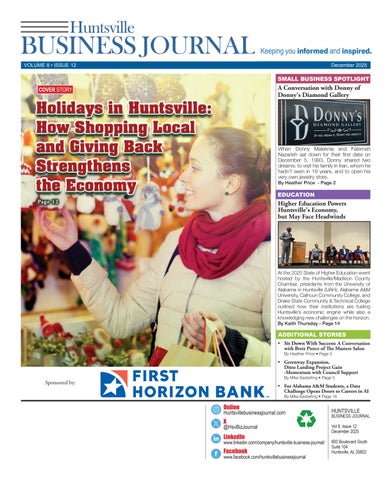
As the holiday season approaches, Huntsville residents have a powerful way to make an impact: support local businesses while giving back to the community. From small shops to major employers, the city’s business ecosystem relies on residents’ holiday spending and generosity to fuel economic growth and strengthen local services.
Citizens Supporting Small Businesses
Shopping locally during Christmas, Hanukkah, and other holiday celebrations helps keep more money circulating within the Huntsville economy. When residents buy gifts at neighborhood stores or dine at independent restaurants, a larger share of that spending often stays in the community, helping pay employee wages, rent, and local vendor bills. In the Huntsville metro, small businesses account for about 45% of employees and 42% of payroll, underscoring their economic importance.
Smaller businesses often give a higher percentage of earnings to local nonprofits than larger firms, supporting food banks, shelters, schools, and community programs.
Holidays in Huntsville: How Giving Back Strengthens
By: Kait Thursday
While large corporations may contribute more in total dollars, local businesses play a critical role in sustaining Huntsville’s charitable ecosystem. During the holidays, this generosity is especially visible, as neighborhood shops, restaurants,
and service providers contribute both cash and in-kind donations that directly benefit families and organizations in need.
Residents can also contribute by participating in holiday drives, visiting neighborhood markets, or attending charity events. Even small gestures—buying gifts from local artisans, ordering meals from independent restaurants, or donating to community pantries—have tangible benefits that ripple across the economy.
Businesses Fuel the Local Economy Through Giving Huntsville’s business community plays a central role in charitable giving. The Community Foundation of Greater Huntsville awarded approximately $12.5 million in grants in 2024, funding programs in
education, health, workforce training, and basic needs. Nonprofits across the city employ roughly 11,200 people and generate $930 million in revenue, highlighting the vital role philanthropy plays in Huntsville’s economy.
Every dollar donated to a nonprofit contributes to local economic activity—paying staff, purchasing supplies, renting space, and funding programs that serve residents. Ticketed events like Burritt on the Mountain’s Holiday Magic or the 100 Black Men Gala generate revenue for local vendors while supporting charitable missions. Seasonal drives coordinated by organizations such as the Food Bank of North Alabama or Downtown Rescue Mission also reduce household spending for families in need, freeing income for other local purchases.
How Shopping Local and Strengthens the Economy
Tax Benefits Make Giving Strategic
Federal and state tax laws provide incentives for businesses and individuals to give:
• Corporations can deduct charitable contributions up to 10% of taxable income under IRC §170(b)(2), with excess contributions carried forward up to five years.
• Businesses donating food inventory, including restaurants and grocery stores, may qualify for an enhanced deduction under IRC §170(e)(3).
• Alabama offers various state tax credits and incentives for business contributions to economic development projects; companies should check specific eligibility.
Individuals also benefit when itemizing, with deductions for cash or property donations to qualified nonprofits, as outlined in IRS Publication 526. Because changes to charitable deduction rules are scheduled to take effect beginning in tax years after 2025, some businesses may find 2025 a strategic year to give under the current rules.
Local Businesses Leading by Example
Huntsville businesses demonstrate how philanthropy and economic growth can go hand-inhand:
• Redstone Federal Credit Union contributed over $1 million in 2024 to scholarships, STEM initiatives, and the United Way of Madison County.
• Torch Technologies channels hundreds of thousands annually into veterans’ causes, arts programs, and education through the Torch Helps Foundation.
• Large aerospace and tech firms in the region support STEM education and workforce development at local institutions, blending philanthropy with strategic economic investment.
Even small- and mid-sized businesses make an impact through corporate matching programs, which double employee contributions to charities, shelters, and food banks. Companies such as Huntsville Utilities leverage these programs to maximize giving while
building stronger community ties. How Citizens Can Help Residents can actively participate in Huntsville’s economic and social ecosystem by:
• Shopping local at neighborhood businesses and artisan markets.
• Attending holiday events and ticketed fundraisers hosted by nonprofits and local businesses.
• Donating items or funds to organizations like the Food Bank of North Alabama, Downtown Rescue Mission, Manna House, and local church pantries.
• Encouraging employee giving or volunteering through workplace programs or corporate matches.
Every dollar spent locally or donated strategically amplifies impact. Businesses can hire more staff, invest in projects, and support the city’s cultural and charitable infrastructure, while residents enjoy stronger community ties and enhanced local services. Economic studies in some Alabama counties suggest that $1 in local spend-
ing can generate roughly $1.50 in economic output, providing a benchmark for understanding how generosity can circulate through the Huntsville economy.
Building a Culture of Generosity
Huntsville’s holiday season reflects a unique synergy between businesses, nonprofits, and residents. From church pantries in Five Points to aerospace and tech firms in Cummings Research Park, philanthropy fuels both goodwill and tangible economic growth.
As year-end approaches, citizens and businesses have opportunities to strengthen Huntsville’s economy. Shopping locally, donating, or volunteering ensures holiday dollars circulate within the city, supporting families, nonprofits, and small businesses. In turn, businesses that give back help create jobs, sustain services, and keep Huntsville thriving—demonstrating that generosity is more than goodwill; it's smart economic strategy.
This holiday season, Huntsville proves that community investment is a shared responsibility—and a win for everyone. w
Higher Education Powers Huntsville’s Economy, but May Face Headwinds
The city’s higher education leaders are bullish on the future. At the 2025 State of Higher Education event hosted by the Huntsville/Madison County Chamber, presidents from the University of Alabama in Huntsville (UAH), Alabama A&M University, Calhoun Community College, and Drake State Community & Technical College outlined how their institutions are fueling Huntsville’s economic engine while also acknowledging new challenges on the horizon.
At the forum, each institution reported rising enrollment and reinforced its commitment to aligning education with Huntsville’s evolving workforce. Calhoun Community College announced record enrollment of 10,141 students, underscoring its role as the largest feeder of skilled workers in North Alabama. Its new 57,000-square-foot Advanced Manufacturing Center has already become a hub for industry training, equipping students with skills directly applicable to aerospace, automotive, and healthcare industries.
Drake State Community & Technical College also marked impressive progress, reporting a 26 percent increase in enrollment over the past year. Drake State’s president, Dr. Patricia Sims, said this growth reflects Drake’s focus on short-term credentials and career re-entry programs, which are opening doors for residents seeking high-wage, high-demand positions. “We see our mission as empowering families through education,” Sims said. “When a student gets a certification and a job, the entire household’s trajectory changes.”
Meanwhile, the University of Alabama in Huntsville emphasized its retention and local impact, noting that 80 percent of UAH graduates remain in the Huntsville area after graduation and 85 percent stay within Alabama. UAH President Dr. Charles L. Karr highlighted that the university’s partnerships with defense and aerospace employers are not only fueling job growth but also driving
innovation that keeps Huntsville competitive on a global scale. UAH’s partnerships with defense and aerospace employers like Boeing, Dynetics, and NASA Marshall Space Flight Center create direct employment pipelines that strengthen the city’s economic ecosystem.
Alabama A&M University, celebrating more than 150 years of service, shared updates on its 10-year master plan that includes expanding STEM facilities, modernizing student housing, and increasing capacity for physical and analytical sciences research. Dr. Daniel K. Wims, president of Alabama A&M University, stressed that A&M’s mission remains rooted in serving the local and regional community. “Our purpose is not just to educate,” Wims said, “but to uplift the community that has supported us for generations.”
Economic Engines with Local Impact
Collectively, Huntsville’s higher education institutions represent a massive portion of the region’s economy. Calhoun’s annual economic contribution alone is estimated at $802.8 million, accounting for 1.8 percent of North Alabama’s gross regional product. Over the last five years, UAH researchers have secured more than $639 million through contracts and grants and generated nearly $700,000 in licensing and royalty revenue from a portfolio of 187
active patents. Meanwhile, Alabama A&M contributes approximately $279.2 million to the local economy each year. Drake State’s growing footprint in workforce training, particularly in manufacturing, con-
struction, and healthcare, adds $21 million more. Oakwood University, which was not represented in the panel, nevertheless contributes an annual $92.6 million in direct economic value.
Dr. Jimmy Hodges of Calhoun Community College highlighted how advisory boards composed of local business leaders guide the college’s curriculum to meet real-time needs. “We meet regularly with employers,” Hodges said. “If they tell us they need 200 more machinists or nurses next year, we adjust. That’s what community colleges are built to do.”
Serving Beyond the Classroom
The presidents also emphasized how their campuses support community well-being beyond academics. Calhoun offers continuing education and GED programs for adult learners, along with childcare support for
By: Kait Thursday / Photos by Kait Thursday and Huntsville/Madison County Chamber
working parents. Drake State runs small business development workshops and partners with the city to offer free technology training for veterans and displaced workers.
At Alabama A&M, faculty and students participate in dozens of outreach programs each year, from tutoring local high school students in math and science to hosting agricultural extension workshops for North Alabama farmers. UAH’s engineering students regularly collaborate on local infrastructure projects, providing analysis and design support for public safety and environmental sustainability initiatives.
These community programs have measurable economic and social effects. According to a recent ACCS report, for every dollar invested in higher education, Alabama sees an average return of $6.50 in long-term economic value through job creation, higher wages, and increased local spending.
Challenges and Federal Uncertainty
Despite the optimism, leaders acknowledged the growing strain of financial and demographic pressures. Hodges described a “constant
balancing act” between affordability and innovation, especially as state and federal funding stagnates. Wims pointed to aging infrastructure and competitive faculty recruitment as critical concerns, noting that A&M’s ability to attract top researchers depends on sustained investment.
The ongoing federal government shutdown has added another layer of uncertainty. While federal student aid programs like Pell Grants remain operational, furloughs within the Department of Education and related agencies have slowed approvals for grants, research funding, and compliance reviews.
Looking Ahead
Even with these challenges, Huntsville’s colleges remain deeply interwoven with the region’s growth strategy. Each president reaffirmed a shared vision: education not as a separate sector, but as the foundation of the city’s economic resilience and community well-being. “Our universities and colleges are the foundation of Huntsville’s growth,” Hodges said, “We’re not just producing graduates, we’re producing the future workforce, the innovators, and the civic leaders who will keep this region thriving.” w
For Alabama A&M Students, a Data Challenge Opens Doors to Careers in AI
For the third time in as many years, some Alabama A&M University students accepted an invitation to compete in the third FICO Educational Analytics Challenge.
FICO created the program for aspiring scientists, engineers or anyone seeking a data-driven career. The project is specifically for Historically Black Colleges and Universities (HBCUs). Other schools participating include Bowie State University, Delaware State University and Morehouse College.
The current Challenge for the Fall ’25–Spring ’26 school year focuses on solving real-world financial services problems through the development of small language models. FICO, a leading credit services company, is officially known as Fair Isaac Corporation, named for the founders who established it in 1956.
The company started with its headquarters in California but is now based in Montana.
Dr. Scott Zoldi, Chief Analytics Officer at FICO, and his team of data scientists spearhead the program, which involves weekly lectures, virtual meetings and mentoring the students.
“FICO is a proud participant in the HBCU Partnership Challenge, an initiative of the Bipartisan Historically Black Colleges and Universities Caucus and led by Congresswoman Alma Adams and Congressman French Hill,’’ Zoldi said.
The FICO program is targeting HBCUs to diversify and curtail bias in the data science and AI fields.
“Through this partnership, FICO is connected to HBCUs who have expressed interest in participating in the program,’’ Zoldi said. “We have worked with seven universities and more than 200 undergraduate and graduate students to date, with more to come next semester.’’
Dr. Ed Pearson, a professor at Alabama A&M and faculty member who oversees the school’s Challenge team, said reaction to the program from the student body has been positive.
“The feedback from students has shown an overwhelming amount of enthusiasm,’’ he said. “Each year, a growing number of students sign up
to participate in the Challenge. Furthermore, students have indicated that the skills gained from this experience have been instrumental in securing summer internships.’’
According to Zoldi, FICO presents a new Analytics Challenge annually and it brings real financial services business problems to the HBCU students.
“This year, students are focused on creating a small language model, so students walk away with a better understanding of how AI and large language models (LLMs) work and are trained,’’ he said. “Students will be exposed to the underlying mechanisms of neural networks, transformers, LLMs, and FICO’s own approach to focused language models.
Two Alabama A&M undergraduate students, Bukata Mubanga and Thabo Ibrahim Traore, are participating in the Challenge this fall and spring.
“I registered to gain hands-on experience applying data analytics to real-world business problems and to challenge myself in a competitive learning environment,’’ Mubanga said. “I hope to strengthen my technical and problem-solving skills, learn industryrelevant tools, and collaborate with peers while gaining insights into analytics applications in business.”
Traore has similar ideas.
“I hope to gain deeper insights into how data can be analyzed and applied in meaningful ways, including being ethical, while also strengthening my technical skills and learning from collaboration with peers,’’ he said.
The program has grown at Ala-
bama A&M.
“At the student level,’’ Zoldi said, ‘’we have seen success in students becoming empowered to pursue careers in data science and many considering continuing their education and obtaining a master’s degree. At the university level, FICO continues to play a pivotal role in encouraging the
implementation of new data science curriculum.
“At Alabama A&M University, FICO played an influential role in introducing a new Data Science minor, which helps aspiring data scientists gain the AI and analytics experience, and knowledge needed to be competitive in today’s workforce.’’ w
By: Mike Easterling / Photo courtesy of Alabama A&M
Dr. Scott Zoldi, Chief Operating Ofiicer at FICO (center with blue jacket) pictured with Alabama A&M University FICO challenge team. (Alabama A&M University).
Mortgage Relief Searches Hit 2009 Levels, But This Time Is Different
By: Matt Curtis
Across the U.S., more people than ever are searching for mortgage relief — a sign that some homeowners are feeling real financial pressure. According to MarketWatch, Google searches for “need help with my mortgage” recently hit their highest level since 2009. It’s definitely a trend we’re watching closely.
But here’s why this isn’t a repeat of 2008. Nearly 40% of homeowners in America have no mortgage debt at all, and about 60% of active mortgages are locked in below 4% interest rates. That means the majority of homeowners are in a much stronger financial position than they were during the 2008 housing crash.
In North Alabama, we’re seeing a much healthier picture. Huntsville continues to benefit from strong job growth, high household incomes, and a balanced housing market. Our region remains one of the most affordable tech and defense hubs in the country, and that combination continues to attract families and employers alike.
That said, there are still families under strain. I recently overheard someone on the phone at an Atlanta gas station talking about a friend who was stressed about making their mortgage payment — a reminder
that these issues are real for many households. Rising insurance costs, property taxes, and consumer debt are impacting a lot of families.
At Matt Curtis Real Estate, we’ve brought back our Instant Offer Program to help homeowners who need immediate assistance or simply prefer a faster, easier process.
The program allows qualified sellers to receive an offer quickly, choose their closing date, and avoid the hassle of showings — providing flexibility and peace of mind during uncertain times.
Every housing cycle brings its own set of challenges and opportunities. The key takeaway is that today’s market remains far more stable than what we saw in 2008 — especially as we’ve seen a notable uptick in pending sales since interest rates began to ease in September. w
Matt Curtis of Matt Curtis Real Estate
At
HudsonAlpha,
Score Pharma Develops Method to Boost Antibody Potency Against Cancer
Scientists at Score Pharma, a therapeutics company located on the HudsonAlpha Institute for Biotechnology campus, believe they’ve found a way to make existing antibody therapies for cancer significantly more potent.
The company claims that by making a small structural change during the upstream biologics process for existing antibody therapeutics, the cancer cell-killing mechanism of that specific therapeutic is greatly improved. Through library screening, Score has identified tens of thousands of potential modulators for its patented (Japan) and patent-pending (US, EU) process technology that will act as the duplicatable platform for improvement of commercially available therapies.
Score is now preparing to conduct scientific confirmation studies at Southern Research, targeting its first clinical application in HER2-positive breast cancer.
“We couldn’t be happier with the results we’re seeing in our early studies,” said Jennifer Riggs-Sauthier, Ph.D., Chief Development Officer & Vice President of Chemistry at Score Pharma. “Cancer takes the lives of about 27,000 people every day. That’s one cancer death every three seconds. This advancement brings us one step closer to the clinic – and ultimately, to helping patients benefit from stronger, more effective antibody therapies.” w
Drake State Creates Endowed Scholarship
ship in recognition of automotive executive and entrepreneur Ellenae Hart-Fairhurst. The scholarship honors her professional contributions and lasting impact on the industry.
Once fully funded with a principal gift of $500,000, the endowment will provide a permanent source of financial support for Drake State students, with a particular focus on assisting mothers—whether biological, adoptive, or legal guardians—who are pursuing their education full- or part-time.
Ellenae Fairhurst’s life embodies perseverance, leadership, and a steadfast belief in the power of education. A native of Dayton, Ohio, she began her career at Ford Motor Company and later became a pioneering automotive dealer. Fairhurst made history as the first African American female in North America to own both an Infiniti and a Lexus dealership, operating the successful Huntsville Autoplex for decades. Her career was marked by innovation, resilience, and a commitment to opening doors for others.
Through this endowed scholarship, Drake State seeks to carry forward Fairhurst’s legacy of empowerment and opportunity. The scholarship will strengthen families, foster leadership, and provide transformative support to students seeking to achieve their educational and career goals.
“Ms. Fairhurst’s story is one of determination, courage, and excellence,” said Drake State President Dr. Patricia Sims. “We are proud to honor her remarkable legacy through a scholarship that uplifts students and celebrates her lifelong commitment to perseverance and success.”
The Ellenae Fairhurst Endowed Scholarship supports Drake State’s efforts to expand access to affordable education for students in the Huntsville community. w
Honoring Ellenae Fairhurst
Drake State Community and Technical College has established the Ellenae Fairhurst Endowed Scholar-
First Horizon Bank is committing $150,000 to support Huntsville’s expanding startup ecosystem through
programs run by gener8tor.
The funding supports gBETA Huntsville and Spark at MidCity, delivered in partnership with gener8tor, a nationally ranked startup accelerator and venture capital firm, and the Apollo Coalition. By leveraging the Innovate Alabama Tax Credit Program, First Horizon is helping channel resources directly into initiatives that equip founders with mentorship, capital connections and the tools to scale their businesses.
This investment builds on First Horizon’s track record of supporting accelerators and entrepreneurial initiatives across Alabama, reinforcing the bank’s commitment to helping founders transform ideas into thriving businesses statewide.
“First Horizon knows firsthand what it means to build from the ground up. When we first entered Alabama in 2011, we were essentially a startup ourselves,” said Eric Sanders, EVP, Huntsville Market President. “We believe in investing in founders and, by supporting gener8tor and the Apollo Coalition, we are helping entrepreneurs in Huntsville access the resources, mentorship and capital they need to succeed.”
Through programs like gBETA, a free seven-week accelerator, and Spark, which helps founders turn ideas into minimum viable products, entrepreneurs receive mentorship, investor connections and tailored coaching. Since launching, gBETA Huntsville has served 40 companies, created 163 jobs and helped startups raise more than $11 million in funding, with a total economic impact of more than $13 million.
“Corporate partners play a critical role in fostering entrepreneurship and driving economic growth in North Alabama,” said Rochelle Silviera, gBETA managing director at gener8tor. “Thanks to First Horizon’s investment, we’re able to prepare founders for investment, connect them with mentors and investors, and help them scale companies that strengthen our local economy.”
The Apollo Coalition, a Huntsville-based nonprofit dedicated to building inclusive pathways for entrepreneurs, plays a key role in ensuring these resources reach founders, artists
and creatives.
“The beauty of this model is that it’s not just about funding startups. It’s about creating access,” said Apollo Coalition Managing Director Joanna White. “With First Horizon’s support, we can continue placing resources where they’ll have the greatest impact, ensuring Huntsville’s innovation economy reflects the diversity and creativity of our community.”
Huntsville founders supported through gBETA include startups like Visual Flow Code, MESO, Aesonova, KrillPay and Biobanking AI. These companies are tackling everything from artificial intelligence and drone maintenance to space innovation and financial technology.
First Horizon joins a strong coalition of partners supporting Huntsville’s entrepreneurial ecosystem, including Innovate Alabama, RCP Companies, Cobbs Allen, Robins & Morton, Regions, ALFA Farmers and Bank Independent. w
VBC Veteran Mike Vojticek Honored as He Retires After More Than Three Decades of Leadership
After more than three decades of service, Mike Vojticek, Assistant Director of the Von Braun Center (VBC), has announced his retirement, effective October 31, 2025.
To recognize his contributions to Huntsville’s entertainment and tourism industries, Mayor Tommy Battle proclaimed October 29, 2025, as Mike Vojticek Day in Huntsville. The proclamation was presented during a retirement celebration at the VBC’s Mars Music Hall, where colleagues, family, and industry partners gathered to honor his career and lasting impact on the community.
A Huntsville native and 1978 Butler High School graduate, Vojticek earned his Bachelor of Science in Accounting from the University of
First Horizon Bank Invests $150K to Boost Huntsville Startups
Alabama in Huntsville and later became a Certified Public Accountant through the University of Alabama.
His professional journey began in the restaurant industry, working in a variety of roles at Cork ‘n Cleaver, Darryl’s, and Bennigan’s. Those experiences sparked a lifelong passion for hospitality and service - one that ultimately led him back to the industry through the Von Braun Center.
After earning his CPA designation, Vojticek joined a local accounting firm before accepting the position of Director of Finance at the VBC in May 1991. His combination of financial expertise and hospitalitydriven mindset made him an integral part of the Center’s leadership. He was later promoted to Assistant Director, a position he has held for more than 25 years.
During his tenure, he played a significant role in the VBC’s growth and evolution - helping the facility expand its footprint, enhance its offerings, and strengthen its position as a cornerstone of North Alabama’s entertainment, convention, and hospitality industries.
As the VBC prepares for this transition, Vojticek’s responsibilities will be distributed among several department directors and senior staff to ensure a seamless continuation of leadership and operations.
In retirement, Mike plans to enjoy traveling with his wife, Anggie, and spending more time with their children and six grandchildren who call him “Papa.” An avid Alabama football fan, he’s also looking forward to cheering on the Crimson Tide.
“This job has been a huge part of my life, and I’ll always be grateful for the friendships and memories made here,” Mike added. “The VBC’s future is bright, and I’m proud to have been part of its story.” w
Major Real Estate Deal
Highlights Growth of Solar Manufacturing in North Alabama
Ambrose, a leading vertically integrated investment manager
BRIEFCASE
specializing in Class A industrial, logistics and e-commerce real estate, has announced the sale of a 554,000-square-foot, Class A distribution hub situated on more than 40 acres at 1250 Cooperage Way in Trinity, AL, located within the Greater Huntsville region. The modern facility is fully occupied by First Solar, a U.S.-based photovoltaic solar technology and manufacturing company. The buyer is global investment bank Goldman Sachs.
Ambrose developed the asset, working closely with First Solar end-to-end throughout the design, construction and financing of the project. The state-of-the-art facility includes 40-foot clear heights, 40 docks, 80 auto parking spots, 36 trailer parking spots and truck courts with 150-foot depths. The facility houses machinery, raw materials and equipment for use in First Solar’s adjacent, recently completed manufacturing facility.
“This successful investment exit underscores the Ambrose team’s multidisciplinary capability in the development and strategic positioning of this asset to achieve an attractive outcome amid the current market environment,” said Ambrose Founder and CEO Aasif Bade. “This transaction is also indicative of the institutional market’s appetite for modern, high-quality Class A logistics facilities that meet the needs of today’s sophisticated, tech-forward tenants.”
First Solar, founded in 1999, is America’s leading photovoltaic solar technology and manufacturing company, and is the only U.S.-headquartered company among the world’s largest solar manufacturers. Importantly, the distribution hub is located less than one mile from First Solar’s newly opened $1.1B production facility, and it is part of an investment strategy that will scale First Solar’s manufacturing footprint in the U.S. to more than 10 GWDC (Gigawatt Direct Current) and generate over 700 new jobs in the Alabama market. w
Kalm Therapeutics Gains Key Advisor as It Advances Clinical Pipeline
Kalm Therapeutics, a biotechnology firm based at the HudsonAlpha Institute for Biotechnology in Huntsville, said it has added Dr. Peter Lio, a Harvard-trained dermatologist and researcher, as both an investor and member of its Scientific Advisory Board. The move marks a key step for the company as it advances clinical development of its experimental patch therapy for inflammatory skin diseases and approaches several major milestones in its pipeline.
Dr. Lio is a Harvard-trained dermatologist and clinical researcher located in Chicago, IL. He is one of the foremost authorities on atopic dermatitis and inflammatory skin disorders and has been on the National Eczema Association’s Board of Directors for over eight years. He currently serves as Clinical Assistant Professor of Dermatology and Pediatrics at Northwestern University Feinberg School of Medicine and is the founding director of the Chicago Integrative Eczema Center.
“We are honored to welcome Dr. Lio to our advisory board at this pivotal phase of growth,” said AJ Singhal, CEO of Kalm Therapeutics. “His deep clinical expertise and longstanding commitment to innovation in dermatology will be instrumental as we advance our lead programs toward late-stage development and explore strategic partnerships.”
Dr. Lio has authored over 100 peer-reviewed publications and is actively involved in translational research and clinical trials. His appointment provides additional validation of Kalm’s scientific approach and its potential to address large, underserved markets with significant commercial opportunity.
“Kalm Therapeutics has a clear focus on patient-centered innovation while pursuing a novel patch system
which will protect and treat the inflamed skin,” said Dr. Lio. “I look forward to advising the team as they advance their pipeline and work to bring meaningful new treatments to market.”
Dr. Lio joins Kalm at a time of growing momentum, as the company prepares for upcoming clinical data readouts and strategic initiatives to expand its intellectual property portfolio and clinical reach. w
8 Huntsville Companies Among Latest Recipients of Innovate Alabama Grants
Innovate Alabama has awarded $2.2 million in Small Business Innovation Research (SBIR) and Small Business Technology Transfer (STTR) supplemental grants to 13 companies across the state, including eight based in Huntsville. The funding is intended to advance research, product development and job creation in sectors such as biotechnology, aerospace, advanced manufacturing, materials science and software.
“These 13 companies have already proven their technologies can compete and win against the best in the country,” said Cynthia Crutchfield, CEO of Innovate Alabama. “Our role is to help them scale those innovations here, creating Alabama jobs and sustained economic growth.”
Since 2022, the Innovate Alabama Supplemental Grant Program has deployed more than $19 million in funds across 86 unique research-based companies, helping them expand operations, hire skilled workers and compete for larger federal contracts. The program matches federal research awards, allowing Alabama to extend the reach of those dollars while keeping innovative companies in-state.
“Over the past three years, it has
become clear how this supplemental funding creates a multiplier effect,” said Dr. Michael Chambers, Innovate Alabama board member and University of South Alabama Chief Economic Development Officer, who has championed the program since its inception.
“Companies leverage the funding to expand their technical teams, bring products to market faster and establish the R&D infrastructure that generates jobs and revenue in Alabama.”
Nine of this year’s recipients have returned after using earlier awards to grow their teams and secure additional federal funding. Their continued success demonstrates how the matching model creates compounding returns for Alabama’s economy.
“Each round, this program continues to deliver measurable results,” said Dave King, Innovate Alabama board member and former Director of NASA’s Marshall Space Flight Center. “Companies returning as multi-round recipients demonstrate the value of this support in helping them scale, secure additional federal contracts, and
grow right here in Alabama, ultimately growing our state’s economy.”
This round’s Huntsville recipients include:
• EngeniusMicro – Designs and manufactures advanced MEMS sensors and microelectronics for defense and aerospace applications. A three-time recipient, the company has earned multiple SBIR awards and a $1 million Missile Defense Agency contract.
• ENVENTION, LLC – Builds software, FPGA hardware and AI/ML systems for defense and space applications. The company is using its NASA Phase II SBIR award to develop a radiation-hardened co-processor for spacecraft, building on earlier work at Marshall Space Flight Center.
• HyBird Space Systems – Builds hybrid rocket engines for defense and commercial aerospace using safer propellants and modern manufacturing. The company recently added six engineers and
completed hot-fire tests of its first Alabama-built engines. A past recipient, HyBird is constructing a propulsion test stand to accelerate in-house testing and development.
• K Sciences GP, LLC – Conducts applied research in sensors and materials science. The company has received three SBIR/STTR awards totaling $1.2 million, including work in fiber-optic sensing technology, and is using state support to advance its latest Air Force project and local R&D.
• KODA Technologies – Designs and develops weapons systems for the Department of Defense and NASA. A past recipient, KODA is using this grant to improve systems and algorithms for detecting spacecraft, and the company has hired an Alabama A&M engineering intern to support its research team.
• Linc Research, Inc. – Provides structural, mechanical, optical and software engineering
solutions for NASA and the Department of Defense. A two-time recipient and HUBZone firm based in Cummings Research Park, Linc is using its NASA SBIR award to develop new spaceflight hardware and expand in-house R&D capacity.
• Zaden Technologies, Inc. – Creates AI-driven defense software that automates Model-Based Systems Engineering through its Icarus platform. A two-time recipient, the company is testing, securing and scaling the platform while adding Alabama-based talent to accelerate delivery for government users.
• Zeus Research and Technology, Inc. – Develops navigation systems that operate reliably in GPS-denied environments. A three-time recipient, the company is advancing sensor fusion and guidance technologies for defense applications and expanding its R&D capabilities at Cummings Research Park. w
BRIEFCASE
United Community Earns National Recognition for Advancing Financial Literacy
The American Bankers Association Foundation has honored United Community with a 2025 ABA Foundation Community Commitment Award for its Financial Literacy Month program. The award, presented in the volunteerism category, was announced during the ABA’s annual convention on Oct. 21 in Charlotte, North Carolina.
United Community’s Financial Literacy Month program, which launched in 2022, engages bankers and support staff to deliver essential financial literacy knowledge through various activities to students and adults across the bank’s footprint, including Alabama, Florida, Georgia, South Carolina and Tennessee. In 2025, United's team led 154 workshops, which reached more than 13,400 students and adults, and contributed $30,000 to local nonprofit organizations in the communities it serves.
The initiative is anchored in the bank’s Together for Good Council, a group of 30 employees who guide and advance United’s social impact programs, ensuring that financial education remains a key part of its community engagement strategy.
A field of nationally recognized experts selected award winners in each category, including affordable housing, community and economic development, financial education, financial inclusion, protecting older Americans, supporting military families and volunteerism. The selection committee chose the winning banks based on the creativity and thoughtfulness of programs — traditional or innovative in nature and structure — that embody the ideals of corporate social responsibility and demonstrate success in making an impact.
“United Community’s Financial Literacy Month program exemplifies
the powerful impact financial institutions can have when they invest in the well-being of their communities,” said Lindsay Torrico, executive director of the ABA Foundation.
“As a 2025 Community Commitment Award honoree, United’s work stands as a model of purpose-driven banking, and we hope it inspires others across the industry to lead with compassion and innovation.”
"We are honored to receive this award for our Financial Literacy Month program, which is designed to strengthen financial knowledge across our communities and help people feel more confident in managing their finances,” explains Holly Boynton, community development senior manager and head of the Together for Good Council at United Community. “This recognition reinforces our commitment to ensuring United Community continues to serve and support local communities by providing individuals the tools they need to succeed.” w
Bank Independent Returns to a Prestigious National List
Most Loved Workplace® has released the 2025 America’s Top 100 Most Loved Workplaces®
The rankings, published as a custom content feature in the Wall Street Journal, highlight 100 organizations across industries that are transforming employee experience and redefining retention strategies in today’s economy.
Bank Independent was ranked #32 on this prestigious list, which recognizes employers where people truly love to work. It is the fourth consecutive year that Bank Independent has appeared on the list.
“These companies aren’t just attracting top talent—they’ve cracked the code on how to keep employees engaged and thriving,” said Louis Carter, Founder and CEO of Best Practice Institute and creator of the Most Loved Workplaces® certifica-
tion and annual rankings. “America’s Top 100 Most Loved Workplaces® prove that when you help employees become who they want to be, they’ll help your company become what it needs to be.”
"Being named to America’s Top 100 Most Loved Workplaces list for the fourth consecutive year is a tremendous honor and a true testament to the culture we’ve built at Bank Independent," stated Macke Mauldin, CEO of Bank Independent. “We’ve always strived to be the employer of choice in our community, and we are proud that Bank Independent is a place where team members feel valued and connected."
As U.S. businesses face unprecedented pressure from employee burnout, shifting job markets, and AI-driven change, the 2025 America’s Most Loved Workplaces® show a better way forward. These companies go beyond transactional perks to create transformational cultures rooted in growth, purpose, and connection.
“We’ve always believed that when you invest in people—supporting their growth, well-being, and sense of purpose—you create a ripple effect that reaches far beyond the workplace,” said Penny Camp, Chief Administrative Officer of Bank Independent. “This recognition celebrates the dedication of our team members and the meaningful impact they make every day for each other, our customers, and our communities.”
Bank Independent was the #2 ranked Alabama-headquartered business and the #7 ranked business in the Financial Services category. w
Robins & Morton
Completes $14M Concourse Renovation at Huntsville International Airport
Construction firm Robins & Morton has finished a $14 million renovation of Huntsville Interna-
tional Airport’s main concourse.
The upgrades improve accessibility for travelers with the addition of a second elevator and an extra set of escalators. The project also replaced the existing elevator and escalators and added two new stairways.
Earlier this summer, a $5.7 million renovation and expansion of the mid-concourse restrooms was completed. The project added a lactation room for nursing mothers, and a set of family restrooms was finished in early 2025.
These project completions follow additional airport upgrades last year, including work to convert an existing airport parking lot into a rental car return lot. A new entrance and two canopies were built, one for the rental car facility and another to cover a walkway for customers.
"We are thrilled to have completed these upgrades at Huntsville International Airport that will enhance the travel experience for our community,” Robins & Morton Division Manager Mitch Coley said. “We are grateful to Huntsville-Madison County Airport Authority for their tremendous partnership. These projects reflect our team's commitment and expertise to complete the upgrades efficiently and with minimal disruption.”
Robins & Morton served as the general contractor for the concourse renovation and restroom upgrade projects. EDT-THA Architecture was the architect for each. w
Calhoun Community College Launches First Respiratory Therapy Program in North Alabama
Calhoun Community College has opened a new state-of-the-art Respiratory Therapy Lab on its Huntsville campus, marking the launch of its first Associate of Applied Science (A.A.S.) in Respiratory Therapy program. The
initiative represents a major milestone for the college and North Alabama, addressing the region’s growing demand for respiratory therapists and the rising number of patients affected by conditions such as asthma, chronic obstructive pulmonary disease (COPD), and pneumonia.
The event coincided with Respiratory Care Week (October 19–25, 2025), a national observance dedicated to raising awareness about respiratory health and honoring the contributions of respiratory therapists who care for patients with both chronic and acute respiratory conditions.
North Alabama consistently ranks among the most challenging regions in the nation for pollen, allergies, and respiratory distress. According to the American Lung Association, Alabama is among the states with the highest rates of COPD in the country. State data show that 9.4 percent of adults, approximately 369,369 people, have been diagnosed with COPD, leading to more than 3,200 deaths and 338,000 lost workdays each year, at a cost exceeding $543 million in healthcare expenses.
For Emily Russell, Calhoun’s Director of Clinical Education, the launch of the program represents a deeply personal and professional achievement. “What excites me about Calhoun launching its first Respiratory Therapy Program is the chance to help shape the future of a profession that has meant so much to me personally,” said Russell. “Respiratory therapists play an essential role in patient care, and by establishing this program at Calhoun, we are not only preparing the next generation of therapists but also directly serving the needs of our community.”
Calhoun’s new program directly responds to this need. The accelerated five-semester curriculum, developed in partnership with more than 20 local healthcare employers, prepares students for high-demand careers in respiratory care. The college also announced plans to expand and renovate additional space on the Huntsville campus to build an even larger lab, further enhancing hands-on training opportunities with industry-standard equipment and real- world simulations.
“This program represents a major step forward in meeting the urgent need for trained respiratory therapy professionals throughout our region,” said Christy Goodwin, Respiratory Therapy Program Director. “Our graduates will help people breathe easier, literally. From asthma and COPD to allergy season and critical care, respiratory therapists save lives every Day.”
Both Russell and Goodwin hold Asthma Educator-Certified (AEC) credentials, allowing them to integrate strong patient education into Calhoun’s curriculum. “The AE-C credential emphasizes teaching strategies,” Russell explained. “It helps our students not only manage pulmonary diseases but also educate and empower their patients. By blending these skills into our instruction, we are developing professionals who can truly improve outcomes.”
The Respiratory Therapy Program recently earned provisional accreditation from the Commission on Accreditation for Respiratory Care (CoARC) following a rigorous twoyear process that involved curriculum development, lab construction, and collaboration with clinical Partners.
“This program is both a solution and an opportunity,” said Wes Rakestraw, Vice President of Academics. “We are preparing students for high-demand, high-wage careers while strengthening the healthcare workforce that serves our communities. When our students succeed, our entire region breathes easier.”
Goodwin, who serves on the American Association for Respiratory Care International Committee, emphasized the global and local importance of advocacy in the field. “Advocacy is critical because it ensures our voices are heard, our expertise is recognized, and our profession continues to grow,” she said, reflecting on her experience meeting with Alabama Representative Dale Strong in Washington, D.C., to advance respiratory therapy initiatives. Looking ahead, both instructors are optimistic about the program’s future and its impact on the community. “I want to continue building a program that helps students feel confident in their ability to pro-
vide high-quality care and make a meaningful difference,” said Russell. Goodwin added, “We hope to see our students become leaders and advocates within their healthcare teams, inspiring others and advancing the profession across North Alabama.” w
First Horizon Bank Invests $150K to Boost Huntsville Startups
First Horizon Bank is committing $150,000 to support Huntsville’s expanding startup ecosystem through programs run by gener8tor.
The funding supports gBETA Huntsville and Spark at MidCity, delivered in partnership with gener8tor, a nationally ranked startup accelerator and venture capital firm, and the
Apollo Coalition. By leveraging the Innovate Alabama Tax Credit Program, First Horizon is helping channel resources directly into initiatives that equip founders with mentorship, capital connections and the tools to scale their businesses.
This investment builds on First Horizon’s track record of supporting accelerators and entrepreneurial initiatives across Alabama, reinforcing the bank’s commitment to helping founders transform ideas into thriving businesses statewide.
“First Horizon knows firsthand what it means to build from the ground up. When we first entered Alabama in 2011, we were essentially a startup ourselves,” said Eric Sanders, EVP, Huntsville Market President. “We believe in investing in founders and, by supporting gener8tor and the Apollo Coalition, we are helping entrepreneurs in Huntsville access the resources, mentorship and capital they need to succeed.”
Through programs like gBETA, a free seven-week accelerator, and
RECOGNITION
J.E.P. Buchanan Appointed Market President at FirstBank in Huntsville
FirstBank has named James Edward Propst “J.E.P.” Buchanan as Market President for Huntsville, where he will lead local teams and oversee delivery of a full range of financial products and services.
“J.E.P.’s lifelong ties to Huntsville and decades of industry experience make him the ideal leader for FirstBank’s growing presence in North Alabama,” said Grant Lauderdale, SVP and Head of Metro Banking. “His deep understanding of this market and commitment to the Huntsville community align perfectly with our people-first business model, and I am confident he will strengthen our teams and drive long-term growth.”
A banking professional with 35 years of experience, Buchanan was part of the founding team of Progress Bank, later acquired by United Community Bank. He earned a bachelor’s degree in finance from Auburn University.
A Huntsville native and Huntsville High School graduate, Buchanan is active in the community through the Huntsville Rotary Club and other civic work. He enjoys golf, bird hunting, and spending time with his wife and three children.
Spark, which helps founders turn ideas into minimum viable products, entrepreneurs receive mentorship, investor connections and tailored coaching. Since launching, gBETA Huntsville has served 40 companies, created 163 jobs and helped startups raise more than $11 million in funding, with a total economic impact of more than $13 million.
“Corporate partners play a critical role in fostering entrepreneurship and driving economic growth in North Alabama,” said Rochelle Silviera, gBETA managing director at gener8tor. “Thanks to First Horizon’s investment, we’re able to prepare founders for investment, connect them with mentors and investors, and help them scale companies that strengthen our local economy.”
The Apollo Coalition, a Huntsville-based nonprofit dedicated to building inclusive pathways for entrepreneurs, plays a key role in ensuring these resources reach founders, artists and creatives.
“The beauty of this model is
BRIEFCASE
that it’s not just about funding startups. It’s about creating access,” said Apollo Coalition Managing Director Joanna White. “With First Horizon’s support, we can continue placing resources where they’ll have the greatest impact, ensuring Huntsville’s innovation economy reflects the diversity and creativity of our community.”
Huntsville founders supported through gBETA include startups like Visual Flow Code, MESO, Aesonova, KrillPay and Biobanking AI. These companies are tackling everything from artificial intelligence and drone maintenance to space innovation and financial technology.
First Horizon joins a strong coalition of partners supporting Huntsville’s entrepreneurial ecosystem, including Innovate Alabama, RCP Companies, Cobbs Allen, Robins & Morton, Regions, ALFA Farmers and Bank Independent. w
WellStone Expands Access with Mobile Mental Health Unit
WellStone is preparing to launch the state’s first Mobile Mental Health Clinic, expanding access to mental health care across the community.
The customized “clinic on wheels” is expected to help thousands of Madison County children, teens, and adults overcome transportation, scheduling, and other barriers by bringing vital behavioral health care and clinical services directly to them.
WellStone’s new van, the first of its kind in Alabama, will ensure greater access to the vital mental health care services everyone in Madison County deserves.
“We are about to embark on an exciting new chapter as we launch our first mobile health service,” said Jeremy Blair, WellStone CEO. “We
PUBLIC NOTICE
The City of Huntsville and Unincorporated Areas of Madison County engineering and public works departments, in accordance with National Flood Insurance Program regulation 65.7(b)(1), hereby gives notice of the Town and County’s intent to revise the flood hazard information, generally located downstream of I-565. Specifically, the flood hazard information will be revised along Bradford Creek from a point approximately 370 feet upstream of Martin Road to a point approximately 7,760 feet downstream of Martin Road.
As a result of the revision, the floodway will widen and narrow, the 1-percent- annual-chance water-surface elevations shall increase and decrease, and the 1-percent-annual-chance floodplain will widen and narrow within the area of revision.
Maps and detailed analysis of the revision can be reviewed at each community’s respective floodplain departments at 308 Fountain Circle Huntsville, Alabama 35801, or at 266C Shields Rd, Huntsville, AL 35811. Interested persons may call Gary Gleason at 256-4275300 or Jason Britton at 256-746-2900 for additional information from 9am to 4pm.
cannot wait for this van to be deployed in the coming weeks to increase access to mental health care.”
Modified by Vandoit, a leader in custom vehicle conversions, the van is designed to be both functional and welcoming. Clients will participate in therapy sessions in a comfortable environment. The back of the vehicle also serves as a mobile medicine dispensing unit, providing clients with safe access to psychiatric medications.
Technology provided by Netsmart ensures client records remain secure and up to date, even on the road.
Initially, WellStone will introduce the Mobile Mental Health Clinic through existing partners, including First Stop and the Downtown Rescue Mission. After several months, administrators will evaluate demand and consider whether to add a second vehicle to serve the area.
The unit was made possible through a generous grant from the Huntsville Hospital’s Community Health Initiative, along with additional philanthropic support. w
PUBLIC NOTICE
The City of Huntsville and Unincorporated Areas of Madison County engineering and public works departments, in accordance with National Flood Insurance Program regulation 65.7(b)(1), hereby gives notice of a third-party applicant’s intent to revise the flood hazard information, generally located upstream of Providence Main St NW. Specifically, the flood hazard information will be revised along Dry Creek 2 from just downstream of Providence Main St NW, to just downstream of Old Monrovia Rd NW.
As a result of the revision, the floodway shall widen and narrow, the 1- percent-annual-chance water-surface elevations shall increase and decrease, and the 1-percent-annual-chance floodplain will widen and narrow within the area of revision.
For further information, the applicant’s Engineer, Bobby Douglass/Red Mountain Engineering, can be contacted at 205-730-6040 or bdouglass@redmountaineng.com. If an in-person review is needed at Huntsville City Hall at 305 Fountain Circle Huntsville, Alabama 35801, interested parties should call the City Hydrologist at 256-427-5300 between 9am and 4 pm to schedule an appointment.