vanston an
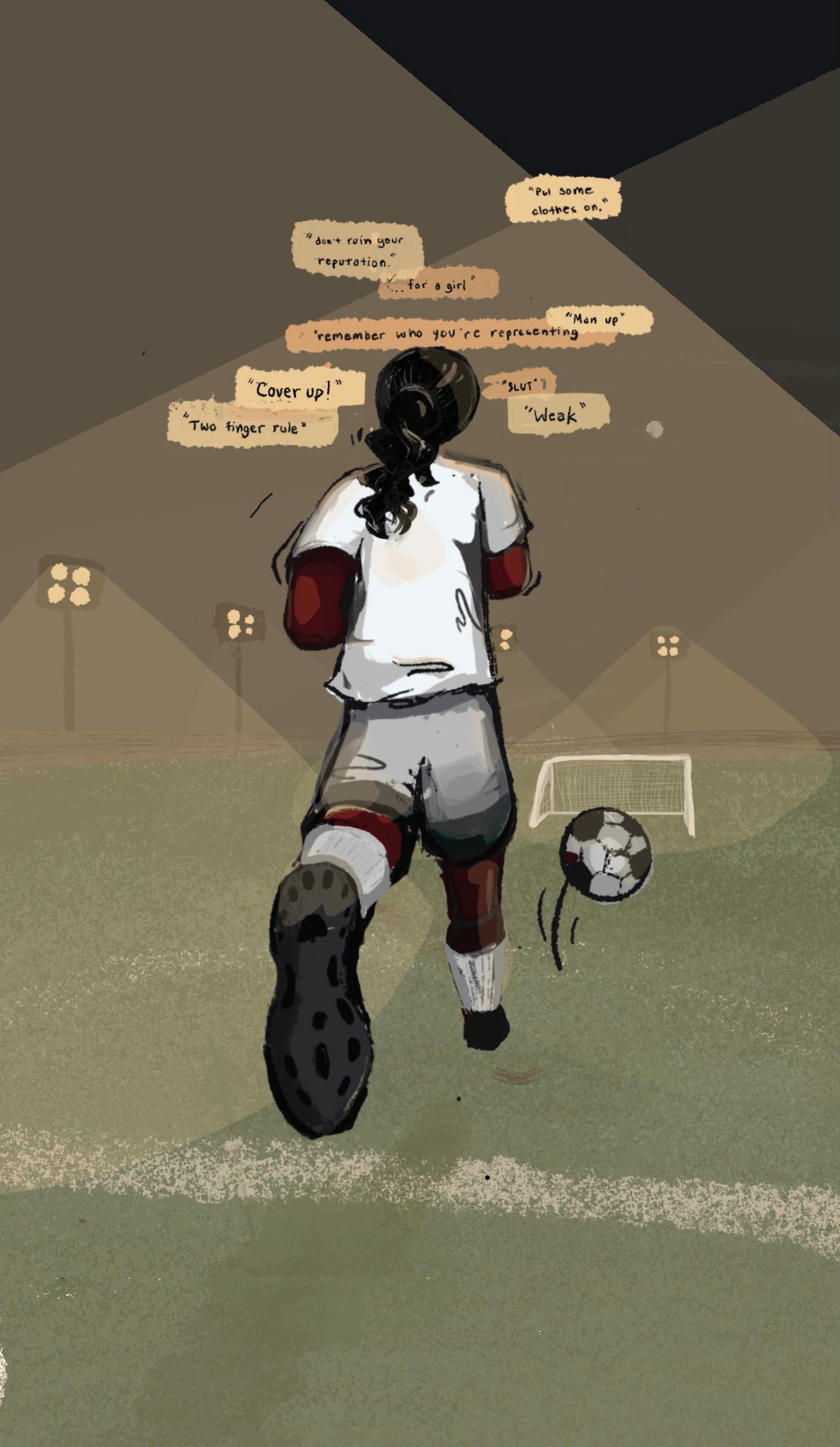
For many ETHS students, sports are an integral part of the high school experience. They invigorate passion, build community, develop students’ character and create invaluable opportunities for countless athletes. However, with the many different messages sent to student athletes, they can develop mental illness, eating disorders and other mental health concerns. Gender biases in sports can also play a huge role in the challenges student athletes face, which leaves many feeling unfulfilled and unhappy within their sport. How are these problems with sports cultures intertwined, and what are we doing to combat them?

Due to the structure of many sports, the messages that are directly or indirectly received by student athletes as well as the gender biases that have been coded into the way sports are played, coached and perceived, mental health issues and disordered eating are frequent elements of the athlete experience, as one 2020 literature review found in the Journal of Eating Disorders.

According to sports psychiatrist Alan Currie, “There is strong and consistent evidence that eating disorders are prevalent in sport and especially in weight sensitive sports such as endurance, weight category and aesthetic sports as well as jumping events.”
Figure skating, wrestling and dancing are just some of the sports that fall into this category.“Definitely a lot of people [on my team] still struggle with eating disorders,” senior Caroline Klearman, who skates for the Evanston team not affiliated with ETHS, shares. “I've known probably six or seven girls who went to in-patient centers for them. I think it's just so common that it's not really shocking when someone goesThere’saway.”also some overlap with gender-based biases and the promotion of eating disorders and other self-image issues.
“When we would go to traveling competitions with our coaches, they’d regulate our diets. There's very different rules about what the girls could eat versus what guys could eat,” Klearman

Anotherillustrates.sportnotorious for promoting restrictive diets is wrestling. In order to compete, wrestlers are entered into different weight classes, and they are weighed and tested for body fat through the program, which can encourage athletes to try to alter their weight in order to compete strategically.

“If you do have issues with eating or your body [image, then] stepping on the scale and seeing your weight every day [can be challenging],” senior wrestler Peter Wade explains. “Just having a number assigned that can make you feel either good or bad about yourself, I can see that being really tough.”
However, Wade shares he’s never felt pressure from his coaches or teammates to gain or lose weight for a competition.
“I don’t push a weight class on people,” boys and girls wrestling varsity head coach Rodolfo Salinas reinforces.


[Continued on page 10]


 Illustration by Kupunoli Sumi
By Jessica Sehgal, Bridget Baker, Marin Ubersox, Paula Hlava, Sophie Milner-Gorvine, Zoe Kaufman
Executive Editor, In-Depth Editor, Assistant In-Depth Editor, Staff Writers
Illustration by Kupunoli Sumi
By Jessica Sehgal, Bridget Baker, Marin Ubersox, Paula Hlava, Sophie Milner-Gorvine, Zoe Kaufman
Executive Editor, In-Depth Editor, Assistant In-Depth Editor, Staff Writers
Sexism in sports: female athletes attest to culture of misogyny
When we would go to traveling competitions with our coaches, they’d regulate our diets. There were very different rules about what the girls could eat versus what guys could eat.
—Caroline Klearman, senior figure skater
Evanston Township High SchoolEvanston, IL. Vol. 106, Issue 2
i
September 23, 2022E opinion8,9,12 a&efeaturenews 2-5 6,7 13-16 sports18-20
“
New cafeteria policies hamstring students’ social lives, give more structure & order to lunch blocks
By Ella Cleary, Elizabeth Wenning Staff Writers
The 2022-2023 school year has brought about many new changes to school policy, including changes made to the cafeterias. This year’s rigid rules regarding cafeterias have left many students feeling frustrated and caused an abundance of students to decide to leave the school during lunch, especially during the warm days of sum mer and early fall.
While last year the option to leave the school during a lunch block was made available to all students, rather than just the upperclassmen, this year, the school has kept the option open to just the soph omores, juniors and seniors. The ETHS administration chose to keep the campus open for the current sophomores who had the opportunity to leave school last year, but this year’s freshmen have to stay in for lunch.Another change made this year has been the strict enforcement of assigned cafeterias. This rule was introduced last year, and it dictates that every student go to their designated cafeteria unless they’re leaving for lunch or going to another space such as the Hub or the Academic Study Center. This policy wasn’t tight ly enforced last year, and many students
were able to go to other cafeterias. How ever, this year, administration has been cracking down on this rule and making sure students are in the right place.
“[Not having assigned cafeterias] re sulted in a lot of folks in the hallway, a lot of unstructured, unsupervised spaces… We’re not a college campus, we’re still a high school. We want to provide freedom, which is why, if you don’t have social pro bation or detention tardies, you can go out for lunch, from sophomore to senior year. We want to make sure that we are support ing students, and that we have some struc ture. Sometimes, we have to set some pa rameters or expectations. You can’t just be walking all over. It’s really hard to man age; it’s hard for safety to manage,” Assis tant Superintendent Taya Kinzie explains.
The assigned cafeterias provide more structure for students, allow administra tion to keep track of students, and ensure cafeterias aren’t reaching max capaci ty. However, many students dislike this change as it separates them from their friends, who may be assigned to a differ ent cafeteria.“Proswith assigned lunchrooms is that [staff] know where students are and they can see how many people are in each lunchroom, but it’s not great in a social sense. It’s great for the administrators,
but if people want to go see their friends during lunch that can’t happen anymore,” says senior Cricket Wright.
This strictly enforced policy has led to more students leaving the building for lunch so they can see their friends, but be cause of this, there is excessive crowding in lines to go outside.
“Most of the time I stay inside because there’s not enough time in the period to go out, get food and come back,” said Wright. “Half the time, you’re waiting [in line] to get outside and you have no time to do
Manyanything.”students have also noticed that one of the doors to leave during lunch has been moved to be right in front of the health office, which has created crowding problems in the North hallway and blocks students from entering the Health Office.
“I feel like it’s inefficient, because it’s not a very big hallway, and everyone is crammed in there, and also people need to get into the health office at that time. When people need to get through there, no one is willing to budge. It doesn’t feel safe,” stated Wright.
The cafeterias have also experienced similar overcrowding problems.
“In North Cafeteria, on the first day, they didn’t have enough chairs and ta bles for everyone, so a lot of people were
standing. They should’ve accounted for the number of people that were going to come to each place. I also don’t like how there are new entrances and exits to the cafeterias. It’s too crowded. It’s not set up well,” says Wright.
The excessive crowding in the cafe terias can partly be attributed to the new block schedule. Before the block schedule was introduced, there were more lunch periods in a day. Now that there are just two lunch periods in a day, there are more students going to lunch simultaneously, causing long lines and crowding. To solve this issue, many other areas of the school have been opened for lunch, such as the Hub and, most recently, the Academic Study
“OneCenter.ofthe things that we planned at the beginning of the school year was our Ac ademic Study Center. You can bring your own lunch there. You can get a cold sack lunch. So those are options so that even if you aren’t bringing food from home, you have that option,” explains Kinzie.
While the new cafeteria policies may make the social lives of students more challenging, for administrators, they are just another way that the school continues to adjust to the new block schedule and improve safety conditions in the building.
What are the roosters cockadoodle-doing?
By Annabelle Harris Assistant News Editor
This year, ETHS welcomed new additions to the school, 11 chickens that were hatched this past summer. Students that have class near the greenhouse may have already heard one of the two roosters of the flock, Tyrone or Gooba. Big Tino, Cornbread and Bean (all named by Urban Agriculture students) are among the nine hens that make up the rest of the flock.
Having chickens at ETHS has been a plan in the works for a long time, and in the past, ETHS has hatched them and found homes for
them. But this year, the school kept them to augment the Urban Agriculture class, espe cially in its animal husbandry unit. They help students learn how to take care of chickens and learn about chicken health and develop ment.The two Urban Agriculture teachers, Ellen Fierer and Sujud Ottman, helped hatch the chickens this summer. This past spring they got a grant which helped them to buy the chicken coop and run. They also had to get a permit from the City of Evanston to have the chickens at the school. The two of them currently do most of the work pertaining to caring for the birds, however, they are cur
rently working on a schedule to get Urban Agriculture students more involved in the caretaking. This hands-on experience will be hugely beneficial for students learning about animalAnotherhusbandry.way the chickens are used at ETHS is to teach students about food sover eignty, the right to healthy food that is made using sustainable and ecologically sound methods.“The current food system doesn’t serve people equally and is not currently resilient to the climate crisis. We want students to know more about how to gain control of what they eat and how they access good food. Having
hens for eggs is just one way to secure that access,” explained Fierer.

One goal that they have pertaining to this issue is to figure out a way to donate eggs to food pantries in Evanston so that they can be utilized by food insecure people. If they develop that relationship, not only will the chickens benefit the students and teachers, they will benefit the community as well.
“I think they’re really neat animals,” Ott man explained, “I think what’s really helpful is it will give students an idea of how to care for the animals in a really nice way, and then also kind of give some responsibility to the students and see how that works out.”
Photograph courtesy Aaliya Weheliye
2 - news
New admin, new levels of safety enforcement
On Dec. 16, 2021, when ETHS underwent a lockdown due to students illegally possessing guns on school property, many members of the Evanston community expressed concerns over the safety of students at ETHS.
Amid a rise in mass shootings in the U.S. in recent years, the topic of safety at school has only become more prevalent. In response, ETHS reached out to the Facility Engineering Associa tion (FEA) to conduct a series of interviews and evaluations regarding safety at the high school. The results of the analysis have led to changes to the school’s safety policy that were instituted at the start of this school year.
At the start of this academic year, the ETHS administration sent out an email detailing each individual change that has come as a result of the FEA assessment. These changes include struc tural improvements to key locations in the build ing, like doors and fences, and changes to safety practices during a regular school day.
One of the most notable changes to the ev eryday operation of the school is the emphasis placed on using identification cards to get in and out of locations during the school day. Staff members are now required to wear their ID con stantly throughout their time spent in the build ing, and if students are going to spaces that aren’t their classrooms, (like cafeterias, study centers and doors to exit the building), they are required to scan their IDs. While some of these identifi cation practices aren’t new, they are part of an effort to monitor activity in the school building.
“Making sure that we’ve got our consisten cy of practices is really important,” said Taya Kinzie, Assistant Superintendent and Principal at ETHS. “So, we are scanning in and scanning out, and we’re doing that very consistently. It’s not just, ‘Oh, it’s lunchtime.’ We wanted to look at what our systems are and how consistently we are implementing them, so that we’re ensuring that’s all in place.”
All these new policies contribute to the goal of improving the monitoring of ETHS facilities.
“Students are going to be in designated spac es, and they’re going to be in designated spaces after school, [it’s] not just anybody kind of in and out so that we’re all being accountable to each other and supportive of each other,” said Kinzie. “Those are some of those technical piec es that we’re really paying attention to. [We ask ourselves] who’s in the building? How are we supporting each other? How are we making sure we’re in our designated spaces? And what does that look like?”
In addition to monitoring improvements, ETHS has also updated its staff training pro gram. Kinzie highlighted the importance of training all the leaders of ETHS in how to react in a potentially dangerous situation, not just the designated safety staff.
“If Mr. Driscoll, (the director of safety), isn’t here, any one of us needs to be ready to jump in
and prepare to support every single person here, because we’re responsible for you all. And we take that very, very seriously.”
Many of the new safety enhancements im plemented at ETHS this year stem directly from the FEA audit conducted last spring. The FEA is a corporation that analyzes facilities and deter mines how to improve them and their role during the audit last year was to figure out what was working at ETHS (in terms of safety) and what needed to be improved. ETHS has completed some internal audits about their safety measures in past years, but the FEA one has had some con siderable impact on the new policies.
“[The FEA assessment] was a really compre hensive audit of our entire facilities, inside and outside,” Kinzie said.
Student opinion on the safety changes has been somewhat controversial. While many un derstand the FEA assessment’s need and the changes it brings, there is concern over everyday learning being disrupted by drills, limited access to workspaces and more.
“It’s really frustrating; we’ve been limited with entrances. I don’t know why they closed entrance 3; they keep talking about phones, the
signs. Not bringing weapons into school is al ready an assumption, anyone who wants to do that isn’t being stopped by a sign in front of the sink,” said senior Delcene Ralaingita.

“I get that this stuff is necessary, and may be it’ll end up helping in the long run. But right now, I don’t know how much of a difference it’s making. Sometimes, it feels like the school doesn’t care, like they care more about the image they show to the public instead of trying to make us really feel safer.
“I want it to help, I hope it’ll help.”
In a similar way to how students have to fol low the new safety rules, teachers at ETHS have a very important job when implementing them. It is up to them whether or not students can go to the bathroom, take a brain break or sit outside the classroom to work on assignments. However, teachers’ ability to grant some of these privileges to the extent that they wish to has been limited.
“I have been told that I’m not allowed to put students out in the hallway. And that’s a pain for me, because sometimes you’ve got to switch it up. I’ve seen teachers do it anyway,” said Julian Sotnick, a history teacher entering his 26th year. He also called into question the impact of the
new rule “Studentschanges.haveto be safe and have to feel safe. That’s critically important. But I’m not sure any of these recommendations are going to make that happen. Am I doing anything differently day-today, this year than I was last year? Not so much. And we don’t want to make things too difficult for teachers to be able to implement their lesson plans. So it’s about striking the right balance,” said Sotnick. “But I’ve never felt that the school was never a safe place physically.”
There will be more improvements coming to safety policy this year, as Kinzie believes that there is always more work to be done in the ef fort to create a safe learning environment. It is clear that the ETHS administration’s priority is to improve the safety of its students. However, teachers and students alike wonder whether the changes will make enough of a difference.
“There’s lots more to come, because this is what we see as an ongoing process. We did be fore and we’re going to continue to,” said Kinzie. “We’re going to be having a lot of conversations about [safety at ETHS] this fall.”
By Ethan Ravi, Mack Jones Assistant News Editor, Staff Writer
ETHS puts students on ‘Do Not Disturb’ with new phone policy
By Charlotte Geyskens, Ella Bowker Staff Writers
At the beginning of this school year, the ETHS administration introduced a new cell phone pol icy for students.
The policy, which was introduced via email on the first day of school, specifies, “Cell phones are not to be used in academic spaces (classrooms/ labs) without permission from the teacher or school staff… Cell phones and electronic devic es, earbuds and/or earphones must not be visible, must be turned off or muted during the entire class period, and before entering offices, librar ies, instructional spaces, or academic areas.”
Teachers held mixed feelings about the new policy.One
concern teachers voiced centered around how students’ current relationship with phones may not correlate well with being in higher learning institutions or workplaces.
“I want you all to be able to learn to navi gate phones plus life, because in a year or more, you’re going to be in college or out in the world and need to do that on your own,” said Forensics teacher Adam Held.
Besides anxieties about interference with plans for the future, teachers are also nervous
about how phones are affecting students now.
“My number one concern is around students’ mental health. Students have told me stories about being bullied online and how text messag es in class foster further conflicts outside of class.
It makes me worried that there is something that not just distracts the student from opportunities for them to learn and get the most out of class, but that there is such a larger social distraction that isn’t safe sometimes,” said English and Reading teacher Patricia Delacruz.
Since the release of the policy, teachers have adapted it into their classes in different ways. Some, like Delacruz, allow students to use their phones if in an emergency. Others, like Held, chose to use a new program. PocketPoints, an app that tracks how much time a student has their phone off during class, gives students points to wards gift cards for different restaurants based off of that amount of off-screen time.
“There’s two ways to motivate someone. It’s through positive rewards or negative conse quences. For this class environment and building relationships with kids, which I think Evanston makes their number one priority, a positive re ward system is better for building those rela tionships and encouraging kids to do things in a better way,” said Held.
As teachers figure out ways to implement the
policy in a way that fits their classroom spaces, student reactions have mostly been negative. Many don’t believe the policy will make any positive change.
“I think kids will just continue to try and sneak phone usage, and I don’t think [banning phones from classrooms] is the best way around that,” said sophomore Jexa Edinberg. In contrast to Held’s concerns, Edinberg also pointed out that colleges and workplaces will not have specific cell phone policies and will rely on individual people to regulate themselves.
Additionally, students pointed out that phones can actually help some students academically.
“I find the part where I can’t listen to music in class to be really hard for me, because that is a way that I stay grounded to focus on my work,” said senior Elliot Jamison.
Some of the issues caused by phones last year may have been residual damage from the year that everyone spent online.
“Last year, I agree that there was an excess of phone usage, because we just came out of COVID, and we were so used to being on tech nology. Half of the kids were on their phone while on Zoom, so it makes sense that kids were on their phones more,” said senior Amira Grace.
While some students can see the purpose be hind the policy, the implementation was confus
ing.“I am not going to sit here and say that there wasn’t an email sent out with all the policies, be cause I know that was sent out in the beginning of the school year. However, I think the admin istration knows that a lot of students don’t check their email often,” said Grace.
The manner in which the policy was com municated led to panic among many students, including Edinberg, who at first was afraid that they could be penalized for using their head phones during passing periods.
According to Assistant Superintendent and Principal Taya Kinzie, the policy was a reaction to last year’s more lenient post-COVID regula tions.“Ithink we tried to provide a lot of support and grace and give a lot of latitude [with the amount of phone usage]. That worked well in many ways, and in some ways, it didn’t… So that’s why we’ve all been having many conversations even last year about how to hold ourselves in lovingCombinedaccountability.”withthe new tardy policies and lunch policies, loving accountability is an over arching theme this year for the administration. However, students are primarily focused on how the policy will affect their lives.
Photograph by Ahania Soni; edited by Clara Gustafson
3 - news
No code necessary: new gender neutral bathrooms
By Clara Gustafson, Sam Consiglio News Editor, Staff Writer
Coming back to ETHS for the 2022-23 school year, students found a surprising ad dition: All-Gender restrooms without pass words on the first floor of East wing.

All-Gender restrooms were originally in stalled around 2019, with codes administered to LGBTQ+ youth who completed an admin istrative process. The stages students needed to complete before receiving access to the passcode-protected bathrooms were long and frustrating for many. A student would have to visit the website with their parents or guard ians, fill out a form with their parents or guari dans, and even have a meeting with someone from the school to determine eligibility.
ETHS received criticism due to the lack of gender-neutral bathrooms throughout the building and the tedious system for accessing the ones that did exist.
change—-another gender neutral bathroom—but this time without a code necessary to enter. This may make it easier for closeted students that cannot come out to utilize the bathrooms they feel comfortable in without stress and without having to navigate what was previ ously a daunting system.
“I went through the process of getting a code right before freshman year, and I was re ally stressing out about how I had to have a code to use the bathrooms,” sophomore Jexa Edinberg said. “I feel like they should’ve made it easier to find on the website.”
Senior Eliott Jamison found similar issues as Edinberg.
“It was definitely a stressful process to go through. It was just this thing in our queer community at school, where people were com ing up to you, and they’re like, ‘Hey, do you know where I can go to get a code to get to the bathrooms and locker rooms? Because I don’t know where to go,’” Jamison explained. “As a
year, I honestly don’t remember. It’s just kind of disappointing that these bathrooms aren’t easily accessible to queer students.”
Sophomore Romy Steinitz Miller never went through this process because of how in timidating and difficult it seemed.
“I haven’t gone through the process yet, mostly because I feel like it’s a very stress ful process. You have to go to higher ups [at the school], and then it feels very official and very uptight,” they explained. “Personally, this makes me shy away from [going through this process] because it feels like it makes things a much bigger deal than it has to be.”
This process to access the All-Gender bathrooms with codes excluded students who couldn’t come out to their families or commu nity. The new addition in the first floor of East wing solves this issue for closeted students. In fact, the newly open bathrooms seem to be a plus even for cisgender students.
“There’s no real negative or con about them;
cisgender freshman Nytasha Sharpe said.
To Nytasha and many other students, the new stalls are simply just another, newer bath room for everyone to utilize regardless of gen der. However, not all students share the same views about the future usage of these bath room stalls. Some students believe that in the future the stalls may instead morph into more of a hangout spot rather than for what they were“Theinstalled.bathroom might be abused and end up being shut down, which could be dangerous to the kids who might actually need it,” cisgen der freshman Rocco DiPadova said.
Due to them having no codes, the gender neutral bathrooms could be accessible not just to students who need it, but also students of any gender looking to hang out together. Still, for now, the bathroom is a helpful addi tion for “It’sstudents.nicethat [the new All-Gender bath room] is available and accessible,” Romy
‘Preparation for real world:’ tardies & NCs return
By Tarek Anthony Staff Writer
The post-pandemic relaxation of tardy poli cies was aimed at allowing a smooth readjust ment to in-person school last year.
Yet, an unintendent consequence of this shift was a stark increase in the number of tardies and absences amongst students, which went relatively unpunished due to the lack of a ‘No credit’ policy. In response to the increase in tardies and absences, the administration has announced a new policy regarding attendance to combat habitual tardiness.
The new attendance policy features two types of tardies: minor and extreme. A minor tardy allows students to arrive up to 10 min utes late and receive detention. By contrast, anything past 10 minutes late is considered an “extreme tardy,” resulting in an unexcused absence.
“The new attendance policy didn’t neces sarily affect my (daily) schedule, but it defi nitely changed my mindset on getting to class on time. Now, I’m more stressed,” says soph omore Madison Ball.
Formerly, students who accumulated seven or more unexcused absences in any given class would receive no credit for the semester for that class. Among students, no credit is more commonly known as an “NC.” As a part of the new attendance policy, the maximum number of unexcused absences has been lowered to six in the 2022 school year.
“We hold ourselves in loving accountabili ty of (our students). We want the school to be supportive and feel relevant. There’s no job where you could be gone for 30 days and get a paycheck. We often talk about [how] this isn’t the real world; this is preparation for the real world, [so we built] in more support.” says
newly appointed Assistant Superintendent Taya Kinzie.
A demonstration of the new support system is the relaxed criteria for an “unexcused ab sence” leading to an “NC”. As part of the new policy, a “parental excuse” for something such as a doctor’s appointment or funeral no longer counts towards an “NC” as long as proper pa rental documentation is provided.
Students will also be allowed five excused “mental health” days, which schools are re quired to provide following the passing of a new state law that went into effect in 2022.
“I think the new tardy policy is well intend ed but has harmful effects on students, because there are many circumstances that affect a stu dent’s attendance, and their passing of a class should be based on class performance, not at tendance,” says junior Vasanth Visweswaran.
Students who acquire 10 or more tardies
are placed on “social probation,” barring them from sporting events, open campus privileg es, school dances and more until the student clears their detentions.
While extreme tardies and “NC” status can not be cleared, detentions from regular tardies roll over from one school year to the next and can be cleared in various ways, including but not limited to A.M. support, study centers and Wildkit
“WeAcademy.wanttobuild in the positive to this disruption and recognizing when students are doing it right now, as opposed to a penal sys tem,” Kinzie said. “We’re not just focused on castigation … [We are] think(ing) positively around how are we all holding [students] ac countable. Accountability isn’t the end all be all, because everybody cares and [we must] show the care.”
4 - news
news
Edzo’s: soon to be back and better than ever
By Sophia Siddiqui Staff Writer


Edzo’s has been an Evanston staple for years, bringing people of all ages together to enjoy a classic American meal. From their iconic fries, burgers and shakes to their convenient pricing and philanthropic hiring policies, it is safe to say all Evanstonians have some memory of the restaurant.

When the COVID-19 pandemic hit, Edzo’s was one of the many businesses affected. Fewer people were dining out, and, coupled with their historically slow winters, owner Eddie Lakin was forced to make the decision to temporarily close the establishment.
The closing of businesses in the past two years has haunted the Evanston community, with classic establishments such as Barnes & Noble, Panera and Naf Naf Grill having been permanently shut down.
“I’ve lived here pretty much my whole life, so it’s really strange to see all these places from my childhood disappearing,” says sophomore Claire Ross. “Evanston has been

changing so much recently.”
With the downfall of chain restaurants in Evanston, students have been finding it difficult to find affordable places to go with on their limited budgets.
“One of the cool things about Evanston is all the small, local businesses, but when I want to go somewhere with my friends, it’s not like we all have the money to go to them every time,” Ross says.
Though the jarring closed sign on the front door may be giving many Evanston residents flashbacks to the many well missed chains, Edzo’s plans on coming back bigger and better in late April or early May.
In an interview with Evanston Now, Lakin shared his plans for the restaurant. “[We’re] deep cleaning, adding a liquor license, setting things up to make sense in a post-Covid world.”Though the times have given Evanstonians a reason to worry, Edzo’s will return, and the folks behind the restaurant don’t plan on going anywhere soon.
Health-focused options shift Evanston’s food scene
By Elliot Hoffner, Rafi DiCrescenzo, Maggie Huston Staff Writers


The restaurant scene in Evanston is undergoing a drastic transformation. More and more traditional restaurants have begun shutting down—and in their place, modern, healthy food has begun to take over.
“It does feel like more stores are closing down,” junior Daniel Jung said. “There was a Five Guys downtown a while ago [which has since shut down], and it does feel like unhealthy food is going away.”
Restaurants such as Sweetgreen and Blended, which offer salad bowls and smoothies, have gained remarkable popularity in the last few months. Both are praised for their accessible and environmentally conscious menus, and Blended in particular has garnered attention for its inclusive allergy accommodations. But the shift could also prompt some to shy away from the evolving downtown area, especially because these new healthy centered restaurants are consistently more expensive.
“For at least a little bit, the population of people eating downtown will definitely decrease,” Jung said. “There are learning curves to every change. But at some point, people are going to come back [downtown] anyway.”Some, however, have seen no change at all. Carly Seef, an ETHS senior and staff
member at Blended, said that high schoolers are among the most common
is in
school,” she added. “A lot of families come in [as well]. I think it’s going to get busier.”
For junior Becca Sanderson, it has been easier to find vegetarian and vegan options
Both Jung and Sanderson believe these changes would bring more flow to Evanston’s downtown area.
“Any new restaurants coming here, in general, will help make downtown Evanston more lively. I think that, with Panera shut down, Barnes and Noble gone and a lot of stuff closed, anything coming to downtown Evanston will help open it up a little more,” Sanderson said.
Now that the pandemic is over, these newer restaurants are trying to reach the same levels of publicity that restaurants downtown used to have—especially since many students, like Sanderson, haven’t been going downtown as much as they did before COVID.
“After the pandemic, there haven’t been a lot of [restaurants] opening in downtown Evanston, so I haven’t been going down there a lot,” Sanderson said.
Hopefully, the shift towards accessible, healthy food will prompt renewed interest in the downtown scene. And for those uninterested in a salad bowl or a smoothie, there are still some pretty good options. Jung recommends 10Q, a fried chicken and sandwich place. As for Sanderson?
etarian] for a while, and I remember it being hard to find stuff. Now, I go to restaurants with a lot of friends who are vegan, and it seems like there are more options for them.”


“Taco Diablo,” she said. “That’s one of my favorites.”
vanston i an
Writers, Artists, Photographers: Naomi Alemayehu, Tarek Anthony, Jillian Arnyai, Isaac Averbuch, Audrey Bodine, Ella Bowker, Ella Cleary, Lydah Coates, Sam Consiglio, Ali Cutter, Stella Davis, Rafi DiCrescenzo, Adele Fammeree, Charlotte Geyskens, Maria Gomez, Calliope Green, Madison Greer, Ella Gutowski, Vanessa Harvey, Paula Hlava, Elliot Hoffner, Maggie Huston, Leah Johnson, Mack Jones, Zoe Kaufman, Sophia LaFleur, Ben Levy, Alec Lloyd, Sophie Milner-Gorvine, Charlotte Murray, Lila Portis, Marco Roman, Sophia Siddiqui, Eva Sondgeroth, Olivia Tankevicius, Jared Tucker, Mia Valentine, Hope Vezner, Fiona Vosper, Aaliya Weheliye, Elizabeth Wenning, Grace Wise, Rosie Witt



John

whendents,see]ies.smooth-age“[Ialsocollegestu-[especially]Northwestern
shift.thehasthatnowEvan-stonmadehealth“Iwas[veg-
Illustration by Ahania Soni
Illustration by Macyn Hoeveler
5 - news
Adviser
Phillips E Executive Editors Meg Houseworth, Jessica Sehgal, Ahania Soni Arts & Entertainment Editor Mae Luning Feature Editor Jilian Denlow In-Depth Editor Bridget Baker News Editor Clara Gustafson Opinion Editor Sophia Sherman Sports Editor Christopher Vye Photo & Art Editors Kupu AiyanaSumiJehan Assistant Arts & Entertainment Editor Sam Froum Assistant Feature Editor Izzy Rudolph Assistant In-Depth Editor Marin Ubersox Assistant News Editors Annabelle Harris Ethan Ravi Assistant Opinion Editor Maddie Molotla Assistant Sports Editors Owen Chiss Alexis Rogers Podcast Editor Saliha Ansari Video Editor Sadie Dowhan Social Media Editor Amy Grill Copy Editor Macyn Hoelever shegroupsage to find vegetarian thatnow
Getting comfortable with contraception


 ByAhania Soni, Calliope Green Executive Editor, Staff Writer
We’re living in a post-Roe world. Illinois may be, as of yet, unaffected, but
tained, for many years now, a grant from the city of Evanston that provides us with funds so that we can purchase contraceptives and provide them free for our student’s dispensaries here, as opposed to sending them to the pharmacy,” says Ida Joyce-Sia, Health Center
The Health Center has a one-time consent form, which must be signed by parents or guardians, for students to use the clinic for any purpose. Once this form is signed, whether it’s for reproductive care, a sports physical thing else, students have full access to the health center’s services. This that, with nurse approval, students prescriptions for short-term hormonal birth control like the birth control pill and other similar methods. However, even without the parental consent form, students have access to free condoms and Plan B, an emergency contraceptive that can be taken up to 72 hours after sex.
For minors, there’s often a concern that any
ayouconversationshavewithanadultabouttheirsexlivesputtheirpri-vacyinjeop-ardy.Atschool,studenttelling

that room and us talking about this really sensitive topic,” Joyce-Sia says.
Despite students’ willingness to talk amongst themselves about sex, there’s still a deep-seated discomfort, especially when it comes to female sexuality. ‘Slut shaming’ and gossip about girls’ sex lives are laced with undertones of judgement and disapproval that young men don’t face nearly as much, especially from their peers. Senior Miles Grange has seen this many times throughout the course of his ETHS experience.
“I don’t think any of it really happens to people’s faces, but definitely people gossip about it. And you know they have that thought in the back of their head. People will definitely look down on you in private,” Grange says.
under recognizingpressure,and utilizing them has become more important than ever. The hub
any adult that they are sexually active, or asking about protection from STDs, seems completely counterintuitive. Years of abstinence-only sex education and reprobation of teenage sex have led to students viewing schools much in the way they view their parents or guardians in conversations about sex: judgemental and punitive. At the Health Center though, the environment is different—they’re not working for students’ parents or guardians, they’re there to
“Sometimes, it’s a harder conversation to have with a parent. We understand that, and we try to support wherever [students] are in their conversation and communication with their parents,” says Health Center nurse Julianne Russell “We do protect student confidentiality. So, if a parent were to have concerns, we can’t answer questions regarding a student’s sexual activity or use of contraception with the parent without their student giving us permission.”
Students today have grown up in a generation which is more sex-positive than those before us. But the views of older generations are still passed down to young people today in subtle ways. And as has been seen with the overturn of Roe vs. Wade, American culture is still struggling to grapple with modern ideas of what’s morally right, what’s taboo, and what are things that we as a culture and a society should be comfortable talking about.
People aren’t used to girls being more sexually sensitive and being in touch with their bodies and what they want to do with them,” says senior Andrea Arce, “I think people are just now realizing that women can do what they want when it comes to their bodies. And they’re getting scared.”
But ETHS is working to minimize the way these stigmas affect its student’s views on contraception. Often sex ed classes are thought of as uncomfortable, rid-
that people may or may not do, depending on when and if they feel ready. Dispelling that discomfort, and that idea that sex is something which can’t be talked about candidly, is the first step to really educating people.
“[Sex ed] was mainly medical. They told us about consent, STDs and pregnancy,” says sophomore Elijah Hamman, “The awkwardness is just knowing that your classmates are there right next to you being taught the same thing. It’s the main teenage stigma around that.”
Many students at ETHS have also had access to reproductive care outside of school. Often, a pediatrician is the person students trust most with information about their reproductive needs. At the very least, students have multiple options and resources to learn about safe sex, and to find out what it might mean
“Part of the reason why our school has single-gendered freshman classes is because of these conversations that we have in our freshman year. It’s much, much easier to have them, and students tend to feel more comfortable in single-sex spaces,” says freshman P.E teacher Luella Gesky, “Another thing we do is bringing in professionals to make it comfortable, so it seems less like a specific kid is being targeted, and it’s more
havethatgeneraljustinfor-ma-tionyouaccess
you might be able to get at your pediatrician’s office, you can also get here… We have ob-


This approach helps ize the idea that sex is a part of life. It doesn’t have to be something to joke about or mock. It’s some-
like in the ‘old days’ where it was ‘don’t have sex or you’ll die’. It’s not like that or anything,” says junior Amelia Anderson, “I think partially schools teach sex ed, but also you’ve probably heard from your doctor ‘if you’re gonna have sex, use Societyprotection.’”stillhas a long way to go in its discussions of sexuality. And at times, it can feel like a backslide into a time when reproductive care as a whole was criminalized. But students in the present day are also lucky to be in a time and place where they have the resources and support systems that they do.
“My mom also went to ETHS, and she told me how the Health Center only got introduced towards the end of her senior year. She told me that a lot of girls were shamed if they had sex, or people found out if they had sex, and that just the concept of schools offering condoms to kids was really foreign. And, in comparison to right now, I think that has kind of loosened up.” Arce says.
Illustrations by Grace Wise
6 - feature
comfort about sit- ting in
looking forward—to college our school and community youconversationshavewith
Noah Reichlin: Unscripted
By Naomi Alemayehu, Audrey Bodine, Ahania Soni Staff writers, Executive Editor
At 8:27 AM every morning, all of the 3,731 students in attendance at ETHS that day hear a beep from the loudspeaker, followed by the energetic encouragement of senior Noah Reichlin to “move it, move it” to their first period class. Since the very beginning of last year, Reichlin has been greeting students each day, but for many, it’s a mystery how Reichlin began to appear on the announcements in the first place.
“We were coming out of the pandemic, and I asked myself ‘Who’s gonna be doing announcements?’ and I said, ‘I could do the announcements.’ So I reached out to my counselor and said ‘Do you know who I can talk to, to see if I can get this to work?’” Reichlin says, “So I came in [to the Hub] after the first day of school, and [Ms. Boyd] basically told me what the role entails, and that you need commitment. And I was like, ‘Okay, I’m ready. Let’s do it.’ And she said, ‘Okay, you got the job.’”
Every morning, Reichlin arrives early at the Hub to prepare himself for the daily announcements. Part of what he says is his own script, which, although it’s sustained minor changes, has remained mostly intact during his time as an announcer. Some of his most iconic phrases, like “This is Noah Reichlin coming at you live from the hub,” and of course, “it’s time to move it, move it to your first period class” have been with him since day one.
“They told me on the first day I was there that they were going to have the song ‘move it, move it’ play every day at 8:27 to encourage people to get to their classes. They said, ‘You can completely disregard it, or you can work it into your announcements — whatever you want.’ So I chose to say it’s time to move it, move it to class.”
The rest of Reichlin’s routine usually consisting of notices from other groups in the school,
and important reminders for students, which are often given to him the day of — sometimes just minutes before he goes live. For many students, public speaking like this, in front of thousands of your peers, is frightening, but Reichlin enjoys it, and with over a year of practice under his belt, he’s quite comfortable in the Hub. In fact, his main concern as he rattles off upcoming school events is maintaining the level of energy and enthusiasm that he’s become known for.
“I just read through [new material] in my head, and figure out what parts I’m going to emphasize.” Reichlin says, “Because, from what I’ve seen, the afternoon announcements
sort of have a more formal, or informational tone. The mornings should be more energetic, so I have to figure out how I’m going to keep that tone throughout.”
The process of giving the announcements is shockingly simple. Earlier this week, Evanstonian reporters followed Reichlin through his morning routine. After arriving at the Hub we simply followed him into the Hub, where he opened his portion of the script on his phone and placed it next to the other announcements, which had been printed out for him. Then one of the staff members in the Hub punched a code (which not even Reichlin is allowed to know) into a phone, we heard a loud beep, and there it

was: Noah Reichlin, live! from the Hub.
But, sadly, all good things come to an end, and as Noah begins looking towards graduation, ETHS must begin to consider who the next announcer will be. Reichlin hopes to have a hand in finding the perfect person to be his successor, and perhaps even create a process that can be used to pick new announcers in years to come.
“What I think the most likely option is, at least right now, that there might be an audition selection process.” Reichlin says, “I’m gonna try not to have any bias. I know there’s many, many other people who want to take [the job].
“I want to give them the opportunity to experience it.”
Academics, sports, travel: student summer experiences
By Mackenzie Greco, Lily Kellams Staff Writers
Summer is the time that people look most forward to. Trips to the beach, barbecues with family and movies with friends are numerous parts of the summer experience that many ETHS students indulged in this past summer.
Aside from the basics, many students also explore new places aroundthe world, prepare for their upcoming sport seasons and work with fellow classmates, taking advantage of the few short months of summer they have before returning back to school. For seniors, much of their summer includes college visits, essay writing and setting goals. For incoming freshmen, many seek advice from older siblings or friends about how to navigate their new school environment. Many students spend their summer within the Evanston area, and more specifically the ETHS community.
Over the summer, ETHS facilitated various summer camps catered towards specific sports to maximize exposure in the offseason. Freshman Jazmyn White-Pratt participated in the girls volleyball and basketball camps, both of which were run by ETHS coaches.
Each camp provided different activities and focused on various components and skills of the sport. White-Pratt enjoyed her time at the basketball camp, where she was able to master the basics while also getting a feel for the program.
“At the ETHS basketball camp, we ba-
sically did the kinds of things that the high school girls would do in practice…going into the skills and sharpening them so we’re ready for the upcoming season this winter,” sheInsays.addition to the ETHS basketball camp, White-Pratt took part in the ETHS girls volleyball camp, as well as the Volley4Change camp run by ETHS seniors Meg Houseworth and Margaret Adams, as well as Niles West senior Cherie Animashaun. Both of these camps allowed White-Pratt to improve her confidence on the court, while advancing her skills to prepare for tryouts.
“In Volley4Change, we went over the basic skills, sharpening them and making them better. We had a beach day at the end, which was very fun. At ETHS volleyball camp, we went more into the technical aspects of volleyball and the controls. The camp was preparing us for tryouts,” White-Pratt states.
While summer acts as a break from school, students who have an important role within the ETHS community still had responsibilities to adhere to. Student Representative Nicole Yao was hard at work while many other students were basking in the sun. She spent much of her time coming up with ways to start the school year in a positive way. Safe to say, it’s working.
“The last two weeks of summer, [Mr. Pond] and I [figured out how] to make the transition easier and that kind of stuff,” Yao states.
Summertime urges students to explore new places and spend time away from home. Senior Jonah Ross spent the end of his summer break exploring the Southern part of California with his family. Ross enjoyed his trip by visiting colleges, spending time at the beach and walking the streets of Los Angeles and San “MoreDiego.towards the end of the summer I went to Los Angeles, and we kind of went all over the Southern part of California to visit some schools and stuff like that. I visited UCLA, UC San Diego and I visited Pomona [University] to maybe play basketball there, so that was good,” Ross states.
During his time back at home in Evanston, Ross spent most of his summer working at Soul and Smoke, a takeout barbeque restaurant in North Evanston.
“I worked at Soul and Smoke, which is a barbeque spot right by Fleetwood [Jourdain Center], and it was kind of a last minute job, but I worked there for a majority of the summer. I did a little bit of everything. It’s more of a take out spot, [so] I would be a cashier, greet the customers and handle GrubHub and Doordash orders,” Ross states.
Very rarely do high school students engage in different internships, but when they do, they are as invested in it as they are in their school work. Junior Stella Hostine has been in her current position for almost two years and continues to express how much she enjoys it.
Holstine has been invested in political change in the Chicagoland area since middle school, and she finally joined a team to make her
“I’mimpact.an intern for the US. House of Representatives, more specifically for Congresswoman Jan Schakowsky, who represents the ninth congressional District of Illinois…But I also was a fellow for Alexi Giannoulias’ Secretary of State campaign for the upper North Shore operations and field work.”
In most cases, students work at an internship for the experience, and a lot of the time people intern in the field they are interested in. Holstine was moved to make a change and wanted to be as involved as she could, by contributing to the helpfulness granted by interns.“I’ve always been involved in progressive change. Especially now, with recent events in our society such as the overturn of Roe v. Wade. And the Black Lives Matter protests happening back in 2020, because I got my internship when I was around fourteen, during that time. If I can be a part of the progressive Democrat change, [it makes it worth it],” Holstine expresses.
As summer time comes to a close and we start to reminisce about our break, ETHS students are remembering the joy that summer vacation brings. The fun with friends, the trips with family, and the break from school that is well deserved. “That’s what summer’s supposed to be about right?” Yao states.
feature - 7 feature
College Board is rooted in racism and discrimination
 By Leah Johnson, Aaliya Weheliye Staff Writers

While some students go into high school wondering if their experience will look like Mean Girls or 10 Things I Hate About You, covered in glitter and a pop-punk soundtrack, other students are forced to worry about whether or not they’ll leave their four years feeling adequately prepared for the future. They wonder whether or not their most basic needs will be met and whether or not the system they are relying on for their education is working against them from the most structural level. Many of the attributes of a successful college application, such as rigorous AP courses and high standardized test scores— accolades almost all students face immense pressure to receive—are much harder to attain for students of color. The numerous opportunities and privileges afforded to white students, both historically and presently, paves a much clearer way to an AP classroom and beyond, and the discrepancies between this idyllic experience and the reality of many Black students have seen little change. Considering the extent to which the education system was designed to exclude Black students, complacency and band-aid solutions are immensely inadequate.
One of the largest reinforcements of the structural oppression of Black students in the education system is standardized testing. The SAT was created in the early 20th century as a method of excluding Black Americans from academic spaces. As immigration picked up in the U.S., white parents were uncomfortable with people of color “infiltrating” white schools. Prominent psychologist and eugenicist Carl Brigham echoed these sentiments and created a highly-biased standardized test to administer to people of all races and backgrounds. He used his results as a way to justify the oppression of Black Americans and immigrants, writing that black Americans were not intellectually competent and that this testing had proven the superiority of “the Nordic race.” Furthermore, he fear-mongered white parents into believing that if they were to welcome immigrants and Black Americans into academia, the education system would be ruined. Thus, standardized tests such as the SAT were structured into almost every school


nationwide.Obviously,
the test Brigham devised was blind to the cultural and linguistic discrepancies between a native-born American and an immigrant, as well as the structural oppression of people of color in America that limit-
ed their access to quality education predating the test—and the SAT has remained so ever since. An investigation of the Educational Testing Service found that, as recently as the 90’s, agencies in charge of pre-testing SAT questions collected data about which questions white students were more likely to get right. Such questions were the only ones ever put on the final version of the test.
In addition, there are many class barriers put on standardized tests that disproportionately affect students of color. Families spend, on average, $45 through $100 per hour for test prep courses, a benefit that can only be afforded to so many, and which has immense benefits on test day. Opportunities like these directly make doing well on the SAT an exclusiveThisprivilege.problem doesn’t end with the SAT.
There is no denying the challenge that comes with taking an AP class; the coursework, rigor and level of commitment required is a hard burden for any student to bear. However, a nuance many overlook is who is in those
classes. This is a problem many students don’t ever seem to notice, because, well, they don’t have to. That is, of course, if you are white.Itis
an undeniable fact that the amount of people of color in Advanced Placement classes is not nearly proportional to the amount of people of color at ETHS. Yet, this segregation of knowledge is a national problem that comes from centuries of systemic racism.
Throughout history, enslaved people were not allowed to read or write becuase this would give them too much power in the eyes of slave owners. Many immigrants to the U.S. were ostracized for not speaking the languages, and their education suffered due to that. During the Jim Crow Era, Black students were separated from their white peers, and their schools received less funding, resources, and worse learning. Ultimately, learning has always been treated as a privilege for the white and the wealthy, when it is a right, and AP classes are no different.
The lack of people of color in these ad-
vanced spaces can be discouraging to other students of color for many reasons—first being imposter syndrome. When you are one of three people of color in a class of 25, you get the feeling that you don’t belong. There seems to be an unspoken notion that being smart, hardworking, and intellectual are “white
Kylatraits”.Wellington, an African American senior at ETHS, explains the implications that the College Board has had on people of color.
“The AP system has made such a strong impression on POC that it isn’t a space where they are expected to do as well as white students,” Wellington says.
Having people that look like you and share many experiences with you contributes to your learning environment. In addition, the opinions being shared in these classrooms are not separate from the identities of those who are sharing them. Debating topics like slavery, segregation and immigration polices, when there are not people who feel the effects of these events on a daily basis, or have family who were effected by these events, can leave students feeling misunderstood. Not being surrounded by people with similar backgrounds can be ostracizing, and discouraging.
“I’ve always felt like I’ve had to work twice as hard (as a woman of color) to be treated with the same respect in AP spaces,” senior Brooke Banks notes.
We know knowledge is power, so keeping people out of advanced learning spaces leaves them powerless. While there is no simple solution to these prejudices, the first step is to acknowledge them. These issues have been consistently swept under the rug and gone unnoticed. Education is a right that everyone deserves to have equal access to. Advanced classes should be an inclusive environment where people can be surrounded by others who can support and relate to them. Testing should evaluate students’ ability to learn and retain knowledge rather than their race or class. Learning needs to be accessible to everyone, otherwise this vicious cycle of systemic injustice continues. High school should equally prepare all of us for adulthood, and not just the ones who already have a leg up. Racial justice starts inside ETHS classrooms, with equal knowledge and opportunities for all.
As Supreme Court Justice Sonya Sotomayor said, “Until we reach equality in education, we can’t reach it in society.”
Art by Valerie Larson
8 - opinion
September is Pediatric Cancer Awareness month
By Ella Gutowski
Staff Writer
September is Childhood Cancer Awareness month. Childhood cancer is the leading cause of death in children and adolescents, but only four percent of all National Institute of Health (NIH) research funding goes towards a cure . Dr. Ashley Plant, a neuro-oncologist at Lurie Children’s says, “Not a lot of funding goes into studying pediatric cancers, while a lot goes into studying adult types of cancer. So the more awareness there is, the more support we get for finding new and better treatments.”
Why so little support and funding for kids and teens fighting such a horrific illness? Why such a small investment towards finding a cure? Why in a country with so much innovation in medi-
cine- with COVID vaccines so readily available? And the unanswerable question I often ask myself: Why me? As a 15-year-old who is battling cancer to this day, I know firsthand how horrible a disease it can be. I want to build awareness not only for funding towards a cure, but also to bring voice and support to other students at ETHS who are battling cancer or know someone who is. It took me much too long to realize, but now I know cancer is nothing to be ashamed of. I’ve finally learned to accept what I’ve been through, and now I’m proud to say I’m a cancer survivor.
When I was first diagnosed, I tried to hide my disease. I wore a wig to school, never talked about what I was going through, and basically lived a double life. I hated being a “sick kid,”
and I promised myself I would do everything I could to conceal what I was going through—
but people knew. I could feel the stares, hear the whispers. No one can truly understand the pain of cancer unless they’ve been through it, but I didn’t let many in on what I was going through. My initial experience with cancer was horribly lonely, even with the support of my family and a few close friends behind me. According to my neuro-oncologist, Dr. Plant, this struggle is far too common.“Onething we hear from our patients going through treatment is [that] they are nervous about talking to their peers. Then they feel kind of isolated and alone versus being able to talk about it in a way where others can actually provide support for them.”
Gold ribbons are a sign of support for pe-

diatric cancer and a way of building awareness towards curing the disease. For many, gold rep-
resents winning; a first place trophy or a gold medal—but for me, gold represents the fight for finding a cure and learning to lift up each and every young person in the fight against cancer. So go gold for us this month. On Sept. 29, the girls varsity volleyball team will be selling gold gear during their game. A girls cross country meet will go gold later in September as well. Thank you to those coaches and teams. Let’s work to support the cause within the greater ETHS
for us community!
ETHS needs to increase access to period products
By Hope Vezner Staff Writer
Anyone with a uterus has most likely experienced the struggle of not having access to period products in school. Products like pads and tampons are a necessity for half the population. Without having these products readily available within school, unfortunate situations can arise. It happened to me last year, and again just last week—I got my period during class. Quickly, I stood up from my seat and headed toward the closest bathroom. But, when I got there, the dispenser was completely empty. I walked to a bathroom far from my class, regretting not bringing anything myself. In the next bathroom I found, I was able to access a low-quality tampon composed of essentially cardboard and plastic.
This is not a unique experience. Many people in ETHS have experienced similar situations.
“I was in gym, and out of nowhere, I got my period, and I was running to different bathrooms across the school trying to find something,” says senior Amira Grace. “Number one, it made me late, so I have that on my record. And number two, I was just stressed out. and I already had homework because all students do, and then this kind of put a damper on my day.”
Situations like this not only ruin people’s days, but they also interrupt instructional learning.“I
think mostly it’s just about not letting your period get in the way of your education, and if you’re spending all day trying to hunt down period products, you’re really wasting a lot of time that you could be having in class and engaging in class, and that’s just a huge barrier for a lot of people,” explains senior Natalie Svolos. “We have the tampons, but they’re bad. No one wants to use Notthose.”being able to access period products when you need them causes very embarrassing situations that no one should have to go through in their place of learning. If you are already embarrassed, it’s worse when that embarrassment disrupts your learning.

It’s not only students who believe pads and tampons should be available in school—many staff members believe this as well.
“I know a lot of teachers who personally keep those products in their classrooms for students, and the problem with that is that it forces students to have to have that interaction with the teacher in the middle of class,” elaborates German teacher Rachel Kern. “It could potentially
be embarrassing for the student, or it could potentially cause the student not to want to ask for something that they need. So, I think just having them widely available in the bathrooms for anybody, for no cost, would be the best approach.”
The school would have many benefits from giving us products in its bathrooms, but, most importantly, the school would be a more comfortable place for everyone.
One reason this would make the school a better environment is that there would be a decrease in student“Studentsstress.aren’t as stressed when they have that certain resource,” notes Grace. “I think it just makes ETHS a more comfortable space because people know that they have these resources available when they need them.”
ETHS would be a more comfortable environment and students would feel more welcome in the school if there were period products in all of the bathrooms—not just the female ones.
“There also needs to be period products in all the bathrooms because more people than just women have periods,” adds Svolos.



Something important that the school and all of us should remember is that not all students who get their periods are women. Therefore,
there should be period products in the women’s bathrooms, all-gender bathrooms, and men’s bathrooms.ETHS would solve multiple problems and have multiple benefits from putting period products in our bathrooms, but how can we make this happen? How can we achieve said benefits?
According to Grace, this was brought up in the Student Union last year, but it was never followed up on. But, enough people care enough about this topic and want to do something about it, it can be brought up again, leading to getting products in bathrooms.
“If we were to write a proposal to the school, if there was a group of people who are really interested and really passionate about this project, if there’s a group of people who want to join the Student Union, and specifically work on this, this can definitely be something that’s fixed throughout the year,” Grace explains.
Ultimately, I think we should all do our part to make this happen, including those of us who do not have uteruses and have no need for period products.“Ifwe can give everyone toilet paper, then why can’t we give everyone tampons?” Svolos concludes.
Are you really going to college to succeed?
By Maria Gomez Staff Writer
Our society seems to present college as a route that will determine our future, income and the rest of our life. The pressure is just terrifying. There are so many steps and so much to think about, with not enough time to fully comprehend the process. My whole life, I have been thinking about this exact moment, but now, here I am, about to apply to college, with no clue of who I am or what I want for my future.
A few weeks ago, I couldn’t sleep. I stayed up all night thinking about how life is simply subjective, how each moment of life is mine and how I am the owner of my life. I need to start emphasizing what I actually enjoy, instead
of trying to satisfy society’s standards.
I am in my last year of high school, and I can’t stop thinking about my college essay, being ‘good enough for scholarships,’ and having a good GPA. Yet, I am simultaneously ignoring all the good experiences that I am already living. This is the last time I’ll cross H Hall or even live as a normal teenager in my family home.
Nowadays, we are so focused on checking things off of our “human success checklist.” Instead, we should see our lives more deeply than college applications. I have heard comments like, “going to college is the secure path for success,” or, “I’m committing to this specific major because all of my family did.” But our lives should mean more than achieving the expectations of others—we should be living in
the present. There’s no way of determining how our future will end up, so the only moment we have control over is the present, and the only way to live it is to be present.
The word success is often associated with having money, a family or the standard type of life that everyone wants. I think success is more than that—not as basic as having a “perfect life.” Success is that part of your life in which you can say that you truly found yourself— where you are doing what you enjoy, not working a certain job because society makes you do it. If you want to travel all over the world, just do it. If you just want to sell your art, just do it. Limiting our minds to thinking there is one set path limits the possibilities of what our lives could look like. The world needs more excite-
ment. We are losing the enthusiasm for living by not seeing the beauty in the small things.
Someone asked me if I was going to be “successful” with my college major pick, and I immediately changed my first choice. Choosing a major or even going to college because you want to be successful might make you wealthy, but never truly successful. Success occurs when you choose to be unordinary.
So, be as extravagant as you’d like with each moment of your life. Choose whatever makes you happy; enjoy the ride. Life is not a checklist. It is a path that means more than just arriving someplace—it is about enjoying the landscapes.
Photo courtesy of Adobe Stock
Photo by rawpixel.com on Freepik
opinion - 9
https://www.calsangels.org/program/awarenesscommunity!
https://www.calsangels.org/program/awareness#CalsAngels#GoGoldSeptember
Stressors in sports: the challenges student
inhibit the athletic performance and participation of women and girls in athletics, and when women and girls do partake in sports, their efforts are often rewarded less in comparison to those of male athletes. For example, dance—a historically female-dominated sport—frequently lacks the recognition of being a ‘real’ sport. rewarded less in comparison to those of male athletes.
“I think [dance] definitely gets a lot less respect, because people don’t see it as a sport,” Dully notes.
“If anything, it can be harder than a lot of other [sports], because there’s an aspect of performance and an artistic aspect involved in it as well as the athleticism. But people don’t regard it as highly, because they think it’s just a silly little thing, not a legit working sport.”

Dully highlights a central disparity between male-dominant and female-dominant sports—the level of recognition and praise from viewership.
“I think historically boys sports have been looked at as expected to be better, expected to do better, where girls sports can be overlooked due to their gender, and as such expectations are lowered,” girls varsity volleyball head coach Paris McFall explains. “Oftentimes, the girls teams outperform the boys, but it’s not celebrated as much.”
This highlights a stark contrast between these two weight sensitive sports: the female-dominant sport, figure skating, practices regulation over the diets of athletes, whereas the male-dominant sport, wrestling, advocates for autonomy. Gender-based discrimination often runs rampant in many sports.
“I think with a lot of girl sports—I don’t know how it is with girl sports in the rest of the school, but with girls volleyball—I’ve heard stories from [fellow players] about how they just don’t appreciate misogyny coming from some of the male coaches,” junior volleyball player Isa de los Reyes explains.
Athletic director Chris Livatino acknowledges the different experiences student-athletes might have based on their gender.“Just from years of doing this and hearing back from females that have been frustrated, I can tell you, I don’t think they do [have the same experience], and that’s a concern of mine, because I want [male and female athletes] to have the exact same experience.”Itisnot uncommon for specific conflicts to arise within individual ETHS programs; however, the majority of sexism within spaces at ETHS is a consequence of a historically misogynistic culture.
“In general, women that play tennis are expected to be more reserved. John McEnroe was this famous tennis player, and when he would miss a shot or when the ump would make a bad call or whatever, he would slam his racket down. If I, tomorrow in a match, slammed my racket down, I would get kicked off the match,” senior tennis player Talia Berger-White expresses.“Ihaven’t seen the guys tennis team play in a while, but I am going to go out on a limb and say if they swore or slammed
a racket, they’d just get a warning, [but if a girl player did that], people would be shocked that we acted that way. I just think that’s a preconceived bias and notion [that exists in] tennis in general; I don’t want to say specifically at Evanston, because it’s not specific to [just] Evanston.”


Although ETHS or the IHSA are not the root cause of this universal sexism, acknowledgement of the issue is still the first step towards progress. However, acknowledgement and actions based on acknowledgement, can be varied as athletes and coaches can have different experiences throughout their athletic careers.
placed upon her as a female-identifying dancer.“Male dancers don’t have to be as good to be as popular or as recognized because there are fewer of them, so female dancers have to try a lot harder.”
The evident gender biases and discrimination in sports influence mental health. Few studies have analyzed the psychological effects of sports in high school athletes according to gender, but a study conducted in 2011 by the Institute for Research in Medicine and Epidemiology of Sport located in France found that approximately 15.1 percent of male athletes had
Despite this wide history of sexism and discrimination, sports are always progressing and becoming more inclusive. For years, it was unheard of for a woman to engage in a sport like wrestling, but the wrestling team at ETHS is reconstructing this“Anarrative.youngman can look at a young woman and be inspired and vice versa. Where it used to be like a man’s sport and [the girls] would be inspired by what the guys are doing. Now, a young man can look at one of our young ladies and be like, ‘She drove me to be better, because I saw her overcome. I saw her work hard.’ And that’s great,” says Salinas.
“I don’t think gender impacts the game of tennis,” girls varsity tennis head coach Leanne Baker, who played professionally for twelve years, shares.
Many student-athletes do experience sexism, whether intentional or not. Specific expectations for male and female athletes vary across sports, and frequently, the expectations for girls are more constraining.“Girl dancers are supposed to have a very obvious amount of femininity and express that and work towards having the highest amount of femininity,” senior Moxie Dully describes the expectations
at least one behavioral or mental disorder as opposed to 20.2 percent of their female counterparts. The primary mental health concerns found in the studied women were anxiety, eating disorders, depression, sleep issues and self-harm.
Similarly, mental health disparities in gender impact the athletic experience of women and girls. According to PBS, approximately five to 10 million females experience eating disorders or disordered eating as opposed to one million males in the United States. Due to the mental and physical demands of sports, these disproportionate nutritional standards can
Last year, the wrestling program introduced a girls wrestling team; prior, female wrestlers were vastly outnumbered on a co-ed wrestling program. However, this new team has encountered obstacles with the lack of popularity surrounding the “Sincesport. [girls wrestling] is a new sport, there’s often not a lot of competition for girls, which is a big problem for them. There’s a lot of people eager to get on the mat, but they can’t necessarily find matches in different weight classes,” explained Wade.This is another huge inclusion issue that needs awareness: not enough girls on sports teams. Fifty years ago, President Richard Nixon passed a law called the Education Amendments Act of 1972. This law stated that sexual discrimination in any federal funded institution would be deemed illegal. Since then, nearly nine times as many girls are participating in high school sports than there were when this law was first put in action. However, schools across the country still have a long way to go towards gender equity in sports, especially one like wrestling. In fact, according to the National Wrestling Coaches Association, only 32 of the 50 U.S. states offer girls wrestling programs.
ETHS has recognized this pattern and has taken vital steps to include as many demographics as they can in sports and extracurriculars.“WecreatedGirls Play Sports, [a nonprofit run through ETHS], initially to address the issues that we wanted to get more girls participating in sports, and that was really successful, and [we’re] learning from that experience,” Livatino shares.
Livatino also recognizes that discrimination in ETHS athletics is not isolated to gender, and despite ETHS’ diverse de-
“In general, women that play tennis are expected to be more reserved. John McEnroe was this famous tennis player, and when he would miss a shot or when the ump would make a bad call or whatever, he would slam his racket down. If I, tomorrow in a match, slammed my racket down, I would get kicked off the match.”
-Talia Berger-white
10 - in-depth
student athletes face due to toxic cultures
mographics, sports teams frequently lack reflectiveness of that.

“The current system that we have does not work, and it really creates a pay for play system, where if you’re a family that cannot afford to participate in sports when you’re in third and fourth grade, you’re kind of on the outside looking in, and you’ll never get there because by the time freshman year rolls around, [you’ll be behind],” Livatino discusses. “Most of our sports are extremely self-segregated. In most cases, it’s predominantly white, and if you look at the demographic numbers over the years, that hasn’t changed nearly as much as I would want it to have changed … You have to do something totally different much earlier on to change all that. I think we’ve got some really good ideas and plans for how to do that; it’s just about figuring out partners to make sure we can execute them. Before I retire, that’s my number one goal. I just want to figure that out, and then I can be Recognizinghappy.”the

need for increased diversity within sport teams and working towards a more inclusive future has also been a large focus for many teams at ETHS. The volleyball program has historically been predominantly white. In an effort to change this, senior volleyball player Meg Houseworth as well as seniors and former volleyball players Margaret Adams and Cherie Animashaun created Volley4Change, a nonprofit organization that aims to introduce girls of color to volleyball prior to entering high school, free of cost.
“I think that’s really amazing that we’re in that environment with people who are always willing to coach everybody,” de los Reyes shares. “We’re slowly starting to introduce volleyball to everybody and be more inclusive.”
Former girls varsity volleyball head coach and current freshman B coach Liz Brieva has also helped to address the lack of diversity in the program by leading the program through discussions surrounding racial equity. Brieva is also a co-founder of Girls Play Sports and has helped as a volunteer coach for Volley4Change.
“I think we should really appreciate the work that Coach Brieva has done with trying to be more inclusive with volleyball. It’s not easy trying to do that. We, as a program, are trying to just improve as a team,” de los Reyes remarks.
With projects like Volley4Change and the effort that the wrestling team has put into giving all of their athletes the opportunity to perform, ETHS athletes have been able to really grow as individuals and unified teams. Improving as a team means that many coaches push for their athletes to learn valuable lessons that they can utilize for the rest of their lives, especially in the area of mental fortitude.
“[The coaches] push for trying your best and giving your all and [in] every sense like school and mental health and everything. They also push for mental strength like being able to take criticism and to not constantly critique yourself,” says Dully.
Mental and physical strength must be taught in a way that is positive and motivating so that athletes can grow their love for sports as they strengthen their athletic ability. If athletes are pushed too hard or don’t learn to think positively about themselves, teams can end their seasons burnt out and unmotivated. When coaches and players share an enjoyment of the sport, the effects can be very positive.
“I want my athletes to work hard for each other and for our team. But at the end of the day, the only way to really work as hard as possible is to enjoy what you are doing. If you are enjoying playing tennis, then the hard work comes naturally,” says Baker.
These lessons that are learned on an individual basis can positively impact the entire team.
“In order to be a great teammate, you have to be a solid, mentally tough person. I mean, it’s hard to get past mistakes and stuff like that, but if you are able to get past your own mistakes and bring yourself up, then you can bring your team up,” says de los Reyes.
High school athletics promote physical fitness, but with work, these teams become more than just an after school activity; they lead to a healthy culture of passionate and considerate
athletes.“It’sjust a culture of having kids that are committed, being disciplined, and really caring about each other. You’re not going to win on Friday nights if you don’t care about your brothers and you don’t care about each other. That’s the number one thing I want in our coaches and guys. They care for each other, and we’ve got some kids that have been very selfless that are
accepting their role, which is very important. Culture is everything,” says varsity football head coach Mike Burzawa.
All of the hard work that dedicated coaches bring to their practices and games leave their athletes with personal growth and a sense of pride.“Ithink the culture is an energy and excitement about representing your school and about
being [from] E-town. I think people are really proud to be athletes here,” says Livatino.
By Jessica Sehgal, Bridget Baker, Marin Ubersox, Paula Hlava, Sophie Milner-Gorvine, Zoe Kaufman
Executive Editor, In-Depth Editor, Assistant In-Depth Editor, Staff Writers
Art courtesy of Kupunoli Sumi
11 - in-depth
ETHS ‘cares’ about you: New policies harm, not help, students
By Sophia Sherman Opinion Editor
For the first few weeks of the school, at 11:25 a.m., students have been met with the blaring of the school bell and the familiar sentiment that, “ETHS cares about you.” Then, just five minutes later, those same students are ushered into assigned cafeterias—isolating them from their friends and creating a culture of control that ruins their only designated break of the day.
Since the start of the school year, this has been a familiar pattern: administrators introduce a new policy in hopes of further exerting their power, and, subsequently, justify it with the talking point about ‘caring’ for their students. In just one month, these recent policies—lunch, tardy, and phone—have already deteriorated student wellbeing. How’s that for caring for their students?
Assigned cafeterias prevent students from seeing friends
By Stella Davis Staff Writer
As students were told to go to their assigned cafeterias on the first day of school, some were then turned away, causing many to wander the halls and an influx of stress for safety and students alike. Furthermore, closed courtyards and limited seating that was not communicated to students also brought a lot of unnecessary confusion during the first weeks of school.
In my experience from last year, the school did not mind which cafeteria students went to, and it made the process easier, especially for incoming freshmen. Even in the midst of a pandemic, the struggle of trying to align schedules with your friends and finding a place to eat was effortless. When it was possible to sit in any cafeteria of your choice, the four cafeterias had a lot of seating options, making it easy for people to spread out. Taking away this opportunity took the best part of lunch: eating with friends.
Along with assigned cafeterias, ETHS closed both the senior and planetarium courtyards, which are arguably the best place to eat in August through October and in the spring. These courtyards used to be open to all grades and had tables and tents set up along with seating in the grass. Statistics from the American Psychological Association show that exposure to nature has numerous benefits like improved attention, lower stress and a better mood. Why take this opportunity away, especially after students are inside for seven hours of their school day?
Sophomore Ashlyn Rogowski voices her experience from the first day with the new policy.
“My friends and I sat in the study center, and it was really hard because of the rules of not using our phones and being really quiet, but we sacrificed to eat with each other,” Rogowski says.
Rogowski wasn’t alone. Lots of students have been forced to eat in new locations without the option of the courtyards.
With many people eating in the Hub and Academic Study Center, both spaces have become heavily overcrowded. The line to the Hub is out the door every day and forces the staff to turn people away once they reach the maximum capacity. This leaves students wandering the halls, worrying about whether or not they will even be able to find a place to eat that day. A similar experience has occurred in the study center. Students are using it as a place to eat lunch, when, really, it should just be a place to study. Now, study hall classes are forced to prohibit students from leaving the class, which defeats the purpose of getting help from teachers in the study center. Overall, students’ options have become much more limited because of the strict policy.
“I just want to be able to eat lunch with my friends,” junior Bo Gylling concludes. “It sucks that my only break of the day is spent alone or with people I don’t know.”
Phone-use bans have little impact on increasing student focus
By Sophia Sherman Opinion Editor
Whether it’s spent watching Netflix from the comfort of a bedroom or working on calculus problems, 85 minutes is a long time to focus on anything. For ETHS students, this inability to focus is exacerbated, as they are expected to go class to class—studying topics that vary from fashion design to mechanical physics—all with little to no break in between.

Up until this year, when students inevitably felt disengaged from class, they had the ability to simply take a break and use their phones. Now, it’s the complete opposite: phone usage is prohibited within the classroom—putting students in a position where they feel disinterested and overly regulated during their class block.

“It doesn’t take a lot of people’s situations into account, because some people have stuff going on at home or family stuff or people just can’t pay attention for 85 minutes straight,” junior Erin Doherty notes. “They focus more on punishing us and don’t seem to think about why we’re on our phones, and it’s just really strict for no reason.”
One study from the Journal of Chemical Education in
dentsthatfound2010stu-begin to lose attention after just two minutes of a class lecture, and 10-20 minutes later, they likely lose it altogether. Meaning, it’s literally impossible for students to stay fully engaged during the entire class block of 85-minutes if they aren’t able to check out for a moment and take a mental break.
In the real world, there is no boss or college professor prohibiting students from using their phones—there’s just the young adult and their ability to self-regulate phone usage. If high school is truly about preparing students for adult life, then ETHS should focus on teaching students strategies to stay attentive and off their phone, rather than just completely banning them.
In fact, for some students, phones can even serve a purpose to increase focus. Junior Zion Williams-Rauze explains that his phone is an important tool to help manage his ADHD.
“It’s case by case. With me, my phone is kind of there for me to fidget with,” Williams-Rauze

says. “Or, I’m normally listening to music because it helps keep me focused on certain things. Whereas, if there isn’t music or a phone there, sounds in general will just distract me in that set up.”Thus, even in the most interesting of classes, students will still feel an urge to use their phone. Instead of punitive measures that work to make learning even more difficult for some, ETHS should look to implement mandatory breaks during the class block—allowing students an opportunity to use their phones without distracting from learning.“I’musually more focused in class if we have a break. I won’t feel like I need to go on my phone, but not allowing phones in class altogether doesn’t really have the same effect,” junior Chloe Wagner However,agrees.thisproblem doesn’t end with a ban on phones inside the classroom. Per the student handbook, the new policy also gives safety the power to search students’ phones if, “there exists a reasonable suspicion that it may have been used in an activity prohibited by the Student Behavior Code.” Now, the privacy and integrity of students are in jeopardy.
“I think that it’s super invasive, and I didn’t even know about it. Teenagers should have a right to privacy, even when we’re in school,” Doherty says. “Even if you’re breaking a school rule,
wouldwhyyou
write it down on your phone? It doesn’t make any sense.”
“It’s completely unethical and a form of policing students,” senior Ashley Cochrane adds.
Besides putting student privacy at risk, the policy additionally fails to give guidelines as to what “reasonable suspicion” might entail. Almost anything could be justified as “suspicious,” which might further endanger the safety of students and contribute to profiling.
“There’s already problems with safety and ETHS profiling kids, and if they have that power, they might over use it based on their own bias,” Cochrane concludes. “Honestly, I think something like this should just be illegal.”
Tardies minimize student freedom
By Fiona Vosper Staff Writer

Tardy policies at ETHS have created an

uproar of fear and stress among students. Over the past couple of years, students have dealt with many struggles regarding the transition from online learning to in-person learning. Prior to this year, ETHS has dealt with the transitional nerves of students well by giving us flexibility on tardiness rules.However, this year, ETHS is using a completely different approach with a copious amount of new policies. The jump between last year and this year has been something students have struggled to get used to.
“I expected this year to be the same as last but I was shocked when the announcements came on and started listing all the expectations for this year,” sophomore Dylan Bonn notes. “The most shocking one was the method of dealing with tardiness.”
Two different types of tardies are being implemented this year at ETHS. The first tardy is just the typical tardy, received when arriving between five and nine minutes late to class. The ways you can reverse the tardy is by attending AM support, the Academic Study Center, and even Wildkit However,Academy.thesecond type of tardy that was created is an extreme tardy. A student is given an extreme tardy when they arrive 10 or more minutes late to class. Extreme tardiness counts as a Non-Credit or NC. Eventually, six NCs will automatically cause a student to lose credit for the entireWhileclass.tardies do enforce stricter attendance and can lead to smoother class transitions, they also have one considerably large negative. The tardy policy minimizes freedoms of students.
“A lot of the time school just feels suffocating, like I can’t make my own choices throughout the day,” Bonn adds.
The new lunch policies regarding cafeterias are already causing mass complaints from students but, on top of that, the tardy policy is also making lunch a stressful space.
“I see kids trying to scan their IDs and [walking] back because they have too many detentions,” Bonn elaborates. “Everyone watches them walk away. I honestly feel bad for them. They get separated from their friends and then have to be embarrassed in front of everyone.”
Lunch is the one time in the school day when students are allowed to relax on their own time. It’s meant to give us a mental break from school to catch up with friends and feed ourselves with nutrition. Instead, students are being denied the right to leave the building because they have more than 10 tardies. With the harsh rules on attending your assigned cafeteria, the places friends are allowed to eat lunch together are even more
Theselimited.policies


are meant to organize students, but, instead, they are creating cliques among students—preventing students from meeting new people. This causes a build-up of social and emotional anxiety between students.
“My friend has been split from our group during lunch because she has tardy detentions from last year that weren’t resolved,” Bonn says. “She had to eat in the cafeteria with nobody since she came to lunch late and lunch tables were already full. She felt so uncomfortable, and there was nothing she could do to change that.”
Many tardies are built up from first block classes where students arrive at school late. Personally, getting to school can be a complete mess. City buses are extremely unreliable in the morning, which causes me to try and catch a ride from my parents or a fellow student most days. When a parent is driving me to school, we also have to drop off my younger brothers along the way, which is completely out of the way and makes me late to class most days. In this situation, students are left feeling extremely aggravated. There was no way I could do anything to make the process go smoother, but, somehow, I am being punished with an extreme tardy.
“I just want to feel relaxed at school but instead I’m worrying about what rules I might be breaking and punished for,” Bonn says.
right rule, why
12 - opinion
‘Better Call Saul’ delivers satisfying fi nal season
 By Jared Tucker Staff Writer
Spoiler warning for Better Call Saul
By Jared Tucker Staff Writer
Spoiler warning for Better Call Saul
Vince Gilligan’s highly anticipated prequel to Breaking Bad has come to an end after six seasons. What started as a lawyer drama about Heisnerberg’s shady and comical attorney evolved into a character study that rivals even the excellence of its predecessor.
Better Call Saul began by following Jimmy McGill (Bob Odenkirk), a con-man from Cicero looking to make a name for himself as a lawyer after leaving his brother’s highly respected law firm in Albuquerque. Jimmy struggled to make ends meet while caring for his brother who had electromagnetic hypersensitivity, meaning he couldn’t be near any electricity, and soon, viewers found Jimmy swept up into being a cartel lawyer. Over the first five seasons, Jimmy managed his relationships between his girlfriend, Kim Wexler (Rhea Seehorn), and the constant threat of representing the Salamanca cartel as Gus Fring (Giancarlo Esposito) planned his big move to take over the drug trade in New Mexico and beyond..
As season six begins, Lalo Salamanca (Tony Dalton) has just escaped an assassination attempt by Gus and is headed back to Albuquerque to finish him off. Meanwhile, Jimmy and Kim are working vigorously to shame their former boss Howard Hamlin to get him kicked off the bar. As each episode ends, the stakes build, and each plot gets closer to entering the Breaking Bad timeline. The cartel shootouts increase, and trust between characters are built up and torn down as they do everything in their power to try and survive.
The character work in this season is some of the best in Vince Gilligan’s entire career. Every character that graces the screen embraces their highest highs and their lowest lows. From marrying a soulmate to being stranded in a desert, Saul experiences successes and failures in life and as a lawyer which adds more depth to a character who stole all the comedic scenes in Breaking Bad. The show even manages to add more layers to the already complex villain in Fring as we watch his rise to power unfold before our eyes. However, the largest character development doesn’t come from Saul, Gus, or Kim, but from Nacho Varga (Michael Mando). (MAJOR SPOILERS) Nacho started the series as a mid level player in the Salamanca cartel who suf-

fered through threats against his family and the constant threat against himself who eventually finds his way into a desert grave in early season six.. His arc is brutal, heartbreaking and proves that Better Call Saul had to develop characters outside of Breaking Bad.
By the midseason finale of season six, Howard has been disgraced, and Lalo has made his return to Albuquerque, but Gus’s men cannot locate him. As Howard stops by Jimmy and Kim’s apartment as a defeated man, Lalo surprisingly appears, and over Howard’s constant talking, shoots him in the head. This shocking twist is the amalgam of everything at which Better Call Saul excels. As characters are in their most vulnerable emotional states, the most surprising moments happen, proving why Better Call Saul is seen as one of the best dramas of all time. The very next episode doesn’t slow as Gus’s final fight with Lalo goes down, and Jimmy and Kim are finally freed. With bad guys defeated and plotlines tied up, it seemed strange that five episodes remained, but a flash-forward to Saul hiding out after the events of Breaking Bad begins to tie up Saul’s arc in the most controversial episode of a show that was never afraid to take chances.

Season 6, episode 10, titled Nippy, shows Saul

once again embracing his con-man life, hiding out in Omaha, and this time in black and white.


Many criticized the episode for its lack of shocking moments and familiar characters, but stories just like Nippy is where Better Call Saul excelled in previous seasons. It’s a study of Saul’s nature, and his yearning to plan, trick and steal. Even though Saul can escape Albuquerque, he can’t escape who he really is, and that eventually leads to him getting found in a dumpster.
Just as Breaking Bad had one of the best endings of all time, Gilligan once again finds the perfect ending for one of his main characters. Saul embraces his past in court, which leads him to dropping his Saul Goodman persona, and his plea deal, to get Kim back. As Jimmy looks on as Kim leaves the prison gates in the last shot of the show’s finale, we realize that Saul’s inescapable life of crime led him back to the person he really cared about. Better Call Saul was a turn away from the more shocking events that piled on every episode in Breaking Bad, but in doing so, it beautifully and tragically develops Jimmy McGill into a character far more complex than we saw him in Breaking Bad, making it one of the best dramas in television history.
Fabulous fashions for this school year
By Charlotte Murray, Ali Cutter Staff Writers

Croc Comeback
When VSCO girls died, so did this shoe, but who knew Crocs were back in style!? They may not be the most stylish, but you can’t deny they’re definitely super comfy. Students in all grades are seen in a rainbow of Crocs, and the memorable Jibbitz still accessorize a good number of Crocs, showcasing the wearer’s unique qualities and obsessions.


Converse
Coming in different colors, you can wear
Converses with any outfit. Cute, fun and completely classic, Converse is obviously here to stay. While the company is known for its classic Chuck Taylor shoe, all different styles are popping up nowadays: platforms, slip-ons—you name it, someone’s wearing it. A great choice of footwear for the school year that ages well and arguably looks better worn.
Friendship Bracelet/Beaded Bracelets
The ultimate proof that you have at least one friend (unless you made it for yourself, in which case, no judgment), friendship bracelets of all styles can be seen on wrists around the school. Whether beaded or wo-

ven, all genders are rocking them in stacks or singles. This summer fashion trend is definitely bleeding into the school year, so if you have some string and some free time, take a shot at making one for a friend (or for yourself; again, no judgment).

Summery White Pants
White summery pants made their appearance on the first day of school, with many wearing flares or a straight leg. But like all pants, they come in all different styles. They’re a great way to add a dressier element to any outfit, making for a very cute, much classier first day than previous years. They are simple way to dress up any shirt
you pair the pants with. The only issue, like with all white clothing, is that they can be easily stained, so be careful!

Claw Clips
Claw. Hair. Clips. Yep, definitely last year’s big accessory, and they continue to live on during this school year. Claw hair clips still adorn bags, and are instrumental in creating fun updos. They’re a cute but practical way to get your hair out of your face or off your neck. If you have hair long enough to clip up and don’t own one, they’re a simple and cheap way to spruce up your hairstyles.
Photos by Ben Levy
Art by Kupu Sumi
A&E - 13
Soothing songs to help you study


 By Ben Levy, Amy Grill Staff Writer, Social Media Editor


Nowadays, you can’t do anything without music. Whether you’re doing homework or working out, a playlist is an essential component. With the school year picking back up again, one of these vital playlists is for studying. As a rule of thumb, many steer away from songs with lyrics, choosing instead the instrumentals; jazz, classical, EDM, even videogame soundtracks. From studious serenades to due-date-defeating ditties, these are some of our absolutely essential songs to study to.
Illinois- Sufjan Stevens (Album)


Sufjan Stevens’ fifth album Illinois takes listeners on a journey through the midwest. From beginning to end, Stevens fills 73 minutes of sound with familiar references to the state ETHS students call home. Stevens combines subtle references to darker moments in time, under the guise of a calm and soothing tone. Through this journey, Stevens and his strange song titles float across our state. Tracks like “Come On! Feel the Illinoise! Part I: The World’s Columbian Exposition-Part II: Carl Sandburg Visits Me In A Dream” prove this point fairly clearly. Despite the mouthful of a title, this song in particular is an exercise in enthusiasm. “Come On!...” is one of the most upbeat and percussive songs on the whole album, boasting drum fills, glorious horns, harpsichord riffs, shakers, and of course the beautiful voice of Sufjan himself. On the contrary, the album also features slower, quieter songs (also with mouthful names), such as “Riffs and Variations on a Single Note”. “Riffs…” is merely an instrumental, but is beautiful, wallowing you in symphonic bliss. Although his folk style and wonky song titles can be an
acquired taste, it becomes a great backdrop when you’re facing a mountain of work.

MALIBU by Masayoshi Takanaka (Song)
A masterful mix of RnB, jazz, city pop and jazz fusion, Masayoshi Takanaka’s craftsmanship creates a state of bliss. He creates a whole world of soothing, seaside music—emphasized further by his tropical album covers. Malibu is the second track from his 1977 project An Insatiable High. The song opens with a thrumming bassline, a guitar and a sparse shaker. Strings began to accompany, giving the feeling of floating, like a feather, in a tropical breeze. Then the drums enter. They have a jazzy essence, cool and collected as the keyboard gently plays. These elements shift around, taking brief spotlights, and occasionally dropping out for a few measures. Finally, the song reaches what feels like a climax, as the guitar croons a warbling tune, coasting the listener to the end. Takanka creates this effortless environment; relaxed, but in touch with the surroundings. It feels as if you are lounging, breathing in the beauty of a beachside view. Whether you’re doing extensive equations or endless essays, Takanaka’s mastery makes everything easier.
Scenery by Ryu Fukui (Album)
A self-taught piano wizard, Ryu Fukui has become a hidden gem of the internet. Lurking in Youtube recommendations and communal music lists, his beautiful works resurfaced in the past decade to widespread acclaim. Coming much later than many of the big names in jazz (1976), Fukui shines in his latency. The essence of this project lies in simplicity; the drums are quiet brushes and snares, the piano plays thoughtfully and the bass resonates along the background. It is plain and easily digestible. It has no shocking technique demonstrations or elaborate cacophonies of brass and string like some of its earlier coun-
terparts. Even amidst this bare-bones composition, there is a wide variety of emotion and sounds. Songs like “Early Summer” and “It Could Happen To You” invite motivation, boasting a larger and livelier drum presence in the track. On the contrary, songs, like “I Want To Talk About You”, and the titular “Scenery” have a much more wistful tone, as if observing the world and its beauty. Every song is a swirling wind that encapsulates you. They captivate all your attention, perfect for focusing on even the most onerous work. Perfect for an art project that needs a thoughtful outlook, or a simple study session in East library—Fukui’s album is a breath of fresh air beneath the weight of your work.
Mario Kart Soundtrack
What started as a TikTok trend almost two years ago is now considered by some as the perfect studying soundtrack. While that is a big generalization to make, listening to the Mario Kart soundtrack makes the mundane task of studying just that much more enjoyable. The energetic, electric and fast paced sounds of Mario Kart strike a nerve of childhood nostalgia. Yet the upbeat music, with its lack of lyrics, creates a musical medley that evokes images of video games and race tracks, and motivational, encouraging feelings. The perfect backdrop to hours spent studying is one that makes the time go by just that much faster and can make the time feel that much more fun, something that Koji Kopando of Nintendo was able to achieve through the classic soundtrack that is Mario
Crossword by Emerson Kimrey art.
Art by Macyn Hoeveler
14 - A&E
WILLOWFemaleHozierLikeFayeAKaceySlowTaylorSadPhoebeSaviorArcticBabyMenSevenBeachSpaceMichaelThrillerPhoebeKyotoBridgersJacksonSongHouseITrustI’mYoursMonkeysComplexBridgersBeautifulTragicSwiftBurnMusgravesDreamWithaBaseballPlayerWebsterRealPeopleDoEnergy,Pt.2 fall! the AllThe24/7evanstonianNeighbourhoodTooWell(10min version) Taylor AfterSwiftthe Storm Kali Uchis ft. Tyler The Creator C U Girl Steve CanlacyI Call You Rose? Thee Sacred Here’sSteveRydFleetwoodRhiannonNeilHarvestCucoLoverRexSycamoreSoulsGirlOrangeCountyIsaDayMoonYoungMacLacyWheretheStory Ends The Sundays To the WhatJunodreamMoonKindof Love Childish ‘CauseGambinoI’m a Man Tame FadeImpalaInto You Mazzy Star we fell in love in october girl in red Fall at ETHS 1 2 3 4 5 6 7 8 9 10 11 12 13 14 15 Down: Across: 1.Wing where the new, all-gender bathrooms are located 2.Friday song: "____ on me" 3.He puts the 'soup' in superintendent 4.Friday night lights 5.New fall sport at ETHS 6.Our mascot's first 8.October7.Parent-_______-Conferencesname1stthisyear(abbrev.) 9.Wednesdays and Fridays 10."____ it, ____ it to your first-period class" 11.Saturday school (second word) 12.Tickets are $12 for all ETHS scholars 13.ETHS' loudest new student 14.Jack-o-lanterns, ETHS, fallen leaves 15.The S in PSL
Pep-pering improv
By Mae Luning Arts and Entertainment Editor

When I think of Amsterdam, the first things that come to mind are bikes, canals, art and—I don’t know—tall, skinny buildings? The point is, when I was in Amsterdam back in 2019, I was not thinking about comedy.
But Pep Rosenfeld was.
Rosenfeld sees comedy everywhere in everything and was lucky enough (well, talented enough) to make a whole life out of his humor… in Amsterdam of all places.
From ETHS to Northwestern, YAMO to SNL, Rosenfeld found his calling at Boom Chicago, the English-language comedy theater he founded with his best friend, Andrew Moskos, in 1993.

I attended my first improv comedy show at Boom Chicago when I was in Amsterdam, and it left quite the impression. The remarkable uniqueness of the show and the connection the actors formed with the audience stuck with me… but we’ll get to that later.
To tell Pep’s story, we first need to go back to the 80s, when he was in high school at ETHS. “I was on the YAMO governing board. I was the script co-chairman,” Rosenfeld tells me through the Zoom screen (his chosen background is Central Perk from the tv show Friends… just thought I should mention that; a Zoom background says a lot about a YAMOperson).isanentirely student-run, musical-comedy extravaganza that ETHS has been putting on for over sixty years. It’s one of the key aspects of Rosenfeld’s early life that eventually led him down the road of comedy, specifically writing. This is no surprise considering all YAMO has to offer; working with other students that had the same interests and passions as Pep made him realize that maybe he could do this for a living.
“I think [YAMO] really just put a little message in my head; we can do this. I can do this.”


Co-founder of Boom Chicago and long-time best friend of Pep, Andrew Moskos, also has fond memories of their time in YAMO.
“It shaped me for sure,” he tells me.
Moskos and Pep met in 3rd grade and “were best friends immediately.” In high school they “hung out every day.”
“Pep is smart and talented,” Moskos says. “What takes me time and work, he can do seemingly effortlessly.”
Pep didn’t really have a clear idea of his life “plan” until college—well after college, really— but it seems he had the skills to do pretty much anything he Rosenfeldwanted.ended up going to Northwestern and majoring in economics and psychology, but that’s not the most important thing that came out of his college experience.
“There was this show at Northwestern called the Mee-Ow Show. That was it. That was the game-changer.”Thinkofthe Mee-Ow Show as a more sophisticated YAMO. It offered yet another opportunity for Rosenfeld to experience the magic of comedy, this time with improv.
Not only did the Mee-Ow Show confirm
Rosenfeld’s knack for comedy, it also became the origin of Boom Chicago years later. A considerable amount of the original cast of Boom Chicago came directly from the Mee-Ow Show (including–you guessed it–Moskos).
But it was after college that things really started to come together for Pep.
When I ask him how he and Moskos came up with the idea for Boom Chicago, he simply tells me, “It was just a dumb idea over drinks!”
He and Moskos were doing the “classic postgrad trip to Europe,” which brought them to Amsterdam first.
While there, “we had a couple of drinks, and sort of thought to ourselves, hmm, they speak English. It’s a beautiful city. There are a lot of tourists. I’ll bet we could do an English language comedy show here,” Pep recounts.
And that’s exactly what they did.
“We were in the back of someone’s salsa bar the first summer. But the next year, it was a real theater, and then it just got a little bit bigger every year,” the comedian says.
Rosenfeld tells me that he didn’t think it would last at first. According to him, it was just going to be a summer project until they realized they could really do it for a living.
“The mix of hard work and real fun was phenomenal,” says Pep. “It was just unbelievable to do it with such a good friend.”
At this point, I just had to ask; where does the name Boom Chicago come from?
Rosenfeld laughs and tells me; it’s actually a really funny story. (Of course.)
“We wanted a name that would mean the same thing in every language, you know? Something’s happening, and it’s coming from Chicago,” he explains “So we thought BOOM would be a great word. Well… it turns out, there’s a Dutch word, spelled b-o-o-m, that means tree,” he says, laughing.Nevertheless, the name stuck.
The first few years of Boom Chicago were crucial in the development of the theater and brought in a lot of attention from people in Amsterdam and, really, around the world.
One of the unique things that earned them that attention, according to Rosenfeld, is that they “really try to make shows that are both really funny and have a point. We don’t like it when things don’t have a point. And we don’t like it when things aren’t funny.”

This uncommon take on humor that stems from Pep’s interest in news and the “real world.”
Rosenfeld explains they “really like being connected to the audience. I think we’re one of the few theaters that celebrates that feeling.”
When I was there, I definitely felt this. The actors on stage were able to put on a show that was both hilarious and involved the audience more than any show I’d ever been to before. This
effectively created a memorable night that would no doubt draw viewers in for another show.
Whether Rosenfeld was writing, directing or acting in the shows himself, the experience of creating something so profound with his friends was something that became really important to him throughout his life.
In fact, this key aspect of his life was put to the test in 2000, when he went to write for SNL.
“It was crazy exciting. It was fantastic,” he tells me. “My whole job was reading the newspaper and writing jokes about the news. I mean, I was doing that anyway, just for fun, so that was great. It was a fantastic experience, a mind-blowing experience, a really unique experience.”
Rosenfeld really emphasizes how great the experience was; obviously, it’s SNL—the dream of all comedy writers. But at the same time, it seems like he felt that something was missing.
“There was something phenomenal about being on the floor during the taping of SNL when one of your jokes gets said, it was fantastic,” he tells me, tapping into one of the good things that came out of the experience, “but at the same time, it’s one of those things where you kind of go, oh, it’s not really what I wanted it to be.”
Pep tells me that he loved living in New York but always found himself thinking, “It’s kind of like Amsterdam, but with too many cars!”
And as it turned out, the city wasn’t the only thing he missed. When Moskos called Pep up to congratulate him on SNL, he also promised if Rosenfeld wanted to come back to Boom Chicago, there was a space for him, an offer Pep couldn’t refuse.
“That is what I want to do. I love my life in Amsterdam, at Boom Chicago,” Pep says.
So, when SNL didn’t renew Pep’s contract after six months, he was not entirely devastated. After all, he realized he had something even better in Amsterdam.
“I really am proud that Andrew and I built this place that makes all sorts of people laugh.”
But there’s more to Pep Rosenfeld than just laughs. One of the points that friends of Rosenfeld bring up the most is Pep’s absolute and unblemished kindness. He has a kindness about him that not everybody who is funny has. A lot of people make fun of others as a part of their humor, for example, but Pep was never that way.
“[Funniness] is not just you being mean to someone else, because that doesn’t count. That’s too easy,” Rosenfeld says.

Pep never shied away from a challenge— creating Boom Chicago, writing for SNL or raising his kids. When I ask Pep what he thinks his biggest accomplishment is he doesn’t say Boom Chicago or even SNL, he says, “If in 10 years, my kids have happy lives, that’ll be my greatest accomplishment. Right? Gosh, what a sappy thing to say, but I really do mean it. If my kids are happy, then it’s all worth it.”
Sappiness aside, it’s important to note that, minutes later, Pep does stop me mid-question to tell me that maybe his biggest accomplishment is actually making Obama laugh. What?!
By Sadie Dowhan Video Editor

Anyone who knows me knows that I have many likes and obsessions that fluctuate between the months, seasons and sometimes just the days. Whatever the particular passion, I could talk about it for hours, but I’ll spare you the hours, and just write a couple hundred words instead.
September brings the Emmy awards. Ever since I was a kid, I’ve loved award shows. For the Oscars, my mom and grandma would throw parties, and we’d dress up and eat Trader Joe’s appetizers. We’d make predictions about the winners and judge fashion on the red carpet like we were writing for E! News. While the awards don’t always represent the best media, I live for the lavish fashion and exaggerated fame seen on the broadcast.
The 74th Emmy awards were held this month. Some parts were a bit peculiar, but it was an all-around successful night. Kenan Thompson was the host and opened with a weird dance number that remixed different TV show theme songs like Friends and Stranger Things . Many fan favorite shows like Severance , Better Call Saul and Yellowjackets got snubbed, but a big win from the night was the amount of women of color who took home awards.
One of my favorite nominated shows, Abbott Elementary, donated all of their Emmys campaign money to underfunded schools, and Sheryl Lee Ralph, who plays Barbara Howard in the show, was named best supporting actress in a comedy series. After a roaring applause, Ralph opened her speech by singing an emotional a capella of “Endangered Species’ by Dianne Reeves.She continued her acceptance by telling everyone watching to never give up on their dreams, she is proof that they can come
Alsotrue.from Abbott Elementary, Quinta Brunson took home the award for best writing in a comedy series. As a presenter bit, Will Arnett dragged Jimmy Kimmel onto the stage claiming that he had “too many skinny margaritas” and Kimmel continued to lay there during Brunson’s
speech.The bit became controversial for good reason. I was distracted by Kimmel as Brunson received her first Emmy for a show she starred in and wrote. Since then, the talk show host has given her a public apology on his show, but if we’re being honest, Jimmy Kimmel gets away with too much.Everyone in our household, as well as millions of people around the world were thrilled about Zendaya’s win for best actress in a comedy series. She gave a heartfelt acceptance speech, thanking the people who have shared their stories because of her character Rue on Euphoria who deals with substance abuse. Many other big stars went home with Emmys, including but not limited to Lizzo, Micheal Keaton, Jason Sudeikis and Jennifer Coolidge.
Overall, I loved the representation and kindness put into this year’s Emmy awards and I hope, in years, to come, this will only improve.
Representation, kindness fill this year’s Emmy’s
“Take all the opportunities you get. Better yet, make your own opportunities. And remember, you’re better off doing something with a trusted friend than you are doing it by yourself.”
- Pep Rosenfield
A&E - 15
Continued on evanstonian.net
From YAMO, to SNL, to BOOM Chicago
Acclaimed restaurant dramedy ‘The Bear’ brings taste of Evanston to silver screen
By Sam Froum Assistant Arts & Entertainment Editor
If you were walking through Northwest Evanston on March 7, you might have no ticed the blue flyers taped up throughout the neighborhood, the large white vans driving around the streets or the signs with directions to the “set” or the “crew lunch.”
That is because the FX TV show The Bear was filmed in Evanston that day. The Bear is a critically-acclaimed half-hour dramedy series for FX about a chef who comes back to his hometown of Chicago to take over his brother’s restaurant. It stars Jeremy Al len White, who some might recognize from the show Shameless and also includes Ebon Moss-Bacharach, Ayo Edibiri and Abby El
liot. The Bear became one of the biggest TV shows of the summer and is beloved by fans and critics for its deeply flawed but lovable characters and its strikingly accu rate depiction of the food service industry.
The filming took place at a house near the corner of Lincoln Street and Harrison Street, which is where ETHS sophomore Charles Bird lives, so I asked Charles some questions about the experience.
What was it like having a TV show filmed at your Charles:house?

It’s really weird and cool at the same time. Weird because you just have all this equipment and people in your house. Cool because you get to see your house on TV and can recognize it.

What did they change on the inside of your house while shooting?
Charles: They changed the whole kitchen, repainted the walls and replaced our family pictures with the actors. Also, they changed the stuff in our kitchen, like they put flow ers, plates and cookbooks in our kitchen. They also put cardboard all over the floors and walls to protect them from mud and the equipment.Next,I
interviewed the show’s assis tant location manager, Gilbert Morales, to ask him about his role as assistant location manager and about filming in Evanston.
How did you find the Bird’s house to shoot at? What drew you to the house/
Morales:Evanston?
We have filmed at this house
a few times already and their neighbors as well. I scouted them for a Gerber TV Commercial when I first started out in the business. So I have known them and their neighbors for about five years now. They are a great family and have a beautiful home. We felt it was a great option for Sug ar’s house (Carmy’s House) and love film ing there. Any opportunity we can bring a project there, we are all for it.
As an assistant location manager, what do you look for when finding places to
Morales:shoot?
Most of the time, we receive spe cific directions from the Director and Pro duction Designer. They tell us “we want a two-story house, ranch style house, a burg er restaurant with a drive through, a public park with a pond in the middle, etc.” From there, we look through our files and scout in areas we feel we can best find that type of location. That is the creative aspect but also, logistically, we think “can we realisti cally bring 100 people to this location with 20 trailers/trucks.” We have to constant ly think creatively and logistically when scouting for locations.
What qualities were you looking for in your location? Why did you choose Morales:Evanston?
Evanston is a great area to film. They are super film friendly and have many awesome locations to offer. We hope to be back there for Season 2!
What is it like setting up a location for a tv show shoot/set?
Morales: A lot goes into it from coordi nating with the specific city/village, to the local police department. In addition, we have to make sure we address all the other film departments’ requests. Art De partment, Sec Dec Department, Grip De partment and Electric Department will all have their own individual requests at each location. So it takes a lot of coordination to make sure everything goes smoothly. [This] usually takes weeks to set up, some times even a month prior to filming. We have to apply for film permits in each city/ village and then look for support as well (where will the crew park their personal vehicles, where will we eat lunch? etc). If we are shutting down streets, then we need to coordinate with local police and the Chi cago Film Office to make sure it all goes smoothly and safely.
Season 3 of Netflix’s ‘Never Have I Ever’ brings a big milestone for inclusion to the small screen
By Charlotte Murray, Lila Portis Staff Writers
In April 2020, The Office alum Mindy Ka ling launched the coming-of-age comedy series Never Have I Ever (NHIE). The show, partially inspired by Kaling’s childhood, follows 15-yearold Devi Vishwakumar as she grapples with her father’s traumatic death and attempts to redefine her social standing in her sophomore year.

Tennis champion John McEnroe narrates as Devi (Maitreyi Ramakrishnan) falls for teen jock Paxton Hall-Yoshida (Darren Barnett), competes with annoying know-it-all Ben Gross (Jaren Lewinson), argues ferociously with her mother (Poorna Jagannathan) and confides in her closest pals (Lee Rodriguez, Ramona Young).
All of this happens as Devi tries to define her sense of identity and self-worth. The show was an immediate success during the pandemic and has since led to a second and third season.
Although there are some mixed reviews about the series’ new installment, there’s no denying that the show’s representation of South Asian characters is valuable and not something to over look.
In the season 2 finale, Devi established a re lationship with heartthrob Paxton, much to the dismay of her academic arch-nemesis turned ex-lover Ben Gross.
The first few episodes of NHIE season 3 il lustrate just how well she’s maintained this ro mance: terribly. Devi is perpetually insecure to the point where she feels paranoid about her peers judging her and Paxton’s relationship. On top of this, she feels pressure from herself and her mom to do well in school.
When asked about Devi’s struggles, junior Jocelyn Leigh says, “There were a lot of mo ments that showed [Devi] trying to juggle aca demics, extracurriculars, family, and so much more. [Kaling’s choice to] show teens trying to navigate their way through high school and ad versity in life [makes the series] very relatable.”
Junior Emma Socas agrees that the show de picts her experiences in high school.
“I relate to some of the characters, and not just identity-wise, but also because it shows the immense pressure that teens put on themselves to not just do well in school but the constant wor rying about the future.”
Notably, the show is meant to be dramatic, meaning Devi experiences many hard-to-be lieve, bizarre moments too.
“The show can be pretty unrealistic at times in terms of how high school works, but I feel like it gives you insight into how other people in high school may feel or what they might experience, and [it’s] just funny to watch. It also has some very sweet moments,” says Leigh, who found season 3 particularly easy to binge-watch.
Socas also binged the show, finishing the ten episodes in the three days between the show’s release and the beginning of school.
“It was entertaining,” Socas says, “so what ever [Season 4] is, I’ll watch it because it’s just a show you watch that isn’t all that good, but isn’t all that
Thoughbad.”
many students think the show is mindlessly entertaining (almost like eating a bag of chips), there are real elements of substance. For example, the show attempts to feature a di verse set of experiences that provide more repre sentation than most high school shows.
“Representation can be a lot of different things,
except it’s usually just that one side character, but here the representation was in your face,” Socas says, “and it should be in your face.”
When stumbling upon the casting call-out, Ramakrishnan understood that if she landed the role of Devi, she would be the face of a strong Asian-American protagonist that could inspire otherThegirls.show’s representation and inclusion al lows people to see themselves as the main char acter, not just the token side piece. NHIE also de bunks common myths about Indian culture, like when Kamala explained to her boyfriend that arranged marriages aren’t a barbaric practice, but instead are a way for her to honor her family.
Although NHIE is paving the way for rep resentation in comedy/teen dramas, the show alone cannot change the industry. Indian (and other Asian) students deserve to see more di versity presented by creators on screen. NHIE depicts Devi’s financially stable, secure life, but this life is not the case for all Asian Americans. In the future, we hope to see production compa nies create shows featuring characters from dif ferent families and socioeconomic backgrounds, protagonists who are neurodiverse, stories with LGBTQ+ romance plots, and more.
Similar to past seasons, season 3 finished on a cliffhanger. The last scene depicts sparks fly ing between Devi and Ben, and viewers ques tion whether something romantic will happen between them. For those with queries, it seems season 4 will wrap up all the loose ends.
arts & entertainment courtesy
Co-creator Lang Fisher said: “There is a choice. [Devi] makes a choice…The winner wins. [...] ‘One team is going to be really mad at me. Team Paxton and Team Ben… get ready.” This would be the time to get your pitchforks
ready, folks! The show will definitely come to an emotional end. If you’re upset, it may be com forting to know the cast members feel the same way: many have expressed their sadness about the finale but excitement to embark with Devi on her final school year. With that said, Mindy Ka ling has been vocal that if viewers are interested, she would consider running a spin-off series with one of the side characters.
There’s no denying: NHIE is progressing South Asian representation, and the fact that people are giving this attention reveals that they are ready and willing to see more diversity in mainstream media. In the final season, we hope to see Never Have I Ever’s inspiring inclusivity become a flashlight for the rest of the industry to follow.
The filming of The Bear took place at Charles Bird’s house.
At Charles Bird’s house near the corner of Lincoln and Harrison.
A&E - 16
Photo
of IMDb


Field hockey aims to stick it to its opponents
By Alexis Rogers Assistant Sports Editor
The field hockey team kicked off its season with three games in August–a loss to both St. Ignatius and Lombard West, and then a resounding 7-1 win against Lakes Community.Asanewly inaugurated varsity sport, the field hockey program boasts 44 athletes across two teams. With only three seniors at the varsity level, the teams are focusing on mastering the game and improving communication.
“We only had five or six [athletes] returning to varsity,” says interim head coach
Anne Lesch. “We are really young in terms of our playing experience at the varsity level. I think that is going to be an adjustment for the girls. Come our first game, we really [got] tested to see if we could do this at this next “We’lllevel.” probably be working a lot on communicating, because we’re great at communicating off the field, but sometimes on the field, it’s a little hard to get into the mode,” says varsity junior Susanna Wright.
A home game against Loyola on Oct. 3, to whom the team narrowly lost to last fall, looms on the team’s calendar heading into the second half of their schedule.
The Loyola match will help the Kits see how they match up to tough competition in their first year of varsity status, which was granted by athletic director Chris Livatino after an outstanding performance last season–the team made it to the elite eight round of the state tournament.
“We’re really excited that the school is recognizing us like that and supporting us,” says LeschLesch. enters the program with experience as a parent and spectator of ETHS field hockey and is looking forward to continuing the traditions and momentum the team had from last year in the absence of


an official head coach.
As a no-cut sport, field hockey welcomes new athletes to come and try it out. No experience is necessary.
“Field hockey is a great sport to pick up later in your athletic career,” says Lesch. “So if you’ve played sports before and are looking for a new one, I would encourage you to come try field hockey. We have a program here in Evanston called Rise and they practice at [Quad Indoor Sports]. We’re definitely always looking to grow the program, grow the sport, we could even add more teams. It’s for anyone who’s interested.”
New head coach pushes tempo for girls volleyball
By Alexis Rogers. Jillian Arnyai Assistant Sports Editor, Staff Writer
With six seniors and a brand new coach, girls volleyball entered the season hoping to build a winning culture.
Having experience playing volleyball in college as an All-American at Robert Morris University, new head coach Paris McFall steps into his first varsity head coaching position with knowledge and grace. Tactically, he came in wanting the team to focus on pace.
“We really want to push tempo. We want to be able to make sure that we’re passing our first contact pretty consistently. [If] you control the first contact you can really control the
tempo of the game. That’s gonna be something that we are continuously working on throughout the season,” says McFall.
The Kits started their season off with a bang. After two 2-0 wins against Maine East and Highland Park, the Kits traveled to Warren for the Crosstown Classic tournament. There, the Kits clawed their way through the competition, accumulating a 4-2 record by the end of the weekend.
Since those first
few games, it has been a mixed bag for the squad, which stands at a 8-8 record as of Sept.
18.In the last couple of weeks, as the team has moved intoenceconfer-play,itsuf-


fered three straight losses, but McFall knows the long term goal is to have the team bring the team-building and work in practice to games.
“We saw a lot of seniors graduate here recently,” says McFall. “Coming in as a first year coach, trying to make sure that we can really step into the culture that we've worked out in our gym is going to be the most challenging thing.”
The next tournament the volleyball team will head to is the Hersey Invite on Saturday, Sept. 24. Home matches to follow include games against Niles West on Sept. 27, and Glenbrook South on Sept. 29.
By Vanessa Harvey, Alec Lloyd Staff Writers
Football season has officially started.
Lazier field is packed and Evanston fans are excited to see what this year's team has to offer, as the squad will feature many new faces. Last season, the Kits had their various ups and downs, but overall finished the regular season strong with a 6-3 record. While Evanston was confident going into playoffs, the team’s hopes for a state berth were crushed after a tough 23-13 loss against Plainfield North in the first round.
“It was disappointing. Everyone wants to win their last game. That's the goal of every team,” says coach Mike Burzawa. “It was heartbreaking to lose a game that we played well in the playoffs.”
With their last season having ended that way, the Kits are dedicated to having a comeback this year—on the field and in the classroom.
“Off the field, we want to reach the IHSA Team Academic Achievement Award [through having] a team GPA of 3.0,” says Burzawa. “Along with that, we want to earn a play-
off to a 1-3 start with a win
Lib-tolossesTrailIndianagainstand
againstgameTrail, but only a combined 45 between the three losses.
With many key offensive players graduating last year, including current North Carolina freshman Sebastian Cheeks and star wide receiver Kamau Ransom, there are many new faces to keep an eye on this year. With Ransom being gone, the offense is expected to run the ball more, which is where junior running back and outside linebacker Damarion Timberlake comes into play. He started last year on JV, and is expected to make a big impact on this year's team judging from his performances last year, as well as
through the heart and dedication he brings to the field.
“I just want to be able to execute on all plays that coaches provide, and continue to support the team in the run game as best as possible,” says Timberlake.
There’s also sophomore and backup quarterback Colin Livatino, the youngest player on the varsity roster. Livatino has a lot of responsibility and standards to live up to when called upon.
“There isn’t too much pressure yet, but if I do have to go in, I have high expectations for myself and I know others will too,” says Livatino.With the Evanston football community being so close however, all these new faces should fit right in.


“For us, it’s a brotherhood, it’s a family, team bonding, leadership, having meals together,” says Burzawa. “Just doing all the little things and creating those friendships that last a lifetime.”
Cheer squad eager to hype up crowds at halftime
By Jessica Sehgal Executive Editor
ETHS cheer has long been an integral component of football and basketball games, with an innate ability to garner enthusiasm and spirit within a crowd. However, many fail to recognize that cheerleading events stretch far beyond the sidelines. This year, cheer held its tryouts in May, and the athletes knew their teams before the end of last school year. Cheerleaders had practice all throughout summer, preparing for their appearance at annual community events, including the annual
Race Against Hate, the Juneteenth Parade and the Fourth of July Parade, although the latter was ultimately canceled.
Leading the cheer program are second-year

ETHS coaches Candice Sayles and LaShanda Banks.“The cheer season so far has been awesome,” says Sayles. “We are looking forward to coaching, motivating and mentoring the cheer
Theteam.”team had a strong start to the school year at the first home football game on Friday, Aug. 26 against Indian Trail. The exciting
match, which resulted in a win for Evanston during overtime, was enhanced by the compelling performance of the cheer team.
“Even though I’m not on the football team, I get the rush [when we win],” senior varsity cheerleader Grace Motogawa explains. “Everyone gets together, they’re jumping up and down, they’re screaming, and it’s just such a surrealMovingfeeling.”forward, the cheer team looks forward to their homecoming performance on Friday, Sept. 30.
“I am confident that the cheer team will be a


highlight of the halftime show,” states Sayles.
While every season holds unique qualities, cheerleaders expect this season to be particularly“Imemorable.thinkthisseason is going to be a lot different due to the combination of new coaching as well as having so many new cheerleaders,” says Motogawa. “We had a pretty senior dominant team last year, and all of those kids left, so I feel like we’re really starting up again.”
off teamfar,ons.”pi-cham-CSLbecourse,and,berth,ofSotheis
ertyville, Prospect and Barrington. The difference maker? Offense. The Kits scored 53 points in their first
Photo by Marco Roman
sports - 18
fall rundownssports ‘All the little things:’ Friendship fuels football rebuild
Pomkits again ready to dominate their dances
By Eva Sondgeroth Staff Writer


When a person thinks of the high school experience at Evanston, images of the football team, cheerleaders and Pomkits come to mind. It’s the school spirit trifecta, if you will.


At the first home football game on Aug. 26, the Pomkits performed an exciting routine to JUMP by Ciara that got the crowd pumped up.
“Our routine was very high energy, and I’m proud of everyone that showed up and




put on a show, '' says varsity Pomkit Cecily Jordan.Due to the smaller number of home games this year, four as opposed to last year’s five, the Pomkits are ready to maximize the opportunities they have to show the ETHS community what they can do.
“This season, we are planning on having a lot of visual choreography, more things in order to have the crowd involved, '' Jordan remarked.“ThePomkits have been working hard all summer to change and incorporate dif-
ferent styles of dancing heading into this season,” Pomkits head coach Priscilla Ruiz commented.Afteran exciting home opener for the varsity football team, the Pomkits are looking forward to the next home game, Homecoming, in fact, against Niles West on Friday, Sept. 30.
“I’m really excited for what’s to come with this team. I believe that we have all worked together to create something really special here,” says Ruiz.
“Whether it’s marching in for the game
or just the anticipation for when you run onto the field, it’s always really exciting for me, even after two seasons,” says Jordan.
Like they always have, the Pomkits continue to dominate on and off the field, creating strong bonds that will last a lifetime in the process.
Jordan reflects on the bonds she has made as a Pomkit thus far, and looks toward the future with high hopes.
“I’ve made so many friends on this team, and Coach [Ruiz] continues to bring everyone together, which is great for the future.”
Boys soccer undefeated, heads into conference play
By Owen Chiss Assistant Sports Editor
With a regular season record of 163-4 last fall, the boys soccer team looked like a heavy favorite to go downstate. A 3-0 loss to Oak Park-River Forest in the sectional finals ended those dreams, but with an undefeated start to this son, the Kits are looking to be right back where they left off last year.Coach Franz Calixte’s team, one that graduated a whopping 23 seniors last season, has already jumped out to a strong 7-0-2 start. Senior captain Sam Darer emphasized the importance of new varsity members making an impact right out of the gate.
“It’s a whole new style of play, but we’re looking really good this year. Every new guy on the team is playing like they’ve been on varsity before,” says Darer.
The Wildkits opened their season with a 1-1 tie against Barrington. Junior Joseph Ndahiriwe scored a tap-in goal off of a corner kick in the second half to give the Kits the lead, but Barrington responded just seconds later off the kickoff to tie the game for good. Days later,
the knockedKits off Waukegan 1-0. A rain delay momentarily halted the game, but after around a 20-minute pause for lightning, the Kits scored on sophomore Johnny
Hunwick’s goal to seal the win. Evanston typically has a difficult schedule to open each season, but Darer knew that the Kits would be ready to compete from the get
“We always start with a few tough games. We knew the games were gonna be tough. We just had to have the right mindset going into it. [We] can’t be lazy. It’s worked so far,” Darer states.
The week before Labor Day, Lazier Field was the host of the Evanston Invitational, a round-robin style tournament that included Jones, Walter Payton and Lake Forest Academy (LFA).

Evanston cruised to a 4-1 win over Jones on Aug. 30 before

tying the Caxys of LFA, 2-2, on Sept. 1. A 5-2 victory over Payton two days later was enough to win the Kits the tournament, making it the tenth year in a row the Kits have secured the title.
Although this year's team looks almost entirely different from last season, Darer notes that many players have been with each other on club teams for most of their soccer careers.
“I think this year is gonna be really special because a lot of the guys have already been playing together for their whole life on Jahbat, or even on Chicago Fire. I've played with a lot of the guys even if they're not my age group, so I think we already have a sense of familiarity, which is great,” says Darer.
With CSL conference play starting up, the Kits look to maintain their undefeated record.

Boys golf looks to shoot un d e rpar head i ng into IHSA post-season
 By Owen Chiss Assistant Sports Editor
Following a season where boys golf qualified its entire team at sectionals, Coach Jed Curtis has high expectations. But as it turns out, the team is on track to not only repeat, but to better last year’s performance.Ledbya strong senior class that returned Ryder Bellios, Jack Clair, Nick Ghate and Jamie Young, the Kits’ lineup was already solid before any newcomers were added in. The arrival of freshman standout Kieran Low was just icing on the cake.In the season opener, Evanston defeated Oak Park-River Forest (OPRF), 318-325, with the lowest scores coming from Low and Young, at 78 for eighteen holes. The next day, the Kits knocked off 2021 Class 1A state runner-up, North Shore Country
Day (NCSD), piloted by a whopping 73 from Low and a 78 from Bellios. Having a mix of senior leadership and early impacts from newcomers on varsity is something that Curtis believes has been huge for the team.
“I was excited about having some strong senior leadership coming into this year,” Curtis says. “The seniors, they’re all real tight friends. And I think the fact that they were excited to start and knew that we would have some young guys coming in was huge.”
“We have juniors Will Wagener and David Castellini, who have already contributed this year. Kieran Low has done a great job for us too. So a nice mix of some young guys and some veterans has really set us up for this year,” Curtis states.
In addition to wins over OPRF and


NSCD, The Kits have already knocked off New Trier’s second varsity team, Niles West and the Jones/ Walter Payton coop in brookHighlandmatches.head-to-headSomequal-itygolfwasalsoplayedataquadtournamentwithPark,Glen-NorthandNilesNorthwhereBelliosshottwounderparinnineholes.


Last season, Bellios missed going downstate by a single stroke, despite golf- ing a
team-best 75 strokes at the Lockport sectionals. Bellios emphasized that coming up just short is driving him forward this year.“Playing solid golf like that, it was a bit of a bummer,’’ says Bellios.“I shot something that I was really satisfied with, but knowing that New Trier and other really tough teams were in our sectional, it was tough. I didn’t actually know that I needed one less stroke at the time.”
“[Curtis] and I talked about it a lot. I’m using that as fuel and hopefully I can make this year.”


The CSL conference tournament will take place on Sept. 21 at Deerfield Golf Club, and the Wilmette regional a week later at Wilmette Golf Club.
 Photo courtesy of Eddie Roman
sports - 19
The steps to shaping a superior student section
By Christopher Vye Sports Editor
As the sun set over a cloudless sky on an ideal August night, Lazier Field transformed into something straight out of a high school movie. Students in the stands stood, decked out in orange and blue body paint; their hands became claws when it came time to celebrate or pose for pictures. Even if it may never be known exactly what propelled the football team to win 53-50 in overtime that night, the passion exhibited by the student section is a lead“Youcontender.could see very clearly [that] Friday night, that that was a full student section,” says Athletic Director and Kit Pit sponsor Chris Livatino.
“The game was really fun, and the energy in the student section was great,” says senior attendee Bella Rene. “Everyone was really excited.”
So what was it that made these fans stand out from past ones?
Kit Pit.
Kit Pit is the official student section of Evanston Township High School. While it was known as Paw Patrol last year, its name was changed via a student vote to broaden its appeal. As a matter of fact, the student section used to go by another


name, Blue Crew, prior to COVID-19.
“We created Blue Crew back in 2006, and the focus of Blue Crew was to be a student section that went to all the different sports,” says Livatino.
Numerous problems had emerged towards the end of the Blue Crew era. For one, the group was only ever really able to drive students to come to football and boys basketball games. On top of that, Blue Crew was also becoming known for fostering an environment of exclusion, particularly when it came to race.

“We had this recognition [that] our student area was becoming super segregated. We had all our white kids in here, and then we had all our students of color over here. And it just was really ugly,” says
Livatino.Sincepacked stands at high school sporting events weren’t exactly possible during much of the pandemic, Blue Crew essentially disappeared after 2020. But last year, class of 2022 seniors Ava Axelrood, Molly Kaplan, Zoe Snider and Maya Wallace approached Livatino about reviving an official student section.

“Those four girls really wanted to try to start a student section off again, and I said, ‘Yeah, that’s cool, but let’s start fresh. Let’s not call it Blue Crew,’” says
Livatino.Thus, Kit Pit was born.
This year, Kit Pit is being led by seniors Carter Aaron, Heath Grossman, Othman Hariri, Jessica Sehgal and Kyla Wellington. To introduce to the rest of the school to how the student section would be different from past years, the Kit Pit rally was held on Monday, Aug. 22, in Beardsley Gym.
“We wanted the Kit Pit rally to explain how we want an inclusive student section of all people of all grades, because, one, it has been very white, and, two, it has been very senior. We want to change that up and see all types of people,” says Wellington.Despite these efforts, there was an incident at the first football game in which multiple seniors showed up long past the start, but still proceeded to shove students out of the way so that they could sit where they wanted. This act marked a major setback for Kit Pit and drew sharp rebuke from “InappropriateLivatino.behavior like that makes people not want to be a part of a section. It’s not like a country club. It’s not an exclusive thing. We’re here to cheer on our team. You want the seat in the front row? Get there on time,” states Livatino.
Nevertheless, Kit Pit’s successes have far outweighed its shortcomings, even in the face of this episode. This can be most notably seen in the sales of the Kit Pit Football Season Pass. As of Aug. 30, 556 of them had been sold at a cost of four dollarsAttendance,each.
however, has always been high at football games. The real challenge lies in encouraging students to attend games and meets for sports other than football. This is yet another cause to which Kit Pit is dedicated.
“I’d like Kit Pit to feature every sport at least one time during their season and give them the same amount of energy and love that we show for football and basketball,” says Livatino.
So, whether it’s ensuring that all grade levels and races feel welcomed at ETHS sporting events, driving up turnout for sports that traditionally don’t have packed student sections or just plain old making sure that every fan is having fun, one things is for sure:

Kit Pit’s got you covered.
For all the latest updates on Kit Pit, they can be found on instagram @ethskitpit.
Photo courtesy of Kyla Wellington
sports - 20
