Phone policy rewires classroom learning,


 By Jessica Sehgal, Bridget Baker, Marin Ubersox, Paula Hlava, Zoe Kaufman, Sophie Milner-Gorvine, Kate Myers Executive Editor, In-Depth Editor, Assistant In-Depth Editor, Staff Writers

Over the past 15 years, theyʼve sparked controversy in classrooms, made board meetings into battlegrounds and permanently altered long-standing policies in schools worldwide. The pandemic only increased their hold on students, leading to more intense crackdowns than ever. What could possibly influence the education system in such a way? The answer is simple: cell phones. According to Common Sense Media, teen screen use increased 17 percent over the past two years. Now that in-person school is back in session, teachers and administrators are struggling more than ever to keep students off their phones in the classroom.
“Phone addiction exists. It's a lot, because teachers are in the trenches with the students every day to continually reinforce that [idea of] ‘Let's just be together and be present as a community,ʼ” English teacher Liz Shulman explains.

Many ETHS teachers share this feeling and concede that phones in the classroom are a notoriously difficult issue to tackle.
“Last year, I tried to remind my kids to be mindful, to be present, to be in class, to stay engaged [and] don't rush the work, maybe go back to the work if it seemed like it was rushed through. It seemed like, [with] the phones, [it] was like, ‘Oh, as soon as I'm done, I can be on my phone,ʼ which I think harms the depth of writing, research and thinking that students can actually do. It never hurts to just sit and think a while sometimes,” says English teacher Sara Young.

The years following the pandemic saw a large uptick in students' addiction to technology, specifically cell phones. Technology had been one of the only things that allowed people to connect with each other even when everyone was stuck at home, and many teachers have noticed the increase in technological use that students endured remotely has translated into the classroom setting.

minimizes distractions Opinion | Banning books from schools prevents important conversations from taking place in classrooms Page 18
“This generation is going to have a lot to reckon with, because I think this generation, more than any other, is digitally dependent, and what are the implications of that?
Opinion | Church St. needs bike paths
to protect student cyclists
Page 14 In-Depth continued on Page 12
Vol. 106, Issue 3 Evanston Township High School | Evanston, Ill.
- English teacher Liz Shulman
October 14, 2022
EMPATHY fundraiser aims to feed 10,000 Malawians
By Ethan Ravi Assistant
While sitting in one of your classes this year, you might have seen an envelope going around, with students putting their spare change inside and then passing it on. But what is the story behind the envelope, and why is it so important?
In 2015, Mark Vondracek, more commonly known as Doc. V, was selected as a top 50 finalist for the Global Teacher Prize, an award given to exemplary teachers around the world. A year later, while attending a conference for the finalists in Dubai, Vondracek met Andrews Nichessie, a teacher in Malawi. Nichessie explained to Vondracek the difficulties of life in Malawi for students, especially with the famine that was then ongoing in the country.
“That was right after Malawi had come through a famine. And so [Nichessie] was telling us about how kids were out of school for months at a time. They literally had to help their families try to find anything to eat. For those of use in the West, we don’t know what famine is. But after hearing his story, we had to come up with something. We had to help them somehow,” explained Vondracek.
That was the beginning of the still-standing partnership between Vondracek and Nichessie. Over the years, Vondracek has raised about $20,000 for Malawi and continues to raise more. One key to the success of Vondracek’s fundraising is that the U.S. dollar is a very strong currency compared to the Malawian kwacha.
“The dollar is worth a lot in that part of the world,” said Vondracek. “So even if we

raise $1000 here, that’s almost like a small fortune for them.”
Once the money has been collected and transferred directly to an account in Mala-
“With these new schools coming on board, we’re looking to hopefully feed 10,000+ kids for full school years, each and every year,” said Vondracek.
junior at ETHS who is part of the Chem/ Phys program, he has Vondracek for physics and heard about the issue in class.
“I thought it was just a really cool program,” said Talmage. “So I figured, hey, if I can just do a little bit by raising maybe $20 in each of my classes, I could raise over $100. Because of the exchange rate, that would be a small fortune.”
To raise money in his classes, Talmage followed a simple set of steps.
“I asked my teachers if I could give a one-minute speech at the start of class. Doc V would give us a piece of paper with bullet points of things to say to get people interested and grab their ear. I would then pass around an envelope, and if you had any change, I would put it in the envelope,” explained Talmage. “I would also leave the envelope for the teacher to pass around in their other classes.”
Even though there aren’t envelopes going around classes anymore, students are always encouraged to help out by giving small change anytime to Vondr cek. Another way to help out is by donating to the GoFundMe site by scan-

started on the farming program.
Ten ETHS seniors named National Merit Semifinalists
By Maggie Huston Staff Writer
Test takers who score in the top one percent of the PSAT become National Merit Semifinalists, a significant achievement for many students. ETHS recently congratulated nine of its seniors on this academic excellence: Frances Brady, Emmet Ebles Duggan, Caroline Klearman, Jason McDermott, Sofia Shewfelt, Max Smith, Rex Wallin, Jane Watson and Luca Zerega. Approximately 16,000 high school students were named semifinalists this year by the National Merit Scholarship Corporation and had the opportunity to continue in the competition for the scholarship.
On the National Merit Scholarship’s official website, the organization’s goals are to ¨shine a spotlight on brilliant students,


and promote wider and deeper respect for learning in general and especially for exceptionally talented individuals in particular.¨ ETHS students have mixed opinions about National Merit.
¨I guess it’s exciting, but also I just happened to do well on this one random test,¨ said semifinalist Sofia Shewfelt. ¨There are so many other people I know who are just as smart and great, but they didn’t get one. It just puts things into perspective.¨ Semifinalist Rex Wallin also agrees.
¨I definitely don’t think [NMS] is equitable and representative of everyone. I would say that I am a much better test taker than most people, which gives me a huge advantage in getting this scholarship,¨ said Wallin. ¨There are plenty of others who are very good students and easily could have qualified in some other way but just maybe didn’t do well on the
test.¨


This controversy around the scholarship among students, even those who are semifinalists, raised the question of if this scholarship could be given out in a different and more equitable way. Caroline Klearman, a semifinalist, cannot think of a better way this could be done.
¨It’s hard to say another way that they could do it. There definitely are some issues, but I don’t know how they could do it better with the number of students they have to look at,¨ said Klearman.

Despite the constructive energy around National Merit among the students, this scholarship is definitely not something that Evanston takes lightly. The names of these nine students have been spread all around the town at a shocking speed. ETHS even announced the names of the students at one of their home football
games a couple of weeks ago.
¨I’ve had teachers who I haven’t talked to in years say stuff to me in the hallways. My parents have also gotten Facebook messages from family and friends who we don’t talk to very often,¨ said Klearman. ¨It’s definitely surprising how it spreads throughout Evanston.¨
National Merit accomplishes its mission of honoring those students who do have the opportunity to receive it. Being a part of this scholarship can mean a lot for students and help them during their process of getting into college and paying for it. Klearman, Shewfelt and Wallin all agreed that it felt very good to be recognized in this way. And, despite all the controversial feelings, many find the act of being in the top one percent of students to be a large honor.
Evanstonians raise awareness, support for breast cancer
By Clara Gustafson, Hannah Cervantes News Editor, Staff Writer
When October begins, so does breast cancer awareness month. In Evanston this means events to raise awareness and support for those with breast cancer, those who have beaten it, those working to help those who have it and the families of deceased and fighting patients are starting up.
Leading up to and during October, there are events such as walks and community gatherings that are available to anyone to help spread awareness not only in Evanston but also in Chicago.
ETHS parent Debbie Jefferson was diagnosed with breast cancer in 2017 and has since recovered, and since her recovery, she has been active in breast cancer awareness events.
“I participated in the Susan G. Komen Breast cancer walk in Chicago this past weekend,” she explained. “[My daughter] and I have been volunteering ever since I had my surgery. I try to do a lot of volunteer work to support different organizations with breast cancer research and provide women with the
opportunities to get mammograms because it is a very, very prevalent disease.”
would say is really every household, because every household obviously knows women, or has women as part of that household and even then, 1 percent of men can develop breast cancer.” Spear said.
“So I think it’s an educational piece for every single household, whether they have family or loved ones that have or have had breast cancer … but really every household can be affected by this, because one in eight women will be diagnosed breast cancer in

proactive against breast cancer and catching it in its early stages.
“Early detection matters in breast cancer screening and encouraging family and friends to get screened for breast cancer every year.” She continued, “I would always urge that people are always advocating for their health and finding out more about it. My mission has always been to find leading innovations, technology and research that are going to help make a difference”
Although through the NorthShore and American Cancer Society, citizens of Evanston are able to reach a large audience, there is always more that can be done. “Can we always improve on [getting information about breast cancer out to people]?” Dr.Spear asked. “Absolutely… We always want to do better. I mean, I don’t think we’ve ever achieved our saturated status of outreach. We are always trying to make sure that women and just families know about breast cancer and about breast cancer screening and what options are there for them. We can always do better.”
being shared at events and walks is aimed at everyone in Evanston.
“The target audience [of these events] I
Even though the obvious ultimate goal is for breast cancer to be cured, Dr.Spear believes that the best that Evanston residents can do right now is be aware and
2 - news
tributed to the cause is Calvin Talmage. A
News Editor
Art courtesy of Free SVG
Students, activists advocate for global climate action
By Annabelle Harris, Rosie Witt Assistant News Editor, Staff Writer
According to NCEI’s Global Annual Temperature Rankings Outlook, it is al most certain that 2022 will be among the 10 warmest years on record, which will be detrimental to our planet and its ecosys tems. Scientists from the UN’s 2022 Cli mate Impacts report say that the overheat ing of our planet will cause irreversible losses, including the extinction of many species that don’t have the ability to adapt to a warmer climate.
In an attempt to spread awareness about
this issue, a climate strike was staged in downtown Chicago on Sept. 23, with over 200 people of different ages on foot and on bikes. The strike included many dif ferent climate action organizations, with chants, speeches and even a dance to “Sta yin’ Alive.” One participant in the dance described it as “bringing fun and art and creativity to fight climate change, because most of the time, these protests are very serious and gloomy.”
Those involved in advocacy believe protests like this are a good way to get involved in climate action, especially for young people who can’t do much more

than use their voice to speak up about is sues that are important to them.
“I wanted to participate in this, because I feel that I’m not doing enough to prevent climate change,” Allie Beck, a student at ETHS and participant in the climate strike said.

Even when it feels like there’s not much one can do personally to make change in the world, protesting and spreading aware ness is always an option.
“I’m concerned for the lives of my grandchildren,” one activist from the Ex tinction Rebellion organization explained. “If you don’t do something about climate
change, you’re wrong.”
This was a huge event, with police clearing the streets for protesters on bikes and people honking their horns in support when driving past. People of all ages, rac es and backgrounds came together to fight for action against climate change.

Considering why it is so important for young people to speak up about climate change, one protester explained, “For us, this is our future. I have younger siblings, so this is important for our generation and theirs. I might have kids one day, and I don’t want them growing up in a world like ours.”
Life-long Evanston resident named second ward alder
By Tarek Anthony Staff Writer
In light of the resignation of for mer Second Ward Alderman Peter Brathiewhite, Mayor Daniel Biss has ap pointed fifth-generation Evanston resident Kristian “Krissy” Harris to serve as the interim Alderperson for the Second Ward. Braithwaite resigned this past June amid growing local political turmoil in Evan ston due to personal reasons. Braithe white’s resignation added to a growing list of city officials stepping down this past year, including Ninth Ward Alderwomen Cicely Fleming and interim city manag er Kelly Gandurski. Braithwaite served as Alderman for the Second Ward for 10 years after being appointed in 2012, fol lowing the resignation of Alderman Jean Baptiste.
Harris was chosen by Biss following a Second Ward Candidate Forum on Sept. 6, which featured seven candidates vying for the position, including candidate Darlene
Cannon, who lost by a mere 71 votes to Braithwaite in the last election cycle. In the forum, the issue of gun violence and police department funding took center stage. Many candidates vowed to work on reducing gun violence in the city and im proving the relationship between citizens and the Evanston Police Department. Har ris identified the topics of public safety, affordable housing, and community en gagement as her top priorities for the City of Evanston.
“Getting back to the community [and having] standards are so important … we can touch kids and families at a younger age and show them, (that) there are other ways, [of] providing support to help fam ilies in need. [There is] generational trau ma… so (we are) trying to find services, and I think Evanston has the services. It’s just getting people patched into those services and building a bigger, better and broader community engagement [to stop violence],” said Harris.
Harris hopes to connect with her com munity by continuing Braithwhite’s monthly ward meetings to connect with the community and address constituent concerns, hoping to travel to various loca tions across the ward to maximize meeting attendance.
“I like to say it’s like the Wizard of Oz. We know what we see in front of the screen, but behind the screen could be a whole different story. I want to make sure I’m understanding what the needs of the constituents of the Second Ward (are), how that falls into place with the rest of the city, and how we get (things) accom plished,” Harris said.
A lifelong Evanston resident, Harris has worked as the Manager of Student Life and Campus Inclusion at Oakton Commu nity College in Des Plaines for the past 24 years. Harris has been an active member of the Evanston community, serving as a trustee of the 2nd Baptist Church in addi tion to serving on the board of directors of
the YMCA and Family Focus additionally working with the Daejon Coleman Foun dation, a scholarship program in honor of the 14-year-old who was killed in 2012.
A proud ETHS alumn, Harris has nu merous degrees and certificates, includ ing a Bachelors degree in Construction Management, a master’s in Education Administration as well as certificates in Substance Abuse Counseling, Elder Care Support, Human Services and Sexual as sault training, which all qualify her for the new position.
“I always say I started [my education] with [helping] building things and end ed my degree in helping build people. I think that’s what a council position is about, helping build the community, help ing build the people in it (and ultimately) helping build a better life,” said Harris.
Harris will serve the Second Ward un til the 2023 spring election cycle when she will have to win a special election to maintain her seat in office.
Community service office’s new way to log hours on SchooLinks
By Elise Goulding Staff Writer
This year, ETHS has moved the plat form that students track community ser vice hours on from myETHS to SchooL inks, which is used primarily for College and Career readiness. Students can submit by clicking the school option, then going to the Experience Tracking section. There, SchooLinks will show a student’s commu nity service transcript. Hours can be add ed by clicking add experience.
“It makes sense for service hours, which are a big part of current college readiness to be housed [in SchooLinks],” said Erin Claeys, an ETHS staff member at the Community Service Office.
In SchooLinks, before hours are con firmed, an email is sent to the service su
pervisor asking for approval. A signature from the supervisor is no longer necessary.
“It’s easier for students who have done stuff in the past to record [service hours] because they don’t have to go back and get a physical signature. They can just get a virtual approval,” Claeys said.
When service hours were logged in my ETHS, everything was recorded on paper and turned into the Community Service Office. There, they were processed and put into students’ transcripts. By using SchooLinks, hours can be recorded faster and digitally.
“Hopefully students will see less of a delay of having their service recorded… especially during the time of year when honor society is kind of starting up,” Claeys said. “We’re getting like 300-plus pages of service hours every day, and it
can take us a week or so to put those hours in.”
Unfortunately, some students think the tracking hours on SchooLinks will raise new difficulties, because if a super visor doesn’t confirm the service hours, they won’t be logged. Students see this challenge with a relatively new system at ETHS as a major drawback to the new way to track service hours.
“I hate SchooLinks. It’s a website that’s hard to navigate. It was really easy in my ETHS, now it’s a pain, and we have to wait for approval on SchooLinks,” junior Maeve O’Connor says.
Although some students may need time to adjust to the new way to track hours, it may not be such an obstacle to get super visor confirmation.
“If you can’t find another way to vali
date it… there is a way for us, [the Com munity Service Office], to overstep, if you’re really in a crunch,” Claerys said.
However, the biggest issue to arise from switching the way to track service is that many students do not know that their community service hours have been moved. The school has done little to noti fy students of any changes.
“I don’t remember ETHS telling us they changed it [from myETHS],” junior Johanna Di Gioia said.
Only once students know and under stand schoolinks’ more accessible way to track hours, will results be seen in terms of how students feel about the platform, but for now, the Community Service Of fice has improved the efficiency of the process overall.
news - 3
news
Photos by Tanya Weisman
A positively glowing evening: Homecoming 2022
By Lily Kellams, Stella Morton Staff Writers
This year, ETHS is making a switch from formal to relaxed with the new student picked glow-in-the-dark Homecoming dance theme. Bright lights and neon colors filled the Field house for Homecoming.

By evening’s end, Homecoming left ETHS booming on Oct. 1. As the night wound down and glow sticks were left on the floor of the Fieldhouse, students started to reflect on their night and experience, some of these hot top ics being the theme and Homecoming court.
Students are able to vote on a theme for the homecoming dance each year. As other dances have gotten cut from the roster, such as ‘frosh/soph formal,’ and a few others, stu dents’ opinions on this fun easy-going dance have changed.
The hesitation some feel towards Home coming is nothing personal; it is caused by the lack of other dances at ETHS for under classmen.
“I like how it is, but if we had a real dance as well, it would make sense for it to be for mal, if there was another formal dance then this would be fun,” says sophomore Tait Hansen.
Hansen expressed that this is a common feeling among her and her friends, but how do the representatives of this dance feel about it?
Running for homecoming court is some thing a handful of seniors anticipate and wait years to do. Senior Jaiden Francis, who won Homecoming court, detailed his experience and involvement, which handed him the crown at the homecoming football game.
“I really do like Homecoming for the most
part. I mean feel like it would be cool to have it more formal, but for the most part I think it’s a fun dance, and I like going.”
As a representative of the dance, Francis expressed that the casual feeling of Home coming is something that makes it more en joyable and fun.
Running for Homecoming court doesn’t guarantee votes from your peers. Making posters and passing out candy are both as pects of the race that the court has fun with.
“I liked having to do all the posters and everything, I feel like my mom and my sister are really having more fun with it than I am, but I think it’s fun to do all of that stuff,” said Francis.
Though glowing in the dark was the high light of the night for most, making a night out of it is a popular experience among ETHS students. Many shared they upgraded their Saturday night by grabbing dinner or taking pictures with friends before the dance.
“Before [the dance], we’re all going to my house and getting ready together and taking photos and I’m very excited. I did it last year too,” Hansen said prior to the dance.
Freshman Naomi Goldberg is looking for ward to her first homecoming dance at ETHS. Anticipating loads of fun, she can’t wait to spend the night with her friends and peers.
“It’s my first time [going to homecoming]. I’m excited to see everyone,” Goldberg said before Homecoming.
The anticipation and excitement from the student body about Homecoming was well lived. Post-dance, many students enjoyed their Saturday night with their friends and peers, whether that was in the Fieldhouse or during outside plans.
Pro choice club helps students ‘keep that power’
By Mackenzie Greco, Maeve Haughey Staff Writers
New to ETHS this year is the Pro-Choice club, run by Elizabeth Wenning and Yudora Petraitis. Wenning had the idea when she saw a pro life club started at another school, and thought she would do the same idea, but the opposite. Petraitis and Wenning both care deeply about reproductive rights, especially right now, while they are under attack in cer tain states and at the federal level.
Taking into account their desire to bring awareness to this issue in the ETHS commu nity, they started the process of this club.
“We talked to Ms. [Kathy] Rosemond. She’s the Student Activities Coordinator.
We met with her a couple of times, just to talk through what we had planned, [and] she helped us in the process. Then we found a sponsor, and we agreed that we wanted it to be a woman,” Petraitis explained.
When looking for a sponsor, the co-found ers decided they wanted it to be a woman, mainly because the pro-choice movement is specifically affecting women and their families. Petraitis’s English teacher from the 2021-2022 school year happened to be Wenning’s current English teacher, so, they decided to ask her because they were both comfortable and familiar with her. Ultimate ly English teacher Clare Georgantas agreed.
“I have both girls in class, and they asked me if I would sponsor [the club] and I just felt like it was really important to start, and I think
they really want to raise awareness of choice issues and the fact that so many women can’t get abortions in neighboring states, and I just thought it was really cool that they wanted to put this together,” Georgantas shared.
While the process of starting a club at ETHS was fun and interesting for the co-founders, there was concern for what the rest of the student body might think of this specific one. Yet, so far, there’s been no neg ative reaction.
“At the moment, I haven’t really seen too many [bad] reactions. To the administration as a whole, I doubt [negative reactions] be cause Evanston is a fairly progressive area. The other students… [who] perhaps hold different views, obviously, I could see them taking issue with it. Honestly, part of it is, if
you don’t like it, don’t join. Right?” Petraitis expressed.
The co-founders are passionate about this issue, as well as Georgantas. Since recent negative reactions to this issue, they’ve been going to protests and advocating for the prochoice movement.
“I feel like not only is it important for women to have [a] choice, but also to keep that power, the power to make those deci sions.” Georganatas shared.
The pro-choice club, while new to ETHS, will make a large impact on the ETHS com munity and its students. Club members will be supporting and bringing awareness to this issue that has influenced so many lives.
Get involved: ETHS hosts activities, volunteer fairs
By Ella Cleary Staff Writer
In the last month, the school has organized and hosted two separate events designed to inform students about activities outside of class, the Student Activities Fair and the Vol unteer Fair.
On Sept. 14, students, club leaders and staff members joined in the Fieldhouse for this year’s Activity Fair. Each club had a table to present information about their club and encourage students to join. Stu dents could get involved in their commu nity, join new activities and dive into their interests.
“[Joining clubs] helps students be well-rounded. You get more than just aca demics and just meeting people in your class es; you can meet people that are like minded or have like interests in clubs or activities,” Katharine Rosemond, Student Activities Co ordinator, said.
Joining clubs is one of the best ways for students to get involved at school, meet new people and get out of their comfort zones by trying new things. On top of that, clubs
like Emerge, S.O.A.R (Students Organized Against Racism), Community Service Club and Gender & Sexuality Alliance are ways for students to find community and create change at ETHS and in our community at large.
“I believe that real change will come to the city, this community, this country, via young people and getting active now. And creating a platform or pushing a platform now real ly will help them be invested when they get older. So when it’s time to start voting, or time to get politically active, when they’re young adults or even older adults, I think it’s important to lay that foundation now,” says Rosemond.
Despite the already vast amount of clubs at ETHS, 79 to be exact, many students want to expand the selection of activities available.
Many students do so by creating new clubs that allow students with shared interests to gather.
“In order to start a new club, students need to have an idea of what they want to do, how they would like it to turn out and then they need to find a sponsor, an adult in this building who’s willing to volunteer
their time to be there. …Once they have that information, there is a form on the [ETHS] website, under the Get Involved page,” Rosemond said.
Two weeks after the student activity fair, the Community Service Office hosted the Volunteer Fair in the Fieldhouse. Stu dents could find volunteer opportunities and learn about community organizations in and around Evanston.
“So the volunteer fair happens every year, usually a week or a couple of weeks after the activity fair. And it’s hosted by our office, and we invite a whole bunch of community organizations to come in and table and tell students about how they can get involved in these organizations and find volunteer oppor tunities.” Erin Claeys, NU PIP Community Service Intern, said.
“It’s like the activity fair, and that it’s a chance for students just to learn how they can get more involved in their com munity. And we have organizations both within ETHS and from Evanston, Skok ie and beyond, all of whom are looking for volunteers and are happy to talk with high schoolers about what that would look
like.”
Community service is a great way for students to learn about themselves and their community, help others, and gain new skills.
“When you volunteer, you get to learn a lot of skills that you don’t necessarily learn in the classroom; there’s a lot of like prac tical, hard skills, like how to take direction, how to talk to adults, how to communicate your ideas, how to be responsible and de pendable. And those skills are transferable to jobs, colleges, all these kinds of things that most students are looking for after they graduate,” Claeys said.
“Community service is a great way to get students thinking about life goals and thinking about morals and ethics and what you really care about. It allows you to kind of dip your toes into exploring different is sues,” said Claeys.
Getting involved at ETHS and in its com munity through clubs and community service is one of the best ways for students to meet new people, start thinking about the future, grow as a person and most importantly, have fun.
4 - news
Photo by Nicole Saenz
Ranked-choice voting on ballot in November
By Sophia Siddiqui Staff Writer
Voting is perhaps one of the most universal American experiences. It surrounds the culture and the beliefs of the nation, working as a time to bring people together as they collectively use their voices to write history. Evanston is a nucleus for voter turnout, with the 2018 mid term election eliciting just under 20 percent over the national average. However, election day in 2022 may have something brand new on the ballot that could change Evanston vot ing forever.
In a City Council meeting on July 11, it was unanimously decided that on the upcom ing Nov. 8 ballot, a new referendum would be voted on. Come election day, all Evanston voters will be given the opportunity to vote for whether they want to implement rankedchoice voting for future elections or not.
Ranked-choice voting (RCV) is a system in which voters rate the candidates in a sequence of first, second, third and so forth on the bal lot. RCV has been an active player in politics since the 1850s, though it wasn’t introduced to America until 1915. RCV is used in over 20 states in some capacity, whether it be for state-wide use or simply just at a local level. Implementing it at a local level is what Evan ston activists are fighting for.
“[Ranked-choice voting] would be benefi cial to the whole community,” Mayor Daniel Biss said in his May 2022 State of the City address, a jumpstart to the push for RCV in the Evanston community.
Though the movement has been making its way through the country and onto Evanston’s ballot, many voters find themselves clueless as to what exactly it may mean.
“I hadn’t even heard that [ranked-choice voting] was a thing until I saw that it would be on the ballot. And it’s not really talked about anywhere,” says Evanston resident Mulay Mueller.
RCV is tallied in a unique way, differ ing from the traditional highest percentage of
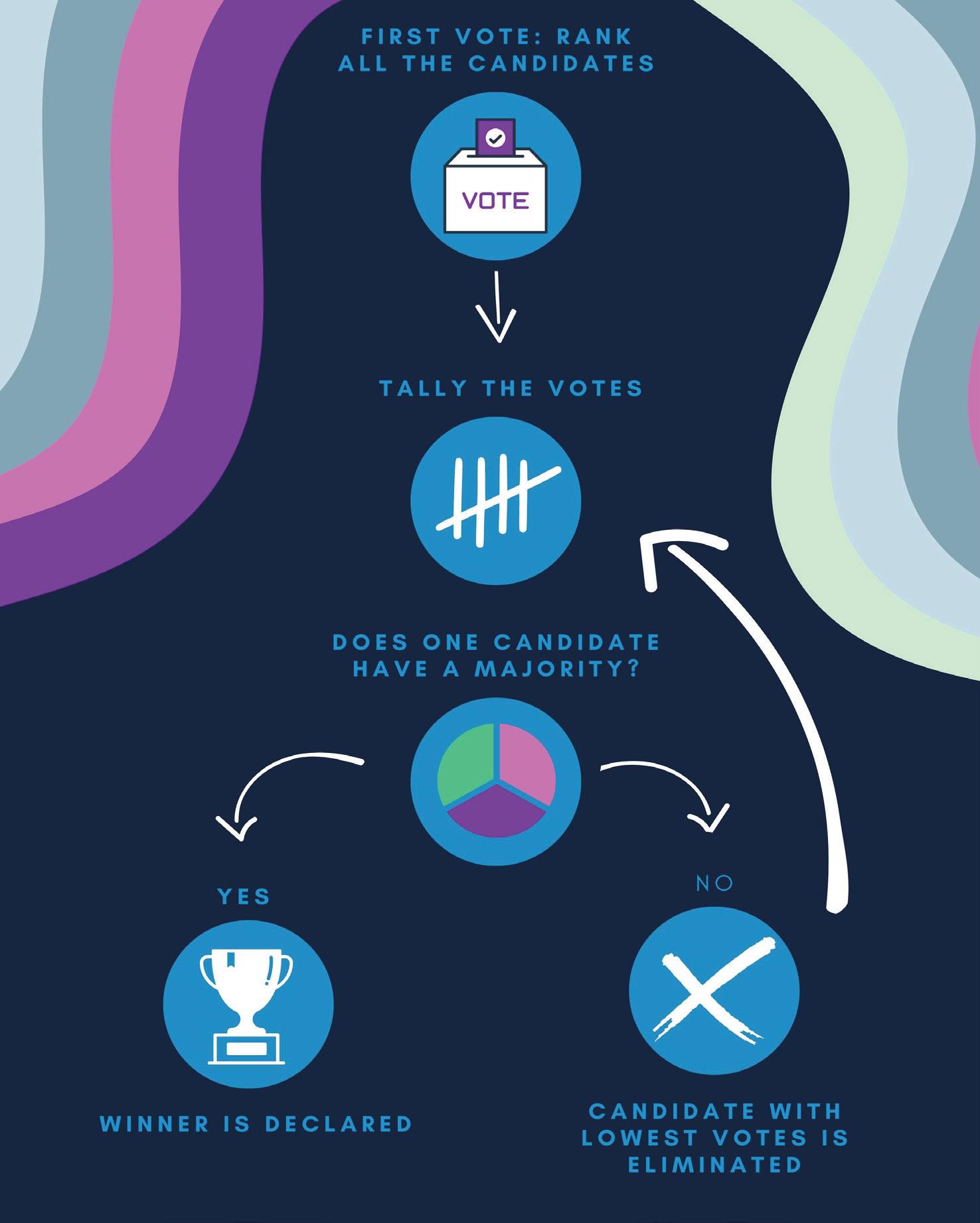
votes winning due to the complexities of the formula. If any one candidate has over 50 per cent of the number one votes, then they win, a direct parallel to traditional election format ting. However, if no one candidate reaches that goal, poll workers move on to the next step.
The candidate with the fewest overall votes is then eliminated from the race and any vot ers who had ranked them as their number one choice have their vote transferred to their number two choice. The ballots are then re counted to see if any candidate has reached the necessary majority. The process repeats it self until one candidate has earned 50 percent of the vote, crowning them the winner of the election.
Many politicians and voters alike believe that Evanston is rushing into the decision of changing a traditional, tried-and-true voting method and that that is a detrimental mistake.
“We’re talking about changing our voting system, and folks want to rush this through. This is a horrible, horrible process for some thing as big as this,” eighth ward council mem ber Devon Reid told the Evanston Roundtable following the referendum announcement.
Despite apprehension about RCV and its place in Evanston, voters have had many pos itive things to say as well. In a June 27 city council meeting, Mary Keefe Kelly, co-pres ident of the Evanston League of Women Vot ers, sang its praises.
“The League of Women Voters supports ranked-choice voting as an alternative to plu rality voting,” she said, “...[Ranked-choice voting] gives the voters more choices and more power and represents the best practice in choosing elected officials in our democracy.”
Supporters praise RCV for its prioritization of voter satisfaction.
“In most elections in the United States, the candidate with the most votes wins, even if that candidate’s share of votes is less than 50 percent. In ranked-choice voting, the winner must have over 50 percent of the votes to win, which ensures that the majority of the voters support the winning candidate,” said Kelly.
RCV advocates argue that the system leaves room for minor-party candidates to win elec tions and also helps reduce the number of vot ers casting their ballot for “the lesser of two evils.”
Regardless of personal belief, all eligible Evanston citizens will have the opportunity to
vote on whether or not Evanston should im plement RCV in future municipal elections.
More information surrounding all Evanston elections can be found at the city of Evanston website. Want to get involved with RCV?
More information can be found at the Rankedchoice Evanston homepage and newsletter.
There and back again: the North Shore Century ride
By Lia Mirza, Hazel Michener Staff Writers
The 37th annual North Shore Century bike ride took place on Sept 18. The 100-mile ride started at Dawes Park, looped up to Keno sha, Wisconsin, and then ended right back in Evanston where it had began.
Around 2,200 people attended the ride. Bikers can complete as much of the ride as they’d like, as well as go at any speed. The age range for this year’s ride spanned gen erations with people as young as seven and
as old as 83. The younger ones mostly did shorter rides compared to the older and more experienced bikers.
Junior Aiden Cooney has taken part in the ride a few times. In 2021, he finished 62 out of the 100 miles.
“I’ve done the ride three times and have always enjoyed it,” Cooney said.
One of the challenges that he faced was towards the end when he was on Sheridan and had to join in with the 100-mile bikers. Cooney mentioned it was fun to do a daylong bike ride, but something he disliked was
how it got harder the further he rode. Cooney would be open to doing the bike ride again.
President of the North Shore Century Alan Cubbage has been president for a year. His job as president is to be responsible for the business of the club. Each month, the club has a meeting where members bring in speakers to talk about bicycle-related activities. Cub bage was there on Sept. 18 signing certifi cates for people who had finished biking. But how many people actually finished the event? “Right around 2000,” said Cubbage.
For Cubbage, planning the event is a “huge
Evanston i an
Houseworth, Jessica Sehgal, Ahania
Luning
Denlow
Bridget Baker
Editor Clara Gustafson
Editor Sophia Sherman
Editor Christopher Vye
Photo & Art Editors
Kupu Sumi Aiyana Jehan
Editor Sam Froum
&
Assistant Feature Editor Izzy Rudolph
In-Depth Editor Marin Ubersox
Assistant News Editors Annabelle Harris Ethan Ravi
Assistant Opinion Editor Maddie Molotla
Assistant Sports Editors Owen Chiss Alexis Rogers
Editor Saliha Ansari
Video Editor Sadie Dowhan
Social Media Editor Amy Grill Copy Editor Macyn Hoelever
amount of organizational work.” The group has 160 volunteers who are all members of the Evan ston Bicycle Club. During meetings, the mem bers plan routes, mark the ground with arrows and coordinate with the local police. They also plan so the riders have access to food and water. Each year, the riders have to pay a fee to join. The money that gets collected gets donated to different organizations. This year around $40,000 was collected, some organi zations are the Evanston-based Center for In dependent Futures, Orchard Village and Over the Rainbow.
Writers, Artists, Photographers:
Tarek Anthony, Gemma Callam, Hannah Cervant es, Ella Cleary, Kayla Drajpuch, Miranda Escalera, Isaac Flint, Charlotte Geyskens, Elise Goulding, Mackenzie Greco, Maeve Haughey, Shay Hecker, Paula Hlava, Maggie Huston, Stella Israelite, Simone Jacot-Bell, Celia Jefferson, Mallory John ston, Jordin Kadiri, Zoe Kaufman, Lily Kellams, Emerson Kimrey, Parker Krzystofiak , Sophia LaFleur, Mary Lister, Tony Mateos, Hazel Mi chener,Sophie Milner-Gorvine, Lia Mirza, Siobhan Monahan, Stella Morton, Charlotte Murray, Kate Myers, Jessica O’Koon, Henry O’Malley, Izabella Paracuelles, Lila Portis, Eliana Prawer-Stock, Lily Roback, Marco Roman, Nicole Saenz, Finch Shew felt, Merrill Short, Sophia Siddiqui, Milo Slevin, Eva Sondgeroth, Liviani Sumi, Olivia Tankevicius, Emma Thomas, Jared Tucker, Isaiah Turk, Maya Valentine, Fiona Vosper, Aaliya Weheliye, Tanya Weisman, Rosie Witt
Adviser John Phillips
news - 5
Executive Editors Meg
Soni Arts & Entertainment Editor Mae
Feature Editor Jilian
In-Depth Editor
News
Opinion
Sports
Assistant Arts
Entertainment
Assistant
Podcast
What gender-affirming care looks like in Evanston
By Isaac Flint Staff Writer
Since its opening in February 2013, the Lurie Children’s Hospital Gender Development Program has provided a safe haven for transgender youth on the North Shore. In a country that has become increasingly concerned with the health and lives of transgender youth, finding access to gender affirming care can be challenging, especially for kids and teens under the age of 18.
Gender-affirming care is a multi-faceted approach to the healthcare of patients navigating their gender identity. This includes physical care such as Hormone Replacement Therapy, psychological care such as psychiatric evaluations, therapy and medication, and providing social resources that provide support during school, family adjustments and other changes inherently involved in one’s gender transition.
On the North Shore, Lurie Children’s Hospital, Northwestern Health and North Shore University Health System all offer health care for transgender and gender non-conforming patients. Both Froedtert Inclusion Clinic and Children’s Hospital of Wisconsin Gender Health Clinic are located about 80 miles north of Evanston. For pediatric care closest to Evanston, Lurie Children’s Hospital offers the most accessible care, however the gender health clinic consistently receives threats from many conservative groups across Illinois and beyond.
Just last month, Lurie Children’s Hospital experienced public backlash against their Gender Pathways Program.
“Awake Illinois,” a conservative organization based out of Naperville, Ill., has been promoting false claims against the Hospital and their mission. Not only are these claims being spread through conservative social media platforms, threats to Lurie forced its youth transgender support groups to be moved online for the time being.

Despite the threats to the clinic, Lurie continues to provide care to their transgender patients.
In a statement regarding the threats, Lurie stated, “We stand in solidarity with our transgender patients and families, community, and colleagues who are providing gender-affirming care. We strongly condemn any threats on and harassment toward the transgender community.”
“Lurie has long supported gender-affirming care for youth,” the hospital continued in the statement. “All young people should have access to comprehensive, gender-affirming and developmentally appropriate health care that is provided in a safe and inclusive environment.”
As one of the first Pediatric Gender Health clinics to open its doors in the Midwest, Lurie has experience handling threats such as the “Awake Illinois’’ threat from September and has continued to provide gender affirming care for the nine years the clinic has been in existence. The clinic emphasizes the importacne of providing this care and has provided transgender youth with the resources they need to stay healthy, both mentally and physically.
When transgender and gender non-conforming teens are unable to access gender affirming care, studies have shown a decline in their overall mental and social well-being. The Trevor Project, a non-profit that primarily focuses on suicide prevention for
LGBTQ+ youth, conducts annual studies on the mental health of queer and transgender youth. In Dec. 2021, it was found that LGBTQ+ youth are four times more likley to attempt suicide than their peers. This National Survey also found that 45 percent of LGBTQ+ youth seriously considered attempting suicide in the past year, including more than half of transgender and nonbinary youth.
It is well documented by Medical Research Facilities, the American Academy of Pediatrics and the American Medical Association that gender-affirming care is essential to improving the mental and physical health of young transgender youth.
Whether that care is puberty blockers,
within elementary level education. His proposed bills include bans on gender affirming healthcare, as well as banning teachers from respecting the preferred name and pronouns of their students,and requiring them to “out” any LGBTQ+ students to their families.
Marjory Taylor Greene, a Representative from Georgia, proposed the “Protect Children’s Innocence Act,” which would make anyone involved in providing gender related healthcare services to anyone under 18 a Class C Felony, a bill strongly supported by Desantis.
“If providing gender affirming care for people under the age of 18 becomes a felony, we are likely going to see an uptick in suicide attempts, worsening depression and
health care can make it difficult to receive the care a patient may need. During the peak of the pandemic, higher rates of mental illness such as depression and anxiety were reported, likely due to uncertainty regarding the future, as well as isolation during quarantine. Because of this increase, many more people began seeking psychiatric care, a historically undervalued and understaffed medical field.
Lakatos finds it increasingly difficult to refer her patients to the necessary providers.
“The aspect of my job that I find most challenging is attempting to connect people to specialty care, specifically psychiatry support, that may be unavailable or under-resourced. The COVID-19 pandemic placed a spotlight on the fact that many people suffered from anxiety and depression during the pandemic, and the importance of therapy and psychiatry support is imperative to overall health. Mental health is not an isolated need; we all need to take care of our mental and physical health,” Lakatos shares.
Another challenge for youth seeking gender-affirming care is the need for parental consent. For services such as psychiatric support and Hormone Replacement Therapy (HRT), parental consent is required for patients under the age of eighteen.
“The biggest reason I can’t access [gender affirming care] is the fear surrounding my parents finding out,” says a junior at ETHS who is hoping to receive Hormone Replacement Therapy in the
Even if parental consent is obtained, many private health insurance companies will not cover the cost of HRT Prescriptions, making it even more inaccessi-
While Lurie offers the most comprehensive gender affirming care on the North Shore, it is not available to everyone. For transgender teenagers who do not have access to health insurance or have unsupportive parents, there are several available resources to support them before they can obtain access to gen-
have thoughts or feelings of suicide, as well as other severe symptoms of mental illness.
Even with these proven benefits, many lawmakers today have turned gender-affirming care for youth into a political issue.
In 2022 alone, more than 240 bills targeting the rights of transgender Americans have been filed, the highest rate of anti-trans legislation in the history of America. These bills have the capacity to restrict things such as trans people’s rights to play sports, use their preferred bathroom, receive gender-affirming healthcare and the right to be called their preferred name and pronouns in a classroom setting.
Florida Governor Ron Desantis is well known for his support of harsh anti trans legislation, a stance that is a primary factor of his speculated 2024 presidential campaign. Earlier this year, Desantis passed legislation known as the “Don’t Say Gay” bill, which banned the instructiuon of LGBTQ+ topics
olescents within the LGBTQIA community suffer from higher rates of suicide. We know that when adolescents and kids are not able to access healthcare that they need, specifically healthcare that has been demonstrated to improve their physical and emotional health, then we will see the repercussions. Health care providers are not immune to the stress, also referred to as moral injury, that accompanies the inability to provide the best healthcare they can—especially if the reason is purely political. Ultimately, this will hurt individuals, families and communities.”
Ida Joyce Sia, a nurse here at the ETHS Health Clinic, also opposes Greene’s Bill.
“It’s absurd, in my opinion, to make [gender affirming care] a felony and to criminalize healthcare that saves lives,” she expresses.
Even when physical care can be accessed, recent growth in the demand for mental
At the ETHS Health Center, students have access to free counseling sessions, as well as reproductive health services. Both reproductive and mental health are integral parts of gender affirming care and can be accessed by everyone at the ETHS Health Center, regardless of identity or financial status. While the center does not provide services such as Hormone Replacement Therapy, it is a great resource for both transgender and cisgender students looking to take initiative over several aspects of their health.
The Trevor Project provides several crisis text and call lines aimed at LGBTQ+ youth experiencing mental health crises. Their website creates access to resources for teens to share with their families regarding gender identity and sexual orientation, as well as topics related to Hormone Therapy and other forms of gender affirming care.
Protecting access to gender-affirming care is essential to the health and safety of America’s youth and is even more important as federal lawmakers bring healthcare into the National political spotlight. In a time where bodily autonomy is a luxury and not an inherent right, it is necessary to prioritize the healthcare and support of transgender youth.
6 - feature
feature
Photos by Celia Jefferson, collage by Ahania Soni
Bringing the living room to life
Inside Evanston’s initiative to create safe spaces for Evanstonians struggling with mental health and to minimize police action when people are in crisis
Milo Slevin Staff Writer
Just south of St Francis Hospital stands a small brick house with a cement pathway leading to a brown wood front door. If you peek through the front window, you can see a completely bare room with a dusty wood floor and a fireplace on the back wall. Soon enough, this deserted brick house will be an oasis, a place for people in mental health crises to see professionals without needing health insurance or even a checkbook. It will be a place for anyone to feel safe, welcomed and helped.

Since the pandemic hit, the world’s mental health has deteriorated. With the shift to a virtual world in 2020 and ‘21, people became isolated and more prone to stress, anxiety, fear, sadness and loneliness. And mental health disorders, including anxiety and depression, worsened for many. This led to hospitals flooded with patients and social workers overwhelmed with clients who needed support.
On March 28, the Evanston City Council voted to address the mental health crisis head on. The council allocated $900,000 to create a mental health ‘Living Room.’


“Ideally, this [Living Room Program] would make an impact, because it would give people experiencing any sort of mental health crisis an immediate place to get support with professionals as opposed to checking into a hospital,” says Evanston First Ward Alderwoman Clare Kelly.
Kelly believes that the Living Room is a direct solution to some of the overcrowding in hospitals. And overcrowding isn’t the only reason that people in a mental health crisis shouldn’t be checking into hospitals; Hospitals can also be incredibly stress-inducing.
Kristen Kennard, the Director of Social Work Services at the Moran Center, explains, “When somebody is having a mental health crisis, it is very difficult to manage what is going on around you… And if you go to an emergency room, it is not the most trauma-informed, safe-feeling space. It is scary and it is chaotic.”
Moreover, the innovation of the Living Room isn’t just about how it helps; it’s about who it helps. The program appeals specifically to the needs of homeless and low-income people.
People across the country who can’t afford mental health services often have to deal with their problems alone, and that can have dangerous psychological consequences.
According to the National Survey of Drug Use and Health in 2016, over 25 percent of the U.S population with a serious mental illness lives below the poverty line. Howev

less than 13 percent of the U.S. population at the time lived below the poverty line.
The correlation between extreme poverty and mental illness is evident. That’s why the Living Room specifically benefits impoverished people.
As Kennard explains, “[The Living Room] will benefit those who don’t have ready access to support and resources…
It is there for an individual, an individual who is in crisis and who needs support.”
The creation of the Living Room also brings another issue to light: Armed police officers are often the first ones to the scene of a mental health crisis. Kennard notes that when someone is having a hard time with substance use or homelessness, “it can be very alarming for their first point of contact to be a police officer.”

Police officers aren’t necessarily at fault for this fear since most of them have little to no training in dealing with serious mental health crises. But a lack of training makes it difficult for them to decide what to do in these kinds of situations, which may only lead to more problems.
That’s why, in a separate initiative, Evanston partnered with Trilogy’s First-response Alternative Crisis Team (FACT), which is a program that sends pairs of mental health professionals to a mental health emergency instead of police officers. The goal is to reduce stress and provide safe access to professionals for anyone who needs it.
Right now, police officers still respond to a lot of mental health calls, but Kennard hopes to see a bigger shift in the future. “Down the road, I hope that when calls come in to (police) dispatch, if they’re able to identify it as a mental health emergency, [FACT] will be dispatched by them-
selves, unless there is some imminent danger that’s reported or medical issue.” Kennard says. While the Living Room and FACT are two completely different programs, they both represent a commitment by the city to improve mental health access in the community. But will these efforts actually work?
In Skokie, a successful Living Room program has already been implemented. The Living Room, open from 12 p.m. to 8 p.m. on every day of the week, has already proved itself to be a crucial oasis in the Skokie community.

“[The Skokie Living Room] has had success being a space where somebody doesn’t have to com- mit themselves to a hospital to get support when experiencing anxiety, stress or anything along those lines. Instead, they can go into a center staffed with a couple of counselors without a lot of questioning and bureaucratic tape.” Kelly says.
Turning Point, the facilitator of the Skokie program, taking charge when Evanston’s location opens up.
All of these ideas and plans for addressing the mental health crisis in Evanston are exciting for experts like Kennard, but they still need to be implemented. And right now, the location for the Living Room remains completely deserted. There’s not so much as a chair on the property, much less a functioning crisis center.
Kelly clarifies that the architect hired to design the Living Room has taken longer than expected to get plans back to the city, preventing the project from getting started. She hopes that the crisis center “will be up and running before the end of next year.”
Essentially, the Skokie Living Room has been everything that Evanhopes theirs will be. That’s also why the City of Evanston has
Evan- ston


However long the development process takes, the Evanston community will await the arrival of a new kind of assistance. Assistance that is accessible and stress-free. Assistance that experts in the city hope will turn a page for all of Evanston; away from a time of crisis and towards a new era of mental health support.

feature - 7 er,
Photo by Ahania Soni
Serving validation, connection (and caffeine)
Business owner John Kim’s stores are vital components of Evanston culture
Jilian Denlow, Izabella Paracuelles Feature Editor, Staff Writer
Clusters of teenage girls collect at the tables in the corners, their notebooks and computers strewn across the furniture as they type and talk simultaneously. Nearly every seat in this cafe is filled; by tired college stu dents typing furiously, backs bent over mess ily scrawled notes and textbooks; or friends catching up over steaming drinks, their legs crossed beneath them as they clamor to share their stories. A mom with her hand clasped around her son lets him have a sip of her beverage—to which he wrinkles his nose— and an older woman balances a large purple orchid on one arm while clutching her iced green tea in another.
Customers in line muse over what drink they should order—the oatmeal cookie latte or the cardamom rose—and ponder which donut would go with it best. From the speak ers, songs that range from smooth, soft jazz to Bruno Mars and Marvin Gaye waft through the air; along with the sound of clinking glass plates and the hiss of an espresso machine, though it’s nearly drowned out by people’s voices as they eagerly chatter. Even on a sim ple Wednesday afternoon, it’s easy to see that Backlot Coffee serves as a hub for its neigh borhood; a collection of people young and old alike come to enjoy each other’s company or simply for a hot drink and welcoming atmo sphere. It’s clear Backlot’s patrons represent a snapshot of the Evanston community.
But communities are constantly evolving, which makes it easy for large chain enterpris es to swoop in and disrupt the uniqueness of such places. Local businesses are instrumen tal parts of the character that defines those communities and makes them original. These businesses provide individuality to a com munity. These stores reflect its values, and the people who are part of it; they provide safe, comfortable places for people to gather, while also protecting the aspect of ingenuity.
As someone who runs several self-made businesses in a progressive community like Evanston, John Kim, owner of Backlot in ad dition to other stores, has shown how restau rants, cafes and shops can shape and ulti mately influence the people they serve. From coffee shops to plant stores to pizzerias, Kim has covered just about every neighborhood in Evanston with his local businesses, heavily impacting the makeup of storefronts and the people of Evanston alike.
Opened in 2005, Kim’s first coffee shop, The Brothers K, located on 500 Main Street, was just the beginning of Kim’s up-and-coming business ventures. Kim is the co-owner of this long stand ing Evanston staple, which he started with his brother and business partner, Brian Kim.
“I think being able to open my first busi ness with my brother is something that’s spe
cial,” Kim shares. “It feels good that we were able to start something together and continue to do things together.”
From there, Kim’s entrepreneurial insights only continued to grow with the opening of the Other Brother Coffeebar in 2011. Three years later, Kim established Boltwood with partner Brian Houston, a popular, family restaurant until its closing in 2019. In 2015, Kim and Isaac Bloom opened Backlot Cof fee on 2006 Central Street. Kim’s business es were expanding largely and rapidly, and Evanston provided all the room to grow.
Unfortunately, the Other Brother Coffeebar closed in 2020, but Kim’s other businesses continued to evolve. From there, he opened Plant Shop Evanston last year, in partner ship with the folks from Plant Shop Chicago. Most recently, Kim partnered with Staci and Alex DeSalvo to open DeSalvo’s pizza, just across the street from Backlot Coffee.
“John is one of our partners here at De Salvo’s and more than anything, he has been an ear and a sounding board,” Alex DeSalvo says. “As someone who had been through many openings in the past, he knew his way around the city and in a lot of ways, has been the advisory role.”
Not only do Kim’s establishments hold sig nificance for Evanston storefronts and those that seek a sense of community in these spac es, but the names carry meaning as well. The label ‘The Brothers K’ was partially inspired by the book ‘The Brothers Karamazov,’ be cause their last name begins with ‘K’ and they are brothers. ‘The Brothers Karamazov’, though, written by Fyodor Dostoevsky, tells the story of a dysfunctional family and their struggles in 19th century Russia. The ‘Oth er Brother Coffeebar’ was a spin off of ‘The Brothers K’ since Kim ran it alone.‘Bolt wood’ was a former principal in the early days of ETHS, as well as the title of one of the wings of the school before they were re furbished. Backlot Coffee is a reference to an Evanston neighborhood called ‘the backlot,’ where neighbors share backyard space.
“[The backlot neighborhood] is kind of a community within a community, and that’s essentially what we feel a coffee house is. So we named it Backlot,” Kim says.
Though it’s obvious Kim has had entrepre neurial ideas brought to fruition, and suitable names that do them justice, an occupation in business wasn’t always what Kim had in mind for himself.

“I think failing at other things [influenced me to start my own business]. I was studying to become a pastor, and I soon realized that it was not really what I wanted to do, so I went back into the world of finance, which is what I graduated with in undergraduate school but was pretty unhappy,” Kim shares.
At the time, coffee-central companies like Starbucks and Metropolis were beginning to
take off. The local coffee house was starting to come back alive again, Kim says. As they switched out their machines for ‘super au tomatic’ ones, the ‘third wave of coffee’, as Kim called it, was picking up as well.
“I was sitting in a coffee shop in Evanston one day and a buddy of mine kind of tonguein-cheek said, ‘Why don’t you open a coffee shop? So I called [Brian],” Kim shares. “And we opened up a coffee shop.”
Although entrepreneurship wasn’t always the career path Kim imagined he’d pursue, restaurant ownership has been a worthy feat.
“I love people. I love communities. And I love serving communities. I think the world of hospitality is creating spaces where people can congregate and come together and share a common experience. The local coffee house [serves as just that]; a bunch of different peo ple coming in for a bunch of different reasons, [yet] they’re all sharing a similar space and a similar experience, but doing it in their own ways,” Kim shares. “There’s something nour ishing about going into a restaurant that you’re familiar with and getting to know the other people and regulars that go there. There’s just something [about] community building and the world of hospitality that attracts me.”
DeSalvo can attest that Kim has been suc cessful in serving the communities and creat ing spaces that offer such conviviality.
“One thing that’s very true about John is his ability to make people in the community feel welcome and validated and seen. John has the ability to make everyone feel like they’re his dear friend,” DeSalvo says.
For restaurant owners, location can ul timately determine the fate of the establish ment. It dictates the outward image of one’s company, and how many customers it might attract. Kim, along with others that have chosen to conduct their small businesses in Evanston, saw the appeal in bringing their businesses to the Evanston locale, creating a close-knit feeling and diversifying the blocks.
“I think restaurants that are in a neighbor hood for an extended amount of time create anchor spaces [for locals]. And whenever you walk through any given neighborhood, you can tell the places that are important to that neighborhood, and they generally look and feel like that neighborhood,” Kim says. “It’s fun to be able to be a part of that landscape here in Evanston.”
Despite loving his job for a variety of other reasons, having a lifestyle that isn’t bound to 9 to 5 is also a refreshing aspect of the job for Kim, who has become successful enough to not have to personally oversee each estab lishment he owns.
While he starts most of his mornings at Backlot Coffee, working and interacting with employees and customers, he has the free dom to come and go as necessary. Being able to dictate his own schedule in certain ways,
maintain his hobbies and being able to be at home with his kids and wife are what makes it all worthwhile, Kim says.
“After the mid-morning rush [at Back lot], I’ll head home and [then] I’ll head to the beach with my dog and spend, like, an hour there. I’ll go back home, and then check in at Backlot again. Some days, I’ll pop across the street and hang out at DeSalvos. Other days, I’ll be in the basement at Backlot doing paperwork. But usually my day ends by the time my kids are done with school and [I’ll] come home, start making dinner, hang out with them and truck them around to all their different activities,” Kim says. “And then I go to bed early and do it again.”
And while owning a plethora of business es has paid off, it doesn’t come without a handful of challenges. From plumbing faults to broken refrigerators to sick employees, restaurant ownership has its fair share of ob stacles even without a pandemic to factor in.
“I think the challenges are always being flexible to whatever is going to be thrown at you. No day really looks the same.” Kim says. “But you figure it out. You figure out how to keep the machine rolling. And you make that happen.”
In COVID-19, Kim encountered one of the largest obstacles a business owner could face.
“COVID taught us to be flexible,” Kim says. “It taught us to be adaptable. And I think it was an opportunity for the neighbor hood to say, ‘these are the things that are im portant to us. And we want to make sure that they’re still around when this is all said and done.’ And it was—we grew during COVID because we were determined to stay open and the neighborhood was able to say okay, let’s continue to support these businesses.”
But even after the hardships that come with owning a business (or owning several businesses, in Kim’s case), restaurant owner ship is an admirable career, and Kim is proud to have followed it. For aspiring entrepre neurs, Kim shares words of encouragement:
“Be patient. Be comfortable with the pro cess. I think it’s be[ing] comfortable with [the fact that] what you had in mind [is] not neces sarily what happens. So it’s [finding] a com fort in change. Because best made plans are seldom what actually ends up happening.”
Kim acknowledges that his situation is unique. Not everyone gets to follow the same path he did, to the same successful destina tions or are able to contribute to a community like Evanston.
Not only do many people in Evanston rec ognize and appreciate Kim and his work, but Kim attests to it as well.
“I feel like I’m a lucky guy,” Kim says. “I’m able to live and work in a place that is my neighborhood. I recognize that this is a really wonderful thing and I’m thankful for it.”
feature - 7
Photos by Aaliya Weheliye, art by Kupu Sumi, collage by Ahania Soni
Reviving downtown Evanston
Charlotte Geyskens Staff Writer
It’s three in the afternoon on a Monday, and downtown Evanston is alive. People walk around Fountain Square, to the li brary, to whatever small business they may be frequenting or to grab a bite to eat. The downtown area is a staple of Evanston for students, residents, visitors and everyone in between.
However, many Evanstonians remem ber that it wasn’t always this way, espe cially not in the past couple of years. In fact, during the peak of the pandemic, the downtown area was nearly deserted.
“The first time I went back to down town Evanston, during COVID times, it was desolate, it was so depressing,” says senior Bennett Gottesman.
Finally, after two years of restrictions, lockdowns and anxiety, the people of Evanston are returning to a much awaited sense of normalcy. It’s nevertheless hard to ignore that the pandemic ran through the downtown area and left plenty of scars. Among the lost businesses are the city’s Barnes and Noble, the Century 12 movie theater and a number of small businesses and restaurants.
“Some of my favorite parts of down town Evanston are no longer [there]. It was a tradition with my family to… go to Andy’s Custard and the movie theater, and [they’re] gone now, which is tragic to me,” said senior Kodie Winkler.
Some windows still stand empty, their papered-over storefronts clashing with the lively background, but other business es are bouncing back. In February, AMC
Theaters signed a long-term lease with the developer of the Century 12 building to bring movies back to downtown Evanston, and the space previously occupied by the Barnes and Noble is now a Northwestern Medicine building.
“I miss the Barnes and Noble as a hangout space, [but] I feel like it’s a pretty worthwhile thing to replace it with. I guess I’m kind of sad in a nostalgic sense. Ev erything else has been pretty positive. I can’t think of anything else, other than the movie theater, that was lost and that I’m actually sad about,” said Gottesman.
There are plenty of businesses that sur vived and continue to thrive after the pan demic, such as local bookstore Bookends and Beginnings, which opened in 2014.

At the beginning of the pandemic, own er Nina Barrett and her staff had to make sacrifices to save the store.
“That first six weeks was a very weak and scary time,” Barrett said. “We have gi ant bills that come due whether we’re sell ing the books or not.”
There was a lot of fear surrounding the store’s funds and if they would be able to stay open. In the midst of all the uncertain ty, the Evanston community rallied around the local business.
“We raised nearly $50,000 [with a Go FundMe campaign]. People really support ed us in our time of need.”
Two years later, business is actually better than it was in 2019. In 2021, Barrett purchased a second space and turned it into a stationary store, which serves both as a space for purchasing gifts and as a useful tool to further advertise Bookends and Be ginnings to passersby, since it’s somewhat
hidden.
“That store is serving basically as a gi ant billboard for this store. We’re catching all of these people who would love to come into this store except they never would have made it down the alley,” said Barrett.
Even though the closing of Barnes and Noble saddened many Evanstonians, it benefited Barrett and the business. “It was a moment when everyone who thought there was no other bookstore in downtown Evanston discovered us,” Barrett said.
Although Barnes and Noble was be loved in downtown Evanston, it was still a national chain, and according to Barrett, local businesses provide more benefits to their communities.
“When you spend money in an inde pendent store… more of the dollars you spend here are going [back to the commu nity.] But there are all of these intangible benefits as well. In many communities, it’s the local bookstore that gives personality to the block, if not the town. It serves as a gathering place for people. It’s called the third space: a space that’s neither home nor work where people can gather in a differ ent way.”
The city is working tirelessly to revive downtown Evanston. According to Mayor Daniel Biss, Evanston has been encour aging officers to come back to work and deploying federal funds to make the down town area more financially competitive. A long term study, set to end in 2023, is currently sampling opinions from stake holders, analyzing data and building a plan to breathe life back into downtown. This year, the main focus of the city has been offering more opportunities for people to
come together and assuring Evanston res idents that they are safe, despite the con tinued threat of COVID-19. Public health efforts remain a priority.
Other areas of Evanston were of course affected, but according to Biss, the down town area was the hardest hit by the pan demic, because it is the most densely pop ulated area. Since Northwestern went back to having in-person classes, the city has revived somewhat automatically, since so much of the traffic and business come from students. The opportunities presented by this moment are also not lost on Biss. Even after the pandemic, downtown Evanston continues to draw new business.
“Having more places for people to be together, to experience art or culture or food or drink, is really critical. Downtown Evanston shouldn’t be just about com merce; it’s a gathering place for our com munity,” said Biss.
According to Biss, Evanston is unique in its closeness and in the way that it unites around the center of the city.
“We are a small enough community that we can all have some of the same reference points. [Downtown Evanston is] a shared gathering place and a shared melting pot for all of us.”
That’s just what downtown Evanston is: a middle point, something that we can all share. For years, ETHS students and the people of Evanston have enjoyed the culture and opportunities presented by the downtown area and as the city returns to its former heights, they will be able to do so again.
feature - 7
Photo by Isaiah Turk
What issue should students be most concerned with?


Focus on enjoying high school
By Aaliya Weheliye Staff Writer
I learned something so crazy when I started taking classes I was truly interested in: I don’t hate school.
Many of my peers and I have put immense pressure on ourselves because it feels like college is when our life starts. The problem is viewing high school as a mere stepping stone to college and not its own unique experience. It makes sense we feel this way because of the way our school is set up, we are prepared for college the minute we step foot on campus as bright-eyed freshmen. There are benefits to this, but ultimately it takes away from our high school years. I am not going to be a hypocrite and tell people to not take AP classes, or do test prep for the SAT, or to join clubs and sports when I have done all of those.
The problem is why people take these actions for the wrong reasons. Some of my favorite classes ever have been AP classes, and I have gained valuable knowledge I wouldn’t have otherwise. The same thing is to be said about extracurriculars—I have had great experiences with these and have made great friends via clubs and sports.
But this idea that we have to take a meaningless amount of AP classes and join every club under the sun to appeal to college is beyond detrimental to our growth and learning. The value in challenging yourself in subjects and areas about which you are passionate is unmeasurable. Yet, we stretch ourselves so thin thinking that wanting to be a math major means we have to get an A in AP Literature. This picture of a “well-rounded student” that colleges want has us pushing ourselves in areas that we don’t care about.
I think there is so much pressure to not “peak” in high school that we dismiss this
crucial time of our life. For many of us, it’s the first time in our adolescence that we know what we want to do with our lives. We make new friends and experience so many firsts. These are all valuable lessons that we gain from high school.
But trying to have fun and maintain a good social life in high school is not peaking. I am so tired of people acting like valuing friendships during school is unfocused or irresponsible. You can study for that biology quiz and still grab coffee with your friends. This idea that school should isolate us so we can focus is so unhealthy. Having strong social connections actually helps increase brain function. It even helps you live longer! This study also found that people who are isolated are more likely to develop dementia and other brain problems. Your friendships are crucial to your ability to be a good student and should not be dismissed.
While we go to a public school, it is still extremely competitive and high pressure. I noticed me and my peers focusing more on how we can make ourselves academically successful than actually enjoying high school. I want school to be something that people, including myself, look forward to rather than dread.
Contrary to popular belief it is not normal by any means for classes to give us anxiety or insurmountable stress. I know this article probably won’t change people taking countless AP classes or basing their worth off an outdated standardized test, but we can look for small ways to reduce that anxiety and start to actually enjoy high school.


Gym AC, assigned cafeterias, and rigorous classes
By Mallory Johnston Staff Writer
Air conditioning in the gym wing
When you work out, you want to feel cool. Physical exertion through exercise is enough exhaustion for a student to handle, but without AC? Students have two 85-minute blocks of P.E. every week. That’s roughly two hours and 48 minutes in total. That’s not a short amount of time for some students. Exercising is sometimes the last thing students want to do, and without the cool support of air conditioning, can you blame them? While there are fans throughout the gym wing, it doesn’t do much.
“[The gym wing] needs air conditioning,” says freshman Sattaphi Miller. “It can make gym class a lot harder than it should be.” Assigned cafeterias
I understand why we have assigned cafeterias. We can’t have kids roaming around the halls, or places getting too crowded. Students should at least have a say in what cafeteria they eat in. What if a group of students who are friends are in separate cafeterias? Yes, they can go to the Hub. What if it’s closed? What if the Academic Study Center has reached capacity? What if they get in trouble for being too noisy
in the library? They should have a place to go that they are guaranteed entrance to together.
“I think going to a specific one is not needed. Friends outside of the same cafeteria should be able to socialize with each other,” says freshman Talia Reichlin.
Students shouldn’t have to worry about scheduling intricate lunch plans on where to meet and when, especially underclassmen who can’t leave campus and are sometimes stuck with their assigned cafeteria. Rigerous classes for underclassmen
Upperclassmen have the option to take honors classes and AP. I’m not saying all freshmen and sophomores have to take an AP class but maybe a little bit more of a challenge in classes might be good. Not every freshman comes from a District 65 school so a lot of kids land at different levels. There should be options for students who don’t want to retake or repeat what they’ve already learned. Just because they’re underclassmen doesn’t mean they don’t have the capacity to undertake rigorous coursework. Yes, Humanities and Civics are graduation requirements but could it be split up into sections of AP and honors? Are there remedies?
Art by Sophie Yang
Recognizing individuality is a two-way street
By Shay Hecker Staff Writer
For as long as anyone can remember, there has been a divide between teachers and students in schools. For whatever reason, whether that be a difference in age, maturity, responsibility or power, there has always seemed to be a distinct ‘us vs them’ mentality that dominates high school. It’s pretty much a joke at this point—a common trope in every coming-of-age high school movie. So, when I first began to formulate this article, I almost instinctively gravitated toward this power struggle between students and teachers. My question was somewhat defensive: why is it so hard for teachers to see students as individuals with lives outside of school? Why don’t they care about us on a level that goes beyond academics? Don’t they see that this issue is damaging to our mental health?
But upon taking a closer look, I slowly began to re- alize that this issue was much deeper than it appeared at first glance. The more I thought about it, the harder it was for me to actually make the case that most teachers don’t respect the fact that students’ lives exist outside of their classroom. In fact, I came to the conclusion that, in my experience, teachers this year are actually doing a really great job at not falling into this cycle. Partricia Delacruz, one of ETHS’ AP Language and Composition teachers, is a well-known example of a staff member that seems to have this recognition of individuality already figured out.
“It’s important that students know— and students that I have a relationship built upon—an understanding of one another’s identities. I think it matters that students come with different identities, different experiences, different ways of navigating school as an institution. That’s going to be what informs our relationship,” said Delacruz. “Part of being a teacher is taking my time to make sure that I’m engaging with you as an individual with human experiences, outside of being an academic.”
Delacruz pretty much just described ev-
These people have lives too,” remarked junior Tyler Tang.
While I was inclined to rebuke Tang’s idea at first, it didn’t take much thought to realize that he may have a point. How often do we complain about teachers taking forever to grade our work or for taking a day off because they’re sick? How often do we send emails and expect a response right away?
“[Teachers] are not just teachers,” added Tang. “They’re fathers. They’re daughters. They’re sisters. They’re people that have
“[Teachers] are not just teachers. They’re fathers. They’re daughters. They’re sisters. They’re people that have impacts on other communities as well, and maybe we as students should be more aware of that and empathetic of that. But I think it’s a really give and take relationship. That type of sympathy could be given to the teachers, but I think it’s way easier if that type of relationship is also given to the students.”
- Junior Tyler Tang
it seems like we’re impossible to deal (with), just remember we’re all trying to learn together and adapt the best way we can,” says junior Madisyn Bates “[But], I think that teachers struggle to take student individuality into account because they also have so much going on, and I think we as students even forget that our teachers have lives outside of just the work they do in class.”
ery student’s dream: to be seen as a human being with lives outside of their classroom that might be completely different from how they’re perceived within the school walls. Students strive for a teacher to recognize that we have other interests, other struggles, and even other classes. To be fair, most would agree that Delacruz is incredible at building these relationships, so it’s not exactly accurate to say that every teacher thinks this way. But, for the most part, I have heard about and had positive interactions with teachers in regards to recognizing our out-of-school lives.
“I feel like, if anything, students really don’t care about teachers’ individuality.
impacts on other communities as well, and maybe we as students should be more aware of that and empathetic of that. But I think it’s a really give and take relationship. That type of sympathy could be given to the teachers, but I think it’s way easier if that type of relationship is also given to the students.”
A give and take relationship. This seems to be a reoccurring theme that both teachers and students can attest to.
“If I could transport one thing into my teachers’ minds about myself and other students, it would be that we are constantly learning and evolving. So even when we’re getting on teachers’ nerves, or when
So although I had originally set out to bring light to the flaws in our education system at ETHS, I now find myself sitting here with a completely new perspective. Perhaps it’s not the teachers who need to make changes, but our school as a whole. Our institution. Our society. ETHS is nothing if not a society inside a society, one that reflects not just us as students and teachers, but the general outlook that Evanstonians have of each other. If we all took a moment to stop when we’re irritated with a peer or a teacher or a student—if we put ourselves in their shoes, or at least tried to—maybe we wouldn’t feel so stuck in this ‘us vs them’ cycle. Maybe, by offering just a bit more empathy to our teachers and stu- dents, we can ac- tually make Evanston a more connected, loving community.
10 - opinion
Inclusivity is key when addressing current events in class
By Stella Israelite, Simone Jacot-Bell Staff Writers
When Russia began its invasion of the independent nation of Ukraine under the guise of rightful reunification, the Western world held its breath and waited for what was advertised as an inevitability. However, a swift Russian victory never came, and the war rages on for what has now surpassed six months. There are several differing stances on the Ukraine conflict in the U.S., namely revolving around our country’s involvement, or lack thereof. Between the prevalence of such a devastating war and America’s long standing tensions with Russia, it’s no wonder that there has been such an outpouring of support for Ukraine, as there absolutely should be. However, the heavy discussion of the war in ETHS classrooms begs the question, how do teachers choose what conflicts to address in their classrooms? And, more importantly, how does the infiltration of whiteness within education, and the United States’ role in these conflicts, impact the level of attention paid to them?

Particularly towards the end of last year, teachers felt that the Ukrainian conflict was an issue that they felt morally obligated to address with their classes. Almost all of my teachers acknowledged that it was happening and gave students a space to express any of their feelings regarding the conflict, which was highly appreciated (Simone Jacot-Bell). While this is inarguably important to address, as it affects many ETHS students in a variety of ways, it made me question how teachers go about deciding what current events should be included in their curriculum. For instance, Ethiopia is dealing with a violent and deadly conflict between civilians and the national government within its northern region of Tigray, the conflict between Israel and Palestine is killing off civilians everyday, and Afghanistan is still suffering from the repercussions of the Taliban takeover. These are just a few examples out of the many atrocities that are occurring within the world, yet there is minimal
discussion about these conflicts within the classroom. American classroom discussions about current events often center whiteness, making it important to be mindful of the topics that are addressed in class. There must be a collective understanding that addressing Mahsa Amini’s murder in Iran is just as important as discussing the Ukrainian crisis. It is not effective to simply address the issues that pertain to U.S. allies or only talk about issues within predominantly white countries such as Ukraine. ETHS is a school that contains folks from all different backgrounds, and it’s arguably what makes our school such an outstanding community.
With that being said, we must keep our range of identities in mind when deciding what is important to discuss in class, so that all students feel
ever the standard curriculum is…”, says Pond. “It is how could we possibly, as human beings teaching in the social sciences, not bring the present day and the things that are relevant to our lives into the classroom.”
While it may be essential, holding classwide conversations about current events is not always simple. According to Pond, there are several factors that need to be considered when approaching these conversations. These are the pedagogical questions that he considers within his classroom:
“How relevant is this to my students now? [is the question that I ask myself]? How many of my students have heard about this, and what are they hearing? How relevant or important is this to the history that we have been studying?
the students within the community.
Teachers must think critically about what message they are sending to their students when they neglect to cover events that do not affect those who are born in positions of power due to their whiteness, geographical location, or other. Educators cannot begin to address this disparity if they are not discussing current events at all in their classrooms. There is no denying the time and effort that goes into crafting the curriculums for classes, especially at ETHS. However, there is immeasurable benefit in balancing laid out plans with what is happening in the now. Our school advertises itself as a place that prepares its students to go out into the real world, and current events play a primary role in the world we will be entering so imminently. While history is the foundation of any modern conflict one would wish to discuss, I (Stella Israelite) am confident that there is untapped value in connecting classroom lessons to broader world issues, which would make these teachings not only more pertinent, but more personal. By highlighting the value of what we are being taught through a lens where it is actually applicable and relevant, teachers vastly improve their students’ engagement with and understanding of the content.
seen within their classroom environments, no matter their background.
Michael Pond, Civics and AP United States History teacher at ETHS, finds that it is crucial to include conversations about current events within his curriculum in order for students to better understand the history.
“For me, it’s not a question of should I be teaching current events at the expense of what-
How relevant or important is this current event to building a better community/world/country?” asks Pond.
It is pivotal to weigh the different factors of a class community before deciding what current events should/should not be addressed in class. It is important to note that there is no clear cut or flawless formula to choose what to address in class. It should be based on the direct needs of
In an age where world news is available at the click of a button, our system of education falls behind the curve. As the premise of ‘preparing students for adulthood’ grows to buzz-word levels of use, our school does not make an effort to live up to the expectation it sets when it comes to the discussion and implementation of current events in the classroom. A truly well-rounded student who is ready to contribute positively to society is one who has been taught the importance of de-centering wealth, whiteness and the west within their studies. We need an education that prioritizes these lessons in the context of the world as we know it today, not just decades ago.
llustrated by Jessica O’Koon
Unfair norms: Running for Homecoming royalty
 By Miranda Escalera Staff Writer
When Homecoming nominations were open, I asked people to nominate me as a joke. But in reality, I wanted to get selected. Because of how society talks about events like Homecoming, I was embarrassed to admit that getting nominated would mean a lot to me. The media makes people who don’t fit in with the popular crowd feel like they can’t participate in running for events like Homecoming royalty. I know that, because of these specific standards, people who were interested in running didn’t.
So, of course, I was shocked when I got the email that I was nominated for Homecoming court. I couldn’t believe that it was happening. I was that one goofy kid for years who was picked on and looked over constantly, so seeing that email was such a shock.
At first, I considered dropping out, because I knew people would see me as a joke. But I didn’t. I used the opportunity to speak up for those in my position. Especially being a nerdy person of color, I could speak for many of those people, and that was my goal. I started campaigning the day I found out. I posted on my social media about my campaign; some people listened, and some completely ignored it. Once more people found out that I was running, I was laughed at and asked to drop out.
Someone even satirically asked me if I thought I would win. I told them yes.
The whole time I campaigned, I thought that was the worst thing I’d endure during this process. But that was until the Homecoming court got announced. My last name, “Escalera”, was misspelled. It was written down as ‘Escalena.’ I immediately emailed the staff who made the announcements. I told them I knew it was a common mistake and asked for it to be changed. I got a reply later saying that my name would be changed on the ballot but not on the announcement.
I looked closely to see if everyone else’s name on the ballot was spelled correctly— they were. I immediately expressed my anger, especially being the only queer person of color on the ballot. Some agreed, and some told me I was overreacting. But, important to note, everyone who told me I was overreacting was white.
I looked at the girl below my name, who had a pretty complicated name that even I would misspell, plus her nickname in the middle. Her name? Spelled correctly. Yet Escalera was misspelled, and it isn’t that hard. I was angry that my name wouldn’t be changed, because it’s just one letter to fix.
I was seen as a joke, and that made it even worse. Especially the people who didn’t know who I was. They would think I am Miranda Escalena instead of Escalera. My friends who caught the typo were on my side. People who weren’t fond of me just laughed and saw it as a perfect opportunity to use that against me to annoy me.
On the morning of the Homecoming game
and pep rally, I was asked if my name was Escalera or Escalena. I told them Escalera and at the pep rally, they said it correctly, but when it came down to the game and Homecoming court was being announced, the worst had happened. When my name was being announced they paused at ‘Esca,’ then continued to say, ‘leena.’ It’s like they gave the anticipation of getting my name wrong, and they did, and it wasn’t right. I didn’t even get an apology.
This shows how the people who don’t fit in with society’s norms get treated. That norm is so normalized, and it shouldn’t be. We feel like we don’t belong in events like this.
Since as far back as 1910 at ETHS, Homecoming royalty has almost been essential to the stereotypical high school experience. It’s one of the most significant events in high school for some people. But people already know this event is a big popularity contest. If you look as far back as the 1965 ETHS Homecoming, all the females running for Homecoming queen were skinny white women. There was no telling when the first person of color won Homecoming royalty, but it was most likely closer to today than 1965. But still, then, the pattern was most of them were popular in school.
Moving forward to the most recent years at ETHS, this event has expanded significantly. LGBTQ people have won these events, and that’s changing the narrative, but the people who are different, whether it’s their skin tone, personality or interests, are still stuck in that norm that they can’t run for stuff like Home-
coming royalty. As soon as you are seen as not popular or anti-social, you get looked over. It is entirely unfair.
I have talked to multiple people about this. I run Anime Club, and many of the members expressed that they wanted to run but were afraid they wouldn’t be able to because of how society por- trays us. The Anime club is filled with amazing people.
I hope people come to realize that ev- eryone belongs and every- one is differ- ent. It doesn’t matter if we are popular or not social. Our differ- ences are what make us unique. Anyone can participate in activ- ities like this, and no one should make you feel any less. If you want to do something, do it. You may never know the out- come, but it could be the one you hoped would happen.
opinion
opinion - 11
afraid
Technological troubles in teaching: how
regards to phones], then it kind of pins one teacher against another.”
Nonetheless, this inconsistency regarding phone policy enforcement still persists across classrooms.
“Some teachers are more lenient, some teachers are really strict about it,” Fargo shares, in reference to fulfilling the phone policy.

This lack of cohesion can not only be frustrating for students, but it also creates a wavering communication line between students and their guardians. Phones are the primary source of contact between guardians and students during the school day, and eliminating that direct messaging system can have significant consequences. After the lockdown last year, many students feel a sense of security with their phones as both a source of information to follow current events and a service to immediately connect with others.
“My wellness teacher keeps saying the phones should be kept outside of the classroom. I think that's ridiculous. Phones shouldn't disturb class, but they should be kept on; they should be able to be kept on your person,” Zehr explains.
Phones and Education: Asset or Adversary?
continued from Page 1
“I think the teenage brain is wired for being social, and [phones are] really the mechanism that students use to be social and to connect with one another. We all really crave connection, and the way to connect, especially during the pandemic, was through technology,” Technology Integration Specialist Mina Marien explains. “Just like anything else, making connections is a skill, and you get good at whatever skill you practice. Students have really practiced using phones to connect with one another on social media, just by text [or] playing different games, and so I think that is really what students want to do. They want to feel connected and involved with their peers, and [they] don't want to feel like [they’re] missing out. If everything's going on online, then you want to be part of that action. Even if you're not fully participating in it, you want to be on board, so I think that's why a lot of people like phones, and [this is] especially prevalent for teenagers, because that's the phase of brain development that students are in at that time.”
In addition to acting as a vehicle for social interaction, phones can also be a tool for students to turn to when they experience anxious thoughts, which was another aspect of phone usage that was amplified by the pandemic.

“A lot of studies show that students relieve anxiety by having coping mechanisms and sometimes that is using the phone. Obviously the pandemic was pretty anxiety causing, so having the phone as an attachment is sometimes a way that students tried to [cope with that anxiety],” Marien continues. “The problem is that [phones are] not helping the kids learn. As much as I accept that there are good uses for the phone that helps students, I think that we need to go back to trying to find other ways to help relieve anxiety that's not just being tied to the screen. I do think [student phone usage has] gotten worse [since the pandemic], but I hope that we can continue to try to find more productive strategies for helping students engage and be comfortable at school.”
The primary way in which ETHS is attempting to combat phone usage is a new phone policy. The ETHS Pilot states that phones need to be out of sight and not used during class time. Violation of these guide-
lines can result in a call home or a dean referral and allows for an ETHS staff member to potentially search through a student’s phone. The policy also prohibits the use of earbuds and other electronic devices. This is vastly different from last year, when students frequently used their phones during class, even if the teacher was explaining something important. In light of this stark transition to a new policy, ETHS staff and students have expressed mixed opinions regarding its purpose and efficacy, many of which are positive.
“We're here to learn, so I guess it is good that we focus on learning and put the phones away,” says sophomore Chris Fargo. “I think it actually helps me because I stay more focused. I don't know about some people, they're not that distracted by their phones, but for me, I get distracted pretty easily by my phone, so it’s really helpful for me.”
Many teachers have reinforced this viewpoint that the phone policy helps to eliminate distractions in the classroom, yet some teachers still think there is more work to be done.
“I think it's a great start. We have all the data and the research that shows that students are distracted on the phone,” says Shulman.
Some teachers, like Sujud Ottman, a biology and urban agriculture teacher, have implemented creative strategies to thwart phone use.
“If I have to tell [a student] a second time during class period to put their phone away, I just give them this envelope, and it explains my phone policy, and what they have to do is take their phone, they put it in the envelope. The envelope stays with them, but they're not allowed to take it out until the end of the class period, and not even on breaks,” she explains.
Active enforcement of the phone policy hasn’t been noticeable or a positive change for all students though.
“It just doesn't really seem to be doing anything in terms of [stopping] kids [from] actually using their phones, and even if it is enforced, it doesn't seem to be doing anything. I don't really see it [working]. It just seems to be adding more stress to students and teachers,” says senior Sachin Clark.
While the new phone policy seeks to help students focus and maximize their learning, for some students, it may be more distracting than helpful. The long classes of the block schedule have students focused for longer periods of time than with previous schedules, which can make phones especially appealing.
“I think the new phone policy, in addition

to the block period, is not great, because it's already really hard to focus for that long and retain so much information, and I like to use my phone to take breaks sometimes in class,” says Clark. “I don't think that being on your phone in class is great, because it's distracting you from learning. At the same time, it's also an hour and a half of learning, so most of my classes offer breaks during that time.”
Having students learn to self-manage their phone usage is also a concern. As students graduate high school, they will have more independence and will have to be more responsible for their own time.
“I don't actually think phone policies help. It's teaching the opposite of self reliance. It has you depend on other people to decide when you should be paying attention. If we're trying to prepare for college, we need to learn to do that for ourselves,” says sophomore Kathryn Zehr.
One of the other popular counterarguments to the phone policy pertains to students with disabilities or mental disorders. It’s often said that cell phones help these students stay focused in class and work more efficiently. According to the Council for Learning Disabilities, “A mobile device can be considered as assistive technology (AT) for some students with disabilities … Due to its ubiquitous use among middle and high school students, students with disabilities are more likely to use a mobile device and feel less stigmatized than if they were carrying an AT device.”
Technology use in the classroom could help many students who may often feel overstimulated or ostracized in school environments, yet the phone policy holds no exceptions for students with an Individualized Learning Plan (IEP) or 504 Plan.
Despite the benefits to an individualized method of considering different students’ needs when it comes to phone usage, many ETHS staff members view a consistent and unified phone policy to hold important benefits as well.

“It's becoming a school-wide culture shift with the phones…because when it is left up to the teachers, there's just so many varying philosophies and ideas,” Melanie Marzen, another Technology Integration Specialist, explains. “[Phones] really get in the way, from a teaching standpoint, of social-emotional development in the classroom, classroom connection and being able to do what you need to do to make the class work efficiently and appropriately. If teachers are doing different things in the classroom [in
Nevertheless, many parents have praised the new phone policy with the hope that it will minimize phone addiction among their children.
“I just wish kids would realize how much their phone is taking away from their actual potential to be in the present moment,” ETHS parent Annie Lesch states, “Or how much happier they are when they have had a break from their phone and how they actually feel after not being on their phone. I feel like it is a maturity thing.”
While there are many ferent angles to consider while analyzing the phone policy and its usefulness, it’s important to keep in mind the fact that the ETHS community is still reeling in the wake of the COVID-19 pandemic, and the lasting effects could take years to shake.
“I think it's really hard to talk about [phones] without talking about remote learning and the pandemic. You know, all of us were on the phones all the time when we were on Zoom or Google Meets, adults as well, so I think it's hard to talk about,” shares Shulman.
Technology’s Role in Education
Aside from solely mobile phones, technology as a whole has assumed a signifi-

12 - in-depth
13 - in-depth
how mobile devices affect education, ETHS
cant position in schools across the nation, which has stemmed benefits and drawbacks regarding the educational impact.
“I think technology can take on a lot of roles within that [educational] space. I think one of them is providing students with additional ways to express themselves and to explore ideas, [and it] can also be [used in] additional ways for teachers to be able to engage with their students,” explains Dr. Marcelo Worsley, an assistant professor of both computer science and education and social policy at Northwestern.
Worsley expands on the way in which technology’s progression allows for teachers to approach their curriculum in more creative, individualized methods.

“I think technology can be a way to give teachers more direct access to creating the types of learning artifacts and types of learning experiences that they want there, that they want their learners to engage with.”
Despite the seemingly limitless powers of technology, teachers still question whether technology’s current application in education is appropriate.
of teachers and students.
“Having any kind of technology that is recording anything about students and teachers in the classroom can be highly problematic if not done in ways that are ethical and really provide students with direct access to their data and make sure that the models that are used are transparent and not overly biased,” Worsley explains.
Following security concerns, technology’s ubiquity across learning environments can also serve as an obstacle to student focus and interest.

“There’s ways that students have to be accustomed to being able to have access to that kind of technology” Worsley notes.

“When I was in school, we had Texas Instrument graphing calculators, [and if] you walked into any class, you'd see a handful of students playing Tetris or one of the other games. Those same kinds of things can happen within the existing context of people being on their computers or being on their phones and ultimately getting distracted from the learning experience.”
platforms, including Zoom, Google Drive and Classroom, Flipgrid, Padlet and more, teachers and students have learned various new ways of connecting digitally.
“I think there are aspects of [the pandemic], where people now see that we don't actually have to do everything in person. We can do things more remotely, we can find ways to give students more autonomy over their own learning by having them do more asynchronous activities,” Worsley explains.
However, this dependence on digital resources for curriculum elicits inequity and exposes disparities regarding access to technology.
mind,” Worsley shares. “Perhaps you have a fine motor impairment, [and you’re] not able to type as well, but if you're able to use a speech based interface to help [you] as [you're] trying to write a paper, [you can be more successful]. Even beyond that, and this is something I do in most of my classes, [is] allowing people to submit their assignments in other forms. It doesn't have to be a two-page to three-page document; they can submit a recording of a conversation, they can submit a drawing, they can submit a comic, [so] that there can be a variety of ways that people can demonstrate their knowledge, even within the sort of traditional classroom setting.”
“I think [this] gener- achieving panschools technology.





to have a lot to reckon with, because I think [this] genera- tion, more than any other, is digitally dependent, and what are the implications of that?” Shulman asks. “If teachers are working very hard to create the lessons that we push out through Google, [because] Google has infiltrated every classroom in America, technically, do they own the creative work and lesson planning that teachers do? Because it's all through Google?”
Shulman raises important questions that indicate the degree at which technology micromanages the educational system. School software systems contain a pool of personal data, which makes schools particularly vulnerable to security threats. Data breaches can result in the release of sensitive and confidential information regarding students, staff members and parents, or as Shulman articulates, data archives could grant companies overwhelming control over the creative and intellectual property
Essentially, technology possesses a paradoxical nature within an educational setting: tools that are intended to promote learning can also be the largest distractions in achieving this goal. The pandemic highlighted this theme as schools across the country struggled to establish a school year that functioned primarily off of technology.

“[During the pandemic], we also saw the ways that those opportunities were inequitable. You had some students who were able to really take advantage of [their technological resources], and they grew a lot academically during the pandemic, and others who didn't have access to the same types of resources [didn’t learn as much].” Worsley notes. “People were socialized differently during the pandemic, and they’ve been socialized into a different way of thinking about [and] engaging with learning . . . I do think people are starting to really consider the ways that we used technology during the pandemic [and] which aspects of that we want to maintain [and] which aspects we want to forget about.”
Significantly, the improvement of technology is an effective solution to diminishing some of the inequities that digital learning has revealed. As technology continues to progress, schools are constantly considering the most beneficial ways to implement these tools into their classrooms, because regardless of contradicting opinions surrounding technology’s place in education, one thing is for certain: technology is here to stay, and its presence will only continue to enhance.
completely the that how uni-


“[Technology] has completely changed education, and I don't think that we can effectively talk about it without talking about the pandemic, because [technology] was the only way that we could connect with our students. I'm so grateful that we were able to, but it was done in very isolating ways,” Shulman shares.
However, Shulman continues to explain how the pandemic’s learning system, while unideal, was able to bring to light new ways of considering technology as an instrument to cater to different learning styles.
“I still have some students who miss it. I have students who wouldn't necessarily speak when we were on Zoom, but they would put a lot in the chat or [participate] all the time when we were in small groups in the breakout rooms. I put students into 25 different breakout rooms, so that I could conference with each one of them, and I was like a frog jumping from one room to the next, and you don't have that in [the physical classroom],” she elaborates. “It definitely was a different way of communicating, so I think it brings up the question of how do we integrate that? We can't go back; we have to figure out how to go forward.”
In the spirit of moving forward, many have recognized that the pandemic has permanently shifted the way in which technology is used and perceived, and the biggest change is the amount of time spent using technology. According to a study conducted by the Pew Research Center, 40 percent of U.S. adults reported using digital technology in ways that they hadn’t explored before the pandemic. Schools are no exception to this pattern, through digital
Worsley highlights a long-standing struggle within the education system of the exclusionary effects that technology presents. In an attempt to provide students with the same access to digital learning tools, ETHS, following a national 2010s trend, administered a Google Chromebook to every student in 2016—a policy that has continued for every year since.
“When I was teaching, we didn't have Chromebooks,” Marien begins. “Everything is different [now], because the computer is completely essential to all learning at ETHS. It really has transformed how we do school and the things that are possible. It has been powerful in personalizing learning, and really letting students explore more diverse passions and perspectives than we could have when it was just the teacher teaching. Now, we have the teacher and the entire internet at our fingertips, and with thoughtful instruction and planning, I think teachers really harnessed the power of the internet to make learning deeper for kids and more personalized.”
Despite this learning shift, ETHS is still one of many schools nationally that faces concerns regarding technology and inclusion.
“Anytime someone does a PowerPoint presentation or does a slideshow, and you have a student in the class who may be blind or low vision, and they don't have direct access to that document, [for example], maybe people have not included alt text for the images or even as they're giving a presentation, they're not describing what is on those slides, [then] you're already making for a less inclusive experience. A lot of the web content that's out there is not de- signed for people with disabilities in
“There's something called the SAMR model, which is substitute, augmentation, modification and redefinition, and those are the levels of how learning can be changed through technology,” Marien clarifies. “I don't know that every single use I see for technology is in the redefinition phase, but more and more, I'm seeing teachers redefine what learning looks like with their technology. It's personalizing [education, and] it's really building in choice and skills that kids are going to need after ETHS. All that is happening, so I do think we're definitely seeing a lot of redefinition of what learning looks like.”
By Jessica Sehgal, Bridget Baker, Marin Ubersox, Paula Hlava, Zoe Kaufman, Sophie Milner-Gorvine, Kate Myers Executive Editor, In-Depth Editor, Assistant In-Depth Editor, Staff Writers


 Illustrations courtesy of Kupu Sumi
opinion
In response to ‘I’ve had enough of the panhandlers downtown’
By Students Organized Against Racism (SOAR) Guest Writers

On Sept. 1, Evanston Now published a provocative guest essay that criticized the panhandlers in downtown Evanston, most notably on Davis and Maple near Gigios and Bennisons. The essay was brief and anecdotal. In summation, the author was fed-up with the panhandling she routinely faces at that intersection in her neighborhood. The article was met with a stark contrast in reactions. Many older citizens flocked to the comments, praising the author’s honesty and agreeing about the issue, while many teenagers fired back against the message. Older audiences made comments about Evanston’s declining “standards” and expressed nostalgia for the past when this was (supposedly) less of a problem. They commended her, viewing her statements as someone who is merely concerned with being heckled on the street. Younger audiences saw it as an entitled, misguided approach to a social problem. They argued that they frequently encountered these people and felt no hostility or aggression.
Our intent with this response is not to degrade or “cancel” any parties involved, but to discuss how this article can be used as a tool to examine, understand, and confront injustice.
We are in a time where many people are moving forward, working towards new solutions, while others, in opposition to this progression, seek comfort in the past. Particularly within Evanston, we see an individual avoidance to progressivism, and people find comfort in our collective liberal reputation. Particularly older, white, wealthy Evanstonians seem to think that our work towards equity in the city is finished now that we have reached a sort of “minimum threshold” of being progressive.
And this is what we should take note of. When we reach a certain point of progress, resistance to change often follows. People get upset, leave and search to find space that replicates the nostalgia they feel. An anonymous commentator under the pseudonym “Wake Up Evanston” literally speaks to this.
“Evanston used to be the dining capital. It was clean, beautiful and respectable. It was a sophisticated destination . . . Our
family tradition was going to Bennison’s on the weekend. We now have a new tradition in Wilmette at the little French bakery where no one accosts me and my children don’t hear foul language.”
The author provides only anecdotal stories of her personal experiences with harassment, which of course is supported and refuted by more stories from the two opposing sides. It becomes a game of telephone, and we cannot discern fact from fiction, and really understand the piece. These two sides have narratives and ideas about one thing or another, and the piece’s point is lost. Thus, it is not these recantations where we find the true controversy of her argument. The issue lies not in what is said, but rather what isn’t.
We must recognize the presence of race and anti-Blackness within the author’s writing. Anti-Blackness is a relatively newer term, deriving from the ideas of Afro-Pessimism.
Although it has no cer- tain definition, the term pertains to a White (particularly American) in- ability to recognize the humanity of Black people. By not isolating race– by not explicitly naming how homelessness is related to anti-Blackness—the writer allows readers to make inferences about who she’s referring to without a nuanced and racialized context of the issue. The majority of unhoused men in downtown Evanston are Black men. My (S.J-B’s) experiences with them have consisted of simply an acknowledging nod or a “How you doing?” that Black folks have generationally exchanged between strangers.
In this regard of avoiding nuance and social context, supporters of this article flourish. Of course, if we are to blindly and naively see this complaint, we can live in bliss thinking that she merely wants to be left alone, and see their side of things. This approach is impossible though. The true issue with this piece lies in the tone, the startling reaction to blatant poverty, and the racist implications that lay beneath her statements.
She throws around phrases like, “Bad luck” as she laments running into a red light, and waiting next to a man asking for change or thinking “safe” as she reaches the pizza parlor.
She writes with a sense of entitled disgust, and her tone is
filled with contempt towards unhoused people. Her social perspective seeps out near the end, as she expresses her dissatisfaction with the approaches of “In- terfaith, Connections, and the usual Evanston Do-gooders”. In this battle of old and new, she exposes herself as the old, and the true meaning that lies between the lines is revealed. It’s in this final paragraph, while admonishing other residents, where she admits her resentment towards their ideas, and the issue is blatantly clear.
She is fed up being chided by people to “‘have compassion’ because ‘panhandlers are people’”. She writes, “You know what? The panhandlers today certainly did not see me as a person. They didn’t want to know my name or what I did this summer. They were only interested in what I could do for them.”
This is the final straw in her facade as a woman only concerned with being asked for money. She seems to regard unhoused citizens as less than people. Here, she embodies an issue in all suburbs and bleeds entitlement. Unwavering in her stance, the mask is off, and the larger-scale implications show themselves. People in the suburbs are often averse to the acknowledgment of poverty, and when it is staring her, and all these other people in the face, they feel uneasy. Their safe, quiet suburb is suddenly a place where people are not homogeneously wealthy, popping their bubble of bliss by a harsh reality.
The rudimentary, simplistic view of such complex problems is something that we (SOAR) feel compelled to respond to. Although she avoids explicitly stating it, her rhetoric blatantly reinforces class disparities and anti-Blackness.
Her article isn’t the end-all-be-all though. The author provides no solution, which is actually a good thing. Although it’s an article that frames itself as a misguided cry of entitlement and white supremacy, she’s not truly stuck to one view or another, and it seems there is still room for improvement. There is still time for her to look inwards, and realize a dollar or two can’t hurt. In that sense, there’s still time for the people of Evanston, politicians and citizens alike, to realize that this is a real problem, not an online discussion. Because there is no immediate solution. Between the hyper-politicization of social issues and the social implications of political issues, people have lost sight of what matters. Homelessness and the subsequent racial issues are not merely debate topics that need to be evaluated for ethics and morals by two audiences. These are issues with layers embedded within them. Mental illness, addiction, trauma, economic disparities and a lack of public resources all work in and out of each other, creating a massive cycle that traps people—especially BIPOC—into unshakeable poverty.
We can’t just “ship them away” like some commenters believe. We also can’t ignore it or just see it as a normal way of life. If you have the privilege, the ability to help out, what’s stopping you?
Art by Nora Miller
Church St. needs bike paths to protect student cyclists
By Fiona Vosper Staff Writer
There are many different types of transportation that students use to arrive and leave school— driving, taking the bus, walking and even biking. One of the busiest places where these modes of transportation interact with eacother is at Church St. Cars and buses command the streets, while walkers fill the sidewalk. This leaves one critical question: where should the cyclists go? As roads are dangerous and sidewalks are busy, bikers are left desperate.
Many students have found that the primary issue stems from a lack of bike paths near the school.
“Every day, I bike down McCormick and take a left on Church. The ride down McCormick is easy and relaxing, but the second I hit Church, it’s so chaotic,” sophomore Samantha Schuneman notes. “If I decide to go on the sidewalk, I get yelled at by students and adults on their way to school. I feel guilty having them move and sort of being a threat.”
People on sidewalks can be extremely unpredictable. Nowadays, it is common for people to walk with headphones on, completely unaware of their surroundings. I’m guilty of this as well, but it causes confusion and accidents.
“I was biking down Church [on the sidewalk] and was trying to pass a girl on her way to school. I assumed she heard me behind her,
Both biking in the street and on sidewalks cause frequent casualties. However, biking in the street is the most dangerous for bikers.
out thinking of bikers. I’m constantly worrying about getting hit.”
The safest place for me when I’m biking is downtown Evanston. There are bike paths on almost every street, which causes sidewalks to be safer for walkers, streets to be clear of distracted cyclists, and bikers to have a clear ride around town. I believe that streets around ETHS such as Dodge and Church would absolutely benefit from the addition of bike paths.
In addition to overall safety, bike paths would also benefit environmental and public health. According to AARP, the inclusion of bike paths reduces air pollution and noise, making more desirable living conditions for people that aren’t cyclists.
Another study from MedicalNewsToday states that cycling has many benefits on cardiovascular health. Commuters who cycle have a 46 percent lower risk of developing cardiovascular diseases and are 52 percent less likely to die from one of these diseases.
Implementing bike paths on streets surrounding school grounds will benefit students, staff and Evanston residents as a whole.
so I sped up but instead, she moved directly into where I was biking. I felt really bad, but I didn’t really know what else I was supposed to do. She wasn’t hurt but it could have ended really badly,” Schuneman explains.
“I bike around town a lot but streets like Central and Church make it really hard to get around,” says sophomore Kate Schonwald. “I have had a lot of scary situations where cars aren’t paying attention and change lanes with-

“Most days, I really dread biking to school,” Schuneman concludes. “Not only because it’s tiring, but also because it can be stressful.”
Art by Parker Krzystofiak
14 -
Feel-good films for this upcoming fall
By Kayla Drajpuch Staff Writer
When Harry Met Sally
When Harry Met Sally is the ultimate romcom. It’s the movie that every other rom-com is judged against (at least in my book). Harry and Sally, the film’s protagonists, cannot stop running into each other. Although they don’t like each other at first, they eventually form an unlikely friendship that slowly becomes more.
When Harry Met Sally spans across eleven years, and the front cover of the film is basically a pumpkin spiced latte come to life. The leaves are red and orange, and Sally is wearing a hat to warm herself up from the chilly fall weather.


has big dreams of becoming a musician. This runs counter to the rest of his family, who dislikes anything related to the arts. Miguel keeps dreaming, inspired by his idol, Ernesto De La Cruz. When a mixup leaves Miguel on the wrong side of the gates to heaven, he embarks on a journey to learn more about his family history.
Coco is heartfelt and beautiful. The animations are whimsical and
animations are whimsical and bright, with won-


parts made me tear up or clench my fists a bit tighter, because Coco is simply bursting with life.

Heartstopper
Heartstopper is a TV series adapted from the graphic novels by Alice Oseman. It follows Nick and Charlie, who develop feelings for each other after being assigned to sit together at school. The show also happens to take place during a quaint British fall, with lots of animated leaves transitioning between scenes and the most adorable sweaters (or jumpers, as the main characters would say).
The movie poster is taken from a beautifully framed scene in the movie where Harry and Sally are walking around New York, visiting Central Park and the Metropolitan Museum of Art. It’s just a normal day, but that’s what makes it so special. Their conversation doesn’t feel scripted, and they spend the day speaking in funny voices and simply enjoying each other.
the day
The sweaters are gloriously chunky, the hair gloriously floofy. Need I say more?
Coco
Coco is about Day of the Dead (El Dia de Los Muertos), and it has similar spooky vibes to Halloween. El Dia De Los Muertos is a Mexican fall holiday celebrating and remembering those that have passed.
Coco follows Miguel, a young boy who
fully
personable dancing skeletons and bridges made of autumn leaves. The film shows how families can learn to support each other and open their hearts to things that they wouldn’t have under any other circumstances. Certain
By Charlotte Murray Staff Writer
I find myself as surprised by the movie Vengeance as Ben Manalowitz (BJ Novak) was to find semi-intelligent people in Texas. Now, I feel this is the perfect time to share that I unapologetically love The Office . I’m a typical teenager: I chug chai tea like it’s water, I thrift as if it makes me unique and I LOVE The Office. I even boycotted Netflix (to be fair, my “boycott” only lasted three weeks) when they took it out of their catalog. I’ve watched the whole show from start to finish, more times than I have fingers and I straddle the line between regular and super crazed stalker fan. Not that I would stalk someone—I’m not crazy—but you have to wonder what kind of breakfasts John Krasinski eats to become so talented. But I digress. I went into this with a pre-established respect for BJ Novak as an actor and a writer. Vengeance is not the kind of movie I would’ve seen had it not been for the impressive cast (Ashton Kutcher, BJ Novak, Issa Rae) and the fact that Novak wrote, directed and starred in the movie.
Is it perfect? No. But every part of the story feels relevant to today, and as a bonus, I found myself laughing so hard I was clutching my stomach and wiping tears from my eyes.
Ben Manalowitz (Novak) is a New York journalist, living the bachelor lifestyle and convincing himself of his insightfulness as he continues to move through his relationships as noncommittally as he wishes. But don’t be fooled by his shallowness, Ben has real “thought-provoking” theories about why America is so divided, but as his skeptical editor (Issa Rae) points out, he needs a story to prove it. He’s on the hunt for the next big podcast story when he receives an unexpected call from Ty Shawson (Boyd Holbrook) saying his younger sister, one of Ben’s former hookups Abilene Shawson (Lio Tipton), is dead. After being coerced into flying to Texas for her funeral, Ben learns she led her family (Boyd Holbrook, Dove Cameron, J. Smith Cameron, Louanne Stephens, Eli Bickel, Isabella Amara) to believe they were in a serious relationship and is thrust into the family’s conspiracy that she didn’t OD but was instead murdered. Ty, looking
for revenge, pulls Ben into his plot to find Abby’s killer. But the more Ben thinks about it, the more he realizes that this obvious dead-end hunt for vengeance might actually make the perfect story for his commentary podcast on America…
It’s ironic, because this movie itself is a commentary on the misconceptions we place on each other and ourselves. For example, the liberal elites *cough* Ben *cough*, who hail from NYC and claim to be all-knowing or “woke” have more blind spots than they might think. Some of which might be the delicious aphrodisiac that is Frito pie, the correct way to support Texas college football (GO Texas Tech!), the kindness of Southerners and the importance of a good proximal WhataBurger (Side note: My father just got back from Austin, so I have a first hand source that can confirm that WhataBurgers are very real and just about everywhere).

The beginning of the movie was slow, it drew you into the unusual conflict and the hunt for the killer was fun with some twists along the way, but overall, the story felt pretty flat. Not in a bad way, just the difference between sparkling and still
each other in the rain.
to find their footnew terests and a new the there for each
Heartstopper realistically depicts modern high school in a way that most series do not. It’s unabashedly corny and adorable. Nick and Charlie exchange rye smiles in the hallway, and run to each other in the rain. The series has amazing and realistic friendships. Everybody in the group struggles to find their footing in new schools with new love interests and a new course load. At the end of the day, though, they are all there for each other. Many of the people in the friend group are queer, which allows Hearstopper to explore transgender and lesbian identities in a way that is nuanced. Hearstopper is a hot pumpkin spice latte for your frosty heart.
 Art by Aiyana Jehan Movie posters courtesy of IMDb
‘Vengeance’ is a hundred percent the kind of movie we need in America right now
water. I left the movie feeling conflicted. I was hoping for something bubbly and energizing, but instead I got quiet and thought provoking. Finishing the movie was like reading a book you didn’t like, but loved simply because of how it changed your perspective. Some part of me feels fond when looking back on my experience watching it, and another part of me feels logically unsatisfied with the ending. It didn’t need to be tied up in a nice bow, but I still felt like there were too many loose ends. So while, like me, you might not have liked the ending, or you might not have even liked the movie at all, you can admit that there was something powerfully transcendent about the message of Vengeance . It tackles the divided state of the U.S., but fails to dive into immigration, race, religion, or politics. This is what made it so powerful. It was a commentary on people. Not the labels we apply to them, but the content of their character.
Bottom line: this movie might not be for everyone, but everyone should see it.
15 - A&E
arts & entertainment
Into You
Star
Sentimental Reasons


It Fate, Call It Karma
Fabulous fashions for this fall
By Charlotte Murray, Lila Portis Staff Writers

Fall fashion is known for being comfy and cozy: perfect for stay- ing warm as temperatures start drop- ping. And for those of us whose clos- ets are already fall-oriented, the moment we’ve been waiting for is here! This year’s fall trends are no different; snuggly clothing stays superior. However, just because an item is soft and fluffy doesn’t mean can’t be intentional and stylish. At ETHS, students al- ready enjoy fall classics like Uggs, Doc Martens and sweaters, but we also suggest incorporating other, less com- mon, pieces like pleated skirts, turtlenecks and cardigans.
Shoes
Doc Martens: These shoes are made to crush the competition. Or your bank account. They are hella expensive! You’ve been warned. Beauty hurts; your wallet, not your feet. These are also super comfy once broken into. Try thrifting if you’re on a budget or just don’t want to go through the trouble of breaking in a new pair. Whether you want the 1460 classic boot or a pair of Mary Janes they unapologetically scream fall. They can also be as unique as you want them to be. Go for a sky high platform or maybe a floral print. Pair them with a smart pressed pant or any type of skirt or dress—we recommend pleated—for a really striking juxtaposition.
Uggs: Definitely the boot of the 21st century. First made popular in the aughts by celebrities like Kim Kardashian and Paris Hilton, Uggs are large, fluffy and comfortable (sensing a pattern here?). Uggs are not

the most conventional boots for winter snow, as nobody likes wet feet, but they are nice in autumn for stepping through leaves. These days Uggs are usually worn in the traditional boot style, low length or slipper form— which is extremely popular at the moment. Colors range from brown to pink to blue—in fact, we look forward to any other colors the company releases this fall! They’ll be sure to be lining ETHS hallways in no time.
Knits
Turtlenecks: Truly classic, these have been worn by the likes of Audrey Hepburn and still manage to look sophisticated on us regular folk. While not many turtlenecks are donned at school, this is your PSA to start wearing them. Try a sleeveless turtleneck for these transition weeks, but when it gets colder one of those Steve Jobs icon black turtlenecks always looks good. Whether worn alone or layered underneath something, they are one of the most versatile pieces of clothing and should be a staple in everyone’s closet.
Cardigans: Also a fall favorite, but possibly more so this year thanks to Taylor Swift’s lyrically-brilliant song released in 2020 (Folklore). Cardigans these days come in many styles just like the other clothing items listed, but the most popular is definitely a knitted sweater with long sleeves and buttons. Cardigans can be layered on top of dresses, dress-shirts, tank tops and other items (see turtlenecks!). They can also be draped over the shoulders for a preppy look or tied around the waist like a skirt. Cardigans are wonderfully cozy and ETHS students seemingly always love them.
Materials


Jeans: Jeans have always been symbolic of teenhood. They’re the pants that were originally designed for miners and laborers, but became largely popularized by teen heartthrobs Marlo Brando and James Dean
in their 1950’s films Gone with the Wind and Rebel Without a Cause. Today, ETHS students enjoy high-waisted, mom, ripped and skinny jeans. The “best” style has changed frequently over the decades, but can we finally agree that low-waisted jeans aren’t supreme anymore…? And let’s not forget about jean jackets, especially the fleece lined ones; absolutely perfect for cooler months. But no matter how they’re worn or styled (croptops, hoodies and t-shirts being the most popular pairing), there’s no denying the garment has risen and remains at the top. Bored with your normal-colored jeans (jacket or pants) this fall? Try spicing them up this season by adding decals, painting them or dying them with bleach!
Flannels: These have also been a fall favorite for ages. The material is usually softwove, made of wool or cotton and decorated with a striped/plaited pattern. This season, popular flannel color palettes include red and black, black and white, and green and black. These days, ETHS students wear jackets, sweatshirts and (the fan-favorite) pajama pants made or decorated with these classic patterns. There’s no doubt that flannels, with their comforting colors and cozy feel, are perfect for fall.
Corduroy: Did anyone else’s parents dress them in corduroy pants as a kid, and now they love them but can’t be sure if it’s just because they were conditioned to or bethey actually like corduroy? Just me? Great! In all seriousness, corduroy is great. Whether as pants, dresses, or jackets the material is a fall staple. With its earthy tones, and soft structured texture, it’s unique and supremely fall!

‘WWDITS’ season 4 loses its signature bite

 By Jared Tucker Staff Writer
*Spoilers for season 3 and 4*
The first three seasons of Jemaine Clement and Taika Waitit’s smash-hit comedy
4 Seasons
Leone


Eyez Only
What We Do In The Shadows put it in the conversation for truly one of the most hilarious shows of all time. The raunchy and chaotic comedy is based off Waititi’s 2014 feature of the same name and follows four vampires and their human “familiar” Guillermo as they go through the extravagant excursions of their daily lives. The show has developed a massive cult following, with an incredibly passionate fanbase who wait
fall flat. What went wrong?


At the end of the third season, the characters go their separate ways. Nandor heads on a worldwide trip to try and find his true purpose, Nadja heads to London to work on the Worldwide Vampiric Council with Guillermo and Laslo stays home to take care of the baby Colin Robinson who emerged from the chest of the older, dead, Colin Robinson. The season finale was fantastic and set up the characters for a full season of new plotlines in new places as they all seem to delve deeper into themselves, but in the premier episode of season four, all the characters come back home, and the massive and shocking season finale set up before almost feels worthless.
It essentially created another main plotline that went on a road to nowhere. Nadja, who spent half the season building up her vampire nightclub burns it down at the end of the season, once again a plotline that ends up right back where it started.
Find Love
Season 4 has good plotlines, a decent amount of laughs, and a fair amount of emotion, but it still felt like a different show. Without adult Colin Robinson, the relationship between all the characters feels broken. Colin Robinson was the glue that held the show together, even if it was hard to tell in the earlier seasons. Also, fan-favorite Guillermo was given so little to do this season that he basically just stood around and had little development until the twist in the season finale.
To make matters worse, the baby Colin Robinson’s entire development over the course of the season was to become the same character that existed a season before.
Despite story flaws that spanned over the course of the entire season, What We Do In The Shadows season four still musters enough comedy to keep it entertaining, but it’s simply just not as funny as it used to be. A lot of the jokes felt like the writers are trying too hard and the comedic timing that was so perfectly executed in seasons 1-3 wasn’t as successful in the fourth. It felt as if the jokes felt written in the fourth season while the first three felt so natural.
Overall, What We Do In The Shadows is far from bad, especially compared to most comedies like Friends which are far from being comedies. There are plenty of emotional and laugh out loud moments, but the season was unable to capture the charm, comedy and flamboyance of the first three seasons. Hopefully season five explores the characters more in depth than its predecessor and reverts back to the absolute incredibleness that was the first three seasons of What We Do In The Shadows.
Art by Aiyana Jehan
16 - A&E Monster Mash Bobby “Borris” Pickett Calling All the Monsters China Anne McClain Evil Woman Electric Light Orchestra Somebody’s Watching Me Rockwell Thriller Michael Jackson Superstition Stevie Wonder Autumn In New York Ella Fitzgerald & Louis Armstrong Campus Vampire Weekend Spooky Dusty Springfield ‘Tis Autumn Nat “King” Cole Songs for Women Frank Ocean october the evanstonian You Get Me so High The Neighbourhood Oct 33 (Live in Studio) Black Pumas 4 Your
J. Cole C U Girl Steve lacy Can I Call You Rose? Thee Sacred Souls
Rex Orange County Peach Pit Peach Pit We
Daniel Caesar Roslyn Bon Iver & St. Vincent Ryd Steve Lacy Passing Out Pieces Mac Demarco For
Sam Cooke Sierra
Frank Ocean Call
The Strokes Fade
Mazzy
Half Time Amy Winehouse
nanigans from the vampire
cause
KADIRI’S
Kitchen
By Jordin Kadiri Staff Writer

In life, there’s truly nothing better than eating the classic combo of tacos with rice and beans. It really doesn’t get much better than that. Living in Evanston, there are many Mexican restaurants that will truly fulfill your appetite with their array of selections on their menu.
When thinking about what makes a good taco dinner, three things come to mind: a good balance of flavors, a warm tortilla and finishing the meal with a bloated stomach. Accompanying the dinner with chips, salsa and an horchata makes the meal even more worthwhile.
For the first review of the school year, I went to two well renowned Mexican restaurants in Evanston: Supreme Burrito and La Principal. Despite my own previous opinions on both restaurants, I went into the tasting with a fresh, objective approach.
Supreme Burrito
Throughout my time in Evanston, I cannot even begin to tell you how many times I’ve been to Supreme. It is almost like a second home for me. I have been there so many times, the cashier knows my name… For this review, I ordered a classic taco dinner, with rice and beans. The meal was exactly what I expected: perfection. The total came out to about $8 and you truly get what you pay for, if not more. I enjoyed every last bite of my meal and left the restaurant full, yet already craving those tacos again. Anyone who can should take a trip to Supreme Burrito if they want a little extra happiness in their life!
Score: 4.8/5
La Principal
This street-taco styled restaurant has been a staple in Evanston for a while now.
My previous dining experiences in this morethan-fine establishment have been filled with constant satisfaction. This time around, I
ordered two carne tacos with a side of rice and beans. The total came out to around $14, which was very different from that of Supreme. Although you get less for more, the food doesn’t fail to make your mouth water! The meal filled me with instant joy, but I was hungry for more. I will say I did, however, like La Principal’s rice and beans better than that of Supreme. Overall, I was happy with my experience and would recommend it to all in the area!
Score: 4/5
Getting the chance to review both of these restaurants was an honor and allowed me to realize what I qualify as a good taco. La Principal provided me with flavors I’ll never forget. However, Supreme did what it needed to for my hunger: SATISFIED IT! This is what, truly, gave it the win over La Principal.
I appreciate both local eateries for serving me and displaying why they are both so prevalent in E-TOWN!
How to decorate for Halloween
 By Tony Mateos, Finch Shewfelt Staff Writers
Halloween is just around the corner, and everyone’s favorite part (of everyone’s favorite holiday) has got to be the decorations. The first question you should ask yourself as October begins is What will my decorations be like this year? Although we can’t totally answer that question for you, we can give you a place to start.
The beginning of every good Halloween setup is a theme. For example, you might just make some ghosts out of sheets, or you might want to turn your home into a werewolf den. However you do Halloween, there will be something for you. You can find a great theme easily.
First, choose a desired effect. Your desired effect is how you want passers-by to feel after seeing your decorations. Then choose a method—what reaction are you seeking from your audience that will help convey your desired effect? (i,e. if you want someone scared, you could first surprise them, if you want someone to feel happy, making them laugh).
Once you’ve decided on a theme and
method, you’re nearly there. All you have left to do is to find the decorations. With a near endless supply to choose from, it can seem overwhelming at first, but if you remember your theme and plans, it’ll be a breeze. You need to know your own budget, but cost is not the only factor to success.
We recommend Spirit Halloween as a goto for spooky props. Being one of the very few Halloween-only retailers, Spirit tends to come with a heftier price tag, but you get generally good quality for the cost. If you want a similar scale, but for less, Amazon is a good option, although when you shop online, quality is not guaranteed.


If you’re trying for an autumn theme, some top picks for decorations include Halloween colored lights. Orange and purple are a great choice, as recommended by student Tyson Clark, these lights will really bring an area together, and help to grant your house some visibility to trick-ortreaters in the dark. Another popular seasonal choice are pumpkins. They can come in many different colors, and with fake foam pumpkins, you can reuse them year after year. Two of the season’s most iconic markers are leaves on the ground and the color orange. A rec-

ommendation from student Terrance Stevenson: “orange leaves are a top tier pick for seasonal halloween decor,” (although, we recommend sticking to paper cutouts if you don’t want a house filled with crumbled leaves in November).
If you want to make your audience feel fear, scary decorations are the name of the game. A classic option for the creepy side of things would be jack o’lantern figures. Like a scary older brother to the previously mentioned pumpkins, jack o’lanterns and jack o’lantern figures are scary, but also fit the season well by maintaining their roots in the pumpkin theme. Another recommendation from Clark is Animatronics. Animatronics are moving decorations. They usually come in somewhat human shaped designs, and can vary in size greatly, but share the common theme of moving. A moving decoration will always be just a few notches up from a still one. It’s a completely different kind of terror. Lastly, for topping off, or starting up a theme, smoke machines, or flashing lights should be your go to for bringing your decorations up a notch.
Fall brings me joy, comfort, & nostalgia
By Sadie Dowhan Video Editor
Anyone who knows me knows that I have many likes and obsessions that fluctuate between the months, seasons and sometimes just the days. Whatever the particular passion, I could talk about it for hours, but I’ll spare you the hours, and just write a couple hundred words instead.

In my opinion, fall is the best season. It is the time of year where clothing is layered, and the ground is covered in red and orange. Fall exists between a short span of months before it gets too cold to be outside, and most importantly, it is the season with the best drinks.

This year, fall started on Aug. 30, the day when Starbucks began selling pumpkin in stores. On that Tuesday after school, I drove to my Crawford and Central Starbucks and got two items I had been anticipating all year: an iced chai latte with a shot of espresso and pumpkin cream cold foam and a pumpkin scone.
The Starbucks pumpkin scone was a formative part of my childhood. I remember on countless October days taking that bright white frosting out of a brown and green bag and examining each side to see which part of the scone I should eat first. Back then I’d have apple cider next to me, and every time I would burn my tongue because I wasn’t patient enough to wait for it to cool down. While the scone stays constant, my hot fall drinks now have a lot more caffeine. I recommend an americano with pumpkin sauce for a milk-free but still creamy and sweet coffee option. You could also try Taylor Swift’s classic fall drink, a caramel nonfat latte.
Apart from Starbucks, one of my other long anticipated fall favorites is Halloween. Every year in my house, October 31st is a big celebration. We dress up, the kids trick or treat, we pass out candy from the front yard, people watch, and we eat whatever candy doesn’t get taken. We order pizza and eat cake celebrating my mom’s birthday, which takes place on that same day and wake up November first with a holiday hangover.
While I still celebrate Halloween as a teenager, I feel like it is a lot more fun for younger kids. One of my favorite parts of the day is watching small children walk up and down the blocks and up to houses asking for candy in an adorable costume. I remember how excited I was to come home from school in first grade and turn into the sugar plum fairy or be transformed into Ms. America for our fifth grade parade.
Unlike Halloween, Thanksgiving is often overlooked as a fall holiday. Each year, I go to Texas and see family, and we all eat completely home-cooked meals prepared at our family ranch in the middle of nowhere. It’s a very conventional Thanksgiving day. We get up and watch the parade while drinking coffee, eat a meal packed with Thanksgiving classics, half of us nap and then go back for seconds. At the end of the night we all gather by the campfire and eat our choice of pie while sharing stories of our favorite family memories. It’s a day full of family, joy and lots of food. The next day we brave the crowds at Walmart and walk into WhatABurger in a large group. Whatever the occasion, I feel extremely grateful that fall can bring many excuses to gather with friends and family.
A&E - 17
Photos by Emma Thomas
Art by Aiyana Jehan
Banning books prohibits learning

 By Lily Roback Staff Writer
To Kill a Mockingbird, Lord of the Flies, The Grapes of Wrath, Catch 22, Slaughterhouse V. The books are classics, meant to be absorbed and devoured in classroom curriculums where students are encouraged to explore universal themes of humanity and society’s greatest faults. Yet, in many places, such books are banned from classrooms. Classics fall throughout the years of history, holding the testament of time, and it is through the imagination and fluidity of language that these written texts became a universal language in themselves. It is through time and language, however, that the most poignant controversy developed, and where numerous disagreements and disputes have been had over the kinds of books labeled “inadequate” or “inappropriate” for school curriculums.
Slaughterhouse V, published in 1969, is a deconstruction of fate and war set in the Vietnam War in which author Kurt Vonnegut parallels his own struggles and PTSD from war through the protagonist. As an anti-war testament that sang the hardships of the damage that America’s Dresden bombing did to innocent human lives, it is not difficult to see
why the government banned this book during the 70s, a time where protests against the Vietnam War were at their peak and support for the war was steadily decreasing.
Elizabeth Hartley, an English teacher, has Slaughterhouse V in her curriculum as a way to teach students the dangers of war and to humanize all the lives lost at the hands of our government.
“I think, during the Vietnam War, everybody was really, really hoping for a happy ending, and there wasn’t one,” Ms. Hartley explains. “The way we got out of the war was not because we ran out of bullets or we beat the bad guys or anything like that. We got out of that war because of people [in high school]. It was the protesting stateside that made it commercially unlivable in society.”
Those officials that were banning books did not want to see revolts take effect and stop their plans in part because, as Hartley states,
“It’s bad for the economy to be at peace”.
The production and shipment of fabric, weaponry, bullets, food and other war essentials boost businesses, therefore supporting our economy. But at what cost? Our voices are more powerful than we know, and without them, our world would have already turned into one void of emotion, artistic expression and humanity.
This debate also seeps into academic fields outside of the humanities.
Recently, Florida legistlators banned multiple math textbooks from the curriculum due to content regarding “banned topics” such as critical race theory and racial profiling.

“I’m just thinking to myself, like, two plus two equals four, right? It’s not two plus two equals, well, how do you feel about that? Is that an injustice?” says Desantis regarding his reasoning for supporting the banishment.
Desantis’ sentiment echoes that of the numerous efforts made by elected officials to prevent social and political dialogue within classrooms—even in mathematics, where these topics are rarely mentioned. Among the 41 percent of math textbooks rejected from Florida’s curriculum, a familiar textbook came to light: The Practice of Statistics, an AP Statistics textbook we use here at ETHS.
“I think perhaps the Governor of Florida is trying to suppress students from using the skills they learned in, say, an AP Statistics class to understand some of the societal issues happening in this country,” says ETHS statistics teacher Jacob Mills. “If we give students the tools to analyze those problems from a statistical lens and understand the scope and severity of the issue, then it becomes a problem for some people in this country.”
Desantis is not troubled about the supposed learned “critical race theory” present throughout the text, but what students can take from that information and start applying it to real-world situations. In short, Desantis wants to keep his citizens ignorant, hold onto the power he holds in conversations regarding race in the education system, and to live in a world where ignoring the problem will keep his hands clean of any potential threats.
Mills states that “the whole idea of Statistics is to analyze problems that are relevant and local, both to engage students and answer the question, ‘How can I apply this new knowledge to solve problems in this world?’ How can we as a society consciously prepare our students to interpret the world around us if we are not given the tools to do so?”

Banning books silences voices who dare to question notions and social constructs, which young audiences in particular should be encouraged to do because it enhances their critical thinking and individual expression. Literature, and art in general, should be available and sought after by everyone. Prohibiting books is prohibiting the future generations of students from being able to learn.
‘Don’t Worry Darling’ entertains, but acting and plot falls short

 By Mae Luning, Merrill Short Arts & Entertainment Editor, Staff Writer
Harry Styles, Florence Pugh and Olivia Wilde star in one of the year’s most anticipated films—Don’t Worry Darling. The movie is set in the fictional desert town of Victory, Ca. where everything is a little too flawless. From the always-sunny weather to the picture-perfect families, on the surface Victory seems like the ideal place to live. Throughout the film, we follow Alice (played by Florence Pugh) as she begins to question her reality and uncover the dark secrets that surround the city and everything she believes to be true.

Don’t Worry Darling is the second movie directed by Olivia Wilde (the first being Booksmart, undoubtedly the stronger of the two). She attempts to make a statement on gender roles and the patriarchy through the lens of a 1950s neighborhood in mystery/ thriller style film with a twist ending that ultimately fizzled out into disappointment.
Though I had high hopes at the start of the film and many details and questions were undeniably intriguing, I found the resolution
to be predictable and borderline unoriginal. What Wilde no doubt intended to be woke and unique comes off as a Truman Show or Matrix-like film that simply isn’t as good and certainly isn’t original. It also left the audience with a lot of unresolved questions (i.e. what really happened to Margaret?).
Despite these flaws, Don’t Worry Darling certainly wasn’t all bad. The film had excellent cinematography, a stand-out element in an otherwise subpar film. Matthew Libatique, the cinematographer for the film, is most well known for his incredible and one-of-a-kind work with director Darren Aronofsky on the films Pi, Requiem for a Dream and Black Swan.
In addition, the film demonstrated the talents of an undoubtedly strong cast-- especially that of Florence Pugh. Previously known for her jaw-dropping acting in films like Little Woman, Midsommar and Black Widow, there is no doubt in my mind that Florence Pugh stole the show, or, in this case, the movie. Pugh was the center and driving force of Don’t Worry Darling and managed a brilliant and emotional performance despite being put next to a not-so-strong co-star— Mr. Harry Styles (Sorry, Harry fans! He’s a
singer, not an actor). Styles’ only notable performances have been a small role in Dunkirk and the lead in the upcoming movie, My Policeman, both of which did not earn him particularly exceptional reviews. So, while it isn’t entirely shocking that Styles didn’t give an outstanding performance, I was expecting a bit more from someone who landed a role in the Oscar winning movie, Dunkirk. The unfortunate side effect of pairing Pugh with an amateur like Styles is that the contrast in dramatic ability comes off very strongly. A scene that comes to mind is a climax/turning point of the film in which Alice (Pugh) and Jack (Styles), the married couple at the center of the story, have a huge fight. The scene was intense, emotional and outrageously overdone by Styles.
For a film that has been going viral nearly since its announcement all the way back in April of 2020, the result was not what I expected or wanted it to be. However, I wouldn’t say that Don’t Worry Darling isn’t worth watching It may have missed the mark for some key factors, but it is, nevertheless, an entertaining watch.
As stated by Harry Styles in an interview on the “Don’t Worry Darling” press tour, “my
favorite thing about the movie is that it feels like a movie.” Ok, Harry Styles. Thank you for your expert commentary.
18 - A&E
Photo
courtesy of Feeling The Vibe Magazine
Art by Siobhan Monahan
Nutrition curriculum promotes diet culture, unhealthy eating habits
Sassos explains that every food serves a benefit to one’s holistic health—whether it be for the nutritional value or, simply, that the food invokes a positive reaction.
“Some foods have ingredients that aren’t as nutritious for the body, like trans fats and artificial additives, but that doesn’t mean we should form strict and rigid rules around avoiding those foods for the rest of our life or attaching morality to food,” Sassos says in that article. “You are not a better person if you eat a more nutritious food, and you are not a worse person if you eat something that is less nutritious. Life isn’t perfect and involves making choices that take your circumstances, tastes and preferences into account.”
eating [to be] forced to watch that like I was.”
Both Koski and Weston also noticed similar problems with the wellness classes misrepresenting disordered eating.
By Sophia Sherman Opinion Editor
For nearly every student, the nurses office is the last place one would want to find themself. However, there is one element in particular by which students are distressed while there—a sign informing them of exactly how long they need to walk to burn off the calories of specific foods.

Although seemingly harmless, signs like these that promote exercise for the purpose of burning calories can eventually lead to unhealthy food restriction and negative impacts on self-esteem. In a society where, as NEDA explains, eating disorders will impact more than 13 percent of girls between the ages of five and 20, ETHS, like most other US schools, places far too much of an emphasis on ideals that feed into diet culture.
Ultimately, this issue extends out of the nurse’s office and into the classroom. For as long as students can remember, the P.E. nutrition curriculum has utilized fear to alter eating habits. Students have been taught that certain foods, such as sugars and fats, should be kept out of diets, that high-calorie foods are inherently unhealthy and that, if one were to consume these foods, there would be a negative impact on their health—all ideas that are blatantly false.
Senior Violet Weston recalls that much of the curriculum even goes as far as to mimic a diet.
“The way ETHS teaches nutrition is structured in a way that doesn’t take into account that everyone eats differently and needs different things for their body. And [the wellness classes] also put an emphasis on certain foods being ones you shouldn’t eat or label them as bad, when really they are okay and only overconsumption of food groups could actually be negative,” Weston says. “I remember the strong emphasis that our teacher had on not eating processed sweet foods, repeatedly saying how terrible these foods were for you. We were instructed to track our eating and follow the rules of what the teacher considered eating healthy. This included, as we were advised, having a ‘treat day,’ where you are allowed to eat the sweets that you are cutting out throughout the week. It sounds awfully similar to a diet.”
So, why is teaching teenagers to diet such a problem? Well, besides the more obvious implications that such lessons could cause some to develop disordered eating patterns, in general, any sort of changes in youth nour-
ishment can lead to negative impacts on both physical and emotional health. During a time when bodies are still developing and weight loss is rarely recommended, students are already taught to track their food intake and create meal plans.
In fact, one research paper from the Paediatrics & Child Health Journal explains that, “In growing children and teenagers, even a marginal reduction in energy intake can be associated with growth deceleration. Disordered eating, even in the absence of substantial weight loss, has been found to be associated with menstrual irregularity, including secondary amenorrhea in several cross-sectional studies. The long-term risk of osteopenia and osteoporosis in dieting girls, even in the absence of amenorrhea, is of considerable concern as well.”
When it comes to disordered eating, the problem shows up as a two-fold. For students that have already struggled with eating, either currently or in the past, discussing such topics can harm their recovery, but for students that do have a healthy relationship with food, these lessons could be exactly what changes that. For instance, Rogers Behavioral Health has found that 15 percent of its patients associate school nutrition curriculum as what fostered their eating disorders.
“We were told to count the calories, sugar and fat on foods that we had in our houses, and the food tracking that we were told to do throughout the day, for myself and my friends included, put a lot of pressure and judgment into eating normal foods,” Weston elaborates. “Feeling guilty about eating carbs and all the foods that were simply deemed as bad in the class was a reality. As someone who has struggled with disordered eating, and took the class with people that I knew who also did, I have to say that the class massively impacted my disordered eating in a detrimental way.”
Thus, the very lessons that are there to promote “healthy” eating have had the exact opposite result. Every task that Weston and her classmates were instructed to complete— counting calories, cutting out processed sugars and labeling certain foods as good or bad—are all symptoms that NEDA recognizes for eating disorders. In fewer words, ETHS is teaching young, impressionable students how to have an eating disorder.
Even throughout adulthood, these recommendations have very little truth to them and can lead to damage. In a 2021 Good Housekeeping article, registered dietician Stefani
Unfortunately, ETHS has blatantly failed to tell this multi-dimensional narrative, focusing on the unlikely consequences of eating certain foods, rather than the benefits of eating items that do have more nutritional value. However, the worst example of this fear mongering technique would have to come from the P.E. Department’s “Sugar Show” from last year—a presentation that worked to convince kids that, as developing high school students, they should cut sugar out of their diet.
For junior Evelyn Koski, this presentation was especially detrimental toward her wellbeing. Since before she can remember, Koski has struggled with an eating disorder—visiting food therapists and seeking treatment as early as elementary school. But, despite all of the various challenges Koski had to overcome these past years, the ‘Sugar Show’ proved to be one of the worst yet.
“I have never felt as bad about my own eating as I did when watching [the Sugar Show]. Being told that I will suffer forever in my life if I don’t stop eating what I honestly need to eat made me feel sick; I could not eat right for a few days after,” Koski says. “The Sugar Show relies on fear and guilt to trick you into eating healthier, [but] I doubt it has ever once inspired a teenager to change their eating habits overnight.
Although she informed her teacher of this and asked to be excused from the presentation, Koski was then forced to sit through it for a second time.
“I asked my teacher the second time last year if I was allowed to simply sit in the hallway and was told if I did I would be marked absent from class and have to make it up with exercise later,” Koski elaborates. “I don’t ever want someone else struggling with
“The group assignments for studying disorders, such as anorexia, were triggering. Working in a group of five or so people to make a presentation on something you suffer from or can relate to is hard, because some people take it lightly and with a grain of salt, not respecting the seriousness or reality of it, and are really insensitive, which can be harmful,” Weston elaborates. “Someone who I know was recovering from an eating disorder was placed in the anorexia presentation group, and they asked to be removed from it, [to prevent] triggering anything in their recovery. Regardless, they were still placed in that group, and it ended up triggering thoughts that they were working to get rid of, not to mention they had to work with a group of people that were acting insensitively.”
“There was no effort to discuss eating disorders outside of my own, when I took it upon myself to teach the class about my own struggles with eating. They ignored what I had said and tried to tell me the exact opposite, even though I was talking about something that I personally struggled with,” Koski adds.
Besides promoting unhealthy eating habits through lessons such as the Sugar Show, the nutrition curriculum additionally feeds into negative feelings about body image. In some classes, students are asked to determine their BMI, and then, based on the numeric value of it, could be advised to lose weight.
One particular assignment that students have been asked to complete reads, “You can use an online calculator to figure out your BMI. If you are in the overweight or obese category, try to lose some weight.”

Recommendations pertaining to weight loss and eating should only ever be made by health professionals—not a random ETHS teacher that doesn’t know the full history behind a student’s health and body composition. Such actions do nothing but make students feel bad about their bodies when, almost every time, there isn’t an actual need to lose weight.
“Promoting diet culture and pushing students toward healthy eating are two different things, and clearly, ETHS’ success in promoting healthy eating with the way they teach wellness classes has been poor,” Weston concludes.
opinion - 19 In this Wellness assignment, students are asked to calculate their Body Mass Index (BMI) to determine whether they are at a “healthy” weight or not. According to Medical News Today, BMI “is an inaccurate measure of body fat content because it does not take into account muscle mass, bone density, overall body composition, and racial and sex differences.”
Elevator policies make being an injured student difficult
 By Mary Lister Staff Writer
ETHS prides itself on being inclusive, the words of acceptance plastered on the walls as you walk in, and the school, despite its faults, often holds this statement true, but sometimes, the school can very easily slip up on this statement.
On Aug. 22, I sprained my ankle while traveling in between classes. After spending around 40 minutes in the nurses’ office, icing my ankle, it was determined that I could not go back to class. Overall, the nurses were busy and didn’t have much time for individual patients, which left me a little lost on what to do for my ankle. After going to urgent care, and getting an x-ray, I was given a doctor’s note saying that I was excused from gym and that I was allowed a crutch in class and to use
the elevator. A day later, my parents then had to email my doctor’s note to the school, and only then was I able to go to the nurses and get the key, but that wasn’t even the end of the process.
I had to sign a second sheet that assured the office that my parents were aware of me using the elevator and that I was also aware that if the key was late or lost, there would be a $50 fee.
A replacement ID card is $5, a replacement gym uniform is $20, a pair of underarm crutches cost around $40, and this key is a full $30 more expensive than a full outfit that is required for an entire subject. It often takes less than $10 to copy a key, but the school charges five times that price in case someone loses it. $50 is a lot of money, especially if someone is dealing with a long-term medical condition.
There are also more restrictive limits on the elevator key. Only the owner of the key is allowed to use the elevator; none of their
friends who don’t have a key are allowed to ride with them, which is understandable. However, there are some people who will slip onto the elevator that don’t even know the person who needs the elevator, and the key owner doesn’t really have a way to kick them off. ETHS could make the rule and its punishment more clear to everyone as well as having safety be aware of the rule/encourage them to keep an eye on it so students aren’t forced to do it themself. This unfairly puts pressure on the key holder to fix the problem alone.
The key also has a time limit, and in my case, it was not long enough. An average sprained ankle takes around four weeks to fully heal, and my key was due Sept. 7, which is only two weeks after I got my injury. At that point, I was still using a crutch and a brace, which means I couldn’t have even attempted the stairs, and I was forced to keep the key over its time limit, just so I could get to class.
There is only one way to extend your time. You need to go back to the doctor’s office and get a new note extending the time, which is time-consuming and could cost more money for a person that might already have an influx of medical bills. Ultimately, this time limit goes directly against the doctor’s note, which doesn’t have a set time limit, so what is the point of the doctor’s note if the school doesn’t even follow it?
ETHS says that it offers equity for every student. But, if I can’t even have the bare minimum of a singular key in order to get to class, then how can I be sure that if my injury had been a longer lasting injury, I would get the help I need? A student’s basic needs should be respected, and something that is intrinsically necessary for someone to go to school should be easily accessible and usable.
Illustration by Liviani Sumi
The complicated balance between childhood desire and practicality
By Gemma Callam Staff Writer
As kids, we frequently asked each other what we wanted to be when we grew up. Most replies were, to say the least, unlikely—princesses, superheroes, or even supernatural creatures. We dreamed big, and no one told us we couldn’t because we were three or four. But as we got older, we learned that these dreams are usually unattainable, and kids’ dreams shifted from princesses and superheroes to firefighters, lawyers or doctors.
My first dream job was to own a museum. Then, it was to be the U.S. president, a naturalist, a marine biologist, and, finally, a biologist.
As I got older, the more ‘sensible’ my ‘dream job’ became. Maybe this was simply because I matured, but most students experience a similar trend. “You have to start thinking about this question, ‘What do I want to be when I grow up?’ And, as a kid, it’s a fairy, but as you get older you have to be realistic, and the question becomes a much bigger problem,” notes freshman Devika Clark.
Finding your passions is a part of childhood and finding your way in the world. As a kid, through school or extracurricular activities, we get to learn about different subjects that might spark our passion and also lead to a career later in life.
High school is an especially good time to explore these passions and all the different careers they can connect us to, since we are offered so many choices of classes and electives, especially at ETHS. Through these experiences, we can discover our passions and figure out ideas about how to pursue them—including, sometimes, more achievable ideas. If I love to sing and dream of being on Broadway, I might eventually think beyond Broadway and
get excited about pursuing my interest in music in other ways, through community theater, or teaching as a result of having to think about the future more realistically than when I was a younger kid. But it’s a tricky balance. What’s the line between letting go of a dream and getting more practical about how to achieve that dream? Sometimes as we mature, we narrow our choices too soon.
This need to find more attainable jobs isn’t just due to maturing. We are taught at a young age that to survive, you need a job—but not just any job; it needs to be one that will pay enough to cover your bills, taxes, insurance and mortgage. Thus, dream jobs change from being a zoo keeper or famous actor, to an accountant or banker.
In part, this is the fault of capitalism. The question, ‘What do you want to be when you grow up?’ makes life center around your job. What do I want to be when I grow up? What about happy and adventurous? A good baker,
artist, or reader? Why don’t those things matter just as much as your job? Unfortunately, they can’t, because we depend on our jobs to survive.
This doesn’t only apply to our ‘dream jobs.’ Most people have been taught since a young age that college is the key to success. In a multitude of ways, this is true.
Cornerstone University explains that, “College grads earn
$17,600 more than high school graduates annually. People with only a high school degree are three times more likely to live below the poverty line. The unemployment rate for those without a college degree is twice as high as those with one.”
But is college really an attainable goal for most people? The National Center for Education Statistics reports that, “At public four-year institutions, average annual tuition and fees were $9,400 (2020-2021).”
For a four-year education, that totals $37,600. College is so expensive that many families sacrifice a lot so their children can go. Kids are pushed to participate in after-school activities that they are not particularly interested in, all so they look good on their college applications. Despite this, there is still stigma around community college, or not going to college at all.
can are good still
“Literally every family member has asked me [about my post-high school plans], from the day I started high school. We would host family parties, and every single person asked me, ‘What do you want to do after high school?’” Clark continues. “As soon as we can talk, people ask us.”

Freshman Eden Osborn echoes Clark’s experience.
“The first week of high school, it’s, ‘Oh, how’s high school?’ The second week, it’s, ‘What do you want to do after high school? What college do you want to go to?’” Osborn explains.
parties, single week, want you want stressful
In all, when kids are made to think about their college or career plans, it can add unnecessary stressors to an already stressful environment. Even worse, these questions are posed at such a young age that we can’t fully comprehend their significance.
The solution can be tricky. Do we let kids be kids for as long as possible, even if this could underprepare them? Or, do we add on stress about their futures, money, and the realities of life, so they have a better chance of success? How long will it take to reach a place where there is a perfect balance between these two options?
by Olivia Tankevicius
20 - opinion
Art
What’s the point of college, anyway?
By Sophia LaFleur Staff Writer

College is a looming prospect that many seniors (myself included) must come to terms with sooner rather than later. But in addition to the anticipation of going to college, I have recently found myself thinking about why we’ve been so heavily encouraged to go and, more prominently, what the actual benefits of going to college are as opposed to the perceived, or espoused benefits. A college degree doesn’t automatically guarantee a job related to your area of interest, yet we’ve been told that college is a necessity. That notion is stigmatized and outdated.
“[Going to college] comes from the fear of not having the best life possible. You hear a lot of FOMO these days that seems to come [mostly] from parents and teachers projecting this idea that if you just work hard enough, you can have the perfect life, and college [needs to be] a part of that equation,” says Dr. Bethany Walker, a therapist at Light on Anxiety, a Cognitive Behavioral Therapy treatment center. “I would disagree with that. There are a lot of people who have careers they enjoy. Or careers that pay the bills, but they have other enriching parts of their lives, [allowing them to live] happy, fulfilling lives.”
From the individuals I talked to, they expressed how the pressure to attend college is a goal parents and guardians have for their children, passed down to future generations.
“It’s the path that all of the advisors in our life have told us to [follow]. High school advisors, tutors, any type of authority or guiding figure [imply that we’re] expected to go to college. Everything else is looked at as a secondary option. Especially with the ever-more competitive job market, a college degree is incredibly valuable and sets you apart,” says Ben Gordon, an ETHS graduate and freshman at Northwestern.
Noah Reichlin, a senior at ETHS, agrees that it is generational.
“There’s a pressure to go to college mostly because of parents and previous generations.


“Family is telling you that you should go
to college, at least from what I’ve been experiencing. Family is telling you that college will set you up for success, at least [according to] their version of success,” Reichlin says.

The stigma surrounding not going to college is something preserved by these ideas from many students’ parents and guardians.
“I definitely think there’s a stigma in most cases. When employers are hiring people, and they see that someone didn’t take their education ‘far enough,’ that kind of puts them at a disadvantage. People should be able to do what they feel comfortable doing. In many cases, people who don’t go to college end up happier, and some of them end up more successful, depending on how you define success,” Reichlin states.
For Reichlin, success is, “Happiness and fulfillment in your [areas of] interest and [hob-
If college has so much stigma and pressure surrounding it, ideally it should benefit the students the most, right?
Gordon thinks so. “Primarily, it benefits the students; it’s there for them. If society as a whole didn’t want to further grow students into becoming more educated and more experienced people before they went off into the ‘real world’, then college wouldn’t be successful. You would get your high school diploma and be done. But [enough] people thought that more [education] was needed. College is there to grow people into the best versions, or at least a more mature version, of themselves. [College] primarily benefits the people who it’s trying to help, which is a good thing.”
However, myself, Walker and Reichlin, have more negative views about college.


“If you asked 100 people what they thought someone should do after they graduated high school, at least 90 percent of them would say, “Go to college”. I don’t know if there’s any specific stigma, but I just feel like if you don’t have a college degree then other people look down on you and will perceive you as less than or not as smart as others. Even if what you do after high school (trade school or straight into the workforce) is the same level of difficulty and importance as college.”
-alumni Ben Gordon
those years to be a good part of their life and not [get] overwhelmed or overcome by the stressors of college,” says Walker. This excludes people with mental illnesses, which is one in five adults.
Another nuance that is often overlooked when talking about college is the financial accessibility of higher education. According to TheBestColleges.org, the cost of private school rose by 129 percent since 1980, and for public school: 213 percent. Compounded with the fact wages have only risen by 67 percent since 1970, it is generally agreeable that college is inaccessible to the majority of Americans. The ones who can afford it, however, have most likely accumulated generational wealth to pay for college—and those people are most often white.
“I would say [college] benefits [primarily] white people. I think it [also] benefits people who have connections to other people who are notable, [and] people who have money. So if you’re white, rich, and you have connections, you’re gonna basically get into wherever you want. That’s how it’s been, and that’s how it still is,” says Reichlin. This excludes 40 percent of the population in the U.S., 60 percent being rich and white (from USAFacts.org).


bies],” a belief that many parents and guardians don’t share, instead defining success as the amount of money you make and how you can be a productive member of society.
Gordon also recognizes that divide between genuine interests and had a similar line of thinking.
“I feel like there is somewhat of a stigma around not going to college. If you asked 100 people what they thought someone should do after they graduated high school, at least 90 percent of them would say, ‘Go to college.’ I feel like if you don’t have a college degree, then other people look down on you and perceive you as less than or not as smart as others. Even if you go to trade school or straight into the workforce, [which] is the same level of difficulty and importance as college,” Gordon continues.
My mom went through several years of school to receive a masters in teaching, only for the administration at Chicago Public Schools to prevent her from being hired within CPS. She had more education than most CPS teachers, and CPS requires a higher salary for higher degrees. CPS did not have enough funding to be able to hire and keep her hired, because it would require them to pay her more, due to her academic achievements. In this case, college hindered her more than it helped. My mom ended up leaving teaching and received a certificate in coding, now working as a digital engineer.
College also disproportionately affects students with mental illness.
“It benefits people who are set up for success, for people who are ready for college, not just academically, but socially and emotionally [for]
We’ve been so heavily conditioned to think that college is our future and, without it, we’re lost to the whims of life. Many people aren’t able to afford the luxury and safety a college degree provides, though, and even though the work they do is often the most valuable for society, it’s often looked down upon as being a job that no one else wants to do. College was originally made to benefit some people but not others, which would be excusable if they were working to fix that narrative. The problem arises when colleges continue to perpetuate the privilege of whiteness and social class. Colleges are doing nothing to diversify their demographics, leading to a never ending cycle of generations who are unable to get the education they need for either a respectable salary or a livable wage.
opinion - 21
Crossword by Emerson Kimrey


the_evanstonian ... Autumn in Evanston Liked by williethewildkit, dr.campbell and 1,409,867 others the_evanstonian fall photo dump <3 Come to ETHS’ Choir’s Open Mic! October 27th, 6:30 in the little theater $5 admission fee concessions will be served Sign up at tinyurl.com/ethsopenmic Proceeds go towards ETHS Fine Arts Department CTE Department Chair Hope Stovall teaches students proper interview conduct.
Volleyball takes relentless Trevian attack to third set
By Alexis Rogers, Eva Sondgeroth Assistant Sports Editor, Staff Writer
Girls volleyball fought tooth and nail to sour New Trier’s senior night, but ultimate ly came up a bit short.
In a match that went to a conclusive third set, the Trevians wore the Kits down, winning 25-14, 27-29, 25-13.
The initial outlook of the game seemed bleak– the Trevians took an early lead in the first set that did not let up until its even tual 25-14 end. New Trier’s blocks proved fatal for the Kits, as they struggled with spacing and movement on their side of the court.
However, after their brief break, the Kits returned with a distinctly different attitude.
“We realized that it wasn’t necessarily what they were doing that was causing us to mess up. It was more of our own things that are messing us up, our inability to move on, inability to realize where we were on the court,” says coach Paris McFall. “We de cided to make a change mentally.”
The second set immediately began with longer games full of movement and digs. Evanston took an early lead that persisted until New Trier began tying up the score. From point 10 to the end of the set, domi nation oscillated with the serve.

Off a serve from senior Meg House worth, the Kits brought an end to the ex tended set, one that lasted four points past the typical limit of 25.
Unfortunately, their momentum didn’t carry through to the final set, where New Trier caught the wave of improvement seen in the Kits between the first and second and won a series of hard-fought points to take the win.
Communication and mental fortitude were focuses for ETHS as the team inte grated a new rotation into its strategy.
“This game was a little tough, because we tried a new rotation, but I think the more we practice, the better we’ll be,” se nior Claire Henthorn says.
“I thought this was actually one of our better passing games,” says McFall, “and I thought girls made really good defensive plays around the whole match.”
Throughout the game, players honed in on their skills to produce exceptional gameplay that demonstrated their determi nation to prove themselves against the Tre vians. Several athletes stood out among the team, though.
Henthorn delivered consistently strong volleys, a highlight being three winning serves in the second set that propelled the Kits to take the 23-20 lead.
“I was trying to keep my energy up the whole game, and those serves gave me a lot of adrenaline to motivate the rest of the team,” she stated.
“From the first contact standpoint, from the serve, receive, and defensive stand points, I think [Claire] was a rock today, and she has been all season,” says McFall.
Senior Sophie Lechleitner started the Kits off strong with six straight serves in the top of the second set, starting the team off strong with the lead. Her dependable presence as a talented outside hitter won the Kits many points.
Though the team took a loss, the im provement from Sept. 14’s 2-0 match against the Trevians proved the team’s willingness to improve their physical and mental skills.
“In volleyball, the best teams are the ones that are the most talkative,” says Mc Fall. “In any sport, really, the moment you go quiet, the other team’s living in your head.”
“If there’s no energy on the court but there’s energy on the bench, that can real ly influence the players to pick up and get going,” Henthorn states. “It is never fun to lose to [New Trier]. But I think it will help us motivate ourselves.”
Groff leads football to lopsided Homecoming victory
By Christopher Vye, Eliana Prawer-Stock Sports Editor, Staff Writer
When senior quarterback Dylan Groff found fellow classmate Boaz Lieberman in the end zone for an 18-yard passing touchdown early in the first quarter of Evanston’s Homecoming game against Niles West, Lieberman promptly celebrated the occasion with a backflip.

For a team that was on a four-game los ing streak, the celebration was a sign that this would be the game Evanston would return to the win column. By the end of the night, Groff would put up three more total touchdowns, leading the Kits to a 31-0 victory over the Wolves.
The win was a reminder for Evanston (24, 1-1 CSL) that it was a better team than its record may reflect.

“We’ve had four of our first five games go down to literally the final minute,” said Coach Mike Burzawa.
Last week, the Kits lost to New Trier by a touchdown in a tightly contested game. Games like that only added fuel to the fire for
the Orange and Blue on Homecoming.
“It’d be one thing if we were getting blown out every game, but it’s been four close loss es that we’ve been in the entire time, so that’s been really frustrating,” said Groff.
On Homecoming, it was Evanston on both sides of the ball that would be doing the frus
trating all night to the Wolves (2-4, 0-2 CSL).
With the Kits already up 7-0, senior kick er Evan Siegel nailed a 38-yard field goal in the second quarter, and that on top of Groff rushing for a 32-yard TD gave the Kits a solid, 17-0 lead by the half. In the second half, with the game well in hand, Evanston continued to
put on the pressure, with a seven-yard TD pass from Groff to senior Mac Mettee in the third and another massive 54-yarder to senior Pres ton Brown in the fourth.
The offense was only half of the story, how ever.
On defense, Evanston was nothing short of a wall. Seniors Flo Feldman and Caleb Lieber man as well as junior Yohannes Jean-Francois combined for a grand total of 17 solo tackles.
Thanks largely to their efforts, the Kits’ de fense was able to limit the Wolves to a mere 59 rushing yards, 67 passing yards and, most importantly of course, zero points.
“It’s just great to get that feeling of a win. It’s evidence of all the work that the kids and the coaches put in,” said Burzawa.
The Kits followed up their Homecoming performance with another victory last Friday against Glenbrook North, winning 38-13.
Tonight, Evanston will host Maine South (5-2, 3-0), who is unbeaten on the road thus far this year. The Kits will then have one more game on the road against Glenbrook South to close out the regular season the following week.
Four minutes: a difference-maker for girls field hockey
By Jessica Sehgal Executive Editor
Booming over the bleachers of Lazier Field, the announcement declared, “And as we start the second half, the score remains . . . score less.”
It was 8:30 on Monday night, and field hockey was fiercely competing against one of its long-standing rivals, Loyola Academy, and keeping the game close. But a few minutes lat er, after a quick lapse of focus, the Kits found themselves in a hole they couldn’t come back from, ultimately losing in the 2-0 loss.
Three minutes in, Loyola scored their first goal, and just four minutes after that, they scored their second. With neither team scoring for the rest of the game, those four minutes de termined the outcome of the night.
“It was really like a four-minute lapse; it was from 12 minutes to eight minutes [left in the third quarter] that [Loyola] got those two [goals] in, so I’m trying to tell the girls, it was like four minutes of the game, if we could have those back, it [would have been] 0-0,” express es varsity head coach Annie Lesch.
Despite those fateful four minutes, ETHS had a strong defensive game with key defensive players Rocca, senior Anna Marks and junior Alice Porter holding up a strong force on the
field. However, the Kits were unable to put in any goals against Loyola, resulting in the 2-0 loss.
“The entire second half we were seeing Loyola play some really aggressive traps with two defenders on [junior] Makayla [Clark], which I think we actually played through pretty well,” Rocca explains. “If we were just able to get some more offensive movement with cuts to open spaces or transfers—which is where you swing the ball back and across from one side to the other side of the field— we definitely will be able to convert that into offensive opportunities.”
The game was played tightly enough that it was truly just a few moments of better run from Loyola that determined the score. In fact, throughout the first two quarters, the score remained strictly 0-0, neither team letting up. White and maroon jerseys raced up and down the field, each team playing an equal amount of offense and defense.
“Going into this game, we knew that Loyola was going to be a really competitive, tough match the entire time,” senior captain Sofia Rocca shares. “And that’s exactly what it was.”
sports - 23
Photo by Alexis Rogers
Photo by Marco Roman
Photo by Maya Valentine
ETHS’ eSports team takes gaming to the next level
 By Christopher Vye Sports Editor
Walk into the South Technology Center (STC) this year, and you’ll notice something different. Juxtaposed against the fluorescent overhead lights and dull styrofoam ceiling tiles lies an all new assortment of twelve state-of-the-art gam ing PCs, complete with monitors, keyboards and even mice. Together, this equipment retails for a grand total of $36,000.
So, why is this in the STC now?
ETHS eSports.
Founded by a group of eleven seniors, ETHS eSports aims to provide Evanston students with an outlet for competitive gaming that is both eq uitable and inclusive. Though the team has faced its fair share of adversities thus far, interest in the team has been higher than its founders could have ever imagined. The team may only be just a month old, but one thing is already abundantly clear: it’s here to stay.
Regardless of whether one considers eSports to be actual sports, the sheer fact of the matter is that eSports require a similar time commitment, are similarly competitive and are even similarly popular to more traditional sports. In fact, ac cording to research from Syracuse University, competitive eSports have more viewers than ev ery major U.S. sport except football. Yet, despite their huge popularity, Evanston had never had an eSports team of its own. That is, until now.
“I’ve been a gamer as I grew up,” says ETHS ESports President Adil Alibhai. “Sophomore year, when [school] was e-learning, me and my friends, we used to play video games, we used to talk about how we could [start] an eSports team at the school. We would always discuss how we could make it into a huge team and go to State, play finals, all that.”
There was, however, one big roadblock in the way of this idea—finding a sponsor. Thankfully, Alibhai and his friends were able to find what they were looking for in his freshman year ge ometry teacher Jose Arias. Although not a gam er, Arias’ previous experience working with Al
ibhai made him want to help.
“Somebody like Adil, he is here to make sure that people have access to the gaming communi ty,” says Arias.
“I didn't remember the last time I played a game, but what I did have was a very solid group of students that were looking [to start] a com petitive eSports team. The initial block
members.
“It is important to us as the eSports team to make sure that if somebody doesn't have the WiFi or the PCs that they need, our priority is to make sure that they get access to the computers here,” says Arias.
Once all that was finally said and done, ETHS eSports went public. The team held its first informational meeting
Rocket League, Minecraft, Brawlhalla and Mul tiVersus. While all of these games implement a ranking system, in order for players to join the official ETHS team, one still must try out rather than simply present their rank.
“The thing is, if you're super high ranked, we don't base you off that, because we want cooper ative people who want to have fun,” says ETHS eSports Vice President Brad Le. “We don't want somebody closed off and solo that just doesn't care about the rest of their teammates.”
In turn, this effort to encourage collaboration between team members has also led to a stronger sense of community—something that can be, at times, hard for gamers to find.
“When we're in the [STC], I love the feeling of having everybody together,” says senior and ETHS eSports founding member Ava Moseley. “We're all concentrating and everybody cheers when you clutch up a round. I love the support and the vibe. It makes [gaming] a lot more fun, because usually when I'm playing games, I'm just in my room alone in the dark, and it’s a little sad.”
If there’s one thing that has made building this community a challenge though, it’s been getting girls to join. Though lack of female representa tion in gaming is an issue far greater than ETHS, there are still ways in which it can be rallied against on a local level.
Moseley discusses some of the steps she has taken in order to do just that.
planning and preparation to get the team off the ground commenced. Everything from what leagues the team would compete in, where in the school it would actual ly take place and how it would pay for gaming equipment had to be sorted out. It was especially important to Arias that eSports team members would not have to supply their own equipment so that cost was not a barrier for aspiring team
ers to know that this exists at ETHS,” says Alibhai. Roughly 50 students attended this meeting, and after a second push for enrollment at the activities fair, the team has expanded to roughly 100 members—larger than most ETHS sports programs.
So far, ETHS eSports has either started or has plans to start teams across a selection of eight different games: Overwatch, Valorant, Fortnite,
“I think there’s a lot of girls who game at this school,” says Moseley, “As the Social Media Manager, I’ve tried to include pictures of us girls to show that there there’s girls on this team, that we welcome you.”
And as Le puts it, that’s what ETHS eSports is all about.
“We're welcome to any kind of gamer.”
Boys cross country runs the extra mile to initiate program excellence
By Jessica Sehgal Executive Editor
When many people picture cross country, they envision one exercise: running. Howev er, this year for boys cross country, the run ning itself is just a fraction of the battle to victory.
“To run for so long and so hard takes a level of determination that can be hard to find [in yourself],” shares senior varsity captain Oscar Baliga.
One of the ways that the team attempts to combat this mental obstacle is by sticking together throughout the duration of races.
“We’re trying to run in packs during rac
es, because that’s what New Trier does, and that’s how they’ve had so much success,” Baliga explains. “Running in a pack makes you stronger, mentally, because it is a mental sport. Just having guys that you can pace off expands how far you can go and how long you can be zoned in.”
In addition to overcoming the mental chal lenges that come with cross country, the team this year has also had to learn how to move forward after distinguished senior runners graduated out of the program.
“Last year, a lot of our seniors were very fast, so we had a good top seven guys who would reliably place pretty well, but this year, we lost a bunch of those guys, so we’re
somewhat rebuilding with the sophomore class, who has a lot of promising talent, [and] bringing seniors up to the fitness that they have to be [at],” Baliga notes.
In order to improve fitness this year, the program has enhanced strength training and scaled up the intensity of workouts. This in cludes mile repeats, tempo runs, weight lift ing and uphill cardio workouts.
“In previous years, we didn’t have a good strength program, so we weren’t able to give the physicality to our runners that we really need so that they don’t get injured and that they can be more reliable,” Baliga reflects.
Thus far, the program is satisfied with the progress they’ve made in terms of conquer
ing the struggles they’ve encountered and improving overall as competitors. At a War ren Township meet, the team placed second with 69 points, an encouraging ranking that displays their capability to succeed.
“[Warren] is where we really showed how strong we could be, but we faltered a little bit in the third mile, so I think if we push a little bit harder, races like that will become more predictable and we’ll do even better,” Baliga notes.
On Saturday Oct. 15, Glenbrook North is hosting the CSL Conference Invite where the Kits hope to take home a victory and ulti mately extend their season as far as possible.
‘Young’ girls cross country team takes strides towards success
By Jessica Sehgal Executive Editor
In late February 2022, Beth Arey was named the new girls cross country varsity head coach for the 2022-2023 season, and during her first year, Arey has already established a new cul ture of intensity.
“I think it’s been really great [with Arey]. She’s been pushing us a lot harder and our
workouts have been really intense, but I think it’s showing with everyone’s times [improv ing],” senior cross country runner Caroline Klearman shares.
Arey isn’t the only new face on the team. This year, the top seven varsity lineup consis tently includes two new runners, sophomore Sammy Schuneman and freshman Rory Ma lia.
“It’s a really young team … there’s way
more underclassmen than upperclassmen,” Klearman notes. “I think it’s good for the fu ture of the program [that the] majority of the runners are sophomores and freshmen.”
In fact, one of the team’s star athletes is a second-year varsity runner sophomore Stel la Davis. On Saturday Oct. 1, Davis finished in fifth place at the Pat Savage Invitational, which counted as a large contribution towards the team’s overall second place standing.
Schuneman and Malia also contributed to this ranking, as well as sophomore Fiona Vosper and senior Sophie Milner-Gorvine.
This weekend, the team has their CSL Con ference Invitational at Glenbrook North, and the following weekend, they have their region al meet at Wheeling. With a combination of new and experienced runners, the team looks forward to putting up a fierce competition.
Girls swimming looks for a great finish to competitive season
By Henry O’Malley Staff Writer
According to swimming senior co-cap tains Molly Lemon and Amanda Nelson— who doubles as a top finisher—the girls swimming team has started off on a fun-filled note—due to team camaraderie and a shared love for their head coach, Kevin Aguilar.
“I would like to say we are bonding really well,” says senior swimmer Abby Romisher. One change that has impacted the team this year is their practice schedule, which requires all swimmers to attend at least 80 percent of
all practices. “You can’t fall below 80 per cent attendance, even if you have a legitimate reason, like a doctor’s appointment or some thing, or you can’t swim,” shares Nelson.
In September, Evanston swam in its sec ond meet against Loyola Academy, barely losing 111-75. There were some bright spots in the dark however, with Amanda Nelson taking home second with a 1:02.38 and with senior Sussanah Bailey and sophomore Tait Hansen taking the top two spots in the varsity one meter diving competition.
During the season, the girls compete against a variety of schools, with meets at
Barrington, Highland Park and several oth er competitive pools. A particularly exciting meet was at Niles North in late September, where the girls took a solid 104-82 victory. The win was headlined by the 200 and 400 meter freestyle Evanston relays, and Monroe Stroth’s individual first place 1:02.32 second freestyle win.
Another great victory was their very close 95-87 win over Barrington, a school that the girls say is usually one of the top teams in the state. Nelson swam a 1:01.32 100 me ter backstroke top finish and Stroth swam a 57.36 second place time during the win.
The end of the season looks to be a good one for the girls, with Romisher saying that Nelson has a shot of going to state. “She just needs to get her backstroke time down a sec ond or two. We’ve all got a shot, but she has the best one,” says Romisher.
Come sectionals and state, the team looks to overcome their current 2-3 meet record and ultimately finish off the season with the same positive energy that they entered it with.
“[Swimming] is a really fun high school experience that we think everyone should be a part of,” concludes Lemon.
sports - 24
“Our main goal mational meeting was just to see how much interest there was
Image courtesy of ETHS Esports
