SCHOOL & EDUCATION S U P P L E M E N T Sponsored by
Education system in Spain I
N Spain, education is compulsory between the ages of six and 16. This is the period between Primary (Primaria) (six to 12) and Compulsory Secondary Education (ESO) (from 12 to 16). Children can also attend nurseries and preschools from the ages of 0 to six. At all levels, there is private education available and in areas where there are large expat communities, there are many schools which follow the British curriculum and learning methods. At the age of 16, Spanish students pass exams to obtain a qualification known as ‘Graduado en Educacion Secundaria Obligatoria,’ which is the equivalent to GCSEs in the UK. This is required to access two of the options which come next. One of these is Bachillerato, two years in which students take subjects more specific to the type of career they wish to pursue. The options are Arts, Science and Technology, Humanities and Social Sciences
and Health and Natural Sciences. These are similar to the UK A-Levels, which aim to provide students with the knowledge they required for their university career path. Whereas most students who attend private schools which follow the British system continue up the educational ladder to take their ALevels and continue on to University, in Spain, after the GCSE level, Formacion Profesional,
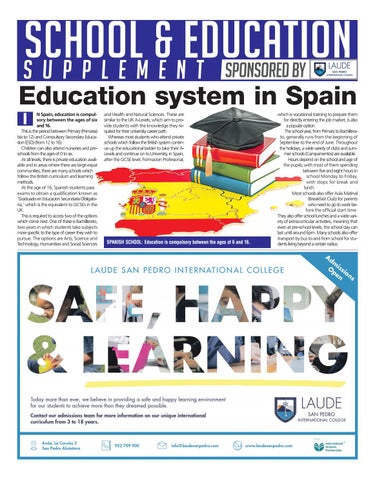
SPANISH SCHOOL: Education is compulsory between the ages of 6 and 16.
which is vocational training to prepare them for directly entering the job market, is also a popular option. The school year, from Primary to Bachillerato, generally runs from the beginning of September to the end of June. Throughout the holidays, a wide variety of clubs and summer schools (Campamentos) are available. Hours depend on the school and age of the pupils, with most of them spending between five and eight hours in school Monday to Friday, with stops for break and lunch. Most schools also offer Aula Matinal (Breakfast Club) for parents who need to go to work before the official start time. They also offer school lunches and a wide variety of extracurricular activities, meaning that even at pre-school levels, the school day can last until around 6pm. Many schools also offer transport by bus to and from school for students living beyond a certain radius.
2 EWN
M
25 February - 3 March 2021
AKING the decision to move to Spain and bringing your children with you is something which is sure to cause you to ask yourself at some point whether you have done the right thing. However, it is also likely that you have considered the benefits of your children being bilingual. Many parents are concerned about the language barrier, but in general, children find it easier to learn a language than adults, and the younger they start, the better. Even from a young age, if they have Spanish lessons and mix with native Spanish speakers, whether in school or elsewhere, they will soon pick it up. When you’re choosing a school, you may decide on a private school, amongst which there are many which follow the British curriculum and include Spanish lessons. This is one advantage they will have, as they will easily be able to follow the lessons in their own language and learn with all the advantages of the teaching methods used in private schools. Another is that they are bound to have classmates who speak Spanish and who can help them to develop their language skills. Encourage friendships with Spanish children and if possible, get to know the parents and maybe meet occasionally
Sponsored by
CDS
SCHOOL & EDUCATION
How can you help your children be fluent in two languages?
BILINGUAL: Don’t force things, find fun tasks and books they will enjoy. outside school, as this will give all involved a chance to practise their language skills. But speaking is not everything, so it is important from a certain age, they have Spanish lessons which also focus on reading and writing, and learning some of the hows and whys of Spanish grammar. Spanish lessons in private schools here tend to be well-structured and based on tried and tested learning methods.
Teachers are often fluent or native Spanish speakers, who specialise in teaching languages. Meanwhile, even if is the language in which they are learning at school, your children’s native language should also be kept up at home. If you are trying to learn Spanish yourself, it is not recommended that you do so with your child if you want them to maintain your own language too. It is easier
for them, until they can handle their bilingualism more efficiently, to keep different languages in different contexts. This will help them to get a better grasp on both languages. In time, they are likely to be capable of being their own interpreters, and switching seamlessly between two or more languages without a second thought. When it comes to Spanish state schools, it is important to know that
the level of English taught is rather low, or at least does not advance at a very fast pace, so private schools are always best if you want your children to advance in all subjects in their native language. The systems are very different in English and in Spanish, and if they are learning Spanish reading and writing at school, be sure to make this clear to them, and carry out learning tasks of the extra language slowly but steadily. It is best that they have learned the rules of one properly before you introduce a second language to read and write, but the speed at which this can be achieved will depend a lot on the child. Do not force things, find tasks which are fun and books which they will enjoy. If they already had a good grasp on English reading and writing before their move to Spain, that will be one thing less to worry about. Again, keep them speaking in English, and make sure the school encourages them to maintain good reading and writing skills. This will serve them well for the future, as they will not only speak it correctly but will read and write at a high level. Don’t stress too much about the language ‘barrier,’ instead, see it as an opportunity for your children to learn another language which will be a great advantage in their future.
SCHOOL & EDUCATION
CDS
Sponsored by
25 February - 3 March 2021
EWN
3
Sponsored by Spain’s best ranked universities S 4 EWN
25 February - 3 March 2021
PAIN is a popular destination for foreign students wanting to study abroad, as tuition fees are not overly high and both the climate and the cultural scene are attractive. However, many young people who have grown up in Spain and gone through the system here, in both public and private schooling, may consider going to university here. Fees at state universities range from about €700 to €2,000 per year, while private universities can cost as much as €20,000 per year. There are 76 universities in Spain, of which 45 are state-run, while 31 are private or run by the Catholic Church. Some of the best ranked are: Universidad Autónoma de Madrid Founded in 1968, it has eight faculties on three campuses, and is especially noted for its Faculty of Law. It prides itself in being the alma mater of King Felipe VI of Spain. Universitat de Barcelona Established in 1450, it’s among the oldest higher education institutions in the world, and currently
has more than 63,000 students in doctoral degree to a female stua wide array of undergraduate and dent, in 1785. postgraduate courses, across 16 Universidad de Navarra faculties and 106 departments. It was established in 1952 by Universitat Autónoma de Saint Josemaría Escrivá de Balaguer Barcelona and more than 11,400 students are The Universitat Autònoma de enrolled in the university’s underBarcelona, established in 1968, it graduate and postgraduate degree teaches over 40,000 students and programmes. The university’s main is famous for being one of the few campuses are in Pamplona and San universities in Spain to have a cenSebastián, while its prestigious tralised campus, created in order IESE Business School also has to promote university commuoffices in Barcelona, nity, with all academic, reMadrid, New York, Musearch, cultural and social acnich and São Paulo. tivities in the same place. Universidad PomUniversidad Complutense peu Fabra Madrid Pompeu Fabra UniThe oldest Spanish universiversity is still a fairly ty, it dates back to 1293, young university, havwhen it was originally ing been set up in known as Estudio de 1990 in Escuelas Generales de Barcelona. Its Alcalá, before receivstrengths lie in ing its current name social sciences, in 1499. More humanities, than 86,000 stuhealth, life scidents study in ences, comthe university, munications which was and ICT. It one of the has three first in the campuses loworld to cated across UNIVERSITY: There are 76 in Spain. give a Barcelona.
CDS
SCHOOL & EDUCATION
The language factor don’t see it as a barrier MANY parents putting their children into Spanish school may be concerned about the language barrier. In general, children find it easier to learn a language than adults, and the younger they start, the better. If they are in Spanish school, with Spanish classmates and teachers, although it may sound daunting to the parents, they will soon pick it up. The tendency in Spain is to place children who come to the school without any Spanish in a class below their age group, until their language skills have improved enough to follow lessons at the same pace as children their age. Schools in areas with lots of expats often have intensive language classes and extra lessons for their children in their first few weeks. Nowadays, there are ‘bilingual’ schools, in which certain core subjects from Primary, such as natural sciences or social sciences are taught in English. English lessons are quite low level, so if you want to make sure that your child has a good level in their English reading and writing, and not only speaking, this is something you will have to undertake yourself or find a private tutor or language school. If your child already has a good level of reading, writing and speaking in English, you may want to approach their English teacher at school to ask if they can bring in their own work to do. Don’t stress too much about the language ‘barrier’ to begin with, especially if your child is quite young, they will most probably learn the language with ease, and being bilingual will be a great advantage in their future.
SCHOOL & EDUCATION
CDS
Sponsored by
25 February - 3 March 2021
EWN
5
6 EWN
25 February - 3 March 2021
Advertising Feature
Sponsored by
CDS
SCHOOL & EDUCATION
A truly international school HE Benalmadena International College (BIC), situated in Benalmadena Costa, is purpose built on a 17,000 s q u a re m e t re p l o t , o n l y 300 metres from the sea. It is now celebrating its 25th anniversary. With a highly successful academic record, our students enjoy university success all around the world including the UK and Spain. We pride ourselves on a truly international intake of children with 29 nationalities who make up our very friendly and caring school. Education can start in our Early Year’s class at the age of two, working their way through Primary, Secondary and ultimately to sixth form classes. BIC pupils are constantly challenged to strive for excellence in all they undertake,
T
PURPOSE BUILT: BIC is in Benalmadena Costa. bringing out the best in each individual. W h i l s t t h e s c h o o l i s a c ademically demanding, we also place strong emphasis on providing an all-round education. We therefore strive to create an atmosphere where team w o r k a n d h u m a n re l a t i o n-
ships can develop in harmony, building, most importantly, inner confidence in each child. Our teaching staff are highly qualified to teach the British Curriculum with native teachers in our language department.
B I C i s re c o g n i s e d b y t h e Spanish Ministry of Education as a British school entitled to teach a full English curriculum. This involves periodic inspection by British inspectors. We a re n o w d e v e l o p i n g a n e w re l a t i o n s h i p w i t h t h e Council of British Internation-
al Schools, (COBIS). The college has been an examination centre with Edexcel Examination Board, London for nearly 20 years, producing the International General Certificate of Education examinations (IGCSE) and the International A Level examinations.
If you would like further details about our college, please contact us by email or telephone to discuss your child’s education.
SCHOOL & EDUCATION
CDS
Sponsored by
25 February - 3 March 2021
EWN
7
8 EWN
25 February - 3 March 2021
Advertising Feature
Sponsored by
CDS
SCHOOL & EDUCATION
Sunny View School, a place to thrive NE of the most important things a school can do is to create an environment which allows its students to truly thrive - academically, emotionally, personally and socially. Sunny View School in Torremolinos places a high value on its inclusive, caring and respectful atmosphere, a quality often commented on by visitors and newcomers to the school. This special environment, combined with quality teaching and modern resources and facilities, makes the school a place where students can, and do, thrive. The school’s academic success is evidenced by its students’ examination results, which are consistently well above the UK national average. The majority of its A level students go on to study at universities in the UK, Spain, elsewhere in Europe or the USA. Sunny View School firmly believes that the path to such success is as important as the results themselves. At each stage of the curriculum, from Preschool to A levels, the school’s team of experienced, UK-trained teaching staff strive to make learning fun, interactive, engaging and inspiring, with students actively involved in their own learning and development. This has continued to be the case during this unique academic year when the
O
SPECIAL ENVIRONMENT: Makes the school a place where students can and do thrive.
school has adapted its facilities and routines to ensure safety while maintaining a dynamic and stimulating learning environment. As always - and while strictly adhering to the current safety protocols - a wide variety of activities inside and outside the classroom allows students to broaden their experience and take on new challenges in an inclusive and supportive environment that engenders confidence and an enthusiasm for learning. Looking to the future, and to meet the needs of its growing student population, the school has also continued to expand and upgrade its facilities and resources. Last school year saw the launch of new libraries for both Primary and Secondary students, as well as a Sixth Form study area with an adjoining outdoor terrace. Playgrounds in Preschool and early Primary were remodelled and outfitted with new equipment. Yet while always evolving and advancing - as well as adapting to special circumstances such as the current public health situation - Sunny View School has maintained its strongest focus on what it does best: delivering quality, British education here on the Costa del Sol. And doing it within an environment that allows its students to truly thrive.
SCHOOL & EDUCATION
CDS
Sponsored by
25 February - 3 March 2021
EWN
9
10 EWN
25 February - 3 March 2021
Advertising Feature
Sponsored by
At your disposal ITHOUT continual growth and progress, such words as improvement, achievement, and success have no meaning.” Benjamin Franklin The team at MTA, Mallorca has been working to provide excellence in education and customer service for the past 12 years. Our journey started in September 2009 when we first took the initial steps to open our education centre, near Palma de Mallorca. Since then many things have changed and our business has grown into what it is today. So, it was with equal pride and excitement I took on our new venture; to expand onto the mainland of Spain, setting up in Malaga Province in February 2019. Our supplementary educational programmes are wide ranging and include English, mathematics and sciences at all levels up to A level. We also provide tuition
W
for students who need to improve their skills in Spanish and Catalan, again at all levels. We are committed to continue to work closely with our clients utilising our highly regarded academic excellence and experience. Our primary focus here on the Costa del Sol is to offer an individually tailored AS and A level programme in conjunction with our online partner Wolsey Hall. Whilst building the students’ confidence in their chosen subjects they develop the ability to learn independently. Our students enjoy working with us and the modern technology that forms the foundation to their studies. The MTA team are passionate about education in the widest sense so that each student can realise their full potential. Whether you are based on Mallorca or in the Costa del Sol we will be at your disposal.
EXCELLENCE IN EDUCATION IS OUR PASSION AND GOAL AT THE MTA GROUP Contact us: +34 951 518 821 - +34 660 976 322 julie@tutoringacademy.eu • www.tutoringacademy.eu
CDS
SCHOOL & EDUCATION
Early years and primary in private schools SPAIN has a number of private schools which follow the British Curriculum through the early years of learning. The term starts in September, although many private schools will admit new students at any point during the school year. Private schools will be happy to offer you a tour of the premises upon request and answer any questions you may have regarding the facilities and the learning methods. In Spain, what level a child is in, is strictly based on the calendar year of their birth, meaning that children born in January are the oldest in their class, and those born between October and December are closer in age to the year below them. This also applies in many private schools following the British curriculum. The first years, Kindergarten, Nursery and Reception, known as Early Years Foundation Stage teach social and personal values, as well as physical and mental skills. Writing and reading is introduced gradually, and a series of skills are expected to be met. Students should use written language in play and learning, use phonic knowledge to write simple regular words and make phonetically plausible attempts at more complex words. They should also
be able to show an understanding of how information can be found in non-fiction texts to answer where, who, why and how questions, as well as form simple sentences, sometimes using punctuation. There are also maths lessons, and activities keyed towards understanding the world and expression through art and design. The Primary Stage, lasts from Year 1 (age five to six) to Year 6 (age 10 to 11), and is divided into Key Stage 1 (Years 1 and 2) and Key Stage 2 (Years 3, 4, 5 and 6). The learning areas for all pupils in Key Stage 1 are Language and Literacy, Mathematics and Numeracy, Arts, the World Around Us, Personal Development and Mutual Understanding and Physical Education. Meanwhile, in Key Stage 2, there are more areas, which are English, Mathematics, Science, Design Technology, History, Geography, Art and Design, Music, Physical Education (PE), Computing, Foreign Languages and PSHE or citizenship. At the end of Year 6, students take the National Curriculum Tests, colloquially known as SATs which cover English and Maths.
SCHOOL & EDUCATION
CDS
Sponsored by
25 February - 3 March 2021
EWN 11
12 EWN
25 February - 3 March 2021
Advertising Feature
Sponsored by
CDS
SCHOOL & EDUCATION
The Essentials Package at InterHigh: Get started with online learning HE Essentials P a c k a g e f ro m I n terHigh is perfect for those wanting to try o n l i n e s c h o o l i n g . I n t e rHigh has been delivering a British education to children in the UK and around the world since 2005. We provide an interactive education for students aged eight - 18, from KS2 up to international GCSE and Alevel standard. If you’re looking to step into the world of online learning, the InterHigh Essentials Package gives you a taste of learning with an online school. Our three introductory subjects of English, Maths and Science will each be delivered by our teachers in a live, online classroom. Plus, access to an online
T
ONLINE LEARNING: Students can enjoy all the usual benefits of school and feedback from teachers. school tutorial, guiding students on progress and next steps. Our mission at InterHigh is to engage students online and encourage them to reach their full academic potential. Students enjoy all the usual benefits of school,
including socialising with classmates, societies and p e r s o n a l f e e d b a c k f ro m teachers. It’s not just about academic progress, we create a community that is supportive to every individual. Our platform and teaching model provide an unrivalled
and flexible opportunity for students to pursue their personal interests, hobbies, and goals. There is less classroom distractions and better class sizes, so they get the time they need. Our students even include young entrepreneurs and profession-
als in sport, music and acting. Online schooling gives y o u r c h i l d m o re f l e x i b i l i t y with their education. Lessons are streamed live and then stored and can be accessed online 24/7. This enables students to catch up if they’ve had to miss lessons due to sickness or other commitments. We have several fee packages, with differing levels of commitment to suit most circumstances. In most cases, parents have the option to pay in instalments, spreading t h e c o s t m o n t h l y. W i t h prices for the Essentials Package starting from £12 a d a y, s t u d e n t s a ro u n d t h e w o r l d a re d i s c o v e r i n g t h e benefits of online education, at an affordable price.
Find out more about how your child can join our thriving online school by visiting www.interhigh.co.uk/apply.
place main road.
www.marbellahorses.com
SCHOOL & EDUCATION
CDS
Sponsored by
25 February - 3 March 2021
EWN 13
14 EWN
25 February - 3 March 2021
Sponsored by
CDS
SCHOOL & EDUCATION
Much more than just child’s play LAYING - if we let them, most children would spend their time doing just that. And as adults, we only have vague memories of our own childhood play favourite toys and games, but not exactly how we played. We may think that a child’s playtime is serving no other purpose but to entertain them, but if carefully handled, it can be so much more. This is why in many schools, play is now an integral part of learning in early years, and the games and activities students are given in class are there to develop important skills, not only academic, but also social. Educators no longer believe in separating subjects and putting them in their own boxes either, so there is no reason why maths can’t be learned through artistic creation, for example. One of the areas of play is often roleplay, this can be in the classroom, often in specially created play areas such as a kitchen, a restaurant, a house, a shop, or a doctor’s office. The children learn to express themselves better, explore and expand language, develop feelings about themselves and others, develop motor skills and learn to work together. They imitate and recreate scenes from daily life which are familiar to them,
P
PLAY OPTIONS: There are a wide variety. but at the same time, use their imaginations, a skill which will stand them in good stead in the future. This type of play can be combined with dressing-up, also a great way to improve story-telling skills. Another area of play seen often in classrooms is sand and water. These two substances, either separately or combined, delight most children and will engage them for long periods of time. Children learn through their sens-
es and one of those is touch. Playing with sand and water is a gratifying sensory experience, but can also serve to see if things float or sink, whether they hold water or absorb it, see what patterns can be made in the sand with the hands or with other objects and to learn the meaning of quantities by measuring. Talking about these experiences can develop a huge number of words for their vocabulary and a
wide variety of skills, such as pre-writing skills by making patterns or making up stories with the toys used to play. Have you ever considered that playing with dough, plasticine or clay can teach your children skills? Consider this, handling them can allow children to explore their properties and talk about them and how they change. They can learn pre-writing skills by using tools to mark them and also explore the different shapes and forms that can be made from them. Shaping the clay or dough also exercises the fingers and thumbs, which can improve their grip on pencils and ensure better handwriting skills. They can also make snakes of different lengths and thicknesses, which develops an understanding of size and maths skills, as well as the chance to make letters and encourage reading skills. It’s easy and inexpensive to make dough for children to safely play with, and will provide them with hours of fun. There are also a wide variety of activities which are set out on tables for children and can help to improve concentration, memory and analytical skills, these include classics such as jigsaw puzzles, snap cards, memory cards, lacing and threading games, magnetic toys and many others.
SCHOOL & EDUCATION
CDS
Sponsored by
25 February - 3 March 2021
EWN 15
16 EWN
25 February - 3 March 2021
Sponsored by
The journey through Secondary ROM age 11, students begin secondary school, leading up to their GCSE exams at the age of 16. Secondary is divided into two stages, Key Stage 3 (Years 7, 8 and 9) and Key Stage 4 (Years 10 and 11). In the first of the two stages, students have lessons in English, Mathematics, Science, Computing, Design and Technology, History, Geography, Modern Foreign Language, Art and Design, Music, Physical Education and PSHE (which includes lessons in Citizenship, Sex Education and Career Education). In the second, they study English, Mathematics, Science, Information and Communication Technology, Physical Education and studies relating to citizenship, career guidance and other areas. There are also optional subjects in the following areas: Arts, Design and Technology, Humanities and Healthcare and Modern Foreign Languages. At the end of this stage, in
F
Year 11, when pupils are aged 15 or 16 (depending on their birthday) they are normally entered for external examinations. Most frequently, these are IGCSEs (International General Certificate of Secondary Education) examinations, although a range of other qualifications is growing in popularity. These examinations are not all based on the results of papers taken throughout May and June, but many also have a component of coursework which is carried out with the guidance of the teachers at their school. Education throughout the earlier stages of learning in this system is all geared to passing these exams and the skills learned, essay writing amongst others, especially going through Key Stage 3, are to help pass them. Schools will enter students for the exams, which have a fee, and their learning will be targeted specifically to learning the methods to correctly complete them.
CDS
SCHOOL & EDUCATION
Handling home schooling WE’VE already been through it once, and learning from home can be challenging for students, parents and of course, teachers. Although we hope that schools will not be forced to close again, there are some measures which can be taken to make teaching from home easier on everybody. Maintain routine - Parents who are working from home will have to do that anyway, but those who aren’t, should try to stick to their children’s usual routine, encourage them to be up, dressed, and sat down ready to begin lessons at the same time as normal. Teachers will appreciate them being on time and looking ready for lessons. Be helpful, but not overbearing Make sure your children, both small and older, have what they need for the lesson, but unless it’s necessary, don’t watch over them the whole time. Unless they are very small, think that in class, their teacher would be keeping an eye on them, but cannot be with each individual child all the time. Make sure they know what is being asked of them, be on hand to help if necessary, but give them some autonomy. Teachers will appreciate your confidence in
them and their teaching methods. Not everyone is the same - You may think that the work which has been set by the teacher is too much or too little for your child, but remember, it has been set with all students in mind and they will not all be able to work at the same level. If you need the work to be adapted, get in touch with the teacher privately. They will almost certainly be happy to give you extra work or point you in the right direction of where to find it, or if you need to reduce the workload, they will be able to tell you what to prioritise. Be understanding - Whether your child is in private school or state school, unless the situation is very bad, if you have a complaint,
talk to the teacher first and give constructive criticism rather than going over their heads. Remember that in most cases, they are doing their best, often combining teaching with their own children’s home schooling, working with limited resources and frequently putting in crazy hours to get lessons prepared, all with the students’ best interests at heart. A school day has several hours, and although it may be difficult, make sure your child sticks to those hours as much as possible. Give praise and rewards - Praise your child when they do good work and encourage them to do their best. When school hours are over and any homework or studying is done, allow them and the whole family to disconnect from anything school-related and relax with a favourite pastime.
AT HOME: Maintain a routine.
SCHOOL & EDUCATION
CDS
Sponsored by
25 February - 3 March 2021
EWN 17
18 EWN
25 February - 3 March 2021
Sponsored by
CDS
SCHOOL & EDUCATION
Why choose private school VERY year, parents face the decision regarding whether they should send their children to private school, which, of course, is an added expense to the family budget, but has many benefits to consider. No-one left behind Class sizes are generally smaller in private schools, meaning that the teachers’ time is not divided among so many students. This means that they can give more individual attention to each student. This means that they will be able to focus on children who are talented in certain areas, setting them differentiated tasks so that their skills are not wasted or lost in the crowd. On the other hand, they can help students who might be finding certain subjects a little challenging, giving them work adapted to their level which will help them to achieve their goals little by little and not lose interest when they realise they don’t grasp certain concepts at the same rate as their classmates. In Early Years stages, there are Teaching Assistants, who support
E
small groups or even individual students during lessons, to focus on aspects with which they may have more difficulty while the teacher can continue to make progress with the rest of the class. Your children will also be in a more nurturing environment. Smaller classes mean the teachers get to know their students better and are more likely to become aware if there is a situation which is worrying them or if there is something going on in their lives. Above and beyond Private school teachers are typically well-qualified and dedicated to transmitting their knowledge in the best way possible, with specialised lesson plans to fulfil the curriculum in which they ensure that children are learning in a fun and engaging way. These teachers want their students to receive the best education possible and having access to the resources and technology needed to introduce different learning styles, bringing together both the traditional and the interactive, in order to give your child the best start.
PRIVATE EDUCATION: Will help your child develop at many levels. Safe as houses The safety of their children is a top priority for all parents, and private schools have much stricter safety measures in place. This includes controls so that only authorised members of the family can take the children out of school, a tighter watch on possible cases of cyber-bullying and more adults on the premises with a better teacher-
student ratio. Playgrounds are watched for violent or suspicious behaviour to ensure that a safe environment is provided. Get involved Private schools often make more of an effort to involve parents and get them to participate in daily life at school. This gives parents a better understanding of their child’s education and they can meet with
the teachers or contact them more frequently. Private schools also tend to provide a community feeling for students and their families, with activities and events, allowing children of different ages to mix. This means students feel more at home in school and have no qualms about interacting with older or younger children as equals. Getting on in life The number of students who go to better rated universities is higher amongst those who have studied at private school. They achieve better grades and as they are mainly surrounded by peers who also aspire to the same standards and generally pursue other beneficial activities outside school, such as sports, music, art, etc. An investment for the future Investing in private education will help your child develop at many levels, as well as preparing them for future academic success. There are many excellent private schools throughout Spain, some offering education in English or other languages, others following the Spanish curriculum. It is a case of finding what best suits your needs.
SCHOOL & EDUCATION
CDS
Sponsored by
25 February - 3 March 2021
EWN 19
20 EWN
25 February - 3 March 2021
Sponsored by
CDS
SCHOOL & EDUCATION