DISCUSSION PAPER 2 SEPTEMBER 2026
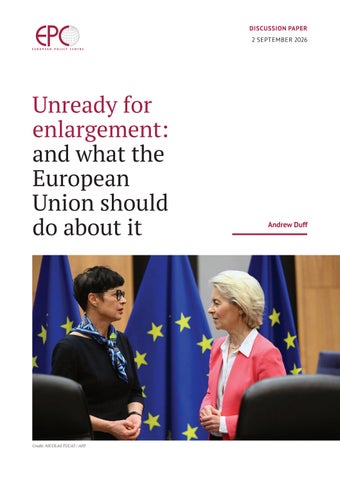
Unready for enlargement: and what the European Union should do about it
Credit: NICOLAS TUCAT / AFP
Andrew Duff
Table of contents Executive summary
3
The promise
4
The preparation
5
The premise
5
The proposals
6
Facing up to the member states
9
Endnotes
11
ABOUT THE AUTHOR Andrew Duff represented the European Parliament at the drafting of the Treaty of Lisbon. He is a Senior Academic Fellow of the European Policy Centre. @andrewduffeu.bsky.social
ACKNOWLEDGEMENTS / DISCLAIMER The support the European Policy Centre receives for its ongoing operations, or specifically for its publications, does not constitute an endorsement of their contents, which reflect the views of the authors only. Supporters and partners cannot be held responsible for any use that may be made of the information contained therein.
Executive summary In this paper, Andrew Duff looks again at the dual challenge facing the European Union of enlarging its membership and reforming its government. Despite its rhetorical support for enlargement, the European Council is floundering. It falls to the Commission of President Ursula von der Leyen now to deliver on its promises to speed enlargement, enhance security and strengthen EU government. The Commission might also learn how to campaign for Europe at elections and referendums.
Duff makes proposals, including two treaty amendments, aimed at making the case before enlargement and avoiding deadlock afterwards. The reforms involve accelerating the accession process; rationalising the composition of the European Parliament; cutting the size of the Commission; drafting a new defence treaty and creating a European security council; and, above all, facilitating the deployment of the ‘passerelle’ clause and widening its scope. Without such democratic reform, he argues, an enlarged Union will fail.
3
The promise Three years ago, in September 2023, Commission President Ursula von der Leyen addressed the question of whether the European Union was ready to expand its membership. Confirming her commitment to the principle of enlargement, she reassured the European Parliament that she also backed the reform of the EU’s system of government – even if that meant re-opening the EU treaties. She continued:
The European Council, never uncomplicated, has always had to contend with various degrees of federalist ambition, euroscepticism and downright nationalism. Some member states (a group notoriously led in its time by the UK) favoured enlargement in the belief it would weaken the drive towards federal union. In the Balkans, especially, support for enlargement has always been highly selective. Divisions between richer and poorer member states, worried about the budgetary implications of adding new members, are inevitable. And for the last 20 years, Germany and France have not been able to agree to seriously promote either enlargement or reform, while all the time paying lip-service to the ‘in parallel’ fallacy.3
“But we cannot – and we should not – wait for Treaty change to move ahead with enlargement. A Union fit for enlargement can be achieved faster. That means answering practical questions about how a Union of over 30 countries will work in practice. And in particular about our capacity to act.
Europe, meanwhile, is increasingly threatened by the imperialistic behaviour of America, China and Russia. The EU’s welfare and security relies on its ability to react strongly to these external challenges, most vividly Russia’s invasion of Ukraine. A resilient EU requires stable and robust borders. An EU that is rapidly developing its defence dimension is bound to take on a care for the wider European neighbourhood. Enlargement is a powerful tool of foreign and security policy. Unashamed territorial expansion is one obvious way for the Union to project its own liberal democratic values and promote its interests.
The good news is that with every enlargement those who said it would make us less efficient were proven wrong. ... So it can be done. But we need to look closer at each policy and see how they would be affected by a larger Union. This is why the Commission will start working on a series of pre-enlargement policy reviews to see how each area may need to be adapted to a larger Union.1 We will need to think about how our institutions would work – how the Parliament and the Commission would look. We need to discuss the future of our budget – in terms of what it finances, how it finances it, and how it is financed. And we need to understand how to ensure credible security commitments in a world where deterrence matters more than ever.
An EU that is rapidly developing its defence dimension is bound to take on a care for the wider European neighbourhood.
These are questions we must address today if we want to be ready for tomorrow. And the Commission will play its part.”2 One hopes she knew what she was taking on. A thorough review process was what should have happened, but did not, after the French rejected the EU’s new constitutional treaty in 2005. The same should have happened, but did not, after the financial crash in 2012. Equally lacking was a deep reflection about the future of the Union after Brexit in 2020. Von der Leyen was now proposing to do two big things at once, enlargement and reform, when the EU is usually unable to do even one big thing once. The ambition to accomplish enlargement and reform in parallel was bold indeed; and it soon ran into difficulties.
Resistance to enlargement by some member states may continue for a further while, but will ultimately prove futile. Inevitably, the EU will have to confront the geopolitical reality that it must admit many new member states if it is to remain true to its treaty values and viable as a polity. Pressure from frustrated candidate states will continue to build whether or not the EU’s internal operating system is reformed or continues to deteriorate. Someday the dam will burst, especially if Putin and Trump do a sudden, dirty deal on Ukraine. Yet rapid advance to the fulfilment of all membership criteria in 2028 by the frontrunner Montenegro, a small and fragile state, may not be enough to break the logjam. As things stand today, the EU is unready for enlargement.4
The problem was that the doctrine of parallel progress could be accepted glibly as a holding pattern by all member states, combining those that wished to stop enlargement with those opposed to deeper integration.
4
The preparation So what happened to von der Leyen’s pre-enlargement papers? In March 2024, the Commission published some important first thoughts on solving the ‘in parallel’ conundrum.5 “Enlargement”, it said, “is in the Union’s own strategic interest ... The EU must deepen as it widens ... and use enlargement as a catalyst for progress”. Emphasising the importance of the values of the Union, new tools will be needed to “ensure the rule of law is truly and consistently upheld across the EU, beyond accession”. The enlargement process should be adapted to allow for the gradual admission of accession states to the single market. Several ambitious proposals are advanced for the early connection of the new members to the common social and economic policies of the Union. Enlargement will require a thorough assessment of the long-term viability and sustainability of the common agriculture policy. The new multiannual financial framework (MFF) for 2028–2035 should be cast assuming an enlarged Union.
The Commission hopes for a more flexible, differentiated approach whereby a core group of integrationist member states acts as a vanguard under the enhanced cooperation rules of Lisbon.8 It suggests some (unspecified) relaxation of the rules governing the accession process. It questions whether the European Council should continue to insist that each member state have its own member of the Commission. And it worries about the increased workload on the institutions implied by enlargement. The General Affairs Council, whose job it is, has made no progress in taking forward the issues raised in the Commission’s interim paper.9 The European Council has not dared to open the dossier, and, stupidly, even declines to set up a non-institutional expert group to reflect and advise on options for reform.10 That omission may be serious as many of the current batch of heads of state or government are fairly illiterate in the constitutional niceties of their Union. The only thing on which all the leaders agree is that the EU needs to improve its capacity to act decisively and effectively.
On governance, however, the Commission’s paper of 2024 rather grinds to a halt. “So far”, it admits, “no consensus has been found on how best to approach this issue.” It accepts that efforts to exploit in full the potential of the current Treaty of Lisbon (2007) are blocked by national vetoes. The central question is how far to shift decision-making in the Council of ministers from unanimity to qualified majority voting (QMV).6 The Commission paper points to the dysfunctional passerelle facility designed to enable just such a democratic reform. It hazards that any decision to deploy the passerelle should be accompanied by a caveat clause allowing escalation to the level of the European Council of a dispute over a vital strategic national interest.7 That the European Council itself would have to act by unanimity in those circumstances will not have been lost on the authors of the Commission’s paper.
The European Parliament, on the other hand, has been proactive, even restless, if not always consistent. It produces resolutions containing high ambition for structural change and treaty amendment.11 MEPs are much concerned with protecting the prerogatives of their own institution, including the reapportionment of seats in the House after enlargement. After a long delay, the Commission now promises to publish the series of pre-enlargement papers on 30 September in time for a critical meeting of the European Council on 15–16 October. Von der Leyen’s late delivery of her package evinces a lack of a self-confident, coherent strategy; and it certainly did not help Iceland as it toyed with a misjudged referendum on restarting accession talks.12
The premise Nationalism is the antithesis of liberal democracy.
So how are we to judge the Commission’s eventual contribution? The Commission would do well to establish that for Europe, at least, obsession with national sovereignty is anachronistic. Nationalism does not help Europeans rise to meet the challenges of trade, technology, climate, security, culture or immigration. Nationalism is the antithesis of liberal democracy. That indeed is why the evolution of EU government is such an important and delicate matter. How the Union manages the democratic transition from a troubled confederation of independent states into a confident federation of interdependent member states is what engages us.
The process is necessarily complicated and long-winded: unlike the American founding fathers, we have no George Washington on whom to hang the federal experiment; workable compromises cannot simply be thrashed out as in 1789 when James Madison and Alexander Hamilton went to dinner at the Jeffersons. The EU works best
5
according to the operation of the Community method, inspired by Jean Monnet, driven by supranational institutions, secured in treaty amendment and subject to legitimation by national constitutional methods. This is how the Union has developed so far, and this is how it must continue. A strong Commission, chastened by the secession of Britain and the hesitation of Iceland, would be wise to spell out how it intends in future to articulate the case for enlargement and justify the emergence of supranational government to a European public opinion often suspicious of integration, distracted by populism and seduced by nationalism.
supplement and, as necessary, set up new arrangements as a substitute for NATO defence. The priority is to address Europe’s military shortcomings. The Treaty of Lisbon provides for the development of an EU defence policy compatible with NATO strategy that will lead to EU common defence when the European Council so decides. A majority of member states intend to exploit these provisions.15 In setting the stage for enlargement, the EU should aim to recall the United Kingdom, the only member state to have seceded.16 Having lost its empire, Britain found a decent role as an EU member state for nearly 50 years. In an unforced error of a referendum in 2016, the UK has once again lost its moorings, rendering the EU smaller, weaker and poorer. Brexit is now recognised as a bad mistake by a democratic majority in the country and in Parliament at Westminster. Perhaps the new Labour Government under Andy Burnham, having fiddled around on the edges of Boris Johnson’s secession deal and toyed with inferior alternatives to full membership, will have the sense to trigger Article 49. An early accession to the EU by Ukraine, which Britain strongly supports, would make a big impression on British public opinion.17
Article 49 of the Treaty on European Union (TEU) lays down that the Union is open to any European state which respects its values, and is committed to promoting them, to apply to become a member. Candidate states will be helped in their accession bids, a task particularly arduous for those emerging from a relatively recent Soviet past. Although Ukraine will not be allowed by the US to join NATO, the country is generally accepted as a member of the transatlantic security community.13 The EU will defend Ukraine’s cultural and political integrity as a sovereign state so that it can take its rightful place as a federal member state equal to others.14 The EU has no imperial intentions as far as Russia is concerned, but is adamant that Ukraine will be admitted to the EU as a full member state despite objections from the Kremlin.
These are the key geopolitical developments that form the context for the current exercise in EU enlargement. They shape the kind of Union new member states will be signing up to join. They also form the backdrop to important 2027 elections in France, Italy, Poland and Spain.
The EU knows that NATO is not the reliable security alliance it once was. While NATO’s EU member states remain loyal to the Atlantic Alliance, they are moving to
The proposals The Commission is well-meaning with regard to institutional reform, but has been too timid in its pursuit. President von der Leyen is right to say that treaty amendment must happen where it is necessitated. The European Parliament is right to encourage her, even if it may be over-reaching itself in demanding in short term a full-blown Convention to overhaul the Treaty of Lisbon.18 Things constitutional can go backwards, especially if they are ill-prepared.
reform. We here recommend a small number of incisive reforms designed to streamline enlargement, strengthen the executive authority of the Commission, improve the efficacy of the European Council and Council of ministers, and enhance the legitimacy of the European Parliament. The additional number of government ministers around the table will make Council decision-making more complex. Those from the Western Balkans, in particular, despite their geographical proximity and mutual interest in regional cohesion, will represent widely divergent political views, laden with contested legacy. Moreover, internal divergence in economic wealth and social development is set to increase markedly with enlargement: war-torn Ukraine, Europe’s poorest country, has a GDP per capita of roughly €6000 – compared with Poland’s €27,000.
There is no point in candidates joining up to a federal union that is not working well.
The enlarged Union will require much greater differentiation in EU policy between the fastest and slowest member states. Such flexibility demands robust institutional coherence if EU law is to be applied efficiently across them all. The Commission and its executive agencies must strengthen their techniques to monitor the implementation of EU policy by national
The dilemma is that the EU does not work well at the moment with 27 member states: unreformed, it will seize up entirely with 30 + members. Frankly, there is no point in candidates joining up to a federal union that is not working well, knows it, but is closed to the prospect of 6
administrations and, inevitably, to fight domestic political corruption and international organised crime. The deployment of enhanced cooperation by the more integrationist member states will doubtless become more common, and should not be resisted.19
draft legislation on the grounds of breach of subsidiarity will remain intact in accordance with the Protocol on the role of National Parliaments in the European Union. A draft of the amendment is as follows: Article 48(7)
The Council
"7. Where the Treaty on the Functioning of the European Union or Title V of this Treaty provides for the Council to act by unanimity in a given area or case, the European Council may adopt a decision authorising the Council to act by a qualified majority in that area or in that case. This subparagraph shall not apply to decisions with military implications or those in the area of defence.
For the sake of expediency, the first priority must be to unblock the accession process without lowering standards. Ukraine is indeed a special case and must not be held hostage by individual member states, such as Hungary, as it tries to take the path of western integration. Article 49 insists on unanimity in the European Council only at the start and end of the accession process. In the interim, it should fall to the Commission to assess the candidate’s fulfilment of the acquis communautaire, stage by stage.20 The Commission should now insist on a return to the spirit and letter of the treaties. It should initiate the relaxation of the current laborious accession procedures that have given to any single member of the Council the power to veto each step.21 Instead, Commission decisions should only be reversible by the Council according to a qualified majority vote.22 The Commission should also write into the Ukrainian accession treaty a roadmap for the reforms that Kyiv will still need to undertake after joining, during a necessarily long transition period, as it steadily assumes all the rights and obligations of membership.23 Where Ukraine leads, others will follow. The time of ‘vetocracy’, where the European Council and Council of ministers have departed from the Monnet method, must soon be over.24
Where the Treaty on the Functioning of the European Union provides for legislative acts to be adopted by the Council in accordance with a special legislative procedure, the European Council may adopt a decision allowing for the adoption of such acts in accordance with the ordinary legislative procedure. Any initiative taken by the European Council on the basis of the first or the second subparagraph shall be notified to the national Parliaments. If a national Parliament makes known its opposition within six months of the date of such notification, the decision referred to in the first or the second subparagraph shall not be adopted. In the absence of opposition, the European Council may adopt the decision. For the adoption of the decisions referred to in the first and second subparagraphs, the European Council shall act by unanimity a qualified majority as defined in four fifths of its members representing at least two thirds of the total population of the Union, after obtaining the consent of the European Parliament, which shall be given by a majority of its component members."26
So we come to the heart of the matter, which is reforming the voting procedure in the Council. Article 48(7) TEU, the passerelle or bridging clause, was invented to allow the Council to make further democratic steps to fulfil the objectives of the treaties once political circumstances permitted. Unfortunately, however, unanimity was imposed on decisions to actually deploy the passerelle. Worse, any single national parliament can usurp the power of the European Parliament under the ordinary legislative procedure and veto use of the passerelle. So it has never been used. The Council continues to labour under the constant threat of the national veto, to its own evident frustration.
Further to the revision of the passerelle clause, the Commission should also propose the suppression in its entirety of Article 353 of the Treaty of the Functioning of the European Union (TFEU). This clause was added to the Lisbon treaty, largely to placate the UK, in order to prohibit the application of the passerelle to four cardinal provisions of the treaty. These are Article 311 concerning Council decisions on revenue to the EU budget (‘own resources’); Article 312(2) concerning the Council decision on the MFF; Article 352, the famous ‘flexibility clause’, which allows the Union to supplement its powers in pursuit of treaty objectives; and Article 354 which sets out the decisionmaking procedure for the operation of the Article 7 TEU procedures in respect of breaches by a member state of the values of the Union.
The Council continues to labour under the constant threat of the national veto, to its own evident frustration.
These proposed amendments to the treaty would liberate the Council from paralysis over the current MFF negotiations and allow the European Parliament to assume full democratic control over the whole of the budget, like any normal parliament. The revisions would not force either the Commission or the Council to
The Commission, backed by the Parliament, now has the chance to press for a simple treaty amendment to lift this shadow.25 In place of unanimity, the amended passerelle should be triggered by a high-threshold majority vote. The normal rights of national parliaments to call in any 7
identify at this stage precisely where it wished to deploy the passerelle. But removing the threat of the veto from the Council will change the diplomatic climate, creating the potential for quicker and better law making in the future. The reform will lead to the deployment of new, more flexible instruments for efficient EU government. And it will make more realisable the penalisation of an errant member state. QMV in the Council and codecision with the Parliament would be extended across the board. Although the general passerelle clause does not apply to foreign policy issues, one could expect the practice of QMV to spread to other sectors of EU government, as is already permissible in foreign and security policy (but not defence).27
comprehensible and durable. In theory, the right to initiate the distribution of seats falls to the Parliament itself.30 In practice, seats have been bartered between member states in an unseemly way, a practice which undermines the legitimacy of Parliament in the constitutional courts and causes jealousies and resentment among member states (even those who do not care much for the Parliament itself). The prospect of the Western Balkans countries squabbling over the 751st seat in the House hardly bears thinking about. The good news is that eminent mathematicians have been discussing this problem for years; they should be invited to assist the institutions to define a final formula for seat allocation that meets the treaty requirements of degressive proportionality based on the total resident population of the states, as certified by Eurostat. The Commission needs to take seriously its responsibilities to help the Parliament and European Council reach an enlargement-proof agreement on this important constitutional issue.31 Left to their own devices, for fairly obvious reasons, MEPs have proven themselves unable to make a decisive objective proposal.
The Commission The impending enlargement is the perfect time to return to some unfinished business concerning the other institutions. The European Commission at 27 is already too big, forcing von der Leyen to parcel out some rather spurious jobs, risking incoherence. The prospect of a college of over 30 members is ludicrous. Moreover, that every member state nominates one of its own nationals to the Commission weakens its character as a supranational executive and parrots the many powerful intergovernmental organs that also sit in Brussels, principally the Committee of Permanent Representatives (COREPER), the Political and Security Committee and the Council’s many working groups. The EU should use this opportunity to insist that when it is next convened in 2029, the Commission will comprise only two thirds of the number of member states.
Defence The Commission’s pre-enlargement review is bound to cover the Union’s readiness to defend itself against an unprovoked attack by Russia. The nature of Russian aggression can take many forms and none can be excluded: terrorism on EU territory, cyberattacks against critical infrastructure, espionage and political destabilisation, or even a military incursion across the borders of an eastern member state. If the EU cannot fill the alarming security vacuum in the Western Balkans, irredentist Russia will be keen to move in— with China and Turkey not far behind. Only EU membership will secure a western orientation for the whole Balkans region.
The prospect of a college of over 30 members is ludicrous.
Likewise, the two ex-Soviet countries, Ukraine and Moldova, have applied for EU membership for both economic and security reasons. As the EU speeds to develop its own defence dimension, so grows its attraction to Kyiv and Chisinau. The Union is having to act quickly at a time when, thanks to Donald J Trump, the NATO alliance is in big disarray and probable terminal decline. Progress has begun, but it will take time for EU states to reverse their spending cuts on their armed forces, to mobilise joint arms procurement and to develop shared military capacity including mechanisms for command and control. There is also the daunting democratic task of convincing western electorates not only that the security threat is real but also that the EU’s response is credible. (The Icelanders were clearly unpersuaded.)
This reform will strengthen the power of the Presidentelect to pick his or her own quality team. It will also accord with the spirit and the letter of the Lisbon treaty which already prescribes such a smaller college.28 It was unfortunate that in 2009 the Irish government insisted on keeping ‘its’ Commissioner as a price to pay to re-run their botched referendum on Lisbon; the current Irish term presidency of the Council would do well to announce a change of tack. President of the European Council António Costa should insist that his colleagues now agree on a formula to reduce the size (and cost) of the college, ensuring the strictly equal rotation of Commissioners between member states, reflecting demographic and regional range.29
As the EU speeds to develop its own defence dimension, so grows its attraction to Kyiv and Chisinau.
The Parliament Another urgent item of unfinished business is to agree a method for the apportionment of seats in the European Parliament that is fair, transparent, 8
institutions but supplement them with a European security council, a body capable of responding in short order to Russian and other crisis threats by nonstate actors. The new system will complement the current and envisaged efforts of certain member states to collaborate in permanent structured cooperation within the EU framework (PESCO).35 It will overcome the obstacle posed by the Lisbon treaty that actually prevents the integration under single market rules of the arms industries.36 Such a treaty should be drafted and ready for signature early in 2027. It should be designed for future incorporation within the EU treaties proper once circumstances permit.
President von der Leyen will be wise to pick up the proposal of her defence Commissioner, Andrius Kubilius, for a new intergovernmental treaty whose purpose is to prepare the EU to operationalise common defence.32 Such a treaty should include as signatories in the first instance Ukraine and Moldova as well as the UK, Norway, Canada and Iceland.33 The defence treaty arrangement will be the natural evolution of the concept of the coalition of the willing advanced by France and Britain and of other practicable examples of military collaboration in the region.34 The new treaty should utilise as far as possible the EU
Facing up to the member states The revelation of the Commission’s pre-enlargement strategy this autumn is a critical moment for the Union. If the Commission sticks to technicalities, its proposals for the reform of the way the EU is governed will fall way below what is required to measure up to the challenge of enlargement. If, on the other hand, the Commission steps up and fulfils its role as the pilot of integration, widening and deepening in parallel may at last become a reality.
the EU’s incapacity to act on his proposed reform package speaks volumes. His answer is a “pragmatic federalism” where states that want to move ahead are not held back by the EU’s existing institutional framework.38 But without a decisive and specific initiative from the Commission, a viable coalition of integration minded states seems unlikely to emerge of its own accord.39 European leadership, articulating the common European interest, is lamentably thin on the ground, especially at a time when right-wing nationalism is a formidable force in several member states.
In an enlarged Union where greater differentiation is inevitable, one can expect the Commission to reiterate its support for recourse to enhanced cooperation. Where there is disagreement in the Council, the Commission will encourage the minority to formally abstain rather than block; this tactic would be particularly helpful in foreign policy decisions, not least over sanctions.37
Without a decisive and specific initiative from the Commission, a viable coalition of integration minded states seems unlikely to emerge of its own accord.
Three important institutional reforms will ease enlargement and the assimilation of new member states, namely, changing the methodology of the formal accession process in Council; reducing the size of the Commission after 2029; and agreeing on a mathematical formula for seat allocation in the European Parliament. Further, as a response to Europe’s security crisis, a new intergovernmental treaty is now required to drive forward Europe’s common defence. This treaty should embrace the Union’s close neighbours whether or not they are candidates for EU membership.
The real question is can the EU insure itself against a breakdown of its institutions under the pressure of integrating new member states. How robust, indeed, is the case for enlargement without decisive steps being taken towards political union? The putative accession of a prodigal Britain and hesitant Iceland and Norway can well be justified as being unequivocally good for the Union.40 But is the EU confident that it can sustain as member states the poorer and more fragile democracies of eastern and southern Europe? And what is the contingency plan for managing relations with any country, especially in the Western Balkans, which cannot or chooses not to cross the formidable hurdles presented by Article 49?
Once published, the Commission’s pre-enlargement papers are likely to attract most attention for their analysis of common policies, such as agriculture, fisheries and cohesion, as well as their budgetary consequences. Candidate states will focus on the imposition of any extra hurdles put in their way to slow or even reverse their progress to accession. There may be less media interest in what the von der Leyen team has to say about EU governance. That would be a pity.
Seeking her second mandate in July 2024, the Commission President told MEPs: “I believe we need Treaty change where it can improve our Union”.41 One hopes that von der Leyen will now finally bite the political bullet and table a formal proposal based on the two key amendments
Without the ways and means to endow the Union with an efficient executive and streamlined law and policymaking, the EU’s scale of delivery will continue to be less than the level of ambition. Mario Draghi’s evident frustration at 9
identified in this paper. She should be prepared to challenge members of the European Council to vote down reforms designed to expand EU membership, avoid deadlock and enhance institutions’ capacity to act effectively. Public opinion across Europe is in general highly favourable to the Union.42 Which of the leaders would dare veto such a reform package and provoke an existential moment? Given such a constitutional hiatus, would this be the moment for a federalist vanguard to break away, leaving the laggards behind?
and the European Council could be confident of proceeding without the need to summon a Convention.43 The amended treaties would then be sent to national parliaments for ratification, possibly alongside one or more of the accession treaties. Restricting treaty amendments to these two clauses to make the Union fit for enlargement does not preclude the calling of a Convention in future to undertake a more general revision of the treaties. But taking these reforms now will immediately enhance the Union’s potential to develop as a well-governed federal democracy. Without them, the government of the Union will surely fail. And with it, enlargement.
A decisive institutional initiative by the Commission, launched this year before the 2027 elections, would be backed strongly by the European Parliament,
10
My emphasis. Von der Leyen, Ursula, “2023 State of the European Union Address”, Brussels (European Commission),13 September 2023. 3 This despite attempts to start a debate. See: Report of the FrancoGerman Working Group on EU Institutional Reform (2023), Sailing on High Seas: Reforming and Enlarging the EU for the 21st Century. 4 For a thorough discussion of scenarios, see: Emmanouilidis, Janis A. et al (2025), A Test of Times: Permachange through enlargement and EU reform, European Policy Centre. 5 European Commission (2024), Communication from the Commission to the European Parliament, the European Council and the Council, COM(2024) 146. 6 According to Article 238(3)(a) TFEU, the normal QMV threshold comprises 55% of the members of the Council, representing 65% of the population. 7 The general passerelle clause is Article 48(7) TEU. Sector specific varieties are Article 31(3) TEU for foreign policy; Article 81(3) TFEU for family law; Article 153(2) TFEU for employment law; Article 192(2) TFEU for environmental policy; Article 312(2) TFEU for the MFF; and Article 333 TFEU for enhanced cooperation. 8 Article 20 TEU. 9 See the report on the Future of Europe by the then well-meaning Belgian presidency of the General Affairs Council: Council of the European Union (2024), Future of Europe: Presidency Progress Report, Doc. 10411/24. 10 Emmanouilidis, Janis A. et al (2025), A Test of Times. 11 European Parliament (2025), Institutional Consequences of the Enlargement Negotiations, 2025/2041(INI). 12 Iceland’s accession negotiations were suspended by Reykjavik in 2013. The referendum on 29 August 2026 resulted in a 52.8% ‘No’ vote on a turnout of 82%. 13 North Atlantic Treaty Organization, The Ankara Summit Declaration, issued by the Heads of State and Government participating in the meeting of the North Atlantic Council in Ankara, 8 July 2026 (Brussels: NATO, 2026). 14 Article 4(2) TEU. 15 Article 42(2) TEU. 16 Article 50 TEU. 17 Andrew Duff, Ukraine and the United Kingdom: How the EU Should Address the Challenge of Enlargement to the East and West, European Policy Centre, November 2025. 18 Article 48(2) TEU. 19 There is a large literature on how the EU can best diversify its policymaking. See, for example, the contributions by Frank Schimmelfennig and Janis Emmanouilidis in Richard Youngs (ed) (2026), Europe from Scratch: Visions for a New European Order, Brussels: Carnegie Europe. 20 Article 17(1) TEU. 21 Duff, Andrew, How Ukraine Should Join the European Union, VerfBlog, 26 January 2026. 1
The procedure of reverse qualified majority vote was first introduced in the context of the Stability and Growth Pact in 2011. 23 See Emmanouilidis, Janis A., Test of Times; and Lippert, Barbara; von Ondarza, Nicolai; Seebass, Frauke M. (2026), EU Enlargement: Ukraine as a Special Case; the Western Balkans as the Norm, SWP Comment 2026/C 17. 24 Hillion, Christophe (2024), Editorial Comments, Common Market Law Review, vol. 61. 25 This is the key demand of the European Parliament. See, for example, its resolution of 9 June 2022: European Parliament (2022), The call for a Convention for the Revision of the Treaties, 2022/2705(RSP). 26 This threshold is higher than that provided for in the current Article 238(3)(b) TFEU, namely 72% of the members of the Council comprising 65% of the EU population. A four-fifths-fifths majority is also requisite in Article 7(1) TEU. 27 Article 31(3) TEU. 28 Article 17(5) TEU. 29 Article 244 TFEU. There is also a case for reducing the size of the Court of Auditors. 30 Article 14(2) TEU. 31 For a thorough discussion of the options, see: Pukelsheim, Friedrich; Grimmett, Geoffrey (2018), Degressive Representation of Member States in the European Parliament 2019–2-2024. 32 Article 42(7) TEU. See also: Andrius Kubilius, The way to achieve a genuine European Defence Union, Speech to the European Parliament Former Members Association, Brussels, 2 June 2026. 33 Duff, Andrew, Unlocking Enlargement and Building Common Defence: Next Steps for the European Union, European Policy Centre, March 2026. Turkey cannot be considered for inclusion at least until it stops locking up political prisoners and joins the EU’s sanctions against Russia. 34 For example, the Joint Expeditionary Force for the Baltic and the High North, which includes the UK, Iceland and Norway plus 7 EU member states. 35 Article 42(6) TEU. 36 Article 346 TFEU. 37 Article 31(1) TEU. 38 Draghi, Mario, Speech at the Charlemagne Prize Ceremony, Aachen, 14 May 2026. 39 See the option floated in Emmanouilidis, Janis A., Test of Times, for an open supra-governmental avantgarde. 40 One needs, too, to see the Commission’s critique of the relevance to the present day of the 1992 European Economic Area agreement with Iceland, Norway and Liechtenstein. 41 Von der Leyen, Ursula, Statement at the European Parliament, Strasbourg, 18 July 2024. 42 European Union (2026), “EP Spring 2026 Survey” 43 Article 48 (2-4) TEU. 22
2
11
The European Policy Centre is an independent, not-for-profit think tank dedicated to fostering European integration through analysis and debate, supporting and challenging European decision-makers at all levels to make informed decisions based on sound evidence and analysis, and providing a platform for engaging partners, stakeholders and citizens in EU policymaking and in the debate about the future of Europe.
EUROPEAN POLICY CENTRE | 14-16 RUE DU TRÔNE/TROONSTRAAT | B -1000 BRUSSELS | BELGIUM | WWW.EPC.EU