EU–China relations at a crossroads, Vol. V:
The geometry of
coexistence
Ivano di Carlo (ed.)
About the project
The context of EU–China relations has changed dramatically in recent years. While cooperation with China continues to offer significant opportunities, it also presents growing challenges. Diverging perceptions, strategic interests and approaches to global and domestic affairs increasingly risk undermining the effectiveness of bilateral dialogue. Minimising misperceptions and addressing gaps in understanding is therefore more important than ever.
The EU & China Think-Tank Exchanges, a project funded by the European Union and coordinated by the European Policy Centre (EPC) in cooperation with EGMONT – The Royal Institute for International Relations, the Elcano Royal Institute and the Center for China and Globalization (CCG), seeks to strengthen and revitalise dialogue among think tanks and research institutes across the EU and China. The project also brings together a core group of organisations, including: the Instituto Affari Internazionali (IAI), Mercator Institute for China Studies (MERICS), Institute of European Studies – Chinese Academy of Social Sciences (IES-CASS), China Institute of International Studies (CIIS), Shanghai Institutes of International Studies (SIIS), Fudan University and Zhejiang University.
This is the final issue of the project, which, across its two-year cycle, has promoted structured exchanges among experts, analysts and policymakers from Europe and China on issues of shared relevance. Through a series of focused discussions among leading thinkers and strategic analysts, the initiative has also convened constructive EU–China dialogue, enhanced mutual understanding and supported collaborative action across a range of relevant and cross-cutting policy areas.
DISCLAIMER
This publication was produced under the EU & China Think-Tank Exchanges project. The input papers contained in this publication are the sole responsibility of the authors and do not necessarily reflect the views of the EU or the EPC. The EU’s financial support to the project does not constitute any EU endorsement of the contents of the project events or any papers and publications produced. Supporters and partners cannot be held responsible for any use that may be made of the information contained therein. This work was made possible by the contributions of Julian Hale, Almut Möller, Jessica Moss, Jon Wainwright, Elixabete Arrieta and Simona Lusuardi.
About the contributing organisations
Africa Policy Research Institute (APRI)
Africa Policy Research Institute (APRI) is an independent think tank based in Berlin, Germany, with a second office in Abuja, Nigeria. APRI produces research and analysis on Africa’s engagement with the major powers shaping the global order, working at the intersection of African and European policy debates. Its outputs are addressed to policymakers and institutions across Africa and to the European and other external actors whose decisions affect the continent. APRI’s research focuses on the political economy of the green transition, critical minerals, industrial policy, and Africa’s relationships with the European Union, China and the United States. Further programmes cover democratic governance, migration, security and energy policy, with particular attention to how external partnerships shape African development. The Institute publishes policy briefs, factsheets and analytical papers, and convenes dialogues that bring researchers, officials and partners from Africa and beyond into structured exchange.
Center for China–Europe Relations, Fudan University
Fudan University is one of China’s leading institutes in European studies with a long-standing role in shaping research on Europe in East China and nationwide. In 2013, the Center for China-Europe Relations (CCER) evolved out of the former Center for European Studies and is now affiliated with Fudan’s Institute of International Studies. CCER’s core research areas include China–EU relations, European integration, EU external relations and EU member states issues, particularly German, British and French Studies. Its scholars undertake projects funded by the Shanghai Social Science Foundation, National Social Science Foundation of the People’s Republic of China’s Ministry of Education and contribute to the EU and the World publication series. The CCER maintains extensive academic cooperation with leading institutions, including the London School of Economics and Political Science (LSE), and delivers policy advice.
China Institute of International Studies (CIIS)
China Institute of International Studies (CIIS) China Institute of International Studies (CIIS) is the think tank of China’s Ministry of Foreign Affairs. It conducts research and analysis on medium- and long-term strategic issues, focusing on international politics and the global economy, and provides studies and policy recommendations on major international developments. Founded in 1956 as the Institute of International Relations under the China Academy of Sciences, it adopted its current name in 2014. In 2020, after being reviewed and approved by the Central Committee for Comprehensive Deepening Reform, CIIS was designated as a pilot unit for the development of national high-end think tanks. CIIS employs nearly 200 researchers and professionals, including senior diplomats, leading area specialists, and experts in key fields of foreign affairs. Its younger scholars hold advanced degrees in international relations or related disciplines. The Institute hosts a professional library with over 260,000 volumes, one of China’s strongest collections in international affairs. CIIS publishes International Studies, a bimonthly journal, and China International Studies, the country’s first English-language academic journal on diplomacy and international politics.
The Center for China and Globalization (CCG)
The Center for China and Globalization (CCG) is a non-governmental think tank based in Beijing, founded by Dr. Henry Huiyao Wang and Dr. Mable Lu Miao in 2008. CCG was granted special consultative status by the Economic and Social Council of the United Nations (ECOSOC) as an accredited nongovernmental organisation. In the 2020 Global Go To Think Tank Index, CCG ranked 64th worldwide and among the top 50 best independent think tanks. CCG now has more than 10 branches and overseas representatives and employs over 100 full-time researchers and staff working on globalisation, global governance, international economy and trade, international relations and global migration. CCG has built an international research network of leading experts and publishes more than 10 books and numerous research reports each year. Its proposals and recommendations are regularly considered by relevant state authorities. CCG also maintains long-term cooperation with many international organisations and think tanks.
About the contributing organisations
Egmont Institute (The Royal Institute for International Relations)
The Royal Institute for International Relations is an independent think tank based in Brussels. Its interdisciplinary research is conducted in the spirit of full academic freedom and aims to provide policy-relevant analysis and operational recommendations. Drawing on the expertise of its research fellows as well as that of external Belgian and international specialists, the Institute contributes to informed debate on foreign policy, security and international affairs. Benefiting from Brussels’ central role in European and global diplomacy – and from the prestigious setting of the Egmont Palace – the Institute offers a unique forum for visiting Heads of State and government, representatives of international organisations, foreign ministers and other senior figures. Its conferences, colloquia and seminars nurture the work of the research fellows and give participants the opportunity to exchange views with other specialists and a well-informed public made up of representatives of the political, economic, academic, media and civil society circles. Along with research and meetings, the Institute provides specialised training activities in Brussels and abroad.
Elcano Royal Institute
The Elcano Royal Institute is Spain’s leading think tank on international and strategic affairs, with over two decades of experience analysing global dynamics and Spain’s role in the world, particularly within Europe. Its mission is to deliver innovative, rigorous and inclusive analysis that supports informed responses to major global challenges and examines their impact on Spanish society. Anchored in the values of independence, dialogue, sustainability, equality and transparency, the Institute brings together diverse perspectives through interdisciplinary research teams and sustained engagement with public institutions, the private sector, academia, civil society and international organisations. Its work contributes to advancing sustainability, peace and security, prosperity, democracy, human rights and gender equality. Founded in 2001 as a private foundation, Elcano’s governance structure balances public and private interests in a plural and independent environment. All research outputs are made available through open-access publications. The Institute is named after Juan Sebastián Elcano, the navigator who completed the first circumnavigation of the globe.
Institute of European Studies (IES), Chinese Academy of Social Sciences (CASS)
The Institute of European Studies (IES) is China’s leading research institute dedicated to the study of European politics, economy, law, society, culture, international relations and countries. IES was founded in May 1981 as a successor to the former Institute of Western European Studies. Now, IES comprises several specialised divisions, including the Division of European Economy, European Politics, EU Law, European Society and Culture, European History, International Relations, European Major Countries Studies, and Central and East European Studies. IES also operates the ChinaCEE Institute in Budapest, the first think tank in Europe registered by CASS. IES publishes the Chinese Journal of European Studies, a flagship academic periodical on European Studies in China.
Istituto Affari Internazionali (IAI)
The Istituto Affari Internazionali is an independent, private and nonprofit think tank founded in 1965 on the initiative of Altiero Spinelli. It promotes the understanding of international politics and contributes to advancing European integration and multilateral cooperation. IAI is part of a broad network of research institutes and think tanks specialising in international relations, and it actively engages with government institutions, public administrations, European and international bodies, universities, major national economic actors, the media and leading global think tanks. Its envisions a world grounded in democratic freedoms and in fair and sustainable development, enabled by deeper European integration and strengthened through international cooperation. In pursuing this vision, IAI works as an independent research institute committed to deepening understanding, fostering informed debate and developing evidencebased solutions to the challenges faced by European and international policymakers.
About the contributing organisations
The Polish Institute of International Affairs (PISM)
The Polish Institute of International Affairs (PISM) is a leading Central European think tank that positions itself between the world of politics and independent analysis. PISM provides analytical support to decision-makers and diplomats, initiates public debate and disseminates expert knowledge about contemporary international relations. The work of PISM is guided by the conviction that the decision-making process in international relations should be based on knowledge that comes from reliable and valid research.
The Institute carries out its own research, cooperates on international research projects, prepares reports and analyses and collaborates with institutions with a similar profile worldwide. PISM is steadily growing in importance as an opinion-forming institution. PISM researchers are responsible for preparing analyses, studies and forecasts at the request of public administration bodies, but also at the Institute’s own initiative. They conduct interdisciplinary and comparative research into international relations and Polish foreign policy, Poland’s membership of the EU and NATO, international and energy security, Poland’s bilateral relations, etc.
Mercator Institute for China Studies (MERICS)
The Mercator Institute for China Studies (MERICS) was founded in 2013 by Stiftung Mercator to strengthen knowledge and debate about China in Germany and Europe. With about 20 full-time international researchers from Europe, the United States and Australia, MERICS is the largest European research institute focusing solely on contemporary China and its relations with Europe and the wider world. Its specialists bring extensive expertise, scientific qualifications and methodological skills. Based in Berlin, with an office in Brussels, the institute provides a collaborative platform for cutting-edge research through cooperation with national and international institutions. Since its foundation, MERICS has become Europe’s leading think tank on China, offering independent, fact-based analysis that deepens understanding of China’s global role, informs public debate and supports decision-makers with insights shaping European China policy. Committed to democratic values, the institute promotes nuanced perspectives, challenges stereotypes and critically reflects on how China research influences broader societal perceptions.
The Shanghai Institutes for International Studies (SIIS)
The Shanghai Institutes for International Studies (SIIS) was established in 1960 as a comprehensive research institution, one of the earliest government-affiliated think tanks in China dedicated to international studies. Mr. Jin Zhonghua, then Vice Mayor of Shanghai, was the inaugural president. Over the past six decades, SIIS has played a crucial role in conducting strategic research, providing policy recommendations and contributing to the understanding of international politics, economics, security and other related fields. It has evolved into an important institution informing and shaping China’s foreign policy and global engagement, and has been accredited as one of the most influential think tanks in China and around the world. SIIS comprises six institutes: the Institute for Global Governance Studies, Institute for Foreign Policy Studies, Institute for World Economic Studies, Institute for International Strategic and Security Studies, Institute for Public Policy and Innovation, and Institute for Taiwan, Hong Kong & Macao Studies; and eleven centres for area studies.
Zhejiang University
Zhejiang University is a world-class, comprehensive, research-intensive and innovative institution committed to the development of China and the wider world. Guided by its vision, the university seeks to cultivate future leaders and responsible global citizens, promoting education grounded in international awareness and social responsibility. Its mission emphasizes interdisciplinary and innovative research aimed at addressing the most pressing challenges of our time, while ensuring that knowledge and creativity are translated into tangible benefits for both local and global communities. Through its academic excellence, research capacity and societal engagement, Zhejiang University plays a significant role in advancing global understanding and fostering sustainable progress. It is affiliated with the Ministry of Education.
Foreword
It is my pleasure to present this latest compendium of policy papers produced by the EU & China Think Tank Exchanges project. This edition marks the culmination of two project phases totalling six years so far of continued dialogue and exchange between EU and Chinese policy experts, supported and funded by the European Union.
Now spanning five volumes, the compendia provide a valuable insight into how the geopolitical environment and EU-China bilateral relations have evolved, and how the views of experts on both sides have developed, after six years of exchanges. Indeed, during that time, the project has spanned major inflection points and challenges such as the COVID-19 pandemic, Russia’s fullscale invasion of Ukraine, and the unprecedented growth of the EU-China trade deficit.
As European Commission President Ursula von der Leyen stated in her July 2025 speech on EU-China relations to the European Parliament, to move our relationship forward, we need to make real progress. In this context, exchanges between EU and Chinese think tanks play a valuable role in analysing the challenges and identifying where progress is most needed.
I would like to thank all the think tank partners involved for their dedication to the exchanges. I invite readers to use the papers in this compendium as a basis for further reflection and inspiration on the practical solutions needed to move forward in our vital EU-China relationship.
Jorge Toledo Albiñana Ambassador of the European Union to
China
Beijing,
June 2026
Preface
The fifth volume of this compendium series brings to a close the second phase of the EU-funded EU & China Think Tank Exchanges project, launched in 2020. Since then, the geopolitical landscape has shifted dramatically. The COVID-19 pandemic, tit-for-tat sanctions, Russia’s full-scale invasion of Ukraine, mounting trade tensions, conflict in the Middle East and rapid advances in artificial intelligence have all reshaped the context in which Europe and China engage. Through these changes, EU–China relations have remained among the world’s most consequential bilateral relationships, marked by periods of engagement and friction but arguably shaped more often by tension than rapprochement.
It is against this backdrop that the title of this volume, The Geometry of Coexistence, takes on its meaning. Coexistence, here, describes a relationship that is necessary but unsettled, connected but not convergent. EU–China ties no longer follow a predictable line. They bend, collide and reconfigure across policy areas. They move between escalation and de-escalation, proximity and distance, cooperation and competition. This is not a relationship that settles into stable patterns. It is one that must be continuously recalibrated under pressure.
Within this shifting geometry, the project created a rare and sustained space for exchange. Over its duration, the project convened 36 events and recorded around 1,000 expert participants. Five compendia were published containing 60 papers and more than 700 policy recommendations. Yet these figures tell only part of the story. Statistics alone cannot capture the depth of the exchanges that took place, the networks that were built or the importance of preserving spaces for informed dialogue at a time of geopolitical uncertainty and strained relations.
This project is also a story of impact. At a time when both formal and informal channels of communication between the EU and China were narrowing – and in some cases closing altogether – it helped keep critical lines of exchange open. It served as a discreet but effective conduit for transmitting messages, clarifying positions and explaining the reasoning behind policy choices on both sides. Perhaps most visibly, it brought people back into the room. Among the first cohorts of think tankers to travel between China and Europe following the easing of COVID-19 restrictions, participants were able to reconnect face to face, re-establish professional trust and encounter perspectives that had become difficult to access from a distance.
The project carved out an early space to debate what was then termed the “geoeconomic determinant”, a forerunner of today’s de-risking and economic security agenda. At times it became a “dialogue of anticipation”, allowing both sides to read and signal emerging shifts before they fully took shape. It also seeded new institutional partnerships, turning exchanges into sustained collaboration and opening avenues for joint work between European and Chinese experts.
All of this unfolded amid a steady deterioration in EU–China relations. Yet this is precisely what makes structured exchange more necessary. For think tanks, the work begins – and has the greatest impact – in creating spaces in which differences can be clarified, assumptions tested and relationships sustained.
It also highlights the enduring importance of translation in its broadest sense: not only between languages, but between ways of thinking, interpreting and engaging with the world. A short walk from the EPC offices, on one of the upper floors of the House of European History, visitors encounter a line by the Italian philosopher Umberto Eco: “The language of Europe is translation.” Although conceived in the context of European integration, the idea speaks clearly to EU–China relations as well. What matters is not the emergence of a single shared language, but the continuous effort to bridge differences and negotiate meaning across them. In this sense, translation is not a technical exercise; it is the very condition that makes the relationship possible.
Earthquakes are often preceded by tremors whose meaning becomes clear only in hindsight. The EU–China relationship may be experiencing such a moment. It remains unclear whether the strains of recent years are part of a difficult adjustment to a new equilibrium or the first signs of a deeper rupture to come.
That uncertainty is precisely why communication cannot be treated as a luxury reserved for periods of agreement. The ability to keep talking may be what allows an increasingly complex relationship to absorb future shocks without breaking.
Ivano di Carlo Senior Policy Analyst, European Policy Centre
List of acronyms
ADCs Antibody-Drug Conjugates
AEEP Africa-EU Energy Partnership
AEGEI Africa-Europe Green Energy Initiative
AI Artificial Intelligence
APIs Active Pharmaceutical Ingredients
AU African Union
B2B Business-to-Business
B2C Business-to-Consumer
BMJ British Medical Journal
BRI Belt and Road Initiative
CAI Comprehensive Agreement on Investment
CATL Contemporary Amperex Technology Co. Limited
CBAM Carbon Border Adjustment Mechanism
CO₂ Carbon Dioxide
COCA Colorectal Cancer AI Model
COP26 26th Conference of the Parties to the United Nations Framework Convention on Climate Change
CRM Critical Raw Materials
CRMA Critical Raw Materials Act
CT Computed Tomography
DAMO Discovery, Adventure, Momentum and Outlook
DRC Democratic Republic of Congo
DC District of Columbia
ECFR European Council on Foreign Relations
EHDS European Health Data Space
ESG Environmental, Social and Governance
ETS Emissions Trading System
EU European Union
EU-US European Union–United States
EV Electric Vehicle
FDI Foreign Direct Investment
FEOC Foreign Entity of Concern
FOCAC Forum on China-Africa Cooperation
FSR Foreign Subsidies Regulation
GDPR General Data Protection Regulation
GG Global Gateway
GRAPE Gastric Cancer Risk Assessment System
HAIP Hospital General Artificial Intelligence Platform
IAA Industrial Accelerator Act
ICH International Council for Harmonisation of Technical Requirements for Pharmaceuticals for Human Use
JET-IP Just Energy Transition Investment Plan
JETP Just Energy Transition Partnership
JV Joint Venture
MAGA Make America Great Again
MFN Most Favoured Nation
MoU / MoUs Memorandum of Understanding / Memoranda of Understanding
NATO North Atlantic Treaty Organization
NMPA National Medical Products Administration
NZIA Net-Zero Industry Act
PANDA Pancreatic Cancer Detection Artificial Intelligence System
PV Photovoltaic
R&D Research and Development
REE Rare Earth Elements
RMB Renminbi
TEPSA Trans European Policy Studies Association
UN United Nations
US United States
US-China United States–China
WTO World Trade Organization
EU–China Relations: Finding Common Ground in
a Fragmented Global Order
• How is global fragmentation reshaping EU-China relations?
• Can China and the EU identify enough common interests to prevent further deterioration despite economic and geopolitical tensions?
• What would a realistic agenda for cooperation look like in a more fragmented and securitised global order? 1.1
Reconstructing China-Europe cooperation within the fragmented global order
Introduction
The global order today is undergoing deep transformation, with the uncertainties arising from the ‘Trump 2.0’ administration of the US having the biggest disruptive impact. In recent years, ‘Trumpism’ has gradually evolved into a major variable influencing the global political and economic landscape. It has not only profoundly changed the US’s domestic and foreign policy
Jin Ling
Director and Senior Research Fellow, Department for European Studies, CIIS
Xu Zhaoying Associate Research Fellow, Department for European Studies,
CIIS
orientations, but has also posed an ongoing challenge to the UN-centred world order formed in the aftermath of the Second World War. The influence of ‘Trumpism’ will extend far beyond Trump himself and his term by shaping a more divided, competitive and uncertain world, with China-EU relations as no exception.
Main challenges and opportunities
THE RISE OF ‘TRUMPISM’ AND THE FRAGMENTED GLOBAL ORDER
Trumpism emerged from deep economic, social and political roots. Under the slogan of ‘America First’, he has combined economic nationalism, cultural conservatism and diplomatic transactionalism to form a political narrative that has shown itself to have considerable potential to mobilise people. At a deeper level, Trumpism reflects the US’s strategic anxiety in the face of the global power shift in which its long-term ability to dominate international rules and global governance has been weakening. Those who believe in Trumpism are casting serious doubt on the existing international order as they do not consider it to be in line with the US’s interests and are calling for it to be rebuilt.
The most major impact of Trumpism has been to weaken multilateralism. In the past, the US has acted as a hegemon mainly through its dominance of multilateral mechanisms, international rules and alliance systems. In the context of Trumpism, international relations are being redefined as a series of bargaining efforts based on strength. Bilateral negotiations are taking precedence over multilateral mechanisms while tariffs, sanctions
and market access are becoming the main negotiation tools and a ’win-win’ mindset is being replaced by a zero-sum game logic.
This transformation is also leading to an increasingly blurred line between economic and security issues. Trade, technology, investment and even supply chain issues have become security issues. The trade war with China, technology restrictions, investment screening and supply chain restructuring are indications that globalisation is shifting from its current orientation towards efficiency to being security-oriented. International economic cooperation is no longer solely market-driven and centred on an evaluation of costs and benefits, but is also being increasingly and deeply influenced by geopolitical and strategic competition.
At the same time, the US’s alliance system is also falling apart. Trumpism denies the value of the existing alliance system with the aim of redefining it. In his eyes, allies should be instruments to serve ‘America first’ whilst following MAGA (Make America Great Again) ideology. The new concept of alliances is eroding fundamental trust in the alliance system and forcing European, Japanese and other allies to rethink their long-term strategic
partnership with the US and to try to seek a new balance between security dependence and strategic autonomy.
In this context, the global order presents several distinct trends. Firstly, multilateralism has been significantly weakened. The authority of the United Nations has been crippled, the dispute settlement mechanism of the World Trade Organization has been blocked and other multilateral institutions are all struggling to survive. With the binding force of institutional constraints seriously weakened, the world runs the risk of turning into a jungle.
Secondly, the global economy will be more fragmented and is one in which there will be no winner. It cannot be denied that ‘super globalisation’ has its own shortcomings, but we will end up in a dead end if we try to stop it by erecting more barriers. With the blurred line between geopolitics and economic cooperation, the world economy is increasingly fragmented when more ‘nearshore outsourcing’ and ‘friendship offshore outsourcing’ come into play. Especially if the US makes geopolitical competition with China its first priority, other countries will be forced to take sides, leading to more fragmentation and securitisation of the world economy.
Thirdly, the global governance deficit will get worse. On the one hand, more global challenges such as climate change, public health, financial stability and AI governance need global responses. But, on the other hand, major powers have become less willing to coordinate to deal with these issues and the supply of global public goods is facing a new vacuum. In conclusion, Trumpism has hit the UN-centred world order hard and the world is heading into unchartered waters where the stakes are high for the EU and China and where both parties share common responsibilities.
A NEW START FOR CHINA- EUROPE COOPERATION: FROM ECONOMIC COMPLEMENTARITY TO STRATEGIC CONVERGENCE
In the context of an era of transformation, China-Europe relations are entering a new historical phase not only with new dynamics but with new challenges as well. Besides drawing on experience from fruitful cooperation in the past, both sides should, first and foremost, seek strategic convergence in this uncertain world.
The importance of China-Europe cooperation in defending international rules is becoming increasingly evident. By launching military action against Venezuela
and a war against Iran with Israel, the Trump administration has clearly violated the sovereignty and territorial integrity referred to in the UN Charter, which will have a long-term and systemic impact on the transformation of the world order. As world powers, both China and Europeshare a common responsibility to stand firm against these violations and to defend the UN Charter. Otherwise, the wars run the risk of leading the world into disaster, which the whole of Europe has spent 80 years avoiding via EU integration.
To sum up, with international institutions facing mounting pressure, governance deficits worsening and US unilateralism becoming the new reality, China and Europe can serve as both stabilising forces and drivers of progress. Whether by implementing the Paris Agreement on climate change, expanding development financing, strengthening public health systems or shaping digital governance norms, closer cooperation between China and Europe can inject much-needed certainty into an increasingly uncertain world.
China and Europe also share common interests as they navigate this changing world context. For Europe, its confrontation with Russia and increasing divergence with the US make stable relations with China increasingly important. At the same time, in pursuit of more independence from an increasingly bullying US, maintaining a stable and constructive relationship with China could provide more strategic flexibility and space within which to manoeuvre. For China, Europe remains an indispensable partner in promoting a multipolar world and resisting confrontation between different blocs. In this sense, China and Europe share a natural alignment in supporting a more balanced and pluralistic international order.
Moreover, safeguarding an open global economy has become one of the most important shared interests for China and Europe. One of the main distinctive features of Trumpism is its unilateralism, the way in which it challenges multilateral mechanisms and its prioritisation of ‘America First’ over international rules. This has undermined the stability of the economic order and increased uncertainty in international markets. In this context, as two of the world’s largest economies, both China and the European Union have a strong interest in keeping markets open and stabilising the world order. Both have evolved in a liberal international economic order governed by clear, predictable rules and have also benefited from interdependence. For both sides, support for multilateralism is no longer merely a normative preference but has become a strategic necessity.
Recommendations and conclusions
NEW MINDSET AND WAYS OF COOPERATING
Amid the current complicated state of bilateral relations between Europe and China, the fundamental challenge comes from distrust. The problem of distrust stems
from the evolving international context and can be rectified via cooperation. First, it is important to reset the terms of the bilateral relationship. In recent years, the shackles imposed by the EU seeing the relationship as based on systemic rivalry has seriously hindered
cooperation. Through this lens of rivalry, Europe considers cooperation with China as a risk instead of an opportunity, thus leading to derisking, which to some extent draws the relationship into a kind of ‘actionreaction’ downward spiralling trend and becomes a self-fulfilling prophecy. Now is the moment to break the shackles and allow joint interests and responsibilities to become driving forces to forge a common understanding of the spirit of partnership. Following the recent visits of European leaders, including Germany’s Chancellor Friedrich Merz and Spain’s Prime Minister Pedro Sánchez, all advocating cooperation and partnership, it is high time to turn the relationship into one of practical cooperation.
While the current relationship has been very resilient in the area of investment and trade cooperation, it has been negatively influenced by the EU’s derisking strategy. In fact, the shared risk for China and Europe is a disordered world economic system in which rules and regulations are subordinate to geopolitical considerations. China and Europe should therefore remain committed to openness and mutually beneficial collaboration. As regards competition, this could be managed as both sides continue to possess clear comparative advantages. China excels in manufacturing, the digital economy and infrastructure development while Europe has distinct strengths in high-end manufacturing, green energy, technological innovation and capital markets. This suggests that, as long as both sides can move beyond a mindset dominated solely by competition and conflict and avoid politicising or securitising economic issues, mutually beneficial outcomes are entirely achievable.
Science, technology and innovation also present significant opportunities. In an era of intensifying global technological competition, innovation fundamentally depends on openness and collaboration. China and Europe each possess distinct strengths in areas such as artificial intelligence, life sciences, advanced manufacturing and green technologies. Enhanced cooperation in joint research and development, standards-setting and exchanges of talent would not only boost mutual innovation capacity, but also contribute to a more open, inclusive and effective global technology governance system.
In fact, the shared risk for China and Europe is a disordered world economic system in which rules and regulations are subordinate to geopolitical considerations. China and Europe should therefore remain committed to openness and mutually beneficial collaboration.
Enhanced cooperation in joint research and development, standardssetting and exchanges of talent would not only boost mutual innovation capacity, but also contribute to a more open, inclusive and effective global technology governance system.
The green transition offers enormous potential to set a new model for cooperation. It is high time to put this high on the cooperation agenda given that the Iranian war has exposed both China and the EU as net energy importers and given that the green transition is the only way to overcome the vulnerabilities. In the green industrial sector, Europe is worried about China’s dominance, but it could be effectively rebalanced by a kind of reversed ‘technology for market’ whereby China invests more in European markets with agreed technology transfer to promote the EU’s green transition while promoting jobs and growth.
In recent times, China has consistently pursued highlevel opening up of its economy and has introduced a range of concrete measures in recent years. This has included further shortening its negative list for foreign investment, fully removing foreign ownership restrictions in the manufacturing sector, steadily expanding market access in services such as telecommunications, healthcare and education, and continuously improving the business environment. Initiatives such as pilot free trade zones and the development of the Hainan Free Trade Port have created new opportunities for global investors, including European businesses. This policy of ‘raising the level of openness’ reflects China’s firm commitment to using openness to drive reform and development.
At the same time, Europe should view China’s efforts to enhance its industrial competitiveness with a more open and constructive mindset. Europe’s push for the green transition and industrial modernisation is fundamentally aimed at strengthening its economic resilience and innovative capacity, in which China could play an important role. Many European countries still regard China as an important source of investment and welcome greater Chinese participation in local economic development, job creation and technological innovation. Both sides should uphold market principles, resist the over-securitisation and politicisation of economic issues and work together to foster a fair, transparent and nondiscriminatory investment environment. Protectionism cannot enhance competitiveness. Only openness and cooperation can deliver shared prosperity.
China-Europe relations are certainly not without challenges. Trade imbalances, industrial competition,
regulatory differences and geopolitical spillovers will remain enduring features of the relationship. Europe’s emphasis on ‘de-risking’ and China’s commitment to openness are not inherently contradictory. The key lies in ensuring that de-risking does not evolve into de-coupling and that competition does not erode the foundation for cooperation.
Last but not least, people-to-people exchanges are equally vital for sustaining long-term strategic trust. State-to-State relations are ultimately based on friendship between peoples. Beyond political and economic ties, China-Europe relations also require a strong social and cultural foundation. Despite their different systems, China and Europe can bridge cognitive gaps and build trust through sustained high-level dialogues, think tank exchanges, research collaboration, as well as cultural and educational interactions. China and Europe should further strengthen the social foundations of their relationship. Both sides should expand cooperation among think tanks, universities, media organisations and local governments, particularly through joint research and policy dialogue on shared priorities such as global governance, the green transition, artificial intelligence and population ageing. Special emphasis should be placed on youth exchanges, academic collaboration and innovation partnerships to cultivate a new generation of individuals who understand each other and can help shape the future of the relationship.
In summary, Trumpism is contributing to a more fragmented and uncertain international environment. It is precisely under such circumstances that the
strategic value of China-Europe cooperation becomes even more apparent. China and Europe share not only common interests, but also common responsibilities. From defending the multilateral system to advancing the green and digital transformation, from strengthening supply chain resilience to providing global public goods, China and Europe have the potential to serve as two major pillars of stability in a changing world. If both sides remain committed to openness, mutual respect and the careful management of differences, we can transform external pressures into drivers of cooperation and turn uncertainty into new opportunities for shared development. For China and Europe, this shared strategic interest provides a practical foundation for cooperation, enabling both sides to overcome fragmentation and promote stability in an increasingly complex global environment.
From defending the multilateral system to advancing the green and digital transformation, from strengthening supply chain resilience to providing global public goods, China and Europe have the potential to serve as two major pillars of stability in a changing world.
EU-China relations amid global fragmentation
Justyna Szczudlik Deputy Head of Research; China Analyst, Polish Institute of International Affairs (PISM)
Introduction
Since the EU announced its new approach to China in 2019 – reframing the country not only as a partner but also as an economic competitor and systemic rival1 – Europe has increasingly leaned towards the latter two assessments. Recent global turbulence has further strained the relationship. The Covid-19 pandemic, China’s zero-Covid policy and its abrupt reversal, Beijing’s ‘mask diplomacy’, and Russia’s invasion
of Ukraine, Beijing’s closer ties with Moscow, rising tensions around Taiwan following US Representative Nancy Pelosi’s visit to Taipei and Donald Trump’s hardline stance on China have all made closer EU–China cooperation more difficult. Instead, the divergence of interests between Brussels and Beijing has grown significantly.2 This raises a question: are there still areas in which the EU and China can cooperate?
Main challenges and opportunities
MOUNTING CHALLENGES HAVE BECOME STRUCTURAL
US–China rivalry now represents the overarching challenge for Europe’s relations with China. It affects not only economic security, but hard security and the EU’s wider political and strategic positioning.
Economic security has already become one of Europe’s central concerns. From a European perspective, US tariffs and export controls targeting China create indirect but serious risks. They expose the EU to Chinese coercion – an issue that affects countries beyond the US, as demonstrated by China’s export controls on rare earths3 – and increase the likelihood that Chinese goods redirected from the US market will flood (at least partially) into Europe. The EU’s substantial trade deficit with China, which reached €360 billion in 2025,4 and the significant influx of Chinese cars into the European market are compelling evidence of the negative impact of US–China competition on the EU.
Washington’s designation of China as a strategic threat has also accelerated Beijing’s de-risking agenda. China is investing heavily in self-reliance and high technology5 in an effort to surpass the West, particularly the US. However, without reforms to boost domestic consumption, this strategy risks reinforcing overcapacity and overproduction, which will likely be exported to Europe and other markets. Subsidised and relatively cheap Chinese products could displace European goods in third markets and undermine the EU’s trade.
The negative consequences of the Chinese economic model are already evident in the automotive industry.6 European brands are facing declining demand in China,7 while Chinese brands are gaining market share in Europe. This threatens European self-sufficiency, expertise and jobs – the European automotive sector employs 13.2 million people and supports millions more in related industries.8 It also leaves Europe vulnerable to future pressure from China, which – when it reaches monopolistic status – could dictate prices.
E-commerce has become another sector of concern. The Chinese model is primarily based on businessto-consumer (B2C) platforms in contrast to Europe’s business-to-business (B2B) model. Together with cheap products based on ‘reverse auctions’, in which producers compete to offer the lowest prices for products requested by the e-platform, this often contributes to financial losses for European manufacturers and even may lead to bankruptcy.
Hard security has also become a problem in EU–China relations. China has become an increasingly negative player from Europe’s perspective, primarily because of its stance on Russia’s war on Ukraine. Beijing’s narrative presents the war through the lens of rivalry with the US, including claims that Russia is responding defensively to the imminent US-led expansion of NATO.
To put it bluntly, China’s political and economic support for Moscow, including the export of dual-use items, enables Putin to continue the war on Ukraine. In other
words, China could easily bring the war to an end by cutting off its support for Russia. This raises difficult questions for the EU. How would Beijing respond if Putin were to invade NATO countries such as Poland, Estonia or Finland? Is it acceptable for the EU to maintain normal relations with a country that supports the aggressor of Europe’s most consequential war in decades? The closer cooperation among Russia, China and North Korea further complicates the EU’s approach on Beijing.
aggression against Ukraine. However, there has been no substantial Chinese engagement to de-escalate the situation in the Middle East. This creates the impression that Beijing is unwilling to take constructive action on global issues and demonstrate its leadership. Vague remarks are not enough.
MITIGATING RUSSIA AS A POSSIBLE AREA FOR LIMITED EU – CHINA COOPERATION?
How would Beijing respond if Putin were to invade NATO countries such as Poland, Estonia or Finland? Is it acceptable for the EU to maintain normal relations with a country that supports the aggressor of Europe’s most consequential war in decades?
As economic and political issues so far seem to offer almost no prospect for tangible EU–China cooperation, it is time to consider a less obvious and more controversial area: Russia. However unlikely it may sound, the EU should consider cooperating with China to prevent Russia from rebuilding the military capability needed to attack NATO. There are at least three potential areas for EU–China cooperation in this domain: preventing Putin from starting a war with NATO, accelerating Russia’s deindustrialisation, and safeguarding NATO’s existence.
Trump’s policies, including his criticism of Europe and NATO, add another layer of political and strategic difficulty. Some of Trump’s stances on China may resonate with the EU’s concerns, creating the impression of a convergence between Europe and the US on Beijing. In reality, however, this is not the case. Paradoxically, the US under Trump and China under Xi appear to view Europe and Russia in increasingly similar ways. Neither views Europe as a significant political or strategic player. Rather, they see it primarily as a large market.
China’s perception of Europe as politically marginal was visible during the EU–China summit in Beijing last July. Xi’s rejection of the invitation to Brussels to mark the 50th anniversary of EU–China relations, the decision to shorten the Beijing summit from two days to one and the absence of any substantial Chinese proposals to strengthen ties with Europe all point to Beijing’s limited interest in a more ambitious partnership.
Trump’s recent decisions also directly affect Europe. His eagerness to acquire Greenland has not only seriously undermined the transatlantic alliance, but also sparked a debate about the possibility of NATO disintegration. Such a scenario would align with Russian and Chinese preferences. China has been saying for years that that, like the Warsaw Pact, NATO should have been disbanded at the end of the Cold War.
Trump’s capture of Venezuela’s Nicolás Maduro and the US–Israeli attack on Iran – both of which are indisputable violations of international law – have not created space for closer EU–China cooperation either. While China has focused on the fact that the attack on Iran violated international law,9 Beijing has notably failed to apply this position consistently to Russia’s
It is in the interests of both the EU and China to avoid a possible kinetic conflict between Russia and NATO. For Beijing, such a war would mean losing access to the European market, which is crucial for its export-oriented economic model. Furthermore, a war between Russia and NATO would not be confined to one region; it could spread to the Asia-Pacific and escalate into a wider conflict. The likelihood of nuclear escalation would make such a scenario even more dangerous.
However unlikely it may sound, the EU should consider cooperating with China to prevent Russia from rebuilding the military capability needed to attack NATO.
The issue is that Beijing does not seem to believe that a war between Russia and NATO is a realistic prospect. In other words, President Xi Jinping does not think Putin is illogical enough to attack NATO. It is in Europe’s best interest to persuade China that this risk should be taken seriously. As there is consensus that Xi has played a mitigating role when Russia has threatened to use nuclear weapons in Ukraine in autumn 2022,10 it is in Europe’s interest to make him aware that Putin may cross this red line. China should be encouraged to use its influence to mitigate Russia and help prevent a large war that could potentially develop into a wider global war.
A second potential issue for cooperation concerns the Russian economy. China has provided economic support to Russia, but this assistance is largely motivated by selfinterest.11 It helps Beijing sustain exports and redirect parts of its excess production to the Russian market. By
flooding the Russian market with finished goods,12 China is also weakening Russia’s own industrial base. This dynamic could contribute to Russia’s deindustrialisation, which is undoubtedly in the EU’s interest.
The third potential area concerns NATO’s continued existence and the presence of US troops in Europe. Despite China’s long-standing view of NATO as a relic of the Cold War, it seems that Beijing does not share Moscow’s interest in seeing the alliance collapse. The current state of NATO arguably serves China’s interests in two ways.13 First, unlike the US, European NATO members generally do not view China as an immediate military threat, but rather a challenge.14 This has limited
Washington’s ability to make China a main priority on NATO’s agenda. Second, NATO has been effectively deterring Russia from attacking European NATO allies, thus reducing a wider war that could also harm Chinese interests.
There are also differences between Russian and Chinese interests regarding a US military presence in Europe. While China wants them to remain in Europe, Russia wants them relocated to the Asia-Pacific or elsewhere. Europe should therefore emphasise to Beijing that NATO’s continued existence and a significant US military presence in Europe may in fact play in China’s favour.
Recommendations and conclusions
For years, it has been argued that there are at least two potential areas for cooperation: tackling climate change and collaborating with third countries. However, under current circumstances, both look increasingly unrealistic. On climate, China is a serious competitor to the EU, producing green technology equipment such as solar panels, wind turbines and electric vehicles, which places pressure on Europe’s industrial base. Concerns are also growing about the data that China collects, or could access via its equipment, and how such data could one day be used against specific countries or the bloc as a whole.
Cooperation in third markets is similarly difficult. China has already captured and expanded its market share, often through cheap exports that undercut European firms. Rather than creating space for joint EU–China engagement, third markets have become another arena of competition.
From an economic perspective, it is highly unlikely that China will modify its economic model to prioritise domestic consumption. In that sense, the EU should focus on economic defence and cooperation with other countries, rather than China, given the serious threat it poses to the bloc’s economic security.
Similarly, there is very little room for manoeuvre on the political front. Contrary to its own narrative, China does not view the EU as a pole in its vision of a multipolar world. Rather, it sees the EU as an irrelevant political and strategic player that remains close to the US and strictly follows its lead. Despite recent turbulence in transatlantic relations, the US remains the main security guarantor for Europe. The concept of EU
strategic autonomy, which has gained renewed relevance under Trump 2.0, may signal to China that Europe is less dependent on Washington as Beijing assumes. Nevertheless, this remains a long-term perspective.
Contrary to its own narrative, China does not view the EU as a pole in its vision of a multipolar world. Rather, it sees the EU as an irrelevant political and strategic player that remains close to the US and strictly follows its lead.
As the differences between China and the EU have grown, neither side should have high hopes for strategic cooperation. It would be better to lower expectations and focus on small-scale tactical cooperation to rebuild a minimum level of trust. One promising area is Russia. The EU should explore whether China could be encouraged to help prevent Russia from rebuilding its strength to the point where it could threaten NATO countries and potentially trigger a third world war. Building on its reported role in mitigating the threat of Russian nuclear escalation in Ukraine, China could further demonstrate its commitment to global peace by restraining Moscow further. This would be in the interests of both the EU and China.
1 European Commission and HR/VP contribution to the European Council (2019), EU-China – A Strategic Outlook, Strasbourg: High Representative of the Union for Foreign Affairs and Security Policy, JOIN(2019) 5 final
2 Ewe, Koh et al, “EU chief says ties with China at ‘inflection point’”, BBC News, 24 July 2025.
3 Bureau of Safety and Control, „The Ministry of Commerce Announcement No. 61 of 2025 announced the decision to impose export controls on relevant rare earth items from overseas [商务部 公告2025第61号 公布对境外相关稀土物项实施出口管制的决定”, Ministry of Commerce of the People’s Republic of China, 9 October 2025.
4 European Commission, EU trade relations with China, Latest News: Trade and Economic Security.
5 Xinhua News Agency, „Outline of the 15th Five-Year Plan for National Economic and Social Development of the People’s Republic of China [中华人民共和国国民经济和社会发展第十五个五年规划纲要 中国 政府网] „ 13 March 2026.
6 Nurmamat, Mia, “China’s plug-in hybrid exports spike in wake of EU tariff exemption”, South China Morning Post, 25 June 2025.
7 Ho-Him, Chan, “High-end car sales sink in China as its economy slows, taking a toll on European automakers,” Associated Press, 14 December 2025.
8 MotorFinance Online, “Europe’s auto industry at a crossroads: Time for decisive action - Motor Finance Online”, 22 September 2025.
9 Ministry of Foreign Affairs of the People’s Republic of China, „Wang Yi spoke by phone with Russian Foreign Minister Lavrov [王毅同俄罗斯 外长拉夫罗夫通电话 中华人民共和国外交部]”, 1 March 2026.
10 Ministry of Foreign Affairs of the People’s Republic of China “Xi Jinping meets with German Chancellor Scholz [习近平会见德国总理朔尔 茨 中华人民共和国外交部]”, 4 November 2022.
11 Kluge, Janis (2024), “Russia-China Economic Relations - Stiftung Wissenschaft und Politik”, Berlin: Stiftung Wissenschaft und Politik.
12 Caruso, Alessia and Rühlig, Tim, “The dependence gap in Russia-China relations | European Union Institute for Security Studies”, European Union Institute for Security Studies, 2 October 2025.
13 Szczudlik, Justyna, “The Disintegration of NATO Would Not Be in China’s Interests”, The Diplomat, 23 January 2026.
14 NATO 2022 Strategic Concept, NATO: official texts and resources, Updated 3 March 2023.
Between Expectations and Reality: Strategic Autonomy and EU–China Relations in the Trump 2.0 Era
• How is Trump’s return reshaping European strategic autonomy and EU–China relations?
• Can the EU pursue greater strategic autonomy while maintaining transatlantic commitments, and how does this shape Beijing’s view of Europe’s global role?
• Are Brussels and Beijing misreading each other’s intentions, priorities and strategic objectives?
1.2
Mutual strategic perceptions between the EU and China under Trump 2.0: Getting them right is key for shaping constructive relations
Grzegorz Stec Senior Analyst and Head of Brussels Office, MERICS
Introduction
Since the arrival of ‘Trump 2.0’, the second US administration under Donald Trump, China has sought to project a sense that the geopolitical and geoeconomic instability created by the US should change how the EU approaches China and open up a space to redefine bilateral ties. This has also been argued or implied, with varying degrees of caution, by multiple Chinese experts,1 particularly around the time of the spike in EU-US tensions over Greenland. However, the practical reality is far from this projected scenario. Instead of an opening, we seem to be observing the opposite.
The geopolitical volatility and geoeconomic tensions generated by Trump 2.0 have produced a dual dynamic in EU-China relations. On the one hand, they have created stimuli for tactical stabilisation to limit the impact of geoeconomic and geopolitical tension spikes. On the other hand, they have further exacerbated economic imbalances between the EU and China and reinforced the case for de-risking, self-reliance and diversification to reduce dependencies. This creates the potential for contradictory signals and misinterpretations.
This is why it is essential to distinguish shifts in public opinion, temporary, tactical policy adjustments, and rhetorical changes from in-depth changes in ‘strategic perceptions’ and fundamental strategies that both sides deploy towards each other. The term ‘strategic perception’ is used here not to describe a general view of the other side, but a judgement about how that actor fits into one’s own strategic interests, priorities, hierarchy of threats and economic calculations. This distinction matters in the current debate over how geopolitical fragmentation,
transatlantic tensions and stronger European ambitions for strategic autonomy affect EU-China relations. Both sides may fall victim of mistaking shifts in tone or tactical positioning for changes in strategic perception. Building policy expectations on that basis would make it harder to anticipate the other side’s moves and to design better targeted policy responses.
This analysis argues that both the EU and China run the risk of building their policy strategies based on an incorrect assessment that the strategic perception of the relationship by the other side may be changing.
The following analysis argues that both sides run the risk of building their policy strategies based on an incorrect assessment that the strategic perception of the relationship by the other side may be changing – with the EU hoping for China to become more responsive to its concerns and China hoping that the EU will move away from its more assertive policy over the medium to long term. Such misreadings could limit the ability of the two sides to manage relations effectively amid the geopolitical shifts.
KEY ISSUES
At the end of 2024, prior to inauguration of the Trump presidency, the mutual strategic perceptions could have been roughly summarised as follows:
The EU increasingly regarded China as a security and structural challenge and developed de-risking and a trade defence strategy that sought to strike a balance between the need to maintain economic engagement, navigate the deindustrialisation challenge and address vulnerabilities in trade, technology and supply chains. Simultaneously, it attempted to limit Beijing’s support for Russia in the midst of its invasion of Ukraine.
China, in turn, regarded the EU as a divided actor with limited geopolitical capabilities, highly impacted by the United States due to its security dependence, but important for its role as a single market able to absorb Chinese goods. Its core objective was therefore to drive a wedge between the EU and the US and limit the EU’s progress in de-risking and trade defence.
This put the two on a divergent trajectory, where the EU was invested in addressing these issues, whereas Beijing attempted to delay significant changes in the dynamic or any of the EU’s measures that targeted its interests.
If there had been a meaningful shift in those strategic perceptions, it would have been reflected at several levels consecutively. This paper analyses the strategic perceptions and assesses how tangible they are by looking at three different contexts where such a shift would notably manifest itself: public opinion, where a change in public opinion can create potentially more favourable circumstances for policy adjustment; official rhetoric, which can signal a shift in government thinking or a willingness to explore a new direction in the relations; and finally, policy practice, which would confirm the change of that assessment.
PUBLIC OPINION: SLIGHT IMPROVEMENT BUT NO MAJOR SHIFTS
Public opinion data points to an improvement in terms of European views of China in the past couple of years, but not a fundamental overhaul. Several analyses have linked the recent positive shift to a more unfavourable view of the United States – a ‘counter-Trump’ effect.
Indeed, Beijing could be viewed as a more predictable, stable and responsible actor than a United States that has repeatedly targeted its allies with tariffs, threatened to take over Greenland and, on several occasions, used rhetoric to attack the European Union.
The results of a Pew Research Survey conducted in Spring 2024 and Spring 2025 indicate that the share of European citizens’ favourable views of China increased,
on average, by 8.4 percentage points. Yet, the overall balance of the opinions remained negative, with only about four-in-ten respondents holding a positive view of China.
In late-20242 and late-20253 polling by the European Council on Foreign Relations (ECFR), views appeared more positive. The share of respondents in 10 EU member states4 describing China as a “necessary partner” rose from 39 to 45 percent. Yet the share viewing China as a “rival” or “adversary” declined only modestly, from 36 to 32 percent, while the view of China as an “ally” only increased by less than two percentage points, to five percent.
On the Chinese side there appears to be a similar adjustment of sentiment, but equally no overhaul. The ECFR’s aforementioned global polls show a similar tendency on the Chinese side, with descriptions of the EU as a “necessary partner” moving from 41 to 46 percent and as an “adversary” or “rival” from 31 to 26 points, with a description as an “ally” falling slightly from 24 to 23 percent.
However, surveys by Tsinghua University’s Center for International Security and Strategy show no major adjustments of view on the EU’s importance as a global actor and a partner for China. The EU’s perceived global influence fell from 3.7/5.0 in 2024 to 3.44/5.0 in 2025, while favourability towards the EU merely returned to its 2023 levels after dipping in 2024, when Chinese respondents became more pessimistic about the overall international landscape.
The overall data therefore indicates a slight improvement in both sides’ views of each other, likely due to Trump-induced reassessments. But there have been no major shifts that could translate into more pressure on governments to change their stance or reflect a widespread reassessment of the position of the other actor.
Polling data about how the EU and China view each other indicates a slight improvement, likely due to Trump-induced reassessments. But there have been no major shifts that could translate into more pressure on governments to change their stance or reflect a widespread reassessment of the position of the other actor.
RHETORIC: EU PUSH FOR REBALANCING VS. CHINA’S INCREASED CONFIDENCE
While there was a slight improvement in public opinion, the EU’s rhetoric stayed relatively consistent. It evolved primarily by putting a clearer focus on competitiveness and economic concerns, but there was no change in its general substance.
The Trump administration’s impact was felt most in early 2025, when Brussels briefly tested whether geopolitical turbulence might create room for more constructive reengagement with Beijing. At Davos in January that same year, EU Commission President Ursula von der Leyen said that Europe hoped to “engage and deepen” ties with China and, where possible, expand trade and investment. But the same speech also warned of a possible “second China shock” driven by “Statesponsored overcapacity”.5
voices such as Canada’s Prime Minister Mark Carney,12 that middle powers, including those in Europe, may have to be more flexible in their international outreach if the old global order does not return. Even so, all the aforementioned European leaders highlighted their concerns about overcapacity, market access and the unsustainable nature of the bilateral economic relationship, showing that structural economic imbalance issues play a key role in the EU’s and its member states’ strategic thinking on China.
At the Davos summit in January 2025, EU Commission President Ursula von der Leyen said that Europe hoped to “engage and deepen” ties with China and, where possible, expand trade and investment. But she also warned of a possible “second China shock” driven by “State-sponsored overcapacity”.
That harder diagnosis soon returned. As Beijing left long-standing structural concerns unresolved, the trade imbalance worsened, compounded by trade diversion from the US market. Beijing’s April 2025 rare-earth restrictions, for example, further hardened the EU line. By July, von der Leyen described the relationship as standing at a “clear inflection point”.6 Later, EU Commissioner for Trade and Economic Security Maroš Šefčovič reduced the EU line to one word: “rebalancing”,7 which is urgently needed in economic relations. He called the roughly €360 billion trade deficit with China “unsustainable”, whilst EU Industry Commissioner Stéphane Séjourné welcomed Chinese investment where it strengthens European competitiveness.8
In parallel, from late 2025, several European capitals adopted a noticeably softer public tone during visits to China. France’s President Emmanuel Macron,9 Germany’s Chancellor Friedrich Merz10 and Spain’s Prime Minister Pedro Sánchez11 all signalled greater openness to and interest in Chinese investments as Europe searched for ways to ease economic pressure in a less predictable global environment. That shift was reinforced by the broader argument, associated with
The Chinese rhetoric remained broadly consistent but became more assertive in 2025-26. Initially, Beijing reverted to a familiar formula that it had also used during the first Trump presidency: oppose protectionism, present China as a source of stability and frame EU-China ties as an anchor of certainty in a volatile world. In April 2025, the Chinese Premier Li Qiang used a phone call with the European Commission President Ursula von der Leyen to link US tariff pressure directly to EU-China coordination, arguing that both sides should “enhance communication and coordination” and jointly safeguard open trade and investment. At the July 2025 summit, the Chinese readout largely brushed aside EU concerns and instead highlighted the “three proposals” for the relationship set out by China’s President Xi Jinping: mutual respect, openness and cooperation, and multilateralism.
At the July 2025 summit, the Chinese readout largely brushed aside EU concerns and instead highlighted the “three proposals” for the relationship set out by China’s President Xi Jinping: mutual respect, openness and cooperation, and multilateralism.
The “three proposals” marked a clear change in tone. Beijing had become more confident and more prescriptive. The decision by China’s President Xi Jinping not to travel to Brussels for the 50th anniversary EU-China summit signalled limited willingness to invest politically on European terms. Wang Yi, China’s top diplomat, then made the message explicit at the March 2026 press conference on the sidelines of the two sessions, saying that “for China-Europe relations to stay steady and sound, it is crucial for Europe to have a correct perception of China”. He urged Europeans to leave the protectionist “small attic” for the Chinese market’s “fitness club”. Beijing was no longer indicating its preference for Europe to develop a more distinct path from the United States. It was more openly prescribing to Europe how the relationship should be understood, indicating a significant increase in China’s confidence.
OUTPUTS AND POLICIES:
TENSIONS OVER DE - RISKING AND TRADE DEFENCE
Despite these fluctuations in public opinion and on the rhetorical front, summit outputs and policy outputs show no meaningful shift towards a collaborative dynamic. Had either side fundamentally revised its view of the relationship and of the other side’s strategic importance, it was to be expected that this shift would be visible in both sides’ agendas and policy instruments. However, this has not been the case.
The July 2025 summit produced no major outputs beyond a mechanism for discussing the licensing of rare earths exports and no joint political statement beyond a separate climate-related document. In practice, the summit looked more like an attempt at limited damage control rather than reopening a joint agenda-setting approach.
This is not a new dynamic, as EU-China summits have increasingly struggled to produce an ambitious joint agenda or meaningful deliverables, reflecting the broader trend in the relationship. An example of this is that the two sides have been unable to agree on a new Strategic Agenda for Cooperation since the last one expired in 2020. It has been an ongoing struggle to reach an agreement on many dedicated collaboration roadmaps, including the EU-China Joint Roadmap for the Future of Science, Technology and Innovation Cooperation (under
negotiation since 2020) or the EU-China Roadmap on Energy Cooperation (inactive since 2020).
The EU’s own policy output after the 2025 summit backs up this reading of the situation. Brussels has continued to build up its economic security agenda and capacity to tackle China-related challenges unilaterally, amid limited signs of accommodation by Beijing. The December 2025 Joint Communication on Economic Security aimed to move from ad hoc responses to more proactive risk mitigation. ResourceEU and the Industrial Accelerator Act were framed around reducing dependencies, ensuring diversification and boosting competitiveness. Even the debate on price undertakings for China-made electric vehicles (EVs), sometimes interpreted by Chinese actors as the EU softening its line, was merely a form of guidance under the existing anti-subsidy regime and set firm conditions for any offer. Put simply, the EU has been largely continuing on its pre-existing policy track.
There has been similar continuity on China’s side, while Beijing has simultaneously demonstrated growing confidence. Beijing has paired rhetorical outreach with retaliatory trade measures, targeting, among others, European dairy or pork exports, exerting pressure on the EU’s economic security agenda or Industrial Accelerator and Cybersecurity 2.0 Acts and making ongoing demands that Europe adopt a more “objective” understanding of China.
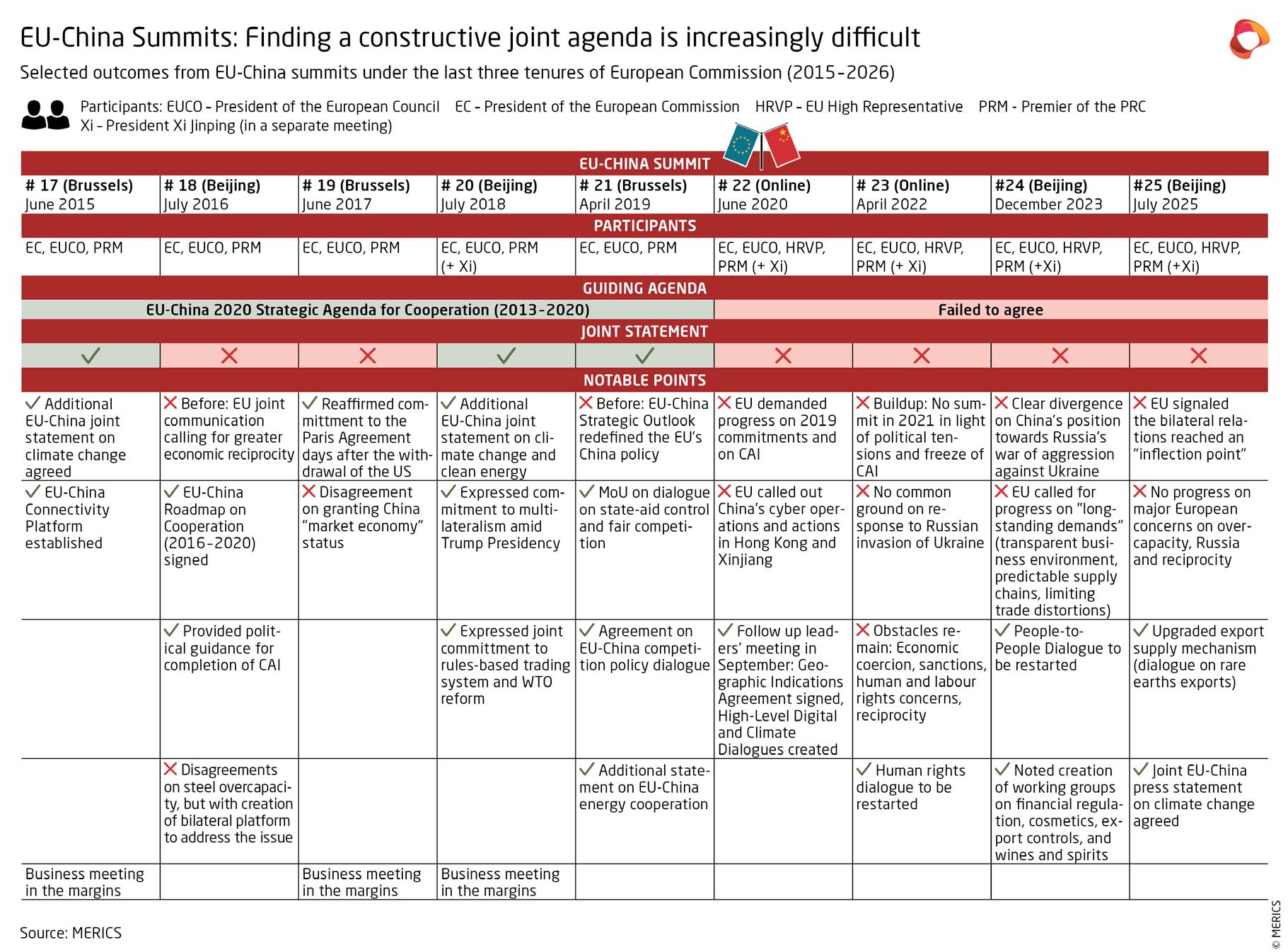
Figure 1
The rollout of restrictions on rare earth exports and targeting European industry through limited licensing, as well as targeting the United States, have also been indications of limited change to Beijing’s traditional approach in terms of its strategic perception. However, these policies have further strengthened the preexisting arguments in Europe that dependencies on China remain a strategic vulnerability.
Considering how both sides have deepened previous trajectories at the policy level, it appears that the fundamental strategic perceptions that the EU and China hold of one another have not shifted. The bilateral agenda as a whole continues to be difficult and uncooperative in nature. This is because the EU’s strategic perception of its relationship with China remains one of a problem to address whereas, for China, the fact that problems need to be addressed presents a problem.
Main challenges and opportunities
As the above examples show, the geopolitical volatility and economic tensions created by the Trump administration’s second term might have led to some changes in public views and official rhetoric. However, fundamentally, both the EU and China have doubled down on the pre-existing strategic perceptions they hold of one another. This is because geopolitical and geoeconomic frictions have exacerbated the economic imbalances in their relationship and strengthening the case for limiting dependence on each other.
As such, overstating the supposed transformative strategic impact of the Trump effect on EU-China relations, which can be seen to a certain extent in public opinion and views expressed, can lead to erroneous policy advice. It can also lead to mistaken assessments as to what would it take to mend EU-China relations which currently remain on divergent trajectories.
OPPORTUNITY: STABILISATION THROUGH TARGETED COLLABORATION
The most realistic opening created by the geopolitical shifts induced by the Trump administration is selective coordination to contain external shocks that impact the interests of both the EU and China. There is a precedent for this: During the first Trump presidency, the EU and China reaffirmed support for the Paris Agreement and the Joint Comprehensive Plan of Action pertaining to Iran’s nuclear programme, from which the Trump administration withdrew, and they both joined the effort to prevent an appellate mechanism in World Trade Organization (WTO) trade disputes from becoming paralysed. The same logic applies today.
The July 2025 summit still produced a joint climate statement. And the April 2026 call on the Iran War and disruption in the Strait of Hormuz between Chinese Foreign Minister Wang Yi, and the EU’s High Representative for Foreign Affairs and Security Policy, Kaja Kallas, showed that both sides are willing to discuss stabilisation efforts. Such moves are narrow and largely symbolic in nature. Still, at a time of heightened geopolitical tensions, they help to mitigate an undesirable spiral of tensions and help prevent an uncontrolled disintegration of the international order and institutions.
CHALLENGE: AVOIDING FALSE EXPECTATIONS
Europe’s challenge
For Europe, the main risk is to misread tactical engagement, for instance in the context of the Strait of Hormuz crisis or similar geopolitical tensions, and targeted commercial offers, extended in particular to EU member states and often in the form of agricultural export deals, as proof that China is prepared to adjust the relationship in substantive ways.
Brussels continues to seek to rebalance the relationship, which includes limiting Europe’s dependencies and asymmetries in economic relations and combining de-risking with economic engagement. But Beijing’s failure to adjust course in recent months shows that its key objective continues to be to prevent or delay more assertive European measures without addressing the underlying structural issues in the relationship. If Europe blurs the distinction between selective cooperation and structural challenges, it runs the risk of weakening its own leverage.
The most realistic opening created by the geopolitical shifts induced by the Trump administration is selective coordination to contain external shocks that impact the interests of both the EU and China.
This is especially sensitive where Chinese investments are seen as a piece in the puzzle of boosting European competitiveness. Without a clear common line between EU member states and an acute understanding of China’s strategic perceptions of Europe, tactical openness is, in fact, often turning into intra-European competition, fragmenting EU member state positions and undermining the EU’s bargaining power.
China’s challenge
For Beijing, the main risk is the opposite misreading, i.e. overestimating how far Trump-related tensions will soften Europe’s China policy. Beijing may assume that European outreach reflects a broader strategic shift when in fact it often reflects more instrumental outreach under deteriorating external conditions.
Beijing may also continue to overstate the extent to which US pressure alone explains Europe’s harder line on China. This underestimates the degree to which Europe’s concerns are internally driven by China’s overcapacity exports and economic coercion, critical
dependencies, and the political costs of China-induced de-industrialisation in Europe. And that does not even account for the EU’s non-economic domain concerns that linger on, such as China’s support for Russia in the midst of its invasion of Ukraine or broader China-related security concerns.
In that sense, more intense European debates about autonomy and the EU’s efforts to limit its dependence on the United States do not necessarily imply that it is seeking a more amicable relationship with China. Instead, they have led to a more determined EU effort to address China-related risks on its own terms as part of a wider push for autonomy.
Recommendations and conclusions
The observations described above show that, while geopolitical shifts have created more room for tactical EU-China engagement and might have led to shifts in rhetoric and views, they do not seem to have fundamentally altered the two sides’ strategic perceptions of one another. If they had done so, this would have been reflected in different policy outputs. Indeed, the ongoing geopolitical changes may even entrench the EU and China in their current assumptions about the relationship in the long run. Both the EU and China therefore face a risk of misreading shifts of public views or official rhetoric as deeper changes in strategic perceptions. Policy expectations formed on that basis thus run the risk of being less effective in pursuing key strategic interests.
The EU is under greater pressure to adjust the bilateral relationship than China, which tends to favour the status quo and preventing a more assertive EU policy towards China. This may create a short-term tactical benefit with regard to China’s objective, but, over the long term, the Trump 2.0 effect is reinforcing the EU’s commitment to strategic autonomy, resilience and reduced dependence. Put simply, the EU and China will remain on divergent trajectories unless there is a genuine attempt by China to address the structural issues.
1 Stec, Grzegorz (2026), “China sees EU-US rift as an opening for EU re-engagement – on its own terms”, Mercator Institute for Chinese Studies (MERICS).
2 Garton Ash, Timothy, Ivan Krastev, Mark Leonard (2025), “Alone in a Trumpian world: The EU and global public opinion after the US elections”, Policy Brief, European Council on Foreign Relations (ECFR).
3 Garton Ash, Timothy, Ivan Krastev, Mark Leonard (2026), “How Trump is making China great again and what it means for Europe, Policy Brief, European Council on Foreign Relations (ECFR).
4 The countries polled by the ECFR included: Bulgaria, Denmark, Estonia, France, Germany, Hungary, Italy, Poland, Portugal and Spain.
5 European Commission, “President von der Leyen promotes openness and stronger European competitiveness during keynote speech at the Davos World Economic Forum”, 21 January 2025.
6 European Commission, “Statement by President von der Leyen with President Costa following the EU-China Summit”, 24 July 2025.
For both the EU and China, the challenge described above gives rise to three concrete recommendations:
q Stay engaged, be frank: Ensure that communication channels remain open and sufficiently frequent to enable continued exchange on geopolitical volatility. Both sides should jointly attempt to stabilise geopolitical tensions where their interests align. However, the discussion behind closed doors should strike at the heart of structural, long-running issues. Tactical coordination should be differentiated from addressing structural challenges.
q Judge progress by policy outputs, not rhetoric: Without such adjustment, any talk of ‘stabilisation’ should be understood merely as a tactical move, not as a fundamental, strategic adjustment of perceptions and policy directions.
q Build a more acute understanding of the underlying structural challenges: Develop track 2 workshop-type workstreams on targeted challenges in EU-China relations, including a broader set of actors, such as think tanks, academia and business. These could help generate a selection of more tangible constructive policy options for the EU and China.
7 Bermingham, Finbarr, South China Morning Post, “EU too slow to act as China rewrites global trade rules, trade chief Sefcovic warns”, 25 February 2026.
8 Martuscelli, Carlo, Politico, “EU industry chief says Europe won’t follow the US on China”, 10 April 2026.
9 Reuters, “France’s Macron threatens China with tariffs over trade surplus - Les Echos”, 7 December 2025.
10 Germany’s Federal Government, “ We want a partnership with China”, 26 February 2026.
11 France 24, “Spain’s Sanchez calls China trade imbalance with EU ‘unsustainable’”, 13 April 2026.
12 World Economic Forum, “Davos 2026: Special address by Mark Carney, Prime Minister of Canada”, 20 January 2026.
European strategic autonomy and its impact on China-EU relations: A Chinese scholarly perspective
Langjia Zeren Assistant Research Fellow, Institute of European Studies, Chinese Academy of Social Sciences
Introduction: European strategic autonomy as a form of ‘strategic awakening’
Chinese academics generally conceptualise European strategic autonomy as a process of self-reflection and strategic reorientation through which the EU seeks to reduce external dependence and reassert control over its developmental trajectory. This process entails not only a recalibration of Europe’s internal development model but also has far-reaching implications for the evolution of China-EU relations.
In substantive terms, European strategic autonomy revolves around the notion of ‘European sovereignty’, aiming to diminish reliance on external actors, enhance independent decision-making capacity and enable the EU to participate in great-power interactions as a relatively autonomous entity.1 Its scope has expanded from initially focusing on security and defence to encompass key domains such as trade, technology and energy, gradually evolving into a cross-sectoral policy narrative and governance framework. Along the same lines, its strategic orientation has shifted from a negative form of autonomy – defined by it becoming less dependent on the US – to a more proactive form that seeks to shape the international environment, positioning Europe as a ‘third pole’ beyond China–US rivalry.2
However, making this ‘middle path’ a reality remains challenging. Strategic autonomy emerges both as an adaptive response to internal structural constraints and as a contingent outcome of external shocks. On the one hand, Europe continues to face enduring vulnerabilities in terms of demographic dynamics, energy security and economic resilience.3 On the other, its longstanding security dependence on the US has become institutionalised, constituting a persistent structural constraint. Trump’s America First orientation has further intensified Europe’s sense of strategic insecurity and reinforced calls for greater autonomy.4 Yet, while the Ukraine crisis has opened a window for institutional recalibration, it has simultaneously deepened Europe’s reliance on the US and NATO due to persistent deficiencies in its own defence capabilities.5
Overall, European strategic autonomy is marked by a structural tension best captured as ‘high ambition, limited capability and multiple constraints’. In the security domain, entrenched dependence remains difficult to transcend,6 while persistent internal divergences continue to shape policy outcomes across defence, industrial strategy and trade. Moreover, successive rounds of EU enlargement have, in some respects, diluted policy coherence and reinforced Atlanticist orientations.7 At the same time, the underlying logic of economic governance has undergone a discernible shift from an ‘efficiency-first’ to a ‘securityfirst’ paradigm. As part of this reorientation, the notion of ‘de-risking’ has increasingly supplanted the traditional commitment to openness, accompanied by a notable rise in protectionist measures and industrial intervention.8 Taken together, these dynamics delineate the practical limits of advancing European strategic autonomy and generate consequential spillover effects for the EU’s external relations.
The underlying logic of economic governance has undergone a discernible shift from an ‘efficiency-first’ to a ‘security-first’ paradigm. As part of this reorientation, the notion of ‘de-risking’ has increasingly supplanted the traditional commitment to openness, accompanied by a notable rise in protectionist measures and industrial intervention.
Main challenges and opportunities: The dual effects of European strategic autonomy
In general, the EU’s pursuit of strategic autonomy reflects both a proactive effort to shape its international role and a reactive adjustment to mounting external pressures. This dual logic is particularly evident in China–EU relations, where challenges and opportunities are increasingly intertwined.
1. STRUCTURAL CHALLENGES: RISING TENSIONS AND UNCERTAINTY
First, the strengthening of strategic autonomy is reshaping the EU’s cognitive framework towards China. The EU’s ‘tripartite’ characterisation of China – as a partner, competitor and systemic rival – has made bilateral relations more complex and multidimensional.9 Against a backdrop of heightened global uncertainty, elements of institutional rivalry have become more pronounced, with China increasingly framed as a “strategic challenge” in European policy discourse.10 Moreover, as value-based considerations are progressively embedded in EU trade and supply chain policies – evolving into instruments with geostrategic implications11 – value divergences are likely to prove more structural and enduring than competition in technology or markets.12
Second, the US remains a critical external variable constraining European strategic autonomy and shaping China-EU relations. Despite significant frictions in transatlantic relations during the Trump administration, a substantial degree of coordination and continuity persists in US-EU approaches toward China.13 This is particularly evident in areas such as export controls, critical technologies and supply chain security, where coordinated policies have imposed tangible constraints on China-EU economic and trade cooperation.14
Third, under the heading of ‘de-risking’, EU economic governance has exhibited a clear trend towards securitisation and protectionism. Mechanisms for screening foreign investment have been progressively tightened, generating institutional barriers for Chinese enterprises. In practice, some of these measures have evolved into forms of ‘selective decoupling’.15 Trade actions targeting sectors such as electric vehicles have further intensified economic frictions.16 Meanwhile, the rise of far-right political forces within Europe has reinforced narratives of ‘defensive sovereignty’, thereby raising the threshold for market access for Chinese firms.17
Finally, the expansion of issue securitisation has heightened the risk of strategic miscalculation. On the one hand, the EU has shown a tendency to securitise non-traditional domains – such as critical infrastructure and emerging technologies – while increasingly aligning with the US pivot to the Asia-Pacific in adopting a more coordinated and, at times, hardline posture towards
China.18 On the other, growing mistrust within the EU has fostered the perception that a tougher stance towards China may enhance bargaining leverage, particularly in transatlantic negotiations.19 In addition, regulatory instruments such as the Foreign Subsidies Regulation and the Anti-Coercion Instrument – though formally designed with multiple targets in mind – have, in practice, contributed to heightened uncertainty and volatility in China-EU relations.20
2. POTENTIAL OPPORTUNITIES FOR COOPERATION
At the same time, Chinese scholarship maintains that European strategic autonomy also generates significant structural opportunities for China–EU relations.
First, Europe’s preference for avoiding rigid bloc alignment preserves a degree of strategic flexibility in bilateral interactions. Rather than fully aligning with any single major power, the EU is often characterised as a ‘balancer’ in international affairs. This orientation creates conditions for limited convergence between China and Europe in their respective approaches towards the US and on key global issues,21 while also contributing to a relatively stable external environment for bilateral engagement.22 Moreover, the objectives underpinning European strategic autonomy are, to a considerable extent, compatible with China’s advocacy of a multipolar international order, thereby providing a normative and strategic basis for deepening cooperation and mitigating the risks associated with an emerging ‘new Cold War’.23
Second, the broad convergence between China and Europe on multilateralism and global governance constitutes an important foundation for stabilising bilateral relations amid intensifying great-power competition. Europe’s longstanding commitment to multilateralism aligns closely with China’s positions on issues such as climate change and global governance reform, helping to moderate systemic antagonism.24 By contrast, unilateralist tendencies in US foreign policy have, at times, weakened the multilateral order and constrained Europe’s strategic autonomy, thereby incentivising China and the EU to articulate more convergent positions in support of multilateralism and in opposition to protectionism.25 In addition, overlapping interests in non-traditional security domains – such as climate governance and marine protection – provide a practical basis for consensusbuilding through high-level dialogue and for coordinated responses to global challenges.26
Finally, the structural interdependence underpinning China–EU economic and trade relations continues to demonstrate considerable resilience. Notwithstanding growing competition and periodic frictions, both sides retain substantial shared interests in maintaining supply
chain stability and upholding the multilateral trading system.27 This deep-rooted interdependence constrains the EU’s ability to fully pivot toward exclusive or
exclusionary external strategies, ensuring that economic and trade ties remain a critical anchor for the overall stability of China–EU relations.
Recommendations and conclusions
Given the structural conditions outlined above, the stable development of China-EU relations hinges on the establishment of manageable boundaries between competition and cooperation, as well as on the reduction of uncertainty through institutionalised mechanisms.
First, strategic communication mechanisms should be further strengthened. Through high-level dialogues and issue-specific consultations, both sides should identify and consolidate areas of convergence between European strategic autonomy and China’s vision of multipolarity, clarify the boundaries between ‘institutional rivalry’ and ‘pragmatic cooperation’, and prevent the spillover effects associated with the over-securitisation of specific issues. At the same time, mechanisms for mitigating strategic misperception should be institutionalised, enabling structured communication to counteract the amplification of cognitive biases in policymaking processes.
Second, the framework for economic and trade cooperation requires recalibration. In the context of ‘de-risking’, enhancing the transparency of regulatory frameworks and the clarity of standards is essential to prevent the evolution of policy tools into instruments of ‘selective decoupling’ or generalised protectionism. Through sustained industrial dialogue and mechanisms for technological cooperation, both sides should regularly assess potential sources of trade friction, stabilise expectations in key sectors and alleviate ‘de-risking’ concerns through mutually beneficial engagement –thereby reinforcing the role of economic interdependence as a stabilising anchor in bilateral relations.
Third, multilateral coordination should be deepened. By focusing on key issue areas such as climate governance, digital regulation and global governance reform, China and the EU can strengthen the institutional foundations of cooperation through joint initiatives and enhanced coordination. Regular high-level dialogues on environmental and climate issues should be institutionalised to advance the development of lowcarbon technology standards, while digital dialogues can serve as platforms for negotiating rules on digital trade and for jointly resisting unilateral sanctions and protectionist measures. Such efforts would enhance the joint capacity of both sides to shape global governance outcomes.
Finally, the societal foundations of bilateral relations should be consolidated. From a long-term perspective, expanding people-to-people exchanges and academic collaboration can help mitigate cognitive divergences and reduce the transmission of ideological differences into the policy sphere. In particular, the expansion of youth exchange programs and the establishment of joint innovation funds would facilitate cooperation in science, technology and culture among younger generations. By acknowledging differences in development models and institutional pathways, and by fostering mutual understanding, both sides can cultivate a more resilient and stable societal basis for long-term engagement.
The framework for economic and trade cooperation requires recalibration. In the context of ‘de-risking’, enhancing the transparency of regulatory frameworks and the clarity of standards is essential to prevent the evolution of policy tools into instruments of ‘selective decoupling’ or generalised protectionism.
Overall, China and the EU need to recalibrate the boundaries of their bilateral relationship amid structural tensions. The impact of European strategic autonomy on China-EU relations is inherently dual. On the one hand, the growing securisation of policy frameworks, the increasing perception that China poses a threat to Europe and the mounting external pressures have intensified bilateral frictions and reinforced strategic distrust. On the other hand, Europe’s preference for flexible alignment, its sustained commitment to multilateralism and the deeply embedded nature of China-EU economic interdependence continue to provide a pragmatic foundation for stability. As the most consequential external variable, the US functions not only as a principal constraint on the development of European strategic autonomy, but also as a major source of uncertainty shaping Europe’s China policy and a focal concern within Chinese scholarly debates. Its influence is therefore likely to remain a defining factor in the evolution of China–EU relations.
Looking ahead, European strategic autonomy is expected to advance within a framework shaped by both internal limitations and external pressures, while China-EU relations will continue to evolve through a dynamic interplay of competition and cooperation. The central challenge lies not in eliminating differences,
but in delineating their boundaries and preventing their escalation and spillover. Only by deepening institutionalised cooperation on the basis of mutual respect and a balanced configuration of interests can both sides preserve stability amid structural tensions and sustain a limited yet viable space for constructive engagement.
1 Feng Zhongping (2023), “Strategic Autonomy Concerns Europe’s Destiny”, Chinese Journal of European Studies, No. 1, pp. 8-17.
2 Yan Shaohua and Wu Xuhuai (2025), “The Trajectory of European Defense Autonomy Under Trump’s Re-turn and Its Impact on Transatlantic Relations”, Journal of International Relations, No. 5, pp. 64-90.
3 Wei Nanzhi (2022), “Why Cannot Europe Be in Charge of Its Own Destiny?”, Beijing Cultural Review, No. 6, pp. 49-57.
4 Zhao Jizhou (2023), “Europe’s ‘Strategic Autonomy’ revisited”, International Social Science Journal, No. 1, pp. 94-100.
5 Chang Chen and Song Lilei (2025), “The Institutional Evolution of EU Security Autonomy through the Lens of Critical Junctures”, International Security Studies, No. 5, pp. 27-48.
6 Zhao Chen (2025), “The Origins, Functions, and Dilemmas of the European Political Community Amidst Geopolitical Shifts”, Journal of Contemporary World, No. 9, pp. 52-58.
7 Yan Xiaoxiao (2024), “The Road to European Strategic Autonomy: Internal Conflicts and Outlook”, Journal of International Relations, No.6, pp. 3-23.
8 Sun Yanhong (2024), “Analysis of the EU’s Economic Security Strategy and its Impact on China: From ‘Open Strategic Autonomy’ to Comprehensive “De-risking’”, Journal of Russian, Eastern European and Central Asian Studies, No. 2, pp. 21-43.
9 Feng Zhongping (2019), “Europe: Mired in Strategic Anxiety, Embarking on a Strategic Awakening”, World Affairs, No. 24, pp. 34-36.
10 Feng Zhongping (2023), “Strategic Autonomy Concerns Europe’s Destiny”, Chinese Journal of European Studies, No. 1, pp. 8-17.
11 Jin Ling (2022), “Transformation of the EU’s External Strategy and the Reshaping of China-EU Relations”, Foreign Affairs Review, No. 4, pp. 28-51.
12 Jian Junbo (2025), “Alteration of the EU’s China Policy Under Strategic Autonomy: From Geopolitical Competition to Geopolitical Combination”, Journal of International Relations, No. 5, pp. 17-39.
13 Sun Chenghao (2025), “‘Trump 2.0’ Is Reshaping NATO Defense Sharing: Characteristics, Motivations, and Impacts”, Peace and Development, No. 4, pp. 30-59.
14 Xu Mingqi (2026), “The Future of Europe: Strategic Autonomy—A Long and Arduous Journey”, World Affairs, No. 2, pp. 52-54.
15 Liu Zuokui (2021), “The Comprehensive Agreement on Investment between China and the EU and the Prospects for U.S.-EU Policy Coordination toward China”, Journal of Contemporary World, No. 3, pp. 24-31.
16 Sun Yanhong (2024), “Analysis of the EU’s Economic Security Strategy and its Impact on China: From ‘Open Strategic Autonomy’ to Comprehensive ‘De-risking’”, Journal of Russian, Eastern European and Central Asian Studies, No. 2, pp. 21-43.
17 Jin Ling (2025), “The Rise of the European Populist Far Right and the Transformation of the EU’s External Strategy”, Foreign Affairs Review, No. 5, pp. 104-128.
18 Zhao Huaipu (2024), “‘Alliance-ization’ Trends Emerge: New Developments in EU-NATO Relations Under Strategic Autonomy”, Journal of Contemporary World, No. 6, pp. 26-33.
19 Xu Mingqi (2026), “The Future of Europe: Strategic Autonomy—A Long and Arduous Journey”, World Affairs, No. 2, pp. 52-54.
20 Yan Shaohua and Wu Xuhuai (2025), “The Trajectory of European Defense Autonomy Under Trump’s Re- turn and Its Impact on Transatlantic Relations”, Journal of International Relations, No. 5, pp. 64-90.
21 Feng Zhongping (2023), “Strategic Autonomy Concerns Europe’s Destiny”, Chinese Journal of European Studies, No. 1, pp. 8-17.
22 Zhao Jizhou (2023), “Europe’s ‘Strategic Autonomy’ revisited”, International Social Science Journal, No. 1, pp. 94-100.
23 Yan Shaohua and Wu Xuhuai (2025), “The Trajectory of European Defense Autonomy Under Trump’s Re- turn and Its Impact on Transatlantic Relations”, Journal of International Relations, No. 5, pp. 64-90.
24 Jin Ling (2022), “Transformation of the EU’s External Strategy and the Reshaping of China-EU Relations”, Foreign Affairs Review, No. 4, pp. 28-51.
25 Jin Ling (2026), “Drifting Apart Accelerated: The New US National Security Strategy and the Trend of Transatlantic Relations”, Contemporary International Relations, No. 2, pp. 84-105.
26 Zhao Ningning and Fu Wenhui (2022), “The Generative Logic, Strategic Implications, and Impact Assessment of the EU’s ‘Indo-Pacific Strategy’”, Journal of German Studies, No. 2, pp. 4-18.
27 Zhuo Hua and Wang Mingjin (2025), “The EU’s Strategic Adjustments in the Context of the Trump Shock”, Contemporary International Relations, No. 10, pp. 28-51.
Between Rebalancing and Reciprocity: The Future of EU–China Economic Relations
• Can the EU and China find a common understanding of “rebalancing”, or do they disagree on the roots of current trade tensions?
• Can they preserve a mutually beneficial economic relationship while pursuing divergent industrial, geopolitical and technological strategies?
• Can investment, technology cooperation and regulatory dialogue ease frictions without deepening protectionism? 1.3
Rebalancing China-EU trade: A Chinese perspective
Yan Shaohua Associate Professor & Deputy Director, Center for China-Europe Relations, Fudan University
Introduction
Economic and trade cooperation between China and the European Union (EU) has long been a cornerstone of this bilateral partnership and for global stability. In 2025, bilateral trade approached a historic $800 billion, reflecting a deep-seated interdependence and resilience regardless of geopolitical challenges.1 However, with the EU’s growing trade deficit in terms of goods exceeding €300 billion in 2025 the discourse surrounding the trade imbalance has become an increasing source of tension between the EU and China.2
From a Chinese perspective, it is important to acknowledge that the EU’s concern about this imbalance is legitimate. For European policymakers, a rapidly widening deficit in key industrial sectors raises valid questions about manufacturing resilience and the sustainability of its domestic job market. These concerns deserve a constructive, high-level dialogue rather than a refusal to consider them. At the same time, we must
caution against overhyping the issue, which overlooks the complexity of modern trade and risks triggering a cycle of protectionism that harms the very consumers and industries that the EU seeks to protect.
Upon closer examination, however, the currently imbalance is far more nuanced. First, the overall focus on trade in goods ignores the more balanced picture that includes trade in services, where the EU consistently maintains a surplus with China. Second, the deficit is partly a natural outcome of the international division of labour as well as the result of European demand. For decades prior to 1996, the EU maintained a surplus with China and the reversal reflects shifting comparative advantages. Crucially, much of China’s surplus is contributed by European firms themselves. These are some of the facts that have yet to be put in perspective when discussing the trade imbalance between China and the EU.
Main challenges and opportunities
For China, the main obstacle to a more balanced trade relationship lies not solely in a lack of Chinese market openness, but in the structural and political conditions that limit the EU’s export potential.
HIGH -TECH EXPORT CONTROL
While Brussels frequently laments the trade deficit, it maintains a rigid and expanding regime of export controls on precisely the products for which China has the highest demand. European companies lead the world in high-end lithography equipment, advanced chemical precursors and specialised dual-use technologies. By restricting the sale of these items when it comes to the Chinese market, the EU is effectively choosing to widen the trade gap.3 As many Chinese analysts observe, the trade deficit is in some ways a choice made by European policymakers, who are prioritising geopolitical alignment over economic logic.
If the EU were to liberalise even a fraction of its high-tech exports, the imbalance in the balance of trade would be significantly reduced. European companies lead the world in high-end lithography equipment, advanced chemical precursors and specialised dualuse technologies. By restricting the sale of these items when it comes to the Chinese market, the EU is effectively choosing to widen the trade gap.
THE DE - RISKING STRATEGY AND OVERCAPACITY NARRATIVE
The politicisation of trade through the de-risking framework has created a ‘compliance maze’ for Chinese enterprises.4 Meanwhile, the narrative of ‘Chinese overcapacity’,5 particularly in the ‘New Three’ industries (electric vehicles, lithium batteries, solar panels), is interpreted by Chinese scholars as an illustration of Chinese competitiveness. From the Chinese perspective, what the EU calls ‘overcapacity’ is actually ‘comparative advantage’ achieved through early-mover investment and intense domestic competition. The EU’s Foreign Subsidies Regulation and anti-subsidy investigations into Chinese electric vehicles (EVs) are increasingly viewed by Beijing as tools of “green protectionism”.6 These measures do not solve Europe’s internal productivity issues as they increase costs for European consumers and delay the continent’s own ambitious climate targets.
DIMINISHING EUROPEAN INDUSTRIAL COMPETITIVENESS
The current deficit is also linked to the internal challenge of European competitiveness. Chinese firms are increasingly moving up the value chain due to a massive pool of engineering talent and world-class infrastructure. Conversely, many European manufacturers are grappling with soaring energy costs, ageing labour forces and a fragmented regulatory environment across the EU’s 27 member states.7 Blaming external overcapacity for the decline of European market share in traditional strongholds like machinery and automotive parts is a distraction from the urgent need for industrial revitalisation within Europe.
Despite the prevailing rhetoric of de-risking and systemic rivalry, China–EU trade relations have remained resilient in recent years. With pragmatic engagement and constructive dialogue, opportunities are emerging for China and the EU to work together to reduce the trade imbalance.
THE 15TH FIVE -YEAR PLAN (2026-2030)
China’s 15th Five-Year Plan offers several conditional but tangible openings to rebalance the structural trade deficit that the EU has with China. With boosting domestic demand identified as a top priority, Chinese consumers could increasingly absorb European goods, luxury products and machinery where EU firms retain a competitive edge. China’s plans to expand market access to EU services, including telecommunications, biotechnology, education, culture and wholly foreignowned hospitals, could further increase the EU’s exports of services. The Five-Year Plan’s commitment to accelerating the development of green energy, green manufacturing and green finance also creates space for
EU clean-tech partnerships and collaborative investment that could rebalance flows beyond trade in goods. However, turning these opportunities into reality will require regulatory transparency, genuine reciprocity and sustained diplomatic engagement.
The Five-Year Plan’s commitment to accelerating the development of green energy, green manufacturing and green finance also creates space for EU clean-tech partnerships and collaborative investment.
LOCALISATION AND THE ‘REVERSE MARKET FOR TECHNOLOGY’
The most pragmatic path towards rebalancing EUChina trade flows is via deeper investment. In the era of Deng Xiaoping, China famously offered ‘Market for Technology’, opening its vast domestic market to Western firms in exchange for the technology needed to modernise it. Today, we see a ‘Reverse Market for Technology’ model taking place.8 In the ‘New Three’ sectors, China now holds technological leadership. Through the ‘In Europe, For Europe’ strategy, Chinese EV giants are establishing manufacturing hubs in the EU, such as in Hungary, Germany and Spain. In this ‘Reverse Deng’ scenario, China provides advanced green technology while the EU provides the market and the regulatory framework. When Chinese technology fuels European production, creating local jobs and tax revenue, it also helps to reduce the trade imbalance.
GLOBAL GOVERNANCE AND WTO ALIGNMENT
Finally, the green and digital transitions provide real opportunities to rebalance trade through growth. By aligning on carbon standards and data flow regulations, China and the EU can lead the world in setting the rules for the 21st-century economy. Cooperation on World Trade Organisation (WTO) reform, particularly in defining the boundaries of industrial subsidies in a way that respects different developmental paths, could provide a rules-based resolution to current frictions. As the EU’s Carbon Border Adjustment Mechanism (CBAM) enters into force in 2026, its impact on EU-China trade is also a matter of concern. A recent study has suggested that the CBAM may complicate the EU-China trade war, exacerbating trade imbalances.9 In this context, it is important that China and the EU show willingness to engage in discussions regarding the CBAM.
Recommendations and conclusions
To rebalance China–EU trade, both sides need to move away from unilateralism and work towards structural synergy. Here are some of the recommendations for policymakers from both sides to consider:
q Mutual market opening: China should continue lowering entry barriers in services like healthcare and finance while the EU should ensure its economic security tools do not become discriminatory barriers against Chinese investment.
q Loosening tech export controls: The EU could objectively reassess its export control regime to balance its security concerns and economic interests. Allowing the sale of high-tech, high-value-added products to China is the most direct macroeconomic path to reducing the trade deficit.
q Promoting a two-way investment rebalance: China and the EU should encourage rebalancing through investment. By facilitating more Chinese greenfield investment in the EU, the nature of trade shifts from ‘export-driven’ to ‘localized production’, naturally reducing friction in the area of trade in goods. In this sense, the suspended Comprehensive Agreement on Investment (CAI) continues to be the most logical framework for structured EU-China economic engagement. Both sides should explore a renegotiated framework that is more realistic in scope, focusing on sectoral agreements in green technology, financial services and digital trade.
q Upholding multilateralism through WTO reform: The EU and China are both systemic stakeholders in multilateral trade governance. They share an interest in restoring a functioning WTO and in defending multilateralism against unilateral protectionism. Both parties should lead efforts to reform the WTO, specifically addressing the governance of subsidies to prevent a wasteful subsidy race.10
The trade imbalance between the EU and China is a structural issue that cannot be solved simply via unilateral trade defence tools. In fact, current tensions over the trade imbalance also provide incentives for both sides to look for a robust bilateral framework to manage the structural differences.
China’s Ministry of Commerce has consistently maintained an open and welcoming attitude towards bilateral trade arrangements, echoing the sentiment of European leaders like Germany’s Chancellor Friedrich Merz.11 China is also making unilateral efforts to address the trade imbalance. During the recent ‘Two Sessions’ press conference, Minister Wang Wentao highlighted that China will launch a series of activities revolving around three major brands, including ‘Buy in China’ (购在中国), ‘Export to China’ (出口中国) and ‘Invest in China’ (投资 中国).12 These initiatives represent a proactive Chinese effort to bridge the trade gap by expanding imports and facilitating European entry into the Chinese market.
1 Lemaire, Claire, “China-EU trade up 5% in 2025, despite disputes”, Brussels Signal, 8 January 2026.
2 Macron, Emmanuel, “ We urgently need to rebalance EU-China relations”, Financial Times, 17 December 2025.
3 Oushi, “Trade imbalance between China and the EU should be assessed comprehensively and objectively”, Huanqiu, 20 July 2025.
4 China Chamber of Commerce to the EU, “Trapped in a “Compliance Maze”: Chinese Firms in EU Face Dual Pressures of Politics and Soaring Costs”, 12 November 2025.
5 European Parliament, “Industrial overcapacities, with a focus on China”, March 2026 – PE 783.610.
6 Chinese Ministry of Commerce, “MOFCOM Spokesperson’s Remarks on the European Commission’s In-Depth Investigation into Chinese Wind Power Enterprise under the Foreign Subsidies Regulation”, 5 February 2026.
7 BusinessEurope, “EU-China relations: Shaping the way forward”, 20 November 2024.
8 Godement, François, “Can Europe Do a ‘Reverse Deng’ With China?”, Institut Montaigne, 21 March 2025.
9 Perdana, Sigit, Marc Vielle, and Ru Li (2026), “Trade war to cooperation: scrutinizing China’s strategies to the EU carbon border adjustment mechanism”, Review of World Economics, pp. 1-33.
10 Xianbai Ji & YAN Shaohua, “How China and Europe can best settle their EV tariff disputes”, South China Morning Post, 3 September 2024.
11 Finbarr Bermingham, “Germany’s Merz floats EU-China trade deal as European capitals soften on Beijing”, South China Morning Post, 26 March 2026.
12 Chinese Ministry of Commerce, 9 April 2026.
Taking China as it is: The limits of the ‘Reverse Deng’
Victor De Decker Research Fellow for Geoeconomics, Egmont Institute
Introduction
Under President Donald Trump, the United States has hardened its stance towards all its trade partners. In that context, international economic diplomacy is undergoing a realignment. Countries that once approached China with considerable caution – like Canada or the UK – are now openly recalibrating towards a much warmer relationship in search of
economic stability and increased market access. In addition, some European countries are striking a more pragmatic posture. But how will this new posture take shape in practice? What will be the deliverables of this new strategy? And to what extent can and will Chinese companies be allowed to integrate their supply chains within Europe?
Main challenges and opportunities
TAKING THE WORLD AS IT IS
The year in which this text was written, 2026, started with the EU offering Chinese Electric Vehicle (EV) makers an olive branch. This took the form of a conditional release of countervailing duties (tariffs) through a corporatelevel, conditional price undertaking mechanism provided that the EV manufacturing footprint within Europe were to increase.1 Later in the Spring, Spain’s Prime Minister Pedro Sanchez went a few steps further by going to Beijing, signalling a renewed willingness to deepen economic engagements.2 A similarly pragmatic tone is visible beyond Europe. Last year, Canada’s Prime Minister Mark Carney significantly lowered tariffs on Chinese EVs to a 6.1% Most Favoured Nation (MFN) rate, for an initial country specific quota of 49,000 EVs per year. Part of this Canada-China EV-package deal promises considerable new Chinese EV joint venture investment in Canada, in a move that clearly links market access with increased investment into localised manufacturing.3 In response to criticism of his pivot to China and away from an increasingly antagonistic Trump-led United States, PM Carney quipped: “We take the world as it is – not as we wish it to be.”
This pragmatic acceptance of the geopolitical reality created by the increasingly hostile actions of Washington DC is becoming a defining feature of an emerging status quo policy stance towards China. However, while engagement may be increasing, resulting in announcements of economic diplomatic commitment between China and a whole range of countries, the underlying structural challenges of China’s integration into the world economic system remain largely unresolved.
TRADE IMBALANCES AND THE LIMITS OF ENGAGEMENT
During Commission President Von der Leyen’s latest visit to China in July 2025, talk about ‘de-risking’ shifted to a narrative of ‘rebalancing’. Priorities in this effort are to increase market access for European companies in China, limit the external impact of overcapacity and reduce export controls. Despite addressing the issue ever since, the EU’s economic relationship with China continues to be characterised by a significant and persistent trade imbalance. In 2025, the EU exported €199.6 billion worth of goods to China, whereas it imported €559.4 billion, resulting in a trade deficit of €359.8 billion. Compared to the year prior, exports decreased by 6.5% while imports increased by 6.4% – widening the bilateral trade deficit only further.4 The latest wave of high-value exports from China to Europe has been colloquially branded as the “China Shock 2.0”.
In recent years, European policymakers have tried to address this by complementing traditional trade policies with industrial policy measures. Later iterations of these are reflected in the European Industrial Accelerator Act (IAA), which aims to revitalise domestic manufacturing through ‘Made in Europe’ requirements for procurement, while simultaneously attracting foreign capital and knowhow, including from China.
In theory, this approach offers an advantageous path forward for all parties involved: it provides much-needed investment in struggling European industrial sectors, teaching European firms valuable techno-industrial
insights in sectors where they are lagging behind China, while also creating market access and generating profits for Chinese companies.
ECONOMIC SECURITY VS COMPETITIVENESS
This approach of bringing in Chinese technology through investments sits uneasily alongside another priority for the current Commission: the economic security agenda and the tightening of investment screening. Since 2019, the EU has put forward a coordinated framework for member states to conduct foreign direct investment (FDI) screening, allowing them to review, block or restrict foreign acquisitions on security and strategic grounds. While formally country-neutral, this mechanism has been widely seen as primarily in response to Chinese investments in critical sectors, reflecting growing concerns about technology leakage and strategic dependence. China’s rise in hightech sectors has not only reduced fears of leakage but has also sparked a growing appetite in Europe for learning from Chinese technological capabilities.
This system of strict capital controls allows the State to tightly regulate financial flows across its borders, shaping not only the scale but also the direction of investment. This enables a far more coordinated and State-driven form of industrial policy than what is feasible within the EU. Due to its grip on capital flows through the People’s Bank of China and its vast network of State-banks, Chinese authorities retain significant influence over the exchange rate. While estimates vary, many analysts continue to argue that the Renminbi is substantially undervalued, reinforcing China’s export competitiveness. A structurally cheaper currency raises the cost of imports while lowering the price of exports, contributing directly to China’s persistent current account surplus and, by extension, to Europe’s bilateral trade deficit.
Screening has added a layer of scrutiny –particularly towards Chinese acquisitions in sensitive sectors – but has not fundamentally altered Europe’s openness as a destination for foreign capital.
Even in a best-case scenario – where Chinese firms expand investment in Europe and some degree of technology transfer occurs – the competitive landscape within China remains structurally skewed. Europeanbased production, even when upgraded, must still compete with imports from China produced under a different cost structure, shaped by an undervalued RMB, State-backed industrial policy, controlled capital flows and currency management. In this sense, capital controls function as a structural constraint on reciprocity. On top of serving as an effective export subsidy, they limit European firms’ ability to invest freely in China and restrict meaningful access to the Chinese market. At the same time, they enhance the Chinese State’s capacity to coordinate supply chains within its own borders – capacity that can be leveraged in response to external pressure. The EU remains open in the hope that engagement will yield market access, investment opportunities and technological gains. Yet the very mechanisms that underpin China’s economic model constrain those outcomes structurally.
Where to draw the line between which Chinese investments are desirable and which are encouraged is still a largely open question due to divergent FDI screening regimes and political priorities between EU member states. However, despite the introduction of the EU’s FDI screening framework in 2019, European economies remain, by global standards, highly open to inbound investment. Screening has added a layer of scrutiny – particularly towards Chinese acquisitions in sensitive sectors – but has not fundamentally altered Europe’s openness as a destination for foreign capital.
There is limited evidence thus far that Chinese investment alone has generated the type of broad strategic technological upgrading European policymakers hope for. Even less convincing is the notion that such investment can serve as a tool to rebalance trade in the long term.
CAPITAL CONTROLS AND RMB UNDERVALUATION
A major hindrance to any rebalancing effort is that China’s financial and monetary system operates on a fundamentally different model than that of the EU.
It needs to be stressed that this is not a mere battle between Chinese and European firms, but a conflict between industrial systems: European firms with a large manufacturing footprint in China will be dragging their feet to expand manufacturing in Europe at the expense of their China-based facilities just as much as Chinese companies.
INTERNATIONALISING DIFFICULTIES
When Chinese companies have internationalised or operated in foreign markets, a series of high-profile cases reveal recurring difficulties in adhering to local rules and regulations. In several instances, when local authorities initiated enforcement measures, Beijing reacted by escalating rather than engaging in constructive cooperation.
In Europe, the Commission has recently activated the Foreign Subsidies Regulation in relation to Nuctech, a Chinese security-inspection equipment company, over concerns that foreign subsidies were distorting the European market.5 Another major episode involved the Dutch government’s decision to assume control of Nexperia, a Dutch semiconductor manufacturer owned
by China’s Wingtech Technology, over a corporate governance dispute. Beijing retaliated by halting exports of Nexperia chips produced in the sister facility in Dongguan, disrupting the European automotive sector. The Chinese government saw all these individual cases as discriminatory targeting practices and retaliation ensued.
These challenges are not limited to Europe. BYD’s much-anticipated investment in Brazil has faced major setbacks after the Brazil Ministry of Labour blacklisted the company over allegations of “slave-like labour” conditions.6 Across these examples, a clear pattern is emerging: tensions between Chinese corporate practices and local regulatory expectations repeatedly complicate internationalisation efforts.
However, whereas the ‘original Deng’ strategy was successful in leveraging the low-cost labour in China in return for market access, thereby rapidly upgrading China’s manufacturing base, it did not give birth to 21st century innovation leaders. While the roots of Chinese technology leaders often go beyond the past two decades, their emergence as globally competitive innovators accelerated significantly under the policy framework introduced by Xi Jinping, increasingly codified in the 13th and 14th Five Year Plans and industrial policies under Made in China 2025. Under Xi Jinping, China has shifted away from foreign technology, towards a model that prioritises self-reliance, indigenous innovation and control over critical inputs. It is a significant reversal of Deng’s policies – one we can just as well brand ‘Reverse Deng’ – which is even more codified in the concurrent plans and strategies.
Tensions between Chinese corporate practices and local regulatory expectations repeatedly complicate internationalisation efforts.
The Nexperia case also illustrated that Chinese investment in European technology sectors has not reduced dependency on Chinese inputs; it exposed it. Factories in Europe are heavily dependent on Chinese inputs, such as wafers and other industrial components. Combined with recent supply shocks linked to the wars in Ukraine and Iran, these vulnerabilities strengthen the case for derisking through diversified supply chains as a strategy to mitigate future supply bottlenecks.
THE REVERSAL OF DENG’S POLICIES
Under Deng Xiaoping’s leadership, China pursued a strategy of opening up, whereby Western and Japanese firms were invited to invest in China to accelerate China’s economic growth and technological development. In homage to the late Chinese leader, analysts have called the pattern for Western countries to invite Chinese – now often technologically superior –companies ‘the Reverse Deng’.7
Beyond the latest 15th Five Year Plan, the April 2026 Chinese rules on industrial supply chain security, extraterritoriality and outbound investments only underline this dynamic. Due to their broad scope and vague language, these new rules grant Beijing considerable discretion to intervene whenever it perceives that a company is not acting in China’s interests. Although these measures were initially seen as targeting the United States, it has in practice been the EU that has already fallen victim to them: the Chinese firm Nuctech, was prohibited from cooperating with an investigation under the EU Foreign Subsidies Regulation, as the Chinese Ministry of Justice stated that the FSR probe “constituted unlawful extraterritorial jurisdiction.”8
China’s latest expansion of export controls on critical raw materials demonstrates an increasing willingness to weaponise its position in global supply chains. These controls extend licensing requirements to technologies used in rare earth element (REE) mining, smelting, magnet manufacturing and recycling. They also restrict exports of foreign-made goods whose value contains Chineseorigin REE inputs above thresholds reportedly as low as 0.1%. The signal is clear: China does not want to leave room for trading partners even to consider diversification or de-risking strategies that would localise part of the supply chain for critical inputs outside China – even when it allows Chinese companies to participate. Rather than opening up, China is closing the door behind it.
Recommendations and conclusions
TAKING CHINA AS IT IS
While a ‘Reverse Deng’ policy for Europe, inviting Chinese companies to expand their manufacturing footprint within the EU can play a role in an overarching industrial strategy, it will not address the systemic trends underpinning the current imbalances and tensions, which
are increasing: persistent capital controls, an undervalued RMB, supply chain control, export control weaponisation and an overarching push towards self-sufficiency. Rather than opening up the possibility of a European ‘Reverse Deng’, these trends point towards a reversal of Deng Xiaoping’s ‘Opening Up’ in China, leading to an exacerbation of the structural imbalances already at play.
A transfer of strategic technologies towards the EU and third countries remains genuinely desirable –the concentration of an ever-larger share of global manufacturing in a single country is unsustainable. But desirability is not the same as feasibility. As long as China’s push for self-reliance, and its system of capital, supply chains and export controls remain in place, European efforts to encourage technology transfers out of China will have minimal structural impact. To paraphrase Carney: Europe must take China’s current economic policy as it is – not as it wishes it to be.
POLICY RECOMMENDATIONS:
q Harmonise economic security instruments across EU member states: The Commission should push for a more unified framework so that the economic security agenda is not undermined by the weakest-link member state.
q Condition engagement on reciprocity: Future engagement mechanisms, including the EV price undertaking framework, should include enforceable reciprocal market access clauses with measurable benchmarks and sunset provisions if commitments are not met.
q Treat capital controls and the undervalued RMB as a trade issue: The Renminbi’s structural undervaluation systematically distorts the terms of trade and constrains European firms’ ability to invest and compete in and with China. Thus, the EU should formally treat the structural undervaluation of the RMB as a subsidy, permitting the application of trade defence measures.
q Build in countermeasures for the weaponisation of export controls and extraterritorial regulations: China is weaponising export controls to retaliate against American export controls, sanctions and tariffs. Although never explicitly targeted, the EU fell victim as collateral damage of the export controls. Under the Extraterritorial Jurisdiction Law, China even went one step further by explicitly targeting the EU Foreign Subsidies Regulation. If China does not provide reassurance towards the EU that its trade relationship will not be hindered, EU countermeasures should be considered and sharpened.
1 European Commission, “Commission issues Guidance Document on submission of price undertaking offers for battery electric vehicles from China”, 12 January 2026.
2 Ministry of Foreign Affairs People’s Republic of China, “President Xi Jinping Meets with Spanish Prime Minister Pedro Sánchez”, 14 April 2026.
3 Prime Minister of Canada, “Prime Minister Carney forges new strategic partnership with the People’s Republic of China focused on energy, agri-food, and trade”, 16 January 2026
4 Eurostat, “Trade in goods with China in 2025”, 10 April 2026.
5 European Commission, “Commission opens in-depth foreign subsidies investigation into Nuctech’s activities in the threat detection systems sector”, 11 December 2025.
6 Corrêa, Douglas, “Chinese carmaker BYD added to Brazil’s forced labor list”, Agencia Brasil, 8 April 2026.
7 Xie, Yanmei, “Reverse Deng? For professionals only”, Mercator Institute for China Studies, 10 December 2025.
8 State Council of the People’s Republic of China, 产业链供应链安全 规定 [Regulations on the Security of Industrial and Supply Chains]; National State Council Decree No. 834, 7 April 2026; 中华人民共和 国反外国不当域外管辖条例 [Regulations of the People’s Republic of China on Countering Foreign States’ Unlawful Extraterritorial Jurisdiction Measures]; National State Council Decree No. 385, 13 April 2026; 对外投资条例 [Regulations on Outbound Investment], State Council Decree No. 837, 1 July 2026; Ministry of Justice of the People’s Republic of China, “China urges EU to stop abusing foreign subsidies probe tools”, 18 May 2026.
Managed interdependence?
The Green Transition Between Cooperation and Competition
• How can the EU and China manage clean-tech interdependence without turning the green transition into a zero-sum industrial contest?
• Is Europe’s dependence on Chinese clean technologies a strategic vulnerability or a condition for delivering the green transition at speed and scale?
• Can climate dialogue deliver practical cooperation on carbon standards, supply chains and clean-tech investment despite growing competition?
4
1.
Strategic interdependence in clean technology supply chains: EU-China relations in the green transition
Mario Esteban Professor, Autonomous University of Madrid & Senior Fellow, Elcano Royal Institute
Miguel Otero-Iglesias
Senior Fellow, Elcano Royal Institute & Professor of Practice in International Political Economy, IE University
Introduction
The green transition is reshaping global economic interdependence. Nowhere is this more visible than in clean technology supply chains, where the European Union’s decarbonisation ambitions intersect with China’s industrial dominance. From solar photovoltaics and batteries to electric vehicles and critical raw materials processing, the EU’s path to climate neutrality is deeply entangled with Chinese production capacity, cost competitiveness, indispensability in key supply chains and technological scaling.
This creates a structural tension at the heart of European policy. On the one hand, access to Chinese clean technologies is essential to deliver the green transition at speed and at manageable cost. On the other, high levels of dependency in strategic sectors and supply chains generate economic vulnerabilities and potential geopolitical risks, particularly in a context where trade, technology and supply chains are increasingly shaped by strategic competition and great power rivalry between the US and China.
Confronted with this new reality, and despite its complex governance structure, the EU response has evolved rapidly. The shift from a purely climate-driven agenda to a broader framework combining decarbonisation, industrial policy and economic security is reflected in initiatives such as the Net-Zero Industry Act, the Critical Raw Materials Act, the EU’s de-risking strategy and, recently, the proposed Industrial Accelerator Act (IAA). Yet this response remains incomplete. The debate continues to be framed in binary terms, oscillating between reducing dependence and preserving openness.
This paper argues that such a binary approach is insufficient. EU-China relations in clean technology supply chains are best understood not as a problem of dependence to be eliminated, but as a case of
asymmetric strategic interdependence that must be actively managed and improved. The challenge for the EU is not to decouple from China, but to reshape this interdependence in ways that preserve access to critical inputs while strengthening European industrial capacity, economic resilience and strategic autonomy.
The challenge for the EU is not to decouple from China, but to reshape this interdependence in ways that preserve access to critical inputs while strengthening European industrial capacity, economic resilience and strategic autonomy.
This paper first examines the dual nature of EUChina clean-tech interdependence, highlighting both vulnerabilities and sources of mutual benefit. It then explores how a strategy of constructive interdependence can move beyond narrow de-risking. The analysis is complemented by a comparison of industrial policy responses in Europe and China and a short analysis of Chinese investment in Spain’s green industry as a case study of potential mutually beneficial collaboration. The final section outlines a series of policy recommendations aimed at transforming current EU dependencies into a more balanced and resilient form of strategic interdependence.
Main challenges and opportunities
VULNERABILITIES AND MUTUAL BENEFITS IN CLEAN -TECH INTERDEPENDENCE
EU-China clean-tech relations are best understood as a case of asymmetric but mutual interdependence to the point that continued engagement with Chinese suppliers remains unavoidable if the EU wants to reach its decarbonisation targets.1 In batteries, electric vehicles, solar equipment, power inverters and parts of the critical raw materials chain, Chinese scale and cost competitiveness shape the pace and affordability of Europe’s green transition. China’s dominance in green-technology supply chains gives Beijing significant influence over Europe’s transition options, aggravated by high production costs and insufficient battery capacity among European manufacturers.2
At the same time, this relationship is not unidirectional. China also has meaningful, if narrower, vulnerabilities vis-à-vis Europe. First, the European market remains an important outlet for Chinese clean-tech exports, especially electric vehicles.3 The EU remains particularly valuable for Chinese exporters because it combines scale with relatively high margins. A second source of European leverage lies in regulatory access.4 Under the EU batteries framework, information and labelling obligations begin in 2026, while QR-code requirements and a battery passport for EV and industrial batteries follow from 2027. This gives the EU an important rule-setting role in the downstream governance of battery and EV value chains.
CONSTRUCTIVE INTERDEPENDENCE: MANAGING STRATEGIC EXPOSURE BEYOND DE - RISKING
Europe’s approach to China in green sectors should move beyond a narrow understanding of de-risking.5 Reducing excessive dependencies is necessary, but it is not sufficient as a strategy for competitiveness, industrial renewal or climate delivery. In sectors such as batteries, electric vehicles, solar photovoltaics and critical raw materials processing, China remains a central pillar of global manufacturing capacity and technological scaling. If China successfully meets the targets set out in its 15th FiveYear Plan, it is likely to consolidate and even deepen this central role in global green manufacturing ecosystems. Trying to exclude Chinese technology or capital altogether would not make Europe stronger; it would likely make the EU less competitive, raise the cost of decarbonisation, and slow the timelines of the green transition. The question is not whether to engage China, but how to do so in ways that expand Europe’s room for manoeuvre.
At the same time, openness without strategy would be equally misguided. As several contributions in a recent TEPSA debrief stress, strategic autonomy is not autarky, but neither can it mean accepting one-sided dependencies that may later be turned into instruments of pressure or coercion.6 In an era in which trade,
technology and supply chains can be weaponised, overdependence creates economies and political vulnerabilities. This is particularly relevant in green industries, where Europe faces significant concentration risks vis-à-vis China across upstream and downstream segments of clean-tech value chains.7
Trying to exclude Chinese technology or capital altogether would not make Europe stronger; it would likely make the EU less competitive, raise the cost of decarbonisation, and slow the timelines of the green transition.
The challenge, therefore, is to build constructive interdependence: a form of engagement that preserves access to Chinese capabilities while strengthening European strategic autonomy. This means diversifying partners, expanding domestic capacity in strategic segments, investing in innovation and recycling, and leveraging Europe’s own assets — from market access to advanced industrial equipment and regulatory power — to create more balanced and reciprocal ties.
In this sense, strategic sovereignty should not be understood as separation from China, but as the capacity to shape interdependence on terms that support Europe’s competitiveness, resilience and climate objectives. Moreover, the EU should not be afraid of pursuing this approach, as it controls several critical chokepoints in global value chains8 — including areas such as advanced machinery, chemical inputs and high-end technologies — on which China remains dependent.
INDUSTRIAL POLICY RESPONSES IN EUROPE AND CHINA
European and Chinese approaches to clean-tech industrial policy reflect fundamentally different models of state-market coordination, which in turn shape the structure of their interdependence.
China’s strategy is characterised by long-term planning, scale and tight alignment between industrial policy, financial support and technological development.9 Through successive Five-Year Plans, targeted subsidies, preferential financing and support for domestic champions, Beijing has built a dominant position across key segments of clean-tech value chains, from solar manufacturing to battery production and critical minerals processing.10 This model has prioritised rapid scaling and
cost reduction, enabling Chinese firms to achieve global competitiveness and, in many cases, market leadership.
By contrast, the European Union’s approach has historically been more fragmented and market driven. Industrial policy has gained prominence only recently,11 as the EU has sought to respond to both the US Inflation Reduction Act and China’s entrenched position in green industries. Instruments such as the Net-Zero Industry Act and Critical Raw Materials Act, along with the relaxation of state aid rules, represent a shift towards a more proactive industrial strategy. However, implementation remains uneven, and the EU continues to face structural constraints in terms of financing, coordination and speed of execution.
These differences have direct implications for the nature of EU-China interdependence. China’s capacity to mobilise resources at scale has allowed it to consolidate upstream and midstream positions in clean-tech supply chains,12 while Europe remains more competitive in downstream segments, advanced equipment and regulatory governance. As a result, interdependence is not only asymmetric in volume but also structured across different stages of the value chain.
At the same time, recent developments suggest a degree of convergence. European policy is becoming more strategic and interventionist with an expansion of the trade defense toolbox,13 while China is increasingly navigating external constraints, including trade tariffs and regulatory barriers in key export markets. It is developing its own legal toolbox to counteract these constraints.14 This evolving landscape reinforces the need for the EU to move beyond reactive measures and develop a coherent industrial strategy that integrates competitiveness, resilience and openness alongside deterrence mechanisms.
REINDUSTRIALISATION OR NEW DEPENDENCY? THE CASES OF EBRO - CHERY AND CATL IN SPAIN
It is too early to assess the full impact of Chinese investment in Spain’s green industries, as many projects are still at an early stage. Although there is clear momentum, with several initiatives advancing in parallel, it remains uncertain whether this wave of investment will generate industrial upgrading or dependency. The cases of EBRO-Chery and CATL capture both the opportunities and ambiguities of this process.
Projects are generating spillovers and reinforcing local industrial ecosystems. In Zaragoza, the 2024 announcement of the Stellantis-CATL battery gigafactory,15 backed by up to €4.1 billion, has been followed by complementary projects that point to a broader electric-vehicle cluster. In December 2025, Fagor Ederlan and China’s Duoli created Lieder Automotive to supply structural components for Leapmotor’s B10 electric SUV, which Stellantis confirmed in 2026 will be produced in Figueruelas from the second half of the
year.16 CATL has also presented the project as a way to strengthen the European battery value chain and attract strategic suppliers. These developments suggest that Chinese investment can support reindustrialisation not only through direct job creation, but also by encouraging supplier networks and related industrial activity.
A similar dynamic is visible in Linares. The reactivation of the Santana Science and Technology Park has brought manufacturing activity to an area deeply affected by deindustrialisation. Desay SV signed an agreement in 2024 to establish a plant for intelligent automotive systems,17 while Santana Motors restarted vehicle assembly in late 2025 in partnership with Zhengzhou Nissan and Anhui Coronet and announced a new agreement with BAIC.18 The local ecosystem is also being reinforced through education and training, as the University of Jaén has adapted its academic offer and launched cooperation with the Shenzhen University of Information Technology in electric mobility.19
At the same time, the most advanced automotive projects still rely heavily on assembly operations. This is evident in the EBRO-Chery20 and Santana21 cases, where production initially depends on semi knocked–down kits and relatively low value-added activities.
These projects raise a central question: do they represent genuine reindustrialisation, or do they relegate Spain to a subordinate position within Chinese-led value chains – and risk transforming it into merely a door to the EU market? The answer depends on whether the promised transition towards more localised and technologically advanced production materialises.
These projects raise a central question: do they represent genuine reindustrialisation, or do they relegate Spain to a subordinate position within Chinese-led value chains –and risk transforming it into merely a door to the EU market?
There are encouraging signs: Ebro plans to expand production through a new line incorporating welding processes, Chery established an R&D and operations centre in Catalonia in 2026,22 and Santana and BAIC have committed to jointly developing new models through integrated Chinese and Spanish teams. Santana’s stated goal of reaching 60% localisation is especially significant.23 Yet these remain, for now, only expectations.
More broadly, these projects have benefited from a cross-party Spanish effort to attract Chinese investment, involving both the socialist central government and regional administrations, many of which are in the hands
of the Partido Popular (Popular Party).24 This suggests that, for Spain, Chinese capital is widely seen as an opportunity for industrial renewal, no matter the ideology of the government. Whether it becomes instead a source of dependency will depend on the extent of technology
transfer, local value creation and the ability of Spanish actors to move beyond assembly into higher segments of the green industrial value chain. In this regard, the 2030 Auto Plan of Spain,25 involving all the relevant stakeholders in the private and public sector, is a positive initiative.
Recommendations and conclusions
A sober analysis points to a clear conclusion: the EU cannot decouple from China in clean technology supply chains without incurring significant economic and climate costs. At the same time, maintaining the current pattern of asymmetric dependence would expose Europe to long-term vulnerabilities. The strategic objective should therefore be to transform existing asymmetric interdependence into a more balanced and resilient form of engagement.
q The EU should adopt a framework of managed or constructive interdependence. This implies moving beyond a narrow focus on de-risking and recognising that engagement with China will remain necessary. The priority should be to shape the terms of this engagement in ways that expand European agency, rather than passively accepting existing asymmetries.
q Europe should strengthen domestic capacity and diversification across strategic segments of cleantech value chains, particularly where dependencies are most acute. This includes power inverters, battery manufacturing, critical raw materials processing and key components for solar and electric vehicle production. However, even more important than catching up in sectors where Europe is currently less competitive than China is reinforcing those areas in which Europe already holds comparative advantages. It also means investing decisively in technologies of the future to avoid reproducing excessive dependence on China. Achieving this will require not only effective regulatory frameworks, but also sustained financial support, faster permitting procedures and stronger coordination between EU and national policies.
q The EU should pursue diversification through partnerships with third countries both in the Global North and the Global South. Initiatives such as the Global Gateway and strategic partnerships on critical raw materials can help reduce concentration risks while supporting broader geopolitical objectives. However, diversification should be understood as a complement to, not as a complete substitute for, engagement with China.
q The EU should deepen the Single Market as a central pillar of its industrial strategy. Fragmentation across national markets continues to limit economies of scale, slow down the deployment of clean technologies and weaken Europe’s capacity to compete with more integrated systems such as those
in China or the United States. Completing the Single Market in areas such as energy, capital markets, digital infrastructure and clean industrial value chains would allow European firms to scale more rapidly, reduce costs and attract investment.
q Europe should leverage its regulatory power as a strategic asset. Instruments such as the battery passport, sustainability standards and market access conditions provide the EU with significant influence over global value chains. These tools should be used not only to set norms, but also to encourage reciprocity, transparency, and higher levels of local value creation.
q The EU should develop a more coherent approach to foreign investment in strategic sectors. As the Spanish case illustrates, Chinese investment can contribute to reindustrialisation and ecosystem development, but also risks locking European economies into lower value-added positions. Screening mechanisms, conditionality on technology transfer and requirements for local integration, as proposed in the Industrial Accelerator Act, should be calibrated to maximise benefits while limiting dependency but also excessive protectionism.
q The EU should complement openness and industrial policy with credible deterrence. With economic interdependence increasingly being used coercively, Europe needs both the instruments and the political will to respond. The development of tools such as the Anti-Coercion Instrument represents an important step in this direction.
q Finally, European policy should recognise that interdependence is not static. The balance of vulnerabilities and leverage between the EU and China will evolve over time, shaped by technological change, policy decisions and global market dynamics. This requires continuous monitoring and adaptation, rather than one-off policy responses.
In this context, strategic autonomy and sovereignty should not be understood as separation, but as the capacity to act within interdependence. The EU’s objective should be to remain open enough to benefit from global innovation and scale, while being resilient enough to withstand shocks and political pressure from its trade partners. Managing this balance will be one of the defining challenges of Europe’s green transition.
1 Lipke, Alexander et al (2024), “Trust and trade-offs: How to manage Europe’s green technology dependence on China”, European Council on Foreign Relations.
2 Trasi, Cecilia, “How should the EU govern Chinese investment in its EV transition?”, Bruegel, 22 July 2025.
3 Gunter, Jacob and Stec, Grzegorz, “EV tariffs + EU-China policy at an inflection point + Exports to China”, MERICS, 10 October 2025.
4 Green Lion, Digital Battery Passport 2027: QR Code Compliance & Infrastructure Leadership (accessed 9 June 2026).
5 Otero-Iglesias, Miguel and Esteban, Mario, “ Why Spain’s outreach to China offers a viable model for Europe”, South China Morning Post, 20 April 2026.
6 Trans European Policy Studies Association (TEPSA) (2026), Strategic Autonomy in an Age of Power Politics, TEPSA Experts’ Debrief: Issue XVII
7 Cornago, Elisabetta et al (2025), “Europe’s clean tech industry between Trump’s policies and Chinese pressure”, London, Brussels, Berlin: Centre for European Reform.
8 Barth, Jonathan and Eisl, Andreas (2026), Relearning the language of power, Geostrategic Europe Taskforce: Munich Security Conference.
9 Naughton, Barry (2021), The Rise of China’s Industrial Policy: 1978 to 2020, Universidad Nacional Autónoma de México Facultad de Economía Centro de Estudios China-México.
10 Shepherd, Christian and Li, Jinpeng, “How China came to dominate the world in renewable energy.” Washington Post, 3 March 2025.
11 The future of European competitiveness: Report by Mario Draghi (2024), Luxembourg: Publications Office of the European Union.
12 Tooze, Adam, “Chartbook 386: How China’s powerslide is driving the global green electricity transition,” Substack, 19 May 2025.
13 European Parliamentary Research Service (2025), Briefing: Understanding the Eu trade defence toolbox
14 Pan, Frank, “China Introduces New State Council Decrees on Supply Chain Security and Countering Unjustifiable Extraterritorial Measures,” Global Sanctions and Export Controls Blog, 1 May 2026.
15 Silveira, Fernao, “Stellantis and CATL to Invest Up to €4.1 Billion in Joint Venture for Large-Scale LFP Battery Plant in Spain”, Stellantis, 10 December 2024.
16 Fagor, “Fagor Ederlan y Duoli Technology refuerzan su colaboración con la creación de Lieder Automotive”, 16 December 2025.
17 Desay SV Europe News, “Desay SV to produce displays in Europe from the end of 2026”, 7 May 2024.
18 Soldado, Garcia Pedro, “Santana Motors, ZZ Nissan y Anhui Coronet fabricarán todoterrenos de forma conjunta en Linares”, Auto-revista, 30 April 2025.
19 Info Linares, “La UJA firma un acuerdo internacional con la Universidad de Shenzhen para crear un programa pionero en automoción eléctrica en Linares”, 12 January 2026.
20 CAN, “EU commissioner questions added value of Chinese car manufacturer in Barcelona”, Catalan News, 14 September 2025.
21 Donaire, Gines, “Santana fabricará coches 14 años después en Linares gracias a la inversión de dos firmas asiáticas”, CincoDias, 30 April 2025.
22 Perez, Xavier, “El presidente de Chery inaugura su centro de I+D europeo en Barcelona”, El Periodico, 8 April 2026.
23 Pavon, Teresa Lopez, “Los motores de Santana vuelven a vibrar en Linares tras 14 años de apagón industrial”, El Mundo, 5 December 2025.
24 Iglesias, Miguel Otero (2026), Spain’s China Strategy Pragmatic Engagement to Strengthen Strategic Autonomy, Bonn: Friedrich-EbertStiftung.
25 ANFAC, “Plan España Auto 2030: la hoja de ruta para reindustrializar la automoción y situar España a la vanguardia europea”, 3 December 2025.
Bridging the green divide: Strategic Alignment in EU–China environmental governance
Shen Wei
Qiushi Chair Professor and Director of Asia Europe Research Centre, School of Public Affairs and Executive Vice-Dean, Institute of France Studies, Zhejiang University
Jia Zhiyuan Research Assistant, Asia Europe Research Centre, School of Public Affairs, Zhejiang University
Introduction
The global climate governance architecture currently stands at a critical juncture, profoundly shaped by rapid shifts in the geopolitical landscape. In July 2024, Ursula von der Leyen secured a second term as President of the European Commission. Her renewed mandate explicitly frames the current era as one of geostrategic competition, solidifying the European Union (EU)’s approach toward China not merely as a negotiating partner, but as an economic competitor and systemic rival. Consequently, the EU’s sweeping de-risking strategy has increasingly linked climate policy with economic security and industrial protectionism. At the same time, the return of Donald Trump to the White House in 2025 introduced a massive external shock. The anticipated rollout of extreme US protectionist frameworks, such as the proposed ‘Big and Beautiful Act’, aimed at aggressively decoupling global clean energy supply chains, drastically alters the transatlantic partnership, leaving the EU strategically vulnerable and globally isolated on climate action.
Against this turbulent backdrop, the China-EU climate partnership, historically a vital twin-engine that salvaged the Paris Agreement during Trump’s first term, has been worryingly shaken. As recent empirical analyses demonstrate, bilateral climate and environmental engagements have increasingly devolved into dialogue for the sake of dialogue.1 Rather than driving substantive, outcome-oriented collaboration, established mechanisms like the High-Level Environment and Climate Dialogue have largely become symbolic exercises. They are currently bogged down by severe bureaucratic friction, misaligned institutional expectations, structural information asymmetries and, more importantly, an underlying deficit of mutual trust.
The anticipated rollout of extreme US protectionist frameworks, such as the proposed ‘Big and Beautiful Act’, aimed at aggressively decoupling global clean energy supply chains, drastically alters the transatlantic partnership, leaving the EU strategically vulnerable and globally isolated on climate action.
Established EU-China mechanisms like the High-Level Environment and Climate Dialogue have largely become symbolic exercises, currently bogged down by severe bureaucratic friction, misaligned institutional expectations, structural information asymmetries and, more importantly, an underlying deficit of mutual trust.
The underlying cause of this stagnation lies in the deep geo-politicisation of the green transition. The EU is rapidly transforming itself from a normative climate leader into a progressively defensive geopolitical actor.
Legislative tools such as the Carbon Border Adjustment Mechanism (CBAM) and aggressive anti-subsidy probes into Chinese electric vehicles (EVs) reflect the EU’s acute strategic anxiety over China’s comprehensive dominance in net-zero technology manufacturing and critical raw material supply chains. Consequently, what was once perceived as a shared pursuit of a global public good has degenerated into a fiercely contested area of zero-sum industrial competition.2
joint statement on climate change signals a nascent, mutual recognition of this geopolitical reality.
Washington’s renewed climate isolationism and aggressive trade posturing leave Brussels with little choice but to recalibrate its stance and pragmatically re-engage with Beijing to sustain the global green transition that both parties are committed to.
Policymakers in Beijing and Brussels must look beyond high-level rhetoric and address the structural core of the friction between them: strategic interdependence in clean technology supply chains.
Paradoxically, the disruptive spectre of a Trump 2.0 administration presents a potential window of opportunity. Washington’s renewed climate isolationism and aggressive trade posturing leave Brussels with little choice but to recalibrate its stance and pragmatically re-engage with Beijing to sustain the global green transition that both parties are committed to. The momentum surrounding the renewed 2025 China-EU
To capitalise on this fragile momentum, policymakers in both Beijing and Brussels must look beyond high-level rhetoric and address the structural core of the friction between them: strategic interdependence in clean technology supply chains. This policy brief deconstructs this complex dynamic, examining the delicate balance between strategic vulnerabilities and mutual benefits. By analysing the friction between the EU’s de-risking agenda and China’s industrial prowess, exemplified by the clash between the EU Net-Zero Industry Act (NZIA) and China’s industrial power, this report assesses the profound implications for global energy transition timelines. Ultimately, it provides targeted, actionable recommendations to bypass trade frictions and forge a resilient, mutually beneficial climate partnership capable of weathering the turbulent geopolitical storms of the late 2020s.
Main challenges and opportunities
While high-level rhetoric continues to frame the green transition as a shared pillar of Sino-European relations, the reality is that the pace of bilateral engagement has visibly decelerated. The core of the friction between China and the EU needs to be deconstructed to understand the current bottleneck and chart a pragmatic path forward. The core element is their strategic interdependence in clean technology supply chains, which is becoming an area of weaponisation. The systemic problems paralysing diplomatic channels, the geoeconomic challenges fuelling mutual distrust and the paradoxical opportunities emerging from a volatile global order all need to be examined in this context.
KEY ISSUES
At the micro-level, bilateral climate cooperation is suffering from profound institutional fatigue. Empirical observations tend to suggest that interactions between Brussels and Beijing have largely devolved into ‘performative diplomacy’ that prioritises procedural engagement over substantive policy alignment.2
This stagnation is fundamentally driven by severe capacity constraints and bureaucratic asymmetries on both sides.
Empirical observations tend to suggest that interactions between Brussels and Beijing have largely devolved into ‘performative diplomacy’ that prioritises procedural engagement over substantive policy alignment.
Within the European framework, external climate outreach is chronically under-resourced. Diplomatic staff and resources dedicated to the green transition represent a mere fraction of the EU’s representation in Beijing.4 Furthermore, structural misalignments
between the directorates overseeing internal climate action and the external diplomatic services often result in uncoordinated messaging.5 Conversely, the Chinese governance architecture presents a highly fragmented counterpart. Climate responsibilities are dispersed across nearly a dozen distinct ministries. Intra-governmental coordination and leverage is therefore crucial but frequently lacking. For example, historically, attempts to align on crucial issues like methane reduction have been delayed by inter-agency reluctance to disclose sensitive energy data.6 Consequently, bilateral dialogues often suffer from mismatched interlocutors, resulting in cyclical discussions that fail to translate into actionable regulatory convergence.
CHALLENGES
Beyond bureaucratic hurdles, a macro-level cognitive divergence also threatens the foundation of the partnership. The European Union has demonstrably pivoted from its traditional role as a normative climate power towards becoming a defensive geopolitical actor.7 In this new paradigm, Brussels no longer treats climate and environmental initiatives as isolated global public goods. Instead, ecological policies are increasingly intertwined with broader strategic and economic security objectives, reflecting Europe’s structural shift toward de-risking rather than outright decoupling.8
This geoeconomic shift has led to the EU introducing unilateral regulatory mechanisms, most notably the Carbon Border Adjustment Mechanism (CBAM) and sweeping supply chain due diligence directives. From Beijing’s perspective, these instruments are perceived as punitive ‘green protectionism’ designed to force supply chain repatriation, blurring the line between de-risking and precision decoupling.9 However, from the EU’s standpoint, they are viewed as legitimate and necessary tools for ensuring supply-chain resilience and maintaining a level playing field. To bridge this cognitive gap, it is important to treat these measures not defensively, but as a new regulatory reality that demands technical, mutually agreed rule-based responses.
Furthermore, there is a growing clash in terms of diplomatic execution. While European policymakers prefer to treat climate targets as standalone imperatives, China’s leadership integrates climate negotiations deeply into its comprehensive foreign policy strategy. This ideological asymmetry breeds mutual scepticism: Europe views China as an opportunistic climate actor while China interprets European regulatory manoeuvres as attempts to constrain its upward economic partnership under the guise of decarbonisation.
Another challenge undermining mutual trust is the intense industrial friction surrounding net-zero technologies, rooted in a complex web of vulnerabilities versus mutual benefits. Fearing being marginalised in the global clean technology race, Brussels has aligned with transatlantic narratives condemning alleged Chinese ‘overcapacity’ and State subsidisation, leading to punitive
tariffs on electric vehicles (EVs) and stringent scrutiny of green tech imports.
However, a granular analysis of market data reveals a disconnect between political rhetoric and industrial reality. While critics frequently point to a broader Chinese manufacturing utilisation rate hovering around 75%,10 a figure dragged down by legacy sectors inextricably linked to the real estate downturn, top-tier Chinese EV and clean energy manufacturers operate at near-maximum capacity, often exceeding 98%.11 Moreover, allegations of predatory export dumping are contradicted by trade metrics: overseas shipments account for less than 13%12 of China’s total new energy vehicle output and these products are typically sold in European markets at significant price premiums compared to domestic rates.
The root cause of Europe’s defensive measures lies in supply chain vulnerability rather than market distortion. With Beijing supplying virtually all of Europe’s rare earth elements and over 95% of its refined lithium, the EU has deployed defensive industrial policy responses,13 most notably the Net-Zero Industry Act (NZIA). The NZIA’s legislative push to cap single-source dependencies at 65% reflects a desperate bid for strategic autonomy to counter Chinese manufacturing dominance, rather than a measured response to genuine overcapacity.14
With Beijing supplying virtually all of Europe’s rare earth elements and over 95% of its refined lithium, the EU has deployed defensive industrial policy responses, most notably the Net-Zero Industry Act (NZIA).
OPPORTUNITIES
Paradoxically, the greatest opportunity to revitalise China-EU climate cooperation stems from severe external geopolitical shocks, specifically, the turbulent trajectory of US domestic politics and the resurgence of American isolationism. The return of a Trump 2.0 administration and the rollout of ultra-restrictive US legislative frameworks drastically alter the transatlantic equilibrium. Proposals such as the widely debated ‘Big and Beautiful’15 legislation seek to impose draconian guardrails on global supply chains. Legislative frameworks, particularly the stringent Foreign Entity of Concern (FEOC) guidelines under the US Inflation Reduction Act, have the same purpose. These measures institute strict ownership thresholds – typically capping foreign government-linked equity at 25%16 – eliminate critical clean vehicle tax credits for non-compliant joint ventures, and mandate rigorous supply chain tracing and extended compliance audits for critical minerals.17
This aggressively protectionist US approach presents a profound threat to Europe’s own green industrial ambitions, inadvertently serving as a potential catalyst for a Sino-European tactical rapprochement. With Washington moving away from a reliable climate, Brussels finds itself under pressure: the sheer scale of the investment required to meet the EU’s 2030 climate targets, estimated at over one trillion euro, cannot be borne by internal mechanisms alone, especially given the fiscal pushback from heavily fossil-reliant Eastern European member states.
As a result, the geopolitical vacuum is forcing a pragmatic recalibration between China and the EU, carrying profound implications for global energy transition timelines. An unmanaged fracturing of clean-tech supply chains would make the Paris Agreement targets financially and logistically unattainable. The renewed 2025 bilateral joint statement on climate change signals a recognition that, despite intense industrial competition,
the EU and China must forge a form of managed interdependence. With the transatlantic divide, Beijing and European capitals have a narrow but viable window to compartmentalise trade disputes while synchronising carbon accounting standards and collaboratively sustaining the momentum of global climate governance.
The renewed 2025 bilateral joint statement on climate change signals a recognition that, despite intense industrial competition, the EU and China must forge a form of managed interdependence.
Recommendations and conclusions
RECOMMENDATIONS
To navigate the current period of stagnation and shift defensive posturing into a functional climate partnership, policymakers in Brussels and Beijing must pivot towards pragmatic, granular problem-solving. Acknowledging the systemic rivalry approach that has been adopted by Brussels while recognizing the indispensable nature of the strategic interdependence between the EU and China in clean technology supply chains, this policy brief proposes six strategic recalibrations across institutional, industrial and global dimensions:
q Harmonise carbon accounting and regulatory interoperability. To overcome the frictions caused by unilateral environmental legislation, both sides must shift from performative diplomacy to highly technical negotiation and alignment. The EU and China should establish a dedicated, apolitical joint task force to synchronise the methodologies of the EU’s Carbon Border Adjustment Mechanism (CBAM) with China’s expanding Emissions Trading System (ETS). Creating mutually recognised carbon footprint certification protocols will alleviate the EU’s concerns regarding industrial greenwashing while shielding Chinese exporters from redundant compliance costs, transforming a source of trade friction into a driver of shared regulatory standards.
q Upgrade diplomatic capacity and centralise climate outreach. To emerge from the institutional fatigue paralysing current bilateral mechanisms, diplomatic resources and institutional mechanisms must be reinforced. Both the EU Delegation in
Beijing and China’s Mission to Europe should deploy specialised environmental technocrats rather than traditional generalist diplomats. Furthermore, both sides should designate empowered, crossministerial climate envoys capable of bypassing internal departmental fragmentation. Beyond official State-level interactions, revitalising Track II diplomacy is paramount. Establishing sub-national climate partnerships, linking progressive European municipalities directly with Chinese counterparts in low-carbon provinces, can bypass national-level political gridlock and foster grassroots innovation, creating a resilient, multi-layered foundation for a broader bilateral relationship.
q Foster “In-Europe for Europe” green industrial symbiosis. To defuse intense European anxiety with regard to perceived clean technology overcapacity, both sides must reconcile their clashing industrial policy responses. The EU’s Net-Zero Industry Act (NZIA), with its 40% local manufacturing target and “resilience contribution” criteria, is a direct response to the scale achieved by Chinese industrial actors.18 To navigate this, Chinese industrial champions must pivot away from an export-heavy model.
Establishing joint ventures (JVs) and manufacturing hubs within EU member states will help Brussels to achieve its strategic autonomy targets. Crucially, this cooperation would address mutual vulnerabilities versus mutual benefits: while the EU would gain localised battery and solar manufacturing capacity, China would secure vital market access and maintain its integration with high-end European machinery and technology (such as precision machine tools and
core components for green hydrogen electrolysers, where Europe still holds a monopoly). In return, the von der Leyen administration should provide transparent, non-discriminatory guidelines for foreign direct investment, ensuring that security-driven screening mechanisms are not weaponised to block commercially viable green partnerships.
q Institute a bilateral supply chain transparency mechanism. To operationalise de-risking without slipping into destructive decoupling, Beijing and Brussels should create an early-warning and datasharing framework for critical minerals and net-zero technologies. By transparently mapping genuine global market demand against production capacities and processing bottlenecks (such as lithium, cobalt and rare earths),19 both actors can collaboratively manage supply gluts and mitigate the reflexive use of trade defence instruments. Data-driven transparency is the only viable antidote to the mutual suspicion currently dominating the clean-tech sector.
q Pioneer co-financing frameworks in third-party markets. As the United States threatens to retreat from international climate finance on the basis of an ‘America First’ doctrine, China and the EU must fill the leadership vacuum. By synergising the Green Belt and Road Initiative with the EU’s Global Gateway, both actors can blend European regulatory frameworks and multilateral financing structures with China’s unmatched cost-efficiency in hardware deployment. This approach would replace zero-sum bidding wars with trilateral cooperation, successfully funding renewable infrastructure in the Global South while providing a depoliticised buffer zone for rebuilding the Sino-European trust base.
q Construct a framework to protect green trade. Anticipating ultra-restrictive US supply chain legislation and retroactive compliance audits, Beijing and Brussels must institutionalise bilateral legal safeguards. It is imperative that the EU and China formulate contingency agreements that insulate Sino-European green technology trade, joint research initiatives and critical mineral flows from extraterritorial sanctions or third-party political volatility. By formalising dispute resolution mechanisms specifically tailored for green tech commerce, Beijing and Brussels can prevent localised trade spats from escalating into systemic decoupling.
CONCLUSION
As China and the European Union navigated the fiftieth anniversary of their diplomatic relations in 2025, it became clear that a period of unconditional climate cooperation has come to a definitive end. In its place, a harsh but necessary reality of managed interdependence has emerged. The second mandate of Ursula von der Leyen signifies a structural continuation of Europe’s defensive geoeconomic posture, prioritising economic
security and strategic autonomy alongside ecological ambitions. Simultaneously, Beijing’s integration of climate goals into its broader geopolitical calculus demonstrates that the green transition is no longer a domestic issue, but the prime battleground for future global competitiveness.
However, this period of heightened bilateral friction coincides with a period of profound external change. The resurgence of aggressive US protectionism and climate isolationism leaves both Europe and China politically and economically exposed. The draconian supply chain decoupling strategies emanating from Washington make a Sino-European tactical rapprochement not merely an option, but a planetary imperative.
The draconian supply chain decoupling strategies emanating from Washington make a Sino-European tactical rapprochement not merely an option, but a planetary imperative.
Ultimately, the trajectory of global climate governance hinges on the maturity of the Brussels-Beijing axis. The challenge is no longer about generating mutual political goodwill, but about constructing a resilient institutional framework that allows technical climate cooperation to continue despite growing geopolitical frictions. Both sides must recognise that their fortunes are inextricably linked with regard to their vulnerabilities and mutual benefits. Europe cannot finance or physically execute its 2030 climate mandates without access to Chinese technological scalability. Conversely, China requires the normative stability, market scale and advanced industrial machinery of the European Union to validate its green industrial transformation.
Europe cannot finance or physically execute its 2030 climate mandates without access to Chinese technological scalability. Conversely, China requires the normative stability, market scale and advanced industrial machinery of the European Union to validate its green industrial transformation.
If both sides can successfully implement the recommendations outlined above: compartmentalising industrial disputes, reconciling the friction between the NZIA and industry subsidies and establishing clear boundaries between de-risking and decoupling – they can construct a durable climate partnership. Failing to do so and allowing geoeconomic anxiety to
paralyse bilateral engagement will not only fracture the global green supply chain but also have catastrophic implications for global energy transition timelines, all but guaranteeing the failure of the Paris Agreement objectives. The window for pragmatic recalibration is narrow. However, the cost of continued stagnation is greater and too severe to ignore.
1 Pongratz, Barbara and Rabe, Wiebke (2025), “Dialog for the Sake of Dialog: Obstacles to China–EU Climate and Environmental Cooperation”, Global Policy volume 16, pp. 840–851.
2 Oertel, Janka et al (2020), “Climate Superpowers: How the EU and China Can Compete and Cooperate for a Green Future”, European Council on Foreign Relations.
3 Krause, Rachel M. (2011) “Symbolic or Substantive Policy? Measuring the Extent of Local Commitment to Climate Protection”, Environment and Planning. C, Government & Policy, volume 29, number 1, pp. 46–62.
4 Pongratz, Barbara and Rabe, Wiebke (2025).
5 Torney, Diarmuid (2014), “Challenges of European Union Climate Diplomacy: The Case of China”, European Foreign Affairs Review, volume 19, pp. 119–134.
6 Gippner, Olivia (2020), Creating China’s Climate Change Policy: Internal Competition and External Diplomacy, Edward Elgar Publishing Ltd.
7 Bäckstrand, Karin, & Elgström, Ole (2013), “The EU’s Role in Climate Change Negotiations: From Leader to ‘Leadiator’”, Journal of European Public Policy, volume 20, number 10, pp. 1369–1386.
8 “欧盟谈对中贸易”去风险而非脱钩” Deutsche Welle, 19 January 2023.
9 Freeman, Duncan (2021), “The EU and China: Policy Perceptions of Economic Cooperation and Competition”, Asia Europe Journal, volume 20, pp. 245–264.
10 National Bureau of Statistics of China (2025, October), National Industrial Capacity Utilization in the Third Quarter of 2025
11 Long Ge, Xiao from the Car Circle, “Domestic leading automakers’ capacity utilization rate ranking: Only Chery and BYD exceed 80%!”, Yiche, 6 August 2025.
12 Autohome (n.d.). In 2023, China’s new energy vehicle exports reached 1.203 million units, accounting for 12.5% of the total production.
13 International Energy Agency (2023), Energy Technology Perspectives 2023; Zhang, J., Zhang, X., Li, X., Wang, Y., Zhang, W., & Li, C. (2022), “A review of the rare earth industry in China: History, consumption, and production”, PLoS ONE, volume 17, number 2.
14 European Chamber of Commerce in China, 13 March, 2024. Mazzocco, Ilaria, (2023) “A Balancing Act: Managing European Dependencies on China in Climate Technologies”, Washington: Center for Strategic and International Studies.
15 Internal Revenue Service (2025, July), One Big Beautiful Bill provisions
16 Bipartisan Policy Center (2025), “Unpacking the FEOC Provisions in the One Big Beautiful Bill Act”.
17 ADP (2025, July) “HR 1: The One Big Beautiful Bill Act Enacted July 4, 2025”.
18 Chang, Su and Fangda, He “Focusing on «Resilience Contribution»—EU Issues Implementation Regulations for the Net Zero Industrial Act”, King & Wood Mallesons, 22 July 2025.
19 Mei, X. (2024), “Challenges and strategies for global electric vehicle supply chains”, Energies, volume 19, number 2, pp.508. ; Tang, L., & Lu, S. (2024), “The Opportunities, Risks, and Governance in Developing China’s Clean Energy Supply Chain”, in 2024 International Conference on Resource and Environmental Science (ICRES 2024).
From Critical Minerals to Green Industrialisation: A New Africa–EU–China Agenda
• What would a successful Africa-EU-China green transition partnership look like in practice?
• Is a trilateral approach support Africa’s green transition more effectively than competing bilateral initiatives?
• How can the EU and China align their interests with Africa’s long-term development agenda while rebuilding trust through climate and energy cooperation? 1.
Africa’s green industrialisation as a solution: The case for a ChinaEU-Africa trilateral
Olumide Abimbola Executive Director, APRI
Introduction
Africa holds a significant share of the minerals that the global green transition feeds on, yet it remains at the extractive end of its value chains. Europe needs those minerals as well as the intermediate industrial products made from them. However, it is acutely aware of its overdependence on Chinese supply chains that currently dominate their processing. China controls those supply chains and has the technology and commercial interest to extend its reach deeper into Africa. This means that three actors with distinct interests are converging on the same resources. This paper examines the related tensions between the three parties and makes the case for a formal trilateral arrangement on green mineral value chains: African industrialisation around intermediate goods, Chinese refining technology offshored at scale and European demand secured for the short to medium term.
This paper makes the case for a formal trilateral arrangement on green mineral value chains: African industrialisation around intermediate goods, Chinese refining technology offshored at scale and European demand secured for the short to medium term.
Main challenges and opportunities
AFRICA’S INDUSTRIALISATION IMPERATIVE
Africa occupies a distinctive place in the global green transition. For one, the region accounts for less than 4% of cumulative global CO2 emissions, making it the region with the lowest levels of greenhouse emissions.1 As industrialisation is the most viable way to deliver prosperity at scale, Africa needs to industrialise so that it can generate jobs for some of the youngest populations in the world and increase productivity. Given current carbon budgets, Africa has to adopt a pathway that is different from the carbon-intensive industrialisation historically used by Europe, North America and, more recently, China.
Beyond its low emissions profile, Africa is also central to global decarbonisation ambitions. The continent’s mineral wealth, which by some estimates includes 30% of global battery mineral endowments,2 is being sought after by others to drive their green transition.3 At least twelve external actors have concluded mineralsrelated cooperation arrangements with African countries since 2020.4
Beyond its low emissions profile, Africa is also central to global decarbonisation ambitions. The continent’s mineral wealth, which by some estimates includes 30% of global battery mineral endowments, is being sought after by others to drive their green transition
Africa has mainly exported commodities, including minerals. Between 2021 and 2023, commodities accounted for approximately 78.6% of Africa’s total merchandise exports.5
Turning these minerals into value-added commodities has been on the agenda of African leaders in recent
decades. In 2009, the continent drafted the African Mining Vision,6 outlining its ambition to make minerals a central piece of its development agenda. It provided a framework for using the continent’s minerals as a catalyst for value addition and broad-based industrial development. Specifically in the context of the green transition, the African Union adopted the African Green Mineral Strategy in 2025. Its aim was to ensure that the intensified interest in Africa’s minerals forms the basis of Africa’s economic transformation and industrialisation.7
In addition to these continental initiatives, many African countries have moved to restrict raw mineral exports. Zimbabwe was the first, banning the export of unprocessed lithium ore in 2022.8 Others have since followed with similar bans or export restrictions. The direction is consistent: African governments are using mineral export policy as a lever for domestic value addition, treating the global green transition as an opening for minerals-based industrialisation.
How can Africa leverage its mineral wealth to industrialise on a low-emissions pathway, ensuring that the global green transition does not simply reproduce an extractive model in which Africa supplies raw materials while value is created elsewhere?
TWO ACTORS, ONE AGENDA, DIFFERENT MEANS
Africa cannot achieve this alone. Partnership with external actors who take its industrialisation agenda seriously will be decisive.
Compared with Africa’s other external partners that have formalised minerals agreements with countries on the continent, the European Union (EU) and China more consistently frame minerals cooperation with Africa in terms that accommodate African ambitions for value addition and industrial development.
The EU’s relations with African countries are governed by Minerals Partnerships that serve as part of the implementation of the bloc’s broader minerals security strategy, anchored in the Critical Raw Materials Act (CRMA). The EU currently has 15 Critical Raw Materials (CRM) Partnerships, five of them with African countries.9 These include the Democratic Republic of Congo (DRC), Zambia, Namibia and South Africa. In addition to being about the EU accessing minerals, these Partnerships, which are documented in Memorandums of Understanding (MoUs), include the creation of sustainable raw material value chains, local processing, skills development and responsible production.
China’s official policy regarding African minerals is similarly expansive, going beyond mineral access. The Beijing Action Plan (2025-2027)10 states that China will support Africa in developing local value chains, manufacturing and the processing of critical minerals, while also linking these objectives to industrial parks, training and broader industrial-chain cooperation.
China’s minerals diplomacy is thus framed not only around access to raw materials, but also around downstream upgrading, productive capacity and industrialisation on the continent.
Rhetoric alone does not translate into development outcomes. China’s and the EU’s partnership models accommodate African demands for value addition. More importantly, both have concrete incentives to follow through. This is not about altruism as the logic of their respective positions in the global green transition makes delivery in their interest.
Further to the MoUs that it has signed with the five African countries, the European Commission has also approved a list of Strategic Projects, thirteen of them with non-EU countries.11 Five of these are with African countries; four are mining projects and one on refining.12
China, in comparison, is the leading destination for Africa’s transition minerals. For the manufacture of electric vehicles, China accounts for nearly half of the export value of Africa’s relevant unprocessed raw materials.13 Chinese entities therefore have the easiest route to acting on the intent expressed in Beijing’s official, diplomatic statements and documents regarding support for Africa’s minerals-based industrialisation.
The case of Zimbabwe suggests that Chinese firms are adapting to African governments’ demands for local value addition by investing in domestic processing capacity rather than relying exclusively on the export of unprocessed ores or concentrates.
In Zimbabwe, the government’s 2022 ban on raw lithium ore exports was followed by a further decision to ban lithium concentrate exports from 2027 as part of a strategy to promote in-country processing. Chineseowned companies responded by developing lithium sulphate plants at major mines, including Huayou’s Arcadia operation and Sinomine’s Bikita project.14
In April 2026, Prospect Lithium Zimbabwe, the operator of the Arcadia mine and a wholly owned subsidiary of Zhejiang Huayou Cobalt, dispatched its inaugural shipment of locally processed lithium sulphate.15 This has been hailed as a milestone for both the country and the continent, marking a shift from the export of raw and semi-processed ores towards higher-value domestic processing.16 Lithium sulphate can be further processed into battery-grade lithium carbonate or used as a precursor in lithium hydroxide production for batteries.
This example, though not a continent-wide pattern, indicates how some Chinese firms are responding to African governments’ value addition agendas.
If Europe and China are both committed to mineral value addition with African partner countries, what drives the difference in outcome? The problem has more to do with actual ability to make good on the rhetoric as well as the relative positioning of both actors in the global green transition.
As noted above, China is the leading destination for Africa’s transition minerals. It is also the leading financier of Africa’s transition mineral projects.17 Chinese entities control the supply chains of the green transition’s critical minerals, processing over 60% of global lithium, 70% of cobalt and nearly 90% of rare earth elements.18 Therefore, China’s response to Africa’s push for domestic processing and value addition stems from a desire to maintain control of those supply chains.
By contrast, the EU wishes to create an alternative mineral supply chain and put an end to its overdependence on China. EU concerns about overdependence are real, especially considering that Europe views China as a systemic rival.19 Europe worries that the situation can be weaponised against it,20 taking the presence of Chinamade industrial inputs (most of which have transition minerals in them) as a security threat.21
But the question is whether, in the short to medium term, creating an alternative supply chain is the solution, and, if so, whether the EU currently has the tools to get the job done. The evidence suggests that the answer to the latter question is no. For all its ambition, the EU still appears
to lack the scale of finance and the hard industrial instruments required to create a major alternative mineral supply chain.
For instance, the EU has sought to use its Africa-Europe Investment Package,22 part of its Global Gateway Initiative, designed to compete23 with China’s Belt and Road Initiative, as a vehicle for advancing some of these objectives. In principle, this makes sense. In practice, however, the Global Gateway has yet to demonstrate that it can mobilise the required capital, move with the necessary speed or absorb the level of risk associated with building minerals-based value chains in African contexts.24
In its minerals-related partnerships with African countries, the EU does have a demonstrable comparative advantage in the governance aspects of mineral value chains as well as technical assistance in this area.25
It also has a need to continue accessing green transition technologies safely, especially those with minerals in them, given that the real short-term concern for Europe is not the minerals per se, but industrial inputs containing these minerals.26
Recommendations and conclusions
THE TRILATERAL PROPOSITION
Africa’s minerals-based industrialisation is the solution to these short- to medium-term concerns provided that the right political and diplomatic arrangements can be established between the EU, China and African countries.
Morocco’s automotive sector offers perhaps the clearest case for the plausibility and timeliness of formal ChinaEU-Africa cooperation on intermediate industrial products. Chinese investors such as Hailang,27 Shinzoom28 and Gotion are manufacturing midstream industrial inputs such as cathodes, anodes, copper inputs and batteries in Morocco. Gotion29 is even building Africa’s first battery gigafactory in Kenitra, north-eastern Morocco.
The following features of the arrangement are precisely what make such investments viable:
Moroccan midstream manufacturers offer European automotive manufacturers geographic proximity and lower-carbon, regulation-compatible production. A free trade agreement with the EU provides the regulatory commercial framework.30
Chinese firms invest in Morocco because they expect European demand to anchor those midstream industries.
The Moroccan government provides direction through a strong industrial policy that factors in the interests of all parties, coordinating a finely balanced trilateral act. A formal trilateral arrangement in this context would streamline the government’s balancing act and allow the scaling of the manufacture of these intermediate products for the European market.
Morocco’s automotive sector offers perhaps the clearest case for the plausibility and timeliness of formal China-EU-Africa cooperation on intermediate industrial products.
On this model, African governments would set the terms, determining which value chains to develop, which investments to anchor and which industrial policy frameworks to establish. China would offshore selected refining technologies, securing feedstock access and frictionless entry to the European market. Europe would access the intermediate products that its industries need in the short to medium term, while building towards longer-term supply chain security. Morocco illustrates the
possibility: its government has been coordinating Chinese investment and European demand through deliberate industrial policy. The model needs to be formalised.
Three objections to such an arrangement present themselves. The first is that engaging Chinese refining technology, even when offshored to Africa, undermines the EU’s de-risking agenda. The Critical Raw Materials Act is, after all, about cutting dependence on Chinese processing, not formalising it elsewhere. But repatriation is rhetoric, not industrial reality: domestic European processing capacity at scale is not coming online in time.31 Price floors and sovereign co-investment (operational for rare earths in the US and under discussion at EU level) point towards what that longerterm architecture could look like but have not yet been calibrated to the full basket of green transition minerals. Diversifying where refining happens, with EU standards and governance embedded, is closer to the practical meaning of de-risking, while working towards the longterm project of creating alternative supply chains.
The second is that Beijing has no incentive to share its strongest geoeconomic asset. Two decades of investment in dominant processing capacity is precisely what gives China the supply-chain leverage that the EU now considers a threat. Yet some of that capacity is already in surplus.32 Offshoring selected capacity to Africa secures feedstock access, insulates Chinese firms against EU tariffs and the Carbon Border Adjustment Mechanism (CBAM)33 and builds long-term commercial stakes in African States. The question is not whether Beijing would consider this but under what conditions.
The third objection is from the African policy world: producing intermediate goods, with refined inputs flowing onward to European factories, is not so different from the colonial extractive pattern. The African Union’s African Green Mineral Strategy pushes for full domestic processing of minerals, finished batteries, finished Electric Vehicles (EVs), not an upgraded link in someone else’s value chain. Morocco illustrates the response. Intermediate-goods capacity is the entry point to highervalue steps, not a terminal stage. Countries that have tried to leap directly to finished products have largely failed on scale, learning curves and market access.34
The logic is already playing out elsewhere on the continent. In Namibia, a green iron facility using hydrogen technology points towards a green steel sector that could anchor broader manufacturing.35 In Guinea,
the government is actively enforcing domestic alumina processing mandates and has signed deals to build refining capacity at scale.36 Both cases demonstrate that the trilateral model proposed here is an extrapolation from dynamics already in motion.
The idea proposed here will not build itself. Making it actionable requires a specific research and policy agenda and that involves the following.
On the African side: mapping which green mineral value chains can realistically be developed, country by country and sometimes cluster by cluster, and identifying the green energy infrastructure to connect to them. On the European side: mapping the intermediate product needs of European industries at a granular level – not strategic documents, but specific inputs, specific timelines, specific gaps – and overlaying this on what Africa could plausibly supply. On the Chinese side: building the case that selective offshoring of critical processing technologies is not a strategic concession but a strategic interest.
None of this is straightforward. The most fundamental obstacle is not technical or economic but political. The trust deficit between Brussels and Beijing is real and deep. Yet the green transition may be one of the few domains where their interests converge more than they diverge, precisely because both depend on African minerals to make it work. That convergence is underexplored. Exploring it seriously, rather than treating the deficit as an end point, is, in this author’s view, the most productive next step for anyone working at the intersection of these three geographies.
The trust deficit between Brussels and Beijing is real and deep. Yet the green transition may be one of the few domains where their interests converge more than they diverge, precisely because both depend on African minerals to make it work. That convergence is underexplored.
1 International Energy Agency (IEA), “Africa Energy Outlook 2022”, Paris, 2022.
2 African Development Bank, “Critical Minerals for Africa’s Inclusive Growth and Development”, Abidjan, 2025.
3 S&P Global Commodity Insights, “China drives Africa’s battery metals buildout”, 30 September 2025.
4 Africa Policy Research Institute (APRI), “Mapping Africa’s Green Mineral Partnerships”, accessed 30 April 2026.
5 Gbahabo, Paul Terna (2025), “Can Commodity Specialisation Explain the Pattern of Structural Change in Africa: Evidence from Direct and Indirect Transmission Channels”, Cairo: African Export-Import Bank, APRWPS/2025/09.
6 African Union, “About the African Mining Vision”, accessed 30 April 2026.
7 APRI, “A Guide to the African Union’s Green Minerals Strategy”, accessed 30 April 2026.
8 Mkodzongi, Grasian (2024), “Lithium Mining and National Economic Development in Zimbabwe”, Berlin: APRI.
9 European Commission, “Raw materials diplomacy”, accessed 7 May 2026.
10 Ministry of Foreign Affairs of the People’s Republic of China, “Forum on China-Africa Cooperation Beijing Action Plan (2025-2027)”, Beijing, 5 September 2024.
11 European Commission, “Strategic Projects under the Critical Raw Materials Act”, accessed 20 April 2026.
12 Schulze, Meike, “Strategic Raw Material Cooperation between Africa and Europe”, Berlin: SWP (Stiftung Wissenschaft und Politik, German Institute for International and Security Affairs), 9 February 2026.
13 Agora Verkehrswende, “Africa’s Raw Materials for Electric Mobility at a Glance”, Berlin, 2025.
14 Muronzi, Chris Takudzwa, “Huayou to start Zimbabwe lithium sulphate production early 2026”, mining.com (Reuters), 17 October 2025.
15 Taruvinga, Mary, “Zimbabwe ships first lithium sulphate in beneficiation push”, NewZimbabwe.com, 28 April 2026.
16 Adegboyega, Ayodeji, “China-backed miner makes history as Zimbabwe exports first battery-grade lithium”, Business Insider Africa, 28 April 2026.
17 Mbate, Michael (2025), “Financing Africa’s transition minerals: Chinese capital, control structures, and developmental constraints”, Resources Policy, Volume 111.
18 IEA, “Global Critical Minerals Outlook 2025”, Paris, 2025.
19 European Commission and High Representative of the Union for Foreign Affairs and Security Policy, “EU-China – A strategic outlook”, Strasbourg, JOIN(2019) 5 final, 12 March 2019.
20 García-Bercero, Ignacio and Niclas Poitiers (2025), “From strategy to doctrine: the next steps for European economic security”, Brussels: Bruegel, Policy Brief 32/2025.
21 Hobhouse, Caspar (2026), “The dragon in the grid: Limiting China’s influence in Europe’s energy system”, Paris: European Union Institute for Security Studies (EUISS), Brief No. 1.
22 European Commission, “EU-Africa Global Gateway Investment Package”, accessed 30 April 2026.
23 García-Herrero, Alicia et al. (2024), “David and Goliath: The EU’s Global Gateway versus China’s Belt and Road Initiative”, Brussels: Bruegel.
24 Schulze (2026).
25 Schulze (2026).
26 Le Mouel, Marie (2024), “ What should Europe do to secure its supply of critical raw materials?”, Brussels: Bruegel.
27 Shanghai Metals Market (SMM), “Hailiang Copper to Invest in Morocco’s New Material Technology Industrial Park with Diverse Production Lines”, news.metal.com, May 2024.
28 Benchmark Source, “China’s overseas anode push expands with Shinzoom’s planned Morocco plant”, 7 May 2024.
29 Ministry of Industry and Trade of Morocco, “Investment for the Establishment of the First Gigafactory in the Middle East and Africa Region”, accessed 30 April 2026.
30 Agyeman, Stephen and Hermas Abudu (2025), “Morocco-China-EU Relations on Green Transition Minerals”, Berlin: APRI.
31 European Court of Auditors, “Special Report 04/2026: Critical raw materials for the energy transition”, Luxembourg, April 2026. See also Klumpp, Florian; Jakob Hensing; Thorsten Benner and Louca Derville, “Out of the Dependency Trap: Why Germany’s and Europe’s Critical Raw Materials Policy Falls Short and How to Fix It”, Berlin: Global Public Policy Institute (GPPI), May 2026; and Jacques Delors Centre (2025), “The EU’s critical raw materials predicament: ReSourceEU to the Rescue?”, Berlin.
32 Bjerkan-Wade, Benjamin et al. (2026), “Understanding the global clean tech manufacturing slowdown”, Analysis 11/2026, Brussels: Bruegel. See also CRU Group (2025), “China’s overcapacity: Will its battery industry consolidate?”, August 2025.
33 Hakim, Shirin et al. (2025), “Geoeconomic bridging node in global production: Chinese electric vehicle battery investments in Morocco”, Taylor & Francis, 2025. See also South China Morning Post, “Made in Morocco: how China’s EV battery makers are powering past Western tariffs”, February 2025; and Bjerkan-Wade, Benjamin et al. (2026), “Understanding the global clean tech manufacturing slowdown”, Analysis 11/2026, Brussels: Bruegel.
34 Hidalgo, C.A., Klinger, B., Barabási, A.-L. and Hausmann, R. (2007), “The Product Space Conditions the Development of Nations”, Science, 317(5837), pp.482–487. For Africa-specific evidence, see Energy for Growth Hub (2023), “EVerything you need to know about African EV manufacturing”.
35 Creamer, Martin, “Multi-country hydrogen-based iron-ore-to-greensteel breakthrough in Namibia”, Mining Weekly, April 2026.
36 Ecofin Agency, “Bauxite: In Guinea, Government Pressure Leads to New Alumina Plant”, January 2025. See also Kpler, “The future of Guinea’s position in global bauxite trade and its alumina ambition”, August 2025.
China–EU cooperation on the energy transition in Africa: Towards a pragmatic approach
Yao Le Assistant Research Fellow Institute for Global Governance Studies & Centre for African Studies, Shanghai Institutes for International Studies
Introduction
Africa lies at the heart of the global climate agenda. Although the continent is endowed with vast renewable energy potential, it has long suffered from energy shortages and a marked lack of clean energy investment. As a result, it is one of the regions that is most negatively affected by climate change. In recent years, African countries have vigorously promoted the energy transition to address these energy challenges and accelerate the transition to a low-carbon, climate-resilient economy.
As major economic and development partners of Africa, China and the EU have been playing a pivotal role in supporting the continent’s energy transition. Since the early 2000s, both parties have boosted relevant cooperation with Africa within existing frameworks and via newly proposed initiatives. Within the framework of the Forum on China-Africa Cooperation (FOCAC), China has committed to supporting Africa in implementing 100 clean energy projects, thereby facilitating the transfer of clean energy technologies. In September 2023, at the Africa Climate Summit, China launched the Africa Solar Belt programme, which is designed to help solve electricity problems for nearly 50,000 African households through photovoltaic infrastructure construction and technology assistance.1
As regards the EU, the Africa-EU Energy Partnership (AEEP) was established to facilitate dynamic dialogue, knowledge sharing and capacity support between the two continents as early as 2007. After announcing the EU’s Global Gateway (GG) strategy, the European Commission launched the Africa-Europe Green Energy Initiative (AEGEI) as the energy component of this framework in Africa. It did this in order to increase electricity production and access to energy, promote energy efficiency, create a conducive regulatory environment for private investments and advance market integration.2
However, due to the rise in strategic and geopolitical competition among major world powers, the energy transition has become a new area of competition
between the EU and China. This has impeded them from cooperating in this field. The political narrative of geostrategic competition between the EU’s Global Gateway and China’s Belt and Road Initiative (BRI) has become an increasingly popular view in policy and academic circles.
However, a micro-level observation of interactions between European and Chinese enterprises reveals that it does not fully reflect reality. In fact, the EU and China have a complex and multi-dimensional relationship of competition and cooperation in Africa concerning access to critical minerals, supply chain resilience, green technological innovation as well as the shaping of green standards and rules. The way in which the relationship is managed will affect how the China-EU relationship evolves. Zero-sum competition not only leads to a lose-lose situation but also to a further deterioration of bilateral relations and undermines strategic stability; while seeking pragmatic cooperation in competition can promote mutual benefit and simultaneously expand the space for positive interactions between the two sides.
This article analyses the major challenges and opportunities for China-EU cooperation in jointly advancing Africa’s energy transition. It argues that the current narrative of China-EU geopolitical competition in Africa misrepresents the real interactions among European, Chinese and African stakeholders. Significantly harming Africa’s development interests, such geopolitical competition neither helps China nor the EU gain local competitiveness and influence. By contrast, pursuing pragmatic cooperation that harnesses their complementary comparative advantages can deliver mutual benefits for all three parties.
Main challenges and opportunities
1. THE NEGATIVE IMPACT OF THE GEOPOLITICAL COMPETITION NARRATIVE
In recent years, as the EU’s perception of China has shifted from partner to competitor and rival, the European understanding of the EU’s economic interdependence with China has fundamentally changed. The EU is increasingly considering China’s advantages on the green transition field as both a dependency risk and a competitiveness challenge. Hence, the EU has grown to view China as a competitor in Africa on a range of issues, including clean energy infrastructure constructions, the manufacture of green technologies, the strategic supply chain of critical minerals and so on.3
The EU has taken the following two measures to deal with the challenges. On one hand, it has implemented a de-risk strategy. To reduce dependence on Chinese photovoltaics (PVs), the European Commission launched the European Solar Photovoltaic Industry Alliance in December 2022. Its aim was to support European domestic photovoltaic manufacturers and promote supply chain diversification.4 Subsequently, the Net-Zero Industry Act (NZIA) came into force on 29 June 2024. The European solar manufacturing industry can be protected by NZIA provisions in public procurement, auctions and other aspects.5 To reduce reliance on China’s critical minerals, the EU is attempting to build a collaborative supply chain network, excluding China, by strengthening cooperation with developed countries with shared values as well as African producers of critical minerals. These clearly targeted, exclusive and isolating measures have not only introduced obstacles to inter-enterprise cooperation but have also severely damaged strategic mutual trust between the two parties.
On the other hand, the EU uses the GG as a counterpart to the BRI to compete for local influence with China in Africa. The GG is presented as an alternative offer to the third-party developing countries, emphasising “the highest social and environmental standards”, “the EU’s democratic values” and “international norms and standards”. In addition, the European Commission highlighted the GG’s goal of “ensuring a greater level playing field for European businesses in third country markets”.6 Although these statements are not directly aimed at China, the narrative of geopolitical competition between the GG and the BRI has gained in popularity. This narrative does not reflect the actual situation and, to some extent, has intensified political opposition between China and the EU and hindered potential cooperation.
2. DIVERGENT PHILOSOPHIES ON ENERGY TRANSITION BETWEEN CHINA AND THE EU
In the field of energy transition, China and the EU hold significantly divergent ideas on the cooperative pathway for Africa’s energy transition. This is due to the substantial gaps between the developing and the developed countries
in energy structure, energy efficiency, technological capacity and industrial development levels.
In the process of China-Africa energy transition cooperation, China supports a relatively moderate transition pathway, agreeing that African countries should treat the alleviation of energy poverty as the highest priority.
In the process of China-Africa energy transition cooperation, China supports a relatively moderate transition pathway, agreeing that African countries should treat the alleviation of energy poverty as the highest priority. Given their vastly different endowments of resources and energy consumption structures, the energy transition of African countries should be based on their respective national conditions and development status. Most importantly, the energy transition needs to strike a balance between social economic justice and climate justice goals. At the same time, China emphasises the issue of fairness of responsibilities between the ‘Global North’ and the ‘Global South’, repeatedly calling on the developed countries to credibly fulfil their commitments to provide adequate financial, technological as well as capacity-building support for the energy transition of African countries.
Compared with China, the EU has been adopting a more radical transition approach, accelerating the phase-out of all types of fossil fuels. With substantial investment in Africa’s clean energy industry, the EU is urging African countries to abandon fossil fuels and to replace them fully with clean energy. The limited achievements of the Just Energy Transition Partnership (JETP) between the EU and South Africa illustrate this point. During the United Nations Climate Change Conference of the Parties (COP26), the EU and other international partners announced the first JETP with South Africa, whereby the former provides financial and technical support to facilitate the fair and inclusive energy transition in the latter. According to South Africa’s Just Energy Transition Investment Plan (JET-IP), only around 4% of the funds have been allocated for just transition elements such as skill retraining, economic diversification and social inclusiveness. Most of the funds have been directed towards decommissioning coal plants, green electricity generation as well as the development of new energy vehicles and green hydrogen.7 Implemented via a sponsor-driven rather than recipient-oriented approach, the JETP deviated from the goals of social fairness and
economic inclusiveness when pushing for a radical energy transition process.
3. THE AWAKENING OF STRATEGIC AUTONOMY IN AFRICA
Against the backdrop of increasingly fierce geopolitical competition among major powers, energy transition in Africa has become a new arena. Besides the EU and China, many other countries, including but not limited to the US, Japan, Turkey and the Gulf States, are investing substantial resources to vigorously pursue energy diplomacy with African countries.
competitors, external parties are prone to falling into a zero-sum mindset, thereby making cooperation among them even more difficult. It is hard for the EU and China to avoid this interactive logic.
4. OPPORTUNITIES FOR COOPERATION
This situation has further fostered the awakening of strategic autonomy in Africa, while objectively granting African countries greater leverage. They are proactively cultivating diversified partnerships based on their deliberate choice rather than as a passive reaction to the interests of external actors.
In reality, spontaneous and market-driven cooperation between Chinese and European enterprises in Africa has been going on for a long time. Objectively speaking, they possess complementary comparative advantages. Chinese companies have accumulated significant advantages in infrastructure construction, engineering and development finance, while European companies hold distinct strengths in equity investment, marketbased bidding, consulting services on specific knowledge and skills as well as operation management. To date, there have been some successful cases of China-EUAfrica trilateral cooperation in the clean energy sector. Chinese companies like TBEA, China Three Gorges Corporation, China Energy Engineering Corporation, PowerChina and Jinko Solar have conducted fruitful cooperation with European companies such as Acciona, Voith Group and Schneider Electric on projects such as photovoltaic projects in Egypt and Algeria, hydropower projects in Angola and so on.
This situation has further fostered the awakening of strategic autonomy in Africa, while objectively granting African countries greater leverage. They are proactively cultivating diversified partnerships based on their deliberate choice rather than as a passive reaction to the interests of external actors. Driven by the need to maximise their own interests, African countries may deliberately inflate their demands, incite rivalries among external parties and play one off against another in the context of specific project collaborations. This will lead to a deterioration in the interactive environment among external actors. In their efforts to outmanoeuvre
Moreover, energy transition in Africa faces enormous supply-demand gaps in terms of financial support, technology transfer, infrastructure connectivity and many other aspects. Neither China nor the EU can, as an external partner, meet all these needs alone. The resource commitments made by both China and Europe towards energy transition in Africa up until now have fallen far short of the continent’s actual demands. At the same time, energy transition projects in Africa – particularly those focused on adding local value and the enhancement of local green industrialisation capabilities – always entail substantial investment and a long payback period, thereby facing heightened risks. Cooperation between China and the EU can facilitate risk-sharing and enhance the feasibility and sustainability of projects.
Recommendations and conclusions
To foster effective China-EU cooperation on the energy transition in Africa, both sides need to transcend the mindset of geopolitical competition and take a pragmatic approach, focusing on specific projects and using comparative advantages.
q Align with African agendas and build up a demand-driven partnership. China and the EU should promote the process of energy transition
whilst fully respecting Africa’s development priorities, such as the requirements to upgrade the green value chain, promote the added value of critical mineral industries, facilitate energy accessibility and so on. Based on their respective cooperative mechanisms towards Africa, both parties could establish the specialised framework involving stakeholders from China, the EU and Africa to discuss trilateral cooperation issues and deal with disputes and problems.
q Strengthen cooperation between Chinese and European companies. The demonstrative and spillover effects of successful cases should be enhanced. Successful existing cases demonstrate that mutual trust between Chinese and European enterprises could be gradually built and reinforced through a succession of positive cooperative endeavours. Hence, grounded in project implementation, the dialogue and communication between Chinese and European enterprises should be strengthened to foster experience sharing, capacity building, expertise dissemination and cooperative network expansion.
q Enhance the synergies of rules and standards in the energy sector. China and the EU should promote the coordination of energy transition initiatives at national, regional and global levels. They should
enhance synergies in terms of rules and standards relating to Environmental, Social and Governance (ESG) management, green finance, green value chain management and so on. In addition, they could also hold working group-level consultations, discussing the establishment of a dispute settlement mechanism.
q Promote co-financing and risk-sharing. Various forms of co-financing between development and commercial financial institutions should be encouraged from both sides to mobilise more private capital. In addition, the cooperation between Chinese and European insurance institutions should be strengthened to provide more robust risk mitigation mechanisms for energy transition projects in Africa.
1 Zhao, Jia, “China, Africa join hands for bright future”, China Daily, 11 February 2025.
2 European Commission, “EU-Africa: Global Gateway Investment Package-Green Energy Initiative”, 2022.
3 Ciommo, Mariella Di et al. (2026), “The EU and China in Africa: Is it better to compete or work together?”, European Centre for Development Policy Management (ECDPM).
4 European Commission (2022), “Launch of the European Solar Photovoltaic Industry Alliance”.
5 Yuen, Simon, “China Begins Investigation into EU’s Investment Barrier for Solar PV ”, PVTECH, 12 July 2024.
6 European Commission (2021), “Global Gateway: up to €300 billion for the European Union’s strategy to boost sustainable links around the world”.
7 Presidency Republic of South Africa (2022), “South Africa’s Just Energy Transition Investment Plan (JET IP) for the Initial Period 2023-2027”, pp. 126-127.
EU–China Health Cooperation: Innovation,
Regulation and Resilience
• Can health cooperation still serve as a bridge between the EU and China amid wider strategic competition?
• How can the EU and China prevent health technology and digital health from becoming another arena of geoeconomic confrontation?
• What would a trusted model of cooperation look like on ageing, chronic disease, healthcare resilience and health innovation? 1.6
A healthy balance: China’s rise and Europe’s response
Francesca Maremonti Research Fellow for Asia, Istituto Affari Internazionali (IAI)
Introduction
China’s increasingly strong position in the biotechnology, pharmaceuticals and health technology sectors is rapidly reshaping the global healthcare landscape. In the past decade, China has evolved from a low-cost producer of active pharmaceutical ingredients (APIs) and generic medicines into an increasingly sophisticated biopharmaceutical innovation hub. This transformation has been enabled not merely through industrial subsidies, but through deep regulatory reforms, the mobilisation of venture capital and the emergence of highly innovative firms operating with the agility of technology start-ups rather than traditional pharmaceutical conglomerates.
For the European Union (EU), this development presents both opportunities and strategic risks. Europe continues to be one of the world’s leading pharmaceutical centres, directly employing a million Europeans while indirectly supporting millions more indirectly through upstream and downstream industries in highly sought-after jobs.1 Yet Europe’s competitive position is increasingly under pressure. China now combines scale,
manufacturing capacity, faster regulatory pathways and growing innovative capabilities, while Europe faces concerns over regulatory burdens, declining investment attractiveness and dependence on Chinese pharmaceutical supply chains.
The trajectory of China’s biotech sector increasingly resembles earlier developments in green technologies, where China moved from manufacturing follower to global leader. A similar transition may now be unfolding in pharmaceuticals and biotechnology. For European patients, it may matter little whether innovative medicines come from Basel, Boston or Beijing, provided that they are safe and effective. For European governments and corporate actors, China’s supplies are becoming a new source of dependence and an engine of domestic de-industrialisation. Nonetheless, the central policy question for Europe, speaking for both its patients as well as industry, is therefore no longer whether China will become a major innovative pharmaceutical power, but how Europe should respond.
Main challenges and opportunities: China’s rise through regulatory reform and innovation
China’s ambitions in the pharmaceutical sector were catalysed by a comprehensive reform agenda launched in 2015. The reform process aimed, first, to modernised the country’s drug approval and regulatory system. In 2017, China joined the International Council for Harmonisation (ICH), aligning many of its pharmaceutical standards with international norms. The 2019 revision of the Drug Administration Law consolidated these reforms and established a modern lifecycle system based on regulatory supervision. These measures dramatically accelerated clinical development timelines and reduced approval bottlenecks. Today, the cycle for clinical trials often proceeds faster in China
than in Europe, giving Chinese firms a significant competitive advantage in bringing innovative therapies to market.2
Over the years, China has also fostered an ecosystem of venture-capital-backed biotech firms. Unlike the State- and subsidy-dominated image often associated with Chinese industrial policy, much of the country’s pharmaceutical innovation has emerged from relatively small, highly entrepreneurial private firms. This model increasingly resembles the innovation ecosystem of Silicon Valley rather than the traditional State-owned manufacturing paradigm.
Foreign investment has also played an important role. The ‘Made in China 2025’ strategy, launched a decade prior, aimed to boost domestic capabilities, while simultaneously encouraging foreign direct investment (FDI) into high-end sectors, including biotechnology and pharmaceuticals. The overall objective of attracting FDI was not just to inject much-needed liquidity into China’s pharma market, but to make the industry sector driven by a selective form of technological absorption. Foreign expertise, technology transfer and talent circulation accelerated the development of Chinese domestic competitors.3
China’s heft in innovation is now becoming visible globally. In 2024, Chinese-headquartered companies accounted for 28 of the 81 new active substances launched worldwide, surpassing both the United States and Europe. According to Goldman Sachs, approximately one quarter of potentially innovative drug candidates currently under development now originate from China, Chinese companies produced 46% of new drug molecules entering human trials in the first half of 2025.4 China is also emerging as a leader in advanced oncology therapies. Chinese firms are reportedly responsible for roughly 70% of global development activity in antibody-drug conjugates (ADCs) and approximately 60% of bispecific antibody development, two types of targeted cancer treatment.5 Combined with rapid advances in artificial intelligence for life sciences, China’s pharmaceutical innovation is on a steep upwards trajectory.
Nevertheless, there are still considerable limitations. China has not yet produced a global pharmaceutical giant equivalent to Pfizer or Johnson & Johnson. Moreover, Chinese innovative drugs have thus far struggled to enter the most profitable Western markets –although this may change rapidly in the coming decade.
EUROPE’S DEPENDENCE ON CHINESE APIS
While China makes progress in innovation, it is also keeping a firm hand on the lower-value end of the pharma supply chain. In a development not dissimilar from the way it gained dominance in critical raw materials refining, the world has become dependent on China when it comes to Active Pharmaceutical Ingredients, the building blocks of any drug. Europe has thus become deeply dependent on Chinese pharmaceutical manufacturing, particularly for APIs and antibiotics.
The severity of Europe’s dependency problem was on display when, in May 2025, the Copenhagen-based API facility of the Xellia Pharmaceuticals company closed. The plant was among the EU’s last major facilities producing critical antibiotic ingredients. Production shifted to lower-cost locations, including China, reflecting long-term economic pressures within pharmaceutical manufacturing.6 This development is just in a much larger trend.
Today, Europe depends overwhelmingly on Asiaparticularly China - for many essential pharmaceutical inputs. China accounts for almost half of global antibiotics exports and roughly 90% of the global supply of key inputs used in generic antibiotic manufacturing.7 Given its exposure to a number of severe vulnerabilities, the EU is, as proposed by the 2025 Critical Medicines Act, currently trying to diversify pharmaceutical supply chains, particularly for APIs and critical medicines.8
As for other types of strategic supplies – from chips to critical materials – the most urgent goal for the EU is to boost its capacity to absorb potential supply shocks deriving from geographical chokepoints or deliberate weaponisation of supply chains. Longer-term, the EU aims to arrest – and reverse – the erosion of its industrial fibre, which threatens its prosperity, social equilibrium and technological sovereignty.
The debate therefore increasingly extends beyond industrial competitiveness into broader economic security considerations. Pharmaceutical supply chains can now be viewed similarly to semiconductors, energy or critical raw materials: economically globalised, but strategically sensitive and prone to geopolitical risk.
EUROPE’S COMPETITIVE POSITION UNDER PRESSURE
In the last two decades, Europe has seen its leadership in pharmaceutical manufacturing and innovation gradually erode. It has steadily lost market share and investment attractiveness to the United States, where higher pricing and stronger capital markets have generated more favourable returns for pharmaceutical innovation. China is now compounding these challenges even further. European pharmaceutical companies increasingly contend that the EU regulatory environment has become excessively burdensome and insufficiently innovationoriented.9 Lengthy approval procedures, fragmented reimbursement systems and lower returns on investment are pushing research activity and innovation – as well as production – abroad.
Europe’s relative decline in innovative output is measurable. Having lost its position as the world’s leading pharmaceutical innovation region in around the year 2000, Europe now ranks third globally in originators of new molecules, behind both China and the United States.10
The emergence of globally competitive Chinese biotech firms further illustrates this shift in terms of a reversal of the old model. Western pharmaceutical firms are increasingly licensing Chinese-developed compounds and acquiring access to Chinese innovation pipelines. This dynamic raises the prospect of a future ‘DeepSeek moment’ for biotechnology in the not so distant future: the sudden global recognition that Chinese firms have become major innovators rather than mere low-cost manufacturers.
Recommendations and conclusions
China’s transformation in biotechnology and pharmaceuticals is one of the most significant structural shifts in the global healthcare economy. What began as a strategy centred on APIs and generic manufacturing has evolved into a sophisticated innovation ecosystem increasingly capable of competing at the technological frontier with established Western companies.
The EU is faced with a dual challenge. Chinese innovation may contribute positively to global healthcare outcomes through cheaper and more effective therapies, ultimately benefitting global populations, while posing a challenge to the European industrial base. The EU thus needs to strike a balance between granting citizens access to affordable and effective therapies, and preserving its own industrial sovereignty, which China’s impetuous development is threatening. In particular, Europe’s strategic vulnerabilities with regard to its indigenous industrial base, range from growing dependency on external inputs, declining competitiveness and regulatory inertia.
q First, the EU should strengthen the capacity of European medical regulators to assess the safety and effectiveness of the incoming wave of Chinese innovative drugs. Regulatory agencies must be sufficiently staffed and technically equipped to conduct rigorous, objective and timely evaluations. Europe should neither automatically block nor uncritically approve Chinese medicines, but ensure that decisions are based on transparent and rigorously applied scientific standards.
q Second, Europe must substantially increase pharmaceutical and biotechnology R&D investment to remain competitive. To maintain its competitiveness, Europe needs to strengthen its innovation ecosystem rather than relying primarily on defensive trade measures. This includes improving access to venture capital, accelerating approval pathways, supporting biotech scale-ups and reducing unnecessary regulatory complexity.
Chinese innovation may contribute positively to global healthcare outcomes through cheaper and more effective therapies, ultimately benefitting global populations, while posing a challenge to the European industrial base.
q Third, the EU should diversify pharmaceutical supply chains, particularly for APIs and critical medicines, as proposed by the 2025 Critical Medicines Act. This requires a combination of reshoring selected production capacities within Europe and developing partnerships with third countries, as an alternative to China. While diversification may increase short-term costs, it is necessary to reduce exposure to supply shocks and potential geopolitical weaponisation of critical inputs.
Attempting to isolate European markets from Chinese pharmaceutical innovation would likely prove economically costly and medically counterproductive. Yet, passive acceptance of industrial decline would risk undermining Europe’s long-term strategic and economic position. Europe requires a balanced response that avoids both complacency and protectionism by acting on four parallel tracks:
q Finally, Europe should recognise that Chinese pharmaceutical innovation is no longer a future possibility but an emerging reality. A coherent European strategy must therefore combine openness to scientific progress and innovation with the preservation of industrial resilience and economic security.
1 European Federation of Pharmaceutical Industries and Associations (EFPIA) (2025), “The Pharmaceutical Industry in Figures”.
2 Liu, Sen, Hongxi Hu, Ge Chenghao et al. (2025), “The rise of China’s pharmaceutical industry from 2015–2024: A decade of innovation”, Nature Reviews Drug Discovery, 24, pp. 738–739; Tong, Charles, Zhengyu Wu, Yang Gao et al. (2024), “Evolving China’s Regulatory System in Alignment with ICH”, International Society for Pharmaceutical Engineering (ISPE)
3 Boullenois, Camille, Malcolm Black and Daniel Rosen (2025), “ Was Made in China Successful?”, Rhodium Group
4 Goldman Sachs Research (2025), “China Is Increasing Its Share of Global Drug Development”.
5 Liu, Sen, Hongxi Hu, Ge Chenghao et al. (2025), “The rise of China’s pharmaceutical industry from 2015–2024: A decade of innovation”.
6 Keenan, Joseph, “Xellia to shutter Copenhagen antibiotics plant, dealing a blow to EU reshoring efforts”, Fierce Pharma, 7 May 2025.
7 Yang, Yang, Lewis Husain and Yangmu Huang (2024), “China’s position and competitiveness in the global antibiotic value chain: implications for global health”, Global Health; Gibson, Rosemary, “China has cornered the market on antibiotics, so the U.S. must rebuild its manufacturing capacity. [Opinion]”, MarketWatch, 28 April 2021.
8 European Commission (2025), “Regulation of the European Parliament and of the Council. laying a framework for strengthening the availability and security of supply of critical medicinal products as well as the availability of, and accessibility of, medicinal products of common interest, and amending Regulation (EU) 2024/795”.
9 European Federation of Pharmaceutical Industries and Associations (EFPIA) (2025), “The root causes of unavailability of innovative medicines and delay in access: Shortening the wait”.
10 European Federation of Pharmaceutical Industries and Associations (EFPIA) (2025), “The Pharmaceutical Industry in Figures”.
Bridging China and Europe in digital health: Opportunities for collaborative smart healthcare solutions
Wang Zichen Deputy Secretary-General, Center for China and Globalization
Introduction
Digital health is becoming a useful test case to help determine whether or not China and Europe can still cooperate in a period of mutual strategic distrust. The subject is neither politically innocent nor purely commercial: health data is sensitive, artificial intelligence is increasingly regulated as a high-risk technology and hospitals are part of critical social infrastructure. Yet the case for cooperation remains strong. Both sides need to make healthcare more preventive, continuous, affordable and accessible, while avoiding the illusion that technology alone can solve institutional problems.
The demographic pressure is real but should not be overstated or portrayed as something brand new. By the end of 2025, China had 323.38 million people aged 60 and above, accounting for 23% of its population, including 223.65 million people aged 65 and above, accounting for 15.9%.1 In the European Union, people aged 65 and above accounted for 22% of the population in 2025, while the old-age dependency ratio reached 34.5%.2 The more important point is what follows from this: health systems on both sides are moving from a model centred on hospital episodes to one that must manage chronic disease, multimorbidity, rehabilitation, frailty, home care and long-term follow-up. More than 40% of Europeans aged 65 and over report living with at least two chronic diseases, while the EU also faces an estimated shortage of around 1.2 million doctors, nurses and midwives.3
This paper argues that China-Europe cooperation in digital health should not be framed as an open-ended agenda of “AI healthcare cooperation”. That would be too broad to be credible. A more practical approach is to build cooperation around specific smart healthcare solutions: AI-assisted imaging, chronic disease management, remote follow-up, hospital workflow optimisation, medical knowledge retrieval, patient education and privacy-preserving research. In other words, the question is not whether Chinese digital health products should be directly transplanted into European systems or whether Europe should export its regulatory model to China. The question is whether both sides can build delimited, clinically useful and wellgoverned channels of cooperation.
This would also be consistent with the spirit of earlier work on health cooperation carried out via EUChina think-tank exchanges. The 2023 compendium argued that global health should not become a victim of geopolitical confrontation and that pandemic preparedness, prevention, information exchange and health cooperation should be treated as a ‘de-risked’ area where practical cooperation remains necessary despite the political scars left by COVID-19.4 Digital health now requires a similar but more sophisticated logic. It cannot be separated from questions of data security, regulation and industrial competition. But it can be made safer, narrower and more trustworthy.
Main challenges and opportunities
CHINA’S DIGITAL HEALTH CAPABILITIES ARE MOVING FROM ACCESS PLATFORMS TO AIENABLED HEALTHCARE INFRASTRUCTURE
The development of China’s digital health system started with access and convenience: online consultation, appointment booking, e-prescriptions, internet hospitals and follow-up care for common and chronic diseases. The
2018 State Council opinion on Internet Plus Healthcare allowed internet hospitals to develop on the basis of physical medical institutions and permitted online followup consultations and prescriptions for some common and chronic diseases after doctors had access to patients’ medical records.5 China’s internet medical services’ ecosystem has continued to expand, though its growth has become more uneven. By the end of 2025, internet medical
services’ users stood at 411 million, while data cited by the National Health Commission show that China had 3,756 internet hospitals by September 2025 and 130 million internet-hospital consultations in 2024.6 In 2024, Chinese official reporting also stated that more than 3,000 medical institutions were offering medical and nursing services online for people unable to visit in person.7
This matters for Europe not because China’s internet hospital model can be copied wholesale. European health systems have different reimbursement rules, professional structures, data laws and public expectations. The lesson is more operational: China has accumulated experience in connecting online and offline care, routing patients through digital channels, extending follow-up beyond hospitals and using digital tools to compensate for uneven distribution of medical resources. These are also European problems, even if the institutional setting is different.
show that China’s digital health ecosystem is not simply a story of fast deployment. It is increasingly a story of regulatory consolidation.
CHINESE COMPANY CASES SHOW SEVERAL DIFFERENT LAYERS OF SMART HEALTHCARE CAPABILITY
Chinese technology companies are already active across different layers of digital health. These cases should be used carefully. A company announcement is not the same as independent clinical validation. But the cases are still important because they show where Chinese capabilities are emerging and what kinds of cooperation might be realistic.
China is now moving from access platforms to AI-enabled healthcare infrastructure. In November 2025, five Chinese central agencies, including the National Health Commission, issued implementation opinions on promoting and regulating ‘AI + healthcare’ applications.
China is now moving from access platforms to AIenabled healthcare infrastructure. In November 2025, five Chinese central agencies, including the National Health Commission, issued implementation opinions on promoting and regulating ‘AI + healthcare’ applications. The policy calls for artificial intelligence to support prevention, diagnosis and treatment, rehabilitation, health management and continuous intelligent services, while also stressing safety, controllability and regulated application.8 This is significant because it places medical AI within a policy framework that recognises both innovation and governance. It also reflects a broader shift: AI in healthcare is no longer treated only as a research tool or a company product, but as a potential layer of healthcare system infrastructure.
The regulatory architecture is also becoming more formal. China’s National Medical Products Administration (NMPA) issued principles for classifying AI-based medical software products in 2021 and the Center for Medical Device Evaluation released registration review guidance for AI medical devices in 2022.9 In 2025, NMPA also called for stronger standards and evaluation requirements for AI-powered medical devices, including research on standard datasets, evaluation databases and technical guidelines for multi-disease and large-model AI fields.10 These developments do not eliminate concerns about transparency, liability or data governance. But they
Alibaba offers one of the clearest examples in the area of AI-assisted imaging and medical knowledge services. Alibaba Health operates as a healthcare platform while Alibaba Cloud provides healthcare and life sciences’ solutions for medical institutions, pharmaceutical companies and research organisations.11 Its DAMO Academy has produced peer-reviewed work in AI-assisted cancer screening. In 2023, a Nature Medicine paper introduced PANDA, a deep-learning system for detecting pancreatic lesions from non-contrast Computed Tomography (CT) scans. The study reported multicentre validation across 10 centres and real-world multiscenario validation involving 20,530 consecutive patients, with the authors arguing that PANDA could potentially serve as a tool for large-scale pancreatic cancer screening.12 In 2025, another Nature Medicine paper introduced GRAPE, an AI system for gastric cancer risk assessment from non-contrast CT imaging, validated on cohorts including 18,160 cases from 16 external centres and evaluated in real-world opportunistic screening using 78,593 consecutive non-contrast CT scans.13 In 2026, DAMO Academy also announced COCA, an AI model for colorectal cancer detection from routine non-contrast CT scans, with related research also published.14
These examples matter for Europe because they point to an important application category: opportunistic screening. Many patients undergo CT scans for reasons unrelated to cancer screening. If AI can safely identify high-risk signals from scans that already exist, it could make screening less invasive, more scalable and more costeffective. But this is also exactly the kind of application where local validation is essential. A model trained and tested in Chinese hospital networks cannot simply be assumed to perform equally well in European populations, imaging protocols, clinical workflows or medico-legal environments. The opportunity for cooperation is therefore not direct deployment but joint evaluation.
Alibaba Health’s ‘Hydrogen Ion’ medical AI product illustrates a different layer of the ecosystem: evidencebased medical knowledge retrieval and clinical research support. Hydrogen Ion is a medical AI assistant for doctors. Its partnership with the BMJ Group to license journal content for evidence-based Q&A, full-text reading and translation in China has been noted.15 This is less about replacing clinical judgement and more about
reducing the time doctors spend searching, reading and synthesising medical literature. For Europe, such tools raise familiar questions: what sources are used, how evidence is ranked, how AI hallucinations are controlled, whether answers are traceable and who is responsible when clinicians rely on AI-generated summaries. These questions could become a useful area for China-Europe dialogue on evidence-based medical AI.
Huawei represents another layer: digital infrastructure for hospitals. Huawei’s healthcare business covers smart hospital campuses, medical technology digitalisation, storage, cloud, networks and healthcare data infrastructure.16 In 2026, Huawei, Southern Medical University’s Nanfang Hospital, West China Hospital of Sichuan University and other institutions released a white paper on a Hospital General Artificial Intelligence Platform, or HAIP. HAIP is a kind of ‘AI operating system’ for hospitals, designed to coordinate computing power, data, models and applications, and to address common problems such as data silos, fragmented construction, operational difficulty and weak integration with clinical workflows.17 This is an important concept because many hospitals are not lacking in isolated AI tools. They are short of the infrastructure, governance and workflow integration needed to make AI useful at scale.
Huawei’s hospital cooperation cases also show that Chinese digital health companies are not operating only inside China. In 2025, Huawei and Zhongshan Hospital launched, in affiliation with Fudan University, a global showcase for intelligent healthcare. This described eight core and 24 extended intelligent healthcare scenarios across one main campus and nine branch campuses.18 In March 2026, Huawei and Spain’s HM Hospitales launched what Huawei described as its first smart healthcare showcase in Europe, involving medical technology digitalisation, smart hospital campus solutions, Wi-Fi 7 deployment, network operations’ management, hospital information systems, all-flash storage and a medical data lake.19 Huawei also states that it has supported the digital and intelligent transformation of more than 6,200 healthcare institutions in over 110 countries and regions.20 The relevant policy lesson is that hospital digitalisation cooperation is already happening in Europe at the infrastructure layer, even if more sensitive clinical AI applications will face higher scrutiny.
EUROPE’S CONTRIBUTION IS NOT ONLY A MARKET, BUT A GOVERNANCE ARCHITECTURE
Europe should not be treated merely as a destination for Chinese products. Its comparative strength lies in regulation, clinical governance, patient rights and institutionalised caution. The European Health Data Space (EHDS) Regulation entered into force on 26 March 2025 and will be implemented gradually. The European Commission’s timeline states that key parts of the Regulation will apply from March 2029, including the exchange of patient summaries and e-prescriptions/edispensations across EU Member States, while medical images, laboratory results and hospital discharge reports
are scheduled for later implementation from March 2031.21 The EHDS Regulation aims to enable safer exchange, use and reuse of health data for patients, health professionals, researchers, regulators and innovators.
The EU AI Act adds another layer. It entered into force on 1 August 2024 and treats many AI systems intended for medical purposes as high-risk, requiring safeguards such as risk-mitigation systems, high-quality datasets, clear user information and human oversight.22 AI-enabled medical products may also fall under the Medical Device Regulation, meaning that developers must navigate overlapping requirements for safety, performance, clinical evaluation, post-market surveillance, transparency and data protection.23 This makes Europe a demanding environment for medical AI. But that is precisely why cooperation with Europe is valuable: Chinese companies that can meet European expectations will become more credible globally.
The European model also creates opportunities for regulatory science cooperation. The EU and China do not need to harmonise their legal systems to compare methods. They can still discuss how to define intended use, how to evaluate clinical performance, how to monitor model drift, how to audit bias, how to document training data, how to involve clinicians and how to assign responsibility when an AI system contributes to a medical decision. These are not ideological questions. They are practical questions that every serious regulator will face.
OPPORTUNITIES FOR COLLABORATIVE SMART HEALTHCARE SOLUTIONS
AI-assisted imaging and opportunistic screening
AI-assisted imaging is the most obvious area for cooperation, but also one of the areas requiring the strictest validation. Alibaba DAMO’s PANDA and GRAPE cases show why the field is attractive. Routine non-contrast CT scans are already widely produced in clinical practice. If AI systems can detect early signs of pancreatic, gastric or colorectal cancer from such scans, screening could become less dependent on invasive procedures or specialist availability. This is particularly relevant for ageing societies, where the cancer burden has been rising and early detection can reduce treatment complexity and cost.
For Europe, however, the appropriate pathway should be validation before procurement and staged clinical adoption rather than direct deployment. A realistic China-Europe pilot could begin with retrospective external validation of Chinese-developed AI imaging models on European datasets, under the supervision of European hospitals or authorised health-data access bodies. Consistent with the logic of the European Health Data Space, data access could take place in secure processing environments: the model or evaluation protocol would be brought to the data, while patient-
level data would remain within European-controlled infrastructure and only anonymised outputs would be exportable. European hospitals, clinicians and regulators would then assess whether performance remains robust across local patient populations, scanners, imaging protocols, disease stages and clinical workflows. If retrospective performance is strong, the next step could be prospective clinical evaluation in real-world care pathways. If performance is weak or uneven, that result would still be valuable, because it would identify where recalibration, additional training, workflow redesign or narrower intended use is required.24
Such cooperation would be valuable for China as well. External validation in European settings would improve the credibility of Chinese medical AI and help Chinese developers understand EU regulatory expectations. It would also reduce the temptation to treat a domestic success as globally ready before sufficient evidence exists.
Smart hospitals and workflow optimisation
A second area for potential cooperation is smart hospital infrastructure. This is less politically sensitive than diagnostic AI but potentially very valuable. Hospitals everywhere face problems of patient flow, scheduling, imaging data storage, PACS (Picture Archiving and Communication System) performance, clinical documentation, laboratory turnaround, pharmacy logistics, discharge coordination and network reliability. Huawei’s HAIP concept, its Zhongshan Hospital showcase and its HM Hospitales cooperation in Spain all belong to this broader category.
The European entry point should be measurable operational improvement, not technology deployment for its own sake. Consistent with evidence frameworks used by health-system purchasers and evaluators, smarthospital pilots should specify in advance what operational benefit they are expected to deliver and how it will be measured in real-world settings. Relevant indicators could include waiting times, duplicate testing, administrative workload, discharge delays, system reliability, clinician usability and staff experience. Hospitals should also assess whether digital infrastructure improves information flow and continuity between hospital, primary-care and community-care settings. These metrics are less glamorous than AI diagnostic accuracy, but they are central to whether digital transformation actually improves health-system performance rather than merely adding another technological layer.25
China and Europe could jointly develop a smart hospital evaluation framework. This would include clinical safety, cybersecurity, interoperability, usability, cost-effectiveness, environmental footprint, procurement transparency and patient experience. Such a framework could be used by public hospitals on both sides when evaluating vendors, including Chinese and European firms. It would help move the discussion away from technology promotion towards evidence-based hospital management.
China and Europe could jointly develop a smart hospital evaluation framework. This would include clinical safety, cybersecurity, interoperability, usability, cost-effectiveness, environmental footprint, procurement transparency and patient experience.
Chronic disease management and home-based care
A third area for potential cooperation is chronic disease management. Internet hospitals and remote follow-up services in China were initially driven by access and convenience, but their long-term significance lies in continuity of care. Chronic disease does not fit well into a system organised around episodic hospital visits. Patients need monitoring, medication adjustment, lifestyle support, timely referral and follow-up. Digital tools can help, but only when embedded in a care team and a payment system.
Europe has extensive experience in primary care, social insurance and patient rights, while China has extensive experience in digital platforms, internet hospitals and large-scale implementation. A joint agenda could focus on elderly patients with diabetes, hypertension, cardiovascular disease, chronic respiratory disease or post-discharge rehabilitation. Cooperation could involve remote monitoring protocols, AI-assisted risk stratification, digital medication adherence tools and patient education. Data should remain local, but protocols and evaluation metrics could be shared.
The most important design principle is that remote monitoring should not become remote abandonment. If a device collects abnormal signals but no clinician is responsible for acting on them, the system creates risk rather than care. China-Europe pilots should therefore evaluate not only technology performance, but also escalation pathways, clinician workload, patient anxiety, digital exclusion and caregiver burden.
Evidence-based medical knowledge and clinical search
A fourth area for potential cooperation is medical knowledge retrieval. Clinicians are overwhelmed by the volume of medical literature, guidelines, drug information and trial data. Evidence-based medical AI assistants could, if well designed, reduce search costs and improve access to up-to-date knowledge. Alibaba Health’s Hydrogen Ion and its reported BMJ partnership show one possible direction: medical AI tools built around traceable, authoritative sources rather than generalpurpose chatbot responses. ByteDance’s Volcengine’s
medical search materials point to another direction: AI systems that retrieve, compare and structure healthcare information from selected sources.26
This area may be especially suitable for China-Europe cooperation because it can begin without sensitive patient data. Cooperation could focus on multilingual medical knowledge systems, guideline comparison, drug information, clinical-trial search, continuing medical education and patient-facing explanations. European partners would bring expertise in evidence grading, guideline methodology, medical publishing, liability and patient communication. Chinese partners would bring large-scale AI engineering, Chinese-language medical corpora and deployment experience.
The main risk is hallucination and false authority. In healthcare, fluency is not the same as reliability. An AI system that gives inaccurate or incomplete medical information in an authoritative tone may mislead patients and reinforce automation bias among clinicians, making source traceability, uncertainty disclosure and human review essential.27 Therefore, cooperation should require source traceability, evidence ranking, uncertainty disclosure, audit logs, expert review and clear boundaries being set between education, decision support and diagnosis.
Patient education and health communication
A fifth area for potential cooperation is patient education. Digital health is often discussed in terms of data and diagnosis, but communication is equally important. Patients with chronic disease need repeated, comprehensible and personalised explanations. Older patients may need family-facing material. Migrant communities may need multilingual communication. Patients recovering at home may need reminders, rehabilitation instructions and warning signs explained in plain language.
ByteDance’s strength in content platforms and Volcengine’s AI video and search tools point to one potential contribution in this space.28 In Europe, however, patient education tools would need strong safeguards: medical review, advertising restrictions, privacy protection, accessibility standards, non-discrimination and clear separation between health education and commercial promotion. Cooperation could focus on evidence-based health communication rather than clinical diagnosis. For example, Chinese and European institutions could jointly develop multilingual patient education modules on diabetes, hypertension, cancer screening, vaccination, rehabilitation or medication safety.
This is not a secondary issue. In ageing societies, health systems will not have enough clinical labour to explain everything face to face. Safe and personalised health communication can support adherence, reduce anxiety and help patients know when to seek care. But if done poorly, it can amplify misinformation. That is why this field needs governance as much as creativity.
REGULATORY AND POLITICAL CHALLENGES
The first challenge is health data. In Europe, health data is protected under the General Data Protection Regulation (GDPR), EHDS and national rules. In China, personal information and important data are governed by the Personal Information Protection Law, the Data Security Law and sector-specific rules. These legal systems differ in philosophy, enforcement and institutional accountability. It is unrealistic to expect broad cross-border health data sharing in the current political climate.
A workable cooperation model should therefore begin with a principle whereby the default position is that no raw patient data is exported. Sensitive patientlevel data should normally remain inside its original jurisdiction. Cooperation can rely instead on federated learning, federated evaluation, model-to-data testing, common data models, synthetic data, secure research environments and third-party audits. This approach would reduce European concerns about data leakage and Chinese concerns about data outflow. It would also make cooperation more politically durable.
The second challenge is clinical validation. Medical AI should be judged by intended use, safety, performance, workflow compatibility and patient benefit, not by technical novelty. Retrospective performance is not a guarantee of real-world clinical value. After deployment, medical AI can be weakened by workflow mismatch, clinician distrust or over-reliance, excessive false positives and data drift arising from changes in scanners, protocols, patient populations or disease patterns. Prospective evaluation and continuous monitoring should therefore be treated as part of the evidence base, not as optional add-ons after procurement.29
International guidance increasingly stresses lifecycle governance for trustworthy AI in healthcare, including design, development, validation, deployment, monitoring and updating.30 Clinical trial reporting guidelines also emphasise transparency in trials involving AI interventions.31 China-Europe cooperation should therefore require clear documentation of intended use, training data, validation data, subgroup performance, human oversight, error handling, update policy and postmarket monitoring.
Liability and accountability must also be addressed from the beginning. If an AI tool contributes to a wrong diagnosis or unsafe clinical decision, responsibility may be distributed across several actors: the developer that designed, trained and updated the system; the hospital or health system that procured, validated and deployed it; the clinician who used or disregarded its output; and the internal governance bodies responsible for training, monitoring and escalation protocols. Regulators may not be direct parties to every liability dispute, but they shape the duties, documentation requirements and oversight mechanisms that determine whether responsibility can
be traced. Without clearer allocation of responsibility, AI may distort clinical behaviour: clinicians may over-rely on the system to shift responsibility, reject useful tools out of fear of liability or use them without adequate understanding. Legal and regulatory dialogue should therefore be part of digital health cooperation, not an afterthought.32
The third challenge is interoperability. Hospitals often suffer not from too little technology, but from too many disconnected systems. Health data may be trapped in separate hospital information systems, imaging systems, laboratory systems, insurance platforms and research databases. AI adds another layer of complexity. If a tool cannot be integrated into the clinical workflow, it becomes a demonstration project rather than a healthcare solution.
Europe’s EHDS may gradually improve structured health data exchange across EU Member States. China has built large-scale hospital information systems and regional health platforms, but interoperability remains uneven. China-Europe cooperation should therefore include technical work on common data models, metadata standards, terminology mapping, imaging formats, audit logs and procurement criteria. Hospitals should be encouraged to purchase systems that remain open, interoperable and auditable rather than locked into one vendor ecosystem.
The fourth challenge is industrial competition. Digital health is a public-good agenda, but it is also a market. European companies may fear unfair competition, weak reciprocity, intellectual property leakage or dependence on Chinese infrastructure. Chinese companies may fear
politicised scrutiny, procurement discrimination or shifting regulatory expectations. These concerns cannot be wished away.
China-Europe cooperation should therefore include technical work on common data models, metadata standards, terminology mapping, imaging formats, audit logs and procurement criteria. Hospitals should be encouraged to purchase systems that remain open, interoperable and auditable rather than locked into one vendor ecosystem.
The better approach is to acknowledge them and design cooperation accordingly. Public-interest research should be separated from commercial deployment. Pilot projects should have transparent governance and procurement rules. Clinical evaluation should be independent of vendor claims. Market access discussions should be reciprocal. If Chinese firms want trust in Europe, they should accept European-style documentation, auditability and accountability. If European institutions want cooperation with China, they should distinguish between manageable risk and blanket exclusion.
Recommendations and conclusions
Realistically, China and Europe should create a digital health testbed focused on a small number of practical use cases: AI-assisted imaging, chronic disease management, smart hospital workflow, medical knowledge retrieval and patient education. The testbed should include hospitals, regulators, universities, patient groups and companies from both sides. It should not be a trade fair. Each pilot should begin with a defined clinical or operational problem, an evaluation plan and a governance framework.
Regulators and technical bodies should hold structured exchanges on AI-enabled medical devices and clinical decision-support tools. The agenda should include intended use, clinical evidence, dataset documentation, bias testing, post-market monitoring, model updates, cybersecurity, explainability and human oversight. The goal should not be mutual recognition of approvals. It should be mutual understanding of evaluation methods.
AI imaging is the most mature and internationally comparable field. China-Europe cooperation should begin with federated validation of selected AI models
on European and Chinese datasets without transferring raw patient data. Cancer screening tools, including models inspired by PANDA, GRAPE and COCA, would be suitable candidates if developers, hospitals and regulators agree on strict protocols. The outcome should be evidence, not publicity.
China and Europe should develop shared metrics for smart hospital projects, including patient flow, system resilience, cybersecurity, interoperability, clinician workload, data governance, patient satisfaction and cost-effectiveness.
Chinese cases show that infrastructure-level cooperation is already feasible. China and Europe should develop shared metrics for smart hospital projects, including patient flow, system resilience, cybersecurity, interoperability, clinician workload, data governance, patient satisfaction and costeffectiveness. Such a framework would benefit all vendors, not only Chinese firms.
Medical knowledge retrieval and patient education are lower-risk entry points because they can start without patient-level data. Alibaba Health’s evidence-based AI direction and ByteDance/Volcengine’s content and search capabilities could be useful if combined with European expertise in evidence grading, medical publishing, patient communication and regulation. This workstream should focus on traceability, source quality, uncertainty disclosure and medical review.
Digital health cooperation should not be naïve about politics, but it should not be paralysed by politics either. Public health, outbreak preparedness, chronic disease and ageing are long-term social challenges. The EU and China should maintain technical channels of communication even when strategic relations are strained. Cooperation should be delimited, auditable and reversible where necessary, but not abandoned.
Digital health will not transform China-Europe relations. It will not erase distrust over trade, technology, Ukraine, market access or values. But it can provide a practical field in which cooperation is still possible if both sides accept limits.
China brings scale, implementation experience, AI engineering capacity and a rapidly expanding digital health ecosystem. Europe brings regulatory architecture,
clinical governance, patient-rights traditions and experience in building trust around sensitive data. These strengths are complementary, but only if cooperation is designed carefully.
China brings scale, implementation experience, AI engineering capacity and a rapidly expanding digital health ecosystem. Europe brings regulatory architecture, clinical governance, patientrights traditions and experience in building trust around sensitive data. These strengths are complementary, but only if cooperation is designed carefully.
The central principle should be trusted, delimited collaboration. Health data should remain local by default. AI tools should be independently validated. Company claims should be distinguished from clinical evidence. Patients and clinicians should remain at the centre. Regulators should cooperate on methods before they cooperate on approvals. Commercial pilots should be transparent, measurable and reversible.
In a relationship increasingly defined by de facto de-risking, digital health offers a more constructive formulation: not cooperation without risk, but cooperation designed to manage risk.
1 National Bureau of Statistics of China, “National Economy Pushed Forward with Innovation-led and High-quality Development and Expected Targets Achieved Successfully in 2025”, 19 January 2026.
2 Eurostat, “Population structure and ageing”, data extracted on 2 February 2026 .
3 OECD and European Commission, “Health at a Glance: Europe 2024: State of Health in the EU Cycle”, OECD Publishing, 18 November 2024.
4 European Policy Centre, EU–China relations at a crossroads, Vol. II: Decoding complexity, mitigating risk, EU & China Think-Tank Exchanges Compendium, 31 July 2023, section 4, “EU-China cooperation in health”, especially Victor De Decker, “EU-China health relations after the pandemic”.
5 State Council of the People’s Republic of China, “Opinions on Promoting the Development of ‘Internet Plus Healthcare” [国务院办 公厅关于促进“互联网+医疗健康”发展的意见], 28 April 2018.
6 Xinhua, China Internet Network Information Center, “The 57th Statistical Report on China’s Internet Development”, [互联网普及率 超80%!数智生活向‘新’向‘好], 5 February 2026 ; People’s Daily, “互联网医院,离建好用好还有多(健康焦点)”, 15 May 2026.
7 National Medical Products Administration of China, “China to deepen medical, healthcare reform in 2024”, 19 July 2024.
8 National Health Commission, National Development and Reform Commission, Ministry of Industry and Information Technology, National Administration of Traditional Chinese Medicine, and National Disease Control and Prevention Administration, “Implementation Opinions on Promoting and Regulating the Development of ‘Artificial Intelligence + Healthcare’ Applications” [关于促进和规范“人工智能+医疗卫生”应用发展的实施意见], 4 November 2025.
9 National Medical Products Administration of China, “NMPA Announcement on Guidance for the Classification Defining of AIBased Medical Software Products”, 8 July 2021, ; Center for Medical Device Evaluation, National Medical Products Administration of China, “Announcement on Issuing the Guideline for Registration Review of Artificial Intelligence Medical Devices” [国家药监局器审 中心关于发布人工智能医疗器械注册审查指导原则的通告], 10 March 2022.
10 National Medical Products Administration of China, “Announcement of the National Medical Products Administration on Issuing Measures to Optimize Whole Life-Cycle Regulation in Support of the Innovative Development of High-End Medical Devices ([2025] No. 63)”, 14 October 2025.
11 Alibaba Health, official website; Alibaba Cloud, “Healthcare and Life Sciences Industry Solutions”.
12 Cao, Kai et al. (2023), “Large-scale pancreatic cancer detection via non-contrast CT and deep learning”, Nature Medicine 29: 3033–3043, .
13 Hu, Can et al. (2025), “AI-based large-scale screening of gastric cancer from noncontrast CT imaging”, Nature Medicine 31: 3011–3019 .
14 Alibaba Cloud Community, “DAMO Academy Unveils COCA: AI Model for Colorectal Cancer Detection”, 29 April 2026 ; Chen. X et al (2026), “Colorectal cancer detection using non-contrast CT and deep learning”, Annals of Oncology
15 Beijing Daily (Xinhua News Agency), “BMJ exclusively partners with hydrogen ion, marking the beginning of Alibaba Health’s collaboration with a top international journal” [BMJ独家牵手氢离 子,阿里健康开启国际顶刊合作起点], 14 May 2026.
16 Huawei, “Smart Healthcare”.
17 Huawei, Southern Medical University Nanfang Hospital, West China Hospital of Sichuan University et al. (2026), “Hospital General Artificial Intelligence Platform Technical White Paper” [医院通用人 工智能平台技术白皮书].
18 Huawei, “Huawei and Zhongshan Hospital Launch a Global Showcase for Healthcare Intelligence”, 17 September 2025 .
19 Huawei, “HM Hospitals and Huawei Jointly Launch a Global Smart Healthcare Showcase”, 3 March 2026.
20 Huawei, “2026 Global Education & Healthcare Partners China Convention”.
21 European Commission, “European Health Data Space Regulation (EHDS)” .
22 European Commission, “Artificial Intelligence in Healthcare”; European Union, 12 July 2024.
23 European Union, “Regulation (EU) 2017/745 of the European Parliament and of the Council of 5 April 2017 on medical devices, Official Journal of the European Union”, 5 May 2017.
24 World Health Organization (2023), “Regulatory considerations on artificial intelligence for health”; Tanguay, William et al., “Assessment of Radiology Artificial Intelligence Software: A Validation and Evaluation Framework”, Canadian Association of Radiologists Journal 74, no. 2 (2023): 326–333.
25 OECD (2026), “Building People-centred Digital Health Systems”, OECD Publishing; National Health Service (NHS) England, “Digital Maturity Assessment”.
26 Volcengine, “Precise online search for healthcare: Volcano Engine AI assists in professional and timely queries” [医疗健康联网精准搜 索:火山引擎AI助力专业时效查询], 10 April 2026 .
27 World Health Organization, “Ethics and governance of artificial intelligence for health: Guidance on large multi-modal models”, 25 March 2025; World Health Organization, “ WHO releases AI ethics and governance guidance for large multi-modal models”, 18 January 2024 ; Draelos, Rachel L. et al., “Large language models provide unsafe answers to patient-posed medical questions”, npj Digital Medicine 9 (2026): 241, 13 February 2026.
28 Volcengine, “Seedance 2.0医疗科普视频:专业高效的医学内容生 产方案”.
29 Rosenthal, Joshua T. et al. (2025), “Rethinking Clinical Trials for Medical AI with Dynamic Human–AI Interaction”, npj Digital Medicine 8. US Food and Drug Administration, “Evaluating AIenabled Medical Device Performance in Real-World Settings,” 30 September 2025 ;
30 World Health Organization, “Regulatory considerations on artificial intelligence for health”, 19 October 2023,; Lekadir, Karim et al., “FUTURE-AI: International Consensus Guideline for Trustworthy and Deployable Artificial Intelligence in Healthcare”, BMJ 388 (2025): e081554.
31 Liu Xiaoxuan et al. and the SPIRIT-AI and CONSORT-AI Working Group (2020), “Reporting Guidelines for Clinical Trial Reports for Interventions Involving Artificial Intelligence: The CONSORTAI Extension”, Nature Medicine 26: 1364–1374, ; Cruz Rivera, Samantha et al. (2020) and the SPIRIT-AI and CONSORT-AI Working Group, “Guidelines for Clinical Trial Protocols for Interventions Involving Artificial Intelligence: The SPIRIT-AI Extension”, BMJ 370 (2020): m3210, .
32 American Medical Association (2024), “Augmented Intelligence Development, Deployment, and Use: Principles to Promote Physicians’ Professional Satisfaction and Support Safe, Effective, Equitable, and Ethical Medical Care” ; Maliha, George et al. (2021), “Artificial Intelligence and Liability in Medicine: Balancing Safety and Innovation”, Milbank Quarterly 99, no. 3: 629–647.
The European Policy Centre (EPC) is an independent, not-for-profit think tank dedicated to fostering European integration through analysis and debate, supporting and challenging European decision-makers at all levels to make informed decisions based on evidence and analysis, and providing a platform for engaging partners, stakeholders and citizens in EU policymaking and in the debate about the future of Europe.
The Europe in the World (EiW) programme scrutinises the impacts of a changing international system on Europe and probes how the EU and its member states can leverage their untapped potential to advance their interests and values on a regional and global level. It thus examines the evolution of EU relations with major powers, such as the US, China and Russia, and how Europe can contribute to a rules-based global order. Second, the programme focuses on the role of the EU in fostering reforms, resilience and stability in neighbouring regions. It looks closely at the developments in Turkey and Ukraine. Third, the programme examines how the EU can strengthen its security in the face of terrorism, jihadist radicalisation or hybrid and cyber threats. It also seeks to advance the debate on Europe’s defence policy.
The EU & China Think-Tank Exchanges is a project funded by the European Union that promotes EU–China dialogue and supports mutual understanding and joint action in cross-cutting policy areas and issues of mutual concern. The initiative is coordinated by the European Policy Centre (EPC) with the cooperation of EGMONT – The Royal Institute for International Relations, the China Institute of International Studies (CIIS) and the Center for China and Globalization (CCG). Over its two-year cycle, the project promotes structured exchanges among experts, analysts and policymakers from Europe and China on issues of shared relevance. Through a series of focused discussions among leading thinkers and strategic analysts, the initiative aims to foster constructive EU–China dialogue, enhance mutual understanding and support collaborative action across a range of relevant and cross-cutting policy areas.
Funded by the European Union