DISCUSSION PAPER 15 SEPTEMBER 2026
Disinformation and Democracy: the EU’s misplaced priorities
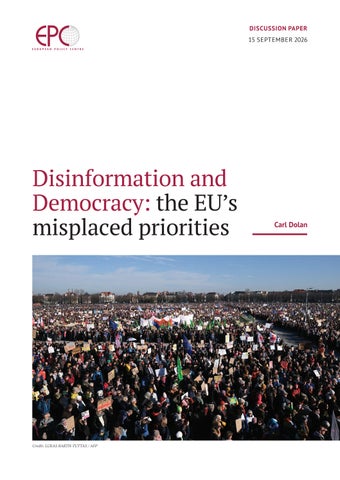
Credit: LUKAS BARTH-TUTTAS / AFP
Carl Dolan
Table of contents Executive summary
3
Introduction
4
From Disinformation to Democracy Promotion and Back to Disinformation
4
How did we get here?
6
Understanding the impact of disinformation on democracy
6
Does disinformation really undermine democracy?
7
Why choose this path?
8
Mis-selling democracy?
8
Endnotes
9
ABOUT THE AUTHOR Carl Dolan is Senior Adviser on Ethics and Transparency at the European Policy Centre.
ACKNOWLEDGEMENTS / DISCLAIMER The support the European Policy Centre receives for its ongoing operations, or specifically for its publications, does not constitute an endorsement of their contents, which reflect the views of the authors only. Supporters and partners cannot be held responsible for any use that may be made of the information contained therein.
Executive summary In this paper, published on the International Day of Democracy, Carl Dolan traces how the EU’s preoccupation with disinformation, and especially foreign interference campaigns, has skewed its policies to protect democracy. The von der Leyen Commission has presented a series of initiatives to promote democratic resilience that are increasingly focused on the threats posed by hostile geopolitical rivals to the integrity of the information environment, effectively anchoring democracy promotion policies in a more encompassing security agenda.
The reality of disinformation campaigns sponsored by Russia and others is beyond question. However, Dolan argues that the prominence of counter-disinformation policies as part of the democracy agenda is not justified by the impact of such campaigns on our democracies and rests on a contestable view of the conditions necessary for democratic legitimacy. Furthermore, the securitisation of democracy policy may have unintended and counterproductive consequences such as restricting civic space and further eroding trust in democratic deliberation.
3
Introduction The EU has a European Commissioner for Democracy and the Berlaymont building is currently draped in a 50 m high banner urging us to protect our democracy. Given the Union is home to some of the oldest democracies in the world, this may seem unexceptional, but it wasn’t always so. While functioning democratic institutions are the sine qua non of membership, it was not until 2020’s European Democracy Action Plan that the European Commission set out policy proposals explicitly designed to safeguard democracy within the EU’s borders. Until that time, the EU’s efforts to promote democracy targeted countries outside the bloc, especially those countries that were candidates for membership.
self-consciously illiberal experiments. Before 2020, the Commission had responded to these developments in its undisputed role as guardian of the treaties and the EU legal order, framing this more narrowly as a rule of law crisis and creating a set of new legal instruments that were brought to bear in the first instance on Poland and Hungary. However, the rise in support for illiberal parties of the right and left across the region made it clear that there was a broader democratic malaise that could not be reduced to a breakdown in the rule of law. Treating this malaise requires a broader set of policy interventions in the field of democracy promotion, a field where the European Commission has relatively little experience and limited powers. Moreover, the nature of – and necessity for – such governmentsponsored interventions are fiercely contested politically. In this paper, I argue that the EU has navigated these pitfalls by progressively narrowing its focus on an issue that is peripheral to Europe’s democratic resilience and potentially counterproductive – the threat of disinformation and more specifically foreign information and manipulation and interference (FIMI) campaigns conducted by geopolitical rivals such as Russia and China. This represents a broader trend of prioritising security or security-adjacent policies by an avowedly geopolitical Commission, but misdiagnoses our current democratic predicament.
The increasing prominence of democracy as a policy issue was an inevitable consequence of growing concern with democratic backsliding in both older and newer member states.
The increasing prominence of democracy as a policy issue was an inevitable consequence of growing concern with democratic backsliding in both older and newer member states, a trend that accelerated after the 2008 financial crisis and reached its apotheosis in Hungary’s
This paper traces the evolution of this policy discourse, reconstructs the rationale for this selective focus and points to some of the unintended consequences of the Commission’s choices.
From Disinformation to Democracy Promotion and Back to Disinformation Tellingly, efforts to combat disinformation predate policies on internal democracy promotion. The origins of the EU’s counter-disinformation can be traced to Russia’s annexation of Crimea in 2014 and the ensuing deterioration of the security environment. In March 2015, the European Council explicitly recognised “Russia’s ongoing disinformation campaigns”1 and called for a coordinated European response. This led to the establishment of the East StratCom Task Force within the European External Action Service (EEAS), whose initial mandate was to improve the Union’s capacity to identify, analyse and respond to Russian information activities directed primarily at Eastern Partnership countries and the Western Balkans.
At this stage, the policy problem was understood principally as one of strategic communication, emphasising improvements in the Union’s capacity to detect and respond to coordinated foreign influence campaigns. Russian disinformation was viewed as an instrument of hybrid conflict rather than as a broader threat to democratic politics within the Union itself.2 The geopolitical context changed dramatically following the 2016 United States presidential election. Allegations of Russian interference, together with the subsequent Cambridge Analytica revelations, transformed public understanding of digital political communication. A benign or neutral view of social media gave way to
4
a darker vision of platforms such as Twitter (now called X) and Facebook as the opaque plumbing of our democratic town hall, facilitating political manipulation on an unprecedented scale. Disinformation consequently moved from the margins of foreign policy into the centre of debates concerning democratic resilience.
Information security to prevent foreign interference is now firmly anchored as the organising framework for EU policies on democracy.
The European Commission’s 2018 Action Plan against Disinformation3 reflected this transition. Although retaining a strong emphasis on countering foreign interference, the Action Plan broadened the policy agenda to include cooperation with online platforms and support for fact-checking initiatives. The idea of disinformation as one of the defining challenges facing European democracy was not front-and-centre, however. Rather, it is represented as one among several emerging vulnerabilities associated with digital transformation.
The Communication itself reaffirmed that citizens should be able to “form their own opinions”6 within an information environment free from interference while emphasising again the role of foreign authoritarian regimes as actively subverting European democracy through covert lobbying, foreign funding, cyber operations, fake research institutes, coordinated social media activity and manipulated audiovisual content. Particular attention is devoted to election integrity. The document is less scrupulous in distinguishing between disinformation more generally – deliberate attempts to mislead for a variety of motives – and foreign influence or FIMI operations specifically. Information security to prevent foreign interference is now firmly anchored as the organising framework for EU policies on democracy.
From European Democracy Action Plan to Democracy Shield The publication of the European Democracy Action Plan in December 2020 represented a decisive pivot – the first ever policy document that outlined an EU agenda on democratic resilience within the Union. The Plan embedded disinformation within a broad strategy spread over several areas such as civic participation, regulation of digital platforms, media freedom, media pluralism and the integrity of electoral processes. Significantly, it required the Commission to explicitly articulate a conception of democracy and democratic legitimacy:
This was reinforced in the political priorities that von der Leyen outlined at the start of her second term in 2024. Under the heading of ‘protecting our democracy’ she urges the new Commissioner for Democracy, Justice and the Rule of Law, Michael McGrath, to “step up our fight against foreign information manipulation and interference”. Last year’s Democracy Shield Communication is the apex of this development so far. Conceived as a series of policy measures to shore up European democratic resilience, the centrepiece of the proposal is a new “Centre for Democratic Resilience”7 to coordinate responses to disinformation campaigns between the EU and its member states. The Centre began operations in February this year.
“For participation to be meaningful, citizens must also be able to form their own judgements — they should be able to make electoral choices in a public space where a plurality of views can be expressed freely and where free media, academia and civil society can play their role in stimulating open debate, free from malign interference, either domestic or foreign.”4 This becomes the touchstone for subsequent prescriptions. Democracy is understood as more than a procedure for aggregating preferences through elections: as a process whose legitimacy depends to a substantial degree upon the epistemic quality of the environment in which those preferences are formed. Defending democracy therefore means defending the integrity of the information environment.
Despite gesturing to initiatives to promote electoral integrity, media pluralism and media literacy, once again there is a pronounced emphasis in both the Communication and public statements8 on external authoritarian regimes employing increasingly sophisticated methods to weaken democratic societies, exploit social divisions and undermine trust in democratic institutions. The document also clearly links disinformation to democratic malfunctioning: “Strengthening the integrity of the information space [is required] to support everyone in society to... exercise their democratic rights”.9 The promise to implement the Shield “in synergy with the EU’s agenda on security, defence, preparedness” for the first time explicitly yokes together policies on democracy and defence.
The Commission’s Defence of Democracy Package, published in December 2023 continued and expanded this approach. The package had a prominent place in President von der Leyen’s State of the EU address the previous year, in which she portrayed the EU’s democracies as vulnerable to subversion by hostile autocrats: “We will not allow any autocracy’s Trojan horses to attack our democracies from within”.5 Following Russia’s brutal invasion of Ukraine earlier that year, democratic resilience had become increasingly intertwined with European security policy.
5
European Parliament special committees
MEPS, it heightened the sense that, as President Metsola memorably claimed, “European Democracy is under attack”.10
In parallel, the European Parliament established three temporary ‘special committees’ to debate democracy, disinformation and foreign influence, starting with the Special Committee on Foreign Interference in all Democratic Processes in the European Union, including Disinformation (INGE) created in 2020 and continuing to the present day with the Special Committee on the European Democracy Shield (EUDS), whose mandate runs until 2027.
EUDS focuses on FIMI threats almost to the exclusion of all other issues. Indeed, in the committee’s final set of recommendations, FIMI threats are presented in the gravest of terms as “complex, full-scale and cross-sectoral crises with detrimental effects on safety and security, the well-being of citizens, and the functioning of society and the economy as a whole...and destabilising democratic institutions across the Member States”.11 The message is clear: the most serious threat faced by our democracies is interference and meddling by foreign powers.
The focus on disinformation and foreign threats was striking to begin with and was turbo-charged by the Qatargate scandal that erupted in 2022. For many
How did we get here? As vivid and disturbing as these examples are, a justification for placing FIMI at the heart of policies to protect democracy needs to go further. It would need to show that the impact of FIMI on electoral processes and democratic debate is significantly damaging or that only if we can assure ourselves of the integrity of the information environment can we have confidence that our democracies are functioning well. While the Commission and Parliament documents reviewed above nod toward these arguments, unfortunately both rest on very shallow foundations.
Over the last half-dozen years, the EU has progressively securitised its flagship democracy initiatives, in response to anxieties about covert disinformation campaigns. And no-one can doubt that geopolitical rivals, most notably Russia, are systematically engaged in FIMI operations that target elections and social media debates in EU and candidate countries. That much has been amply documented by Commission initiatives (e.g. EUvsDisinfo)12, national intelligence agencies,13 journalists,14 NGOs15 and cybersecurity agencies.
Understanding the impact of disinformation on democracy In terms of the impact of FIMI campaigns, an early assessment of European disinformation policy observed that “the evidence of harm caused by disinformation and influence operations is patchy…Russia’s scattershot approach to disinformation entails running multiple campaigns simultaneously, with some achieving notoriety while the vast majority of them fail to attract attention from the target audiences or gain traction”.16
spearheaded by Russia’s Internet Research Agency (IRA) and associated actors. These activities included the creation of false social media accounts impersonating American citizens, the purchase of political advertisements, the dissemination of polarising political content, the organisation of online communities around divisive social issues and the strategic amplification of existing political tensions.18
Of course, it is always possible that the greater impact of these essentially covert activities are unobserved, so it is hard to make robust generalisations. However, a brief review of the most notorious (and therefore best documented) case of FIMI – that of the 2016 US Presidential elections – may be instructive. This has become the reference point for subsequent debates concerning platform regulation, election security and foreign information manipulation, both in the United States and in Europe.17
Assessing the effectiveness of these activities is rather more difficult. As researchers obtained access to more comprehensive platform data, the empirical picture became considerably more nuanced. Studies consistently report that exposure to content produced by the IRA represented only a very small proportion of users’ overall political information environments and was concentrated overwhelmingly among individuals who already held strong partisan commitments. Eady et al. (2023), for example, found no statistically significant relationship between exposure to Russian Twitter content and meaningful changes in political attitudes, partisan identification or vote choice. Exposure was real, but persuasion proved considerably more difficult to demonstrate.19
There is now overwhelming evidence that Russia conducted a coordinated effort to influence the American political environment during the 2016 campaign, 6
These findings are backed up by a comprehensive review of existing scientific literature undertaken by researchers for Nature.20 The authors conclude that three assumptions frequently made in public debate receive only limited empirical support. First, average exposure to misinformation is substantially lower than commonly assumed. Secondly, exposure is concentrated among relatively small groups of politically engaged users rather than being evenly distributed across electorates. Thirdly, existing evidence provides only limited support for claims that such exposure systematically alters political attitudes or electoral behaviour. The review therefore cautions against inferring democratic effects directly from the visibility or scale of online misinformation.
A revealing example concerns Facebook’s estimate that Russian-linked content reached approximately 126 million American users. This figure has been widely cited as evidence of the extraordinary scale of Russian influence. What has received less attention is that this represents 0.0004% of the content the US citizens saw on their news feed. It should also be borne in mind that very few of the outputs of the IRA generated exposure on the scale of the Facebook example above. The median number of impressions for all online political material disseminated by the IRA was 199.21 There are clear doubts that this kind of online disinformation campaign had a significant impact on political behaviour, either individually or in aggregate.
Does disinformation really undermine democracy? To the extent that it articulates a clear theory of democratic legitimacy, Commission documents have a distinctive flavour that reflects one strand of democratic theorising since at least the beginning of the 20th century, one which emphasises the nature of democracy as free and informed deliberation about political ends and means. This ideal of the autonomous citizen freely adopting opinions within a marketplace of ideas closely resembles one of the most influential normative conceptions of democracy developed during the 20th century: Jürgen Habermas’s theory of the public sphere and deliberative democracy. Habermas argued that democratic legitimacy depends not only upon electoral procedures but also upon the quality of the communicative processes through which political preferences are formed.22
Citizens frequently know little about public policy, yet democratic systems continue to function with considerable stability
Most recently, this critique has been deepened and synthesised by Christopher Achen and Larry Bartels in their influential work “Democracy for Realists”.25 Their critique is directed at what they describe as the “folk theory of democracy”: the widely shared belief that democratic elections work because informed citizens evaluate competing policy programmes and hold governments electorally accountable for their performance. They comprehensively and painstakingly show how decades of empirical research provide remarkably little support for this account. Electoral behaviour is shaped less by careful policy evaluation than by enduring social identities, partisan loyalties, group attachments and retrospective judgements that often bear only an indirect relationship to governmental performance. Citizens frequently know little about public policy, misunderstand institutional arrangements and exhibit limited ideological coherence. Yet democratic systems continue to function with considerable stability. Importantly, their account does not imply that citizens are irrational or that information is irrelevant to democratic politics. Rather, it holds that representative democracy can thrive without placing undesirable and unachievable epistemic demands on voters.
Indeed, the turn to more open and accountable EU decision-making that was ushered in by the European Commission’s 2001 “White Paper on Governance” can be seen as an attempt to embrace alternative, Habermasian foundations for its legitimacy in the wake of declining voter turnout and rejections of EU treaties in national referenda. Deprived of a properly constituted European demos as a foundation stone for legitimacy, the inclusiveness and consultative nature of decisionmaking, the idea of legitimacy as an endpoint becomes the regulative ideal. “[The EU’s] legitimacy today depends on involvement and participation...Democracy depends on people being able to take part in public debate”.23 While the Habermasian public sphere remains a highly attractive ideal, it rests on dubious empirical foundations as a model of how citizens actually reason. More worryingly, assuming that “ought implies can” it can additionally subvert our understanding of democratic legitimacy. Ever since Philip Converse’s seminal essay “The Nature of Belief Systems in Mass Publics”24 there is a rich political science literature that exposes the frailties, inconsistencies and instability of political reasoning among ordinary (and even elite) voters.
7
Why choose this path? If disinformation and FIMI campaigns are unlikely to have a significant impact on elections or decisionmaking, nor undermine the legitimacy of democratic processes, why has this issue been elevated to the EU’s flagship intervention to secure European democracy?
The focus on foreign threats has another important advantage in that it can garner consensus on a highly contested issue among member states and political parties: what features of our heterogenous European democracies need preservation, repair and reform. There is an institutional logic to the framing at EU level because the FIMI agenda lends itself to ideologically neutral, technocratic interventions that are more suited to an institution like the European Commission. It reflects the fact that there is no political consensus among member states about what needs to be done to revive our democracies and an unwillingness to let the EU take the lead on more substantive issues. It also reflects a (fragile) consensus on the need to counter Russian and Chinese geopolitical assertiveness and so to paint what is fundamentally a security and defence concern as an exercise in democracy promotion.
Two primary reasons stand out. Firstly, in a field where the Commission has few regulatory powers or track record, focusing on the integrity of the digital information space was at least consistent with a broader digital agenda and significant single market powers. Von der Leyen’s democracy agenda evolved at much the same time as the Digital Services Act and Digital Markets Act and there is substantial overlap in terms of tracing disinformation and making platforms accountable for its circulation.
Mis-selling democracy? One might be forgiven for thinking that, for entirely understandable reasons, the EU is simply guilty of mislabelling a policy initiative. Under the guise of ‘fostering democratic resilience’, a self-consciously geopolitical Commission has prioritised achievable security objectives that are designed to counter efforts by Russia and others to destabilise the Union. Is this not simply a harmless game of bait-and-switch?
campaigns, the evidence suggests that these merely aim to exploit existing societal concerns around the pace of social change, growing wealth inequality, lack of social mobility and mistrust of elites.28
Europe’s democratic malaise is real and is evidenced by increasing support for extremist parties, many with distinctly illiberal and undemocratic platforms.
There are reasons to be more sanguine. Firstly, there are clear and present unintended consequences. Von der Leyen’s concern with ‘autocracies, Trojan horses’ have put civil society organisations firmly in the crosshairs of suspicious regulators, as part of a broader effort to prevent non-profit entities from being exploited as fronts for disinformation campaigns. The keystone legislative initiative of the Defence of Democracy package was a ‘Transparency of Interest Representation Carried out on Behalf of Third Countries’ directive that mirrors provisions in the US’s notorious Foreign Agent Registration Act (FARA) and has been criticised by civil society groups for potentially allowing unscrupulous governments to harass and silence critical NGOs.26 The European Parliament, while paying lip-service to the role of civil society in promoting democracy, prominently notes that “civil society organisations can be, and have been, used as tools by malicious non-EU-country actors to illegitimately influence democratic processes”.27 Such sentiments run the risk of adding fuel to the wildfires currently ravaging the civil society ecosystem.
Thirdly, there is the risk that such narratives actually compound the mistrust in democracy and democratic debate that has been seeded in part by these influence campaigns. The furore over the 2016 US election has surely contributed to the situation where US citizens estimate that 65% of the news they see on social media is misinformation (Budak et al., 2024).29 Finally, foregrounding the threat rather than the impact of disinformation may end up doing Russia’s dirty work for it. Documents obtained recently from a Russian agency engaged in influence operations in Europe speak of the wish to “maintain the image of a superpower” on the world stage. The real goal of such operations, they suggest, is to demonstrate the illusion rather than the reality of Russian omnipotence: “the more Russia participates in active influence campaigns all over the world, the stronger the image of a global Russian power”.30
Secondly, there are the opportunity costs. Europe’s democratic malaise is real and is evidenced by increasing support for extremist parties, many with distinctly illiberal and undemocratic platforms. As comforting as would be to blame this on foreign disinformation 8
European Council (2015), European Council meeting (19–20 March 2015): Conclusions, Brussels, EUCO 11/15. 2 Pamment, James (2020), “The EU’s Role in Fighting Disinformation: Taking Back the Initiative”, Carnegie Endowment for International Peace, 15 July 2020. 3 European Commission and High Representative (2018), “Action Plan against Disinformation”, Brussels, JOIN(2018) 36 final, 5 December 2018. 4 European Commission (2020), Communication from the Commission on the European Democracy Action Plan, Brussels, COM(2020) 790 final. 5 Von der Leyen, Ursula, “2022 State of the Union Address”, European Commission, 14 September 2022. 6 European Commission (2023), Communication from the Commission on Defence of Democracy, Brussels, COM(2023) 630 final. 7 European Commission and High Representative of the Union for Foreign Affairs and Security Policy (2025), European Democracy Shield— Empowering strong and resilient democracies, Brussels, JOIN(2025) 791 final. The European Centre for Democratic Resilience formally started its work in February 2026. 8 Goujard, Clothilde, “Barbarians at the Gate: Von der Leyen makes foreign influence a key campaign topic”, Politico, 14 May 2024. 9 European Commission and High Representative of the Union for Foreign Affairs and Security Policy (2025), European Democracy Shield. 10 Metsola, Roberta, “EP President Metsola on the ongoing investigations by Belgian authorities”, statement at the opening of the plenary session, European Parliament, 12 December 2022. 11 European Parliament, Special Committee on the European Democracy Shield (EUDS) (2025–26), draft report and working documents on the European Democracy Shield, Brussels. See also European Parliament Decision of 18 December 2024 setting up EUDS, P10_TA(2024)0065, recital M, on hybrid threats leading to “full-scale and cross-sectoral crises”. 12 European External Action Service (EEAS), EUvsDisinfo database (accessed 10 September 2026). 13 U.S. Senate Select Committee on Intelligence (2019), Senate Intel Committee Bi-partisan Report on Russia’s Use of Social Media. 14 Pomerantsev, Peter (2019), This is Not Propaganda, London: Faber & Faber. 15 Cucu, Ciprian (2025), “The Disinformation Landscape in Romania”. 16 Pamment, James (2020), “The EU’s Role in Fighting Disinformation: Taking Back the Initiative”, Carnegie Endowment for International Peace, pp. 3–4. 17 Office of the Director of National Intelligence (2017), Assessing Russian activities and intentions in recent US elections, ICA 2017-01D; United States Senate Select Committee on Intelligence (2019), Russian active measures campaigns and interference in the 2016 U.S. election, Volume 2: Russia’s use of social media with additional views, US Senate. 18 Office of the Director of National Intelligence (2017), Assessing Russian activities and intentions in recent US elections, ICA 2017-01D; Mueller, Robert S. III (2019), Report on the investigation into Russian interference in the 2016 presidential election, U.S. Department of Justice; United States Senate Select Committee on Intelligence (2019), Russian active measures campaigns and interference in the 2016 U.S. election, Volume 2: Russia’s use of social media with additional views, US Senate.
Eady, Gregory, Paskhalis, Tom, Zilinsky, Jan, et al. (2023), “Exposure to the Russian Internet Research Agency foreign influence campaign on Twitter in the 2016 US election and its relationship to attitudes and voting behavior”, Nature Communications, 14, 62, https://doi.org/10.1038/s41467022-35576-9. 20 Budak, Ceren, Nyhan, Brendan, Rothschild, David M., et al. (2024), “Misunderstanding the harms of online misinformation”, Nature, 630, pp. 45–53, https://doi.org/10.1038/s41586-024-07417-w. 21 United States Senate Select Committee on Intelligence (2019), Russian active measures campaigns and interference in the 2016 U.S. election, Volume 2: Russia’s use of social media with additional views, U.S. Senate; Eady, Gregory et al. (2023), “Exposure to the Russian Internet Research Agency foreign influence campaign on Twitter in the 2016 US election and its relationship to attitudes and voting behavior”. Facebook’s congressional testimony estimated that IRA content amounted to about 0.004% of News Feed content over the relevant two-year period. 22 Habermas, Jürgen (1996), Between Facts and Norms: Contributions to a Discourse Theory of Law and Democracy, William Rehg (trans.), Cambridge, MA: MIT Press. 23 European Commission (2001), European governance: A white paper, COM(2001) 428 final; Føllesdal, Andreas and Hix, Simon (2006), “Why there is a democratic deficit in the EU: A response to Majone and Moravcsik”, Journal of Common Market Studies, 44, 3, pp. 533–562; Schmidt, Vivien A. (2013), “Democracy and legitimacy in the European Union revisited: Input, output and ‘throughput’”, Political Studies, 61(1), pp. 2–22, https://doi. org/10.1111/j.1467-9248.2012.00962.x. 24 Converse, Philip E. (1964), “The nature of belief systems in mass publics”, in David E. Apter (ed.), Ideology and Discontent, New York: Free Press, pp. 206–261. 25 Achen, Christopher H. and Larry M. Bartels (2016), Democracy for Realists: Why Elections Do Not Produce Responsive Government, Princeton, NJ: Princeton University Press. 26 European Commission (2023), Proposal for a Directive establishing harmonised requirements in the internal market on transparency of interest representation carried out on behalf of third countries, Brussels, COM(2023) 637 final, 12 December 2023; Civil Society Europe (2024), “Defence of Democracy Package – Civil society and academia sound the alarm”, 14 February 2024. 27 European Parliament, Special Committee on the European Democracy Shield (EUDS) (2026), amendments to the draft report on the European Democracy Shield, Brussels, PE784.408v01-00, para. 40. 28 Bryson, Joanna, “Science Fails to Find Correlations Between Social Media Use and Affective Polarisation”, 6 February 2022. 29 Budak, Ceren, Brendan Nyhan, David M. Rothschild, Emily Thorson and Duncan J. Watts (2024), “Misunderstanding the harms of online misinformation”. 30 Organised Crime and Corruption Reporting Project (OCCRP) (14 February 2026), “Propaganda machine: Secret documents reveal Russia’s foreign influence strategy across three continents”.
1
19
9
NOTES
10
NOTES
11
The European Policy Centre is an independent, not-for-profit think tank dedicated to fostering European integration through analysis and debate, supporting and challenging European decision-makers at all levels to make informed decisions based on sound evidence and analysis, and providing a platform for engaging partners, stakeholders and citizens in EU policymaking and in the debate about the future of Europe.
EUROPEAN POLICY CENTRE | 14-16 RUE DU TRÔNE/TROONSTRAAT | B -1000 BRUSSELS | BELGIUM | WWW.EPC.EU