Elizabeth Mittendorf, ASCO President 2026–2027, on the evolution of breast cancer immunotherapy Congress Interview:
Review of the American Society of Clinical Oncology (ASCO) Annual Meeting 2026, May 29–June 2
ASCO 2026: Highlights in Breast Cancer Research Advani and Leon-Ferre
Erika P. Hamilton Chair, ASCO 2025 Annual Meeting Scientific Program Committee; Director, Breast Cancer Research Program, Sarah Cannon Research Institute, Nashville, Tennessee, USA
Advances in the Treatment of HER2Positive Early Breast Cancer: Key Updates from ASCO 2026
Evaluating the Safety, Performance, and Clinical Utility of a Multi-Cancer Early Detection (MCED) Test for Population Screening
Advancing Quality of Life in Advanced Prostate Cancer: Cognitive Outcomes and Patient Preference from ARACOG
Editorial Board
Editor-in-Chief
Dr Erika Hamilton
Sarah Cannon Research Institute, Nashville, Tennessee, USA
Director, Breast Cancer Research Program and Chair, Executive Breast Committee
Dr Caroline Michie
University of Edinburgh, Scotland, UK
Dr Samir Parekh
Icahn School of Medicine at Mount Sinai, New York City, New York, USA
Dr Pooja Advani
Mayo Clinic, Jacksonville, Florida, USA
Dr Nicolò Battisti
The Royal Marsden NHS Foundation Trust, London, UK
Dr Roberto Leon-Ferre
Mayo Clinic, Rochester, Minnesota
Prof Daniel McFarland
The University of Rochester Medical Center, Rochester, New York, USA
Dr Ghaith Abu-Zeinah
Weill Cornell Medicine, New York City, New York, USA
Dr Ashwin Mehta
Integrative Medicine at Memorial Healthcare System, Pembroke Pines, Florida, USA
Prof Benjamin Weinberg
Georgetown University, Washington D.C., USA
Aims and Scope
AMJ Oncology is an open-access, peer-reviewed eJournal committed to helping elevate the quality of healthcare in respiratory medicine by publishing high quality content on all aspects of cancer care.
The journal is published annually, 6 weeks after the American Society of Clinical Oncology (ASCO) Annual Meeting, and features highlights from this congress, alongside interviews with experts in the field, reviews of abstracts presented at the congress, as well as in-depth features on congress sessions. Additionally, this journal covers advances within the clinical and pharmaceutical arenas by publishing sponsored content from congress symposia, which is of high educational value for healthcare professionals. This undergoes rigorous quality control checks by independent experts and the in-house editorial team.
AMJ Oncology also publishes peer-reviewed research papers, review articles, and case reports in the field. In addition, the journal welcomes the submission of features and opinion pieces intended to create a discussion around key topics in the field and broaden readers’ professional interests. AMJ Oncology is managed by a dedicated editorial team that adheres to a rigorous double-blind peer-review process, maintains high standards of copy editing, and ensures timely publication.
Our focus is on research that is relevant to all healthcare professionals in cancer medicine. We do not publish veterinary science papers or laboratory studies not linked to patient outcomes. We have a particular interest in topical studies that advance research and inform of coming trends affecting clinical practice in the oncology field.
Editorial Expertise
AMJ is supported by various levels of expertise:
• Guidance from an Editorial Board consisting of leading authorities from a wide variety of disciplines.
• Invited contributors are recognised authorities from their respective fields.
• Peer review, which is conducted by AMJ’s Peer Review Panel as well as other experts appointed due to their knowledge of a specific topic.
• An experienced team of editors and technical editors.
Peer Review
On submission, all articles are assessed by the editorial team to determine their suitability for the journal and appropriateness for peer review.
Editorial staff, following consultation with either a member of the Editorial Board or the author(s) if necessary, identify three appropriate reviewers, who are selected based on their specialist knowledge in the relevant area. All peer review is double blind.
Following review, papers are either accepted without modification, returned to the author(s) to incorporate required changes, or rejected. Editorial staff have final discretion over any proposed amendments.
Submissions
We welcome contributions from professionals, consultants, academics, and industry leaders on relevant and topical subjects.
We seek papers with the most current, interesting, and relevant information in each therapeutic area and accept original research, review articles, case reports, and features.
We are always keen to hear from healthcare professionals wishing to discuss potential submissions, please email: editorial@americanmedicaljournal.com
To submit a paper, use our online submission site: https://emj.kriyadocs.com/submissions/submit/emj/emj/login
Submission details can be found through our website: www.emjreviews.com/contributors/authors
Reprints
All articles included in AMJ are available as reprints (minimum order 1,000). Please contact hello@emjreviews.com if you would like to order reprints.
Distribution and Readership
AMJ is distributed through controlled circulation to healthcare professionals in the relevant fields globally.
Open Access
This is an open-access journal in accordance with the Creative Commons Attribution-Non Commercial 4.0 (CC BY-NC 4.0) license.
Congress Notice
Staff members attend medical congresses as reporters when required.
This Publication Launch Date: 2024 Frequency: Yearly Online ISSN: 3049-5415
AMJ Oncology is published once a year. For subscription details please visit: www.emjreviews.com
All information obtained by AMJ and each of the contributions from various sources is as current and accurate as possible. However, due to human or mechanical errors, AMJ and the contributors cannot guarantee the accuracy, adequacy, or completeness of any information, and cannot be held responsible for any errors or omissions. AMJ is completely independent of the review event (2026 ASCO Annual Meeting) and the use of the organisations does not constitute endorsement or media partnership in any form whatsoever.
Helena Bradbury, Katrina Thornber, Aleksandra Zurowska, Bertie Pearcey, Jess Nicholson, Alena Sofieva, Niamh Holmes, Nonyelum Okonkwo, Roli Omamuli, Josh Warren Lister
Creative Director
Tim Uden
Design Manager
Stacey White
Design
Tamara Kondolomo, Owen Silcox, Shanjok Gurung, Fabio van Paris, Fraser Hoey, Helena Spicer, Caleb Wylie
Marketing Director
Stephanie Corbett
Vice President of Customer Success
Alexander Skedd
Vice President of Business Development
Robert Hancox
Chief Executive Officer
Justin Levett
Chief Commercial Officer
Dan Healy
Founder and Chairman
Spencer Gore
Welcome
Dear Readers,
Welcome to our 2026 issue of AMJ Oncology. The AMJ team has brought together congress coverage from the American Society of Clinical Oncology (ASCO) Annual Meeting 2026, and abstract reviews spanning breast, lung, colorectal, pancreatic, hepatic, and hematologic malignancies.
Our ASCO 2026 review captures a meeting shaped by the theme 'The Science and Practice of Translation: Improving Cancer Outcomes Worldwide'. Opening the meeting, ASCO President Eric J. Small emphasized that scientific discovery must be met with its match: ensuring advances become meaningful improvements for patient outcomes. This message runs throughout our congress coverage, from novel targeted therapies and immunotherapy combinations to de-escalation strategies, early detection, survivorship, and equitable access to care. Three Phase III trial results presented at the Meeting delivered what oncologists are already calling the most consequential plenary data in years, including the first drug to nearly double survival for patients with metastatic pancreatic cancer.
We are also pleased to feature an exclusive interview with Elizabeth Mittendorf, President of ASCO for 2026–2027, who spoke about her career as a surgeonscientist, the evolution of breast cancer immunotherapy, and her presidential focus on intentional teams delivering exceptional cancer care. Her reflections on de-escalation, survivorship, global collaboration, and support for early-career oncologists offer a thoughtful perspective on where oncology is heading next.
I’d like to thank the Editorial Board, contributors, interviewees, and readers for their continued support as AMJ Oncology strives to be the go-to place for healthcare professionals. I hope this publication informs and inspires you.
Editorial enquiries: editor@emjreviews.com
Sales opportunities: salesadmin@emjreviews.com
Permissions and copyright: accountsreceivable@emjreviews.com
Anaya Malik Vice President of Content
Reprints: info@emjreviews.com
Media enquiries: marketing@emjreviews.com
Stay at the Forefront of Modern Medicine
High-level perspectives. Global experts. Essential updates.
Join us for conversations with the minds shaping healthcare's future. Gain the distilled insights you need to lead in your field and make maximum impact.
Jonathan Sackier: Non Executive Director & CMO, AiM Medical Robotics, Florida, USA
Saranya Ravindran: Paediatric Emergency Medicine Registrar, Imperial College Healthcare NHS Trust
Catherine Glass: Associate NHS GP and Senior Appraiser, NHS England
Foreword
Dear Colleagues,
Welcome to this new edition of AMJ Oncology, heavily anchored by the practice-changing revelations from the American Society of Clinical Oncology (ASCO) 2026 Annual Meeting. This issue brings you comprehensive congress highlights, exploring the most impactful clinical data, alongside critical disease-specific updates. Pooja Advani and Roberto Leon-Ferre break down the latest in breast cancer, while Jian Campian delivers essential insights into neuro-oncology.
Complementing our congress coverage, we feature exclusive conversations with key voice leaders. This includes an inspiring interview with incoming ASCO President (2026–2027) Elizabeth Mittendorf, alongside non-congress interviews with Christopher Cogle and Jorge Cortes, discussing regional cancer care advancements.
Finally, our robust abstract reviews offer deep dives into real-world data and pipeline therapeutics. These include critical findings from the C-PROWESS and BeTAS trials in colorectal cancer, real-world brain metastasis outcomes comparing trastuzumab deruxtecan to tucatinibbased therapies in human epidermal growth factor receptor 2-positive breast cancer, and diagnostic breakthroughs in early kidney cancer detection using blood-based mRNA profiling. Of all the practice-changing data emerging from this year’s plenary session, the results for the oral
RAS(ON) multi-selective inhibitor, daraxonrasib, stand out as an undeniable milestone. For decades, targeting KRAS mutations in pancreatic ductal adenocarcinoma was considered an insurmountable challenge, leaving patients with tragically few options.
This issue brings you comprehensive congress highlights, exploring the most impactful clinical data, alongside critical disease-specific updates
The presentation of daraxonrasib completely altered that narrative. Demonstrating an unprecedented survival benefit, the data drew a spontaneous standing ovation from a packed auditorium. This is not an incremental gain; it represents the first major therapeutic breakthrough the pancreatic cancer field has witnessed in a generation. It establishes an immediate new standard of care for previously treated metastatic disease.
Erika Hamilton Director of Breast Cancer Research Program; Chair, Executive Breast Committee;
Sarah Cannon Research Institute, Nashville, Tennessee, USA
Congress Review
Review of the American Society of Clinical Oncology (ASCO) Annual Meeting 2026
THE 2026 Annual Meeting of the American Society of Clinical Oncology (ASCO) returned to Chicago, Illinois, USA, from May 29–June 2, bringing together the global oncology community for one of the most influential meetings in cancer research and care. Held at McCormick Place and online, this year’s congress centered on the presidential theme: 'The Science and Practice of Translation: Improving Cancer Outcomes Worldwide'. The program featured more than 200 sessions, with more than 7,000 abstracts presented or published as part of the meeting.
Chicago provided a fitting backdrop for a meeting focused on translating discovery into practice. Situated on Lake Michigan, the city is known for its architecture, cultural institutions, food scene, and long history as a hub for medical research and clinical care.
Its major academic medical centers and cancer programs have contributed to advances across oncology, making the city an apt host for discussions spanning prevention, diagnosis, treatment, survivorship, and global access.
FROM DISCOVERY TO MEANING
Opening the Meeting, ASCO President Eric J. Small framed translation as the central responsibility of the oncology community. Speaking to delegates, he emphasized that the value of scientific discovery lies not only in the generation of new knowledge but also in its ability to improve patient outcomes across settings and populations.
Small described three dimensions of translation: moving laboratory science into the clinic, translating clinical trial evidence into real-world patient-centered care, and ensuring innovation reaches every patient. His remarks connected the scientific program to a broader ethical and practical challenge: ensuring that breakthroughs presented at the Meeting are ultimately reflected in better care.
The congress program reflected this theme through oral abstract sessions, posters, lectures, educational sessions, symposia, plenaries, and digital content. Topic areas included immunotherapy, targeted therapies, liquid biopsies, novel imaging, biomarkers, early detection, survivorship, quality of life, cancer disparities, global oncology, supportive care, and health policy.
Because discovery alone is not enough, it’s about what becomes of what we discover
SCIENCE, ACCESS, AND EQUITY
A recurring message from the opening session was that progress in oncology must be measured not only by new treatments but also by whether patients can access them. Small highlighted the need for diverse clinical trial representation, stronger bonds of trust between patients and community oncologists, and systems that reduce barriers to timely, evidence-based care.
He also brought a deeply personal dimension to the theme, reflecting on the death of his partner, Amy Lin, from metastatic clear-cell ovarian cancer. Her experience, he said, reinforced the importance of placing what matters to patients at the center of oncology advances.
That patient-centered focus shaped the tone of the opening ceremony, with speakers repeatedly linking innovation to responsibility. Small noted that translation must occur across languages, cultures, geographies, resources, and practice settings so that scientific advances can benefit patients everywhere.
FUNDING THE FUTURE OF CANCER RESEARCH
The opening session also featured remarks from Anthony Letai, Director of the National Cancer Institute (NCI), who addressed the current cancer research landscape and emphasized stability in the U.S. cancer research infrastructure. He acknowledged concerns around funding delays and planning uncertainty, particularly among earlycareer investigators, but stated that the NCI remained committed to supporting highquality research across the community.
Letai underscored the long-term progress made in reducing cancer mortality in the U.S., while cautioning that cancer remains a leading cause of death and continues to affect millions of Americans. He described the NCI’s priorities as focused on reducing friction in the system, accelerating progress for patients, and funding the best science.
The opening ceremony also recognized the next generation of cancer researchers through the Conquer Cancer grant and award recipients, including acknowledgment of the Young Investigator Award established in honor of Felix Feng.
A GLOBAL ONCOLOGY PLATFORM
ASCO’s global reach was evident throughout the opening session. Small noted that ASCO has more than 50,000 members, with approximately 40% international membership, representing more than 170 countries. This global scale shaped the Meeting’s central message: oncology innovation must move
beyond discovery and become meaningful, accessible progress for patients worldwide.
As the congress opened, the message from ASCO 2026 was clear: the future of cancer care will depend not only on scientific breakthroughs, but on how effectively the oncology community translates them into practice, access, and improved outcomes for every patient.
The program featured more than 200 sessions, with more than abstracts presented or published as part of the meeting
7,000
Congress highlights
Daraxonrasib Extends Survival in Metastatic Pancreatic Cancer
PROMISING Phase 3 data (NCT06625320),
presented at ASCO 2026, suggest that daraxonrasib could offer a new treatment option for patients with second-line metastatic pancreatic adenocarcinoma (mPDAC), a highly aggressive cancer that has spread beyond the pancreas and is associated with poor survival outcomes.¹
Current second-line therapies provide limited clinical benefit, with reported median progression-free survival (PFS) of 3–4 months and a median overall survival (OS) of 6–7 months. Aberrant RAS pathway activation is a key driver of the disease, with RAS mutations found in more than 90% of cases, most commonly at codon G12.
Daraxonrasib, an oral RAS(ON) multi-selective, tri-complex inhibitor, targets the active, guanosine triphosphate (GTP)-bound state of both mutant and wild-type RAS. The global, randomized, open-label Phase 3 RASolute 302 study enrolled 500 patients with secondline mPDAC and an Eastern Cooperative Oncology Group (ECOG) performance status of 0–1. Participants were randomized to receive either daraxonrasib or investigator’s choice of standard-of-care chemotherapy.
The trial met all primary and key secondary endpoints, with statistically significant improvements in OS and PFS observed with daraxonrasib compared with chemotherapy. In patients with RAS G12 mutations, median OS reached 13.2 months with daraxonrasib versus 6.6 months with chemotherapy (hazard ratio [HR]: 0.40; 95% CI: 0.30–0.54; p<0.0001). In the overall population, median OS was 13.2 months versus 6.7 months, respectively (HR: 0.40; 95% CI: 0.30–0.53; p<0.0001).
Median OS reached 13.2 months with daraxonrasib versus 6.6 months with chemotherapy (hazard ratio [HR]: 0.40; 95% CI: 0.30–0.54; p<0.0001)
Median PFS in the RAS G12 subgroup was 7.3 months with daraxonrasib compared with 3.5 months with chemotherapy (HR: 0.45; 95% CI: 0.34–0.59; p<0.0001). In the overall population, median PFS was 7.2 months versus 3.6 months (HR: 0.49; 95% CI: 0.38–0.64; p<0.0001). Objective response rates were also higher with daraxonrasib, reaching 33.2% versus 11.8% in the RAS G12 group and 31.6% versus 11.2% overall.
At the data cutoff point (February 10, 2026), treatment discontinuations were also lower with daraxonrasib. Grade 3 or higher treatment-related adverse events occurred in 43.6% of patients receiving daraxonrasib compared with 57.5% receiving chemotherapy. Treatment-related serious adverse events occurred in 10.8% versus 18.7%, while discontinuations due to treatmentrelated adverse events were reported in 1.2% and 11.2% of patients, respectively. No new safety signals were reported.
Although the open-label design should be considered when interpreting the findings, efficacy outcomes were assessed through blinded independent central review.
These findings support daraxonrasib as a potential new standard-of-care option for second-line mPDAC, and longer follow-up could help further define the durability of benefit across patient populations.
STRIDE-Based Combinations Improve PFS in EMERALD-3 HCC Trial
THE PHASE 3 EMERALD-3
study (LBA4000), presented at ASCO 2026, evaluated whether adding systemic therapy to transarterial chemoembolization (TACE) improves outcomes in patients with embolization-eligible unresectable hepatocellular carcinoma.2 TACE is a global standard of care in this setting, and is thought to enhance tumor antigen release, potentially synergizing with immunotherapy.
EMERALD-3 randomized approximately 760 patients with confirmed unresectable disease into three arms: TACE alone; STRIDE-based immunotherapy plus TACE; and STRIDE plus TACE combined with lenvatinib. STRIDE consisted of a priming dose of tremelimumab followed by regular dosing of durvalumab. Patients were stratified by region, prior embolization, and tumor burden.
The primary endpoint was progression-free survival (PFS) comparing STRIDE + lenvatinib + TACE versus TACE alone, with overall survival (OS) as a key secondary endpoint across both STRIDE-containing arms.
At interim analysis (February 2026), STRIDE + lenvatinib + TACE significantly improved PFS versus TACE alone, reducing the risk of progression or death by 30% (hazard ratio [HR]: 0.70; 95% CI: 0.57–0.86; p=0.0007). A favorable but non-significant trend in OS was observed (HR: 0.84; 95% CI: 0.65–1.09; p=0.18). The STRIDE + TACE arm also demonstrated consistent benefit, improving both PFS (HR: 0.71) and OS (HR: 0.70) compared with TACE.
Survival rates at 24 months were higher in both combination arms versus TACE alone, suggesting potential durability of benefit, although follow-up remains immature.
Safety findings were consistent with known profiles of immune checkpoint inhibitors, tyrosine kinase inhibition, and locoregional therapy. Grade 3/4 treatment-related adverse events occurred in 62.7% of patients receiving STRIDE + lenvatinib + TACE, 48.6%
with STRIDE + TACE, and 18.6% with TACE alone.
Overall, EMERALD-3 demonstrates that integrating STRIDE-based immunotherapy, with or without lenvatinib, into TACE significantly improves disease control in unresectable hepatocellular carcinoma, with encouraging early survival trends and manageable safety signals.
At interim analysis (February 2026),
STRIDE + lenvatinib + TACE significantly improved PFS versus TACE alone, reducing the risk of progression or death by 30% 30%
Survival rates at 24 months were higher in both combination arms versus TACE alone
Ivonescimab Improves Survival in Advanced Squamous Lung Cancer
NEW
PHASE III trial results presented at ASCO 2026 have shown that ivonescimab combined with chemotherapy significantly improved overall survival (OS) compared with tislelizumab plus chemotherapy in patients with previously untreated advanced squamous non-small cell lung cancer (NSCLC), marking the first time a regimen has demonstrated superiority over an active programmed cell death protein 1 (PD-1) inhibitor control in the first-line setting.3
The findings come from the HARMONi-6 trial, an international Phase III randomized study evaluating ivonescimab, a dual-targeted immunotherapy, in patients with Stage III–IV squamous NSCLC who had not previously received systemic treatment. Earlier analyses had already demonstrated a progression-free survival benefit with ivonescimab; the latest results now confirm a significant OS advantage.
A total of 532 patients were randomly assigned to receive either ivonescimab plus paclitaxel and carboplatin chemotherapy or tislelizumab plus the same chemotherapy regimen. Following four treatment cycles, patients continued on maintenance therapy with either ivonescimab or tislelizumab alone. The analysis was conducted after a median follow-up of 21.4 months.
Researchers reported a median OS of 27.9 months in the ivonescimab arm compared with 23.7 months in the tislelizumab arm (hazard ratio [HR]: 0.66; 95% CI: 0.50–0.87; p=0.0017). The result met the trial’s prespecified boundary for statistical significance and represents a 34% reduction in the risk of death.
Importantly, the survival benefit was observed across key patient subgroups regardless of programmed death-ligand 1 (PD-L1) expression status. Among patients with PD-L1 tumor proportion scores below 1%, median OS had not yet been reached in the ivonescimab group, compared with 18.6 months in the control group (HR: 0.64; 95% CI: 0.43–0.96). Similarly,
among those with PD-L1 expression of 1% or higher, median OS was not yet reached with ivonescimab versus 27.3 months with tislelizumab (HR: 0.68; 95% CI: 0.46–0.99).
The safety profile of ivonescimab plus chemotherapy was reported to be manageable and consistent with previous studies, with no new safety concerns identified during follow-up.
Investigators concluded that ivonescimab delivers clinically meaningful improvements in survival while maintaining a favorable risk–benefit profile. The findings position the regimen as a potential new standard of care for patients with advanced squamous NSCLC, a population that continues to face limited treatment options despite recent advances in immunotherapy.
Researchers reported a median OS of 27.9 months in the ivonescimab arm compared with 23.7 months in the tislelizumab arm (hazard ratio [HR]: 0.66; 95% CI: 0.50–0.87; p=0.0017)
Gene Test Safely Spares Many Patients Chemotherapy
NEW FINDINGS from the Phase III OPTIMA
trial, presented at ASCO 2026, suggest that thousands of patients with high-risk early breast cancer could safely
4
avoid chemotherapy when treatment decisions are guided by a tumor gene expression test.
The international RCT evaluated whether Veracyte, Inc’s (South San Francisco, California, USA) Prosigna (PAM50) gene expression test could be used to direct chemotherapy decisions in patients with estrogen receptorpositive (ER-positive), human epidermal growth factor receptor 2 (HER2)-negative early breast cancer who would traditionally be recommended chemotherapy based on clinical features alone.
The study enrolled 4,429 patients between 2017–2025, including predominantly nodepositive patients considered at relatively high risk of recurrence (ROR). Participants were randomized to receive either standard chemotherapy followed by endocrine therapy or a treatment strategy guided by the Prosigna test. Patients with a low ROR score of 60 or below received endocrine therapy alone, while those with higher scores received chemotherapy in addition to endocrine treatment.
Among patients whose tumors had low ROR scores, representing 68% of the study population, outcomes were comparable regardless of whether chemotherapy was given. After a median follow-up of 3.9 years, the 5-year invasive breast cancer-free survival
rate was 94.9% in the standard treatment group and 93.7% in the test-directed group. Statistical analysis confirmed that omitting chemotherapy in these patients met the trial’s predefined criteria for non-inferiority.
Across the overall study population, 5-year invasive breast cancer-free survival was 91.5% in the control arm and 90.4% in the test-directed arm, with no meaningful difference in outcomes. Researchers also found no evidence that the results varied according to menopausal status or the extent of lymph node involvement.
Importantly, the findings extend to groups that have historically been underrepresented in studies evaluating chemotherapy omission, including premenopausal patients receiving ovarian function suppression and those with more extensive nodal involvement. The results therefore provide some of the strongest evidence to date supporting a personalized approach to adjuvant treatment in ERpositive, HER2-negative early breast cancer.
The researchers concluded that patients with low-ROR tumors can safely avoid chemotherapy without compromising cancer outcomes, potentially sparing many individuals the short- and long-term toxicities associated with treatment.
While follow-up remains relatively short for a breast cancer trial and longer-term results will be important, the OPTIMA study represents a significant step towards more individualized treatment decisions and reducing unnecessary chemotherapy in early breast cancer.
After a median follow-up of 3.9 years, the 5-year invasive breast cancer-free survival rate was 94.9% in the standard treatment group and 93.7% in the test-directed group
Senomac Trial Supports Omission of Axillary Dissection in Selected Patients with Breast Cancer
AVOIDING completion axillary lymph node dissection (ALND) in patients with breast cancer and limited sentinel lymph node involvement does not compromise survival outcomes and significantly reduces long-term arm morbidity, according to results from the SENOMAC trial presented
procedure is associated with substantial postoperative complications, including pain, reduced arm mobility, and lymphedema. The SENOMAC trial was designed to determine whether completion ALND can be safely omitted in patients with one or two sentinel lymph node macrometastases.
The international, randomized non-inferiority study enrolled 2,766 patients with clinically node-negative T1–3 invasive breast cancer across five countries between 2015–2021. Patients were randomized to either undergo completion ALND or omit further axillary surgery following identification of up to two sentinel lymph node macrometastases. The per-protocol population included 2,540 patients, with a median follow-up of 60 months.
During follow-up, 196 deaths were recorded, including 75 attributable to breast cancer. Five-year overall survival was 93.4% in the ALND group and 94.4% among patients who omitted the procedure. Similarly, 5-year breast cancer-specific survival reached 97.3% and 97.8%, respectively. Both endpoints met the predefined criteria for non-inferiority, demonstrating that omission of completion ALND did not adversely affect survival outcomes.
The omission strategy also resulted in meaningful improvements in patient-reported arm function.
Using the Lymphoedema Functioning, Disability and Health (Lymph-ICF) questionnaire, investigators found significantly better physical arm function among patients who avoided ALND at both 3 and 5 years after surgery. Armrelated symptoms measured using the 23-item European Organization for Research and Treatment of Cancer Quality of Life Questionnaire - Breast Cancer Module (EORTC QLQ-BR23) questionnaire were likewise substantially lower in the omission group throughout follow-up.
While overall health-related quality of life did not differ significantly between treatment groups, the reduction in long-term arm morbidity represents an important patientcentered benefit.
Notably, SENOMAC expands upon previous studies by including patients with larger tumors and those undergoing mastectomy, broadening the applicability of the findings to contemporary clinical practice.
The investigators concluded that omission of completion ALND following a positive sentinel lymph node biopsy is oncologically safe in appropriately selected patients and offers a significant reduction in long-term arm morbidity, supporting continued de-escalation of axillary surgery in early breast cancer.
NHS-Galleri: Mixed Verdict on Multi-cancer Screening Blood Test
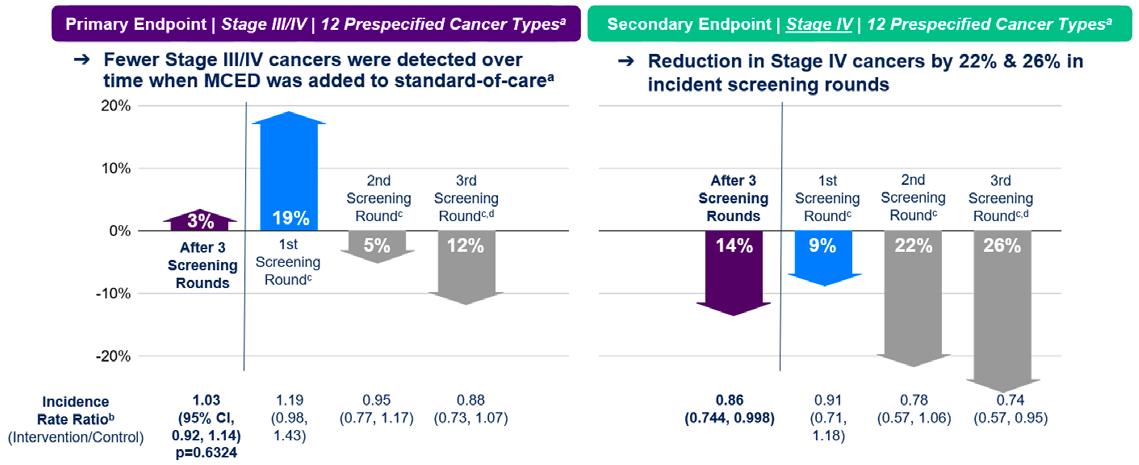
A BLOOD test designed to catch many cancers early failed to hit its main target in a landmark 140,000-person NHS trial, yet still quadrupled screendetected cancers and cut the most advanced, Stage IV diagnoses by 14%, according to results presented at ASCO 2026.6
Multi-cancer early detection (MCED) tests spot a shared cancer signal in circulating cell-free DNA in the blood. The NHS-Galleri trial tested whether adding the Galleri MCED test (GRAIL, Inc., Menlo Park, California, USA) to routine care could catch cancers earlier, when they are more treatable, across asymptomatic older adults in England.
The RCT enrolled 142,924 asymptomatic participants aged 50–79 years. After an initial draw, they were randomized 1:1 to an intervention arm tested with the MCED test, or an untested control arm, with samples taken at up to three annual visits. Those with a detected cancer signal entered NHS urgent suspected-cancer pathways.
The arms were well balanced, but the primary endpoint was not met: Stage III/IV cancers numbered 706 in the intervention arm versus 688 in the control arm (incidence rate ratio: 1.03). However, Stage IV cancers fell by 14% (342 versus 397) over 3 screening years, with the reduction growing
from 9% in Year 1 to 26% by Year 3. Earlierstage detection rose correspondingly, with Stage I/II cancers up 16% (647 versus 559; relative risk: 1.16 [1.03–1.30]). The test quadrupled screen-detected cancers (1,173 versus 290), cut clinically-detected cancers by 21% (2,464 versus 3,110), and reduced emergency presentations by 21% (225 versus 286). Specificity was 99.55%, and positive predictive value was 52.0%, with no related serious adverse events.
The authors acknowledged that the primary endpoint was not met, but argued that adding annual MCED testing to standard screening boosted early detection while lowering Stage IV diagnoses and emergency presentations. Combined with the test’s safety profile and strong specificity, they suggested that integrating MCED into population screening could help cut latestage cancer, though longer follow-up is needed to confirm whether earlier detection means fewer cancer deaths.
Adding annual MCED testing to standard screening boosted early detection while lowering Stage IV diagnoses
frontMIND Meets Primary Endpoint in High-Risk DLBCL
THE PHASE 3 frontMIND trial has demonstrated a significant progressionfree survival (PFS) benefit with the addition of tafasitamab and lenalidomide to standard R-CHOP (rituximab, cyclophosphamide, doxorubicin, vincristine, prednisolone) chemotherapy in patients with newly diagnosed, high-risk, aggressive B cell lymphomas, according to results presented at ASCO 2026, supporting the regimen as a potential new first-line standard of care.7
Approximately 40% of patients with diffuse large B cell lymphoma (DLBCL) are not cured with first-line R-CHOP, highlighting the need for more effective treatment approaches. frontMIND evaluated whether adding tafasitamab and lenalidomide to R-CHOP could improve outcomes in patients with highintermediate or high-risk DLBCL or high-grade B cell lymphoma.
In this double-blind, placebo-controlled study, 899 patients aged 18–80 years were randomized to receive tafasitamab-lenalidomide-R-CHOP (Tafa-Len-R-CHOP; n=448) or standard R-CHOP (n=451). Eligible patients had newly diagnosed disease with high-risk clinical features, including International Prognostic Index (IPI) scores of 3–5. Baseline characteristics were balanced between treatment arms.
At the primary analysis, conducted after a median follow-up of 35.2 months, Tafa-Len-R-CHOP significantly improved investigator-assessed PFS compared with R-CHOP, reducing the risk of disease progression or death by 25% (hazard ratio [HR]: 0.75; 95% CI: 0.59–0.96; p=0.019). In the subgroup of 773 patients with centrally confirmed lymphoma subtypes, the benefit was even greater, with a 32% reduction in risk (HR: 0.68; 95% CI: 0.52–0.88).
The 24-month PFS rate was 72.7% with Tafa-Len-R-CHOP versus 62.2% with R-CHOP, representing an absolute improvement of 10.5%.
The PFS advantage was observed across both cellof-origin subtypes, activated B cell and germinal center B cell, suggesting broad applicability of the regimen. The combination also significantly improved event-free survival, while complete response and overall response rates were similar between treatment groups. Overall survival data remain immature, although a favorable trend was observed (HR: 0.85), with final analysis planned after 5 years of follow-up.
Safety findings were consistent with expectations for an intensified treatment regimen. Any-grade treatment-emergent adverse events occurred at similar rates in both arms, although Grade 3 or higher events were more frequent with Tafa-Len-R-CHOP (86.7% versus 76.1%). Treatment discontinuations and adverse event-related deaths were also higher in the experimental arm. Despite this, fewer deaths from any cause were reported with Tafa-Len-RCHOP than with R-CHOP (18.5% versus 21.7%).
Investigators concluded that frontMIND met its primary endpoint and that Tafa-Len-R-CHOP offers a clinically meaningful improvement in disease control for patients with high-risk DLBCL and highgrade B cell lymphoma, potentially establishing a new first-line treatment standard across both molecular subtypes.
Approximately 40% of patients with diffuse large B cell lymphoma (DLBCL) are not cured with first-line R-CHOP
Apalutamide Regimen Improves Outcomes Before Prostate Surgery
ADDING apalutamide to androgen deprivation therapy (ADT) before and after radical prostatectomy significantly improved pathological responses and metastasis-free survival in patients with high-risk localized or locally advanced prostate cancer, according to findings from the Phase 3 PROTEUS trial presented at ASCO 2026.8
While radical prostatectomy can be curative for patients with high-risk localized or locally advanced disease, around half of patients experience disease recurrence after surgery, highlighting the need for more effective treatment strategies.
In the PROTEUS trial, 2,109 patients with high-risk localized or locally advanced prostate cancer were randomized to receive either apalutamide plus ADT or placebo plus ADT for 6 months before surgery, followed by a further 6 months of assigned treatment after recovery. The dual primary endpoints were pathological complete response/minimal residual disease (pCR/MRD) and metastasisfree survival.
Patients receiving apalutamide plus ADT were significantly more likely to achieve pCR/MRD than those receiving placebo plus ADT, with rates of 8.9% versus 1.0% (odds ratio: 10.17; 95% CI: 5.27–19.64; p<0.0001). This represented a more than 10-fold increase in the odds of achieving pCR/MRD. As highlighted by the findings, adding apalutamide substantially improved pathologic responses at surgery.
The combination regimen also significantly improved metastasis-free survival (hazard ratio: 0.80; 95% CI: 0.67–0.96; p=0.0169). Five-year metastasis-free survival rates were
78.2% and 73.5%, respectively. Investigatorassessed metastasis-free survival also favored apalutamide plus ADT (hazard ratio: 0.74; 95% CI: 0.62–0.87; nominal p=0.0004).
Additional efficacy measures, including event-free survival, time to first subsequent treatment, and time to distant metastasis, all favored the apalutamide-based approach. Using a more stringent residual cancer burden definition, MRD rates were significantly higher with apalutamide plus ADT, at 30.6% versus 11.7% (odds ratio: 3.36; 95% CI: 2.67–4.23; nominal p<0.0001). The findings were supported by favorable results across multiple efficacy endpoints.
Higher rates of Grade 3/4 treatment-emergent adverse events and treatment discontinuations were observed with apalutamide plus ADT than with placebo plus ADT. Grade 3 or 4 treatment-emergent adverse events occurred in 39.6% of patients receiving apalutamide plus ADT and 31.0% of those receiving placebo plus ADT, while treatment discontinuation due to adverse events occurred in 7.4% and 2.7%, respectively.
The findings support the use of perioperative apalutamide plus ADT alongside radical prostatectomy in patients with high-risk localized or locally advanced prostate cancer.
MRD rates were significantly higher with apalutamide plus ADT, at 30.6% versus 11.7%
Adjuvant Selpercatinib in Stage IB–IIIA RET+ NSCLC Associated with Improvement in EFS
PATIENTS with early-stage RET fusion-positive (RET+) non-small cell lung cancer (NSCLC) experienced a significant improvement in event-free survival (EFS) after treatment with adjuvant selpercatinib according to the primary results of the Phase III LIBRETTO-432 trial presented at ASCO 2026.9
RET-targeted therapy has not previously been studied in patients with Stage IB–IIIA RET+ NSCLC, a group with high recurrence rates after definitive locoregional treatment and no approved adjuvant targeted therapy. Selpercatinib is a selective, brain-penetrant RET inhibitor approved for RET+ NSCLC. This study investigated selpercatinib against a placebo to determine its safety and effectiveness in improving EFS in patients with Stage IB–IIIA RET+ NSCLC.
Researchers evaluated selpercatinib 160 mg twice a day against a placebo in patients with Stage IB–IIIA RET+ NSCLC after definitive locoregional treatment for up to 3 years in a double-blind, Phase III randomized (1:1) controlled trial.
The primary endpoint was investigatorassessed EFS in patients with Stage II–IIIA disease. A key secondary endpoint was investigator-assessed EFS in the overall population (Stage IB–IIIA). Other secondary endpoints included EFS by blinded independent central review, overall survival, and safety.
Patients were randomly assigned to receive selpercatinib (n=75) or placebo (n=76), with median follow-up times of 24 and 27 months, respectively.
EFS in patients with Stage II–IIIA disease after treatment with selpercatinib was significantly improved (n=109; hazard ratio [HR]: 0.172; 95% CI: 0.058–0.509; p=0.0003). The median EFS for placebo was 31.8 months, while the median EFS was not reached in the selpercatinib arm. The investigator-assessed EFS results aligned with EFS by blinded
independent central review (HR: 0.125; 95% CI: 0.028–0.552; p=0.0011). Selpercatinib had a 2-year EFS rate of 91.5% compared with 61.1% for placebo. In the overall population, error-controlled EFS HR was 0.165 (95% CI: 0.056–0.485; p=0.0002), and median EFS was not reached for either of the treatment arms.
With selpercatinib, increased alanine aminotransferase and aspartate aminotransferase levels were the most common adverse events, and overall adverse events were comparable to those reported in metastatic RET+ NSCLC.
These data demonstrated that adjuvant selpercatinib significantly increased EFS in comparison to placebo in patients with earlystage RET+ NSCLC. Utilizing selpercatinib for adjuvant NSCLC treatment adds to the existing evidence for targeted therapy, including the use of epidermal growth factor receptor (EGFR) and anaplastic lymphoma kinase (ALK) inhibitors. Moreover, researchers noted that providing optimal therapeutic decision-making requires comprehensive genomic testing across disease stages at diagnosis of NSCLC.
Adjuvant selpercatinib significantly increased EFS in comparison to placebo in patients with early-stage RET + NSCLC
RESEARCH presented at ASCO 2026 found that sacituzumab govitecan plus pembrolizumab improved progression-free survival (PFS) after next-line treatment compared with chemotherapy plus pembrolizumab in patients with previously untreated programmeddeath ligand 1 (PD-L1)-positive metastatic triple-negative breast cancer. The benefit was observed despite crossover, with most patients in the chemotherapy arm who went on to receive subsequent therapy receiving sacituzumab govitecan.10
The findings come from ASCENT-04, a randomized Phase 3 study evaluating first-line sacituzumab govitecan plus pembrolizumab versus investigator’s choice chemotherapy plus pembrolizumab in 443 patients with previously untreated PD-L1positive metastatic triple-negative breast cancer. Earlier results from the study showed a statistically significant and clinically meaningful improvement in PFS with sacituzumab govitecan plus pembrolizumab versus chemotherapy plus pembrolizumab, with median PFS of 11.2 months versus 7.8 months, respectively.
In this analysis, investigators assessed PFS after next-line therapy (PFS2), which can provide insight into longer-term clinical benefit when overall survival data remain immature or may be affected by treatment crossover. PFS2 was defined as the time from randomization to first documented progression on next-line therapy, as assessed by investigators, or death from any cause.
At a median overall survival follow-up of 14.0 months, 43% of patients in the sacituzumab govitecan plus pembrolizumab group and 23% in the chemotherapy plus pembrolizumab group remained on study treatment. PFS2 events occurred in 25% of patients receiving sacituzumab govitecan
plus pembrolizumab compared with 37% of those receiving chemotherapy plus pembrolizumab.
Median PFS2 was not reached in the sacituzumab govitecan plus pembrolizumab group, compared with 21.0 months in the chemotherapy plus pembrolizumab group. The stratified hazard ratio was 0.67, with a 95% CI of 0.48–0.95, and the nominal stratified log-rank p value was 0.0224. PFS2 rates also favored sacituzumab govitecan plus pembrolizumab at 12, 18, and 24 months, reaching 63.7% at 24 months compared with 45.6% for chemotherapy plus pembrolizumab.
Time to first subsequent treatment was also longer with sacituzumab govitecan plus pembrolizumab, at 17.3 months versus 9.8 months. Among patients who discontinued treatment and received subsequent therapy, the most common treatments were taxanes, platinum chemotherapy, and capecitabine in the sacituzumab govitecan arm, and sacituzumab govitecan in the chemotherapy arm.
Overall, the data support sacituzumab govitecan plus pembrolizumab as a potential first-line standard of care for patients with previously untreated PD-L1-positive metastatic triple-negative breast cancer.
PFS2 rates also favored sacituzumab govitecan plus pembrolizumab at 12, 18, and 24 months, reaching 63.7% at 24 months compared with 45.6% for chemotherapy plus pembrolizumab
References
1. Wolphin B et al. Daraxonrasib, a RAS(ON) multi-selective inhibitor, vs chemotherapy in previously treated patients with metastatic pancreatic adenocarcinoma: primary analysis from the phase 3 RASolute 302 study. Abstract LBA5. ASCO Annual Meeting, May 29-June 2, 2026.
2. Abou-Alfa G et al. Efficacy and safety results from EMERALD-3: a phase 3, randomized study of tremelimumab plus durvalumab with or without lenvatinib combined with transarterial chemoembolization in participants with embolization-eligible unresectable hepatocellular carcinoma. Abstract LBA4000. ASCO Annual Meeting, May 29-June 2, 2026.
3. Chen Z et al. Ivonescimab plus chemotherapy versus tislelizumab plus chemotherapy in previously untreated advanced squamous non-small cell lung cancer: overall survival results of the phase 3 HARMONi-6 trial. Abstract LBA4. ASCO Annual Meeting, May 29-June 2, 2026.
4. Stein R et al. First results from the OPTIMA phase III randomized noninferiority trial of test-directed chemotherapy in patients with high clinical risk ER-positive HER2-negative early breast cancer. Abstract #500. ASCO Annual Meeting, May 29-June 2, 2026.
5. de Boniface J et al. Omission of completion axillary dissection in patients with breast cancer and sentinel lymph node macrometastases: overall survival and patient-reported arm morbidity from the randomized SENOMAC trial. Abstract LBA503. ASCO Annual Meeting, May 29-June 2, 2026.
6. Swanton R et al. NHS-Galleri: primary results from a randomised controlled trial to assess the clinical utility of a multicancer early detection test in population screening. Abstract LBA100. ASCO Annual Meeting, May 29-June 2, 2026.
7. Lenz G et al. frontMIND: phase 3 study of tafasitamab plus lenalidomide and R-CHOP for patients with newly diagnosed diffuse large B-cell lymphoma. Abstract LBA7000. ASCO Annual Meeting, May 29-June 2, 2026.
8. Taplin ME et al. Perioperative (neoadjuvant and adjuvant) apalutamide (APA) + androgen deprivation therapy (ADT) vs placebo (PBO) + ADT with radical prostatectomy (RP) in high-risk localized or locally advanced prostate cancer (HR LPC/LAPC): final analysis of the PROTEUS phase 3 study. Abstract LBA1. ASCO Annual Meeting, May 29-June 2, 2026.
9. Goldman JW et al. Event-free survival with adjuvant selpercatinib in stage IBIIIA RET fusion-positive NSCLC: primary results of the phase 3 LIBRETTO-432 trial. Abstract LBA3. ASCO Annual Meeting, May 29-June 2, 2026.
10. Kalinsky K et al. Progression-free survival after next line of treatment and subsequent therapies in the ASCENT-04 study of participants with previously untreated PD-L1+ metastatic triple-negative breast cancer treated with sacituzumab govitecan plus pembrolizumab vs chemotherapy plus pembrolizumab. Abstract LBA1000. ASCO Annual Meeting, May 29-June 2, 2026.
ASCO 2026: Highlights in Breast Cancer Research
Authors: Pooja P. Advani,1 *Roberto A. Leon-Ferre1
1. Division of Medical Oncology, Mayo Clinic, Rochester, Minnesota, USA *Correspondence to LeonFerre.Roberto@mayo.edu
Disclosure: Leon-Ferre has reported providing consulting services for Gilead Sciences, AstraZeneca, Lyell Immunopharma, and Merck, outside the scope of this work, with fees paid to his institution (no personal payments); personal honoraria from MJH Life Sciences for CME events, and Connected Research and Consulting for consulting activities; and funding from the Mayo Clinic Breast Cancer SPORE grant (P50 CA116201) from NCI, the Eisenberg Foundation for Charities, and the Conquer Cancer - Breast Cancer Research Foundation Advanced Clinical Research Award for Breast Cancer supported by Breast Cancer Research Foundation. Advani has received institutional research funding from Gilead, Agendia, AstraZeneca-DSI, Caris Life Sciences, Seagen/Pfizer, Atossa Therapeutics, Modulation Therapeutics, Biovica International, Loxo Lilly, Sermonix, Menarini Stemline, Elephas, Puma, and 858 Therapeutics; served on advisory boards for Epic Sciences, Biovica International, AstraZeneca, DSI, Hesian Labs, Elephas, Belay Diagnostics, Merck, and Astrin Biosciences; and received consulting and speakers bureau honoraria from GE Healthcare, AstraZeneca, MJH Lifesciences, Menarini Stemline, Iksuda Therapeutics, Breathe Biomedical, Guardant Health, and DSI. Any opinions, findings, and conclusions expressed in this material are those of the author(s) and do not necessarily reflect those of the NCI, the American Society of Clinical Oncology (ASCO), Conquer Cancer, or Breast Cancer Research Foundation.
Keywords: Antibody-drug conjugates (ADC), American Society of Clinical Oncology (ASCO) 2026, breast cancer, chemotherapy de-escalation, clinical trials, endocrine therapy, HER2-positive breast cancer, metastatic breast cancer, pembrolizumab, triple-negative breast cancer.
The American Society of Clinical Oncology (ASCO) 2026 Annual Meeting delivered a broad and scientifically rigorous breast cancer program spanning metastatic and early disease settings. In metastatic triple-negative breast cancer (TNBC), updated antibody-drug conjugate (ADC) data from ASCENT-03/04, TROPIONBreast02, and the novel bispecific ADC iza-bren in PANKU-Breast02 consolidated and expanded treatment options. In hormone receptor (HR)-positive disease, SERENA-6, persevERA, and VIKTORIA-1 illustrated that benefit from next-generation endocrine and PI3K-pathway agents is context-dependent. In early TNBC, KEYNOTE-522 confirmed durable survival benefit with perioperative pembrolizumab and chemotherapy, while OPTIMA and SENOMAC advanced the de-escalation agenda across chemotherapy and axillary surgery, and lidERA established the first Phase III evidence for an oral selective estrogen receptor degrader (SERD) in the adjuvant setting.
METASTATIC BREAST CANCER
SG as 1L Treatment for mTNBC: PFS2
Data from ASCENT-03 and ASCENT-04
Key takeaway: Despite high rates of crossover, updated PFS2 d ata from ASCENT-03 and ASCENT-04 suggest a benefit of using SG in the first-line mTNBC setting.
Sacituzumab govitecan (SG) was established as a second-line (2L) or later treatment option for metastatic TNBC (mTNBC) based on the results of the ASCENT trial, which showed significant improvements in PFS and overall survival (OS) compared to chemotherapy (OS improvement from 6.9 to 11.8 months). Subsequently, two trials1,2 have evaluated SG as a first-line (1L) therapy option: ASCENT-04 compared SG+pembrolizumab versus chemotherapy+pembrolizumab for programmed death-ligand 1 (PD-L1) positive mTNBC (median PFS: 11.2 versus 7.8 months; HR: 0.65); and ASCENT-03 compared SG monotherapy versus chemotherapy for PDL1(-) or immunotherapy ineligible mTNBC (median PFS: 9.7 versus 6.9 months; HR: 0.62). Both trials incorporated crossover to SG at progression for those randomized to the control arm, with nearly 80% of patients in the control arm receiving SG as 2L treatment in each trial. At ASCO 2026, progression-free survival 2 (PFS2) data presented showed that the median PFS2 was superior in the SG arm in both trials: in ASCENT-04, median PFS2 was not reached with SG+pembrolizumab versus 21 months with the control regimen (HR: 0.67); and in ASCENT-03, median PFS2 was 18.2 versus 14.0 months (HR: 0.70). These results suggest that the benefit of 1L SG persists even though most control patients eventually received SG, suggesting that
The benefit of 1L SG persists even though most patients in the control arm eventually received SG
there may be a benefit from earlier exposure. However, open questions remain, as: (1) PFS2 is a contested endpoint, with variable definitions and no standardization of restaging imaging timing once patients cross to 2L; and (2) OS remains immature in both trials.
Dato-DXd as 1L Treatment for PD-L1(-) or Immunotherapy-Ineligible mTNBC: Additional Efficacy Endpoints from TROPION-Breast02
Key takeaway: Additional efficacy endpoints from TROPION-Breast02 suggest that the benefit pf 1L Dato-DXd extends beyond first progression.
The TROPION-Breast02 trial3 demonstrated superior median PFS and OS with 1L datopotamab deruxtecan (Dato-DXd) compared to chemotherapy for PD-L1() or immunotherapy-ineligible mTNBC (median PFS: 10.8 versus 5.6 months; HR: 0.57; median OS: 23.7 versus 18.7 months; HR: 0.79), establishing it as a robust 1L treatment option for this population. New efficacy analyses presented at ASCO 2026 showed that additional efficacy
5.6 months; HR: 0.49), PFS2 (15.6 versus 11.8 months; HR: 0.61), and time to second subsequent therapy (16.7 versus 12.6 months; HR: 0.67). Like in the ASCENT-03 and ASCENT-04 trials, these results reinforce that the benefit of 1L Dato-DXd may persist beyond the first progression event, as suggested previously by the demonstrated improvement in OS. However, unlike the ASCENT-03 and ASCENT-04 trials, TROPION-Breast02 did not include crossover, and less than half of patients in the control arm have received an antibody drug conjugate (ADC) as subsequent therapy, which may play a role in the observed OS benefit.
Iza-bren, a First-in-Class Bispecific ADC for Previously Treated mTNBC (PANKU-Breast02)
Key takeaway: Iza-bren, a novel firstin-class bispecific ADC targeting EGFRxHER3, significantly improved PFS and OS compared to chemotherapy in previously treated mTNBC.
The Phase III randomized PANKU-Breast024 trial evaluated the first-in-class EGFRxHER3
bispecific ADC delivering a topoisomerase I inhibitor payload in 418 patients with mTNBC who had received 1–2 prior lines of therapy. Patients were randomized to izalontamab brengitecan (Iza-bren) versus investigator’s choice chemotherapy, and demonstrated superior median PFS (8.5 versus 3.1 months; HR: 0.29) and median OS (15.9 versus 12.5 months; HR: 0.60), with an objective response rate of 52% versus 21%. The frequency of Grade 3 or higher adverse events (AE) was 89% with Iza-bren compared to 63% with chemotherapy, with similar rates of AEs leading to treatment discontinuation between arms, but more frequent dose reductions and interruptions in the Iza-bren arm. The main adverse events were hematologic, with the rates of Grade ≥3 anemia, leukopenia, neutropenia, and thrombocytopenia being 47%, 56%, 58%, and 53%, respectively, with Iza-bren, compared to 4%, 33%, 47%, and 2%, respectively, with chemotherapy. Despite this, the rate of febrile neutropenia was low (5.3% with Iza-bren versus 0.5% with chemotherapy). Interstitial lung disease was rare (1.4%, all low grade). These results support Iza-bren as a potential new treatment option for patients with mTNBC, and represents a novel
The benefit of nextgeneration endocrine and PI3K-pathway targeting is highly context-dependent
promising ADC that targets different antigens than the currently approved ADCs targeting TROP2 or HER2.
Depth of Response with First-Line T-DXd+P in HER2(+) Metastatic Breast Cancer (DESTINY-Breast09)
Key takeaway: Achievement of complete response or deep partial response with 1L T-DXd+P is associated with more durable disease control.
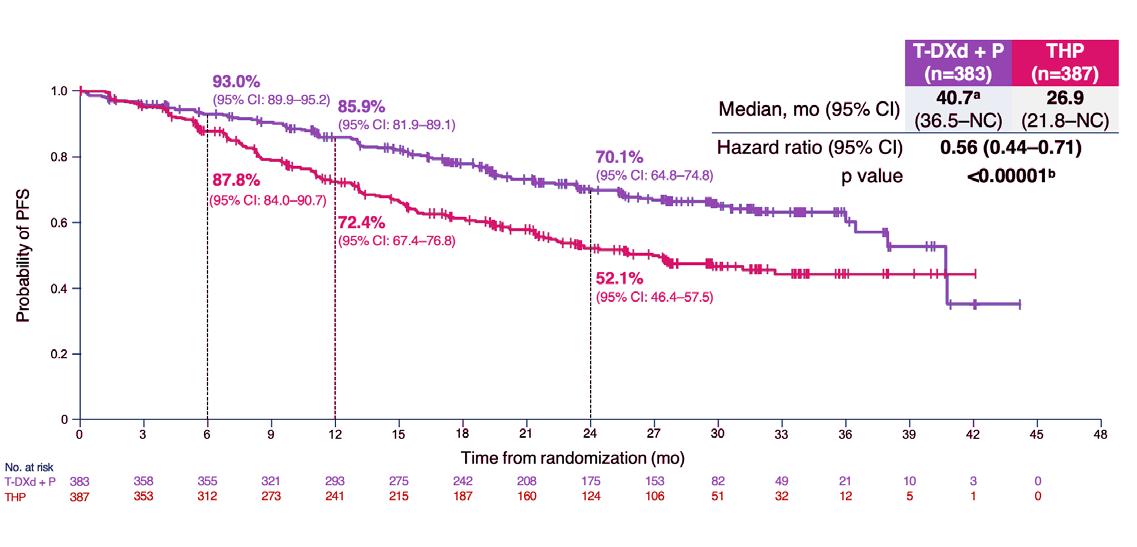
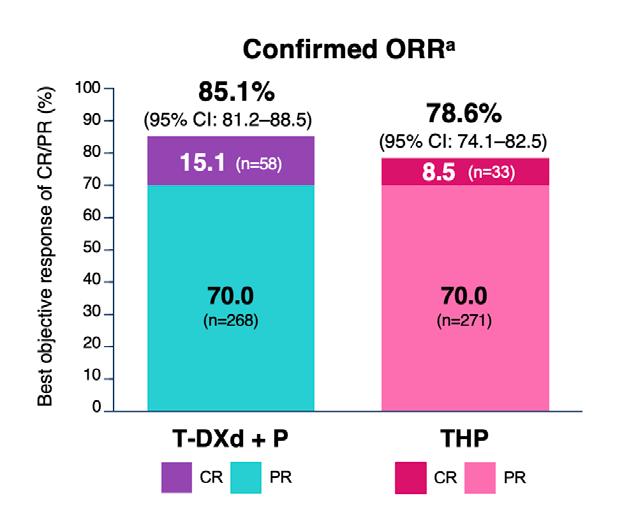
Trastuzumab deruxtecan plus pertuzumab (T-DXd+P) was established as a new 1L therapy option for metastatic HER2+ breast cancer by the DESTINY-Breast09 trial,5 which showed a remarkable improvement in the median PFS from 26.9 months with the CLEOPATRA regimen (taxane, trastuzumab, and pertuzumab) to a notable 40.7 months (HR: 0.56) with T-DXd+P. A new analysis presented at ASCO 2026 examined the association of depth of response with longterm outcomes. In the T-DXd+P arm, 15% of patients achieved a complete response (CR), 37% achieved a deep partial response (deep PR, defined as 80–99% tumor reduction), 34% achieved PR (30–79% tumor reduction), and 14% experienced stable/progressive disease. Patients achieving CR or deep PR had higher 24-month PFS rates (85% and 80%, respectively) compared to those with PR and stable/progressive disease (64% and 36%, respectively). The median time to CR or deep PR was 8.4 months and 9.6 months, respectively, with 80% of the intention-totreat population achieving maximal tumor reduction by 24 months. While these data provide additional reassuring data, the central question on the optimal duration of T-DXd+P in the 1L setting remains: should T-DXd+P be continued until disease progression or prohibitive toxicity (as pursued in DESTINYBreast09) or could depth of response or other biomarkers be leveraged to de-escalate treatment to a less toxic maintenance strategy (as per previous standard of care based on CLEOPATRA, and supported by PATINA and HER2CLIMB-05)? Studies such as DEMETHER and DB-GUIDE evaluating
T-DXd induction followed by maintenance are designed to address this question.
Next-Generation Endocrine and PI3KPathway Targeting in ER-Positive/HER2Negative Metastatic Breast Cancer (SERENA-6, persevERA, and VIKTORIA-1)
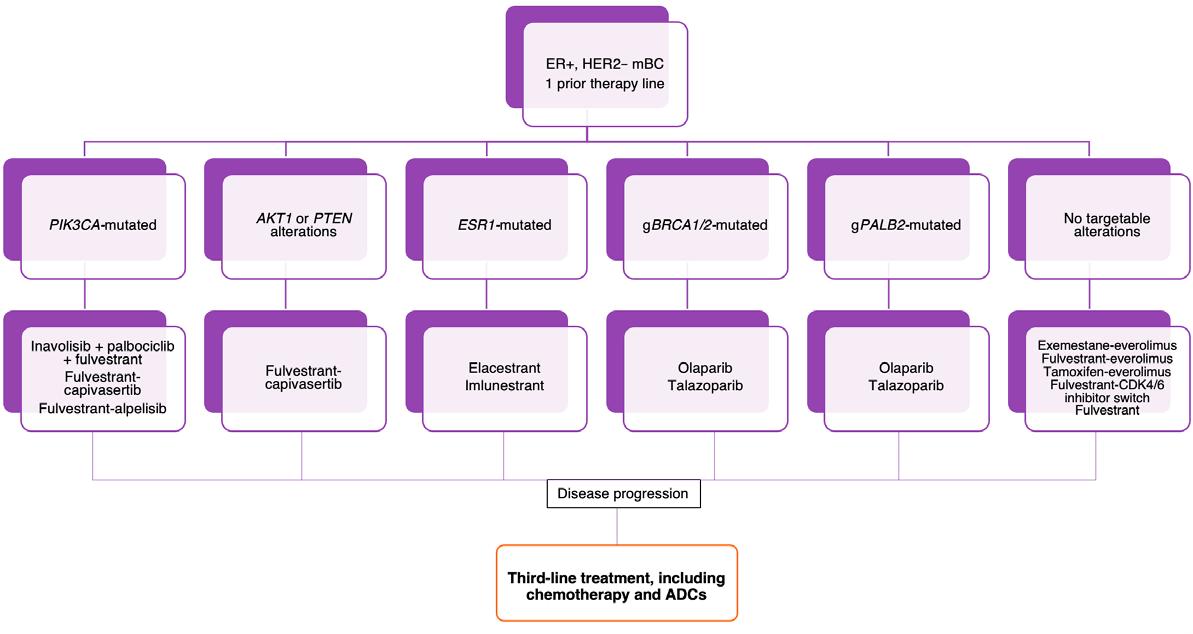
Key takeaway: Three trials in ER-positive/ HER2-negative metastatic breast cancer collectively demonstrate that the benefit of next-generation endocrine and PI3Kpathway targeting is highly contextdependent: camizestrant improves outcomes in ESR1-mutated disease detected by liquid biopsy, giredestrant fails to add to CDK4/6 inhibition in unselected first-line disease while succeeding in post-CDK4/6 settings, and gedatolisib offers a clinically meaningful and better-tolerated alternative to alpelisib in PIK3CA-mutant disease.
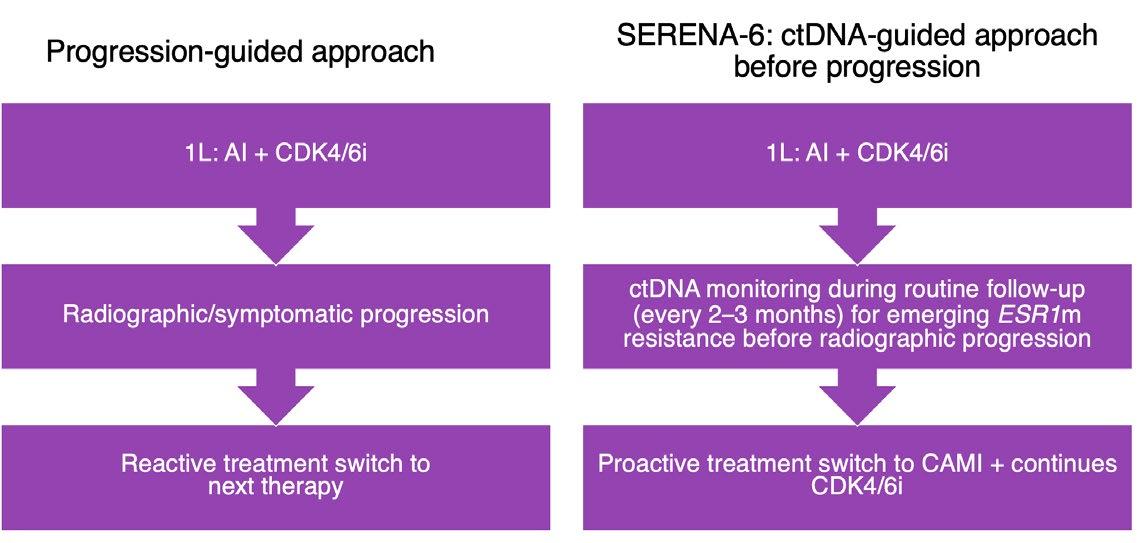
Three trials demonstrate that the benefit of next-generation endocrine and PI3K-pathway targeting is highly context-dependent. SERENA-66 evaluated proactive switching to camizestrant upon liquid biopsy detection of an emergent ESR1 mutation in patients on 1L AI plus CDK4/6 inhibition, without awaiting
radiographic progression. Updated data (at a median follow up of 23.5 months) showed a near-doubling of median PFS (16.8 versus 9.2 months; HR: 0.45) with consistent benefit in PIK3CA- and TP53–co-mutated disease and single versus multiple ESR1 mutations. Additionally, switch to camizestrant was associated with a 6.6 month PFS2 advantage (HR: 0.63). This was associated with ctDNA clearance with camizestrant plus a CDK4/6 inhibitor that reached 51.0% versus 1.9% with AI plus a CDK4/6 inhibitor. The biology is compelling-ESR1 mutations confer ligandindependent ER activation and endocrine resistance. However, regulatory acceptance remains uncertain, as the FDA’s ODAC voted 6–3 against approval of ctDNA-guided early treatment switching, citing concerns regarding lead-time bias and the lack of validated long-term clinical benefit, with the FDA specifically noting that PFS2 is not an appropriate endpoint to support regulatory approval. OS data will be ultimately decisive.
persevERA7 asked whether replacing letrozole with giredestrant as CDK4/6 inhibitor partner improves PFS in 1L HR+/HER2-negative metastatic disease setting, and although giredestrant plus palbociclib produced a
numerical improvement in PFS of 4.9 months, it did not significantly outperform letrozole plus palbociclib in the 1L treatment setting. Objective response rate and clinical benefit rate was similar in the two groups. Median overall survival is immature. This contrasts with lidERA’s adjuvant success (see below), currently suggesting that giredestrant’s clinical niche is predominantly in earlierstage and later-line treatment rather than unselected 1L metastatic disease.
VIKTORIA-18 is the most immediately actionable result of this group. Gedatolisib, a pan-PI3K/mTORC inhibitor plus fulvestrant plus palbociclib (triplet) and gedatolisib plus fulvestrant versus alpelisib plus fulvestrant in PIK3CA-mutant HR+/HER2-negative advanced breast cancer post-CDK4/6 inhibitor progression showed median PFS of 11.1 and 11.3, respectively, versus 5.6 months (HR: 0.50 with triplet and 0.51 with doublet). The clinically meaningful tolerability advantage over alpelisib, particularly hyperglycemia and diarrhea may enable the real-world uptake that alpelisib never achieved. Unlike oral therapies in this setting, gedatolisib is administered as a weekly intravenous infusion for 3 weeks of
every 4-week cycle, requiring regular clinic visits that may limit treatment accessibility for some patients. The optimal timing of gedatolisib remains uncertain. Whether earlier use after CDK4/6 inhibitor progression or later use following an oral PI3K inhibitor provides greater benefit is unknown. Until prospective data are available, treatment selection will likely be individualized based on efficacy, patient preference, and treatment logistics.
Treatment benefit with chemotherapy+pembrolizumab versus chemotherapy alone: 7-year OS was 85.1% versus 77.2%
EARLY BREAST CANCER
Perioperative Pembrolizumab in HighRisk Early TNBC: Final Analysis of KEYNOTE-522
Key takeaway: With nearly 8 years of follow-up, the KEYNOTE-522 trial continues to show significant improvements in EFS, distant recurrencefree survival, and OS with the addition of perioperative pembrolizumab to chemotherapy for high-risk early TNBC.
KEYNOTE-5229 established the incorporation of pembrolizumab to the neoadjuvant and adjuvant treatment strategy for Stage II–III TNBC. The final analysis with a median follow-up of 94 months was presented at ASCO 2026, and confirmed the durability of treatment benefit with chemotherapy+pembrolizumab versus chemotherapy alone: 7-year OS was 85.1% versus 77.2% (HR: 0.64), event-free survival was 78.3% versus 69.8% (HR: 0.68), and distant recurrence-free survival was 82.9% versus 74.2% (HR: 0.64). Subgroup analyses showed that EFS and OS were numerically superior with pembrolizumab, both in patients achieving pathological complete response (pCR) or not. However, the study was not
powered for these subgroup analyses. These results further solidify the role of pembrolizumab in high-risk early TNBC, buy the relative contribution of pembrolizumab in the adjuvant versus the neoadjuvant phase of treatment remains an open question. The Optimice-pCR trial will address this question in the subset of patients achieving pCR, by evaluating whether omission of adjuvant pembrolizumab is non-inferior to continuing pembrolizumab in these patients.
Genomically-Guided Chemotherapy
Omission in Node-Positive ER-positive/ HER2-Negative Disease (OPTIMA)
Key takeaway: In clinically high-risk ER+/ HER2-negative early breast cancer, PAM50 (Prosigna) risk stratification identifies a subgroup who can safely forgo chemotherapy, extending deescalation beyond node-negative disease into a population where chemotherapy has long been the reflexive choice.
The OPTIMA10 Phase III trial enrolled clinically high-risk ER+/HER2-negative early breast cancer, including patients with up to 9 positive nodes or tumor size of at least 30n mm, and used Prosigna (PAM50) testing to guide treatment. The patients were randomly assigned 1:1 to receive standard CET or test-determined CET with an ROR >60 or ET alone with a low ROR score (approximately 68%). The test-directed approach was non-inferior for 5-year invasive breast cancer-free survival (93.6% versus 94.8%), with noninferiority holding across highrisk subgroups, including 4–9 patients who were node-positive and premenopausal women on ovarian suppression. This is clinically significant as OPTIMA provides robust randomized evidence that genomic stratification can help to identify subgroup of women that can safely omit chemotherapy, extending the de-escalation case established in node-negative disease by TAILORx and in 1–3 node-positive patients by RxPONDER. Some of the limitations of this study include: the trial enrolled only patients aged 40+
years, follow-up is a relatively short (4 years), the population was predominantly White, and the design was powered for noninferiority rather than superiority. In premenopausal patients, part of chemotherapy’s benefit comes from inducing ovarian suppression rather than direct cytotoxicity; the favorable result in this subgroup therefore likely depends on endocrine regimens that include deliberate ovarian suppression, rather than endocrine monotherapy alone. Overall, the trial supports avoiding chemotherapy in roughly two-thirds of tested patients, a meaningful reduction in treatment burden for a substantial proportion of high-risk disease.
Omission of Completion Axillary
Dissection: SENOMAC
Key takeaway: Long-term follow-up from SENOMAC confirms that omission of completion axillary lymph node dissection (ALND) in sentinel nodepositive patients undergoing breastconserving surgery or mastectomy does not compromise locoregional control or survival, further supporting a deescalation approach to axillary surgery in appropriately selected patients.
SENOMAC11 randomized patients with 1–2 sentinel node macrometastases undergoing breast-conserving surgery or mastectomy to completion ALND versus no further axillary surgery. Long-term follow-up at >5 years confirmed equivalent locoregional recurrence, distant recurrence-free survival, and OS, with axillary recurrence <2% in the no-ALND arm. Crucially, SENOMAC extends the ALND omission evidence base, previously established by ACOSOG Z0011 in breast-conserving surgery to mastectomy patients, who have historically undergone completion dissection. The morbidity of lymphedema and shoulder
dysfunction is not offset by survival benefit in patients with limited sentinel node disease.
Adjuvant Oral SERD Therapy Across Menopausal Status (lidERA)
Key takeaway: Adjuvant giredestrant significantly reduces invasive disease recurrence in ER+/HER2-negative early breast cancer, with benefit consistent across both premenopausal and postmenopausal patients, establishing the first Phase III evidence for an oral SERD in the adjuvant setting.
lidERA12 randomized 4,170 patients with Stage I–III ER+/HER2-negative early breast cancer (node-positive, or node-negative with highrisk features) to adjuvant giredestrant or investigator’s choice of standard endocrine therapy, with mandatory ovarian function suppression for premenopausal patients and men. At ASCO 2026, subgroup analysis by menopausal status confirmed consistent benefit: in premenopausal patients, 3-year IDFS was 94.0% with giredestrant versus 91.5% with standard therapy (HR: 0.65), while postmenopausal patients showed 91.3% versus 88.3% (HR: 0.74). Distant recurrencefree interval improved similarly in both groups, and giredestrant was associated with fewer treatment discontinuations than aromatase inhibitors. Mandatory ovarian suppression in premenopausal patients ensures the benefit reflects giredestrant’s direct effect rather than confounding from differential ovarian function, and the consistency across menopausal strata simplifies clinical decision-making. Overall survival data remain immature.
References
1. Hurvitz SA et al. Progression-free survival after next line of treatment (PFS2) and subsequent therapies (subs tx) in the ASCENT-03 study of participants (pts) with previously untreated metastatic triple-negative breast cancer (mTNBC) treated with sacituzumab govitecan (SG) vs chemotherapy (chemo). J Clin Oncol. 2026;44(Suppl 16):1001.
2. Kalinsky K et al. Progression-free survival after next line of treatment (PFS2) and subsequent therapies (subs tx) in the ASCENT-04 study of participants (pts) with previously untreated PD-L1+ metastatic triple-negative breast cancer (mTNBC) treated with sacituzumab govitecan (SG) plus pembrolizumab (pembro) vs chemotherapy (chemo) plus pembro. J Clin Oncol. 2026;44(Suppl 17):LBA1000.
3. Cescon DW et al. First-line datopotamab deruxtecan (Dato-DXd) vs chemotherapy in patients with locally recurrent inoperable or metastatic triple-negative breast cancer (TNBC) for whom immunotherapy was not an option: additional efficacy endpoints from the TROPION-Breast02 study. J Clin Oncol. 2026;44(Suppl 16):1002.
4. Wu J et al. Izalontamab brengitecan (iza-bren) versus physician’s choice of chemotherapy in patients with
unresectable locally advanced or metastatic triple-negative breast cancer (TNBC): a randomized phase III study. J Clin Oncol. 2026;44(Suppl 17):LBA1003.
5. Park YH et al. A DESTINY-Breast09 analysis of treatment duration and clinical outcomes by best response to trastuzumab deruxtecan (T-DXd) + pertuzumab (P). J Clin Oncol. 2026;44(Suppl 16):1021.
6. Bidard FC et al. First-line (1L) camizestrant (CAMI) for emergent ESR1 mutations (SR1m) in advanced breast cancer (ABC): final progressionfree survival 2 (PFS2) from the phase III SERENA-6 trial. J Clin Oncol. 2026;44(Suppl 17):LBA1007.
7. Turner NC et al. Giredestrant (GIRE) + palbociclib (PALBO) vs letrozole (LET) + PALBO as first-line (1L) therapy in patients (pts) with estrogen receptor–positive, HER2-negative locally advanced or metastatic breast cancer (ER+, HER2– LA/mBC): primary analysis of the phase III persevERA BC trial. J Clin Oncol. 2026;44(Suppl 17):LBA1006.
8. Hurvitz SA et al. A randomized, openlabel, phase 3 study of gedatolisib + fulvestrant ± palbociclib vs standard of care in HR+/HER2−/PIK3CAmutant (MT) advanced breast cancer (VIKTORIA-1 Study 2). J Clin Oncol. 2026;44(Suppl 17):LBA1008.
9. Schmid, P. et al. Neoadjuvant pembrolizumab or placebo plus chemotherapy followed by adjuvant pembrolizumab or placebo for high-risk early-stage TNBC: Final analysis results from the phase 3 KEYNOTE-522 study. J Clin Oncol. 2026;44(Suppl 16):507.
10. Stein RC et al. First results from the OPTIMA phase III randomized non-inferiority trial of test-directed chemotherapy in patients with high clinical risk ER-positive HER2-negative early breast cancer. J Clin Oncol. 2026;44(Suppl 16):500.
11. Boniface JD et al. Omission of completion axillary dissection in patients with breast cancer and sentinel lymph node macrometastases: overall survival and patient-reported arm morbidity from the randomized SENOMAC trial. J Clin Oncol. 2026;44(Suppl 17):LBA503.
12. Schmid P et al. Efficacy and safety of giredestrant (GIRE) in patients (pts) with estrogen receptor–positive, HER2negative early breast cancer (ER+, HER2– eBC) in the phase III lidERA BC clinical trial: results by menopausal status. J Clin Oncol. 2026;44(Suppl 16):502.
Advances in the Treatment of HER2Positive Early Breast Cancer: Key Updates from ASCO 2026
The American Society of Clinical Oncology (ASCO) Annual Meeting was held in Chicago, Illinois, USA, between May 29–June 2, 2026
Support: The publication of this article was funded by AstraZeneca.
Author: Helen Boreham1
1. HB Medical (UK) Ltd, Wetherby, UK
Disclosure: Boreham has declared no conflicts of interest.
Keywords: Adjuvant, antibody–drug conjugate (ADC), DESTINY-Breast05, DESTINY-Breast11, early breast cancer (eBC), human epidermal growth factor receptor 2-positive (HER2+), neoadjuvant, trastuzumab deruxtecan (T-DXd).
The evolving treatment landscape in human epidermal growth factor receptor 2-positive (HER2+) early breast cancer (eBC) featured in several presentations at the 2026 American Society of Clinical Oncology (ASCO) Annual Meeting, including updates from pivotal clinical trials, data on new therapeutic regimens, and key insights for clinical practice.
Treatment of HER2+ eBC is being reshaped by a move away from anthracycline-based chemotherapy and towards antibody–drug conjugate (ADC) regimens with improved efficacy and tolerability profiles. Trastuzumab deruxtecan (T-DXd) has recently been approved by the FDA in both the neoadjuvant and adjuvant settings for patients with HER2+ eBC based on results from the pivotal DESTINY-Breast11 and DESTINY-Breast05 trials, respectively. In DESTINY-Breast11, neoadjuvant treatment with T-DXd followed by paclitaxel, trastuzumab, and pertuzumab (THP) demonstrated a statistically significant and clinically meaningful improvement in pathological complete response (pCR) rate compared to dose-dense doxorubicin plus cyclophosphamide and THP (ddAC-THP). In DESTINYBreast05, T-DXd showed superior efficacy versus trastuzumab emtansine (T-DM1) in patients with HER2+ eBC with residual invasive disease after neoadjuvant chemotherapy and high risk of recurrence. Secondary analysis of the DESTINY-Breast05 study was presented at this year’s ASCO meeting, helping to further establish the pulmonary safety profile of T-DXd with radiotherapy (RT) and support its clinical practice use. Collectively, data from DESTINY-Breast11 and DESTINY-Breast05 are helping to redefine the role of
PHARMA
T-DXd as both neoadjuvant and adjuvant therapy for HER2+ eBC, signaling a shift towards more curative-intent treatment settings.
The Evolving Role of ADCs in Breast Cancer
Highlights of the year in breast cancer (BC) were discussed by William Gradishar from Northwestern University in Evanston, Illinois, USA, during a special session at ASCO 2026, focusing on optimal management with ADCs across BC stages and subtypes.1 Gradishar explained how findings from pivotal Phase III trials of ADCs, such as the DESTINY-Breast11 study of T-DXd, have helped to transform the management of HER2+ eBC.1-3
Focus on DESTINY-Breast11
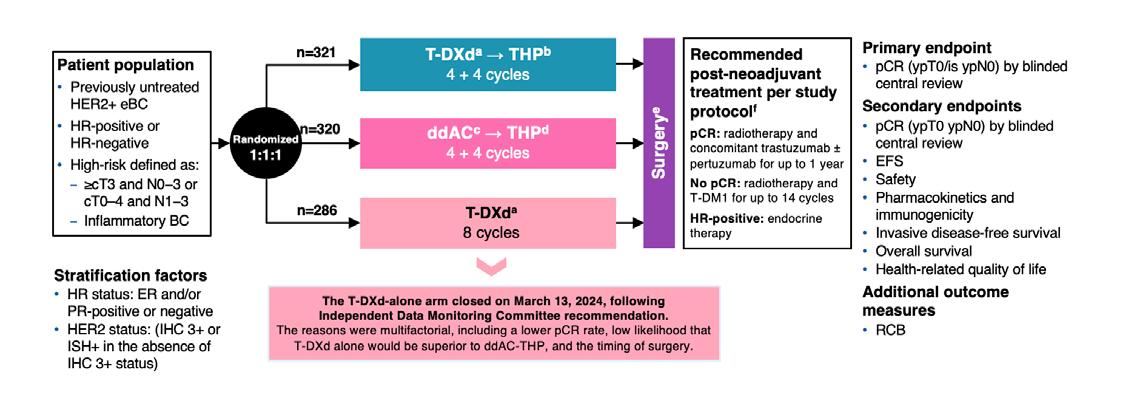
The DESTINY-Breast11 study was designed to address the unmet need for more effective and less toxic neoadjuvant regimens for HER2+ eBC.1-3 This randomized, global, multicenter, open-label Phase III study enrolled patients with previously untreated HER2+ eBC who were high risk, as defined by ≥cT3 and cN0–3 or cT0–4 and cN1–3, or inflammatory BC (Figure 1). The primary endpoint was pCR, which is a prognostic factor for event-free survival and overall survival in HER2+ eBC and provides essential information to support clinical decisionmaking.4-6 In total, 321 patients were randomized to T-DXd-THP, 320 to ddAC-THP (which was standard of care [SoC] at the time of study inception), and 286 to T-DXd monotherapy (this arm was closed early).2,3
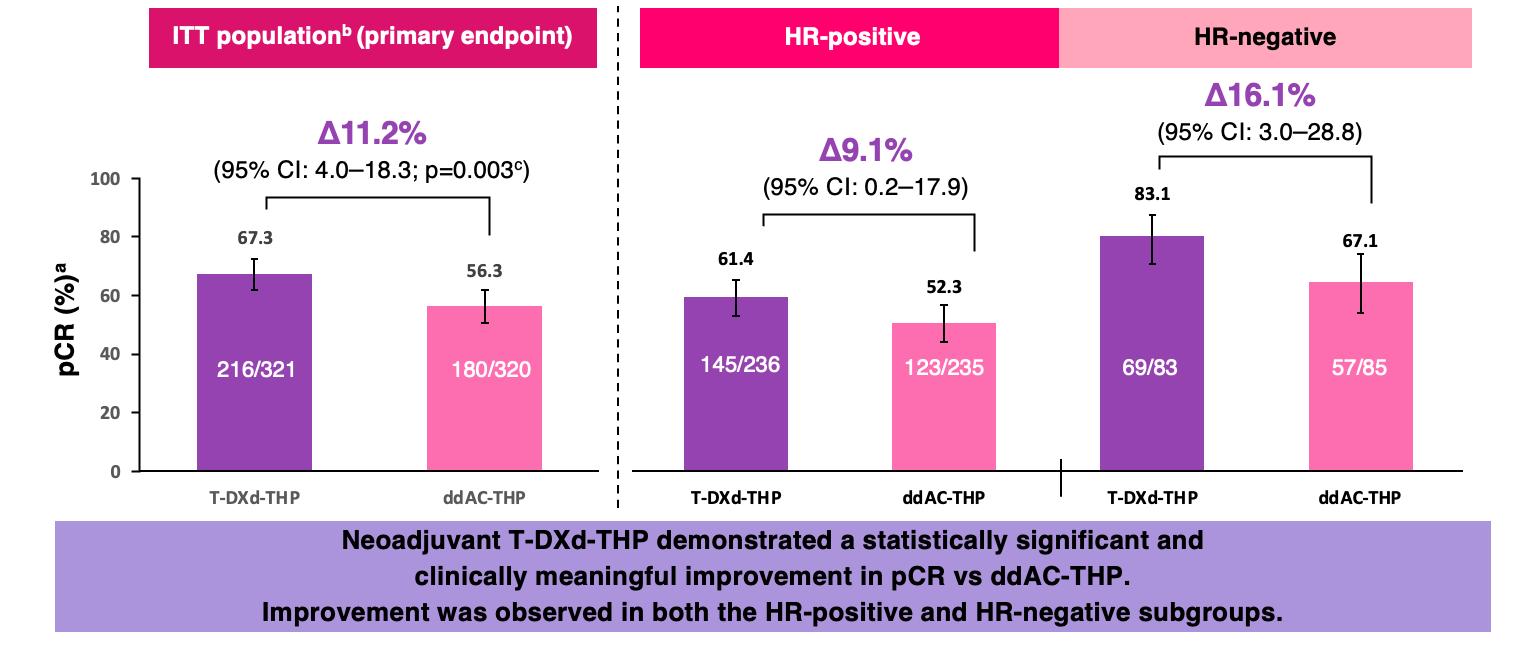
In results from the DESTINY-Breast11 study, originally presented at the European Society for Medical Oncology (ESMO) Congress in 2025, more than two-thirds (67.3% of patients) treated with T-DXd-THP achieved the primary endpoint of pCR compared with 56.3% in the ddAC-THP arm (Figure 2).2,3
Improvement in pCR for T-DXd-THP versus ddAC-THP was observed in both patients who were hormone receptor (HR) positive
and negative, and across most pre-specified subgroups.2,3 Gradishar described this result as “the highest pCR rate we have seen in a patient population with either HR positive or negative disease.”1
Analysis of the residual cancer burden (RCB) index in DESTINY-Breast11, presented at ESMO Breast 2026, showed that the extent of residual disease was also reduced with T-DXd-THP versus ddAC-THP in patients who did not achieve pCR.7 RCB is a validated predictor of long-term survival that is complementary to pCR.8 The improvements in RCB with T-DXd-THP were driven by an increase in patients with favorable RCB-0 and RCB-I classes, and a shift from the RCB-II class. After surgery, 81.3% of patients who received neoadjuvant treatment with T-DXdTHP had no or minimal residual invasive cancer (RCB-0 + I) detected in the resected breast or lymph node tissue versus 69.1% of those receiving ddAC-THP. Almost 80% of patients with HR-positive disease had RCB-0 + I with T-DXd-THP.3,7
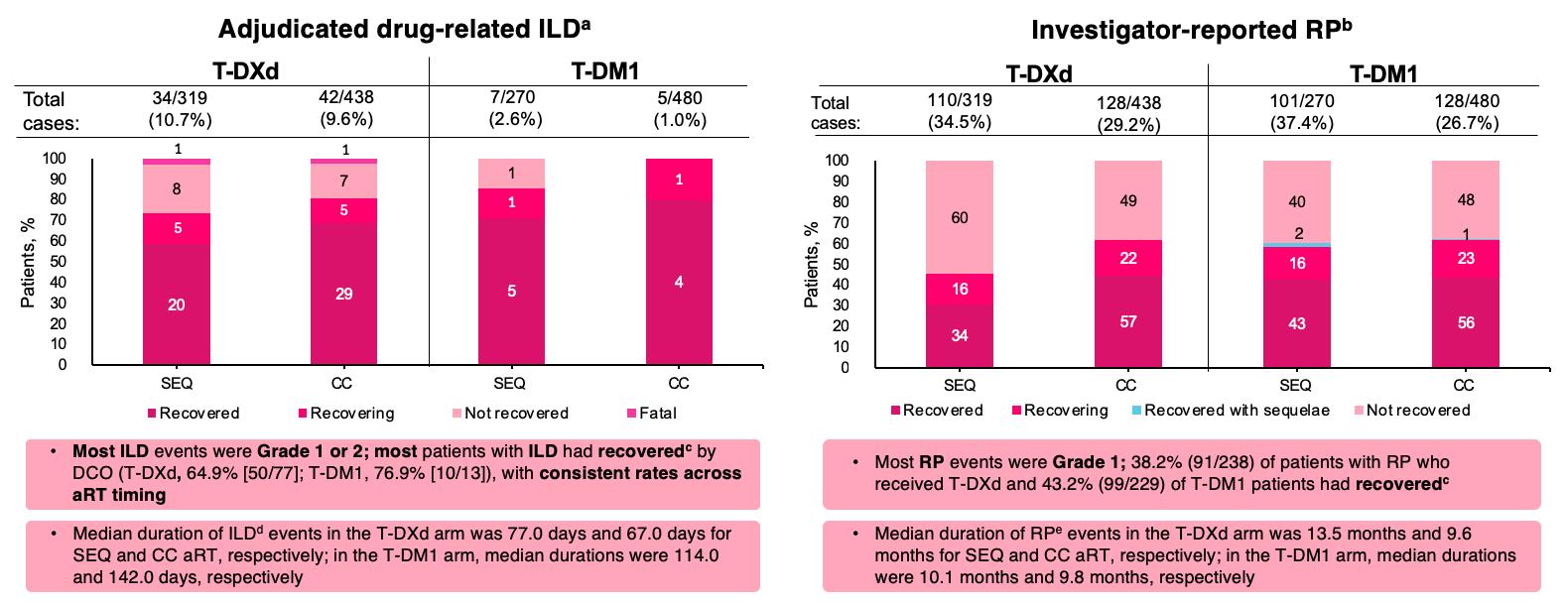
In the DESTINY-Breast11 trial, T-DXd-THP demonstrated a favorable safety profile compared with ddAC-THP, with no new safety signals identified. Rates of Grade ≥3 adverse events (AE), serious AEs, and AEs leading to treatment interruption were all consistently lower in the T-DXd-THP arm as compared to the ddAC-THP arm. Rates of all-grade adjudicated drug-related interstitial lung disease (ILD) and pneumonitis were low and similar across all arms, and Grade ≥3 events occurred most frequently with ddACTHP. Rates of ILD/pneumonitis remained stable (T-DXd-THP) and were higher (ddACTHP) in the THP phase (cycles 5–8) versus cycles 1–4.9
Collectively, these efficacy and safety results from DESTINY-Breast11 support T-DXd-THP
a5.4 mg/kg Q3W.
bPaclitaxel (80 mg/m2 QW) + trastuzumab (6 mg/kg Q3W) + pertuzumab (840 mg loading dose followed by 420 mg Q3W).
dPaclitaxel (80 mg/m2 QW) + trastuzumab (8 mg/kg loading dose followed by 6 mg/kg Q3W) + pertuzumab (840 mg loading dose followed by 420 mg Q3W).
eThe recommended window for surgery was 3–6 weeks following administration of the last dose of neoadjuvant study treatment.
fAdministered as part of the patient’s SoC at the investigator’s discretion.
High-resolution CT chest scans were performed every 6 weeks during treatment. If ILD/pneumonitis was suspected while receiving T-DXd, treatment was interrupted and a full investigation completed. Echocardiograms or multigated acquisition scans were performed during screening (<28 days prior to randomization), during treatment (<3 days before cycle 5), and at end of treatment to assess left ventricular ejection fraction.
BC: breast cancer; ddAC-THP: dose-dense doxorubicin plus cyclophosphamide and THP; EFS: event-free survival; ER: estrogen receptor; HER2+: human epidermal growth factor receptor 2-positive; HR: hormone receptor; IHC: immunohistochemistry; ISH: in situ hybridization; ITT: intention-to-treat; pCR: pathological complete response; PR: progesterone receptor; QW: once weekly; Q2W: once every two weeks; Q3W: once every three weeks; RCB: residual cancer burden; SoC: standard of care; T-DXd: trastuzumab deruxtecan; THP: paclitaxel, trastuzumab, and pertuzumab.
as a neoadjuvant treatment option for eligible patients with HER2+ eBC and have led to its recent FDA approval in this setting. T-DXdTHP is now indicated in the USA for the neoadjuvant treatment of adult patients with HER2+ (immunohistochemistry [IHC] 3+ or in situ hybridization [ISH]-positive) Stage II or III BC, as determined by an FDA-authorized test.10
Future Directions in ADCs
ADCs like T-DXd are a rapidly advancing field in oncology, with over 200 agents now in clinical development, the majority deploying topoisomerase 1 (TOPO1) inhibitor or auristatin payloads.11 Novel ADC targets and payloads are also an active area of investigation encompassing not only traditional chemotherapy drugs, but also dual-payload ADCs, immunostimulatory agents, protein degraders, and radioisotopes. As Gradishar
Figure 1: DESTINY-Breast11 study design.2,3
aBy blinded central review.
bpCR responders were defined as patients who only received randomized study treatment (at least one dose) and had pCR.
cTwo-sided p value crossed the 0.03 prespecified boundary.
For the ITT population, treatment effects were estimated by the difference in pCR with 95% CIs and p values based on the stratified Miettinen and Nurminen’s method, with strata weighting by sample size (i.e., Mantel-Haenszel weights). Patients with no valid records regarding pCR status for any reason were considered to be non-responders (including but not limited to withdrawal from the study, progression of disease or death before surgery, lack of surgical specimen, or defined as not evaluable by the central pathologist). Subgroup analyses were unstratified.
ddAC-THP: dose-dense doxorubicin plus cyclophosphamide and THP; HR: hormone receptor; ITT: intention-to-treat; pCR: pathological complete response; T-DXd: trastuzumab deruxtecan; THP: paclitaxel, trastuzumab, and pertuzumab; vs: versus.
explained, a key theme moving forward will be combination strategies in BC treatment, using ADCs alongside immunotherapy or other targeted agents.1
Gradishar also raised important clinical questions around ADCs that still need to be addressed in BC, including optimal sequencing of these agents and determining ‘what should come first’. This is particularly important as ADCs move into earlier lines of BC treatment including (neo) adjuvant therapy and first-line treatment of metastatic disease. There is also a need to
better understand mechanisms of resistance and response to ADCs, an area where predictive biomarkers will play a key role. All these questions will hopefully be answered by ongoing concluded trials and further interrogation of data from existing studies, Gradishar concluded.1
Figure 2: pCR primary endpoint results from the DESTINY-Breast11 study of T-DXd.2,3
Updated Safety Analysis From DESTINY-Breast05
DESTINY-Breast05 was a global, multicenter, randomized, open-label Phase III trial involving patients with residual disease in the breast or axillary lymph nodes after neoadjuvant chemotherapy plus HER2directed therapy, and with high risk of recurrence. In this study, adjuvant treatment with T-DXd improved invasive diseasefree survival (IDFS) by 53% compared with T-DM1 (hazard ratio: 0.47; 95% CI: 0.34–0.66; p<0.001).12,13 Based on the results of DESTINY-Breast05, T-DXd is now approved in the USA as adjuvant treatment for adult patients with HER2+ (IHC 3+ or ISH+) BC who have residual invasive disease following neoadjuvant trastuzumab (with or without pertuzumab) and taxane-based treatment.10
Secondary safety analysis of the DESTINYBreast05 study, further exploring clinical and demographic risk factors for ILD and radiation pneumonitis (RP), was presented at ASCO 2026 by Michael Untch from the Breast Cancer Center at Helios Hospital Berlin-Buch in Germany.14
As Untch explained, the DESTINY-Breast05 population, patients with HER2+ eBC plus residual invasive disease and high risk of recurrence, represent a group in which RT is broadly used in clinical practice. In DESTINYBreast05, protocol-specific CT requirements were used to identify ILD and RP in patients receiving adjuvant RT alongside ADC therapy. All patients in the study underwent lowdose, non-contrast CT at baseline as part of screening. Chest CT was also performed in all patients receiving adjuvant RT prior to infusion at cycles 3, 7, and 11, and at 40 (+7) days follow-up, and in patients receiving sequential adjuvant RT after completion of RT and prior to the first infusion.14
If any signs or symptoms of RP or drug-related ILD appeared during the study, an additional chest CT was recommended. CT scans showing ILD or RP underwent blinded central adjudication. Causal association between
study drug and ILD/RP events was based on the timing and location of radiographic abnormalities relative to the radiation treatment. Cases of ILD and RP arising in DESTINY-Breast05 were treated according to recommended management guidelines:14
For drug-related ILD:
• Grade 1: Interrupt T-DXd and consider steroids; restart T-DXd only after full resolution (Grade 0)
• Grade 2: Permanently discontinue T-DXd and initiate steroids (symptomatic with radiographic abnormalities)
• Grade 3–4: Discontinue study treatment and initiate steroids
For radiation-related pulmonary toxicity:
• Grade 1: Maintain T-DXd dose
• Grade 2: Interrupt and manage per SoC (e.g., steroids) until recovery to Grade ≤1 (asymptomatic)
• Grade 3–4: Discontinue study treatment and initiate steroids
Adjudicated drug-related ILD events occurred in approximately 10% of patients treated with T-DXd and investigator-reported RP in around 30%, according to updated pulmonary safety outcomes from the July 2, 2025 data cutoff (DCO) in DESTINY-Breast05 (Figure 3). 14 The majority of ILD events were Grade 1 or 2. Most patients with ILD had recovered or were recovering by DCO: 77.9% in the T-DXd arm and 92.3% in the T-DM1 arm, independently of adjuvant RT timing. As with ILD, most RP events were Grade 1 or 2; however, as Untch explained, the recovery period was longer. RP events had resolved or were resolving in 54.2% of T-DXd patients and 61.6% of T-DM1 at DCO; median duration was similar in both arms.14
The next safety question considered was whether occurrence of a first pulmonary safety event during T-DXd treatment increased the risk of subsequent events. “The clear answer is no,” remarked Untch. Results from an updated analysis of DESTINYBreast05 showed that neither adjudicated drug-related ILD nor investigator-reported
Figure 3: Adjudicated drug-related ILD and investigator-reported RP in DESTINY-Breast05.14
aThe outcome of the worst ILD event denominator is based on the number of patients with adjudicated drug-related ILD events.
bRP grouped terms include the following MedDRA preferred terms: pulmonary radiation injury, radiation alveolitis, radiation bronchitis, radiation fibrosis - lung, radiation pneumonitis.
cRecovery/resolution is defined as Grade 0 (no radiographic abnormalities). Recovery of RP to Grade 0 may take up to 1 year.
dDuration of first ILD = investigator-reported end date – investigator-reported onset date + 1. End date will be censored for ongoing ILDs.
eDuration of first investigator-reported RP = investigator-reported end date – investigator-reported onset date + 1. End date will be censored for ongoing events.
Stacked bars show percentages of patients; numbers inside bars are counts (n).
RP as a first event increased the risk of subsequent adjudicated drug-related ILD or investigator-reported RP. Similarly, investigator-reported RP did not increase the risk of subsequent adjudicated drug-related ILD or investigator-reported RP. Where they did rarely occur after a first event, subsequent adjudicated drug-related ILD and investigator-reported RP events were all low grade (Grade 1–2).14
Additional analysis of DESTINY-Breast05 also revealed an influence of region and baseline renal function on adjudicated drug-
related ILD and investigator-reported RP rates. In both treatment arms, higher rates of adjudicated drug-related ILD and RP were observed in patients from Japan versus outside Japan and the rest of Asia. Rates of adjudicated drug-related ILD and RP, respectively, in the T-DXd arm were 14.9% and 47.1% in patients from Japan compared to 8.3% and 38.5% for Asia (excludes Japan) and 8.9% and 27.4% for global (excludes Japan).14 These regional differences are “as expected,” Untch confirmed, based on a prior pooled analysis.15 Across treatment arms, adjudicated drug-related ILD rates
were higher in patients with moderate renal impairment compared to those with mild impairment and normal kidney function.14
Overall, these updated safety data from DESTINY-Breast05 presented at ASCO 2026 further reinforce the feasibility of using T-DXd in clinical practice in the context of adjuvant RT. Adjudicated drug-related ILD and RP events were mostly low grade and reversible with treatment management guidelines and, at the time of the analysis, had resolved or were resolving in the majority of patients.14
As Untch concluded: “This analysis further establishes the pulmonary safety profile of T-DXd with RT, complementing its superior efficacy and supporting the adoption of T-DXd as a new post-neoadjuvant SoC.”14
Other Key Updates in the HER2+ eBC Arena
Emerging Real-World Evidence
Alongside data from clinical trials, real-world evidence is important to guide and inform the integration of ADCs in the real-world clinical management of HER2+ eBC.16,17
Results from a retrospective cohort study presented at ASCO 2026 estimated the prevalence and associated outcomes among patients with HER2+ eBC and residual disease meeting eligibility criteria for DESTINY-Breast05 versus KATHERINE in a US real-world setting. The KATHERINE trial first established adjuvant T-DM1 as SoC for patients with HER2+ eBC and residual invasive disease following neoadjuvant therapy. However, while KATHERINE included any residual disease, DESTINYBreast05 restricted eligibility to high-risk patients (inoperable at presentation or ypN+ at surgery). A total of 9,561 patients with HER2+ eBC and residual disease after neoadjuvant therapy were included in this real-world study; 99% (n=9,447) met KATHERINE eligibility criteria while only 48%
(n=4,567) met DESTINY-Breast05 high-risk criteria. DESTINY-Breast05 eligible patients experienced a 3-year distant recurrence-free survival of 82% and 3-year overall survival of 91%. However, authors acknowledged that ADCs were not widely available for eBC during the study period, hence the observed outcomes may not fully reflect their potential treatment effect and impact on distant recurrence-free survival in the real-world setting.17
A further real-world Italian study conducted at the European Institute of Oncology in Milan, Italy, set out to benchmark outcomes with post-neoadjuvant T-DM1 and contextualize this against emerging T-DXd strategies in routine practice. A total of 187 patients were included in the study, of whom 32% met inclusion criteria for DESTINYBreast11, 3% for DESTINY-Breast05, and 25% for both. At a median follow up of 30.4 months, the real-world 3-year IDFS rate was 97% with T-DM1.16
Chemotherapy De-escalation
Chemotherapy de-escalation was a particularly common theme at ASCO 2026, reflecting continued efforts to develop effective combination regimens for HER2+ eBC with reduced toxicity compared to SoC.
In the neoadjuvant setting, the Phase III multicenter HELEN-HER 013 study in patients with operable Stage I–II HER2+ BC (n=610) showed that the chemotherapy-de-escalated regimen of nanoparticle albumin-bound paclitaxel and trastuzumab plus the tyrosine kinase inhibitor pyrotinib (nab-PHPy) was non-inferior to SoC docetaxel/carboplatin/ trastuzumab/pertuzumab (TCHP), with a pCR rate of 63.1% versus 59.2%. Authors concluded that the distinct toxicity profile of the nab-PHPy regimen, notably reduced anemia and less nausea, may support its role as an alternative neoadjuvant strategy for HER2+ eBC.18
Similarly, a prospective study evaluating a short-course (12-week) de-escalated
carboplatin- and anthracycline-free regimen of THP in HER2+ eBC showed a pCR rate of 82% in HR-negative patients. Authors suggested this neoadjuvant regimen may represent a promising ‘chemo-light’ option for selected patients, potentially guiding future de-escalation strategies in personalized oncology.19 A further Phase II study disclosed at ASCO 2026 showed promising early results for the fully oral neoadjuvant regimen of pyrotinib, subcutaneous trastuzumab, and capecitabine in HER2+ eBC.20
In the adjuvant setting, pyrotinib plus nabpaclitaxel showed a promising 3-year IDFS rate and a manageable safety profile in patients with low-risk, HER2+ eBC in the Phase II PHAEDRA trial, representing a potential oral de-escalation strategy for this population.21 Similarly, in IRIS-A, a Phase II, single-arm trial in Stage IA HER2+ BC, oral capecitabine plus trastuzumab demonstrated a 5-year IDFS rate of 97.9% and benefited from reduced toxicity compared with SoC intravenous chemotherapy.22
New Drugs in the Pipeline
Despite recent therapeutic advances, new treatment options and novel combinations are still needed to improve long-term outcomes in HER2+ eBC, and a number of studies at ASCO 2026 looked at new agents and regimens in clinical development.
In the Phase II neoHIP trial, neoadjuvant THP plus pembrolizumab was associated with a 100% event-free survival rate after 37 months of follow-up in patients with HER2+ eBC, supporting further Phase III evaluation of this combination.23 The Phase II TORCH trial evaluated another novel combination comprising the programmed death protein 1 (PD-1) inhibitor toripalimab, dual HER2 blockade with inetetamab and pertuzumab, and nab-paclitaxel. This quadruplet therapy showed promising efficacy and manageable toxicity in the neoadjuvant setting for HER2+ BC.24
Another ongoing Phase II clinical trial is evaluating SHR-A1811 (ruikang-trastuzumab), a next-generation HER2+-directed ADC conjugated to a TOPO1 inhibitor, as a potential chemotherapy-free neoadjuvant strategy for HER2+ HR- BC.25
In addition to ADCs and immunotherapy, the Phase II NATASHA study is evaluating intratumoral dendritic cell therapy prior to neoadjuvant chemotherapy in HER2+ eBC. Preliminary results showed improved pathologic tumor response rate, particularly in HR- patients.26
Wider Clinical Context in eBC
In addition to treatment of the cancer itself, side-effect management and patient quality of life are vital components of overall BC care, as reflected in several presentations at this year’s ASCO. Studies at ASCO 2026 looked at the relief of vasomotor symptoms associated with hormone-blocking BC treatment, as well as the impact of diet and physical activity on patient health and recurrence risk.27,28 There was also a focus on emerging areas in eBC, such as response biomarkers and the increasing use of AI in diagnosis and risk prognostication.29,30 Unfortunately, as in many areas of oncology, evidence of socioeconomic and racial disparity persists in BC management, which may restrict the availability and access to new advances in therapy for some patients.31
Conclusion
New data disclosures at ASCO 2026 illustrate how the treatment landscape in HER2+ eBC is continuing to advance, with the overarching goal of improving clinical outcomes for patients. T-DXd is now approved in the USA for both neoadjuvant and adjuvant therapy of HER2+ eBC and included in updated NCCN guidelines as a category one recommended adjuvant treatment for patients with residual disease and high recurrence risk, and as a primary option (followed by THP) for Stage
II-III HER2+ eBC.32 This new therapeutic positioning, supported by data from the pivotal DESTINY-Breast05 and 11 studies, signals a movement of T-DXd into curative-
References
1. Gradishar W. Highlights of the year in breast cancer: optimal management with antibody-drug conjugates across breast cancer stages and subtypes. Presentation 267750. ASCO Annual Meeting, May 29-June 2, 2026.
2. Harbeck N et al. Neoadjuvant trastuzumab deruxtecan alone (T-DXd) or followed by paclitaxel + trastuzumab + pertuzumab (T-DXd-THP) vs SOC for high-risk HER2+ early breast cancer (eBC). Presentation 291O. ESMO Congress, October 17-21, 2025.
3. Harbeck N et al. Neoadjuvant trastuzumab deruxtecan alone or followed by paclitaxel, trastuzumab, and pertuzumab for high-risk HER2positive early breast cancer (DESTINYBreast11): a randomised, open-label, multicentre, phase III trial. Ann Oncol. 2026;37(2):166-79.
4. Spring LM et al. Pathologic complete response after neoadjuvant chemotherapy and impact on breast cancer recurrence and survival: a comprehensive meta-analysis. Clin Cancer Res. 2020;26:2838-48.
5. Cortazar P et al. Pathological complete response and long-term clinical benefit in breast cancer: the CTNeoBC pooled analysis. Lancet. 2014;384:164-72.
6. Davey MG et al. Pathological complete response as a surrogate to improved survival in human epidermal growth factor receptor-2-positive breast cancer: systematic review and metaanalysis. BJS Open. 2022;6:zrac028.
7. Pusztai L et al. Residual cancer burden (RCB) following neoadjuvant treatment (NAT) with trastuzumab deruxtecan (T-DXd) followed by paclitaxel + trastuzumab + pertuzumab (THP) vs dose-dense doxorubicin + cyclophosphamide followed by THP (ddAC-THP) in high-risk HER2+ early-stage breast cancer (eBC). Presentation LBA1. ESMO Breast Congress, May 6-8, 2026.
8. Yau C et al. Residual cancer burden after neoadjuvant chemotherapy and long-term survival outcomes in breast cancer: a multicentre pooled analysis of 5161 patients. Lancet Oncol 2022;23:149-60.
intent, early-stage treatment approaches for eligible patients, spanning both adjuvant and post-neoadjuvant settings.
9. Curigliano G et al. DESTINYBreast11 (DB-11) safety: neoadjuvant trastuzumab deruxtecan (T-DXd) alone or followed by paclitaxel + trastuzumab + pertuzumab (THP) vs dose-dense doxorubicin + cyclophosphamide followed by THP (ddAC-THP) in highrisk, HER2+ early-stage breast cancer (eBC). Presentation RF6-03. SABCS, December 9-12, 2025.
10. Daiichi Sankyo. Enhertu (famtrastuzumab deruxtecan-nxkiprescribing information. Available at: https://daiichisankyo.us/ prescribing-information-portlet/ getPIContent?productName =Enhertu&inline=true. Last accessed: June 8, 2026.
11. Colombo R et al. The journey of antibody–drug conjugates: lessons learned from 40 years of development. Cancer Discovery. 2024;14(11):2089-108.
12. Geyer CE et al. Trastuzumab deruxtecan (T-DXd) vs trastuzumab emtansine (T-DM1) in patients (pts) with high-risk human epidermal growth factor receptor 2–positive (HER2+) primary breast cancer (BC) with residual invasive disease after neoadjuvant therapy: interim analysis of DESTINY-Breast05. Abstract LBA1. ESMO Congress, October 17-21, 2025.
13. Loibl S et al. Trastuzumab deruxtecan in residual HER2-positive early breast cancer. N Engl J Med. 2026;394:845-57.
14. Untch M et al. Secondary safety analysis of trastuzumab deruxtecan (T-DXd) vs trastuzumab emtansine (T DM1) in DESTINY-Breast05: clinical and demographic risk factors of interstitial lung disease and radiation pneumonitis. Abstract 516. ASCO Annual Meeting, May 29-June 2, 2026.
15. Powell CA et al. Pooled analysis of drug-related interstitial lung disease and/or pneumonitis in nine trastuzumab deruxtecan monotherapy studies. ESMO Open. 2022;7(4):100554.
16. Antonarelli G et al. Real-world data on post-neoadjuvant trastuzumab emtansine to benchmark DESTINYBreast-05 and -11 emerging paradigms. Abstract e12516. ASCO Annual Meeting, May 29-June 2, 2026.
17. Tarantino P et al. Adjuvant antibodydrug conjugate (ADC) eligibility and
corresponding prognosis in HER2+ early breast cancer (eBC): a US-based realworld comparison of KATHERINE and DESTINY-Breast05 populations. Abstract 535. ASCO Annual Meeting, May 29-June 2, 2026.
18. Zhu J et al. Neoadjuvant pyrotinib versus pertuzumab therapy for HER2positive early breast cancer: the Helen HER-013 randomized clinical trial. Abstract 509. ASCO Annual Meeting, May 29-June 2, 2026.
19. Ruban M et al. Efficacy and safety of a short-course (12-week) deescalated neoadjuvant regimen (weekly paclitaxel/trastuzumab/pertuzumab) in early HER2-positive breast cancer: interim analysis of a prospective study. Abstract 599. ASCO Annual Meeting, May 29-June 2, 2026.
20. Zhang L et al. Early results of neoadjuvant therapy with pyrotinib, subcutaneous trastuzumab, and capecitabine for HER2-positive early breast cancer from a prospective, single-arm, multicenter trial. Abstract 606. ASCO Annual Meeting, May 29-June 2, 2026.
21. Wang C et al. Pyrotinib plus nabpaclitaxel as adjuvant therapy for patients with N0/ N1mi, HER2-positive early-stage breast cancer: 3-year iDFS results of the phase II PHAEDRA trial. Abstract 533. ASCO Annual Meeting, May 29-June 2, 2026.
22. Wang R et al. Adjuvant capecitabine and trastuzumab for stage IA HER2-positive breast cancer (IRIS-A): A phase II clinical trial. Abstract 508. ASCO Annual Meeting, May 29-June 2, 2026.
23. McArthur H et al. Event-free survival from the randomized phase 2 neoHIP trial evaluating neoadjuvant taxane, HER2targeted therapy, +/- pembrolizumab in early-stage HER2-positive breast cancer. Abstract 623. ASCO Annual Meeting, May 29-June 2, 2026.
24. Ni M et al. Neoadjuvant toripalimab combined with inetetamab, pertuzumab, and nab paclitaxel in HER2 positive breast cancer (TORCH): a phase II trial. Abstract e12658. ASCO Annual Meeting, May 29-June 2, 2026.
25. Yang Z et al. A molecular subtype–guided, chemotherapy-free neoadjuvant strategy using SHR-A1811 plus
pertuzumab for hormone receptor–positive/ HER2-positive breast cancer: A phase II trial in progress. Abstract TPS653. ASCO Annual Meeting, May 29-June 2, 2026.
26. Han H et al. Intratumoral dendritic cell (DC1) therapy prior to neoadjuvant chemotherapy in HER2-positive breast cancer (NATASHA trial). Abstract 2594. ASCO Annual Meeting, May 29-June 2, 2026.
27. Augustin L et al. The effects of Mediterranean diet, physical activity, and vitamin D on breast cancer recurrence and cardiometabolic health: A multicenter randomized trial.
Abstract 511. ASCO Annual Meeting, May 29-June 2, 2026.
28. Soares C et al. Effect of elinzanetant on sleep disturbance and aspects of quality of life in women with breast cancer experiencing vasomotor symptoms: OASIS-4 subgroup analysis by type of endocrine therapy. Abstract 512. ASCO Annual Meeting, May 29-June 2, 2026.
29. Ghimirey N et al. Predictors of pathologic complete response following neoadjuvant TCHP in HER2-positive breast cancer. Abstract e12519. ASCO Annual Meeting, May 29-June 2, 2026.
30. Daswani S et al. Insights from patients with early-stage, hormone positive
breast cancer (BC) using an artificial intelligence (AI)–driven digital navigation platform. Abstract e12554. ASCO Annual Meeting, May 29-June 2, 2026.
31. Lei L et al. Socioeconomic and racial disparities in receipt of treatment among early-stage ER+/PR+ HER2breast cancer: Insights from invasive breast cancer OncoDX recurrence score database. Abstract 520. ASCO Annual Meeting, May 29-June 2, 2026.
32. NCCN guidelines. Breast Cancer. Version 3.2026. Available at: https:// www.nccn.org/professionals/physician_ gls/pdf/breast.pdf. Last accessed: June 8, 2026.
Evaluating the Safety, Performance, and Clinical Utility of a Multi-Cancer Early Detection (MCED) Test for Population Screening
These oral presentations took place at the American Society of Clinical Oncology (ASCO) held from May 29–June 2, 2026, in Chicago, Illinois, USA
Support: The publication of this article was funded by GRAIL Inc., who were involved in its creation and development.
Presenters: Charles Swanton,1,2 Karthik V. Giridhar3
1. The Francis Crick Institute, London, UK
2. University College London Cancer Institute, UK
3. Mayo Clinic, Rochester, Minnesota, USA
Disclosure:
Swanton has received honoraria from Amgen, AstraZeneca, Boehringer Ingelheim, Bristol-Myers Squibb, Celgene, GlaxoSmithKline, Illumina, Lilly, MSD Oncology, Novartis, Ono Pharmaceutical, Pfizer, Roche, and Roche/ Genentech; acted as an advisor or consultant for Achilles Therapeutics, Amgen, AstraZeneca, Bicycle Therapeutics, Bristol-Myers Squibb, Genentech/Roche, GlaxoSmithKline, GRAIL, Illumina, Medicxi, Metabomed, MSD, Novartis, Relay Therapeutics, Roche, Saga Diagnostics, and Sarah Cannon Research Institute; and received research funding from Archer, AstraZeneca, BMS, Boehringer Ingelheim, Ono Pharmaceutical, Personalis, Pfizer, and Roche. Giridhar has acted as a consultant or advisor for the Association for Molecular Pathology, AstraZeneca/Daiichi Sankyo (Inst), Clinical Care Solutions, Conexiant, GRAIL, Lilly (Inst), Medscape, Novartis, Primo Summit, Puma Biotechnology (Inst), Quantum Leap Healthcare Collaborative; and received research funding from Guardant Health (Inst), Pfizer (Inst).
Acknowledgements: Medical writing assistance was provided by Alison Halliday, Whitley Bay, UK.
Disclaimer: The opinions expressed in this article belong solely to the named speakers.
Keywords: Blood test, cancer screening, early detection, early diagnosis, multicancer early detection test (MCED), NHS-Galleri, PATHFINDER 2.
Multi-cancer early detection (MCED) tests are designed to detect a shared cancer signal from circulating cell-free DNA (cfDNA) in blood and can help identify multiple cancer types through a single test.
This article summarizes data from two late-breaking oral presentations at the 2026 American Society of Clinical Oncology (ASCO) Annual Meeting. Results were from two large population-scale screening studies of a targeted methylation-based MCED test (GalleriⓇ [GRAIL, Inc., Menlo Park, California, USA]). PATHFINDER 2 is a prospective study evaluating the test’s safety and performance when used alongside standard-of-care cancer screenings in a diverse intended-use population in North America. NHS-Galleri is the first and only RCT of an MCED test, conducted in England, evaluating the clinical utility of annual screening of asymptomatic individuals aged 50–79 years.
In PATHFINDER 2, the MCED test demonstrated robust performance and a favorable safety profile after 12 months of follow-up. Adding the test to guideline-recommended screening for breast, cervical, colorectal, and lung cancers led to a 6.5-fold increase in screendetected cancers, with most detected at Stages I–III. In NHS-Galleri, although the primary endpoint of reducing combined Stage III/IV cancers was not met, annual MCED testing substantially increased screen-detected cancers and reduced Stage IV diagnoses and emergency presentations.
These findings support that MCED testing can be safely implemented at a population scale and may provide benefit when added to existing screening by increasing screen-detected cancers and shifting diagnosis to earlier stages, when there is a greater opportunity for treatment with curative intent.
The Goal of Multi-Cancer Early Detection
Cancer screening aims to detect early signs of the disease in asymptomatic people. While effective screening improves early cancer detection, in the USA and the UK, only 14.1% and 6.2% of cancers, respectively, are currently detected through guidelinerecommended screening tests.1,2 In the USA, around 70% of cancer deaths occur from cancer types that are not covered by current screening recommendations.3
Late-stage disease contributes disproportionately to cancer deaths. In a US modeling study, Stage IV cancers accounted for an estimated 18% of diagnoses but 48% of cancer-related deaths within 5 years.4 This highlights an important unmet need to detect cancers earlier, before symptoms develop,
and before the disease has spread. Earlier diagnosis may increase the opportunities for treatment with curative intent and could improve outcomes at a population level, including reducing cancer-related deaths and treatment-related side effects.
MCED tests are designed to detect multiple cancer types by analyzing small fragments of cfDNA released into the bloodstream by tumor cells. The MCED test (GalleriⓇ) evaluated in these studies is a targeted methylation-based assay that detects a shared cancer signal in cfDNA. When a positive result is identified, it also predicts the likely cancer signal origin (CSO), guiding the diagnostic evaluation. The test can detect more than 50 types of cancer before symptoms appear and has been clinically validated in large case-control and population-scale intended-use studies in North America and the UK.5-8
Study Populations and Endpoints
PATHFINDER 2
PATHFINDER 2 is a prospective, multi-center, interventional study evaluating the safety and performance of the MCED test when used alongside standard-of-care screenings in a diverse, intended-use population in the USA and Canada (Figure 1A).9 The study enrolled more than 35,000 adults aged 50 years and older with no clinical suspicion of cancer.9,10 Participants were broadly representative of the intended screening population across age, sex, race, and ethnicity.11
The primary objectives of the study were 1) to evaluate the safety of the MCED test based on the number and type of diagnostic procedures triggered by a positive result, and 2) to assess test performance across various measures, including: the likelihood of receiving a cancer diagnosis following a positive test result (positive predictive value [PPV]), negative predictive value, episode sensitivity (the ability to detect cancer that could be confirmed within 12 months after blood collection), specificity, and CSO prediction accuracy. Secondary objectives included the use of guideline-recommended cancer screening procedures after use of the
MCED test, the ability of confirmatory PETCT to detect cancer in participants where targeted diagnostic evaluation triggered by MCED test results does not result in a cancer diagnosis, and participant-reported outcomes over several time points, including an assessment of anxiety and satisfaction with the MCED test.
NHS-Galleri
The NHS-Galleri is the first and only RCT of an MCED test and evaluated annual screening with the test in England’s NHS over 3 years in approximately 142,000 demographically representative participants aged 55–77 years at enrollment (Figure 1B).12,13 Retention was high, with approximately 88% of participants completing all three screening rounds.
The study objectives were developed in collaboration with NHS England. The primary endpoint was to show a significant reduction in late-stage (Stage III or IV) cancers in people who received the MCED test compared to those who did not. This was measured in three clinically important groups of cancer, focusing first on a prespecified group of 12 cancers (lung, head and neck, colon/rectum, pancreas, myeloma/plasma cell neoplasm, liver/bile duct, stomach,
informed of MCED result; diagnostic workup proceduresa (recommended in protocol based on CSO prediction)
Figure 1: Study design: PATHFINDER 2 and NHS-Galleri.9
All participants had blood sample collected (control
aDiagnostic evaluations based on CSO were recommended in the protocol.
bAll participants are actively followed by enrolling institutions for 3 years to assess cancer status and utilization of cancer screening tests on an annual basis.
cClinical information, including but not limited to cancer type, histology, and staging information were collected.
dResearch blood draw was also collected to understand the clinical benefit of an MCED test; the results of the research blood draw were not returned.
eParticipants who were diagnosed with cancer were not required to return for blood samples.
A) The PATHFINDER 2 study enrolled approximately 35,000 adults aged 50 years and older without clinical suspicion of cancer, as well as without cancer diagnosis or treatment within 3 years of enrollment.9 Each participant received a single MCED test. Individuals with positive test results underwent further diagnostic procedures guided by the predicted CSO to determine if they had cancer. If no cancer was identified through standard diagnostic assessment, participants underwent an additional PET-CT scan. The results presented are based on 12 months of follow-up, with additional analyses planned for 2 and 3 years of follow-up.
B) The NHS-Galleri study enrolled approximately 142,000 asymptomatic individuals aged between 50–77 years. Participants provided three blood samples over approximately 3 years, about 12 months apart. Following the initial blood collection, participants were randomly assigned 1:1 to an intervention or control group. Blood samples from the intervention group were tested, while samples from the control group were stored. Individuals with a positive MCED result were referred through established urgent cancer diagnostic pathways, with all subsequent investigations and treatment delivered through routine NHS care. Participant outcomes were captured through national registry datasets.
CSO: cancer signal origin; MCED: multi-cancer early detection test.
esophagus, anus, lymphoma, ovary, and bladder) responsible for around two-thirds of cancer deaths in the USA and UK. Secondary objectives included a reduction in Stage IV cancers, proportion of early-stage (Stage I or II) cancers, the safety and performance of the MCED test, and an increase in the overall cancer detection rate.
Results
PATHFINDER 2
Of 440 participants who were diagnosed with cancer, 264 (60%) were detected through screening (Figure 2). Of these screen-detected cancers, MCED testing identified 173 cancers (151 new primary
Figure 1: Study design: PATHFINDER 2 and NHS-Galleri.9 (Continued)
Return for 1 and 2-year follow-up blood sample collectionse
Participants passively monitored through national registry datasets
and 22 recurrent cancers), with a further 91 detected through current US Preventive Services Task Force (USPSTF)-recommended screening (Figure 2). MCED testing increased the number of screen-detected cancers by ~6.5-fold when added to recommended screening for breast, cervical, colorectal, and lung cancers (USPSTF A/B), and by ~3-fold when added to recommended screening for breast, cervical, colorectal, lung, and prostate cancers (USPSTF A/B/C; Figure 2).
As well as increasing the number of cancers detected through screening, the MCED test also detected many cancers at early stages. More than half (53.0%) of new cancers detected by the MCED test were diagnosed at Stage I or II, and more than two-thirds (70.9%) were at Stage I–III. Of the MCEDdetected Stage I or II cancers, more than two-thirds (71.2%) were cancer types without USPSTF A/B screening recommendations.
Figure 2: MCED testing increased the number of screen-detected cancers when added to USPSTF-recommended screening.
aClinically detected cancers included those detected incidentally (n=74), by signs and symptoms (n=66), by surveillance (n=27), and other (n=9); of which four were follow-up after abnormal test results, two were incidental findings, and three were unknown.
bUSPSTF Grade A/B recommendations include screening for breast, cervical, colorectal, and lung cancers.
cMCED-detected cancers refer to cancers diagnosed within 12 months following a positive MCED test result.
dUSPSTF Grade A/B/C recommendations include screening for breast, cervical, colorectal, lung, and prostate cancers.
MCED: multi-cancer early detection test; USPSTF: US Preventive Services Task Force.
The MCED test demonstrated robust performance with a low false-positive rate. The MCED test detected a cancer signal in 287 participants, 173 of whom were subsequently diagnosed with cancer, corresponding to a PPV of 60.3%. Episode sensitivity was 69.8% for the 12 prespecified cancers, and 39.3% across all cancers. Specificity was 99.6%, translating to a falsepositive rate of 0.36%.
The MCED test also performed well at predicting the likely location of the cancer in the body. Overall, CSO prediction accuracy was 91.3% across all cancers, supporting efficient targeted diagnostic evaluation. Among participants with a positive test result who were subsequently diagnosed with cancer, the median time to diagnosis was 37 days.
Screening with the MCED test showed a favorable safety profile. Only 0.6% of all participants included in the safety analysis had an invasive procedure following a positive test result, 90.5% of which were non-surgical. At the time of analysis, five study-related adverse events were reported during diagnostic evaluation, none of which were serious. Participant anxiety increased modestly after a positive MCED test result but returned to baseline levels within 12 months.
NHS-Galleri
The study did not meet its primary endpoint of a statistically significant reduction in Stage III/IV cancers in 12 prespecified cancer types within the current follow-up period. A total of 706 Stage III/IV cancers were diagnosed in the intervention group compared with 688 in the control group (incidence rate ratio: 1.03; p=0.6324) after three annual screening rounds and 1 year of follow-up. However, the pattern of results differed across successive screening rounds. After an initial 19% increase in the relative incidence of Stage III/ IV cancers in the first (‘prevalent’) screening round, there were decreases of 5% and 12% during the second and third (‘incident’) rounds, respectively (Figure 3A).
One of the prespecified secondary endpoints was the incidence of Stage IV cancer. Across the 12 prespecified cancers, there were 14% fewer Stage IV cancers in the intervention group than in the control group after three rounds of screening (Figure 3B). The relative incidence of Stage IV cancers progressively decreased across screening rounds, with reductions of 9%, 22%, and 26% reductions during the first, second, and third rounds, respectively (Figure 3B).
Consistent with this reduction in Stage IV disease, the incidence of early-stage (Stage I/II) cancers increased by 16% for the 12 prespecified cancer types, after three rounds of screening. Stage I–III cancers increased by 19%.
Adding MCED testing to standard-of-care screening substantially increased cancer detection through screening. The number of screen-detected cancers was approximately four times higher in the intervention group than in the control group (1,173 versus 290). Of MCED-detected cancers, 68% were Stages I–III. MCED testing detected more Stage I–II cancers than all cancers detected through NHS-recommended screenings combined. MCED testing was also associated with a 21% reduction in cancers diagnosed following clinical presentation and a 25% reduction in cancers diagnosed through emergency presentation.
The MCED test demonstrated robust performance and a favorable safety profile. Across three screening rounds, 1,801 participants (0.91%) had a positive test result, of whom 937 were subsequently diagnosed with cancer, corresponding to a PPV of 52.0% overall and 58.0% in the first (‘prevalent’) screening round. Specificity was 99.55%, resulting in a low false-positive rate of 0.45%, while CSO accuracy was 92.5%. Episode sensitivity was 54.7% for the 12 prespecified cancer types and 30.7% across all cancers. No serious study-related adverse events were reported.
Figure 3: Relative incidence rate of combined Stage III/IV cancers, and Stage IV cancers, in the intervention group compared to the control group in a prespecified group of 12 cancers.a
B A
Primary endpoint | Stage III/IV| 12 prespecified cancer typesa
Fewer Stage III/IV cancers were detected over time when MCED was added to standard-of-carea
Secondary endpoint | Stage IV | 12 prespecified cancer typesa
Reduction in Stage IV cancers by 22% and 26% in incident screening rounds
aThe prespecified cancer types were lung, head and neck, colon/rectum, pancreas, myeloma/plasma cell neoplasm, liver/ bile duct, stomach, esophagus, anus, lymphoma, ovary, and bladder.
bPercent difference was calculated with IRRs as part of the prespecified analysis, not raw cancer counts (graphed in bar charts for illustrative purposes).
cAs not all participants attended every screening round, some cancers were not assigned a screening round.
dFollow-up time was variable in the third screening round and ranged from 12–22 months.
A) After three screening rounds, the IRRb of Stage III/IV cancers was 1.03 (95% CI: 0.92–1.14), with a p value of 0.6324. The relative incidence rate of Stage III/IV cancer decreased after the first (‘prevalent’) screening round (IRR: 1.19) to ‘incident’ rounds (second round IRR: 0.95 [95% CI: 0.77–1.17], third round IRR: 0.88 [95% CI: 0.73–1.07]).
B) There was an overall 14% reduction in Stage IV cancers after three screening rounds. The relative incidence rate of Stage IV cancers decreased each screening round, with a 9% reduction in the first (‘prevalent’) screening, and a 22% and 26% reduction in the second and third (‘incident’) rounds.
MCED: multi-cancer early detection test; IRR: incident rate ratio.
Key Takeaways
In PATHFINDER 2, the MCED test detected many cancer types for which screening is not currently recommended, including many cancers diagnosed at early stages when there may be options for treatment with curative intent. The test demonstrated robust performance and a favorable safety profile in a diverse, intended-use population, supporting efficient targeted diagnostic evaluation.
In NHS-Galleri, the primary endpoint of reducing Stage III/IV cancers was not met within the current follow-up period, which may in part reflect an overall increase in the number of Stage III cancers detected in the intervention arm, particularly in the prevalent screening round. Secondary analyses showed fewer Stage IV diagnoses across 12 prespecified cancer types, with larger reductions during the second and third screening rounds. Annual MCED testing also increased Stage I–II diagnoses when added
to standard-of-care screening. The MCED test increased the cancer detection rate by four-fold when added to standard-of-care screening and reduced cancer diagnosis through emergency presentation.
Across both of these studies, the MCED test demonstrated robust performance and a favorable safety profile when implemented at a large scale. Together, the findings
References
1. NHS England. Routes to diagnosis, 2018. 2022. Available at: https:// digital.nhs.uk/data-and-information/ publications/statistical/routes-todiagnosis/2018/results. Last accessed: June 10, 2026.
2. NORC at the University of Chicago. Percent of cancers detected by screening. Available at: https:// cancerdetection.norc.org/. Last accessed: June 10, 2026.
3. GRAIL. The Galleri test. Available at: https://grail.com/galleri-test/the-test/. Last accessed: June 10, 2026.
4. Clarke CA et al. Projected reductions in absolute cancer-related deaths from diagnosing cancers before metastasis, 2006-2015. Cancer Epidemiol Biomarkers Prev. 2020;29(5):895-902.
5. Liu MC et al. Sensitive and specific multi-cancer detection and localization using methylation signatures in cell-free DNA. Ann Oncol. 2020;31(6):745-59.
suggest that integrating MCED screening into population screening programs may support earlier diagnosis. Detecting more cancers before metastatic spread could provide greater opportunities for treatment with curative intent. Ongoing follow-up from NHS-Galleri will help determine whether the observed shift towards earlier diagnosis translates into improvements in long-term patient outcomes.
6. Klein EA et al. Clinical validation of a targeted methylation-based multicancer early detection test using an independent validation set. Ann Oncol. 2021;32(9):1167-77.
7. Schrag D et al. Blood-based tests for multi-cancer early detection (PATHFINDER): a prospective cohort study. Lancet. 2023;402(10409):1251-60.
8. Nabavizadeh N et al. Safety and performance of a multi-cancer early detection (MCED) test in an intendeduse population: initial results from the registrational PATHFINDER II study. Abstract LBA64. ESMO Congress, October 17-21, 2025.
9. GRAIL, Inc. PATHFINDER 2: a multicancer early detection study. NCT05155605. https://clinicaltrials. gov/study/NCT05155605.
10. Giridhar KV et al. PATHFINDER 2: a prospective study to evaluate safety and performance of a multi-cancer early detection test in a population
setting. Abstract 4784. AACR Annual Meeting, April 5-10, 2024.
11. Gadgeel S et al. Baseline participant characteristics from PATHFINDER 2, a prospective interventional study of a multi-cancer early detection test in a population setting. Abstract C145. AACR Conference on the Science of Cancer Health Disparities, September 18-21, 2025.
12. GRAIL, Inc. Does screening with the galleri test in the nhs reduce the likelihood of a late-stage cancer diagnosis in an asymptomatic population? A randomised clinical trial (NHS-Galleri). NCT05611632. https:// clinicaltrials.gov/study/NCT05611632.
13. Neal RD et al. Cell-free DNA-based multi-cancer early detection test in an asymptomatic screening population (NHS-Galleri): design of a pragmatic, prospective randomised controlled trial. Cancers (Basel). 2022;14(19):4818.
Advancing Quality of Life in Advanced Prostate Cancer: Cognitive Outcomes and Patient
Preference from ARACOG
This presentation took place at the American Society of Clinical Oncology (ASCO) Annual Meeting, held from May 29–June 2, 2026, in Chicago, Illinois, USA
Support: This article was funded by Bayer and developed independently by the American Medical Journal. Bayer had no editorial input into the content.
Presenter: Alicia Morgans1
1. Dana-Farber Cancer Institute, Harvard Medical School, Boston, Massachusetts, USA
Disclosure: Morgans has received consulting fees, research funding and/or travel, accommodations and expenses from Advanced Accelerator Applications, Astellas Scientific and Medical Affairs Inc, Astellas Pharma, AstraZeneca, Bayer, Bristol Myers Squibb Foundation, Curium Pharma, Exact Sciences, Exelixis, Janssen, Lantheus Medical Imaging, Macrogenics, Myovant Sciences, Merck, Novartis, Pfizer, Sumitomo Pharma Oncology, Telix Pharmaceuticals, and Tolmar; and declares consultancy or advisory roles with Advanced Accelerator Applications, Astellas Pharma, AstraZeneca, Bayer, Johnson & Johnson/Janssen, Lantheus Medical Imaging, Merck, Novartis, and Sumitomo Pharma Oncology.
Acknowledgments: Medical writing assistance was provided by Helen Boreham, HB Medical (UK) Ltd, Wetherby, UK.
Maintaining cognitive function is critical during advanced prostate cancer treatment to protect patients’ independence, quality of life, and medical decision-making. At the American Society of Clinical Oncology (ASCO) Annual Meeting 2026, Alicia Morgans from the Dana-Farber Cancer Institute in Boston, Massachusetts, USA, presented findings from the randomized, Phase II ARACOG trial of darolutamide versus enzalutamide in advanced prostate cancer, which evaluated the primary endpoint of change in the maximally changed cognitive domain (MCCD) at 24 weeks. Enzalutamide was associated with a significantly greater decline in objectively assessed cognitive function when compared with darolutamide. Although a similar number of patients met crossover criteria by Week 24 of the study, only those randomized to enzalutamide crossed over to darolutamide, providing important insights into patients’ treatment preference.
Why Cognitive Function Matters
Preserving cognitive function is an important consideration for patients receiving treatment for advanced prostate cancer. Advanced prostate cancer often affects an older patient population, where cognitive function is vital for daily functioning, independence, quality of life, and treatment decisionmaking.1,2 Cognitive side effects are a known consideration with some androgen receptor pathway inhibitors (ARPI), and treatment may potentially impact cognitive domains such as executive function, visual memory, attention, and working memory.1,2 However, prospective comparisons of cognitive change between distinct ARPIs have historically been limited, especially in US populations, with many studies of poor quality and rigor.1
Blood–Brain Barrier Rationale
Preclinical studies have suggested lower blood–brain barrier (BBB) penetration with darolutamide than with enzalutamide, linked to structural differences. Notably, darolutamide has a more flexible and polar molecular structure compared to enzalutamide, which has a rigid core.1,3 In in vivo studies conducted in rats, BBB penetration with darolutamide was shown to be >25-fold lower than that of either enzalutamide or apalutamide.3
In the ARANOTE Phase III clinical trial, lower rates of fatigue and discontinuations were observed in patients treated with darolutamide plus androgen deprivation therapy compared to androgen deprivation therapy alone.4
Collectively, these findings from preclinical and clinical studies suggest that the low BBB penetration with darolutamide may potentially equate to a reduced impact on the central nervous system and, in turn, cognitive function.3 The ARACOG study set out to specifically evaluate this question.
ARACOG: An Innovative PatientCentered Study Evaluating Cognitive Outcomes
The ARACOG study, from the Alliance for Clinical Trials in Oncology, was designed to prospectively compare objective and subjective cognitive function among patients with advanced prostate cancer treated with darolutamide versus enzalutamide in a US population.1
ARACOG used a differentiated study design focused on neurologic and cognitive outcomes, rather than traditional oncology efficacy endpoints (Figure 1). It assessed objective cognitive change using the Cambridge Neuropsychological Test Automated Battery (CANTAB®; Cambridge Cognition, UK) testing as the primary endpoint. CANTAB modules are research-focused tools used for technical neurocognitive testing, which are not employed in routine clinical diagnosis. ARACOG also evaluated patient-reported outcome measures, functional assessment, and central nervous system-associated adverse events as secondary endpoints.1,5
The primary endpoint of ARACOG was the change in MCCD from baseline to 24 weeks.1 This was assessed using five CANTAB tests covering cognitive domains identified as being the most affected during hormone therapy for prostate cancer: executive function, visual memory, attention, and working memory. The MCCD reflects the greatest percentage change observed across the assessed CANTAB domains for each individual patient, rather than a single prespecified module applied uniformly across all patients.1,6,7
ARACOG employed a patient-centered crossover design where patients who preferred to could switch to the other treatment at 12 or 24 weeks if they met prespecified criteria, with crossover between time points permitted in the event of a severe neurocognitive adverse event. Criteria for crossing over were: decline in
AEs of interest: falls, severe neurologic toxicity (including fatigue), PRES, seizure
AE: adverse event; AR: androgen receptor testing; CANTAB®: Cambridge Neuropsychological Test Automated Battery (Cambridge Cognition, UK); FACT-Cog: Functional Assessment of Cancer Therapy-Cognitive Function; FACT-P: Functional Assessment of Cancer Therapy-Prostate; mCRPC: metastatic castration-resistant prostate cancer; mHSPC: metastatic hormone-sensitive prostate cancer; N: no crossover; nmCRPC: non-metastatic castration-resistant prostate cancer; PHQ-9: Patient Health Questionnaire-9; PHS: polygenic hazard score; PRES: posterior reversible encephalopathy syndrome; PROMs: patient-reported outcome measures; TUG: timed up-and-go; Y: yes crossover.
cognitive testing (≥30% reduction in any CANTAB module); patient-reported cognitive decline (≥10-point decrease in Functional Assessment of Cancer Therapy-Cognitive Function [FACT-Cog]); falls or increased risk of falls as assessed by the investigator; or neurologic toxicity (≥Grade 2 neurologic AE).1
In total, 55 patients received darolutamide and 56 were treated with enzalutamide in this study. Median patient age was 71 years and the majority of participants in both study arms were White (92.7% versus 73.2%, respectively). Disease state at enrollment was metastatic hormone-sensitive prostate cancer (54.5% versus 50.0%), metastatic castration-resistant prostate cancer (34.5% versus 44.6%), and non-metastatic castration-resistant prostate cancer (10.9% versus 5.4%), respectively.1
Key Results
Overall, 95 patients were evaluable for the primary endpoint: 48 in the darolutamide arm and 47 in the enzalutamide arm. The median change in the MCCD was −15.8%
with darolutamide versus −36.1% with enzalutamide (p=0.009; Figure 2). This indicates a greater cognitive decline with enzalutamide than with darolutamide at 24 weeks, meeting the study’s primary endpoint.1
Based on the “learning effect” concept, stable cognitive function would generally be expected to produce improved scores over time with repeated testing.8 In this study, darolutamide-treated patients showed increased median test scores across CANTAB cognitive domains at 24 weeks, evidence of a learning effect. In contrast, enzalutamide-treated patients had stable to decreased scores, suggesting cognitive decline (Figure 3).1
Crossover in the ARACOG study was patientcentered and preference-based, occurring only if criteria were met and the patient preferred to switch. A similar number of patients in the study met crossover criteria by Week 24, but only patients randomized to enzalutamide crossed over to the other
Median change in MCCD from baseline (%) p=0.009
Enzalutamide was associated with greater decline in objectively assessed cognitive function than darolutamide. MCCD: maximally changed cognitive domain.
Figure 2: Primary endpoint: median change in MCCD at 24 weeks.1
3: Secondary endpoint: difference in learning effect.
Randomized arm
Darolutamide
Enzalutamide
CANTAB®: Cambridge Neuropsychological Test Automated Battery (Cambridge Cognition, UK); OTSMCC: One Touch Stockings of Cambridge - Mean Choices to Correct; PALFAM: Paired Associated Learning First Attempt Memory Score; RVP: Rapid Visual Information Processing; SSP: Spatial Span; SWM: Spatial Working Memory.
treatment. No patients crossed from darolutamide to enzalutamide. The most common reasons for switching treatment were objective and subjective cognitive decline, highlighting the importance of cognition as a patient-relevant outcome.1
Limitations
ARACOG was an open-label, Phase II trial conducted at academic centers in the USA that enrolled a predominantly White patient population. Enzalutamide provided through standard of care may have affected crossover rates, as eligibility criteria required all patients
to have acceptable co-payment amounts for enzalutamide. Longer-term analyses of cognitive and patient-reported outcomes for patients in this study remain ongoing.
Moving Beyond Oncology Efficacy Endpoints in Prostate Cancer
The ARACOG trial is an innovative, patientcentered study that illustrates how treatment impact can be assessed beyond traditional efficacy endpoints in advanced prostate
Figure
cancer. Rather than focusing solely on disease control, the study provides insight into how ARPIs may differ in their effects on cognitive function and how those effects may influence patient decision-making. This shift beyond
References
1. Morgans A et al. Cognitive effects of darolutamide vs enzalutamide – results of ARACOG (AFT-47) a randomized clinical trial from the alliance for clinical trials in oncology. Abstract 5005. ASCO Annual Meeting, May 29-June 2, 2026.
2. Barreira J et al. Cognitive impairment in prostate cancer patients receiving androgen deprivation therapy: a scoping review. Cancers (Basel). 2025;17(15):2501.
3. Zurth C et al. Higher blood–brain barrier penetration of [14C]apalutamide and [14C]enzalutamide compared to [14C] darolutamide in rats using wholebody autoradiography. J Clin Oncol. 2019;37(Suppl 7):156.
traditional oncology efficacy endpoints is important to better understand how the patient-reported experience and treatment preference can shape care decisions in advanced prostate cancer settings.
4. Saad F et al. Darolutamide in combination with androgen-deprivation therapy in patients with metastatic hormone-sensitive prostate cancer from the phase III ARANOTE trial. J Clin Oncol. 2024;42(36):4271-81.
5. Cambridge Cognition. CANTAB® [Cognitive Assessment Software]. Available at: https://cambridgecognition. com/digital-cognitive-assessments/. Last accessed: June 12, 2026.
6. Backx R et al. Comparing webbased and lab-based cognitive assessment using the Cambridge neuropsychological test automated battery: a within-subjects counterbalanced study. J Med Internet Res. 2020;22(8):e16792.
7. McGinty HL et al. Cognitive functioning in men receiving androgen deprivation therapy for prostate cancer: a systematic review and meta-analysis. Support Care Cancer. 2014;22(8):2271-80.
8. Jutten RJ et al. Lower practice effects as a marker of cognitive performance and dementia risk: a literature review. Alzheimers Dement (Amst). 2020;12(1):e12055.
The Evolving Role of T-DXd in HER2+ Metastatic Breast Cancer Treatment
A series of plenary and poster presentations took place between 2025–2026, as part of the American Society of Clinical Oncology (ASCO) in Chicago, Illinois, USA, the European Society for Medical Oncology (ESMO) 2025/26, and the San Antonio Breast Cancer Symposium (SABCS) 2025
Support: The publication of this article was funded by AstraZeneca.
Presenters:
Disclosure:
Acknowledgements:
Sara Tolaney,1 Sibylle Loibl,2 Mothaffar F. Rimawi,3 Erika Hamilton,4 Yeon Hee Park,5 Seock-Ah Im6
1. Dana-Farber Cancer Institute, Boston, Massachusetts, USA
2. University Hospital Goethe, University Frankfurt/M, GBG Neu-Isenburg, Germany
3. Dan L Duncan Comprehensive Cancer Center, Baylor College of Medicine, Houston, Texas, USA
4. Sarah Cannon Research Institute, Nashville, Tennessee, USA
5. Samsung Medical Center, Seoul, Republic of Korea
6. Seoul National University Hospital, Cancer Research Institute, Seoul National University College of Medicine, Republic of Korea
Tolaney has served in consulting or advisory roles for Novartis, Pfizer, Merck, Eli Lilly, Nektar Therapeutics, NanoString Technologies, AstraZeneca, Puma Biotechnology, Genentech, Eisai, Immunomedics, Sanofi, Tesaro, and Celldex Therapeutics; and received research funding from Genentech, Merck, Exelixis, Pfizer, Eli Lilly, Novartis, Bristol-Myers Squibb, Eisai, AstraZeneca, Novartis, NanoString Technologies, Cyclacel, and Nektar Therapeutics, with payments made to the institution.
Rimawi has served in consulting or advisory roles for AstraZeneca, Pfizer, Gilead Sciences, Stemline Therapeutics, Tempus, Genentech, and Daiichi Sankyo/AstraZeneca; and received research funding from Greenwich LifeSciences, with payment made to the institution.
Hamilton has served in consulting or advisory roles for Pfizer, Genentech/Roche, Lilly, Daiichi Sankyo, Mersana, AstraZeneca, Novartis, Seagen, ITeos Therapeutics, Janssen, Loxo, Relay Therapeutics, Greenwich LifeSciences, Orum Therapeutics, Ellipses Pharma, Olema Pharmaceuticals, Stemline Therapeutics, Tubulis GmbH, Verascity Science, and Theratechnologies, with payments made to the institution.
Im has served in consulting or advisory roles for AstraZeneca, Novartis, Pfizer, Eli Lilly, Roche, and Daiichi Sankyo; and received institutional research funding from AstraZeneca, Pfizer, and Eisai.
Loibl and Park have declared no conflicts of interest.
Medical writing assistance was provided by Yolande Chalmers, EMJ, London, UK.
Disclaimer: AstraZeneca had no input on editorial content except for a check on medical accuracy.
Keywords: Advanced metastatic breast cancer (a/mBC), antibody–drug conjugate (ADC), DESTINY-Breast03, DESTINY-Breast09, first-line (1L) therapy, HER2+ breast cancer, human epidermal growth factor receptor 2-positive (HER2+), neoadjuvant, progression-free survival (PFS), trastuzumab deruxtecan plus pertuzumab (T-DXd + P).
A series of plenary and poster presentations at the American Society of Clinical Oncology (ASCO), European Society for Medical Oncology (ESMO), and San Antonio Breast Cancer Symposium (SABCS), held across 2025 and 2026, outlined the evolving role of antibody–drug conjugate (ADC) trastuzumab deruxtecan (T-DXd) in human epidermal growth factor receptor 2-positive (HER2+) advanced/metastatic breast cancer (a/mBC).
Latest interim data and sub-analyses from DESTINY-Breast09 evaluated T-DXd + pertuzumab (P) in the first-line (1L) metastatic treatment setting against the longestablished docetaxel, trastuzumab, and pertuzumab (THP) standard of care (SoC). T-DXd + P delivered durable disease control, with a median progression-free survival (PFS) exceeding 40 months. Clinically meaningful PFS benefit was observed versus (vs) THP, demonstrated consistently across clinically relevant subgroups (prior treatment history, hormone receptor status, or PIK3CA mutational status). Patient-reported outcomes (PRO) as a secondary endpoint in DESTINY-Breast09 showed that patients reported similarly tolerable side effects between T-DXd + P and THP arms, with no new safety signals reported overall.
The final analysis of DESTINY-Breast03 evaluated long-term survival, investigating T-DXd monotherapy as second-line (2L) therapy for a/mBC vs trastuzumab emtansine (T-DM1) in patients whose disease had progressed after prior treatment with trastuzumab and a taxane. Five-year follow-up data confirmed the advantages of T-DXd in conferring sustained long-term survival. Additionally, an exploratory analysis of DESTINY-Breast03 assessed deep partial response (PR) as a new response category to assess efficacy outcomes. In DESTINY-Breast03, complete response (CR) was 13.0% and deep PR was 16.5% in the T-DXd arm, totaling 29.5%. Moreover, the exploratory analysis of DESTINYBreast09 demonstrated that over half of patients treated with T-DXd + P achieved CR or deep PR, reinforcing the importance of sustained HER2-targeted treatment for achieving long-term clinical outcomes in HER2+ a/mBC. Together, the data represent a shift in the role of T-DXd in the treatment landscape for HER2+ a/mBC.
HER2+ Breast Cancer is Typically Aggressive, with Poor Prognosis
HER2+ breast cancer is characterized by an overproduction of the HER2 protein
due to an amplification of the HER2 gene.1 High levels of HER2 can be found in approximately 15–30% of all breast cancers,1 and the disease itself is aggressive, historically marked by poor patient prognosis
PHARMA PARTNERSHIP
and a high risk of recurrence.2 However, major breakthroughs in the development of targeted therapies for breast cancer have led to HER2 protein-targeting therapies, which have led to improved outcomes and prognosis for patients.2
The HER2+ a/mBC treatment landscape continues to evolve, with an expanding number of targeted treatments being investigated for the 1L setting. Major ongoing Phase III trials at the time of writing include DESTINY-Breast09, evaluating T-DXd + P;3 PATINA, assessing cyclin-dependent kinase 4/6 (CDK4/6) inhibition during maintenance and endocrine therapy;4 and HER2CLIMB-05, evaluating the addition of tucanatib to trastuzumab, pertuzumab, and chemotherapy.5 Often, patients do not receive a diagnosis until advanced or metastatic disease, or the disease metastasizes despite initial treatment.3,6
The Emergence of Antibody–Drug Conjugates
The emergence of ADCs has drastically improved the treatment of HER2+ mBC, including T-DM1 and T-DXd.7-9 The combination of THP, as established in the CLEOPATRA trial,10 represented 1L SoC for this population for over a decade, following its approval in 2012.7-9 In the landmark trial, THP demonstrated a median overall survival (OS) of 57.1 months (95% Cl: 50–72) with THP vs 40.8 months (95% Cl: 36–48) in the placebo group (hazard ratio [HR]: 0.69; 95% Cl: 0.58–0.82), which established dual HER2 blockade as the benchmark for 1L therapy regimens.9 If HER2+ breast cancer progresses despite initiation of 1L treatment, ADCs can provide an alternative therapeutic option for patients.3,6 T-DM1, an earlier generation ADC, was evaluated as a 1L treatment in the MARIANNE trial, but did not demonstrate superiority over trastuzumab + taxane in efficacy and tolerability, providing a potential alternate treatment option to THP in patients with HER2+ mBC.8
Phase II and III trials of DESTINY-Breast01 and DESTINY-Breast02 established T-DXd as third-line or later care.10,11 Later, DESTINY-Breast03 established T-DXd as 2L therapy, with a median PFS of 28.8 months compared to T-DM1, with a median PFS of 6.8 months.12 T-DXd has an established trajectory of consistent PFS advantage,9-12 and DESTINY-Breast09 is an ongoing trial to evaluate T-DXd + P as a potential 1L treatment regimen.3 Regarding the breast cancer treatment space, attrition between lines of cancer therapy presents a recognized challenge, with studies revealing that approximately 30–34% of patients do not receive a 2L of treatment following administration of 1L therapy.13
It should be noted that the comparisons are hypothesis-generating only, as it is not possible to directly compare the studies due to differences in trial population and design.
Five-Year Survival in DESTINYBREAST03: T-DXd Versus T-DM1
At SABCS 2025, Seock-Ah Im, Seoul National University College of Medicine, Republic of Korea, presented results from the final analysis of DESTINY-Breast03, which compared final treatment efficacy and safety in T-DXd compared to T-DM1, after a 5-year follow-up period.14 At 5 years, the final analysis included PFS, PFS from the time of randomization to progression on the next line of therapy or death (PFS2), OS, confirmed objective response rate (ORR), duration of response (DOR; all investigator-assessed), and safety.14 At the final analysis data cutoff (June 27, 2025), the median duration of follow-up in the study was 43 months (0.0–80.6 months) overall, 50.9 months (0.0–80.6 months) in the T-DXd group, and 35.4 months (0.0–80.4 months) in the T-DM1 group. A total of 24 patients (9.3%) in the T-DXd group and two patients (0.8%) in the T-DM1 group remained on treatment at data cut-off.14
T-DXd Demonstrated Survival Advantage Over T-DM1
The 5-year final analysis found that the substantial survival advantage of T-DXd over T-DM1 was sustained in the long-term.14 The median PFS by investigator assessment was 29.0 months in the T-DXd group compared with 7.8 months in the T-DM1 group. Notably, the estimated 5-year PFS was 37.6% with T-DXd vs 10.0% with T-DM1. Among the patients who discontinued the treatment, 161 of 233 (69.1%) in the T-DXd group and 203 of 259 (78.4%) in the T-DM1 group received subsequent systemic anticancer therapy.14
The 5-year OS rate was 48.1% with T-DXd vs 36.9% with T-DM1, representing an 11.2 percentage-point absolute difference in the proportion of patients alive at 5 years. The safety profile at 5 years was consistent with prior reports, with no new safety signals identified with extended follow-up. These 5-year findings are particularly important in the context of metastatic disease, for which long-term disease control has historically been difficult to achieve.14
Deep Partial Response in the Context of Long-Term Outcomes
At the ESMO Breast Cancer Annual Meeting 2026, Erika Hamilton, from the Sarah Cannon Research Institute, Nashville, Tennessee, USA, presented data from a preplanned exploratory analysis of DESTINY-Breast03 on deep PR validation in the context of long-term outcomes in patients with HER2+ mBC.15 In the DESTINYBreast03 trial, the benefits and safety of T-DXd vs T-DM1 in patients with HER2+ a/mBC were compared. In the randomized, multicenter, open-label, Phase III trial, patients with HER2+ unresectable or a/mBC (N=524) were randomized to either of the two treatment arms: T-DXd 5.4 mg/kg (n=261) or T-DM1 3.6 mg/kg (n=263). The exploratory analysis, as outlined by Hamilton, aimed to identify an additional subset of patients
with HER2+ mBC previously treated with trastuzumab and a taxane who may derive sustained treatment benefit with T-DXd or T-DM1.11,15,16
Deep Partial Response as a Potential New Response Category
The analysis explored deep PR as a potential new response category and assessed efficacy outcomes across response subgroups. The current conventional criteria of Response Evaluation Criteria in Solid Tumors (RECIST) may have limitations in measuring CR. RECIST defines PR as a ≥30% reduction in tumor size, which results in the grouping of those with modest tumor shrinkage with those with larger elimination.15,16 Therefore, the development of a new response category in this exploratory analysis may identify a subset of patients with previously treated HER2+ mBC who may derive benefit from T-DXd or T-DM1 treatment.15 Deep PR was defined as PR with ≥80% to <100% reduction in the sum of target lesion (TL) diameters from baseline with CR, non-CR/non-progressive disease (PD), or no disease in non-TLs (validated at thresholds of ≥70–<100% and ≥60–<100%), or as CR in TLs with non-CR/non-PD in non-TLs. Then, efficacy outcomes, including treatment duration, time to best response on treatment, DOR, PFS, and reasons for treatment discontinuation, were evaluated by response subgroups.15
T-DXd Treatment Duration was Longer in Patients Achieving Deep Partial Response
At final analysis data cut-off, deep PR was observed in 16.5% in the T-DXd arm and 11.4% in the T-DM1 arm, with confirmed CRs in 13.0% and 4.9% of patients, respectively, and nondeep PRs in 49.4% and 20.5%. Across response categories, the most common reasons for treatment discontinuation were PD and adverse events (AE), with notably fewer patients in the deep PR group discontinuing due to PD compared with those in the non-deep PR group. In terms of efficacy, T-DXd treatment duration was 32.1 months in the deep PR group
compared with 14.7 months in the non-deep PR group, representing a difference in treatment duration of 17.4 months.15
Deep Partial Response was Pronounced in Those on T-DXd
In patients treated with T-DXd, 24-month PFS rates were 93.9% among complete responders, 77.6% among deep PR patients, and 45.9% among those with non-deep PR. At 60 months, rates were 77.2%, 59.7%, and 25.0%, respectively. Deep PR was particularly pronounced in those receiving T-DXd.15
inducing cytotoxicity via HER2-mediated internalization and membrane-permeable delivery, which exerts a bystander effect on neighboring tumor cells, whilst pertuzumab blocks HER2 heterodimerization with HER3, suppressing downstream PI3K/AKT/ mTOR signaling and inhibiting tumor cell proliferation and survival, which makes the drug more active in combination than alone.18
DESTINY-Breast09 Study Design and Patient Population
Interim Results from DESTINYBREAST09: T-DXd + P as a FirstLine Treatment
T-DXd + P May Represent a 1L Therapy Option in HER2+ mBC
At ASCO 2025, Sara M. Tolaney, from the Dana-Farber Cancer Institute, Boston, Massachusetts, USA, led a plenary presentation, which reported interim data from the ongoing randomized, multicenter, open-label (for THP arm) Phase III trial in patients with HER2+ a/mBC. The trial compares T-DXd + P, T-DXd + placebo, and SoC, THP, the SoC 1L treatment regime at the time of trial initiation.3,17 Building on results reported in DESTINY-Breast03, the trial was designed to evaluate the efficacy and safety of T-DXd monotherapy and T-DXd + P for 1L treatment of HER2-positive a/mBC.17,18
Pertuzumab with T-DXd May Have Complementary Inhibitory Effects
In her presentation, Tolaney explained the rationale behind the T-DXd combination with pertuzumab. The targeted monoclonal antibody blocks the heterodimerization of HER2 and human epidermal growth factor receptor 3 (HER3), which has complementary inhibitory effects with trastuzumab on tumorcell proliferation and survival.17,18 T-DXd can be targeted to reach the intracellular space,
Patients with HER2+ a/mBC (N=1,157) were randomized 1:1:1 to receive T-DXd (5.4 mg/kg every 3 weeks) + P (840 mg loading dose, then 420 mg every 3 weeks); T-DXd + placebo; or THP (investigator’s choice of paclitaxel [80 mg/m2 every week or 175 mg/m2 every 3 weeks]; or docetaxel [75 mg/m2 every 3 weeks for a minimum of six cycles or until intolerable toxicity] plus trastuzumab [8 mg/kg loading dose, then 6 mg/kg every 3 weeks] plus pertuzumab).17 Eligible patients with HER2+ a/mBC were required to have >6-month disease-free interval from last chemotherapy or HER2-targeted therapy in the neoadjuvant/ adjuvant setting, with no prior systemic anticancer therapy for metastatic disease. One prior line of endocrine therapy for metastatic disease was permitted. Patients with asymptomatic or previously treated brain metastases were also eligible.18 If T-DXd was discontinued due to AEs (except Grade >2 interstitial lung disease [ILD]), patients could switch to trastuzumab without the loading dose. Concurrent use of endocrine therapy (aromatase inhibitor or tamoxifen) was allowed for those with hormone receptor-positive disease after six cycles of T-DXd or discontinuation of taxane in the THP arm.17 Randomization was stratified by disease presentation (de novo vs recurrent mBC), hormone receptor status, and PIK3CA mutation status. The primary endpoint was PFS as assessed by blinded independent central review (BICR), with OS as the key secondary endpoint.17
Additional secondary endpoints included investigator-assessed PFS, ORR, DOR, PFS2, and safety and tolerability.17
Approximately half of patients in each arm (T-DXd + P vs THP) had de novo metastatic disease at diagnosis (52.2% and 51.7%, respectively), and around half had hormone receptor-positive disease (54.0% in both arms). The majority of patients had immunohistochemistry 3+ HER2 status by central testing (83.0% and 81.4%).17 Visceral metastases were present in 73.4% of the T-DXd + P arm and 69.3% of those receiving THP, and brain metastases at baseline were reported in 6.5% and 5.7% of patients, respectively. The interim analysis presented at ASCO reports results for the T-DXd + P and THP arms with a data cut-off of February 26, 2025. The T-DXd + placebo arm remains blinded pending the final PFS analysis.17
Patient Disposition and Statistical Analysis
At data cut-off, following a median followup of 29.2 months, 45.8% of patients in the T-DXd + P arm remained on treatment compared with 33.4% in the THP arm, consistent with the longer duration of disease control observed with the experimental regimen.17 Regarding prior treatment, approximately 43% of patients in both groups had received prior neoadjuvant or adjuvant therapy, of whom around 28–29% had been treated with trastuzumab, 6–8% with pertuzumab, and fewer than 1% with T-DM1.17
The interim PFS analysis was pre-planned to occur after approximately 399 progression or death events across all three arms, requiring at least 277 events per pairwise comparison, with a pre-specified significance threshold of p<0.00043 to account for interim testing. At data cut-off, the superiority criterion had been met for the T-DXd + P vs THP comparison. The first interim OS analysis was also conducted at this time point, at which 126 OS events had occurred, representing approximately 16% data maturity. The final OS analysis will be conducted per protocol.17
PFS (BICR) Primary Endpoint: Results
For the primary endpoint, T-DXd + P showed a statistically significant and clinically meaningful PFS by BICR benefit with T-DXd + P (median Δ: 13.8 months; Figure 1).17 The median PFS in patients treated with T-DXd + P was 40.7 months vs 26.9 months with THP, corresponding to an HR of 0.56 (95% CI: 0.44–0.71; p<0.00001), representing a 44% reduction in risk of disease progression or death. At 6 months, 93.0% of patients in the T-DXd + P arm remained progression-free vs 87.8% in the THP arm; at 12 months, the rates were 85.9% and 72.4%, respectively; and at 24 months, 70.1% vs 52.1%.16 These findings were corroborated by investigator-assessed PFS, which showed a median of 40.7 months with T-DXd + P vs 20.7 months with THP (HR: 0.49; 95% CI: 0.39–0.61), representing a 20-month absolute difference.17
Subgroup Analyses Looked at Prior Treatment, Hormone Receptor Status, and PIK3CA Mutations
The PFS benefit with T-DXd + P over THP was consistent across all pre-specified subgroups (prior treatment status, hormone receptor status, and PIK3CA mutation status). Patients with de novo metastatic disease derived particular benefit (HR: 0.49; 95% CI: 0.35–0.70), as did those with hormone receptor-negative disease (HR: 0.52; 95% CI: 0.37–0.73) and those with PIK3CA mutations (HR: 0.52; 95% CI: 0.35–0.77).17
Overall Response Rate and Duration of Response by BICR
The confirmed ORR by BICR was 85.1% (95% CI: 81.2–88.5%) with T-DXd + P compared with 78.6% (95% CI: 74.1–82.5%) with THP (Figure 2). CR was achieved in 15.1% of patients receiving T-DXd + P vs 8.5% with THP, demonstrating a greater CR rate in the T-DXd + P arm.18 PR was observed in 70.0% of patients in both arms. Regarding durability, the median DOR was 39.2 months (95% CI: 35.1–not calculable) with T-DXd + P vs 26.4 months (95% CI: 22.3–not calculable) with THP. Among patients who responded, 73.3%
aMedian PFS estimate for T-DXd + P is likely to change at updated analysis.
bStratified log-rank test. A p value of <0.00043 was required for interim analysis superiority.
BICR: blinded independent central review; mo: months; NC: not calculable; P: pertuzumab; (m)PFS: (median) progression-free survival; T-DXd: trastuzumab deruxtecan; THP: taxane, trastuzumab, and pertuzumab.
in the T-DXd + P arm remained in response at 24 months, compared with 54.9% in the THP arm.17
Overall Survival Data
At the time of interim analysis, OS data had reached approximately 16% of expected event maturity. Median OS had not been reached in either arm. The interim HR was 0.84 (95% CI: 0.59–1.19), indicating a positive trend in favor of T-DXd + P over THP, but no statistical significance was achieved.17
Second Progression-Free Survival: Clinically Meaningful Improvements
For PFS2, as assessed by investigators, T-DXd + P demonstrated a clinically
meaningful improvement in PFS2 compared with THP, with an HR of 0.60 (95% CI: 0.45–0.79; nominal p=0.00038), and median PFS2 not yet reached in the T-DXd + P arm vs 36.5 months with THP.17
At data cut-off, fewer patients in the T-DXd + P arm required post-discontinuation 2L therapy compared with THP (32.4% vs 46.8%), consistent with longer 1L disease control. Among those who did receive 2L treatment, T-DXd was administered to 1.6% of patients originally randomized to T-DXd + P vs 10.1% of those who received THP, while T-DM1 was used in 1.8% vs 12.1%, respectively.17
Figure 1: PFS (BICR): primary endpoint in DESTINY-Breast09.17
Figure 2: Confirmed objective response rate.17,a
aBased on RECIST version 1.1; response required confirmation after 4 weeks.
T-DXd + P Safety Profile was Consistent with Known Profiles of Individual Agents
Tolaney reported that the overall safety profile of T-DXd + P was consistent with the known profiles of the individual agents.17 Possible treatment-related AEs of Grade 3 or higher occurred in 54.9% of patients in the T-DXd + P arm and 52.4% of those receiving THP.1 Treatment discontinuation due to AEs was less frequent with T-DXd + P (20.7%) than with THP (28.3%), though dose interruptions and reductions were more commonly required in the T-DXd + P arm (68.8% and 45.9%, respectively), compared with THP (49.0% and 19.9%), reflecting the need for active management of dosing.17
The median total treatment duration was 21.7 months with T-DXd + P vs 16.9 months with THP, consistent with the longer duration of disease control. Treatment-emergent AEs with outcome of death occurred in 13
patients (3.4%) receiving T-DXd + P and three patients (0.8%) receiving THP. The most frequently reported possibly treatmentrelated AEs with T-DXd + P were nausea (71.1%), diarrhea (55.9%), neutropenia (48.8%), fatigue (48.3%), alopecia (46.2%), and vomiting (42.0%).17
Two Adverse Events of Clinical Relevance Were Monitored
Adjudicated drug-related ILD or pneumonitis occurred in 12.1% of patients receiving T-DXd + P compared with 1.0% of those in the THP arm. Left ventricular dysfunction was reported in 11.0% of patients receiving T-DXd + P vs 7.1% with THP at any grade. Grade 3 events occurred in 1.8% of patients in both arms, and one Grade 4 event was recorded in the T-DXd + P arm, with no fatal cardiac events in either arm.17
DESTINY-Breast09 Interim Data: Key Takeaways
The interim results from DESTINY-Breast09 demonstrate a statistically significant and clinically meaningful improvement in PFS in patients treated with T-DXd + P compared with the established 1L SoC, THP, across subgroups of patients with HER2+ a/mBC.17 A 44% reduction in the risk of disease progression or death, a median PFS exceeding 40 months, CR rates nearly double those seen with THP, and response durations over 3 years represent a substantial advance over the efficacy benchmark with THP.17 OS data remain immature at this interim analysis, and final OS results are necessary to fully characterize the long-term impact.17 The safety profile was consistent with known individual drug toxicities, with ILD signal requiring clinical vigilance given the occurrence of fatal events. Summarizing these findings, T-DXd + P may represent a promising candidate for 1L SoC for patients with HER2+ a/mBC.17
of de novo or recurrent status. In patients with de novo metastatic disease, median PFS was not calculable with T-DXd + P vs 31.2 months with THP (HR: 0.49; 95% CI: 0.35–0.70), while in those with recurrent disease, median PFS with T-DXd + P was 38.0 months vs 22.5 months with THP (HR: 0.63; 95% CI: 0.46–0.87), demonstrating that the benefit of T-DXd + P extends to patients with prior neoadjuvant or adjuvant exposure despite the treatment-refractory nature of recurrent disease.19
T-DXd + P Treatment Benefit Applies Regardless of Hormone Receptor Status
When stratified by hormone receptor status, median PFS was 38.0 months vs 27.7 months in hormone receptor-positive patients (HR: 0.61; 95% CI: 0.44–0.84) and 40.7 months vs 22.6 months in hormone receptor-negative patients (HR: 0.52; 95% CI: 0.37–0.73).
Key Subgroups of Interest: An Additional Analysis
T-DXd + P vs THP for HER2+ a/mBC in Key Subgroups of Interest
Sibylle Loibl, University Hospital Goethe, University Frankfurt/M, GBG Neu-Isenburg, Germany, presented results from a prespecified subgroup analysis of DESTINYBreast09 at ESMO 2025. The analysis investigated the clinical benefit of T-DXd + P in clinically relevant patient subpopulations, representing the breadth of 1L HER2+ mBC populations.19 Key subgroups of interest were stratified according to prior treatment status, hormone receptor status, and PIK3CA mutation status.19
T-DXd + P Treatment Benefit Applies Regardless of Prior Treatment Status
T-DXd + P demonstrated a clinically meaningful PFS benefit vs THP regardless
Notably, concurrent endocrine therapy use was markedly lower in the T-DXd + P arm than in THP among hormone receptor-positive patients (13.5% vs 38.3%). PFS advantage of T-DXd + P in the hormone receptor-positive subgroup remained clinically meaningful. CR rates and DOR favored T-DXd + P vs THP regardless of prior treatment status and hormone receptor status.19
PIK3CA Mutations Had No Effect on PFS Benefit
In patients with PIK3CA mutations, median PFS was 36.0 months vs 18.1 months (HR: 0.52; 95% CI: 0.35–0.77), with the magnitude of benefit in this subgroup comparable with that observed in PIK3CA wild-type patients (HR: 0.57; 95% CI: 0.43–0.77), suggesting that PIK3CA mutational status does not substantively attenuate the efficacy of T-DXd + P and should not be considered a criterion for patient selection in this setting.19
Subgroup Analysis: Safety and Conclusions
In this subgroup analysis of DESTINYBreast09, 1L treatment with T-DXd + P
demonstrated a clinically meaningful PFS benefit vs THP regardless of prior treatment, hormone receptor, or PIK3CA mutation status, reflecting results similar to those observed in the overall population. Safety outcomes for each arm were broadly similar across subgroups and in line with the overall population. DOR favored T-DXd + P (median of ~3 years), and CR rates were higher with T-DXd + P (13.7–16.5%) than with THP (4.1–10.7%) in all subgroups. T-DXd + P represents an effective 1L treatment for patients with HER2+ a/mBC, regardless of prior treatment, hormone receptor, or PIK3CA mutation status.19
1 of every second cycle thereafter (every 6 weeks) until PD.20
Treatment Side Effects Were Similarly Tolerable Between T-DXd + P and THP Arms
For overall tolerability, patients reported T-DXd + P and THP as similarly tolerable via PGI-TT. Post baseline, 52–64% (T-DXd + P) vs 61–68% (THP) of patients reported to be "Not at all" or "A little bit" bothered by treatment side effects, and 14–19% (T-DXd + P) vs 12–16% (THP) of patients reported to be ‘Quite a bit’ or ‘Very much’ bothered by treatment side effects. No differences were observed in the risk of clinically meaningful deterioration in pain between T-DXd + P and THP.20
Patient-Reported Outcomes in DESTINY-Breast09: T-DXd + P vs THP
At SABCS 2025, Mothaffar F. Rimawi, Fellow of the American College of Physicians (FACP), Dan L Duncan Comprehensive Cancer Center, Baylor College of Medicine, Houston, Texas, USA, presented secondary endpoints of PROs from the DESTINY-Breast09 interim analysis (data cut-off: February 26, 2025).20
The measured PRO secondary endpoints consisted of the proportions of patients reporting different levels of overall tolerability, as measured by Patient Global Impression of Treatment Tolerability (PGI-TT); the time to deterioration, as measured by the European Organisation for Research and Treatment of Cancer (EORTC) Quality of Life Questionnaire Core 30 (QLQ-C30) pain scale; the proportions of patients experiencing treatment-related symptoms, as measured by EORTC QLQ-C30 and EORTC Quality of Life Questionnaire breast cancer-specific module (QLQ-BR45) scales; and the proportions of patients with maintained or improved physical function while on treatment on the EORTC QLQ-C30 physical functioning scale.20 All PROs were assessed before infusion on Cycle 1 Day 1, Day 1 of each cycle thereafter (every 3 weeks) until Cycle 9, and QLQ-C30 and QLQ-BR45 only were assessed on Day
T-DXd+P Had Similar Effects on Fatigue and Physical Activity, More Gastrointestinal Symptoms Compared to THP
Regarding treatment-related symptoms, T-DXd + P had a comparable impact on fatigue to THP, possibly with fewer arm symptoms. Moreover, T-DXd + P demonstrated fewer skin/mucosal symptoms than THP and the proportion of patients experiencing deterioration in other QLQBR45 scales, including upset by hair loss, endocrine therapy symptoms, endocrine sexual symptoms, and breast symptoms, were similar between both arms. In terms of gastrointestinal symptoms, T-DXd + P was associated with more nausea/vomiting, constipation, and appetite loss symptoms than THP, with a similar impact on diarrhea. For physical function, most patients reported “maintained or improved” during the study, which was consistent between both arms.20
Deep Responder Analysis in DESTINY-Breast09
At ASCO 2026, Yeon Hee Park, from the Samsung Medical Center, Seoul, Republic of Korea, presented an exploratory responder analysis of response subgroups from the
DESTINY-Breast09 trial, which aimed to evaluate the association between depth of response to T-DXd + P treatment and longterm clinical benefit. The analysis utilized CR, deep PR, PR of <80% tumor reduction, and stable disease (SD) or PD.21 Analyses were not predefined to allow comparisons between the T-DXd + P and THP arms.
Achieving Complete Response and Deep Partial Response Were Associated with Durable PFS Outcomes
Of 377 patients in the T-DXd + P arm, approximately 53% achieved either CR (15.4%) or deep PR (37.4%), with PR of <80% observed in 33.7%, and SD/PD in 13.5%.
Baseline characteristics were well balanced across response subgroups. At data cut-off, 55.2% of CR patients and 47.5% of deep PR patients remained on T-DXd + P, compared with 37.0% of those with PR of <80% and only 12.0% of those with SD/PD, with PD as the primary driver of discontinuation increasing from CR (8.6%) through deep PR (16.3%) and PR of <80% (26.0%) to SD/ PD (38.0%), demonstrating an inverse relationship between response depth and disease progression on treatment.21 In the T-DXd + P arm, achieving CR and deep PR was associated with similar durable PFS outcomes. Moreover, 80% of patients in the intention-to-treat group achieved maximal tumor reduction by 24 months.21
Patients who achieved CR and deep PR had the longest treatment duration, with responses deepening over time. Compared to the THP arm, achieving deep PR was not associated with outcomes similar to
References
1. Iqbal N, Iqbal N. Human epidermal growth factor receptor 2 (HER2) in cancers: overexpression and therapeutic implications. Mol Biol Int. 2014:DOI:10.1155/2014/852748.
2. Swain SM et al. Targeting HER2positive breast cancer: advances and future directions. Nat Rev Drug Discov. 2023;22(2):101-26.
achieving CR.21 Overall, safety in the T-DXd + P arm showed exposure-adjusted incidence rates for drug-related Grade 3 AEs were similar across different responder subgroups, with no new safety signals identified. Responses to T-DXd + P deepened over time, emphasizing the importance of maintaining 1L therapy to sustain clinical benefit and longterm clinical outcomes.21
Conclusion and Future Outlook
These data presented at ASCO, ESMO, and SABCS meetings across 2025 and 2026 provide a promising outlook for the potential of T-DXd + P as a 1L therapy for a/mBC, demonstrating progressive tumor reduction and long-term clinical benefit, and establishing superiority over the longstanding, gold-standard THP.1,3,9,19-21 Together, findings from DESTINY-Breast09 establish the superior efficacy of T-DXd + P over THP in the 1L setting, with the capacity to induce deeper, more durable tumor responses in a larger proportion of patients, translating into meaningfully improved long-term PFS and maintained tolerability and no new safety signals.1,3,19-21 In conjunction with the DESTINY-Breast03 deep PR analysis, the data presented supports the concept of deep PR as a clinically meaningful response category in HER2+ mBC.15,16 In the 2L setting, final analysis 5-year follow-up data from DESTINY-Breast03 confirm long-term survival advantages over T-DM1, as T-DXd becomes embedded across earlier lines in the a/mBC milieu.1,3,14,15
3. Tolaney SM et al. Trastuzumab deruxtecan plus pertuzumab for HER2positive metastatic breast cancer. N Engl J Med. 2026;394(6):551-62.
4. Metzger O et al. Palbociclib for hormone-receptor–positive, HER2positive advanced breast cancer. N Engl J Med. 2026;394(5):451-62.
5. Dieras V et al. HER2CLIMB-05: a phase III study of tucatinib versus placebo in combination with
trastuzumab and pertuzumab as firstline maintenance therapy for HER2+ metastatic breast cancer. J Clin Oncol. 2026;44(17):1597-607.
6. Tripathy D et al. De novo versus recurrent HER2-positive metastatic breast cancer: patient characteristics, treatment, and survival from the SystHERs Registry. Oncologist. 2020;25(2):e214-22.
7. Baselga J et al. Pertuzumab plus trastuzumab plus docetaxel for metastatic breast cancer. N Engl J Med. 2012;366(2):109-19.
8. Perez EA et al. Trastuzumab emtansine with or without pertuzumab versus trastuzumab plus taxane for human epidermal growth factor receptor 2–positive, advanced breast cancer: primary results from the phase III MARIANNE study. J Clin Oncol. 2017;35(2):141-8.
9. Swain SM et al. Pertuzumab, trastuzumab, and docetaxel for HER2positive metastatic breast cancer (CLEOPATRA): end-of-study results from a double-blind, randomised, placebo-controlled, phase 3 study. Lancet Oncol. 2020;21(4):519-30.
10. Modi S et al. Trastuzumab deruxtecan in previously treated HER2-positive breast cancer. N Engl J Med. 2020;382:610-21.
11. Hurvitz SA et al. Trastuzumab deruxtecan versus trastuzumab emtansine in patients with HER2positive metastatic breast cancer: updated results from DESTINYBreast03, a randomised, openlabel, phase 3 trial. Lancet. 2023;401(10371):105-17.
12. André F et al. Trastuzumab deruxtecan versus treatment of physician's choice in patients with HER2-positive metastatic breast cancer (DESTINYBreast02): a randomised, open-label,
13. Cottu P et al. Attrition between lines of therapy and real-world outcomes of patients with HER2-positive metastatic breast cancer in Europe: a cohort study leveraging electronic medical records. Breast Cancer Res Treat. 2025;209(2):419-30.
14. Im SA et al. Trastuzumab deruxtecan versus trastuzumab emtansine in patients with human epidermal growth factor receptor 2–positive metastatic breast cancer: final analysis from DESTINY-Breast03. Poster PS5-01-30. SABCS Annual Meeting, December 9-12, 2025.
15. Hamilton E et al. The value of experiencing deep partial response in the context of long-term outcomes in patients with human epidermal growth factor receptor 2-positive (HER2+) metastatic breast cancer: a DESTINYBreast03 exploratory analysis. Poster 453P. ESMO Congress, May 6-8, 2026.
16. Cortés J et al. Trastuzumab deruxtecan versus trastuzumab emtansine for breast cancer. N Engl J Med. 2022;386(12):1143-54.
17. Tolaney SM et al. Trastuzumab deruxtecan (T-DXd) + pertuzumab (P) vs taxane + trastuzumab + pertuzumab (THP) for first-line (1L) treatment of patients (pts) with human epidermal growth factor receptor 2–
positive (HER2+) advanced/metastatic breast cancer (a/mBC): interim results from DESTINY-Breast09. Poster LBA1008. ASCO Annual Meeting, May 30-June 3, 2025.
18. Nami B et al. Mechanisms underlying the action and synergism of trastuzumab and pertuzumab in targeting HER2-positive breast cancer. Cancers (Basel). 2018;10(10):342.
19. Loibl S et al. Trastuzumab deruxtecan (T-DXd) + pertuzumab vs taxane + trastuzumab + pertuzumab (THP) for patients (pts) with HER2+ advanced/ metastatic breast cancer: additional analyses of DESTINY-Breast09 in key subgroups of interest. Abstract LBA18. ESMO Congress, May 6-8, 2026.
20. Rimawi MF et al. Trastuzumab deruxtecan (T-DXd) + pertuzumab vs taxane + trastuzumab + pertuzumab (THP) for first-line treatment of patients with HER2+ advanced/metastatic breast cancer: patient-reported outcomes from the DESTINY-Breast09 study. Abstract 1021. ASCO Annual Meeting, May 30-June 3, 2025.
21. Park YH et al. A DESTINY-Breast09 analysis of treatment duration and clinical outcomes by best response to trastuzumab deruxtecan (T-DXd) + pertuzumab (P). Abstract 1021. ASCO Annual Meeting, May 19-June 2, 2026.
Targeting DLL3 in First-Line ExtensiveStage Small Cell Lung Carcinoma
This poster presentation took place between May 29–June 2, 2026, as part of the American Society of Clinical Oncology (ASCO) Annual Meeting held in Chicago, Illinois, USA
Support: The poster presentation and publication of this article were funded by Boehringer Ingelheim.
Presenter: Solange Peters1
1. Centre Hospitalier Universitaire Vaudois, Lausanne, Switzerland
Disclosure:
Peters declares consulting or advisory roles with AbbVie, Amgen, Arcus Biosciences, AstraZeneca, Bayer, BeiGene, Biocartis, Bicycle Therapeutics, Bioinvent, BioNTech, Blueprint Medicines, Boehringer Ingelheim, Bristol Myers Squibb, Clovis Oncology, Daiichi Sankyo, Debiopharm Group, Eli Lilly, F-Star Biotechnology, Foundation Medicine, Genzyme, Gilead Sciences, GSK, HUTCHMED, Illumina, Incyte, Ipsen, ITeos Therapeutics, Janssen, Merck Serono, MSD, Novartis, Novocure, Nuvation Bio, Nykode, Pfizer, PharmaMar, Promontory Therapeutics, Qlucore, Regeneron, Roche/ Genentech, Sanofi, Seagen, Takeda, Vaccibody, and Zymeworks; travel, accommodations, and/or expenses from Bristol Myers Squibb, Incyte, MJH Life Sciences, MSD, Roche, and Sanofi; honoraria from AstraZeneca, Boehringer Ingelheim, Bristol Myers Squibb, Ecancer, Fishawack Facilitate, Foundation Medicine, GSK, Illumina, Imedex, Incyte, Ipsen, Medscape, Medtoday, Mirati Therapeutics, MSD, Novartis, Oncology Education, PeerView, PER, Pfizer, Prime Oncology, Research to Practice, RMEI Medical Education, Roche, Sanofi, Seattle Genetics/Astellas, and Takeda; and institutional research funding from Amgen, AstraZeneca, Biodesix, Boehringer Ingelheim, Bristol Myers Squibb, Eli Lilly, Illumina, Iovance Biotherapeutics, Merck Serono, MSD, Novartis, Pfizer, Phosplatin Therapeutics, and Roche.
Acknowledgements: Medical writing assistance was provided by Helen Boreham, HB Medical (UK) Ltd, Wetherby, UK.
Disclaimer: This content is intended for US healthcare professionals.
Keywords: DAREON-8 study, DAREON-Lung-1 study, delta-like ligand 3 (DLL3), extensive-stage small cell lung carcinoma (ES-SCLC), first-line, obrixtamig, small cell lung cancer (SCLC), standard of care (SoC), T cell engager.
Extensive-stage small cell lung carcinoma (ES-SCLC) is an aggressive subtype of lung cancer that progresses and metastasizes rapidly, making early initiation of effective first-line therapy essential. Obrixtamig, a novel delta-like ligand 3 (DLL3) and cluster of differentiation 3 (CD3) IgG-like T cell engager, is undergoing clinical investigation for ES-SCLC. It targets DLL3, which is overexpressed on the majority of SCLC tumor cells.
At the 2026 American Society of Clinical Oncology (ASCO) Annual Meeting, Solange Peters from Lausanne University, Switzerland, presented updated efficacy and safety data from the ongoing Phase I DAREON-8 study of obrixtamig in combination with standard of care (SoC) carboplatin, etoposide, and atezolizumab for the first-line treatment of ES-SCLC.
These results showed encouraging efficacy and persistent clinical activity with first-line obrixtamig plus SoC in patients with ES-SCLC, particularly with the 60 mg selected target dose. The overall response rate (ORR) with obrixtamig 60 mg plus SoC was 76%, and 10% of patients achieved a confirmed complete response (CR). Obrixtamig, used in combination with SoC, showed a safety profile consistent with the individual treatments. Maximum tolerated dose was not reached, and no patients experienced Grade ≥3 cytokine release syndrome or neurotoxicity.
Collectively, these updated efficacy and safety data from DAREON-8 support the continued investigation of obrixtamig in combination with first-line SoC in patients with ES-SCLC. Clinical development with the selected obrixtamig target dose (60 mg) is currently ongoing in the global Phase III DAREON-Lung-1 study.
Unmet Needs in First-Line ES-SCLC
SCLC represents 10–15% of all lung cancer cases and is characterized by aggressive disease progression and a tendency to metastasize.1 The majority of patients, up to 80%, will have ES-SCLC at the time of their initial diagnosis.1 Due to the aggressive nature of ES-SCLC, early initiation of optimal therapy is important, as many patients may not reach the maintenance phase of treatment.1-3
In recent years, the first-line treatment landscape in ES-SCLC has evolved from chemotherapy alone to chemoimmunotherapy.1,4 Carboplatin and etoposide, in combination with the immune checkpoint inhibitor atezolizumab or durvalumab, are now considered a SoC.1,4 While survival outcomes have been improved by the addition of immunotherapy, many patients still progress early, and the overall prognosis remains poor.1,4 This underscores
the need for new investigational approaches in the first-line treatment setting for ES-SCLC.
Targeting DLL3 with Obrixtamig
Obrixtamig is a novel IgG-like T cell engager that targets both DLL3 and CD3. DLL3 is minimally expressed in normal tissues but is a hallmark of neuroendocrine cancer, expressed on over 90% of SCLC tumor cells.5 Obrixtamig binds simultaneously to DLL3 on tumor cells and CD3 on T cells, forming a dynamic junction between the immune cell and its malignant target. T cells are thereby activated and directed to attack DLL3-expressing tumor cells, destroying them via apoptosis.2,6-9
Obrixtamig is currently under clinical investigation in ES-SCLC in the ongoing Phase I DAREON-8 study, preliminary results from which were disclosed at last year’s
Obrixtamig (10 mg) + SoC
Obrixtamig (30 mg) + SoC
Obrixtamig (60 mg) + SoC
Total
ᵃObrixtamig 60 mg group includes patients from Parts A (n=13) and B (n=16).
bKaplan–Meier estimates.
PFS: progression-free survival; SoC: standard of care.
European Society for Medical Oncology (ESMO) Congress.10 This article summarizes updated data from the dose escalation and expansion cohorts of DAREON-8 presented at the 2026 ASCO Annual Meeting.2
DAREON-8 Study Design
DAREON-8 employed an induction-tomaintenance study design where obrixtamig was combined with carboplatin, etoposide, and atezolizumab for cycles 1–4 (induction) and obrixtamig plus atezolizumab given from cycle 5 onward (maintenance). During dose escalation (Part A), patients received obrixtamig at three target dose levels: 10, 30, and 60 mg. For dose expansion (Part B), the 60 mg target dose was selected for further investigation.2
The primary study endpoint was doselimiting toxicities (DLT). Secondary endpoints (Part B) included safety, ORR, and duration of response (DoR) by investigatorassessed Response Evaluation Criteria in Solid Tumors (RECIST) v1.1. Key inclusion criteria were histologically/cytologically confirmed ES-SCLC, eligibility for SoC therapy, and adequate liver, bone marrow, and renal function.2
As of March 26, 2026, 46 patients were treated in DAREON-8 (28 in Part A and 18 in Part B), with 44 patients receiving ≥1 dose of obrixtamig. Median patient age was 69 years, 52% were male, and median treatment exposure to obrixtamig was 10 months (range: 0–20).2
Figure 1: PFS in the DAREON-8 study of obrixtamig.2
ᵃObrixtamig 60 mg group includes patients from Parts A (n=13) and B (n=16).
CR: complete response; DoR: duration of response; NC: not calculable; PD: progressive disease; PR: partial response; SD: stable disease; SoC: standard of care.
Updated Efficacy Results
First-line obrixtamig demonstrated encouraging efficacy and durable responses in combination with SoC, most notably in patients receiving the target dose of 60 mg.2
ORR was 73% (95% CI: 58–84), and the disease control rate was 91% (95% CI: 79–96) in all patients (n=44). In the obrixtamig 60 mg target dose group (n=29), ORR was 76% (95% CI: 58–88), including 10% CR (n=3), 66% partial responses (n=19), and 14% stable disease (n=4). Disease control rate was 90% (95% CI: 74–96).2
At a median 10.5 months follow-up, 6-month progression-free survival (PFS) was 78% and 9-month PFS was 62% in all patients. Corresponding PFS rates were 85% and 73%, respectively, in the 60 mg obrixtamig dose group (Figure 1).2
Responses to obrixtamig plus SoC appeared durable in this study, with a 6-month DoR in all patients of 74%. DoR was 81% in the 60 mg target dose group. In total, 22 patients remained on obrixtamig treatment at data cut-off (Figure 2).
Updated Safety Results
Updated data from the DAREON-8 study showed a consistent safety profile for the combination of obrixtamig and SoC, in line with that expected for the individual treatments (Figure 3).2
The maximum tolerated dose of obrixtamig was not reached. Three patients experienced DLTs: tumor pain, increased blood creatine phosphokinase, and pneumonitis. Notably, there were no reports of Grade ≥3 cytokine release syndrome or Grade ≥3 neurotoxicity.2
Figure 2: DoR in the DAREON-8 study of obrixtamig.2
aICANS or potential ICANS-like neurotoxicity events.
bNeurotoxicity events were ICANS (n=3), confusional state (n=1), and memory impairment (n=1).
MTD was not reached (three patients experienced DLTs: tumor pain, increased blood creatine phosphokinase, and pneumonitis); obrixtamig 60 mg was selected as the target dose for Part B.
One patient discontinued etoposide due to TRAEs (Grade 3 anemia, Grade 2 decreased platelet count) and two patients discontinued obrixtamig and atezolizumab due to TRAEs (Grade 2 stress, Grade 2 asthenia).
Grade ≥3 treatment-emergent adverse events occurred in 89% of patients in this study, mainly cytopenias attributable to chemotherapy. The overall rate of discontinuations was low. One patient discontinued etoposide (due to Grade 3 anemia and Grade 2 decreased platelet count) and two patients discontinued obrixtamig and atezolizumab (due to Grade 2 stress and Grade 2 asthenia).2
Ongoing Phase III Development
In updated results from the DAREON-8 study, first-line obrixtamig in combination with carboplatin, etoposide, and atezolizumab demonstrated encouraging efficacy in ES-SCLC and a consistent safety profile, supporting its continued clinical development.2
Obrixtamig has now advanced into the ongoing global Phase III DAREON®-Lung-1 study (NCT07472517). The primary endpoint of this multicenter, open-label, randomized trial is overall survival with obrixtamig, at the selected target dose of 60 mg, plus SoC in patients with ES-SCLC.11
Figure 3: Obrixtamig-related AEs in the DAREON-8 study.2
References
1. Saida Y et al. Extensive-stage smallcell lung cancer: current landscape and future prospects. Onco Targets Ther. 2023;16:657-71.
2. Peters S et al. DAREON®-8: updated efficacy and safety from a phase I doseescalation/expansion trial of first-line (1L) obrixtamig plus chemotherapy and atezolizumab in extensive-stage small cell lung carcinoma (ES-SCLC). Poster 8089. ASCO Annual Meeting, May 29-June 2, 2026.
3. Bunn PA Jr et al. Small cell lung cancer: can recent advances in biology and molecular biology be translated into improved outcomes? J Thorac Oncol. 2016;11(4):453-74.
4. Behrouzi R, Blackhall F. State of the art in treatment of small cell lung cancer. Ther Adv Med Oncol. 2025;17:17588359251363518.
5. Bylsma L et al. Systematic literature review of the prevalence and prognostic value of delta-like ligand 3 protein expression in small cell lung cancer. Target Oncol. 2023;18(6):821-35.
6. Hipp S et al. A bispecific DLL3/CD3 IgG-like t-cell engaging antibody induces antitumor responses in small cell lung cancer. Clin Cancer Res. 2020;26(19):5258-68.
7. Wermke M et al. Phase I trial of the DLL3/CD3 bispecific T-cell engager BI 764532 in DLL3-positive smallcell lung cancer and neuroendocrine carcinomas. Future Oncol. 2022;18(24):2639-49.
8. Rojo F et al. International real-world study of DLL3 expression in patients with small cell lung cancer. Lung Cancer. 2020;147:237-43.
9. Saunders LR et al. A DLL3-targeted antibody-drug conjugate eradicates high-grade pulmonary neuroendocrine tumor-initiating cells in vivo. Sci Transl Med. 2015;7(302):302ra136.
10. Peters S et al. DAREON®-8: a phase I trial of first-line obrixtamig plus chemotherapy and atezolizumab in extensive-stage small cell lung carcinoma. Ann Oncol. 2025;36(Suppl 2):S1367-8.
11. Boehringer Ingelheim. DAREON® -Lung-1: a study in people with advanced small cell lung cancer to compare obrixtamig plus atezolizumab, carboplatin, and etoposide treatment with standard chemotherapy. Available at: https://clinicaltrials.gov/study/ NCT07472517. Last accessed: June 4, 2026.
Metastatic Hormone Receptor+ Breast Cancer at ASCO 2026: Endocrine
Resistance, Precision Monitoring, and Emerging Sequencing Strategies
These posters were presented at the 2026 American Society of Clinical Oncology (ASCO) Annual Meeting, held from May 29–June 2, in Chicago, Illinois, USA
Support: The publication of this article was funded and supported by AstraZeneca.
Presenters: François-Clément Bidard,1 Nicholas Turner,2,3 Tim Crook,4 Daniel Adams,5 Luc Cabel,1 Ana Elisa Lohmann,6 Sara Hurvitz,7 David Cescon,8 Barbara Pistilli,9 Elaine Kuhn,10 Nuhad Ibrahim,11 Sara Tolaney,12 Javier Cortes13-16
1. Institute Curie, Paris, France
2. Royal Marsden Hospital, London, UK
3. Institute of Cancer Research, London, UK
4. Cromwell Hospital, London, UK
5. Creatv MicroTech, Inc, Rockville, Maryland, USA
6. University of Western Ontario, Canada
7. Fred Hutch Cancer Center, Seattle, Washington, USA
8. Princess Margaret Cancer Centre, Toronto, Canada
9. Gustave Roussy, Villejuif, France
10. Dartmouth-Hitchcock Medical Center, Lebanon, New Hampshire, USA
11. The University of Texas MD Anderson Cancer Center, Houston, USA
12. Dana-Farber Cancer Institute, Harvard Medical School, Boston, Massachusetts, USA
13. International Breast Cancer Center (IBCC), Barcelona, Spain
14. Scientific Department, Medica Scientia Innovation Research, Valencia, Spain
15. Vall d’Hebron Institute of Oncology (VHIO), Barcelona, Spain
16. Universidad Europea de Madrid, Spain
Disclosure:
Tolaney has received consulting honoraria from Novartis, Pfizer/SeaGen, Merck, Eli Lilly, AstraZeneca, Genentech/Roche, Eisai, Bristol Myers Squibb/SystImmune, Daiichi Sankyo, Gilead, Blueprint Medicines, Reveal Genomics, Sumitovant Biopharma, Artios Pharma, Menarini/Stemline, Aadi Bio, Bayer, Jazz Pharmaceuticals, Natera, Tango Therapeutics, eFFECTOR, HengRui USA, Cullinan Oncology, Circle Pharma, Arvinas, BioNTech, Launch Therapeutics, Zuellig Pharma, Johnson & Johnson/Ambrx, Bicycle Therapeutics, BeOne Therapeutics, Mersana, Summit Therapeutics, Avenzo Therapeutics, Atkis Oncology, Boehringer Ingelheim, Celcuity, Samsung Bioepis, Olema Pharmaceuticals, Tempus, and Boundless Bio; institutional research support from Genentech/Roche, Merck, Exelixis, Pfizer/SeaGen, Lilly, Novartis, Bristol Myers Squibb, AstraZeneca, NanoString Technologies, Gilead, OncoPep, Daiichi Sankyo, Menarini/ Stemline, and Jazz Pharma; and travel support from Eli Lilly, Gilead, Jazz, Pfizer, Arvinas, Roche, and AstraZeneca.
Turner has received research grants from AstraZeneca, F. Hoffmann-La Roche Ltd, Guardant, Invitae, Merck Sharp & Dohme, Natera, Personalis, and Pfizer; consulting fees from AstraZeneca, Eli Lilly, Exact Sciences, Genentech, Inc., Gilead, GlaxoSmithKline, Novartis, Pfizer, Relay Therapeutics, and Repare Therapeutics; and research support in the form of third-party medical writing assistance from F. Hoffmann-La Roche Ltd. The other presenters and Cooper have declared no conflicts of interest.
Acknowledgements: Medical writing assistance was provided by Bethany Cooper, Ownership Health Limited, UK.
Keywords: Advanced breast cancer (aBC), antibody–drug conjugates (ADC), circulating tumor DNA (ctDNA), endocrine therapy (ET), ESR1 mutations, hormone receptor-positive (HR+) breast cancer (BC), PI3K pathway, selective estrogen receptor degrader (SERD).
Citation: Oncol AMJ. 2026;3[1]:74-87.
https://doi.org/10.33590/oncolamj/B8O77065
Meeting Summary
The management of hormone receptor-positive (HR+) metastatic breast cancer (mBC) has advanced considerably in recent years, with the development of targeted therapies, next-generation endocrine strategies, and targeted combination therapies changing the landscape of treatment. That being said, endocrine resistance (ER) remains an inevitable and clinically significant challenge, resulting in disease progression and uncertainty around optimal treatment sequencing. This report synthesizes recent advances in the management of HR+ mBC presented at the 2026 American Society of Clinical Oncology (ASCO) Annual Meeting, which took place in Chicago, Illinois, USA, between May 29–June 2, 2026.
Key clinical trials presented at ASCO 2026 reflect a growing shift toward adaptive, biomarker-informed treatment strategies designed to identify resistance early and intervene more precisely with one common goal: to maintain quality of life alongside durable disease control. Key themes include the expanding role of circulating tumor DNA (ctDNA) monitoring, the clinical significance of ESR1 mutations, optimization of oral selective estrogen receptor degrader (SERD)-based approaches, and the integration of PI3K/AKT pathway-targeted therapies into the metastatic treatment landscape. Development also continues through later-stage treatment lines, with research into novel antibody–drug conjugates (ADC) ongoing.
ASCO 2026 HR+ mBC abstracts build on those from the previous year, shifting focus from static guideline adherence to real-time dynamic disease monitoring, integrating ctDNA surveillance, resistance timing, and sequencing optimization across endocrine, targeted, and ADC-based therapy lines.
Introduction
Breast cancer (BC) is the most commonly diagnosed cancer in women worldwide, considered a leading cause of mortality and morbidity, with an estimated 2.3 million new cases, and 764,000 deaths in 2023.1,2 BC can be divided into four subtypes based on the expression of hormone receptors (HR), including: estrogen receptor and progesterone receptor; human epidermal growth factor receptor 2 (HER2): HR+/HER2−, HR+/HER2+, HR/HER2+; and HR−/HER2− (triple-negative BC [TNBC]).3-5 HR+/HER2− BC is the most frequently identified subtype, representing between 65–76% of cases,3,6-8 making it a major focus within oncology research. The majority of the cases are diagnosed in non-metastatic stages (Stages 1–3),3 which typically have the most favorable short-term prognosis.6,9 HR+/HER2− mBC, however, represents a distinct clinical challenge, characterized by therapeutic resistance, inevitable disease progression, and the need for long-term and sequential systemic treatment options.10
Current Treatment Pathway
Treating HR+ mBC is complex, involving a combination and sequence of different therapeutic modalities.11,12 In HR+/HER2− BC, estrogen binding to ER stimulates receptor‐regulated transcription, which promotes tumor cell growth and proliferation.13 Because these tumors are largely driven by the estrogen signaling pathway, endocrine therapy (ET) is indicated in all patients with detectable ER expression.14 ET is typically categorized into three classes: aromatase inhibitors (AI), selective estrogen receptor modulators (SERM), and SERDs.15,16
Following a number of landmark clinical trials (PALOMA-2 [NCT01740427]; MONARCH 2 [NCT02107703]; MONALEESA-3 [NCT02422615]),17-19 the combination of ET with cyclin-dependent kinase 4/6 inhibitors (CDK4/6i) is now the standard-of-care first-
line (1L) treatment in HR+/HER2− mBC, and has changed the treatment landscape for metastatic disease. CDK4/6i-based regimens have demonstrated significant improvements in progression-free survival (PFS) and overall survival (OS) compared with ET alone.20-22 The combination of ET + CDK4/6i has also proved good tolerability without any related deterioration in quality of life.23-25 When compared with dual chemotherapy in patients with aggressive tumor characteristics, the results showed similar efficacy, but with a better safety profile.23,25 This combination of treatments is now widely considered the standard 1L treatment approach for the majority of patients with HR+/HER2− advanced breast cancer (aBC; Figure 1).26
The Challenge of Endocrine Resistance
Despite pharmaceutical advances, intrinsic or acquired ER commonly results in disease progression, complicating treatment sequencing and resulting in poor clinical outcomes in advanced disease.16,27 In the metastatic setting, secondary ER is defined as disease progression after more than 6 months of ET.28,29 Cancer cells may develop resistance either by acquiring new mutations, such as ESR1 mutations, or by modulation of estrogen receptor expression and signaling.6,16,30 Genome instability, contributing to a high burden of copy-number, structural alterations, and telomere shortening, has been associated with ET resistance,31 limiting the duration of endocrine response.
Progression on 1L Therapy
For patients who progress on 1L treatment, options include switching endocrine agents, adding other targeted drugs based on tumor genomics, or moving to chemotherapy, with choices informed by prior treatments alongside routine testing for activating mutations, including ESR1, PIK3CA, AKT1, or inactivation of PTEN 32 For patients who have specific molecular alterations, a number of targeted therapies have been developed, including the use of alpelisib and inavolisib, which target PIK3CA-mutant disease.33,34 The
Treatment algorithm developed by the author based on recommendations from the ESMO Clinical Practice Guideline for mBC.26
AI: aromatase inhibitor; CDK4/6i: cyclin-dependent kinase 4 and 6 inhibitor; ER: estrogen receptor; ESMO: European Society for Medical Oncology; ET: endocrine therapy; HER2: human epidermal growth factor receptor 2; mBC: metastatic breast cancer; wt: wild type.
CAPItello-291 trial (NCT04305496)35 showed that adding capivasertib, an AKT inhibitor, to fulvestrant significantly extended median PFS versus fulvestrant alone in patients with PIK3CA, AKT1, and/or PTEN alterations, leading to updated ASCO guidelines.36 The mTOR inhibitor everolimus provides another combination ET option for patients following progression on prior AI therapy, while ADCs
continue to expand treatment options in the context of ER, heavily pretreated, or advanced disease, including trastuzumab deruxtecan (T-DXd; DESTINY-Breast06 [NCT04494425]),37 sacituzumab govitecan (TROPiCS-02; NCT03901339),38 and datopotamab deruxtecan (Dato-DXd; TROPION-Breast01 [NCT05104866];39 Figure 2).25
Figure 1: First-line management of ER+ HER2− mBC.
Treatment algorithm developed by the author based on recommendations from the ESMO Clinical Practice Guideline for metastatic breast cancer,26 and supplemented with recent regulatory approvals and available evidence.34
ADC: antibody–drug conjugate; CDK4/6: cyclin-dependent kinase 4 and 6; ER: estrogen receptor; ESMO: European Society for Medical Oncology; g: germline; HER2: human epidermal growth factor receptor 2; mBC: metastatic breast cancer.
Navigating Treatment Decisions
With emerging evidence and new agents and combinations being published almost every year, it can be challenging to determine the most appropriate treatment strategy, and second-line (2L) treatment selection can be complex.24 Despite the availability of several biomarker-driven treatment options, as shown in Figure 2, the optimal sequence after a CDK4/6i remains unclear.40 According to Eitan Amir, Princess Margaret Cancer Center, Toronto, Canada, who presented an educational session titled “Navigating Treatment Decisions in Early-Stage Hormone Receptor-Positive Breast Cancer” at ASCO,
on June 2, 2026, while tumor size, nodal status, and histologic grade are considered prognostic in early disease, there is often considerable heterogeneity within a single stage, meaning anatomic risk alone is not always predictive of treatment benefit or considered sufficient to guide treatment decisions. Recently published treatment sequencing in the HR+/HER2− mBC Delphi consensus24 highlights that the sequential choice of treatment lines should be guided not only by the presence of specific targetable mutations but also by evidence of efficacy and safety from up-to-date clinical trials. This ongoing uncertainty represents a major area of active investigation, forming a
Figure 2: Second-line management of ER-positive, HER2-negative mBC.
key theme throughout the data presented at ASCO 2026.
ASCO Key Clinical Trial Data
Presentations at ASCO 2026 explored whether using ctDNA to refine treatment sequencing, functional imaging approaches, intensified pathway inhibition, and novel ADC strategies could refine the management of endocrine-resistant disease.
ctDNA-Guided Early Intervention
Additional Evidence from SERENA-6: Final PFS2, Chemotherapy/ADC-Free Survival, and Updated PFS
ESR1 mutations have emerged as an important predictive biomarker in metastatic disease, particularly following AI exposure.41-43 Traditionally, treatment changes in mBC are guided by radiographic or symptomatic progression.44-46 However, the ability to detect ESR1 mutations using ctDNA assays has generated considerable interest as a marker for identifying resistance to AI as early as possible.47 Tumoral DNA is released into the circulation by tumor cells through apoptosis, necrosis, or active secretion, providing a dynamic snapshot of the tumor’s genetic profile.48 Its short half-life allows real-time monitoring via a simple blood draw, facilitating analysis of tumor burden, therapeutic response, and minimal residual disease (MRD), and has demonstrated utility in predicting disease recurrence and emerging drug resistance.48
The Phase III SERENA-6 trial (NCT04964934)49 evaluates camizestrant (CAMI), a next-generation oral SERD and complete ER antagonist. In a novel approach, patients with aBC with HR+ HER2– tumors were tested for ESR1 mutations in ctDNA once every 2–3 months (Figure 3). All the patients had received
at least 6 months of 1L therapy with an AI plus a CDK4/6i (palbociclib, ribociclib, or abemaciclib). Patients who were found to have an ESR1 mutation and did not have radiologic progression were assigned in a 1:1 ratio to switch to CAMI with a continued CDK4/6i plus placebo in place of an AI or to continue to receive an AI plus a CDK4/6 inhibitor plus placebo in place of camizestrant. The primary outcome was investigator-assessed PFS. A key secondary endpoint was investigator-assessed second PFS (PFS2) to evaluate continued benefit beyond the first progression.49,50
An updated analysis presented at ASCO 2026 showed a statistically significant improvement (hazard ratio: 0.63; 95% CI: 0.46–0.86; p=0.00373) with an absolute median improvement of 6.6 months.50 Furthermore, chemotherapy and ADC-free survival were prolonged, suggestive of delayed transition to later lines of treatment.50 OS data were also presented at the ASCO 2026 analysis; however, at a median followup of 23.5 months, the dataset remained immature (30% maturity), precluding any definitive conclusions regarding OS (Table 1).
These longer-term findings from the ASCO 2026 analysis were consistent with the previously reported primary PFS analysis,49 which established the initial benefit of early treatment switching at ESR1 mutation emergence.
Results from persevERA
Primary analysis of the Phase III persevERA BC trial (NCT04546009)51 evaluated giredestrant (GIRE) + palbociclib (PALBO) versus letrozole (LET) + PALBO as 1L therapy in patients with HR+/HER2− locally advanced (LA) or mBC. Nine hundred and ninety-two patients were randomized, 495 to GIRE and 497 to LET; the primary endpoint was investigator-assessed PFS (INV-PFS), with secondary endpoints including OS, objective response rate (ORR), duration of response (DoR), clinical benefit rate (CBR), and safety.51 Although GIRE + PALBO demonstrated a
numerical improvement in INV-PFS compared to LET + PALBO (33.1 versus 28.2 months), the study did not meet its predefined threshold for statistical significance.51 The observed numerical separation in PFS suggests that SERDs can achieve meaningful endocrine activity in the 1L setting when combined with CDK4/6i.
persevERA provides a key interpretive counterpoint to studies such as SERENA-4 (NCT04711252)52 and OPERA-01 (NCT06016738),53 which also evaluated next-generation endocrine strategies in combination with CDK4/6i in advanced disease. While SERENA-452 and OPERA-01,53 evaluating CAMI and palezestrant, respectively, are aligned with persevERA in exploring oral SERDs, differences in trial design, such as population selection and sample size, may be important in shaping their respective outcomes, and could help to
explain any divergence in observed efficacy signals (Table 2).
ctDNA and Blood-Based Biomarkers for Treatment Guidance
Many other presentations considered the utility of ctDNA and blood-based biomarkers to inform treatment decisions. Crook et al.54 reinforced the role of liquid biopsy-guided management strategies, considering the potential of ctDNA analysis to inform earlier therapeutic intervention, highlighting that molecular residual disease may detect relapse earlier than radiologic recurrence. Adams et al.55 presented data reflective of the potential use of blood-based biomarkers as potential early predictors of PFS in mBC. Exploratory evidence suggested that longitudinal changes in cancer-associated macrophage-like cells could correlate with clinical outcomes in
Figure 3: Progression-guided approach versus SERENA-6 ctDNA-guided approach before progression.
Table 1: Efficacy outcomes from the Phase III SERENA-6 trial.48
PFS (updated from ASCO presentation at DCO3)
Final PFS2
Chemotherapy/ADCfree survival
Events, n (%)
(54.1)
(0.34–0.59); p<0.00001
(62.0) 0.64 (0.47–0.87); nominal p=0.00375
ADC: antibody–drug conjugates; AI: aromatase inhibitor; ASCO: American Society of Clinical Oncology; CAMI: camizestrant; CDK4/6i: cyclin-dependent kinase 4 and 6 inhibitor; DCO3: third data cut off; HR: hazard ratio; PFS: progression-free survival; PFS2: second progression-free survival.
heavily pretreated patients. Cabel et al.56 presented a retrospective analysis of PADA-1 samples, showing that serial analysis with a highly sensitive ctDNA test can uncover the molecular trajectory of tumor response to 1L AI + palbociclib, complementing imagingbased monitoring. Lohmann et al.57 presented their evaluation of concordance between ctDNA and tissue biopsy in 120 patients with newly diagnosed recurrent BC, with a high agreement between tissue pathology and ctDNA molecular tumor type observed in 95 of 96 cases with diagnostic tissue pathology, including a 99% agreement for BC. While SERENA-6 and supporting studies could present a potential change from reactive to proactive ctDNA-guided, biomarker-adapted treatment strategies, current regulatory frameworks and clinical trial endpoints remain anchored to radiographic progression as the basis for treatment decisions, and broad clinical consensus around the use of ctDNA monitoring has not yet fully emerged.
Drug Intensification
VIKTORIA-1 Study 2
Building on the insights from SERENA-6, which highlights ESR1-mutant disease as a key mechanism of acquired ER, the VIKTORIA-1 clinical trial focuses on a complementary but distinct driver of treatment failure in HR+ BC: activation of the PI3K/AKT/mTOR (PAM) pathway (VIKTORIA-1; NCT05501886).58 PIK3CA mutations occur in approximately 40% of patients with HR+/ HER2− aBC.59 The PAM pathway drives BC growth and contributes to endocrine and CDK4/6i resistance.40 After CDK4/6i, patients with PIK3CA-MT (mutant) disease often derive only modest benefits from PI3Ka and AKT inhibitors, and may experience associated toxicity.60
VIKTORIA-1 is a two-part Phase III study evaluating gedatolisib, a comprehensive
Table 2: Study design comparison of persevERA, SERENA-4, and OPERA-01.
Intervention/treatment
Giredestrant + palbociclib versus letrozole + palbociclib
Camizestrant plus palbociclib, versus anastrozole plus palbociclib
Palazestrant as a single agent vs SoC ET (fulvestrant, anastrozole, letrozole, or exemestane)
Treatment stage No prior systemic treatment for aBC No prior systemic treatment for aBC
Patients with ER+, HER2–mBC that relapsed or progressed on 1–2 prior lines of ET, including a CDK4/6i
PFS as determined by the investigator according to RECIST v1.1
OS, ORR, DoR, clinical benefit rate, time to confirmed deterioration in pain level, pain presence and interference, physical functioning, role functioning, global health status, number of adverse events, vital sign abnormalities, and plasma concentration of giredestrant and palbociclib at specified timepoints
Phase 3, randomized, double-blind, multicenter study
PFS as determined by the investigator according to RECIST v1.1
PFS2, OS, ORR, CBR, DoR, TFST, TSST, TTC, clinical benefits rate at 24 weeks, plasma concentration of CAMI at specified timepoints, change in baseline in EORTC QLQ-C30/BR45
Phase 3, randomized, multicenter, open-label study vs SoC
PFS; plus incidence of adverse events, dose reduction, and drug discontinuation (dose-selection)
OS
ADC: antibody–drug conjugate; AI: aromatase inhibitor; CAMI: camizestrant; CDK4/6i: cyclin-dependent kinase 4 and 6 inhibitor; DCO3: third data cutoff; HR: hazard ratio; n: number; OS: overall survival; PFS: progression-free survival; PFS2: second progression-free survival; SoC: standard of care; vs: versus.
inhibitor of the PAM pathway that targets all Class I PI3K isoforms, mTORC1, and mTORC2, combined with fulvestrant and given with or without palbociclib, versus
fulvestrant monotherapy. In the PIK3CAWT (wild-type) cohort of VIKTORIA-1,58 both gedatolisib + palbociclib + fulvestrant (known as the gedatolisib triplet) and
gedatolisib + fulvestrant (known as the gedatolisib doublet) significantly improved PFS compared to fulvestrant alone, with a median 9.3 versus 2.0 months (hazard ratio: 0.24; 95% CI: 0.17–0.35; p<0.001; triplet regime), and a median 7.4 versus 2.0 months (hazard ratio: 0.33; 95% CI: 0.24–0.48; p<0.001; doublet regime), respectively.58
The main goal of Study 2, presented at ASCO 2026,61 was to compare gedatolisib + fulvestrant + palbociclib to the standard of care alpelisib + fulvestrant in patients with PIK3CA-MT disease. People with HR+ HER2− aBC in both studies had previously been treated with ET, including a CDK4/6i + AI, and had experienced disease progression. The gedatolisib triplet demonstrated a median PFS of 11.1 months versus 5.6 months with alpelisib + fulvestrant (hazard ratio: 0.50; 95% CI: 0.37–0.68; p<0.0001), indicating substantial improvements in disease control.61 The results show that gedatolisib-based combinations could represent a new option for 2L treatment in people with HR+/HER2− PIK3CA-MT aBC following progression on standard endocrinebased regimens. However, efficacy gains must be interpreted alongside the safety and tolerability profile of an intensified treatment pathway, as adverse events were more frequent in the gedatolisib-containing arms compared with standard of care.61
Continuing Development of Antibody–Drug Conjugates
Beyond endocrine-directed strategies and novel combinations, the development of ADCs continues to enhance treatment lines following disease progression and recurrence after 1L and 2L treatment. Additional efficacy analysis from the Phase III TROPIONBreast02 study (NCT05374512)62 further supported the clinical benefit of 1L Dato-DXd in patients with advanced disease for whom immunotherapy is not an option. Alongside previously reported significant improvements in OS and PFS versus investigator’s choice
of chemotherapy (ICC),63 Dato-DXd also prolonged secondary time-to-event outcomes, including PFS2 (15.6 versus 11.8 months; hazard ratio: 0.61), time to first subsequent therapy or death (TFST; 10.9 versus 5.6 months; hazard ratio: 0.49), and time to second subsequent therapy or death (TSST; 16.7 versus 12.6 months; hazard ratio: 0.67).62 The safety profile of Dato-DXd was manageable and generally consistent with the known profile, and treatment-related discontinuations were lower versus the ICC.63
HERTHENA-Breast04 (NCT07060807), a Phase III, randomized, open-label study, will evaluate the efficacy and safety of patritumab deruxtecan (HER3-DXd), a novel ADC composed of a fully human anti-HER3 IgG1 antibody linked to a cytotoxic topoisomerase I inhibitor via a stable tetrapeptide-based linker that is selectively cleaved within tumor cells, versus treatment of physician’s choice in HR+/HER2 unresectable LA or mBC.64
Imaging-Enabled Sequencing Strategies
Insights From ESTROTIMP
ASCO 2026 also highlighted broader strategies aimed at optimizing treatment selection and long-term therapy adherence, including the use of imaging to identify timely endocrine-refractory disease under 1L treatment. The primary results of ESTROTIMP were presented, evaluating the use of [18F] fluoroestradiol PET/CT to guide 2L treatment decision-making in patients with HR+/HER2− LA BC, following progression on 1L AI + CDK4/6i (ESTROTIMP; NCT05486182).65 16α-[¹⁸F]fluoro-17βestradiol positron emission tomography (FES-PET) uses an ER-targeted radiotracer (FES) to visualize ER-positive tumor burden throughout the body.66 By contrast to standard 2-deoxy-2-[¹⁸F]fluoro-D-glucose positron emission tomography (FDG-PET),
FES-PET identifies sites of ER expression. In this non-randomized, prospective, multicenter study, patients with ER+/ HER2− aBC progressing on 1L AI + CDK4/6i underwent standard-of-care FDG PET/ CT followed by FES PET/CT.65 The primary endpoint was the proportion of patients with a therapeutic management change after FES PET/CT. Therapeutic management was changed based on incorporation of FES PET/CT results in 46/129 patients (35.7%; 96% CI: 27.0–44.3; p<0.0001), most commonly prompting a switch between ET and chemotherapy, or refinement of targeted and local treatment strategies.65 Clinicians reported high confidence in FES PET/CT interpretation with an average of 7.8/10, while patients experienced significantly less pain and apprehension compared with biopsy.65 ESTROTIMP supports FES PET/ CT as a non-invasive functional biomarker that can meaningfully refine 2L treatment selection by distinguishing endocrinesensitive from endocrine-refractory disease at progression.65
Further Insights and Ongoing Research
Enhancing Adherence to Treatment
Treatment adherence is a key clinical challenge, with up to half the patients with BC not completing the standard 5-year course of adjuvant therapy, a finding which is associated with increased recurrence and BC-specific mortality.67 According to retrospective data, treatment adherence is lower among patients who switched therapy than among those who received treatment for side effects.68 The Phase 2 SWIVEL study (NCT07071038), presented at the ASCO Annual Meeting, is open and actively recruiting.69 While conducted in Stage I–III ER+/HER2− BC, SWIVEL will compare the effectiveness of a switch in hormonal therapy to guideline-directed intervention for frontline management of side effects of AI among patients with BC, in an attempt
to enhance notoriously low adherence to adjuvant therapy.70-72
Emerging Insights
The ELECTRA trial (NCT05386108),73 an open-label, multicenter, Phase Ib/II study of elacestrant in combination with abemaciclib in patients with brain metastasis from ER+/HER2− BC, reinforces a persistent unmet need in brain metastases, with Phase II recruitment ongoing. OPERA-02 (NCT07085767),74 a Phase III study of palazestrant + ribociclib as 1L treatment of ER+/HER2− aBC, continues to research optimal treatment sequencing, evaluating the efficacy and safety of palazestrant + ribociclib versus letrozole + ribociclib in the 1L treatment of patients with ER+/HER2− aBC. Likewise, the Phase II CADILLAC trial (NCT07195227)75 will continue evaluation of next-generation oral SERDs, hypothesizing that camizestrant + ribociclib as 1L therapy may improve outcomes versus historical ribociclib + AI or fulvestrant in HR+/HER2− aBC relapsing after long-term adjuvant ET.
Conclusion
Unmet Needs and Perspectives
Despite the advances in our understanding of ET sequencing, treatment resistance, CDK4/6 inhibition, and the increasing integration of molecular profiling alongside emerging ctDNA-based approaches, significant gaps remain. In an educational session titled “Getting it right early in HR+ metastatic breast cancer,” Matthew Goetz, Mayo Clinic Cancer Center, Rochester, Minnesota, USA, discussed several frequently recurring questions encountered in clinical practice: 1) what treatment (or sequence of treatments) will keep me alive longest with the best quality of life; 2) is there a best strategy for when I should take this new drug/drug combination; and 3) if I take two, or even three drugs together, will this improve my OS without a detrimental effect on quality of life,
compared to taking the drugs sequentially? These three questions make up the backbone of what many clinical trials in HR+/HER2− mBC are trying to evaluate, reflecting the central challenges facing clinicians today, particularly as the therapeutic landscape becomes increasingly complex and personalized. Current research is increasingly directed toward refining post-CDK4/6i treatment strategies, identifying predictive
References
1. World Health Organization (WHO). Breast cancer. Available at: https://www. who.int/news-room/fact-sheets/detail/ breast-cancer. Last accessed: June 5, 2026.
2. Bhangdia K et al. Global, regional, and national burden of breast cancer among females, 1990–2023, with forecasts to 2050: a systematic analysis for the Global Burden of Disease Study 2023. Lancet Oncol. 2026;27(3):302-26.
3. Garutti M et al. Definition of high-risk early hormone-positive HER2-negative breast cancer: a consensus review. Cancers (Basel). 2022;14(8):1898.
4. Carvalho E et al. Molecular subtypes and mechanisms of breast cancer: precision medicine approaches for targeted therapies. Cancers (Basel). 2025;17(7):1102.
5. Chiru ED et al. Pharmacologic management of HR+/HER2- mBC: a clinically oriented review. Front Oncol. 2025;15:1596634.
6. Huppert LA et al. Systemic therapy for hormone receptor-positive/human epidermal growth factor receptor 2-negative early stage and metastatic breast cancer. CA Cancer J Clin. 2023;73(5):480-515.
7. Vaz-Gonçalves L et al. Capturing breast cancer subtypes in cancer registries: insights into real-world incidence and survival. J Cancer Policy. 2025;44:100567.
8. Loponen H et al. Size and treatment outcomes of HR+, HER2- early breast cancer population with high risk of recurrence: a real-world cohort study with Danish breast cancer cooperative group registry data. J Health Econ Outcomes Res. 2025;12(1):252-60.
biomarkers to guide therapy selection, and determining whether specific targeted agents or combination approaches can improve outcomes compared with empiric sequencing. Until then, clinical judgment and shared decision-making should be central to individualizing therapeutic decisions, utilizing clinical trial insights to guide treatment optimization.
9. Howlander N et al. Differences in breast cancer survival by molecular subtypes in the United States. Cancer Epidemiology Biomarkers Prev. 2018;27(6):619-26.
10. Buonaiuto R et al. Key decision factors in second-line therapy: expert insights on HR+/HER2- metastatic breast cancer post-CDK4/6 inhibitor progression. Canc Treat Rev. 2025;138:102972.
11. Cardoso F et al. 6th and 7th international consensus guidelines for the management of advanced breast cancer (ABC guidelines 6 and 7). Breast. 2024;76:103756.
12. Cao LQ et al. Therapeutic evolution in HR+/HER2- breast cancer: from targeted therapy to endocrine therapy. Front Pharmacol. 2024;15:1340764.
13. Gruszka O et al. Estrogen receptors as key factors in carcinogenesis. Biomedicines. 2025;13(11):2620.
14. Senkus E et al. Primary breast cancer: ESMO Clinical Practice Guidelines for diagnosis, treatment and follow-up. Ann Oncol. 2015;26(5):V8-30.
15. Rugo HS et al. Expert consensus on treating HR+/HER2- metastatic breast cancer based on real-world practice patterns observed in the RETRACT survey of US oncologists. The Breast. 2025;82:104485.
16. Rej RK et al. Therapies for the treatment of advanced/metastatic estrogen receptor-positive breast cancer: current situation and future directions. Cancers (Basel). 2024;16(3):552.
17. Finn RS et al. Palbociclib and letrozole in advanced breast cancer. N Engl J Med. 2016;375(20):1925-36.
18. Sledge GW et al. MONARCH 2: abemaciclib in combination with fulvestrant in women with HR+/ HER2- advanced breast cancer who had progressed while receiving endocrine therapy. J Clin Oncol. 2017;35(25):2875-84.
19. Slamon DJ et al. Ribociclib plus fulvestrant for postmenopausal women with hormone receptor-positive, human epidermal growth factor receptor 2-negative advanced breast cancer in the phase III randomized MONALEESA-3 trial: updated overall survival. Ann Oncol. 2021;32(8):1015-24.
20. Cristofanilli M et al. Fulvestrant plus palbociclib versus fulvestrant plus placebo for treatment of hormonereceptor-positive, HER2-negative metastatic breast cancer that progressed on previous endocrine therapy (PALOMA-3): final analysis of the multicentre, double-blind, phase 3 randomised controlled trial. Lancet Oncol. 2016:17(4):425-39.
21. Im SA et al. Overall survival with ribociclib plus endocrine therapy in breast cancer. N Engl J Med. 2019;381(4):307-16.
22. Luo C et al. CDK4/6 inhibitors plus endocrine therapy vs. placebo plus endocrine therapy for HR+/HER2advanced breast cancer: a phase III RCTs based meta-analysis. BMC Cancer. 2024;24(1):1031.
23. Sammons SL et al. HR+, HER2advanced breast cancer and CDK4/6 inhibitors: mode of action, clinical activity, and safety profiles. Curr Cancer Drug Targets 2017;17(7):637-49.
24. Popovic L et al. Treatment sequencing in metastatic HR+/HER2- breast cancer: a Delphi consensus. Cancers (Basel). 2025;17(9):1412.
25. Gennari A et al. ESMO Clinical Practice Guideline for the diagnosis, staging and treatment of patients with metastatic breast cancer. Ann Oncol. 2021;32(12):1475-95.
26. de Azambuja E et al. Metastatic breast cancer: ESMO Clinical Practice Guideline for diagnosis, treatment and followup. Ann Oncol. 2026;DOI:10.1016/j. annonc.2026.05.707.
27. Rasha F et al. Mechanisms of endocrine therapy resistance in breast cancer. Mol Cell Endocrinol. 2021;532:111322.
28. Hartkopf AD et al. Endocrineresistant breast cancer: mechanisms and treatment. Breast Care (Basel). 2020;15(4):347-54.
29. Cardoso F et al. 4th ESO-ESMO international consensus guidelines for advanced breast cancer (ABC 4). Ann Oncol. 2018;29(8):1634-57.
30. Raheem F et al. Metastatic ER+ breast cancer: mechanisms of resistance and future therapeutic approaches. Int J Mol Sci. 2023;24(22):16198.
31. Ghosh A et al. Genomic hallmarks of endocrine therapy resistance in ER/ PR+HER2- breast tumours. Commun Biol. 2025;8:207.
32. Makhlin I et al. Targeted therapies, sequencing strategies, and beyond in metastatic hormone receptor–positive breast cancer: ASCO guideline clinical insights. JCO Oncol Pract. 2025;21(2):140-4.
33. Andre F et al. Alpelisib for PIK3CAmutated, hormone receptor–positive advanced breast cancer. N Engl J Med. 2019;380(20):1929-40.
34. Turner NC et al. Inavolisib-based therapy in PIK3CA-mutated advanced breast cancer. N Engl J Med. 2024;391(17):1584-96.
35. Turner NC et al. Capivasertib in hormone receptor–positive advanced breast cancer. N Engl J Med. 2023;388(22):2058-70.
36. Burstein HJ et al. Endocrine and targeted therapy for hormone receptor–positive, human epidermal growth factor receptor 2–negative metastatic breast cancer-capivasertib-fulvestrant: ASCO rapid recommendation update. J Clin Oncol. 2022;42(12):1450-3.
37. Bardia A et al. Trastuzumab deruxtecan after endocrine therapy in metastatic breast cancer. N Engl J Med. 2024;391(22):2110-22.
38. Rugo H et al. Overall survival with sacituzumab govitecan in hormone receptor-positive and human epidermal growth factor receptor 2-negative metastatic breast cancer (TROPiCS-02): a randomised, open-label, multicentre, phase 3 trial. The Lancet. 2023;402(10411):1423-33.
39. Pistilli B et al. Datopotamab deruxtecan versus chemotherapy in previously treated inoperable/metastatic hormone receptor-positive, HER2-negative breast cancer: final overall survival analysis of the phase III TROPION-Breast01 study. Ann Oncol. 2025;37(5):663-74.
40. Narvaez DP et al. Navigating treatment sequencing in advanced HR+/HER2breast cancer after CDK4/6 inhibitors: biomarker-driven strategies and emerging therapies. Int J Molec Sci. 2025;26(21):10366.
41. Miranda F et al. Resistance to endocrine therapy in HR + and/or HER2 + breast cancer: the most promising predictive biomarkers. Mol Biol Rep. 2022;49(1):717-33.
42. Clatot F et al. Kinetics, prognostic and predictive values of ESR1 circulating mutations in metastatic breast cancer patients progressing on aromatase inhibitor. Oncotarget. 2016;7(46):74448-59.
43. Zhang K et al. Clinical value of circulating ESR1 mutations for patients with metastatic breast cancer: a meta-analysis. Cancer Manag Res. 2018;10:2573-80.
44. Cardoso F et al. International guidelines for management of metastatic breast cancer: combination vs sequential single-agent chemotherapy. J Natl Cancer Inst. 2009;101(17):1174-81.
45. Jhaveri KL et al. Imlunestrant with or without abemaciclib in advanced breast cancer. N Engl J Med. 2025;392(12):1189-202.
46. Bardia A et al. Elacestrant in ER+, HER2- metastatic breast cancer with ESR1-mutated tumors: subgroup analyses from the phase III EMERALD trial by prior duration of endocrine therapy plus CDK4/6 inhibitor and in clinical subgroups. Clin Cancer Res. 2024;30(19):4299-309.
47. Schiavon G et al. Analysis of ESR1 mutation in circulating tumor DNA demonstrates evolution during therapy for metastatic breast cancer. Sci Transl Med. 2025;7(313):313ra182.
48. Panet F et al. Use of ctDNA in early breast cancer: analytical validity and clinical potential. NPJ Breast Cancer. 2024;10(1):50.
49. Bidard FC et al. First-line camizestrant for emerging ESR1-mutated advanced breast cancer. N Engl J Med. 2025;393(6):569-80.
50. Bidard FC et al. First-line (1L) camizestrant (CAMI) for emergent ESR1 mutations (ESR1m) in advanced breast cancer (ABC): final progressionfree survival 2 (PFS2) from the phase III SERENA-6 trial. Abstract LBA1007. ASCO Annual Meeting, May 29-June 2, 2026.
51. Turner N et al. Giredestrant (GIRE) + palbociclib (PALBO) vs letrozole (LET) + PALBO as first-line (1L) therapy in
patients (pts) with estrogen receptor–positive, HER2-negative locally advanced or metastatic breast cancer (ER+, HER2- LA/mBC): primary analysis of the phase III persevERA BC trial. Abstract LBA1006. ASCO Annual Meeting, May 29-June 2, 2026.
52. Seock-Ah I et al. SERENA-4: a phase 3 comparison of AZD9833 (camizestrant) plus palbociclib, versus anastrozole plus palbociclib, for patients with ER-positive, HER2-negative advanced breast cancer who have not previously received systemic treatment for advanced disease. J Clin Oncol. 2021;39(15):TPS1101.
53. Pistilli B et al. OPERA-01: a randomized, open-label, phase 3 study of palazestrant (OP-1250) monotherapy vs standard-of-care for ER+, HER2advanced or metastatic breast cancer patients after endocrine therapy and CDK4/6 inhibitors. J Clin Oncol. 2025;43(16):TPS1131.
54. Crook T et al. Integrated tumorinformed and tumor-agnostic ctDNA molecular residual disease (MRD) assessment with imaging in early breast cancer. Poster 11130. ASCO Annual Meeting, May 29-June 2, 2026.
55. Adams DL et al. Monitoring bloodbased biomarkers as early predictors of progression-free survival in a randomized Bria-ABC phase 3 trial for advanced metastatic breast cancer: an ongoing analysis. Abstract 2652. ASCO Annual Meeting, May 29-June 2, 2026.
56. Cabel L et al. ctDNA kinetics throughout first-line AI and palbociclib using a tumor-informed structural variant-based ctDNA assay: retrospective analysis of PADA-1 samples. Abstract 3050. ASCO Annual Meeting, May 29-June 2, 2026.
57. Lohmann AE et al. Concordance between circulating tumor DNA and tissue biopsy in patients with newly diagnosed recurrent breast cancer. Abstract 1031. ASCO Annual Meeting, May 29-June 2, 2026.
58. Hurvitz SA et al. VIKTORIA-1 trial of gedatolisib plus fulvestrant with or without palbociclib in hormone receptor-positive/HER2-/PIK3CA wild-type advanced breast cancer. J Clin Oncol. 2026;44(12):1108-19.
59. Chen JW et al. Comparison of PIK3CA mutation prevalence in breast cancer across predicted ancestry populations. JCO Precis Oncol. 2022;6:e2200341.
60. Jhaveri K et al. Clinical management of common toxicities with inhibitors targeting the PI3K/AKT/mTOR pathway in breast cancer. ESMO Open. 2026;11(2):105936.
61. Hurvitz SA et al. A randomized, openlabel, phase 3 study of gedatolisib +fulvestrant±palbociclib vs standard of care in HR+/HER2-/PIK3CAmutant (MT) advanced breast cancer (VIKTORIA-1 Study 2). Abstract LBA1008. ASCO Annual Meeting, May 29-June 2, 2026.
62. Cescon DW et al. First-line datopotamab deruxtecan (DatoDXd) vs chemotherapy in patients with locally recurrent inoperable or metastatic triple-negative breast cancer (TNBC) for whom immunotherapy was not an option: additional efficacy endpoints from the TROPION-Breast02 study. Abstract 1002. ASCO Annual Meeting, May 29June 2, 2026.
63. Dent R et al. Datopotamab deruxtecan in patients with untreated, advanced triple-negative breast cancer (TROPION-Breast02): a randomised, open-label, international, phase III trial. Ann Oncol. 2026;DOI:10.1016/j. annonc.2026.03.008.
64. Pistilli B et al. HERTHENA-Breast04: a phase 3, randomized, open-label study evaluating the efficacy and safety of patritumab deruxtecan (HER3DXd) versus treatment of physician’s choice in hormone receptor- positive (HR+)/human epidermal growth factor receptor 2-negative (HER2) unresectable locally advanced or metastatic breast cancer. Abstract
TPS1149. ASCO Annual Meeting, May 29-June 2, 2026.
65. Bidard FC et al. [18F] Fluoroestradiol PET/CT to guide second-line treatment decision-making in patients with estrogen receptor–positive, HER2negative advanced breast cancer after progression on first-line aromatase inhibitor and CDK4/6 inhibitor: primary results of ESTROTIMP. Abstract 1077. ASCO Annual Meeting, May 29-June 2, 2026.
66. Li C et al. 18F-FES PET/CT in invasive lobular breast cancer: assessment of axillary lymph node metastasis. Am J Nucl Med Mol Imaging. 2026;16(1):63-6.
67. Cosgrove O et al. Adherence and compliance with endocrine treatment after primary breast cancer treatment: a cross-sectional qualitative study. Medicina. 2025;61(11):2055.
68. Kuhn EP et al. Preventing metastatic recurrence in low-risk ER/PR + breast cancer patients-a retrospective clinical study exploring the evolving challenge of persistence with adjuvant endocrine therapy. Breast Cancer Res Treat. 2023;198(1):31-41.
69. Kuhn EP et al. SWIVEL: a randomized phase II trial of switching medications versus guideline-directed interventions for adjuvant aromatase inhibitor side effects in breast cancer patients. Abstract TPS12171. ASCO Annual Meeting, May 29-June 2, 2026.
70. Wang X et al. Influencing factors of adherence to adjuvant endocrine therapy in breast cancer patients: a meta-analysis. Health Sci Rep. 2025;8(6):e70934.
71. Hershman DL et al. Early discontinuation and nonadherence to adjuvant hormonal therapy in a cohort of 8,769 early-stage breast cancer patients. J Clin Oncol. 2010;28(27):4120-8.
72. Yussof I et al. Factors influencing fiveyear adherence to adjuvant endocrine therapy in breast cancer patients: a systematic review. Breast. 2022;62:22-35.
73. Ibrahim NK et al. ELECTRA: an openlabel, multicenter, phase 1b/2 study of elacestrant in combination with abemaciclib in patients with brain metastasis from ER+/HER2- breast cancer. Abstract TPS1155. ASCO Annual Meeting, May 29-June 2, 2026.
74. Tolaney SM et al. OPERA-02: a phase 3 study of palazestrant plus ribociclib as first-line treatment of ER+, HER2advanced breast cancer. Abstract TPS1152. ASCO Annual Meeting, May 29-June 2, 2026.
75. Cortes J et al. Camizestrant plus ribociclib in hormone receptor–positive/ HER2-negative advanced breast cancer: the phase II CADILLAC trial. Abstract TPS1150. ASCO Annual Meeting, May 29-June 2, 2026.
ASCO 2026
Abstract Reviews
The following abstract reviews explore the biomarker-led approaches, realworld evidence, and emerging technologies shaping cancer care, as presented at the American Society of Clinical Oncology (ASCO) 2026 Annual Meeting.
Baseline Characteristics of NSCLC First-Line Immunotherapy Super-Responders in Three European Lung Cancer Centers: An ENDEAVOUR-IMIGO Project
Authors: *David Lang,1,2 Frederike Bensch,3
Carlo Genova,4,5 Joana Duarte Albuquerque,6
Vanessa Pirklbauer,1,2 Melissa Hohn,1,2
Peter Etzel,1,2 Joelle Armbruster,1,2
Romana Wass,1,2 Bernhard Kaiser,1,2
Bernd Lamprecht,1,2 Francesca Rita Ogliari7
1. Department of Pneumology, Kepler University Hospital, Linz, Austria
2. Clinical Research Institute for Inflammation Medicine, Johannes Kepler University, Linz, Austria
3. Department of Pulmonology and Tuberculosis, University Medical Center Groningen, University of Groningen, the Netherlands
4. Department of Internal Medicine and Medical Specialties, University of Genoa, Italy
5. Academic Medical Oncology Unit, IRCCS
Ospedale Policlinico San Martino, Genoa, Italy
6. Oncology Department, Hospital da Luz, Lisbon, Portugal
7. Department of Medical Oncology, IRCCS
Ospedale San Raffaele, Milan, Italy
*Correspondence to david.lang@kepleruniklinikum.at
Disclosure: The authors have declared no conflicts of interest.
Acknowledgements: The authors thank Daiichi Sankyo (Tokyo, Japan) for providing organizational, non-financial support to the project within the ENDEAVOUR lung cancer programme.
Immune-checkpoint inhibitors (ICI) are an indispensable part of first-line treatment concepts for most patients with metastatic non-small cell lung cancer without targetable driver mutations.1 Still, long-term response is
rare, and data on predictive biomarkers are limited, with the expression of programmed death-ligand 1 (PD-L1) being the only one used in daily clinical practice.
As part of the Daiichi Sankyo ENDEAVOUR program supporting young lung cancer researchers, the ENDEAVOUR-IMIGO working group was formed to explore novel biomarkers from imaging and genetic testing, including AI methods.
METHODS AND RESULTS
As a first exploratory analysis,2 'superresponders' to first-line ICI treatment with a progression-free survival of ≥24 months were identified from three separate registries in Linz (Austria), Groningen (the Netherlands), and Milan (Italy), and compared for their baseline characteristics.
Of interest, the rate of super-responders was very similar in the three cohorts, with 50/402 (12.4%) in the Linz, 46/428 (10.7%) in the Groningen, and 45/283 (15.9%) in the Milan cohort. Baseline characteristics of the respective cohorts are shown in Table 1, showing predominantly adenocarcinomas with a high average PD-L1 expression. Of interest, nearly half of the patients across all three cohorts had KRAS mutations.
To further elucidate possible factors associated with a 'super-responder' status, the Linz cohort was matched for age, sex, histology, PD-L1 positivity, stage, and Eastern Cooperative Oncology Group (ECOG) performance status with non-responders (progression-free survival <6 months). Marked differences were seen concerning a higher rate of chemo-immunotherapy combination treatment, lower use of systemic
Table 1: Baseline characteristics for ICI super-responders as compared to non-responders in the Linz cohort, as well as for super-responders in the Milan and Groningen cohorts.
steroids at treatment initiation, and lower neutrophil-to-lymphocyte ratio in superresponders (Table 1).
CONCLUSION
The authors concluded that 'superresponders' to first-line ICI therapy may represent a distinct patient phenotype that
showed consistent characteristics across three independent registries. Matched exploratory analyses from only the Linz cohort also showed possible implications of tumor characteristics, co-medication, and the patient’s baseline inflammatory state, which warrant further, more detailed analyses.
Linz (n=100)
Milan (n=45)
Groningen (n=46)
FUTURE DIRECTIONS
Planned next steps in the ENDEAVOUR-IMIGO project include harmonization of the national registry data and establishment of a multinational control group, and the inclusion of broad-panel next-generation sequencing data and variables derived from CT and 18F-FDG-PET/ CT into more complex models.
References
1. Hendriks LE et al. Non-oncogene-addicted metastatic non-small-cell lung cancer: ESMO Clinical Practice Guideline for diagnosis, treatment and follow-up. Ann Oncol. 2023;34:358-76.
2. Lang D et al. Baseline characteristics of NSCLC first-line immunotherapy super-responders in three European lung cancer centers: An ENDEAVOUR-IMIGO project. J Clin Oncol. 2026;44:8578.
Response to Cancer Immunotherapy for p53 Antibody-Positive Non-small Cell Lung Cancer According
to Treatment Regimen
Author: *Tetsuo Shimizu1
1. Division of Respiratory Medicine, Department of Internal Medicine, Nihon University School of Medicine, Tokyo, Japan *Correspondence to shimizu.tetsuo@nihon-u.ac.jp
Disclosure: Shimizu has received payment or honoraria for lectures from MSD, AstraZeneca, Chugai Pharmaceutical, Bristol-Myers Squibb, Taiho Pharmaceutical, Takeda Pharmaceutical, Daiichi Sankyo, Janssen, Boehringer Ingelheim, and Eli Lilly.
Cancer immunotherapy has transformed outcomes for patients with advanced nonsmall cell lung cancer (NSCLC), enabling long-term survival in a subset of patients. However, resistance to immunotherapy remains a significant clinical challenge. Mutations in the p53 gene have been implicated in suppressing anti-tumor immunity within the tumor microenvironment, potentially contributing to this resistance.1 Serum p53 antibody, an autoantibody arising from p53 gene mutations, may serve as a clinically accessible biomarker, but its relationship to immunotherapy response, particularly across different treatment regimens, has not been well established.
AIMS
This study aimed to clarify whether p53 antibody positivity in NSCLC is associated with differential responses to immune
checkpoint inhibitor (ICI)-based therapies, and whether treatment outcomes vary depending on the specific regimen used.2
METHODS
The study enrolled 173 patients with advanced NSCLC who received ICI therapy, with or without chemotherapy, at a single institution between November 2018–June 2024. Serum p53 antibody levels were measured before and after treatment initiation. Key outcome measures included early progressive disease (EP), progressionfree survival, and overall survival. Subgroup analyses were performed to assess whether treatment regimen modified the impact of p53 antibody status.
RESULTS
The cohort had a mean age of 69.4 years, was predominantly male (76.7%), and had adenocarcinoma as the most common histology (58.4%). The majority of patients (75.1%) received ICI combined with chemotherapy rather than ICI alone. Serum p53 antibody was positive in 40.4% of patients at baseline. Among patients receiving ICI with chemotherapy, patients who were p53 antibody positive had a significantly higher rate of EP compared to patients who were p53 negative (28.6% versus 15.5%; p=0.04). Multivariate analysis confirmed that p53 antibody positivity was the only independent predictor of EP (hazard ratio: 3.11; 95% CI: 1.19–8.50; p=0.02). In patients with low programmed death-ligand 1 (PD-L1) expression (0–49%), progressionfree survival was significantly shorter in the p53-positive group (3.7 months versus 7.2 months; p=0.01). When examining the effect of specific regimen components, no
1/2/5
B7: B7 costimulatory molecule family (CD80/CD86); CCL 22: C-C motif chemokine ligand 22; CD8+: cluster of differentiation 8-positive T cell; CTL: cytotoxic T lymphocyte; CTLA-4: cytotoxic T-lymphocyte-associated protein 4; Cxcl 1/2/5: C-X-C motif chemokine ligands 1, 2, and 5; MDSC: myeloid-derived suppressor cell; PD-1: programmed cell death protein 1; PD-L1: programmed death-ligand 1; p53: tumor protein p53; TCR: T-cell receptor; Treg: regulatory T cell; VEGF: vascular endothelial growth factor; VEGFR2: vascular endothelial growth factor receptor 2.
significant difference in treatment response was observed between ICI alone and ICI plus chemotherapy among patients who were p53 antibody positive. However, the addition of anti-vascular endothelial growth factor (VEGF) antibody therapy to ICI was associated with a markedly lower EP rate compared to regimens without anti-VEGF therapy (14.3% versus 30.2%; p=0.03), suggesting a potential benefit in overcoming p53-related immunotherapy resistance.
CONCLUSION
Serum p53 antibody status significantly influences the efficacy of cancer immunotherapy in NSCLC patients. p53 antibody-positive NSCLC demonstrates variable treatment responses depending on the regimen employed. Notably, combining ICI with anti-VEGF antibodies appears to be
a promising strategy for improving outcomes in this subgroup (Figure 1). These findings support the clinical utility of pre-treatment p53 antibody measurement as a predictive biomarker and highlight the need for tailored therapeutic approaches in p53 gene mutation-positive NSCLC.
References
1. Mahat DB et al. Mutant p53 exploits enhancers to elevate immunosuppressive chemokine expression and impair immune checkpoint inhibitors in pancreatic cancer. Immunity. 2025;58(7):1688-705.e9.
2. Shimizu T, Nakagawa Y. Response to cancer immunotherapy for p53 antibody-positive non-small cell lung cancer according to treatment regimen. J Clin Oncol. 2026;44(16):8589.
This work addresses an important evidence gap in the use of immune checkpoint inhibitors among patients with pre-existing hepatitis C virus (HCV) infection.1-3 Patients with chronic viral hepatitis have historically been underrepresented or excluded from pivotal immunotherapy trials, leaving clinicians with limited data to guide treatment decisions in this population.4,5 The central concern is that immune checkpoint blockade may precipitate hepatic inflammation, viral hepatitis flare, immune-mediated hepatitis, or hepatic decompensation in patients with underlying liver disease.6
METHODS
Using the TriNetX™ (TriNetX, LLC, Cambridge, Massachusetts, USA) Research Network from 2014–2024, this retrospective real-world analysis compared adults with solid tumors receiving immune checkpoint inhibitors with and without pre-existing hepatitis C. HCV exposure was defined by detectable HCV RNA and/or an ICD-10 diagnosis of chronic hepatitis
C within 1 year before immunotherapy initiation. The study used 1:1 propensity score matching across demographics, comorbidities, cancer type, metastatic sites, and baseline liver tests, resulting in well-balanced matched cohorts of 1,137 patients per group.
RESULTS
The primary findings suggest that immune checkpoint inhibitors can be used in patients with HCV, but with increased attention to hepatic monitoring. In the primary matched cohort, patients with HCV had a numerically higher rate of alanine aminotransferase elevation ≥150 U/L compared with nonHCV patients, although this did not reach statistical significance (7.0% versus 5.2%; relative risk [RR]: 1.36; 95% CI: 0.98–1.88; p=0.066). Bilirubin elevation ≥3 mg/dL and diagnosis-coded hepatotoxicity were similar between groups (bilirubin ≥3 mg/dL: 5.0% versus 5.0%; RR: 1.00; 95% CI: 0.70–1.43; p=1.000; diagnosis-coded hepatotoxicity: 1.8% versus 1.8%; RR: 1.05; 95% CI: 0.57–1.93; p=0.875). However, severe hepatotoxicity was significantly higher in the HCV cohort (4.7% versus 2.5%; RR: 1.89; 95% CI: 1.21–2.97; p=0.005). Importantly, there was no statistically significant decrement in overall survival among patients with HCV, with median survival numerically favoring the HCV group in the primary analysis (median verall survival: 613 versus 522 days; 5-year survival probability: 30.70% versus 26.39%; HR: 0.90; 95% CI: 0.806–1.004; p=0.0595).
The RNA-confirmed sensitivity analysis strengthens the signal for transaminitis. When HCV was restricted to patients with laboratory-confirmed viremia, alanine aminotransferase elevation was significantly higher in the HCV group (10.4% versus 4.6%; p=0.006), while bilirubin outcomes and overall
*p value <0.05 indicating statistical significance.
survival remained not significantly different (mean bilirubin 0.833 versus 0.654 mg/dL; p=0.064; 5-year survival 26.8% versus 31.8%; HR: 1.04: 95% CI: 0.84–1.28; p=0.749; Table 1). This suggests that active or confirmed HCV infection may increase susceptibility to hepatocellular injury after immune checkpoint inhibitor exposure, without clearly translating into excess biliary toxicity or inferior survival.
CONCLUSION
Overall, these findings support the cautious use of immune checkpoint inhibitors in solid tumor patients with hepatitis C. HCV infection alone should not be considered an absolute contraindication to immunotherapy. The clinical implication is practical: obtain baseline liver tests, clarify HCV activity when possible, coordinate antiviral evaluation when appropriate, and monitor closely for early transaminitis during treatment.
References
1. Yibirin M et al. Immune checkpoint inhibitors suppress hepatitis C virus replication in infected patients with solid tumors. Am J Gastroenterol. 2023;118(9):1609-17.
2. Alkrekshi A, Tamaskar I. Safety of immune checkpoint inhibitors in patients with cancer and hepatitis C virus infection. Oncologist. 2021;26(5):e827-30.
3. Muhammad Yousaf et al. Safety of immune checkpoint inhibitors in solid tumor patients with hepatitis C: a real-world analysis. Abstract 54526. ASCO Annual Meeting, May 29-June 2, 2026.
4. Pu D et al. Safety and efficacy of immune checkpoint inhibitors in patients with HBV/HCV infection and advanced-stage cancer: a systematic review. Medicine (Baltimore). 2020;99(5):e19013.
5. Ziogas DC et al. Reconsidering the management of patients with cancer with viral hepatitis in the era of immunotherapy. J Immunother Cancer. 2020;8(2):e000943.
6. Dougan M et al. AGA clinical practice update on diagnosis and management of immune checkpoint inhibitor colitis and hepatitis: expert review. Gastroenterology. 2021;160(4):1384-93.
Table 1: RNA-only sensitivity analysis (n=308 per group).
Real-World Brain Metastasis Outcomes with T-DXd Versus Tucatinib-Based Therapy in Second-Line
HER2-Positive Metastatic Breast Cancer
Authors: Zunairah Shah,¹ *Sheheryar Kabraji1
1. Department of Breast Medicine, Roswell Park Comprehensive Cancer Center, Buffalo, New York, USA
*Correspondence to sheheryar.kabraji@roswellpark.org
Disclosure: The authors have declared no conflicts of interest.
Keywords: Brain metastases (BM), central nervous system (CNS) metastases, human epidermal growth factor receptor 2 (HER2)-positive breast cancer, real-world evidence, trastuzumab deruxtecan (T-DXd), tucatinib.
Brain metastases (BM) represent one of the most clinically significant complications of human epidermal growth factor receptor 2 (HER2)-positive metastatic breast cancer (MBC), affecting quality of life, treatment options, and survival. Tucatinib in combination with trastuzumab and capecitabine demonstrated substantial intracranial activity in the HER2CLIMB trial and established a new treatment paradigm for patients with HER2-positive MBC and central nervous system (CNS) involvement.1 Additional analyses have further confirmed the durable intracranial efficacy and survival benefit of tucatinib-based therapy in patients with HER2-positive MBC and BM.2
As systemic therapies improve extracranial disease control, the cumulative incidence of CNS progression continues to rise, with historical studies reporting a lifetime risk of CNS involvement approaching 30–50% in patients with HER2-positive disease.3
Earlier HER2-directed CNS studies similarly highlighted the persistent unmet need for more effective prevention and treatment strategies for BM.4
More recently, trastuzumab deruxtecan (T-DXd) demonstrated superior systemic efficacy and promising intracranial activity across the DESTINY-Breast clinical trials.5-7 Despite these advances, comparative realworld data evaluating the risk of developing incident BM among patients without baseline CNS disease remain limited.
MATERIALS AND METHODS
The authors conducted a retrospective cohort study using the TriNetX™ (TriNetX, LLC, Cambridge, Massachusetts, USA) federated electronic health record network.8 Eligible patients had HER2-positive MBC previously treated with first-line taxane, trastuzumab, and pertuzumab and had no documented BM before second-line treatment initiation. Patients receiving T-DXd or tucatinib, trastuzumab, and capecitabine (TTC) were included. Prior exposure to trastuzumab emtansine or pre-existing BM resulted in exclusion.
To minimize misclassification from occult baseline CNS disease, a landmark sensitivity analysis excluded events occurring within 60 days of treatment initiation. Cohorts were balanced using 1:1 propensity score matching based on age, comorbidity burden, and prior treatment exposure. The primary endpoint was incident BM. Secondary endpoints included BM-free survival, CNS-related morbidity, healthcare utilization, and overall survival.
After propensity score matching, 540 patients were included in each treatment cohort. Median follow-up was 13.4 months. Incident BM developed in 12.6% of patients treated with T-DXd compared with 20.9% of those receiving TTC, corresponding to a 38% relative risk reduction (risk ratio: 0.62; 95% CI: 0.46–0.83; p=0.0015). BM-free survival favored T-DXd, with 1-year BM-free survival rates of 72.7% versus 67.9% for TTC (hazard ratio: 0.72; 95% CI: 0.54–0.97; logrank p=0.03; Table 1). Among patients who subsequently developed BM, those treated with TTC experienced a greater healthcare encounter burden, suggesting increased CNS-related clinical complexity.
Furthermore, CNS morbidity events, including seizures and cerebral edema, occurred less frequently among patients receiving T-DXd. Despite these differences in CNS outcomes, no statistically significant difference in overall survival was observed between treatment groups (hazard ratio: 0.89; 95% CI: 0.76–1.04; p=0.16).
CONCLUSION
In this real-world analysis of patients with HER2-positive MBC without baseline BM following first-line taxane, trastuzumab,
and pertuzumab, treatment with T-DXd was associated with a significantly lower risk of developing incident BM and prolonged BM-free survival compared with tucatinibbased therapy. These findings complement prospective evidence demonstrating meaningful intracranial activity with T-DXd and support its emerging role in the management of CNS disease in HER2-positive MBC.5-7
The possibility that earlier use of T-DXd may modify CNS disease evolution warrants prospective validation using standardized CNS surveillance and biomarker-guided risk stratification strategies. The present findings extend prior CNS-focused HER2-directed therapy literature and provide real-world comparative evidence in a clinically relevant second-line population.8
References
1. Murthy RK et al. Tucatinib, trastuzumab, and capecitabine for HER2-positive metastatic breast cancer. N Engl J Med. 2020;382(7):597-609.
2. Lin NU et al. Tucatinib vs placebo, both in combination with trastuzumab and capecitabine, for previously treated ERBB2 (HER2)-positive metastatic breast cancer in patients with brain metastases: updated exploratory analysis of the HER2CLIMB randomized clinical trial. JAMA Oncol. 2023;9(2):197-205.
3. Warrior S et al. Modern management and diagnostics in HER2+ breast cancer with CNS metastasis. Cancers (Basel). 2023;15(11):2908.
4. Müller V et al. Epidemiology, clinical outcomes, and unmet needs of patients with human epidermal
Table 1: BM outcomes in HER2+ MBC.
growth factor receptor 2-positive breast cancer and brain metastases: a systematic literature review. Cancer Treat Rev. 2023;115:102527.
5. Hurvitz SA et al. Trastuzumab deruxtecan versus trastuzumab emtansine in HER2-positive metastatic breast cancer patients with brain metastases from the randomized DESTINY-Breast03 trial. ESMO Open. 2024;9(5):102924.
6. Modi S et al. Trastuzumab deruxtecan in previously treated HER2-positive breast cancer. N Engl J Med. 2020;382(7):610-21.
7. Harbeck N et al. Trastuzumab deruxtecan in HER2positive advanced breast cancer with or without brain metastases: a phase 3b/4 trial. Nat Med. 2024;30(12):3717-27.
8. Shah Z et al. Comparative real-world risk of incident brain metastases in HER2-positive metastatic breast cancer: trastuzumab deruxtecan versus tucatinibbased therapy in the second-line setting. Abstract 1051. ASCO Annual Meeting, May 29-June 2, 2026.
A Multicenter Single-Arm Phase II Trial Evaluating the Safety and Efficacy of Panitumumab and Irinotecan in Patients with
NeoRAS Wild-Type Metastatic Colorectal Cancer (C-PROWESS Trial)
1. Department of Gastroenterological Oncology, The Cancer Institute Hospital of the Japanese Foundation for Cancer Research, Tokyo, Japan
2. Department of Gastroenterology, Kanagawa Cancer Center, Yokohama, Japan
*Correspondence to hiroki.osumi@jfcr.or.jp
Disclosure: Osumi has received payment or honoraria from Eli Lilly Japan, Merck Biopharma, Bristol Myers Squibb, Chugai Pharmaceutical, Ono Pharmaceutical, Taiho Pharmaceutical, MSD, Takeda Pharmaceutical, and Daiichi Sankyo. Shinozaki has received payment or honoraria from Takeda Pharma, Merck Biopharma, Eli Lilly Japan, and Chugai Pharma. Yamaguchi has a consulting/ advisory role at Bristol Myers Squibb Japan and Daiichi Sankyo; received honoraria for a speakers’ bureau from Chugai Pharma, Bristol Myers Squibb Japan, Takeda, Taiho Pharmaceutical, Eli Lilly Japan, Ono Pharmaceutical, Daiichi Sankyo, and Merck Biopharma; and received research funding from Ono Pharmaceutical, Taiho Pharmaceutical, Daiichi Sankyo, Lilly, Gilead Sciences, Yakult Honsha, Chugai Pharma, Boehringer Ingelheim, Eisai, MSD Oncology, Sanofi, and Bristol Myers Squibb.
Acknowledgements: The authors would like to thank the independent data monitoring committee and the data managers.
Keywords: Anti-EGFR monoclonal antibody, circulating tumor DNA (ctDNA), liquid biopsy, metastatic colorectal cancer (mCRC), NeoRAS.
Previous studies have demonstrated that patients with RAS-mutant metastatic colorectal cancer (mCRC) occasionally develop RAS wild-type (WT) status following systemic treatments, a phenomenon known
as NeoRAS WT.1,2 While anti-epidermal growth factor receptor (EGFR) monoclonal antibodies (mAb) are ineffective for RASmutant mCRC, recent advances in circulating tumor DNA (ctDNA) testing3 have enabled the detection of this conversion, suggesting that such patients might benefit from antiEGFR therapy.4 Indeed, retrospective reports indicate favorable efficacy of anti-EGFR mAbs in patients with NeoRAS WT mCRC, achieving tumor shrinkage or long-term disease control.5 However, prospective efficacy and safety data for anti-EGFRbased treatments in this population remain limited. This multicenter, single-arm, Phase II trial (C-PROWESS) aimed to prospectively evaluate the efficacy and safety of panitumumab plus irinotecan in patients with NeoRAS WT mCRC.6,7
MATERIALS AND METHODS
Patients with tissue-confirmed RAS-mutant mCRC who developed intolerance to or disease progression after fluoropyrimidine, oxaliplatin, and irinotecan were screened for RAS mutation status in ctDNA with the OncoBEAM™ RAS CRC assay (Sysmex, Kobe, Japan). Those without RAS mutations detected within 28 days before enrollment received panitumumab (6 mg/kg) and irinotecan (150 mg/m2) biweekly.
RESULTS
Among 404 patients screened for RAS status in ctDNA, conversion to NeoRAS WT was observed in 54 (13.3%), and 30 patients were enrolled. The response rate (RR) and disease control rate were 6.7% and 76.7%, respectively. With a median follow-up of 22.4
months, median progression-free survival (PFS) was 4.1 months, and median overall survival (OS) was 16.8 months. Grade 3 adverse events were observed in 14 patients (46.7%), with no Grade ≥4 adverse events. ctDNA next-generation sequencing results using Guardant360 were available for 27 patients. The RR for patients with none of the gene alterations related to anti-EGFR mAb resistance (negative hyper-selection cohort) was 16.7% (2/12), while no patient with any of these alterations achieved a response (0/15).
Negative hyper-selection was associated with significantly longer PFS and OS (PFS: 6.1 versus 2.9 months; HR: 0.37; p=0.018; OS: 25.5 versus 13.1 months; HR: 0.34; p=0.038).
CONCLUSION
Anti-EGFR mAbs with chemotherapy may be effective for NeoRAS WT mCRC, especially for patients hyper-selected for the absence of gene mutations related to anti-EGFR mAb resistance detected by ctDNA nextgeneration sequencing.
References
1. Osumi H et al. NeoRAS wild-type in metastatic colorectal cancer: myth or truth?-Case series and review of the literature. Eur J Cancer. 2021;153:86-95.
2. Osumi H et al. A multi-institutional observational study evaluating the incidence and the clinicopathological characteristics of NeoRAS wild-type metastatic colorectal cancer. Transl Oncol 2023;35:101718.
3. Osumi H et al. Clinical utility of circulating tumor DNA for colorectal cancer. Cancer Sci. 2019;110(4):1148-55.
4. Udagawa S et al. Circulating tumor DNA: the dawn of a new era in the optimization of chemotherapeutic strategies for metastatic colo-rectal cancer focusing on RAS mutation. Cancers (Basel). 2023;15(5):1473.
5. Osumi H et al. Clinical features associated with NeoRAS wild-type metastatic colorectal cancer a SCRUM-Japan GOZILA substudy. Nat Commun. 2024;15(1):5885.
6. Osumi H et al. Multicentre single-arm phase II trial evaluating the safety and effiCacy of Panitumumab and iRinOtecan in NeoRAS Wild-type mEtaStatic colorectal cancer patientS (C-PROWESS trial): study protocol. BMJ Open. 2022;12(9):e063071.
7. Osumi H et al. A multicenter single-arm phase II trial evaluating the safety and efficacy of panitumumab and irinotecan in NeoRAS wild-type metastatic colorectal cancer patients (C-PROWESS). Abstract 3546. ASCO Annual Meeting, May 29-June 1, 2026.
Inferring Molecular Signatures in Colorectal Cancer Directly from Routine Whole-Slide Images
Author: *Piotr Keller1
1. Predictive Systems in Biomedicine (PRISM) Lab, Department of Computer Science, University of Warwick, Coventry, UK *Correspondence to Piotr.Keller@warwick.ac.uk
Disclosure: The author has declared no conflicts of interest.
Molecular profiling has advanced colorectal cancer (CRC) research but remains limited in the clinic due to cost and tissue constraints. In contrast, hematoxylin and eosin (H&E) whole-slide images (WSI) are routinely available. Recent deep learning studies show that certain molecular signatures can be inferred from morphology. However, prediction of patient-level gene set activity remains underexplored despite their pathobiological significance as coordinated drivers of cancer risk and their interpretable definitions. Furthermore, gene set-level signatures are likely to be more robust and biologically meaningful than single-gene signals because they capture coordinated transcriptional programs.
MATERIALS AND METHODS
The author and their team developed SPARROW, a custom graph neural network trained to predict over 200 molecular signatures simultaneously from WSI graph representations of tumor, stroma, lymphocytic, and mucosal regions in primary
untreated resection specimens. SPARROW was trained on The Cancer Genome Atlas Program (TCGA; n=585) and externally validated in the PETACC3 trial dataset (n=1,160). It predicts pathway enrichment scores, point mutations, and clinically actionable CRC subtypes.
RESULTS
As shown in Table 1, SPARROW accurately predicts key molecular features of CRC directly from routine H&E slides and generalizes robustly to the independent PETACC3 trial dataset. The strongest concordance was observed for biologically and clinically relevant programs, including intrinsic consensus molecular subtype 3 (iCMS3) genes, fetal enteric progenitor pathway genes, a 22-gene YAP/TAZ transcriptional target signature, and epithelial-specific high-risk gene set (epiHR) activity. SPARROW also showed good performance for clinically used classifications, including Consensus Molecular Subtypes (CMS) and intrinsic CMS (iCMS) subtypes, interferon phenotype, and BRAF mutation status. Importantly, imagederived molecular scores were predictive of relapse-free survival, showing their prognostic value for patient risk stratification.
CONCLUSION
SPARROW demonstrates that some key molecular features of CRC, including transcriptomic subtypes and genomic alterations, are robustly encoded in and learnable from routine H&E histology. This enables histology to serve as a costeffective and rapid surrogate for predicting key molecular signatures and actionable molecular subtypes while also allowing
*p-value <0.05 based on log-rank test using median pathway score.
Performance is reported as Spearman correlation coefficient (ρ) for continuous molecular signatures and AUC for discrete molecular phenotypes. Results are shown for internal validation using four-fold cross-validation in the TCGA cohort and external validation in the PETACC3 trial cohort. Prognostic relevance of image-derived molecular scores was assessed using relapse-free survival analysis in PETACC3, reported as HRs with 95% CIs. Asterisks indicate statistical significance (p<0.05) based on log-rank testing using the median predicted pathway score as the threshold.
AUC: area under the receiver operating characteristic curve; CMS: Consensus Molecular Subtypes; CV: cross-validation; EpiHR: epithelial-specific high-risk gene set; HR: hazard ratio; iCSM: intrinsic CMS; TCGA: The Cancer Genome Atlas Program.
mining of spatially localized image signatures associated with these transcriptional programs. Future work will involve a detailed analysis of the morphological correlates of these signatures, their association with patient treatment response, and multimodal integration.1
Reference
1. Keller P et al. Inferring molecular signatures in colorectal cancer directly from routine whole-slide images. J Clin Oncol. 2026;44(Suppl 16):3522.
Table 1: Performance of SPARROW for molecular signature prediction.
Congress Interview
Elizabeth Mittendorf, President of the American Society of Clinical Oncology (ASCO) for 2026–2027, speaks with AMJ Oncology about her career as a surgeon–scientist, the evolution of breast cancer immunotherapy, and her presidential focus on intentional teams delivering exceptional cancer care. She also reflects on ASCO’s global role, the need to support early-career oncologists, and the scientific themes shaping ASCO 2026.
Featuring:
Elizabeth Mittendorf
Elizabeth Mittendorf
President (2026–2027), American Society of Clinical Oncology (ASCO) Chief, Division of Breast Surgery, Beth Israel Deaconess Medical Center and Chief of Multi-Disciplinary Oncology at Dana-Farber Cancer Institute, Boston, Massachusetts, USA
You have built a unique career as a surgeon-scientist, and your commitment to breast cancer immunotherapy has not diminished. What keeps you in the field? And how has your work in immunotherapy shaped the way you approach patient care and research?
I like to suggest that I was into immunotherapy before it became cool. When I was serving in the military, after I finished my surgical training, I had the opportunity to staff the breast center at the Walter Reed Army Medical Center, Bethesda, Maryland, USA, and I met a woman there who had recurrent breast cancer. She had a chest wall recurrence after being treated for a really indolent Stage 1 hormone receptor-positive breast cancer about 15 years earlier. And I just remember thinking to myself that her immune system failed her. So, after that, in short
order, I went to MD Anderson, Houston, Texas, USA, to do my surgical oncology fellowship, and I expressed wanting to do my research in immunotherapy. I remember the director of the program said that he couldn't allow that, that immunotherapy would never work, and that was based on his experience with IL-2, which was very toxic. But I was very fortunate to be early in recognizing that, in fact, we just needed to improve our basic understanding of how the immune system works. Federally funded research gave us a lot of insight into how the immune system worked, which allowed us to have these advances. Having been in the field from its early days, it's exciting to think that immunotherapy is now a pillar of cancer care, along with surgery, which is what I do, as well as chemotherapy and radiation.
Q2Your lab has led several vaccine-based trials, including the Phase III PRESENT study and a multicenter Phase II trial combining a CD8 T-cell-eliciting vaccine with trastuzumab. Which recent findings from these or related trials are you most excited about, and how might they change the therapeutic landscape for patients with HER2-positive or triple-negative breast cancer?
Our lab has led a number of clinical trials, including a Phase III study that involved more than 750 women. It was an international study asking the question, did this vaccine that we developed improve their survival? It was a very simple vaccine. We took a little piece of that HER2 protein and tried to teach the immune system that, in the setting of cancer, this is foreign, so you should recognize it as such, and attack and destroy it. That trial actually was what we call a negative study. It did not demonstrate the
survival benefit that we had hoped for. And I think that was in part because the standard of care in breast cancer had improved. But it was also in part because we didn't yet have a good understanding of how best to stimulate that immune system. We had given it a target, but perhaps not the other aspects of a vaccine that are necessary to make it work. For example, we had an inferior adjuvant, the spark plug, to get the immune response going. It was very early work, and we learned a lot. And for our team, it really did help inform the research that's being done now by others, including my former fellows and mentees, who are now taking much more sophisticated approaches to stimulating the immune system through novel vaccines, targeting neoantigens, and using technologies such as mRNA. But I will say that when I was doing these vaccine trials, it was becoming clear that we weren't quite understanding how to stimulate enough of an immune system.
I had the opportunity to meet and then work with Jim Allison, University of Texas MD Anderson Cancer Center in Houston, Texas, who's a Nobel laureate for his work looking at immune cell regulation, T cell regulation specifically. We did a little bit of a pivot, and our group was the first to report on programmed death-ligand 1 (PD-L1) expression in triple-negative breast cancer, which now, fast forward, we've done a number of clinical trials that have demonstrated this when we add immunotherapy targeting PD-L1 to chemotherapy. In the early stage, women with triple-negative breast cancer have higher rates of what we call pathologic complete response. It's also approved for patients with PD-L1-positive metastatic triplenegative breast cancer. I like to think that the opportunity that I had to more broadly explore how we could use the immune system allowed us to keep an open mind and pivot in that direction.
Q3
As only the third surgeon ever elected ASCO President, your term offers a unique opportunity to highlight the multidisciplinary nature of cancer care. How do you envision bringing your perspective to the American Society of Clinical Oncology’s (ASCO) strategic plans to efforts to improve access to clinical trials, strengthen team-based care, and advance the use of technologies, such as AI?
I think it's a unique opportunity as a surgeon to be president of ASCO. The majority of our members are, in fact, probably medical oncologists. But I would highlight that ASCO is the society for oncology professionals. So I think it’s a critical organization for folks such as myself, surgical oncologists, and I’m proud to represent that group, along with radiation oncologists and others. Now we think about multidisciplinary care. And when we say that, we often think to ourselves, a patient needs a good surgeon, a good medical oncologist, and a good radiation oncologist. During my presidential term, I am promoting the theme of 'Intentional Teams. Exceptional Care'. And what I mean by that is not a multidisciplinary team, but an entire team that impacts the patient's experience. So that's everybody, from those of us who have the privilege of actually touching the patient to those whose impactful work is behind the scenes but still informs a patient's care. I think it's critical that we build these teams intentionally. We then create an environment, a culture where the team can really thrive, where everybody can be operating at the top of their skill set. And if we do that, I believe that we're going to offer care that's efficient. It's going
to be of high quality, the patient will have a good outcome, and a good experience. And importantly, the team will feel very positive about the work we've done with this shared purpose. So, when I say care in my message, I mean both care of the patient and care of the team. I'm really looking forward to the opportunity to think about the vast resources that ASCO has for its members through the lens of a surgeon, to think about how we can, as an organization, support these outstanding teams providing care for our cancer patients.
I think it's critical that we build these teams intentionally. We then create an environment, a culture where the team can really thrive, where everybody can be operating at the top of their skill set
Q4ASCO’s membership boasts more than 50,000 professionals in over 170 countries. Building on your former roles within the society, how would you like to make ASCO’s work more inclusive globally and translate that research into equitable care?
I've been very privileged during my career to be involved with the organization. I've had the opportunity to work on the Conquer Cancer Grant selection committee, helping identify investigators who should receive those awards. I've also had the opportunity to be
involved with planning the Annual Meeting and to represent ASCO with other societies in planning their sessions, for example. It has really been a journey for me to then serve on the board, and within my time on the board, as treasurer and now as president. I have tremendous enthusiasm for this organization, and I'm really looking forward to the opportunity to expand avenues to get others involved with ASCO. And by others, I don't mean just my colleagues at home or not even just my colleagues here in the United States, I mean those globally. One of the opportunities that I hope to capitalize on is to think about ASCO's global efforts. We have a number of regional councils, and those regional councils give us an opportunity for a bidirectional relationship where we can learn from our colleagues globally what's meaningful to them. We can then take some of the outstanding programs we have at ASCO, the Leadership Development Program being one example, institute them in those countries, and then hopefully allow them to further their leadership skills and, in turn, learn from them what's been effective in their own journeys to cancer care in their countries and bring them back to strengthen our programs here at ASCO. I'm eager to apply my boots-on-the-ground experience as a volunteer in the organization to this role on the board as president, and to think strategically about how ASCO can expand those efforts.
Q5 Mentorship, sponsorship, and advocacy for research funding and key issues faced by early-career oncologists. During your presidential year, what initiatives do you hope to champion to address to mentor the next generation of oncologists, particularly for clinician-scientists in the face of funding challenges?
ASCO is very dedicated to our junior colleagues, the early-career individuals. There are a number of programs that ASCO has available. I think everybody's aware of one of the flagship programs, the Leadership Development Program, but there are many others. And in fact, we have a fairly new initiative called TECAG, the Training and Early Career Advisory Group, where we have actually pulled together a group of younger early-career investigators, early colleagues, in order to hear from them what they need from us as ASCO. And I think this is a critical time. There is something I’ve been thinking a lot about in my leadership roles, both at my home institution and within ASCO, and that is what I refer to as generational leadership. The way I was led, mentored, and sponsored early in my career is not the way we need to do it for this new generation. And so ASCO is very aware of that and is working to bring in that voice so that we can best support our colleagues. I would also highlight that one of the things that early-career investigators are most concerned about is funding for their research. Funding is very competitive, and there are concerns with the landscape of funding and what the different opportunities are. One of the things that we're so proud of at ASCO is the Conquer Cancer Foundation, which is a part of our organization that enables
us to generate philanthropic support in order to fund these early investigators through the Young Investigator Awards and our Career Development Awards. This has been an incredible initiative that just keeps getting stronger. We're very excited about the number of awards we were able to give at the Annual Meeting this year. And it comes full circle because later at the Annual Meeting, at our plenary session, we're going to hear work from an investigator who started with a Young Investigator Award and took that idea from that lab, that idea, to a clinical trial, and now to the podium here at ASCO. I think that's another thing for our early investigators that will continue to prioritize. Q6
One of the things that we're so proud of at ASCO is the Conquer Cancer Foundation, which is a part of our organization that enables us to generate philanthropic support in order to fund these early investigators
At ASCO 2026, what themes, scientific advances, or policy discussions do you hope to draw attention to? How will these align with your broader goals for the Society during your presidency?
Every Annual Meeting, the week that we spend here in Chicago, USA, gets me excited about the
tremendous advances that we're making in cancer care. And this year is no exception. One of the things that I'm excited about, based on my own research interest, is immunotherapy and how we continue to identify ways to augment a patient's immune system to treat their cancer. Another thing that's pretty near and dear to my heart as a surgeon, and is a point of emphasis at the Annual Meeting, is what we refer to as deescalation, which I might suggest we would say is the opportunity to better personalize a patient's treatment. Some studies will be reporting out on de-escalation or personalized strategies. And again, as a breast surgeon, one of those areas is looking at the right amount of axillary surgery to perform for a patient. We’ve made such tremendous advances in the care of our patients that we now have many survivors, and the toxicities and long-term effects of treatment are critically important for those individuals. So the goal is to right-size treatment to provide the care they need while minimizing the associated toxicity. And the other thing I’m excited about is the broader recognition of the importance of science. The theme of our 2025–2026 president, Eric Small, emphasizes that science matters, and translating that science to the benefit of all of our patients also matters. And I think we see that throughout the Annual Meeting. And so it's really nice to be able to see how that theme has resonated in so many different ways.
Interview
In a fascinating interview, Christopher Cogle, Professor, University of Florida, Gainesville, USA, speaks to AMJ about systems-level challenges in cancer care, balancing innovation with delivering care, and disparities in access to molecular testing and targeted therapeutics.
Christopher Cogle
Professor, University of Florida; Director, Florida Health Policy Leadership Academy, Gainesville, USA
Q1Your work spans clinical oncology, stem cell biology, public health leadership, and healthcare policy. How have those different domains influenced the way you think about cancer care, not simply as treatment, but as a systems-level challenge involving access, prevention, and long-term outcomes?
as the finish line, while neglecting the harder challenge of affordability and access.
The health systems that succeed will be those that make genomic testing and targeted therapies as routine as other standard components of cancer care
Moving back and forth among the bedside, the laboratory, and the policy arena has given me a wide view of health. As a medical oncologist, I’ve cared for patients with leukemia whose lives depended on highly specialized treatments. As a biologist, I’ve spent years tinkering with molecular mechanisms that drive disease. At the same time, my public service career has given me the opportunity to design and lead health systems that serve millions of Medicaid recipients.
What I’ve learned is that innovation doesn’t end at the laboratory door. A new therapy creates value only when patients can actually receive it. Too often, our innovation ecosystem celebrates FDA approval
Scientists are rewarded for novel findings and grant funding. Investors are rewarded for generating returns and protecting intellectual property. And those incentives have produced remarkable breakthroughs, many of which have transformed cancer care.
What they don’t reward is simplicity, affordability, or broad accessibility. As a result, we often develop therapies that are scientifically elegant but difficult to deliver, requiring specialized infrastructure, highly trained personnel, and prices that strain both public and private healthcare budgets. The burden of solving those implementation challenges is frequently shifted to state Medicaid agencies, health systems, hospitals, and oncology clinics after the innovation is already complete.
Every innovator should ask four questions from the beginning: Can we discover it? Can we build it?
Can we get it approved? And can ordinary people actually receive it? The first three questions dominate our innovation ecosystem. The fourth often receives the least attention, despite being the one that ultimately determines societal impact.
History will remember us for inventing cures. We will also be remembered for whether people can reach them.
Q2You have spent much of your career focused on hematologic malignancies such as acute myeloid leukemia (AML), myelodysplastic syndromes, and myelofibrosis, while also helping shape broader healthcare policy through Medicaid and public health leadership. How do you balance innovation in cuttingedge oncology with the realities of delivering equitable cancer care at a population scale?
I don’t see innovation and accessibility as competing
priorities. In fact, one of the reasons I entered public service was to use the same scientific skills I had developed in the laboratory and clinic to improve access to health at a larger scale. After 15 years of oncology practice, I wanted to make a broader contribution to society. That required me to lean into the same creativity that had driven my academic discoveries, but to apply it to health systems, policy, and population health.
I saw this tension early in my work with patients with AML and myelodysplastic syndromes. At the time, the dominant mindset was intensive induction and consolidation chemotherapy. Yet I was testing all-oral chemotherapy regimens because I believed access had to be part of the innovation equation. That thinking was shaped heavily by community oncologists in small rural towns who were caring for twice as many patients as I was, and with fewer resources.
Of course, those physicians were interested in molecular pathways and new therapies. But because they practiced in resourceconstrained environments, they also asked a different and equally important question of whether a regimen could be delivered to real patients in real communities. They needed treatments that were as accessible as they were effective.
That experience has stayed with me. The ultimate test of innovation is whether it can improve outcomes for patients across diverse communities, including those served by Medicaid, rural health systems, and safety-net providers. To me, equitable cancer care means designing innovation with delivery in mind from the beginning.
Q3
Recent oncology studies in the US have highlighted the growing role of measurable residual disease (MRD) testing in AML and its ability to guide treatment intensity and transplant decisions. How do you see MRD reshaping clinical decision-making in hematologic oncology, and what challenges remain before it becomes universally integrated into care pathways?
MRD is one of the most important advances I’ve witnessed in AML during my career. It’s amazing to consider that the microscope, invented in the 1590s, was the cornerstone of AML and myelodysplastic syndromes diagnosis and treatment assessment even into the early 2000s. We now know that many patients who appear to be in remission under a microscope still harbor residual leukemia in a sequencing lane.
I expect MRD to become as routine in AML management as molecular profiling is today. The remaining challenges involve standardizing assays, determining optimal thresholds and timing, and expanding access beyond major
academic centers. Looking ahead, the most powerful approach will likely combine MRD, genomics, and AI to create increasingly personalized treatment strategies.
Q4
Precision oncology and genomic-guided therapies continue to transform blood cancer treatment. However, recent research has also raised concerns about disparities in access to molecular testing and targeted therapeutics. From your perspective, what are the most important lessons clinicians and health systems should take from these findings when implementing precision medicine in real-world oncology practice?
We already know that disparities exist in our healthcare system. I think that the more important lesson is that precision medicine has exposed where those weaknesses are located.
The first lesson is technological. From the start, we should design molecular testing platforms and clinical decision-support tools that are easier to deploy beyond major academic centers. Precision medicine can’t remain dependent
on a handful of specialized institutions if we want it to improve outcomes for everyone.
The second lesson is financial. Reimbursement policies often treat molecular testing and targeted therapies as separate decisions, even though they are part of the same clinical pathway. Health systems and payers should evaluate the value of precision medicine across the entire episode of care, recognizing that accurate molecular diagnosis can avoid ineffective treatments and improve outcomes.
The third lesson is operational. Precision medicine requires infrastructure. Community oncologists need access to molecular tumor boards, genomic expertise, referral networks, and clinical trials. Technology alone does not create access.
Science has advanced rapidly, and the next frontier is access. The health systems that succeed will be those that make genomic testing and targeted therapies as routine as other standard components of cancer care.
Q5
Many countries are facing rapidly rising cancer incidence alongside aging populations and escalating treatment costs. How do you think healthcare systems can continue advancing sophisticated oncology care, such as cellular therapies and stem cell transplantation, while maintaining sustainability and accessibility on a global scale?
Cellular therapies and stem cell transplantation will continue to play an important role for selected patients, and we’re working to make those innovations more affordable and accessible.
However, I don’t believe we can treat our way out of the global cancer burden. As cancer incidence rises and populations age, the most sustainable strategy is to prevent cancers from occurring or detect them at earlier, more curable stages.
Many cancers have long lead times, creating opportunities for vaccination, tobacco cessation, obesity prevention, environmental risk reduction, screening, and early detection. The greatest advances in global cancer outcomes may come from reducing the number of patients who ever need them.
The way I see it, the most effective cancer therapy is the one that never has to be given.
Q6
You have written and spoken extensively about innovation within public institutions and healthcare systems. In oncology specifically, where do you believe policy reform could have the greatest impact internationally: drug affordability, clinical trial access, cancer prevention infrastructure, data sharing, or another area entirely?
If I had to choose one area, I would focus on our cancer prevention machinery, including policies, institutions, workforce, data systems, financing mechanisms, and community programs, because preventing or detecting cancer early has a greater population impact than any individual therapy. However, prevention can’t succeed
without supporting reforms in drug affordability, clinical trial access, and data sharing.
From my payer experience, one policy tool that deserves greater attention is value-based purchasing. Healthcare systems should increasingly pay for cancer therapies based on the outcomes they achieve rather than simply the volume of drugs delivered. Aligning payment with value can encourage innovation while improving affordability and sustainability. Value-based purchasing can also help take doctors off the relative value unit treadmill and allow us to spend quality time with our patients, building much needed trust and continuity of care.
Q7
Cellular therapies, AIassisted diagnostics, and personalized immuno-oncology approaches are rapidly redefining cancer medicine. Which emerging developments are you personally most excited about, particularly for hematologic malignancies and bone marrow failure syndromes?
I’m particularly excited by the convergence of genomics, AI, and immunotherapy. Cancer is a genetic and oligoclonal disease that evolves over time. In hematologic malignancies, we’re moving beyond simply classifying disease at diagnosis to continuously measuring their biology through genomic profiling and MRD testing. AI has the potential to integrate these complex data streams to predict relapse guide treatment selection, and personalize transplant decisions.
Q8Finally, as oncology moves into an era increasingly shaped by data science, biotechnology, and health system transformation, what do you hope the next generation of cancer specialists will prioritize, not only scientifically, but also ethically and socially, in the future of cancer care?
I hope the next generation of cancer specialists sees themselves not only as scientists and clinicians, but also as builders of better systems. The greatest breakthroughs of the next century will come from new drugs and clinical decision-support algorithms. But they will also come from finding ways to ensure that every patient can benefit from them.
One of the themes I explore in my book, ‘Public Startup’, is that innovation is not complete until it reaches the people it was intended to serve. In many ways, it’s like colorectal cancer screening. A fecal immunochemical test kit or Cologuard test has little value if a patient with a positive result never receives a diagnostic colonoscopy. The screening process is only
successful when the entire pathway is completed. The same principle applies to oncology innovation. A breakthrough discovery, an AI algorithm, or a new therapy doesn’t achieve its purpose simply because it works in a laboratory, a clinical trial, or receives regulatory approval. Its value is realized only when all intended patients can access it and benefit from it.
As oncology becomes increasingly driven by data science, biotechnology, and AI, we must build affordability, accessibility, and implementation into innovation from the beginning. These should not be afterthoughts, as they currently are. They should be design requirements in grant applications and investment proposals. Our scientific funding systems, public and private alike, must evolve to reward not only discovery but also deliverability.
Scientific progress is essential, but the ultimate measure of our generation’s success is whether we improve the lives of entire populations.