


5 What Winning the World Cup Is Really Worth to Spain
8 Volkswagen in China: Winning Share, Losing the Market
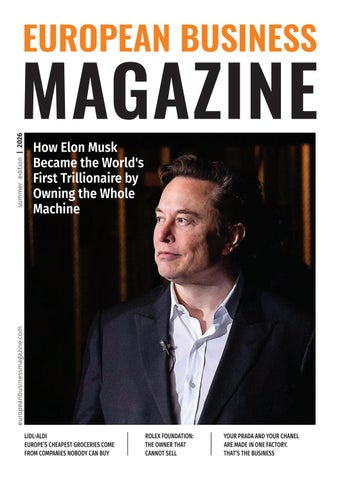
11 How Elon Musk Became the World's First Trillionaire by Owning the Whole Machine
16 Ben Francis Is Buying Back Gymshark at a Fraction of Its Peak Value
18 The Billionaire Behind Le Monde, Mistral and France’s Tech Ambitions
21 Aliko Dangote
The African Whose Refinery Now Fuels Europe
24 Nvidia Just Signed a $50bn Datacentre Lease With Itself
26 Your Prada and Your Chanel Are Made in One Factory. That’s the Business
28 Europe’s Cheapest Groceries Come From Companies Nobody Can Buy
31 The Owner That Cannot Sell
34 Cyber-Enabled Fraud Is Now One of the Most Pervasive Global Threats, Says New Report
36 From Hollywood to the Championship: How Ryan Reynolds and Rob McElhenney Built Wrexham’s Football Fairytale
40 Why 2026 Could Decide the Continent’s Economic Future
43 Why Stocks, AI and Energy Are Heading for a Reckoning
44 How OnlyFans Went From a £10,000 Loan to an $8 Billion Digital Empire
48 How Roger Federer Turned On Running Into a Multi-Billion-Dollar Sportswear Empire
55 Lara Daniel
58 Why Cybersecurity Fails Without Strong Infrastructure and Leadership, Says Former US Cyber Chief Dan Lohrmann
60 Europe’s Industrial Power Is Shifting - Here’s Who’s Gaining and Who’s Losing
62 Can the US Legaltech Unicorn Conquer the Continent?
64 Apple Sits Out the AI Arms Race to Play Kingmaker Between Google and OpenAI
66 New York Luxury Office Market Booms as Companies Seek High-End Amenities
68 Geopolitical and Economic Risks Rise in New Age of Competition
70 Rolls-Royce Shares Hit Record Highs in 2026 as 1,200% Five-Year Rally Redefines the FTSE 100
73 German Bank Vault Heist Leaves 3,000 Customers Facing Losses as €90m Disappears in Christmas Robbery
76 Will The EU’s New AML Rulebook Break the Fintech Growth Playbook?
78 Global CEOs Warn on Slowing Growth as Pressure to Deliver Returns Intensifies
80 EU Carbon Border Tax Comes Into Force as Companies Begin Paying Real Emissions Fees
83 European Stocks Face Pivotal 2026 as Germany’s €500bn Spending Plan Meets China Competition
Publisher Nick Staunton
Editor Nick Staunton
Deputy Editor
Anthony Gill
Associate Publisher
Brad Adams
Features Editor Katie Winearls
Head of Production
Paul Rogers
Head of Design
Vladimir Mladenovski
Subscriptions Manager
Rebecca Hill
Head of Business Development
Paul Matthews
Advertising Sales
Brad Adams Tara Duckworth
Advertising Sales
Tara Duckworth, Mike Ray, Andy Ellis, Mark Holburn
Contributing writers
Patricia Cullen, Richard Fitzpatrick, Bala Murali Krishna, Shilpa Meen, Argee Laraya, Aimee Ni Mhaolcraibhe, Gordana Ristic, Jonathan Hooker, Jose Ignacio Latorre
Head of Digital
Stephen Scott
Photographer Ben Fisher
NST Publishing Ltd, 19 Leamington Spa (studio 1) Leamington Spa,Cv324tf, UK
The information contained has been contained from sources the proprietor believes to be wholly correct however no legal liability can be accepted for any errors. No part of this publication can be reproduced without consent of the publisher.

Spain beat Argentina 1-0 at MetLife Stadium on Sunday 19 July to become world champions for the second time.
The celebrations began immediately, and so did the familiar claims about what victory would do for Spain’s international image, national confidence and economy.It is an appealing idea. It is also easy to exaggerate.
The last time Spain won the World Cup, in July 2010, the country was entering the most painful phase of its modern financial crisis. Two years later, Madrid requested access to a credit line of up to €100 billion to recapitalise its banks. Youth unemployment rose above 50%. The trophy transformed the national mood, but it could not overpower a property crash, a banking crisis and the eurozone’s wider breakdown.
The lesson is not that winning has no economic value. It is that the value is modest, temporary and delivered through a different channel from the one politicians usually describe.
The most detailed research comes from Marco Mello, whose study was published in the Oxford Bulletin of Economics and Statistics in 2024.
Mello used OECD data beginning in 1961 and compared the economic performance of World Cup winners with that of runners-up. That comparison matters because both countries reached the final, received weeks of international attention and experienced the excitement of a successful tournament. Only one won the trophy.
The study estimated that victory increased year-on-year GDP growth by 0.454 percentage points in the first quarter following the tournament and by 0.683 points in the second. By the third quarter, the measurable effect had disappeared.
The sensible conclusion is that winning may add roughly half a percentage point to GDP growth for about six months. It does not permanently
raise the economy’s productive capacity or establish a new longterm growth rate.
Even that conclusion needs qualification.
The estimates were statistically significant only at the 10% level, a relatively weak threshold. The result should therefore be treated as suggestive evidence rather than a dependable rule that can be applied automatically to Spain.
World Cups occur only once every four years, and there are relatively few winners available for economists to study. Each country is also experiencing different interest rates, political conditions, trade cycles and financial shocks when it wins.
Football is only one variable in a very complicated economy.
It is not a domestic spending boom
The most interesting finding concerns where the temporary growth appears to originate.
The conventional theory is based on confidence. Supporters celebrate, consumers feel better, businesses become more optimistic and spending rises. Economists often refer to this as a change in “animal spirits.”
Mello’s findings offer little support for that explanation.
The estimated increase was driven primarily by stronger exports rather than by a material rise in private consumption, government spending or investment.
Winning the World Cup therefore looks less like an economic stimulus and more like a short international marketing campaign.
For several weeks, the winning country dominates television coverage, social media and newspaper front pages. Its flag, supporters, cities and culture receive extraordinary global exposure. That visibility may make foreign consumers marginally more interested in its goods and services.
For Spain, the likely beneficiaries include tourism, hospitality, food, fashion, entertainment and internationally recognised consumer brands. That is a reasonable commercial inference from the export finding, rather than a sector-by-sector result established by the study.
The effect works primarily through the rest of the world’s attention, not through Spanish households suddenly spending enough to transform national output.
Other assessments have found much less evidence of a consistent World Cup dividend.
Coutts examined the six tournaments before 2026 and compared each winning country’s growth during the following year with its previous ten-year average. It then made the same calculation for the host countries.
The host performed better on three occasions. The winning country performed better on the other three. There was no consistent pattern showing that either hosting or winning created sustained economic outperformance.
That analysis does not directly disprove Mello’s research. It examines a different period and uses a simpler methodology. But it reinforces the central limitation: any World Cup effect is small relative to inflation, investment, productivity, interest rates and international trade.
The tournament itself has been credited with generating tens of billions of dollars in global economic activity. But much of that relates to spending in the three host countries, not to the economy of the country that eventually lifts the trophy.
Hosting and winning are separate economic questions. Spain has won the World Cup without incurring the enormous infrastructure and organisational costs associated with staging it.

Spain enters this victory in a far stronger position than it did in 2010
Its economy expanded by 2.7% over the year to the first quarter of 2026, outperforming most of its large European peers. The Spanish government now expects full-year growth of 2.6%, while the European Commission forecasts 2.4% and the OECD 2.2%.
The unemployment rate remains high by European standards, standing at 10.83% in the first quarter, but the government expects it to fall below 10% during the year.
Tourism is already operating at record levels. Spain welcomed 96.8 million international visitors in 2025, 3.2% more than the previous year, with international tourist spending reaching €134.7 billion.
A World Cup victory therefore provides a modest tailwind to an economy that was already expanding. It does not reverse Spain’s direction because Spain did not need its direction reversed.
That may make the commercial opportunity more useful. Spanish companies can attach themselves to a positive international story while consumer confidence in the country’s

brands, culture and tourism offer is already high.
But businesses have to act quickly. The research suggests that the measurable advantage lasts for two quarters, not two years.
The bigger threat is energy
Spain’s economic outlook will ultimately be determined by forces much larger than football.
The European Central Bank raised interest rates by 25 basis points in June after concluding that the Middle East conflict and higher energy
prices were creating renewed inflationary pressure across the eurozone.
Spain has greater protection than some European economies because of its strong renewable electricity capacity. It nevertheless remains dependent on imported crude oil, leaving transport, agriculture, industry and consumer prices exposed to global energy markets.
Brent crude moved above $90 again on Monday as escalating American-Iranian hostilities disrupted shipping through the Strait of Hormuz.
That is the economic contrast that matters.
Winning the World Cup may produce a temporary export and visibility benefit. A prolonged energy shock can affect inflation, interest rates, household incomes and business costs across the entire economy.
The football result is positive. It is not powerful enough to cancel those forces.
Winning the World Cup is worth something to Spain.
The best available research suggests that it may lift GDP growth by roughly half a percentage point during each of the next two quarters, primarily through stronger exports. But the evidence is not conclusive, and the effect appears to disappear after six months.
It is not a domestic spending boom, a productivity revolution or a substitute for economic policy.
It is a temporary international branding advantage.
Spanish exporters, hotels, tourism businesses and consumer brands should use the moment while the country commands global attention. The rest of the economy should treat the victory for what it is: an exceptional national achievement with a modest and shortlived macroeconomic dividend.
Spain’s experience in 2010 remains the clearest warning against claiming more.
The football was magnificent. It did not prevent the banking rescue, mass unemployment or the sovereign-debt crisis.
This time, Spain’s economy is in much better condition. It reached that position through employment growth, domestic demand, investment, service exports and European-funded projects, not through anything that happened at MetLife Stadium.
The trophy can amplify that success. It did not create it.
Volkswagen reclaimed the top position in China at the beginning of 2026. It did so while selling dramatically fewer cars.
The German group delivered 4.13 million vehicles worldwide during the first half of the year, 6.3% fewer than in the same period of 2025. Its Chinese sales fell 25.9%, with the decline accelerating to 36.6% in the second quarter.
Yet during January and February, Volkswagen held 13.9% of China’s passenger-car market, placing it ahead of Geely, Toyota and a sharply weakened BYD.
The apparent contradiction explains what has happened to Europe’s largest industrial company. Volkswagen did not mount a meaningful recovery in China. It briefly became the largest participant in a market that was contracting even faster than its own sales.
China’s passenger-car market fell by around 20% in the first half of the year after Beijing allowed electric-vehicle tax incentives to expire and reduced its support for trade-in programmes. BYD suffered particularly heavily, allowing Volkswagen to recover the top ranking despite its own steep decline.
For a company that built much of its modern prosperity on China, this is more than a difficult sales cycle. It marks the breakdown of the business model that allowed Chinese profits to support Volkswagen’s sprawling and expensive European manufacturing operation.
The consequences are now arriving in Lower Saxony.
The decades when China paid for everything
It is difficult to overstate the importance of China to Volkswagen.
The company was the first major Western carmaker to establish a significant presence in the country, forming its Shanghai joint venture in 1984. For a generation, the Volkswagen Santana became to Chinese motoring what the Model T had once been to the United States: widely recognised, domestically assembled and closely associated with the arrival of mass car ownership.
Volkswagen was China’s best-selling automotive brand from at least 2008. At its peak, the country accounted for roughly four out of every ten vehicles the group sold worldwide. Audi and Porsche benefited from the same expansion, establishing themselves among China’s rapidly growing class of affluent consumers.
The Chinese operation provided Volkswagen with more than volume. It generated the profits needed to sustain a costly European industrial structure.
The group’s German operations carried high labour costs, a complicated portfolio of brands and models, and manufacturing plants that were politically and operationally difficult to shrink. Strong Chinese earnings helped make those burdens manageable.
China, in effect, subsidised Wolfsburg.
For two decades, Volkswagen’s decisions about employment, investment and production capacity were based on the assumption that the Chinese contribution would continue. The

group could maintain a large German workforce and an unusually broad product range because its Chinese joint ventures supplied growth and margin.
That assumption no longer holds.
BYD overtook Volkswagen as China’s best-selling automotive brand in 2024, ending a leadership run that had lasted at least 15 years. In 2025, Geely pushed Volkswagen into third place, while the German group’s two main joint ventures saw their combined retail-market share fall from 12.2% to 10.9%.
The deeper change is visible across the entire industry. Foreign manufacturers once controlled more than 60% of the Chinese car market. Domestic

brands now account for more than two-thirds of sales.
Volkswagen has not merely lost ground to one unusually successful rival. The market has shifted decisively towards Chinese manufacturers.
Why the reversal happened so quickly
Volkswagen’s decline in China resulted from three strategic failures that reinforced one another: software, electrification and cost.
The first was software.
Volkswagen committed billions of euros to building an in-house software capability, but the programme repeatedly suffered delays and organisational problems. That mattered everywhere, but nowhere more than in China.
Chinese consumers increasingly evaluate cars as technology products. The quality of the screen, operating system, voice assistant, connectivity and update cycle can matter as much as the engine, chassis or perceived durability.
Volkswagen remained highly capable at building conventional cars. But in a market where buyers expected rapid software improvements and seamless digital features, that was no longer enough.
A well-engineered vehicle with an outdated interface became difficult to sell, particularly when Chinese competitors offered more advanced technology at a lower price.
The second failure was electrification.
Volkswagen’s ID range was developed around a common platform intended to work across several brands and international markets. The approach promised scale, but it also produced complexity and slower development.
The vehicles arrived in China just as domestic manufacturers were reducing prices, improving battery performance and updating models at a pace European companies struggled to match.
Volkswagen was not alone in making the wrong assumptions about electric-vehicle demand. European and American manufacturers spent more than $100 billion on EV programmes between 2022 and 2025, often on the expectation that regulation and subsidies would guarantee a rapid transition.


On the morning of 12 June 2026, a rocket company started trading on the Nasdaq and a man became worth more than any human in recorded history. SpaceX opened under the ticker SPCX at $135 a share. Within a session, the largest IPO ever attempted had crossed a $1.77 trillion valuation and kept climbing. Elon Musk, who owns about 42% of the company, woke up a billionaire and went to bed the first trillionaire. No one has done that before. This year, no one else came close to doing anything like it. That is why he is our Man of the Year.
You do not have to like him to see the scale of it. You do not even have to believe the valuation will hold, and as
we will see, it already wobbled. What happened in 2026 is that one person assembled a private empire spanning rockets, satellites, cars, robots, artificial intelligence and a social network, then floated the crown jewel and detached from the rest of the billionaire pack entirely. The gap between Musk and the world's second-richest person, Google's Larry Page, is now larger than Page's whole fortune. That is not a lead. It is a different weight class.
The SpaceX float was the financial event of the decade, and it broke records on the way out the door. It raised roughly $75 billion, more than
two and a half times the size of Saudi Aramco's 2019 listing, the previous record holder. It handed tens of billions in gains to a handful of hedge funds and venture firms that had held SpaceX stock for years. And it did all of this in New York, not London or Frankfurt, on a syndicate of 21 banks that did not include a single European name. Europe supplied capital to the deal. It did not get to underwrite it.
The listing worked because SpaceX had a rare thing for a rocket company: a consumer brand. Starlink, its satellite-internet arm, now has close to ten million subscribers worldwide and generates the bulk of the group's revenue. That gave the IPO a retail

hook that pure launch economics never could. Musk had spent years insisting he wanted to keep SpaceX private. The valuation, and the merger that preceded it, changed his mind.
The machine he built
To understand the trillion, you have to understand the structure. Musk does not run a company. He runs a machine of companies, and each part feeds the others.
SpaceX builds and launches the rockets. Starlink, inside SpaceX, sells the broadband those rockets put in orbit. In February 2026, SpaceX absorbed xAI, Musk's artificial-intelligence startup, in a $1.25 trillion all-stock deal , the largest merger ever recorded. xAI already owned X, the social network formerly called Twitter, which supplies the data its Grok models train on. Tesla builds the cars, the batteries and, increasingly, the robots and the
self-driving software. The stated logic for stitching AI to rockets is orbital data centres: compute in space, powered by solar, cooled by the void. Whether that is visionary or a slide in search of a business, it is genuinely his own idea, and he is spending real money to chase it.
The result is that around two-thirds of Musk's wealth now sits in the combined SpaceX-xAI entity, as we set out when his fortune overtook Saudi

Arabia's sovereign wealth fund earlier this year. Tesla, the company most people still think of as his, has quietly become the smaller asset.
Here is the part that fascinates and troubles in equal measure. Musk has become the most practised operator alive at moving value between companies he controls, mostly without cash changing hands.
The pattern is old. In 2015 Tesla bought SolarCity, a solar firm founded by his cousins, on whose board he sat. In 2022 he took Twitter private for $44 billion, funding much of it by selling Tesla stock. In March 2025 his AI startup xAI acquired X in an all-stock deal, valuing the social network at $33 billion and xAI at $80 billion. Because both were private and both were his, the deal was essentially a reshuffle of his own cap table. Then SpaceX swallowed xAI. Then SpaceX floated.
Value flowed up the chain, gathering a bigger number at each step, until it crystallised in a public share price.
Tesla plays its part too. Last year Tesla put $2 billion into xAI's funding round and sold it hundreds of millions of dollars of battery systems. Money and hardware circulate around the group, and each transaction can be read two ways. Sympathetically, it is vertical integration: one owner aligning rockets, chips, cars and data behind

a single plan. Sceptically, it is a man marking his own homework, valuing his own companies to one another and asking outside investors to accept the price. Both readings are true at once, and the SpaceX IPO is where the sceptical reading met the market and, for now, won.
The other headline act of Musk's year happened in Austin in November 2025, when Tesla shareholders approved a pay package worth up to a trillion dollars, the largest in corporate history. He
takes no salary. Instead he gets stock, in tranches, only if Tesla hits a series of enormous targets: a market value of $8.5 trillion, twenty million cars a year, a million robotaxis, a million humanoid robots. To collect the lot, Tesla would have to grow more than fivefold from where it trades today.
The vote is a story in itself. More than 75% of shares backed it, and the crowd cheered. But the big proxy advisers told investors to vote against, and Norway's sovereign wealth fund, one of Tesla's largest holders, did. The board's argument was blunt:
approve it or risk losing Musk to his other ventures. Shareholders decided that keeping him focused was worth almost any price. That tells you something real about his value to a company, and something uncomfortable about how much of that value is tied to one irreplaceable man.
It has not all gone his way. Tesla's brand took damage from his politics, and its flagship pickup flopped. Cybertruck sales came in far below the projections that suppliers across Europe had built their plans around. The bet now is that Tesla stops being a carmaker and becomes an AI-and-robotics company. That bet is unproven. It is also the entire basis of a trillion-dollar pay deal.
Strip away the theatrics and the ledger tricks and there is a hard core of genuine achievement that no amount of scepticism dissolves.
He made rockets reusable. Before SpaceX, a launch vehicle was thrown away after one flight, like tearing up an airliner after a single trip. SpaceX landed boosters and flew them again, cut the cost of reaching orbit by an order of magnitude, and now launches more mass into space than every other operator on earth combined. He did the same trick to satellite internet, blanketing the sky with Starlink and reaching customers no cable ever would. He forced the entire car industry to take electric vehicles seriously, years before it wanted to. And he built, from a standing start in 2023, an AI lab valued in the hundreds of billions.
The common thread is appetite for risk that would terminate most careers. He bet Tesla and SpaceX simultaneously to near-bankruptcy in 2008 and survived both. He overpaid wildly for Twitter and turned it into the training ground for an AI business now worth many times what he paid. He is wrong often and loudly. He is also right at a scale that reorders industries, and he keeps taking the swings. That combination, more than the net worth, is what earns the cover.

A serious Man of the Year piece has to say the difficult part plainly, so here it is. The empire has a single point of failure, and it is him.
SpaceX is not really a normal technology company. As we argued when the prospectus landed, it looks more like a defence utility with a technology wrapper. The US government is its largest customer, and it holds something like 97% of a $13 billion Pentagon secure-broadband programme. Its valuation, its contracts and its favourable regulatory treatment lean heavily on Musk's personal proximity to power in Washington. That is a strength while the relationship holds and a serious risk the moment it does not.
The valuation is not bulletproof either. Within weeks of the float, SpaceX stock fell back through its $135 IPO price, after a peak that had briefly made the company worth more than Amazon and Microsoft. More than a trillion dollars of paper value came off in days, and Musk's own stake fell with it. He is still, comfortably, the richest
person alive. But the "first trillionaire" headline describes a moment in June, not a fixed fact, and the market has already reminded everyone how fast the number moves.
Then there is the governance question that Europe, in particular, has barely begun to answer. One individual now controls more market value than several members of the so-called Magnificent Seven do individually. The rules Brussels writes on AI, on digital markets, on space, were built to constrain firms, not a single person who straddles all three. The concentration is real, and the tools to check it are not.
So we hand Elon Musk the cover with clear eyes, not a halo.
The circular financing is aggressive and, at times, uncomfortably close to self-dealing. The Tesla pay deal rewards one man on a scale that should make any believer in ordinary corporate governance wince.
The SpaceX valuation depends on government contracts and personal politics as much as on engineering. And the whole structure rests on the health, focus and continued good luck of one 55-year-old. None of that is a footnote. All of it is the price of the thing.
But the thing itself is extraordinary. In a single year, Musk floated the biggest IPO in history, became the first trillionaire, closed the largest merger ever, won the largest pay package ever, and did it while running the companies that dominate commercial space, satellite internet, electric cars and, increasingly, artificial intelligence. Europe, meanwhile, watched the value list in New York and supplied capital to an AI and space boom it no longer sets the terms of. That gap is the story of the year as much as Musk himself is. He is not a comfortable choice. Man of the Year rarely is. He is simply the person who bent the most reality to his will in 2026, and there was not a close second.
On 3 July, the Financial Times reported that Ben Francis is in talks to buy back part of the 21% stake he sold to private equity firm General Atlantic in 2020. Francis, who started Gymshark in his parents’ garage at nineteen, still owns more than 70% of the business and is now sounding out banks to fund the repurchase. The number nobody will confirm is the one that counts: the price. Because the athletic-apparel category General Atlantic bought into at the top has been repriced hard since, and a founder buying his own company back cheaper than he sold it is a rare thing to watch.
That is the story in one line, and it is a very European one. Britain spent the last decade minting direct-toconsumer champions on the promise that a strong brand plus a big Instagram following equalled a durable business. General Atlantic, a firm that made its name backing Facebook and Uber early, paid £200m for a slice of the best of them. Five years on, the smart money is the one taking the haircut and the founder is the one holding the cards. How that happened is a lesson every European investor with a 2020-vintage consumer bet should read carefully.
When General Atlantic invested in August 2020, the terms looked like a win for everyone. The firm put in £200m for 21%, valuing Gymshark at more than £1bn and turning a garage brand into a British unicorn. Francis lifted his own stake above 70% and took some money off the table. General Atlantic got a board seat and a marquee consumer name at the exact moment lockdown was pouring
demand into home fitness and online shopping. For a while it worked beautifully. Gymshark kept growing, and the price looked cheap in hindsight.
Two things broke the spell. Interest rates rose, which crushed the multiples investors would pay for fast-growing, low-profit brands. And the directto-consumer model itself got harder. The trick that made Gymshark special was selling straight to customers through social media, which kept margins high and cut out the retailer. But the cost of reaching those customers climbed as Meta and TikTok advertising got dearer, and rivals like Vuori, Alo Yoga and Lululemon crowded the same feeds.
Across consumer tech, the valuations that held their ground are now the exception, not the rule. Gymshark still grew. Revenue rose 6.4% to £646m in the year to July 2025, its thirteenth straight year of growth. But pre-tax profit fell more than 40% to under £7m as it opened stores, including a flagship on Regent Street, and spent to keep the top line moving. Francis has called the profit dip deliberate, the price of building for the future. That is a fair account. It is also exactly the kind of story that makes a brand hard to value.
The obvious exit for General Atlantic was a stock market listing. It is not available on good terms. Francis met Chancellor Rachel Reeves last October as she tried to talk British firms into floating in London, and Gymshark has been linked to an IPO for years. But the London market remains a

hard sell for founders, and even with IPO activity picking up in 2026, no exchange is paying 2020 prices for a direct-to-consumer apparel brand today. A trade sale to a Nike or an Inditex would mean handing over the company Francis built, which he plainly does not want to do.

That leaves the founder buyback as the cleanest route to liquidity for General Atlantic. It also hands Francis the pricing power, because he is the only motivated buyer in the room. Private equity still has plenty of capital to put to work, just not at the terms it was writing five years ago.
There is no confirmed figure, and that matters. Both companies have declined to comment, and the FT is clear that valuation and size are still being negotiated. So the honest claim is direction, not a precise number. The 2020 valuation was struck at the top of the

cycle, listed comparables have more than halved since, and Francis is buying only part of the stake rather than the lot. A meaningful discount to the old £1bn mark is close to certain. Anything more exact than that runs ahead of what anyone has actually disclosed.
It is also worth resisting the tidy morality tale. General Atlantic is not being routed. It bought into a brand now turning over £646m, it has banked five years of paper gains and a board seat, and even a marked-down exit may still clear its original cost. The mistake, if there was one, was the entry price and the timing, not the company.
That keeps the “fraction of peak value” claim defensible throughout — the body now supports the headline instead of undercutting it. Want me to hand you the full article again with this section and the new H1 slotted in, clean to paste?
Strip away the schadenfreude and this is a clean parable about multiples. The best investors in the world can still overpay if they buy a whole category at its peak, and the cycle does not care how clever the term sheet was. For founders the lesson is more enviable. Take institutional money at a rich valuation, keep control and keep your nerve, and you may get to buy your own company back at a discount a few years later. Very few ever get to run that trade. Ben Francis, pizza-delivery driver turned billionaire, is about to run it on the smart money itself. That is the most instructive thing about this deal, and the part the headline almost gets right.
There is a particular kind of European billionaire the continent has learned to distrust: the one who buys newspapers. In France the archetype is Vincent Bolloré, the media magnate often called the French Murdoch, who turned Vivendi’s outlets into instruments of a hard-right cultural project. So it says something odd about Xavier Niel that he owns France’s paper of record, Le Monde, and is widely regarded as the reason it remains free.
Niel is the closest thing France has to a self-made technology mogul, and one of the more improbable figures in European business. He made his first money in the 1980s on Minitel adultchat services, had a brush with the law that he has spoken about with disarming candour, and built from there a telecoms empire, a startup machine, the largest single bet on French artificial intelligence, and a stake in the country’s most respected newspaper. He is, in one man, most of the arguments about money and media that Europe keeps having. He is also a useful test of a hard question. Can a billionaire own this much and still be trusted with a free press?
The maverick who kept winning
Start with the business that made him. Niel founded Iliad, the parent of the Free brand, and spent two decades doing to French telecoms what few European entrepreneurs manage to do to any incumbent: he won. Free’s mobile launch in 2012 detonated the market with plans priced at a couple of euros, forcing every rival to slash prices and handing consumers a
windfall the regulator never could. In 2021 he took Iliad private in a $3.7bn deal, removing the quarterly scrutiny of public markets and giving himself room to build.
What he built is now a genuinely European operator, spanning France, Italy, Poland, Ireland, Monaco, Switzerland and the Nordics, alongside the cloud provider Scaleway. On the short list of Europeans who created something at global scale and kept the headquarters at home, next to the fintech founders now topping the continent’s most-valuable rankings, Niel belongs near the front. He is also, tellingly, everywhere the power is: a seat on the board of KKR, another on Unibail-Rodamco-Westfield, and, most striking of all, a board seat at ByteDance, the Chinese parent of TikTok. His partner is Delphine Arnault, of the LVMH dynasty, which quietly ties France’s leading tech maverick to its grandest luxury fortune, itself an owner of newspapers. Concentration, in the Niel story, is never far away.
Money is only half of it. Niel has spent the past decade making himself the gravitational centre of French technology. He built Station F, the vast Paris campus that is the largest startup incubator in the world, and École 42, a free and tuition-less coding school that has been copied across the globe. Through Kima Ventures he backs roughly a hundred startups a year, one of the most prolific angel operations anywhere, and his personal portfolio runs past a hundred companies, from Wise to the insurer

Alan. Where French founders gather, Niel is usually the man who wrote the first cheque, and increasingly the ecosystem that funding has helped seed bears his fingerprints.
Since 2023 that energy has poured almost entirely into artificial intelligence, and here Niel has made himself indispensable. He was an early backer of Mistral, now Europe’s most valuable AI company and the closest thing the continent has to a frontier lab. He co-founded and funds Kyutai, a Paris research lab, alongside the shipping magnate Rodolphe Saadé

and the former Google chief Eric Schmidt. He turned Scaleway into one of Europe’s largest buyers of Nvidia chips, and Iliad has committed billions to AI data centres. His pitch is unashamedly patriotic. Niel warns that a Europe which misses this moment risks becoming an abandoned continent, and he frames sovereign compute as a matter of not letting French children grow up dependent on American or Chinese algorithms.
That instinct puts him in the middle of the continent’s central technology argument. France has a real
edge in AI, anchored by Mistral, Hugging Face and Dataiku, yet the chips it runs on are still overwhelmingly American. Niel’s answer has been to fund the European side of the stack with European money, the same logic that saw Mistral raise debt from a syndicate of European banks with no US lender involved. It is also why he sits, awkwardly, alongside a French government sceptical of joining US-led chip coordination even as it depends on American hardware. Niel embodies both the ambition and the contradiction.
Then there is Le Monde, and this is where the story turns from impressive to important.
Le Monde was founded in 1944 by Hubert Beuve-Méry, at Charles de Gaulle’s urging, in the spirit of the Resistance. It pledged to remain “politically, economically and morally” independent, and to protect that promise its journalists held a controlling stake and the power to reject their own editor. That arrangement lasted until 2010, when financial distress forced the newsroom to

cede control. A trio of businessmen bought in: Niel, the investment banker Matthieu Pigasse and the Yves Saint Laurent partner Pierre Bergé. None held a majority, and a body representing journalists, staff and readers kept roughly a quarter of the parent company and a formal say in what came next.
The equilibrium held until it didn’t. When Bergé died in 2017, Niel and Pigasse split his shares. Then the Czech billionaire Daniel Kretinsky bought nearly half of Pigasse’s stake, and the newsroom found out not through the owners but through one of its own reporters. The staff revolted, arguing the secrecy violated the terms under which they had surrendered control, and forced through a veto agreement: no shareholder could sell a controlling stake to anyone the journalists and readers had not approved. It was a rare victory for a newsroom over its proprietors, and it set the precedent for what followed.
In 2023, Niel’s holding company bought out Kretinsky’s stake, reported at around €50m, and did something billionaires almost never do. It committed the shares, along with its own and Pigasse’s, to a fund dedicated to defending press freedom, moving control away from any single owner and toward a structure designed to outlast all of them. Where Bolloré bent his outlets to a worldview, and
Kretinsky unsettled a newsroom simply by appearing, Niel spent his money to lock independence in. It is, on the face of it, the most public-spirited thing a media billionaire in Europe has done in years.
And yet. The uncomfortable truth about benevolent proprietors is that their benevolence is a choice, and choices can be revised. The value of a foundation structure is that it constrains the founder’s successors; its weakness is that it was still designed by the founder, and still sits inside a web of interests only he fully sees.
Consider what Le Monde now has to cover without flinching. Its part-owner runs one of Europe’s largest telecoms groups, bankrolls its most important AI company, and sits on the board of TikTok’s Chinese parent at a moment when that platform is a live political and regulatory question across the West. He is romantically tied to the family that controls LVMH, itself the owner of French newspapers. A paper of record cannot avoid writing about telecoms regulation, AI policy, Chinese technology or luxury conglomerates, and in every one of those stories its proprietor has a stake. The fight over how AI should pay for the journalism and culture it trains on is not an abstraction at Le Monde. It is a negotiation in which the paper’s owner is
also an investor on the other side of the table.
None of this means Niel interferes, and the available evidence suggests he does not. The point is subtler and harder to legislate away. Independence that depends on the restraint of a single powerful man is independence on loan, however sturdy the paperwork. It is better, plainly, than Bolloré’s model of open capture. It is also not the same thing as the structural independence Le Monde’s founders built, in which the journalists themselves held the controlling stake. Niel has protected the newspaper’s freedom with his fortune. He has not returned it to the newsroom, and a fortune that protects can also, in other hands or other moods, direct. The same concentration of capital now reshaping European AI is reshaping who owns the continent’s information, and the two trends run through the same handful of people.
Here is what makes Niel worth a Weekend Read rather than a puff piece. He is the best-case version of a story Europe should worry about. He has used his money to defend a great newspaper rather than to bend it, to build European technology rather than to sell it to California, and to seed an ecosystem rather than to hoard it. If you had to choose a billionaire to own your paper of record, you would choose someone like him.
But the fact that the best case still leaves a national newspaper dependent on the goodwill of a telecoms-AI-and-TikTok magnate tells you how narrow the good outcomes have become. The lesson of Xavier Niel is not that he is dangerous. It is that Europe has arranged its media and its money so that press freedom, technological sovereignty and startup capital increasingly rest on the same small group of very rich men, and that we are left hoping they stay benign. Niel, for now, is. The system that requires him to be is the problem, and he is its most flattering example.

This spring, as European airlines were warned they had six weeks of jet fuel left, the fuel began arriving from an unexpected place. Not the Gulf, which the Iran war had shut off. Not the United States, whose refiners were already stretched. It came from Lagos, from a single refinery on the Nigerian coast that did not exist in usable form three years ago.
The man who built it is Aliko Dangote, and he is Africa’s richest person by a wide margin. His fortune has swung between roughly $34 billion and $38 billion through 2026, depending on the tracker, and almost all of the recent growth comes from one asset: a $20 billion refinery that has quietly rewired global fuel flows. To understand why a Nigerian industrialist now matters to a European reader, you have to understand what that refinery has done, and how improbable it was that it got built at all.
The paradox he set out to fix
For decades Nigeria lived with an absurdity. It is one of Africa’s largest crude oil producers, yet it imported
almost all of its own petrol and diesel. The country pumped crude, shipped it abroad to be refined, and then bought the finished fuel back at a premium. It was a drain on the nation’s dollars and a permanent political sore. Every fuelprice crisis, every queue at a Nigerian pump, traced back to the same failure: the country could not refine its own oil.
Successive governments tried and failed to fix this for sixty years. State refineries were built, then left to rot through mismanagement and neglect. By the 2010s they barely functioned at all.
Dangote decided to solve it privately. He had made his first fortune in cement, sugar and flour, building the largest industrial group on the continent from a small trading business his grandfather had started in Kano. By the time he turned to oil, Dangote Cement alone operated across ten African countries. In 2013 he announced he would build a refinery big enough to meet all of Nigeria’s fuel needs and still have product left to export. Almost no one believed the scale was achievable.
Eleven years and $20 billion
It took eleven years and roughly $20 billion. The refinery, built on reclaimed land near Lagos, is the largest single-train refinery in the world, designed to process 650,000 barrels of crude a day. It began operations in early 2024, and the ramp-up since has been faster than the sceptics predicted.
By February 2026 it had reached its full nameplate capacity of 650,000 barrels a day. By June, engineers had certified test runs above 700,000 — more than the plant was designed for. Dangote has already announced plans to expand it toward 1.4 million barrels a day, which would make it one of the largest refineries on Earth, rivalling India’s giant Jamnagar complex.
The effect on Nigeria was immediate and historic. In March 2026, the country exported more petrol than it imported for the first time in decades. A nation that had spent sixty years importing fuel became a net exporter, almost entirely because of one privately owned plant.
Here is where the story reaches Europe, and where the timing became extraordinary.
The refinery hit full stride at exactly the moment the Iran war closed the Strait of Hormuz. Roughly a fifth of the world’s oil normally passes through that narrow waterway, and its closure cut off a large share of the diesel and jet fuel that Europe imports from the Gulf. African policymakers warned the shock would ripple across the continent’s economies The IEA warned that Europe had only weeks of jet fuel left, calling it the largest energy crisis it had ever tracked. European refineries were already running flat out and could not make up the gap.
Dangote’s refinery could. In April 2026, S&P Global data confirmed it had become the single largest exporter of jet fuel in the world, shipping aviation fuel to Europe, the United States and even Saudi Arabia — capturing

the same blown-out refining margins that handed the oil majors an exceptional quarter. Its jet fuel exports jumped roughly 770% between 2024 and 2026. A Nigerian plant was now supplying the aviation fuel that kept European airlines flying through the summer season.
This was not planned. It was luck of timing meeting years of preparation. But it placed Dangote at the centre of the same energy crisis EBM has tracked from every other angle. When Britain’s last pre-war fuel tankers arrived and the real shortage began , West African refining was part of what filled the gap. When the world’s second-largest diesel exporter,
Russia, banned exports entirely, the pool of alternative suppliers shrank again, and refineries like Dangote’s became more valuable still.
The deeper significance is not about one plant. It is about where the power to refine fuel now sits.
For years the story of global energy has been about crude — who pumps it, who controls the pipelines, who guards the chokepoints, and who profits when those chokepoints close.
The Iran war exposed a different vulnerability. Even Saudi Arabia’s clever bypass of the Strait of Hormuz could
move crude but not refined product, because refining capacity is the real bottleneck. The world does not run on crude. It runs on the diesel, petrol and jet fuel that crude is turned into — the same refined products whose shortage pushed Europe’s chemicals industry into crisis this year. And refining capacity, unlike crude, cannot be conjured in a crisis. It takes a decade and tens of billions to build.
That is why a refinery on the Nigerian coast suddenly carries strategic weight. Europe spent years closing refineries as unprofitable and leaning on imports. Britain now has four refineries, down from seventeen in the 1970s. When the Gulf supply was

cut, that thin domestic capacity left Europe exposed, and dependent on whoever else could make the fuel. Increasingly, that includes Lagos.
The controversy and the risk
Dangote is not a straightforward hero in this story, and it is worth being clear about the criticisms.
The most persistent is monopoly. A single private company now dominates Nigerian fuel refining, which gives one man enormous power over prices in Africa’s largest economy. Critics warn that swapping dependence on imports for dependence on one domestic monopolist is not obviously
an improvement. Nigerian airlines have complained that fuel middlemen are inflating prices. Dangote has at times feuded publicly with regulators and with the state oil company, and once offered to sell the refinery to the government amid accusations that he was building a monopoly. There is also the question of concentration. Dangote’s empire spans cement, sugar, fertiliser and now fuel, much of it privately held and hard for outsiders to value. That opacity is one reason his net worth is so hard to pin down: Forbes and Bloomberg differ by billions because so little of his business trades on public markets. Dangote himself argues the refinery
alone is worth more than $40 billion, well above the construction-cost figure the trackers use.
He is now trying to prove that. A pan-African IPO of the refinery is planned, targeting a valuation of $40 billion to $50 billion, with a subscription window expected to open around August 2026. It would be by far the largest share sale in African history, dwarfing anything the Nigerian exchange has hosted. To attract foreign investors wary of Nigeria’s currency, Dangote has proposed a rare structure: shares bought in naira, but dividends paid in US dollars, backed by the refinery’s export earnings. If regulators approve it, it would be unlike anything African capital markets have offered before.
It would be easy to file Dangote as an African success story with no bearing on Europe. That would miss the point.
The Iran war taught European business a lesson it had been avoiding: that the continent’s decision to offshore its refining left it exposed to shocks it could not control. The fuel that filled the gap this year came partly from a plant that a private African industrialist willed into existence against sixty years of failure. That is a striking reversal of the usual direction of dependence. Europe, which has spent a century as the supplier of industrial capacity to Africa, found itself this year buying jet fuel from Lagos to keep its own planes in the air.
Dangote says he wants to be remembered as the man who industrialised Africa. Whether one refinery and a giant IPO can carry that ambition is an open question. But he has already done something more concrete than most billionaires ever manage. He built a piece of critical infrastructure that the market said could not be built, at a scale the continent had never seen, and it arrived at the exact moment the world needed it. Europe should pay attention, because the age in which refining capacity is a source of power has quietly returned, and the map of who holds it is being redrawn in places Europe long stopped watching.

Nvidia is the tenant behind leases worth up to $50 billion at a Texas data centre campus being built by Hut 8, the Financial Times reported on Tuesday 28 July, citing five people familiar with the arrangement. Eight
days earlier Hut 8 had told investors it had fully commercialised the site through two leases of 352 megawatts each, signed with what it described only as a “high-investment-grade tenant”. The campus, Beacon Point in Nueces County, is a gigawatt site designed around Nvidia’s own reference architecture for large AI installations. So the tenant is the company whose chips will fill the racks, in a building designed to its specification.

Read that back slowly, because it is the whole story. Nvidia designed the blueprint, has committed to the lease, and sells the hardware that goes inside. The customer, the financier and the supplier are the same company wearing three hats. None of that is unlawful, and none of it is even unusual in a young industry where demand runs ahead of anybody’s ability to fund it. But it does make a particular question harder to answer than it was a month ago: how
much of Nvidia’s demand is somebody else’s decision?
On 20 July, Hut 8 put a number on Beacon Point. Two 352MW leases, $19.6 billion of contracted base-term value over fifteen years, and a potential campus-level value of $50.2 billion once renewal options are counted. It named the counterparty only by credit quality.
That is normal commercial confidentiality. It is also the reason the disclosure worked. A fifteen-year lease is worth precisely as much as the tenant’s ability to pay it, and “high investment grade” was doing the load-bearing work in that sentence. Investors priced a long-dated income stream on the strength of an unnamed covenant. The FT’s reporting supplies the name, and with it a question the original announcement did not raise. Nvidia’s credit is not in doubt. What is now in view is that the tenant underwriting the campus is also the vendor whose equipment fills it, which means the lease is not quite the independent third-party validation it appeared to be.
Because building AI capacity costs more than the people who want it can currently pay.
We have written before about the circular structures inside Elon Musk’s companies, where entities fund one another and revenue travels in a loop. The AI infrastructure build-out is producing the same shape at far greater scale, for the same reason: the hyperscalers are spending faster than their cash flow allows. Google’s AI spending has already pushed its free cash flow negative, and Amazon’s build-out plans exceed what its own operations generate. Somebody has to fill the gap. Increasingly it is the chipmaker.
For Nvidia the logic is straightforward. Capacity that does not get built is capacity that never buys chips. Backstopping the lease removes the financing risk that would otherwise slow the project, and the company can afford it. On its own terms this is a rational use of a very strong balance sheet.
The difficulty is what it does to the numbers everyone else relies on. Nvidia’s order book has been treated for two years as an objective reading of demand for AI, and therefore as evidence that the spending is justified. If part of that order book rests on capacity Nvidia has itself underwritten, the reading loses some of its independence. A supplier that finances its own customers is not measuring demand. It is partly creating it.
Europe owns almost none of this build-out and is exposed to nearly all of it.
The exposure runs through index funds and pension allocations that hold Nvidia at its current weight, through European ambitions for sovereign AI that still depend on American silicon, and through the European industrial suppliers selling into American sites. When the AI trade wobbled this month, European indices caught the fall without ever having held the upside.
This is not a scandal, and the market is unlikely to treat it as one. Nvidia has the balance sheet, the deal is disclosed, and the capacity is real.
But it is a change worth naming. For two years the case for AI infrastructure has rested on the argument that customers are queuing to buy. When the seller starts guaranteeing the leases, that argument becomes partly self-referential — and the moment to notice a circular structure is while it is still growing, not afterwards.

Look at the glasses on your face. If they are Prada, and the pair beside them on the shelf were Chanel, the same factory in Italy made them both. The same company owns the brand names on each, licences them from the fashion houses, and very likely owns the shop where you tried them on. Its name is EssilorLuxottica, it turned over €28.5 billion in 2025, and most people who wear its products have never heard of it. This is the purest version of a story EBM has been circling for weeks. We looked at how Rolex answers to no shareholder and how Aldi and Lidl
win by staying private. Those companies control one link in their chain and defend it fiercely. EssilorLuxottica controls every link at once — the brands, the licences, the factories, the wholesale, the shops, even the insurance that pays for the glasses. And unlike Rolex, it did it in plain sight, on a public stock exchange, with the regulators watching and waving it through.
What one company actually owns
Start with the frames. EssilorLuxottica owns Ray-Ban, the best-selling eyewear brand on earth, along with
Oakley, Persol, Oliver Peoples, Vogue and Arnette. Then it makes the eyewear, under licence, for the fashion houses whose names sell at a premium: Chanel, Prada, Armani, Burberry, Versace, Dolce & Gabbana, Ralph Lauren, Michael Kors, Coach, Tiffany. More than twenty designer labels. When you choose between a Prada frame and a Versace one, you are choosing between two products made by the same factory. Then the lenses. The Essilor half is the world’s largest lens maker — Varilux progressives, Crizal coatings, Transitions photochromics, Stellest myopia-control lenses for children. So the company that made your frame very likely also made the lens inside it.
Then the shops. It owns Sunglass Hut, the largest sunglasses chain in the world, and LensCrafters, the largest optical chain in North America, plus Pearle Vision, Target Optical, and after the €7 billion GrandVision deal, much of European high-street optics too. Around 17,750 stores.
And then, in the United States, it even owns EyeMed, one of the largest vision-insurance plans. The company can sell you the insurance, the eye test, the frame, the lens and the shop you buy them in. It is present at every single step between your eyes and your wallet.
Here is the mechanism, because the ownership list is only shocking once you see what it does.
A normal branded product passes through hands that each take a cut: factory, brand, distributor, retailer. Competition at each stage is supposed to keep any one of them from charging too much. EssilorLuxottica occupies every one of those stages itself. There is no independent distributor to negotiate the brand’s price down, because the distributor is the same company as the brand. There is no rival retailer refusing to stock an overpriced line, because the retailer is the same company too.
The cost side makes the point sharper. The founder of LensCrafters, Dean Butler, once told the Los Angeles Times
that a good frame can be made for four to eight dollars. Branded sunglasses routinely sell for a hundred and fifty and up, luxury-licensed ones for several hundred. The gap between the manufacturing cost and the shelf price is not explained by materials. It is explained by the absence of anyone in the chain with the independence to compete the price down.
There is a second, quieter lever. Because EssilorLuxottica owns Sunglass Hut and the other chains, it decides what goes on the shelves. A rival brand trying to reach customers has to get into shops largely controlled by the company it is trying to compete with. The story that hardened this reputation is Oakley’s. In the years before EssilorLuxottica bought it in 2007, Oakley was an independent challenger; a pricing dispute reportedly saw Luxottica reduce Oakley’s presence in its stores, Oakley’s share price suffered, and the company was eventually bought by the giant it had fallen out with. Whether or not every detail of that retelling is exact, the shape of it is the point: you cannot easily fight a company that owns the shelves you need.
The number nobody agrees on
Now the fairness, because this is where a lazy version of the story overreaches, and EBM should not.
The famous claim, from a 2012 60 Minutes report and repeated ever since, is that Luxottica controls around 80 per cent of the eyewear market. That figure is almost certainly too high. Luxottica itself has said its share of the global market is far smaller, in the region of 10 per cent by some measures, and the global eyewear market is genuinely large and fragmented, with cheap independents everywhere. A €15 pair from a beach kiosk is not made by EssilorLuxottica.
But the 80 per cent number, while wrong as stated, points at something real. The company’s dominance is not evenly spread. It is concentrated at the premium and mid-premium end — the branded and designer eyewear most people picture when they think of buying “proper” sunglasses — and
in the physical retail chains where those glasses are sold. In that segment, in those shops, the control is close to total. The honest statement is not “one company owns 80 per cent of all eyewear.” It is “in the part of the market where you are likely to shop, your choices are largely owned by one company.” That is less lurid and more damning.
Here is what makes this an EBM story rather than a curiosity. EssilorLuxottica is not a private foundation hiding from scrutiny like Rolex, nor a web of private entities like Musk’s. It is a public company, listed on the CAC 40, and it is still controlled — Delfin, the holding company of the late Leonardo Del Vecchio’s family, owns around 32 per cent. Total vertical control, sitting in plain view, on a regulated European exchange.
And the regulators cleared it. When Essilor and Luxottica proposed their merger, the European Commission approved it in 2018 without conditions. Margrethe Vestager, then competition commissioner and not a soft touch, said a market test of nearly 4,000 opticians suggested the combined company would not gain the power to harm competition. The reasoning was that a lens maker and a frame maker did not directly overlap, so combining them removed no competition between them.
That is technically correct and arguably misses the wood for the trees. The concern was never that Essilor and Luxottica competed with each other. It was that stacking the world’s largest lens maker on top of the world’s largest frame maker and the world’s largest eyewear retailer created a chain no rival could enter at any point. Vertical integration is precisely the kind of dominance that traditional merger review, focused on head-to-head overlap, is worst at seeing. The GrandVision retail deal that followed was cleared with only limited divestments. Europe looked at the most vertically integrated consumer company on its own exchange and largely nodded it through.

The integration is not only extraction, and a fair piece has to say so. Owning the whole chain has funded real innovation: Ray-Ban Meta smart glasses, whose sales more than tripled year on year, are a genuine new category, and Stellest lenses slow the progression of childhood myopia. LensCrafters can grind a prescription in an hour because it owns the lab. The OneSight foundation has brought vision care to more than 760 million people in underserved communities, which is not nothing when uncorrected sight is a real barrier to work and school. A fragmented industry of tiny players might charge less and innovate slower. Scale bought the smart glasses.
The choice on the shop wall is mostly an illusion, and it is an illusion the buyer pays for. A dozen proud brand names, one owner, one price-setter, one set of shelves. That is not a conspiracy; it is the logical endpoint of letting a company own every link in a chain, and it was permitted at each step by regulators applying rules built for a simpler kind of dominance.
The lesson runs alongside the others EBM has told this month. Rolex and Aldi escape the market’s discipline by leaving it. EssilorLuxottica did something subtler and arguably bolder: it built a structure that looks exactly like a normal public company, competes with itself on its own shelves, and sets the price of seeing clearly for much of the Western world. The next time you pay two hundred euros for a pair of sunglasses that cost eight to make, you are not paying for the frame. You are paying for the absence of anyone in the chain with a reason to charge you less.
In 2025, Lidl started a price war in Germany and its parent company grew anyway, to €185.6 billion. That is not a typo and it is not a rounding of some global luxury conglomerate. It is what one family-controlled German grocer now turns over in a year, which makes the Schwarz Group the largest retailer in Europe and one of the largest on earth. Its nearest rival is another German discounter that also cuts prices for a living and also answers to no shareholder anywhere
Between them, Aldi and Lidl set the price of groceries across much of the continent. Neither is listed. Neither publishes the detail a public company must. Both are controlled through private foundations, and that arrangement is not a quirk of German tax law sitting to one side of the business. It is the business. The thing that lets these two companies grind down every listed competitor is the same thing that keeps them off the stock market.
The story starts in Essen in 1913, with a small shop run by Anna Albrecht. After the war her sons Karl and Theo took it over and did something radical for the time. They stripped retailing back to almost nothing.
No advertising. No fresh-food counters. A few hundred products instead of thousands. Stock left in the shipping boxes rather than arranged on shelves. Every cost that did not lower the price to the customer was treated as waste and removed. The German word for it is hard discount, and the Albrechts more or less invented it.
In 1960 the brothers split the company in two, reportedly over whether to sell cigarettes. Theo took the north, Karl the south, and to this day Aldi Nord and Aldi Süd are separate businesses with separate territories, divided by an invisible line across Germany that locals call the Aldi equator. In June 2025 the two branches were reported to be exploring a merger for the first time in over sixty years, which tells you something about the pressure even they now feel.
Lidl came later and copied the template. Dieter Schwarz built it out from his father’s fruit wholesaler, opening the first Lidl in 1973 and deliberately not putting the family name over the door. It worked. Lidl alone did €140.2 billion in 2025, up 6.1 per cent, and is the group’s engine.
Here is the mechanism, because it is the part most people get slightly wrong. The discounters are not cheaper because they are mean. They are cheaper because they sell almost nothing.
A typical Tesco carries around 30,000 to 40,000 separate products. A Walmart supercentre holds far more. An Aldi carries roughly 1,400 to 1,800. Lidl a bit more, around 4,000. That single decision cascades through the whole business.
Fewer products means enormous orders of each one, which means the buyer can squeeze the supplier harder than any full-range grocer can. It means simpler shops, less staff, faster restocking and far less wasted food. It means a smaller store

that still sells a lot per square foot, because customers are not wandering twelve varieties of peanut butter. And it means the shelves can be filled with the discounter’s own label rather than a brand.
That last point is the quiet core of it. Around 90 per cent of what Aldi sells is its own brand. When you own the brand, you are not paying for the manufacturer’s marketing, and you can switch supplier whenever you like. The usual link between low price and low quality is broken, because the

discounter controls the recipe and the packaging and simply leaves out the advertising budget. The customer gets something close to the branded product for meaningfully less, and the shop keeps a healthy margin while still undercutting the supermarket down the road.
None of this is secret. Tesco and Sainsbury’s have known the mechanics for twenty years. The question that matters is why they have never been able to answer it, and that is where ownership comes in.
The foundation is the weapon
Aldi and Lidl are not owned by people in the way a listed company is owned by its shareholders. They are owned by foundations.
Aldi Süd sits under the Siepmann-Stiftung and two smaller foundations, controlled by the heirs of Karl Albrecht. Aldi Nord runs through three separate foundations, Markus, Lukas and Jakobus, controlled by Theo’s side. The Markus foundation alone holds 61 per cent of Aldi Nord. Lidl and its
sister chain Kaufland sit under the Dieter Schwarz Stiftung. Three different structures, one shared effect.
The effect is this. There are no public shares, so nobody outside the families can buy in, and the companies can never be taken over. There is no share price, so there is no quarterly number to defend and no analyst to placate. There is no dividend obligation, so the profit is not pulled out and handed to investors. It is poured back into new stores, cheaper prices and bigger warehouses. The Albrechts
built the three-foundation split at Aldi Nord specifically to stop any single family member selling or seizing control. It was designed as a fortress.
We saw the same architecture doing the same work in last week’s piece on the Rolex Foundation. A company owned by a foundation is not run for an exit. It is run to continue. In watches that means protecting scarcity. In groceries it means something more aggressive: the freedom to compete on price for as long as it takes, without ever being punished for it.
Put a foundation-owned discounter next to a public supermarket and the asymmetry is brutal.
When Lidl cut prices across Germany in 2025, it did not have to explain a thinner margin to anybody. There was no earnings call, no share-price wobble, no activist investor demanding the margin back. It simply cut, and grew to €140 billion while doing it.
Now imagine Tesco or Sainsbury’s doing the same. Both are listed. Both must report to the City every few months. A grocery chief executive who deliberately sacrificed margin for two or three years to match a discounter would spend every results day defending the decision and would likely not survive to see it pay off. The market punishes exactly the patience the discounter model requires.
This is the same discipline gap we traced across luxury, where Ferrari’s refusal to chase volume and the Swiss watchmakers holding price through the downturn both rested on being insulated from the quarterly demand to grow. Grocery is the same lesson in a lower-margin key. The listed British grocers were forced to compete on price against opponents who never have to justify a bad six months to anyone. That is not a fair fight, and it was never designed to be.
The results are on the shelves. Aldi took fourth place in the UK from Morrisons in 2022. Lidl passed 8 per cent of the British market and became the

fifth-largest chain, making a pre-tax profit of £156.8 million in the year to February 2025, up from £43.6 million the year before. The same rise of own-label that is remaking European retail has now pushed UK own-brand past half of all grocery volumes for the first time. That is the discounters’ worldview winning even inside their rivals’ stores.
There is a real cost to all this, and it should be said plainly. These are among the most secretive large companies in the world. No listing means no public accounts, no external scrutiny, no market for control if the stewardship ever slips. Aldi Nord has already had bruising family disputes over its foundations, and a court had to curb
the family’s power in 2017. A structure with no shareholders also has no shareholder to sound the alarm.
But as competitive engineering it is close to unbeatable. Europe spends a great deal of energy asking how to make its listed champions leaner and quicker. Its two most relentless retailers answer the question by not being listed at all. They took the continent’s grocery market with a model any rival could copy and none can match, because the part that cannot be copied is the absence of a shareholder.
The cheapest trolley of food in Britain and much of Europe is filled, in the end, by companies that no investor can own and no rival can buy. That is not an accident of the discount model. It is the whole of it.
In 2025, Rolex put fewer watches into the world than the year before and made more money than at any point in its history. Production fell 2 per cent. Sales rose 4 per cent, past CHF 11 billion for the first time. It was the second consecutive year the company reduced output, something it had not done in over two decades, and it happened while Swiss watch exports contracted and American demand became the industry’s only reliable growth story. No listed company could have done that without a very awkward call with its investors
There was no call. Rolex has exactly one shareholder, and that shareholder is a foundation in Carouge with about twenty staff, no fundraising department and no obligation to explain itself to anybody. A viral Instagram post this month described this as the most secretive empire in business, which is doing the structure a disservice. It isn’t secrecy. It’s the deliberate absence of anyone with standing to ask.
What the foundation actually is
The popular version says Rolex has been owned by the Hans Wilsdorf Foundation since 1960. That’s the year Wilsdorf died and his shares passed across. The structure itself was built fifteen years earlier.
Wilsdorf’s wife died in 1944. The couple had no children. In the year that followed he worked with lawyers and tax specialists on what to do with a company he could not leave to anyone, and on 1 August 1945 the Hans Wilsdorf Foundation was formally established in Geneva. His shares

went to it on his death. It has held all of them ever since.
Here is the detail that the retellings skip, and it changes the story. The foundation’s first stated purpose is not charity. It is Rolex. The founding document commits the foundation’s resources to the company’s preservation and normal development. Philanthropy is what happens to the money afterwards.
That ordering matters. This was not a rich man giving away a watch company. It was a man with no heirs building a legal container designed
to stop anyone ever selling, splitting or listing it. The charity was real, and remains substantial — roughly CHF 300 million a year, funding a bridge across the Rhône, a cardiology wing at Geneva’s university hospital, student housing, a seniors’ complex. But it was the second instruction, not the first. It is also strikingly local. As the NZZ has reported, Wilsdorf wrote his 1945 statutes with the words à Genève after almost every category of beneficiary. Eighty years on, one of the wealthiest charitable foundations in Europe distributes nearly all of its money inside
a single Swiss canton, according to a list that includes a provision for discreet help to cultivated and deserving women. It reads exactly like what it is: a private document from 1945 that nobody has the standing to modernise.
The year that proves the point
Set the sentiment aside and look at what the structure did last year.
Morgan Stanley and LuxeConsult put Rolex above CHF 11 billion in wholesale sales for 2025, around 33 per cent of the entire Swiss watch industry, on roughly 1.1 million watches. At retail the number is closer to CHF 16 billion. Rolex now takes more revenue than the Apple Watch.
Every one of those figures is an estimate. Rolex publishes nothing. Swiss private foundations are not required to file audited accounts. The mostcited financial analysis of the world’s dominant luxury watchmaker is an outside reconstruction, updated annually, that the company has never confirmed or corrected.
The wider picture is where the argument gets sharp. Swiss watch exports fell 1.7 per cent in value in 2025 and volumes hit 14.6 million units, roughly half the 2011 peak. Inside that contraction, four brands — Rolex, Patek Philippe, Audemars Piguet and Richard Mille — increased their combined share to 49.1 per cent by value and captured an estimated 76 per cent of the industry’s operating profit.
All four are privately held. None of them answers to a public market.
Now look at the other side. Swatch Group, which is listed, shed 216 basis points of share and is down more than 1,000 since 2019. Longines fell 18 per cent to CHF 920 million and dropped out of the billion-franc club for the first time in a decade. Omega, once the clear number two, is now fifth. We wrote in April that Richemont and Swatch had split on strategy, one holding price and allocation, the other chasing volume. A year on, the discipline argument has won, and the

brands with the most discipline are the ones with the fewest shareholders.
That is not a coincidence and it is not really about craftsmanship. Cutting production two years running is a strategy that public equity punishes on sight. A listed chief executive who did it would spend two earnings calls defending the decision and a third defending their job.
The tariff year made the difference visible.
On 7 August 2025 the United States imposed a 39 per cent tariff on Swiss goods, watches included. Swiss watch exports to America fell 56 per cent in September and 46.8 per cent in October. The rate was in force for 99 days before being replaced by 15 per
cent, backdated to mid-November. Some importers got refunds. The US had been the industry’s largest foreign market and its last growing one.
Rolex responded by raising American prices around 7 per cent on average, its third adjustment in a single year, with gold up about 9 per cent and steel around 5.6. It did not pre-announce, guide, or explain. Contrast that with the listed groups, which had to absorb the same shock in public and watch their share prices take the verdict.
Switzerland remains outside the trade settlement Brussels reached. It now sits at 12.5 per cent under Washington’s new forced-labour duties, above the 10 per cent the EU secured and above the 15 per cent ceiling the bloc accepted at Turnberry. Add a franc that has been quietly punishing Swiss exporters for two years and

gold near record highs, and the cost base is genuinely difficult.
Rolex has absorbed all of it without once being asked a question in public.
The same freedom explains Bucherer. In 2023 the foundation bought the world’s largest luxury watch retailer, a business turning over around CHF 2 billion, almost certainly for several billion more. No shareholder vote. No analyst call. No synergy targets. Jörg Bucherer, as it happens, also had no heirs and wanted his company in safe hands, which is very nearly the same story told twice. Rolex kept the brand, the staff and the relationships with competing labels it sells. Its certified pre-owned programme now accounts for 5 per cent of Watches of Switzerland’s turnover, ahead of Patek Philippe — the same formalisation of the resale market reshaping European retail more broadly.

The part nobody puts on a carousel
Be honest about the costs, because they are real.
There is no external check on this organisation at all. No shareholders, no published accounts, no analyst scrutiny, no market for corporate control. It works beautifully while the stewardship is good. There is no mechanism whatsoever for what happens if it stops being good. A listed company with bad management eventually gets a raider or an activist. A Swiss charitable foundation gets neither.
The charitable purpose is frozen in 1945 language and confined to one canton, while the company it funds sells globally and has been the beneficiary of worldwide demand. And the “no shareholders” line that made the post travel is simply wrong. Rolex has one shareholder. Concentrated, permanent, and accountable to nobody but itself.
It also cannot be copied. The 1945 Swiss tax regime that made the transfer viable is gone. When Yvon Chouinard moved Patagonia into a purpose
trust in 2022 it was widely called a Wilsdorf move, but the conditions were not remotely the same, and almost nobody has followed him.
Wilsdorf was not designing a competitive moat. He was a widower with no children solving an estate problem, and he solved it with the best legal advice money could buy in 1945. The moat was a by-product.
Eighty years later it is worth more than the watches. In a contracting industry, in a tariff war, with a punishing currency, the four Swiss brands that answer to nobody took half the market and three-quarters of the profit. The single most valuable asset in luxury right now is not a movement, a dial or a hundred years of marketing. It is the absence of a quarterly obligation to grow.
Europe spends a great deal of time asking how to make its listed champions more competitive. It should spend some asking why its most competitive luxury business is not listed, and never can be.
The report, developed in collaboration with Accenture, highlights that cyber-enabled fraud has become a pervasive threat. This shift underscores the growing societal and economic impact of fraud as it spreads across regions and sectors. The report also showcases how AI is supercharging both offensive and defensive capabilities. Geopolitical fragmentation further compounds these risks, reshaping cybersecurity strategies and widening preparedness gaps across regions.
This year marks the fifth edition of the Global Cybersecurity Outlook series, which has traced a steady evolution from pandemic-driven digitalization to today’s increasingly complex cybersecurity landscape. The new findings point to a cyber landscape undergoing profound structural shifts, where cyber resilience can no longer be approached as a technical function alone but as a strategic requirement that underpins economic stability, national resilience and public trust.
“As cyber risks become more interconnected and consequential, cyber-enabled fraud has emerged as one of the most disruptive forces in the digital economy, undermining trust, distorting markets and directly affecting people’s lives,” said Jeremy Jurgens, Managing Director, World Economic Forum. “The challenge for leaders is no longer just understanding the threat but acting collectively to stay ahead of it. Building meaningful cyber resilience will require coordinated action across governments, businesses and technology providers to protect trust and stability in an increasingly AI-driven world.”
The gap between highly resilient organizations and those falling behind remains stark, with skills shortages and resource constraints amplifying systemic risk. Meanwhile, global supply chains have become more interconnected and opaque, turning third-party dependencies into systemic vulnerabilities. These dynamics are converging at a moment when inequalities in cyber capabilities are

widening, leaving smaller organizations and emerging economies disproportionately exposed.
“The weaponization of AI, persistent geopolitical friction and systemic supply chain risks are upending traditional cyber defences. For C-suite leaders, the imperative is clear; they must pivot from traditional cyber protection to cyber defence powered by advanced and agentic AI to be resilient against AI-driven threat actors,” said Paolo Dal Cin, global lead, Accenture Cybersecurity. “True business resilience is built by fusing cyber strategy, operational continuity and foundational trust—enabling organizations to swiftly adapt to the dynamic threat landscape.”
The report identifies key factors that shape the evolving cyber landscape of 2026. These include:
• AI is accelerating cybersecurity risks at unprecedented speed. AI-related vulnerabilities rose faster than any other category in 2025, with 87% of respondents reporting an increase. Data leaks linked to generative AI (34%) and advancing adversarial capabilities (29%) are among the leading concerns for 2026. Meanwhile, 94% of leaders expect AI to be the most consequential force shaping cybersecurity in 2026. Organizations are responding, nearly doubling the share assessing AI security, from 37% to 64%.

• Geopolitics is redefining the global cybersecurity threat landscape, with 64% of organizations now factoring geopolitically motivated attacks into their risk strategies and 91% of the largest enterprises adjusting their cybersecurity posture accordingly. 31% of respondents expressed low confidence in their country’s ability to manage major cyber incidents. Confidence levels vary widely, from 84% in the Middle East and North Africa to 13% in Latin America and the Caribbean.
Cyber-enabled fraud has become a pervasive global threat. A striking 73% of respondents were or knew someone directly affected in 2025 and CEOs now rank fraud and phishing ahead of ransomware as their top concerns.
• Supply chains remain a major systemic vulnerability. Among large companies, 65% cite third-party and supply chain risks as their greatest cyber resilience barrier, up from 54% last year. Concentration risk is also intensifying, with incidents at major cloud and internet service providers demonstrating how infrastructure-level failures can trigger widespread downstream impacts across interconnected digital ecosystems.

• Cyber inequity is widening across regions and sectors. Smaller organizations are twice as likely to report insufficient resilience compared to large firms. Regionally, the shortage of cybersecurity talent is most pronounced in Latin America and the Caribbean, with 65% of organizations reporting insufficient skills to achieve their security objectives, while 63% of organizations in sub-Saharan Africa face similar constraints.
“Developments in AI are reshaping multiple domains, including cybersecurity. When deployed responsibly, these technologies can strengthen cyber defences by supporting faster detection and response. But if misused or poorly governed, they can also introduce serious risks, from data leaks to cyberattacks,” said Josephine Teo, Minister for Digital Development and Information and Minister-in-Charge of Cybersecurity & Smart Nation Group, Singapore. “Governments therefore need a forward-looking and collaborative approach to ensure AI enhances cyber resilience while minimizing risks that increasingly transcend borders.”
The report calls on leaders across sectors to move beyond isolated efforts and commit to raising the collective baseline by sharing intelligence, aligning standards and investing in the capabilities needed to ensure all organizations can benefit from a more secure and resilient digital environment.
The survey draws on insights from 804 global business leaders in 92 countries, including 105 CEOs, 316 chief information security officers and 123 other C-suite executives, including chief technology officers and chief risk officers.


What began as a £2 million gamble on a struggling Welsh football club has become one of sport’s most remarkable business success stories, catapulting Wrexham AFC from the fifth tier to England’s Championship while generating £191 million in annual tourism revenue for a former mining town
The Hollywood Pitch That Changed Everything
In November 2020, as the world grappled with pandemic lockdowns, two Hollywood actors made an audacious pitch to the supporters of a failing


Welsh football club. Ryan Reynolds, the Canadian star of Deadpool, and Rob McElhenney, creator of It’s Always Sunny in Philadelphia, stood before a virtual meeting of the Wrexham Supporters Trust with a vision that seemed equal parts ambitious and absurd: transform one of the world’s oldest football clubs into a global force.
The Wrexham Supporters Trust had owned the club since 2011, when fans rallied to raise £127,000 in a single day to save their 156-year-old institution from administration. After a decade of fan ownership that saw the club languish in non-league


football’s fifth tier—its lowest position in 150 years—the Trust faced a stark choice: continue struggling with limited resources or gamble on two American celebrities with no football experience.
The vote wasn’t close. An extraordinary 98.6% of the 2,000 Trust members who participated backed the Hollywood takeover. By February 2021, Reynolds and McElhenney completed their £2 million acquisition through the RR McReynolds Company LLC, a 50-50 joint venture that would become the vehicle for one of sport’s most improbable transformations.

The Business Model Behind the Magic McElhenney has been transparent about the origins of his football obsession. Inspired by the Netflix documentary “Sunderland ‘Til I Die,” he became fascinated by the English football pyramid—a meritocratic system where any club can theoretically rise to the top through promotion and relegation. This stood in stark contrast to the closed franchise model dominating American sports.
Yet McElhenney quickly realized his ambition required serious capital. As he candidly admitted, he needed “movie-star money” to execute the
vision. Enter Reynolds, whose entrepreneurial success extends far beyond acting. His Aviation Gin sale to Diageo and Mint Mobile’s $1.3 billion acquisition by T-Mobile had established him as a savvy businessman with deep pockets and sharp marketing instincts.
The initial £2 million purchase price proved to be merely the entry fee. Financial statements reveal that Reynolds and McElhenney invested an additional £15 million in shareholder loans over the first three years, funding the operational losses deemed “necessary to allow the club to maximize its full potential in the shortest time practically possible.” Those losses peaked at £5.1 million in 2023 before declining to £2.7 million in 2024 as revenues surged.
The investment strategy was aggressive and, critics argued, anticompetitive. Wrexham signed players like striker Paul Mullin from clubs two tiers above them, paying wages well above National League market rates. The wage bill soared from £6.9 million in 2023 to over £11 million in 2024, alongside £824,000 in promotion bonuses. Opposing fans grumbled that the Hollywood duo’s financial firepower created an unfair advantage reminiscent of Premier League oil money.
However, the gamble paid off spectacularly. By March 2025, the club announced it had fully repaid all £15 million in shareholder loans, achieving financial independence far faster than anticipated. Meanwhile, the club’s valuation skyrocketed. The Allyn family’s October 2024 investment—acquiring nearly 15% of the club—valued Wrexham at £100 million. By mid-2025, informal valuations reached £350475 million, representing a potential 17,500% to 23,750% return on the original investment in under five years.
Perhaps the most inspired element of Reynolds and McElhenney’s strategy was leveraging their Hollywood connections to create “Welcome to Wrexham,” an Emmy Award-winning documentary series produced by Boardwalk Pictures for FX. Debuting in August 2022 on FX and Hulu in the
United States, followed by Disney+ internationally, the show has become essential viewing for understanding modern sports marketing.
The series did more than chronicle the club’s journey—it created a global commercial platform that transformed Wrexham’s sponsorship potential. Traditional lower-league clubs attract local businesses hoping to reach matchday crowds. Wrexham now commands partnerships with United Airlines, HP, Hewlett Packard Enterprise, and TikTok—global corporations seeking access to the show’s international audience.
Commercial revenue tells the story starkly. In 2023, Wrexham generated £1.9 million in commercial income. By 2024, that figure had exploded to £13.2 million—a 595% increase in a single year. Total turnover jumped from £10.5 million to a record £26.7 million, shattering League Two financial records and positioning Wrexham’s revenue more in line with mid-table Championship clubs than newly promoted ones.
The documentary’s impact extended beyond corporate sponsorships. Merchandise sales soared, with approximately 100,000 shirts sold annually— half purchased by overseas supporters who had never set foot in Wales. Social media metrics reflected the global reach: within a year of the takeover, Twitter followers increased by 57,800 with 181.3 million impressions, Instagram gained 60,000 followers, and Facebook reached 2.4 million users.
Total social audience grew by 192,000, unprecedented for a fifth-tier club.
The on-pitch success that validated the entire venture came with remarkable consistency. Wrexham’s 2021-22 season ended in heartbreak—finishing second in the National League only to lose the playoff semi-final to Grimsby Town after conceding in the last minute of extra time. The setback proved temporary.
In 2022-23, under manager Phil Parkinson, Wrexham clinched the National League title, securing automatic
promotion and ending their 15-year exile from the English Football League. The moment sparked jubilation across Wrexham, with Reynolds and McElhenney celebrating alongside fans who had waited over a decade for this return.
Rather than consolidate, Wrexham accelerated. The 2023-24 season saw them finish runners-up in League Two, achieving back-to-back promotions and reaching League One for the first time in 19 years. The 2024-25 campaign completed an unprecedented hat-trick—finishing second behind Birmingham City to secure Championship promotion, making Wrexham the first club to achieve three consecutive promotions from the National League to England’s second tier.
As of January 2026, Wrexham sit ninth in the Championship with 40 points from 26 matches—10 wins, 10 draws, and 6 losses. They are just three points off the playoff positions and nine clear of the relegation zone, a remarkable achievement for a newly promoted club competing in England’s second tier for the first time since 1982. Recent form has been particularly strong, with four consecutive victories building momentum toward a potential playoff push.
While the football success captures headlines, the economic impact on Wrexham itself represents perhaps the most significant achievement of Reynolds and McElhenney’s stewardship. Tourism data compiled by the Scarborough Tourism Economic Assessment Model—used by 21 of 22 Welsh local authorities—reveals a transformation that extends far beyond the Racecourse Ground.
In 2019, before the Hollywood takeover, tourism contributed £135 million to Wrexham County’s economy. The pandemic collapsed that figure to £49 million in 2020 and £101 million in 2021. However, the subsequent recovery has been extraordinary. By 2022, tourism spend reached £151 million—a 50% increase over 2021. In 2023, the figure climbed to £179 million, and by 2024, tourism was contributing £191
million annually to the local economy, representing 90% growth over the pre-takeover decade and the strongest tourism growth in Wales.
Visitor numbers reflect this boom. In 2024, Wrexham County welcomed 2.07 million total visitors—a 1.1% increase from 2023 and a 21% surge from the previous year. Of these, 1.63 million (79%) were day visitors, while 440,000 (21%) stayed overnight. The tourism economy now supports 1,758 full-time hospitality jobs, up 36% year-on-year.
Hotel occupancy levels frequently exceed 90%, with visitors often struggling to secure rooms during match weekends. The Turf pub, located adjacent to the Racecourse Ground and regularly featured in “Welcome to Wrexham,” has become a pilgrimage site for international fans. Local businesses report transformative increases in trade, with overseas visitors arriving to see the stadium but discovering Wrexham’s other attractions—the UNESCO World Heritage Pontcysyllte Aqueduct, Erddig Hall, and Chirk Castle.
Joe Bickerton, Wrexham County Borough Council’s destination manager, credits the documentary with creating awareness money couldn’t buy: “We now have a global platform afforded to us which we could never purchase. The draw may initially be the Racecourse Ground, but once here visitors realize what a beautiful county we live in.”
Challenges remain. Sam Regan, owner of The Lemon Tree restaurant and chair of hospitality group This Is Wrexham, warns that economic pressures threaten sustainability. “The hospitality industry in Wrexham needs huge support,” Regan noted. “Things are getting more difficult. It’s not a particularly frothy industry in terms of profitability, and it’s only getting worse.” Limited hotel capacity and rising operational costs could constrain future tourism growth despite surging demand.
Reynolds and McElhenney’s ambitions extend beyond league positions and balance sheets. The Racecourse Ground, recognized as the world’s

oldest international stadium still hosting matches, requires substantial investment to accommodate growing demand. Current capacity stands at approximately 12,400 after temporary seating additions.
Plans call for expanding capacity beyond 15,000, with the new Kop stand central to these ambitions. However, construction has faced delays due to financial constraints and planning complexities. The December 2024 investment by Apollo Sports Capital— reportedly under 10% of the club but from a firm managing $900 billion in assets—provides the capital needed to accelerate infrastructure projects. Apollo’s involvement represents a validation of the Wrexham model by serious institutional investors. Al Tylis, Apollo Sports Capital’s chief executive and chairman of Mexican club Necaxa (in which Reynolds and McElhenney also hold stakes), described the investment as providing “longterm, patient capital to help Wrexham

reach its goals and contribute to the ongoing revitalisation of the facilities and local economy.”
The ownership structure has evolved to support this growth. While Reynolds and McElhenney maintain majority control through Wrexham Holdings LLC, minority investors now include the Allyn family (near-15%), Apollo Sports Capital (under 10%), and Al Tylis and Sam Porter (5%). This diversification provides capital for growth while preserving the founders’ control and vision.
Beyond football, Reynolds and McElhenney acquired Wrexham Lager Beer Company in October 2024 through Red Dragon Ventures LLC, partnering with the Roberts family that had owned the 142-year-old brewery since 2011. The acquisition aims to distribute Wrexham Lager in the United States and Canada, capitalizing on “Welcome to Wrexham” fandom to build a global beer brand rooted in Welsh heritage.
Reynolds and McElhenney have been clear about their ultimate ambition: reaching the Premier League. “The dream has always been to take this club to the Premier League while staying true to the town,” they stated when announcing Apollo’s investment. That journey now appears plausible rather than fantastical.
Wrexham’s current Championship position—ninth with 40 points and three points off the playoffs—demonstrates they can compete at this level. The club expects approximately £50 million in revenue during the 202526 Championship season, bolstered by enhanced broadcasting rights and continued global sponsorship appeal. Should they achieve Championship playoff success, the financial rewards multiply exponentially.
Premier League promotion would unlock broadcasting revenues exceeding £100 million annually even for bottom-placed clubs, alongside matchday revenues from expanded capacity and commercial deals befitting top-flight status. The financial gap between Championship and Premier League remains football’s most lucrative threshold, and Wrexham’s trajectory suggests they’re building toward sustained competitiveness rather than a quick flip.
Skeptics note that Championship to Premier League promotion represents a far steeper challenge than the lower-league ascent. The division features parachute-payment clubs with recent top-flight experience, established mid-sized cities with larger fanbases, and billionaire-backed operations. Wrexham’s wage bill, while impressive for League Two, remains modest compared to Championship heavyweights.
Yet Reynolds and McElhenney have consistently exceeded expectations. Their willingness to bring in serious investors while maintaining control, commitment to infrastructure investment, and proven ability to monetize the club’s global profile suggest this is no vanity project. The question is no longer whether Hollywood can succeed in football, but how far they can take it.
The Wrexham story has implications beyond one Welsh town. It demonstrates how celebrity ownership, when executed with genuine commitment and business acumen, can unlock value that traditional models cannot access. The integration of entertainment and sport—using documentary filmmaking to create a global audience for a local club—represents a template others are already attempting to replicate.
Birmingham City’s ownership by Tom Brady and the Knighthead consortium has drawn “Hollywood Derby” comparisons. Yet few celebrities possess Reynolds and McElhenney’s combination of marketing genius, genuine passion, willingness to invest heavily, and humility to hire competent football professionals like Parkinson. For Wrexham itself, the transformation extends beyond tourism pounds and league positions. The town’s profile as Wales’s newest city (granted status in 2022) and UK City of Culture 2029 bidder reflects renewed civic pride. Investment in hospitality, infrastructure, and cultural programming builds long-term resilience beyond football’s fortunes.
As Reynolds told a source in January 2026: “Ryan’s work in the Deadpool movies has generated billions of dollars in ticket sales, but the Wrexham project has been a lot closer to his heart and the partnership with Rob McElhenney continues to bear real fruit. It’s apples and oranges to compare these two franchises.”
That emotional investment—backed by shrewd business strategy, substantial capital, and three consecutive promotions—has rewritten what’s possible when Hollywood meets football. Whether Wrexham reaches the Premier League remains uncertain. What’s beyond doubt is that Reynolds and McElhenney have already achieved something remarkable: transforming a failing club in a former mining town into a globally recognized brand worth hundreds of millions, while revitalizing an entire community in the process.
After outperforming Wall Street in early 2025, European equities face a critical year as structural weaknesses collide with ambitious fiscal stimulus, Chinese competition intensifies, and investor confidence hinges on whether Germany’s spending revolution can offset decades of industrial decline
European equity markets enter 2026 at an inflection point that could determine the continent’s economic trajectory for years to come. The STOXX Europe 600 surprised investors by outperforming the S&P 500 through much of 2025, with Germany’s DAX, France’s CAC 40, and Italy’s FTSE MIB all delivering stronger returns than their American counterparts. Yet this rally masks profound structural challenges that threaten to derail the continent’s economic competitiveness unless addressed decisively in the months ahead.
Morgan Stanley’s European equity strategists forecast earnings growth of just 3.6% for 2026, starkly below the bottom-up consensus estimate of 12.7%. This divergence reflects a familiar pattern: European equities typically begin the year with elevated forecasts that are gradually downgraded as reality intrudes. The question confronting investors is whether this time will be different—or whether Europe’s old economy exposure and rising Chinese competition will once again constrain corporate profitability.
The most significant development reshaping European markets is Germany’s dramatic abandonment of
fiscal conservatism. After decades of adhering to strict debt limits, Europe’s largest economy passed a comprehensive investment package worth an estimated €500 billion to €1.3 trillion over the next decade. This marks the most significant fiscal expansion since German reunification and represents a tectonic shift in the nation’s economic philosophy.
The spending priorities are clear: defence expenditure rising to 4% of GDP by 2035, infrastructure modernisation including roads, rail, and digital networks, and green energy investments to reduce dependence on foreign fossil fuels. Germany’s fiscal deficit is projected to increase from 2.7% of GDP in 2024 to 3.4% in 2026 and 4.0% in 2027, according to International Monetary Fund forecasts.
This infrastructure boom creates tangible opportunities for European industrials, materials companies, and banks. Cement producers stand to benefit from carbon credit systems that constrain supply even as demand expands for roads, bridges, and railways. Defence contractors like France’s Safran have transformed from dormant stocks into market darlings as NATO members commit to sustained military spending increases. European banks, trading at 9-10 times earnings—a discount to US counterparts—could see loan portfolio expansion as fiscal stimulus drives credit demand.
Yet Germany’s spending spree unfolds against a backdrop of intensifying competition from China that

threatens to overwhelm domestic manufacturers. Chinese overcapacity in strategic sectors—electric vehicles, solar panels, steel, chemicals—is depressing global prices and squeezing profit margins across European industry. In Germany, profit margins for non-financial companies have fallen 5 percentage points over the past three years, with even steeper declines in manufacturing sectors directly exposed to Chinese imports.
The structural nature of this challenge cannot be overstated. China invested nearly as much in clean energy in 2025 as the United States and European Union combined, cementing its status as the world’s clean technology powerhouse. Chinese companies lead manufacturing across most clean

energy supply chains, from solar cells to lithium batteries to wind turbines. European efforts to compete through the Net-Zero Industry Act—which aims for 40% domestic production of annual deployment needs by 2030— face the reality that Chinese manufacturers have decade-long head starts and substantial cost advantages. Goldman Sachs Research identifies increased Chinese competition as reinforcing structural weaknesses already plaguing the euro area economy: demographic decline, overregulation, and persistently high energy costs. These headwinds explain why European GDP growth is forecast at just 1.1% to 1.3% in 2026—modest by historical standards and well below the continent’s potential.
The energy crisis catalysed by Russia’s invasion of Ukraine continues reverberating through European manufacturing. While wholesale gas prices have retreated from 2022 peaks, energy costs remain approximately 40% above pre-2022 levels for many industrial users. This persistent premium relative to American and Asian competitors undermines Europe’s ability to retain energy-intensive industries.
The consequences are stark. German chemical giant BASF has announced 2,600 job cuts, with peer Evonik eliminating 2,000 positions. Dow Chemical is closing European facilities entirely. Recent surveys indicate 75%
of German energy-intensive companies are shifting investments abroad to regions with lower power costs and fewer regulatory burdens. This industrial exodus threatens the manufacturing base that underpins European prosperity.
Europe’s pivot away from Russian energy sources—aiming to phase out Russian gas, oil, and nuclear entirely—creates both challenges and opportunities. The transition requires massive infrastructure investment in LNG terminals, renewable generation capacity, and grid modernisation. Yet the timeline for completing these investments extends years into the future, leaving manufacturers exposed to price volatility and supply uncertainty in the interim.


The European Central Bank faces a delicate balancing act in 2026. After cutting its deposit facility rate four times in 2025, the ECB is expected to hold rates steady at 2% through much of 2026 even as inflation hovers near the 2% target. This cautious stance reflects concerns that German fiscal stimulus could reignite price pressures, particularly given tight labour markets across much of the eurozone.
This monetary policy divergence relative to the Federal Reserve—which is expected to continue rate cuts— creates both risks and opportunities. A stronger euro could further undermine European export competitiveness, particularly against Chinese manufacturers. However, stable ECB policy should support credit growth and money supply expansion, potentially boosting corporate activity and earnings performance.
Political instability continues weighing on investor sentiment, particularly in France where the equity market trades at an outright discount to the EURO STOXX 50—historically a warning sign reserved for major crises. French stocks have


underperformed by 15% since January 2024 amid recurring political turmoil. While markets showed resilience when the government survived October’s no-confidence vote, the underlying political fragmentation remains unresolved.
The upcoming US midterm elections in November 2026 add another layer of uncertainty. Potential shifts in American trade policy could trigger renewed tariff threats targeting European manufacturers, particularly in automotive and aerospace sectors. The polarisation of global trade into US-led and China-led blocs forces European companies to navigate increasingly complex supply chain decisions.
Despite formidable challenges, European equities offer compelling value for investors with appropriate time horizons. The STOXX Europe 600 ex UK Index trades at 14.8 times 2026 consensus earnings—slightly above its long-term average but justified by improving fiscal dynamics. Sectors positioned to benefit from German stimulus—select industrials, materials, and banks—present tactical opportunities.
J.P. Morgan strategists forecast eurozone earnings growth approaching


15% in 2026, driven by easy base effects, improving macro conditions, rising liquidity, and better Chinese demand. This optimistic scenario requires multiple catalysts to align: German spending accelerating on schedule, Chinese stimulus supporting export demand, and European companies successfully defending margins against Asian competition.
The pessimistic case is equally plausible: delays implementing fiscal programmes, continued Chinese overcapacity depressing prices, and energy costs remaining structurally elevated. Under this scenario, Morgan Stanley’s 3.6% earnings growth forecast looks more realistic, implying limited upside for equity indices trading near fair value.
What’s certain is that 2026 represents a pivotal year for European capitalism. The continent’s ability to execute ambitious fiscal plans, defend industrial competitiveness against Asian rivals, and modernise regulatory frameworks will determine whether recent stock market gains prove sustainable or merely a brief respite before renewed underperformance. For investors, the choice is stark: embrace Europe’s transformation potential or acknowledge that structural decline may prove irreversible without radical reform.


The start of 2026 shows an economy driven more by long-term structural pressures than by a normal recovery cycle. Markets are operating in a fragmented geopolitical environment where security concerns increasingly shape trade, investment, and technology policy.
Geopolitical tensions, supply chains disruptions, and intense competition in areas such as artificial intelligence are influencing where capital flows and how risks are priced. Although US growth remains relatively strong, it exists alongside ongoing geopolitical uncertainty, stubborn services inflation, and uneven global policy direction. As a result, market optimism is uneven, with investors favoring perceived stability while remaining cautious about risks tied to geopolitics, trade policy, and economic miscalculations.
Global markets have opened the year moving at different speeds. US equities remain near record highs, suggesting confidence in earnings durability, yet leadership is narrowing as investors question elevated technology valuations. Japan stands out as a beneficiary of structural reform and currency dynamics, while Europe and the UK remain constrained by weaker growth momentum.
In commodities, the divergence is striking. Oil prices signal a world of ample supply, where geopolitical conflict adds only a modest premium to structurally soft demand. Gold, by contrast, reflects deeper financial anxiety; rising debt, geopolitical distrust, and central-bank diversification, highlighting a disconnect between the physical economy and the financial system.
Markets across the Middle East and North Africa have begun 2026 on a firmer footing, supported by reform momentum rather than commodity strength alone. The most consequential development is Saudi Arabia’s decision to fully open its stock market to foreign investors from February. This move signals a strategic push to deepen liquidity, attract long-term capital, and support the ambitious Vision 2030 pipeline.
Early gains in Saudi and UAE equities suggest cautious optimism, as investors anticipate improved market access and potential index re-weightings. For the region, 2026 could mark a shift from being a small, optional investment to becoming a regular and more meaningful part of global investor portfolios.Commentary provided by Mohanad Yakout, Senior Market Analyst at Scope Markets.
£10,000 Loan to an $8 Billion
What began as a modest startup funded by a father’s loan has transformed into one of the most profitable platforms on the internet. OnlyFans, the subscription-based content platform that revolutionized the creator economy, now processes over $7 billion in transactions annually and has minted at least one billionaire in the process. This is the story of how a British entrepreneur’s vision, combined with a Ukrainian-American investor’s strategic execution, built a digital empire that forever changed how creators monetize their content.
The Founder: Tim Stokely’s Journey to OnlyFans
Tim Stokely, born in July 1983 in Harlow, Essex, wasn’t an overnight success story. The youngest of four children born to Guy Stokely, a retired Barclays investment banker, Tim showed entrepreneurial instincts from an early age. While still in school, he ran a side hustle collecting fish and chip shop orders and charging a markup for delivery—a humble beginning that would eventually lead to building one of the internet’s most talked-about platforms.
After graduating from Anglia Ruskin University, Stokely ventured into the digital content space with ventures that would lay the groundwork for OnlyFans. In 2011, he created GlamWorship, a BDSM and fetish website, followed by Customs4U, a platform that allowed fans to request personalized videos from adult entertainers. These early experiments taught him a crucial lesson: there was untapped demand for customizable, direct-toconsumer adult content that put creators in control.
In November 2016, armed with just a £10,000 loan from his father—who reportedly told him “Tim, this is going to be the last one”—Stokely launched OnlyFans. The platform was initially conceived as a subscription service for all types of content creators, not exclusively adult content. It was a true family affair: his brother Thomas became Chief Operating Officer, and their father Guy took on the role of Chief Financial Officer.
The early days were challenging. OnlyFans needed to differentiate itself in a crowded market of content platforms. Stokely’s breakthrough insight was building a referral system that incentivized third parties to recruit new creators, essentially turning marketing into a viral growth mechanism. This proved to be genius—creators themselves became the platform’s best advertisers, promoting their OnlyFans accounts across Instagram, Twitter, and other social media platforms.
Radvinsky
The trajectory of OnlyFans changed dramatically in 2018 when Leonid Radvinsky entered the picture. Born in Odesa, Ukraine, Radvinsky emigrated to Chicago with his family as a child. A prodigy who helped run a video game fan site at age 15, he graduated summa cum laude from Northwestern University in 2002 with a degree in economics.
Radvinsky had already made his fortune in the adult entertainment industry as the founder of MyFreeCams, a successful adult webcam site. When he acquired a 75% stake in OnlyFans’ parent company, Fenix International, from the Stokely family in 2018, the platform was generating

less than $100 million in gross revenue. The purchase price has never been officially confirmed but is rumored to have been around $30 million—a figure that would prove to be one of the greatest bargains in internet history.
Under Radvinsky’s ownership, OnlyFans evolved from a struggling startup into a cultural and financial juggernaut. He brought technical expertise, financial resources, and strategic insight from his experience with MyFreeCams. Critically, Radvinsky understood the economics

of the creator economy: keep creators happy with generous revenue shares, and they’ll bring their audiences with them.
The Business Model: Simple but Revolutionary
OnlyFans operates on a deceptively simple business model that has proven extraordinarily profitable. Creators set monthly subscription prices ranging from $4.99 to $49.99 for access to their exclusive content. OnlyFans takes a 20% commission on
all transactions, while creators keep 80%—a revenue share that far exceeds what traditional adult entertainment companies or even other creator platforms offer.
But subscriptions are just the beginning. The platform’s true genius lies in its multiple revenue streams:
Pay-Per-View Messages : Creators can send locked content directly to subscribers who must pay to view it. This feature has proven wildly lucrative, with some top earners making more from pay-per-view messages than from subscription fees.
Tips: Fans can leave tips ranging from a few dollars to hundreds, with OnlyFans taking just a 20% cut. This allows subscribers to show extra appreciation for content they particularly enjoy.
Direct Messaging: Unlike traditional social media, OnlyFans enables direct, personal interaction between creators and subscribers. This intimate connection—whether real or perceived— drives engagement and spending. Many top creators employ teams to manage these interactions, as handling thousands of individual conversations becomes impossible at scale. The platform’s subscription-based nature means creators earn predictable, recurring revenue rather than relying on the algorithmic whims of platforms like Instagram or YouTube. There’s no discovery algorithm on OnlyFans—creators must bring their own audience, typically built on other social platforms. This eliminates the platform from needing to invest heavily in content recommendation systems while ensuring only committed creators with existing followings succeed.
The financial figures surrounding OnlyFans are staggering. By 2024, the platform was processing $7.2 billion in subscriber payments annually, paying out $5.8 billion directly to creators while generating $1.4 billion in revenue and approximately $684 million
in pre-tax profits. Remarkably, this empire runs with only about 42-46 employees, giving OnlyFans the highest revenue-per-employee ratio of any major tech company—approximately $37.6 million per employee, dwarfing even tech giants like Nvidia ($3.6 million), Apple ($2.4 million), and Google ($1.9 million).
For Leonid Radvinsky personally, OnlyFans has been a money-printing machine. Between 2020 and 2024, he paid himself approximately $1.8 billion in dividends, including a record $701 million in 2024 alone—equivalent to earning $1.9 million per day. As of late 2025, Forbes estimates his net worth at $7.8 billion, double their estimate from just a year earlier.
Tim Stokely, who stepped down as CEO in December 2021 and sold his remaining shares, reportedly had a net worth of $120 million at that time. While substantially less than Radvinsky’s fortune, it represents an extraordinary return on that initial £10,000 investment. Stokely has since launched a new creator platform called Subs in 2025, hoping to replicate his earlier success.
The creator base on OnlyFans has grown to over 4 million registered content creators as of 2024. While adult content creators drove the platform’s initial growth and continue to represent a significant portion of the user base, OnlyFans has diversified considerably. The platform now hosts fitness trainers, chefs, musicians, podcasters, athletes, and celebrities across various genres.
Income distribution on the platform is dramatically unequal. While headlines focus on creators like Bella Thorne (who made $2 million in her first week) or Bhad Bhabie (who earned $1 million in six hours and has lifetime earnings exceeding $70 million), the reality for most creators is far more modest. The average creator earned approximately $1,300 per year in 2023. The bottom 50% of accounts earn less than $100 monthly, as the platform
offers no internal discovery mechanism—creators must bring their own traffic from Instagram, TikTok, Twitter, or other social media platforms.
On the subscriber side, OnlyFans boasts over 305 million registered users (though not all are active paying subscribers). Research indicates that users are predominantly white, married males between 18-45 years old who identify as heterosexual, bisexual, or pansexual. Interestingly, studies have found that OnlyFans users’ sexual attitudes don’t significantly differ from the general population, challenging stereotypes about who subscribes to adult content.
The platform offers anonymity for both creators and subscribers. Fans can subscribe without revealing personal details beyond a username and country, while creators can use pseudonyms and control exactly who sees their content. This privacy protection has been crucial to the platform’s growth.
The COVID-19 Catalyst
While OnlyFans launched in 2016, its explosive growth came during the COVID-19 pandemic. Between March and April 2020 alone, the user and creator base grew by 75%. Lockdowns created both a surge in demand for digital entertainment and a desperate need for alternative income sources as traditional employment evaporated.
The platform received an unexpected boost when Beyoncé mentioned OnlyFans in her remix of Megan Thee Stallion’s “Savage” in April 2020, driving traffic up 15%. By December 2020, OnlyFans had 85 million users and over 1 million creators, generating more than $2 billion in sales that year—a 553% increase from the previous year.
This pandemic-driven success wasn’t temporary. Even as lockdowns ended, OnlyFans continued growing. By May 2023, it had 3 million registered creators and 220 million registered users. The platform has proven pandemic-proof, inflation-resistant, and resilient against increasing competition.
OnlyFans’ success hasn’t come without significant challenges. The platform operates in a legal and ethical minefield, constantly navigating concerns about adult content, age verification, payment processing, and regulatory compliance.
In August 2021, OnlyFans announced it would ban sexually explicit content starting October 1, citing pressure from banking partners including BNY Mellon and JPMorgan Chase, which had “flagged and rejected” transactions. The announcement triggered immediate and severe backlash from creators who relied on the platform for income. Within six days, OnlyFans reversed the decision—a testament
to the power of its creator community and an acknowledgment that adult content remained central to its business model.
Payment processing remains a persistent challenge. Credit card companies typically charge over 10% rates for adult content sites to process transactions (though they’ve charged OnlyFans less), and banks remain hesitant about servicing the adult entertainment industry. The specter of what happened to Pornhub—which was cut off by Visa and Mastercard in 2021-2022 over allegations of illegal content—looms over OnlyFans’ future.
Age verification and content moderation represent ongoing concerns.
The company employs approximately 800-1,000 people, with 80% focused on content moderation and support, working to ensure minors neither create nor access content. CEO Keily Blair has acknowledged these risks while arguing they’re similar to those faced by mainstream social media platforms.
These challenges have made OnlyFans difficult to sell despite its profitability. Reports indicate Radvinsky has been quietly exploring a sale for around $8 billion, but the adult content association limits valuations to relatively modest multiples compared to “clean” tech companies. Traditional investors remain wary of the reputational and regulatory risks.
The Platform’s Evolution and Future
OnlyFans has made concerted efforts to diversify beyond adult content. In 2021, it launched OFTV, a safe-forwork streaming platform featuring reality shows, fashion competitions, and celebrity content. The company has signed deals with celebrities like Whitney Cummings and the Sims family from “The Only Way is Essex,” and established creative funds to support emerging musicians and fashion designers.
Despite these initiatives, adult content remains the platform’s primary revenue driver. The question is whether OnlyFans can successfully pivot to mainstream content while maintaining its profitability, or whether adult entertainment will always be the core of its business model.
The broader implications of OnlyFans extend beyond adult content. The platform demonstrated that creators could build sustainable businesses through direct fan support, bypassing traditional gatekeepers, algorithms, and advertisers. This “creator economy” model has influenced platforms from Patreon to Substack to Twitch, all of which adopted or enhanced direct creator monetization features.
The OnlyFans story offers several valuable insights for entrepreneurs and digital platforms:
Start Lean : A £10,000 loan and four-person family team was enough to launch what became a multibillion-dollar business.
Align Incentives: By giving creators an industry-leading 80% revenue share and subscribers direct access to creators, OnlyFans aligned everyone’s interests toward platform growth.
Engineer Growth Loops: The referral system and social media integration turned creators into marketers, generating viral growth without massive advertising budgets.
Timing Matters: OnlyFans existed for four years before the pandemic catalyzed its explosive growth, proving that patience and positioning matter.
Control Your Destiny: Building on the web rather than app stores allowed OnlyFans to avoid Apple and Google’s content restrictions and revenue sharing requirements.
Conclusion: A Controversial Crown Jewel
OnlyFans represents one of the most unusual success stories in modern tech. Built on an industry that traditional finance and technology sectors prefer to avoid, it has become more profitable per employee than virtually any other platform. Leonid Radvinsky has amassed a $7.8 billion fortune while remaining remarkably reclusive, avoiding the spotlight that typically accompanies such wealth.
Tim Stokely’s vision of giving creators control over their content and direct relationships with their audiences has fundamentally reshaped the creator economy. Whether building a new platform with Subs or reflecting on his OnlyFans legacy, Stokely can claim credit for democratizing content monetization in ways that have rippled far beyond adult entertainment.
As OnlyFans navigates its future— potentially facing sale, dealing with regulatory pressures, or diversifying its content mix—it has already secured its place in internet history. The platform proved that given the right tools and incentives, creators can build sustainable businesses on their own terms, subscribers will pay for authentic connections and exclusive content, and with ruthless focus on unit economics, even controversial businesses can generate extraordinary profits.
From a £10,000 loan to an $8 billion empire, OnlyFans has written one of the most remarkable chapters in digital platform history. Whether that chapter is ending or just beginning remains to be seen, but its impact on the creator economy is already permanent.

In 2018, the sports world watched in astonishment as Roger Federer, one of tennis’s greatest champions, walked onto Wimbledon’s hallowed grass wearing Uniqlo instead of Nike—ending a 24-year partnership with the swoosh. What seemed shocking then was merely the opening chapter of an even more remarkable story. Behind the scenes, Federer was orchestrating a business move that would ultimately make him one of the world’s billionaire athletes, not through his racquet, but through his investment in an upstart Swiss running shoe company called On.
For two decades, Roger Federer and Nike seemed inseparable. Since signing with the brand at age 13 in 1994, Federer had become synonymous with Nike’s tennis dominance. The partnership produced iconic moments, the famous RF logo, and helped establish Federer as one of the most marketable athletes in history.
But in 2017, as Federer’s contract neared expiration, something unexpected happened: Nike hesitated. According to Federer’s agent Tony Godsick, who revealed the story on Andy Roddick’s ‘Served’ podcast in 2025, “He didn’t leave Nike. Nike kind of left him, you know? We were trying to re-sign, and they chose not to re-sign. He would have stayed.”
The issue wasn’t performance— Federer was in the midst of a remarkable late-career renaissance, winning three Grand Slams in a single year at age 36. Rather, Nike’s corporate principles around sponsorship spending created an impasse. The company maintained a policy of not spending more than 10% of overall revenue on athlete deals, and with Serena Williams, Rafael Nadal, and other superstars already on the roster, Nike couldn’t justify the investment Federer commanded.
Godsick spent an entire year trying to negotiate a renewal. On the final day of Federer’s contract, he left Nike headquarters without a deal. “I cannot

believe this,” Godsick recalled thinking. “I’m gonna go down as the agent who could not renew. Not just the greatest guy, but the greatest tennis player in history. And he won a bunch of majors recently. What a loser, Tony.”
When Federer and Godsick entered the open market, the reception was surprisingly cool. Other brands were skeptical. As Godsick recounted, one brand said, “He’s already branded Nike. We’re not interested.” Another wanted to wait a year to avoid diluting their founder’s anniversary celebrations.
Enter Japanese retailer Uniqlo, which saw what others missed. In June 2018, Uniqlo signed Federer to a 10-year, $300 million deal—three times what he was earning with Nike at $10 million per year. Crucially, the deal covered only apparel, not footwear, leaving Federer free to pursue other opportunities.
While Federer was navigating his Nike exit, a revolutionary running shoe company was taking shape in his backyard. On Running was founded in Zurich in 2010 by three friends with a simple yet ambitious goal: to revolutionize the sensation of running. The story began with Olivier Bernhard, a former professional triathlete and three-time world duathlon champion who had won six Ironman titles. Plagued by running injuries during his career, Bernhard became obsessed with finding the perfect running shoe—one that could provide both a cushioned landing and an explosive push-off. His experiments began unconventionally: he literally glued pieces of garden hose to the soles of shoes, creating a prototype that would eventually become On’s signature CloudTec cushioning technology.


Bernhard pitched his innovation to Nike, his sponsor at the time, but received a polite “no.” Undeterred, he turned to his former agent Caspar Coppetti and friend David Allemann, both marketing executives. Despite initial skepticism about competing against industry giants, the trio was convinced they had something unique. In January 2010, they officially founded On, with each investing $150,000 and agreeing to forfeit their shares if they took another job within three years. The commitment was total. Just one month later, their prototype won the prestigious ISPO BrandNew Award, and they left the trade show with over half a million Swiss francs in orders.
Switzerland’s small market forced On to think globally from day one. As co-founder Coppetti explained, “In a country as small as Switzerland, you simply can’t make enough sales with a running shoe brand. We had to get out into the world right away and launched in six countries at the same time.” By 2019, On held 40% of Switzerland’s running shoe market and was rapidly expanding internationally.
The Perfect Match: How Federer Found On
The partnership between Roger Federer and On Running didn’t follow the traditional athlete endorsement playbook. It began organically, almost serendipitously. Federer and his wife Mirka had been wearing On shoes casually for years, impressed by the minimalist Swiss design and cloud-like comfort. The brand’s clean aesthetic and functional innovation resonated with Federer’s own sensibilities.
On’s founders noticed Federer wearing their shoes around the world and simply reached out. “We noticed Roger wearing On shoes and reached out to him,” co-founder Olivier Bernhard explained. “That’s when we found out he is a longtime fan of On and, of course, we are longtime fans of his. Switzerland is a small place and we started having dinner together.”
What started as casual meetings between Swiss compatriots evolved into something more profound. Federer wasn’t just looking for a sponsorship deal—he wanted to be part of building something. “I’ve been a fan of On and its products for a while,” Federer said, “but after talking to the founders I realised we have a lot more in common than just our Swiss roots.”
In November 2019, Federer became a “co-entrepreneur” and investor in On, purchasing a 3% stake for approximately $50 million. This wasn’t a traditional endorsement—it was an entrepreneurial partnership. As Bernhard noted, “It became clear that there was a unique opportunity to forge a joint entrepreneurial path that is very different from an athletic sponsorship that a big company would do.”
Unlike typical celebrity endorsements, Federer took an active role in On’s business. He became involved in product development, marketing strategy, and building the company’s “athlete spirit.” His first major contribution was designing “The Roger”—a line of tennis-inspired lifestyle sneakers that launched in July 2020.
The Roger line represented On’s first major move beyond traditional running shoes. The all-white sneakers, priced at $200, combined tennis heritage with On’s CloudTec technology. They sold out almost instantly and became a cultural phenomenon, appearing on fashion influencers and sneakerheads worldwide.
Federer also helped On expand into performance tennis footwear. In 2021, the company launched The Roger Pro, a performance tennis shoe that Federer helped design. This was significant—On was primarily known for running shoes, and breaking into tennis required deep sport-specific knowledge that only someone of Federer’s caliber could provide.
Beyond product development, Federer brought expertise in brand building and global marketing. As

he told The New York Times, “Brand building and global marketing… How to connect with fans across cultures. And I think I can motivate employees from a leadership perspective too, on how to stay humble but dream big.”
On September 15, 2021, On Running went public on the New York Stock Exchange in spectacular fashion. True to the brand’s ethos, the founders and about 100 other runners jogged along the Hudson River to Wall Street, where they rang the opening bell. The symbolism was perfect—a running brand literally running to its IPO.
The company priced its IPO at $24 per share and ultimately raised $746

million after underwriters exercised their option to purchase additional shares. On offered 31.1 million shares total, with 25.4 million new shares and 5.7 million from existing shareholders. The initial market valuation reached approximately $7.3 billion— though the stock surged 46% on its first day of trading, pushing the valuation even higher.
For Federer, the IPO represented a financial home run. His 3% stake, purchased for around $50 million just two years earlier, was suddenly worth approximately $300 million. Combined with his $300 million Uniqlo deal, Federer had engineered roughly $600 million in earnings from deals that followed his Nike departure—nearly six times what he would have earned staying with the swoosh.
The IPO timing was remarkable. In 2020, On had recorded net sales of 425.3 million Swiss francs ($465.4 million). By the first half of 2021, revenues had surged 85% year-over-year to 315 million Swiss francs ($342.5 million). The company achieved profitability for the first time in 2021, with $4 million in net income, while also generating $32 million in operating cash flow.
The years following the IPO saw On Running achieve growth that stunned the athletic footwear industry. The company’s trajectory defied conventional wisdom about competing against Nike and Adidas in a mature market.
Key milestones in On’s financial journey:
2021 (IPO year): $746 million in revenue with first-time profitability
• 2022: Broke the $1 billion sales barrier
• 2023: Revenue reached approximately $2 billion
• 2024: Sales exceeded 2.32 billion Swiss francs (approximately $2.6 billion USD), a 29.4% increase
• 2024 net profit: 242.3 million Swiss francs—more than triple the previous year’s 79.6 million
• 2025 forecast: At least 2.94 billion Swiss francs (approximately $3.3 billion USD), representing 27% growth
Within just two years of going public, On had doubled its revenue to nearly $2 billion. By early 2025, the company achieved a market valuation exceeding $19 billion—making it the third most valuable publicly traded footwear brand in the world behind only Nike and Adidas. This was particularly remarkable as Nike’s shares fell 29% during the same period that On’s stock doubled.
The growth wasn’t just in traditional running markets. On’s direct-to-consumer sales surged 40.3% in 2024, outpacing wholesale growth of 22.8%. The company expanded its retail footprint to nearly 50 owned stores globally. In the Asia-Pacific region, sales exploded by 84.5%, while Americas sales grew more than 25%.
Federer’s involvement did more than just provide capital—it transformed On’s brand perception. His association lent instant credibility and opened doors that would have remained closed to a pure running brand. The partnership helped On transition from a specialty running shoe company to a lifestyle brand that resonated far beyond endurance athletes.

The Roger collection became a catalyst for On’s expansion into the sneakerhead and fashion markets. Collaborations with Kith’s Ronnie Fieg in 2022 (the “RF Squared” collection featuring hand-rubbed clay shoes) generated massive buzz. Subsequent partnerships with luxury brands like Loewe, celebrity stylists like Law Roach, and artists like FKA Twigs and Zendaya elevated On from performance footwear to high fashion.
High-profile athletes followed Federer’s lead. On signed world number one women’s tennis player Iga Świątek and rising stars Ben Shelton and João Fonseca. Even celebrities outside sports, like Drake, became brand ambassadors through organic adoption. The SoHo On store in New York became notorious for daily lines outside its doors—a phenomenon typically reserved for Supreme or limited-edition sneaker drops.
Federer’s star power also proved valuable during major sporting events. On’s presence at the 2024 Paris Olympics, combined with the success of On-sponsored athletes and partnerships with icons like Zendaya, drove significant brand awareness. The company’s innovative LightSpray technology—using robotic manufacturing to create shoe uppers from continuous filaments—generated headlines at the Olympics and reinforced On’s image as an innovation leader.
In 2025, Forbes confirmed what industry observers had suspected: Roger Federer had joined the exclusive billionaires club. Remarkably, his investment in On Running played a decisive role in reaching this milestone—potentially more significant than his $130 million in career prize money.
As On’s market valuation grew from $7 billion at IPO to over $19 billion by 2025, Federer’s stake increased proportionally. While exact figures remain private due to the dual-class share structure that gives founders voting control, estimates suggest Federer’s On holdings could be worth $400-600 million depending on market conditions—representing an 8-12x return on his initial $50 million investment in just five years.
This wealth creation stands in stark contrast to what might have been. Had Federer renewed with Nike at their offered terms, he would have earned perhaps $50 million over the same period. Instead, his combination of the Uniqlo deal ($300 million) and On investment (potentially $400-600 million) could represent more than $700 million in total value—roughly 14 times his alternative with Nike.
The On investment also demonstrates a broader shift in athlete
compensation models. Rather than accepting traditional endorsement fees, elite athletes increasingly seek equity stakes in growing brands. This approach aligns incentives—success for the brand means success for the athlete investor—and can generate exponentially greater returns than fixed sponsorship deals.
On’s success wasn’t accidental—it resulted from strategic choices that differentiated the brand in a crowded market:
• Innovation-First Approach: On’s CloudTec cushioning technology provided genuine functional innovation, not just marketing. The hollow pods that compress vertically and horizontally offered a distinctive running sensation that built word-of-mouth buzz.
• Premium Positioning: Rather than competing on price, On positioned itself as a premium brand with shoes typically priced $140-200. This strategy protected margins while attracting quality-conscious consumers.
• Multi-Channel Distribution: On balanced wholesale relationships (selling through specialty retailers) with direct-to-consumer channels. By 2024, DTC represented a significant and growing portion of sales, providing higher margins and direct customer relationships.
• Swiss Identity: On leaned into its Swiss heritage, emphasizing precision engineering, minimalist design, and quality craftsmanship. This differentiated them from American giants Nike and Adidas and German competitor Puma.
• Sustainability Focus: On introduced initiatives like the Cyclon subscription program with fully recyclable shoes, appealing to environmentally conscious consumers.
• Category Expansion: While maintaining running as the core, On strategically expanded into tennis (via Federer), lifestyle sneakers, and apparel, ultimately surpassing 100 million Swiss francs in apparel sales by 2024.
The company’s gross profit margins reached approximately 60.5% by 2025, among the highest in the industry. This profitability, combined with efficient operations, allowed On to achieve an adjusted EBITDA margin targeting 17-17.5% in 2025, progressing toward an 18%+ target by 2026.
By 2025, On had established itself as a legitimate force in the global athletic footwear market, despite being less than 15 years old. While Nike’s market capitalization exceeded $150 billion and Adidas topped $40 billion, On’s nearly $20 billion valuation represented a stunning achievement for a brand that didn’t exist before 2010.
Market share data tells the story of On’s disruption. In Switzerland, On commanded 40% of the running shoe market by 2019. In Germany, it held 10%. In the United States—the world’s largest athletic footwear market—On captured approximately 6.6% of the performance running category. Globally, On was estimated to hold 2% of the athletic footwear market, a figure that continued growing rapidly.
These percentages might seem small, but in a $127 billion global athletic footwear market (as of 2021, projected to reach $196 billion by 2030), even single-digit market share represented billions in revenue. On was growing at 25-35% annually while Nike and Adidas struggled with single-digit growth or declines.
What worried Nike and Adidas most wasn’t On’s current size but its trajectory. On was winning in premium segments, capturing younger consumers, and building brand heat that the established giants struggled to match. The fact that On achieved a $20 billion valuation with roughly $3 billion
in annual revenue—while Nike’s $150 billion valuation came with $45 billion in revenue—showed investors believed On had tremendous room for growth.
As On celebrated its 15th anniversary in 2025, the company launched its “Dream On 2026” strategy with ambitious targets. Management aims to double sales between 2023 and 2026, requiring sustained growth rates above 25%. The company forecasts 2025 revenue of at least 2.94 billion Swiss francs ($3.3 billion USD), with continued expansion through 2026.
Strategic priorities include:
• Geographic expansion, particularly in Asia-Pacific markets where growth exceeded 84% in 2024
• Continued retail expansion toward 50+ owned stores globally
• Accelerating apparel growth beyond the 100 million Swiss franc milestone achieved in 2024
• Technology innovation, including scaling LightSpray manufacturing and developing new performance technologies
• Category expansion from running into adjacent sports and lifestyle segments
• Brand elevation toward becoming “the most premium global sportswear brand”
Federer remains deeply involved in these initiatives. Despite retiring from professional tennis in 2022, his role with On expanded. He continues contributing to product development, appears in major marketing campaigns (including a 2025 Super Bowl commercial with Elmo), and serves as a bridge between On’s Swiss roots and global aspirations.
The Roger Federer and On Running partnership offers several insights for athletes, brands, and investors:
• Equity Over Endorsements: Traditional sponsorship deals provide predictable income but limited upside. Equity stakes align interests and can generate exponentially greater returns when betting on the right partner.
• Authenticity Matters: Federer’s genuine affection for On products—he wore them before any business relationship—created authentic advocacy that resonated with consumers. Forced partnerships lack this credibility.
• Active Participation Drives Value: Federer wasn’t a passive investor. His involvement in product design, marketing strategy, and brand building created real value beyond his celebrity.


• Innovation Beats Budget: On succeeded not by outspending Nike and Adidas but by offering genuinely differentiated products. CloudTec technology and Swiss design philosophy created competitive advantages money couldn’t easily replicate.
• Premium Positioning Works: In an age of discounting and fast fashion, On proved consumers would pay premium prices for quality, innovation, and brand cachet.
• Right Time, Right Partner: Federer’s 2019 investment came at an inflection point—On had proven its concept but needed capital and brand power to scale. The timing benefited both parties.
• Global From Day One: On’s necessity to think internationally from inception—due to Switzerland’s small market—created a mindset that served the company well during rapid expansion.
When Nike declined to renew Roger Federer’s contract in 2018, the company made a decision that seemed rational by traditional corporate metrics but proved spectacularly shortsighted. Nike saved perhaps $30-40 million annually but lost association with one of sport’s most beloved figures and the opportunity to participate in On Running’s remarkable growth.
For Federer, what could have been a painful rejection became the catalyst for his greatest business success. By betting on On—a company that shared his Swiss values, commitment to innovation, and vision for the future—Federer didn’t just find a new shoe sponsor. He became an entrepreneur and, ultimately, a billionaire.
The partnership worked because both parties brought complementary strengths. On provided the innovation, manufacturing expertise, and entrepreneurial drive. Federer
contributed capital, global credibility, product insights, and marketing genius. Together, they built something neither could have achieved alone.
As On Running enters 2026 with revenues approaching $3.5 billion and a market value exceeding $19 billion, the company stands as proof that even mature industries have room for disruption when innovation meets excellent execution. And as Roger Federer enjoys his status as a billionaire athlete—with his On stake potentially worth more than all his tennis prize money combined—he represents a new model for how elite athletes can build wealth that outlasts their playing careers.
The story of Roger Federer and On Running isn’t just about shoes or money. It’s about vision, partnership, timing, and the courage to say yes to opportunity when convention suggests otherwise. From garden hoses glued to shoe soles in a Swiss garage to a $20 billion global brand, the journey has been nothing short of extraordinary—and it’s far from over.
CEO and Co-Founder of Pulse Advertising
Lara Daniel is the CEO and CoFounder of Pulse Advertising , where she leads the strategic vision and growth of a dynamic, data-driven agency helping brands amplify their impact in a rapidly evolving digital landscape. With a strong track record in integrated marketing, media innovation, and performance strategy, Lara combines creative leadership with operational excellence to deliver measurable business results for clients across sectors. Her work at Pulse Advertising is defined by a commitment to innovation, client partnership, and building future-focused advertising solutions.
Who is Pulse Advertising and what is your background?
I co-founded Pulse Advertising in 2014 with Chris Kastenholz. Today we’re a global social media agency with 125+ people across 11 offices, working with brands like Apple, BlackRock, and Nestlé.
We make brands the first choice through social media – driving real business outcomes like sales and market share for our clients, not vanity metrics. We’re official partners of Meta, TikTok, and Google.
My background is unconventional. I’ve lived in six countries and learned early that understanding culture is a business lever, not a nice-to-have. I believe there should never be a Plan B – that conviction shapes how we build strategies for our clients.

With social media becoming an important part of business now, how has social media become a core driver for business growth and customer connection?
5.24 billion people now use social media globally – nearly 64% of the world’s population. In Western markets like the UK and Germany, penetration exceeds 80%. In China, 97% of internet users are on social platforms. That’s where your customers are.
But attention alone isn’t the breakthrough. What’s changed is that social has collapsed the distance between discovery and purchase. TikTok Shop processed $26.2 billion in global GMV in just the first half of 2025, growing 100% year-on-year. That’s not a marketing channel – that’s a retail revolution.
For our clients, social is now the layer where brand building, customer acquisition, community, and commerce all converge. Brands treating it as a silo are operating on legacy assumptions.
What does this mean for marketers and businesses navigating ever-changing social media platforms?
It means accepting that what worked eighteen months ago is already outdated. We help our clients treat social as core infrastructure rather than a channel to be optimised quarterly.
The key shift is measurement. Too many marketers celebrate reach while struggling to connect activity to business outcomes. We focus on Customer Acquisition Cost and Return on Ad Spend – the numbers that tell you whether your strategy is building the business.
The other change is patience. Algorithms now favour creator content over brand content – 92% of marketers report creator content outperforms their own. But authentic creator partnerships take time. Brands treating creators as media buys face the same erosion that made traditional advertising ineffective.
With the growing interest from VCs, what do you think is the future of the creator economy and why are VCs striking more deals with influencers?
The creator economy is projected to reach $480 billion by 2027. VCs finally understand that creators are economic infrastructure, not a marketing trend. There are roughly 67 million creators globally today, growing at about 10% annually to reach 107 million by 2030.
The smart money is backing the picksand-shovels: AI content tools, monetisation platforms, creator-led commerce infrastructure. Proven business models matter. VCs are investing in companies solving real creator problems rather than speculating on scale.
The future is professionalisation. As creators formalise their businesses and platforms expand monetisation, we’re watching an entirely new media and commerce layer emerge – built on individual influence rather than institutional brand power.

What opportunities are available to VCs? And likewise, what are the benefits to the creator?
For VCs, AI-powered creative tools are capturing roughly 25% of deals because they solve the creator’s biggest constraint: time. Monetisation platforms take about 35% because they address income diversification – brand deals currently represent around 70% of creator revenue, which is risky.
For creators, VC backing unlocks scale that was previously impossible: production infrastructure, marketing support, data analytics, global distribution. More importantly, it signals legitimacy. When platforms reach billion-dollar valuations, it validates the entire ecosystem and creates pathways for creators to build genuine
enterprises rather than depending on algorithms or a handful of brand deals.
The healthiest dynamic is capital flowing toward enabling creators rather than extracting from them. That’s where long-term value sits.
6. How have Influencers and Creators contributed to the rise of social commerce?
Creators essentially invented modern social commerce. The reason TikTok Shop can project $66 billion in GMV for 2025 is that creators have trained audiences to expect entertainment and purchase to coexist seamlessly. 86% of consumers now make purchases influenced by creators. Creator content converts at 4.5 times the rate of traditional branded content.

These are retail metrics, not influencer metrics.
What creators have done is collapse the funnel. Traditional advertising separated awareness, consideration, and conversion. Creators merge all three into a single piece of content. A makeup tutorial is entertainment, product education, and checkout trigger combined. For our clients, this changes everything about how we plan campaigns.
7. What do you think the future of retail/e-tail will look like with influencers at the helm?
We’re heading toward a world where the most powerful retail channels are individual creators. Livestream e-commerce is projected to reach $258 billion globally by 2034. In China, live
commerce already represents 20% of total retail according to Kantar. The West is three to five years behind that curve, but the direction is clear.
The future is entertainment-first commerce. Products will be discovered through content that doesn’t feel like advertising because, at its best, it isn’t. The transaction becomes almost incidental to the relationship.
For our clients, this means creator partnerships as core infrastructure, not marketing add-ons. The brands that will thrive understand they’re participating in culture – and the gatekeepers of culture are increasingly individual creators with authentic audience relationships.
8. Finally, what are your predictions for social media and the business of influence for 2026?
First, creator partnerships become non-negotiable. Brands that haven’t integrated creator strategies by end of 2026 face algorithmic irrelevance.
Second, measurement catches up with investment. We’re building toward unified measurement that connects creator activity to actual sales impact –making social ROI as transparent as paid search.
Third, micro-communities eclipse mass reach. Chasing follower counts will be recognised as the vanity play it always was. The value is in deep engagement within specific communities.
Fourth, AI-generated content creates a credibility challenge. As it becomes easier to create polished content, authentic creator relationships become more valuable, not less.
Finally, social commerce expands beyond impulse categories into higher-consideration purchases as trust in creator recommendations deepens.
The brands that win in 2026 won’t just be present on social – they’ll be embedded in communities, participating rather than broadcasting, measuring what matters rather than what’s easy to count. That’s exactly what we help our clients do.
Pulse Advertising makes brands the first choice through social media, enabling them to win on sales and market share. We combine human creativity with AI-powered technology to deliver end-to-end solutions — from standardised success measurement and integrated social commerce to content that converts — turning engagement into transparent results through a single, unified brand value score.
Founded in 2014 by Chris Kastenholz and Lara Daniel, Pulse Advertising has grown into a team of 125+ experts across 11 offices worldwide, working as one global unit to provide seamless, effective client support on both global and local levels. Our clients include Apple, BlackRock, and Nestlé. An official partner of Meta, TikTok, and Google, our work is recognised worldwide for driving growth and impact, with accolades from Forbes 30 Under 30, the Influencer Marketing Awards, and TEDx.
About Lara Daniel:
Lara Daniel is recognised by Forbes 30 Under 30 as one of the most influential entrepreneurs in media and marketing. Lara’s core expertise lies in understanding cultures and building diverse, high-performance teams united towards one common goal. Combining strategic vision with sharp business acumen to deliver brand growth in the digital age. She is a sought-after speaker at TEDx, OMR, Bocconi, NYU, Imperial College and other leading institutions.
In the world of cybersecurity, few experts can match Dan Lohrmann’s reputation for insight and authority. A leading technologist and data privacy expert, Dan has held senior roles across both the public and private sectors, including Field Chief Information Security Officer (CISO) for Presidio, Chief Strategist for Security Mentor Inc, and positions with Lockheed Martin, ManTech International and the National Security Agency.
Recognised with awards such as CSO of the Year and Computerworld Premier 100 IT Leader, Dan is also a best-selling author of several influential books, including Virtual Integrity, BYOD For You and Cyber Mayday and the Day After. He writes the internationally ranked blog Lohrmann on Cybersecurity, which is widely respected for its thought leadership on cyber resilience and future threat trends.
With decades of experience and a global reputation for excellence, Dan is one of the most sought-after voices in the industry and a prominent speaker represented by The Cyber Security Speakers Agency.
In the following interview, Dan shares his expert perspective on infrastructure resilience, cyber defence weaknesses, preparing for future threats and the importance of strong leadership during a cyber-attack.
You talk about infrastructure resilience; why is this so important in business?
Dan Lohrmann: “The number of cyber-attacks hitting businesses around the world has skyrocketed. From

ransomware and malware to online fraud, incidents have increased dramatically.
Your infrastructure is the first line of defence; it gives the business the capability to stop those attacks and enables the digital transformation of the business, allowing technology to be used properly. The protections we put in place for the infrastructure are paramount.”
What do you believe is the biggest weakness in a business’s cyber defences?
Dan Lohrmann: “Technology. The challenges really span all those areas. People can be your biggest asset but also your biggest challenge. Actions such as clicking on a link, reusing a password, or falling for social media attacks can be used to penetrate any organisation.
No matter how good the technology is, we still hear of misconfigured services on cloud platforms. The challenge companies face is keeping things secure over time, even if they are secure at one point. It is about keeping them secure, ensuring that

processes are maintained, people are well trained, and the technology is up to date.”
How can businesses prepare for the cyber threats of the future?
Dan Lohrmann: “It starts with a good understanding of your current environment. We call it the ‘as-is’ environment: your current infrastructure. Then it is about knowing where things are going, having a good understanding of advances in artificial intelligence and autonomous technologies.
In government and finance, what attacks are being carried out today? It is about connecting those dots and

looking at the attacks likely to happen in the future. There are a lot of ways we can do that: by connecting the dots, by looking at current threat trends, and by studying leading-edge trends that are becoming more prevalent. We saw that with ransomware. It started slowly, then grew, and then evolved into new types of attacks. As we track those, and I track predictions each year, my prediction report brings in vendors from across the industry and looks at the top companies around the world and what they are predicting.
Bringing those together and making sense of them is key: what are the trends? What are the best practices for
stopping those attacks? I keep close tabs on that every year, and my report at Lohrmann on Cybersecurity is the top report issued every December.”
How important is strong leadership in the event of a cyber-attack?
Dan Lohrmann: “Strong leadership is essential in a cyber-attack. When a ransomware attack hits, the actions in those first few minutes are paramount. Who are you going to call? Who will get involved in the organisation? Does management know what to do and how to do it? The leaders, starting at the top, from the CEO to the CFO, CSO and CISO, all need to know
what to do, where to go, who to contact, and which partners to work with. Everyone needs to follow. Trust is so important: trust that people can do what they need to do, that they are well trained, that they know who to contact, and that they know how to address the media and communicate with the public, clients, partners, and colleagues. All of it needs to come together quickly, because time is very precious when a cyber-attack hits.”
This exclusive interview with Dan Lohrmann was conducted by Mark Matthews, Senior Keynote Speaker & Entertainment Manager at The Cyber Security Speakers Agency.

Large private-market deals are no longer controlled by a single buyout giant writing a giant cheque. Instead, they are now being stitched together by networks of sovereign wealth funds, private equity firms, family offices and institutional capital working in tandem.
In 2025, nine of the ten largest sovereign wealth fund transactions were co-investments with private equity firms — a structural shift that is reshaping how capital moves through global markets.
This transformation is becoming one of the defining features of the modern global investment economy, as explored in EBM’s coverage of Europe’s
private credit boom, which is rewriting how companies raise growth capital across the continent.
Sovereign wealth funds are no longer passive
Sovereign wealth funds (SWFs) are rapidly evolving from passive LPs into active deal-makers. Rather than allocating capital into blind-pool funds, they increasingly want direct exposure to assets, lower fee drag and influence over strategy.
Co-investment gives them all three.
By investing alongside global private-equity sponsors, SWFs gain visibility into governance, cap ital
structures and exit strategy, while retaining flexibility to scale positions up or down. In today’s volatile world — shaped by geopolitics, inflation and capital controls — that control has become critical.
As EBM has shown in its analysis of Europe’s emerging war-economy dynamics, capital is now being deployed with strategic intent, not just financial logic.
Family offices move up the capital stack
The same shift is playing out among family offices and ultra-high-networth investors. Once confined to

small minority stakes, they are now participating in multi-billion-euro buyouts and infrastructure transactions via co-investment structures.
Alternative assets now account for roughly 44% of family-office portfolios, with private equity at around 21% and rising. In a world of fragile public markets, families are increasingly viewing private assets as the true store of long-term wealth.
That logic mirrors the trends shaping Europe’s broader economic outlook , where investors are repositioning portfolios around structural growth and financial resilience.
Co-investing allows families to avoid the fee drag of traditional funds while
gaining exposure to assets once reserved for sovereign funds and pension giants.
Why co-investment is changing how deals get done
For private-equity firms, this shift is both an opportunity and a challenge.
Co-investment means deals must now be underwritten by multiple sophisticated investors, each with their own governance rules, approval processes and reporting standards. That adds friction — longer timelines, deeper due-diligence cycles and more formalised information flows.
The days of a single sponsor closing a multi-billion-euro transaction behind closed doors are fading. Today’s mega-deals require coalitions of capital
This trend reflects the deeper restructuring of European finance described in EBM’s analysis of Europe’s new friction economy, where capital, regulation and geopolitics are colliding inside corporate deal-making.
Despite the added complexity, co-investment is becoming a strategic advantage for fund managers.
Firms that can provide:
• Institutional-grade reporting
• Governance transparency
• Deal-by-deal flexibility
are now able to attract repeat co-investment capital from sovereigns, pension funds and wealthy families.
That creates a flywheel:
better co-investors → bigger deals → stronger track record → easier fundraising.
In a world where capital is becoming more concentrated and politically sensitive, trust and execution matter more than brand alone.
What is taking shape is a fundamentally new private-market power structure. Capital is no longer simply allocated; it is co-designed, co-deployed and co-governed
Sovereign wealth funds are building internal deal teams. Family offices are underwriting alongside global sponsors. Private-equity firms are becoming capital orchestrators rather than lone wolves
This mirrors the deeper realignment playing out across Europe’s financial system, as seen in the rise of private credit, defence-linked capital flows and strategic investment blocs. In 2026, co-investment is no longer a trend.
It is the operating system of global private finance.
Winston Weinberg, founder and CEO of US legaltech unicorn Harvey, spends more time in rainy London than many residents of San Francisco’s sunny climes might hope to. Yet for Weinberg, needs must. Harvey has its sights set on Europe — and is fast building out its 75+ person team in London, along with opening offices in Spain, Germany and, as of this week, Paris.
“We want everyone to be using Harvey,” the founder, who’s been backed by Andreessen Horowitz, along with EQT and Evantic, tells Sifted. The big question: will he succeed? In Europe, Harvey’s going up against a notable competitor — Swedish unicorn Legora — while Big Tech model makers also loom over the fast-growing legaltech market.
The $8 Billion Ambition
Harvey’s aggressive European push comes on the heels of extraordinary momentum in its home market. The San Francisco-based company recently closed a $160 million funding round led by Andreessen Horowitz, valuing the business at $8 billion—a remarkable achievement for a company founded just two years ago in 2022. The valuation represents a 60% increase from its $5 billion Series E round earlier in 2025, demonstrating the venture capital community’s conviction that legal AI represents a transformational opportunity.
The company has already secured over 1,000 customers worldwide, with more than 300 based in Europe. Its client roster reads like a who’s who of the legal elite, including 50 of the top AmLaw 100 firms and major corporate legal departments. By August 2025,
Harvey had surpassed $190 million in annual recurring revenue, and the company now plans to expand beyond large law firms to target smaller practices—a move that could dramatically accelerate its European footprint.
For European business leaders watching the legaltech space, Harvey’s expansion represents both opportunity and competitive threat. The company’s domain-trained AI platform assists with legal research, document drafting, contract analysis, and other core legal workflows—tasks that have historically consumed enormous billable hours.
The Swedish Challenge: Legora’s Home Advantage
Harvey isn’t entering virgin territory. Stockholm-based Legora achieved unicorn status in late 2025 after raising $150 million in Series C funding at a $1.8 billion valuation, led by Bessemer Venture Partners with participation from ICONIQ, General Catalyst, Redpoint Ventures, Benchmark, and Y Combinator. Founded in 2023 by CEO Max Junestrand and CTO Sigge Labor, Legora has built a formidable presence across Europe with over 400 clients spanning 40 markets.
Legora’s collaborative AI platform supports document review, drafting, and research tasks for law firms and corporate legal departments. The company works with prestigious European firms including Linklaters, Cleary Gottlieb, Goodwin, and Bird & Bird. With offices in Stockholm, London, New York, Denver, and Sydney, Legora employs nearly 200 legal experts and technologists and plans to more than double its team size in 2026.
The competition between Harvey and Legora mirrors broader trends

reshaping European business and technology, where American technology companies face increasingly sophisticated homegrown challengers. Legora’s European roots give it inherent advantages in understanding local regulatory frameworks, data privacy requirements under GDPR, and the nuanced differences between continental legal systems.
Weinberg argues that Harvey’s competitive moat lies in specific product features that competitors will struggle to replicate. “You have to build things you think they can’t,” he explains, highlighting two key differentiators. First, Harvey’s platform emphasizes collaborative and multiplayer functionality, making it easy for lawyers and their clients to work simultaneously on shared documents—a capability Weinberg describes as “pretty defensible over time.”

Second, Harvey’s memory function allows the platform to remember clients’ previous requests and personal style preferences, understanding which documents carry greater importance than others. The company also plans to increasingly incorporate clients’ institutional knowledge into its platform, enabling firms to leverage their historical expertise alongside AI capabilities.
These features address a fundamental challenge in legal AI: building tools that augment rather than replace human judgment. As technology continues to transform European industries across sectors, the legal sector faces particular resistance due to concerns about accuracy, liability, and the preservation of professional judgment.
The Acquisition Strategy
Harvey is keeping its options open for inorganic growth. Weinberg acknowledges the company is “always actively
looking” at potential acquisitions, noting that “you can’t build everything.” Sensible targets could include specialized point solutions—such as patent law tools—that would expand Harvey’s capabilities without requiring years of internal development.
In April 2024, Harvey acquired Mirage, a San Francisco-based startup, signaling its willingness to pursue strategic M&A. With over $1 billion raised across nine funding rounds, Harvey has the capital firepower to pursue aggressive acquisitions as it scales globally. This approach aligns with broader consolidation trends across European business sectors, where market leaders are using M&A to accelerate growth and eliminate competition.
Ironically, Weinberg doesn’t view Legora or Big Tech as Harvey’s primary threats. “The biggest risk to
startups” isn’t competitive dynamics, he argues—it’s internal execution. “Are you hiring the right people, are you promoting the right people, are you letting the right people go?”
One challenge specific to legaltech involves cultural transformation. “Lawyers aren’t used to that mentality,” says Weinberg, himself a former securities and antitrust litigator. “In a fast-paced environment you’re going to make mistakes, and that’s OK.” Teaching perfectionist lawyers to embrace startup velocity represents a unique human capital challenge as Harvey scales its European operations.
The company plans to hire 180 people across Europe in 2026, a massive expansion that will test its ability to maintain culture and execution quality across multiple jurisdictions and legal traditions.
Harvey’s European expansion represents a critical test of whether American legal AI platforms can successfully transplant to markets with different regulatory frameworks, legal traditions, and competitive landscapes. The company’s $8 billion valuation and $190 million ARR demonstrate product-market fit in the United States, but European success is far from guaranteed.
Legora’s rapid ascent shows that European legal AI startups can compete effectively with Silicon Valley rivals when they understand local market dynamics and build strong relationships with continental law firms. As European markets continue to evolve and adapt, the Harvey-Legora battle will likely define which AI legal platforms dominate the continent for years to come.
For now, Weinberg’s frequent trips to London signal his commitment to winning Europe. Whether that determination translates into market leadership remains the legaltech industry’s most compelling question for 2026.

While Microsoft, Google and Meta are pouring tens of billions into artificial intelligence, Apple is taking a very different path. Rather than racing to build the largest models or the most powerful data centres, the iPhone maker is positioning itself as the gatekeeper of AI distribution — the company that decides which models reach billions of consumers.
By controlling iOS, macOS and the App Store, Apple sits between the world’s two most powerful AI ecosystems.
Instead of betting everything on its own models, it is forming relationships with both Google and OpenAI, giving it leverage over pricing, data access and consumer reach without bearing the capital costs of the AI arms race.
This strategy mirrors the structural shift now under way across Europe’s data-centre and AI boom, where infrastructure and distribution — not just algorithms — are becoming the true choke points of the digital economy.
Why Apple refuses to copy Microsoft and Google
Microsoft’s multibillion-dollar bet on OpenAI and Google’s massive investment in Gemini reflect a familiar Silicon Valley playbook: own the model, own the data, own the user. Apple has little incentive to follow that path.
Instead, it already controls the world’s most valuable consumer hardware ecosystem — more than two billion active devices — giving it unrivalled leverage over how AI is used in daily

life. By embedding AI into iPhones and Macs rather than marketing it as a standalone product, Apple turns artificial intelligence into a feature of its hardware rather than a cost-heavy business of its own.
That approach protects margins and avoids the spending war now reshaping technology markets, as seen in the surge in AI stocks driven by Nvidia and cloud investment.
The economics of being the gatekeeper
Apple’s real power lies not in building the smartest model, but in controlling how AI reaches users. Any assistant that runs on an iPhone must comply with Apple’s rules on privacy, data use and monetisation. That gives Apple the ability to tax, restrict or promote AI providers at will.
In effect, Apple is positioning itself as the central clearing house of consumer AI — capturing economic value without owning the intelligence itself. It is a strategy that echoes how Europe is attempting to shape the tech industry through tougher regulatory enforcement rather than direct technological competition.
Why Google and OpenAI both need Apple
For OpenAI, Apple offers direct access to hundreds of millions of premium consumers outside corporate IT environments. For Google, whose search business is under threat from generative AI, Apple provides a way to keep Gemini embedded in daily mobile behaviour.
That makes Apple uniquely powerful. By allowing multiple models to coexist
on its devices, it prevents any single AI provider from controlling the user relationship. The device — and therefore the customer — remains Apple’s. This balance-of-power strategy reflects a broader realignment in global technology competition, where platform access matters as much as engineering leadership.
Apple’s strategy also has consequences for European companies. Rather than competing head-on with trillion-dollar AI labs, many European firms are focusing on data centres, edge computing and specialised industry models — the layers that Apple’s platform approach leaves open.
Those trends are feeding into Europe’s revival in technology and infrastructure investment, as capital flows into assets that support the global AI build-out without needing to win the model race.
Apple’s kingmaker role also has strategic implications. By deciding which AI systems reach Western consumers, it sits at the centre of the emerging technology rivalry between the US, China and Europe.
As with energy and rare-earth minerals, control of distribution — not just production — is becoming a tool of national power, a dynamic already visible in Europe’s growing defence and technology alignment.
Apple’s
While rivals compete for headlines with ever-larger models and bigger data centres, Apple is quietly building the most durable position in the AI economy: control of the interface between humans and machines.
In the long run, users will not care which model generates their answer. They will care which device delivers it — and Apple owns that device.
Manhattan’s office market has shattered records in 2025, with a dramatic surge in demand for premium workspace that signals a decisive shift in corporate real estate strategy. The number of leases signed for space priced at $100 or more per square foot reached an all-time high, as companies across finance, technology and professional services compete for trophy buildings offering world-class amenities and modern infrastructure.
According to analysis from JLL, tenants signed 313 leases at $100 per square foot or above in 2025, spanning 125 buildings and totaling approximately 9.96 million square feet. This represents a 48% increase from the previous year’s record of 212 such leases, and accounts for roughly onethird of all Manhattan leasing activity. The trend underscores a fundamental reordering of priorities in the post-pandemic workplace, where companies are investing heavily in physical space as a tool for talent retention and collaboration.
The ultra-premium segment has become particularly competitive. Twenty-eight transactions in 2025 started at $200 per square foot or higher, including six deals exceeding $250 per square foot. SL Green’s One Vanderbilt set a new benchmark at $305 per square foot, establishing what industry observers now regard as the ceiling for Manhattan’s most coveted addresses. These figures dwarf asking rents in other major American cities and rival only London’s Mayfair district on a global comparison basis.
Trophy space availability has tightened dramatically, falling below 12% citywide and to just 7.5% in Midtown’s
prime corridors. Hudson Yards, Union Square and the Grand Central district have all seen availability rates compress, with some marquee buildings achieving occupancy levels above 95%. Franklin Wallach, executive managing director of research at Colliers in New York, described 2025 as “a watershed moment in the Manhattan office market’s recovery,” noting that tenant demand matched pre-pandemic volume while supply tightened for the longest continuous quarterly period in nearly two decades.
Financial services firms have led the charge, with major players including Citadel, Jane Street Capital and Guggenheim Partners all committing to substantial long-term leases. Jane Street expanded its footprint to nearly one million square feet at 250 Vesey Street, while Citadel secured 850,000 square feet at 350 Park Avenue—one of Manhattan’s most prestigious addresses. These moves reflect a broader trend among leading financial institutions seeking to project stability and permanence through their real estate commitments.
Technology and media companies accounted for nearly one-third of top-dollar leasing activity, marking a reversal from earlier pandemic-era trends when these sectors downsized aggressively. Amazon, Bloomberg, Universal Music Group and several artificial intelligence startups collectively leased more than one million square feet of premium space, driven by return-to-office mandates and competition for engineering talent. AI companies alone signed deals totaling one million square feet, predominantly concentrated in Midtown South’s tech corridor.

The amenities driving these premium rents extend far beyond basic infrastructure. Trophy buildings now routinely offer rooftop terraces, full-service fitness centers, conference facilities with advanced audiovisual systems, curated food and beverage programs, dedicated wellness rooms and concierge services. One Vanderbilt features a 30,000-square-foot amenity floor with panoramic city views, while JPMorgan Chase’s new $3 billion headquarters at 270 Park Avenue includes meditation rooms and extensive gardens. These features have become essential differentiators as employers seek to create destinations rather than mere workplaces.

Landlord dynamics have shifted accordingly. Vornado Realty Trust leased the largest volume of top-dollar space, totaling approximately 2.6 million square feet across 47 deals. The firm’s Penn 1 and Penn 2 towers near Penn Station emerged as the most active buildings by transaction count, benefiting from their proximity to transit infrastructure and extensive recent renovations. Strategic real estate positioning has become a critical competitive advantage in an increasingly landlord-favorable market.
Asking rents citywide reached a record $60.09 per square foot, far exceeding the national average of $36.35 per square foot. Class-B asking rents in Manhattan hit a record $68.61 per
square foot in the fourth quarter, up 1.1% from the previous quarter, demonstrating that the premium trend is lifting pricing across quality tiers. Midtown’s trophy space now commands asking rents approaching $191 per square foot, up 12% year-over-year.
The market bifurcation has created challenges for budget-conscious tenants. Older Class-B and Class-C buildings face availability rates exceeding 20% as tenants migrate toward newer stock. More than two million square feet of outdated office space exited the market in 2025 for planned conversions to residential use, further tightening supply of quality workspace. This reshaping of urban commercial real estate mirrors trends
observed in London, Paris and other major European capitals.
Industry analysts project the momentum will continue through 2026. Several major office towers broke ground in 2025, including Related’s development at 70 Hudson Yards, but delivery timelines extend well into 2027. With limited new supply and sustained tenant demand, landlords have regained pricing power for the first time since the pandemic. For corporations planning relocations or expansions, the message is clear: premium office space in gateway cities has become a sellers’ market, and companies willing to commit to long-term leases in trophy buildings can expect to pay record prices for the privilege.

The World Economic Forum’s Global Risks Report 2026 has delivered one of its starkest warnings yet, with geoeconomic confrontation identified as the single greatest threat to global stability this year, ahead of interstate conflict, extreme weather and the accelerating spread of misinformation. The findings reinforce how deeply global markets have become exposed
to political rivalry, supply-chain disruption and economic coercion — trends that have already driven volatility across global markets and pushed investors towards safe-haven assets such as gold and defence stocks.
Half of the 1,300 global leaders and experts surveyed expect the world to be either turbulent or stormy over the next two years, while nearly 60%
believe the outlook will remain unstable for at least the next decade — a dramatic escalation in pessimism since last year.
“A new competitive order is taking shape as major powers seek to secure their spheres of interest,” said WEF president Børge Brende. “This shifting landscape reflects a pragmatic reality: collaboration remains essential, but it now exists alongside strategic rivalry.”
Geoeconomic confrontation now ranks as the most severe near-term risk, closely followed by state-based armed conflict. Export controls, tariffs, sanctions and financial restrictions are increasingly being used to project power, reshaping everything from global trade flows to the AI
infrastructure boom now under way across Europe, the United States and Asia.
These tensions are particularly visible in the technology war between Washington and Beijing, where restrictions on advanced semiconductors and data-centre hardware have turned supply chains into geopolitical fault lines.
China’s dominance in rare-earth minerals — essential for chipmaking, electric vehicles and defence systems — has become a central point of leverage in this competition, reinforcing the strategic importance of resource security in the digital age.
The WEF report also highlights growing vulnerability in the global economy. Risks tied to economic downturns, inflation and asset bubbles have climbed sharply, reflecting the pressure created by high debt levels and unstable growth.
These stresses are feeding directly into financial markets, where investors
are increasingly pricing in geopolitical risk alongside interest-rate and earnings expectations.
For Europe, this shift is especially significant as governments boost defence spending, attempt to rebuild industrial capacity and navigate an increasingly fragmented global economy.
Misinformation and disinformation now rank among the top risks over the next two years, while cyber insecurity continues to climb. The risks associated with artificial intelligence have surged even faster, with concerns about labour disruption, surveillance and security rising sharply over the next decade.
At the same time, societal polarisation — driven by inequality, costof-living pressures and uneven economic growth — is becoming more deeply entwined with political and economic instability, creating a dangerous feedback loop.
Environmental
While geopolitical crises dominate today’s agenda, environmental risks remain the most severe long-term danger. Extreme weather, biodiversity loss and irreversible changes to Earth’s systems continue to threaten global stability, even as governments struggle to maintain focus amid competing priorities.
Taken together, the Global Risks Report suggests the world is entering a new era in which economic power, technology and geopolitics are inseparable. Nearly 70% of respondents now expect a fragmented or multipolar global order — a shift that will continue to reshape investment, trade and corporate strategy for years to come.
For investors and businesses alike, resilience and diversification are rapidly becoming as important as growth.

British aerospace giant’s shares climb 10% in first two weeks of year as defense spending surge, civil aviation recovery, and £200 million buyback program combine to create momentum—but analysts warn valuation now leaves limited upside at 38x forward earnings Rolls-Royce shares have achieved a remarkable feat in early 2026: hitting fresh record highs on every single trading day so far this year. The British aerospace and defense manufacturer closed at approximately 1,170 pence on 13 January, marking a 10% gain since the calendar turned and capping a stunning five-year rally that has delivered returns exceeding 1,200% to investors who held through the company’s pandemic-era distress. The unbroken streak of record closes reflects a confluence of favorable conditions rarely seen in industrial equities: surging global defense spending driven by geopolitical tensions, a robust recovery in long-haul aviation generating lucrative aftermarket
revenues, and management executing aggressive shareholder returns that signal confidence in the sustainability of the turnaround. Yet as the stock reaches altitudes few thought possible just two years ago, questions intensify about whether the extraordinary rally has run ahead of fundamental value.
The immediate trigger for Rolls-Royce’s 2026 surge came from renewed geopolitical volatility. The US military intervention in Venezuela in early January, combined with President Trump’s public interest in acquiring Greenland, triggered sharp rotations into European defense stocks. The defense sector across the FTSE 100 and FTSE 250 rose approximately 3.3% in a single week—marking five consecutive days of gains and creating momentum that lifted the broader index through the psychologically important 10,000 level for the first time.
Rolls-Royce occupies a unique position within this defense narrative. Unlike pure-play defense contractors, the company straddles two complementary businesses that compound the investment thesis. Its Defense division benefits directly from pledged NATO spending increases—with member nations committing to defense expenditures reaching 3-4% of GDP over coming years—and from urgent demand for naval and land-based power systems as European militaries modernize capabilities neglected during decades of relative peace.
Interestingly, the near-term financial impact of defense spending appears most dramatically in Rolls-Royce’s Power Systems segment rather than its Defense division proper. “In the short term, where we see the impact of growth show up is not in our defense business, it’s actually in our power systems business, which has a governmental cycle,” explained CFO Helen McCabe in July 2025. The company holds leading positions in land and
naval defense power systems—manufacturing engines for ships, submarines, and military vehicles—and these contracts operate on shorter procurement cycles than aircraft engines, allowing faster revenue realization.
Power Systems order intake increased 85% year-on-year in 2025, with particularly strong demand from NATOaligned governments rushing to rebuild military readiness. The segment also houses Rolls-Royce’s data centers business, which McCabe described as having “huge potential” as artificial intelligence infrastructure buildout drives demand for reliable, high-capacity power generation in locations where grid electricity proves insufficient or unreliable.
While defense spending captures headlines, Rolls-Royce’s largest business by revenue—Civil Aerospace, which manufactures jet engines for commercial aircraft including Boeing and Airbus fleets—represents the fundamental driver of the company’s transformation from distressed pandemic casualty to dividend-paying cash compounder.
Engine flying hours reached 109% of 2019 levels by October 2025, signaling that long-haul travel demand has not merely recovered but exceeded pre-pandemic norms. This metric matters profoundly because Rolls-Royce generates the majority of Civil Aerospace profits not from selling engines— which are often sold at or below cost to win aircraft contracts—but from decades-long service agreements that generate high-margin revenues from maintenance, spare parts, and shop visits as engines accumulate flight hours.
The business model resembles subscription-based software more than traditional manufacturing: predictable, recurring revenues with minimal marginal costs once the installed base exists. As global airline capacity expands and widebody aircraft utilization normalizes following pandemic disruptions, Rolls-Royce captures


escalating cash flow from an installed base of engines already flying. This aftermarket revenue stream carries operating margins approaching 40%— dramatically higher than the 10-15% typical in aerospace manufacturing.
UBS analyst Ian Douglas-Pennant upgraded his price target to 1,625 pence from 1,350 pence on 10 January, describing Civil Aerospace as “a long-term turnaround story” where margin expansion from recovering flying hours and operational improvements will drive earnings growth through 2028. The company guided for operating profit of £3.1-3.2 billion and free cash flow of £3.0-3.1 billion for full-year 2025—representing substantial increases from 2024’s already-strong performance.
Management’s decision to announce a £200 million interim share buyback program on 16 December 2025, commencing 2 January 2026 and running through 24 February, sent a powerful signal to markets. This follows the successful completion of a £1 billion repurchase program in November 2025, demonstrating that RollsRoyce has transitioned from balance sheet repair to shareholder returns after years spent reducing debt accumulated during the pandemic crisis.


The company now maintains a net cash position of £1.08 billion as of mid2025, up from £480 million at year-end 2024. Free cash flow hit £1.58 billion in the first half of 2025 alone—up 36% year-on-year—driven by higher longterm service agreement inflows and improved engine flying-hour recovery. This cash generation capability underpins the buyback program and suggests management expects the operational momentum to persist. However, cynics note that aggressive buybacks at elevated valuations can signal management’s belief that organic growth opportunities are limited or that the share price may face pressure without technical support. UBS operates the buyback on a non-discretionary basis within agreed parameters, but the timing—launching precisely as shares reach all-time highs—raises questions about capital allocation priorities. Would the £200 million deliver superior returns if invested in capacity expansion, R&D for next-generation engines, or strategic acquisitions to strengthen competitive positioning?


Beyond aerospace and defense, RollsRoyce maintains a longer-duration option on nuclear power through its Small Modular Reactor (SMR)
business. In June 2025, Rolls-Royce SMR won selection in the Great British Nuclear competition to provide SMR technology, receiving government backing to build the UK’s first small modular nuclear reactor. Management expects this business to achieve profitability and free cash flow positivity by 2030.
The Welsh government confirmed in November 2025 that Wylfa in Anglesey would host a new power station containing the UK’s first SMRs—providing concrete site selection that moves the project from concept toward reality. While SMR revenue remains years away from meaningful contribution, the business adds optionality that justifies a valuation premium for investors willing to look beyond nearterm financial models. If successful, SMR technology could position RollsRoyce in a multi-decade infrastructure buildout as nations seek carbon-free baseload power generation.
The extraordinary rally confronts a sobering reality: at current prices around 1,170 pence, Rolls-Royce trades at 38.2 times estimated 2026
earnings using normalized earnings per share of 32.6 pence. This represents a substantial premium to aerospace and defense peers and demands exceptional growth to justify continued appreciation.
Earnings are forecast to grow approximately 16% between 2025 and 2026, yielding a price-to-earnings-to-growth (PEG) ratio around 2.8. Financial theory suggests PEG ratios above 2.0 indicate growth expectations are fully reflected in valuations—implying limited upside unless the company substantially exceeds current forecasts. Revenue growth remains modest at just 2.7% compound annual growth rate over 2025-2026, even as operating margins expand above 20%.
Morningstar analyst Loredana Muharremi acknowledged Rolls-Royce’s quality but concluded the stock offers “limited upside at current prices.” The consensus view holds that while Rolls-Royce has executed an impressive turnaround, the market has priced in success through 2028 and beyond. Any stumbles— supply chain disruptions delaying engine deliveries, softer-than-expected flying hour growth, defense contract disappointments—could
trigger sharp corrections from these elevated levels.
Supply chain constraints remain a persistent friction coefficient. Management acknowledged in 2025 halfyear results that supply chain issues would impact free cash flow by £150200 million, with challenges expected to persist through 2026. Even robust end-market demand cannot translate into revenue and cash if the company cannot secure components, deliver original equipment engines on schedule, or complete maintenance shop visits within targeted timeframes.
Investors now focus intensely on three near-term catalysts. First, the £200 million buyback program concludes 24 February, with market participants monitoring daily repurchase volumes for signals of management commitment. Second, full-year 2025 results are scheduled for 26 February, when management will reveal whether operational performance met or exceeded guidance and—critically—announce plans for continued buybacks through 2026.
Third, defense contract announcements from NATO-aligned economies will indicate whether the spending surge represents a durable multi-year cycle or a temporary spike. Sustained order flow in Power Systems and Defense divisions would validate the premium valuation; disappointing bookings would expose the stock’s vulnerability to sentiment shifts.
Rolls-Royce has transformed from a company teetering on the brink during the pandemic to one of Europe’s most compelling industrial turnaround stories. The 1,200% five-year rally reflects genuine operational improvement, strategic repositioning, and favorable end-market conditions. Yet as shares reach fresh records daily, the investment case transitions from “remarkable recovery” to “fully valued quality”—a shift that demands higher standards of execution and leaves diminishing margin for disappointment.
Thieves spent an entire Christmas weekend drilling through concrete walls to loot 3,250 safe deposit boxes undetected—exposing catastrophic security failures that have left thousands of customers facing uninsured losses and Germany’s banking sector scrambling for answers
weekend. Yet nobody noticed until a fire alarm triggered early Monday morning, long after the gang had vanished with their haul of cash, gold, and jewelry.
Now victims are protesting outside the shuttered branch, demanding answers that Sparkasse appears unable to provide. How does a state-owned bank’s vault get breached for 48 hours without detection? Why were insurance limits set at €10,000 when customers held €500,000 or more in single boxes? And why did nearly all the victims happen to be of Turkish or Arab origin—suggesting either inside knowledge or something far more sinister?
The perpetrators gained access through an adjacent parking garage, using industrial drilling equipment to bore through thick concrete walls separating the garage from Sparkasse’s underground vault room. Police believe the gang remained inside the building throughout the extended Christmas holiday weekend—27-28 December 2025—systematically forcing open more than 3,250 safe deposit boxes, representing 95% of all boxes held at the branch.
German banks are facing a reckoning over vault security after one of the country’s largest-ever heists left more than 3,000 Sparkasse customers staring at losses between €10 million and €90 million—most of it uninsured and potentially unrecoverable.
The audacious Christmas weekend robbery in Gelsenkirchen saw a professional gang spend approximately 48 hours inside a supposedly secure underground vault, using industrial drilling equipment to bore through reinforced concrete walls and
systematically crack open 95% of the branch’s safe deposit boxes. Police described the operation as “very professionally executed,” comparing it to Ocean’s Eleven—except this time, the criminals got away with it.
What has shocked Germany’s banking establishment isn’t just the scale of the theft, but how it happened. The perpetrators drilled through concrete generating 100-decibel noise—as loud as a motorcycle—used hundreds of litres of water, required industrial electrical power, and moved freely through the facility for an entire
The operation required extensive planning and execution capability. Drilling through reinforced concrete demands industrial-grade equipment, hundreds of litres of water for cooling, electrical power, and generates noise levels approaching 100 decibels—equivalent to a motorcycle or nightclub. “How did no one hear anything? How was there no vibration, no dust noticed?” asked victim Cihat Erdem Bostanci, a construction professional who understands the technical requirements of such drilling. “This is a major question mark for us.” Witnesses reported seeing several men carrying large bags through the parking garage stairwell overnight between Saturday and Sunday. CCTV footage captured masked suspects in a black Audi RS 6 with stolen license plates leaving the garage early Monday
morning. The theft only came to light when a fire alarm triggered at 3:58 AM on 29 December, summoning police and firefighters who discovered the massive hole leading into the ransacked vault.
Thomas Nowaczyk, police spokesperson, acknowledged the sophistication: “A great deal of prior knowledge and a great deal of criminal energy must have been involved to plan and carry this out.” Police suspect inside knowledge of the bank’s security systems, layout, and holiday staffing patterns contributed to the operation’s success.
The robbery has exposed a critical vulnerability in Germany’s safe deposit box system: the enormous gap between actual contents value and insurance coverage. Each box carried average insurance of €10,000— yet multiple victims report individual losses exceeding €500,000. One victim described the vault containing his retirement savings, now completely gone.
This discrepancy reflects the fundamental structure of safe deposit box services. Banks provide only the physical security infrastructure and charge rental fees—they neither know nor insure the actual contents. Customers can purchase additional insurance, but Bostanci revealed he had previously asked Sparkasse to increase his coverage and was told it wasn’t possible. The bank now requires customers to submit purchase receipts for stolen valuables—”unrealistic” for items like inherited jewelry, family gold holdings, or cash accumulated over years.
German media report Bild investigated whether some losses may represent undeclared assets or funds from criminal activity, with victims often referring to stolen cash as “wedding money.” This complicates recovery efforts, as customers proving legitimate ownership of uninsured, undocumented valuables face substantial challenges. The lack of transparency around safe deposit box

contents—typically considered a feature protecting customer privacy— now works against victims seeking compensation.
Victims have raised disturbing allegations that the Gelsenkirchen branch was deliberately targeted because nearly all safe deposit box holders were of Turkish or Arab origin. “This is clearly visible in the customer records,” said victim Unal Mete. “The thieves knew exactly who these boxes belonged to. That’s why we believe this was a deliberate operation.”
Mete noted that only customer safe deposit boxes were looted—nothing
was taken from the bank’s main vault. “How can a state bank in Germany be robbed so easily? The thieves simply walked in and out.” The allegations of ethnic targeting have added a disturbing dimension to an already traumatic situation for affected customers, many of whom represent Germany’s substantial immigrant communities who traditionally distrust digital banking systems and prefer holding physical assets.
The bank’s response has compounded victim frustration. Sparkasse failed to proactively contact customers following the discovery, leaving many to learn about the theft through media reports. When hundreds gathered outside the branch on 30 December

demanding information, police cordoned off the entrance. The branch remained closed for over a week while repairs continued, with victims receiving minimal communication about compensation procedures or timelines.
The Gelsenkirchen heist represents the largest but not the only recent vault breach in Germany’s North Rhine-Westphalia state. On New Year’s Eve, Sparkasse branches in two additional cities were robbed: four bank vaults in Halle near Bielefeld, and 20 kilograms of gold worth €2.2
million stolen in Bonn. In the Bonn case, a 22-year-old former Sparkasse employee has come under suspicion, with police seizing evidence during a home search.
This clustering of sophisticated vault robberies within a single state suggests either coordinated criminal operations or copycat crimes exploiting known security weaknesses. The pattern raises urgent questions about whether Sparkasse’s security protocols contain systemic vulnerabilities that criminals have identified and are now exploiting across multiple locations.
The robbery illuminates tensions between physical and digital security in modern banking. While German banks have invested heavily in cybersecurity—protecting online transactions and digital retail banking platforms from sophisticated hacking attempts—physical security infrastructure has arguably received less attention and investment. Vault security systems designed decades ago may not adequately defend against contemporary criminal capabilities, including industrial drilling equipment, thermal imaging to map building layouts, and electronic surveillance detection.
Police earlier responded to reports of suspicious dust and activity at the Gelsenkirchen branch on 27 December but found no signs of break-in. An internal police review has been initiated regarding this oversight—a detail suggesting that even when warning signs emerged, existing protocols failed to prevent the heist. This raises questions about coordination between banks and law enforcement during holiday periods when reduced staffing makes facilities particularly vulnerable.
German banking regulators and industry associations now face pressure to reassess vault security standards
nationwide. The incidents may accelerate existing trends toward digital asset storage and away from physical safe deposit boxes. Many German banks have already reduced or eliminated safe deposit box services, citing compliance costs, limited profitability, and security concerns. Private vault companies like CitySafes and Trisor have emerged to fill the gap, often claiming superior security standards including VdS Class C certification and 24/7 monitoring.
However, private vaults face their own scrutiny. Unlike banks, they aren’t subject to the same regulatory oversight, and their proliferation creates monitoring challenges for authorities concerned about money laundering and financial crime prevention. The German government already monitors banks extensively under anti-money-laundering regulations; extending similar scrutiny to private vault operators would require substantial legislative changes.
For affected Gelsenkirchen customers, the immediate concern remains recovery of losses. An online platform has been established to coordinate victim response, with discussions of potential legal action against Sparkasse for alleged security negligence. However, legal experts note that safe deposit box rental agreements typically limit bank liability to negligence directly attributable to the institution—and proving that industrial drilling through external walls constitutes preventable negligence rather than an extraordinary criminal act presents substantial challenges.
The Gelsenkirchen heist may ultimately represent a watershed moment for physical banking security in Germany, forcing uncomfortable reckonings about whether vault infrastructure designed for an earlier era can protect assets against contemporary criminal sophistication. For thousands of victims facing catastrophic uninsured losses, those systemic reforms will come too late.

By Adil Sassa, VP of Solutions Consulting at ThetaRay
At the end of last month, the European Banking Authority closed its consultation on a major package of draft technical standards on customer due diligence and risk assessment, its most
consequential update to the EU’s AML framework in over a decade. The EBA is now preparing its submission to the European Commission, a step that will lay the operational foundation for Europe’s new single rulebook and, ultimately, for the supervisory approach of the Anti-Money Laundering Authority (AMLA).
For fintechs, this marks the beginning of the end of an era. The practices that shaped a decade of hypergrowth

through simplified onboarding, static risk scoring, and minimal due diligence are now fundamentally misaligned with Europe’s regulatory direction.
Compliance is evolving from documentation toward demonstrable performance across the customer lifecycle, as national supervisors are already adopting AMLA’s key principles, traceability, behavioural insight, and provable effectiveness.
This change targets the core of fintech onboarding strategies. Previously,
Adil Sassa is Vice President of Solution Consulting at ThetaRay, where he works with financial institutions worldwide to deploy AI-driven transaction monitoring and risk detection that uncovers hidden financial crime across complex and high-risk payment networks.


onboarding offered a competitive edge: collect data, perform sanctions checks, assign a basic risk score, and enable transactions. Risk was seen as fixed at sign-up and only occasionally reviewed.
The new EBA framework fundamentally redefines risk as a dynamic pattern, not a static label. A low-risk customer can become high-risk in days, and if a firm’s systems fail to detect and respond to that shift, the entire risk model is invalid. Moving forward, supervisors will require proof of performance, not just policies. Compliance must be built on evidence.
This is more than a technical adjustment. It represents a philosophical shift in how Europe defines risk management. Under the new regime, a “low-risk” customer is a temporary judgment that must be tested against every new piece of information. Simplified due diligence remains permissible, but only where firms can prove that the relationship continues to present a genuinely low level of risk.
For fintechs built on speed and seamless customer journeys, the implications are structural. It means moving from static templates to adaptive scoring models that update with behaviour. It means embedding explainability into every algorithm and building governance processes that document each change. The logic of compliance


is changing from a one-off obliga tion to an ongoing proof of competence. The architecture of compliance must be as dynamic as the customers it monitors.
The timing could not be more critical. As 2026 approaches, national supervisors across Europe are aligning their inspection frameworks with the EBA’s draft standards and AMLA’s forthcoming methodology. Financial Institutions that treat AMLA’s 2028 supervision date as a distant concern will find themselves already behind.
However, for firms willing to adapt early, this transition is a strategic opportunity. Modernizing systems now to enable adaptive, explainable onboarding will help them avoid remediation orders and secure a competitive edge by earning the confidence of banking partners, investors, and regulators. The ability to prove control effectively becomes a powerful differentiator, not just an operational cost.
Simplified onboarding is not being outlawed, but simplicity is. Europe’s new AML architecture is built on one principle: compliance must be dynamic, transparent, and defensible. For fintechs that still rely on outdated onboarding models, the simplicity that once fueled growth may soon become their greatest regulatory risk.
Rimini Street, Inc. (Nasdaq: RMNI), a global provider of end-to-end enterprise software support, managed services and Agentic AI ERP innovation solutions, and the leading third-party support provider for Oracle, SAP and VMware software, today announced the findings of its new global survey, “C-suite Imperatives: Accelerating Innovation in a Shifting Landscape.” The research was conducted in partnership with Censuswide surveying nearly 4,300 CFOs, CIOs, CEOs and CISOs across the globe, examining the pressures influencing executive-level technology decisions and the priorities shaping their investment strategies.
The analysis shows executives are recalibrating their strategies around AI, automation and resilience as boards push for faster innovation and clearer business outcomes. While many organizations continue to manage shrinking budgets and heightened cybersecurity concerns, leaders also point to a widening talent gap and increasing frustration with vendor-directed ERP roadmaps that can slow transformation efforts. In fact, 97% of C-suites note that while their current ERP systems meet their business requirements for the most part, 23% of workforce time is spent maintaining existing systems.
Key Finding #1: C-suites Are Aligning Long-term Strategy Around AI and Automation
44% of leaders identify AI and automation as the top capabilities they need to support both short- and longterm IT initiatives.
Automation and AI represent the most important five-year priority for executives, with 46% of CIOs and 43% of
CEOs naming these capabilities as their top imperative. While cybersecurity, compliance and cost optimization still dominate near-term initiatives, leaders report a growing focus on building a reliable foundation for intelligent operations, supported by strengthened business continuity planning and expanded skills development. More than a third (35%) of respondents say they aim to transform their organizations into data-driven businesses over this period. C-suites can benefit from spending less on costly upgrades of still high-value ERP and investing more in meaningful innovation like automation and AI.
Key Finding #2: ROI Expectations Are Rising as Executives Demand Measurable Outcomes
C-suites most often collaborate with CIOs (31%) and CEOs (27%) on IT initiatives, highlighting a need for earlier CFO involvement as ROI expectations rise.
C-suites are placing sharper scrutiny on investment results, with CIOs, CEOs and CFOs identifying benefits realization as their primary measure of ROI. Leaders expect approximately 27% of payback within the first one to two years, increasing to 37% within three to five years, and nearly half (48%) of total expected ROI beyond six years. CISOs express similar expectations but place slightly more emphasis on direct financial benefit. These findings reflect increasing pressure to prioritize technology initiatives that create lasting impact while maintaining cost predictability. While their vision for the future of ERP varies, nearly 70% of C-suite leaders don’t see traditional ERP in the mix — 33% believe Agentic ERP that is autonomous with AI-driven decision-making is the future.

“As economic and operational pressures intensify, executives are taking a far more disciplined approach to technology investment. The findings clearly show that organizations want measurable results, faster payback cycles and far more flexibility in how they allocate their budgets,” said Rimini Street CFO, Michael Perica. “A business-driven enterprise software roadmap — not one dictated by vendors — puts leaders in control of where and when they invest. This allows them to redirect resources from costly, low-ROI activities toward initiatives like agentic AI, that will improve efficiency, strengthen resilience and support long-term growth and innovation.”
Key Finding #3: Talent Shortages and System Support Demands Are Slowing Innovation

36% of C-suite leaders say skills gaps are limiting their ability to pursue growth opportunities, and 23% state that project delays are becoming a concern due to insufficient talent.
A near unanimous 98% of executives report that IT talent shortages are affecting their ability to achieve their technology vision, and 68% say the impact is significant. Although 97% say their current ERP systems largely meet business needs, limited vendor support forces internal teams to devote more time to maintenance, delaying strategic initiatives. As a result, 99% of respondents are outsourcing key IT services, particularly in cybersecurity, infrastructure and application support, to supplement internal capacity and reduce operational risk. Optimization is another way organizations
can unlock greater value from their enterprise software investments and remove obstacles that delay projects and slow innovation.
Key Finding #4: C-suites Are Prioritizing Resilience Amid Rising Risk and Vendor Constraints
69% of leaders anticipate significant changes on the horizon for their ERP investments.
Every respondent (100%) indicated that business risk reduction is a top priority this year, underscoring ongoing concern about cybersecurity threats, supply chain disruptions and economic volatility. To increase business agility and resiliency, leaders are investing in business continuity planning (45%), securing alternative sourcing suppliers (45%) and augmenting their workforce (44%).
Vendor lock-in remains a consistent source of frustration for 35% of C-suites, who cite forced upgrades, limited flexibility and high costs as barriers to achieving long-term technology goals.
“The traditional ERP model is being reimagined as new technologies like Agentic AI redefine expectations for speed, flexibility and intelligence,” said Rimini Street’s Global CIO, Joe Locandro. “Executives want the freedom to modernize and innovate on their own terms, breaking free from vendor-driven upgrade cycles that consume budget without delivering proportional value. By stabilizing and maximizing the ERP foundation already in place, organizations can redirect time and resources toward strategic AI-driven initiatives that generate more meaningful results.”
EU Carbon Border Tax Starts Charging Real Money: €2.1 Billion Revenue Target as Trade War Risks Mount
Brussels transitions Carbon Border Adjustment Mechanism from reporting exercise to actual fees as importers face €70-100 per tonne charges on steel, cement, and aluminium—making EU first major economy to implement fully operational carbon border tax
The European Union has crossed a threshold that could reshape global trade and climate policy for decades. On 1 January 2026, the Carbon Border Adjustment Mechanism transitioned from a two-year transitional reporting phase into its definitive regime, requiring importers to purchase certificates and pay actual fees based on carbon emissions embedded in their products.
The move makes the EU the first major economy to implement a fully operational carbon border tax, marking a watershed moment in the bloc’s ambitious drive toward climate neutrality by 2050. What began in October 2023 as a quarterly reporting requirement—without financial penalties— has evolved into a system that will fundamentally alter the economics of international trade for carbon-intensive industries.
CBAM currently covers six sectors identified as particularly carbon-intensive and at risk of carbon leakage: cement, iron and steel, aluminium, fertilizers, electricity, and hydrogen. Together, these sectors represent more than 50% of emissions in industries covered by the EU’s Emissions
Trading System. EU importers bringing in more than 50 tonnes annually of these goods must now obtain authorized CBAM declarant status and begin purchasing certificates corresponding to the carbon dioxide emissions generated during production.
The financial structure is straightforward but potentially expensive. CBAM certificate prices mirror the EU ETS allowance price, which has recently ranged between €70 and €100 per tonne of CO2. Importers must surrender certificates annually based on verified emissions data, with the first declaration covering 2026 imports due by September 2027.
However, the phase-in remains gradual and deliberate. Until 2034, CBAM will only apply to the proportion of emissions not covered by free ETS allowances, which are being phased out over the same period. In 2026, importers will pay just 2.5% of the full carbon cost, with that share increasing annually—to 4.5% in 2027, accelerating through 48.5% in 2030, until reaching 100% in 2034 when free allocations disappear entirely.
What starts as a modest cost line in 2026 will become a material procurement and profit-and-loss item by the decade’s end. The European Commission estimates that CBAM could generate approximately €2.1 billion in annual revenue by 2030 as the scope expands and payment obligations increase. A portion of these revenues—€1.5 billion through 2028—has

been earmarked for a Temporary Decarbonisation Fund designed to help EU industries cope with the implementation phase and maintain competitiveness in global markets.
For businesses, CBAM represents a fundamental shift in how carbon pricing influences international trade and supply chain decisions. Although legal obligations fall on EU importers, the mechanism’s impact reaches far upstream into global manufacturing. Non-EU producers must supply installation-level emissions data calculated according to EU methodologies—without this information, EU importers cannot complete CBAM reports accurately.

Companies exporting to the EU now face a stark choice: invest in cleaner production processes to reduce embedded emissions, or absorb the additional costs of CBAM certificates— or attempt to pass them on to European customers already squeezed by elevated energy prices and intensifying Chinese competition. The mechanism is already spurring international responses, with countries from Egypt to India considering their own domestic carbon pricing systems to shield their industries from EU charges.
Crucially, if exporters can demonstrate that carbon prices have already been paid in their country of origin—and those prices are recognized by the EU—those costs can be deducted from
their CBAM obligations. This creates a powerful incentive for third countries to implement carbon pricing mechanisms aligned with EU standards, potentially accelerating global adoption of carbon markets.
The practical implementation challenges are substantial. High-quality, installation-level emissions data became mandatory from 1 January 2026, replacing the transitional period’s more flexible reporting options. Importers must now work with accredited third-party verifiers to certify actual emissions data, moving beyond the default values that were permissible during the pilot phase.
Recognizing the administrative complexity, the European Commission introduced simplifications through Regulation (EU) 2025/2083, which entered into force in October 2025. Key changes include a single 50-tonne annual threshold (replacing the previous per-shipment trigger), extended deadlines for annual declarations (moved from May to September), and reduced quarterly certificate-holding requirements (from 80% to 50% of embedded emissions).
However, these administrative concessions do little to soften the fundamental commercial impact. For European manufacturers importing steel from Turkey, primary aluminium from the Gulf, or fertilizers from Russia, CBAM transforms cost structures and competitive dynamics. Industries with thin margins—such as construction materials or commodity chemicals—face particularly acute pressure as carbon costs layer onto already elevated energy expenses.
The Commission’s review of the transitional phase, completed in late 2025, concluded that CBAM has motivated more countries to adopt carbon pricing systems beyond Europe and that its impact on the world’s poorest countries will be limited. Many least developed countries don’t export significant volumes of CBAM-covered goods, according to EU analysis.
Yet this sanguine assessment masks deeper geopolitical tensions. Major trading partners including China, India, and Brazil have expressed concern that CBAM represents protectionism disguised as climate policy, potentially violating World Trade Organization rules. The EU insists the mechanism is WTO-compatible, arguing it merely levels the playing field between domestic producers subject to ETS costs and foreign competitors who face no comparable carbon price. The test of CBAM’s WTO compliance— and its political sustainability—will come as financial obligations scale up through the late 2020s and early
2030s. If certificate costs become prohibitive for major exporters while failing to demonstrably reduce global emissions, political backlash could intensify. Retaliatory trade measures from affected countries could fragment international commerce, undermining both climate cooperation and economic efficiency.
The European Commission has signaled its intention to expand CBAM beyond the initial six sectors. Downstream products with high steel or aluminium content—such as automobiles, machinery, and white goods— are under consideration for inclusion after 2026. The Commission is also exploring whether to incorporate indirect emissions more comprehensively and potentially extend coverage to chemicals and other carbon-intensive sectors.
The Verdict: Climate Pioneer or Trade Bully?
Each expansion multiplies compliance complexity and political resistance. Automotive manufacturers, for instance, face the prospect of accounting for embedded emissions across multi-tier global supply chains encompassing thousands of components. The administrative burden could prove overwhelming for smaller suppliers, potentially accelerating consolidation or forcing supply chain reshoring to the EU.
CBAM represents more than a technical trade mechanism—it’s a test of whether climate ambition can be reconciled with economic competitiveness and international cooperation. The EU is betting that carbon border adjustments will drive decarbonization in heavy industries without undermining its own industrial base or triggering destructive trade wars.
For now, the modest 2.5% adjustment rate in 2026 allows global supply chains time to adapt. But as the percentage ratchets upward through the decade, the stakes will escalate dramatically. By 2034, when CBAM reaches full implementation at 100% of carbon costs, it will represent a fundamental restructuring of global trade in carbon-intensive goods— either spurring a race to decarbonize or fragmenting markets into incompatible regulatory blocs.
The coming years will determine whether CBAM becomes a model for other jurisdictions seeking to align trade policy with climate goals, or whether it sparks a backlash that undermines both European competitiveness and international climate cooperation. What’s certain is that the transition from reporting to real money changes everything—and the consequences will ripple far beyond Brussels.
Berlin’s historic abandonment of fiscal conservatism promises €127 billion annual investment surge, but Morgan Stanley’s 3.6% earnings forecast versus consensus 12.7% reveals deepening divergence between stimulus hopes and structural reality strangling European competitiveness
The Fiscal Revolution Nobody Expected
Germany has torn up its economic playbook. After decades of rigid adherence to balanced budgets and the constitutional debt brake, Europe’s largest economy embarked on the most significant fiscal expansion since reunification in 1990. The numbers are staggering: €126.7 billion in investment for 2026—the highest in German history—backed by €174.3 billion in borrowing and a €500 billion Infrastructure and Climate Neutrality Special Fund spread over twelve years.
This represents nothing less than a philosophical revolution. The government that once lectured profligate southern European nations about fiscal discipline is now borrowing at triple 2024 levels to fund infrastructure modernisation, defence expansion, and green transition investments. Germany’s fiscal deficit is projected to surge from 2.7% of GDP in 2024 to 4.75% in 2026, with the structural primary balance widening from -0.9% to -1.8% before any consolidation begins.
For European equity markets, this should theoretically be transformative. Cement producers, construction materials companies, defence contractors, rail infrastructure firms, and industrial machinery suppliers stand to benefit from the most sustained public investment programme in German history. Yet investor enthusiasm remains decidedly muted, reflecting profound scepticism about whether fiscal stimulus
can offset the structural headwinds battering European competitiveness.
If any sector offers genuine visibility, it’s defence. Germany’s 2026 budget allocates €82.7 billion for the Bundeswehr, a €20.2 billion increase from 2025. Combined with the €25.5 billion Defence Special Fund, total military spending reaches €108 billion. Defence expenditure will climb to 2.8% of GDP in 2026 and is targeted to reach 3.5% by 2029—well above NATO’s 2% minimum that Germany struggled to meet for years.
Military procurement saw the largest budget increase, rising €16.8 billion to account for 27% of defence spending. This covers everything from €1.5 billion for new vehicles to €2.74 billion for digitising Bundeswehr assets, €1.4 billion for expanding the PUMA infantry
fighting vehicle fleet, and substantial allocations for ground-based air defence systems. The Federation of German Security and Defence Industries reports membership surging from 243 to 440 companies since November 2024, with most new entrants being small and medium enterprises pivoting from struggling automotive and machinery sectors into more stable military contracts.
European defence stocks have rallied 78% through late 2025, yet further gains appear plausible if procurement acceleration continues. France’s Safran, Germany’s Rheinmetall, Italy’s Leonardo, and Sweden’s Saab have transformed from dormant holdings into market darlings. The shift reflects not temporary political posturing but structural realignment following Russia’s invasion of Ukraine and deteriorating security architecture across Eastern Europe and the Middle East.
Beyond defence, the investment story becomes considerably murkier. Germany plans €48.9 billion drawn from the Infrastructure Special Fund in 2026, targeting transport networks, digital infrastructure, hospital modernisation, and energy systems. An additional €21.7 billion comes from the Climate and Transformation Fund for decarbonisation projects. Railways alone—through Deutsche Bahn—claim nearly one-third of the special fund allocation.
However, implementation risk looms large. Germany has consistently underdelivered on infrastructure targets in recent years due to bureaucratic delays, planning bottlenecks, and skilled labour shortages. The 2025 budget already shifted money away from originally planned infrastructure projects toward social spending and electricity subsidies for businesses.
The Ifo Institute calculates that of the ten largest investment items in the core budget totalling €24.4 billion, only €5.8 billion will actually fund infrastructure—the rest represents accounting manoeuvres to inflate investment figures.
Critics warn of “creative bookkeeping” designed to bypass fiscal constraints rather than genuine economic stimulus. The Court of Auditors flagged that even with special fund contributions, the Climate and Transformation Fund faces gaps in covering financial liabilities. By 2027, the government faces a projected €34.4 billion budget deficit that finance minister Lars Klingbeil plans to reduce to €12 billion through reserve reallocations and revised tax forecasts— precisely the accounting gymnastics that undermine confidence in fiscal sustainability.
While Germany ramps up public spending, a more immediate threat is crushing European manufacturers: Chinese overcapacity in strategic sectors. Overcapacity in electric vehicles, solar panels, steel, aluminium,

and chemicals is depressing global prices and squeezing profit margins across European industry. In Germany alone, profit margins for non-financial companies have fallen 5 percentage points over three years, with steeper declines in manufacturing sectors directly exposed to Chinese imports.
The structural nature of this challenge cannot be overstated. China invested nearly as much in clean energy in 2025 as the United States and European Union combined, cementing its status as the world’s clean technology powerhouse. Chinese companies lead manufacturing across most supply chains—from solar cells to lithium batteries to wind turbines—with
decade-long head starts and substantial cost advantages. European efforts through the Net-Zero Industry Act, which aims for 40% domestic production of annual deployment needs by 2030, face the reality that Chinese manufacturers operate at scales European firms cannot match without massive ongoing subsidies.
Goldman Sachs Research identifies increased Chinese competition as reinforcing structural weaknesses already plaguing the euro area economy: demographic decline, overregulation, and persistently high energy costs. These headwinds explain why European GDP growth forecasts remain anaemic at 1.1-1.3%

for 2026—well below the continent’s potential and insufficient to absorb surplus capacity or reduce unemployment meaningfully.
This brings us to the core problem confronting European equity investors: the yawning gap between analyst consensus expectations and more sober assessments. Morgan Stanley’s European equity strategists forecast earnings growth of just 3.6% for 2026, dramatically below the bottom-up consensus estimate of 12.7%. This divergence reflects a familiar pattern—European equities typically
begin each year with elevated forecasts that are gradually downgraded as reality intrudes.
The question is whether 2026 marks an inflection point. Optimists point to Germany’s fiscal impulse, potentially improving Chinese demand as Beijing implements stimulus measures, and ECB monetary accommodation as inflation normalises. J.P. Morgan strategists forecast eurozone earnings growth approaching 15%, driven by easy base effects, improving macro conditions, rising liquidity, and German infrastructure spending finally materialising.
Yet the pessimistic case appears equally plausible. Delays in implementing fiscal programmes are almost guaranteed given Germany’s track record. Chinese overcapacity shows no signs of abating—if anything, it’s intensifying as Beijing prioritises manufacturing employment over profitability. Energy costs, while retreating from 2022 peaks, remain approximately 40% above pre-pandemic levels for industrial users, driving an exodus of energy-intensive industries. Surveys indicate 75% of German energy-intensive companies are shifting investments abroad to regions with lower power costs and fewer regulatory burdens.
Political uncertainty compounds economic challenges. French equities trade at an outright discount to the EURO STOXX 50—historically a warning sign reserved for major crises. French stocks have underperformed by 15% since January 2024 amid recurring government instability. While markets showed resilience when the government survived October’s no-confidence vote, underlying political fragmentation remains unresolved. The risk premium investors demand for French exposure has widened significantly.
The upcoming US midterm elections in November 2026 add another layer of uncertainty. Potential shifts in American trade policy could trigger
renewed tariff threats targeting European automotive and aerospace exports. The polarisation of global trade into US-led and China-led blocs forces European companies to navigate increasingly complex supply chain decisions with no clear optimal path.
Despite formidable challenges, European equities offer compelling value for patient investors. The STOXX Europe 600 ex UK Index trades at 14.8 times 2026 consensus earnings— slightly above its long-term average but justified by improving fiscal dynamics and substantially cheaper than the S&P 500’s 22.5 times valuation. Sectors positioned to benefit from German stimulus—select industrials, materials, and banks—present tactical opportunities if implementation accelerates.
European banks trading at 9-10 times earnings represent a particular anomaly. The sector’s recent outperformance has been driven by earnings growth rather than valuation expansion, as investors remain wary after the long post-financial crisis winter. If Germany’s fiscal stimulus drives credit growth and loan portfolio expansion, banks could see sustained earnings momentum even as net interest margins compress.
Yet the broader verdict remains uncertain. Germany’s fiscal revolution represents Europe’s most ambitious attempt in decades to address competitiveness deficits through public investment. Whether €500 billion in infrastructure spending, coupled with defence rearmament and green transition funding, can offset Chinese overcapacity, energy cost burdens, and demographic decline will determine not just 2026 stock returns but the continent’s economic trajectory for years ahead. The answer will reveal whether fiscal policy alone can rescue a growth model under siege from multiple directions—or whether structural reform remains the only viable path forward.
Discover the molecules that make life work


