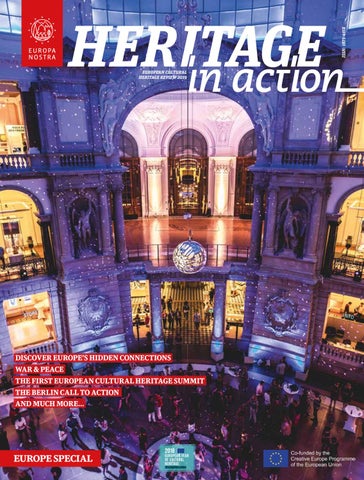
ISSN: 1871-417X EUROPEAN CULTURAL HERITAGE REVIEW 2019
DISCOVER EUROPE’S HIDDEN CONNECTIONS WAR & PEACE THE FIRST EUROPEAN CULTURAL HERITAGE SUMMIT THE BERLIN CALL TO ACTION AND MUCH MORE...
EUROPE SPECIAL
Asset Management Wealth Management Asset Services
A long term view improves our view of the short term.
Our Global
Success Story of Entrepreneurship and Creativity Bertelsmann is a media, services and education company that operates in about 50 countries around the world. It includes the broadcaster RTL Group, the trade book publisher Penguin Random House, the magazine publisher Gruner + Jahr, the music company BMG, the service provider Arvato, the Bertelsmann Printing Group, the Bertelsmann Education Group and Bertelsmann Investments, an international network of funds. The company has 119,000 employees and generated revenues of â‚Ź17.2 billion in the 2017 financial year. Bertelsmann stands for entrepreneurship and creativity. This combination promotes first-class media content and innovative service solutions that inspire customers around the world.
Pictet is proud to support Europa Nostra in their commitment to protect Europe’s cultural and natural heritage for future generations. group.pictet
2018
det europĂŚiske ĂĽr for kulturarv
EUROPEAN CULTURAL HERITAGE SUMMIT BERLIN, 18–24 JUNE 2018
Summit Hosts
With the kind co-operation and support of
Summit Partners, Supporters and Associates
Co-funded by the Creative Europe Programme of the European Union
MICHAEL AND MICHAELA WIRTZ
Summit Cooperation
E RS
TE
H E R I TA
E • VO L U
N
G
•
•
N
ROPEA EU
DR. PETER AND DR. KARIN ZINKANN
03
Welcome By Plácido Domingo, President of Europa Nostra It is a great pleasure for me to introduce you to this special European edition of our Heritage in Action magazine, created for the European Year of Cultural Heritage 2018. In 2018, we celebrated Europe’s heritage with thousands of activities across the continent. So much enthusiasm, creativity and positive energy has been generated by the idea of celebrating our shared history. The European Year was not just a moment in time, it was the beginning of a continent-wide reflection on what Europe is and who we are as Europeans. We are a continent with an ever-changing shared culture and that means that our shared heritage should be at the heart of the European Project. Europa Nostra, as well as all other umbrella networks across Europe, have an essential part to play in this. I saw the European Year therefore as a year of building bridges, between politicians and civilians, between organisations and disciplines, between all of us as Europeans. I believe that the most important goal of the Year was to recognise the European aspects of our local and national heritage and vice versa. If you scratch the surface you will find that in every heritage building, every monument, every landscape, every tradition, there are European elements to discover. That was one of the reasons why the theme of our very first European Cultural Heritage Summit in June in Berlin was “Sharing Heritage, Sharing Values”. It was truly a week-long celebration of Europe’s heritage which brought together thousands of volunteers, experts and decision-makers. The European Heritage Awards Ceremony 2018 was one of the many highlights. I was delighted to be able to thank and honour, together with the Federal President of Germany Dr. Frank-Walter Steinmeier and European Commissioner Tibor Navracsics, the people behind the thirty winning projects from across Europe. It was an evening none of us will easily forget. The Berlin Summit was also the perfect occasion to launch a forceful Call to Action to make cultural heritage a top priority in Europe. You can find an article on this important document
in this magazine. We hope that, if you have not done so already, you will go to the Europa Nostra website and sign the Call to Action. We had hoped for a symbolic two thousand and eighteen (2018) signatures before the end of the year. However, many committed individuals and organisations had already signed it by the beginning of the year, and continue to do so. It was an honour to be the first to do so, together with our co-hosts of the Summit, Dr. Martina Münch, President of the German Cultural Heritage Committee (DNK) and Prof. Dr. Hermann Parzinger, President of the Prussian Cultural Heritage Foundation (SPK), whom I also wish to welcome as Europa Nostra’s new Executive President. In this magazine you will also find articles on many fascinating European heritage stories from across Europe that all show us how diverse, multi-layered and interconnected our continent really is. We will travel from north to south, from east to west to discover how much we have in common. It shows us how we have influenced one another and how all our personal lives and our local communities are linked to a larger European story. This publication would not have been possible without the dedication of our dear colleagues and friends from all over Europe. We especially want to thank our German colleagues, DNK and SPK, without whom we could not have organised the European Cultural Heritage Summit. We also want to acknowledge the vital on-going support of the EU’s Creative Europe Programme, the A.G. Leventis Foundation and our corporate partner Bertelsmann SE & Co. KgaA. Their support has enabled Europa Nostra to develop its activities on so many fronts, including this magazine.
Plácido Domingo, President Europa Nostra
de Canisy 06 L’Esprit From his home and gathering place, Chateau de Canisy, outgoing Executive President of Europa Nostra Denis de Kergorlay looks back and ahead.
the Dots 48 Connecting The European Cultural Routes
give us an opportunity to rediscover Europe as a dense network of historic connections.
heritage has a key 56 “Cultural role to play in building the
Europe of the future” Interview with Tibor Navracsics, EU Commissioner for Education, Culture, Youth and Sport.
of the European 62 Highlights Cultural Heritage Summit in Berlin
82
Peace After millennia of war, Europe is trying to make peace its enduring legacy.
FEATURE
Berlin in June 2018, many European politicians, leaders and civil society organisations stressed the importance of cultural heritage for the future of Europe.
LIVING HERITAGE
Europe through Cultural Heritage 38 Building During the European Cultural Heritage Summit in
PARTNER
Europeans.
FEATURE
30 Neanderthals A reappraisal of the first
FEATURE
keeping in Europe.
LIVING HERITAGE
LIVING HERITAGE
of Time 12 ATheMatter story of time
COUNTRY DREAMS
CONTENTS
Danse Macabre Europe’s heritage is often a reflection of our continuous struggle with the prospect of death.
Lessons to Learn Scholars and students were the first Europeans, laying the foundation of a European culture based on empirical research and knowledge.
122
On The Defensive How we keep enemies out of our towns and countries has changed dramatically over the centuries.
The European Year of Cultural Heritage and Beyond Interview with Hermann Parzinger, Executive President of Europa Nostra.
What Have The Romans Ever Done For Us? / 18 Divas of Stone / 24 A Place at the Royal Table / 34 “Sharing Heritage is Vital to Europe’s Future” Interview with Dr. Uwe Koch, German Cultural Heritage Committee / 44 The Berlin Call to Action / 72
HERITAGE DREAMS
132
YOUTH
112
FEATURE
106
LEGACY
Charlemagne and the European Dream The life and times of the Father of Europe.
MILITARY HERITAGE
96
War Europe has been a continent of war and conflict ever since humans first arrived. In 2018 we commemorated the end of the Great War.
FEATURE
88
Together we are stronger! Interview with Catherine Magnant / 76
Hidden Connections / 142 Helena Vaz da Silva European Award / 154
An Ode to Joy / 102 A Solid Foundation for Heritage / 110 Father of Europe 60 years ago, the European Parliament gave Robert Schuman the title ‘Father of Europe’ / 118 The Future Belongs to the Young But So Does the Present / 136
7 Most Endangered 2018 / 156 Adaptive Reuse of Built Heritage / 160 European Capitals of Culture / 164 Wiki Loves Monuments Photo Competition / 168 In Memoriam / 172
country dreams
06
L’Esprit de Canisy Denis de Kergorlay reflects on his years as Executive President of Europa Nostra and shares the trials and tribulations but also the pleasures of running a family estate in the 21st century.
Denis de Kergorlay in front of the Château de Canisy
Denis de Kergorlay is, as usual, in a good mood. The sun is shining on his stunning family estate Canisy in Normandy. It is a magnificent place surrounded by forests, streams, and fields which are open to the general public. On one side of the estate, we discover a beautiful garden with rare trees and an ornamental fountain. The small village of Canisy (Kergorlay once was its Mayor) starts right outside the property. The family church, where his daughter got married last July, symbolically forms the borderline between town and castle. On the other side of the estate, we find a well-designed park with loud peacocks, plump pigs and even an alpaca or two. The panoramic view from the Chateau – with architectural elements from different time periods – reveals an artificial lake surrounded by flowerbeds and a collection of historical structures including converted stables and a caretaker’s cottage. Time seems to move slowly here and the Parisian world – where Kergorlay spends most of his days – is far, far away. He is a leading figure in the cultural world of the French capital. Since 2009, he has been President of the Cercle de l’Union Interalliée in the heart of the city. The club includes political and cultural leaders among its international members and was founded over a century ago, in 1917, when the Americans entered the Great War. Denis de Kergorlay is not your run-of-the-mill leader. He is kind but decisive. He is a rebel at heart but pragmatic in execution. His guiding principles and clear leadership have helped Europa Nostra - together with Executive
Vice-President John Sell - to realise many of its ambitions and have instilled new energy in the team of professionals and volunteers. During the European Heritage Awards Ceremony in Berlin on 22 June 2018, Denis de Kegorlay was awarded - together with Executive Vice-President John Sell and Vice-President Alexander Fürst zu SaynWittgenstein-Sayn - the Europa Nostra Medal of Honour, the organisation’s highest honour. In the knowledge that Europa Nostra is in good hands with the new Executive President Hermann Parzinger and Executive Vice-President Guy Clausse, he now concentrates on convincing the French government to put cultural heritage and landscapes high on the national and European agenda. Together with Pierre Dumont he has just published a book on the negative impact of wind farm projects on our natural and cultural heritage: “Eoliennes : chronique d’un naufrage annoncé” (Wind Turbines: Chronicle of a Predicted Shipwreck ed.). The passionate heritage activist is, however, also responsible for the Chateau de Canisy that his family has owned since it was built a thousand years ago. It is a responsibility he does not take lightly. I understand you did not grow up in Canisy. You did not play there as a child? You are right. My parents did not live here. But in the late 70s, there was the acute danger that we would lose ownership of the Chateau.
07
country dreams
08
One of the artificial lakes on the property The Spirit of Canisy: good company, good food and good wine
Panorama of Canisy
I was a bachelor, in my thirties. I had spent years of my life trying to distance myself, step by step, from my family, to forge my own path in life. I stood at the beginning of an international career and I felt like a world citizen. I had no interest in being responsible for a castle in Normandy. But it took me only a second to reach the conclusion that I had to do it. It may sound strange but there was no doubt in my mind at all. Not at all. And never has been since. You came from a very different world. How did you go about running a family estate?
I was not interested at all in the museum option. In my eyes of a “open to the world” young man it appeared to be a too conservative, a too traditional option of managing the chateau. I wanted to prove that there were more lively options. I wanted to host visitors in a friendly and innovative way. I knew immediately that I wanted to do something meaningful. I was on a quest for relevance, you could say. What does it mean to have this property if you cannot use it as a family castle? I wanted to prove that we were capable of doing it differently and still be successful. With all its
history and its beauty, it should be possible to make it work. I started to invite my friends to come here for the weekend. Everybody would share the costs for these days in what I call ‘the spirit of Canisy’. Ideally, I believed, we needed a group of about thirty people. In 1982, we formalised these activities in Les Amis de Canisy. Was that enough? My aunt Brigitte said: “You cannot ask money from your friends!” but I explained to her that it was a non-profit association. She said: “Well,
09
The Board and Vice-Presidents of Europa Nostra during a meeting at Canisy in May 2018
then we need cultural activities!” It grew from there. My friends asked me if they could bring their friends and their colleagues. We organised concerts and performances. The Aspen Institute started to organise conferences here in Canisy. The accommodations were quite rudimentary back then but it worked. The success was not only the ambiance; it was also the company of open-minded people, this ‘spirit of Canisy’. In French society, the doctors meet the doctors, the lawyers the lawyers, the bankers the bankers. People are used to encounter people with similar professions and lifestyles. But in Canisy you would meet people from all walks of life. You could debate, share and discuss. Young professionals in their thirties – in the 1980s – would come to Canisy for the weekend and take their children with them. Correct me if I am wrong but is it not the classical view that
the family should never put money in the estate. Should it not be able to survive on its own resources? That was unfortunately not a viable option anymore. The estate itself does not generate enough income. If you want to keep it and maintain it, you need money. In the 1990s – I was married by then – we thought about a foundation that would sustain the castle. Ok, but then the foundation should own it. My wife MarieChristine pointed out that we would not be the real owners anymore. It was the nightmare of not being able to pay the bills versus the nightmare of it not being a home anymore. What is a castle-owner to do if he cannot pay the bills? If my wife wants new curtains we have to ask the foundation if we can have them? So we started Le Cercle de Canisy. Like a club, we would have paying guests who would become friends.
Chateau de Canisy is located near the American landing beaches of the battle of Normandy: La Pointe du Hoc, Utah Beach and Omaha Beach. Many people, especially Americans, are interested in that. My aunt Brigitte, who I mentioned before, a sister of my father, had lived through D-Day and World War II. She would share her stories with our guests. She was very supportive of our philosophy for Canisy. Americans and Europeans instinctively understood that Canisy was a club, a place where friends and guests meet. As it comes to the Asian visitors
A peacock in one of the parks of Canisy
country dreams
10
it is a little different. We have much less shared history and their approach is maybe more traditional. They usually come as part of a guided tour. Their tour operators do not always draw a clear distinction between an hotel and a privately owned historical chateau. Canisy could never become a traditional hotel, like the Hilton or the Marriott, without losing its spirit.
Not far from Canisy we find the UNESCO World Heritage listed Mont-Saint-Michel. Denis de Kergorlay is actively trying to protect the famous site from uncontrolled development.
Was the success of Canisy affected by the economic crisis and the terrorist attacks in France? Tour operators, especially in Asia, deemed France too risky and reservations plummeted. The American interest was
not so much affected by it, but nevertheless it was tough. We had to find our own way to adjust and adapt without losing sight of what Canisy is. If you have a sense of history, which is inescapable at Canisy, you develop a sense of relativity. You have to accept that life is never tranquil. You cannot take anything for granted. History and legacy are therefore very important. The first decision I made as President of the Cercle de l’Union Interalliée in Paris,
literally on the first night, was to mark the 100 years anniversary with a book about the history of the club. If you know the whole story, you can much better define the future. The same with Canisy. My wife Marie-Christine put the idea of the family back into our story, the continuity, the eternity, the perpetuity. The vision of Canisy is that it should be a place to share, to exchange ideas, a place to be open and mindful, just as it was in the 1980s, with good food, good wine, and good company. My biggest joy is to see the children playing at the Chateau. They hide from their parents because they do not want to leave. In a modern hotel, you cannot experience that. The biggest challenge, I think, was to explain that to the outside world. That this ‘Spirit of Canisy’ was an idea that could work, that it would be relevant and meaningful. I think this
11
Executive President Denis de Kergorlay receives the Europa Nostra Medal of Honour during the European Heritage Awards Ceremony, 22 June 2018 in Berlin, together with Executive VicePresident John Sell and Vice-President Alexander zu SaynWittgenstein-Sayn.
philosophy of ‘sharing heritage and sharing values’ is essential for the future discussions about the heritage field in Europe. Since I was 30, my time has been divided between the family business, the invention of a new concept for the Chateau and my involvement in institutions such as Médecins Sans Frontières, the municipality of Canisy, the association of Les Amis de Canisy, the French heritage organisation La Demeure Historique and the French Heritage Society, and, of course, Europa Nostra. Did your experience with Canisy and the underlying philosophy help you in the leadership of Europa Nostra? When John Sell and I started to work for Europa Nostra it was, in a sense, the same situation. You had to explain to the outside world what the L’esprit de
Europa Nostra was, what we were trying to accomplish, why our vision was important and relevant. Now the situation is very different. We are now ‘in’, so to speak. The role of our Secretary-General, Sneška Quaedvlieg-Mihailović and her dedicated team has been instrumental in this, “Sneška Nostra”, as I sometimes joke. We have penetrated the institutions, we are asked to advise and council, we can negotiate and help to transform the European heritage world step-by-step. I believe that the European Year of Cultural Heritage and the Summit in Berlin are a testament to that. That is why it is now time for new leadership. That is why I am delighted to pass the torch to our new leadership and the new Board. In Hermann Parzinger as Executive President and Guy Clausse as Executive VicePresident, we have found two
true professionals who can lead Europa Nostra to the next level. John Sell and I have done all we could do. We have plowed the field, put the seeds in the ground but we now need to bring in the crops. Guy and Hermann have the right skill set, integrity, and experience to do this successfully.
Europa Nostra’s new leadership: Executive President Hermann Parzinger and Executive Vice-President Guy Clausse at Canisy
lıvıng herıtage
12
A Matter of Time Time seemed to stop briefly in Berlin, August 16, 2009, when Usain Bolt ran the 100 metres in an unprecedented 9.572 seconds, a new world record. It was a monumental achievement based on a very small part-second difference. How did we ever get
Usain Bolt (photo Erik van Leeuwen)
to this kind of accuracy and how did we decide how and why time had to be measured more and more precisely? From planes, trains, and automobiles to the stock exchange, from cooking pasta to filling a timesheet: our society revolves around time. We all know time flies when you are having fun and time moves slowly in the dentist’s chair. Time is everywhere, continuously reminding us of its ever moving presence, counting down the minutes of every hour and the days of our lives. What time
Albert Einstein as a young man
Tower of Winds or Horologium (100–50 BC) in Athens
exactly is, we only started to figure out at the beginning of the last century. Time turned out not to be an eternal and unchangeable force in the universe. Since the publishing – on 26 September 1905, at age 26 – of Albert Einstein’s theory, we now know that time is relative. Time can move slower or faster depending on our frame of reference. But it was a long and winding road to get to where we are now when we can measure time by the smallest increments. The atomic clocks, with the rare metal ytterbium at their heart, only miss a beat once in every quintillion (2×10⁻¹⁸) years. The rotation of our good old earth seems hopelessly oldfashioned and inaccurate.
13
Time is cultural heritage pur sang. How we measure time and how we interpret it has changed dramatically over time and space. The cultural heritage of time is closely connected to our scientific and technical progress, and to the needs of our society throughout the ages. The Sumerians were the first to divide the day up in to 12 hours. The Egyptians measured time with sundials and water clocks, which dripped and sloshed away the hours. It was, however, in Europe that the measurement of time was perfected. The famous Tower of Winds (50 BC), under the Acropolis in Athens, had a water clock to keep count at night and 8 sundials for accuracy during the day. Mechanical solutions were available, as became clear from the reconstruction of the incredible and unexpected discovery of the Antikythera Mechanism, an experimental clock dating back to the 1st century BC. Like most Greeks, the Romans knew nothing of the Antikythera Mechanism and used a sundial or a wooden stick in the field to measure time. The legions divided the night into four watches and kept to local time during their marches. Emperor Augustus put an ancient Egyptian obelisk in the centre of Rome, as a giant needle of a square-sized sundial. The sun was however not the most practical time-keeper. In cloudy weather the shadows cast by the so-called gnonom or ‘needle’, were invisible. Water clocks also had their problems. They were hard to calibrate and you definitely could not set your watch by them. Hourglasses and for instance, candles that burned at a certain pace were useful at night but also
Antikythera Mechanism (probably 70-60 BC)
Sundial suitable for a wooden stick (1st century AD), Aquileia
Ambrogio Lorenzetti’s Allegory of Good Government (detail, 1338/39) with an hourglass
highly inaccurate. So time moved on without too many checks and balances and Europe seemed fine without them.
lıvıng herıtage
14
Clock tower in Chiogga
has its roots in the Celtic word clocca, meaning ‘bell’.
Detail clock tower in Chiogga
Medieval Europe had not much use for minutes and seconds. In reality, the average European was not much of a time-keeper. They lived roughly by the hours of daylight and very little accurate measurement was necessary. Religious leaders, however, needed more consistent timekeeping for the exact hours of prayer. Soon, the monasteries and churches started sharing their time measurement loudly with the surrounding towns and villages. There is an element of logic in the fact that the word ‘clock’
The idea of the measurement of time is inseparable from our knowledge of the earth and its place in the universe. The rotation of our planet and its movement around the sun dictate the length of our days and nights. Without accurate clocks, we could not begin to calculate where we were on the surface of our planet and how fast we were moving. These technical and observational challenges served to propel Europe’s culture from the 14th century onwards and the measurement of time became one of the most fundamental elements of many of the major developments in our history.
The first big innovation was the use of weights and cogwheels to power clocks. Not necessarily very exact, but for a population that had no use for more than 15-minute increments, this was more than enough. The first clocks appeared on town halls and churches in the 13th century. The clock that can rightly call itself the oldest public clock in Europe is still a hotly debated issue, with the 14th century Salisbury Cathedral in the UK, the Beauvais cathedral in France and the famous Orloj clock in the Old Town Square of Prague, Czech Republic each staking a claim to the title. The oldest, still working clock is probably in Chioggia, a small city nestled on the marshy laguna south of
15
Clock tower in Clusone Detail clock in Clusone
Venice. This clock dates back to 1386 – it was relocated to the St Andrew’s tower (built around the year 1000) – and was created by Jacopo de’ Dondi, a clock-maker from nearby Padua. He also created the celebrated astronomical clock of Palazzo Capitanio in his hometown in 1344, rebuilt in 1423. Most of the old town hall and tower clocks were not just telling the time. They were a reflection of new scientific discoveries, following the movement of the moon and the stars and tracking the zodiac signs. It was nice to know what time of day it was, but it was much more interesting to discover what the universe had in store for you. Astrology
Mechanism of the clock in Clusone
lıvıng herıtage
16
Philippe Stern’s “Collection of Timekeepers” For over 40 years, Philippe Stern has collected an array of European timekeepers which now comprise one of the largest and most important collections of its kind in the world. In 2001, a long-held ambition to open a museum to house the collection was realised with the establishment of the Patek Philippe Museum in Geneva. Philippe Stern’s collection is composed of around 1,200 timekeepers from across Europe, celebrating craftsmanship. Philippe Stern’s “Collection of Timekeepers” received a Europa Nostra Award in 2017 in the category Research. The jury of the Europa Nostra Awards appreciated the research on the collection noting that “in opening this museum, Philippe Stern has shared his private collection with the public and made the knowledge available to a wider audience. The collection embraces the most valuable, characteristic and outstanding timepieces from the horological centres of Europe”. The story of Patek Philippe is a typical European story. The company was originally started in 1839 in Geneva by Antoni Norbert Patek and Franciszek Czapek, two Polish refugees. Later Czapek withdrew from the company and French engineer Adrien Philippe joined Patek, giving the firm its definitive name.
was as important as astronomy. Often the technological drive to make better clocks was driven by the need to make more accurate predictions through increasingly difficult systems of calculations to interpret the movement of celestial bodies. Although astrology is now firmly in the world of late night TV and tabloid horoscopes, the celebrated scholars now seen as pioneers of the scientific revolution such as Tycho Brahe, Johannes Kepler, and Galileo Galilei, were all avid astrologers, predicting the future for the royal houses and the heads of state. One of the most beautiful examples of an astronomical clock can be found in the small village of Clusone, north of Bergamo, Italy. It is the only known work of local mathematician Pietro Fanzago who built it in 1583 to reflect “the knowledge that astronomers have discovered through their studies.” The multi-purpose clock still has its original machinery and marks the movements of the sun and the moon, the hours of the day and the duration of the night, the equinoxes and the solstices, the constellations of the zodiac, the lunations, the months, the hours and the minutes. The belief in astrology however slowly started to lose its grip on the scientific world and the 17th century Dutch horologist Christiaan Huygens, who invented the pendulum clock, wrote in his Cosmotheoros, published after his death: “And as for the Judicial Astrology, that pretends to foretell what is to
come, it is such a ridiculous, and oftentimes mischievous Folly, that I do not think it fit to be so much as named.” Although time was measured ever more accurately, it was still based on and calibrated by the sun, which meant that time differed wildly from one region to the next. Even a town a few miles away could be in a slightly different time zone. There was no important reason to change that until the 19th century when the world became obsessed with time. To be able to measure longitude you need accuracy. In the age of discovery, the captains had used hourglasses to keep time, but the system left much to be desired. To invent an exact marine chronometer seemed to be an elusive challenge, even deemed impossible. But after John Harrison invented his H-4 chronometer, in 1759, the world finally knew what time it was everywhere on the earth at any given moment. The invention came just in time for the Industrial Revolution and the railway networks which needed clarity and uniformity of time. You cannot ride a train into a different time zone every few minutes. The invention of the electric telegraph and the stock ticker made some form of global time the highest priority. Greenwich Mean Time (GMT) had already been established in 1675 when the Royal Observatory was built, but on December 1, 1847, it became a global standard. By about 1900 the whole world could accurately tell the time. From the 15th century, another development had also been
slowly taking place. Time was communicated to the Europeans by chimes and bells but hardly anybody felt the need to personally, individually know what time it was. Personal timekeepers were what we now would call novelty items, such as the highly inaccurate chamber clock given to Philip the Good, Duke of Burgundy around 1430, now in the Germanisches Nationalmuseum. The process of miniaturisation became more successful over the centuries. The 16th century Nuremberg eggs, designed by Peter Henlein, were little copper balls with intricate springdriven mechanisms that could be worn around the neck or kept in the owner’s pocket to be shown off to friends. The race to miniaturisation was on. The world’s first real wristwatch – which was as much a jewel as a timekeeper – was made by Swiss watch manufacturer Patek Philippe in 1868 for Countess Koscowicz of Hungary (see encadre).
17 Detail clock Padua
The mechanics of watches and clocks changed dramatically when the potential of crystalline quartz oscillation to keep time was first discovered by the brothers Jacques and Pierre Curie in 1880s. Nowadays atomic clocks are the most accurate, such as the aforementioned ytterbium clock. Over the centuries our need and urge to tell time has changed European culture on the most fundamental level and has deeply affected our society and our communities as well as our view of our place in the
world and in the universe. In a sense, time itself became part of our human endeavour. We do not precisely know how long it took the Greek messenger Philippides to run to Athens to
announce the Persian defeat, but we do know that it took Dennis Kimetto exactly 2:02:57 to complete the Berlin Marathon in September 2014, setting a new world record.
Clock tower Padua
lıvıng herıtage
18
What Have The Romans Ever Done For Us? One of the most famous questions from Monty Python’s iconic and controversial film Life of Brian (1979) may have some revealing answers about Europe’s heritage. The answer in the film was sanitation, medicine, education, wine, public order, irrigation, roads, a fresh water system, and public health. An impressive list indeed, but how important were the Romans really for European culture? All roads lead to Rome but it is probably more accurate to say that all roads led from Rome, as civilisation-bringing arteries that transported the rich heritage of the ancient world to the farthest corners of Europe.
Roman theatre in Verona
19
Roman road system
The Romans have influenced Europe’s history in many ways. Their culture, inventions or improvements helped to shape European heritage: • Many of the languages spoken in Europe are heavily influenced by Latin; • Rome was a multi-cultural society and ideas from across the Empire were shared and adapted which fundamentally changed Europe; • They created a decent sewage system in many towns, some of them still in use today; • They created aqueducts which supplied clean water to towns many miles away; • The invented central heating systems; • Most Europeans still use the Latin script and the Latin alphabet; • They realised the value of hot springs and created bathhouses with saunas and steam rooms; • We still start the year on 1 January and our day at midnight; • Many of our months have Roman names and we have 7 days in the week; • All the planets are named after Roman gods; • The Edict of Diocletian (284305) was the first ever document that fixed maximum prices of products and produce; • We still use Roman numerals on our clocks; • We still use “Lorem Ipsum” in modern typology, a text from
Cicero’s De Finibus; • Some of our roads still follow the same trajectory as the 400,000 kilometres of roads the Romans built; • Our principles of law are founded on the Roman system, as is our court system; • The principles behind Roman bridges, domes and high building blocks with apartments are still in use today. Their knowledge of concrete was only recently surpassed; • The hundreds of cities the Romans founded or enhanced still form the heart of Europe. As mentioned above, many are UNESCO World Heritage. Augsburg, Aachen, Strassbourg, and Regensburg are other examples of this; • They advanced Christianity in Europe; • The professional way the Roman army was structured is still the base of our modern armies; • They gave many Europeans deadly tapeworms, the result of the popularity of garum, the famous Roman fermented fish sauce made of the intestines of uncooked fish; • The medical knowledge of Claudius Galenus (129 – 199), a Greek/Roman doctor and healer, would dominate western medicine for over 1500 years.
20 lıvıng herıtage
The Roman stadium in Aphrodisias, Turkey
Porta Nigra, Trier, Germany Aula Palatina, Trier Roman foundations in Trier, Germany
*Part of the UNESCO World Heritage list
Early Europe is in part built on the Roman reinvention of Greek civilisation with a sprinkling of Alexander the Great combined with Egyptian and Persian influences. We tend to forget how closely these civilisations were all linked and how their stories influenced our European story. For example, Jesus’ apostles and followers who travelled from Palestine through present-day Turkey to Europe to spread the word and change the world never left the Roman Empire. They travelled on Roman roads, lived in Roman cities and took advantage of the Pax Romana. The deeper you dig, the more
you discover how much of our present-day culture is related to our Roman past. The Romans have laid the foundation for much of our European heritage. Their ideas still permeate our culture. We could easily fill a few pages listing the innovations and changes the Romans brought to Europe, but it may be more useful to look at the broader picture. The Roman Empire stretched to a size that had never been seen before or indeed since. At its peak, it encompassed the whole Mediterranean and the Black Sea, with the Rhine and Danube rivers to the north and the African
deserts to the south. However, as big as it was as a territorial entity, it was the Roman influence that really counted; an influence that would reach to the north and the Far East and even to sub-Saharan Africa. The gold which paid the hundreds of thousands of soldiers who secured the empire’s borders, came in part all the way from present-day Ghana. The Roman Empire also drew deep lines across the landscape of Europe which are still visible today; changing minds, languages, customs, and religions. As much as the Greek civilisation is Europe’s spiritual home, it is the Roman civilisation that in a sense created the physical foundation of Europe. Part of the borders of the empire, the so-called Limes Germanicus (a term the Romans never actually used) is now UNESCO World Heritage. It includes Hadrian’s Wall in the United Kingdom and the defensive borders from Rheinbrohl to Eining in Germany. The Roman borders were often more of a meaningful statement than an impregnable wall. It was
21
Roman walls of Lugo, Spain
The 7 Most Endangered Programme, a cooperation between Europa Nostra and the European Investment Bank Institute that aims to find sustainable solutions for some of the most endangered sites in Europe, has also selected two sites which are strongly related to Roman heritage. The Roman Amphitheatre in Durrës, Albania The discovery of this magnificent early 2nd-century amphitheatre, which remained unknown to the world until the 1960s, put the ancient city of Durrës back on the map of historic sites in Europe. It also poses a major challenge to ensure a successful integration of the site into the urban fabric and local community of Durrës.
mostly a collection of signal- and watchtowers with ditches and palisades here and there, as well as natural borders such as rivers and hills. The Roman way of life spread easily and even those people far removed from the Limes would eventually start to embrace some of the many advantages civilisation had to offer. Along and behind the border you would find secured camps in which the soldiers and their entourage would live. It was here that the Romans first lured the country folk into protected and walled communities, the cities which in time would become such important symbols
of European culture. Many of Europe’s towns can claim Roman roots. Sometimes the origins are very visible as is the case in Rome* and Verona* in Italy, Trier* in Germany or Lugo* in Spain. In these cities, the Roman heritage has become part of the make-up of the modern city. The ancient theatres are now used for pop concerts and shows and the Roman baths are reinvented as wellness centres. At times, the Roman heritage is less visible as is the case in Paris, London, and Vienna, where most remnants of this past are underground and woven within many other historical layers.
Roşia Montană Mining Landscape in Transylvania, Romania For years, Europa Nostra has been advocating for Roșia Montană, an ancient gold mining district in Romania. This unique landscape is under threat of being lost forever due to the plans to reopen the mines. The landscape of Roşia Montană and its surrounding villages has for more than three millennia been masterfully transformed by mining activities. However, the present opencast gold mining project would seriously threaten its unique heritage and environment, including the in situ Roman mining machinery. This is a typical example of how sustainability and long-term benefits are put at risk of being sacrificed in pursuit of short-term profits. 7mostendangered.eu
Over the years many Roman and Roman related monuments and heritage projects have won the EU Prize for Cultural Heritage / Europa Nostra Awards. Here are some recent examples:
lıvıng herıtage
22
The restoration of the Roman theatre in Medellin (Spain) won the EU Prize for Cultural Heritage / Europa Nostra Awards in 2013. The theatre has now been comprehensively excavated and conserved, made accessible to the public and has revitalised the local community. In 2012 it was the most visited of the five restored monuments selected by the Spanish Ministry of Education, Culture and Sport. The restoration of the Roman Theatre of Cartagena (Spain) won the award in the category Conservation in 2010. The project cleverly integrated the theatre into the existing urban layout and helped with the timely regeneration of this area in Cartegena. The Baths of Diocletian, in the centre of today’s Rome, won in 2016. The huge bathhouses could accommodate 3,000 people at any given time. Following a long period of neglect, the Baths were transformed into an impressive charter-house in the 16th-century This conservation project was challenging as many of the buildings overlap one another, as was the case with the charter-house, cloisters and the open-air pool.
The Roman theatre in Medellin, Spain
Olive tree from Roman times in Spain
The 1st century BC Roman Bridge over the river Guadalquivir in Córdoba won the EU Prize for Cultural Heritage / Europa Nostra Awards in 2014, together with the Puerta del Puente, a renaissance gate, and the Calahorra Tower, an originally Moorish stronghold from the 15th century. This huge and complex restoration project made the city’s long and multi-layered history much clearer to visitors. The restoration of the ruins of the ancient city of Nicopolis in Greece, which was founded by Octavian after his victory over Mark Anthony and Cleopatra, won the award in 2009. The relationship between the competitors was complicated. Cleopatra was the ex-lover of Octavian’s stepfather Julius Caesar. She even had a child by him. Her new lover Mark Anthony was Octavian’s former friend and rival. Nicopolis was dedicated to Nike, the god of Victory – a victory that paved the way to imperial power in Rome. The Romans were very active and destructive miners. They left Las Médulas in the north of Spain 1,700 years ago and it is still a (beautiful) disaster area. It was once one of the largest opencast goldmines of the Roman Empire. The technique the Romans used was extremely destructive and even though the mines have been deserted for such a long time, the UNESCO World Heritage site still looks like a sculpture made by giants. Rio Tinto, in the south of Spain, is, in contrast, still very much in operation. The area is on UNESCO’s tentative list and won an EU Prize for Cultural Heritage / Europa Nostra Award in 2003. It is difficult to describe the region, but perhaps the fact that astrobiologists from NASA use it to research conditions on the planet Mars may give an indication of its appearance.
Roman mine in UNESCO World Heritage Las Médulas
The historical landscape of El Sénia’s ancient olive trees in Spain won the Award in 2014. The saving of these unbelievably old and serene creatures is a wonderful story of communities coming together and making their heritage an essential part of their future. The Phoenicians brought the olive tree, the domesticated version of a small Mediterranean shrub known as úllastres, to Spain. The Romans turned olive oil into a first-class export and their road system and the Pax Romana made trade throughout the Empire a lucrative endeavour. The Arabs inherited and improved the system of cultivation and the Christians further built on their accomplishments. Time passed and empires came and went, but the trees along the Via Augusta, amidst an evergreen ocean of olive groves, simply remained and kept producing their oil, year after year, century after century.
23
The ancient city of healing, Pergamon, Turkey
Roman mosaic floor in Aquileia, Italy Detail mosaic Aquileia, Italy
In quite a few cases, the ancient city did not manage to survive to modern times. Once thriving, Roman cities are now dreamy countryside villages, built on and surrounded by impressive ruins. Pompeii and Herculaneum* are the most famous examples but there are many, many more across Europe. Aquileia* in Italy, for instance, is a charming village with a remarkable collection of Roman remains. Aphrodisias* in present-day Turkey was once an impressive Roman city, loved by the Roman emperors. For the last millennium or so, Aphrodisias was almost completely abandoned and its rich history forgotten. Roman heritage is now an important drive for the local economy and a tourist magnet. Here, you have the chance to experience a Roman town up close as if the Romans had left just a few years ago. In the third century, the Roman Empire was starting to run into trouble, especially in the west. Order was restored in the 4th century but step-bystep the Roman Empire began to descend on a slippery slope to disintegration. The dream, however, lived on. For centuries after the Western Roman Empire
had faded, European leaders continued to portray themselves as the heir apparent and revive the glory and accomplishments of ancient Rome. It became an ideal that would inspire generations of Europeans. In the year 800, Pope Leo III crowned Charlemagne as the Emperor of the Holy Roman Empire, a title which would be used on and off until the early 19th century. However, in the eastern part of Europe, the situation was viewed differently. The Eastern Roman Empire, or Byzantium, continued as if the loss of the Western Roman Empire was just a bump in the road. They saw themselves as the only and true Romans and heirs. They even managed to recapture most of the Empire under Justinian I in 555. Over the centuries, however, trouble started brewing for the Byzantines and the relationship with the West changed from defiant to more cordial. Some efforts were made to glue the two empires back together through marriages but it never came to fruition. The defeat of Byzantium in 1453 officially ended the Roman Empire and caused a flood of scientists and scholars travelling from the east to seek refuge in the west. The fact that most of the
knowledge of the ancient world was preserved by the Byzantines and in the libraries of the MiddleEast, made it possible to jump-start a renaissance in numerous ways. Roman art, Roman law, Roman ideas and ideals were once again embraced and would dramatically change Europe’s future. Our Roman heritage still defines much of Europe today. New research from the University of Copenhagen published in July 2018 shows that areas with high road density in Roman times still have high road density today. Moreover, areas with high economic activity during the Roman Empire are still the most prosperous today. From a heritage point of view, the Roman monuments and sites are among the most important in Europe and many are inscribed on the UNESCO World Heritage list. The deep roots of our shared heritage can maybe also help Europe to rediscover common ground with the countries on the south and east of the Mediterranean basin, to embrace more fully a shared history, based on the same foundation, dating back thousands of years, when the Netherlands, Egypt, Romania, Palestine, and Tunisia were all part of the same empire.
treasure
24
Divas of Stone The theatres of Europe have been the home of rich story-telling and imagination for thousands of years.
Teatro Carlo Felice, Genua
It is a magic world of illusion, of spinning tales to captivate an audience. By putting on a costume, by pretending to be someone else, somewhere else and telling a story, true or imagined, we somehow touch upon an essential element of what it means to be human. We
need to share our tales with one another and we want to listen to the adventures of others. At first, we passed them on to the next generation through memorised songs and verses but more than 2,500 years ago we started to literally set the stage and put the words
and melodies to papyrus or parchment. It is hard to imagine a city in ancient Greece or in the Roman Empire without a theatre at the heart of its community. Unfortunately, most of the classical stories have been lost in the mists of time, but some of the ancient plays by, for instance, Aeschylus, Sophokles, Euripides, and Aristophanes have survived and are still relevant to modern audiences.
25
Over the years, ancient as well as historical theatres have won many European Heritage Awards. The restoration of the Roman Theatre in Cartagena in Spain won in 2010, especially because the work had so beautifully integrated the theatre into the existing urban layout. The restoration of the Roman Theatre in Medellin in Spain won in 2013 and was one of the most significant exercises in patrimonial recovery in Spain. Now it is one of the region’s most visited sites. The restoration and conservation of the unique and completely movable equipment of the 18th century baroque Castle Theatre in Cesky Krumlov in the Czech Republic won the award in 2002. The neo-Renaissance theatre on the main square of the historic town centre of Prešov in Slovakia was built around 1880. It won an award in the category conservation in 2004. The striking Venetian Gothic and Oriental façade and opulent interior décor of the Urania National Film Theatre in Budapest, Hungary was lovingly restored and given new life. The 19th-century cabaret and concert hall was awarded in 2005.
Lydía Koniórdou, the former Minister of Culture for Greece, gave a theatre workshop during the European Cultural Heritage Summit in June 2018, Berlin (photo by organising organisation)
Lydía Koniórdou, the former Minister of Culture for Greece, is a famous leading actor of classical theatre in Europe. In an interview with Heritage in Action, she explains why the old plays are still relevant today. “I am so thrilled by the words themselves; the beauty, the depth of ideas,
From 2002 to 2004, La Scala in Milan, Italy underwent major rehabilitation works, including the complete overhaul of the technical layout of the stage. The extensive work also won an award in 2005. Bergamo’s Teatro Sociale is a fine antique wooden theatre “all’italiana” and was built in 1804. It closed in 1929, functioning thereafter as a cinema and exhibition hall. By the end of the 20th century, it was in an advanced state of decay and its elaborate restoration won an award in 2014.
In 2014 the European Heritage Awards Ceremony was held in the Burgtheater, Vienna
treasure
26
Theatre in Epidaurus, Greece
Across Europe, many civil society umbrella organisations are active in the field of preserving, restoring and invigorating old theatres in the heart of local communities. Perspectiv, the Association of Historic Theatres in Europe, has created a European Route of Historic Theatres which tells the history of Europe through its theatres. www.erht.eu
Europa Nostra President Plácido Domingo in the Teatro de la Zarzuela in Madrid in 2016
The Union des Théâtres de l’Europe has developed into an alliance of European theatres combining artistic and political goals, and uses existing artistic platforms to strengthen professional exchange and to promote an open Europe of culture. www.union-theatres-europe.eu The European Opera Centre was launched more than 20 years ago, to help people with a high potential move from education to employment in opera and to help develop audiences for opera. www.operaeurope.eu
Map of the European Route of Historical Theatres
Operalia, The World Opera Competition was founded by Maestro Plácido Domingo in 1993. Domingo is also President of Europa Nostra. Operalia aims to discover and help launch the careers of the most promising young opera singers (18-32) of today. Each year, the competition receives close to 1,000 applications. www.operaliacompetition.org
The Diazoma Association was founded ten years ago and brings ancient theatres back to life with performances, exhibitions and musical theatre. It helps with the study, excavation, conservation, restoration and functional incorporation of ancient theatres in modern society. There are many different locations across Greece where the organisation is active at the moment: from the ancient theatre of Orchomenus in Boeotia (A.G. Leventis Foundation supported the restorations) and the theatre in Ancient Messene to the world famous amphitheatre of Epidaurus. Stavros Benos, the President of Diazoma: “I look upon these theatres as living organisms transmitting messages of knowledge, wisdom, aesthetics, harmony, and dialogue with the environment and nature. I have always disagreed with the classic treatment of monuments as museum pieces. It puts them to one side, to the margins of our era. It ignores their adaptability and harmonization with every historical period. Ancient theatres are unique examples of exceptional architecture. It is the culmination of the achievements of ancient Greek civilization, in other words, the best of what the Greek spirit has to offer.” www.diazoma.gr
27
the almost satanically complex structure. It is like the pillars of the Parthenon. Not one of them is exactly like the other. There are no straight lines. The building changes when the light changes. It is alive and not motionless. The text of the classic plays is like that as well. It is an adventure, a Wild West, every time you wonder: why did I not see that before? The staging, the pronunciation, the rhythm, the movements; there are just too many rabbits running in all directions. Some verses were meant to be sung, not spoken. It was a form of musical theatre. It was a triangle, with words & poetry, sound & music, and movement & dance. How do you know what to do on stage? Personally, I believe you do not have to explain everything. It needs a bit of abracadabra, of the magic of a magician.” The word ‘theatre’, literally ‘place for viewing’, comes from
La Scala in Milan Europa Nostra Vice-President Costa Carras during the 2013 European Heritage Awards Ceremony in the Odeon of Herodes Atticus, Athens
Ancient Greek, as does the word ‘scene’. In the classical Greek theatres, there were backgrounds that could be rolled on and off the stage, trap doors to make people appear and disappear and even elaborate tricks to make people fly. Much like today, the playwrights and actors (always male and wearing masks) could be influential members of society. In Roman times, the profession had
lost most of its allure and the performers were often slaves or men down on their luck. Women were not allowed on any official stage in antiquity but they did perform in dance and mime acts in less formal venues in the rougher areas of town, ‘offBroadway’ so to say. We have, in a sense - except for improvements in gender equality -, not come a long way
28 treasure
The Teatro Verdi in Padua, Italy
The Concertgebouw in Amsterdam. The famous concert hall was the setting for the European Heritage Awards Ceremony in 2011
Bourla Theater in Antwerp, Belgium
since ancient times. Theatres are still deeply anchored in European civilisation and local communities, from shaky performances on dingy stages in back alleys to world-class shows in the gold plated surroundings and red plush interiors of the national theatres. Shakespeare, Verdi, Chekhov, Beethoven, Ibsen, Camus, Shaw, Mozart,
Brecht, and Stravinsky; it is nearly impossible to discuss Europe’s culture without the unique role of its theatres and its artists, its music, its plays and its performances. It is where art meets the audience in its most direct way. Although most acts only exist in the moment and the spoken word and the music fades with the applause,
the buildings themselves have become increasingly important as treasures of European heritage; from the ancient Odeon of Herodes Atticus in Athens to La Scala in Milan, the Concertgebouw in Amsterdam to the Odéon-Théâtre de l’Europe in Paris. Theatres, big and small, became a perfect treasury of our tangible and intangible heritage.
7 Most Endangered In 2014, the historic stage machinery of the Bourla theatre in Antwerp in Belgium was put on the list of Europe’s 7 Most Endangered monuments and sites. The 7 Most Endangered programme is an initiative of Europa Nostra and the European Investment Bank Institute. One of the main concerns was to make sure that potential restorations would respect the historic theatre and the historic value of the monument itself. As foreseen in the procedure of the 7 Most Endangered programme, a group of European experts visited the theatre and had intensive discussions with the theatre management and city authorities. Following this meeting, Europa Nostra took representatives of all partners – the City of Antwerp, the Toneelhuis, the Flemish Agency for Cultural Heritage, the Cabinet of the Minister-President and Perspektiv
(who nominated the theatre to be included on the list) – on a study trip to Britain, which undoubtedly led to new insights. All of this was made possible thanks to the cooperation and expertise of Europa Nostra’s partner, the European Investment Bank Institute. There was a great willingness on all sides for a constructive dialogue over many years in full respect of one another’s competencies and responsibilities. In 2018 the resulting new master plan for the restoration and development of the Bourla theatre and its unique historic stage machinery has now been welcomed by all parties. The implementation of this remarkable, cooperative success will lead to the removal of the Bourla theatre from the list of the 7 Most Endangered programme.
Teatro Sociale in Bergamo,
Most classic theatres are not much to look at from the outside, especially around the back. Their architectural form is very similar and hails back to the 17th century. The facade often reminds us of an ancient temple and the entrance combines thick carpets with marble staircases and gold-painted ornaments between impressive chandeliers
and mirrors. The auditorium reveals the half circle of the stalls, the grand circle, and loges with rich decorations, red plush chairs, and heavy curtains. It is a very specific and very European form of architecture. The theatres of Europe, ancient and modern, have always been
29
centres of cultural exchange and artistic cooperation across Europe. In the European Year of Cultural Heritage in which ‘sharing heritage’ is such a central theme, the contribution of European theatres is still as vital as it was 2,500 years ago. Donizetti Museum in Bergamo Teatro Lirico Giuseppe Verdi in Trieste, Italy
lÄąvÄąng herÄątage
30
Neanderthals A reappraisal of the first Europeans
When our ancestors first migrated into Europe 43,000 years ago, either through modern-day Turkey or crossing from North Africa into Spain, the continent was mostly untouched with incredible undiscovered riches and unlimited potential. The prehistoric immigrants however, soon found that they were not alone in this vast and varied landscape. Communities of other humanoids had already made Europe their home, settling in the warm lush valleys of the south and the cold tundra of the north. They had colonised the continent tens of thousands
of years earlier and had left their relatively small footprint on their environment. The Neanderthals were the first to dig graves and inter their death, they used fire and stone tools and even created colourful art on the walls of caves.
What happened next is still a matter of heated debate. Did modern man kill the Neanderthals to get rid of the competition or did they hunt them for food? Did they live peacefully together and exchange knowledge and skills? Did the Neanderthals perhaps die out through disease, much like the Native Americans following the arrival of European explorers? To understand these questions we must go back to the 19th century.
Neanderthal Museum in Mettmann, Germany
31
In 1856, workers in a limestone quarry on the Düssel River, east Joachim Neander (1650-80)
of Düsseldorf in Germany, found some interesting bones. The place was locally known as the Neander Valley (Neanderthal), named after Joachim Neander (1650-80), a Calvinist theologian and hymn writer who was inspired by the valley’s meandering stream and green hills and wrote poetry and gave sermons there. The limestone workers thought the bones were from some kind of bear and gave them to Prof. Dr. Johann Carl Fuhlrott to study. He soon discovered they were from an unknown human.*
Original skeleton in the Natural History Museum, Vienna The Neander Valley
* The original finds can still be seen at the Rheinisches Landesmuseum in Bonn. The Fuhlrott Association and his museum in Wuppertal closed its doors in 2008 but efforts are still underway to secure Fuhlrott’s legacy Neander in otherThe museums and Valley collections.
lÄąvÄąng herÄątage
32
The Krapina Neanderthal Site and museum in Krapina, Croatia is a recipient of the European Heritage Label of the European Union, celebrating sites of European importance. Since 1899, the remains of around 80 Neanderthals were uncovered here, as well as the bones of many animals, all dating as far back as 125,000 years ago.
It was a discovery that failed to have any impact: the teachings of the Bible did not leave any room for other humanoids and Charles Darwin’s publication of the “Origin of Species” was still a few years away. It took quite some time before the Neanderthal was taken more seriously. It turned out they had been, unknowingly, discovered before, in 1829, when a skull was dug up in the Awirs caves in Belgium. Little by little, more skeletal remains were unearthed across Europe and questions about our relationship to these humanoids were becoming more complex. At first, our human cousins had a bad reputation of being broad-shouldered simpletons, grunting their way through their short and animal-like lives. Over time and thanks to new research, the Neanderthal has become more ‘human’. The cultural heritage of our own earliest ancestors is difficult enough to unravel but we know even less of our closest relatives. Still, although the puzzle is nowhere near finished, the pieces are beginning to fall into place. The remains found in the UNESCO World Heritage Gorham’s Caves on the eastern side of the Rock of Gibraltar show that Neanderthals lived there for more than 100,000 years, an impressive testimony to their endurance. Genetic research has helped to change our views dramatically. A 2007 study suggested some Neanderthals may have had red or blonde hair, along with a light skin tone. The entire genome of a Neanderthal was first sequenced in 2013. It
has been proven that at least some modern humans and Neanderthals willingly or unwillingly created offspring and many modern Europeans are still 1.5–2.1 % Neanderthal. The story of the Neanderthal ‘birthplace’ is kept alive by the Neanderthal Museum** in Mettmann. Here you can visit the original site of the excavations. The Neander Valley is still important and new findings were made here in the 2000s. We now know that these Neanderthals were probably some of the last of their kind and most probably a family.
The museum shows the Neanderthals in a way that is more reflective of current insights. Gone are the ape-like goons; now they are portrayed in a modern suit or as a happy little girl with braids. The museum shows us how closely related we are to them. Together with partners from across
Europe, they are trying to put the Neanderthal sites of Europe on the UNESCO World Heritage list. Neanderthals are not the ancestors of modern humans, they are our lost cousins. And, for many Europeans, the genetic truth is that the Neanderthals are literally a part of us.
33 ** The Foundation Neanderthal Museum also owns one of the largest picture archives of ice-age art, based on the photographs of setmanager Heinrich Wendel who documented cave art in France and Spain in the 1960s and 1970s.
culınary
34
Banquet Still Life (1667) by Abraham van Beyeren
A Place at the Royal Table A special initiative on the menu for the European Year of Cultural Heritage showcases Europe’s rich and diverse banquet of food and drink.
Workshop in King Jan III’s Palace at Wilanów (photos by M. Mastykarz)
A “Place at the Royal Table” is a project developed by the Network of European Royal Residences and combines the most glamorous and celebrated heritage sites of the continent with our tastiest food and drink. The many links and exchanges between the food culture and culinary traditions of different European Courts are an intriguing part of our tangible and intangible heritage. It is a recipe made in heaven and a fascinating trip through time. It is also a good occasion to look at what the common folk and the royals ate at any given time and how much their meals have changed over the centuries. First, we have to realise that Europe’s food security has dramatically improved over the
The House of European History in Brussels organised a special evening titled “Food - a history of European encounters and exchanges” on 8 May 2018 for the European Year of Cultural Heritage www.historia-europa.ep.eu
out of necessity. When in early fairytales people got three wishes, they did not ask for exotic things, gold or precious stones, they wished to eat until their bellies were full.
centuries. Life was dependent on a successful harvest and especially in spring when all the reserves were running out, life was tough and society was driving on fumes. It is no accident that Europe’s most prized and special products today are the result of trying to keep the precious food from spoiling. Our dried hams and sausages, our marmalades and cheeses, preserves, pickles and even biscuits were all born
For common folk in medieval times, meat was a treat – mostly chicken and pork – and cereals were the staple food, often cooked, in porridge or dissolved in some kind of spicy soup with beans and vegetables such as carrots, leek, and cabbage. There were also different kinds of pasta and filled pies. The poor would eat oat, rye, and barley. The well-to-do ate wheat, which was considered more of a luxury item. The bread was mostly unleavened, thin and hard to digest. The upside was
that it could double as a plate. For the rich, the table was filled with game, fish and fruits, wheat bread, salty butter and many kinds of cheese. Rice only arrived late in the Middle Ages from Italy. In the north, people drank mostly beer, in the south wine. In the north, they used poppy oil or oils made of nuts, in the south mostly olive oil. Milk was not popular as it spoiled too quickly and water was often not a healthy alternative. Fruit and fruit juices were popular in certain regions. There was obviously no coffee or tea, but almond milk was used for almost everything. The knowledge of herbs and spices still made simple meals quite tasty. Sugar was rare and expensive and seen more as a drug than an ingredient. Only when the famous sugarcane mills of Cyprus found a better way to crush the plants did it become available across Europe at more affordable prices, creating a historic wave of massive dental problems as our teeth began to fall out. In the 14th century, our menu started to change when the Crusades brought knowledge of spices and products from the Orient to Europe. It also brought
35
Member organisation Schönbrunn Palace, Vienna
Sneška QuaedvliegMihailović, SecretaryGeneral of Europa Nostra, during her speech at the closing dinner of the European Year of Cultural Heritage, 10 December 2018, Grand Trianon, Versailles, France (photo by Didier Saulnier)
culınary
36
A Place at the Royal Table was launched 15 March with participatory activities in 21 institutions in 12 European countries, including thematic visits, conferences, workshops and virtual exhibitions. A European Open-Air Picnic took place on 23 June across Europe, coinciding with the European Cultural Heritage Summit in Berlin. One of the picnics was organised in the UNESCO listed Sanssouci Palace in Potsdam. On #PalaceDay on 8 October, Michelin star chefs created a special European menu and on 10 December, a special European themed dinner was organised at the Palace of Versailles.
Oyster Lunch (1735) by Jean-François de Troy
The Network of European Royal Residences is a member of Europa Nostra and enables its members to work together and share their knowledge and experience in the preservation and promotion of the rich cultural heritage of more than 90 Royal Palaces across 15 countries. openagenda.com/a-place-at-theroyal-table
Member organisation Parques de Sintra – Monte da Lua, Portugal
table manners and etiquette to the European table. Europe became infatuated with exotic fruits and spices such as pepper, nutmeg, ginger, saffron, and cinnamon. Coriander, cumin, anise, and mustard also found their way into European kitchens and into our heritage. When explorers started to sail across the world from the 15th century onwards, they brought an even richer variety of foods such as potatoes, tomatoes, peppers, and maize. The menu of the rich, as well as the poor, evolved dramatically from the 14th to the18th century. Produce originating from the other side of the world could now be found on our tables. Old traditions disappeared and new ones
developed. All these fundamental changes in the European diet show how multi-layered and complex the history of food and drink really is. Many of our local specialties are connected to a diverse history of exchanges and interaction with other cultures in and outside of Europe. A “Place at the Royal Table” shows the diversity and splendour of royal culinary traditions in this wider European context. Through workshops, we can learn how to cook these dishes ourselves and relive the historic meals at the most splendid palaces of Europe. There are few better or more direct ways to experience cultural heritage. Thanks to this project we can literally taste, smell, drink and eat it.
At Grand Trianon (10/12) celebrating the EU/EN Grand Prix 2018 for the EPICO Research Project, coordinated by Versailles: (from left to right) Laurent Salomé, Director of the Versailles Castle; Sneška Quaedvlieg-Mihailović, Secretary General of Europa Nostra; Catherine Pégard, President of the “Etablissement public de Versailles”; Etienne Poncelet, Chair of the Awards Jury (Category Research); Néomie Wansart and Danilo Forleo, coordinators of the EPICO Project.
37
konferans conference 18.12.2018 pera müzesi istanbul
learnıng from mıstakes başarısızlıklardan öğrenmek
school of hard knocks
nasihate dönüşen musibetler maın sponsor
ınternatıonal colleagues
organısatıon
content consultants
pr sponsor
prıntıng sponsor
feature
38
On 2 March 2018, President Emmanuel Macron and his wife Brigitte Macron welcomed a delegation of Europa Nostra and the Centre Européen de La Musique (CEM) in Bougival at the Elysee Palace in Paris (left to right) French journalist and heritage expert Stéphane Bern; Sneška Quaedvlieg-Mihailović, Secretary-General of Europa; Maestro Plácido Domingo, President of Europa Nostra; Jorge Chaminé, President of the Centre Européen de Musique (CEM); President Emmanuel Macron; Brigitte Macron; Hermann Parzinger, incoming Executive President Europa Nostra; Denis de Kergorlay, outgoing Executive President Europa Nostra; pianist Alfred Brendel and his wife Maria Majno; Alvaro Domingo and communication advisor of the French President Sylvain Port
Building Europe through Cultural Heritage During the European Cultural Heritage Summit in Berlin in June 2018, many European politicians, leaders and civil society organisations stressed the importance of cultural heritage for the future of Europe. There was a strong sense that culture and cultural heritage belong at the heart of the European project. For the first time, many country leaders shared their personal vision of a new European agenda based on our shared heritage and our shared values.
Emmanuel Macron, President of France
39
(Text of his written message, read at the European Cultural Heritage Summit, Berlin, 22 June 2018)
“As the basis for our European cultural project, I did not want to let this week pass without sharing with you my convictions on heritage. First of all, when we are talking about European heritage, we are talking about our identity and our future. My first conviction is that if we are interested in European heritage, and if we act to move forward, we are making a contribution to what I believe is the essence of our project to building Europe. With all our diversity, we are a community because we share this very special link with our history, with artistic creation, with the beauty that surrounds us, and with our territories. It is not coincidental that “patrimoine” in English refers to the notion of “heritage.” Europe is the only continent that cannot be defined only by its geography. Or rather: our European geography is precisely culture. A common cultural past, which continues into a common future. We are a community because we share a dream and project to further build, to build together. The slogan chosen for this European Year of Heritage takes on its full meaning: “Our heritage, where the past meets the future.” Cherishing heritage, which is our common legacy, and passing it on to future generations. It is for this transmission that I wish to salute your commitment. With your professions, your origins,
your languages, so different, you are all gathered to call on decision-makers to respect this common commitment. To take into account a sustainable heritage strategy that is deeply rooted in the programme and in the financial perspectives of the European institutions. An approach that aims to preserve what is unique and irreplaceable, our heritage, and to put it at the service of new generations and a sustainable and socially inclusive quality of life. I would like to thank most sincerely the associations, symbolising the commitment, which have taken the Berlin initiative and which welcome you today: Europa Nostra, DNK (Deutsches Nationalkomitee für Denkmalschutz -, German Cultural Heritage Committee) and SPK (Stiftung Preussischer Kulturbesitz, Prussian Cultural Heritage Foundation). I also thank Chancellor Angela Merkel for her commitment to making Berlin and Germany the first place to host this summit.
Finally, I would like to mention the role that everyone can and must play in this joint endeavour. I hope that France will make a concrete and generous contribution to this initiative. First of all, through an initiative to mobilise French citizens in favour of heritage in danger, which Stéphane Bern* is supporting. Secondly, I wanted to launch the “Assises européennes de la culture,” which will be held in France in autumn, and which will actively pace our work on European culture. We want to be proactive. We bring together all the initiatives that make it possible to reach the widest possible audience with a simple message: our imagination is inspired by European culture, by its images, symbols, monuments, music, and creations. If we allow this imaginary space to develop and reach those who feel excluded, it will be as powerful, if not more powerful, than any Schengen area in building peace and prosperity on the European continent.
Emmanuel Macron, President of France with Maestro Plácido Domingo, President of Europa Nostra
* In 2018, Stéphane Bern was awarded one of the EU Prize for Cultural Heritage / Europa Nostra Awards for dedicated service
40 feature
us as what belongs to others and what represents a memory shared by all. How can we understand Europe and the world without this constant dialogue between tradition and progress, or without respecting differences? Or yet without the understanding of cultural roots, as well as of the strength of artistic creativity and scientific innovation?
Marcelo Rebelo de Sousa, President of the Portuguese Republic, with film director Wim Wenders during the Helena Vaz da Silva European Award, co-organised by Europa Nostra in October 2017 (photo Márcia Lessa)
Marcelo Rebelo de Sousa, President of the Portuguese Republic (Text of his written message, read at the European Cultural Heritage Summit, Berlin, 22 June 2018)
The Berlin European Cultural Heritage Summit, promoted by Europa Nostra, the German Cultural Heritage Committee and the Prussian Cultural Heritage Foundation, under the motto Sharing Heritage, Sharing Values, constitutes a high point in the European Year of Cultural Heritage. From the very beginning I have fully supported and closely followed the various initiatives in this context, as a contribution towards the establishment of a culture of peace based on the understanding of our common cultural roots, as well as the safeguard of what we have inherited from previous generations, thus enriching our own legacy for the future.
The goal of the European Year of Cultural Heritage is to raise our awareness of European values, strengthening our perception of an open European identity—open to the world. Cultural identity, intercultural dialogue and solidarity, as well as the interconnection between Culture, Education and Science, must be particularly stressed nowadays. That is what is stated in the Framework Convention on the Value of Cultural Heritage for Society, signed in the Portuguese city of Faro in 2005: the notion of a shared cultural heritage demands an active citizenship and a shared responsibility, involving the protection of material heritage, monuments, libraries, archives, landscapes and nature, but also the valuing of contemporary creativity. Cultural heritage has to do with the permanence of shared values but also with the safeguard of differences, by respecting as much what is exclusive and specific to each of
The European Union’s decision to dedicate the year of 2018 to Cultural Heritage at a time of such uncertainty and so many threats constitutes a hallmark on the path towards a European project of peace, hospitality, mutual help, human development and cultural diversity. What is at stake here is a free and responsible citizenship and a union of free and sovereign states. A culture of peace can only last if it is based on care and awareness, on knowledge and understanding, on creativity and the ability to innovate. This is indeed the greatest challenge that the current European Year of Cultural Heritage places before us, a challenge which naturally addresses the institutions of civil society, the schools, the universities, the intellectuals, the artists, the scientists, but ultimately each and every European— to share our cultural heritage, share the values of our civilization, preserve the collective memories of our peoples and plan ahead for the future of our cultural heritage. Because cultural heritage is not just made of what has lasted and survived, but also of everything that, while reflecting our past history, is also able to express innovation, creativity and a vision for the future.
Dr. Frank Walter Steinmeier, Federal President of Germany
41
(Text of his speech, delivered at the European Heritage Awards Ceremony, Berlin, 22 June 2018)
European cultural heritage: to those who consider themselves progressive, may sound terribly boring and backward-looking. It conjures up images of old stones, stuffy museums and interminable guided tours given by staff who reel off long lists of dates and royal lineages. However, cultural heritage is, in fact, a crucial subject if we are to ensure the future is good for Europe and worth living for all Europeans. This has been made painfully obvious in the past few months: Europe urgently needs to regain its focus. It needs to agree on what it wants and what it can do, it has to make certain of its own strengths and capabilities, it has to acquire new self-confidence, it has to strengthen its cohesion, it has to take its political future in its own hands. If to this end, we want to rediscover the values for which Europe and the community of Europeans stands, Europe’s cultural heritage is a key point of reference, a wellspring of inspiration and strength for the future. In Europe, crises have repeatedly provided the impetus for renewal. Dire need and dangerous situations have time and again driven people to hone their abilities and develop new instruments. New forms of political organisation and social coexistence have emerged from the ashes of war and conflict, by older sources, by Judaeo-Christian traditions, ancient philosophy, and Roman law, sources which have constantly been infused
with new life. Time and again, our common heritages served as inspiration and encouragement, yardstick and lodestar. This can perhaps be most clearly seen in art and architecture. The Romanesque masterpieces along the Rhine and in Burgundy would have been inconceivable without the Roman structures that preceded them. The spread of Gothic art from Paris to Rostock, the height of modernity in the twelfth century, would, in turn, have been inconceivable without the Romanesque works that went before. And the Baroque style which flourished in Europe from Spain to Lithuania again borrowed elements from antiquity and yet constituted something totally new. Similar developments can be traced in European music, in literature, and in the visual arts. Europe is a continent of constant renewal, not although but because it is also a continent of remembrance, of historical awareness. Each time it
is people who are the heart of our reflections: What is the human being? What should human beings be doing in this world? What can people believe, what can they know, what can they hope for? How should people live together, how can they coexist? Europe and European culture have always sought to make humans the measure of all its endeavours. It is a quest that will never end. But the opposite – hubris or an absence of benchmarks – can lead to the most terrible errors and atrocious crimes. We know that the Europe of temples and cathedrals is also the Europe of witch hunts and concentration camps. European history always provides solace and serves as a grim reminder, it is both a warning and encouragement. There are of course a number of quotes from Goethe which form part of Germany’s cultural heritage, even when taken out of context.
Dr. Frank Walter Steinmeier, Federal President of Germany, during his speech at the European Heritage Awards Ceremony in Berlin, 22 June 2018
feature
42
Even if we think we know them all too well, they are still capable of putting things new light, even if, like this one, they have been pressed into service by witty lawyers giving workshops on inheritance matters, with no concern for their real meaning. These famous words come from Faust, Part I:“What you inherit from your father must first be earned before it’s yours.” If we apply this quote to cultural heritage, it has much to say about cultural education and policy. “Earn it.” In other words, understand the value of the things you have, things you were first granted through no merit of your own. Try to imagine how they came about, the thoughts and ideas that led to what you
see today. And try to understand the story that is being told – the colourful story, full of twists, by turns cruel and tragic, but equally often proud and noble, a story told in Europe by every church and every town hall, by each palace and landscaped park, by the monasteries, the fortresses, the bridges and market squares, the towers, the railway stations and the grand hotels. “Earn it,” reminds us our inheritance is not a gift. These words exhort us to learn about it, to prove ourselves ready for it. They mean we should become familiar with all those things that have had a profound influence on our old and yet still young continent. If we wish history to serve as a useful guide for the future, we must first
(from left to right) Ion Dumitrel, President of Alba County Council, Rev. Lucian Pop, Bishop of Mariamme and Greek-Catholic Curial Bishop of Făgăraș and Alba Iulia, HE Klaus Iohannis, President of Romania, Rev. Irineu Pop, Orthodox Archbishop of Alba Iulia and VicePresident of Europa Nostra Piet Jaspaert during the local award ceremony of the European Heritage Award for the Cultural Palace, located in historic centre of Blaj, Romania (May 2018)
conserve our heritage. We must take systematic steps to preserve our historical monuments. There is nothing backward-looking about that, either. The preservation of our heritage is, in fact, a creative step that enriches our understanding of ourselves and strengthens our ability to meet the challenges of the future. Cultural heritage may appear boring at first glance, but look closer, and you realise it is not. It is a source of fascinating stories, not just about the past, but also about us, today. And it makes you curious to know how things will go on from here. It places us under an obligation to pass on a vibrant legacy, a good Europe, to our children and our children’s children.
lasting legacy of the European Year of Cultural Heritage. Romania is a firm supporter of our joint efforts to consolidate the European Project. To this end, it is my belief that culture and cultural heritage are essential pillars of our endeavour towards the sustainable development of our Union.
Klaus Werner Iohannis, President of Romania (Text of his written message, read at the European Cultural Heritage Summit, Berlin, 22 June 2018)
I strongly believe that linking the responsibilities of the public
authorities together with the commitment of the civil society, for advancing an ambitious European Agenda and Action Plan for Cultural Heritage, is of paramount importance. I am confident that this will be a
I take this opportunity to acknowledge the importance of protecting the fundamental achievements and principles of the European Union. This shared heritage is a very valuable resource. I would like to assure you that these significant values will be responsibly and diligently promoted during the Romanian Presidency of the Council of the European Union.
The video message of Xavier Bettel, Prime Minister of Luxembourg
Xavier Bettel, Prime Minister of Luxembourg (Text of his video message, shown at the Berlin Summit, 22 June 2018)
43
My country, Luxembourg is at a crossroads of European nations and identities. As Prime Minister and Minister of Culture in Luxembourg, I am aware that it is of utmost importance for Europe to raise awareness of cultural heritage and the values linked to it through initiatives like the European Year of Cultural Heritage and this European Summit in Berlin. Our cultural heritage - in all its richness and diversity reflects our common European history. As such, our cultural heritage constitutes a source of shared remembrance, identity and dialogue in Europe. For this reason, cultural heritage needs to be put at the centre of national, European and international policies. We all have a shared responsibility to recognise its importance, ensure its protection
and sustainable management and raise awareness of the relevance of cultural heritage as an expression of our cultural diversity and our shared values. Cultural heritage plays an important role in the social cohesion of a European Union rich in diversity. At a time when different forces are trying to divide European citizens, cultural heritage is an antidote to these old and new demons of extremism and populism. Whereas these dangerous forces try to separate us, our shared cultural heritage and shared values bring us closer together.
Cultural heritage is so much more than a sector. It embraces all segments of our lives and our society. It reflects core European values and contributes to a better and stronger Europe. You can count on my personal support and on the support of my government for promoting a new narrative for Europe based on culture and cultural heritage and for developing an ambitious European Action Plan for Cultural Heritage as a lasting legacy of our European Year of Cultural Heritage.
At the European Heritage Awards Ceremony in Berlin, 22 June 2018 (left to right) Sneška QuaedvliegMihailović, SecretaryGeneral of Europa Nostra; Barbara Rüschoff-Parzinger; Hermann Parzinger, Executive President Europa Nostra and President of the Stiftung Preussischer Kulturbesitz (SPK); Marta Domingo; Maestro Plácido Domingo, President of Europa Nostra; Elke Büdenbender; Dr. Frank Walter Steinmeier, Federal President of Germany; Martina Münch, President of the German Cultural Heritage Committee (DNK); Tibor Navracsics, EU Commissioner for Education, Culture, Youth and Sport; Uwe Koch, Executive Officer of the German Cultural Heritage Committee (DNK)
partner
44
“Sharing Heritage is Vital to Europe’s Future” Interview with Dr. Uwe Koch, German Cultural Heritage Committee, national coordinator of the European Year of Cultural Heritage in Germany.
Uwe Koch welcoming participants at the Open Heritage Evening on the Museum Island
Dr. Uwe Koch has been instrumental in putting the idea of the European Year of Cultural Heritage on the European agenda and has been teaming up with Europa Nostra and the Stiftung Preussischer Kulturbesitz to organise the European Cultural Heritage Summit in Berlin in June 2018 and the presentation of the Berlin Call to Action. Koch has been leading the Deutschen Nationalkomitee für Denkmalschutz (German Cultural Heritage Committee) or DNK since 2015 and he and his dedicated team were keen to spread their message of ‘Sharing Heritage’ across Europe. We caught up with him to discuss the deeper motives behind the European Year and his personal commitment. One of the important issues Europa Nostra stressed in this European Year is that almost all our cultural heritage is layered and complex and the result of European connections, influence, and inspiration. I believe that is something you are also very vocal about?
Yes, very much so and I hope that the Year helped people to realise how much of our cultural heritage is the result of a dense network of cultural links and relationships. Europe’s identity was shaped and enriched through cultural exchange, generating an enormously wealthy diversity. For centuries, our continent has been crisscrossed by trading routes, followed by many other forms of mutual influence, especially ideas. Let me give you two examples. For a long time, Flanders was the marketplace of the whole Christian world. Genovese, Venetian, Florentine, Spanish and French merchants were present there, as were the cogs of the German merchants and the English, Scots, Irish, Dutch, and Frisians. Merchandise from the Levant, the Baltic region and Russia bore witness to the enormous distance over which this exchange took place. Flemish painting and architecture spread far across Europe where its style was selectively adopted and adapted. Another example - from the Baltic region - is the beautiful 12th-century baptismal fonts from the Isle of Gotland which demonstrate the flowering of stone-masonry at that time. Their iconographic diversity shows the cultural influences from Western Europe on the one hand and Russia and the Byzantine Empire on the other - an artistic exchange based on trade relations in the early years of the Hanseatic League. So why do we still need to emphasise this message in the 21st century? You would think
it is pretty obvious and these interactive connections are easily discovered? I think we do need to emphasise these connections, maybe now more than ever. Many of the historical ideas about heritage are the result of a centuries-long process called dissociation. The rise of nationalism in the 19th century marked a turning point in my opinion. We started to concentrate on the differences between nations and on a form of national identity. We wanted to separate from our neighbours who had always been culturally close. Let me illustrate this with an example. During the process of the German national unification in the 19th century – a slow and difficult process vigorously pushed by the Prussian leadership – Gothic art was declared the ‘national style’. Finishing Gothic cathedrals, for instance in Cologne, became a matter of national pride and commitment. It was a way to show the masses that Germany and France were very different countries with a different heritage. It was not just a German phenomenon. Portraying national identity and cultural greatness in paintings, buildings and memorials are typical of the 19th and early 20th centuries. It has shaped a sense of nationalism for generations. The results were devastating; wars and conflicts, millions of people killed, innumerable works of culture lost or destroyed. I think the greatest victory of our era is that we have found a new way - learning the lessons of two devastating world wars and numerous conflicts – to create a historically unique
45
partner
46
Lydía Koniórdou, the former Minister of Culture for Greece, Sneška QuaedvliegMihailović, Secretarygeneral of Europa Nostra and Uwe Koch, Head of the German Cultural Heritage Committee (DNK). Koniordou signs the Berlin Call to Action during the European Cultural Heritage Summit in June 2018, Berlin. Koniordou is currently the President of the Stavros Niarchos Foundation Cultural Center (SNFCC) in Athens, Greece
cooperation, a large-scale peace project through economic interaction. This is why in 2012 the EU was rightfully awarded the Nobel Peace Prize. As a person who grew up in a divided, cold war Germany, I am convinced ever more strongly that we should focus on the fact that our cultural heritage is of different historical, cultural and ethnic origins and cannot be traced to just one nation or one group. Europe is a melting pot of different cultural identities and this should not be feared but celebrated. Cities such as Lviv, Trieste, Toledo, Wroclaw, and Plovdiv are all clear examples of this multi-layered European heritage. Historic routes of trade and cultural transfer like the Alpes, the river Danube and the Via Regia mark such places of exchange too. If you talk about this melting-
pot of cultural identities, do you mean working towards some kind of uniform European culture? No, certainly not. I propose a different way of looking at heritage, to approach it from a different angle. Not to concentrate on what divides us, but on what unites us must be the driving force behind discovering, unlocking and sharing our heritage. We need it as a foundation for living together and developing a shared sense of identity. This is not about constructing uniformity, almost the opposite. It is about rediscovering what we have in common in Europe, despite our local, regional and even national diversity and differences. Part of that discussion, as the Viennese historian Wolfgang Schmale once said, is realising our differences and accepting them. We have to
make an effort to understand our neighbours’ perspective and to explain our perspective to them. To find a way to share a collective responsibility for preserving our cultural heritage and to teach about it, to educate ourselves and others, to have open discussions, especially in border areas. To create an understanding of the long and sometimes painful path to peaceful co-existence. It is not an easy fix which can be accomplished in a short time. We need smart strategies and longterm resources. How can this European sense of identity be reconciled with the strong emotions towards local, regional or national identity? Usually, people refer to the concept of ‘home’ in local or national terms. Recently, the German word ‘Heimat’, which roughly translates to
“homeland”, has experienced a somewhat questionable revival. Many European citizens do not think of Europe as their ‘home’ and the question is, in this globalised world, how we can bridge that gap. That is why our theme of the Year was ‘Sharing Heritage’. I believe that ‘Sharing Heritage’ is vital to Europe’s future. We need it to build up our common future. European cultural heritage is exciting and enriching, but often also ambiguous, uncomfortable and controversial. In Germany, we tackled this challenge with five related themes which all focussed on different aspects of our European connections, from border regions to historical trade relations, from the meltingpot of European cities to the collective commemoration of European wars and conflicts and to the different ways in which European citizens interact with cultural heritage. We had more than 500 registered projects, which were all officially part of the European Year. On our website Sharingheritage.de, you can find all the details of the themes and the projects. A symbolic project for me personally was ‘Ringing the Bells for Peace’. Over the centuries many bells were destroyed to make cannons. Bells are tangible as well as intangible heritage and their clear sound resonates through cities and the countryside and across borders. We asked everyone to ring their bells together for our peace and for our heritage on 21 of September 2018, International Peace Day. We need such narratives of sharing heritage.
47
So what do you hope the Year will accomplish in the long run? I hope that many of the ideas and projects, especially the ones involving young people, will develop into something permanent beyond 2018. We also need the existing programmes which focus on our European connections to reach their full potential in the years to come, such as the European Heritage Label, which highlights sites that stand for European unification, our common values, history and culture; the EU Prize for Cultural Heritage which is organised by our colleagues of Europa Nostra and which celebrates and shares the impact of the preservation of heritage monuments and sites on the lives of Europeans; the Cultural Routes and the European Heritage Days of the Council of Europe which
promote our European cultural identity; the European Capitals of Culture programme which showcases the historical and cultural influences of European cities and last but not least the recently inaugurated House of European History in Brussels which pursues a brilliant and modern educational approach to a new understanding of European history. I hope that all these existing initiatives will be enhanced by many other projects and educational programmes across Europe, with the involvement of many different disciplines and wide political support on all levels. Culture and cultural heritage belong in the heart of the European project and in the heart of all Europeans. sharingheritage.de
(from left to right) Monica Grütters, Minister of State for Culture and Media; Martina Münch, President of DNK; Carsten Brosda, Senator for Cultural affairs and media of the City of Hamburg, and Petra Kammerevert, Chair of the EP Committee on Culture and Education
lıvıng herıtage
48
Connecting the Dots The European Cultural Routes give us an opportunity to rediscover Europe as a dense network of historic connections.
Landscape of the Way of St. James in the north of Spain
St. James by Rembrandt van Rijn
It is a shiny, heavily decorated passageway in the heart of the Cathedral on Obradoiro Square. The stairs descend along goldcovered walls to the holiest place of Santiago de Compostela, Spain. Here, behind iron bars, we finally stand face to face with a silver reliquary, allegedly containing the remains of the apostle St. James the Great and his two disciples. For many pilgrims walking the Way of St. James, or the Camino de Santiago, the shrine of Jesus’ apostle is the emotional end of a physical and spiritually challenging journey. The long and winding roads that lead to Santiago from all over Europe were - in 1987 -
recognised as the very first official European Cultural Route of the Council of Europe*. The Compostela pilgrim routes illustrate “a collective memory, crisscrossed by roads and paths which overcome distances, frontiers and language barriers.” The Way is a prime example of how our European cultural heritage is interconnected and related and how it links Europeans of very different backgrounds, nationalities, and beliefs. In the 30 years that followed, 30 new routes have been registered, all sharing cultural heritage through journeys of wonder and discovery. More will undoubtedly follow in the years to come. They each show in their own way how much of our European history and heritage is the result of complex cultural exchanges. The European Cultural Routes allow participants to follow the trail of the Vikings across Europe
49
The Way of St.James
or make the same journeys that Wolfgang Amadeus Mozart did throughout his life. We can visit Art Nouveau cities or enjoy the network of historic thermal towns. All these different cultural routes create jobs, give new life to local industries and help communities to protect their local cultural heritage. They are prime examples of a win-win approach. The routes can also offer interesting alternatives for some overexposed heritage destinations such as Venice, Amsterdam, and Dubrovnik. Let us take a closer look at some of the fascinating and eyeopening journeys starting with the one that started it all.
The four original pilgrims’ routes - listed in the Codex Calixtinus, published in 1140 and still considered to be the official guidebook – started in France and converged at Puente la Reina, not far from Pamplona. From there, the route continued through the North of Spain to Compostela. In the 19th century the Way of St. James was rediscovered, but by the 1970s only a few pilgrims were inspired to take up the challenge. Slowly but surely, however, the routes were restored and rediscovered. The route was inscribed on the UNESCO World Heritage list. Nowadays many hundreds of thousands walk the Way or rather Ways of St. James as there are many different routes. Every year more visitors, especially from the Americas, follow the famous scallop shell signs – the historic emblem of the road – and receive their Credentials to prove they are walking the
whole way, from one official stop to the next. The Way of St. James has become one of the most celebrated symbols of Europe’s cultural heritage and an important flywheel for positive change for local economies and communities. As with the story of the Holy Grail, the origins of the Way of St. James are a complex and fascinating collection of historic hearsay and jumps of faith of Olympic proportions. St. James the Great was one of the Twelve Apostles and according to legend he travelled to Spain to spread the good word. In around the year 44 he was beheaded in Jerusalem. His body was returned to Spain by his two disciples. They landed at the small harbour town of Iria Flavia (now Pádron), from where the Saint was transported to a cemetery inland. Due to the persecution of the Christians by the Romans, his tomb was
The Cathedral seen from de Praza de Quintana de Mortos
lıvıng herıtage
50
Vienna Central Cemetery
abandoned in the 3rd century. Six centuries later, in 814, the local hermit Pelagius witnessed strange lights and noises coming from the ancient Celtic site, where the tombs of St. James and his two disciples were rediscovered. The place became known as Santiago de Compostella. The early pilgrims may have used the old and relatively safe Roman road through the mountains for their pilgrimage to the tomb. This route is still known today as the ‘Old Camino’ and leads along the North via Vitoria-Gasteiz and Aguilar de Campoo to Villafranca del Bierzo. Throughout the centuries, pilgrims from across Europe found their own Way to Santiago. Today, many municipalities dream to see a section of the road pass through their territory. A marked route attracts tourists and boosts the local economy with or without actual historical roots. The Spanish heritage expert José Maria Ballester – a Europa Nostra Honorary Life Member in recognition of his 40 years of distinguished service – has closely observed the development of the different
St. James routes over the years. “Some associations of friends of the Way of St. James trace routes alternatives. But we can not prevent them from borrowing or tagging them by alleging they are not historic. Moreover, this is how the paths historically arose: simply because pilgrims used them.”
still sharing our towns and villages in the thousands of often ornamental cemeteries across Europe. The prime examples of this tangible and intangible funerary heritage are now linked through a European route which makes the historical connection between the living and the dead come ‘alive’.
European Cemeteries Route
European Jewish Heritage Route
In the last week of May and the first week of June 2018, the European Heritage Route organised the successful Week of Discovering European Cemeteries with the participation of 63 cities in 21 countries, especially for the European Year of Cultural Heritage.
The Jewish people have been victims of some of the darkest human behaviour in European history. When after centuries of discrimination and persecution it seemed almost impossible for humanity to sink any deeper, World War II brought unimaginable horrors, a permanent reminder that our society continuously needs checks and balances on every level to safeguard and protect every minority.
It is an unmistakable fact that dead Europeans greatly outnumber the living, a fact that the Council of Europe euphemistically calls an ‘anthropological reality’. Millions of our ancestors are
Jewish heritage is an integral part of Europe’s culture and the Cultural Route shows
between the cultures of AngloSaxon Europe and Latin Europe. Today’s travellers can follow this 1,800 km journey through England, France, Switzerland, and Italy and rediscover our shared European history. The route was added to the European Cultural Routes in 1994.
51
The Roma The Roma people have endured long-standing persecution and discrimination in Europe but nonetheless have exerted a deep influence on the continent’s culture. Roma music and dance, a central element of their community’s culture, have, for instance, greatly inspired some of Europe’s most popular composers.
the immense contribution of Jewish communities to European heritage. The route includes archives and libraries, specialised museums, archaeological sites, historic synagogues and cemeteries and Jewish quarters. It allows the travellers to experience Jewish culture up close. For the European Year of Cultural Heritage, a special European Story Telling Jewish Heritage Festival was organised from 2 September to 29 October to celebrate Jewish storytelling in places of tangible Jewish heritage, creating a fruitful dialogue between young people and older people.
Robert Louis Stevenson Just like the Wolfgang Amadeus Mozart route, the Stevenson route gives you the opportunity to follow the path of a young artist through Europe. In Stevenson’s case, it is not so much a path as a river and an ode to the great outdoors. The route roughly follows Stevenson’s book “An Inland Voyage” (1878), which describes a canoeing trip with his Scottish
friend Walter Simpson, mostly along the Oise River in France. Following historic travelogues is increasingly popular with tourists. They not only give the chance to go on a historical adventure but also document how much Europe’s landscape has changed over the centuries.
The Via Francigena The Via Francigena was a pilgrim route from Canterbury in the UK to the Holy See and the tombs of the apostles Peter and Paul in Rome. The road formed a cultural bridge
The proposed Roma route not only celebrates Europe’s largest ethnic minority in its own right but also demystifies Roma people and addresses misapprehensions about them. The route will encourage direct people-to-people contact between Roma and non-Roma. The idea was launched during Slovenia’s chairmanship of the Council of Europe in 2007 and has a specifically European dimension, geared towards sharing the Roma experience across Europe. The Cultural Routes can be a strong instrument in raising awareness and promoting Roma inclusion as well as linking various important Romani cultural locations around Europe. The European Parliament has also long supported and helped to coordinate initiatives aimed at combating discrimination against the Roma people. The initiative uses culture as a way
Robert Louis Stevenson photographed by Henry Walter Barnett
lıvıng herıtage
52
El Sénia’s ancient olive trees in Spain Other famous routes and winners of the EU Prize for Cultural Heritage/ Europa Nostra Awards Little of Europe’s natural environment is original. Most of it has been adapted and changed, sometimes dramatically, by humans since the time we first set foot on the continent. Once, almost all of Europe was forest and marshland and over thousands of years, those natural resources were transformed into ships, fuel, houses, and paper. Only pockets of original wild forest remain in Europe. Estonia, the Principality of Liechtenstein and Russia have proportionally the most virgin forest. Many of these forests are however severely threatened, for instance in the Romanian Carpathian Mountains. Interestingly, one of the first examples of protection also comes from Romania. In the
14th century, a “letter of the forbidden forest (carti de paduri oprite)” was issued, which states that you cannot hunt, fish, cut trees, graze cattle or pick fruits and mushrooms without the owner’s permission. The Cultural Routes of the Council of Europe combine the works of nature and the works of man and put cultural heritage into Europe’s wider landscape and natural history. The Council of Europe Cultural Routes is however just a small fraction of the many cultural routes in Europe. Over the years, many winners of the European Union Prize for Cultural Heritage / Europa Nostra Awards have been connected to the restoration and preservation of historical roads and trails.
of breaking down traditional barriers between Roma and non-Roma. However, the Roma Route is unfortunately still in development. The necessity of increased cooperation between all of the stakeholders is clear. The European Roma Institute for Arts and Culture (ERIAC) was launched in Berlin in 2017. It is a historical and ground-breaking initiative that demonstrates how Roma history and culture are an integral part of European cultural heritage. It is a joint initiative of the Council of Europe, the Open Society Foundations, and the Roma Leaders’ initiative. In facilitating activities in the fields of the arts, culture, history and the media, the Institute aims to increase the self-esteem of Roma people and to reduce the negative prejudice of the majority population towards the
Executive Vice-President of Europa Nostra Guy Clausse: “I would like to see more cooperation between Europa Nostra and the Council of Europe to identify the overlaps between the Cultural Routes (“lines on a map”) and of the European Heritage Awards and the 7 Most Endangered sites (“dots on a map”). Let me give you some examples: the Subotica Synagogue, one of our showcase projects, and the Jewish Heritage route, which includes Serbia. Equally Briançon and the Vauban and Wenzel Itineraries. There is a European Route of Historic Theatres (www.historic-theatresroute.eu) – see elsewhere in this magazine ed.) and our other 7Most Endangered showcase project, the Bourla Theater in Antwerp.”
community. The Cultural Route could be a valuable asset to the Institute in working towards achieving these goals.
Western Balkan Routes The European Union works in close cooperation with the Council of Europe in the establishment of the Western Balkan Routes. EU High Representative/Vice-President Federica Mogherini stated: “The Western Balkans are part of Europe. We all belong to the same European family. We share a common history and cultural heritage. We share the same interests in the present, and we will share a common future inside our European Union.” “Cultural heritage helps us learn about each other and ourselves. It builds bridges between people, between communities – and between the past and the future.
That is why cultural heritage has a key role to play in building a cohesive, resilient, united Europe,” said Tibor Navracsics, European Commissioner for Education, Culture, Youth, and Sport. The cooperation not only encompasses the regional cultural heritage but also promotes its cultural and creative industries.
Hansa Routes Being a trader in 13th-century Europe was not for the fainthearted. Any bay or island could hide blood-thirsty and cashstrapped pirates who would rob honest merchants of their precious cargo. Land routes were not much better. The abundant forests were teeming with bandits and plunderers, sometimes even groups of soldiers and mercenaries down on their luck. All prosperous
Some of the European Heritage Award winning routes:
53
The Italian volunteer organisation, the Iubilantes Association won the EU Prize for Cultural Heritage / Europa Nostra Awards in 2014 in the category Dedicated Service. Iubilantes recovers, restores and returns forgotten footpaths, tracks, and routes to public use. They have re-established pilgrim paths in the Lombardy region and ensured wider links with routes of historic pilgrimages across Europe and beyond, including in Russia, Armenia, Israel and Ethiopia. The restoration process includes not only the paths themselves but also monuments and structures in the surrounding areas. The historical landscape of El Sénia’s ancient olive trees in Spain won the Prize in 2014. The 4,700 monumental trees may date back to the Roman Via Augusta. These beautiful examples of living heritage have survived for an amazing length of time and still produce excellent oil. The organisation has created many different walking routes of discovery. Historical route of the lines of Torres Vedras in Portugal also won in 2014. This defensive system of 19th-century forts covers a total distance of some 100km. They were left abandoned for almost 200 years but now they have been restored and opened up to the general public through special walking trails. The King’s Little Pathway in El Chorro Gorge in Spain won the Prize in 2016. The spectacular walkway through a narrow gorge was originally constructed in the early 20th century to enable the population of the small village El Chorro to quickly walk to the hydroelectric plant where they were employed, avoiding the long journey around the mountain. The King’s Road across Filefjell in Norway won last year, in 2017. This historic walking trail winds through the breathtaking landscape of the mountainous Filefjell. Since it was first built in the 1790s, the Road served as an important link between Eastern and Western Norway. In 2009, the Norwegian Public Road Administration together with several partners formally started a project to re-establish and revitalise this forgotten road. Fundación de los Ferrocarriles Españoles in Spain won a medal in 2004. Since 1993, the Spanish Railways Foundation (FFE) has coordinated and promoted the Vias Verdes (the Spanish Greenways Programme) in Spain, which redevelops railway infrastructure in disuse as routes for cycling and walking.
The King’s Little Pathway in El Chorro Gorge in Spain
54 lıvıng herıtage
Hanseatic city of Bergen in Norway
Hanseatic city of Zutphen in the Netherlands Map of the Hansa route
cities in the northern part of Europe faced the same problems of piracy, unprotected trade routes, badly marked roads and unsafe navigation. The city of Lübeck started to think that the solution should be found in cooperation. And so, more than 700 years before the European Coal and Steel Community (ECSC) was established, several cities in the northern part of Europe started
working together in guilds, or Hansa as they were called in German. Lübeck established a partnership with Hamburg (still officially the Free and Hanseatic City of Hamburg) and Cologne and later opened a trading post in London. Soon, a loose cooperation of cities was spreading across Europe and changing the tricks of the trade. This new powerhouse of the Hansa cities was the first European alliance and deeply influenced the history of Europe for centuries. In its heyday, the League had more than 200 members and supported their own armies and, in much the same way that today’s ships are protected from Somalian pirates, supplied vessels with armed guards to fend off intruders.
member cities themselves and reached from Portugal and Italy to Russia and Scandinavia. They could and would implement economic embargoes and fight to protect the Hansa’s interest across Europe. Nothing lasts forever and with the changing of Europe’s political structure, the cities started to lose their grip. By the mid-17th century, it was all over.
Although the heart of the Hansa League was in north-western Europe, the cities’ sphere of influence went well beyond the
The Hansa Cities route was officially established in 1991 and allows travellers relive the Hanseatic spirit.
In 1980, the Dutch town of Zwolle suggested bringing the Hansa League back to life to promote free trade and peace as well as cultural, economic and social cooperation. The network now consists of over 178 cities in 16 countries, a significant number of which are UNESCO World Heritage.
55
Hanseatic warehouse in King’s Lynn, UK
European Institute of Cultural Routes, located in the Abbaye de Neumünster in Luxembourg
* Since 1998 the Cultural Routes programme is implemented by the European Institute of Cultural Routes, located in the Abbaye de Neumünster in Luxembourg. They work closely with the European Union on the Routes4U Programme to foster regional economic development and promote tourism across Europe, often in cooperation with the European Regional Development Fund. Stefano Dominioni is the Director of the European Institute of Cultural Routes. On the Routs4U Project website he explains his enthusiasm for his mission: “The Cultural Routes of the Council of Europe programme is a fascinating programme connecting European culture, its history and people through space and time. The Programme provides a unique reading of Europe as a continent of shared history, traditions and cultural heritage, representative of our cultural diversity in a spirit of constant intercultural dialogue. The programme represents the opportunity for our citizens to participate in the heritage of a wider Europe, which includes the 47 Member States of the Council of Europe. The Cultural Routes Programme, celebrating its 30th Anniversary, presents European history under a variety of fascinating themes and perspectives: arts and architecture, history and religious traditions, European landscapes, as well as important historical figures who have marked the history of our continent.” ** The Network for Cultural Routes Studies (NCRS) is a platform for exchange and mobility for students and researchers and ensures a permanent interaction between the European Institute of Cultural Routes (EICR), universities and Cultural Routes. www.saintjamesway.eu www.culture-routes.net www.jewisheritage.org/web/european-routes www.hanse.org www.eriac.org www.cemeteriesroute.eu/european-cemeteries-route
partner
56
EU Commissioner Tibor Navracsics with members of the European Heritage Alliance 3.3 at the European Policy Debate in Berlin, June 2018
“Cultural heritage has a key role to play in building the Europe of the future” Interview with Tibor Navracsics, EU Commissioner for Education, Culture, Youth and Sport. We congratulate you on the forward-looking New European Agenda for Culture which you presented last May and the European Framework for Action on Cultural Heritage you presented in Vienna during the official closing conference, hosted by the Austrian Federal Chancellery on 6-7 December 2018. Cultural heritage has a much more prevalent position than before and is now a horizontal theme in the Agenda.
Europa Nostra, of course, fully agrees, but can you share your reasoning for making cultural heritage such a strong priority? There are many reasons for giving cultural heritage a prominent role in European cultural policy. Cultural heritage brings important benefits to our economies, boosting innovation and job creation. And it is crucial in helping us build a fair, resilient European society for the future:
helping to foster cohesion and a sense of European identity. That is why the European Union has been supporting cultural heritage for many years through a whole range of its policies, beyond culture itself: from environment to education, and research to regional policy. One good example is the recent publication ‘Connecting Cultures, Connected Citizens’, showcasing 97 Interreg projects that received
EU Commissioner Navracsics speaking at the Closing Conference of the EYCH in Vienna (7/12), together with Gernot Blümel, Austria’s Federal Minister for the EU, Art, Culture and Media and Petra Kammerevert, MEP, Chair of the EP Committee on Culture and Education
the European Year of Cultural Heritage Label*, and showing that investments in cultural heritage are among the most popular topics in European Territorial Cooperation projects. Cooperation on culture, media and arts has proved to be an excellent way to help countries and regions work together across borders, driving economic and social development. It is important to make the best use of all the opportunities that the European Union offers, especially today as the cultural heritage sector is facing unprecedented challenges. Think of the digital shift, which is deeply changing the way cultural institutions manage, protect and give access to their heritage, and transforming the way citizens and communities engage with their cultural heritage. Moreover, our recent Eurobarometer survey on cultural heritage shows that 82% of Europeans take pride in cultural heritage and agree that it can improve quality of life and a sense of belonging to Europe. And indeed, thanks to its diversity, cultural heritage brings us together and helps us to learn more about ourselves and each other; building bridges between people, between communities and between the past and the future. That is why cultural heritage has a key role to play in building the Europe of the future – and our new European Agenda for Culture highlights this role and sets out key objectives for our cooperation in this field for years to come. You have shown strong, personal political commitment to develop the European Framework for Action on Cultural Heritage which
you presented in Vienna during the official closing conference of the Year. What are the guiding principles? How are you engaging all the stakeholders in the creation of the Framework Plan and what kind of connection will you make to the Berlin Call to Action? I think the European Year of Cultural Heritage has clearly enabled us to renew people’s interest in cultural heritage: in the first six months of the year alone, more than 5,000 initiatives took place, attracting 2 million visitors. This is
only possible thanks to the commitment and dedication of cultural heritage stakeholders, who we are naturally involving in drawing up our plans for the future. Our key objective – which was also expressed in the Berlin Call to Action – is to ensure that the European Year leaves a policy imprint beyond 2018. That is why, in line with the New European Agenda for Culture, I presented the European Framework for Action on Cultural Heritage, which is a roadmap for our future work in safeguarding and
57
EU Commissioner Tibor Navracsics and Maestro Plácido Domingo with the 7 Grand Prix winners during the European Heritage Awards Ceremony on 22 June in Berlin
partner
58
Europa Nostra President Plácido Domingo and EU Commissioner Tibor Navracsics in the Liszt Academy in Budapest in August 2016. The Liszt Academy has been selected for a European Heritage Label and has won a European Heritage Award. (Grand Prix winner European Heritage Awards 2015)
promoting Europe’s cultural heritage. It covers topics such as youth volunteering, the accessibility of cultural heritage and activities to fight the illicit trafficking of cultural goods. Innovation and science are also high on the agenda. The Framework for Action builds on the results of the actions that the European Commission has been implementing during the Year, in line with the principles of engagement, sustainability, protection and innovation. It is a big achievement that in your field of Education, Culture, Youth and Sport, the budget – proposed by the European Commission last May – increased. The Creative Europe continues to figure as a stand-alone programme in the chapter on “Investing in People, Social Cohesion and Values.” What are the chances that your proposals will be accepted by the Member States and the European Parliament and how can we help?
The Commission proposal for the next long-term EU budget is indeed a huge success for us, and I am very proud that it foresees a stand-alone programme for culture with bigger funding compared to the current financing period. EU leaders have told us very clearly that they want more ambition when it comes to culture and cultural heritage so that we can make the most of their potential with positive outcomes for our societies and economies. The European Year of Cultural Heritage has had an important role in this. Our proposal for the new Creative Europe programme reflects this recognition of the crucial role that culture can play in the daily lives of our citizens, in our relations with the rest of the world, and in conveying the values on which the European Union is built. This budget is very ambitious - in particular
taking into account the difficult context that the EU is currently facing - and at the same time realistic. However, the negotiations will be tough. I count on all those who believe in the power of culture in transforming our regions and cities for the better to get involved in the discussion and make the case for investing in culture. Organisations such as Europa Nostra have a key role to play in convincing decisionmakers at European, national, regional and local levels. And I hope that during the negotiations we will be able to count on the support of both the European Parliament and the Member States. Our Berlin Call to Action talks about the connection between the local and the European and the value of cultural heritage for communities. You talk of Europe as a “community of communities”.
59
Can you tell us more about this concept and its relevance for the cultural heritage field? I want to raise awareness of the social and economic importance of cultural heritage, and, at the same time, of the wealth of Europe’s cultural heritage. I am convinced that discovering and experiencing our shared cultural heritage can strengthen our sense of togetherness. As I said in Berlin in June, Europe is going through challenging times. Our societies and economies are grappling with deep structural changes. Culture and cultural heritage can be the glue that keeps our communities together. It helps us get to know and accept each other, in all our diversity, and with all that we have in common. That is the ground on which we can build a community of communities in which a European identity complements and indeed enriches our national and local identities. The European Year offers us a unique opportunity to celebrate our cultural heritage at grassroots level and to reconnect with local communities. The Year conveys a universal message about our common values, our history and our dreams for the future that we share. One of the best examples for this local approach are the European Heritage Days. They are the most widely celebrated participatory cultural events in Europe. The Heritage Days have been taking place in the 50 signatory countries to the European Cultural Convention for over 30 years. During the Heritage Days, more than 100,000 buildings, monuments and sites are opened
or exhibited every year, many of which are not normally open to the public. In a lot of cases, our heritage is not only local; it also has a strong European dimension. The European Heritage Label recognises those sites in Europe that have strong links to European history and European integration and the values that underpin them. The sites commit to sharing this heritage as widely as possible, making it accessible, for example by becoming multilingual. They also reach out to a wide range of citizens with educational activities, especially to young people. This is how the European Heritage Label sites work towards, as you say, connecting the local and the European interpretation of our heritage. We are delighted to see that within the European Commission so many of your colleagues now recognise the importance of cultural heritage and this is
already a great positive effect of the European Year of Cultural Heritage. The Year has also mobilised many stakeholders across Europe and Europa Nostra has been very active in connecting all these organisations, as was reflected during the European Cultural Heritage Summit in Berlin. How can we make sure that the momentum of the Year is not lost? The Call to Action asks for a more permanent platform for gathering knowledge, capacity building and coordinating advocacy for cultural heritage in Europe. Is that something you would support? I am very proud that this unique power of culture is now widely recognised and that cultural heritage ranks high on the European Union’s political agenda. The European Year is not just offering visibility. It is an opportunity to work better together, at all levels – from municipalities all the way to the European institutions, creators, stakeholders, and civil society
European Heritage Label recipient 2018: the village of Schengen, site of the signing of the Schengen Treaty.
partner
60
European Heritage Label recipient: Dohány Street Synagogue, Budapest, Hungary (photo by Scheimann)
EU Commissioner Navracsics and Sneška QuaedvliegMihailović, SecretaryGeneral of Europa Nostra, during the local award ceremony for the Bač Fortress, Serbia, a Grand Prix winner of the European Heritage Awards (photo by Vučeta Vujović)
of European integration: the Village of Schengen, where the Schengen agreement was signed in 1985, and the Maastricht Treaty, signed in 1992. These sites have immense significance to me.
organisations, as well as some of our neighbouring countries and international partners. We need to make sure that we can continue this modus operandi after 2018. There can be no strong policy without proper funding. Our budget proposal for the new Creative Europe programme that needs to be adopted by Member States and the European Parliament, will allow us to continue working with the organisations preserving, protecting and making cultural heritage accessible for more people.
On 1 March you announced the new sites of the European Heritage Label. Which of the new sites did you find especially inspiring, a site which maybe shows this multilayeredness of European heritage? Being Hungarian, I am of course proud that the Dohány Street Synagogue has been awarded the Label. It is a symbol of integration, remembrance and openness to dialogue. Among the other sites awarded in 2018 there are two that link directly to the history of the European Union, symbolising two milestones
You also participated in the Ode2Joy Challenge, for which our President Maestro Plácido Domingo asked all Europeans to celebrate Europe by recording their own version of the Ode to Joy in any creative way possible and upload their efforts. Can you share with us what you did and why? I was very pleased to participate in this important initiative launched by Maestro Plácido Domingo. I very much like the way in which it invited people from very different backgrounds all over Europe to be creative and to express their joy at being European. The results of this challenge are amazing and can inspire us all, showing not just in how many different ways we can interpret Beethoven´s Ode but also the many different ways we can be European. Schiller´s lyrics embody the ideals of the French Revolution (Egalité, Fraternité, Liberté) and send a strong message of peace to the world. Our Europe of today has been built on those values that bring us all together. In this spirit, I immediately agreed to participate and to sing the Ode to Joy together with a group of citizens in my hometown Veszprém in Hungary wishing everybody a “Happy Europe Day” on 9 May. * http://www.interact-eu.net/library#1843-ebook-connecting-cultures-connected-citizens
European Heritage Label 2018 The European Commission decided on 1 March 2018 to add nine sites celebrating and symbolising European ideals, values, history and integration to the European Heritage Label list. • • • • • • • • •
Leipzig’s Musical Heritage Sites (Germany) Dohány Street Synagogue Complex (Budapest, Hungary) Fort Cadine (Italy) Javorca Church (Slovenia) Former Natzweiler concentration camp and its satellite camps (France and Germany) Sighet Memorial (Romania) see photo Bois du Cazier (Belgium) Village of Schengen (Luxembourg) Maastricht Treaty (The Netherlands)
This brings the number of sites that have received the European Heritage Label over past four years to thirty eight in total.
feature
62
The Concluding Session of the “Cultural Heritage for the Future of Europe” debate in the BCC, Berlin on 22 June 2018
Highlights of the European Cultural Heritage Summit in Berlin
Europa Nostra, the German Cultural Heritage Committee (DNK) and the Prussian Cultural Heritage Foundation (SPK) co-hosted the first ever European Cultural Heritage Summit in Berlin from 18-24 June. The Summit was the largest European event taking place during the European Year of Cultural Heritage, comprising 67 events organised by some 85 partners and assembling over 1,500 participants from all over Europe. The Summit, with the motto “Sharing Heritage – Sharing Values,” brought together a wide range of stakeholders, decision-makers and citizens as well as top level representatives from European Union institutions, Member States and civil society organisations.
63 The Summit built on the political momentum and promoted an ambitious European Agenda and Action Plan for Cultural Heritage as a lasting legacy of the European Year of Cultural Heritage, mainly through the presentation of the “Berlin Call to Action: Cultural Heritage for the Future of Europe.” The Berlin Call to Action was presented during the European Policy Debate and was immediately endorsed by some of the highest representatives of European institutions, many engaged European citizens and stakeholders.
Dr. Frank Walter Steinmeier, Federal President of Germany, with his wife Elke Büdenbender, during the European Heritage Awards Ceremony
More than 2018 – the original target number of the Call – organisations and individuals have already signed this important document. In this article we can discover some of the many highlights of the European Cultural Heritage Summit.
The European Policy Debate “Sharing Heritage, Sharing Values” at the Allianz Forum, Berlin
feature
64
Dance at the Museum of Communication
Historian, author and broadcaster Bettany Hughes (recipient of the Helena Vaz da Silva European Award 2018) in discussion with Europa Nostra’s communication advisor Wolter Braamhorst during the Creative Session ‘Communicating Heritage in the 21st Century’, organised at Bertelsmann Unter den Linden 1.
The launch of the “Torch of Heritage and Culture” initiative of Future for Religious Heritage (photo by Joop Koopmanschap)
Executive VicePresident John Sell receives the Europa Nostra Medal of Honour during the European Heritage Awards Ceremony, 22 June 2018 in Berlin from Maestro Plácido Domingo, together with Executive President Denis de Kergorlay and Vice-President Alexander zu SaynWittgenstein-Sayn.
Night at the Neues Museum with members of the European Union Youth Orchestra
65
(Above) Lazare Eloundou Assomo, Deputy Director of the World Heritage Centre, UNESCO with Silvia Costa, Member of the European Parliament’s Committee on Culture and Education, during the European Policy Debate
Panel discussions at an event organised by the Maecenata Stiftung, with Europa Nostra Board Member Paolo Vitti.
(Above) After the event “Communicating Heritage in the 21st Century”, organised by Europa Nostra in cooperation with its corporate partner Bertelsmann.(left to right) Hermann Parzinger, Executive President Europa Nostra and President of the Stiftung Preussischer Kulturbesitz (SPK), Helen Müller, Head of Cultural Affairs and Corporate History of Bertelsmann, Sneška Quaedvlieg-Mihailović, SecretaryGeneral of Europa Nostra
feature
66
European Cultural Heritage Policy Debate: Concluding Session ‘Cultural Heritage for the Future of Europe’ with (in the middle) Karl-Heinz Lambertz, President of the European Committee of the Regions (photo by Felix Quaedvlieg)
Federal Government Commissioner for Culture and the Media Monika Grütters during the European Cultural Heritage Policy Debate, Allianz Forum
European Cultural Heritage Policy Debate, Session III moderated by Themis Christophidou EC’s DG for Education, Culture, Youth and Sport: ‘Contributing to Social and Economic Cohesion’, with Francisco de Paula Coelho, Dean of the European Investment Bank Institute (photo by Derdehmel / DNK)
European sing along: Berlin choirs, Summit participants and passersby singing Ode to Joy
67
feature
68
Visit to one of the winners of the European Heritage Awards 2018: the Winzerberg, the Royal Vineyard at PotsdamSanssouci, Germany
Meeting of the Young Professionals Summit “The Future Is Heritage” in the Dutch Embassy in Berlin. It was organised by the Dutch Provinces of Noord– Brabant, Gelderland & Overijssel, Heritage Brabant, Heritage Gelderland and the Dutch Knowledge Institute of Immaterial Heritage – KIEN
Open Museum Night at the Neues Museum
69
Heritage Fair at the Gendarmenmarkt
Messages from the Young Generation during the European Cultural Heritage Policy Debate, Allianz Forum
EU Commisioner Tibor Navracsics at the European Cultural Heritage Policy Debate, Allianz Forum
Luca Jahier, President of the European Economic and Social Committee (EESC) speaking during the concluding session of the “Cultural Heritage for the Future of Europe” debate (photo by Felix Quaedvlieg)
feature
70
Award winner Stéphane Bern with the Chair of the jury Dedicated Service to Heritage Álvaro Santa Cruz during the European Heritage Awards Ceremony (photo by Felix Quaedvlieg)
The closing session of the European Policy Debate in the BCC, Berlin
Network meeting with the Deutsche Stiftung Denkmalschutz: (left to right) member of the foundation board S.K.H. Georg Friedrich Prinz von Preußen, Sneška Quaedvlieg-Mihailović, Secretary-General of Europa Nostra, and chairman of the foundation board Prof. Dr. Jörg Haspel The team behind the European Cultural Heritage Summit with Europa Nostra President Plácido Domingo at the Berlin State Opera.
Visit to Sanssouci Palace followed by open-air concert and picnic in Sanssouci Park
During the Heritage Fair at the Gendarmenmarkt in Berlin, 71 Vice-President of Europa Nostra and President of Europa Nostra Deutschland Alexander Fürst zu Sayn-Wittgenstein-Sayn leads the dance. In 2018, he was awarded the German Heritage Conservation and Protection Award 2018 (Deutscher Preis für Denkmalschutz) as well as the Europa Nostra Medal of Honour
Shortly after the Berlin Summit, the European Parliament held the high-level conference “Cultural Heritage in Europe” in Brussels, 26 June 2018
Sneška Quaedvlieg-Mihailović, Secretary-General of Europa Nostra, presents the Berlin Call to Action to Antonio Tajani, President of the European Parliament during the highlevel conference in Brussels, 26 June 2018 The Excellence Fair on 21 June 2018 at the Allianz Forum, Berlin.
feature
72
“Cultural Heritage for the Future of Europe” Sign the Berlin Call to Action at europanostra.org! First signatories of the Berlin Call to Action : (left to right) Maestro Plácido Domingo, President of Europa Nostra, Martina Münch, President of the German Cultural Heritage Committee (DNK) and Hermann Parzinger, Executive President Europa Nostra and President of the Stiftung Preussischer Kulturbesitz (SPK)
The 2018 European Year of Cultural Heritage marks a turning point for Europe’s ever-growing movement for cultural heritage. We must build on this momentum to recognize and unfold the positive and cohesive power of our shared cultural heritage and values to connect Europe’s citizens and communities and to give a deeper meaning to the entire European project. Time for action is now.
PREAMBLE This “Berlin Call to Action” is presented at the European Cultural Heritage Summit on 22 June 2018 in Berlin by the 3 co-hosting organisations, namely EUROPA NOSTRA – the Voice of Cultural Heritage
in Europe; the German Cultural Heritage Committee (DNK) acting as national coordinator of the European Year of Cultural Heritage in Germany and the Prussian Cultural Heritage Foundation (SPK) based in Berlin.
In the framework of the European Year of Cultural Heritage (EYCH), the first European Cultural Heritage Summit held from 18-24 June 2018 in Berlin brought together numerous citizens and organisations from across Europe. Among them were representatives of institutions, associations, foundations and universities as well as of religious communities and sites, all dealing with cultural heritage; architects, museum professionals, conservatorsrestorers, craftsmen, artists, private owners of historic houses and heritage sites, researchers and teachers; representatives of public authorities or financial institutions; entrepreneurs, startups, (art)historians, journalists, photographers, students and young volunteers; together with Ministers of Culture, Mayors of historic cities, members of European, national and regional parliaments, representatives of European Union institutions, as well as of the Council of Europe, UNESCO and ICCROM and many European heritage networks. This “Berlin Call to Action” draws its inspiration and legitimacy from the expertise, enthusiasm and engagement of all those women and men who care for cultural heritage (tangible, intangible and digital) and who dedicate their expertise, time and energy, as professionals or volunteers, to ensure the transmission of this heritage to future generations. The economic value of their work is significant; its social and cultural value is priceless.
The “Berlin Call to Action” also builds on the input and support of the EYCH national coordinators, members of the EYCH Stakeholders Committee, as well as of members of the European Heritage Alliance 3.3. We now invite all those who care for Europe’s past, present and future to sign, support and widely share this Berlin Call to Action.
THE BERLIN CALL TO ACTION WE, the undersigned citizens, organisations or institutions stand ready to take up our shared responsibility to unfold the cohesive power and potential of our shared cultural heritage to advance a more peaceful, prosperous, inclusive and just Europe. Today, in this European Year of Cultural Heritage, we have a unique opportunity to influence the debate on the Future of Europe. Confronted with so many challenges and even threats to the core European values, this debate cannot be based exclusively on political, economic or security considerations. We must “change the tone” (* reference to be added later on our website) of the narrative about Europe. We must put our shared cultural heritage where it belongs: at the very centre of Europe’s policies and priorities.
WHY? BECAUSE… 1. Our cultural heritage is what makes us being European as it reflects our varying and shared values, cultures and
73
feature
74
memories. Therefore, it is the true embodiment of Europe´s “Unity in Diversity” and it helps us resist divisive forces which are a danger for our society. 2. Our cultural heritage captures the multiple layers of our identity - local, regional, national, and European; these layers are all interconnected and reinforce each other and they are continuously evolving; 3. Our cultural heritage feeds both our sense of belonging to a local community and the sense of togetherness and solidarity in Europe; 4. Our cultural heritage connects generations as it reflects cross-fertilisations and cross-border movements of people and ideas over many centuries of shared history. As such, it is the basis for a respectful and enriching dialogue and interaction within and between communities in Europe but also with other cultures of the world; 5. Our cultural heritage ensures a bridge between our past and our future. It allows us to draw from, and build on, our cultural traditions and history, while it also helps us to heal wounds and mend the fractures of the past. It simultaneously inspires on-going creativity and innovation. As such, it is a source of continuous learning and inspiration and a basis for active and responsible citizenship;
6. Our cultural heritage is also a key driver for sustainable development and enhanced social cohesion, as well as the source of a large number of rewarding jobs both directly and indirectly; Our cultural heritage brings harmony and beauty to our living environment, both man-made and natural, and thus improves our wellbeing and quality of life. While restating – in this year which marks the 70th anniversary of the Universal Declaration of Human Rights - that the right to cultural heritage is a basic human right and while reaffirming – in this European Year of Cultural Heritage - our commitment to the principles formulated in a large number of relevant policy documents already adopted by many European and international organisations, it is now time to translate these principles into effective action with tangible results for Europe and its citizens:
ACTION 1 DEVELOPING THE EUROPEAN ACTION PLAN FOR CULTURAL HERITAGE We call for an ambitious European Action Plan for Cultural Heritage as a lasting legacy of the European Year of Cultural Heritage. This Action Plan which is already announced in the recently adopted New European Agenda for Culture, must be prepared and implemented with full involvement and engagement of all relevant public and private stakeholders, including civil society. It must also be holistic and interconnected with other key EU policy agendas and
priorities, fully in line with the recent conclusions of the EU Council. We refer to objectives and policy areas such as social cohesion, regional development, urban development, rural development, environment, maritime and tourism policies, sustainability agenda and climate change adaptation, research and innovation, digital policy, education and skills and, of course, the youth. This Action Plan should furthermore also have a strong external dimension since the European Union must also take global responsibility and reach out to partners across and beyond the EU borders. The Action Plan should therefore be coherent with the Council of Europe’s European Heritage Strategy for the 21st century and with the UN Agenda 2030 for Sustainable Development.
ACTION 2 RECOGNISING HERITAGE AS A PRIORITY FOR EUROPEAN POLICIES AND FUNDING In support of the future European Action Plan for Cultural Heritage, we call on the EU institutions to fully recognize cultural heritage as a strategic priority in the up-coming policy programmes and the EU’s new multi-annual financial framework (2021-2027). This will contribute to the much-needed investment in Europe’s human and cultural capital and in promoting Europe’s values. At the same time, we all commit to
continue raising the awareness of the multiple values and benefits of cultural heritage for Europe. This is particularly important in view of the upcoming European Parliament elections in May 2019, and the subsequent appointment of the new European Commission.
ACTION 3 BRIDGING LOCAL, NATIONAL AND EUROPEAN The various levels of governance are key for unleashing the full potential of cultural heritage as a strategic resource for society, economy, culture and environment. Therefore, we call on all States, Regions and Cities in Europe to continue to develop holistic and ambitious policy and action plans for cultural heritage. We also urge them to enhance their dialogue and cooperation with relevant European and international organisations as well as with civil society. Hereby, we must ensure that the policy and action plans adopted by various levels of governance – from local, national to European – complement each other and are coherent.
ACTION 4 PRESERVING AND TRANSMITTING THE IRREPLACEABLE Cultural heritage is unique and irreplaceable. Yet it is often vulnerable and even endangered. Therefore, it is our collective task to preserve this treasure so as to transmit it for further enjoyment and (re)use to future generations. We must boost the necessary human and financial resources and invest in skills and capacity building
in order to ensure proper preservation, development and transmission of our heritage, both physically and digitally. In this process we must fully involve universities and the research community, develop innovative business models and stimulate creative synergies between heritage and the arts. We should also recognize the value of intangible expressions of our heritage which are constantly evolving and enriching our society and living environment.
ACTION5 INVESTING IN QUALITY HERITAGE-LED REGENERATION We must ensure and enable adequate investments, public and private, into quality heritage-led regeneration of our neighbourhoods, cities and countryside based on creativity, innovation and adaptive re-use; inspired by the principles of high-quality “Baukultur” as formulated in the Davos Declaration adopted at the very beginning of the European Year of Cultural Heritage; and enriched by active participation of citizens and their communities and civil society organisations. In this context, we welcome creative and respectful interaction between the protection of the built heritage and contemporary contributions to our built environment, which contribute to the heritage of tomorrow.
ACTION6 PROMOTING BETTER KNOWLEDGE AND DEEPER UNDERSTANDING Cultural heritage must be given a much bigger importance
in education activities – both formal and informal - for all ages. This will stimulate stronger public engagement for the safeguard and transmission of our cultural heritage. Special attention must be given to history education and heritage interpretation placed in a broader context of Europe’s past, present and future. This will equip Europe’s citizens and especially our children and the youth, with the necessary tools for gaining a deeper understanding of the on-going encounters and exchanges within Europe as well as between Europe and other cultures of the world. All these activities will help build more respectful and meaningful relationships between people and the places they live, work or visit. This will also facilitate a better understanding, respect and inclusion of new inhabitants in Europe.
ACTION7 BUILDING ON THE MOMENTUM The European Year of Cultural Heritage has strengthened the policy momentum and wide mobilisation for cultural heritage in Europe. We must now consolidate and further improve the synergies between the widest possible range of public and private stakeholders including relevant European and international organisations and civil society. To achieve this, we need to find an adequate formula for a more permanent platform for gathering knowledge, capacity building and coordinating advocacy for cultural heritage in Europe.
75
feature
76
The Dream Team with (back row) Dorota Nigge, Anne Grady, Chiara Bellani, Erminia Schicchitano, (front row) Catherine Magnant and Lorena Aldana
Together we are stronger! Looking back and ahead with Catherine Magnant, Head of the European Year of Cultural Heritage Task Force at the European Commission
It was a challenging yet deeply satisfying task to be the European Commission’s manager of the European Year of Cultural Heritage, which took place in 37 countries. The responsibility, the coordination, the cooperation: everything had to come together. Now the Year is over, Catherine Magnant and her ‘Dream Team’, as she affectionately calls it, can take a moment to reflect and marvel at all the wonderful activities that were undertaken. But what is the next chapter? How can we make sure we do not lose all that has been accomplished? When you started the preparation for the Year what were your main challenges? Clearly - time and money! We only had half a year to prepare the practical implementation of the Year and it was frustrating. Yet the Year has been a huge success, so we can only imagine what we could have done with more time for preparation! As to the budget we received 8 million euro thanks to the support of the European Parliament, which allowed us to organise a special call for projects dedicated to cultural heritage under the Creative Europe programme. As a result, we co-funded 29 very interesting and exciting projects. I sincerely wish we had been able to fund more projects, and in particular the smaller ones, those at the grassroots projects all over Europe. Alas, this means time, staff and money, all of which were scarce commodities in 2018! Do you think the European Year brought the European institutions closer to European citizens?
A resounding yes. The response and level of engagement of institutions and citizens during the European Year was unprecedented – there were 18 000 events reaching over 10 million people and 11 000 events obtained the label of the European Year. And I should add the 30 million Europeans who took part in the European Heritage Days across Europe. In my view, this shows that Europeans take Europe’s cultural heritage to heart and that cultural heritage can contribute to shorten the gap between the Union and its citizens. Indeed, cultural heritage has “magic powers” – that of capturing the multiple layers of people’s identity, from local to regional, national and European. And as such I do believe it has the capacity to strengthen a sense of belonging to a larger community in Europe. Our shared experiences and our cultural heritage remind us of what we have overcome and created. Generations of people - from Europe and further
77
afield - have contributed to this millennia-old cultural tapestry which we are so proud of. It falls upon us to preserve the threads that make up our collective cultural heritage, memory and values, and to write the next chapter of it, with our values firmly at the centre! One of the objectives of the Year was to encourage young people to take an interest in Cultural Heritage. Can you tell us about that?
Catherine Magnant
feature
78
Catherine Magnant moderates a panel discussion on the role of youth for ensuring the legacy of the Year in Vienna (7/12/2018)
Indeed, young people were one of the main targets of our communication campaign. We were very active on Instagram and Facebook and the response was more than enthusiastic 10 million people engaged in the social media campaign, the majority of which were young people. Our cooking competition in particular was a great success – reaching over 2.4 million people! Beyond social media, through DiscoverEU, a new EU scheme whereby young people (18-years old) could receive a train ticket to travel, discover and experience Europe and its cultural heritage. This scheme was, without a doubt, extremely popular.
What else? We put together a fun online game on cultural heritage for school children; we had several hundred schools across Europe engaged in an e-twinning project on heritage; many projects had youth volunteers on board, including through the European Solidarity Corps launched by the EU. Erasmus+ also provided many opportunities for young people to learn more about cultural heritage by studying, training and gaining experience abroad. And it’s not over! We have just started a new project with UNESCO, to bring intangible cultural heritage to the class room - did you know that traditional dishes like sauerkraut can make wonderful topics for experimental physics?
Together with UNESCO we will also organise a Young Heritage Experts Forum in Zadar, Croatia to empower young professionals and upskill future policymakers. So you see, the Year may be over, but activities are continuing. But most importantly, in 2018, we associated young people to the Year by inviting their representative organisations (the European Youth Forum and then the Erasmus Student Network) to take part in our coordination meetings on the Year, alongside other key stakeholders. I am convinced that if we want cultural heritage to be a resource for Europe’s future, young people must be involved in the decision making process at all levels. During the Year we put this principle
into practice, giving young people a space to speak up for Europe, give fresh ideas for EU heritage policy and strengthen their participation in civil society. Some examples were the ‘European Youth Event’ by the European Parliament with several thousand young people and ‘Your Europe Your Say!’ by the European Economic and Social Committee, where young people not only discussed what cultural heritage means for them and for the Europe they dream of, but also provided recommendations to European policy makers. Which role did civil society organisations like Europa Nostra play in the implementation of the Year? Civil society and cultural heritage organisations played a significant role in the Year and its success. Starting at the very beginning, when there was a requirement to have the Year approved. Europa Nostra’s campaign, for instance, was remarkably efficient! During 2018, the professional expertise and energy of the 38 European culture and heritage networks that were the Year’s official stakeholders made a huge difference and contributed widely to its success. It was also for us a matter of principle: we do believe that cultural heritage should be run at all levels in an inclusive and participatory way, in the spirit of the Faro Convention of the Council of Europe. So we put this principle in practice, and associated 38 major European networks and
civil society organisations in the management of the Year at European level. We also associated them to part of the meetings we had with EU Member States, who were running the Year at national level. Finally we had three European institutions on board as observers – the European Parliament, the Committee of the Regions, and the European Economic and Social Committee. Over the duration of 2 years, we all met 3 times a year, and all learnt a lot from this very close cooperation. What was your personal impression of the European Cultural Heritage Summit in Berlin and have you signed the Berlin Call to Action? In one word? Impressed. Impressed and grateful. First, the Berlin Summit was extremely professionally organised - and I know what it takes behind the scenes to obtain such a flawless result. Secondly, exchanges were of very high quality, truly inspiring. The beautiful speech of the Greek Minister of culture still resonates in me. I also remember Sneška QuaedvliegMihailović’s (Secretary-General of Europa Nostra ed.) emotion when reading on stage the messages she had received from Heads of States, in particular that of the French President Macron, which was so fresh that she has to read it from her phone screen. Her emotion and pride were contagious. As to the Berlin Call to Action, it is a great text, well written, punchy and to the point. It was addressed to EU institutions. So as a EU
European Framework for Action on Cultural Heritage The first-ever European Framework for Action on Cultural Heritage was released by the European Commission in December 2018. It establishes a common vision for EU heritage policies and programmes in the coming years, and includes over 60 concrete actions that will be implemented by the European Commission and key partners in 2019-2020. The European Framework builds on the many initiatives launched during the European Year of Cultural Heritage 2018, with the aim of sustaining its legacy and scaling-up its achievements. The European Framework captures the wide mobilisation of stakeholders. It was elaborated through regular exchanges with EU Member States, EU Institutions, civil society organisations, cultural operators and international organisations. The Framework explicitly refers to the Berlin Call to Action: ‘Cultural Heritage for the Future of Europe’ as a key example of the type of mobilisation and work of stakeholders that the European Year spurred. Indeed, the Berlin Call to Action called for an ‘ambitious Action Plan for Cultural Heritage as a lasting legacy of the European Year of Cultural Heritage 2018’. The document establishes 4 principles guiding EU action on cultural heritage: • A holistic approach, looking at cultural heritage as a resource for the future and putting people at its heart; • Mainstreaming and integrated approach, looking at cultural heritage as a crosscutting issue in different policy fields; • Evidence-based policy making, supporting the design of heritage policies with data and statistics; • Multi-stakeholder cooperation, encouraging dialogue and exchange among a wide range of actors in the design and implementation of heritage policies. The comprised actions are structured around 5 thematic areas: • Cultural heritage for an inclusive Europe: participation and access for all; • Cultural heritage for a sustainable Europe: smart solutions for a cohesive and sustainable future; • Cultural heritage for a resilient Europe: safeguarding endangered heritage; • Cultural heritage for an innovative Europe: mobilising knowledge and research; • Cultural heritage for stronger global partnerships: reinforcing international cooperation.
79
feature
80
official, I decided to do better than signing it: I took action to contribute answering it! I coordinated the drafting of a European Framework for Action on Cultural Heritage, which was eventually adopted in December 2018. It reflects the lessons learnt and recommendations heard when implementing the Year, and paves the way for heritage-related actions in European policies for the next two years, with a high level of ambition. So can you tell us about this European Framework for Action on Cultural Heritage which the Commission published as a legacy of the Year. How did it come about and how will it be implemented? It was indeed important to capture the Year’s very rich legacy before it came to an end. In October, we dipped into our energy reserves following an intense period of activities and exchanges all across Europe, consolidated our thoughts and started writing. It was a surprisingly natural and fluid process, probably because the issues had been maturing in our heads as the Year was progressing. We also turned to our colleagues in different services of the Commission, from environment, regional policy and research to tourism, to name just a few, with whom we had been cooperating so closely, and together we identified over 60 heritage actions that the Commission will implement in 2019 and 2020. These actions, each in their own way, are a contribution to
Europe’s future. More precisely, the Framework explains that there are five key areas where cultural heritage has a role to play for a better Europe. These are a more inclusive Europe (through the participation and access for all to heritage); a sustainable Europe (through smart heritage solutions for a cohesive and sustainable future) and a resilient Europe (safeguarding endangered heritage). Then comes an innovative Europe (mobilising knowledge and research for heritage) and finally stronger global partnerships: cultural heritage is a wonderful dialogue and cooperation venue with our international partners. The Framework also establishes a number of key principles for heritage in EU policies: a holistic approach - cultural heritage can be tangible, intangible, digital; a mainstreaming approach cultural heritage policies should not operate in isolation, they must be integrated to a very wide range of other policies, from social ones to agricultural and environmental ones etc. So, we have ONE European Framework with FOUR principles, FIVE areas of actions, and over 60 actions for 2019 and 2020 - not bad as the result of one single Year! And that’s only for the EU level - countries and regions will also keep developing their own policies and activities, with – hopefully - the Framework as an inspiration. I understand that the Commission will set up a Cultural Heritage Forum. Can you tell us more?
Yes indeed, we want to maintain the spirit of multistakeholder cooperation which was so fruitful during the Year. Therefore, as announced in the Framework for Action on Cultural Heritage we will set up a Cultural Heritage Forum. It will be the main European rendez-vous of cultural heritage policy makers and practitioners in Europe, where civil society and cultural heritage organisations will be able to make their voice strongly heard. EU Member States will also be invited to send representatives, so will International organisations like UNESCO and the Council of Europe. The Cultural Heritage Forum’s objective is for all the players to continue exchanging with the Commission and sharing good practices on cultural heritage policies in Europe, to monitor the implementation of the Framework and generally to keep heritage high on the European agenda. I am sure Europa Nostra will be very vocal on that point! You were as the head of the dynamic Task Force in the Directorate General for Education and Culture responsible for implementing the Year. Can you tell us more about your Dream Team? I understand the team was entirely female? Indeed, in the European Commission, the core team running the Year was entirely female. This was great but is not entirely representative of the cultural heritage world, where my impression is that men are still more present
81
than women at management level. If I may add, from what I observed during the Year, I also think that the heritage world should open its doors to young people in a more meaningful manner. As to my team, yes it really was a small but a Dream Team. We were all motivated by the same ideals and objectives - a profound belief in the transformative power of culture and the importance of heritage for Europe. We also had the same work ethic, we were all able and willing to put in long hours and the extra effort that was needed for our project to succeed. Yet we were complementary in many ways - some of us were experts of the EU internal machine while others were respected heritage experts. And finally, and possibly most importantly, we enjoyed each other’s company and had great fun despite the stress. Which are the main takeaways of the European Year of Cultural Heritage for you personally? I learnt two things. First, working in project is a great source of motivation. Everyone in the team shared the same goal and objectives, with super tight but very clear deadlines - there was no way around the fact that Year had to start in January and finish in December! This focuses minds and energies. It was also immensely satisfactory to build a project from scratch, almost like a potter, who makes a clay figure emerge from a heap of hearth. We ended up
with a great sculpture! Beyond the core team in DG EAC, this project spirit worked its magic within the Commission also. We worked with 19 different departments, a record by many standards. Secondly, the Year confirmed that collective intelligence is a treasure. Together we are stronger, and wiser. For this, you need to make sure that everyone in the project or in the team has a space to contribute and shine and if they do, they will give their best. I do believe in participatory and inclusive management and most of the time that’s how the Year was run. What do you think is needed to sustain the ‘momentum’ created by the European Year
of Cultural Heritage in the long-term? With the adoption of the European Framework for Action on Cultural Heritage, its five pillars and 60 actions, we have paved the way for cultural heritage to play a role in EU policies. Let’s see what 2019 brings as we all know the political landscape will be renewed. My message would be that culture and cultural heritage are a thread which has bound us together yesterday, today and which will help us build our European future. We should not underestimate its power. On the contrary, we should use it fully! Our heritage: where the past meets the future!
Catherine Magnant and Dorota Nigge showing the special European Year of Cultural Heritage stamps from Luxembourg
Peace
feature
82
After millennia of war, Europe is trying to make peace its enduring legacy For a very long time, peace seemed to be an almost unavoidable byproduct of war. As war needed to end to allow people rebuild and regroup, peace negotiations had to be held between the victorious and the defeated. Usually, these harsh peace treaties already contained the seeds of new conflicts. For centuries, Europe meandered from one war to the next, the result of ever-changing alliances and personal vendettas. In this permanent state of warfare, the local population made the best of an uncertain, dangerous and often lawless situation. Often, wars could drag on for decennia and only now and again flare up into a real armed conflict. There could be relative peace in the middle of an official war; harvests were brought in, children grew up, time passed. However, the economic and social costs of these endless conflicts began to worry some of the more forward-looking Europeans, who wanted to break the cycle of violence and devastation. Europe’s first big step to change its attitude towards war was the Peace of Westphalia (1648) which marked the end of the ThirtyYear War between many of the great powers of Europe as well as the Eighty-Year war between the Netherlands and Spain. Peace was
negotiated by diplomats, not by soldiers. Over a four year period, negotiators from across Europe talked with one another on and off in the town halls of Münster and Osnabrück. Step by step, complex peace treaties were hammered out, symbolic of religious tolerance and of an international rule of law. The sites of the Peace of Westphalia have received the European Heritage Label of the European Union to mark the importance of Europe’s desire for peace. Although the Peace of Westphalia was a breakthrough moment of European history, the Christian and Catholic European leaders had little appetite for following the biblical advice and “beat their swords into ploughshares, and their spears into pruning hooks: nation shall not lift up sword against nation, neither shall they learn war any more (Isaiah 2:3–4).” Peace finally became a subject to be taken seriously after yet another war between France and Germany in the 19th century and the Civil War in the United States of America. A civil society movement for the advancement of peace was starting to gain momentum. This time, the Europeans would not be taken by surprise by yet another war. This time, the problem would
be studied and discussed and an international solution would be found. This time, bloodshed and destruction would be avoided. The sense of urgency was well-founded. Most Europeans felt that war was in the air. Young men seemed eager to defend their countries against the enemy. The leaders of the European nation states – some of them new to the scene – were circling the idea like warlike moths to a flame. The threat of a new potential Great War made some Europeans realise that war was not only getting more destructive and complicated, it would have global repercussions. Something needed to be done to neutralise the threats. We know that they were eventually unsuccessful or maybe successful too late, only after the world had endured two World Wars. Let us examine three peace initiatives that were developed before World War I and retrace their uphill battle to prevent war in Europe: the Peace Palace in The Hague (the Netherlands), the Mundaneum, now housed in Mons (Belgium) and the Nobel Peace Prize (Norway). As we will discover, many of the important locations connected to Europe as a peace project have received the European Heritage Label of the European Union.
THE PEACE PALACE
83
In the late 19 century, peace finally seemed to get the upper hand. Although tensions across Europe were rising once again, there was real hope the nations involved would finally manage to solve their differences amicably. During the First Hague Peace Conference of 1899 – an initiative of Czar Nicholas II – an unprecedented 26 countries were represented to discuss disarmament and the possibility of some form of international jurisdiction and arbitration. The meeting of minds led to the establishment of the Permanent Court of Arbitration. In 1907, a second peace conference was organized in The Hague, now with 44 countries. th
During the peace conferences, the idea was launched that world peace needed an impressive international court building, a true palace of peace in the heart of the city of The Hague. An international architecture competition was launched and the organisation received 216 contributions from across the globe. The design of French architect Louis Cordonnier, inspired by retrospective architecture, won the competition. The final building was a simplified version of the exuberant original drawings to meet the relatively modest budget of 1.5 million dollars provided by its sponsor Andrew Carnegie. Some participating countries donated precious building materials such as wood and marble while others donated works by artists and artisans such as expensive paintings, silk wall tapestries, huge carpets and impressive vases. The style of
the interior became as diverse as the exterior, a surprising international mix of colours and shapes. Some felt the neorenaissance design was somewhat eclectic, but the universality of it made the concept very appealing. By the time the second peace conference took place, the first stone of the palace was laid in
the presence of the Dutch royal family, Andrew Carnegie and an international group of jurists, politicians, and pacifists. The building was finished and the key of the Peace Palace presented to the Permanent Court of Arbitration on the 28th of August 1913, exactly 11 months before the outbreak of World War I.
Human Rights In 2018 we celebrated 70 years of Human Rights, a fact UN SecretaryGeneral António Guterres reflected on in the following way: For 70 years, the Universal Declaration of Human Rights has been a global beacon – shining a light for dignity, equality and wellbeing … and bringing hope to dark places. The rights proclaimed in the Declaration apply to everyone -- no matter our race, belief, location or other distinction of any kind. Human rights are universal and eternal. They are also indivisible. One cannot pick and choose among civil, political, economic, social and cultural rights. Today we also honour the human rights defenders risking their lives to protect people
in the face of rising hatred, racism, intolerance and repression. Indeed, human rights are under siege around the world. Universal values are being eroded. The rule of law is being undermined. Now more than ever, our shared duty is clear: Let us stand up for human rights -- for everyone, everywhere.
Peace Palace in The Hague (photo by Kasteelbeer)
84 feature
Democracy Often, the idea of peace is closely connected to issues concerning human rights and democracy. The Magna Carta (1215), the French Declaration on the Rights of Man and Citizen (1789), and the US Constitution and Bill of Rights (1791) are hailed as prime examples of the protection of human rights, democracy and the right of men to choose their own government. Democracy famously started in Athens. However, despite their lofty goals, human rights and democracy usually excluded women, slaves, men with low incomes or without land as well as members of religious or ethnic minorities. In ancient Athens, for instance, only male citizens (free, in possession of a property and with both parents born in Athens) who had finished their military education were allowed to vote, roughly 10% of the population. The autonomous Grand Duchy of Finland was the first country to recognise the right for all adults to vote, in 1906.
Mundaneum interior
Mundaneum
Peace of Westphalia exhibition The German Association of Museums, the Prussian Cultural Heritage Foundation, the Association of Palaces and Gardens in Germany and many others started the exhibition project “Peace. From Antiquity to the Present Day,” which was simultaneously launched in several museums in the city of Münster in 2018. Osnabrück, another location of the signing of the Peace of Westphalia, held an international youth meeting, “Labor Europa” about the shared ownership of European history
a simple idea. What if we could collect not only all the knowledge in the world but also devise an organising and filing system to make it accessible to everyone? In a real sense, the worldwide web started here more than a century ago. It was the brainchild of two Belgians, Henri La Fontaine (1854-1943), an international lawyer and pacifist and Paul Otlet (18681944), a visionary, lawyer and peace activist. The Peace Palace has been given the European Heritage Label by the European Union.
THE MUNDANEUM An enormous, revolving globe catches the eye in the central space of the Mundaneum in Mons (Bergen) in the south of Belgium. The museum and archive are nowadays housed in a former department store. It is an incredible place that triggers the imagination. The Mundaneum started with
In 1895, they started the International Office of Bibliography, which would evolve into the Palais Mondial (World Palace) and later, in 1924, into the Mundaneum. The Mundaneum captured the world on tens of millions of standard index cards, organised according to a revolutionary system which was the basis for our library catalogues across the globe. Underneath the structural elements of this ‘paper Google’
Drawing of the World Palace to hold all information
was the founders’ extraordinary and visionary idea that the world would be a better place if we share our collective knowledge and learn from it, to emancipate society through culture. Both men and their supporters were actively involved in The Hague Peace Conferences of 1899 and 1907. La Fontaine received the Nobel Prize for Peace in 1913 for his role in the peace movement in Europe. He invested his winnings into their bibliographic ventures. In 1914, Otlet published his hopeful “La Fin de la Guerre” (The End of War) which stressed the importance of human rights as the foundation of international cooperation. Both Otlet’s sons fought in the Belgian army in the Great War and one of them did not come back. This personal tragedy as well as the global catastrophe of World War I made La Fontaine and Otlet strong advocates for the League of Nations (1919), the forerunner of the United Nations. Despite its lofty goals and its influential and passionate founders, the story of the Mundaneum was not a financial success. The organisation struggled to fund its activities and in 1934 the huge collection of 15 million index cards, 100,000 archived letters, reports, newspaper articles and millions of images, housed in Brussels, was forced to close its doors. During World War II, the Nazis reopened the archive, destroyed part of the collection and presented Third Reich art on its premises. After the war, the Mundaneum
struggled on to 1972. In 1993, the collection moved from Brussels to its adopted home of Mons. The new reopened Mundaneum is today a compromise between the past and the future. The interactive exhibitions in the beautifully restored building were one of the highlights during the 2015, when Mons was the European Capital of Culture. The heritage of Otlet and La Fontaine is now rediscovered, in part thanks to the enthusiasm of Australian academic Boyd Rayward, who became the first worldwide scientific ambassador for the Mundaneum. The internet and the worldwide web, Wikipedia and Google made us realise how visionary and ingenious the founders of the Mundaneum really were. Otlet once had the wild dream that one day, somehow, all the information he collected could be accessed by people from the comfort of their own homes; a pretty good prediction. Both men died in the World War II but it is clear that they would have been pleased that their ideas and ideals would finally be
One of the original boxes with information
realised – however flawed – in the peaceful cooperation of 21st century Europe. The Mundaneum has been given the European Heritage Label by the European Union.
Cultural Heritage Protection in Times of War International conventions and protocols safeguarding heritage sites in times of conflict and war make for difficult reading and international negotiations are complex. The Netherlands have always played a central role, in 1899, in 1907 and - most importantly - in 1954 in the Peace Palace in The Hague, where the International Convention for the Protection of Cultural Property in the event of Armed Conflict, and the related First Protocol, were adopted. In the Convention an emblem, a ‘blue shield’ was introduced, the cultural equivalent of the Red Cross. It is the protective emblem for marking cultural heritage sites to protect them from attacks in the event of armed conflict.
85
feature
86
Nobel Peace prize
The home of Bertha von Suttner
The Oslo City Hall
The Centre Mondial de la Paix in Verdun. One of the many centres across Europe dedicated to peace.
NOBEL PEACE PRIZE
The Nobel Peace Prize, according to the will of Alfred Nobel (18331896), should be awarded “to the person who shall have done the most or the best work for fraternity between nations, the abolition or reduction of standing armies and for the holding and promotion of peace congresses.” The prize was inspired by peace activist Bertha von Suttner (1843-1914) who had once worked as a personal assistant for Alfred Nobel in Paris and this meeting had left a lasting impression on both. Nobel would support the peace movement and Bertha’s initiatives for many years. They
kept in close contact and it is clear that the reason the philanthropist put the establishment of a prize for peace in his will had much to do with their friendship. He had also clearly intended her to be one of its recipients: and so she was - in 1905 – the fifth person and the first woman to receive the Nobel Peace Prize. Von Suttner was a woman who did not fear to boldly go where no one, especially no woman, had gone before. Maybe today’s world is still riddled with war but at least the overall mindset is that peace is better than war. In a way, all politicians have, at least officially, become pacifists. In Von Suttner’s time, the late 19th century and the beginning of the 20th, peace was not such a clearly defined goal as it is today. In that sense, we are all living in Bertha von Suttner’s visionary future. The establishment of the Nobel Peace Prize gave her the opportunity to reach an even larger audience. She felt her time running out. Physically, she was not well and the spectre of World War I was casting its dark shadow across the continent. She kept saying to whoever wanted to listen that Europe was one and that working together harmoniously was the only way forward. Europe, however, was far from ready for Von Suttner’s message of peace and universal arbitration. Although she remained hopeful until the end, she died just two months before the outbreak of the Great War. Now, a hundred years after her death, the message of Bertha von Suttner* is maybe clearer than ever before. * The life, times and ideals of Bertha von Suttner are the subject of a dedicated website created by the Peace Palace in The Hague, the Netherlands at berthavonsuttner.com
The ceremony for the Nobel Peace Prize was for many years held at the Nobel Institute. From 1947 until 1990, the setting was the auditorium of the University of Oslo. In 1990 the event moved to the Oslo City Hall where it is still held today. In 2015, the awardgiving ceremony of the EU Prize for Cultural Heritage / Europa Nostra Awards was held in the same hall. In 2012, the Nobel Peace Prize was awarded to the European Union “for over six decades [having] contributed to the advancement of peace and reconciliation, democracy and human rights in Europe” by a unanimous decision of the Norwegian Nobel Committee.
Ringing the Bells for Peace Initiative For more than a thousand years, the ringing of bells has signalled the time for work, for rest and for prayer. Ringing bells gave an audible structure to religious and secular life. Even today, millions of bells can be heard daily all across Europe. Bells in the towers of churches and city halls, in the belfries of cemeteries and memorial sites uniquely represent core European values in a way which can be both seen and heard. The sound of bells captures the essence of the European Year of Cultural Heritage 2018: the values of solidarity and peace, and our cultural heritage in Europe and the wider world. 2018 marks the 100th year anniversary of the end of World War I, the start of the Thirty Years’ War in 1618 as well as its end in 1648. To remind us how precious peace is, the Ringing the Bells for Peace Initiative invited all owners of bells in Europe to ring the bells together for the International Day of Peace on 21 September 2018, from 18:00 to 18:15. The Peace Palace in The Hague also participated in the successful event with a rendition of the Ode to Joy, the European anthem, on its 48 bells carillon.
87
Europe is First and Foremost a Peace Project The European Movement International has been promoting European integration since 1947. Initially called the Joint International Committee for European Unity, the organisation changed its name to the European Movement on 25 October 1948 after the famous Congress of The Hague. That Congress – chaired by Winston Churchill and held in the Ridderzaal (the Knight’s Hall) in the centre of The Hague – brought together 800 delegates from Europe, Canada, and the US to discuss the development of some kind of European Union. Konrad Adenauer, Harold Macmillan, Bertrand Russell, François Mitterrand, Paul-Henri Spaak, Albert Coppé and Altiero Spinelli were all in attendance. It led to a call for a political, economic and monetary Union of Europe. This landmark conference was to have a profound influence on Europe’s history. It is for this reason that Europa Nostra campaigns to assign the European Heritage Label to the Ridderzaal in The Hague on the 70th anniversary of the European Movement. Duncan Sandys was the first elected President of the European Movement and Léon Blum, Winston Churchill, Alcide De Gasperi and Paul-Henri Spaak were elected as Honorary Presidents. In 1949, the European Movement helped to set up the Council of Europe and later created the College of Europe in Bruges and the European Centre of Culture in Geneva. The organisation strives for a united, federal Europe founded on the principles of peace, democracy, liberty, solidarity, and respect for basic human rights. Lord Duncan Sandys would later, in 1969, become President of Europa Nostra, thereby establishing a bridge between the two European organisations. Since 2017, the organisation has been led by Eva Maydell (Paunova), the youngest Member of the European Parliament.
The Congress of Europe in the Hague 1948
Excerpts from the address given by Winston Churchill at the Congress of Europe in The Hague (7 May 1948) “The Movement for European Unity must be a positive force, deriving its strength from our sense of common spiritual values. It is a dynamic expression of democratic faith based upon moral conceptions and inspired by a sense of mission. In the centre of our movement stands the idea of a Charter of Human Rights, guarded by freedom and sustained by law.(...) It is said with truth that this involves some sacrifice or merger of national sovereignty. But it is also possible and not less agreeable to regard it as the gradual assumption by all the nations concerned of that larger sovereignty which can alone protect their diverse and distinctive customs and characteristics and their national traditions all of which under totalitarian systems, whether Nazi, Fascist, or Communist, would certainly be blotted out for ever. (…) Why should all these hardworking families be harassed, first in bygone times, by dynastic and religious quarrels, next by nationalistic ambitions, and finally by ideological fanaticism? Why should they now have to be regimented and hurled against each other by variously labelled forms of totalitarian tyranny, all fomented by wicked men, building their own predominance upon the misery and the subjugation of their fellow human beings? Why should so many millions of humble homes in Europe, aye, and much of its enlightenment and culture, sit quaking in dread of the policeman’s knock? (...) If we allow ourselves to be rent and disordered by pettiness and small disputes, if we fail in clarity of view or courage in action, a priceless occasion may be cast away for ever. But if we all pull together
and pool the luck and the comradeship – and we shall need all the comradeship and not a little luck if we are to move together in this way – and firmly grasp the larger hopes of humanity, then it may be that we shall move into a happier sunlit age, when all the little children who are now growing up in this tormented world may find themselves not the victors nor the vanquished in the fleeting triumphs of one country over another in the bloody turmoil of destructive war, but the heirs of all the treasures of the past and the masters of all the science, the abundance and the glories of the future.” The young historian Felix Klos discussed the story behind Churchill’s speech of 1948 during the 70th anniversary of the European Movement International at the Sharing Europe/Congress of the Hague 2018 ceremony on May 25, 2018. “The survival of the European project ultimately turns on one simple question. It is a question that Churchill asked seventy years ago. Here it is: “Is the only lesson from history to be that mankind is unteachable?” I propose that we answer this question. I propose we say: no. President John F. Kennedy said that Churchill, by his art as a historian, had made the past the servant of the future. I propose we all do the same. The European Union which history has handed us the unfinished product of the deliberations in this hall seventy years ago, is not without imperfections. But its faults are just that: imperfections on the face of virtue. Our Union represents an ideal of high hope which is in danger. It requires all that every European can give it. Now.”
Bianches National Cemetery in France
feature
88
Europe has been a continent of war and conflict ever since humans first arrived. In 2018 we commemorate the end of the Great War (1914-1918).
89
Fog persistently hangs over an almost featureless landscape of flowing fields, cold on an early spring morning. Hundreds of white crosses slowly emerge from the pale mist, revealing the last resting place of French and English soldiers, often very young, whose lives ended here. It is just one of the many graveyards in Belgium, France and Germany which commemorate the lost
lives of hundreds of thousands of soldiers, a century after the guns fell silent, at least for a little while.
Endless rows of dark memories some located in the countryside where whole villages vanished overnight, others on the outskirts of rebuilt and reconstructed towns.
The names of the Great War are familiar – the Battle of the Somme, the Battle of the Aisne, Flanders Fields, the Battle of Verdun, Amiens, Ypres, and Arras. You cannot visit these meticulously kept cemeteries without reflecting on the lost dreams and lost hopes of the men who are buried here, all too often under crosses with a single word: ‘inconnu’ (unknown).
At first glance, World War I is now a part of Europe’s past: still remembered but no longer a part of living history. The last witnesses have died and their voices have fallen silent. However, the war has left a permanent mark on the present, on the cities and the landscapes that bore witness to the War. The facades of the monumental buildings in the beautiful squares
Saint-Remy-la-Calonne National Cemetery in France
Arras after the Great War Arras today
feature
90
Patarei Sea Fortress in Talinn Across Europe, we can find many examples of prisons and psychiatric hospitals used by the authorities – in wartime and in peace – to isolate political prisoners from the rest of society and break them physically and mentally. One of these places of desolation and abuse is the Patarei Sea Fortress in Estonia. The derelict building is the largest and most impressive intact classicist style construction in Estonia. Historically and culturally, the site represents a complex overview of Estonia’s history in the 19th and 20th centuries and serves as a monument to the tens of thousands of political prisoners detained therein during the Soviet and Nazi occupations. Despite its historic and heritage value, the monument is in an advanced state of decay due to lack of funding from the owner, the Estonian State, to cover the extensive and costly rehabilitation project. The site was selected as one of the 7 Most Endangered sites in Europe by the Board of Europa Nostra.
Graffiti in the Patarei Fortress
7mostendangered.eu Photo taken of Amiens by the US army after World War I
Douaumont Ossuary near Verdun. Design by Léon Azéma, Max Edrei and Jacques Hardy
Bomb crater near Verdun
of Arras are now supported by modern concrete. The remnants of the trenches and military foxholes give the now peaceful hills an unnatural, pockmarked character where plants and trees still grow unevenly and hesitantly. Many of the cities along the former battlefields had to be completely reconstructed after the war. In some cases, such as in Ypres, hardly any building was left standing. A closer look at the charming Somme and Aisne rivers reveals their potential for nightmarish battlefields with treacherous marshlands and muddy pitfalls. The city of Verdun is now a pleasant provincial town but the tremendous trials and tribulations of this city – not just in World War I – lurk just below the surface. At least 230,000 soldiers died in the so-called Hell of Verdun. The Douaumont Ossuary in the northern part of the town contains the bones of 130,000 unidentified French and German soldiers, united in death. The massive structure
towers over a landscape of bomb craters, tunnels and destroyed forts. The total amount of soldiers and civilians who died in battle, succumbed to their injuries or who were victims of disease in the Great War is probably close to 20 million. Whole generations vanished.
The material destruction was unimaginable. The map of Europe was completely redrawn. Royal dynasties, who had ruled for centuries, fell, and economic and social upheaval laid a firm foundation for World War II. How did we get there? World War I reached levels of human depravity that had never before been seen. The armies were ill-prepared for the horrors that awaited them. Many had expected some kind of largescale conflict. War was in the
91
(above) View from the Douamount Ossuary tower with thousands of white crosses The damaged forest around Verdun today Soldiers walking near Ypres, Belgium in 1917 (photograph by Frank Hurley)
air, so to speak. Some were even looking forward to teaching their perceived enemies a lesson. And when on 28 June 1914 Archduke Franz Ferdinand, heir to the Austro-Hungarian Empire, was murdered in Sarajevo by the Bosnian Serb Gavrilo Princip, the powder keg of gradually evolved European animosity exploded. Yes, there were politicians who tried to stop it, who saw the chain of events quickly deteriorate. Yes, all European leaders knew that their decision to go to war would result in the
destruction of Europe. Yes, the military strategists all knew the countries were so interconnected by alliances and colonies that the rest of the world would also be dragged into it. In the end, however, diplomacy lost and nobody backed down. Nobody wanted to lose face or look weak and the world erupted in a war which destroyed countries, decimated communities and changed the world order forever. World War I was a war of firsts. Never before were so many
nationalities involved. Travelling along the front lines of 191418, we encounter cemeteries with Indians, New Zealanders, Australians, Canadians, and Americans. 30,000 Senegalese died here for France and thousands of Chinese, who were employed by the English to bury the dead, have found their last resting place here. The war to end all wars – little did they know – pioneered destructive machinery which took everyone by surprise. It is no wonder that the term shell-shocked was first coined
92 feature
Lone soldier walking along the trenches
German cemetery in France with iron crosses Soldiers and mule with gas masks near Verdun
In 2016, “Limburg 1914-1918, Small stories from a Great War” won the Best Achievement Award in the Heritage in Motion Awards, organised jointly by Europa Nostra and the European Museum Academy in cooperation with Europeana. The winning project is a multi-layered endeavour that smartly combines many different communication tools to engage a large general audience in the personal memories of the Great War, which has had such a large impact on the region.
Herbecourt British Cemetery in France
The Jury was unanimous: “This is an impressive long-term project which is a testament to the enthusiasm of the creators and the local community. This ‘firing on all cylinders’ approach cleverly combines many different forms of media in different settings to tell emotional and personal stories of the Great War that hit home.” www.heritageinmotion.eu/project/ limburg-1914-1918-small-storiesfrom-a-great-war
then, as soldiers of the 1916 Battle of the Somme suffered extreme and long-lasting trauma as a result of their harrowing experiences on the frontline. This was the war in which machine guns, aerial bombs, and poison gas were first used on a large scale. It was the first war with tanks and flame-throwers. And although there are no living witnesses left and the war has faded from living memory into
history, their testimonies and memories are still accessible to us. For the first time, the battles were filmed and officially, professionally photographed, the gates of hell forever caught on celluloid. Witnesses were interviewed after the war and their stories preserved for future generations. In 2018, we commemorated the 100th anniversary of the end of the Great War. The year’s
Armistice Day on 11 November once again served as a sober reminder of some of the darkest years of the continent. It is hard to imagine that a century later, Europe once again has politicians who try to put one group against the other and create a false narrative of nationalism, often abusing cultural heritage as a means to an end. The millions of graves across Europe, commemorating the many wars fought between nation states,
The French-Prussian War of 1870/71 was like a gruesome rehearsal for World War I and when you travel along the WWI battlefields, you also encounter older monuments and graves commemorating this conflict. A new museum in Gravelotte shares the stories of this war with the public. In the fields around the town – as elsewhere in the region - you can find many, simply marked mass graves in which the tens of thousands of unidentified bodies of German and French soldiers are buried together.
Cemetery of the French-Prussian War
93
Verdun Cathedral after the war Verdun Cathedral today
In 2016, the European Union Prize for Cultural Heritage / Europa Nostra Awards in the category Education Training and AwarenessRaising was granted to the Belgian project: “The Great War through the eyes of a child” in Roeselare. This creative and innovative project allowed 14 classes of primary school pupils to explore and present their interpretation of the First World War through the medium of animation. With the help of professional audiovisual artists, the children chose a theme from historical material sourced from an educational website. They then wrote a scenario, created the graphic characterisation of the story’s characters, filmed it and, finally, created the sounds. Each class was encouraged to work with their own local history, lending a local significance to the project.
should be a stark and lasting warning to all Europeans in the spirit of the 1918 promise of ‘Never Again’. When you now drive from Belgium to France and into Germany, only a beep from your smartphone –
signalling a change of provider – indicates that you are crossing the border from one country to the next. The idea that Germany would declare war on France and vice versa, has become an unimaginable, almost absurd notion. That is an unprecedented
accomplishment in Europe’s history, no matter what your opinion is on the European Union. We have now enjoyed 73 years of peace in western Europe and that is the best way to honour all the soldiers who died in the wars of the 20th century.*
Senegalese soldiers during the Great War
* In 2018, the body that advises the United Nations Educational, Scientific and Cultural Organisation UNESCO rejected the proposal to list more than 80 sites on the 700 kilometres of frontlines of the Great War on the World Heritage list. The advisors see the application as a potential glorification of war while the applicants see it as the opposite.
feature
94
Military camp in ANSAC Bay with the so-called Sphinx in the background
The Sphinx today
Commonwealth graves in ANSAC Bay
ANSAC Bay
Lonely Pine cemetery
95
The Çanakkale Martyrs Monument
The Gallipoli Campaign 1915-16 One of the most horrific battles of World War I is the Gallipoli Campaign. The Ottoman Empire had joined the German side in the Great War in order to deny the English, French and Russians control of the region. After trying to win the battle by sea to control access to Istanbul and the Black Sea, then Marine Minister of Great Britain Winston Churchill decided to attack the Ottomans with ground troops on the Gallipoli Peninsula. It would prove to be a dramatic choice, leading to 120,000 deaths. The Gallipoli Campaign was a total failure. Reports, letters and eyewitness accounts reveal a desperate battle which lasted for eight months. The struggle was sometimes so hopeless that the fighters from both sides helped each other to save the wounded and bury the dead. It is a history of heroism and deep human suffering. The campaign has gone down in history as one of the most horrible and most useless campaigns ever. The Allied forces eventually withdrew and the Ottomans were victorious, but in reality, there were only losers. More than in any other conflict, the survivors soon started to commemorate the campaign together. Kemal Atatürk, who became the leader of the new Turkish Republic after the collapse of the Ottoman Empire and who had experienced the horrors of Gallipoli firsthand, wrote in 1934: “There is no difference between the Johnnies and the Mehmets to us where they lie side by side here in this country of ours. You, the mothers who sent their sons from faraway countries, wipe away your tears; your sons are
Detail Commonwealth Cemetery
now lying in our bosom and are at peace. After having lost their lives on this land they have become our sons as well.” Most of the huge Gallipoli peninsula is now a national park of remembrance and it is almost impossible to remain untouched in the peaceful tranquility of the many graveyards and monuments. Some of the graves are directly on the sea, close to where the soldiers fell. Others are on hills in the middle of the green fields, places that were once important in the battle. The main Turkish monument is a huge open stone structure surrounded by a forest with graves of glass. The sadness of the English and French, the Australians
and New Zealanders is captured in a series of tight, architectural buildings. And names everywhere. Endless rows of names; English, Russian and French, German and Turkish, African and Asian. Gallipoli has become a place of pilgrimage. The beach at Gaba Tepe (ANSAC Bay), the recognisable rock overlooking the bay (The Sphinx), the hill of the solitary pine tree (Lonely Pine); they have all become legendary places of remembrance. Every year the commemorative monuments are visited by tens of thousands of people from all over the world.
legacy
96
Charlemagne and the European Dream Inside the Aachen Cathedral
Protector of the Aachen Cathedral The famous Carolingian monument can only survive thanks to the expertise and dedication of hundreds of volunteers. One of these volunteers is Europa Nostra Life Member and businessman Dipl.-Kfm. Michael Wirtz. The Aachen Cathedral is his life-long passion. Since 1968, Wirtz has been a member of the board of the Dombauvereins / Karlsverein for the restoration of Aachen Cathedral and has been Chairman of the European Foundation Aachen Cathedral since 1995. As the former President of the Aachen Chamber of
Charlemagne (742/43-814) means many different things to many different people. So much so that the real historical King of the Franks and Emperor of the Romans may have disappeared behind a curtain of myths and legends. As we explore one of the most famous buildings associated with him, the Cathedral of Aachen, Germany, we look into the life and times of the Father of Europe. Charlemagne was an impressive ruler; tall, decisive, powerful
97
Commerce and Industry, Wirtz has also been, since 2003, member of the Board of Trustees of the Aachen Charlemagne Prize. Under his board membership, the Aachen Cathedral underwent a massive €35 million programme of restorations. The exterior renovations were completed in 2006, while the interior and basement renovations were concluded in 2011, with the cleaning and conservation of the magnificent mosaics in the centre of the octagonal church.
and unifying. The Franks were one of the few tribes that had completely converted to Christianity and Charles set out to successfully become the Christian leader of Europe, the real heir and successor of the Roman Empire. He conquered
and united much of western and central Europe to create the Carolingian Empire, which encompassed modern-day France, large parts of Germany, the Netherlands, Belgium, Luxembourg and most of Italy. In 800, Charlemagne was crowned “Emperor of the Romans” by Pope Leo III. Meanwhile, the growing influence and ambitions of Charlemagne were not very much appreciated in Constantinople, the capital
The Aachen Cathedral with the octagonal chapel in the middle Charlemagne crowned by Pope Leo III
legacy
98
Throne of Charlemagne in the Aachen Cathedral Detail Shrine of the Virgin Charlemagne with his son Pepin of Italy
The real Charlemagne In 2014, German scientists announced, after decennia of research, that the 94 bones in the magnificent Shrine of Charlemagne do indeed belong to the King of the Franks and founder of the Holy Roman Empire. He was 1.84 metres and therefore unusually tall for early medieval times, which fits the descriptions written by his contemporaries. The medieval biographer, Einhard the Frank, wrote that Charlemagne walked with a limp in his old age, which is consistent with the state of the skeleton’s kneecaps and heel bones. The famous bust of the emperor in the Aachen Cathedral Treasury contains part of his skull and another relic holder contains one of his shin bones. Some of the missing Emperor’s bones were probably given away as gifts to dignitaries after his death in 814.
Autograph of Charlemagne
of East-Roman Empire, which considered itself the only legitimate continuation of the Roman Empire. The ‘barbarian’ Charlemagne had no lineage to the West-Roman
Empire and could not possibly be a Roman Emperor. There was only one true Roman Emperor and this person resided in Constantinople. A complicating factor was the fact that the Emperor of the Romans at the time was a woman, Empress Irene. According to the Carolingians that simply meant the throne was empty and Charlemagne was the new Roman Emperor of East and West. Charlemagne himself was much more subtle in his approach towards the rulers of Constantinople and did not push the issue or lay claim to the EastRoman Empire. Real Roman Emperor or not, Charlemagne had enough to deal with in his own kingdom.
From the moment he assumed the Frankish throne he had started with a series of radical political and social changes. He abandoned the gold standard and established a new, universal silver currency. He also introduced one alphabet with 26 letters, which we still use today, and standardised weights and measures. His tripartite system - in which one field lies fallow while the other two are used – had a lasting influence on medieval agricultural practice. Early on, he realised the importance of education and he required that all monasteries
probably never managed to read and write at a sufficient level. He allegedly kept a notebook under his pillow to practice his ABCs. A tall man with – according to contemporary sources – a surprisingly high voice, he was a man of simple pleasures who was not interested in pomp and circumstance. Later in life when the doctors were prescribing him healthy foods and boiled meats, he could not resist the traditionally roasted meats he adored. According to his biographers, he was not much of a drinker (not more than three cups of wine with a meal)
and religious institutions should start schools to teach children writing, singing, arithmetic and grammar. In several letters and decrees, he instructed his bishops to educate anyone who had the desire and the ability to learn. He sponsored architectural programmes including for his residential palace with an octagonal chapel, which would later become the centre of the famous Aachen Cathedral.
and was keen on music and the arts. Before his death at age 72 in 814, his only surviving son, Louis the Pious, was crowned Emperor.
Despite his cultural and religious interests, Charlemagne – to his own frustration –
Charlemagne was the embodiment of the so-called Carolingian renaissance, an era of cultural prosperity and new hope. It was, therefore, no wonder that Charlemagne’s reign would become such a legendary period for his successors. It is hard to overstate the symbolic importance of Charlemagne for medieval Europe. Central to his legacy was his burial
The Torch Project by FRH – Future for Religious Heritage Across Europe, religious heritage, such as the Aachen Cathedral, needs continuous maintenance and care. FRG – Future for Religious Heritage is a member of the Heritage Alliance 3.3 (coordinated by Europa Nostra) and is a strong advocate for religious heritage. For the European Year of Cultural Heritage, they initiated the Torch of Heritage and Culture project to draw attention to Europe’s religious heritage. The project is inspired by the Olympic torch. The FRH Torch is a travelling treasure box, collecting personal letters related to religious heritage, from politicians, artists, scientists and European citizens across Europe. For details on how to participate, please visit www.frh-europe.org
place in his octagonal chapel (probably started in 793 and now in Aachen Cathedral) which was built with columns and marble from Roman monuments, adding a symbolic value to the structure and its
99
The Shrine of Charlemagne Detail Shrine of Charlemagne
The head relic of Charlemagne
New technology and ancient fraud
100 legacy
Technology and new scientific discoveries have now made it possible to look at the inside of culture heritage objects without harming them. These technologies have opened a new window to our past and the panoramic view is much richer and detailed than we could ever have imagined. Now we can look at the structure of Vincent van Gogh’s paint (winner of the Heritage in Motion Award: heritageinmotion.eu) or rebuild the famous Antikythera Mechanism. Archaeologists can discover hidden traces of buildings and roads in the landscape, look through the foliage and into the ground without even lifting a spade. In 2016, for instance, during a restoration of the Church of the Holy Sepulchre in Jerusalem, technicians used ground-penetrating radar to look behind the walls and discovered many new aspects of what is believed to be Jesus’ tomb. The results of this intensive scanning have been converted into a 3D environment allowing digital visitors from across the globe to explore this closed-off site. DNA research allows us to peer into our past in ways never thought possible. It has also led to some surprises and the discovery of quite a few cases of fraud. During the Crusades, Europe developed a taste for holy relics, which attracted devout pilgrims to towns and churches in great numbers. They provided a direct physical link to the Holy Land and to Jesus. Important relics gave cities an economic and cultural boost. In the Middle East meanwhile, many were ready to sell to eager Christians who were looking for precious souvenirs. The churches and cathedrals of Europe, therefore, contain thousands and thousands of bones and objects of the Saints and the Holy Family as well as items of clothing; from pieces of wood and nails from the Holy Cross to the Holy Grail and even furniture made by Jesus in his father’s workshop. The Maria Shrine of Aachen Cathedral contains four different relics of which at least Mary’s cloak has been tested and produced results which suggest that it can be dated to the right period.
The pulpit of Aachen Cathedral
founder. According to legend, the emperor was only resting until his people needed him once again. That time had come two centuries after his death when Europe faced the year 1000. Although most Europeans would
during which some 19th-century archaeologists would unravel mummies for a delighted audience during parties in Paris and London. Rich tourists took mummified hands or heads home to show to their friends. Let us not forget that the traditional American brown bag was partially made of ground up (animal) mummies and that mummies were once even used in medicine as a panacea. It seems a miracle that much of the remains have survived at all. Many of the Egyptian cultural objects and human remains in collections across Europe have now been put to the test. Some animal mummies have turned out to contain nothing but clay and cloth, revealing that it was hard to find enough falcons to keep up with demand. Some human mummies turn out to have three legs or are missing a part of their body as the result of bad mummification. Men turn out to be women. At the same time, better dating methods and DNA research have made it possible to connect some of the mummies with other mummies, revealing family relations.
Another example is the many new discoveries concerning ancient mummies. Egyptian mummies caused a sensation in Europe when they were first discovered. They soon fell victim to rigorous, almost morbid entertainment
Many of the relics also turned out to be questionable. Only 1 in 20 stands up to scientific scrutiny according to experts from Oxford University. Some were made in the medieval times. The Shroud of Turin is a famous example. It has also been discovered that some skeletal remains are just an assortment of bones from several unrelated individuals or even animals. Sometimes research generates a sensation, such as the discoveries around St. Nicolas, the inspiration for the Dutch Sinterklaas and Santa Claus. His remains were stolen in 1087 from Myra in today’s Turkey and brought to Bari, Italy to stimulate the local economy. It has now been proven that a few of the bones which were left behind in Myra, do indeed belong to the same 4th-century individual interred in Bari. Even his face has been digitally reconstructed, showing a broken nose, perhaps the result of a fight he got involved in with Arian bishops during the First Council of Nicaea in 325. It does not prove that it is St. Nicolas but it proves that at least some part of the story is true. The results bring history into the present with a bang. Meanwhile, the Turkish Ministry of Tourism and Culture wants the bones returned, as they claim they had been illegally acquired.
not have known one year from the other, Europe’s elite was keenly aware of these potentially prophetic times. The young emperor Otto III went on a pilgrimage to Aachen to meet Charlemagne face to face. After
three days, the forgotten tomb was rediscovered. The emperor was still sitting on a throne, in full regal dress. Although his bony fingers had broken through his gloves and part of his nose had fallen off, his remains were
101
surprisingly well preserved. Otto III helped to restore and redress the emperor, repaired his nose, cut his fingernails, took one of his teeth for good luck and had him reburied. His discovery did not bring him much luck. He died 2 years later. He was buried close to his hero and ancestor. Holy Emperor Frederick Barbarossa re-opened the tomb of Charlemagne in 1165 and reburied his remains under the floor of the church. In 1215, Frederick II – who was a patron of science and the arts and felt a clear affection to the golden legacy of Charlemagne’s times – personally moved Charlemagne’s bones and placed them in a silver and gold shrine. Nowadays the Shrine of Charlemagne has a central place in the Aachen Cathedral, next to the Shrine of the Virgin or the Maria Shrine (1238). This golden shrine contains some of the most important Christian relics in Germany; the beheading cloth of Saint John the Baptist, the loincloth worn by Jesus during the crucifixion, the swaddling clothes of the baby Jesus and a cloak of his mother Mary. On the wall opposite both shrines is the early 11th-century pulpit with precious stones, ivory and Roman glass objects. The altar, the Pala d’Oro, is an 11th-century masterpiece with seventeen gold reliefs. Perhaps the most symbolic object of the cathedral is found on the first floor of the church. The Throne of Charlemagne (built around 800) was used until the 16th century to crown the German kings. The throne
The Charlemagne Prize or Karlspreis is named after Charlemagne and has been, since 1950, one of the most high profile European awards. In 2018, Emmanuel Macron, President of the French Republic received the Charlemagne Prize. His acceptance speech was a celebration of the unity of Europe and its many accomplishments but at the same time, it was a warning not to be complacent. “(...) Let’s not be weak but make a choice; let’s not be divided but unite; let’s not be afraid but be bold enough to do things and live up to our histories, and let’s not wait, let’s
is assembled from used stones from the Holy Land, with some speculation that some of these stones may come from the Church of the Holy Sepulchre in Jerusalem. It was believed that Christ himself had touched the stones, thereby blessing anyone who was seated on it. Standing in front of the throne, looking down to the Jerusalem Chandelier (from the 13th century) in the middle of the
act now. (...) Europe is a utopia. It’s a tangible utopia, as your presence here shows. So this utopia exists. When, nearly 70 years ago, Denis de Rougemont suggested taking a huge step with a charter of rights, people said, “he’s an intellectual, a poet, this won’t happen” and we did it – maybe you had to be a man of letters or an artist to dare suggest it. Utopians are pragmatists and realists. (…) Let us demonstrate this strength of mind today, and even more so tomorrow and the day after, in wanting to create this Europe, which created the Carolingian era we’re in today, not to honour
a symphony written yesterday but to continue writing our unfinished score, because it’s our challenge, because it’s our duty, because it’s probably our vocation and because I’m profoundly convinced that it’s being decided now!” Since 2008 there is also a youth award, the European Charlemagne Youth Prize for young people who are instrumental in the process of European integration. The patrons of the Charlemagne Prize Foundation are King Philippe of Belgium, King Felipe VI of Spain and Henri, the Grand Duke of Luxembourg.
octagonal central Carolingian chapel of the cathedral, which is now mostly covered in colourful 19th-century mosaics, the spirit of Charlemagne’s renaissance lives on. Maybe it is time to awaken the Father of Europe once again. The 21st century may need his unifying qualities more than ever. In 2018, Aachen Cathedral celebrated 40 years as a UNESCO World Heritage site.
German Chancellor Angela Merkel and French President Emmanuel Macron during the Karlspreis Ceremony in Aachen, 10 May 2018
lıvıng herıtage
102
An Ode to Joy All across the continent, Europeans are celebrating their heritage by sharing their own version of Beethoven’s famous music
Maestro Plácido Domingo recorded a special video message to launch the Ode to Joy Challenge on 31 January 2018
In January 2018, on the occasion of the European Year of Cultural Heritage, Europe Nostra’s President, Maestro Plácido Domingo, asked everyone to participate in a special #Ode2Joy Challenge.
Ludwig van Beethoven’s famous Ode to Joy has become a symbol of Europe, the official anthem of Europe. The Maestro and Europa Nostra strongly believe that we should share our passion for Europe and the joy
The RTÉ Philharmonic Choir sang the Ode to Joy at the UNESCO World Heritage Site Brú na Bóinne in Ireland
cultural heritage brings to our daily lives. The Maestro challenged everyone to create their own Ode to Joy at a heritage site which matters to them and to share the results on social media on 9 May, Europe Day. This was the start of a year-long project – the initiative will run until 9 May 2019 – to upload and share any musical, creative and imaginative interpretation of Ode to Joy, such as professional and amateur musical performances, photographs, videos, drawings, cartoons, apps, games, dances, designs, stories or poems. The Challenge was an immediate success and on Europe Day more than a hundred different
103
contributions were shared online. During the European Heritage Award Ceremony in Berlin on 22 June, video compilations were shown of some of the remarkable entries, including the RTÉ Philharmonic Choir at the UNESCO World Heritage Site Brú na Bóinne in Ireland and choreographed
Ludwig van Beethoven (Ferdinand Georg Waldmüller, 1823)
Friedrich Schiller
dances filmed at industrial heritage sites across Europe for the ERIH “Work It Out” event. The Challenge is on-going and the final results of the project will be celebrated on 9 May 2019 when EU leaders will hold a symbolic EU-Summit in Sibiu, Romania, to discuss the future of the European Union. The project is supported by many Ambassadors such as the European Union Youth Orchestra (EUYO), the Liszt Ferenc Academy of Music in Budapest (Hungary) and the
BOZAR Centre for Fine Arts in Brussels (Belgium). The Ode2Joy Challenge is a strong, symbolic way to celebrate Europe through the beauty of its tangible and intangible heritage and through an inclusive civil society initiative which speaks to the hearts and minds of people. It is an ideal way to involve schools, not only to teach about Europe but also to discuss our shared humanity and our collective history and heritage. It is also a unique opportunity to rediscover the important symbolism of the lyrics which inspired Ludwig van Beethoven. German poet Friedrich Schiller (1759-1805) wrote the poem in 1785 to celebrate the fraternity and unity of all mankind as well as the joy of life. In 1803 he revised it and created its most famous sentences:
“Deine Zauber binden wieder Was die Mode streng geteilt; Alle Menschen werden Brüder, Wo dein sanfter Flügel weilt.” Friedrich, or Fritz as he was commonly known, was a man who forged his own destiny. The historian and poet had a strong social compass and died young, at age 45. Like his friend Goethe, he wanted to make society more just and inclusive. He believed in the power of joy and in the arts as a force for life. He strongly believed in education. People had to learn from their past because Mit der Dummheit
Opera star Jorge Chaminé and President of the European Music Centre admires Beethoven’s Ode to Joy manuscript in the Berlin State Library, together with Europa Nostra Secretary-General, Sneška QuaedvliegMihailović. The handwritten manuscript was added to the UNESCO Memory of the World Programme Heritage list in 2001 The manuscript pages which contain the famous phrase “Alle Menschen werden Brüder’
lıvıng herıtage
104
The famous tenor Joseph Calleja recorded his version of the Ode to Joy in his home town of Valetta, Malta in the Our Lady of Victory church, the oldest church of Valetta, lovingly restored by Din l-Art Ħelwa, the National Trust of Malta The European Union Youth Orchestra (led by Marshall Marcus) recorded a special version of the Ode to Joy used at the opening of the European Heritage Awards Ceremony in Berlin on 22 June.
A video still of E-FAITH’s recording with special chimney hats
A rock band from Mostar recorded their version of Ode to Joy underneath the Jajce Waterfall in Bosnia and Herzegovina
film Help, Stanley Kubrick’s A Clockwork Orange, renditions performed by the Muppets and as the theme tune of UEFA and FIFA. Many have been enthused by it.
kämpfen Götter selbst vergebens (against stupidity even the Gods fight in vain).
The official version of the European anthem was arranged by Herbert von Karajan
Ludwig van Beethoven (17701827) was inspired by Schiller’s poem and included a choral movement in his Symphony No. 9 in D minor. By then he had already completely lost his sense of hearing. It was the first choral symphony ever and it would be Beethoven’s last, finished in 1824 when his health was already seriously failing. He also died relatively young, at age 57. Beethoven was not so sure about using Schiller’s words and was even contemplating taking them out. Luckily, he did not. Interestingly, the official European anthem (arranged by
Herbert von Karajan) does not use Schiller’s inspiring words, just the universal language of music. With or without the words, the music has inspired millions over the years. The 9th is one of the most performed pieces of classical music and its Ode to Joy can be heard in thousands of versions, from the Beatles’
The original manuscript of the Ode to Joy music lies in the Berlin State Library and is part of the UNESCO Memory of the World Programme Heritage list. It was shown to the participants of the European Cultural Heritage Summit in Berlin in June 2018. The #Ode2Joy Challenge officially ends on 9 May 2019 but a follow-up project may be developed for the celebrations of Beethoven’s 250th birthday in 2020.
www.exponatec.de www.exponatec.com
Kooperationspartner von . cooperation partners
Koelnmesse GmbH, Messeplatz 1, 50679 Kรถln, Germany Tel. +49 180 6267747, exponatec@koelnmesse.de
feature
106
Danse Macabre Europe’s heritage is often a reflection of our continuous struggle with the prospect of death If we look at ourselves in the deep mirror of history we would see more than a dozen ghostly reflections for each of the 742 million Europeans alive today. The dead currently outnumber the living 15 to 1. If we start calculate from around 8,000 B.C., at the onset of European civilisation, Europe’s past generations number approximately 11 billion people.
Large collection of Roman urns in Aquileia, Italy
Charnel house of the Cemetery of the Holy Innocents, Paris
No wonder that the deceased are a large part of our tangible and intangible heritage. Often, our earliest heritage monuments are graves or sites commemorating the dearly departed. Yet, for all its familiarity, death was and is an inconvenient and often feared companion of life. Our questions surrounding the mysteries of death lie at the heart of our religions, our philosophies and our artistic expressions, from literature to music, from films to sculpture. No matter that all our ancestors euphemistically have gone to meet their maker or are pushing up daisies, are resting in peace or have kicked the bucket and joined the great majority, the living always try to find new ways to stay calm and collected in face of the inevitable.
the prospect of death. For most of Europe’s history ‘he’ was an everyday companion. Hard numbers are rare, but the life expectancy in Europe was lowered by diseases, wars, famines and especially high infant mortality and childbirth deaths. Although Europeans are now among the longest living, for centuries death was just one breath away. The Greek philosopher Euripides wrote: “No one can confidently say that he will still be living tomorrow,” and this complicated uncertain relationship with death and the dead has inspired the living to imagine how our ancestors communicate from beyond the grave. In which ways could the dead be actively interacting with the realm of the living?
Europe’s heritage is a reflection of our continuous struggle with
In one period the European relationship with the dead was
107
extremely volatile. During the Black Death pandemic (1347-52), at least one-third of the European population died almost overnight. Giovanni Boccaccio (1313-75), who was a witness, wrote: “How many valiant men, how many fair ladies, had breakfast with their family and supper with their ancestors.” In some villages, more than 90% of the population succumbed to the disease. It was a disaster on a scale never before experienced and its effects on all aspects of society would be felt for generations. It changed the medieval world in such a dramatic way that it is hard to overstate the psychological, religious and economic implications. In a real sense, on the ruins of one of the largest tragedies ever to hit the European continent, with over a hundred million Europeans dead, a new world order was arising from its ashes.
The bubonic plague made no distinction between the rich and the poor, the righteous or the sinful, the young or the old, between townsfolk or villagers. The emotional impact of the continuous presence of death and the loss of so many relatives and friends, even of whole communities, generated very specific artistic expressions which would spread across Europe. The Triumph of Death, for instance, can be seen in many paintings and murals, with death standing in victory over the living. It is, however, another depiction of death which would be even more influential in Europe’s art history, from medieval times up to the present day: the Danse Macabre or Dance of Death. It captures the moment in which the dead encounter the living. The dead invite the reluctant dying to take their bony hand for one last dance,
a last celebration of life before they are pulled into the grave. The elaborate and rich imagery was officially first depicted in a 1425 fresco painted on the wall of the Holy Innocents’ Cemetery in Paris. That mural is unfortunately now lost. The 26 metres tapestry Totentanz, designed by Bernt Notke (1440-1508) for St. Mary’s Church in Lübeck, Germany was also destroyed (in the late 17th century, and a replica was destroyed during World War II). Notke also created a Danse Macabre for St. Nicholas’ Church in Tallinn, Estonia which has survived up to the present day, one of the examples which can still be found across Europe, from London to Finland, from Croatia to France. A stunning version of the allegory can be found in the Church of the Holy Trinity in the small village of Hrastovlje in Slovenië, a work by John of Kastav (1490). One of the most
Der Doten Dantz (Bayerische Staatsbibliothe. 1488) The Dance of Death: Woodcut by Hans Holbein (before 1538) The Orchestra of the Dead: Woodcut by Michael Wolgemut (1493)
The Dance of Death by Vincent Kastav (1471)
feature
108
Danse Macabre in the Italian village Clusone Details mural in Clusone
beautiful murals is found on the outside walls of the Basilica of the north Italian town Clusone and was painted by Giacomo de Burchis. The lively painting (1484-85) shows all the elements of the fascination with death so specific to the period, with a triumphant Death standing over the living, reminding them of the fact that the righteous need not fear death. We see the dead dance with an innkeeper, a bailiff, a young man of letters and a group of vain women. The Danse Macabre shows death as the great equaliser, who comes for the pope as easily as for a beggar, for
a king as much as for a labourer. You could even read the vivid depictions as a form of social commentary. Clusone has hosted several conferences on the Danse Macabre motif in art, during which experts identified 150 different Danse Macabre murals across the continent. The theme never lost its artistic appeal, even when the memory of the Black Death slowly started to fade. The woodcuts of Hans Holbein the Younger in his very successful and influential Dance of Death (1526) showed death’s role throughout history.
And 19th century Romanticism reinvented the Danse Macabre as a perfect example of Gothic art. Poets, painters and especially composers embraced the dance with death as a perfect theme for emotional depth. It has never lost its appeal since. Franz Liszt’s Totentanz from 1849, for instance, is a bold piece of almost aggressive music which paraphrases the melody of the Day of Wrath, the Dies Irae. Mussorgsky, Mahler, Schönberg all tried to capture the dance in new musical ways. The most famous of them all is the Danse Macabre by Camille Saint-Saëns,
Skull-themed Pocket watch of Mary, Queen of Scots by French watchmaker J. Moysan of Blois with a telling quote by Horace: “Pale death visits with an impartial foot the cottages of the poor and castles of the rich.”
This scultpture 109 – clearly inspired by the Danse Macabre – shows the body of René of Chalon three years after his death. Created by by French sculptor Ligier Richier in 1545-7. Church of St. Étienne, Bar-leDuc, France.
an 1874 piano piece that was later developed for a more complex setting. We hear Death waking the dead with his slightly out-of-tune violin for a wild, nightly dance in the graveyard, with the rhythmic rattling of bones on a xylophone, an instrument which had never before been used in an orchestra. Recently, the history of the Black Death was rewritten. We can no longer blame rats and other rodents for spreading the disease. It turned out to be us humans who fled from infected cities and villages that brought the killer bacteria to the outskirts of Europe. The horrors of the bubonic plague may no longer haunt us but the cultural heritage of the Danse Macabre motif is still very much with us today, possibly because our relationship with death is still as fragile and final as it was more than 500 years ago.
The Dance of Death (replica of 15th century fresco, National Gallery of Slovenia)
partner
110
A Solid Foundation for Heritage The European Foundation Centre (EFC) is the voice of institutional philanthropy in Europe. Ernst-Ludwig Kirchner, Street scene (1914)
The EFC is the official platform for foundations, corporate funders and other funding organisations to catalyse joint projects to tackle many of today’s greatest challenges. All of their members have their own financial resources which they deploy strategically. They are independently governed and use private resources for public good. For the European Year of Cultural Heritage, 15 foundations* of this Europeanwide partnership shared their passion for safeguarding cultural heritage and presented some of the major works from their collections as part
of the exhibition “From Tiepolo to Richter, European dialogue.” The project was a unique opportunity for the participating foundations to introduce themselves to European institutions. The exhibition underlined the importance of the actions undertaken by the European foundations to encourage the preservation of our cultural heritage for future generations. The theme of the exhibition was ‘shared cultural heritage connecting Europeans.’ Works of art are a bridge between cultures and countries and they bring European citizens closer together. Auguste Rodin, Giovanni Battista Tiepolo,
111
To celebrate the European Year of Cultural Heritage 2018, the European Foundation Centre Conference (29-31 May) was held under the theme “Culture matters: Connecting citizens, uniting communities”. On this occasion, Europa Nostra, in cooperation with the Calouste Gulbenkian Foundation (Portugal) and the Cariplo Foundation (Italy) organised a session entitled “United in Diversity: Strengthening European Identity through our Shared Cultural Heritage” on 31 May in Brussels.
Léon Spilliaert, The Absinth Drinker (1907)
Jacob Jordaens and Albrecht Dürer as well as modern artists Gerhard Richter, Ernst Ludwig Kirchner, Constant, Maria Helena Vieira da Silva and Léon Spilliaert; they are cultural ambassadors, encouraging exchange between European citizens. Cultural heritage has been a major inspiration for Europe’s artists over the centuries. The exhibition was an initiative of the King Baudouin Foundation and included about 60 works of art dated between the 15th and 20th century. The works consist of paintings, sculptures, graphic art, books, tapestry, photographs, porcelain and silver objects,
as well as a collection of coins dating from the 7th to the 18th century.
• Finnish Cultural Foundation (Finland) • Fundação Calouste Gulbenkian (Portugal)
This exhibition’s story gives the opportunity to create a dialogue between the different works from different collections and to emphasize the way art, styles, and artists travelled from country to country, thereby delivering a strong message to European leaders and decision makers.
• Fondazione Cariplo (Italy) Saastamoinen Foundation (Finland)
The ground-breaking exhibition was held from May 24 to September 30, 2018, at the Art & History Museum in the centre of Brussels.
• Prins Bernhard Cultuurfonds (the Netherlands)
• Wihury Foundation (Finland) Swedish Cultural Foundation (Finland) • Stiftelsen Pro Artibus (Finland) Fondazione Cassa di Risparmio di Lucca (Italy) • Fondazione CRT (Italy) • Rembrandt Vereniging (the Netherlands)
• King Baudouin Foundation (Belgium) • Oriente Foundation (Portugal) Olbricht Foundation Berlin (Germany) • Fondazione Banca del Monte di Lucca (Italy)
youth
112
Lessons to Learn In a way it was the students and the scholars who were the first Europeans, laying the foundation of a European culture based on empirical research and knowledge.
Already in ancient Greece, students travelled to study with the right teacher and to examine ancient scrolls and manuscripts. Physical education was seen as being as important as studying philosophy or learning to read, write and calculate. Of
course, higher education was something for free men only. It was, however, not the same everywhere. In Sparta, for instance, free women were also educated and trained in music and dance. They were also able to wrestle, run and throw a
113
‘The School of Athens’ by Raphael (1483–1520)
Fair of European Innovators in Cultural Heritage On 15 - 16 November 2018, Brussels, the European Union organised a showcase event to promote research & innovation in cultural heritage. The Fair built on the results of the ‘Heritage and Innovation’ conference in February 2018 and focused on the next steps and contributions to the EU Action Plan on Cultural Heritage. The event especially promoted stronger ties between research & innovation, policies and arts to create an open cultural heritage innovation ecosystem in Europe and beyond. Participants
javelin. The most famous school was Plato’s Academy, which was founded in 397 B.C. The Greek philosophers did not spend all their time in class, they travelled around and taught in different locations. Aristotle, for instance, was born south-east of Thessaloniki, was a student of Plato in Athens, started his own school in Assos and was the teacher of Alexander the Great.
Higher education in ancient Rome was more informal and private and loosely based on the Greek system. Slaves or freed slaves would educate the welloff boys as well as some girls, although rarely together. The Greeks valued music and the arts as well as physical training. The Romans not so much. To be able to speak, discuss and debate were considered to be the most important skills. After the fall of the Roman Empire in the west, the study
had the opportunity to join the ‘Community of Innovators in Cultural Heritage’ and its platform to engage with innovation providers, users and investors. An exhibition showcased around 40 breakthrough innovations developed by EU funded Research & Innovation projects in the fields of tangible, intangible and digital cultural heritage. Innovations include advanced technologies, IT products, systems and services as well as business and organisational models.
and interpretation of religious texts became increasingly important. The higher learning possibilities concentrated in the cathedral and monastic schools. The Greek schools continued but had fallen on hard times. Plato’s school officially closed in the 6th century after Justinian’s edict to close all pagan educational institutions. The first real university in Europe was the University of Bologna, Italy (1088/1158), followed by universities such as
Roman Library of Celsus in Ephesus, Turkey
youth
114
Cultural Heritage Counts for Europe
27,000 Interrail passes and counting... Bodleian Library, Oxford, UK (photo by David Iliff)
University of Bologna, Italy (1350s) by Laurentius a Voltolina
The DiscoverEU initiative has convinced the EU to offer 27,000 free interrail passes to 18-year-olds. One of the important selection criteria is the motivation to visit at least one European Cultural Heritage site and share it on social media.
Oxford, UK (1167), Salamanca, Spain (1218) and Padua, Italy (1222). The rediscovery of the knowledge of the ancient world, for a substantial part, preserved and improved upon by Middle-Eastern and North African scholars, made European universities into the centres of
knowledge and science they still are today. The universities are not only cultural heritage themselves, they are also vital for research and innovation projects in the field of heritage, especially in this European Year of Cultural Heritage. The European Union has a wide variety of programmes and projects which connect universities across Europe with cultural heritage research. Europa Nostra is involved in many of them.
Cultural Heritage Counts for Europe is a cooperation project that shows that Cultural Heritage is a strategic resource for a sustainable Europe and can play an important role in helping to deliver Europe’s social, economic and environmental priorities. The study provides - for the first time - the evidence base to clearly demonstrate the wide-ranging benefits of investing in Cultural Heritage. The project was coordinated by Europa Nostra in partnership with 5 other organisations: ENCATC (the leading European network on arts and cultural management and policy education), Heritage EuropeEAHTR (European Association of Historic Towns and Regions, UK), the International Cultural
Copernicus The free and open data and information delivered by the EU Copernicus programme represent a valuable resource for Cultural Heritage monitoring and preservation at European and global level. It contributes to tangible and natural cultural heritage preservation and management. Earth Observation (EO) data is becoming increasingly instrumental, with numerous projects and applications aimed at providing products tailored to the needs of cultural heritage
such as land-use change maps, natural subsidence, ground motion detection, risk assessment maps, archaeological sites monitoring and identification (e.g. buried sites), monitoring of the destruction or looting of sites, urban sprawl monitoring, climate change indicators, air pollution monitoring, coastline monitoring (erosion) and bathymetry.
Former EU 115 Commissioner and Vice-President of Europa Nostra Androulla Vassiliou, Jimmy Jamar, Head of the European Commission Representation in Belgium and Sneška QuaedvliegMihailović, SecretaryGeneral of Europa Nostra in May 2018, Paris
Centre (Krakow, Poland), the Raymond Lemaire International Centre for Conservation (KU Leuven, Belgium), and the Heritage Alliance (as associate partner from England). The project is made possible with the support of the Culture Programme of the European Union. The follow-up project ILUCIDARE emphasises the potential of cultural heritage as a strategic resource for sustainable development, as well as the need for creating an enabling environment through participatory governance and stakeholder engagement. Europa Nostra is once again a partner in this new, exciting project.
Erasmus+ Erasmus+ is the EU’s programme to support education, training, youth, and sport in Europe. Its budget of €14.7 billion provides opportunities for over 4 million Europeans to study,
train, gain experience, and volunteer abroad. Established in 1987 and set to last at least until 2020, Erasmus+ doesn’t just have opportunities for students. Merging seven prior programmes, it has opportunities for a wide variety of individuals and organisations. When former European Commissioner for Education, Culture, Multilingualism and Youth (now Vice-President of Europa Nostra) Androulla Vassiliou was asked what she was most proud of during her tenure, she said the thousands of babies born as a result of the relationships sparked between students taking part in the
University Cooperation across Europe Inspired by the call for the creation of a European University by Emmanuel Macron, President of France, many universities have started to form alliances to work more closely together. The project is co-financed by the European Union. The objective is that by 2024, approximately 20 of these crossborder European University
Networks, of about four to six partners each, would be operating cooperatively to strengthen academic performance and boost European synergy. The initiative should increase mobility, promote top expertise and the high quality of education and research, and to take the current cooperation models of higher education institutions considerably further.
Erasmus student exchange programme, facilitated by the European Union. Horizon 2020 Horizon 2020 is the largest EU Research and Innovation programme ever with nearly €80 billion of funding available over 7 years (2014 to 2020). EU Commissioner Tibor Navracsics has proposed to double that amount in the future. By coupling research and innovation, Horizon 2020 puts an emphasis on excellent science, industrial leadership and tackling societal challenges. The goal is to ensure Europe produces world-class science, removes barriers to innovation
Time Machine Europa Nostra is a partner in the Time Machine project, a largescale ambitious programme to make 2,000 years of European history accessible to all Europeans. The project is currently applying for financing. It is the most ambitious project ever on European culture and identity. Computer and Data Sciences, Physics and Chemistry, Material Sciences and Robotics plan to join forces with the Humanities to open a new paradigm for Historical Sciences. Time Machine brings
together research teams from all over Europe and the participation of about 200 institutions. The goal of this consortium is to develop new technologies for the scanning, analysis, access, preservation and communication of cultural heritage on a large scale. Data extracted from this digital heritage are the basis for the reconstruction of the historical evolution of Europe and will make visible the economic, cultural and migration networks, revealing a common history of Europe.
youth
116
Interpret Europe, the European Association for Heritage Interpretation, is a member of the European Heritage Alliance 3.3, a network coordinated by Europa Nostra.
Sculpture of Erasmus by Hendrick de Keyser (1622) (photo by Jannes Linders)
Interpret Europe was awarded the European Commission’s Altiero Spinelli Prize for the paper, “Engaging citizens with Europe’s Cultural Heritage.” The Prize is granted to outstanding contributions to broaden the ownership of the European project. The paper relates to recent findings on the wider European public’s values. Based on this review, it offers recommendations on how to use heritage interpretation to reflect upon Europe’s shared values.
Coimbra University, Portugal Library of the University of Bologna, Italy
European Heritage Label There are two important universities which were granted the European Heritage Label of the European Union, which celebrates their European significance: the Library of the University of Coimbra, Portugal and the University of Tarty, Estonia. Over the years, many universities have won the EU Prize for Cultural Heritage / Europa Nostra Awards, either as the result of a restoration or in the field of research, such as the Royal College of Spain, the University of Alcalá, Spain and Charles University in Prague, Czech Republic to name but a few. Le Collège des Bernardins in Paris, France won a Grand Prix in 2010. The restoration revealed an exceptional building of medieval civic architecture. After more than two centuries of neglect, the College offers once again its gifts of intellectual and spiritual enrichment to contemporary society.
Le Collège des Bernardins in Paris
and makes it easier for the public and private sectors to work together in delivering innovation. Cultural heritage has been of growing interest to Horizon 2020 funding over the last 4 years. One example is the Virtual Multimodal Museum (ViMM), a high-visibility and participative Coordination and Support Action in which Europa Nostra participates. ViMM brings together Europe and the world’s leading public and private sector organisations working in Virtual Museums and in the wider sector of Digital Cultural Heritage. Another example is the REACH project which will establish a social platform as a sustainable space for meeting and collaborating within a wide-
University of Alcalá, Spain
ranging network of development bodies, tourism, education and creative industries, cultural heritage professionals, academic experts, arts practitioners, professionals in archives and galleries, associations and interest groups representative of non-professionals and local societies, and policy-makers. The aim is to give culture and cultural heritage a greater, more relevant and even transformative role.
Inner courtyard Padua University, Italy
On 19 September 2018 Europa Nostra UK organised the conference ‘European Historic Universities as World Heritage Sites’ in Oxford, UK to initiate a pan-European dialogue to strengthen the cultural heritage aspects of European historic universities through a joint initiative. The challenges facing such a grouping will be investigated.
E U R O PA N O S T R A H E R I TAG E TO U R S
MILAN & LAKE COMO See behind closed doors and discover artistic treasures in and around Italy ’s fashion and business capital, and on glorious L ake Como.
1 7 - 2 2 M AY 2 0 1 9
JUTLAND & FUNEN
EXTREMADURA
Enjoy hosted lunches and dinners at some of the finest castles in Denmark, both in Jutland and on the rural island of Funen, or Fyn.
Explore this remote Spanish region, with privileged access to private countr y estates and manor houses, as well as exclusive hosted visits in Madrid.
8-14 SEPTEMBER 2019
14-20 OCTOBER 2019
Specialtours is the acknowledged leader in exclusive tours combining private visits to historic houses, art collections and gardens with excellent accommodation. In co-operation with Europa Nostra, privileged access to unique properties is obtained thanks to a network of contacts established over many years. SPECIALTOURS IS HONOURED TO BE THE PROVIDER OF EUROPA NOSTRA HERITAGE TOURS
+44(0)20 7386 4690
|
info@specialtours.co.uk
|
Specialtours
www.specialtours.co.uk
legacy
118
Father of Europe 60 years ago, the European Parliament gave Robert Schuman the title ‘Father of Europe’. Robert Schuman
It is hard to shake the notion that the area of Europe where Robert Schuman (1886-1963) grew up had something to do with his European ideals. He was clearly a man whose life was deeply influenced by borders and conflicts. His father hailed from Evrange in Alsace-Lorraine (which had become German after the French-Prussian War of 1870-1877) and his mother came from Luxembourg. Schuman was born in Luxembourg and studied in Strasbourg (which was then German) and set up a law practice in Metz (which was then also German). After World War I the border between the countries changed and Metz and Strasbourg became French once again after the Treaty of Versailles. Schuman became – at age 32 – a French national. He would be one of many who changed nationalities without ever moving to another country. People in this border region used to joke that they were very international as they had moved from one country to the next without ever leaving their home. Schuman never experienced the horrors of World War I firsthand (he was not drafted for medical reasons) but knew many who had. After the war, he worked in regional politics and when World War II broke out he was appointed Parliamentary Undersecretary of State for refugees. On his return to Metz,
119
he was arrested and imprisoned. After World War II, he helped to negotiate several important post-War treaties as President of the Council (1947) and Foreign Minister (1948-1952) such as the Council of Europe and the North Atlantic Treaty. His finest moment would, however, come on May 9, 1950, when he – based on the ideas of Jean Monnet – presented the concept for a new form of political cooperation in Europe, which would make war between Europe’s nations unthinkable. His proposal - known as the Schuman Declaration - for the creation of the European Coal and Steel Community
which would pool coal and steel production, laid the foundation for the European Union. Schuman stated: “Europe will not be made all at once, or according to a single plan. It will be built through concrete achievements which first create a de facto solidarity. The coming together of the nations of Europe requires the elimination of the age-old opposition of France and Germany. Any action taken must in the first place concern these two countries. With this aim in view, the French Government proposes that action is taken immediately on one limited but decisive point. It proposes that
Franco-German production of coal and steel as a whole be placed under a common High Authority, within the framework of an organization open to the participation of the other countries of Europe.” Schuman was also the first President of the European Parliament, which awarded him on March 19, 1958, the title of
The Robert Schuman House (Scy-Chazelles, France) Scy-Chazelles, France
legacy
120
Although both Robert Schuman and Jean Monnet have been called the ‘Father of Europe,’ they were two in a group of more than ten visionary European leaders, the official ‘Founders of Europe.’
The study centre of the Robert Schuman House
• Konrad Adenauer of West Germany. The first chancellor of West Germany and one of the movement’s key figures. • Alcide De Gasperi of Italy. Italian Prime Minister, another key figure who was involved in the creation of the Council of Europe. • Joseph Bech of Luxembourg. Prime Minister of Luxembourg Bech was instrumental in the establishment of the European Economic Community in 1958. • Johan Beyen of the Netherlands. Dutch Foreign Minister and an architect of the common market after 1955. • Winston Churchill of the United Kingdom. British Prime Minister who called for a ‘United States of Europe’. • Walter Hallstein of West Germany. German academic and diplomat and the European Commission’s first president. • Sicco Mansholt of the Netherlands. Minister of Agriculture, Fishing, and Food Supply actively involved in the Common Agricultural Policy.
* For many years the diocese of Metz has tried to give Robert Schuman the title “Blessed Robert”, the first step to sainthood. Unfortunately the “Father of Europe” still lacks the necessary miracles, one for potential beatification and two for sainthood.
• Paul-Henri Spaak of Belgium. Belgian Prime Minister involved the Benelux Customs Union, the United Nations, NATO, the Council of Europe and the European Coal and Steel Community. • Altiero Spinelli of Italy. Author of the programme of the Movimento Federalista Europeo which called for a federation of Europe. Author of the 1984 Spinelli Plan, beginning a process which would culminate in the Maastricht Treaty.
Desk of Robert Schuman
‘Father of Europe.’ His famous 1950 speech is commemorated annually on 9 May, Europe Day. We cannot write about Schuman without writing about Jean Monnet. It was Monnet who had provided the main points for Schuman’s 1950s speech. In many respects, Monnet was the opposite of Schuman. Schuman was a solitary figure who spent many of his days in his home near Metz. He never married, did not have a driver’s license and was very religious.* Monnet (1888-1979) was a ‘people person’ from a family of Cognac sellers. He was a well-travelled businessman
The kitchen
and banker, who felt at home in Scandinavia, China, Russia, Egypt, Canada, and the US. At the age of thirty-one, he was named Deputy Secretary General of the League of Nations. His personal life can best be described as “it’s complicated.” He was an excellent lobbyist and managed to convince world leaders such as President Franklin D. Roosevelt, President Charles de Gaulle and Prime Minister Winston Churchill of his ideas on a united Europe. He was never elected to public office, but he was extremely wellconnected with anyone who was anyone. The famous British economist Keynes even claimed
121
that Monnet’s work behind the scenes during World War II had shortened the war by a year. Monnet strongly believed that “the countries of Europe are too small to guarantee their peoples the necessary prosperity and social development. The European states must constitute themselves into a federation.” The Robert Schuman House (Scy-Chazelles, France) Robert Schuman bought the house in 1926 and, from 1960 onwards, spent his retirement years there. Nowadays, it hosts a museum and contains many objects that belonged to Robert Schuman and which prove his attachment to the European ideal. Today, you can visit the historic home of Robert Schuman, which was completely restored in 2004.
Sculpture by Zurab Tsereteli of Alcide de Gasperi, Robert Schuman, Jean Monnet and Konrad Adenauer. It was a gift of the Russian Federation (ScyChazelles, France)
It is in this house that Schuman drafted the Schuman Declaration of 9 May 1950, which paved the way for European integration and the European Union. After his death, the site was taken over by a voluntary organisation to promote his message of peace and international cooperation. The Robert Schuman House cooperates with the Robert Schuman Foundation in Paris. The Foundation was founded in 1991 after the fall of the Berlin Wall and is a reference research centre on the European Union and its policies. It encourages, contributes to and stimulates European debate thanks to the wealth of its research, publications and the events that it organises. The Robert Schuman House has received the European Heritage Label.
Winston Churchill, Jean Monnet and Robert Schuman
The Jean Monnet House (Yvelines, France) Jean Monnet’s house was home to the world traveller Monnet. He bought the farm in Yvelines, about 50 kilometres from Paris, in 1945. In this home, surrounded by the French countryside and deep forests,
he mused about Europe and its future. The Jean Monnet Foundation for Europe in Lausanne is inspired by the thinking, methods, and actions of Jean Monnet. The foundation houses the personal archives of Jean Monnet and Robert Schuman.
mılıtary herıtage
122
Scaligero Castle (13th century) in Sirmione, Italy
On The Defensive How we keep enemies out of our towns and countries has changed dramatically over the centuries.
Many of our European monuments and sites are directly connected to our need – real or imagined – to defend ourselves against intruders. The walled towns, the defensive towers, stone castles, and massive fortifications tell a European story of conflict and competition that goes back to the beginning of civilisation. It shows how the battles between intruder and defender
have shaped our cities and countryside up to the present day. The cultural heritage of many European regions is a reflection of this continuous arms race against ever-changing aggressors and ever-evolving techniques and machinery.
123
Venetian Castle (13th century), Methoni, Greece
Looking at Europe’s heritage from a defensive point of view, we are afforded an insight into technological and social change over the centuries as well as the way in which many of these developments are part of the same European story. At first, defensive strategies were based on a relatively simple concept: a great circular wall or a strong tower, preferably in a high place. Many of the earliest examples of fortresses are like
Fortifications (10-14th century) of Soave, Italy
eagle’s nests; high-level citadels on a steep hill or a limestone plateau, easy to defend against first generation battering rams and attackers with spears and bows. You could see them
coming a mile off, struggling to climb up-hill defenselessly, an easy target for arrows and hot oil showers. As long as you had stockpiled on food and water, you could wait out any siege.
The walls (10-14th century) of Ă vila in Spain Medieval defensive tower in Bergamo, Italy
mılıtary herıtage
124
Palmanova, Italy, around 1600 Forticfications of Palmanova, Italy
17th century fortifications of Peronne, France, upgraded by Vauban
After the year 1000, the socalled motte-and-bailey castle was the most popular defence in western Europe. The motte was an earthen hill, sometimes with a strong structure on top, surrounded by wooden palisades and the bailey, a defensive ditch. Obviously, a fire was a real risk and motivated soldiers with sharp axes could easily wreak havoc.
The development of ever more powerful artillery over the centuries made the traditional curtain wall on a hill less and less desirable. As soon as the walls were breached and came tumbling down, the battle was lost. Initially, thicker walls seemed a good idea but by the 15th century, cannon-innovation had caught up. Not only were the siege weapons getting stronger, the firepower of the cannons
increased and the force of armies that were increasingly growing in size was almost unstoppable. The fortresses slowly began to sink deeper into the ground. The Italians had discovered that a sloping hill of earth and sand was a much better defense than a vulnerable, vertical brick wall. Creating deep ditches and low gun points – with bastions in sharp, polygonal shapes without
Central square, Palmanova, Italy. Part of UNESCO World heritage: Venetian Works of Defence between the 16th and 17th centuries, together with Peschiera del Garda and Bergamo
125
The fortifications of Verdun by Vauban
French military engineer Sébastien Le Prestre de Vauban (1633-1707)
a blind spot – solved many of the strategic problems. And so, the star-shaped defensive fortresses of what was called the trace Italienne type became the leading formula for fortifications across Europe.
Some of the fortifications in Verdun are in need of restauration
In 2013, the Vauban’s Fortifications in Briançon, France, were placed on the 7 Most Endangered list. The site of Briançon (between France and Italy) has been a strategic location since ancient times. During the 17th century, Vauban designed elevated fortifications in this complex mountainous location. Today, a combination of natural elements and human interventions are threatening this unique site. The nomination for the 7 Most Endangered was made by Europa Nostra France and highlighted the historical, artistic and cultural importance of the fortifications of Briançon as well as its fabulous tourism potential. New plans are now being developed with the broad support of the local communities.
mılıtary herıtage
126
Photo by Roman Robroek
The first thing that you will notice when walking around the Citadel of Alessandria in the north of Italy is its sheer size. The second thing you notice is how many of the buildings are in a sad and desolate state. Trees grow out of the roofs and gutters, walls have collapsed and the supporting beams are rotting away. Weeds are continuously threatening to take over the ditches and ramparts, especially the invasive Ailanthus altissima, the tree of heaven. It wrecks roof tiles, cracks masonry and has done more damage than World War II bombers. Still, even in its present state, the 18th-century military complex has a poetic atmosphere. There is beauty in the empty, dusty rooms with a single abandoned chair, the long, half oblong galleries where horses once stood, the massive barrack buildings with their collapsing chimneys. Some areas are closed off to the public, while others have recently been restored and are now open to the public. It is precisely its size, as well as discussions on ownership and the expected costs involved which have halted all sustainable regeneration plans for one of the most important hexagonal fortresses in Europe for years. The prospect of a restoration was just too daunting a task to even contemplate without (inter)national support for a relatively small town such as Alessandria.
The site was nominated by Fondo Ambiente Italiano (FAI) to be added to the 7 Most Endangered list, a joint initiative of Europa Nostra and the European Investment Bank Institute. It was included in the list in 2014 and by June 2015, a technical report by the European Investment Bank Institute was ready. It clearly defined recommendations towards its rehabilitation. In 2016, an investment of ₏25 million was announced by the Italian Ministry of Cultural Heritage. The first interventions to be implemented by the Italian state concentrated on making the Citadel safe and accessible to the public. Following an internal reorganisation of the Italian Ministry of Cultural Heritage, a local branch of the Soprintendenza Archeologia, Belle Arti e Paesaggio was established for the Piedmontese provinces of Alessandria, Asti, and Cuneo. Their offices are now part of the Citadel and opened in March 2018. The future of one of Europe’s largest fortresses looks bright once more.
127
128 mılıtary herıtage
The Teaching Manual: The Fortifications of Vauban won a 2012 EU Prize For Cultural Heritage / Europa Nostra Awards in the category Education, Training, and Awareness-raising. The manual informs the general public about the official recognition of the Fortifications of Vauban as part of the UNESCO World Heritage list. It is a call towards all European cities with this type of fortifications to create more awareness about their importance and share the results.
ever thicker walls and deeper foundations, the cities wanted to get rid of their own defensive structures. The fast-growing towns of the up-coming industrial age were hindered by their old walls and city gates which formed an unwelcome and restricting girdle around the city centre. Most – but luckily not all – cities in Europe tore down their walls almost overnight, often to create large circular public parks.
Briançon, France Neuf-Brisach was Vauban’s last design
The French military engineer Sébastien Le Prestre de Vauban (1633-1707), usually just known as Vauban, improved the Italian style and his ideas revolutionised Europe’s defences for centuries.
Not only did he design almost 40 virtually impregnable fortifications, he also improved about 300 existing ones in northwestern Europe; cities from Lille to Luxembourg, from Verdun to Brest and Strasbourg to Briançon. Twelve of these Vauban fortresses are now on the UNESCO World Heritage list. As fortifications across Europe started to grow in size with
In the 19th century, the defensive strategy of Europe’s nationstates was more and more anchored in a large network of interconnected fortifications and military installations, like a string of stony beads dotted across the landscape. Even the most robust fortresses, however, could only protect against enemies attacking on land or from the sea. Very
Fortifications of Peschiera del Garda, Italy
129
Fortifications of Peschiera del Garda, Italy
Fortifications of Bergamo, Italy Fortifications of Luxembourg by Vauban Fortifications of Luxembourg, renewed by Vauban
few had thought it was a real possibility that the attack would come from the air. The development of military planes at the beginning of the 20th century made the defensive
fortifications more and more vulnerable. The newly conceived tanks were also a direct threat. Still, the Europe’s fortresses, numbering in the hundreds, were an impressive line of
defence against an advancing army. This became clear in World War I as some of its most important battles were fought in and around enhanced Vauban fortifications.
mılıtary herıtage
130
During the European Cultural Heritage Summit in Berlin last June, ICOMOS Germany and the Berlin Wall Foundation organised a conference with the title: “Iron Curtain and Green Belt – Networks and Opportunities for Cooperation in a European Border Landscape” which explored the possibilities of the special corridors across Europe left by the Iron Curtain and the Berlin Wall.
Naarden, the Netherlands
Atlantic Wall (photo by wiki commons)
They were able to withstand the tremendous pounding of the heaviest German artillery. Some of these fortresses were so enormous they were known as ‘land battleships.’
The World War I experience gave rise to yet another innovation in military defence strategies in the 1930s. The new French fortifications of the so-called Maginot Line
were capable of withstanding almost everything, from aerial bombings to the new generation of tanks and missiles. The Germans would have had a hard time penetrating this
Atlantic Wall In 2006 research into the Atlantic Wall won a European Prize for Cultural Heritage / Europea Nostra Awards. The Atlantic Wall is one of the last major defense lines of the 20th century. It was built by the German occupation forces in the period 1941-1944 along the coast of France, Channel Islands, Belgium, the Netherlands, Germany, Denmark and Norway. Its greatest value resides in being the most widespread heritage of European culture preserving a collective memory of WWII. The awarded study was the result of research carried out in the context of the Culture 2000 programme. Partners were the Politecnico di Milano, the Ecole d’Architecture de Versailles, and the Raymond Lemaire Centre for Conservation in Leuven
The fortifications of Naarden in the Netherlands were built by the Spanish Empire in 1572. The restauration won a Europa Nostra Award in 1990.
The Berlin Wall was a typical example of politically motivated military fortifications and walls, built to keep people out as much as in. Even today, almost 30 years after the infamous barrier between East and West-Berlin came down, the far-reaching influence of the Wall on the city of Berlin is still clearly visible in the structure of the city and its monuments.
massive row of state-of-theart fortifications stretching all the way along the border. Unfortunately, the attacking Germans forces did not stick to the plan and largely circumvented the Maginot Line, with disastrous results. The Germans built a defensive wall of their own, coastal fortifications from the north of Norway all the way to the south of France. The Atlantic Wall – built with forced labour in terrible conditions – ended up just as unsuccessful as the Maginot Line and was overrun by Allied Forces (see also the box on the Atlantic Wall in this article). After World War II a new wall was immediately built, now between the East and the West.
This time around the idea seemed to be to keep people in, not out, resulting in more human suffering. Since 1989, when the Iron Curtain and the Berlin Wall came down, Europe has tried step by step to get rid of most of its walls and borders, only to find itself building new ones. Politicians across the globe, including in Europe, still have not given up on defensive walls and fortifications to keep people out, even though historical evidence clearly goes against it. The cultural heritage of Europe’s fortifications and military monuments and sites can help us understand our troubled past and hopefully show us a path to a future with fewer walls and more wisdom.
Europa Nostra Scientific Network The Scientific Council of Europa Nostra has a long history, pre-dating the organisation itself. It was established in 1959 as part of the Internationales Burgen-Institut (International Castles Institute) which was founded in 1949. When Europa Nostra merged with IBI in 1991, the Scientific Council had the specific mission of studying historical castles and fortifications, later extended to include the study of fortified cities and associated landscapes, parks, and gardens. The Council’s experts have had a profound influence on Europa Nostra, not only in thematic discussions but also as jury members for the EU Prize for Cultural Heritage / Europa Nostra Awards and as specialists in the 7 Most Endangered programme. The glossary on fortified heritage and the 67 extensive Bulletins, composed of important scientific articles, are a lasting legacy of the Council, which over the years has been generously supported by the A.G. Leventis Foundation from Cyprus. From 2018 onwards, the experts of the Scientific Council will contribute to all of Europa Nostra’s activities as a network of invaluable scientific advisors.
131
herıtage dreams
132 Hermann Parzinger’s inaugural speech as Executive President of Europa Nostra in the Cercle de l’Union Interalliée in Paris (May, 2018)
The European Year of Cultural Heritage and Beyond Interview with Hermann Parzinger, Executive President of Europa Nostra
These days, the diary of Prof. Dr.Dr.h.c.mult.Hermann Parzinger is even fuller than normal. He is a perfect example of the adage that if you want anything done, ask a busy person to do it. As President of the Stiftung PreuĂ&#x;ischer Kulturbesitz - SPK (Prussian Cultural Heritage Foundation), he leads the largest cultural institution in Germany and one of the largest in the world. He is responsible for museums, libraries, archives and research institutes of international importance. At this moment his organisation is also reshaping the historical centre of Berlin with challenging, sometimes controversial restoration- and (re)building projects. Despite his many obligations, he is nonetheless ready to accept yet another task: leading Europa Nostra as Executive President. He believes one of the most important steps Europeans need to take is to develop a real European identity and that this identity can only be built on the foundation of Europe’s rich and diverse culture. What made you decide to accept the responsibility of the leadership of Europa Nostra? I always was deeply impressed by the enormous work and the many important initiatives Europa Nostra dedicate to the future of cultural heritage in Europe with the help of a very small but effective team and with great support from civil society throughout Europe. This is admirable, and it merits respect and support. I am well aware of the crucial importance of art, culture and heritage
for a respectful, tolerant and knowledgeable society. At this moment I am deeply concerned about the future of Europe, and any real European should contribute something to bring Europe forward. As a heritage professional, I am convinced that only culture and heritage has the potential and power to create a strong European identity. To answer your question in one sentence: Because I want to do something for Europe!
culture and cultural heritage in the EU Institutions. How can we bring heritage closer to the people, especially to the younger generation? How can we use it to create a European identity? What does our Europe include? What are our relations with South Eastern and Eastern Europe as well as with Russia and Turkey? What are the narratives of European heritage? We indeed need to turn Europa Nostra into a fully-fledged civic movement for the cultural heritage of Europe.
As the new Executive President of Europa Nostra, what do you think are the biggest challenges facing the cultural heritage field today and how are we going to tackle them?
Germany has been a strong ally for the European Year of Cultural Heritage 2018: Which practical result would you like to see at the end of it?
Europa Nostra has already become one of the most important promoters of cultural heritage at European level, but we need to develop and implement a renewed, effective strategy for the coming years. We have to advocate for an EU strategy and agenda for
First of all, I would like to see a growing awareness that cultural heritage reflects the multiplicity and intertwined character of European history, that in spite of our plurality, Europe shares many things in our cultural development. If people understand this, they will not fall into the trap of populists.
133
Hermann Parzinger with outgoing Executive President of Europa Nostra Denis de Kergorlay
herıtage dreams
134
The high-level policy debate during the European Cultural Heritage Summit which took place on June 22, 2018 in Berlin. (left to right) Uwe Koch of the German Cultural Heritage Committee DNK, Hermann Parzinger and Luca Jahier, President of the European Economic and Social Committee (EESC) (photo by Felix Quaedvlieg )
Therefore, the European Year of Cultural Heritage 2018 should not end without a clear EU strategy and agenda for promoting and safeguarding culture and heritage. The European Cultural Heritage Summit from 18-24 June 2018 in Berlin was organised by Europa Nostra together with DNK and SPK, of which you have been President for 10 years now: What, in your opinion, were the highlights of the Summit and what do you consider to be the most important accomplishments/ developments of the Summit? One of the highlights was the Heritage Excellence Fair and – of course – the high-level policy debates, which took place on June 22, together with the European Heritage Awards Ceremony in the presence of the
Federal President of Germany, Frank-Walter Steinmeier, European Commissioner Tibor Navracsics, our President Plácido Domingo and cultural ministers from several European countries. Our “Berlin Call to Action. Cultural Heritage for the Future of Europe,” has in the meantime been signed by many people and institutions and was one of the great initiatives and successes of the Summit. And I was happy that everybody, especially the representatives of the European Commission and the European Parliament, expressed their strong commitment for more funding and for strengthening the role of cultural heritage in Europe. We are in a good position to achieve real sustainability in the EU’s engagement by using culture and heritage as a means to advance European integration.
Europa Nostra believes that all heritage has a European component and that our local and national cultures are interlinked with one another. Maybe it is not very obvious at first but as soon as you look into its history you will find many European connections: Can you give us a personal example of a heritage site which embodies that multilayeredness? Our history as well as our heritage has always been multi-layered. It is local, regional, national and European at the same time, because everything is entangled. But this experience you cannot even restrict to Europe, as there is also a global dimension. Refugees from Africa and from the near and Middle East and people from other parts of the world are increasingly coming
135
to Europe. Culture and heritage has an enormous power in integrating them. The huge universal museums in Paris, London or Berlin offer clear narratives showing, for example, that Islamic art and culture is also part of Europe. And a place like the future Humboldt Forum, in the reconstructed Berlin Palace, will make us understand the interconnectedness of the world as a whole. There have recently been many discussions about the repatriation of African art from European collections, including remarks from the French President. You have also weighed in on the discussion. What is your viewpoint on this very important question? Provenance research is very important, because it highlights the many different ways that objects make their way into museums. Not only the artistic value or function of an object is important, but also its biography. Universal museums have collections from all over the world, mostly acquired between the 18th and early 20th century. These universal museums therefore have an enormous potential to create narratives which make us understand the world. Doing this it is crucial to overcome the European perspective and to include voices from the countries and communities of origin. This is a special challenge for the ethnographic museums with its collections mostly from the colonial period. We have to fully understand the circumstances, how these objects came to Europe. What
German Chancellor Angela Merkel and French President Emmanuel Macron with Hermann Parzinger on the roof of the Humboldt Forum in Berlin, April 2018
has been taken by force or which was stolen has to be returned, but collections legally acquired have to be shared with others. In this context, restitution is one option, but cooperation in the sense of sharing heritage is much more important. In closing, you are one of the foremost experts on early European civilisations and you have done research all over Europe as well as in, for instance, Turkey, Iran and beyond. Do you think those oldest of civilisations still have an influence and a relevance to today’s Europe and if so, what is it? Dealing with civilisations which emerged and disappeared millennia ago can tell us a lot about man and human society, about man’s relation with nature and environment,
about his continuous intent to improve life, about the reasons for stratified societies, about the power of religious beliefs and so on. Archaeology offers extremely interesting long-term perspectives on phenomena that we are still processing. Migration, for example, has always strongly influenced Europe’s history, starting already in prehistory by introducing agriculture and continuing throughout all times until today. Again and again, new populations became integrated and contributed enormously to the rich history and cultural heritage of Europe. Exactly these long-term perspectives make people understand that national narratives do not work for understanding the past, and they do contaminate our present and future.
The Future Belongs to the Young
youth
136
But So Does the Present
Young Professionals Summit “The Future Is Heritage�
When you talk to cultural heritage professionals, from civil society organisations to governmental agencies, they all repeat the same mantra: the need to involve younger generations in heritage. How does one reach the Millenials, the Post-Millenials and even the younger members of Generation X? Young people can be a drivingforce for change in their communities. How to channel young people’s skills, energy and enthusiasm for the benefit
If you are aged between 18 and 30 years old, you can apply for free membership. Go to www.europanostra.org/join for more details.
of cultural heritage? How to engage, motivate and inspire young people who have a million other things to do and are courted by every good cause, every marketing company, and every political party? It is like the search for the Holy Grail; there is a big chance you will lose your way, lose your faith and lose your money. Maybe it is not about the destination but about the journey itself. Many organisations over the years
have tried new approaches and moved in new directions. Many have failed and have ended their efforts as a forgotten website, a friendless social medium or a dusty brochure. There are however, a series of successful projects in Europe which have played against the odds and won. Maybe, just maybe, the answer has been found already. Maybe we are not chasing an illusion, maybe some dreams do come true.
137
Culture Ants – Cultural Awareness Foundation, Istanbul, Turkey They won the EU Prize for Cultural Heritage / Europa Nostra Awards in 2009 This heritage education programme was created in collaboration with psychologists, art historians, and educators. Specially trained university student volunteers present Istanbul’s historical sites to schoolchildren and provide information about the city’s historical heritage in an active and entertaining fashion. Often coming from the most socioeconomically disadvantaged families, these children may perceive the educated youth as role models. Through this model, the project is also able to reach families who are in most need of stronger integration into urban life. The model can be utilised in multi-ethnic societies throughout Europe.
and expertise in the métier of historic conservation, the students immediately see the impact of their work. The experience of working as part of a group fosters a sense of community. The model can easily be adapted for other European countries.
Young Archaeologists’ Club, UK The Jugendbauhütten of the Deutsche Stiftung Denkmalschutz e.V., Germany They won the EU Prize for Cultural Heritage / Europa Nostra Awards in 2008 The basic idea of this project is to introduce young people to Europe’s cultural heritage through practical conservation work, thus making them aware of the importance of preserving this inheritance. The volunteers work on actual restoration sites, where they undergo a year of practical and theoretical training, encompassing all disciplines related to monument conservation. In addition to acquiring the requisite skills
They won the EU Prize for
As part of the European Cultural Heritage Year 2018, the sites of the Peace of Westphalia, the cities Osnabrück and Münster in Germany, invited young people to take part in the meeting and participation project “Lab Europe” last August. The joint work took place in five so-called laboratories concentrating on visual arts, history, performance, music, and media. The participants dealt with the history of Europe and discuss the continent’s future.
Participants of the project “Culture Ants”
Geyern Backery project in Regensburg
138 youth
in the sector. The Young Archaeologists’ Club is an outstanding achievement in education, which is particularly important as this subject is often not covered in the school curriculum.
Culture Leap: Educational Programme, Finland They won the EU Prize for Cultural Heritage / Europa Nostra Awards in 2018
Young archaeologist’s club Brecon Beacons
Cultural Heritage / Europa Nostra Awards in 2015 This community-led programme engages children (age 8 -16 years) in archaeology. The Club began at the University of Cambridge in
The youthHansa Every year Hanseatic cities send young delegates ranging from 16 and 25 years of age to take part in the delegation meetings of the youthHansa and the Hanseatic Days. The concept of the youthHansa was introduced for the first time in 1998 when the Hanseatic city of Visby, Sweden invited young delegates to a youth forum. On account of the positive resonance, the Hanse decided to invite the young delegates on a regular basis and this resulted in the founding of the youthHansa. They developed their own statute, which was incorporated into the statute of the Hanse only two years later. Since then, a network of young people has been developed that makes an essential contribution to the sense of a European identity and a shared history and heritage
1972 and its programme is now delivered by 600 volunteers at 70 Branches throughout the UK. Over the years the Club provided opportunities for thousands of children to get involved in archaeology. The young archaeologists learn together and develop a strong identification with their communities and an understanding of their place in the world. They develop team-work and communication skills in real-world situations. Young Archaeologists’ Club alumni have gone on to study archaeology and one-third of the participants now work
The project increases the amount of Cultural Education Plans in Finland, a public programme for schools which ensures that all children and young people get the chance to experience their cultural heritage. The elaborate project produced an online tool that enables municipalities to independently prepare a Cultural Education Plan based on their local and regional heritage. The tool is freely available to all, and it exists in three languages (Finnish, Swedish, and English). This project offers a relatively lowcost but high impact framework that is applicable across Europe.
GeoCraftNL: Minecraft Heritage
139
Project by GeoFort, the Netherlands They won the EU Prize for Cultural Heritage / Europa Nostra Awards in 2018 The project allows children to build and recreate castles, windmills, churches and their own houses in a virtual 3D world. Minecraft is an online modelling platform, much like a digital LEGO, which is extremely popular with children and adolescents around the world. 30,000 children now play a part in the GeoCraftNL community. The skills acquired can be transferable to any region or city and the project illustrates the successful combination of both traditional and innovative teaching methods. It also encouraged children building the virtual monument to visit the monuments in real life.
Apprendisti Ciceroni in Milan, Italy They won the EU Prize for Cultural Heritage / Europa Nostra Awards in 2016 The Cultural Heritage Education Programme “Apprendisti Ciceroni” instills in young
people an awareness of the value of the artistic, cultural and natural heritage in Italy. Students aged 14-19 years old are given the opportunity to study one or more important heritage sites in their region and to present them as tour guides to the public during special events organised by the nonprofit organisation FAI – Fondo Ambiente Italiano. The project is the embodiment of FAI’s primary goal: “the promotion, education, love and enjoyment of Italy’s artistic and natural heritage”.
youth
140
The EEA and Norway Grants Norway is not a member of the European Union. This, however, does not mean that there is no close cooperation. The European Economic Area (EEA) Agreement between the European Union and Norway - as well as Iceland and Liechtenstein - provides access to the internal market of the EU. One of the practical results of the agreement is the EEA and Norway Grants. In total, the three donor countries have provided €3.3 billion through consecutive grant schemes between 1994 and 2014. Culture and cultural heritage have been and still are important aspects of the Grants, especially when the activities are geared towards the youth. The 2009-2014 funding mechanism supported cultural programmes in 14 beneficiary countries, with a total of around €200 million. Some of the key achievements in this funding period were as follow: • 59 buildings of cultural heritage value have been restored or rehabilitated across the beneficiary states; • 12 projects have received the prestigious EU Award for Cultural Heritage, the Europa Nostra Awards; • 6 000 jobs have been created, and according to the Council of Europe, one new position indirectly creates 29 other jobs in the local economy; • 14 new museums and cultural facilities have been created, financed, or developed; • Nearly 2 million people have attended cultural performances in Lithuania, Latvia, Poland, and Portugal. In Poland alone, 2 856 cultural events employed over 6 000 performers and artists, and received more than 1.6 million visitors; • 139 cultural diversity projects have been organised, 62 of which were intercultural projects; • More than 440 000 school children have taken part in educational activities organised by POLIN, the Museum of the History of Polish Jews, in Warsaw. For the current funding period, 2014-2021, cultural programmes are organised in one programme area, Cultural Entrepreneurship, Cultural Heritage and Cultural Cooperation. As of April 2018, the development of cultural programmes has started in eight beneficiary states (Bulgaria, Czech Republic, Hungary, Lithuania, Poland, Portugal, Romania, and Slovakia), with a combined funding of more than €171 million. https://eeagrants.org/
Heritage Schools in Bristol, UK They won the EU Prize for Cultural Heritage / Europa Nostra Awards in 2016 This educational initiative brings heritage into the classroom, reaching 120,000 students in 250 schools across England. The vast majority of the teachers involved with the project reported that their knowledge of the surrounding local history had increased, that they are now aware of how local history can be used to illustrate the wider history of England and that they now know how to use local history successfully to deliver the school’s curriculum. Heritage Schools unlocked local heritage for young people by creating links with local heritage sites. The project is applicable to any other country.
Improve a Heritage Site – Norwegian Heritage Foundation, Norway They won the EU Prize for Cultural Heritage / Europa Nostra Awards in 2012 With this initiative, children and young people up to 18 years old learn about cultural heritage in the vicinity of their home and take part in practical work, such as mending the heritage site, monument or cultural landscape. Many of the locations would otherwise have been left to degradation and neglect. Since the implementation of the project, 1128 heritage sites have been rehabilitated. More than 22,500 children and young people have been involved and about 160,000 hours have been spent in actual work at the heritage sites. The project is an example of best practice at low cost that can be recommended to teaching institutions all over Europe.
The contributions of young Europeans to the European Cultural Heritage Summit in Berlin in June 2018
141
The younger generations of heritage students and young professionals organised interactive meetings and more than 250 young participants attended the Summit. The three co-hosting organisations, namely Europa Nostra, the German Cultural Heritage Committee (DNK) and the Prussian Cultural Heritage Foundation (SPK), were delighted to welcome such a large and inspiring youth delegation, which highly contributed to the strengthening of youth involvement in the heritage field. The programme of the European Policy Debate on 22 June included messages from the young generation during which each youth initiative had the opportunity to make a special intervention in front of an audience of some 400 heritage professionals and decision-makers.
Young Professionals Summit “The Future Is Heritage” (Organised by the Provinces of Noord–Brabant, Gelderland, Overijssel, Erfgoed Brabant, Erfgoed Gelderland and the Dutch Knowledge Institute of Immaterial Heritage – KIEN) Close to 50 heritage students and young professionals from 16 countries discovered more about each other’s history by approaching heritage from a European perspective. The highly interactive programme included discussions and workshops on, among others, youth involvement, craftsmanship, reenactment, contested heritage, religious heritage, museums, as well as visits to inspirational heritage places.
Student Summit “Culture Up Your Future – Living Our European Heritage In The Digital Age” (Organised by the European Students’ Association for Cultural Heritage (ESACH), the European Students’ Forum (AEGEE) and the European Citizenship Working Group) University students from across Europe participated in this programme, which included a panel discussion on cultural heritage in the digital age, workshops (e.g. on the legacy of the Iron Curtain and heritage interpretation), as well as many more activities to foster the engagement of the younger generation with European cultural heritage. During the European Policy Debate, three representatives from ESACH informed the audience about the work and impact of this students’ association, which has become the first interdisciplinary and cross-generational network in the field.
Youth Conference “Culture and Heritage in a Digital World” (Organised by the British Council Germany & UK– German Connection) German and British students explored how digitisation shapes our understanding of heritage. In small groups, they discussed the topics of local and European identity, remembrance, controversial and industrial heritage with experts. They also had the opportunity to discover significant cultural heritage sites in Berlin through art, history, and technology (e.g. a virtual reality experience of the Berlin Wall, a tour about Jewish history in the Bavarian quarter with explanations on the street signs and stumbling stones). Heritage Times & European Heritage Volunteers European Heritage Volunteers organised a Heritage Volunteering Project alongside the European Cultural Heritage Summit which enabled 12 young volunteers from 12 different European countries to get a close and detailed inside view into the network of organisations, institutions and stakeholders that are active all over Europe in the field of cultural heritage, and to support the organisation of the Summit in various ways.
After a special seminar in Weimar (Germany) about volunteering projects for heritage, the young volunteers attended the Summit. As part of the Heritage Times project, the volunteers covered several events on social media and presented the printed Heritage Times newspaper to the Summit participants.
The volunteers of the Heritage Times in Berlin
eTwinning The Eurobarometer states that “nine out of ten Europeans think that cultural heritage should be taught in schools”. eTwinning, the Community for Schools in Europe, has a strong role to play in supporting this discovery. As a cornerstone for collaborative projects between classrooms across Europe, eTwinning has enabled, in its 13 years of existence, more than two million pupils to work together, harness their cultural differences and develop their European citizenship. During the annual eTwinning Conference, which took place in Warsaw, Poland from 25th to 27th October 2018, more than 700 teachers from across Europe explored Cultural Heritage, and the intrinsic role it can play in both teaching and learning. Sneška QuaedvliegMihailović, Secretary-General of Europa Nostra held a passionate keynote address. Over 40 different workshops led by experts in the field, participants shared new and effective educational approaches, methods and materials to introduce and reinforce Cultural Heritage education in schools. In particular, the eTwinning Annual Conference 2018 supported schools to raise their capabilities to: • raise awareness of the common history and values; • reinforce a sense of belonging to Europe; • demonstrate ways of better safeguarding, enhancing, but also reusing and promoting Europe’s cultural heritage as a shared resource. Sneška QuaedvliegMihailović, SecretaryGeneral of Europa Nostra was a keynote speaker at the eTwinning Conference in Warsaw
treasure
142
Hidden Connections Europe’s cultural heritage is complex and multi-layered. It does not belong to one cultural group or nation state. It belongs to all Europeans - present and past - and is our collective achievement. Jorge ChaminÊ in the house of Georges Bizet in Bougival
If we look at our heritage from this wider perspective, with a birds-eye view, we realize how much we are all connected to one another. If we look closer, we can discover European stories in almost every local heritage site. Unfortunately, we often tend to forget how strongly our own
personal stories are linked to the stories of other Europeans and how much of our heritage is shared heritage. Cultural heritage helps us to understand ourselves in relation to others. It is about finding our own personal connection to a much larger story, a European story.
In this article we will look at some of the countless examples of the interconnectedness of our heritage. These stories show how much local heritage is connected to European heritage and how our collective past often moves in mysterious and unexpected ways. From
Meeting at 143 Bougival with (left to right) Jorge Chaminé, Brigitte Macron, Sneška QuaedvliegMihailović, SecretaryGeneral of Europa Nostra, President Emmanuel Macron, Françoise Nyssen, Minister of Culture, and Stéphane Bern. Bern was appointed by the President to select the most endangered sites in France and won a European Heritage Award 2018 in the category Dedicated Service
BOUGIVAL
a small town in France to the origin of a popular cake, from garden gnomes to carnival celebrations: as soon as we scratch the surface of a heritage story, we can discover many hidden connections to the rest of Europe.
It is a very special room, small and intimate. Its large windows overlook the Seine river. With his booming voice, opera star Jorge Chaminé explains how George Bizet (1838-1875) sat here behind his narrow desk and composed his most famous and beloved opera, Carmen. The modest house in Bougival, not far from Paris, is still in a state of transition. The former inhabitants have left the premises but many of
Meeting in Paris with (left to right) Sneška QuaedvliegMihailović, SecretaryGeneral of Europa Nostra, Jorge Chaminé, Maestro Plácido Domingo and Luc Wattelle
Georges Bizet
144 treasure
who were all true fans of Bizet. The families kept the legacy of the composer alive. They would even commemorate the exact moment of the composer’s death, at the age of 36, in the early morning of 3 June at 2.30am. Chaminé now wants the house to become one of the centre pieces of a cultural renaissance in the city. The company Dartagnans organised – with the patronage of Europa Nostra, its President Plácido Domingo and many others – a successful crowdfunding campaign which led to the purchase of the house of Bizet by the ‘Departement’ of Yvelines.
The view on the Seine from Georges Bizet’s room Camille Pissarro: The Seine at Bougival
Claude Monet
their belongings are still here, side by side with the furniture, including the bed and piano, which once belonged to Bizet. Etchings of the original decor of the first Carmen performance
– 3 March 1875 at the OpéraComique in Paris – adorn the walls. The unique objects and the summerhouse itself survived up to the present day thanks to the passion of its former owners
The story of Bizet and Carmen is not Bougival’s only claim to fame. Jorge Chaminé wants to show how truly European this town is, with its hundreds of links to the rest of the continent. Together with Mayor Luc Wattelle, he has a dream, a magnificent and large dream, to once again make Bougival a European centre of art and culture. Chaminé, who studied at the UNESCO World Heritage listed Coimbra University in his home country of Portugal, is not only a famous opera singer, he is also a teacher, artistic director and a passionate cultural activist. He performs the classical repertoire, of course, but he also sings tango, Romani and fado music. He is a European and world citizen who feels just as at home in Madrid and Paris as in Munich or New York. He has performed around the globe, including with Maestro Plácido Domingo, President of Europa Nostra. It is, however, the spirit of the small town of Bougival which has stolen his heart.
145
Mayor Wattelle explains that the reason Bougival has become such a cultural treasure may be quite mundane. The city had some fame due to the impressive machinery which powered the water fountains of the nearby Versailles gardens but it was the short distance to Paris which made the city an international attraction. Its charming location between rolling hills, forests and the Seine river made it an attractive and easy trip, especially by train. The Parisian and international art community found its way to Bougival to write, paint and compose. William Turner, Victor Hugo, Jean-BaptisteCamille Corot, Pierre-Auguste Renoir, Gustave Flaubert, Claude Monet, Camille Pissarro, Alexandre Dumas, Guy de Maupassant, George Sand, Alfred Sisley, Henry James, Édouard Manet and Berthe Morisot (who was married to Manet’s brother Eugène) are just a few of those artists who spent time in Bougival.
Ivan Turgenev
Aside from George Bizet, two other artists are also forever connected to Bougival. Their villas are at the centre of the plans which Chaminé and Mayor Wattelle have for the town: Pauline Viardot and Ivan Turgenev. Their former residences are next to one another on a green hill surrounded by lush gardens, at walking distance from the centre of town. Chaminé, in his role as President of the European Music Centre (Centre Européen de Musique), as Vice-President of
the Georges Bizet Association and as Artistic Director of the Festival de Bougival, sees great potential for the future of Bougival which will no doubt benefit the local community. The derelict villa of the famous opera singer and composer of Spanish descent Pauline Viardot (1821-1910) still stands tall. She was the sister of the even more famous 19th-century opera legend Maria Malibran. The beautifully adorned ground floor room once was a famous ‘salon’, an international gathering place for musicians, artists and writers from across Europe. Chaminé organises annual concerts here but the state of the building severely limits the possibilities. It is clear the villa needs a lot of love as well as urgent repairs. The house was a gift from the Russian author Ivan Turgenev (1818–1883) whose own charming wooden ‘datcha’ stands a little higher on the hill. That building now houses the Ivan Turgenev European Museum. This year they celebrate the 200th anniversary of his birth. The personal relations between the married musician and the celebrated writer were, as we would say today, ‘complicated’. From his balcony, Turgenev would wave at Viardot each morning.
Villa of Pauline Viardot Interior Villa Viardot
Célestine Galli-Marié who was the first singer to play Carmen (photo by P.Nadar)
treasure
146
European Craftsmanship Craftsmanship is probably one of the most multi-layered aspects of Europe’s history. The skills and expert knowledge that was shared over the centuries across Europe created a generation of present-day artisans who still make exceptional objects of the highest quality. These artists are the heart of a billion dollar industry in high-quality products which are exported across the globe. From 14 to 30 September 2018, the Michelangelo Foundation – a Europa Nostra member presented an inspiring showcase called Homo Faber in the Fondazione Giorgio Cini on San Giorgio Maggiore Island in Venice, Italy. The exhibition – which offered visitors an unprecedented opportunity to meet artisans and watch them work - highlighted the finest European craftsmanship, “showcasing what human beings can do better than machines.” The building’s galleries, library, cloisters, and even its 1960s-designed swimming pool hosted masterpieces, exhibitions, installations and workshops presenting the work of European artisans at the top of their game. Together, the exhibits showcase a vast array of materials and expertise, from rare traditional skills on the brink of being lost to the most cutting-edge contemporary techniques.
Viardot and Turgenev connect Bougival to Spain and Russia but they are but one example of the many links Bougival has with the rest of Europe. Chaminé and Mayor Wattelle are working on a masterplan to connect the villa of Bizet on the river bank to the villas of Viardot and Turgenev on the nearby hill. The idea is to develop the 8,000 m2 space between them and reuse the buildings that are still standing on the extensive plot. Chaminé hopes they can realise an international music academy and an historic archive. He is especially interested to look into the connection between music and neuroscience and the physiotherapy of music. He also hopes that the masterplan will create exchanges between younger and older artists. Some of the structures could be redeveloped into artist’s residences. The ambition requires a lot of investment. The successful crowdfunding campaign was just the beginning. Luckily, they have found Europe-wide support for their plans. Europa Nostra’s President Plácido Domingo visited the site in 2016 and expressed a keen wish that these sites will
be revived and made widely known in France and in the whole of Europe. He wrote: “That day, I was unable to conceal my emotions and my tears: both while thinking of Pauline Viardot and Georges Bizet, those musical geniuses who meant so much to me in my life as a singer and musician and also while witnessing the state of disrepair of those important sites of memory that I had just discovered. Sites with a distinctly European legacy, as the “Europe of arts and culture” was born there, in Bougival”, President Emmanuel Macron also promised to give his full support to the “CEM* project” during a symbolic high profile event in the autumn of 2018 as part of the European Year of Cultural Heritage. Key players in the cultural heritage sector in France accompanied the President, including Françoise Nyssen, Minister of Culture, and Stéphane Bern, who was appointed by the President to select the 18 most endangered sites in France. The Villa Viardot has been identified as one of these most endangered heritage sites. As such, its restoration will benefit from the funds raised by the very first Heritage Lottery in France. The multi-layered history of Bougival will no longer be forgotten. Thanks to the efforts of Jorge Chaminé, Luc Wattelle and many others, the European story of this small town near Paris can once again be shared with the world. *CEM - Centre Européen de Musique, European Music Center project created by Jorge Chaminé and developed since 2000.
147
THE MADELEINE CAKE One of the most intriguing moments in literature revolves around the “squat, plump little cakes called petites madeleines, which look as though they had been moulded in the fluted valve of a scallop shell.” Marcel Proust (1871-1922) dips one of these moist cakes in his tea, eats it and “a shudder ran through my whole body, and I stopped, intent upon the extraordinary changes that were taking place.” The “madeleine” triggered a cascade of deep and lost memories and is a key passage in his À La Recherche du Temps Perdu (In Search of Lost Time). Interestingly, the “madeleine” cake only showed up as the main vehicle of his trip down memory lane in the third draft of the novel. Proust’s “madeleine” became a cultural symbol for how
memories can be triggered by a smell or a taste. But what was this “madeleine” precisely and who had created it? If we trace the history of this humble cake from the Lorraine region in France, we quickly discover a multi-layered heritage treasure that takes us from Spain to Poland and from the 19th-century railroads to the French royal court. And, as is appropriate for these kinds of heritage stories, there are more versions of the truth than the cake has ingredients. The oldest versions of the origin of the “madeleine” cake, link it to Santiago de Compostela in Spain. The famous symbol of the European pilgrimage to the grave of St. James is the scallop. The saltwater clam is common in the waters around Santiago and maybe they were used as proof that the pilgrims had indeed reached their goal. Maybe the recognisable lines on the shell reflected the different routes the pilgrims could take to reach Santiago or maybe it was just a handy spoon or cup to carry around on a long and often
Château Stanislaus in Commercy Interior of La Cloche Lorraine
hazardous trip. The scallop shape of the “madeleines” may indicate they were sold to pilgrims as they travelled south through the Lorraine or maybe they were created by a former pilgrim called “madeleine”? Another story links the creation of the cake to Jean Avice, a famous 19th-century pastry chef who was patissier to the rich and famous. The most convincing story, however, links the little cake to the Château Stanislaus, a castle in the French town of Commercy.
treasure
148
Selling madeleine cakes at the railway station
who worked in the palace kitchens to step up and make dessert for the Duke with a sweet tooth. She made the only recipe she knew, little buttery cakes, and Stanislaus and his wife loved them so much they named them in her honour and introduced them to the Royal Court of Versailles and their friends in Paris.
The railway station of Commercy today
The famous wooden houses of the old market town of Troyes, France
The palace is named after Stanislaus I Leszczyński (1677-1766), King of Poland, who became Duke of Lorraine after an international political tug-of-war. The royal had twice lost his title to the Polish throne but as he was well-connected, well-respected and due to his daughter being married to Louis XV of France, he was allowed to keep his titles and became Duke of Lorraine. According to legend, the Duke had an argument with his pastry chef, who walked out. This forced a local girl Madeleine
In any case, the “madeleine” really started to catch on after the railroads reached Commercy in the 19th century. The local bakeries quickly discovered that the cakes were perfect travel food and in 1874, the “madeleine” was officially allowed to be sold at the railway platforms. From morning to late evening young ladies offered wooden boxes of the fresh cakes to the commuters from Paris and Nancy. The “madeleines” of Commercy started to conquer the world. Today, the “madeleines” are still produced in Commercy, often based on traditional recipes. The À La Cloche
Lorraine is one of the famous stores in the city. There is even a real Brotherhood of the Madeleine, created in 1963 to make “the madeleine famous and popular all around the world but also protecting and preserving the high quality of this local specialty.” The story of the Château Stanislaus also has a happy ending. The former palace in Commercy now houses the city’s town hall and library. The once derelict building was carefully restored and brought back to its former glory.
149
Old traditional market hall in Piney in the north of France
MEDIEVAL FAIRS After the Pax Romana ended in the 2nd century AD, Europe’s long distance trade was very difficult for a long time. By 1200, however, changes in agriculture and international trade began to fundamentally change Europe and the growing cities became centres of commerce and trade. Often the new routes followed the old Roman roads. The fairs along the ancient Agrippa Way, from Milan to Boulogne, began to gain international fame. Traders travelled from one city to the next for the spring, summer and winter markets to sell their products. Buyers from across Europe came
to acquire Flemish wool, exotic silks, furs from the north and spices from the east, gold- and silverwork, rare trinkets and gifts. The great market cities were not only commercial centres but also cultural and social melting pots, laying the foundation of a European-wide civilisation. The Champagne region was especially successful and famous for its large scale markets and fairs and the cork-shaped city of Troyes attracted more merchants and merchandise than any other. The city even had its own mint and the Troy ounce became a
EU Prize for Cultural Heritage / Europa Nostra Awards Almost all award winners over the years were examples of a multi-layered history. Here are three recent examples in which cultural complexity was the subject of the research or the restoration.
The Carnival King of Europe, Italy The Carnival King of Europe research project from San Michele all’Adige in Italy won an EU Prize for Cultural Heritage / Europa Nostra Awards in 2017. The project shed new light on the similarities that are found in the winter carnival masquerades which occur across Europe. Through extensive ethnographic fieldwork, cinematic documentation and travelling exhibitions, the Carnival King of Europe project – a partnership of 9 European ethnographic museums – unearthed the common roots of these festivities and established evidence of their striking parallels.
Armenian Church and Monastery in Nicosia, Cyprus This multi-layered site won the EU Prize for Cultural Heritage / Europa Nostra Awards in 2015. The church and monastery are located in the Arab Ahmet neighborhood of northern Nicosia, one of the most historic and culturally diverse areas within the walled city. The project was begun in 2007 as part of a larger peace-building effort in Cyprus. It was designed both to restore one of the most noteworthy parts of the island’s cultural heritage and to provide Armenian, Greek and Turkish Cypriots with the opportunity to work together with international experts to preserve their common heritage and to restore and develop the social cohesion of their communities through the city’s multi layered stories.
The Royal Spanish College in Bologna, Italy
The market of Padua, Italy
The Royal Spanish College in Bologna, Italy won the award in 2012. There could hardly be a finer example of our shared European heritage: a medieval college for Spanish students in an Italian university – the oldest university in the World – using the Italian motif of a loggia around a courtyard, reminiscent of the collegiate architecture of England or France. The College was founded in 1364 and is the only university college in continental Europe to have remained active from the Middle Ages until today. The restoration took 32 years.
treasure
150
Leipziger Messe in 1844
AIZONAI
widely used unit of measure. The great fire of May 1524 destroyed a large part of the city and many of its medieval buildings no longer exist today. Troyes has, however, maintained much of its traders’ roots and the town harbours some of the best preserved 16th century wooden buildings in Europe. Leipziger Messe or the Leipzig Trade Fair can trace its roots back to medieval times and was instrumental in making Leipzig a city of merchants and traders. The Trade Fair was given imperial privileges in the 15th century and has, over the centuries, maintained its important status. After the reunification of Germany, the Leipziger Messe was refounded in 1996 and is still one of the largest trade fair locations in Europe and the world.
Aizonai
Leipziger Messe is a corporate friend of Europa Nostra.
The ancient city of Aizanoi in the centre of Turkey is an excellent example of how literally multilayered the history of Europe is. Step by step you travel further back in time. We start with the 19th-century Ottoman farms dotted along the Kocaçay river. A solitary donkey grazes the grass between a row of 2,000-yearold Phrygian tombs while a modern day tractor drives over the Roman bridge which is still in use. Between the farms, we discover the ruins of a Roman bath house with a beautifully preserved mosaic floor. The Marcellum, a circular building whose foundations can still be seen, was once a lively market. The adjacent colonnade was once the entrance to a shopping centre. The Roman theatre annex amphitheater of Aizanoi lies forgotten in an open field. In the distance you can see the sanctuary of Zeus, the reason why pilgrims have been traveling here for thousands of years. Ancient temples changed into churches and then, in Turkey, were often reused as mosques. The Zeus temple is built on an even older sanctuary dedicated to the mother goddess Cybele which dates back to prehistoric times. On the walls of the temple,
mysterious engraved drawings can be seen, which resemble prehistoric rock inscriptions. They were, however, made in the 13th century by the Tartar troops who were stationed here. The ancient city of Aizanoi and its authentic Ottoman environment are on the tentative World Heritage List of UNESCO.
THE GARDEN GNOME Country roads meander pleasantly through the beautiful landscape of the Marmara Sea and the Dardanelles in Turkey. The sleepy coastal town of Karabiga was once known as Priapos. It was the birthplace of one of the most interesting gods of antiquity. Priapus was a rather unsightly god with an exceptionally active sex drive. His effigies and amulets can be found everywhere in the ancient world. The fertility god was also the protector of seamen which may explain how the popular god’s image spread so easily around Europe. Little statues of him were often put in the house or in the garden and according to some, this is how he became the inspiration for our garden gnome with his beard, mops nose and Phrygian red hat.
151
NIBELUNGENLIED
Schloss Drachenburg
The Dragon’s Rock (Drachenfels) in the Seven Hills (Siebengebirge) is a romantic and lush green landscape along the river Rhine, south of Cologne, Germany. Many myths and legends are set in these attractive volcanic mountains. The Seven Hills Nature Park (Naturpark Siebengebirge) is among the oldest tourist destinations of Germany and was the first to be officially protected, in 1922, effectively starting the German civil society movement for the protection of nature and heritage in Germany.
Seven Hills Nature Park (Naturpark Siebengebirge)
One of the most culturally influential myths is that
this is the home of Fafnir, the man turned dragon from the Nibelungensaga, who was famously killed by the Burgundian hero Siegfried. The legendary story of complex
European origin has many links to Nordic myths and preChristian Europe. It includes oral history and maybe has its base in real events of the 5th or 6th century. One of the many
152 treasure
The Ring des Nibelungen museum
19th-century funicular – which
was constructed to deal with the tourists who flocked to the area at the time – is still in use today. Schloss Drachenburg
The dragon Fafnir in the garden of the museum
versions of the story is told in the epic poem “Nibelungenlied,” written in Middle High German. Three of the original manuscripts are on the UNESCO Memory of the World Register. The story of tragic hero Siegfried, the beautiful Brünnhild and the monstrous Fafnir have become part of Europe’s collective memory through poems, films, plays, books: most famously retold by Richard Wagner (1813-83) in his musical tour-de-force Der Ring des Nibelungen.
The myth of the Dragon’s Rock not only gave the area its name, it also deeply influenced its cultural heritage. The combination of legend and beauty made the area an irresistible spot for European artists such as Lord Byron, whose Childe Harold’s Pilgrimage made the mountains world famous. The 12th century Dragonfels ruins, high on the hill, have not been in use for centuries but are a romantic reference point and viewpoint. In the past, the tourist could take donkeys to the top. The
(Dragon Castle) is a magnificent and beautifully restored fantasy castle, built on the hills of the Dragon’s Rock in 1882 by stock market baron Stephan von Sarter. Its survival was uncertain for years – the castle was used as the Adolf-Hitler School during the war and became derelict in the 60s – but now the impressively strange castle is a gem of heritage restoration by the North-Rhine Westphalia (NRW) foundation. Medieval sculptures and gargoyles can be seen along the roofs and a dragon welcomes visitors above the main door. A little down the mountain slopes, we find a remarkable museum, dedicated to Wagner’s Ring with a cave tunnel and a stone dragon. The building dates back to 1913 – built to celebrate the centenary of Wagner’s birth and is a wonderful combination of architecture, fan-art and real snakes and crocodiles.
On the European level, many different initiatives and projects also relate to the complex and multi-layered story of Europe’s history and heritage. Horizon 2020 Horizon 2020 is a European Union framework programme funding research, technological development, and innovation. For many years, the programme has also funded research related to cultural heritage projects. Most projects combine fundamental research with research into the multilayeredness of Europe’s heritage. A newly funded project under the Horizon 2020 framework is ILUCIDARE, coordinated by the Catholic University of Leuven. Europa Nostra is an important partner in the project. The three-year project (2019-21) promotes and leverages cultural heritage-led innovation and diplomacy through the creation and activation of an international community of cultural heritage practitioners in Europe and beyond. It contributes to the EU strategy for international cultural relations (JOIN/2016/029) and EU international cooperation in research and innovation (COM(2012)497). ILUCIDARE opts to tie its activities to established networks rather than creating a new isolated project with little or no impact. The project will enable the exchanges of best practices, knowledge transfer, skills development and cross-fertilisation within its global network through an extensive use of digital engagement strategies and tools as well as participatory activities including 2 focus groups and 2 co-creation ateliers, 3 high-level international conferences, 5 international competitions, online training by means of a Massive Open Online Course (MOOC), 2 academic training courses, onsite capacity building in 11 locations in 8 countries in South-East Europe, South America, the Middle East and Africa.
European Initiatives of the European Year The European Year of Cultural Heritage is more than just a series of exciting events taking place across Europe. The European Union as a whole wants to create a lasting cross-sectoral and holistic approach to cultural heritage and to develop joint action at European level. They therefore created 10 European Initiatives based on the 4 key principles for the European Year: Engagement, Sustainability, Protection, and Innovation. These initiatives are the core of the future European Action Plan for Cultural Heritage. The 10 European Initiatives of the European Year are: 1. Shared heritage 2. Heritage at school 3. Youth for heritage 4. Heritage in transition 5. Tourism and Heritage 6. Cherishing heritage 7. Heritage at risk 8. Heritage-related skills 9. All for heritage 10. Science for heritage Creative Europe is the European Commission’s framework programme for support to the culture and audio-visual sectors. Cultural heritage is one of the main sectors supported by Creative Europe. A special Creative Europe call was launched to support heritage projects that contribute to the European Year’s objectives. They selected 29 projects for financing. You can find the details on http://europa.eu/ rapid/press-release_IP-18-3901_en.htm
FOOD IS CULTURE Europa Nostra participates in the Food is Culture project – a multimedia artwork sharing the stories and traditions behind European food heritage – which was officially launched on 23 September in Turin, Italy. The project is coordinated by Slow Food – in collaboration with the Kinookus association (Croatia), Nova Iskra Creative Hub (Serbia), and Transpond AB (Sweden). The intangible cultural heritage of food in Europe is an enormous yet underestimated resource. Gastronomy treasures the entire history of a territory and embodies how different cultures have merged over the centuries. It is largely used to promote tourism but hardly ever treated as a resource that can reinforce a sense of belonging to a common European space and social integration. Awareness of traditional food origins and history, traditional processing and farming techniques, of religious rites and festivals, is the key to narrating the story of our common European roots.
153
partner
154
Helena Vaz da Silva European Award Helena Vaz da Silva in the 80s, a photo taken on a CNC Sunday walk
The Helena Vaz da Silva European Award for Raising Public Awareness on Cultural Heritage acknowledges exceptional contributions to communicating about the European ideas and ideals that are embedded in our shared cultural heritage. The prestigious award – established by Centro Nacional de Cultura in cooperation with Europa Nostra and Clube Português de Imprensa and with the support of the Gulbenkian Foundation – celebrated its 5th year in October 2017. The Award is named after the distinguished Portuguese
journalist, cultural activist and politician Helena Vaz da Silva (1939-2002). She was one of the first cultural journalists in Portugal and had significant influence. She was not a mere observer of events but always an active participant. After the revolution of 25th April 1974, she played an important role in the debate surrounding culture and politics. Rather than concentrating on national heritage, Helena Vaz da Silva also sought out traces of Portuguese culture around the world. In all of her activities – for the Centro Nacional de Cultura, UNESCO, the European Parliament, the
Council of Europe or when heading the European Heritage Journeys and in European networks such as Europa Nostra – Vaz da Silva was always a trailblazer and set an example for others. The Helena Vaz da Silva European Award for Raising Public Awareness on Cultural Heritage was started in her spirit and all the award winners share a strong as well as a personal commitment to Europe’s heritage, from literary or musical works, news articles, photographs, cartoons, films or radio and/or television programmes.
Winners of the Award include the Italian writer Claudio Magris (2013), the Turkish writer and Nobel Prize laureate Orhan Pamuk (2014), Maestro Jordi Savall, musician and conductor from Spain (2015), as well as the French editorial cartoonist Jean Plantureux, known as Plantu, and the Portuguese philosopher Eduardo Lourenço (2016). In October 2017, Wim Wenders received the Helena Vaz da Silva European Award from the President of the Portuguese Republic, Marcelo Rebelo de Sousa during a high profile ceremony at the Gulbenkian Foundation in Lisbon. The German film director was recognised for his unique contribution to communicating Europe’s multicultural story and ideals. In his moving acceptance speech, he spoke about the past and present of Europe which was marked by exchanges and hopes as much as by wars and crises. For the future, he stressed the need to promote dialogue and understanding between peoples through our common heritage. “Europe is not the problem, it is the solution. It is a mighty protective roof (this is my favourite image!) and a solid structure. But it can only cover those under its roof, not those just standing next to it! It can protect languages, traditions, regions, minorities, cultures and local industries better than encapsulated, sealed-off small national entities that will implode, be blown away or have their people remain isolated within,” warned Wim Wenders. “Our heritage in all its diversity is
French editorial cartoonist Jean Plantureux, known as Plantu with UN SecretaryGeneral António Guterres
the true backbone for the future of Europe. And that includes all our regional cultures and tastes; languages and accents, our music, our poetry, our architecture, our theatre, and our true common language called cinema,” he emphasized.
Writer Orhan Pamuk
During the ceremony, Silvia Costa, a leading Member of the European Parliament’s Committee on Culture and Education, received a Special Recognition granted by the Award’s Jury for her remarkable contribution to the EU strategy on cultural heritage and to the promotion of the European Year of Cultural Heritage 2018. Guilherme d’Olliveria Martins, Administrator of the Gulbenkian Foundation and member of the Jury, paid tribute to her as well as Europa Nostra’s Secretary General Sneška QuaedvliegMihailović who praised Costa’s outstanding commitment to putting cultural heritage at the heart of the European agenda. In 2018, the Award was won by Bettany Hughes, historian, author and broadcaster from the United Kingdom. The Award pays tribute to Hughes’ unique contribution to communicating Europe’s history and cultural heritage over the last 30 years. Throughout her distinguished career, she has written and presented over 50 TV and radio documentaries – for the BBC, Channel 4 and Discovery, among others – which have been seen by over 250 million people worldwide. The announcement of the Award was made on the occasion of the participation of Bettany
155
The Special Recognition from the Award’s Jury was presented to Silvia Costa, a leading member of the European Parliament’s Committee on Culture and Education, by the Portuguese Minister of Culture Castro Mendes (photo: Márcia Lessa) Wim Wenders received the Helena Vaz da Silva European Award from the President of the Portuguese Republic, Marcelo Rebelo de Sousa (photo Márcia Lessa)
Hughes in the European Cultural Heritage Summit in Berlin last June. Reacting to the news, she stated: “I am indeed entirely thrilled by the decision of the jury. This inspires me to re-double my efforts to strive to support, celebrate and save Europe’s heritage.”
Bettany Hughes (photo Felix Quaedvlieg)
7 most dangered
156
7 Most Endangered 2018
The Buzludzha Monument, Bulgaria
The European programme to save Europe’s heritage in danger celebrates its 5th anniversary
* The 7 Most Endangered is not a funding programme. It serves as a catalyst for action and to promote “the power of example”. It has the support of the Creative Europe programme of the European Union, as part of Europa Nostra’s network project ‘Sharing Heritage – Sharing Values’.
Many of Europe’s cultural heritage sites are in danger, some due to neglect, a lack of expertise or resources, others due to inadequate planning and development. The flagship programme, the 7 Most Endangered, was launched in 2013. It was developed by Europa Nostra in partnership with the European Investment Bank Institute (EIBI) with additional initial support of the Council of Europe Development Bank (CEB). The programme helps local communities who need broader European support to
secure a viable future for their endangered heritage sites. The programme encourages regional, national and European stakeholders, both public and private, to join forces. Multidisciplinary teams from Europa Nostra and the European Investment Bank Institute, together with other partners and the nominators, visit the selected sites and meet with key stakeholders and provide technical advice, identify possible sources of funding and mobilise wide support to save these heritage landmarks. The specialists then formulate
feasible action plans for the listed sites.* Guy Clausse is one of the initiators of the 7 Most Endangered Programme. He was elected in 2018 as Executive VicePresident of Europa Nostra. Until 2016, the impassioned economist and business administrator was the Dean of the European Investment Bank Institute after a long and distinguished career as Director and Special Advisor at the European Investment Bank with wide experience in regional policy, SME finance, innovation finance and urban infrastructure funding.
He noted in 2017: “There is general agreement that the 7 Most Endangered programme has run rather well over its existence of 5 years. A total of 22 projects located in 15 countries were selected from a total number of some 85 nominations. The measures which were taken thereafter were aimed primarily at lifting the visibility of lesser-known or forgotten heritage projects and at simultaneously increasing their credibility (through the preparation of a technical report, typically including a rescue plan proposal) while drawing on both European and local expertise. When combined with a strong involvement at the local and national levels, the results turned out to be quite impressive and significantly contributed to a number of endangered sites and monuments moving out of the initial ‘danger zone’. However, such results could not be obtained in all cases; also, the majority of positive results only accrued over a longer period of time than initially expected and required more support beyond the original report than envisaged at the outset. In sum, the approach has worked, but there is scope for fine-tuning which should be explored.” During a meeting to discuss the experience so far with the 7 Most Endangered programme in November 2017, Guy Clausse also presented a detailed evaluation of the programme based on the progress factsheets of the listed sites. Among the main issues addressed were the need to find sustainable solutions for the sites, the important role of the
nominators, the position of the owners and the respective roles of Europa Nostra and the EIB-I during the expert missions and in the report writing. The responses of the nominated sites were often good and/or excellent. Appreciation for the programme was clearly voiced by the board of Europa Nostra, by Henry von Blumenthal, the Deputy Dean of the EIBI and by Francisco de Paula Coelho, Dean of the European Investment Bank Institute, who added: “The European Year of Cultural Heritage provides an ideal framework for the launch of the fourth list of 7 Most Endangered sites. The evaluation of the previously selected sites and monuments has shown impressive progress with a number of them, and it has also substantiated the capacity of investment in cultural heritage to generate multiple benefits, notably also at the socioeconomic levels. We are therefore hopeful that the sites included on this new list will be saved for future generations, thanks to a combined public and private support.” The 7 Most Endangered 2018 list was made public in midMarch 2018 and the sites were selected by the Board of Europa Nostra from the 12 shortlisted by a panel of specialists in history, archaeology, architecture, conservation, project analysis, and finance. Nominations were submitted by civil society or public bodies which form part of Europa Nostra’s network of member and associate organisations from all over Europe. Previous lists were published in 2013,
157
2014 and 2016. If you want to know what has been happening with the sites that were selected since 2013, please check out their progress and their (success) stories at www.7mostendangered.eu. The 7 Most Endangered 2018 are (listed in alphabetical order of their country):
Post-Byzantine Churches in Voskopoja and Vithkuqi, ALBANIA A number of Post-Byzantine churches in Voskopoja
and Vithkuqi, situated in southeastern Albania, are the most representative monuments of 17th-18th-century ecclesiastical art in the Balkans and are masterpieces of the postByzantine style. War, plundering and natural disasters have seriously damaged this group of 12 churches. The surrounding Christian population has greatly declined and a subsequent lack of clergy has resulted in the majority of the churches remaining unused for most of the year. The nomination for the 7 Most Endangered programme 2018 was submitted by “The Past for the Future” Foundation.
Post-Byzantine Churches in Voskopoja and Vithkuqi, Albania
158 7 most dangered
Guy Clausse, Executive Vice-President of Europa Nostra
Historic Centre of Vienna, Austria Piet Jaspaert, VicePresident of Europa Nostra during the Endangered Heritage, Endangered Values discussion at the Institute for Cultural Diplomacy, Berlin 20 June 2018
Historic Centre of Vienna, AUSTRIA The Historic Centre of Vienna has immense significance to Europe’s tangible and intangible culture, as a city of great architectural importance and as an exceptional centre for the development of arts. In 2001, it was inscribed on the UNESCO World Heritage List. In 2012, a high-rise development, which will include the rebuilding and enlargement of the Hotel Intercontinental, was planned on the site of the Vienna IceSkating Club. The development would totally spoil the most famous view of the city from the Belvedere Palace and Gardens. Europa Nostra Austria made the nomination for the 7 Most Endangered programme 2018.
The Buzludzha Monument, BULGARIA
David Gareji Monasteries and Hermitage, Georgia
Located in the mountains in the heart of Bulgaria, the Buzludzha Monument is an imposing example of 20thcentury architecture. Built in 1981 to be the House-Monument of the then ruling Bulgarian Communist Party, the structure was in use for just 8 years. Soon
after the end of the Communist regime, the monument was abandoned and has since been victim to thefts, vandalism, and severe weather conditions. The Buzludzha Project Foundation made the nomination for the 7 Most Endangered programme 2018.
David Gareji Monasteries and Hermitage, GEORGIA The David Gareji Monasteries and Hermitage are located in Eastern Georgia, on the semidesert Iori plateau and partly extend into neighbouring Azerbaijan. Dating back to the 6th-century, the site is comprised
of 22 rock-hewn monasteries and more than 5,000 sanctuaries and cave-cells. The combination of rock architecture, medieval murals, prehistoric archaeology and paleontological fields makes the entire ensemble a masterpiece of Georgian culture. The monastery complex faces the threat of irreversible deterioration. The main problem is the disintegration of the rocks. The Georgian Arts and Culture Center submitted the nomination for the 7 Most Endangered programme 2018.
Constanta Casino, ROMANIA Built in 1910, the Constanta
Casino has become a landmark of the Black Sea shore. Daniel Renard, the Swiss Romanian architect who designed the building, opted for a lavish expression of Art Nouveau to reflect Romania’s modernisation during the reign of Carol I. During the 2000s, the Casino was abandoned. The main danger to the building comes from the corrosion and rusting of structural metal parts. Sea storms and winds have shattered most of the windows facing the sea. It is very likely that the roof will collapse if this process continues. The nomination for the 7 Most Endangered programme 2018 was submitted by the ARCHÉ Association.
The Prinkipo Greek Orphanage, Princes’ Islands, TURKEY The Prinkipo Greek Orphanage is considered the largest wooden building in Europe and the second largest in the world. Located on Prinkipo, on the Princes’ Islands off the coast of Istanbul, it was built in 1899 to the design of French architect Alexandre Vallaury. The building functioned as an
Constanta Casino, Romania
orphanage until its closure in 1964. Since then, the neglected structure has deteriorated. Damaged by a fire in 1980, today the Orphanage is at immediate risk of further collapse. Europa Nostra Turkey submitted the nomination for the 7 Most Endangered programme 2018.
Grimsby Ice Factory, UNITED KINGDOM The Grimsby Ice Factory is understood to be the oldest ice factory in the United Kingdom. Designed by the engineer W. F. Cott, the Factory dates from 1900 and is arguably the most
159
prominent physical reminder of Grimsby’s important fishing and maritime heritage. The privately owned Factory has been in a state of serious decline since its closure in 1990. The roof is now severely damaged allowing water into the interiors, and much of its metalwork and electrical fittings have been stolen. The nomination for the 7 Most Endangered programme 2018 was made by SAVE Britain’s Heritage. www.7mostendangered.eu
The Prinkipo Greek Orphanage, Princes’ Islands, Turkey Grimsby Ice Factory, United Kingdom
feature
160
Adaptive Reuse of Built Heritage
Van Nelle Factory in Rotterdam won a EU Prize for Cultural Heritage / Europa Nostra Awards in 2008. It is a UNESCO World Heritage listed building.
in transition. The re-imagining of industrial, religious and military spaces is seen as the holy grail of regeneration of urban and rural areas. The initiative gathers architects and stakeholders from the European networks in the field of industrial, military and religious heritage to promote good practice in the field of adaptive reuse. It sensitizes local and regional authorities and communities to the potential cultural, social and economic benefits of (quality) operations. The 10 European Union Initiatives and 4 Principles for the European Year of Cultural Heritage
Walking around the historic cities of Europe they are hard to miss: churches, factories, or military barracks which have found a new future as apartment buildings, creative hubs or shopping malls. For the most part, they are the talk of the town. Often, the adapted
buildings have reinvigorated neighbourhoods, restarted local economies and instilled the local communities with a new sense of hope and pride. It is therefore no wonder that one of the 10 European Union Initiatives of the European Year of Cultural Heritage is dedicated to heritage
The positives, however, may not always outweigh the negatives. During the European Cultural Heritage Summit in Berlin last June, a special workshop was organised* with architects, heritage experts, researchers and policy-makers. Europa Nostra was represented by Council
161
members Fani Tufano and Koen van Balen. The participants discussed a number of case studies to identify success factors. Michel Magnier, Director of Culture and Creativity at the Directorate-General for Education and Culture at the European Commission concluded the workshop by highlighting the contribution of quality reuse operations to sustainable development and by stressing the need to share good practice more widely across Europe.
Michel Magnier was also a speaker at the public conference on Adaptive Re-Use and Transition of the Built Heritage, organised by the Architects’ Council of Europe (ACE) on Friday 23 November in Leeuwarden (the Netherlands). Leeuwarden is European Capital of Culture 2018. Europa Nostra was represented by Council members Tapani Mustonen and Koen van Balen. The conference brought architects and stakeholders of the heritage
Towards a Better Balance between Tourism Promotion and the Safeguard of Cultural Heritage
Michel Magnier during the European Heritage Awards Excellence Fair in Berlin, 21 of June 2018 (photo Felix Quaedvlieg)
Another interactive workshop during the European Cultural Heritage Summit in June 2018 addressed a similarly important and hotly debated topic in the heritage field. It showcased the value of promoting tourism to cultural heritage and how it can be effectively used as an asset for socio-economic and urban development, social and cultural sustainability as well as for the preservation and conservation of cultural heritage. It was organised by the European Travel Commission (ETC) and supported by Europa Nostra.
(top left) Antwerp Station won a EU Prize for Cultural Heritage / Europa Nostra Awards in 2011
Several experts from both the tourism and heritage sectors, as well as National Geographic, engaged in discussions to explore the potential for further partnerships and collaboration between both sectors. They shared examples of best practices from European destinations with some of the most integrated approaches to tourism and cultural heritage. The workshop revisited the Declaration, launched at NECSTouR’s conference Better Places to Live, Better Places to Visit, which addressed five key principles to ensure the sustainability of cultural heritage while also finding a balance between local communities and tourists.
The fortifications of Pamplona won a EU Prize for Cultural Heritage / Europa Nostra Awards in 2012 King’s Cross Station won a EU Prize for Cultural Heritage / Europa Nostra Awards in 2013
feature
162
sector together to take stock of the lessons learned over the European Year of Cultural Heritage and discuss how to build on the momentum generated by the Year. They discussed the skills, knowledge and competences necessary for quality heritage interventions and the relationships between heritage elements and new architectural interventions. Another central theme was the impact of adaptive reuse on the attractiveness of cities across Europe. The
interventions have an important impact on society. Europa Nostra Council member Koen van Balen, a moderator during the workshop in Berlin and one of the contributors in Leeuwarden, is director of the Raymond Lemaire International Centre for Conservation and a major expert in the field. He coordinated the research on the Cultural Heritage Counts for Europe project in collaboration with Europa Nostra, which showed that adaptive research is important
industrial projects and how they are an integral part of European history. The Ostrava steel plant (Czech Republic), at a time the largest in Europe, delivered steel for both the Eiffel Tower and for the weapons used in European wars. In 2012, the complex was carefully restored and repurposed as an educational and cultural facility. This restoration had a deep social and cultural impact at local, regional, national and European level. The Brussels Turn und Taxis complex was
The old post office of Berlin was transformed into the Berlin Museum for Communication and was on 19 June 2018 the location for A Museum Night Out – Dance at the Museum, organised by NEMO and its partners during the European Cultural Heritage Summit (photo Felix Quaedvlieg)
The rehabilitation of l’Abbaye d’Ardenne in Saint-Germain-la-Blanche-Herbe, France won a EU Prize for Cultural Heritage / Europa Nostra Awards in 2011
*by the DirectorateGeneral for Education and Culture of the European Commission and Europa Nostra in cooperation with the Directorate-General for Research and Innovation and the European Committee of Regions in the frame of the Knowledge Exchange Platform – KEP.
conference, which was the final event of the EU initiative “Heritage in Transition”, led to the presentation of a Statement on Preserving and enhancing the value of our built heritage for future generations through its adaptive re-use.
for Europe’s future. The study highlights examples such as the Zsolnay Cultural Quarter in Pecs (Hungary), the Motor Valley Cluster near Modena (Italy), the Sheffield’s Creative Industries Quarter (UK) and Temple Bar in Dublin (Ireland).
These are hot topics that are close to the heart of many members of both Europa Nostra and the Heritage Alliance 3.3. Over the years, many EU Prize for Cultural Heritage / Europa Nostra Awards have been given to large scale reuse and adaptation projects. New research also clearly points to the fact that these
Urban planner Pierre Laconte, Council member and Chair of the Europa Nostra Industrial and Engineering Heritage Committee also spoke about examples of successful adaptive reuse which will soon be published in the book “Europe: First industrial Continent.” The study stresses the (European) impact of European
a pioneering express postal service that covered all parts of Charles V’s Empire and later provided docks for its trading. Saved from destruction by a Europe-wide campaign, it is now a privately owned multifunctional complex of exhibition and leisure spaces, offices, residences and is complemented by a public park. The renovation has had a significant regional, national and European impact and was funded mainly through private investment. The brewery equipment of WielemansCeuppens, also in Brussels, a pioneer of large-scale beer production, was composed of
machines coming from different European countries. They are to be restored for educational purposes, in line with a study financed with the monetary award of the Grand Prix of the EU Prize for Cultural Heritage / Europa Nostra Awards. This will enhance the cultural and social impact of the restored brewery, now a cultural centre of regional, national and European importance. It is clear that adaptive reuse of heritage sites is of vital
The World Economic Forum was held in Davos, Switzerland in January 2018. On the eve of this important summit, a high level conference on cultural heritage was organised by the Swiss government. It led to the adoption of the Davos Declaration Towards a high-quality Baukultur for Europe which stipulated the central role of cultural heritage for Europe’s built environment.
The offices of the Logomo creative hub and event centre in Turku, Finland which was restored when the city was European Capital of Culture in 2011
163
The Declaration stated that “culture must be placed at the centre of development policies and its contribution to the pursuit of the common good must be emphasised. There can be no democratic, peaceful and sustainable development if culture is not at its heart. There is an urgent need for a holistic, culture-centred approach to the built environment and for a humanistic view of the way we collectively shape the places we live in and the legacy we leave behind.” https://davosdeclaration2018.ch/programme/
The Oslo waterfront is one of the many European examples where the old industrial harbour areas are transformed into new and lively city centres
The outstanding rehabilitation of Building 17 of the Cromford Mills won a EU Prize for Cultural Heritage / Europa Nostra Awards in 2017
importance for local communities and the liveability of our cities and countryside. Across Europe, we can discover hundreds of good examples. It is, however, not a one-size-fits-all concept. Fani Tufano, Council Member of Europa Nostra and former Chair of the Jury in the Category Conservation of the EU Prize for Cultural Heritage / Europa Nostra Awards, draws attention to the fact that adaptive re-use, either of individual historic fabrics or of wider historic urban areas, is flourishing worldwide. She notes, however, that the approach concerning conservation policy, characterization of
monuments and architectural education, differs among European countries. In her opinion, it is time that the quality criteria and principles for adaptive reuse interventions be reconsidered, redefined and reconfirmed: adaptive re-use has been greatly encouraged and supported as a fundamental driver for sustainable socioeconomic development and growth. However, equilibrium is necessary between the original European cultural character of the sites and the modern-day and practical requirements, as well as the need for contemporary expression.
Horizon2020 supported innovative projects in Adaptive Reuse of Built Heritage The CLIC project develops, tests and validates innovative “circular” business, financing and governance models to place cultural heritage and historical urban landscapes adaptive reuse at the forefront for the implementation of a European model of circular economy and circular cityregion centered on the regeneration of cultural and natural capital. https://www.clicproject.eu/ The ROCK project focuses on historic city centres as extraordinary laboratories to demonstrate how cultural heritage can be a unique and powerful engine of regeneration, sustainable development and economic growth for the whole city. ROCK implements a repertoire of successful heritage-led regeneration initiatives related to 7 Role Model selected cities: Athens, Cluj-Napoca, Eindhoven, Liverpool, Lyon, Turin and Vilnius. https://rockproject.eu
164 lıvıng herıtage
European Cultural Capital of Culture Valetta
European Capitals of Culture
* The EU has also granted the European Heritage Label to the heart of Ancient Athens.
Everybody agreed that there was really only one city which could be the first European Capital of Culture in 1985. It had to be Athens, the cradle of democracy, the heart of Europe’s cultural ambitions.* On top of that, it was the Greek Minister of Culture and famous actress Melina Mercouri (1920-94) who had suggested the idea. She was unhappy about the lack of cultural references in the European project. There was no mentioning of culture or cultural heritage in the Treaty of Rome, the constitutional basis of the European Union (1957). During the first Greek presidency of the Council of the European Union in 1983, Mercouri brought together all
the Ministers for Culture in an effort to put culture and cultural heritage higher on the agenda. She suggested a European City of Culture programme (later renamed European Capital of
Melina Mercouri in 1985
Culture) to give Europeans the chance to learn more about each other’s cultures and to share their heritage and values. Nowadays, the European Capitals of Culture is one of the most well-known and most popular activities of the European Union. The cities are chosen on the basis of a strong Europe-minded cultural programme, which engages and involves the local communities and helps with the long-term development of the city’s success. Eligibility is open to cities in EU-Member States only. The decision is based on an evaluation conducted by a panel of independent experts in the field of culture. From 2021 and
165
every three years thereafter, a third capital will be chosen from candidates for accession to the European Union or countries of the European Economic Area (EEA). To be selected as a European Capital of Culture seems an opportunity to reap considerable cultural, social and economic benefits. It can potentially help with urban regeneration projects and change the city’s image and reputation for the better. The programme is clearly one of the most prestigious events in Europe but is it really successful in the participating cities? The EU makes a financial contribution to help fund events through the aptly named Melina Mercouri prize (€1.5 million) but the chosen communities also have to heavily invest in their arts, culture and heritage offerings. How about the return on their investment? What was the long-term impact on cities like Lisbon (1994), Amsterdam (1987), Turku (2011), Genoa (2004), Weimar (1999), Istanbul (2010) or Mons (2015) to name but a few? Not every city seems to have profited equally. In some
cities, the effects seem to be very temporary, while others have permanently improved the liveability of their inner city. According to research on the impact – the EU evaluates the programme on a yearly basis – the European Capital designation increases the city’s cultural vibrancy by 50%. 90% of the local population feel that their city became a better place to live. Obviously, during the year the cities see a strong increase in visitors and an explosion of cultural activities but the long-term effects may be more elusive and can only be observed for a smaller group of cities (for instance, Essen, Guimarães, Salamanca, and Tallinn). Wrocław (2016) made it perhaps most clear what the importance of the programme can be for each individual city. In essence, they stated, it gives the opportunity to tell your story to the world. According to their Cultural Capital bid, the Second World War had left the city utterly ruined – both physically and spiritually. The
city had to learn to embrace its diverse cultural history and its German, Jewish and Polish heritage to create a new and open city. They used the year to prove that civilisation cannot develop without culture. They wanted to show, share and celebrate how life can grow from destruction and human tragedies, to create beauty from ashes. What is the experience so far in the two cities who are European Capital of Culture in the European Year of Cultural Heritage, Leeuwarden in the Netherlands and Valetta in Malta? Leeuwarden’s theme is Iepen Mienskip (Open Community) based on the idea of working from the bottom up to create a better world. The activities cover a wide range of subjects, from clean drinking water, a multicultural society, sustainable innovations to poverty reduction.
Campaign images of Leeuwarden in the Netherlands for 2018 European Capital of Culture Opening ceremony in Valetta, Malta (photo building by Jason Borg)
lıvıng herıtage
166
The city is buzzing and cultural activities are flourishing. In 2017, there were 2,000 city walks, this year they have already organised 10,000. An exhibition on painter AlmaTadema in the Frisian Museum has attracted over 160,000 visitors so far. The inquiries at the local tourism office doubled.
Mons (Bergen) in Belgium was European Capital of Culture in 2015 Turku in Finland was European Capital of Culture in 2011
They aim to connect with different communities across Europe. Perhaps the most prestigious and lasting idea is the 11 Fountains Project, with fountains designed by international artists for each of
the eleven cities of the famous long-distance ice-skating championship, the Elfstedentocht (Eleven cities tour). The hotels are – as could be expected – busier than usual.
In Valetta meanwhile, over 140 projects and 400 events are taking place throughout the year. Valletta 2018 has invested heavily in the involvement of around 1,000 local and international artists, curators, artist collectives, performers, workshop leaders, writers, designers, choirs, and film-makers. They want to provide equal opportunities for everyone and made inclusivity a necessity. The basic thought behind the activities is to make Malta’s capital more vibrant and to accomplish long-term results which benefit the local population. The city invested more than €10 million in its cultural sector. At the centre of the 2018 programme are several infrastructure projects such as MUŻA, the Valletta Design Cluster, Is-Suq tal-Belt and Strait Street which will continue well after 2018. For the coming years, the new European Capitals of Culture are already actively planning their activities. In 2019 attention will go to Matera
167
Genua in Italy was European Capital of Culture in 2004
(Italy) and Plovdiv (Bulgaria). The next cities to host the title will be Galway (Ireland) and Rijeka (Croatia) in 2020. Novi Sad (Serbia), Elefsina (Greece) and Timisoara (Romania) will be European Capitals of Culture in 2021. It is maybe food for thought that more than 30 years after Melina Mercouri suggested putting culture and cultural heritage higher on the agenda of the European Union, civil society still has to convince many politicians that the European project is first and foremost a cultural project. The European Year of Cultural Heritage and the changes being foreseen in the priorities of the European Commission
Plovdiv in Bulgaria will be European Capital of Culture in 2019
may signal a positive change in attitude. If Europe wants to conquer the hearts of all Europeans and bring them together to forge a common future, we have to recognise that Europe is built on a
foundation of culture and shared heritage. The success of the European Capitals of Culture programme has, over the years, contributed significantly to help hammer this vital message home.
partner
168
Wiki Loves Monuments Photo Competition For the 8th successive year, Wiki Loves Monuments was organized in 2017 by teams of volunteers, from more than 50 countries. What started in the Netherlands in 2010 as an experiment, has now become an annual worldwide celebration of built heritage.
Verrucole Castle in Tuscany by Iris Gonelli
Like Wikipedia itself, Wiki Loves Monuments is built on a philosophy of open participation and free-licensed sharing. Since 2010, thousands of volunteers - tourist or local, amateur or professional photographer have accepted our invitation to discover, document, and share the built cultural heritage. You, too, are invited to join us in the month of September and share your photos of monuments with the rest of the world and help showcase the cultural riches on Wikipedia. Through this competition, Wiki Loves Monuments has helped expand the digital record for world’s monuments, both famous and little-known. But it has also grown beyond just a photography competition: volunteers contribute heritage knowledge to Wikipedia not just through photos but also through writing articles, they curate the largest monuments database on Wikidata and encourage people to participate through local events. It has also provided a platform for people to share their personal stories of their favorite monuments and has helped bring awareness to cultural heritage and in some cases to those that are endangered.
169
170 partner
Verrucole Castle in Tuscany managed to win twice in the international finale! The photo on the left is by Iris Gonelli, 5th place 2017. Iris’s obsession with perfect lighting has produced this spectacular view of Verrucole Castle in Italy making it hard to believe that this beautiful monument was once a jail. The photo on the right by Simone Letari won the 6th place and shows the interior of the castle. Simone was taking photos but was not quite happy with the outdoor lighting so he moved inside and noticed that the light at that moment lent itself well to having a Flemish style with adequate postproduction, but without ruining the realism by exaggerating.
Interior of Verrucole Castle in Tuscany by Simone Letari
Ruins of Lietava Castle by Kateryna Baiduzha
Facts about Wiki Loves Monuments. When: Month of September. Where: Countries change from year to year. Images: almost 2M free images were collected. 450K is being used in Wikipedia. Winners: 10 national winners per country. 15 international winners in the grand finale. Participate: check out www.wikilovesmonuments.org
Whenever you see a monument don’t forget to take a photo and submit it to Wiki Loves Monuments in September 2019. You can also contribute by becoming a local organizer and lead the effort in your country. These are the European winners of Wiki Loves Monuments 2017:
Kateryna Baiduzha, 4th place winner in Slovakia describes her photo of the Ruins of Lietava Castle as: “This photo shows what Slovakia means to me: scenic ruined castles in the mountains. There is something magical in abandoned castles, they preserve the atmosphere of living history. In those places you can feel like an explorer, not just a visitor; you can touch the real medieval walls or sit on a window with an amazing view for as long as you want.” The Fjærland Church is probably photographed a million times. But the conventional angles didn’t appeal much to Bjørn Erik Pedersen, the photographer of this image. Until he walked up into the hillside behind the church: “You get the magical fjord with the green glacier water as its backdrop.” It won him the first
171
place in the Norwegian WLM competition. The Shipka Memorial in Bulgaria marks the 1878 liberation from Ottoman rule. It felt such an important and historic place to the photographer Anna Boeva, who described the people visiting the place as walking in the footsteps of the soldiers, honoring their memory. She and her boyfriend took many photos of the sunset and managed to capture the texture and mountain in this one photo. It won the first place in the Bulgarian competition. Skerries Windmills by Catherine Bushe, 5th place in Ireland. “The surrounding of Skerries is quite flat, so the great fivesail windmill (built in 1750) dominates the skyline, and demands to be photographed! Milling took place here for centuries, and the complex has been restored as a Heritage Centre which brings to life the story of the milling, and its place in local history. Liepāja by Mārtiņš Bruņenieks, 8th place in Latvia. “The thing that pleases me most about the photo is that the building pictured is far from the capital city where half of the population reside. The building itself is a dwelling house built in 1903 by Max Theodore Berchi who built it to ensure income at the end of his life — his application for a pension from city council was rejected despite serving 32 years as the main city architect.” WIKI LOVES MONUMENTS IS A PARTNER OF EUROPA NOSTRA
Fjærland Church by Bjørn Erik Pederse
Shipka MemorialShipka Memorial in Bulgaria by in Bulgaria by Anna Boeva Anna Boeva
Skerries Skerries Windmills by Windmills by Catherine BusheCatherine Bushe
ın memorıam
172
IN MEMORIAM HRH Prince Henrik of Denmark, President of Europa Nostra (1990-2007)
HRH Prince Henrik of Denmark during the 40th anniversary of Europa Nostra in 2003
It is with great sadness and profound respect that Europa Nostra pays tribute and expresses its gratitude to His Royal Highness the Prince Consort of Denmark who passed away on 13 February 2018. Prince Henrik was the President of Europa Nostra for a period of 17 years, from 1990 to June 2007. His Presidency marked a phase of unprecedented growth and development for our organisation, which is today recognised as the true “Voice” of cultural heritage in Europe.
Greatly committed and dedicated to our work, Prince Henrik never missed a General Assembly or a Council meeting of Europa Nostra, a European Heritage Awards Ceremony or any other event for which his presence was important. From The Hague in 1990 to Stockholm in 2007, via Istanbul, Milan, Budapest, Cardiff, Vienna, Warsaw, Berlin, Madrid, Naples, Prague, Lucerne, Dubrovnik, Strasbourg, Munich, Bergen, Malta…, he toured with us around Europe, and hosted several meetings in Denmark
and also in his Chateau de Caix near Cahors in France. Prince Henrik’s wise and prudent advice was highly valued for any action aimed at the promotion of Europe’s cultural heritage, or in any situation of threat to this heritage. The members of Europa Nostra will always have very fond memories of his frankness and his affability, which made dialogue easy and reinforced the team and family spirit within a European organisation that owes so
much to him for its current expansion. Members of the governing bodies and the International Secretariat of Europa Nostra were always appreciative of his attentive concern regarding the issues at stake in our organisation, especially at a time when Europe was at a turning point in its history. The Prince Consort of Denmark became President of Europa Nostra in 1990, only a few months after the fall of the Berlin Wall which marked the beginning of a new era for the countries of Central and Eastern Europe. Our continent was finally becoming a vast space of democracy and security based on shared values. Our cultural heritage proved to be a key factor in this new European momentum, opening up new horizons for the objectives and activities of Europa Nostra. At that time, accepting the Presidency of our organisation was an act of courage and evidence of Prince Henrik’s dedication to European ideals. By doing so, Prince Henrik took up the task of continuing the work of his two predecessors who were both strongly committed to a united Europe: Lord Duncan-Sandys, former British Minister, Member of Parliament and Chairman of the Sub-Committee on Cultural Heritage of the Parliamentary Assembly of the Council of Europe, and Hans de Koster, former Minister of the Netherlands, who chaired the Committee of Ministers and subsequently the Parliamentary Assembly of the Council of Europe.
The contribution of Prince Henrik to Europa Nostra was decisive: consolidating our organisation among others by establishing its headquarters in The Hague (the Netherlands) with a permanent and efficient Secretariat, as well as developing its collaboration with the European Union and enlarging our citizens’ movement for cultural and natural heritage throughout Greater Europe. This latter task was especially dear to Prince Henrik’s heart: he was always
the origins of Europa Nostra, and with the European Union, of which our organisation has become a valued partner representing civil society. Let us in particular mention that it is under his mandate that the medals and diplomas of Europa Nostra became in 2002 the European Union Prize for Cultural Heritage / Europa Nostra Awards. All in all, following the successful merger of the International Castles Institute (IBI – Internationales Burgeninstitut) with Europa
keen to learn about the needs and concerns of associations and communities committed to cultural heritage in the countries of Central and Eastern Europe and he was always delighted to discover heritage sites in this part of Europe and to offer them Europa Nostra’s full support.
Nostra, our organisation has grown to become the largest European non-governmental network bringing together civil society representations active in the field of cultural and natural heritage across our continent.
Prince Henrik’s diplomatic skills and finesse were a great asset to help us ensure the right balance for our relationship with the Council of Europe, the Strasbourgbased institution linked to
All of these significant achievements reflect the great dedication to the mission and activities of Europa Nostra by HRH the Prince Consort of Denmark, whom we will always remember with gratitude, affection and respect.
173
HRH Prince Henrik of Denmark meets Europa Nostra President Plácido Domingo during the 50th anniversary of the organisation in 2013 at the National Observatory in Athens.
ın memorıam
174
Co-funded by the Creative Europe Programme of the European Union
EUROPEAN HERITAGE AWARDS 2019
It stimulates creativity and innovation, through the power of example.
The European Heritage Awards / Europa Nostra Awards is Europe’s most prestigious accolade in the heritage field. Every year, it honours the most outstanding heritage achievements from all over the continent. It recognises the excellence and dedication by architects, craftspeople, heritage experts, volunteers, schools, local communities and the media.
In 2019, the awards will be given to up to 30 remarkable heritage projects and initiatives. Seven will be selected as Grand Prix winners, receiving €10,000 each, and one will be given the Public Choice Award.
More info: europanostra.org / europeanheritageawards.eu
Published by EUROPA NOSTRA The Voice of Cultural Heritage in Europe
Articles written by
Photography
Paper and Printing
EUROPA NOSTRA
TV Culture (except where noted)
TV Culture Wiki Commons (except where noted)
Quantes
INTERNATIONAL SECRETARIAT
Websites
Lange Voorhout 35
Special Thanks
European Cultural Heritage Review (December 2018) ISSN:1871-417X
Guy Clausse
President
Sneška Quaedvlieg-Mihailović
Plácido Domingo Executive President Hermann Parzinger Secretary-General Sneška Quaedvlieg-Mihailović
Piet Jaspaert Denis de Kergorlay Elena Bianchi
Production MYRA, Istanbul, Turkiye myra.com.tr Design Supervisor Rauf Kösemen
Silvie Malinovskà
Coordination
Jana Paratz
Damla Özlüer
Joana Pinheiro Manon Richard Louise van Rijckevorsel
Periodical Design
europanostra.org
NL - 2514 EC The Hague
myra.com.tr
T +31 (0) 70 302 40 50
tvculture.nl
F +31 (0) 70 361 78 65
quantes.nl
info@europanostra.org This publication is co-funded by the Creative Europe programme of the European Union
Tülay Demircan, Banu Y. Ocak
Editor in Chief
Giuseppe Simone
Page Layout
Wolter Braamhorst
Barbara Zander
Gülderen Rençber Erbaş
Concept
Proofreading
Technical Controls
TV Culture
Audrey Hogan
Harun Yılmaz
Co-funded by the Creative Europe Programme of the European Union
All rights reserved. No part of either publication may be reproduced in any material form, including electronic means, without the prior written permission of the copyright owners. The views expressed are those of the authors and not necessarily those of Europa Nostra. The European Commission support for the production of this publication does not constitute an endorsement of the contents which reflects the views only of the authors, and the Commission cannot be held responsible for any use which may be made of the information contained therein. Every effort has been made to trace the copyright holders of old material. Where these efforts have not been successful, copyright owners are invited to contact the editor.
175
Trieste, Italy
Become a Member of Europa Nostra Make Cultural Heritage a European Priority
GIVE US A CALL, SEND US AN EMAIL OR FILL OUT THE FORM BELOW OR ONLINE membership.europanostra.org
#Heritage4Europe
EUROPA NOSTRA The Voice of Cultural Heritage in Europe International Secretariat Lange Voorhout 35 NL - 2514 EC The Hague
#Europe4Heritage
Europa Nostra is a non-profit organisation, which is financially supported by membership fees and donations, by the European Commission and other public bodies, and by private sponsors. Europa Nostra is a registered charity. Donations may be tax deductible. If you are aged between 18 and 30 years old, you can apply for free membership. Go to www.europanostra.org/join for more details.
T +31 (0) 70 302 40 50 F +31 (0) 70 361 78 65 E info@europanostra.org
MEMBERSHIP O
Member
€100
Annual contribution
O
Joint Membership*
€165
Annual contribution
O
Life Member
€3000
Donation (one-off or in 5 yearly instalments)
O
Joint Life Membership*
€5000
Donation (one-off or in 5 yearly instalments)
I wish to receive more information on: O
O
Benefactor**
O
€300
Annual donation
O
Joint Benefactor**
O
€500
Annual donation
I wish to make the payment for my contribution in the following way:
The President’s Circle
O bank transfer to the account of Europa Nostra ING Bank (NL) no. 6318 630 IBAN: NL63INGB0006318630 BIC: INGBNL2A
* Two adults living at the same address ** Includes membership fees
O via the TGE system (please send me further details)
CONTACT FORM Date:
Signature:
Name: Address: Email:
Please return this form to: Silvie Barends Malinovská email: membership@europanostra.org phone: 0031 70 302 40 57
Phone:
ın memorıam
176
EUROPA NOSTRA celebrates the
EUROPEAN YEAR OF CULTURAL HERITAGE 2018 EUROPA NOSTRA represents a rapidly growing citizens’ movement for the safeguarding of Europe’s cultural and natural heritage. Our pan-European network is composed of 240 member organisations (heritage associations and foundations with a combined membership of more than 5 million people), 140 associated organisations (governmental bodies, local authorities and corporations) and also 1100 individual members who directly support our mission. TOGETHER, • we form an important lobby for cultural heritage in Europe; • we celebrate excellence through the European Heritage Awards organised by Europa Nostra in partnership with the European Union; and • we campaign to save Europe’s endangered historic monuments, sites and cultural landscapes.
We are the Voice of Cultural Heritage in Europe
The A.G. Leventis Foundation
Europa Nostra gratefully acknowledges the continued support of the A.G. Leventis Foundation, without whom much of our work would not be possible.
www.europanostra.org
Asset Management Wealth Management Asset Services
A long term view improves our view of the short term.
Our Global
Success Story of Entrepreneurship and Creativity Bertelsmann is a media, services and education company that operates in about 50 countries around the world. It includes the broadcaster RTL Group, the trade book publisher Penguin Random House, the magazine publisher Gruner + Jahr, the music company BMG, the service provider Arvato, the Bertelsmann Printing Group, the Bertelsmann Education Group and Bertelsmann Investments, an international network of funds. The company has 119,000 employees and generated revenues of â‚Ź17.2 billion in the 2017 financial year. Bertelsmann stands for entrepreneurship and creativity. This combination promotes first-class media content and innovative service solutions that inspire customers around the world.
Pictet is proud to support Europa Nostra in their commitment to protect Europe’s cultural and natural heritage for future generations. group.pictet
ISSN: 1871-417X EUROPEAN CULTURAL HERITAGE REVIEW 2019
DISCOVER EUROPE’S HIDDEN CONNECTIONS WAR & PEACE THE FIRST EUROPEAN CULTURAL HERITAGE SUMMIT THE BERLIN CALL TO ACTION AND MUCH MORE...
EUROPE SPECIAL