NURSERY Online Guide


3 www.qanurserymagazine.co.uk | Features Welcome to the QA Nursery Online Guide! Cover images & contents page images all courtesy of Adobe Stock Photos 4. SuperBlocco - Educational Play 5. New Stay and Play launched thanks to The Guinness Partnership 6. Educational Resources Supplier Findel Announces New Three-Year Partnership With National Day Nurseries Association 8. Over 700 Early Years Settings, Including Childminders, To Take PArt In New EEF-Funded Projects 10. New research: disadvantaged children miss out as the Government’s childcare plans fail to level up children’s chances
SuperBloccoEducational Play
SuperBlocco, an exciting startup of fun and educational children’s puzzles, has launched a Kickstarter campaign for its latest products, three children’s toy puzzles featuring animal shapes.


The campaign aims to raise £8,200 to bring the fun and educational toy puzzle to market.
SuperBlocco children’s toy puzzles are designed to provide young children with a fun and engaging way to learn about animals and develop their problemsolving skills. The puzzles feature brightly coloured animal shapes that fit together to form a complete picture, providing children with a sense of accomplishment and building their confidence. The puzzle is made from high-quality, eco-friendly materials, ensuring safety and durability for children of all ages. The pieces are easy to grip and fit together securely, making it a great choice for younger children who are still developing their motor skills. Each puzzle has 130 pieces and 30 doubled sided cards with animal facts and instructions to create them.
“We are excited to introduce our latest product, the SuperBlocco children’s toy puzzle,” said Falco, the
founder of SuperBlocco. “We believe that learning should be fun and engaging, and our puzzle provides children with a playful way to explore the world of animals while developing their cognitive skills.”
The crowdfunding campaign will allow SuperBlocco’s production and distribution of toy puzzles across the world. Backers can receive early bird pricing on the puzzle. The Kickstarter campaign started on May 12 and will run for 45 days.
Pledges start from just £1 to support the campaign and backers can get their hands on a puzzle from just £22. Backers can choose one of JUNGLE, SAFARI, or Desert - Cool Animal Pattern Puzzles. In each special edition, you can make 30 animals using 130 colourful wooden patterns. Other tiers available: For more information visit https:// www.kickstarter.com/ projects/superblocco/ cool-animal-pattern-puzzlefor-cool-kids or SuperBlocco. nl
4 |www.qanurserymagazine.co.uk
images courtesy of Anne Van Zantwijk
REEL Community Interest
Company REEL CIC is running the new clubs. They give children opportunities to play and learn, while giving parents access to advice, essential baby items and clothing (the REEL Rack), and courses on practical skills, budgeting, and more.
The difference the clubs can make is described as ‘astronomical’ by the project’s director Charlene Burns who has been awarded a British Empire medal as well as a Points of Light Award from 10 Downing Street for her work.
“Providing these services will have a massive impact on the wellbeing and mental health of people and there is far too little support around,” said Director Charlene Burns.
“We couldn’t do it without The Guinness Partnership and we’re really thankful. It’s helped us provide this support, provide a safe space, and tackle social isolation.”
“The difference these activities can make to families’ lives can be astronomical.
“Oldham is a deprived area and a lot of services are still suffering the impact of COVID with a lot of provision having closed down, and so funding like this is needed more than ever.”
New stay and play launched thanks to The PartnershipGuinness
The two new projects started in May 2023 and will run until 20 July, including sessions during the May half-term school holiday.
The stay-and-play baby club includes baby sensory activities, music and dancing, tips on child development, and mental wellbeing support for new parents.
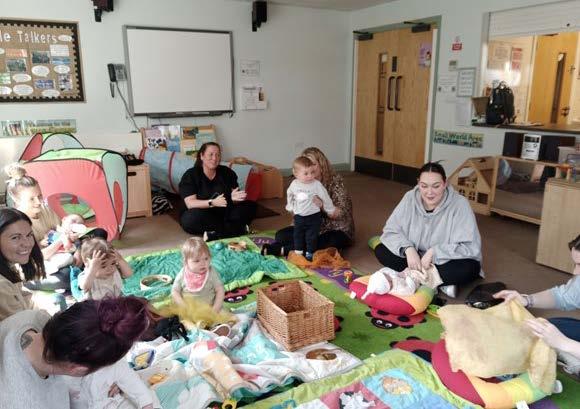
The family club enables children to play with friends, and make new ones, and also includes a homework club.
Parents will be able to meet other parents, share their experiences and offer each other support. They will also be able to ask for advice and support with parenting and other support if they need it.
Brian Hamlin, Senior Community Partnership Manager at The Guinness Partnership, said: “REEL CIC do amazing work which is changing young lives as they develop and grow – giving them opportunities they
perhaps never would have had otherwise.
“The help it gives parents, and how it enables them to support each other is invaluable. Investing in what they do is part of our work helping communities across the country to thrive - improving the life chances and wellbeing of those involved. ”
Local families can contact the centre at info@reelcic.co.uk to find out more and book a place.
5 www.qanurserymagazine.co.uk | | FARM ATTRACTIONS |
A new stay-and-play baby club as well as a family club designed to support parents and children, has opened up in Oldham – thanks to funding from The Guinness Partnership.
Educational Resources Supplier Findel Announces
New Three-Year Partnership With National Day Nurseries Association

NDNA is the national charity representing children’s nurseries across the UK. Its membership encompasses the
20,000-strong nursery sector and the 250,000 people employed within it. Working closely with local and national governments in
England, Scotland and Wales, the charity provides information, training and advice to support nurseries and the people who work in
them. It also campaigns on the cost, choice and quality of childcare to benefit nurseries, families and the economy.
NDNA members will now benefit from a range of benefits from Hope including discounts on more than 32,000 early years products.
This includes a discount of 15 percent off every order and a special one-off 20 per cent discount on an order of choice. In addition, there are discounts of up to 70 per cent off more than 200 essential early years items in a core list curated by NDNA.

Findel, which is delivering the partnership through its online early and primary years educational resources supplier brand Hope, previously partnered with NDNA for 10 years from 2008-2018.
Last year, NDNA announced it was going to competitive tender with its educational resources requirements and
6 |www.qanurserymagazine.co.uk
images courtesy of iStock
Online educational resources supplier
Hope was re-appointed following that process. Talking about the new partnership, NDNA’s chief executive, Purnima Tanuku, said: “NDNA spent months choosing the right partner that offered the very best value for our members. We were impressed by Hope’s passion to inspire and support our members, while also delivering excellent customer service.
“Hope’s time-saving and budget management online solutions will support our members with making savings not just on price, but on precious time too.
Findel describes Hope as a brand dedicated to supporting people who nurture young minds, helping them pass on vital knowledge, build confidence and fuel children’s imaginations and enrich their futures.
Hope aims to put everything these educators need in one place to help those who stand in front of children every day to inspire future generations. This sentiment and service is expressed by Hope’s brand positioning line of ‘Hope is all you need.’

Findel chief executive, Chris Mahady, said: “We’re delighted
business from top to bottom to ensure our customers are at the heart of everything we do. “We will work hard together with NDNA to provide members with the highest quality resources and equipment, the best value, and inspiration, backed by our market-leading service. Findel’s origins as an educational resources supplier can be traced back to 1817. Today, its brands and websites offer more than 32,000 products to educators and parents based in the UK and overseas with the business
exporting to 130 countries. Headquartered in Hyde, Greater Manchester, Findel also has a distribution centre and offices in Nottingham and employs around 300 people. The company’s brands comprise Hope, GLS, Davies Sports, Philip Harris and Scandibørn.
Findel is backed by Leedsheadquartered private equity firm Endless, which supported a management buy-out in April 2021.
For further information on Findel visit www.findel.co.uk

“We’re so pleased to be working with Hope which offers our members savings and inspiration on quality early years resources.”
to be partnering with NDNA once again. Since our previous partnership in 2018, we have been on a transformational journey and have reshaped our

7 www.qanurserymagazine.co.uk |
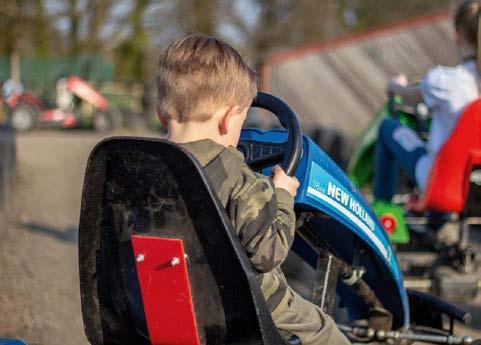
- open every day february to januaryTel: 01786 841309 | www.briarlandsfarm.co.uk Tractor & trailor Rides / GianT JumpinG Pillows new fairie Walk / tractoR Go-Karts Farm animals / fooTball Golf Family fUn FoR all aGes!
Findel has announced a new three-year commercial partnership with the National Day Nurseries Association (NDNA).
“We look forward to welcoming members to our Hope brand and supporting them however we can in the future.”
Over 700 Early Years Settings, Including Childminders, To Take Part In New EEFFunded Projects
New EEF Trials With Stronger Practice Hubs To Explore The Effectiveness Of Promising Early Years Programmes
733 nurseries and early years settings across England will take part in eight new evaluations of programmes to support early language and numeracy development, the Education Endowment Foundation (EEF) has confirmed. The new projects, co-funded with the Department for Education’s Stronger Practice Hubs, are a major part of the EEF’s increased focus on support for the early years sector. All the projects will be independently evaluated, representing a significant contribution to the early years evidence base.


They include the first ever EEF-funded evaluation involving childminders. The pilot ofCommunication Friendly HomeBased Settings, developed by Elklan, will give childminders training to improve their provision and practice to support their children’s language skills. This project is being evaluated by a team based at the University of York.
A version of this programme, Communication Friendly Settings, will also be tested across nurseries. The delivery organisation, Elklan, will train two staff to train other staff in their setting to support children’s speech, language and communication skills. The evaluation, led by a team from the University of York, will look at the impact of the programme on three- and four-year-olds.
Five more new projects will focus on early language development:
Early Years Conversation Project (EYCP): Delivered by Sheringham Nursery School and Children’s Centre, the programme aims to develop staff’s
interactions with children to improve the language skills of two-and three-year-olds. The evaluation will be led by Durham University.
Concept Cat: This approach focuses on teaching vocabulary and supporting staff to teach high frequency concepts such as most, large and near. The programme was developed by the speech and language therapists behind Word Aware and is being delivered in collaboration with Better Communication CIC. RAND Europe will assess the impact of the programme on three- and four-year-olds.
Early Talk Boost: Designed and delivered by Speech and Language UK, this 9-week programme is targeted at three- and four-year-olds identified as
needing additional teaching to support talking and understanding words. Each session includes language activities supported by songs and storybooks.
Talk with Tales with Children (TWiTCH): Developed by Sheffield Hallam University, this approach supports early years staff to optimise their daily story time and provide discussion-based
8 |www.qanurserymagazine.co.uk
activities to promote children’s language development. A team led by Durham University will evaluate the pilot of this programme.
Tales Toolkit: This programme supports staff to implement weekly oral storytelling and story scribing sessions using visual resources that promote a child’s understanding of how to structure a story. The programme will be delivered through a collaboration of Tales Toolkit with Goldsmiths University and aims to support children’s early language and social development. The Institute of Employment Studies (IES) will evaluate the pilot study of this approach.
One of the new trials focuses on early numeracy and executive functions. The ONE Project, delivered by staff at the University of Oxford and University of Sheffield, trains early years staff to engage
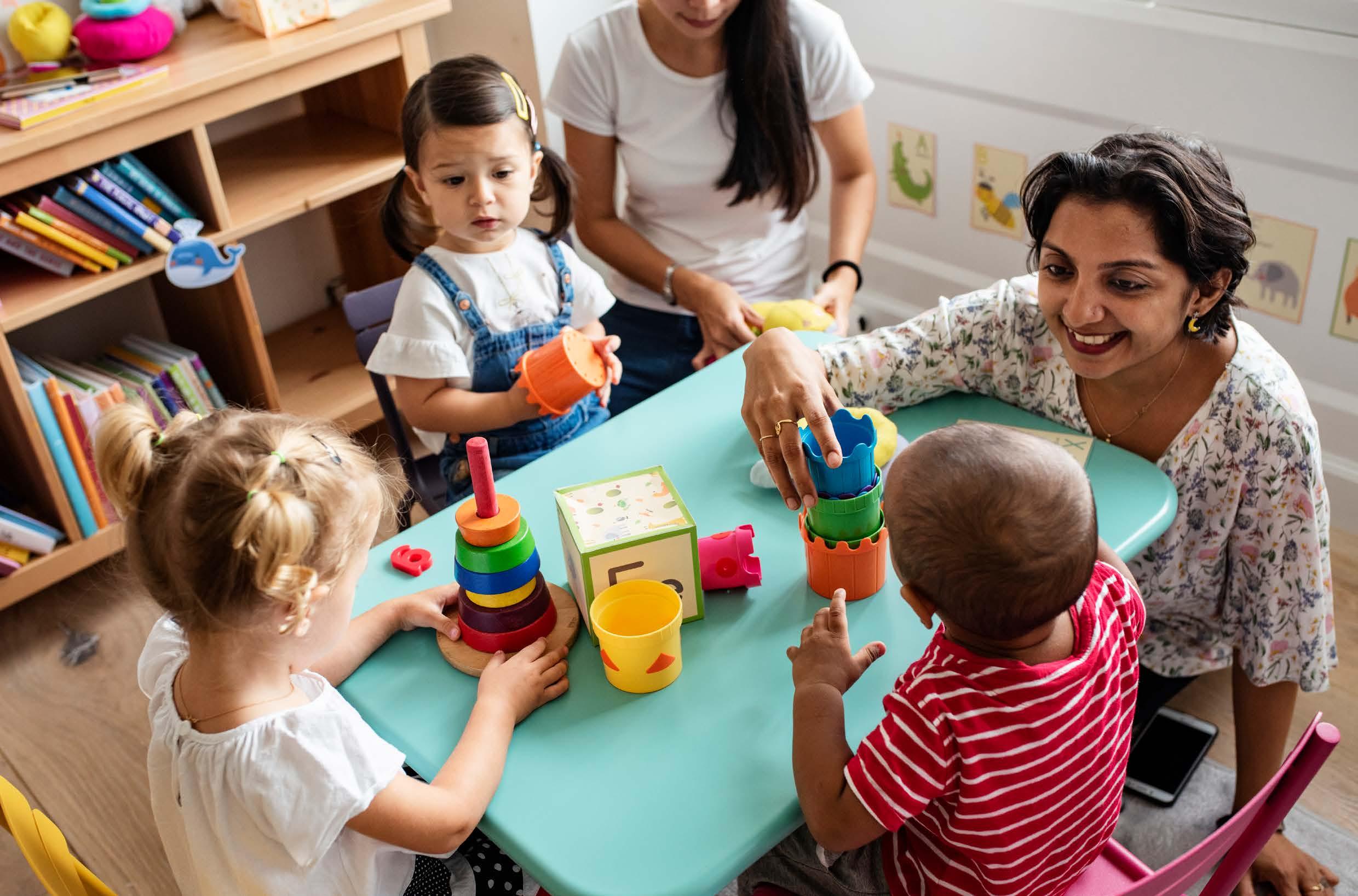
groups of young children in play-based activities to support early numeracy. These tasks last five to ten minutes and are designed to develop pre-schoolers’ numeracy skills by embedding cognitive challenge into learning activities. Core attention and flexible thinking skills, known as executive function, develop over childhood and support early mathematical learning.
The delivery team will work with early years educators to gradually embed executive function challenges into maths learning through fun activities codeveloped with practitioners. Three activities are delivered each week over the course of the 12-week programme, and can be woven into small group activities, outdoor, and free play.
Initial evidence evaluation was supported by the Nuffield Foundation. The independent evaluation will be conducted by RAND Europe.
Early years settings can explore the programmes available in their area and express interest in taking part through the EEF website.
Professor Becky Francis CBE, Chief Executive of the Education Endowment Foundation (EEF), said: “A vital part of supporting early years professionals in their work is broadening their access to high-quality, well evidenced programmes that can bolster their practice and boost young children’s development.
“It is our hope that the research projects announced today serve to increase support and drive innovation in this crucial area of our education system.”
“Nurseries that sign-up to take part in one of our evaluations will be making a vital contribution to education research, as well as getting the chance to access highpotential programmes for their children at a subsidised rate.”
9 www.qanurserymagazine.co.uk | | FARM ATTRACTIONS |
“It is our hope that the research projects announced today serve to increase support and drive innovation in this crucial area of our education system.”
images courtesy of iStock
New research: disadvantaged children
Anew report, Tackling Disadvantage Through Childcare, by Coram Family and Childcare (CFC), in partnership with Joseph Rowntree Foundation (JRF), shows that even with the government’s extra investment, announced at the Spring Budget, children will miss out on the high-quality pre-school care and education that supports their development.
Affordable childcare is essential in making work a route out of poverty – but the research finds that a low earning parent takes home around £4 per hour worked after childcare costs and once the Universal Credit taper rate has been applied, effectively eroding over half of their earnings. This means that a low earning single parent will find that they are only £60 per month better off if they increase their working hours from four to five days.
The research also finds that the
Government’s plans will not improve the quality of childcare provision, despite evidence that children from disadvantaged backgrounds are starting school behind their better off peers and that high quality childcare can narrow the achievement gap. Currently, childcare is not of consistently high enough quality to make a real difference to children’s outcomes.
The report calls for complete reform of the system including:
• Investment in and focus on improving quality of childcare, including better pay for professionals and higher levels of qualifications
• Government directly funding childcare places, as they do for school places
• A simple, affordable, means-tested payment system for parents
• 15 hours per week for all two year olds and 30 hours for all three and four year olds to make sure all children get equal
access to free early education
• Integration with wider support services
• Partnerships between parents and childcare professionals to help spread learning between the home and childcare setting
Megan Jarvie, Head of Coram Family and Childcare, said:
“Disadvantaged children are falling behind before they even start school. A well designed and functioning childcare system can be a key tool in tackling this disadvantage. But instead, families are stuck in poverty and children are missing out on early education that could better prepare them for school. We urgently need to rebalance the childcare and early years system to better serve the children who stand to benefit the most. We have set out a reformed system to better meet the needs of all families and children, and to level the playing field for disadvantaged children.”
Abby Jitendra, JRF Principal Policy Advisor for Care, Family and Relationships,
said:
“Families deserve childcare that’s high quality, affordable and easy to access. But the childcare system we have now is failing disadvantaged children - parents don’t take up the services they are entitled to because, in doing so, they’d lose out financially. The only option many have is to reduce the hours they work in order to stop being penalised.
A childcare system that works doesn’t just help parents, it improves our economy, our communities and our society. We know the UK Government is up to this challenge otherwise it wouldn’t have proposed an expansion but their plans risk entrenching an even less fair system which would become very difficult to unravel.”

10 |www.qanurserymagazine.co.uk
miss out as the Government’s childcare plans fail to level up children’s chances
The Government’s planned £4billion investment in childcare will disproportionately benefit higher income families unless it is retargeted to help the most disadvantaged children, say two national charities.
image courtesy of iStock