

NOWA highlights issues faced by women in aquaculture
SWEDISH waters host both native and invasive crayfish—just not together
THE SHAPE OF FISH KNIVES varies widely from country to country

12/3/19 2:39 PM

![]()


NOWA highlights issues faced by women in aquaculture
SWEDISH waters host both native and invasive crayfish—just not together
THE SHAPE OF FISH KNIVES varies widely from country to country

12/3/19 2:39 PM


Fisheries and aquaculture is evolving in Albania as the country aligns more closely with EU requirements. A European Commission progress assessment notes advanced alignment, while identifying gaps in data collection and scienti c capacity. Control and inspection have strengthened, with a functional vessel monitoring system, integrity measures, and audits to support compliance. In aquaculture, designated Allocated Zones for Aquaculture, set out in a 26 July 2023 decision, are being operationalised, enabling marine cages and mussel longlines. Digitisation through electronic reporting supports traceability and IUU control. A new Otranto Channel sheries restricted area adds ecosystem protection in the Adriatic.

EU aquaculture has largely stagnated despite substantial public funding, even as global aquaculture has grown, leaving the EU increasingly reliant on imports. Administrative burdens, complexity surrounding the grant of permits, and high input costs are key brakes on expansion. Salmonfarming illustrates the challenge. A er Brexit, EU production has largely disappeared, and imports now cover almost all demand, with Norway supplying the majority. However, in Norway’s privately nanced sector, political pressure has shi ed towards extracting pro ts through a resource rent tax introduced in 2023. The tax is portrayed as chilling investment, reducing licence auction revenues, and prompting industry criticism, including concerns about how sustainability certi cation might be treated in tax calculations.

The Horizon Europe project AlgaeProBANOS is working to translate algae innovation into market-ready solutions by tackling cost, data, and scale-up barriers. Its rst Algae Accelerator provided six months of tailored mentorship, valued at up to €10,000 per company, coordinated by the SUBMARINER Network and F6S. Applications from participating start-ups and SMEs span from wastewater treatment to materials. L’Eautelier, which developed a pilot “Seaweed Suite” concept for circular hotel refurbishment, and Latvia’s AlgaePhos4X, which is recovering nutrients and water from food side streams using microalgae are among the bene ciaries. Following the rst cohort, a second call has concluded and a new group is entering mentorship.

AquaFarm returns to Pordenone Fiere on 18–19 February 2026 as an exhibition and conference for aquaculture, algaculture, sustainable shing, and for the wider blue economy. The ninth edition introduces AquaFishery, a new thematic area for small-scale and artisanal sheries, re ecting overlap with other sectors in supply chains, equipment, and services. Organisers are targeting Adriatic cooperatives and highlighting how traditional sheries are adopting tools such as advanced weather forecasting and monitoring. The programme includes a dedicated session on markets, structures, species, and short value chains, alongside exhibitors from across the sector.

Finnish start-up Hailia, founded in 2021, helps seafood processors convert edible side streams into cooked, heat-stable products with a llet-like texture. Side streams are handled on-site, blended, and texturised using dedicated equipment, enabling high utilisation rates and new product formats for retail, food service, and industry. The approach shi s side streams from low-value outlets into the processor’s own branded food lines. Early uptake has been strongest in Finland, including by major retail partners, and the company is expanding trials elsewhere. Yield from a rainbow trout, for example, rises from about 70% to around 90% when side streams are upcycled into food.

Hand lleting still matters alongside high-throughput machines, and the right knife supports yield, safety, and presentation. In German-speaking markets, processors favour a long, narrow, very thin, sharply pointed blade (typically 20 cm or more) with steel hardness above 55 HRC, plus a non-slip, ergonomic handle and good balance. These contrast with Caribbean all-purpose knives, Spain’s semi-circular media luna, Italian/French mezzaluna variants, Thai round knives, and the ultra-sharp Chinese chef’s knife. For hard-boned species such as cobia, heavier cleavers and sti blades are used.

How Sweden turned the invasive signal cray sh into a resource
Cutting tools for processing, portioning and lleting
Eurofish to host companies from its member countries at sh international, Bremen
FAO to contribute to implementation of BBNJ treaty
sheries observer gathers more than just data
Dates, Imprint, List of Advertisers
Innovafeed and NaturAlleva have signed a commercial partnership to integrate black soldier y ingredients into aquafeed formulations for Mediterranean farmed species, including seabass, seabream, sturgeon, and trout. The companies announced the agreement on 22 January 2026, presenting it as a move from pilot-scale testing towards wider, industrial deployment of insect-based inputs in aquaculture. NaturAlleva is an aquaculture feed producer and sh farmer, while Innovafeed supplies insect-derived ingredients. The focus of the agreement will be on Mediterranean farmed species with the aim of positioning insect ingredients as components in established aquafeed formulations within mainstream feed markets rather than as a niche option. The partnership builds on research and development work, as well as
several years of successful commercial use of Innovafeed’s BSF ingredients by NaturAlleva.
According to the partners, accumulated data on performance and health outcomes supports the decision to deploy the ingredients at scale across NaturAlleva’s sea bass and sea bream feed formulations. The stated benets include support for a healthy gut microbiota, improved robustness, and greater resilience to stress which can contribute to overall zootechnical performance in farmed sh. Implementation is scheduled to begin in January 2026, with NaturAlleva planning to use Innovafeed’s BSF ingredients at meaningful commercial volumes across its sea bass and sea bream feeds, with the roll-out expected to expand progressively across the Mediterranean region. Beyond immediate

The deployment of insect ingredients from Innovafeed in NaturAlleva’s feeds for seabass, seabream, sturgeon, and trout has been scaled up to commercial levels.
commercial volumes, the agreement also includes joint investment in further R&D to strengthen the evidence base for targeted applications beyond the initial species focus.
Iceland’s Ministry of Industries has opened a dra bill on aquaculture for consultation, proposing a single, comprehensive legal framework to govern sea-cage farming, land-based farming, ocean farming, and fjord grazing. The bill aims to strengthen regulation, reduce negative environmental impacts, and create clearer incentives that support sustainable value creation. If adopted, it would repeal Act No. 71/2008 on Aquaculture and Act No. 89/2019 on marine aquaculture fees and the Aquaculture Fund. Many proposed changes draw on recommendations from the National Audit O ce’s
January 2023 administrative audit of sea-cage farming.
For sea-cage farming, the dra includes stronger incentives for closed containment and sterile salmon, expanded river monitoring, risk-based planning through infection control areas, simpli ed licensing, and increased supervisory powers with greater use of electronic monitoring. It also proposes tighter measures on lice control, genetic-mixing risk assessment, and monitoring of sexually mature farmed salmon, alongside revised municipal allocations from the Aquaculture Fund.

If enacted, proposed aquaculture legislation is expected to streamline the legal framework governing aquaculture in Iceland.
On 8 January 2026, Spain’s Secretary General for Fisheries, Isabel Artime, met with representatives from regional governments and key shing sector organisations to assess the implications of the reduced mackerel quota agreed at the latest EU Council of Ministers on shing opportunities for 2026. The meeting focused on analysing the potential impact of the quota cut and identifying coordinated measures to mitigate its e ects. Participants agreed to continue joint e orts between the national administration, regional authorities, and industry stakeholders to optimise the management of the shery and make the most of the available quota. The initiative underscores the Ministry of Agriculture, Fisheries and Food’s ongoing commitment to transparency and collaboration with both the sector and autonomous communities in the face of evolving EU sheries policies.

Spain’s Secretary General for Fisheries, Isabel Artime, with representatives from regional governments and key fishing sector organisations

Estonia’s sheries councils have asked the Ministry of Climate to adjust national controls on great cormorants in Estonia’s coastal and inland waters, citing continued growth in breeding numbers, reports ERR. The request proposes extending the current hunting season, which runs from August to November, to the end of March, and introducing a bounty intended to raise hunter participation. It also seeks changes that would permit hunting in selected protected areas. The ministry has opposed expanding culling, arguing that the species is di cult to hunt e ectively. It prefers egg oiling, a measure used in recent years, noting that population impacts can take several seasons to emerge. This approach is supported by environmental groups,
who question the e ectiveness of the proposed culling e orts. Monitoring gures referenced in the councils’ request place the population above 47,000 breeding pairs, compared with a tolerance level of 10,000 pairs in the national action plan, and suggest annual growth of about 10%. Industry estimates arrive at similar numbers, with around 44,000 breeding pairs in 2024, and a summer population of roughly 160,000 birds.
To support Europe-wide struggles with cormorants, the rst dra of a pan-European management plan was presented in April 2025, addressing both the biological dimension of maintaining the great cormorant’s conservation status, and the social and economic dimensions a ecting the shery and aquaculture sector.
A Spanish-led research consortium has launched SpaceGenFish, a pioneering project exploring whether farmed sh could one day feed astronauts on longterm space missions. Coordinated by ICM-CSIC with partners including IEEC, Radian, and Ifremer, the initiative is funded through Spain’s space agency under a European Space Agency (ESA) programme. The project’s main goal is to conduct a 15-day orbital experiment to study how microgravity and space radiation a ect sh physiology—particularly focusing on epigenetic responses that SPAIN
may indicate not just survival, but biological adaptation to space conditions. Alongside the science, SpaceGenFish is also developing an autonomous life-support and monitoring system to ensure stable aquatic conditions without crew input—technology that could also bene t remote aquaculture on Earth. While the chosen species hasn’t been disclosed, the project builds on earlier Ifremer research involving European seabass and meagre—making seabass a likely candidate for the orbital experiment. If successful, SpaceGenFish could mark the rst proof

European seabass is a likely candidate for e periments to grow fish in space. The idea is to potentially feed astronauts on long missions.
of concept for animal protein production in space, expanding the future menu for astronauts beyond plant-based foods and reshaping ideas of sustainable food systems o Earth.
Norwegian vessels are increasingly routing fresh sh through Danish auctions, reshaping price discovery and logistics across Northern Europe. Danish authorities recorded 26,317 tonnes landed from Norwegian shing vessels in 2025, almost 10,000 tonnes more than in 2024, with herring accounting for 21,365 tonnes and saithe 2,057 tonnes. The immediate driver is money. Both Fiskerimagasinet and Fiskeri Tidende report that strong North Sea shing, combined with consistently higher auction prices in Denmark, is persuading skippers to bypass Norwegian buyers. Just as important is exibility: much of the sh is landed in Norway and trucked south, which is o en cheaper than sailing to Hanstholm or Hirtshals, while allowing vessels to spend more time shing.
For the market, larger and more regular Norwegian volumes strengthen Denmark’s role as a regional “clearing house”
for fresh sh. Auctions and exporters can move product rapidly into Europe for instance the auction site Hanstholm Fiskeauktion states that sh sold there can reach key EU markets within 24-36 hours. That speed may narrow price spreads between landing ports, reduce volatility for buyers, and increase competitive pressure on Norwegian coastal processors who rely on local landings. Fiskerimagasinet notes sharp increases in certain white sh and in shell sh, including higher langoustine landings in Denmark, alongside growth in squid, linked to warming seas. If these trends persist, Danish processors could bene t from better utilisation of lleting and packing capacity, while retailers and foodservice buyers may see improved availability outside peak seasons.
Risks remain however, as more road transport raises cost exposure to fuel and border friction, and heavy

A trend started in 2025 by Norwegian fishers seeking to sell their fish into the market through anish fish auctions is expected to continue in 2026.
Pictured, traders in action at Denmark’s Thybor n fish auction.
in ows can squeeze Danish shers during strong supply weeks. Still, in a year when Norway’s seafood exports reached a record value, the Danish auction channel is becoming an ever more in uential route to market.
A recent statement by the HUN-REN Balatoni Limnological Research Institute warns that recurring winter sh kills observed near several harbours on Lake Balaton’s southern shore reect a broader, systemic ecological risk rather than isolated, local incidents. The institute links the problem to the combined e ects of climate change and recent intensive shoreline development, particularly the construction, expansion, or reshaping of harbours. Lake Balaton’s winters are increasingly ice-free, though the lake is shallow and exposed to wind. Fish, which feed little during this period, tend to seek calmer, sheltered areas to reduce energy expenditure. On the southern shore, many harbours have developed into large, dredged, strongly protected basins that provide such refuge, drawing large numbers of sh into relatively enclosed spaces.
The institute explains that these sheltered basins o en have limited water exchange. When high densities of sh gather in areas with weak mixing, oxygen can be depleted rapidly. Oxygen demand from sediments, combined with low winter oxygen production by algae, can trigger acute oxygen shortage, leading to sudden, large-scale mortality even without an external pollution event. There are structural di erences between the northern and HUNGARY


southern shores. The northern shore’s deeper nearshore conditions enable more “ ow-through” harbour designs, whereas the southern shore’s shallow waters tend to favour closed, dredged basins that may function as ecological traps. Harbours with stronger natural ushing, for example where in ows improve water exchange, are less likely to face oxygen-related sh kill risks.
The institute also addresses common explanations. It argues that cormorants are not the primary cause, although their hunting may worsen outcomes
by further concentrating sh in already critical conditions. Likewise, the phenomenon is not directly attributed to natural water-level uctuations. Current interventions such as aeration and cormorant deterrence are described as short-term, symptomatic measures. Long-term risk reduction, the institute concludes, requires more complex, scienti cally grounded harbour planning and redesign that improves water movement and considers climate impacts, harbour geometry, sh behaviour, and the lake’s overall ecological functioning.
Shell sh farming and pond aquaculture are increasingly recognised as key nature-based solutions that can align food production with biodiversity conservation and climate action across Europe. Bivalve mollusc farming in marine and coastal waters, together with sh farming in ponds and wetlands, delivers a broad range of ecosystem services that support healthy ecosystems while sustaining rural and coastal livelihoods. These bene ts are highlighted in a recently published study by the European Climate, Infrastructure and Environment Executive Agency (CINEA) of the European Commission. The study underlines how marine bivalve aquaculture enhances biodiversity by creating complex habitats that function as ecological reefs, supporting sh, birds and

to climate mitigation thanks to their low greenhouse gas footprint
benthic communities. At the same time, bivalves improve water quality through ltration and nutrient cycling, helping to reduce eutrophication and contributing
Restocking of lavaret (Coregonus lavaretus) coregone in Italian, in Lake Garda is set to resume following a regulatory change in Lombardy reopening a pathway for restocking activity. The announcement was made by Alessandro Beduschi, Lombardy’s Regional Councillor with responsibility for agriculture, food sovereignty, and forests. Lavaret is considered allochthonous in Lake Garda, having been introduced in 1918. Over time, it has acclimatised to the lake and become a common catch, supported by continuous, human-led repopulation e orts. This regular stocking has underpinned what is regarded locally as a signi cant commercial shery, and a species strongly associated with the lake’s shing traditions. The new law
suspends the ban on stocking non-native species until 31 May 2026. The ban had been in place since 2020, e ectively halting restocking activity for the species and, according to the regional authorities, creating signi cant challenges for professional shers and for businesses connected to the lake’s food sector.
The decision is a turning point for the Garda area and for Lombardy’s sheries. Despite its long history of residence in the lake, the sh continued to be treated as a non-native species under the previous rules. The regional administration argues that the suspension restores what it considers a more balanced, evidence-based approach, supported by technical data, and responds to the
Pond and wetland aquaculture is shown to play an equally important role. Extensive shponds and lagoons provide habitats for migratory birds and amphibians, regulate water ows, retain water during droughts and help bu er local microclimates. Beyond environmental bene ts, these systems preserve cultural landscapes and contribute to regional resilience. The study concludes that recognising and rewarding these ecosystem services—through targeted policies, improved governance and payments for ecosystem services— could unlock the full potential of shellsh and pond aquaculture as pillars of Europe’s sustainable food systems.

Restocking of lavaret (Coregonus lavaretus) in Lake Garda is set to resume in 2026 after a 6-year pause following a change in legislation in Lombardy. Pictured, Desenzano on Lake Garda.
needs of the local shing community. With the legislative change in place professional shers on Lake Garda are due to begin identifying suitable broodstock. The goal is to secure a supply of around 40 million eggs for the Desenzano sh hatchery, a volume seen as necessary to plan stocking activities during 2026. If the programme proceeds as intended, the region anticipates that juvenile lavaret could be released into Lake Garda as early as February 2026.
A recent study by the Thünen-Institute of Baltic Sea (dated 31 October 2025) shows that Atlantic herring in the Baltic Sea return to their birthplaces every year to reproduce. An international research team traced these movements by combining chemical “ ngerprints” from otoliths—calcium carbonate structures that can be used to reveal the age and environmental history of the sh— with genetic analyses to identify individual sh origins and map reproductive migrations. The results indicate that 56 to 73 per cent of herring return to their birth area to spawn, regardless of the size of the spawning ground. This challenges the long-standing assumption that young, inexperienced sh simply join older shoals and learn migration routes to
established spawning sites. Instead, the ndings imply that di erent coastal spawning grounds are not interchangeable, which has direct implications for sheries management and habitat conservation.

Atlantic herring have been found to migrate to their birth place to reproduce, a discovery that has implications for fisheries management.
The work builds on earlier research into Baltic herring population dynamics, including a 1997 study that proposed migrating shoals incorporate “strays”, supporting genetic exchange among subpopulations and forming a wider metapopulation. By testing this hypothesis and estimating the proportions of returners and strays, the new study strengthens the case that local spawning habitats matter more than previously assumed. With coastal ecosystems facing increasing human pressures, the research highlights the value of targeted coastal zone management to safeguard spawning areas and support long-term stock productivity and marine ecosystem resilience.
Seafood Expo Global/Seafood Processing Global returns to Barcelona from 21 to 23 April 2026 at Fira de Barcelona’s Gran Via venue, bringing together seafood professionals from across the global supply chain.
One of the world’s largest and most diverse seafood trade events, Seafood Expo Global o ers a unique opportunity for buyers, suppliers, processors, technology providers, and decision-makers to meet, compare o erings, and identify new business opportunities. This year’s event follows a strong 2025 edition and
is expected to re ect an industry working through tighter scrutiny of sourcing and labour practices, shi ing trade conditions, and rising expectations for e ciency and documentation.
Covering the entire seafood supply chain, Seafood Expo Global and Seafood Processing Global present a comprehensive hub for everything seafood related. Exhibitors at Seafood Expo will have the chance to showcase innovations in seafood spanning fresh, frozen, canned, value-added, processed and packaged products. Exhibitors at Seafood Processing will complement this, focusing on packaging materials and machinery, refrigeration and freezing equipment and supplies, primary and secondary processing equipment, and hygiene control, sanitation, and quality assurance services. The event attracts high-volume buyers from retail, food service, and distribution companies, making it a pivotal venue for international business, relationship-building, and identifying new market opportunities.
Recognizing the importance of the aquaculture industry for the future of global seafood supply, the 2026 edition will feature an Aquaculture Innovation Zone. In 2022, global aquaculture production overtook that of global sheries for the rst time. As this trend will only increase, the new dedicated area will highlight the industry´s growing focus on innovation, e ciency and sustainability. Seafood professionals will have the opportunity to explore companies at the forefront of aquaculture advancements, showcasing the technology and practical solutions designed to address some of the sector’s most pressing challenges. A rich conference programme will be kicked o by economist and geopolitical strategist Dr Nomi Prins who delivers the 2026

keynote address, providing an economic outlook titled “High Stakes, Shi ing Tides: The Global Outlook on Seafood, Trade, Economic Pressure Points and Opportunities”.
The programme will feature more than 20 educational sessions presented by top experts in the seafood industry. Attendees will gain practical, engaging, and informative insights on the most important and timely issues shaping today’s global seafood business environment. Despite consistent growth in global output, the sector´s success is accompanied by growing demand and challenges. Key sessions will explore solutions such as integrating automation and machine learning with sustainable blue food policies and strategies, as well as emerging market trends and product innovation. Other critical topics, including supply chain compliance, traceability, transparency, corporate due diligence, and seafood business and nance will be
addressed in further sessions. The program will provide a comprehensive overview of the future of the industry by bridging the gap between technological innovation and sustainable stewardship.
This year´s edition will once again host the annual Seafood Excellence Global Awards reception, honouring the best seafood products of the year. Two grand prizes will be awarded for the Best Retail Product and the Best Hotel/ Restaurant/Catering product. Four special awards will be presented for innovation, convenience, retail packaging and seafood product line. All products submitted for the awards will be on display throughout the event in the Galleria. In addition, at a reception and networking event titled “Connecting Women in Seafood”, attendees will be provided with a space to connect and encouraged to share experiences and expand their professional network.
The 2025 edition of the annual conference continued global engagement across the algae community.
AlgaEurope 2025 was jointly organised by the European Algae Biomass Association (EABA) and DLG Benelux, and served as a meeting point for stakeholders spanning science, technology, and industry. Chaired by Jean-Paul Cadoret, the programme featured 24 plenary sessions, 107 speakers, and 116 poster contributions, spanning topics from algae physiology and genetic technologies to biore nery approaches, production systems, and food, feed, and environmental applications. Alongside the scienti c programme, the trade show brought together 20 organisations presenting technologies and services, while site visits to síbiotech provided hands-on insight into production approaches and practical applications. A newly introduced picture contest added a public-facing dimension by highlighting algae’s diversity and ecological role through striking imagery.
Networking remained a central part of the Riga edition, with informal tastings at the Algae Happy Hour, a conference dinner showcasing Latvian cuisine and folklore, and the AlgaEurope app supporting matchmaking and participant interaction. An award evening recognised achievements across the

community, including poster prizes, as well as broader recognition for life and career contributions, impact and action, and youth and outreach.
The discussions took place against a European algae market that is still developing. Production remains modest in global terms—totalling 287,390 tonnes or 0,8% of the global total in 2019— and microalgae accounts for only a small share of overall output. While seaweed aquaculture is o en seen as a route to meet rising demand for algae biomass, progress in Europe has been relatively slow, with most seaweed still harvested from wild stocks, rather than cultivated. Microalgae production, by contrast, is largely land-based and o en relies on photobioreactors. These systems allow
tightly controlled cultivation, supporting high-value uses such as food supplements, nutraceuticals, cosmetics, and feed, but they are costly and di cult to scale, which limits their suitability for large-volume production.
At the EU level, policy momentum has strengthened in recent years, with the European Commission’s EU Algae Initiative setting out a strategic framework to develop algae production and associated value chains, running broadly from 2023 to 2027. Overall, the EU supported 219 algae-focused projects between 2014 and 2023 across major funding programmes, with a total contribution of about €559 million. These e orts were mainly aimed at tackling technical and nancial barriers but also focused on improving market readiness and competitiveness.The success of these developments will once again be in focus when international stakeholders convene from 8 to 11 December in Valletta, Malta for AlgaEurope 2026.
Albania is entering a transformative phase in its sheries and aquaculture sector, marked by a series of strategic developments that re ect the country’s commitment to sustainability, innovation, and regional cooperation.
As Albania approaches accession to the EU, spatial planning reforms, digital modernisation, and marine conservation among other developments are reshaping the country’s sheries and aquaculture sector to meet both national priorities and international standards.
A report from the European Commission on the progress Albanian sheries and aquaculture is making towards EU standards makes encouraging reading despite some shortfalls. Alignment with the EU acquis has reached an advanced stage though data collection particularly regarding for sharks, eel, recreational sheries and discard plans needs further e orts. Interpreting and implementing national legislation on data collection, data management, and scienti c capacity need to be further improved. The report notes that Albania is following GFCM recommendations on sustainable exploitation of sh stocks. Inspection, monitoring, and control institutions and equipment have been strengthened and a functional vessel monitoring system is in place. These, as well as other, measures together with integrity plans in the
sheries directorate and regular internal and external audits will also help to ght corruption in the sheries sector. However, laws concerned with market policy, such as market plans, need to be more fully aligned with EU legislation. The report also nds that the country needs to work on its national maritime spatial plan as well as cooperate more closely with partners in the Adriatic to promote regional maritime initiatives.
As regards aquaculture, a major turning point came with the adoption of Decision of the Council of Ministers No. 461, dated 26 July 2023, which approved the policy guiding document for Allocated Zones for Aquaculture (AZA). This decision o cially mapped out designated areas along the Albanian coast for sh and bivalve mollusc farming, laying the groundwork for a more organised and environmentally responsible aquaculture industry.
The implementation of these AZAs began in earnest during 2024–2025, when the Ministry of Agriculture and Rural Development announced the operationalisation of zones in Vlorë, Shëngjin, Durrës, and Sarandë. These
regions, known for their rich marine biodiversity and strategic coastal access, are now home to a growing number of aquaculture operators. Currently, six businesses are engaged in intensive marine aquaculture using cages, while three others are cultivating mussels through extensive longline systems. These activities are conducted within the newly established AZAs, ensuring that operations are aligned with spatial planning and environmental safeguards. Looking ahead, the Ministry is preparing to launch a public procurement process for the remaining AZAs. This initiative is expected to attract further investment, encourage innovation, and expand the sector’s capacity. By opening these zones to competitive bidding, Albania is fostering a transparent and inclusive approach to aquaculture development, one that balances economic opportunity with ecological responsibility.
In parallel with these spatial reforms, Albania has also taken a signi cant step toward digital transformation in sheries management through the implementation of the Electronic Reporting System
(ERS). This system allows for real-time electronic reporting of catch data and vessel activity, enhancing the country’s ability to monitor, control, and enforce regulations across the sector. The ERS is a powerful tool in the ght against illegal, unreported, and unregulated (IUU) shing, providing authorities with accurate and timely data to support decision-making and policy development. By improving traceability and transparency, the system helps ensure that sheries activities are conducted responsibly and in line with EU standards and international commitments.
Another landmark achievement in Albania’s marine governance is the establishment of the Otranto Channel Fisheries Restricted Area (FRA), ocially endorsed by the GFCM during its 47th annual session. This FRA, located in the southern Adriatic between Albania and Italy, represents the rst shared FRA between EU and non-EU countries, and is a result of years of scienti c collaboration and stakeholder

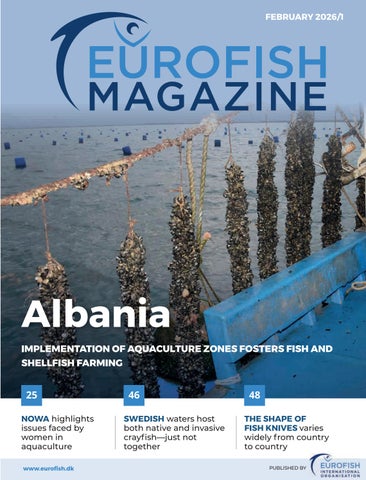
Companies farming mussels are among those exploiting the newly designated allocated zones for aquaculture (AZAs).
engagement. The Otranto FRA was created to protect vulnerable marine ecosystems, particularly the bamboo coral (Isidella elongata) and essential habitats for demersal species such as deep-water shrimp, European hake, and Norway lobster. Covering a core area of 1,900 km2 closed to bottom shing and a bu er zone of 700 km2 with reduced shing e ort, the FRA is now the largest marine reserve in the Adriatic Sea.
This initiative not only enhances biodiversity conservation but also contributes to the long-term sustainability of sh stocks, supporting both ecological resilience and economic stability. The FRA is part of a broader GFCM strategy to strengthen sheries management in the Adriatic through multiannual management plans, scienti c assessments, and spatial protection measures.

Eurofish partners with stakeholders in its member countries and beyond executing projects for the development of fisheries and aquaculture.
Team up with us by contacting projects@eurofish dk or visit eurofish dk/projects for more information.


Microplastics have become one of the most talked-about pollutants in the marine environment, partly because they are di cult to see and, once they are present, di cult to remove. In Albania the issue is being studied and measures to mitigate it are being implemented.
Microplastics are typically de ned as plastic particles smaller than 5 millimetres, ranging from visibly small fragments down to bres that look like specks of lint. These particles can be “primary” (manufactured small, for instance as industrial pellets), or “secondary”, formed when larger plastic items break down under sunlight, wave action, and abrasion. What makes microplastics particularly challenging is that they are durable by design, and common items can persist for decades or far longer in marine conditions. As larger items fragment, the total number of particles rises
dramatically, increasing the chance that wildlife will encounter them. At the same time, many plastics contain additives, and they can also carry other pollutants on their surface, raising concerns about wider biological effects beyond the physical presence of a particle.
Microplastics are generated as plastic waste we recognise, such as bottles, bags, packaging, shing gear, and cigarette lters, breaks down. Rivers and stormwater systems transport this material from towns, farms, industrial areas, and tourist sites to the coast. Once in the sea, microplastics can remain near the shore, settle in sediments, or circulate more widely, depending on currents, wind, and the density of the polymer. Importantly, not all microplastics behave the same way. A short, sti fragment of polyethylene is not equivalent to a so textile bre, and a fresh, clean pellet is not the same as a weathered fragment that has spent years in the environment. This diversity is one reason why perceptions of the threat from microplastics swing widely. Broadly speaking, microplastics are clearly undesirable, they are widespread, and there is strong evidence of harm in many marine organisms, while some questions about long-term,
population-level impacts are still being re ned.
Marine animals can be a ected in two main ways: through direct interaction, and through the knock-on consequences for feeding and health. Direct interaction includes ingestion. Small particles can be mistaken for food or swallowed incidentally when animals feed. Studies and monitoring work in the Adriatic note the broader toll of plastic pollution on marine life, including birds, sh, and marine mammals, and this harm begins with the larger, visible items that later generate microplastics. Once ingested, microplastics may cause irritation, blockages in smaller organisms, or a false sense of fullness that reduces feeding. Even when a particle passes through the gut, repeated exposure can cost energy, and energy is the currency of survival and reproduction.
The second pathway is indirect. Microplastics can interfere with how food webs function, especially when tiny organisms ingest them and transfer them upwards. They may also act as carriers for chemicals, either from additives used in plastics or from pollutants that adhere to their surfaces. However, microplastics are not an acute poison in the way that a spill of a toxic chemical can be. The larger concern is chronic exposure across many species, over time, in waters that are already under pressure from over shing, habitat loss, nutrient pollution, and warming. In that context, microplastics add another stressor that managers cannot ignore.
Albania’s coastline on the Adriatic is relatively short compared with some Mediterranean neighbours yet coastal development, growing tourism, and uneven waste management all contribute to the problem. Research in Albania has highlighted the role of major river mouths as conduits for plastic and microplastic pollution into coastal waters, including the Erzeni River delta. Work focused on the Ishmi River likewise underlines the link between heavily polluted river basins and the coastal environment, with the Ishmi described as Albania’s most polluted basin by the National Environmental Agency. A study on the coastline of Durrës documented heavy macroplastic contamination in parts of the area, with the Ishmi beach section classed as “extremely dirty” under a standard coastal litter index, which the authors linked to the proximity of a river out ow. Further north, surveys of Velipojë and Shëngjin, undertaken just before the tourist season, found that plastics dominated shoreline litter, with cigarette butts and single-use items strongly represented. Cigarette lters are an especially stubborn problem: they are widely discarded, they fragment over time, and they contribute directly to the microplastic load in coastal areas.
In Albania several additional factors amplify the issue. One is the persistence of open dumping and insu cient separation of waste streams, which reduces the chance that plastics are captured for recycling before they enter the environment. Another is the density of coastal use in summer, when consumption rises sharply and waste services can be stretched. Beach


litter ndings from tourist coastlines illustrate how quickly everyday items accumulate when prevention and enforcement are weak. According to the UNEP the Mediterranean is a global hotspot for plastic pollution because it is semi-enclosed, heavily populated
along its shores, and subject to intense coastal activity. A study focused on the Ishmi River notes that a WHO-linked assessment placed Albania among the most problematic Mediterranean countries, reporting a very high share of plastic waste le untreated.


A separate Albanian study on microplastics at the Erzeni River mouth reports very large national plastic waste generation, with limited recycling and measurable leakage to the sea via river discharges, capturing the structural nature of the problem. Under the DeFishGear project (2013-15), Jerina Kolitari, head of the Aquaculture and Fishery Laboratory, Agricultural University of Tirana examined the presence of microplastics in the guts of di erent commercial sh and shell sh species in the Adriatic. She found particles in all the samples irrespective of where along the coast they were caught. The microplastics
were categorised into fragments, laments, foams, granule, pellets and other, and the predominant type found in the samples was laments followed by fragments. Among her conclusions was that the density of microplastics in the marine environment was a more important factor than the actual sh habitat, e.g. pelagic or benthic.
Albania is not starting from scratch to address this issue. The research base is expanding, with recent studies explicitly describing themselves as early contributions to building the evidence needed for a national picture of microplastics and their sources. Better data makes it easier to prioritise hotspots, track progress, and design interventions that are proportionate.
Moreover, Albania has been working to align waste legislation with European approaches, including national planning that sets targets for improved recovery of key household waste streams by 2035. Civil-society and policy analysis also points to strengthened legal measures on plastic waste, alongside e orts to improve enforcement and compliance. In parallel, Albania has introduced restrictions on certain single-use plastic bags, a practical step aimed at cutting one of the most visible, easily avoidable sources of leakage.
International and regional frameworks also bene t Albanian e orts. The Mediterranean has a dedicated regional plan on marine litter under UNEP/ MAP, designed to coordinate action across countries that share the same sea and the same currents. Much of the value of cleaning up is lost if prevention is not widespread across the region, and much of the bene t of prevention grows when neighbouring countries collaborate. There is also an opportunity to connect marine protection with economic interest. Tourism depends on clean beaches, and sheries depend on healthy ecosystems. Studies of Albanian tourist coastlines stress the importance of competent monitoring and local stakeholder engagement in reducing plastic pollution. Practical measures, such as better bins and collection schedules in peak season, targeted campaigns to reduce cigarette butt litter, improved riverbank management upstream, and support for recycling markets, can reduce the ow of plastics into rivers and, ultimately, into the sea.
Albania’s waters will not become microplastic-free overnight, but the direction of travel is clear. The combination of growing scienti c attention, clearer policy, and more visible public discussion creates a realistic basis for progress, provided that enforcement, infrastructure investment, and everyday behaviour move together rather than in isolation.
Researchers at the Department of Biology, University of Copenhagen, are driving a project that seeks to reduce antibiotic use in the rainbow trout farming industry with multiple potential bene ts.
As global demand for seafood continues to rise, aquaculture has become central to supplying high-quality protein. At the same time, bacterial diseases remain one of the main constraints on production, and antibiotics are still widely used to manage outbreaks. This reliance has contributed to the spread of antibiotic-resistant bacteria creating risks for animal health, human health, and the wider ecosystem. Recent scienti c reviews suggest that antibiotic resistance now threatens the intensication of aquaculture unless alternative tools are developed.
Among the alternatives, bacteriophage therapy has attracted particular interest. Bacteriophages—viruses that infect bacteria—can be selected to kill speci c pathogens without harming sh or disrupting the broader microbial community. A 2025 review of phage therapy in freshwater and marine aquaculture species highlights successful experimental applications against key sh pathogens in the genera Aeromonas, Vibrio, Edwardsiella, Streptococcus, and Flavobacterium, although most work has so far remained at laboratory or small-scale trial level. A complementary 2024 review focused on alternatives to antibiotics in aquaculture summarises why phages are so attractive

Mathias Middelboe heads the Aquaphage project which seeks to deploy viruses in the battle against bacterial infections in rainbow trout and thereby reduce dependence on antibiotics.
in this context. Lytic phages, which infect bacteria and reproduce by taking over the host cell machinery killing the host and releasing phage particles that infect more bacterial cells, have narrow host ranges, and have not been associated with adverse e ects on sh or the environment. They can be delivered in several ways—via water, feed, injection, or topical application— and maintain activity over a broad range of temperature, salinity, and other water quality conditions. Yet the review also stresses that farm-ready phage products
should be strictly lytic (as opposed to lysogenic, where the phage reproduces by integrating its genome into the host chromosome), formulated in cocktails to limit resistance, tested for survival under real farming conditions, and produced at a cost farmers can bear. At the University of Copenhagen’s Department of Biology, Professor Mathias Middelboe heads a project, Aquaphage, launched with a clear goal of moving phage therapy from the laboratory to commercial applications for disease prevention in trout farming.
Rainbow trout is one of the most important farmed sh in the European Union. Each year, more than 250,000 tonnes are produced, with an estimated value of around €660 million. The EU accounts for about 30% of global trout production, and Denmark alone produces roughly 12% of EU farmed trout, with national production growing by about 20% between 2012 and 2019.
A particular challenge arises in early life stages. Trout eggs, larvae, and fry are highly vulnerable to bacterial infections, yet they cannot easily be vaccinated, and treatment options are limited. As a result, antibiotics are o en used when outbreaks occur, especially in hatcheries and recirculating systems that rear young sh. This situation raises the risk of selecting for resistant pathogens and of transferring resistance genes to other bacteria in the production environment, feed chain, and surrounding waters.
Flavobacterium psychrophilum is a major cause of disease in these early life stages. Infection can lead to substantial mortality and lost production in salmonids. Experimental studies have already shown that speci c phages can infect and control F. psychrophilum in vitro, and in some sh models, but there are still no licensed, standardised phage products targeting this pathogen for use on farms. This gap—between promising phage science and practical disease control tools— is precisely what Aquaphage aims to close.
Aquaphage is coordinated from the Department of Biology (UCPH BIO) at the University of Copenhagen. The scienti c
work begins with the isolation and characterisation of bacteriophages that infect F. psychrophilum. At UCPH BIO, researchers identify strictly lytic phages, examine their host range, and assess their genomic safety to avoid any phages that might carry virulence or antibiotic resistance genes. Promising candidates are then combined into cocktails that can address the diversity of eld strains while limiting the risk that bacteria will evolve resistance to any single phage. These phage combinations are rst evaluated at laboratory scale, where researchers work to optimise dose, timing, and delivery routes. Immersion treatments can be e ective for pathogens on skin and gills, whereas oral delivery via feed is more suitable for infections in the gut or systemic disease, provided that phages remain viable through feed processing and digestion. Aquaphage designs products speci cally for trout hatcheries and recirculating systems, where phages are expected to be used as preventive tools rather than only as emergency treatments.
The Technical University of Denmark’s National Institute of Aquatic Resources (DTU Aqua) then tests phage performance in aquarium-scale experiments. Using reproducible infection models with F. psychrophilum, DTU Aqua quanti es how di erent product types in uence pathogen load and sh performance in eggs, larvae, and juveniles. This stage is essential for translating laboratory results into realistic expectations of e cacy under farming conditions, including the in uence of water quality, stocking density, and system design on phage dynamics. Scaling up phage production is caried out at the Danish Technological Institute (DTI) where experiments determine long-term phage survival in water and on coated feed to ensure both biological impact and acceptable production costs, particularly in recirculating aquaculture systems where phages can remain in circulation and contribute to prolonged protection. A distinctive feature of Aquaphage is its
use of immobilised phages. DanAqua, a Danish producer of rainbow trout fry, hosts farm-scale trials, providing facilities where phage-based products can be assessed under commercial conditions and where feedback from end-users helps re ne product pro les.
Aquaphage is designed not only as a biological research project, but also as an innovation e ort that spans microbiology, engineering, economics, and regulation. The consortium brings together academic partners, public institutes, and private companies from Denmark, England, and Scotland. Alongside UCPH BIO and DTU Aqua, the University of Copenhagen’s Department of Food and Resource Economics (UCPH IFRO) assesses market potential and environmental impacts of the phage-based products, ensuring that economic analyses and life-cycle considerations inform development decisions. On the commercial side, Carus Animal Health provides expertise in product development and routes to market. Other partners providing technical knowhow include Fixed-Phage, KSK Aqua, and Aller Aqua, while DanAqua o ers practical feedback related to cost and performance from testing on a commercial farm. By aiming to deliver phage-based products that can be used preventively as feed supplements or on bio lters in trout farms, the project seeks to reduce reliance on antibiotics and lower disease-related losses. If successful, the project will not only provide new tools against F. psychrophilum in rainbow trout but also o er a practical model for integrating phage therapy into routine aquaculture health management with bene ts for sh welfare, producer pro tability, and for attempts to curb antibiotic resistance in aquatic food production.
The interactions between politics and aquaculture are extremely complex and di cult. On the one hand, subsidies are paid even when they do not result in any signi cant growth. At the same time, wherever the sector is performing better, governments seek to pro t themselves through higher taxes.
Máximo Torero, Chief Economist of the FAO, called in June 2024 for greater investment in aquaculture in order to meet the food needs of the growing world population in future. Global production, he said, would have to increase by a further 22 per cent by 2050 if current levels of supply are to be maintained. With these demands, the FAO is setting ambitious targets for all nations.
Analyses of the current situation and development of aquaculture in the EU, however, show that the Union is poorly prepared for these challenges. While aquaculture worldwide has grown by 32 per cent (22.9 million tonnes) since 2010, the EU is stagnating. For sh species such as trout, production has even declined. In this way, the EU is clearly unable to make an e ective contribution to feeding the world, as requested by the FAO. The value of European aquaculture production did rise by almost 75 per cent between 2010 and 2022. This, however, is due solely to higher prices, as production volumes have been almost unchanged for years. In addition, aquaculture production in the EU is very unevenly distributed. Two-thirds is generated by only four countries – France, Greece, Spain, and Italy. More than half of total output consists of shell sh, mainly mussels and oysters. One of the few areas where EU

aquaculture can claim progress is in environmental sustainability. Animal welfare standards have been improved, and the European Commission’s ‘Green Deal’ praises the advantages of aquaculture as a source of ‘low-carbon’ aquatic protein.
Instead of improving seafood supplies for other regions of the world, the opposite is happening, as trade ows are being diverted from those regions
towards Europe. The EU’s trade balance in the seafood sector looks bleak. Well over two-thirds of demand now has to be met by imports. This may be helpful for the economies of supplying countries, but it o en creates new dependencies and, for local people, sometimes even supply problems. Problems also arise in EU Member States, where many aquaculture producers have to defend themselves against cheap imports from third countries.
One exception is salmon, whose production in the EU has almost completely collapsed since the United Kingdom le the Union (Brexit). EU demand

is now covered almost 100 per cent by imports. Norway in particular has bene ted as the most important supplier of salmon, accounting for just over 83 per cent of EU imports. Measured in live weight equivalents (LWE), apparent salmon consumption at EU-27 level was just under 1.2 million tonnes.
Given such unsatisfactory levels of self-su ciency, the question inevitably arises as to why aquaculture in the EU is not being expanded. While aquaculture is growing dynamically in almost all parts of the world, Europe is standing still. Why is the potential of this sector, to which the FAO attributes great importance for future global food security, being so grossly neglected? In surveys, bureaucratic requirements and administrative burdens are highlighted above all as obstacles. Applications and permits, o cial requirements, and countless monitoring and reporting obligations o en sti e initiatives and growth plans in the early conceptual phase. These obligations relate not only to essential water use rights, animal husbandry, or sites, but o en also to peripheral areas that have no direct connection with the planned projects. High costs for electricity, fuel (transport), logistics, and feed further dampen any enthusiasm for
investing in new facilities or expanding existing operations.
This has not gone unnoticed by policymakers in the EU. As early as 2023, a special report on aquaculture policy found that production was stagnating despite substantial nancial support. Neither the European Maritime and Fisheries Fund (1.2 billion euro for 2014–2020), nor its successor, the European Maritime, Fisheries and Aquaculture Fund (1.0 billion euro for 2021–2027), has generated any signi cant economic, social, and employment policy growth e ects. The sector has not grown since 2014, and employment has been declining. Instead of addressing the causes of this negative trend, complaints focus rather on the lack of robust indicators for the environmental sustainability of aquaculture in the EU. The data reported are deemed insu cient to assess the environmental and social sustainability of the aquaculture sector, as well as its
competitiveness, in concrete terms. As if that were our biggest problem. Nobody claims that environmental and social sustainability are unimportant, yet this strange prioritisation of objectives helps explain why aquaculture in the EU is not really advancing.
Recently, for example, the European Investment Fund (EIF) announced support for the venture capital fund Blue Revolution Fund. Under the InvestEU programme, 20 million euro will be invested in aquaculture start-ups to promote innovation and sustainability in this eld. In practice, however, the money is likely to ow only partly into production. The press release states that the Blue Revolution Fund aims to ‘address bottlenecks and market gaps in the aquaculture sector by providing capital to support the commercial production of sh, shell sh and algae’. At the same time, however, it emphasises that ‘sustainable technologies and alternative protein solutions for seafood’ are the priority. Working with The Nature Conservancy, it is also intended to contribute to the restoration of marine ecosystems. It is therefore doubtful whether this nancial support will in the end have any measurable impact on the ‘output’, that is, the production volume of EU aquaculture.
In the EU there is an above-average reliance on nancial support from national governments and EU funding instruments. Hardly any major purchase, new facility, or other project is undertaken without rst calling for nancial assistance. It is hard to avoid the suspicion that EU aquaculture has become a bottomless pit. The situation is di erent in booming aquaculture countries such as Norway, where even large aquaculture projects are mostly nanced with private capital. This is not surprising, as investment tends to ow where returns
are attractive. One example of this strategy is the construction of Arctic Seafarm’s land-based salmon farm in Nesna (Helgeland), which is being nanced, among others, by the private equity fund EMK Capital. Anyone who thinks that private investment in Norway might be associated with concessions on sustainability, animal welfare, or environmental and climate protection – which are o en cited in the EU as reasons for subsidies – is mistaken. On the contrary, Arctic Seafarm intends to rear salmon on land in a more sustainable way than by traditional sea-based farming. The state-of-the-art facility is said to make no concessions on climate or animal protection. The salmon are safe from sea lice and environmental impacts, and wild salmon populations are protected from escapes. Thanks to photovoltaics, hydropower, and energy recycling, the facility is largely self-su cient in terms of energy needs. Even the treated water that ows back into the sea a er use is utilised to generate electricity by means of turbines. It is a well-designed and sustainable concept that the EU would almost certainly have subsidised.
However, when it comes to money, conditions in Norwegian aquaculture are not entirely rosy either, albeit with one key di erence from the EU. While aquaculture projects in the EU are almost routinely accompanied by calls for nancial support, the situation in Norway is more or less the reverse. There, policymakers demand that the aquaculture sector share an appropriate portion of its pro ts. The substantial pro ts of the Norwegian salmon industry in recent years have whetted appetites. In 2023, the Norwegian parliament decided to introduce an additional tax on pro ts generated during the marine rearing phase of salmon, trout, and rainbow trout. This resource tax was justi ed on the grounds that aquaculture makes private commercial use of fjords and marine areas, and should therefore ‘give something back’ to Norwegian society. The Storting agreed a tax rate of 25 per cent, which is levied in addition to

Norway s salmon industry is highly profitable. This has awakened appetites among policymakers, who want to skim off part of the profits through a new ta .
corporation tax. Revenue from the new tax is shared between local municipalities and the state. Frustration and anger in the aquaculture industry are running high.
The new tax is dampening con dence and damaging the investment climate in the salmon industry. The mere announcement of the tax plans wiped 4.5 billion euro in market value from the Oslo Stock Exchange. Planned investments worth more than 3.5 billion euro were cut back, cancelled, or postponed. The contract market for salmon collapsed. Revenue from the auctioning of licences for salmon, trout, and rainbow trout production fell by almost 400 million euro, and there were no buyers at all for some licences. Projects that would have created jobs in remote coastal regions also su ered as a result. The salmon tax a ects not only salmon farmers, but also the supply and service industries, although these are not directly subject to the tax. Weaker demand from their customers is hitting them hard.
Deliberations by the Norwegian Aquaculture Price Council, which is to
set sh prices on a regular basis for tax calculation purposes, have even met with sharp criticism from the ASC because of their ‘negative impact on incentives’. The Price Council proposed a premium of 2 NOK (0.17 euro) per kilogram on salmon from ASC-certi ed farms. If implemented, ASC-certi ed companies would have to pay a ‘penalty surcharge’, which would a ect more than 40 per cent of the salmon farms in the country. ASC CEO Chris Ninnes described the tax mechanism as ‘impractical and awed’ in a letter to the Norwegian Ministry of Finance at the end of January 2025. He fears that this ‘penalty tax’ would undermine the attractiveness of ASC certi cation.
Tor Anders Elvegård, director of Nordlaks Aquaculture and head of Seafood Norway, urged the government in the Norwegian nancial medium ‘E24’ to abolish the current model of resource rent tax on the salmon industry and to work towards a cross-party tax agreement for aquaculture in parliament. In particular, he argued, the salmon industry, through its investments, has created attractive, profitable jobs in many rural coastal areas threatened by depopulation, and has fostered growth and value creation. Under the present tax model, there is a danger that these positive developments will be slowed down. Manfred Klinkhardt
The mid-term assessment of the implementation of the EU Strategic Guidelines for Aquaculture, published in October 2025, provides a comprehensive review of how the EU’s aquaculture policy framework is being implemented and where further e orts are required.
The sustainable development of aquaculture in the EU is anchored in the Common Fisheries Policy (CFP). The CFP Regulation established both the objective of sustainable aquaculture development and a coordinated policy approach to achieve it. This approach is based on strategic guidelines adopted by the European Commission, Multiannual National Strategic Plans for Aquaculture (MNSPs) developed by Member States in line with those guidelines, and the exchange of good practices facilitated by the Commission. Financial support for aquaculture under the European Maritime, Fisheries and Aquaculture Fund (EMFAF) must also be aligned with the national strategic plans.
The assessment evaluates actions taken by the European Commission, Member States and the Aquaculture Advisory Council (AAC), and examines how e ectively these actions are contributing to a more resilient, competitive and sustainable aquaculture sector through the implementation of the Strategic Guidelines and the related MNSPs. Prepared by the EU Aquaculture Assistance Mechanism (AAM), the report reviews progress in implementing recommended actions, assesses how eciently funding and measures support policy objectives, and analyses nancial support at both EU and national level.

More than half of EU Member States support the aquaculture energy transition through measures and investments promoting decarbonisation, with renewable energy—such as on-farm solar power—playing a central role, although data on uptake remains limited.
The report con rms that the Commission, both directly and through the AAM, has played a key facilitating role in supporting authorities, industry and stakeholders. At the same time, it underlines that meaningful change on the ground depends on determined and coordinated action by competent national and local authorities. While the assessment nds that important
groundwork has been laid, tangible impacts remain limited. Member States have generally aligned their national plans with the EU strategy, with progress in marine spatial planning, partial streamlining of licensing procedures, and increased support for innovation, training and knowledge transfer. Funding under the EMFAF has been substantial, with around €210 million committed by Member States under shared management between 2021 and 2024. Most resources have been directed towards resilience and diversi cation (35%) and the green transition (43%). By
contrast, investment in animal health and climate adaptation—both essential for long-term sector resilience—has remained comparatively limited.
Structural issues need to be addressed for the sector to grow
The report also notes that the long-standing stagnation of EU aquaculture production has not yet been reversed. Productivity has declined, diversi cation remains limited in scale, and licensing procedures are still o en complex and lengthy.
Uptake of renewable energy, circular economy practices and structured climate adaptation strategies has been slow, while low-trophic sectors such as bivalve farming continue to face mounting environmental and climate-related pressures. On a more positive note, animal welfare and social acceptance have gained greater prominence. More than half of Member States have introduced measures to improve the welfare of farmed aquatic animals and launched communication initiatives to strengthen the sector’s social licence to operate. However, the report highlights the need for greater harmonisation and wider implementation of these measures across the EU.
Looking ahead, the assessment concludes that meeting the 2030 objectives will require accelerated streamlining of licensing procedures and local-level spatial planning, the adoption and funding of climate adaptation strategies, increased investment in animal health and welfare, wider uptake of renewable energy and circular economy practices, and stronger dissemination and uptake of Commission and AAM guidance on good practices among authorities and aquaculture producers. The full report and supporting documents are available at https:// aquaculture.ec.europa.eu and https://aquaculture.ec.europa.eu/key-documents
Tamas Bardocz, Euro sh, tamas@euro sh.dk
Women are essential to aquaculture in the Mediterranean and the Black Sea, but the sector has been slow to adequately recognise their contribution. As production expands and the region faces attempts to meet growing demands for resilient food systems and climate adaptation, gender equality is also shiing up the agenda. The emergence of the Network of Women in Aquaculture (NOWA) o ers a timely reminder of the progress that has been achieved towards greater equity—and of the work that remains to be done.
Aquaculture in the Mediterranean and Black Sea has grown into a strategic pillar of regional food supply and coastal livelihoods. A recent UN-linked regional snapshot reported around 2.97 million tonnes of aquaculture production in 2023, with a rst-sale value estimated at USD 9.3 billion, underscoring
the economic importance of sh and seafood farming. Yet growth in production has not been matched by an increase in gender equality. Women’s labour is o en most visible in
lower-paid or less secure segments of the value chain, while decision-making, public representation, and senior technical roles remain male-dominated. Globally, the FAO notes that where sex-disaggregated data exist, women account for about 24% of fishers and fish farmers in primary production, and around 62% in the post-harvest sector, but that women continue to face constraints in access to resources, training, and leadership opportunities. These overall figures are broadly reflected in the Mediterranean and Black Sea region. Within the EU, the picture is similarly uneven. A 2025 European Parliament analysis drawing on 2020 data reports that women represent about 22% of the EU aquaculture workforce, with variation by segment and technology, and far higher representation in processing.
For many women working in Mediterranean and Black Sea aquaculture, the rst challenge is simply being counted. Informal or family-based roles, seasonal work, and small-scale operations remain under-recorded in national data systems. The lack of data means women are also easier to overlook in training allocations, grant programmes, career development schemes, and national strategies. Christina Zantioti, NOWA’s president, argues that the sector must prioritise three interlinked actions: improving visibility and recognition, strengthening gender-disaggregated data collection, and creating real pathways to leadership. Better data enables better policy, while higher visibility helps challenge stereotypes and prejudice. NOWA was established
following institutional changes acknowledging the role of women. The General Fisheries Commission for the Mediterranean (GFCM) adopted Resolution GFCM/45/2022/1 on empowering women in the aquaculture sector, encouraging countries to develop strategies and policies that promote gender equality and equity in marine and inland aquaculture across the region. The resolution also underlines continued capacity building and awareness-raising dedicated to women. This policy development quickly translated into action. The GFCM’s regional training programme for young women in aquaculture began with a rst edition in Tunisia in 2022, bringing together participants from across the Mediterranean and Black Sea for hands-on exposure to best practices and leadership-focused learning. A second edition followed in Greece in June 2023, co-organised with FEAP (Federation of European Aquaculture Producers) and HAPO (Hellenic Aquaculture Producers Organisation), explicitly addressing the gap between women’s contributions and their limited access to advancement opportunities.
NOWA’s journey started during the June 2023 training in Athens, where eleven women from diverse backgrounds recognised a need for a dedicated, longterm structure to support women across the aquaculture value chain. Ms Zantioti explains that while sheries have a longer history of women-led collective organisation, aquaculture is a younger, rapidly evolving sector that has not yet achieved the same level of structured representation for women. The founders, having met through GFCM-led activities and later collaborated on work
presented at SOFAS 2023 (International Symposium on Fisheries and Aquatic Sciences in Trabzon, Türkiye) saw a clear “visibility gap” and an absence of professional support tailored to aquaculture. NOWA describes itself as a social entrepreneurship initiative which combines combining mission-driven goals—gender equality, sustainability, inclusivity—with the capacity to deliver services across borders. Ms Zantioti notes that the network is legally established as a French-based association that mobilises resources through memberships, partnerships, and donors.
The approach centres on three pillars: capacity building, visibility, and community support and services include training courses and webinars, mentoring, networking opportunities, career-boosting activities, and advocacy and lobbying for gender equality in the sector. In practice, the organisation currently combines open-access activities—such as newsletters and a Women in Aquaculture Spotlight campaign—with member-focused bene ts including a dedicated community space for peer-to-peer exchange. Membership is targeted at individuals, businesses, and organisations that share the network’s core vision. Among the bene ts is SheSpeaksBlue, an international directory of women experts in aquaculture, the purpose of which is to make it easy for conference organisers, media outlets, and project leaders to nd quali ed women speakers and experts. The initiative is already being used to support NOWA’s own events and to recommend speakers when partners request expertise. Speaking, publishing, or sitting on advisory boards o en unlocks future leadership opportunities,
another of NOWA’s priorities. Across the region, women’s participation is growing in technical training and early-career roles, but many struggle to break into middle and senior management roles—where informal networks, sponsorship, and organisational culture play a decisive role. NOWA has identi ed mentoring as a core strand of its work. However, Ms Zantioti emphasises that the programme is still in development, with the team consulting sister associations and established networks to design a exible, international model aligned with real needs across the value chain.
Although early activities focused on the Mediterranean and Black Sea region, NOWA had global ambitions from the outset. One of its initial activities was an international survey in multiple languages to ensure that the network’s services reflected social, economic, and cultural contexts from around the world. Today NOWA has a growing presence in international boards and platforms, including global youth and underrepresented groups. The story of women in Mediterranean and Black Sea aquaculture remains a blend of progress and unfinished business. Structural constraints highlighted by the FAO— limited access to finance, services, technologies, education, leadership roles, and safe, decent employment— continue to appear in different forms across the region. Addressing these barriers will require more than networks alone. Companies, regulators, research bodies, and producer associations need to work to improve:
• Gender-disaggregated data, including recognition of the contribution from informal and family labour

• Transparent recruitment and promotion pathways, especially in technical management, health, welfare, and sustainability roles.
• Targeted training and scholarships, that lead to career progression.
• Inclusive representation in conferences, advisory boards, and media, using tools such as SheSpeaksBlue.
The GFCM’s resolution and training programmes provide a strong institutional foundation for these developments. NOWA, in turn, o ers a mechanism to translate that foundation into everyday professional support and sector-wide visibility.
The most encouraging element of NOWA’s rise is its pragmatic tone. The network links gender equality to sustainability, resilience, and innovation in aquaculture—a logic that should resonate with industry leaders facing complex environmental and market pressures. If the Mediterranean and Black Sea region is to meet future demand for aquatic foods while safeguarding ecosystems and local communities, it cannot a ord to underuse half of its talent base. The creation of structured, inclusive platforms like NOWA suggests that the sector is beginning to recognise this.
By combining expert mentorship with hands-on support, the Horizon Europe project AlgaeProBANOS is helping a new generation of algae innovators overcome scaling and market barriers, strengthening Europe’s growing algae sector.
Across Europe, algae are stepping into the spotlight once again. Long used for centuries in food, farming and traditional practices, these remarkable organisms are now being reimagined through modern science, new technologies and innovative business models. Algae are proving that old solutions can unlock new answers. This renewed interest is reflected in European Commission initiatives and studies—such as EU4Algae and the Study to support a Sustainable EU Algae Industry—which highlight the growing role of both micro- and macroalgae in building more sustainable, resilient and circular production systems in Europe.
Turning this promise into a commercial reality, however, is far from straightforward. High production costs, limited data, and the challenge of scaling up continue to hold back many algae-based solutions. Meeting these challenges calls for coordinated action across the sector, a role taken on by AlgaeProBANOS, a Horizon Europe project working to turn algae innovation into sustainable, market-ready solutions.

As part of this effort, the AlgaeProBANOS project has successfully completed its first Algae Accelerator,
a mentorship programme created to empower algae startups and SMEs across Europe and Horizon Europe-associated countries. Coordinated by the SUBMARINER Network and F6S, the accelerator provided six months of tailored, expert mentorship—valued at up to €10,000 per
participant—at no cost to help companies advance their innovations towards market readiness.
The rst open call attracted a diverse pool of applicants from across Europe, highlighting the breadth and dynamism of the continent’s algae innovation landscape. The selected startups cover a wide range of applications, from microalgae-based wastewater treatment and food fermentation to algae-based materials for the hospitality sector, among others. Participants were matched with experienced mentors specialising in areas such as cultivation, certi cation, regulatory compliance, product development, and business strategy. The value of this tailored support is best illustrated through the experiences of the participating companies themselves.
One of the selected participants, Portugal-based L’Eautelier, addresses the hospitality sector’s renovation waste challenge. Hotels typically refurbish every ve to ten years, with entire guest rooms o en sent to land ll. Morgan Rae, founder of L’Eautelier, reimagines this model by designing hotel interiors using marine-based materials such as algae and bivalves that are recyclable or biodegradable, turning hospitality spaces into closed-loop systems.
Thanks to the programme, L’Eautelier moved rapidly from concept to implementation. Thanks to the Algae Accelerator, the company graduated from concept to action— launching its pilot project, Seaweed Suite™, and developing investor-ready materials in both English and French. The mentorship, says Ms Rae, provided strategic clarity at a critical growth stage.

Another participant in the rst cohort of the Algae Accelerator, Latvian startup AlgaePhos4X, represented by Aigars Lavrinovičs and Alina Dolmate, is developing microalgae-based solutions for wastewater treatment that recover nutrients and water from food production side streams. By optimising cultivation processes, the technology enables higher treatment capacity with a smaller footprint, transforming wastewater management into a circular process that produces useful algal biomass for value-added applications. Commenting on the mentorship, the two representatives highlighted the impact of external expertise on both technical positioning and business focus. They found the mentor guided them in showcasing their technology more e ectively, highlighting its value from both technical and business perspectives. Feedback from the mentor helped identify key performance indicators to focus on,
ensuring their technology resonated with and attracted end-users.
The success of the first open call was built on a group of highly committed mentors. One of them, Joana Silvia, a microbiologist and biotechnologist, described the experience as deeply satisfying. Being a mentor has been quite rewarding and enriching, she says, since it is possible to anticipate some of the problems and challenges that the mentees face, saving time and increasing productivity. Topics like product development and certificates of analysis (CoA), cultivation procedures, quality control, and R&D are detailed, discussed and planned for the short and long term.
With the completion of the rst open call, AlgaeProBANOS has demonstrated the value of targeted mentorship in accelerating algae innovation and strengthening market readiness.
Building on these results, the project launched a second call, which has now closed, and a new cohort of start-ups and SMEs is entering the mentorship phase, further extending the initiative’s impact across Europe’s growing algae sector.

At the 2026 edition of AquaFarm a new thematic area, small-scale fisheries, will be introduced.
On 18 and 19 February 2026, Pordenone Fiere will once again welcome professionals from across Europe to AquaFarm, the international exhibition and conference dedicated to aquaculture, algaculture, sustainable shing, and the blue economy.
Now in its ninth edition, AquaFarm has long been a key meeting point for producers, suppliers, scientists, NGOs, and policymakers in aquatic production. This year, however, marks a signi cant milestone: the launch of AquaFishery, a new thematic area dedicated to small-scale and artisanal sheries, a sector deeply rooted in Mediterranean tradition yet facing profound economic and environmental transitions.
While aquaculture has always been the heart of AquaFarm, the inclusion of small-scale sheries represents a strategic broadening of its scope. According to Patrizia De Odorico, exhibition manager of Aquafarm, the decision to create a distinct thematic area emerged
naturally from the overlap between aquaculture and sheries. Fishing product categories have always been included within AquaFarm, she explains, so we decided to give these categories a more speci c identity, and this led to the idea of creating the new thematic area. Named AquaFishery, this section is not a separate event but a new dimension within the fair, complementing its existing themes. The organisers began developing the concept with the aim of
bringing together a wider community of professionals linked by shared supply chains, technologies, and equipment.
For Marco Comelli, Principal Consultant at Studio Comelli, who has been designing and curating AquaFarm’s conference content since its inception, the expansion into small-scale sheries is both logical and timely. He notes that suppliers of boats, sh processing equipment, nets, and even digital solutions such as weather prediction so ware, are common to both marine aquaculture and small-scale shing. Indeed, Mr Comelli emphasises that small-scale sheries are far from marginal. Smallscale sheries are actually big sheries composed of many small shers, he explains. They are cooperatives, o en regional, and together they represent a large and politically signi cant community. The fair is initially targeting cooperatives that operate along the Adriatic coast—from Friuli Venezia Giulia and Veneto to Emilia-Romagna, Marche, and Puglia. Each cooperative unites numerous small boats, usually operated by one to three shers. Though individually modest, collectively these eets represent thousands of shers—in 2023 they generated a value of EUR158m, nearly a quarter of Italy’s total landed value.
AquaFishery’s thematic debut will highlight both the traditional character of small-scale sheries and the growing integration of digital and technological tools in the sector. Mr Comelli points to the increasing adoption of arti cial intelligence-based weather forecasting and ocean monitoring systems, used to optimise shing and farming activities in small coastal zones. These algorithmic systems predict wind, sea ow, and nutrient outpouring, helping both farmers and shers make better operational decisions, he says. While
the small-scale shing sector is deeply traditional—relying on artisanal techniques such as long lines, nets for small pelagics, and harpoon shing in the Strait of Messina—it is also seeking modernisation where possible. However, mechanisation is limited by the very nature of artisanal shing. It is di cult to mechanise small-scale shing without undermining the essence of the activity, Mr Comelli observes,
The inclusion of small-scale sheries within AquaFarm re ects a moment of transition and rede nition for the sector. Rising fuel costs, regulatory constraints, and resource depletion have made it increasingly challenging for artisanal shers to sustain their livelihoods. To adapt, many have diversi ed their activities. One notable example is shery tourism—a practice where shers take tourists out to sea to experience shing rsthand, followed by meals typically served on board. This has become a valuable source of supplementary income, especially in regions like Veneto, Liguria, and Emilia-Romagna, Mr Comelli nds. Such diversi cation not only supports shers economically but also strengthens public awareness of sustainable, local seafood. Moreover, it aligns with broader European goals promoting low-impact sheries, circular economies, and coastal tourism.
AquaFishery will feature its own dedicated programme within the broader AquaFarm conference agenda. Mr Comelli, who coordinates the scienti c sessions, has allocated a two-hour session to introduce and explore the small-scale sheries sector. We will present an overview of the market, regional structures, target species, and distribution methods, he explains. For example,
many small-scale shers supply directly to restaurants and hospitality businesses, creating a short, high-quality value chain between the sea and the table. The conference will include contributions from trade associations, cooperative representatives, researchers, and policymakers, both Italian and European. Although this is the rst edition of AquaFishery, the response from the industry has been encouraging. According to Ms De Odorico, invitations were extended to the entire artisanal and professional shing sector, with con rmed participation from trade associations, processing companies, equipment manufacturers, net and oat producers, boat accessory suppliers, retailers, and research institutes. While exhibitor numbers and visitor statistics will only become clear during the event itself, the organisers expect strong interest, especially given the geographical proximity of many Adriatic sheries cooperatives. The fair’s design ensures uid interaction between aquaculture and shery exhibitors, with no physical separation between the two areas. The layout of AquaFarm 2026 has been redesigned to accommodate this evolution.
By incorporating small-scale sheries, AquaFarm reinforces its role as a comprehensive platform for the blue economy—a eld that spans aquaculture, sustainable shing, marine technologies, and aquatic resource management. The initiative also addresses a gap in Italy’s trade fair landscape. According to Mr Comelli, while there are political or sustainability-focused events related to shing, there has been no dedicated business-oriented fair for the sector until now. This expansion, therefore, not only serves exhibitors seeking new
markets but also helps policymakers, researchers, and producers exchange ideas on artisanal shing and the issues it faces including lower landings, climate change, and the lack of recruitment. It also underlines Italy’s position as one of Europe’s leading producers of molluscs and a country with a rich coastal shing heritage.
When AquaFarm opens its doors on 18 February 2026, visitors can
expect a sheries area dedicated to smart forecasting systems, artisanal netmaking, seafood traceability, and cooperative models. Whether it becomes a permanent xture in future editions will depend on the sector’s response, but the ambition is to give the small-scale sheries sector a platform to create awareness and a venue where its needs can be discussed. But if the enthusiasm already surrounding
AquaFishery is any indication, this initiative could well become a de ning feature of AquaFarm’s next decade— one that highlights the interests aquaculture and artisanal shing have in common, and steering both towards a more resilient and inclusive future.
AquaFarm 2026 will take place at Pordenone Fiere, Italy, on 18–19 February 2026. For more information, visit www.aquafarm.show.
The Aquaculture Stewardship Council (ASC) has become one of the most recognised organisations promoting environmental and social responsibility in aquaculture. Its distinctive turquoise label has grown into a trusted sign for consumers seeking responsibly farmed seafood.

Desiree Pesci, Market Development Manager Italy for ASC
Founded in 2010 in partnership with WWF Netherlands and the Dutch Sustainable Trade Initiative (IDH), ASC sets global standards to reduce aquaculture’s environmental footprint and safeguard the welfare of workers and communities connected to the sector. Although ASC’s roots lie in northern Europe, the organisation has recently intensified its activities in Italy, recognising the country’s potential as a key aquaculture producer and consumer. This expansion, led by Desirée Pesci, ASC’s Market Development Manager for Italy, marks an important step towards embedding responsible aquaculture practices in southern Europe.
At the heart of ASC’s work lies a comprehensive certi cation programme. The ASC Farm Standard, launched in May 2025, consolidates all previous species-speci c standards into a single, harmonised framework. Farmers will have until May 2027 to transition fully to the new standard. It is built around four key principles: legal and ethical farm management, environmental stewardship, sh health and welfare, and human rights and community well-being. The principle— sh health and welfare—is a major innovation. It re ects growing awareness among
consumers and retailers that welfare is inseparable from sustainability. We already had requirements for welfare, says Ms Pesci, but now, thanks to scienti c advances and consumer concern, it has become a full principle of its own. ASC certi cation extends beyond the farm covering feed ingredients, feed mills, seafood farmers, processors, packers, and retailers, ensuring traceability “from feed to fork.” The ASC Feed Standard—sourcing ASC-conforming feed became mandatory for certi ed farms from 31 October 2025—is particularly signi cant. Feed accounts for roughly 80 percent of aquaculture’s carbon footprint, so certifying feed mills and their ingredient suppliers is crucial for reducing the sector’s overall impact.
The ASC operates a multi-layer veri cation system involving accredited auditors, oversight by Assurance Services International (ASI), and continuous monitoring through ASC’s own digital tools such as MapASC, TraceASC, and MonitorASC. Audits are performed by independent conformity assessment bodies (CABs). Farmers seeking certication contact CABs directly to obtain quotations, which vary according to species, farm size, production model, and location. Every certi ed farm undergoes an initial audit followed by annual surveillance visits, and 10 percent of farms receive unannounced inspections each year. Over time, ASC has moved towards a risk-based approach. Lower-risk farms face fewer requirements, reducing audit costs and administrative burdens. A new digital data management platform allows farmers to store and share documentation electronically with auditors, streamlining compliance.
When ASC began focusing on Italy in 2024, the concept of certi cation

was not as widespread as in northern Europe. Many Italian retailers lacked public sustainability strategies, and consumer awareness of responsible aquaculture was limited. Ms Pesci notes that in countries such as the Netherlands, nearly all seafood in supermarkets carries an ASC or MSC label, while in Italy this was still emerging. However, the past few years have brought rapid change. The number of chain-of-custody (CoC) certi cate holders in Italy grew by 64 percent between 2020 and 2025, while the number of ASC-labelled products sold in Italy increased by 147 percent during the same period. According to ASC’s market research, Italian consumers are showing increasing recognition of the ASC label, associating it strongly with sustainability and responsibility.
In collaboration with Carrefour, ASC launched an awareness campaign titled #Acquaculturizzati, a play on words meaning “educate yourself about aquaculture.” The campaign aims to dispel persistent misconceptions that Italian consumers hold about farmed seafood—such as excessive antibiotic
use or poor environmental practices. Through in-store promoters, posters, and an interactive online hub, the campaign invites shoppers to learn the facts about responsible aquaculture. The dedicated website answers common questions (“Is all farmed sh full of antibiotics?”) with clear explanations of how ASC-certi ed farms address these issues. We do not deny that aquaculture can have impacts, says Ms Pesci, but we explain how ASC standards reduce and manage them responsibly. Promoters trained by ASC engaged directly with customers, while digital content encouraged Italians to rethink aquaculture’s role in sustainable food systems. The initiative will expand in 2026 with additional retail partners.
Italy currently has ve ASC-certi ed farms, producing sea bass, sea bream,
meagre, trout, mussels, and clams. Some farmers pursue ASC certi cation to gain access to northern European retailers, for whom ASC-labelled products are now a purchasing requirement. Others seek to validate their environmental credentials or respond to Italian retailers increasingly incorporating sustainability goals into their sourcing policies. Ms Pesci’s role has been pivotal in bridging language and cultural gaps. Not all Italian producers are comfortable with English, she explains, so part of her work is literally translating materials and making sure they understand the requirements. While enthusiasm is growing, Italian farmers face several challenges in adapting to ASC’s evolving standards. One of the most signi cant changes in the new farm standard is the requirement for pre-slaughter stunning in certain species to ensure humane killing. This is standard practice in salmon farming but relatively new for Mediterranean species such as sea bream and sea bass. ASC has therefore introduced a three-year transition period for these producers.
Another new requirement involves GHG monitoring. Collecting and reporting emissions data is unfamiliar to many small farmers, so ASC developed a user-friendly calculator to simplify data entry and ensure consistency. The cost of certi cation remains a concern, especially for smallholders. Certi cation expenses vary widely, depending on site size and complexity. To address this, ASC encourages farmers to obtain multiple quotes from auditors and explore options for group certi cation, which allows several small farms to share auditing costs, a model is well-suited to Italy’s fragmented, family-run aquaculture sector. A complementary Improver Programme also exists for farmers not yet ready for full certi cation. Over a three-year period, participants work with ASC to enhance speci c practices such as water quality, welfare, or labour conditions, with the goal of eventually meeting full certi cation requirements.

ASC operates in an increasingly complex certi cation landscape that includes other schemes such as GlobalG.A.P., Friend of the Sea, and organic standards, as well as retailer-driven programmes. Some Italian producers already hold other certi cations and are concerned about duplication. Ms Pesci acknowledges this complexity but stresses ASC’s e orts to align requirements wherever possible. For example, ASC’s Chain of Custody Module recognises compliance with Global Food Safety Initiative (GFSI)-approved standards such as BRC or IFS, avoiding redundant audits. ASC further engages with international initiatives including Seafood Watch, the Sustainable Fisheries Partnership (SFP), and the Human Rights at Sea (HRAS) foundation. Independent benchmarking studies show that ASC ranks among the top performers for both animal welfare and social responsibility criteria.
The introduction of ASC certi cation in Italy coincides with a broader shi in attitudes towards sustainability. Italian consumers, historically sceptical of aquaculture, are beginning to recognise its role in providing a reliable, low-carbon source of protein. ASC certi cation helps brands and retailers meet regulatory and reputational expectations by reducing ESG risks and providing veri able proof of responsible practices. To strengthen its presence, ASC is expanding its outreach through events such as AquaFarm 2026 in Pordenone, where it will host a panel on the value of ASC certi cation across the supply chain, and a dedicated workshop for producers on the new ASC Farm Standard. These sessions will give farmers, feed producers, and retailers a platform to discuss the bene ts and challenges of certi cation. Although ASC has no plans to open a physical o ce in Italy, its model of exible, remote collaboration ensures it can respond swi ly to industry needs. As Ms Pesci puts it, ASC’s mission is global, but its approach is local. The Italian market is unique, and we are building trust step by step.


NaturAlleva, part of the VRM Group, is an Italian producer of aquaculture feed. It plays a central role in the group’s fully integrated supply chain that encompasses feed formulation, sh farming, processing, and distribution. This vertical structure enables complete control over the production cycle, ensuring traceability, freshness, and adherence to environmental and ethical standards.
Based in Cologna Veneta, near Verona, NaturAlleva manufactures feed for Mediterranean species such as sea bass (Dicentrarchus labrax) and sea bream
(Sparus aurata), which are farmed in VRM’s Civita Ittica (Italy) and Kornat Ittica (Croatia) facilities. The company also produces specialised diets for freshwater and warm-water species, serving markets in
Europe, North Africa, and Asia. Through research and development, NaturAlleva optimises feed performance, enhances sh welfare, and reduces the environmental footprint of aquaculture.


VRM’s integrated model, feed production, marine sh farming at sites in Italy and Croatia, sh processing, and distribution, enables complete traceability and quality control from feed ingredients to nal distribution. The group produces approximately 30,000 tonnes of feed, 5,000 tonnes of farmed sh, and markets around 10,000 tonnes of seafood annually. This model distinguishes VRM as one of the few Mediterranean aquaculture groups with full vertical integration for sea bream and sea bass.
NaturAlleva’s feed production facility is the technological heart of VRM’s operations. The headquarters supplies feed for the group’s own production as well as for external clients (60% of the output) across Europe and Africa. Every stage of the sh life cycle is covered by the feed range—from crumble for fry and juveniles to pellets for on-growing and nishing phases. NaturAlleva


formulates diets not only for marine species such as sea bass and sea bream, but also for freshwater species like trout, sturgeon, cat sh, tilapia, red drum, and carp. The feed mill’s hallmark is its ASC certi cation, which recognises responsible sourcing, transparency, and sustainable production practices. NaturAlleva selects raw materials based on traceability and sustainability, sourcing sh meal and sh oil primarily from Spain and Morocco, and using vegetable proteins mainly from European suppliers. The company has reduced its reliance on soya to align with certi cation requirements.
Under Fabio Brambilla Ph.D., NaturAlleva’s sh nutritionist, the company has pursued research to minimise dependence on marine resources while maintaining the nutritional integrity of its feeds. Fish meal inclusion has been reduced to 10-15% percent, considered the lowest feasible level without compromising performance. The company actively explores alternative protein sources such as insect meal, bacterial protein, and vegetable concentrates, as well as animal by-products. In 2026, the company signed a partnership to
integrate insect meal into its formulations, re ecting a growing commitment to circular-economy principles. Although insect protein remains expensive, it o ers a high-quality, sustainable alternative to marine ingredients. The company also incorporates algae-derived oils, rich in EPA and DHA, to ensure that farmed sh maintain omega-3 levels comparable to those of wild sh. These oils are derived from fermentation processes, providing a stable and renewable source of essential fatty acids. Our product is rich in omega-3, says Dr Brambilla, and by using algae oil, we can precisely manage EPA and DHA content to achieve the desired nutritional pro le.
ASC certi cation ensures that feed ingredients are responsibly sourced, free from genetically modi ed organisms, and traceable throughout the supply chain. The certi cation complements VRM Group’s ASC-certi ed marine farm, Kornat Ittica in Croatia, which holds full ASC accreditation for sea bass and sea bream. ASC certi cation also includes the monitoring of the Fish Feed Dependency Ratio (FFDR), a key sustainability metric measuring the use of wild sh in aquaculture feed. VRM Group’s FFDR for both sh meal and sh oil is close to zero, signi cantly below ASC limits demonstrating NaturAlleva’s success in reducing wild- sh dependency through innovative feed formulations.
Located within the NaturAlleva facility, the NextFish Centre is VRM Group’s dedicated recirculating aquaculture system (RAS) research hub. This fully automated facility represents the next step in aquaculture innovation, providing a controlled environment for experimental and applied research. The
centre consists of two departments— freshwater and marine—with a total of 48 independent tanks, each equipped with optical sensors, digital owmeters, and sonar-based water-level systems. Real-time control of temperature, salinity, pH, oxygen, and ow rate, is maintained, while a triple ltration system enables a recirculation rate of over 98 percent. The facility allows the company to test new feed formulations and evaluate their performance before scaling up. Key activities include feed performance evaluation (SGR, FCR, and digestibility); biometric and nutritional analyses, including llet fatty acid pro les; testing of alternative raw materials and feed additives; and development of species- and environment-speci c diets. The centre also functions as a training and collaboration platform, open to universities and research institutions. According to Dr Ugo Biasin, VRM’s CEO, the centre is a strategic asset for the entire VRM Group that, together with the ASC feed certi cation, represents a concrete step toward modern and responsible aquaculture.
NaturAlleva’s feeds are used at VRM Group’s two farms, Civita Ittica, in the Gulf of Follonica, Tuscany, which comprises 35 cages, and Kornat Ittica, in Croatia’s Kornati National Park, with 100 cages. These farms are designed to ensure animal welfare and environmental protection with low stocking densities (below 15 kg/m3), antibiotic-free rearing practices, and sustainably sourced feed. Both farms benet from proximity to processing and packaging units, allowing sh to reach markets within 48 hours of harvest, preserving freshness and quality.
A wide range of products based on seabass and seabream
The VRM Group’s processing facility (Meduza d.o.o.), a 2,800 sq. m
factory, is located in Croatia and handles gutting, filleting, and packaging of fish in modified-atmosphere formats (MAP). The products are sold under private labels and distributed across Italy and Croatia, including major retail chains such as Lidl Croatia. The company offers whole, gutted, and filleted fish in various sizes, catering to retail, catering, and export markets. All products are fully traceable, GMO-free, and certified under multiple international standards. In 2024, VRM’s sea bass and sea bream were awarded the Superior Taste Award by the International Taste Institute in Brussels, achieving the maximum score of three stars for outstanding flavour and freshness.
Like other European producers, VRM faces competition from low-cost imports, both from within and outside the EU. Dr Brambilla notes, however that VRM offers a better fatty acid profile and longer shelf life thanks to high-quality feed and rapid distribution whereby fish arrive at the market within 48 hours of being harvested. While southern European retailers have yet to make ASC certification a formal requirement, the company believes its sustainability credentials will offer a future competitive advantage as consumers and large distributors increasingly demand responsibly farmed seafood. Northern and Central European markets, especially Germany and France, already value certified and insect-based feeds, opening new opportunities for VRM’s products.
NaturAlleva and VRM actively participate in national and European research programmes, including Italy’s iFish project, which integrates artificial intelligence and advanced data
management in aquaculture. The company collaborates with several universities—Messina, Parma, Varese and Bologna—on research covering fish nutrition, environmental monitoring, and automation. These partnerships strengthen NaturAlleva’s ability to develop feeds that improve fillet quality, shelf life, water stability, and cooking performance, aligning with market demand for healthy, high-value seafood. Like many Mediterranean producers, VRM’s farms are observing the effects of climate change, particularly rising sea temperatures and the emergence of pathogens new to Mediterranean waters such as Lactococcus garvieae. In response, NaturAlleva’s R&D team is investigating nutritional solutions and feeding regimes to enhance fish resilience and immune response. Seasonal feeding strategies have also been adapted to changing climatic conditions. The summer season has become as critical as winter, says Dr Brambilla, in that the feed is important to give correct energy balance and prevent potential pathogenic risk to maintain fish growth stability throughout the year.
In the coming years NaturAlleva’s priorities will centre on sustainability, quality, and innovation. The company aims to expand production, enhance feed e ciency, and further reduce environmental impact through advanced formulations and digital monitoring. Ongoing e orts focus on widening the use of alternative raw materials; improving llet texture and avour; enhancing feeds for recirculating systems; and increasing collaborations with scienti c partners. NaturAlleva’s integrated model exempli es how circular, responsible aquaculture can thrive in the Mediterranean context. By combining nutritional science, sustainable resource use, and vertical control of the value chain, the company sets a benchmark for modern aquaculture in Europe.
Across the EU, the green transition in sheries is becoming a practical question about the future of shing vessels as climate targets tighten, fuel prices remain volatile, and coastal communities look for viable paths to generational renewal.
LIFE, an organisation that represents small-scale shers in Europe, argues that decarbonisation will require a mix of new strategies, new vessel designs, and changes to shing operations, alongside wider reforms. It warns that electri cation changes the fundamentals of vessel design, because weight, displacement, and space constraints can a ect stability, hold capacity, and how gear and catch are handled. In its view, the transition is not just about swapping engines or retro tting but instead implies building new boats that address stability and safety challenges in addition to being t for purpose. At the same time, LIFE stresses that any transition will require updated seaworthiness certi cation, new skills, and shore-side capability, from recharging points and supply chains to technical service and repair. However, renewing or adapting the EU eet, with over 65,000 vessels (2025), in line with decarbonisation targets will
cost billions, while the EMFAF o ers only around EUR 19 million for engine replacements and energy e ciency to 2027. With limited support, the burden risks falling back on shers, many of whom operate older vessels and face uncertain prospects, especially where stocks are under pressure.
Catching sh more e ciently by improving stock health and management is another route to reducing emissions. The OECD’s work on mitigating the impact of sheries on climate change highlights how rebuilding stocks can raise catch per unit e ort and reduce fuel use intensity markedly. The OECD describes support for stock health and productivity as “low-hanging fruit” for mitigation, because it can lower emissions intensity without posing risks to

Emil Finne, the CEO of Elvene, a Finnish manufacturer of solar-powered vessels, at an event in Finland, where the company was recognised for the “best technical solution to decarbonise European fisheries.
resource sustainability. As these discussions proceed, a Finnish company, Elvene, is carving out a space for its solar-electric boats designed for coastal operations. Emil Finne, the CEO, traces the company’s origin to a simple frustration with how electri cation was being approached in vessel design. There was too much focus on charging infrastructure, and not enough on designing vessels that could generate and manage their own energy, he says. Mr Finne, an engineer in vehicle technology by background, went through the numbers until he had an “equation that made sense”, built a prototype, and found it performed better than expected. Around 2020 he established the company and started building in earnest. On board, solar panels charge onboard batteries continuously, and the vessel’s duty cycle is used to balance consumption and charging. When the boat is moving, it draws on batteries while also taking power from the panels. When stationary, motors do not run, and the system
is e ectively charging. While the vessel is docked, the batteries are charged in preparation for the next trip. Mr Finne says the boats are modular, with solar and battery capacity con gured to match the average energy consumption during the vessel’s normal work cycle. This enables routine shing trips without plugging into shore power.
In performance terms, he claims top speeds of around 30 knots and suggests the purchase price is perhaps 20% higher than a conventional boat, with the difference largely attributed to batteries and electric motors. On the other hand, energy is e ectively free to harvest once the boat is in service, removing fuel costs, which he calls the largest single cost for many shers. Elvene’s solution speci cally targets small-scale shers with the incentive of zero running costs and close to zero maintenance costs thanks to the simplicity of the engine. Other advantages, apart from the environmental bene ts, include an improved working environment with no noise, smell or vibrations. Over time the upfront investment is also likely to decline as the company replaces bespoke components with those that can be sourced o the shelf. To demonstrate proof of concept, Mr Finne took a trip in the Finnish archipelago of more than 200 nautical miles without charging from anything other than solar energy. The test was conducted and documented by an independent electric-boat evaluator, with battery performance tracked by a third-party GPS and data system. He also undertook a separate 200-nautical-mile run between Finland and Sweden and back again without using shore-based charging.
Mr Finne argues that the key constraint in solar-electric vessels is restricted energy input due to the limitations of

batteries, compared with the unlimited power available when a vessel can simply carry more fuel. That constraint forces optimisation not only of the drivetrain, but also of hull e ciency. This has led to design choices such as direct drive without a gearbox, and cooling arrangements designed to reduce ancillary energy use. However, hull shape, he says, is the decisive factor and Elvene has invested years in optimising hull designs and has a concept that can scale across sizes, even if its current main model is around 6.5 metres. The importance of the hull means that while solar and electric retro ts might work for certain models, Mr Finne does not see retro tting as the optimal way forward, because many traditional shing hulls were not designed with energy e ciency as a priority.
If the technology case is partly about design, the market case, according to Mr Finne, is about policy alignment. He says interest exists, especially in Finland and the wider Nordic region where Elvene has focused its market research, but that selling electric shing vessels in Europe is “impossible” under current conditions, because support mechanisms favour conventional propulsion. In response, he engages in lobbying and
policy discussion, including presenting at an EU-focused energy transition event in Finland, and working with relevant ministries to pursue change. This mirrors the priorities of organisations such as LIFE which also call for a level playing eld and equitable access to funds to transform eets that remain dependent on fossil fuels. Mr Finne says Elvene has received EU support for product development and internationalisation through Finnish channels, including Business Finland. The company, he adds, has been awarded recognition for the “best technical solution to decarbonise European sheries.”
The company has placed boats on three continents—North America, Africa, and Europe—of which the latter has proved to be the slowest-moving. While many of the vessels sold have been for the leisure and hospitality industries, the company is also selling shing vessels, including to artisanal sheries projects in Ghana. Decarbonising the shing eet also faces constraints related to the availability
of low-carbon fuels. The OECD notes that achieving a low-emissions shing industry will require “major transformations to vessels”, yet alternative fuels such as green methanol, hydrogen, ammonia, and e-fuels remain costly and constrained in supply, and can be technically di cult to install on smaller vessels with limited space. Moreover, as Mr Finne points out, alternative fuels are still burnt in internal combustion engines which only have an e ciency of 30-40%. He is particularly scornful of hydrogen as a fuel as it takes a lot of
energy to produce, transport, and store and is then burnt in a hydrogen combustion engine where e ciency is typically 25-35%. Biofuels are better, in his opinion, but the bio part uses food crops which may be better utilised for human consumption. By contrast, Mr Finne feels a solar-electric approach could be a far more e cient alternative for certain sheries operations.
A shing vessel that runs on solar power is viable if shers can access nance, ports can support new maintenance needs, and regulation keeps
pace with design change. It also needs to sit alongside better management and stock recovery, which the OECD highlights as powerful ways to cut fuel intensity while improving shing outcomes. While the technology may be ready for parts of the eet, the bigger question is whether Europe is ready to remove the policy contradictions that, in Mr Finne’s view, make the purchase decision irrational for shers, and whether it can do so while guarding against the unintended consequences that both LIFE and the OECD warn about.
As seafood demand rises and quotas tighten, processors everywhere face a di cult question: how do you grow value when volumes stagnate?
Finnish food-tech start-up
Hailia, founded in 2021, believes the answer is not in catching or farming more, but in using what we already have far better. By transforming underused side streams into high-value, llet-like products, Hailia is quietly rede ning seafood processing.
Who is Hailia?
Co-founded by Michaela Lindström and Otto Kaukonen, Hailia is a Finnish food-tech company that focuses
exclusively on seafood. It combines experience from the plant-based protein sector with a deep understanding of the challenges facing modern seafood processors. Hailia sees its role as a partner for secondary seafood processors—the companies that llet, portion, and prepare sh for retail, food service, and industry. Its ambition is to make on-site upcycling of side streams into food an industry standard, not a niche experiment. At its core, Hailia helps processors turn parts of the sh that are usually destined for low-value outlets such as feed, oil, or biogas into versatile, convenient food products.
These side streams include trimmings, frames, heads, and other pieces that are perfectly edible but rarely presented directly to consumers in European markets, where the llet still dominates the chilled cabinet.
Using Hailia’s process, these side streams are transformed into cooked, ready-to-use products with a texture similar to a sh llet. The resulting ingredient can be used in retail, food service, and food industry applications. These applications range from chilled or frozen pieces, canned products, or as an ingredient in ready meals, soups, llings, or toppings. Crucially,

menus, prices, and sustainability targets. At the same time, attitudes within the industry have evolved. When Hailia started in 2021, Ms Lindström recalls that many processors doubted whether consumers would accept foods made from side streams. Today, especially in Finland, she sees a very di erent picture as end-consumers simply call the idea “smart”, and public food-service providers with CO2 targets are actively looking for Hailia’s solutions.
the products are heat-stable and easy to handle in large kitchens, making sh as simple to use as, for example, chicken strips. But what made Hailia and its solutions possible? Hailia’s story begins outside the seafood sector. Ms Lindström and Mr Kaukonen previously worked with plant-based proteins, where they saw how raw materials like fava beans could be turned into sophisticated foods that convincingly mimic mince or other meat products mouthfeel. This background gave them two things they have now brought into seafood: an obsession with texture, and a product- rst mindset.
Before they had a processing line, they had a clear idea of what they wanted the end products to be convenient, tasty, sh-like, and easy to integrate into professional kitchens. They also engaged actively with large food-service operators and food industry customers from the outset, discussing concepts and needs long before the technology was built. This early stakeholder dialogue ensured that the solution was designed around real-world
Hailia’s concept is deceptively simple: takes side streams, handles them with the same care and hygiene as llets, and converts them into high-value food under the processor’s own roof. The process starts by collecting side streams from the lleting line and homogenising them. Depending on the species and the composition of the side streams, the raw material is blended to achieve a suitable base. Around 90% of the nal product is sh side streams, utilized with an exceptionally high yield rate (85-100%) thanks to special knowhow developed by Hailia. The remainder consisting of binders such as potato starch, plus seasoning as required.
The next critical step is texturization: Hailia has developed process and recipes to recreate a texture like cooked sh llet, both in mouthfeel and appearance. The result is a fully cooked, heat-stable product that can be portioned, avoured, and packed for a range of applications from taco-style seasoned sh strips to neutral, versatile pieces for soups, salads, and ready meals. Here the long standing and close partnership with Dana Technology have been a key factor in making Hailia texturization process a reality, with Dana’s Rotary Disc Texturizer (RDT) machine.
This is one of the machines that makes Hailia’s texturization process possible and as Ms Lindström states: We believe in collaboration in Hailia. As a startup you bring solutions to the table, but you need close collaborations with di erent stakeholders to succeed.
But what is unique about Hailia’s solution? Side-stream utilisation itself is not new. Many companies already render trimmings into oil, meal, or functional ingredients that can be blended into patties and other processed products. What Hailia brings is a process that delivers a llet-like, chewable structure, not just a minced or paste-like ingredient. Ms Lindström has not seen other companies texturising side streams in quite the same way. This structural quality is what allows processors to move beyond “economy sh cakes” towards more premium products while still competing on price with a ordable proteins such as chicken. At the same time, using bones and other hard tissues can significantly increase nutritional value with calcium levels up to twenty times higher than in ordinary llets, depending on the composition of the side streams.
Traditionally, many processors have treated side streams as a separate, low-value by-product stream. Trimmings are collected, chilled, and sold to external companies for shmeal, oil, or pet food production. Only the llet is managed as a premium food product. Hailia’s approach changes this logic. Its solution is designed as a processing setup that e.g. can sit next to the existing lleting line essentially an add-on module. Side streams are handled immediately, with the same care and food-grade standards as llets and transformed on site into nished food products under
the processor’s own brand. The capacity of the texturizing machine in the line is around 500 kg of side streams per hour. For many Nordic and Mediterranean processors, this is a realistic threshold, meaning the concept is not limited to only the largest factories. In fact, the system is modular so capacity can be scaled by adding units. In business terms, this turns a cost and logistics item into an inhouse value-adding activity that expands the product portfolio rather than creating a separate, unrelated business such as sh meal or oil production.
So far, adoption has been strongest in Finland, where Hailia has collaborated closely with processors and retailers. One partner, for example, now o ers products made with Hailia’s technology in both retail and food-service channels. Finland’s largest retailer, S-Group, was keen to be the rst to bring such products onto supermarket shelves, underlining the commercial appetite for this type of innovation. Today, Hailia is in discussions with numerous processors in Europe and beyond, with several testing programmes and partnerships already under way. For processors, the most immediate impact is improved raw material utilisation and new product lines at di erent price points. In one Finnish case, the share of a rainbow trout that ends up as food increased from 70% to around 90% using Hailia’s technology for side streams that previously went into low-value items such as animal feed. This expanded product portfolio allows processors to serve both premium llet markets and more cost-sensitive segments. Food-service operators and industrial kitchens can incorporate sh into dishes where they might otherwise choose cheaper proteins, because the side-stream-based products can compete on price while maintaining good eating quality. Process e ciency also improves, as side streams are handled in-line rather than stored and transported for external processing.
In addition, the environmental gains are potentially signi cant. Globally, an estimated 24 million tonnes of seafood


ne of the final side-streams products after ailia s te turi ation process. The side-streams that have been used here are from salmon.
side streams are currently “lost” to lower value uses from a human nutrition perspective. With seafood demand expected to double by 2050, and quotas already tightening, using more of each sh for food is an obvious way to reduce pressure on marine resources. Life-cycle calculations carried out in Finland indicate that products made via Hailia’s process can have a very low CO2 footprint in some cases lower than many plantbased protein products. E cient processing technology and the use of side streams are key drivers of this result. For processors, on-site upcycling also reduces the overall footprint per kilogram of edible product produced, helping them meet increasingly demanding climate and sustainability targets.
What does the future
Looking ahead, Hailia’s main priority is to scale what has already been proven in Finland. The company is actively seeking strategic partners in Europe and further a eld to demonstrate that its side-stream solution can work with different species, markets, and regulatory
contexts. The vision is that, over time, it becomes normal for processors to install such modules alongside lleting lines, and for a much larger share of side streams to be upcycled into food rather than diverted into feed or energy. In practical terms, that means expanding into new seafood side streams i.e. different species, more product formats, more customer types, etc. rather than jumping immediately into other food industries. Hailia expects the largest volumes to come not from retail, but from food service and food industry clients: canneries, ready-meal producers, sandwich and sushi manufacturers, industrial kitchens, and others who need stable, easy-to-use sh ingredients at competitive prices.
If Hailia succeeds, tomorrow’s seafood processing plant may look quite di erent from today’s. Instead of a premium llet line and a side-stream outlet, processors could operate integrated factories where almost every part of the sh becomes food supporting better margins, stronger brands, and a more sustainable use of marine resources. For an industry under pressure to do more with less, that is a transformative proposition.
Søren E. Schrøder, Euro sh, soren@euro sh.dk
Paras Aqua’s hybrid ow-through system challenges conventional RAS and other hybrid models.
Land-based sh farming is o en held back by high investment costs, complex biological treatment systems, and strict environmental constraints. The Finnish company, Paras Aqua, a spin-o from the Natural Resources Institute Finland (LUKE), believes it has found a practical way forward. Its hybrid ow-through system (HFS) o ers many of the environmental and operational bene ts of recirculation aquaculture systems (RAS) while avoiding their cost and technical fragility.
Founded in 2023 by Tapio Kiuru, who doubles as the Chief Technology O cer, Paras Aqua emerged as a spino from LUKE, where Mr Kiuru worked for several years seeking to address the limitations of full RAS. The company’s aim, as he explains, is to make land-based aquaculture both sustainable and economically viable by reducing water use, cutting emissions, and improving sh welfare.
Mr Kiuru’s experience in designing and operating large-scale RAS projects in Finland revealed how expensive and demanding bio lters can be. They require constant oxygen input, release carbon dioxide, and are the main source of o - avour compounds that

Tapio iuru,founderandchieftechnologyofficer alleSinisalo,chiefe ecutive officer ani ulkkinen,chiefresearchofficer
later have to be removed through depuration. Paras Aqua’s system was conceived to eliminate this dependency.
In a conventional RAS facility, the bio lter is the heart of the operation, converting ammonia into nitrate through bacterial processes. But those microbes are slow to mature—taking months or even years to reach full e ciency—and are highly sensitive to variations in temperature, load, or disinfection. Because the biology cannot easily be interrupted, such systems are di cult to clean or restart. Paras Aqua’s hybrid owthrough model does away with biological
ltration entirely. Instead, water is mechanically treated and continuously refreshed at a low rate. Without the bio lter, farms can disinfect tanks at any time and resume full production immediately. This approach o ers far greater biosafety than RAS, where pathogens can persist in shared water or infrastructure. The absence of a bio lter also means there is no need for separate depuration tanks. Fish grown in Paras Aqua systems do not accumulate o - avours at concentrations detectable by humans, so the lengthy purging stage—typically one to two weeks in RAS—is unnecessary.
Only a brief fasting period before harvest is needed to empty the gut for product quality. This saves labour, prevents biomass loss, and improves animal welfare by avoiding additional handling.
Although classi ed as a hybrid owthrough system, Paras Aqua’s technology reuses most of its water. Trials with rainbow trout have demonstrated reuse rates well above 90 percent, with as little as 1,000 litres of new water needed per kilogram of feed. The precise rate depends on the alkalinity of the water source, but even under less favourable conditions the consumption remains a fraction of that required by other hybrid systems or traditional owthrough farms. This e ciency has two immediate consequences. First, energy use is reduced because heating or cooling a small water volume is far less demanding than controlling temperature in an open- ow facility. Second, the environmental load from e uent discharge is easier to manage. The company’s approach to sludge removal is notably simple: solids settle in radial- ow cones directly beside each tank, are withdrawn automatically before nutrients dissolve, and can be used as agricultural fertiliser without chemical treatment. Compared with drum- lter systems that produce hundreds of litres of dilute sludge per kilogram of feed, Paras Aqua’s process yields a thick, nutrient-rich material of about 6.5 litres per kilogram.
The main trade-o is that ammonia remains the dominant nitrogen form in the e uent, whereas RAS typically discharge nitrate. This means that if farms must remove nitrogen biologically, an additional nitri cation step is required before denitri cation. Paras Aqua is developing solutions to make this process more cost-e ective, but

arasAqua shybrid ow-throughmodeldistinguishesitself from othersystems inthat each tankisaself-containedproductionunitwithits own aeration, o ygenation,andcontrolequipment.
phosphorus removal is already highly e cient because the solids are captured so quickly.
Beyond the water-treatment principle, the physical layout of the system is what truly distinguishes Paras Aqua from other land-based concepts. Each tank is a self-contained production unit with its own aeration, oxygenation, and control equipment. Water never mixes between tanks, so every group of sh receives a pristine ow of clean water. Centralised functions— such as temperature regulation—serve the farm as a whole, but almost all components related to biosafety are local to the tank. This decentralised structure reduces both biological and technical risks. A pump or aerator failure can a ect only a single tank, and even in that scenario emergency oxygenation prevents losses. The modular design also allows farms to expand gradually: a ten-tank installation can be extended to fourteen without modifying the shared infrastructure. Temperature control adds further
exibility. Dual piping for inlet and outlet water enables precise thermal management in each tank. Farmers can acclimatise smolts to lower temperatures before transfer to sea cages or slow the growth of ngerlings meant for later stocking. Such control is not possible in RAS, where a central bio lter requires uniform temperature and nutrient supply across the system.
The high degree of water reuse would not be feasible without precise automation. Paras Aqua and its development partner Schneider Electric have built a monitoring and control system that regulates oxygen, carbon dioxide, and pH in real time. Adjusting CO2 and oxygen simultaneously allows operators to steer the acid-base balance in each tank
The technology has been tested extensively at LUKE’s research facilities. Production-scale trials in 100-cubic-metre tanks achieved feed-conversion ratios (FCRs) close to 1.0 even for large rainbow trout and 0.8 for smaller sh.
Densities of up to 127 kilograms per cubic metre were reached with negligible mortality. Even European white sh—a more delicate species— performed well. Paras Aqua’s rst commercial installation is now being built for the Finnish company Nilakkalohi. It will produce 500–700-gram rainbow-trout post-smolts for grow-out in Baltic Sea net pens. The plant consists of multiple decentralised tank units and demonstrates the scalability of the concept for industrial use. Interest extends beyond Finland. Norwegian producers, familiar with large hybrid projects such as Salmon Evolution, are watching the Finnish development closely. Mr Kiuru points out that those systems reuse only a modest share of their water and rely on proximity to the sea, making them site-dependent and energy-intensive. Paras Aqua’s design, by contrast, can be operated almost anywhere freshwater or saline water sources are available.
In the Nordic context, where environmental licensing is stringent, reducing both water abstraction and e uent discharge is critical. Paras Aqua’s approach aligns with these regulatory pressures while maintaining pro tability. The absence of bio lters lowers capital expenditure and simpli es operation, making land-based farming accessible to smaller operators as well as large investors. Energy demand remains moderate thanks to limited water volumes and e ective temperature control. The company estimates that overall running costs are signi cantly lower than for comparable RAS, and the simpli ed waste-management system removes the need for chemicals or complex sludge-drying processes. At the same time, sh welfare indicators have been positive. Trials recorded very low mortality and good external condition, with minimal n erosion or wounds. The tanks’ gure-of-eight ow pattern encourages varied swimming behaviour instead of continuous circular

motion, which may help reduce stress and improve growth uniformity.
Although the technology is already commercially viable, Mr Kiuru emphasises the company’s commitment to further research. Hybrid ow-through systems remain under-studied compared with RAS, despite being used in some of the world’s largest new aquaculture projects. Paras Aqua’s team, composed mainly of former researchers, intends to close that gap. Current priorities fall into three broad areas: environmental performance, farm economics, and sh welfare. Work is underway to reduce energy consumption and material use in construction, and to re ne nitrogen-removal methods. On the welfare side, the company plans to investigate how hydrodynamics, lighting, stability of water parameters, and temperature regimes in uence behaviour and health. Mr Kiuru argues that technological progress in RAS over the past two decades has been slow
relative to its complexity, whereas hybrid systems are still at an early stage but already are delivering encouraging results. With more research and industrial feedback, he believes hybrid owthrough technology could become the dominant model for land-based production within this decade.
Paras Aqua’s technology re ects a pragmatic approach to aquaculture innovation: rather than pursuing maximum recirculation at any cost, it has balanced water consumption against the advantages of removing the biolter. For investors and farmers, this o ers a path to economically feasible, environmentally compliant land-based farming without the high capital intensity of RAS. For regulators, it demonstrates that reduced emissions and good sh welfare can coexist with industrial productivity. As the rst Finnish facility nears completion and potential partners in Norway and elsewhere observe its performance, Paras Aqua stands at a decisive moment. Success would not only validate the company’s technology but could also shi perceptions of what land-based aquaculture should look like—simpler, cleaner, and more adaptive to local conditions.
The native European cray sh has long sustained a social and culinary tradition in Sweden, that of the summer cray sh party. However, disease and competition from the invasive signal cray sh have wiped out stocks of the native species in the south of the country. Today, in a case of adapting to economic and biological realities, Swedes feast on signal cray sh while protecting the European variety where it is present in the north.
For more than a century, Sweden’s lakes and rivers have been home to two very different cray sh stories, one of loss and another of adaptation. The native European cray sh (Astacus astacus) once thrived across the country’s freshwater systems, shaping ecosystems and anchoring one of Sweden’s most beloved culinary

crayfish, Pacifastacus leniusculus, were introduced from the nited States to Sweden in the 60s, where they proceeded to out-compete the native uropean crayfish,
traditions: the annual krä skiva, or craysh party. Today, much of that role has been taken over by a foreign species, the North American signal cray sh (Pacifastacus leniusculus), once viewed as an ecological intruder, now considered both a symbol of summer and a source of income for small-scale shers.
According to Per Pettersson, Swedish Inland Fishermen’s Federation, the turning point came more than a hundred years ago. In the beginning of the twentieth century, he recounts, Astacus were infected with Aphanomyces astaci, the cray sh plague, which led to a collapse of Astacus populations in the south of Sweden, except on Gotland. The disease, introduced inadvertently with imported species, decimated native cray sh and le both ecosystems and traditions
reeling. To restore what was lost, Swedish authorities looked for a substitute that could survive the same waters and preserve the cultural and economic importance of cray sh shing.
A government approved invader
The solution arrived from across the Atlantic. In the 1960s, the government authorised the introduction of Pacifastacus leniusculus, a species native to the western United States. The rst populations were stocked in Lake Vättern, one of Sweden’s largest and deepest freshwater bodies. The animal’s distinctive pale spots earned it the name signal
cray sh. Demand for cray sh has always been large in Sweden, says Mr Pettersson. We have a long tradition of eating them. Fishers, water owners, and authorities wanted a new cray sh, and the authorities decided that Pacisfastacus was the right one. The idea was to re-establish a shery that could support rural livelihoods and keep the kräskiva alive. Over time, signal cray sh spread throughout southern Sweden, establishing strong population in lakes and rivers once dominated by the native species. While it was an ecological compromise, it became an economic success. The shery today is small-scale, Mr Pettersson notes, everyone is small in our lakes, and it is local communities that bene t, there are no big sh acting on the market. For many Swedes, the signal cray sh is now as familiar, and as celebrated, as the native Astacus. Even if some people know it is invasive, consumers still want fresh-cooked cray sh, and since it was introduced in agreement with the government, most people see it as a resource, he adds.
Sixty years a er its introduction, signal cray sh have become both an asset and a ecological puzzle. Its abundance supports a popular shery, yet its ecological footprint remains uncertain. Environmental changes complicate the picture. Agricultural runo , chemical pollution, and earlier sewage mismanagement have all reshaped freshwater habitats since the 1960s, making it difcult to isolate the cray sh’s speci c e ects. Fishers believe that high densities of signal cray sh alter the physical environment. Where there is a lot of signal cray sh, there is less vegetation on the seabed, says Mr Pettersson. Perhaps they also eat a lot of sh eggs, but we have not seen any real impact on trout, for example. What is clear
is that Pacifastacus leniusculus carries the very pathogen that wiped out Astacus astacus in the rst place making coexistence between the two species impossible. This biological barrier has e ectively divided Sweden in two: the south, where signal cray sh dominate, and the north, along with the island of Gotland, where only native cray sh survive. Residents in those areas remain vigilant, determined to keep their waters free from the invader.
For conservationists, the dream of restoring the European cray sh faces daunting practical limits. The only path to recovery would be total eradication of the signal cray sh in a ected waters, a nearly impossible task. Even small-scale attempts illustrate the challenge. The organisation Sport skarna (Swedish Sport Fishing Association) has spent years trying to clear a small stream of signal cray sh yet a er six years of e ort they continue getting a lot of signal cray sh. As a result, most e orts now focus not on eradication but on protection and isolation, maintaining a healthy Astacus populations in areas still free of the plague. The few projects focus on keeping Astacus populations healthy and vital in Gotland and in the north.
Swedish authorities face a delicate balancing act. The signal cray sh sustains rural livelihoods and a thriving domestic market, yet it also represents a permanent ecological loss. While the species is listed as invasive in the European Union, it is so deeply integrated into Swedish society that reversing its introduction seems politically and economically unfeasible. The economy is important, says Pettersson, and since the government, authorities, academics, and consumers wanted a substitution for Astacus, e orts to turn the clock back are limited. This

The uropean crayfish or noble crayfish has long been of cultural significance in Sweden, as the main item on the menu at crayfish parties, a fi ture of the summer season.
pragmatic coexistence highlights a broader dilemma in environmental management: once an introduced species becomes part of a country’s culture and economy, eradication e orts o en give way to regulation and utilisation.
Today, Sweden’s cray sh management re ects a dual reality. The signal cray sh shery continues to generate local income and preserve long-lived traditions, while conservation initiatives aim to safeguard the last refuges of Astacus astacus. The future seems to be split between utilisation and conservation—enjoying the resource already existing, signal cray sh, and protecting the remainder of the native variety. In practice, this means accepting the signal cray sh as a semi-permanent resident of southern Sweden, while treating northern waters and Gotland as sanctuaries for the native species. For policymakers and scientist across Europe, Sweden’s experience offers an instructive case study in adaptive management. It shows how the line between invasive and native can blur when an introduced species meets strong market demand with cultural roots.
Ixai Salvo, ixai@euro sh.dk

nives with long and narrow blades are preferred for filleting in German-speaking countries.
Perfectly de-boned llets form the basis of many sh dishes. Although lleting is o en done by machine these days, the manual cutting of sh, for example, as a service within the sh trade, has by no means lost its importance. The perfect cut, with which a shmonger demonstrates their expertise and mastery to the amazement of customers, requires practice, experience and the appropriate knife. But which knives are best suited for the job?
Modern lleting machines such as the Baader 581 for salmon or the 482 for herring, which can process 100 to 200 sh per minute, are extremely
powerful and enable high yields. In order to cut a few percent more o the bone, considerable manual skills are required, such as those possessed by the employees of Castro Seafood or other lleting companies in Bremerhaven that specialize in lleting fresh sh. But lleting is also very common
Inat sh counters, in restaurant kitchens, by shers, sh farmers and sporting anglers, although usually in smaller quantities and with varying yields. In order to be able to cut acceptable llets at all, naturally, knives that are suitable for this quite special task are needed. While we usually prefer knives with
Germany, the ideal lleting knife is characterized by a narrow, very thin, at least 20 cm long, extremely sharp and usually pointed blade.
long, narrow blades, in remote regions of the world other cutting tools are often preferred, which may seem unsuitable to some readers.
In Germany, knife manufacturers’ recommendations are fairly uniform and the majority of users adhere to their advice. The ideal lleting knife, according to manufacturers, is characterized by a narrow, very thin, at least 20 cm long, extremely sharp blade that usually tapers to a point at the front (Figure 1). In order to achieve extreme sharpness, the blade’s steel must have a certain hardness. A good lleting knife should have a hardness of more than 55 Rockwell (HRC), which is generally considered to be of good quality, allowing for e ective cutting while maintaining exibility. However, this is a matter of personal preference, as some chefs prefer more rigid blades. The handle, also called the hilt, should be non-slip, ergonomically perfectly shaped and t securely in the hand. A good balance between blade and handle is also important to prevent premature fatigue. Incidentally, it is not true that extremely sharp blades lead to more cuts, as a blunt knife requires much greater pressure, which increases the risk of slipping and thus cuts or injuries. Only very sharp blades provide a clean cut and protect the natural muscle structure of the llet. In short, the requirements for a lleting knife can be summarized in the three characteristics of sharpness, grip and design.
Relatively long and narrow knives are also used by shers in the Caribbean, for example in Castara Bay (Tobago). However, since the sh here are rarely
Inshort, the requirements for a lleting knife can be summarised in three characteristics: sharpness, grip and design.
prepared as llets, but are processed mostly whole or cut into slices, many opt for an all-purpose knife that is suitable for cutting the gills, opening the abdominal cavity and, if necessary, cutting llets (Figure 2). Completely di erent cutting tools can be found in Spain. Butchers and shmongers in particular like to use knives called
‘Media Luna’ (half moon) or ‘Cuchillo Media Luna’ in their daily work. The semi-circular blade, which is around 20 cm wide and almost 30 cm long, is usually made of high-quality, durable Nitrum stainless steel, which is extremely hard and allows for an extremely sharp cut. Despite their bulky appearance, these knives are


niversal, all-purpose knife for processing, portioning, gutting and filleting in the Caribbean.
surprisingly light (on average around 200 to 250 grams) and t well in the hand, enabling precise cutting. Trained sta can use the ‘half moon’ to accurately llet even the smallest sh like sardines and anchovies (Fig. 3).
Fishmongers in Italy sell similar knives under the name ‘mezzaluna’, which are also used in private kitchens for cutting sh, meat and cheese (in France, the mezzaluna is called ‘hachoir’, Fig. 4). In a modi ed form with two parallel blades, they serve as rocker knives for chopping herbs, for example, for pesto. A third variant of the wide knife blades is used in Thai slaughterhouses and processing plants for lleting tilapia and barramundi. The knife is reminiscent of the Spanish ‘media luna’, but is slightly rounder in shape, which is particularly noticeable at the back of the knife and the slightly curved handle. Thanks to this special design, the round knife, which weighs just under 300 grams, sits particularly well in the hand and limits fatigue in the hand when lleting.


In Thai fish-processing plants, round knives are often used for filleting, with which semi-skilled employees can achieve high fillet yields after a relatively short period of training.
very sharp blades provide a clean cut and protect the natural muscle structure of the llet.
In China and other Asian countries, a razor-sharp, cleaver-like knife is popular for cutting sh, meat and vegetables (Fig. 5). The cutting tool, which we usually call a ‘Chinese chef’s knife’, has a narrow handle and a strikingly wide rectangular blade. Despite its cleaver-like shape, the knife is not intended for chopping, but only for cutting. In the hands of a skilled chef or sh seller, the Chinese chef’s knife proves to be a truly universal tool for almost any cutting purpose. Its ultra-sharp blade is suitable for cutting and lleting sh, as well as for dicing vegetables, chopping herbs and portioning meat and poultry.
Di erent types of knives are commonly used for slaughtering, cutting and lleting sh with tough skin and very hard bone structures such as cobia (Rachycentron canadum). At Open Blue slaughterhouse in Panama, the sturdy sh are rst beheaded with a heavy cleaver (Fig. 6) and then the abdominal cavity is opened with a rigid, broadbacked knife to remove the entrails. Similar compact knives (Fig. 7) are then used for lleting, which are robust and sharp enough to cut through its almost leathery skin.
When it comes to high-quality cutting tools, the reputation of Japanese knives is legendary. The di erences between European and Japanese knives are not as great as is o en assumed. Apart from the steel used, the main di erence is in the grinding. While we usually sharpen the


then further processed and filleted with a knife with a thick, stiff blade.

These three knives are often used in apan for cutting and filleting fish.
blade on both sides (U-grind), knives in Japan are usually sharpened on one side (V-grind), which enables particularly straight and smooth cuts. As in Europe, there are special knives for speci c tasks in Japan. Three types of knives are preferred for processing sh (Fig. 8). The ‘Deba-bōchō’, a well-known and popular Japanese chef’s knife, has a wide blade about 20 cm long, which is ideal for cutting and lleting sh. Due to its relatively high weight, it can also be used as a cleaver. The ‘Kiritsuke’ is also good for cutting sh and is also very popular for slicing sashimi. In Japan, the ‘Santoku’ is considered a universal knife for almost all cutting tasks, from sh to meat to vegetables. The Santoku is characterized by its relatively short blade, the length of which usually varies between 120 and 180 mm, as well as its blade shape with its rounded tip.
Manfred Klinkhardt


The FISH INFONetwork (FIN) consists of seven independent partners who cover all aspects of post-harvest fisheries and aquaculture. Fifty national governments have signed international agreements with the different FIN services and are using the expertise of these services to develop the fishery sector worldwide.
The FIN pages are a regular feature in the four network magazines
- INFOFISH International,
- INFOPESCA Internacional,
- EUROFISH Magazine
- INFOSAMAK Magazine
They present the FIN-wide spectrum of activities, showing actions and results.
The FIN has more than 70 full-time staff and works with more than one hundred international experts in all fields of fisheries. Through its link from FAO GLOBEFISH to the FAO Fisheries Department, it also has access to the latest information and knowledge on fisheries policy and management issues worldwide.
The execution of multilateral and bilateral projects is one of the main activities of the network. It is also widely known for its range of publications and periodicals as well as for the organisation of international conferences, workshops and training seminars. All eight services offer different possibilities for co-operation with the private sector, institutes, government offices and donors.
For more information on the FISH INFONetwork visit the website http://www.fao.org/in-action/globefish/ background/fishinfonetwork/en/.
Euro sh will once again exhibit at sh international, Germany’s largest tradeshow for the sh and seafood sector. Held in Bremen every second year, the 2026 edition will highlight multiple aspects of the industry from aquaculture to algae products to the latest in packaging technologies in addition to seafood. Euro sh will host companies and an association from four of its member countries, Croatia, Latvia, Lithuania, and Poland. Participation at seafood shows is among the bene ts that Euro sh o ers its members. In April, at Seafood Expo Global, where Euro sh also has a stand, it will o er to host companies from those of its member countries that do not have their own national pavilion. Although per capita seafood consumption at 5.4 kg is modest in Germany, the vast size of the market makes it interesting for companies to attend sh international. Here they will experience German preferences for seafood and get an overview of


Companies hosted at the urofish stand at fish international, remen can look forward to e ploring the potential offered by the German market for their products.
current trends and technologies on the market. A series of seminars will give visitors and exhibitors insight into sales and consumption trends in Germany, but also enlighten them about the implications of new EU rules including on the packaging and packaging waste regulation.
FAO says it intends to contribute to the implementation of the BBNJ (Conservation and Sustainable Use of Marine Biological Diversity of Areas beyond National Jurisdiction) Agreement under the UN Convention on the Law of the Sea, that entered into force on 17 January 2026 a er about two decades of negotiations. The treaty boasts 145 signatories and 81 Parties, and is a binding global framework for conserving, and using sustainably, marine biodiversity in areas beyond national jurisdiction, covering marine genetic resources, area-based management tools, environmental impact assessments, and capacity building with technology transfer.
Waters beyond national jurisdictions cover about two-thirds of the world’s oceans. Fisheries in these areas take around 11 million tonnes annually, largely tunas, bonitos, bill shes, and elasmobranchs. Regional sheries management organisations are tasked with managing shing in many ABNJs by setting observation


s cooperation with regional fisheries management organisations will be critical to the success of the N . ictured, an stonian vessel targeting coldwater prawns in the North Atlantic.
and monitoring systems, science-based catch limits, allocation and bycatch rules, and when needed, closures to reduce pressures on marine resources. FAO notes that these organisations, with which FAO has a long history of cooperation, have decades of experience managing and conserving marine biodiversity and will be critical to the success of the BBNJ Agreement, through science-based management systems
and monitoring. Moreover, FAO’s data collection and networking systems, technical expertise and capacity-building activities will also be essential for implementing the BBNJ.
The UN General Assembly has designated 16 November as the annual International Day of the Mediterranean Diet and FAO will take the lead in supporting celebrations and related awareness-raising. Presented by Italy on behalf of a group of Mediterranean countries the resolution is intended to contribute to the Sustainable Development Goals. FAO regards the International Day as a chance to spotlight “territorial diets” rooted in local history and resource limits, with potential bene ts for health and sustainability, and with relevance for challenges including food loss and waste, and rising obesity. There is long-standing research linking Mediterranean dietary patterns with lower risks of coronary heart disease, and UNESCO recognises the Mediterranean diet as intangible cultural heritage. While acknowledging regional variations, it characterises the diet as centred on fruit and vegetables, whole grains, nuts, legumes, and olive oil, alongside moderate amounts of seafood and other animal proteins, with limited sweets. However, today the diet is under threat due to globalisation, urbanisation and new consumption patterns and lifestyles. Today, many of the countries in the Mediterranean region are also facing higher-than-average rates of child and adult overweight and obesity.
GLOBEFISH
Fishery Industries Division
FAO
Viale delle Terme di Caracalla
I 00100 Rome, Italy
Tel.: (+39) 06 5705 6313/5059
Fax: (+39) 06 5705 5188 globefish@fao.org www.globefish.org
INFOPESCA
Casilla de Correo 7086
Julio Herrea y Obes 1296 11200 Montevideo, Uruguay
Tel.: (+598) 2 9028701/2 Fax: (+598) 2 9030501 infopesca@infopesca.org www.infopesca.org
INFOFISH
1st Floor, Wisma LKIM, Jalan Desaria, Pulau Meranti 47120 Puchong, Selangor, Malaysia
Tel.: (+603) 8064 9169 / 9305
Fax: (+603) 8060 3697 infish@po.jaring.my www.infofish.org
INFOPECHE
Tour C -19éme étage, Cité Administrative, Abidjan 01 Cote d'Ivoire
Tel.: (+225) 228980 / 213198 / 215775 Fax: (+225) 218054 infopech@africaonline.co.ci
EUROFISH
H.C. Andersens Boulevard 44-46 DK-1553 Copenhagen V Denmark
Tel: (+45) 333 777 55 Fax: (+45) 333 777 56 info@eurofish.dk www.eurofish.dk
SE LECTEDPARTNERS
European Commission (DG MARE); FranceAgriMer; Iceland; Bord Bia, Ireland; ANDA, Morocco; Norwegian Seafood Council; Ministry of Oceans and Fisheries, Republic of Korea; Ministry of Agriculture, Food and Environment, Spain; Swedish Agency for Marine and Water Managment; Seafish, UK; ASMI, USA
MEM BERCOUNTRIES
Argentina, Belize, Brazil, Columbia, Dominican Republic, Honduras, Mexico, Nicaragua, Uruguay, Venezuela
MEM BERCOUNTRIES
Bangladesh, Cambodia, Fiji, India, Iran, Malaysia, Maldives, Pakistan, Papua New Guinea, Philippines, Solomon Islands, Sri Lanka, Thailand
MEM BERCOUNTRIES
Benin, Cameroon, Congo, Côte d’Ivoire, Eritrea, Gabon, Gambia, Ghana, Guinea, Guinea-Bissau, Liberia, Mauritania, Morocco, Namibia, Nigeria, Senegal, Sierra Leone, Togo
MEM BERCOUNTRIES
Albania, Croatia, Denmark, Estonia, Hungary, Italy, Latvia, Lithuania, Norway, Poland, Romania, Spain, Türkiye


INFOYU
Room 203, Bldg 18, Maizidian Street, Chaoyang District
Beijing 100026
P.R. China
Tel.: (+86) 10 64195140
Fax: (+86) 10 64195141 infoyu@agri.gov.cn
INFOSAMAK
71, Boulevard Rahal El Meskini 16243, Casablanca, Morocco
Tel.: (+212) 22 540856
Fax: (+212) 22 540855 infosamak@onp.co.ma www.infosamak.org
MEM BERCOUNTRIES China
MEM BERCOUNTRIES
Algeria, Bahrain, Djibouti, Iraq, Libya, Morocco, Mauritania, Palestine, Sudan, Syria, Tunisia, Yemen
Few jobs sit so squarely at the meeting point between marine science and day-to-day shing as that of the sheries observer. Observers are placed on board commercial vessels to document what happens during shing operations, using standardised methods so that scientists and managers can work with evidence rather than assumptions.
The work of a sheries observer o en happens in wet weather, cramped spaces, and shi ing routines. Apart from the relevant educational quali cations, it also calls for particular human skills: the ability to live alongside a crew for weeks at a time, to remain neutral, and to earn enough trust to do the job properly. Carlota Noreña, a former observer who worked with Spanish vessels operating around the Falkland Islands, describes the role as one that brings the reality of shing into full view. Data collection sits at the centre of the assignment, but the experience is also shaped by the relationships on board, the practical limits of regulations, and the wider questions of fairness in global sheries.
Ms Noreña studied biology at Universidad Rey Juan Carlos in Madrid, with the

aim of specialising in marine biology. She describes her choice as an extension of a long-standing wish to protect nature, with the sea at the centre of that commitment. A spear sher from a young age, she credits that experience with giving her a direct sense of how marine ecosystems function, as well as how quickly they can be a ected by pressure. Working on board shing vessels as a scienti c observer was for her a way to translate university learning into applied work. She also valued the opportunity to learn from crews. Fishers, she notes, hold knowledge of the ocean that does not appear in textbooks, knowledge that can help shape and improve policy. As an employee of the Spanish Institute of Oceanography (IEO) she worked as a full-time observer on Spanish vessels
operating around the Falkland Islands (Islas Malvinas). Observers are o en hired for a period of around three months, but Ms Noreña chose to extend her missions to up to six months at sea to follow a campaign from start to nish.
In the Falklands region, Ms Noreña specialised in monitoring trawl sheries. She recalls that longer deployments helped her settle into life on board and understand operations in a way that shorter trips did not allow. Over time, she says, she began to feel like “a true sailor”, which also meant she could anticipate the practical constraints crews face when regulations meet real-world shing. Her daily work focused on observing shing activity as it happened. That included monitoring the shing

operation itself, documenting catches and discards, and recording the presence of non-target species. She tracked sessile benthic organisms such as white corals and bivalves, as well as sh eggs, when these appeared in the catch. Alongside this, she collected otoliths from commercial species for subsequent analysis, and logged wildlife sightings during the trip.
Ms Noreña’s sees respect for the people who work at sea as essential, coupled with a genuine willingness to learn from them. Without that, an observer may still record numbers but will struggle to understand the context that gives those numbers meaning. She also stresses adaptability. Observers need to function in challenging environments, o en with
limited privacy and changing schedules, while maintaining neutrality. For her, the credibility of the role depends on the ability to stay professional, even when tensions arise. On the technical side, the core requirement is rigour. Data collection is only useful when it is consistent and accurate, so the observer must be organised, careful, and able to follow protocols precisely. Preparation begins before sailing. Ms Noreña would review the objectives of the campaign, refresh identi cation skills for target species and typical bycatch, and check that eld equipment and data sheets were ready. She also prepared herself for the human side of the assignment, building routines and focusing on emotional balance, because weeks at sea test far more than scienti c competence.
The work is carried out within a close-knit workplace where everyone depends on each other’s professionalism. Ms Noreña describes her approach as
based on open communication and respect. She saw the experience as a chance to learn from people whose expertise is o en overlooked, and she emphasises that understanding sheries requires being present during daily operations, not merely analysing data a erwards. That does not mean the observer becomes part of the crew in a decision-making sense. The role is to observe and record, not to direct shing activity. In Ms Noreña’s experience, building trust helped the work proceed smoothly and allowed for conversations that helped explain certain practices.
Ms Noreña submitted detailed scientific reports to the IEO, bringing together daily catches, discard quantities, and
measures of shing e ort. She also included information on environmental conditions, and gear speci cations, as well as operational comments that could help interpret trends in the data. However, she did not rely on a single source of information. The reports were grounded in her own observations and eld notes, supported by o cial vessel records such as logbooks, haul positions, and gear details. Where relevant, she substantiated observations with biological samples and photographs. This allows later users of the information to understand how the data were generated, and how reliable they are likely to be.
The reports contribute to monitoring and assessment work that can inform management decisions, including adjustments to quotas, the de nition of management areas, and the design of future monitoring measures.
Any monitoring role raises the question of infractions. Ms Noreña says she encountered irregularities in reporting, particularly around discard quantities, and at times in the reporting of catches or the details of shing operations. The discrepancies she describes are not always a simple story of deliberate wrongdoing. Sometimes, she suggests, they arise because regulatory limits are set without enough understanding of shing practice, leading to thresholds that feel unrealistic to crews. In other cases, poor practice, or limited awareness of environmental consequences, plays a part. Her role did not include enforcement, and she was not there to “improve behaviour” in a formal sense. Still, she speaks of conversations with crew members that helped her understand their perspective, and she sometimes used those moments to explain the importance of respecting minimum sizes and catch limits. Monitoring works best when it is accompanied by mutual understanding: crews need to understand what is being recorded and why, while institutions need to understand which rules t operational reality and which may need rethinking.
Ms Noreña has also worked on monitoring projects that use electronic systems, and she does not see them as a substitute for the human observer. Instead, she argues that the two approaches can complement each other, depending on the eet and the data needs. Technology is well suited to recording what happens, particularly where consistent coverage is needed. In Ms Noreña’s view, a person adds a di erent layer: the ability to interpret why certain decisions were made, or why particular patterns appear in the data. That interpretive element is central to responsible management, because numbers without context can lead to measures that look sound on paper but fail in practice. Her preference is to combine digital precision with human judgement to strengthen transparency and improve data quality. Monitoring can be perceived as a source of tension between the shing industry and regulators, particularly where monitoring is considered policing. Ms Noreña argues that when observers and crew are properly trained, and when each side understands the other’s role, observation can be routine rather than confrontational. Moreover, observers generate data that support stock assessments and can demonstrate compliance, which matters for market credibility. The presence of credible monitoring can in fact strengthen the reputation of responsible eets. She also feels monitoring standards are uneven across regions. The European Union has rigorous and relatively transparent monitoring expectations, but she describes the situation outside the EU as inconsistent. Some eets operate without e ective observation or control, even when shing in the same
areas as vessels facing strict requirements. When catches from less monitored eets enter European markets, it represents an uneven playing eld. To redress this monitoring and control need to be more consistent.
Monitoring challenges are not limited to distant-water eets. In countries with large small-scale sectors, and in places where recreational shing is popular, the absence of reliable data can leave managers guessing about overall shing pressure. Ms Noreña believes voluntary participation, including anonymous data collection where appropriate, can encourage cooperation among recreational shers and small-scale operators. When people understand why information is being collected, she argues, they are more likely to take part, and some may even feel pride in contributing to stewardship.
Looking ahead, Ms Noreña does not expect observers to fade away. She anticipates change in the nature of the work, with observers increasingly acting as intermediaries who connect shing practices with policy design and implementation. As technology becomes more common, observers may need stronger skills in data handling and system literacy alongside the necessary personal qualities. Ms Noreña also expects the scope of observation to broaden further into ecosystem monitoring and, where programmes allow, the documentation of social conditions linked to shing activity. In her view, the observer of the future will still be a collector of evidence, but also a translator of context, helping management become both more e ective and more tuned into life at sea.

18-19 February 2026
AquaFarm*
Pordenone, Italy
Tel.: +39 0434 232261 pdeodorico@fierapordenone.it www.fierapordenone.it

22-24 February 2026
Fish international*
Bremen, Germany
Tel.: +49 421 3505 260 info@fishinternational.de www.fishinternational.de

21-23 April 2026

Seafood Expo Global/Seafood Processing Global*
Barcelona, Spain
Tel.: +1 207 8425504
customerservice@divcom.com www.seafoodexpo.com
27-28 May 2026
Blue Food Innovation Summit
London, Great Britain
Tel.: +44 (0)1273 789989 info@rethinkevents.com www.bluefoodinnovation.com


16-18 June 2026
SeagricultureEU*
Gothenburg, Sweden
Tel.: +31 85 401 73 97 info@dlg-benelux.com www.seagriculture.eu

3-5 March 2026
North Atlantic Seafood Forum
Bergen, Norway
Tel.: +47 4811 4196 ben-erik@nor-seafood.no www.nor-seafood.com
9-11 September 2026
Polfish*
da sk o and Tel.: +48 724 909 039 katarzyna.szkolnik@amberexpo.pl www.polfishtargi.pl


15-17 March 2026
Seafood Expo North America/ Seafood Processing North America
Boston, USA
Tel.: +1 207 8425504
customerservice@divcom.com www.seafoodexpo.com


22-24 September 2026
Icefish*
Kópavogur, Iceland
Tel.: +44 1329 825 335 press@icefish.is www.icefish.is
24-26 September 2026
Future Fish Eurasia
Izmir, Türkiye
Tel.: +90 212 347 10 54 info@eurasiafairs.com www.eurasiafairs.com


29 September-1 October
Aquaculture Europe 2026*
Ljubljana, Slovenia eas@aquaeas.eu www.aquaeas.org

6-8 October 2026
Conxemar Vigo 2026*
Vigo, Spain
Tel.: +34 986 433 351 www.conxemar.com

8-11 December 2026
AlgaEurope 2026*
Valletta, Malta
Tel.: +31 85 401 73 97 info@dlg-benelux.com www.algaeurope.org
* Eurofish will be attending
Publisher Eurofish International Organisation
H.C. Andersens Boulevard 44-46 DK-1553 Copenhagen V Denmark
Tel.: +45 333 777 55, info@eurofish.dk eurofish.dk
Managing editor Marco Frederiksen
ditorial offices Behnan Thomas (bt) H.C. Andersens Boulevard 44-46 DK-1553 Copenhagen V Denmark
Tel.: +45 333 777 64 behnan@eurofish.dk
Dr. Manfred Klinkhardt (mk) Redaktionsbüro Delbrück Franz-Stock-Straße 23 D-33129 Delbrück Germany
Tel.: +49 5250 933416 manfred.klinkhardt@web.de
Advertising Mads Tj rby FRONTMEDIA
Ny Banegårdsgade 55 8000 Aarhus C Denmark
Mob.: +45 2750 7080 Tel.: +45 4822 4450 mads@frontmedia.dk
Frequency 6 issues per year
Circulation 2500 copies
Subscription details
Price: EUR 100,–To subscribe send an email to info@eurofish.dk
Unless otherwise stated, the copyright for articles in this magazine is vested in the publisher. Articles may not be reproduced without written permission from the copyright holders. An electronic copy is available on request to adverts@eurofish.dk
ISSN 1868-5943
rder your free trial info@eurofish.dk


Vredenbu rgSou thAfrica Mobile 27 83 262 036 E-mail: easycancc@gmail.com Website: www.easycan.co.za

Slånbärsv.4, SE-386 90 Öland Sweden info@seac.se WWW. SEAC.SE


“Hands down, the biggest and most relevant trade show for seafood professionals worldwide. Whether you’re sourcing raw material, looking for processing tech, packaging innovations or just trying to get ahead on market trends, this is where the entire supply chain gathers.”
Mauro Paganini, METRO Italia S.p.A, Italy, 2025 Attendee
35,300+
Online: seafoodexpo.com/global/reg Tel: +31 88 205 72 00 Use Promo Code: EUROFISHFEB26 Interested in exhibiting your products or services


