Tracing the flow of colloidal particles in the subsurface

Colloidal particles could be used to remove contaminants from underground aquifers, but getting them to the affected area is a complex task. Dr. Sophie Roman and her team in the TRACE-it project are investigating how colloidal particles flow through geological environments, which could in future lead to methods of effectively driving them to a particular region of interest.
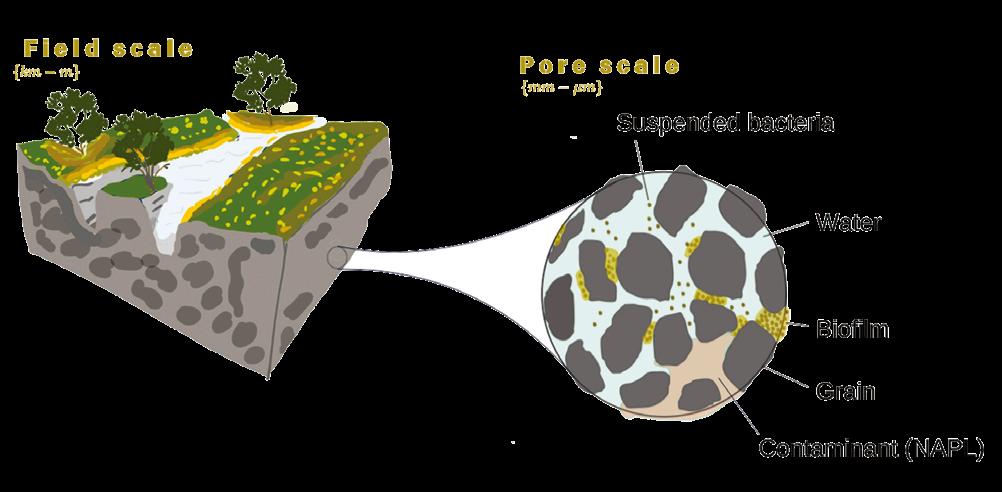
The aquifers beneath our feet hold large quantities of groundwater, which are often a primary source of drinking water, yet they are not insulated from the environment above ground, and contaminants can seep into the soil and filter downwards. In these circumstances colloidal particles, essentially a suspension of particles within a fluid, can be used to remediate groundwater supplies and maintain water quality. “Colloidal particles can be used in subsurface environments to remove contaminants,” explains Dr Sophie Roman, Associate Professor at the University of Orléans, working in the Porous Media Research Group of the Institut des Sciences de la Terre d’Orléans. This first requires a deep understanding of the flow of colloidal particles however, a topic at the heart of Dr. Roman’s work as Principal Investigator of the ERC-backed TRACE-it project. “We want to see how we can actually drive these particles, these colloids - between tens of nanometres and a micrometre in size - towards a particular region of interest. This might be contaminants in an aquifer, or a dissolving fracture in rock,” she outlines. Depending on the remediation strategy, these particles may be engineered metal nanoparticles, naturally occurring mineral grains, or even living bacteria. “Geological environments are made of grains, voids, and fractures, forming what are called porous media. In such complex structures, they are many different paths and directing particles to a specific region is not easy.”
Diffusiophoresis
A mechanism called diffusiophoresis can be used to essentially drive particles to a
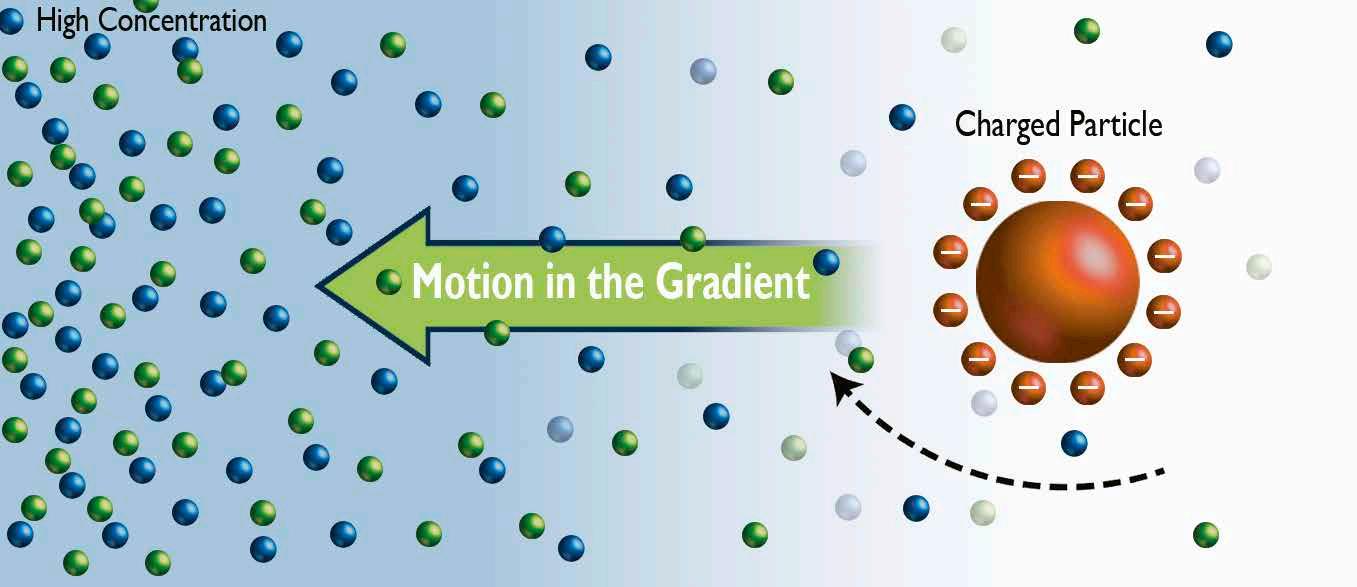
region of interest, now as part of her role in the project Dr. Roman is investigating how it works in geological porous media. With diffusiophoresis, particles move due to differences in concentration gradients of dissolved species. “If colloids are in a straight channel for example, with a high salt concentration on one side and a low salt concentration on the other, the colloids will then move to the side with a higher or lower concentration, depending on the properties of the salts and the properties of the particles,” explains Dr. Roman. The idea is to use concentration gradients of different species to essentially drive colloids in a particular
direction. “Diffusiophoresis is a specific mechanism to displace colloids,” continues Dr. Roman. “In the project we are conducting microfluidics experiments, considering models of spherical particles, of a fairly regular size. We aim to replicate - on a microfluidic chipthe geometry of porous media, the network of channels that can be found in aquifers and reservoirs, which typically have a diameter around the size of a human hair. So we’re doing this research at a very small scale.”
Microfluidics
Developments for Geosciences
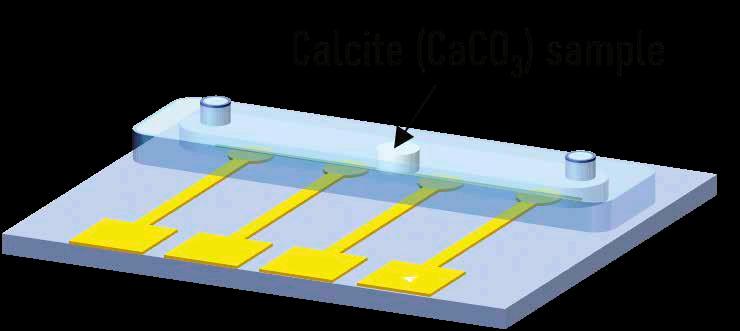
This network of channels is etched onto
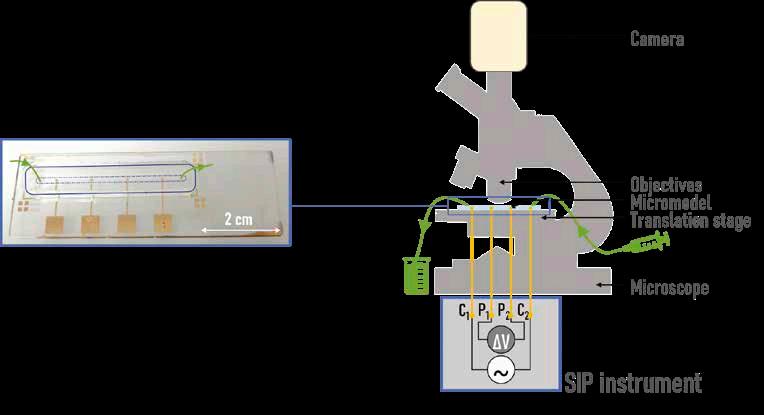
a substrate and covered by a transparent material, then when the chips are placed under a microscope, researchers can directly visualise the flow processes within porous media. Dr. Roman and her colleagues are looking to gain deep insights into the nature of the flow and the behaviour of colloidal particles from these experiments. “We are developing techniques to measure flow velocities in these experiments, and to get access to certain types of chemical information. We are continuously developing new methods in our team, we want to probe the properties of chemical gradients,” she says. Image processing and spectroscopy techniques are also being used in the project to build a deeper picture. “The way light interacts with our materials gives us information about its chemical composition. This is quite effective in detecting certain minerals with different chemistries,” explains Dr. Roman. “We also want to adapt this technique to detect species in solution, that are dissolved in the fluid, thus probing chemical gradients in situ and in real time. When water is in contact with minerals some of them may dissolve in the solution. This gives you water that is particularly rich in calcium, magnesium or other components.”
The project team has also developed the first geo-electrical monitoring method on microfluidic chips. Geophysicists relate electrical signals to physico-chemical processes in the soil and subsurface, now in the TRACE-it project Dr Roman plans to use them to probe concentration gradients at the pore-scale. “We’re working to improve different microfluidic methods, which can then be adapted for a variety of applications,” she continues.

The Wider Aim
The wider aim in the project is to include diffusiophoresis in models to describe the transport of particles in porous media, which is typically neglected in current models. The importance of the mechanism is likely to
colloids, sometimes the velocity of water may be more important, there are still unanswered questions in this area,” says Dr. Roman. “There will also be some cases where we cannot ignore diffusiophoresis, where it will actually lead to the deviation of particles from a particular path.”
“We want to see how we can actually drive these particles, these colloids, towards a particular region of interest. This might be contaminants in an aquifer, or a dissolving fracture in rock.”
vary in different situations. “We can see that diffusiophoresis will not have a big influence on particle transport in some types of system, as generally, the velocity of particles due to diffusiophoresis is quite slow. Water velocity in the subsurface is also quite slow, but greater in most cases than the velocity due to diffusiophoresis. In some cases diffusiophoresis might be an important mechanism to displace
Applications of colloids
This research supports the longer-term goal of using colloidal particles for specific engineering applications, such as remediating groundwater, or limiting the dissolution of minerals. As part of the TRACE-it project researchers have published a paper on mineral dissolution, which Dr. Roman says holds important implications. “When a
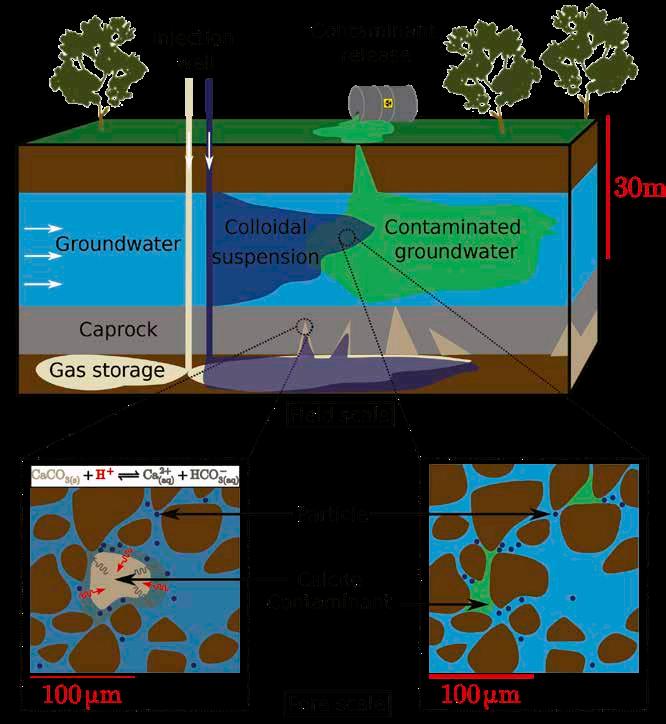
(like sand or rock) whose connected voids store and transmit water underground. Image credit Noura Eddaoui
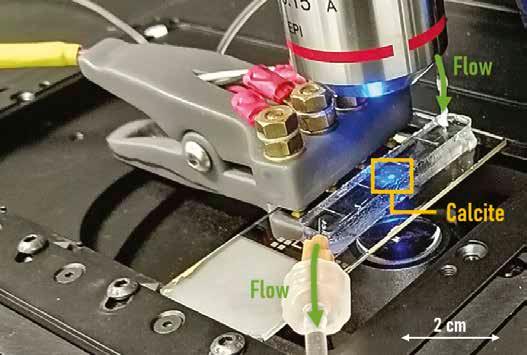
Geo-electrical monitoring under the microscope.
The microfluidic chip is observed under a microscope to watch the chemical reaction in real time, while a Spectral Induced Polarization device measures the accompanying electrical signals.
Left: A microfluidic chip with integrated electrodes used to monitor, through geo-electrical measurements and direct visualisation, the dissolution of a calcite grain inside a microchannel.
Diffusiophoresis is the motion of charged particles (10 nm–10 µm in diameter) induced by solute concentration gradients. Depending on the properties of the solute (e.g., salts, organic compounds) and of the particle surface, the motion can occur toward either higher or lower concentrations.
Diffusiophoresis: chemical gradients generated by dissolution drive colloids for CO storage integrity and groundwater remediation.” Image credit: Florian Cajot.
Images credit: Flore Rembert
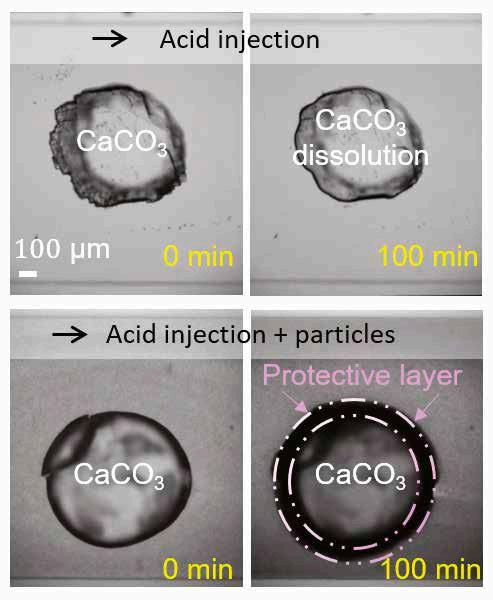
When acid is injected into a microchannel containing a calcite grain, the grain gradually dissolves. If particles are injected as well, they may form a passivation layer around the grain, slowing or inhibiting its dissolution.
TRACE-it
Controlling particle flow driven by local concentration gradients in geological porous media
Project Objectives
TRACE-it aims to control colloidal particle transport in geological porous media using in situ solute concentration gradients (diffusiophoresis). Using combined microfluidic experiments and multi-scale modelling, the project quantifies these gradients and integrates diffusiophoresis into porous-media transport models to guide particles toward targeted subsurface regions.
Project Funding
This project has received funding from the European Research Council (ERC) under the European Union’s Horizon Europe research and innovation programme (grant agreement No 101039854)

TRACE-it Research Team https://erc-trace-it.cnrs.fr/home/people/
Contact Details
Project Coordinator, Dr. Sophie Roman Associate Professor Campus geosciences 1A rue de la Férollerie 45100 Orléans
France
T: +33 2 38 25 50 26 E: sophie.roman@univ-orleans.fr W: https://www.sophieroman.com
Rembert F., Stolz A., Soulaine C., Roman S., A microfluidic chip for geoelectrical monitoring of critical zone processes. Lab on a Chip, 23, pp.3433, 2023.
Roman S., Rembert F., Kovscek A.R., Poonoosamy J., Microfluidics for geosciences: metrological developments and future challenges. Lab on a Chip, 25 (17), pp.4273-4289, 2025.
Roman S., Rembert F., Inhibition of mineral dissolution by aggregation of colloidal particles driven by diffusiophoresis. Physical Review Fluids, 10, 2025.
Dr. Sophie Roman

Dr. Sophie Roman is an Associate Professor at the University of Orléans (France) and a member of the Institut des Sciences de la Terre d’Orléans (ISTO). She leads the Nanoµlab, a state-of-the-art micronanofluidic facility dedicated to exploring coupled processes in porous media.



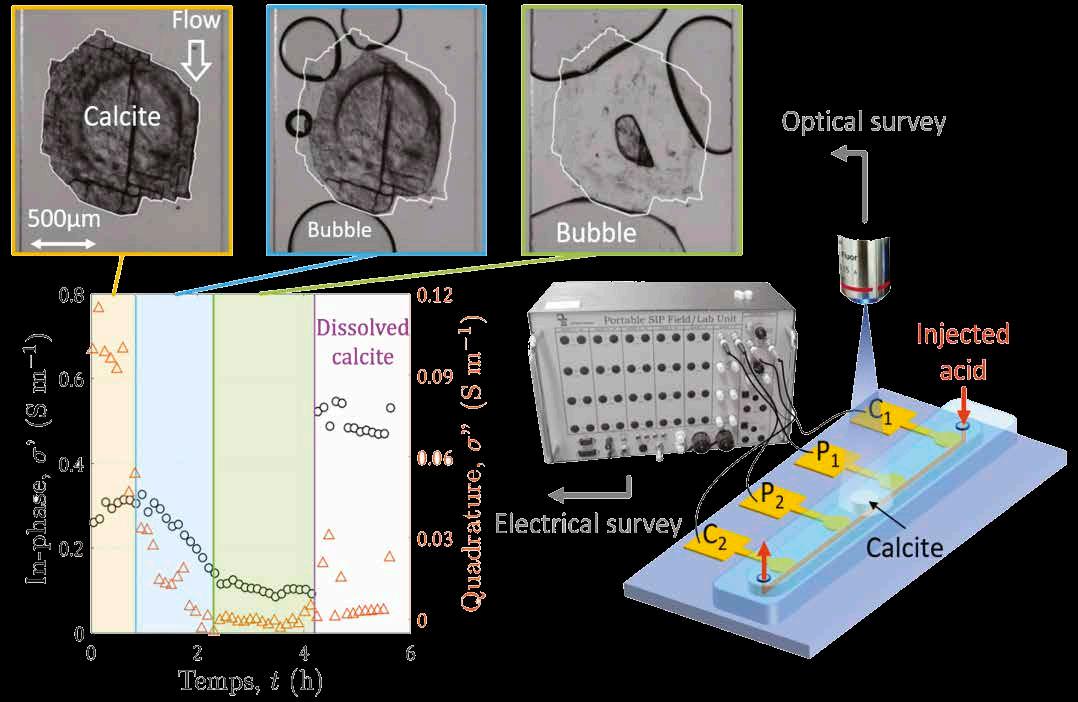
The team developed the first geo-electrical monitoring system on a chip, coupling calcite dissolution imaging with electrical signals recording. The electrical signal reflects the three phases during dissolution —saturated conditions, CO2 bubble formation, and CO2 bubble detachment.” Image credit: Flore Rembert
mineral dissolves, a concentration gradient is created, because species are released into the surrounding water during the dissolution,” she outlines. When colloids are injected during the dissolution they can aggregate around the dissolving mineral, and they may then have wider effects, depending on their specific properties. “Some colloids are attracted to the dissolving mineral, and they can either slow down or completely stop the dissolution,” continues Dr. Roman. “We have been able to show that this is driven by diffusiophoresis - that it is the concentration gradient generated by the dissolution of minerals that makes the colloidal particles move towards the dissolving minerals. This concentration gradient is generated locally.”
“Some
agenda in future; over the course of the project some unexpected physical-chemical processes have been identified, which she plans to investigate further in future. “We want to look at the feedback between mineral reactions, colloidal transport and also certain chemical reactions between the colloids and the minerals,” she says. There is also a lot of interest in working with colloids which more closely resemble those found in nature. At the moment most researchers generally work with uniformlysized, spherical colloids, but in future they could work with different types, such as clay particles or bacteria, as well as different sizes, while the effects of pore-clogging could also be included in further projects. “When
colloids are attracted to the dissolving mineral, and they can either slow down or completely stop the dissolution.”
The project team are also looking at the effects of concentration gradients from other sources, such as hydrocarbons or chlorinated solvents, and investigating the trajectories of particles in different circumstances. This research is largely fundamental in nature, yet Dr. Roman says it also holds wider relevance to the potential application of small particles in groundwater remediation. “Through our research we aim to identify what kinds of particles will be suitable for what kinds of contaminants. We know that some particles will be attracted to the source of dissolved species, and some particles will not, depending on their properties,” she explains. There is still much to learn about particles flow in porous media however, and fundamental research will remain an important part of Dr Roman’s
you inject colloids in a porous medium some of the particles may get stuck in the pores, depending on the properties of the particles and the nature of the flow. These particles that get stuck clog the pore and this changes the properties of the porous medium. The flow cannot go through, so it has to go in another direction, which completely changes the flow path and the properties of the flow,” explains Dr. Roman. The effects of pore-clogging and diffusiophoresis have previously been considered separately, but Dr. Roman hopes to bring these topics together in future, and build a fuller picture of particle flow in porous media. “We are looking into combining our results with those from other projects, in particular the ERC-backed COCONUT project, and including the effects of both poreclogging and diffusiophoresis,” she says.