TETRAS Project Pilot Studies
There are four pilot studies within the TETRAS project, investigating different topics around the operation and management of RAS. We spoke to representatives of two pilot activities in Denmark, Mette Jørgensen and Annette Løttrup-Moore , about the project's work and how it will support the transition towards a circular blue economy.
EUR: What is your role in the TETRAS project?
Annette Løttrup-Moore: I am business development manager at Business LollandFalster, a business support organisation, one of the partners in the project. We are working to bring a very large, land-based fish production facility to our local region, which will produce around 5,000 tonnes of fish a year. In the pilot study we are looking at how to treat water from the facility to avoid discharging large amounts of nitrogen into the Baltic Sea.
Saltwater will be extracted from the ocean for use in the facility. Instead of then discharging it straight back into the ocean, we want to treat it so that it can be used for industrial purposes. How can we treat this water and use it for something else? What can we do with the residue filtered out of the wastewater?
EUR: What kind of water quality levels are you looking to achieve?
AM: We have been looking at cleaning the wastewater to the same quality as drinking water. If we can achieve this, we can then look to re-use the water in industry, for example in power-to-x, or for cooling water, rather than relying on limited groundwater resources. Water recovered from saltwater RAS can be re-used by many different industries.
EUR: What is the current status of the pilot?
AM: We've got the result from our pilot tests, and an expert is currently writing up a report.
We've shown that we can clean wastewater to drinking water quality levels, at a competitive price.
One of our recommendations is to conduct further research into the feed supply – where does the feed come from? What goes in it?
We also recommend looking into the treatment of residue from the cleaning of the water. That is the big issue, how can we separate the residue? And what can we do with it?
Raising awareness
EUR: What is your role in the TETRAS project?
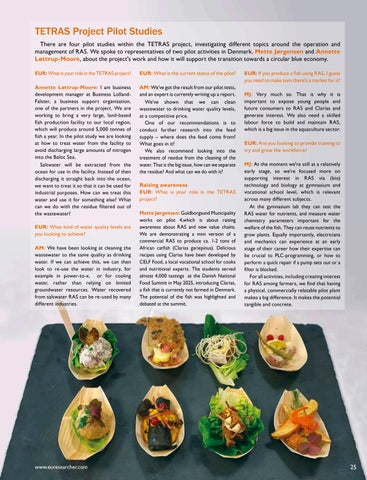
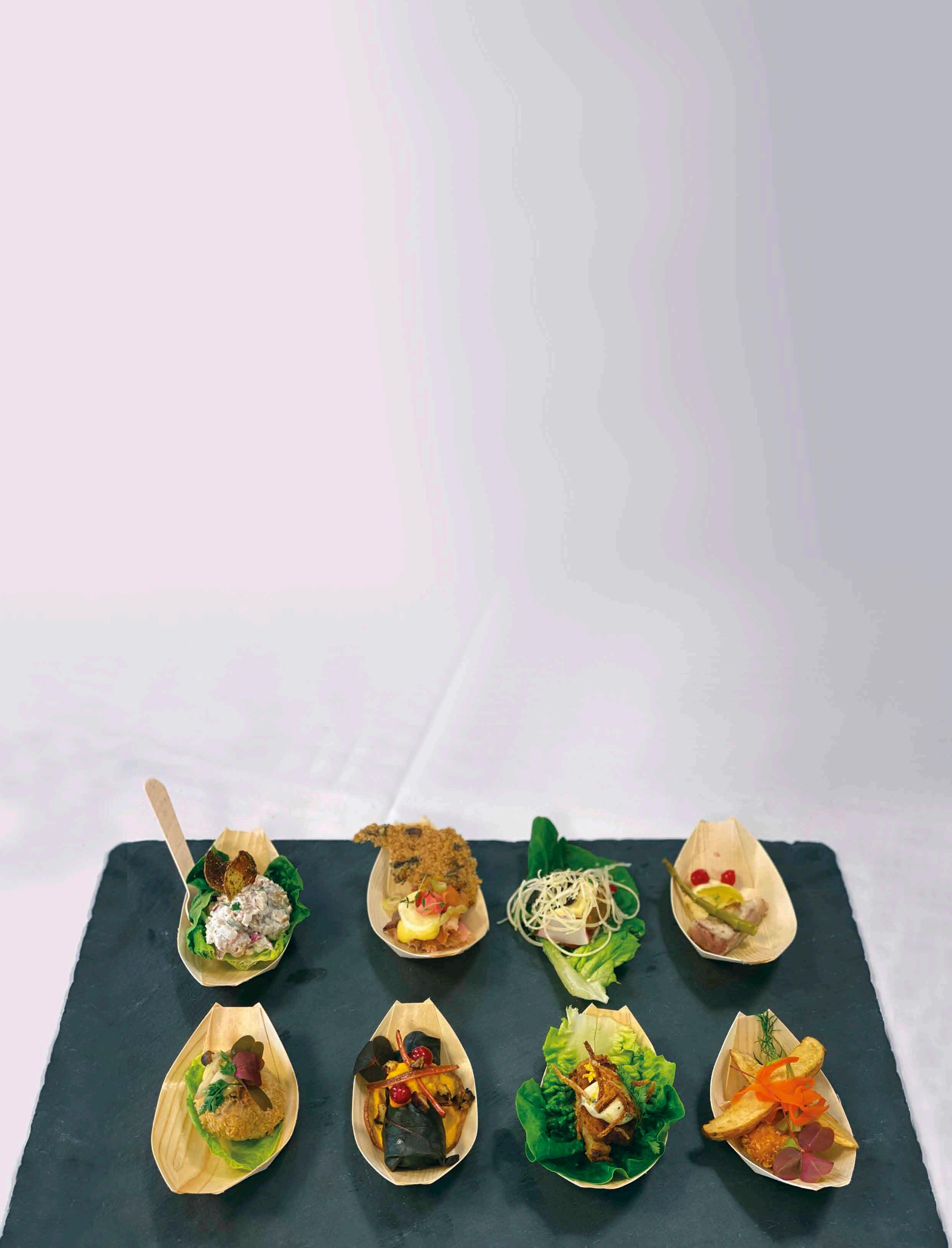
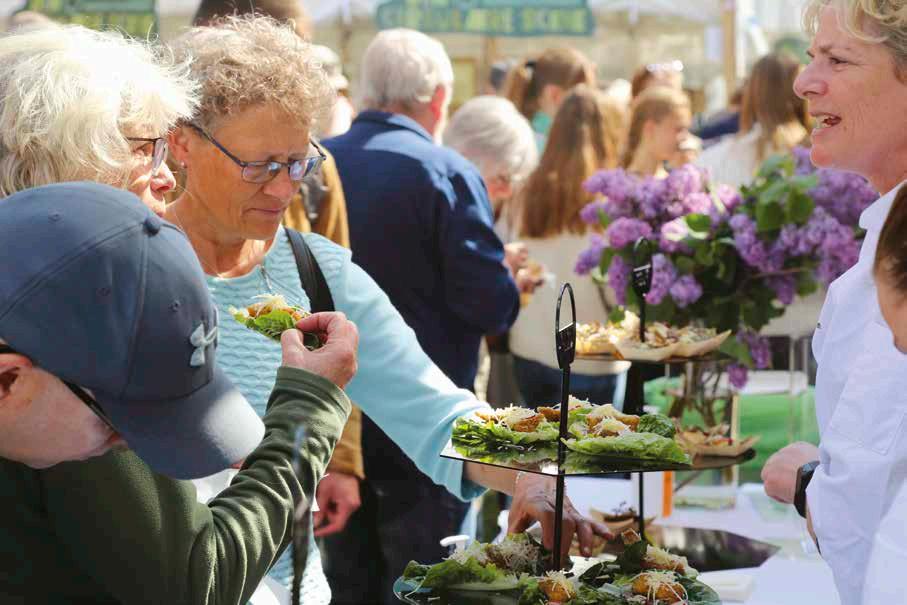
Mette Jørgensen: Guldborgsund Municipality works on pilot 4,which is about raising awareness about RAS and new value chains. We are demonstrating a mini version of a commercial RAS to produce ca. 1-2 tons of African catfish (Clarias gariepinus). Delicious recipes using Clarias have been developed by CELF Food, a local vocational school for cooks and nutritional experts. The students served almost 4,000 tastings at the Danish National Food Summit in May 2025, introducing Clarias, a fish that is currently not farmed in Denmark. The potential of the fish was highlighted and debated at the summit.
EUR: If you produce a fish using RAS, I guess you need to make sure there's a market for it?
MJ: Very much so. That is why it is important to expose young people and future consumers to RAS and Clarias and generate interest. We also need a skilled labour force to build and maintain RAS, which is a big issue in the aquaculture sector.
EUR: Are you looking to provide training to try and grow the workforce?
MJ: At the moment we're still at a relatively early stage, so we're focused more on supporting interest in RAS via (bio) technology and biology at gymnasium and vocational school level, which is relevant across many different subjects.
At the gymnasium lab they can test the RAS water for nutrients, and measure water chemistry parameters important for the welfare of the fish. They can reuse nutrients to grow plants. Equally importantly, electricians and mechanics can experience at an early stage of their career how their expertise can be crucial to PLC-programming, or how to perform a quick repair if a pump sets out or a filter is blocked.
For all activities, including creating interest for RAS among farmers, we find that having a physical, commercially relatable pilot plant makes a big difference. It makes the potential tangible and concrete.
New relationships to support fish farming
Land-based recirculating aquaculture systems (RAS) are a sustainable and controllable means of producing fish, yet in isolation they can be both expensive and energy intensive. The TETRAS project team are exploring new ways of re-using aquaculture sidestreams and establishing symbiotic relationships with other industries, as Freya Robinson and Erika Zavackienė explain.
The aquaculture sector has an important role to play in meeting global food demand, and the industry is set to grow rapidly over the coming years, with levels of fish consumption projected to rise. Landbased recirculating aquaculture systems (RAS) offer a sustainable means of producing fish, as Freya Robinson, a project manager at the Submariner Network in Berlin, explains. “With land based RAS we are able to reuse up to 95 percent of the water, so you don't have to input large quantities of freshwater. RAS is also a controlled environment, so you don't have to worry about external parasites, like with sea-based systems such as salmon farms for example, and you can control the amount of waste you are discharging into the surrounding environment,” she outlines. The water is then filtered, and particulate matter is removed, forming a kind of sludge, which Robinson says represents a potentially valuable resource. “The sludge can then be used for fertiliser or biogas for example, rather than just being released back into the environment,” she continues.
Industrial relationships
As solution transfer manager of the EU-backed TETRAS project, Robinson is now working to build new industrial relationships and encourage the re-use of both this sludge and wastewater in countries around the Baltic Sea, helping to improve the economic and environmental sustainability of RAS. The project team, bringing together 10 partners and 14 associated organisations from countries across Europe, is exploring new ideas around industrial symbiosis. “We're looking at ways to not just put water back into the environment, but to reuse even small amounts for other industries,” explains Robinson. This involves to some extent a shift in perspective, away from aquaculture companies viewing waste simply as material to be disposed of as quickly as possible, but rather as another potential income stream. “We're trying to promote the circularity approach and look at how waste from the aquaculture sector can be processed and then re-used, for example by a concrete producer, or in the agriculture industry ,” continues Robinson. The way in which this waste can be reused will depend to a large degree on the species
of fish that are being produced at a particular site and its overall composition, as well as the regulations and local policy regarding reuse of aquaculture nutrient streams. There are four pilots within TETRAS addressing different topics around RAS, and a number are working with specific fish species. “For example, in our Lithuanian pilot we're producing shrimp and rainbow trout, while our partners in Denmark are working with catfish (Clarias gariepinus),” says Robinson. The conditions required to produce different types of fish may vary; geothermal brine is
economic and environmental sustainability of RAS, a topic high on the project's overall agenda. In isolation RAS can be both expensive and energy-intensive, but re-using materials and establishing mutually beneficial relationships with other industries can help bring down costs. “It is very important that these new technologies are economically viable. So we are developing new business models, focussing primarily on the RAS aspect,” outlines Robinson. The team at the Klaipéda Science and Technology Park (KMTP) in Lithuania play an important role
"We're trying to promote the circularity approach and look at how waste from the aquaculture sector can be processed and then re-used, for example by a concrete producer."
being used to support the growth of the shrimp and rainbow trout in the Lithuanian pilot rather than artificial salt or seawater, yet Robinson says this doesn't require specific filtration methods. “The tools required for different types of filtration and to enable the use of wastewater can be adapted to different systems,” she continues. “The industrial symbiosis concept can also be adapted to different species, depending to some degree on what waste they produce.”
This concept could also enhance the
here, by effectively acting as a bridge between business and academia. “We are looking at different ways to connect companies with new research ideas and to generate novel business models,” says Erika Zavackien ė , Innovation Manager at KMTP and Project Coordinator of TETRAS. “We have established a very close relationship with the local university, which is a key stakeholder, and businesses are looking for new solutions. We work closely with scientists and look to identify new possibilities.”
Policy recommendations
The experimental side of the project's work is nearly concluded, so now the focus is moving towards writing up the results, with the aim of providing recommendations and guidance to policy-makers on the ongoing development of RAS. The team are working towards four main deliverables - focused on the individual pilotsand one main output, which will bring together all elements of the project's work. “This will be a kind of guide to decision-makers, both in public policy and also the commercial sector, about how to adapt or integrate RAS systems. This is really interesting for Lithuania and Estonia in particular, as they do not have many RAS,” says Robinson. By contrast the RAS industry is fairly well-established in Denmark, and the government's recent decision to halt any further expansion of sea-based fish farming may lead to more interest in land-based systems, underlining the wider relevance of the project's work. “There is a lot of interest in novel RAS solutions,” continues Robinson. This work forms part of the wider blue growth agenda, aiming to support long-term, sustainable growth in the marine sector. With land-based aquaculture systems set to play a major role in fish production, new challenges and opportunities will arise, and Zavackien ė says effective collaboration between business and academia will help support the ongoing development of RAS.
“Many businesses are looking for more effective solutions, and we regularly run workshops and discussions, bringing together scientists and the commercial sector,” she says. “We aim to demonstrate the potential of innovative industrial symbiosis concepts in supporting RAS, and will have more discussions with businesses and policy-makers in future, beyond the end of the project.”
TETRAS
Technology Transfer for Thriving Recirculating Aquaculture Systems in the Baltic Sea Region
Project Objectives
TETRAS aims to improve the economic and environmental sustainability of recirculating aquaculture systems (RAS) by demonstrating new concepts of industrial symbiosis where RAS systems are placed strategically or combined with industrial processes to increase resource efficiency (i.e. water, energy) while producing affordable and healthy food.
Project Funding
Funded by the Interreg Baltic Sea Region and co-funded by the European Union.
Project Partners
• Klaipeda Science and Technology Park (Lead partner) • SUBMARINER Network for Blue Growth EEIG • Klaipeda University • Blue Research ApS • Ida-Viru Investment Agency • Guldborgsund Municipality • University of Gdansk • Business LollandFalster • Wismar University of Applied Sciences; Technology, Business and Design • AB Akola group
Contact Details
Erika Zavackienė, Project Manager Klaipėda science and technology parkVilhelmo Berbomo g. 10 -106 LT-92221 Klaipėda T: +370 684 50212
E: erika.zavackiene@kmtp.lt
Freya Robinson, SUBMARINER
E: fr@submariner-network.eu
W: https://interreg-baltic.eu/project/tetras/
Annette Løttrup-Moore - 15 years’ work experience from East Africa and an MSc in Sustainability and Environmental Management, are being utilised as a project manager on aquaculture projects. Freya Robinson – MSc in Aquaculture; experienced in fish welfare, technology trials, and leading international aquaculture projects across Horizon and national funding frameworks.
Mette Jørgensen - MSc in Agronomy and Master’s Degree in Rural Development and Landscape Management. Programme coordinator in Bioeconomy Hotspot, Guldborgsund Municipality.
Erika Zavackienė - Innovation-focused Project Manager at Klaipeda Science and Technology Park with extensive experience in EU projects, startup consulting, business development, and academia-industry collaboration.
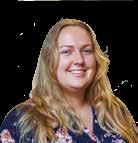
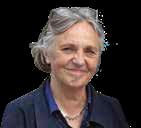
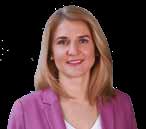
Annette Løttrup-Moore, Freya Robinson, Mette Jørgensen, and Erika Zavackien ė (left to right)
Clarias tastings at the Danish Food Summit, May 2025.
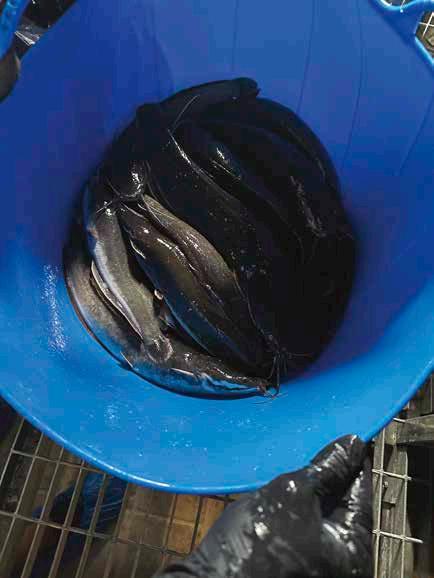
Clarias being weighed as part of Pilot 4 sampling activities, June 2025.
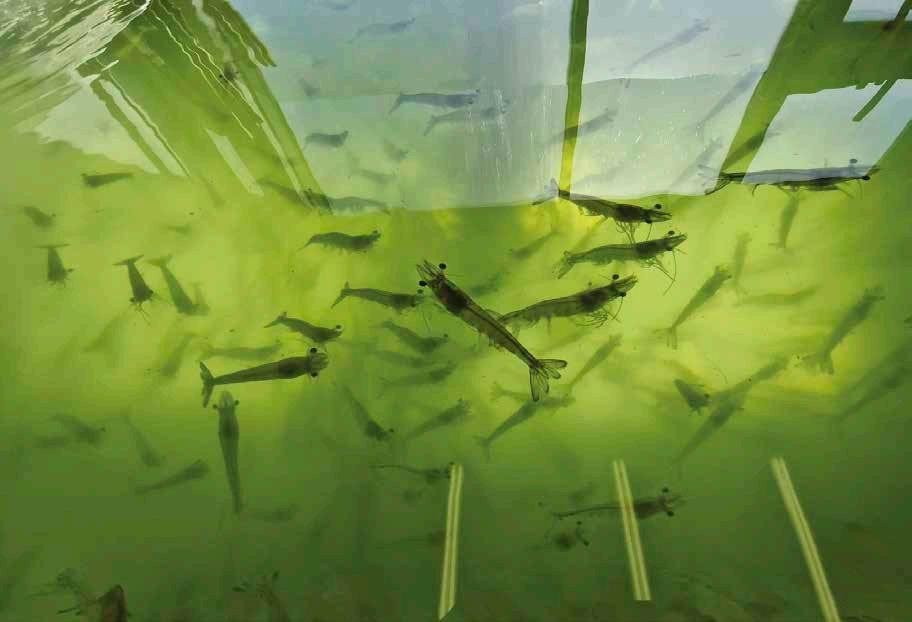
White leg shrimp grown in geothermal brine as part of Pilot 2.
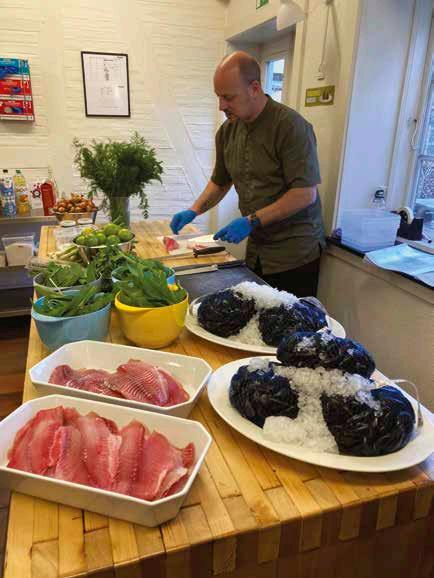
Tilapia and Mussels on the menu! Cooking class hosted by Anette Pedersen and Martin Rommel at Sakskøbing Madskole as part of the TETRAS Partner Meeting in Nykobing Falster, Denmark, March 2025.