Much of the plastic in the world’s oceans finds its way there from rivers, so addressing the issue of riverine litter is crucial to limiting marine pollution. We spoke to Andrej Krzan, Thomais Vlachogianni and Tomaso Fortibuoni about their research into how rivers contribute to marine plastic pollution, which is an important step towards mitigating the problem.
There is intense global concern over the volume of plastic in the world’s oceans, which is polluting marine environments, harming aquatic species and affecting biodiversity. Much of this plastic finds its way into the oceans from rivers which flow out into the sea, says Andrej Krzan, a Senior Scientific Associate at Slovenia’s National Institute of Chemistry. “Rivers are a major contributor of the plastics that we then find in the world’s oceans,” he acknowledges. As part of the team behind the TETHYS4ADRION project, an EUbacked initiative funded under the Interreg IPA Adrion programme, Krzan is working to build a deeper picture of how plastics enter rivers, a key step towards addressing the wider issue of marine plastic pollution. “We want to go to different rivers to see where these plastics actually come from, how they travel down rivers, and how we could then prevent or limit plastic pollution,” he outlines. “The project brings together partners from the countries around the Adriatic and Ionian seas, so we can cover a lot of territory.”
TETHYS4ADRION project
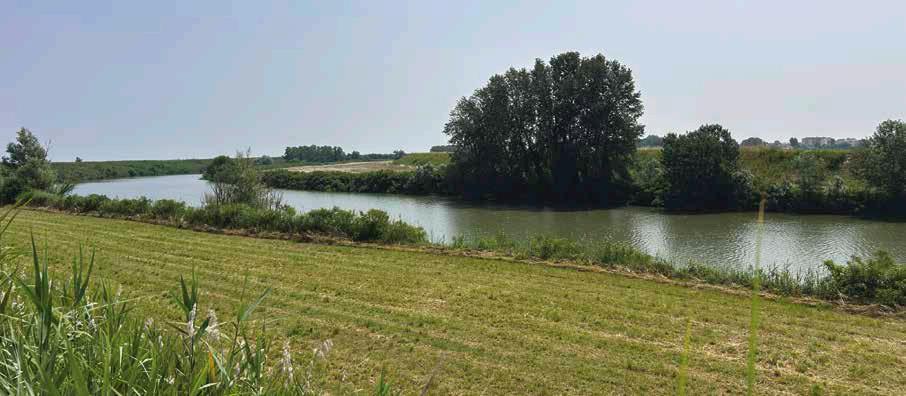
This work is focused on five rivers across the Adriatic-Ionian region, each with very different characteristics. The river Soča for example flows fairly quickly through a mountainous area of Slovenia into Italy, while the river Reno is much longer and slower. “The Reno is particularly slow in the lower sections where it flows through a fairly flat area around Bologna,” says Krzan. The project’s agenda also includes
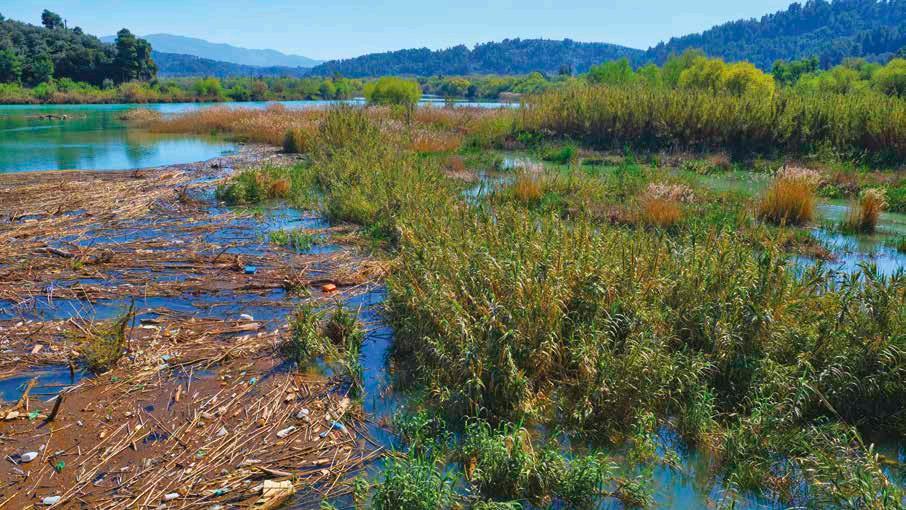
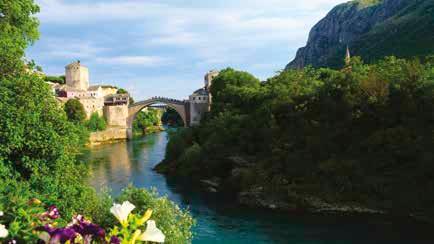
investigating plastic pollution in the Neretva, a large flow river which goes through relatively mountainous areas in Bosnia and Herzegovina, and neighbouring Croatia.
“The Neretva has a very large watershed, and is known to bring relatively large amounts of waste in its flow,” continues Krzan. “We are also looking at the river Buna/Bojana, which flows through Albania and Montenegro. Then we’re investigating plastics in the Alfeios in the Peloponnese in Greece, which is a completely different type of river. It’s less dependent on snow melt and its flow regime is largely driven by rainfall and karstic/groundwater input.”
There are also marked variations in the flow of these rivers across the seasons, with more rain and snow-melt during the Spring and Autumn influencing flow rates for example, which will then affect the way
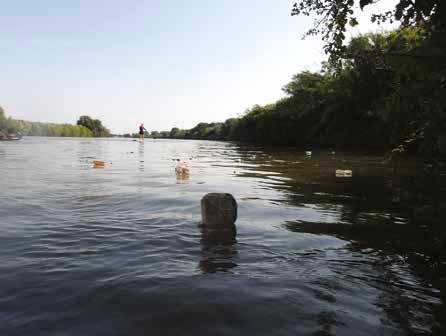
that plastics are transported. Rivers are turbulent, unpredictable bodies of water, and in the project researchers are looking to understand how plastics move within them. “We’re studying how plastic waste is transported in aquatic systems, and where it tends to accumulate,” says Thomais Vlachogianni, head of Science Policy and Research at MIO-ECSDE, a network of 136 environmental NGOs from around the Mediterranean. Because plastic items come in a range of sizes and further break down over time in the environment, the project team is considering different size classes of plastics. “By assessing macro-, meso- and micro-plastics we aim to develop a comprehensive understanding of the diversity of plastic types, their sources, and their associated effects,” continues Vlachogianni. “To support this work, the
project entails capacity-building activities designed to equip all participating parties with the skills needed to monitor litter along river basins.”
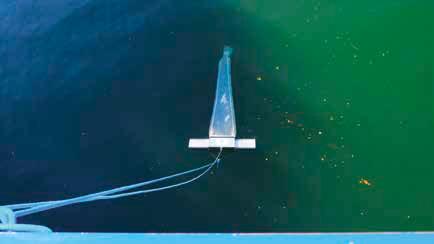
The main priority at the moment is to investigate what kinds of litter tend to end up in rivers, which can then inform the development of preventative measures in future. A number of robust sampling and monitoring methodologies have been identified, and Krzan says they will be tested by the project team. “These methodologies range from deploying a manta net from a bridge, to conducting visual surveys of floating litter, carrying out riverbank surveys and collecting riverbank sediments, to using drones. We can gain a comprehensive overview of the river system, and we can follow how a polluting item moves down the river,” he outlines. Data will also be gathered from GPS trackers inside plastic bottles; taken together, these different data sources will help researchers build a deeper picture of how plastics enter and move along rivers. “We aim to develop a harmonised approach for monitoring plastics in these rivers, to be applied consistently by all project partners,” continues Krzan. “We can then compare the situation on the same basis and move forward together on defining potential solutions, which we can then promote with policy-makers.”

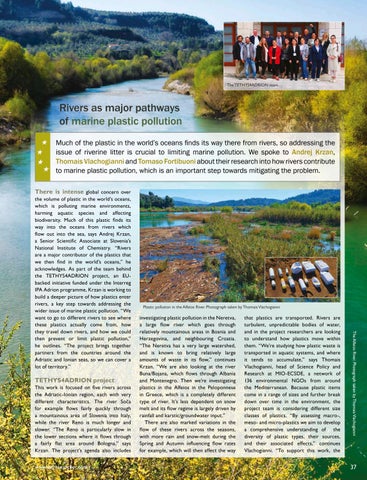
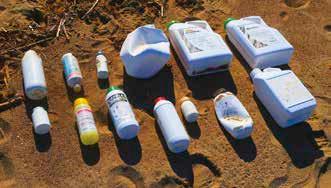
Since the project emphasizes prevention, its primary focus is on preventing plastic pollution rather than removing it from riverine environments. Plastics may enter a river from a variety of sources, and the plan is to identify the human activities that are contributing to the problem; poor municipal waste management practices, tourism and agriculture are among the most prominent culprits. “In the case of Alfeios, early findings suggest that a significant proportion of the litter comes from the agricultural sector,
“Further challenges exist: Greece, like many Mediterranean countries, lacks a comprehensive, fully operational strategy for managing agricultural plastic waste.”
A geodatabase is being developed in the project, bringing together information about the areas in which plastics have accumulated and where they have been illegally dumped, which will provide a valuable resource in this respect. “We have found that there are illegal dumping sites in some countries close to rivers, which are a major source of pollution,” says Tomaso Fortibuoni,
“We want to go to rivers to see where these plastics actually come from, how they travel down rivers, and how we could then prevent or limit plastic pollution. The project brings together partners from the countries around the Adriatic and Ionian seas.”
mainly consisting of pesticide containers, including those for products such as Roundup, raising concerns about potential ecological risks for aquatic ecosystems and biodiversity,” says Vlachogianni. A key step is to enhance awareness of the issue, as many farmers don’t realise they are contributing to river pollution or assume it’s someone else’s responsibility.
“Some point to local municipalities for poor waste management practices, while discarding very harmful types of litter near rivers themselves,” continues Vlachogianni.
a researcher at the Italian Institute for Environmental Protection and Research (ISPRA), a member of the project team. The general public have an important role to play in identifying these kind of sites and the plan is to implement a comprehensive participatory science campaign that provides relevant, fitfor purpose data in the battle against plastic pollution. “We want to have data that can be used in decision-making, in identifying the problem, and that helps us come up with tailor-made solutions,” outlines Fortibuoni.
“While there are regulations in place to address plastic pollution—particularly at the EU level—they need to be implemented in a targeted, rigorous way to be truly effective.”
With the project nearing the halfway point of its three-year funding term, researchers are building a deeper picture of where plastic pollution originates, which Krzan hopes will inform the direction of future policy. “We hope that our findings will provide a sound foundation for measures to reduce the level of plastic pollution,” he says. The hope is to provide solid data about the situation in these five very different rivers throughout the course of the year, taking into account seasonal variations. “We want to provide fresh insights into the waste that’s being channelled towards the seas by rivers, and the dynamics behind their movement. The flow of pollution is thought to be connected
to seasonal conditions,” continues Krzan.
“We hope to formulate recommendations on how the issue should be addressed, which we plan to provide to policy-makers and decision-makers.”
This is a core objective in the project, with Krzan and his colleagues aiming to inform policy-makers at both the national, regional and European levels, giving them a sound basis on which to make their decisions. An expert group will also be established in the Adriatic-Ionian region, with the knowledge and capacity to provide support to local teams on the ground, and help achieve lasting, long-term reductions in plastic pollution. “It’s really important to be part of a wider network of support,” stresses Krzan.
Enhancing Cross-Border Cooperation for Riverine Plastic Litter Reduction in the Adriatic and Ionian Region
Project Objectives
Plastic pollution is a major environmental challenge in the Adriatic-Ionian region, with rivers as key pathways from land to sea. The TETHYS4ADRION project aims to investigate the role of rivers in contributing to marine plastic pollution and develop cross-border mitigation strategies to reduce riverine litter and protect the aquatic environment.
Project Funding
The TETHYS4ADRION project is cofunded by the European Union through the Interreg IPA ADRION Programme
Project Partners
Lead partner - National Institute of Chemistry – Slovenia • Institute of Oceanography and Fisheries • University of Tirana • Italian Institute for Environmental Protection and Research (ISPRA) • Mediterranean Information Office for Environment, Culture and Sustainable Development (MIO-ECSDE) • Hellenic Center for Marine Research (HCMR) • Institute of Marine Biology, University of Montenegro • Water Institute of the Republic of Slovenia –Slovenia • City of Metković • City of Čapljina
Contact Details
Project Coordinator, Prof. Andrey Kržan


National Institute of Chemistry Hajdrihova ulica 19 1000 - Osrednjeslovenska, Slovenija (SI) E: andrej.krzan@ki.si : https://www.linkedin.com/company/ tethys4adrion : https://www.instagram.com/tethys4adrion W: https://tethys4adrion.interreg-ipaadrion.eu



Dr. Thomais Vlachogianni is an environmental chemist and ecotoxicologist, and Head of Science, Policy & Research at MIO-ECSDE.
Dr. Tomaso Fortibuoni is an environmental scientist and researcher at the ISPRA in Italy. His research focuses on the assessment and management of anthropogenic pressures on the marine environment.