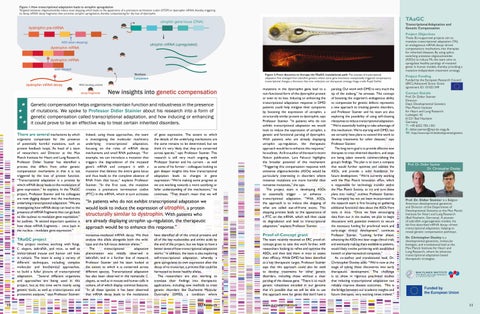
Figure 1: How transcriptional adaptation leads to utrophin upregulation Targeted antisense oligonucleotides induce exon skipping, which leads to the appearance of a premature termination codon (STOP) in dystrophin mRNA, thereby triggering its decay. mRNA decay fragments then promote utrophin upregulation, thereby compensating for the loss of dystrophin.
TAaGC Transcriptional Adaptation and Genetic Compensation
Project Objectives
These EU-supported projects aim to translate transcriptional adaptation (TA), an endogenous mRNA-decay–driven compensatory mechanism, into therapies for inherited diseases. By using spliceswitching antisense oligonucleotides (ASOs) to induce TA, the team aims to upregulate healthy paralogs of mutated genes in human models, thereby providing a mutation-independent treatment strategy. Figure 2: From discovery to therapy: the TAaGC translational path: The concept of transcriptional adaptation first emerged from zebrafish genetics where some gene knockouts unexpectedly triggered compensatory transcriptional changes, a discovery that now underpins our therapeutic strategy. Image credit: Rupal Gehlot
New insights into genetic compensation Genetic compensation helps organisms maintain function and robustness in the presence of mutations. We spoke to Professor Didier Stainier about his research into a form of genetic compensation called transcriptional adaptation, and how inducing or enhancing it could prove to be an effective way to treat certain inherited disorders. There are several mechanisms by which organisms compensate for the presence of potentially harmful mutations, such as protein feedback loops. As head of a team of researchers and Director at the Max Planck Institute for Heart and Lung Research, Professor Didier Stainier has identified a process that differs from other genetic compensation mechanisms in that it is not triggered by the loss of protein function. “Transcriptional adaptation is a process by which mRNA decay leads to the modulation of gene expression,” he explains. In the TAaGC project, Professor Stainier and his colleagues are now digging deeper into the mechanisms underlying transcriptional adaptation. “We are investigating how mRNA decay can lead to the presence of mRNA fragments that can go back to the nucleus to modulate gene expression,” he outlines. “A second important question is how these mRNA fragments - once back in the nucleus - modulate gene expression.”
TAaGC project This project involves working with fungi, C. elegans, zebrafish, and mice, as well as immortalised mouse and human cell lines in culture. The team is using a variety of different techniques, including complex molecular and biochemical approaches, to build a fuller picture of transcriptional adaptation. “Several different organisms and approaches are being used in this project, but at this time we’re mainly using genetic tools, as well as transcriptomic and proteomic analyses,” says Professor Stainier.
10
Indeed, using these approaches, the team is investigating the molecular machinery underlying transcriptional adaptation, focusing on the roles of mRNA decay mechanisms and small RNA pathways. “For example, we can introduce a mutation that triggers the degradation of the mutated gene’s mRNA and compare it with a mutation that deletes the entire gene locus and thus leads to the complete absence of RNA from that locus,” explains Professor Stainier. “In the first case, the mutation creates a premature termination codon (PTC) in the mRNA, which in turn activates
of gene expression. The extent to which the details of the underlying mechanisms are the same remains to be determined, but we think it’s very likely that they are conserved across species,” says Professor Stainier. This research is still very much ongoing, with Professor Stainier and his current - as well as some of his former - colleagues looking to gain deeper insights into how transcriptional adaptation leads to changes in gene expression. “We’re making some progress as we are working towards a more satisfying or fuller understanding of the mechanisms,” he continues. “That doesn’t mean that we will
“In patients who do not exhibit transcriptional adaptation we would look to induce the expression of utrophin, a protein structurally similar to dystrophin. With patients who are already displaying utrophin up-regulation, the therapeutic approach would be to enhance this response.” nonsense-mediated mRNA decay. We then analyze this allele alongside both the wildtype and the full-locus deletion alleles.” The transcriptional adaptation phenomenon was initially observed in zebrafish, and in a further line of research Professor Stainier and his team looked at the extent to which it is conserved across different species. Transcriptional adaptation has also been observed in the nematode C. elegans, as well as in mouse and human cells in culture, all of which display common features. “In all these species it has been observed that mRNA decay leads to the modulation
have identified all of the critical proteins and all of the key nucleotides and amino acids by the end of the project, but we hope to have a better sense of how transcriptional adaptation works.” In addition, the team is also exploring self-transcriptional adaptation, whereby a gene upregulates its own expression after the decay of its transcript, a process that could be harnessed to boost healthy alleles. The researchers are also working to translate their findings into therapeutic applications, including new methods to treat genetic disorders like Duchenne Muscular Dystrophy (DMD), a condition where
EU Research
mutations in the dystrophin gene lead to a non-functional form of the dystrophin protein or even to its loss. Inducing or enhancing the transcriptional adaptation response in DMD patients could help mitigate their symptoms by boosting the expression of utrophin, a structurally similar protein to dystrophin, says Professor Stainier. “In patients who do not exhibit transcriptional adaptation we would look to induce the expression of utrophin, a genetic and functional paralog of dystrophin. With patients who are already displaying utrophin up-regulation, the therapeutic approach would be to enhance this response,” he outlines. As first author of the team’s recent Nature publication, Lara Falcucci highlights the broader potential of this mechanism: “Triggering this compensation response with antisense oligonucleotides (ASOs) would be particularly interesting in disorders where missense mutations are more harmful than nonsense mutations,” she says. The project team is developing ASOs to essentially trigger - or enhance transcriptional adaptation. “With ASOs, the approach is to induce the skipping of what are called out-of-frame exons. This skipping process leads to the appearance of a PTC on the mRNA, which will then cause its degradation and lead to transcriptional adaptation,” explains Professor Stainier.
Proof-of-Concept grant The team recently received an ERC proof-ofconcept grant to take this work further, with researchers looking to refine and optimise the ASOs, and then test them in mice to assess their efficacy. While DMD has been identified as a key therapeutic target, Professor Stainier says that this approach could also be used to develop treatments for other genetic disorders, including those without a clear paralog of the disease gene. “There is so much genetic robustness encoded in our genome that it’s possible that we will be able to use this approach even for genes that don’t have a
www.euresearcher.com
paralog. Our work with DMD is very much the tip of the iceberg,” he stresses. This concept of boosting the organism’s endogenous ability to compensate for genetic defects represents a new approach to treating genetic disorders, and Professor Stainier and his team are also exploring the possibility of using self-cleaving ribozymes to induce transcriptional adaptation. “We’re essentially looking to take advantage of this mechanism. We’re starting with DMD, but we certainly have plans to extend this work to develop treatments for other diseases,” says Professor Stainier. The long-term goal is to provide effective new therapies to treat inherited disorders, and steps are being taken towards commercialising the group’s findings. The plan is to start a company that would further optimise and validate the ASOs, and provide a solid foundation for future development. “We’re currently working with the Max Planck Innovation office, which is responsible for technology transfer within the Max Planck Society, to try and turn these plans into reality,” outlines Professor Stainier. The company has not yet been incorporated as the research team is first focusing on gathering additional functional data about the ASOs from tests in mice. “Once we have encouraging data from our in vivo studies, we plan to begin discussions with potential investors to secure the necessary funding for preclinical work and early-stage clinical development” continues Professor Stainier. “Looking further ahead, advancing the ASOs into later-stage clinical trials and eventually making them available to patients, would likely involve partnering with established biotech or pharmaceutical companies.” As co-author and translational lead, Dr. Christopher Dooley adds: “We’re now at the stage of taking these discoveries into early therapeutic development. The challenge is to show in rigorous preclinical studies that inducing transcriptional adaptation can reliably improve disease outcomes. This is the bridge between our academic insights and future therapies, very exciting times indeed.”
Project Funding
Funded by the European Research Council (ERC) Advanced Grant. Grant agreement ID: 101021349
Contact Details
Prof. Dr. Didier Stainier Director Dept. Developmental Genetics Max Planck Institute for Heart and Lung Research Ludwigstr. 43 61231 Bad Nauheim Germany T: +49 6032 705-1301 E: didier.stainier@mpi-bn.mpg.de W: https://www.mpi-hlr.de/developmental-genetics
Prof. Dr. Didier Stainier Dr. Christopher Dooley
Prof. Dr. Didier Stainier is a BelgianAmerican developmental geneticist and Director of the Department of Developmental Genetics at the Max Planck Institute for Heart and Lung Research (Bad Nauheim, Germany). A pioneer of zebrafish organogenesis models, his lab first described mRNA decay–driven transcriptional adaptation, helping to reveal genetic compensation pathways. Dr. Christopher Dooley is a developmental geneticist, molecular biologist, and translational lead at the Max Planck Institute for Heart and Lung Research, where he advances transcriptional adaptation based therapeutic strategies.
11