
Working Towards a Revolutionary Computer
Professor Erik Folven is working on the SpinENGINE project, full project name:
In all kinds of scientific fields, the ability to harvest huge amounts of raw data is exponentially improving. It has put demands on the processing and analysis of data that are often beyond the reasonable capabilities for conventional computing methods. Whilst neural networks have been a game-changer for accomplishments in, for example, Artificial Intelligence, the energy required for training advanced models is high, indeed too high to be sustainable. The energy cost of AI, for example, is said to be doubling, in terms of global progress, every 3.5 months. Thus, new kinds of energy-efficient hardware need to be explored.
A magnetic solution

Neuromorphic hardware, the kind that the SpinENGINE project is attempting, works on the premise of parallel data processing of very large amounts of data at once, instead of in sequence, one step at a time. This could be the key to making headway in the next generation of low energy computers. The computational demands for data analysis required with many tasks today
would benefit from this envisaged new kind of computer hardware. The interdisciplinary team of researchers working on the SpinENGINE project is reimagining how a computer can be built, with nanomagnets, to be energy-efficient and much faster than conventional computers.
Nanomagnets can be in different states depending on their magnetization direction. By applying a magnetic field to a network of nanomagnets, they will change state depending on the properties of the input field and the states of the other magnets nearby.Nanomagnets are non-linear in their response to most stimuli such as magnetic fields, electric currents, temperature, and laser pulses, and could be more than 100,000 times more energy-efficient than conventional computers. They are also capable of storing information without a power source, scalable in their architecture and relatively easy to fabricate.
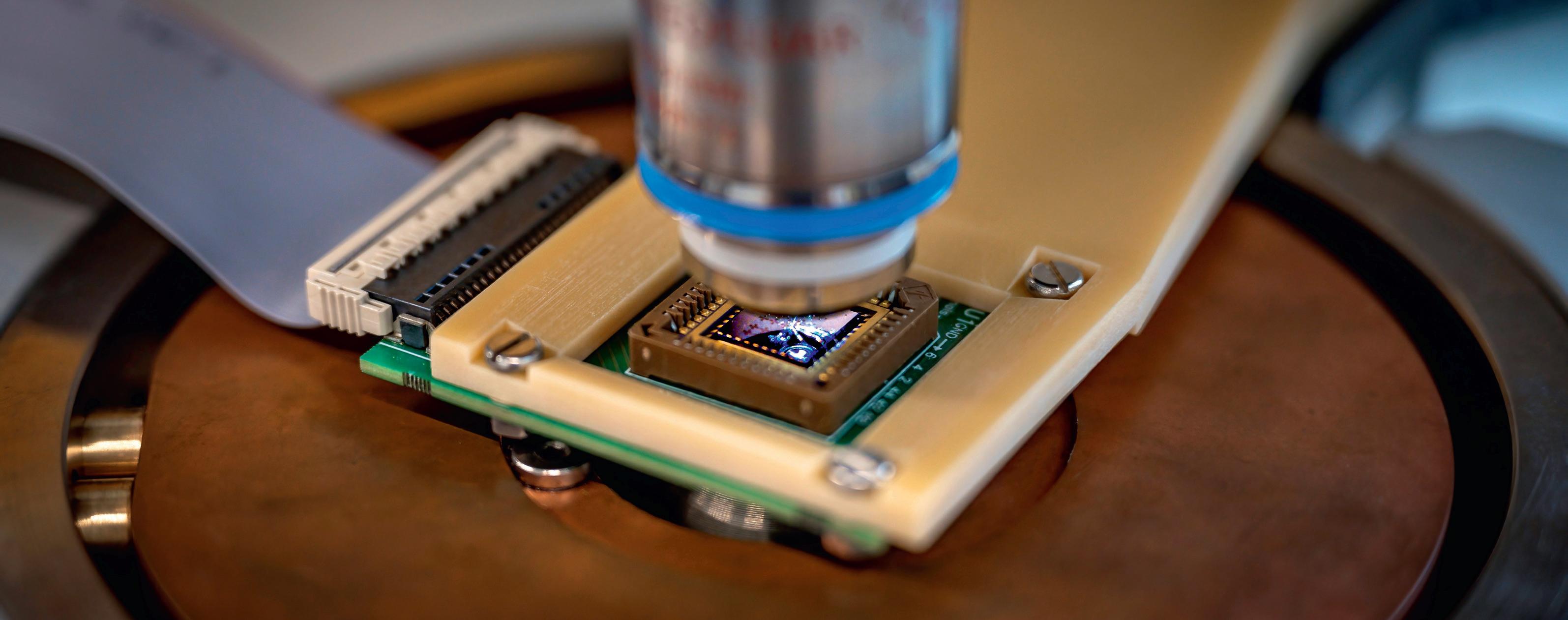
Professor Erik Folven and a multidisciplinary team of scientists across Europe working on the SpinENGINE project, are experimenting with nanomagnet ensembles
to understand their viability and their farreaching potential. The project aims to demonstrate emergent behaviour from these nanomagnet ensembles in a non-linear way based on ‘reservoir computing’ – which is inspired by the workings of biological systems like neural networks in brains.
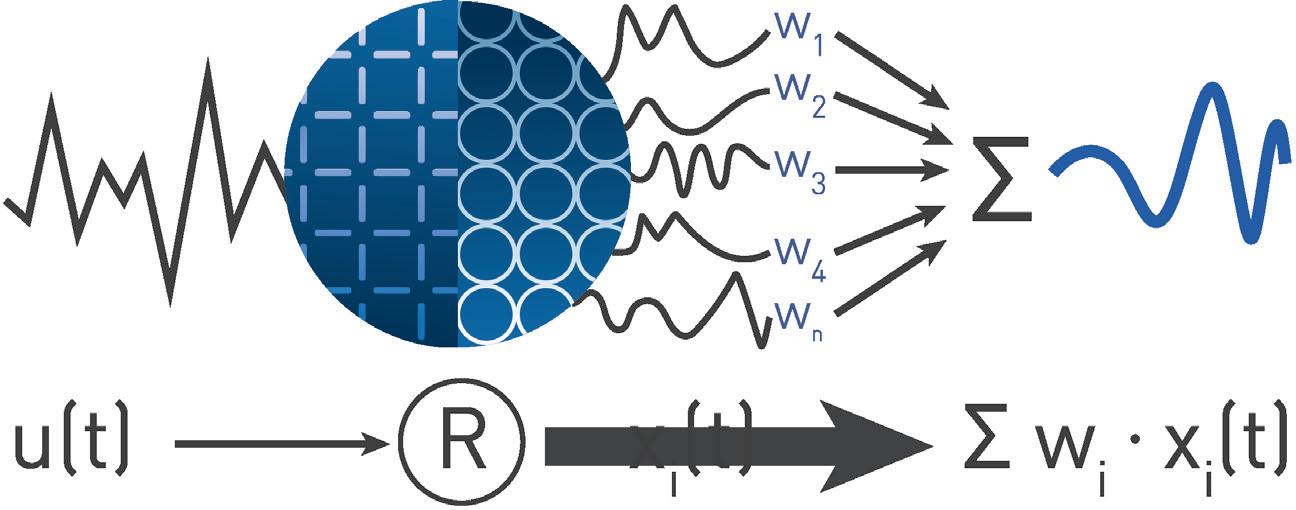
Reservoir computing has its roots in machine learning, where it has outperformed state of the art methods for a range of computational tasks. It relies on neural networks and hinges on the concept of a ‘reservoir’ of ‘neurons’ that does not require training and can process large amounts of data at the same time. It becomes a computational substrate that transforms input data into high dimensional representations – specifically making it excellent at capturing or recognising patterns. Simple linear processing techniques can then be trained to extract an output. Reservoir computing is particularly suitable for machine learning of time varying phenomena and is being considered for sensing and prediction applications which are useful from a smart sensing perspective.
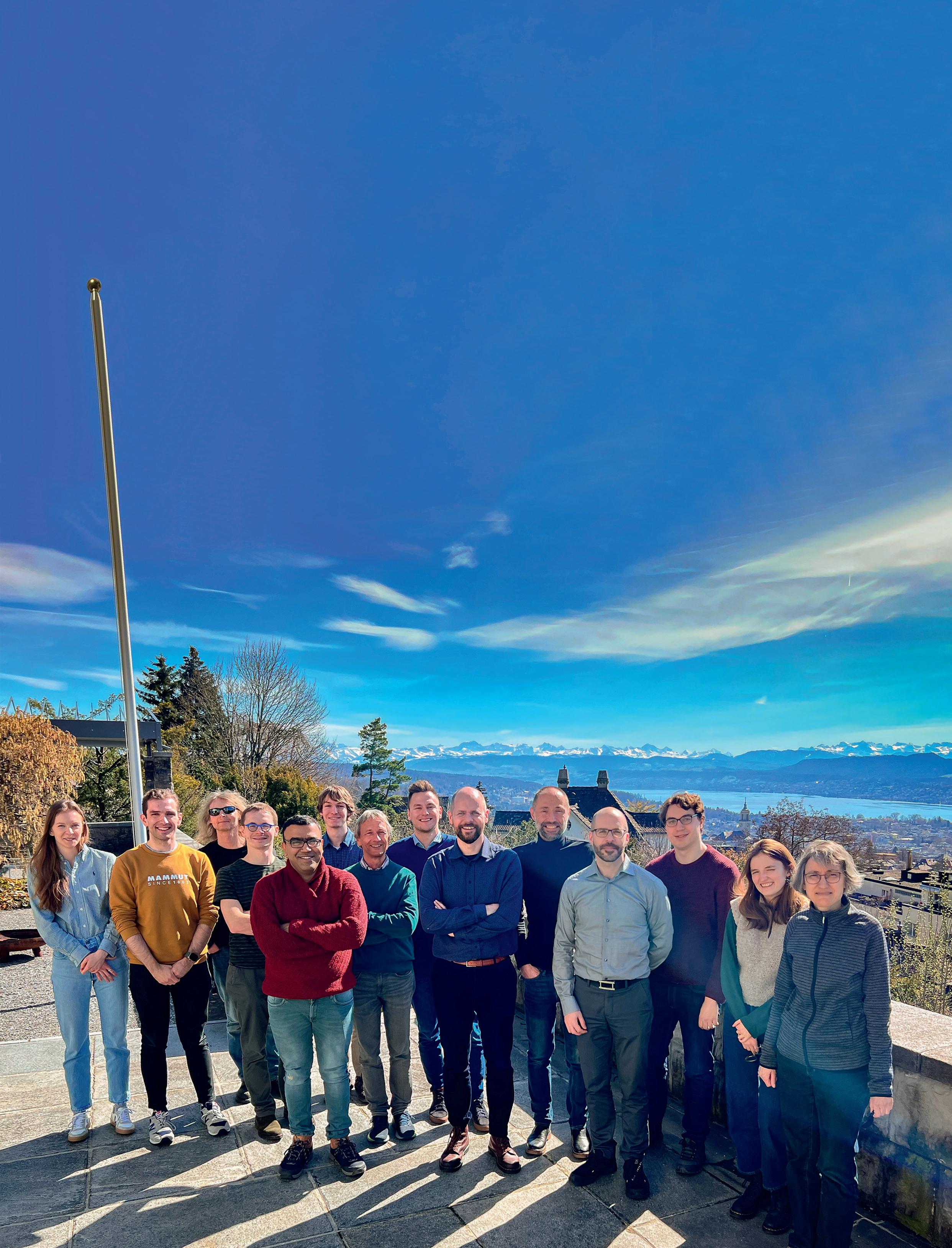
Harnessing the Emergent Properties of Nanomagnet Ensembles for Massively Parallel Data Analysis. Specialized computer chips may in the future be based on magnetism and have an architecture inspired by the brain.The SpinENGINE team.
Mimicking the brain
It is argued that many nanomagnets working in parallel could be used to analyse large, complex datasets far more energy efficiently than conventional computing methods, like complementary metal–oxide–semiconductor (CMOS) hardware which suffer from the vonNeumann bottleneck.
Nanomagnetic computer devices could retain their state and information, even when they are switched off as they rely on magnetisation for data storage, and so their behaviour allows for efficient energy use compared to traditional computer hardware. For a new computer design, it’s a very attractive design concept.
Folven explains an analogy to demonstrate reservoir computing in his mind’s eye: “It makes me think of murmuration, when birds flock together in vast numbers, moving together, flowing with purpose together, influencing each other and giving rise to an emergent behaviour. We are trying to mimic a way of computing that behaves a bit like a brain, only with magnets with magnetic pathways instead of biological, connecting neurons. Imagine when we were children and we played with magnets and they attract or repel and then imagine thousands of these all connecting this way a bit like the neurons of a brain, all working both together and in parallel.”
It is a radical approach to computer hardware and computing, and the project represents the foundational steps in the journey to a new
computing architecture designed for a new age of computational challenges.
“There is a philosophical discussion about ‘what is computing?’ at the heart of it,” muses Folven. “We are asking how we can achieve tasks in other ways than using standard computer technology. The physicists and the material scientists, like myself, try to
potentially do specific tasks in a much more energy-efficient manner. The point is that today, we are pushing current technology almost beyond its limits, so think there is room for some quite different technologies, I’m thinking especially of hardware accelerators, edge computing, smart sensors and those kinds of things.”
units (GPUs), which are very well suited for doing these kinds of calculations.”
Hardware development
The novel hardware requires a new understanding of what computers are and what computers can be. The biggest challenge is ensuring what is built is compatible with the kind of computational tasks required of it.
To make SpinENGINE’s aspirations of new hardware possible it takes combined expertise and requires a willingness from those involved to share their knowledge in collaboration, working in unison as a truly multidisciplinary team of researchers. Team members have backgrounds in computer science, condensed matter physics, material science, computational modelling, and high-resolution microscopy. As part of the project, they are required to learn from each other to a level where they can understand each other’s needs and aims effectively.
Folven observes: “The most fascinating aspect of this project in practice is the way we have enabled computer scientists and physicists to work together. We are putting a lot of effort into this aspect; we meet on a weekly basis and we get the computer scientists to join us at facilities where we do physics experiments. And our physicists have joined our computer scientists to write code for our simulators. We are all learning each others’ languages, which is necessary for this project.”
Major technology firms are recognising how beneficial this kind of application could become for us all. Google and Intel invest in research into neuromorphic computing and try to make bespoke hardware for it, and SpinENGINE’s commercial partner is the computer giant, IBM.

Around the world, there are several pushes to make new hardware based on the principles of reservoir computing with nanoscale technologies.

“This is important research that the big players and academia need to take the lead on because there is a long road ahead, and this technology will take time to mature.
SpinENGINE
Harnessing the Emergent Properties of Nanomagnet Ensembles for Massively Parallel Data Analysis
Project Objectives
The SpinENGINE project aims to create a new approach to computing based on emergent properties, i.e., complex, non-linear behaviour arising from simple local interactions, in tunable ensembles of nanomagnets. The project will provide the foundation for radically new technology ideally suited to meet the challenges in our increasingly data-driven society.
Project Funding
The SpinEngine project has received funding from the European Union’s Horizon 2020 FET-Open programme under grant agreement No 861618.



Project Partners
• NTNU • ETH Zurich • University of Sheffield


• Ghent University • IBM


Contact Details
Project Coordinator, Professor Erik Folven, Norwegian University of Science and Technology Department of Electronic Systems

O.S. Bragstads Plass 2A 7491 Trondheim
Norway
T: +47 94437094
E: erik.folven@ntnu.no
W: https://spinengine.eu/
understand magnetism on the nanoscale –we try to understand how to tailor and tune magnetic materials by design.”
With envisaging this new computing paradigm, the dream is that it would excel in some demanding computational tasks such as understanding shapes in real-time or realtime smart sensing applications. It is clear that CMOS will remain the preferred choice for crunching numbers for traditional computing tasks. In this sense, the nanomagnets are not seen as a replacement technology, but more of an extra tool in the toolkit for some specific computational challenges.
“I do not see what we are looking at as being a general-purpose computer. don’t see this as a computer to do everything. CMOS is here to stay, but our approach could
Scaling up with simulators
In dedicated clean rooms, innovative designs based on nanomagnet technology are taking shape but exploring a vast design space experimentally takes time. That is why an approach of creating simulators is paying dividends in the research.
“We have made simulators that are able to simulate much larger systems with more magnets than existing simulation tools. It’s important to be able to test the computational behaviour of the nanomagnetic systems, and there exist software packages that can simulate how one such magnet rotates its magnetisation or perhaps a hundred of them, but not a million of them in concert. Therefore, we needed to make our own computational software accelerated by graphical processor
“The computer scientists say: ‘If could have my dream material, how should it look in order to do computing?’ The most interesting developments happen at the intersection between computer science and material science, when computer scientists can give us input into how we need to change our materials to get the kind of behaviour they are searching for. This holistic approach is necessary and up until now there has been too little of this.”
“For our part, we have shown that the reservoirs that we make are on the right track. We have done standardised tests which have been established in reservoir computing that show that if we are able to make all the bits and pieces work together, this material has the right properties. This is very promising, and it tells us we are sensible to continue down this line of research. Of course, it would be nice to have a complete system, but we are not there yet. It will take time, effort, and innovations.”
Erik Folven is a professor at Norwegian University of Science and Technology (NTNU). He is actively researching artificial spin systems and is currently exploring the potential for such systems as a computational substrate. At NTNU he is co-leading a research group where computer scientists and physicists work together towards new spinbased computational paradigms.
There is a philosophical discussion about “what is computing?” at it’s heart. We strive to achieve computing tasks in new ways.A nanomagnetic ensemble under a magneto-optic Kerr microscope. Photograph by Aleksandr Kurenkov (ETHZ/PSI).