The power behind the green transition

Power electronics solutions have an important role to play in efficiently converting energy from renewable sources for wider use. Associate professor Kasper Mayntz Paasch and his colleagues in the EU-backed SmartPowerConversion project are developing and testing new technologies which will support the green energy transition.
The team at the University of Southern Denmark’s Centre for Industrial Electronics, (CIE, managed by Professor Thomas Ebel) maintains close links with industry, sharing ideas, knowledge and technical expertise. Many companies have also established a presence in Southern Denmark, and they benefit greatly from their proximity to CIE, with a wide variety of collaborative research projects spurring technical innovations in power electronics. “We have been collaborating on more than 360 projects together with industrial partners,” says Kasper Mayntz Paasch, Associate Professor at CIE. One is the SmartPowerConversion project, an initiative funded under the EU-backed Interreg programme, which brings together partners from both sides of the Danish-German border. “At SDU we are very close to the border, and we collaborate closely with both Danish and German companies and institutions,” says Professor Paasch.
SmartPowerConversion project
As leader of the SmartPowerConversion project Professor Paasch is now working to develop new technologies in the field of power electronics, which concerns the conversion of energy from one state into another. While a large amount of power may be generated at a solar plant for example, it then needs to be converted for the power grid before it can be used by people and businesses, a task which is performed by solar inverters. “Typical inverters have an efficiency of around 95 percent, meaning that around 5 percent of the power that has been generated is lost,” outlines Professor Paasch. This represents quite a high rate of losses, so Professor Paasch and his colleagues are testing new technologies that could achieve higher efficiencies. “We are looking into the potential of a semiconductor material called silicon carbide (SiC), together with our partners,” he continues.
This material is very well-suited to power applications, as it can withstand high voltages and so reach higher levels of efficiency, yet it is more expensive and complex to use than silicon which
has been used in transistors for around the last 50 years or so. However, using SiC in transistors also reduces the need for cooling, which Professor Paasch says is an important consideration in power electronics. “You need a whole cooling system around the electronics, with heat sinks and fans. If you can improve the efficiency and reduce losses, then there is less need for cooling,” he explains. Some silicon carbide-based products are already available on the market, but they are yet not being adopted as quickly as had been hoped, now the project team aim to bring them to wider attention. “We aim to heighten awareness of the effectiveness of
to-x technologies, which are designed to convert excess renewable energy, so that it can then be stored and used in other areas.
“Power-to-x technologies need power electronics to first convert the energy, then it can be stored,” explains Professor Paasch.
A lot of power is required to perform a process called electrolysis, which is key to power-to-x technologies, an issue the project team is addressing. “In electrolysis you generate hydrogen and oxygen by splitting water,” continues Professor Paasch. “We are helping to design power converters, aiming to achieve the highest possible efficiency.” The power electronics team at the Christian Albrecht University zu
“Typical solar inverters might have an efficiency of 95 percent , meaning that around 5 percent of the power generated at a plant is lost heat. We’re testing new technologies that could have an efficiency of up to 99 percent.”
these technologies,” says Professor Paasch.
A conversion rate of around 95 percent with current inverters still leads to significant losses, so there is a lot of scope for improvement. The project team are testing new technologies that could reach a conversion efficiency of 98-99 percent, which would bring wider benefits. “This would lead to improved efficiency in the conversion of DC from solar plants to AC for the power grid, while it would also have an impact in other areas, for example in the conversion of electrical energy to motion energy,” says Professor Paasch. The project’s primary focus is on developing power electronics for motor control, and Professor Paasch says this kind of technology could help improve the performance of electric cars. “If we can convert energy from the battery into movement of the motor, the car can then be driven for longer,” he explains.
An inverter for a motor drive has been developed as part of SmartPowerConversion, which researchers hope will have a significant impact in this respect, while the project’s work also holds wider relevance. For example, inverters are central to power-
Kiel, chaired by Professor Marco Lissere, are experts in power electronics control and motor technologies and is a partner in the project as well.
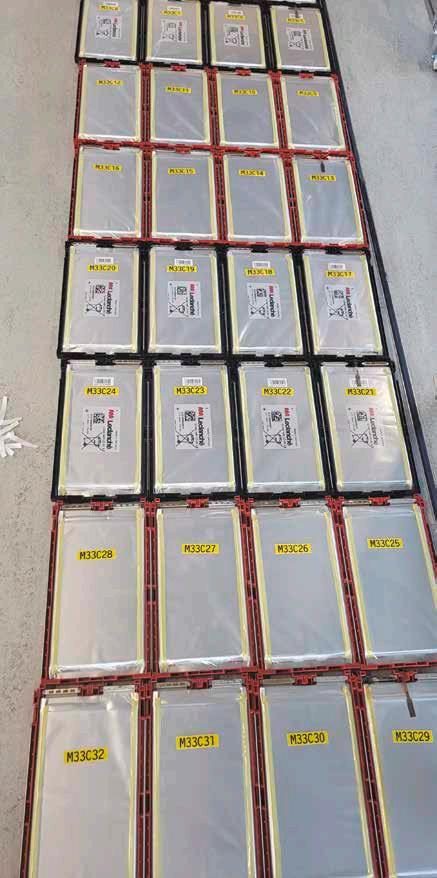
A second demonstrator is centered around the re-use of batteries and optimization with AI, further highlighting the potential of this work in supporting the green transition and enabling efficient use of resources. The world’s longest-running electric ferry Ellen has been carrying passengers between the Danish islands of Als and Ærø for over five years, yet over time its batteries have lost capacity to a point where they can’t function on the vessel; they still have life left in them however, and researchers are looking to harness this potential. “They’re still excellent batteries,” stresses Kun Qian, a researcher at the University of Southern Denmark. Researchers are now looking to reuse these batteries in solar and wind power storage systems, which will help spur further technical progress.
“Instead of throwing away something that still works, we can create a chain reaction of green innovation,” says Henrik Andersen, Associate Professor at the University of Southern Denmark.
Collaborative relationships
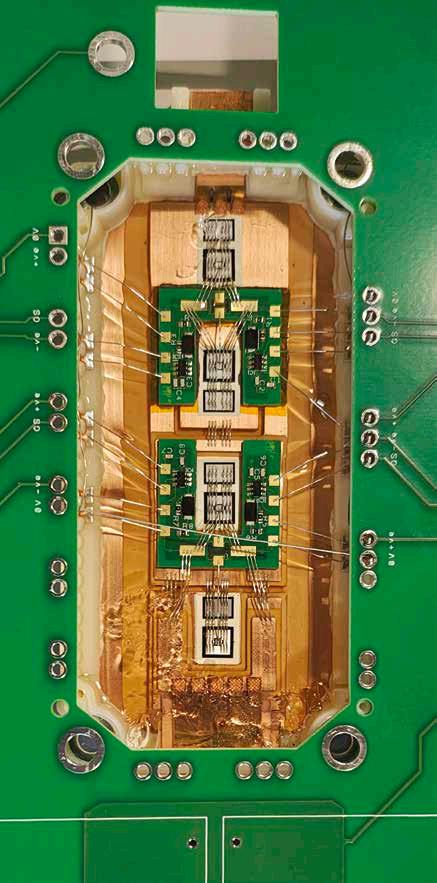
This work combines the expertise of different partners in the project, each of which contribute their own skills and technical knowledge. For example, the team of Professor Aylin Behrend-Bicakci at the University of Applied Sciences (HAW) in Kiel, Germany, are experts in mounting transistor chips inside power modules.
“There’s a lot of issues to consider there, especially thermal handling. You need to get the heat out, and our partners at Kiel are experts in that area,” says Paasch. Sophisticated test facilities are also available at SDU to assess these technologies, which Paasch says is important to local industry.
“When the centre was established, local companies told us they wanted to have really good test facilities to assess the lifetime and reliability of new power electronics technologies,” he outlines. “Companies in the local area can come and use these facilities at SDU, which they may not have been able to afford independently.”
The opportunity to use these facilities helps strengthen relationships between researchers at SDU and local companies, an important issue to Professor Paasch and his colleagues,
SmartPowerConversion
Power electronics, batteries and digitalization for smart electrification upscaling
Project Objectives
The region around the German-Danish border is home to major industries and deep technical expertise. The SmartPowerConversion project aims to create further synergies by building new smart power conversion knowledge and innovation capacity in support of electrification upscaling. The focus is on new intelligent solutions that add smart energy functionality in support of electrification and energy efficiency scaling within established as well as emerging value chains of electric drives for motor control, electro mobility, Power-to-X (PtX), and energy storage.
Project Funding
The project is supported by Interreg Deutschland-Danmark via the SmartPowerConversion project (ref. 16-2.122 1). Find further information on Interreg Deutschland-Danmark on www.interreg5a.eu
Project Partners
• University of Southern Denmark, Centre for Industrial Electronics, DK (lead)
• Christian-Albrechts University of Kiel, DE
• Hochschule für Angewandte Wissenschaften (HAW), Kiel, DE(previously FH-Kiel)
• Business and Technology Transfer Center Schleswig-Holstein (WTSH), DE
• Sonderborg Growth counsel (SV), DE
Contact Details
Project Coordinator, Kasper Mayntz Paasch Faculty of Engineering Department of Mechanics and Electronics
SDU Center for Industrial Electronics (CIE)
T: +45 65 50 16 95
E: paasch@sdu.dk
W: https://www.interreg-de-dk.eu/projekteergebnisse/unsere-projekte-1/einzelansichtprojekte/smartpowerconversion/ W: www.sdu.dk/ansat/paasch
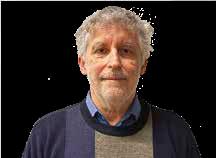
Kasper Paasch has had a long career in the field of electronics, optics and power systems. His journey started in the Danish Airforce and he later completed a MSc. degree in electronics and optics. In 2009 he joined, after 19 years in industry, the university as project manager and in 2016 completed a PhD in the field of photovoltaic systems. He is now associate professor and vice-head of the Centre for Industrial Electronics (CIE) at the university.

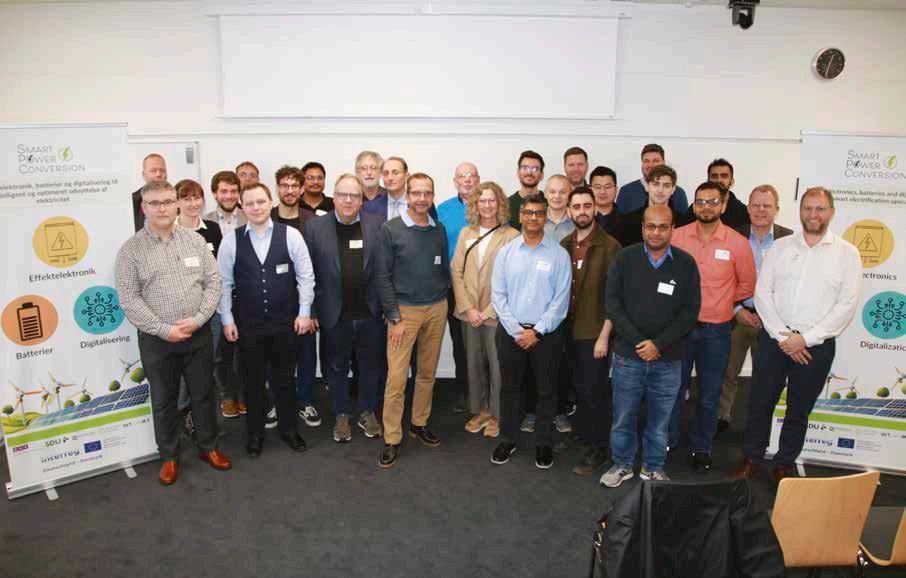
many of whom have themselves worked in the commercial sector. The project builds on previous initiatives and it is hoped the relationships that have been forged will help foster long-term industrial collaboration, so Professor Paasch is looking to bring the project’s work to a wider audience. “We aim to raise awareness of the research and commercial possibilities in Southern Denmark and are conducting a lot of dissemination activities such as technical workshops, to which we invite members of the public and also other companies,” he says. “We collaborate with our partners in Denmark and Germany to develop technologies for the benefit of industry. We also rely heavily on the support from the local business organisation project partners, Sønderborg Vækstråd (DK) and WTSH (DE), who have good contacts to the local industries.”
This will not end with the conclusion of SmartPowerConversion in May 2026, and Professor Paasch is currently planning a further project, this time with a greater emphasis on education. New technologies and converter types will require new forms of care and maintenance, so Professor Paasch is looking to provide effective training. “We are establishing projects with technical schools in certain regions of Germany and Denmark to educate the next generation of repair staff and engineers in the repair and maintenance of new technologies,” he says. All these


power converters are modular-based, yet it’s still important that technicians have a good understanding of the technology, especially when they are working in the field. “That will be a focus point in the new project,” continues Professor Paasch.
The current priority however is more to develop the different technologies, and by the end of the project Professor Paasch hopes to have some working demonstrators ready, that can then be tested in different environments. This will highlight the wider benefits of close collaboration between academia and industry, and encourage further development in Southern Denmark in future, as researchers work to develop cleaner, more efficient solutions for smart power conversion. “We want to raise awareness about the possibilities in the region here,” says Professor Paasch. The wider aim here is to contribute to the energy transition and help encourage the shift towards a more sustainable energy model. “The more efficiently we can convert energy from one form to another the better, both for the environment and also for local industry,” stresses Professor Paasch.
The project is supported by Interreg Deutschland-Danmark via the SmartPowerConversion project (ref. 16-2.1-22 1). Find further information on Interreg Deutschland-Danmark on www.interreg5a.eu