Toward Pesticide-Free Grapevines in Europe Across Europe’s vineyards, climate change and fungal diseases are threatening one of the continent’s most iconic crops. The Horizon Europe project Shield4Grape is developing innovative breeding and pest management strategies to cut pesticide use and safeguard viticulture’s heritage. We spoke with Dr. Giorgio Gambino, project coordinator, about the vision and approach. Europe’s vineyards are more than a cornerstone of agriculture – they are symbols of heritage, culture, and identity. From the rolling landscapes of Piedmont to the steep terraces of the Douro Valley, grapevines have shaped the economies and traditions of entire regions. Yet, behind the romance of wine lies a pressing challenge: viticulture is one of the most pesticide-dependent forms of agriculture in the world. Grapevines are highly vulnerable to fungal diseases such as powdery and downy mildews, and controlling them requires large volumes of chemical treatments. This reliance on agrochemicals comes at a cost. The health of farmers and rural populations, the safety of consumers, and the balance of fragile ecosystems are all under strain. Climate change only intensifies these problems, creating conditions where pests spread more aggressively and unpredictably. For Europe, where wine is not just an economic driver but a cultural emblem, the stakes could not be higher. It is within this urgent context that the EU-funded Shield4Grape project is stepping forward. Coordinated by Dr. Giorgio Gambino and the “Functional Genomics and Ecophysiology” research group of the National Research Council of Italy (CNRIPSP), the project is pioneering innovative breeding and pest management strategies to reduce viticulture’s dependence on chemical pesticides. With an ambitious, multidisciplinary consortium and demonstration fields across the most important European wine regions, Shield4Grape promises not only to protect vineyards, but to safeguard the communities, biodiversity, and cultural heritage that surround them.
Grapevines under pressure The European Green Deal sets ambitious priorities for agriculture, from protecting biodiversity and ecosystems to reducing air, water, and soil pollution, moving towards a circular economy, and improving waste management to ensure long-term sustainability. Within this framework, the EU’s Biodiversity Strategy for 2030 outlines a comprehensive and long-term plan to preserve nature and reverse ecosystem degradation, responding
48
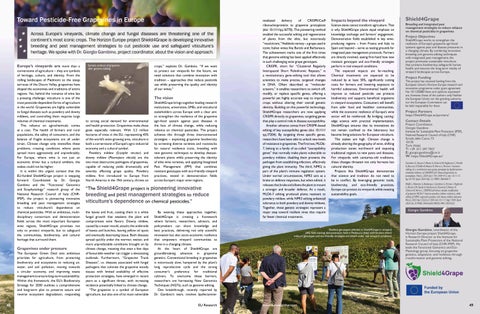
Somatic embryo of grapevine after genome editing.
crops,” explains Dr. Gambino. “If we want to protect our vineyards for the future, we need solutions that combine innovation with tradition – approaches that reduce pesticide use while preserving the quality and identity of our wines.”
The vision
to strong social demand for environmental and health protection. Grapevines make these goals especially relevant. With 3.2 million hectares of vines in the EU, representing 45% of the world’s wine-growing area, viticulture is both a cornerstone of Europe’s agro-industrial economy and a cultural symbol. Powdery mildew (Erysiphe necator) and downy mildew (Plasmopara viticola) are the two most destructive pathogens of grapevines, capable of reducing yields dramatically and severely affecting grape quality. Powdery mildew, first introduced to Europe from North America in the 19th century, thrives on
Shield4Grape brings together leading research institutions, universities, SMEs, and viticultural stakeholders across Europe with a clear aim: to strengthen the resilience of the grapevine agri-food system against pest diseases in the face of climate change, while reducing reliance on chemical pesticides. The project achieves this through three interconnected strategies – exploiting grapevine biodiversity by screening diverse varieties and rootstocks for natural resilience traits, breeding with new genomic techniques to develop diseasetolerant plants while preserving the identity of elite wine varieties, and applying Integrated Pest Management (IPM) that combines resistant genotypes with eco-friendly vineyard practices, tested in demonstration fields across Europe’s major wine regions.
“The Shield4Grape project is pioneering innovative breeding and pest management strategies to reduce viticulture’s dependence on chemical pesticides.” the leaves and fruit, coating them in a white fungal growth that weakens the plant and compromises wine flavors. Downy mildew, caused by a water mould, attacks the underside of leaves and bunches, leaving yellow oil spots and eventually destroying tissue. Both diseases spread quickly under the warmer, wetter, and more unpredictable conditions brought on by climate change, meaning that even a few days of favourable weather can trigger a devastating outbreak. Furthermore, “Grapevine Trunk Diseases”, i.e. diseases associated with fungal pathogens that colonize the grapevine woody tissues with limited availability of effective protection strategies, have emerged in recent years as a significant threat, with increasing incidence potentially linked to climate change. “The grapevine is a symbol of European agriculture, but also one of its most vulnerable
By weaving these approaches together, Shield4Grape is creating a framework where farmers, researchers, advisors, and policymakers can share knowledge and best practices, delivering not only scientific innovation but also socio-economic resilience that empowers vineyard communities to thrive in a changing climate. At the heart of Shield4Grape are groundbreaking advances in grapevine genetics. Conventional breeding in grapevines is notoriously slow, hampered by the plant’s long reproductive cycle and the strong consumer’s preference for traditional cultivars. To overcome these barriers, researchers are harnessing New Genomics Techniques (NGTs), such as genome editing. One breakthrough, recently reported by Dr. Gambino’s team, involves lipofectamine-
EU Research
mediated delivery of CRISPR/Cas9 ribonucleoproteins to grapevine protoplasts (doi: 10.1111/tpj.16770). This pioneering method enabled the successful editing and regeneration of plants from the elite, but notoriously “recalcitrant,” Nebbiolo variety – a grape used in iconic Italian wines like Barolo and Barbaresco. The achievement marks one of the first times that genome editing has been applied effectively in such challenging wine grape genotypes. CRISPR, short for “Clustered Regularly Interspaced Short Palindromic Repeats,” is a revolutionary gene-editing tool that allows scientists to make precise, targeted changes in DNA. Often described as “molecular scissors,” it enables researchers to switch off, modify, or replace specific genes, offering a powerful yet highly accurate way to improve crops without altering their overall genetic identity. Building on this powerful technology, Shield4Grape researchers are now applying CRISPR directly to grapevines, targeting genes that play a central role in disease susceptibility. Another advance comes from CRISPR-based editing of key susceptibility genes (doi: 10.1111/ tpj.17204). By targeting three specific genes, researchers have been able to unlock new levels of resistance in grapevines. The first two, MLO67, belong to a family of so-called “susceptibility genes” that normally make plants vulnerable to powdery mildew; disabling them prevents the pathogen from establishing infection, effectively giving the plant immunity. The third, NPR3, is part of the plant’s immune regulation system. Under normal circumstances, NPR3 acts as a brake on defence responses, but when edited, it releases that brake and allows the plant to mount a stronger and broader defence. As a result, MLO6-7 editing produced plants resistant to powdery mildew, while NPR3 editing enhanced tolerance to both powdery and downy mildews. Together, these genetic strategies represent a major step toward resilient vines that require far fewer chemical treatments.
Impacts beyond the vineyard Science alone cannot transform agriculture. That is why Shield4Grape places equal emphasis on knowledge exchange and farmers’ engagement. Demonstration fields established in key wineproducing regions – from France and Italy to Spain and beyond – serve as testing grounds for integrated pest management protocols. Farmers are directly involved, seeing first-hand how new resistant genotypes and eco-friendly strategies perform in real vineyard conditions. The expected impacts are far-reaching. Chemical treatments are expected to be reduced by at least 50%, significantly cutting costs for farmers and lowering exposure to harmful substances. Environmental health will improve as reduced pesticide use protects biodiversity and supports beneficial organisms in vineyard ecosystems. Consumers will benefit from safer food and healthier communities, while the economic resilience of Europe’s wine sector will be reinforced. By bridging cuttingedge science with practical implementation, Shield4Grape ensures that its innovations do not remain confined to the laboratory but become living solutions for European viticulture. The stakes are high. Climate change is already altering the geography of wine, shifting production zones northward and exposing traditional regions to new pests and diseases. For vineyards with centuries-old traditions, these changes threaten not only harvests but cultural identity. Projects like Shield4Grape demonstrate that science and tradition do not need to be in conflict. By leveraging genomic tools, biodiversity, and eco-friendly practices, Europe can protect its vineyards while meeting sustainability goals.
Resilient genotypes selected in Shield4Grape in vineyard. S4G field training: demonstration field in Piedmont (Italy) with farmers where tolerant genotypes and eco-friendly strategies are tested under real vineyard conditions.
www.euresearcher.com
Shield4Grape
Breeding and integrated pest management strategies to reduce reliance on chemical pesticides in grapevines
Project Objectives
Shield4Grape works to strengthen the resilience of Europe’s grapevine agri-food systems against pest and disease pressures in a changing climate. By combining innovative breeding and genome-editing techniques with integrated pest management, the project promotes sustainable viticulture that protects biodiversity, safeguards human health, and ensures the long-term vitality of vineyard landscapes across Europe.
Project Funding
This project has received funding from the European Union’s Horizon Europe research and innovation programme under grant agreement No 101135088.Views and opinions expressed are, however, those of the authors only. Neither the European Union nor the granting authority nor the European Commission can be held responsible for them.
Project Partners
https://Shield4Grape.eu/partners/
Contact Details
Project Coordinator, Giorgio Gambino Institute for Sustainable Plant Protection (IPSP), National Research Council of Italy (CNR) Strada delle Cacce 73 10135 Turin (Italy) T: +39 011 397 7927 E: giorgio.gambino@cnr.it W: https://Shield4Grape.eu/ Gambino G, Nuzzo F, Moine A, Chitarra W, Pagliarani C, Petrelli A, Boccacci P, Delliri A,Velasco R, Nerva L, Perrone I. Genome editing of a recalcitrant wine grape genotype by lipofectaminemediated delivery of CRISPR/Cas9 ribonucleoproteins to protoplasts. Plant J. 2024 Jul;119(1):404-412. doi: 10.1111/ tpj.16770. Epub 2024 Apr 22. PMID: 38646817. Moffa L, Mannino G, Bevilacqua I, Gambino G, Perrone I, Pagliarani C, Bertea CM, Spada A, Narduzzo A, Zizzamia E,Velasco R, Chitarra W, Nerva L. CRISPR/Cas9-driven double modification of grapevine MLO6-7 imparts powdery mildew resistance, while editing of NPR3 augments powdery and downy mildew tolerance. Plant J. 2025 Apr;122(2):e17204. doi: 10.1111/tpj.17204. Epub 2024 Dec 8. PMID: 39645650; PMCID: PMC12034322.
Giorgio Gambino
Giorgio Gambino, coordinator of the Horizon Europe project Shield4Grape, is Research Director at the Institute for Sustainable Plant Protection of the National Research Council of Italy (CNR-IPSP). He leads the Functional Genomics and EcoPhysiology group, focusing on grapevine genetics, adaptation, and resilience through transformation and genome editing.
49