
Ground truths about ancient hominins in Java


In East Java, an archaeological site on exposed banks along a gentle bend of the Solo River has revealed some of the secrets of early humans. In the 1890s, based on local information that there was a wealth of bones around the village of Trinil, Dutch scientist Eugène Dubois excavated fossils of a hominin we now refer to as Homo erectus a species that bridges the transition from apes to humans.

“I have always been fascinated with the incredible story of this person, Dubois, who was obsessed with discovering the ‘missing link’ between ape and humans and went on wild and dangerous adventures in order to find fossils of such a creature,” said Joordens. “He searched for the proverbial needle in a haystack and found it”.
Dubois not only collected hominin fossils but also thousands of fossils from other animals, including lots of shells. Since early 20 th century the material is housed in the Dubois Collection at Naturalis Biodiversity Centre in the Netherlands, where Joordens and colleagues are studying it.
In 2015, following the spectacular discovery of a fossil shell from Trinil engraved by Homo erectus Joordens was invited by Indonesian archaeologists to start a joint project revisiting Trinil. Together with archaeologist Shinatria Adhityatama, she led an Indonesian-Dutch team following in Dubois’ footsteps, to re-examine his finds and the Trinil excavation site now with the aid of modern-day technology and knowledge. This enabled a deeper, more thorough delve into the story of this unique location.

Re-examining discoveries by Dubois
Dubois turned his back on a safe teaching position in Amsterdam, joined the colonial Dutch East Indies army as a medical officer, and along with his wife and newborn child travelled to Sumatra, dedicating all his personal time to finding the bones of an elusive extinct human species. His explorations of Sumatran caves were unsuccessful. When word came through that Java might be a better place to look, he focused on the fossil-rich deposits along the Solo River. Here the colonial government
supported him with a team consisting mostly of forced labourers supervised by two army engineers, and the search efforts finally paid off.
Although Dubois was the first person to deliberately look for human-like fossils, collecting of fossils was already being done on Java in the early 19 th century, notably by the Javanese painter and scientist Raden Saleh. “Around Trinil, the local people also knew about fossils. Some places there are literally littered with them. Dubois was able to find this rich spot in the bank of the river thanks to the knowledge of the local people,” said Prof Joordens.
“Everyone in Java knows the story. There’s a feeling of pride that Java is the place where the first fossils of Homo erectus have been found. While the concept of ‘missing link’ is no longer used, you could say that Homo erectus still is the key species in human evolution. In many ways, it was physically similar to how we look today: walking upright, similar body proportions and a relatively large brain. Moreover, it was the first cosmopolitan hominin species. About 2 million years ago, its population expanded within and outside Africa, all the way to Eurasia and Southeast Asia, hence the finds on Java. As a result, Trinil is an iconic flagship site for human evolution studies.
However, there is still heated debate about the question whether Dubois’ hominin fossils represent one species, Homo erectus or whether the notorious ‘bone of contention’ femur I actually belongs to a different, much
During several dry seasons, the team conducted new fieldwork at Trinil to expose the fossil-bearing layers, take samples for dating and conduct small excavations, with the ultimate aim to gain insights into the lifestyle and environment of hominins who lived and died there. It was a challenging endeavour but with modern scientific methods and tools, they could go beyond what Dubois was able to achieve in his time.
younger species. And if so, what could that be? The SHeLL project team set out to solve this issue.
Reading the earth
For the joint Indonesian-Dutch investigative team working on the SHeLL project, getting to know about the hominins that lived there was first about getting to understand the geology of the site and its surroundings. At first sight, Trinil appeared not so much a nicely preserved site with neat sediment layers, but more like a daunting mess of rocks, sand, clay and bones jumbled together, accessible only during low river water levels in the dry season.
“The basics have remained the same. You go into the field, you bring a geological hammer, study problems carefully, look and dig, just as Dubois did. But of course, we now also have things like differential GPS, so that you can map all the finds that you recover very accurately. And the whole science of stratigraphy and sedimentology has progressed a lot since the early 20 th century. We can now make a much better distinction between layers and understand how these layers ended up the way they did. Dating techniques at our disposal are also quite advanced, while in Dubois’ time they were virtually non-existent. We use mainly the Argon/Argon dating method, which is very powerful to assess the age of sediments even though there are all kinds of difficulties related to the typical volcanic context on Java”. Using a Digital Elevation Model in combination with field observations, the team identified several Solo river terraces overlying and cutting into the older fossilbearing sediments. What transpired from the modelling, field observations and laboratory data that finally untangled the geological puzzle, was that the Trinil site turned out to be incredibly complex and not entirely what it seemed.
“Dubois thought he was doing a good job by excavating at the same fossiliferous
level, because normally sediments pile up into a ‘layer cake’ with the oldest layers at the base and the youngest layers at the top, and you know that if you stay in the same horizontal plane, you remain in the same layer. Then you can safely assume that everything you find in this plane is of the same age and belongs together. But what we discovered is that even though the deposits look similar, contain fossils, and are situated at the same horizontal level, the main fossil-bearing deposits actually consist of two different channel fills with the oldest one dating to ~800,000 years and the younger one dating to ~450,000 years. Moreover, significantly younger terrace-related channel fills are situated at the same level at the site.
“So within a span of 100 meters, exactly where Dubois excavated, you have deposits of very different ages! He thought he was looking at one time period, and he was actually digging in and collecting fossils from at least three very different time periods.”
The next challenge was to combine the new field data, including drone imagery, with the historical documentation and photos of

Dubois’ excavations, in order to find out from which layer(s) the hominin fossils originated. The team found that the fossil skullcap, teeth and the femora II-IV likely originate from the two older channel fills and may be reworked from even older layers with ages of around a million years. In contrast, femur I likely derives from the younger channel fill, with an age of at maximum ~150,000 years – so, much younger. This means that the fossil belongs to either a very late Homo erectus, a modern human (Homo sapiens) or to the enigmatic new species called Denisovan. Further studies are needed to establish its exact age and, most importantly, its taxonomic identity. The bottom-line is that Dubois may have found at Trinil not one, but two hominin species, making his endeavour even more spectacular. The engraved shell from Trinil and the results of the SHeLL project show how much can be gained from revisiting old museum collections and historical excavation sites with ‘new eyes’ and new tools.
Home by the water
Trinil is a rich site, with its fossils testifying to the fact that hominins were around in

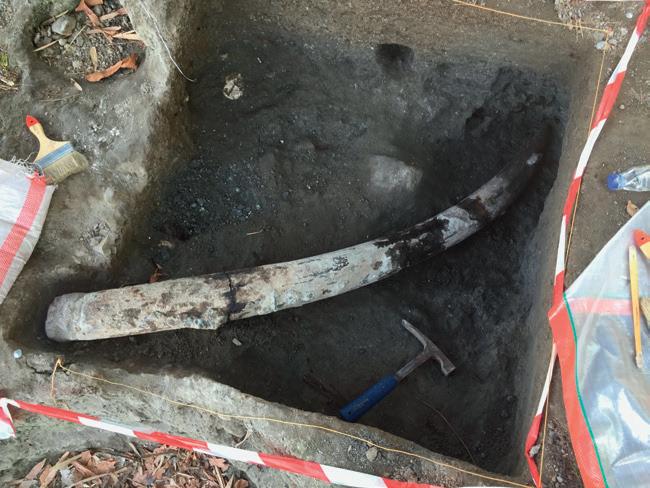
Prof. Josephine Joordens shares revelations unearthed in the project Studying Homo erectus Lifestyle and Location (SHeLL). By reassessing a dig site in Trinil (Indonesia) with geo-archaeological re-excavation, new insights about Homo erectus come to the surface.From left to right: hominin femora I-V and skullcap, found by Dubois. The Trinil site (partly submerged) along the left river bank. Under the blue tent a square is being excavated. Photo by Eduard Pop Sander Hilgen, Mega Hafsari and Triastuti Hapsari taking samples for dating. Eduard Pop and Sander Hilgen crossing the Solo river. Stegodon tusk excavated from older channel deposits.
SHeLL
Studying Homo erectus Lifestyle and Location (SHeLL): an integrated geo-archaeological research of the hominin site Trinil on Java
Project Objectives
SHeLL is a joint Indonesian-Dutch research project to establish the geochronological, climatic, environmental and behavioural context of Homo erectus at the Trinil site in Java. SHeLL endeavours to ultimately answer the bigger question of ‘what makes us human’.
SHeLL is a joint Indonesian-Dutch research project.


Project Funding
This project is funded by the Dutch Research Council NWO (Grant 016.Vidi.171.049)
Project Partners
Naturalis Biodiversity Center and Pusat Penelitian Arkeologi Nasional/ ARKENAS (now Pusat Riset Arkeologi, Lingkungan, Maritim, dan Budaya Berkelanjutan, Badan Riset Inovasi Nasional (BRIN))
Contact Details
Prof. dr. Josephine C.A. Joordens
Senior Researcher, Naturalis Biodiversity Center

Darwinweg 2
2333 CR Leiden
The Netherlands
T: +31-6-23994055
E: josephine.joordens@naturalis.nl
W: www.naturalis.nl/en/science/ researchers/jose-joordens
All photographs were taken by Josephine Joordens unless specified otherwise.
The complex Trinil stratigraphy, showing channels of different ages (BBC-1, BBC-2, T2, and T1), projected on historical photo DUBO1494 of Dubois’ 1900 excavation at Trinil. Fossil symbols (green) show the provenance of the hominin skullcap and of femur I. Adapted from: Pop, E.L., Hilgen, S.L., Adhityatama, S., Berghuis, H., Veldkamp, A., Vonhof, H.B., Sutisna, I., Alink, G., Noerwidi, S., Roebroeks, W., Joordens, J.C.A., 2023. Reconstructing the provenance of the hominin fossils from trinil (Java, Indonesia) through an integrated analysis of the historical and recent excavations. Journal of Human Evolution 176 (103312): 1-26.

this location over several broad time frames spanning hundreds of thousands of years. The research revealed many clues about the environment of the time, explaining aspects of their lifestyles.
Josephine Joordens is a senior researcher at Naturalis Biodiversity Center (Leiden, The Netherlands) and special professor on the Naturalis Dubois Chair in Hominin Paleoecology and Evolution, at Maastricht University (The Netherlands). In her research, she combines the fields of geology, biology and archaeology.
Shinatria Adhityatama has extensive experience conducting archaeological field projects all over Indonesia as archaeologist at ARKENAS (now part of Badan Riset Inovasi Nasional (BRIN)) in Jakarta. He is currently at the Australian Research Centre for Human Evolution (ARCHE), Griffith University studying the underwater archaeology of Matano, a submerged site in Sulawesi.
Yet, in addition to the as yet unknown identity of femur I there is also another mystery that endures until more research is carried out. Joordens affirms: “We showed that the Trinil hominins consumed shellfish and that they used large shells as tools. They have also used a shark’s tooth to make the shell engraving, but that is only part of the picture. The big enigma remains why so far in hominin sites on Java stone tools are not so frequently found as we would expect. This is so strange when you know that so many fossils of Homo erectus have been discovered on the island. We know from discoveries in Africa and Eurasia that hominins like Homo erectus produced and used stone and also bone tools. Yet so far, we do not encounter them so often in excavations on Java. We now have a new research project near Trinil, the BASINS project directed by Eduard Pop, which focuses on solving this particular hominin lifestyle puzzle.
SHeLL team after completion of fieldwork.

Photo by Jan Willem Dogger
“I think their connection with water was very strong, for drinking water but also for food from the water, like fish and shellfish. And of course water attracts other animals that can be eaten. In their time Java was a very diverse and fertile landscape, with rivers, volcanoes, plains and lakes, in many ways comparable to what you find on Java today. Whenever I see people busy in the river, in the evening at the end of the working day, washing themselves, or throwing out nets, or just enjoying the coolness of the river and the calmness of the evening, it gives me shivers because it almost brings you back to those prehistoric times.”
It’s clear that the abundant water sources were central to lifestyle for early humans throughout the ages, and the situation remains that way for people today. It also seems that another central part of being human is to do with having a fertile imagination and an ability to create art and tools of our own design. The engraved shell discovery, specifically, suggests the ‘missing link’ species was possibly more like us than was initially assumed.