Digging deep into mosquito symbiont genes The RosaLind project team is investigating naturally occurring bacteria found in mosquitoes, with a particular focus on Wolbachia and its mobile genetic elements. This work could open up deeper insights into mosquito-transmitted diseases and inform more effective strategies for controlling them, as Julie Reveillaud, Maxime Mahout and Alice Brunner explain. The changing nature of the global climate means mosquitoes transmitting pathogens are spreading deeper into the European continent, and several species have been found as far north as France, Germany and the UK, representing a serious threat to public health. Mosquitoes can transmit different diseases to humans, including dengue fever, malaria and West Nile virus, and the authorities pay close attention to the incidence of these diseases. “There have been reports of dengue fever and Chikungunya cases in France over recent years, and they have been monitored very intensively,” says Julie Reveillaud, a research scientist at the French National Research Institute for Agriculture, Food and the Environment (INRAe). As Principal Investigator of the RosaLind project, Reveillaud is investigating the mobilome (the set of mobile genetic elements) of a naturally-occurring bacterium in mosquitoes called Wolbachia, in interaction with other microorganisms, work which could lead to improved strategies to control mosquitotransmitted diseases (MTD). “Wolbachia is found mainly in the ovaries of mosquitoes, in the germline,” she outlines. “It interacts with its host, and pathogens when present, creating two main phenotypes. It can block
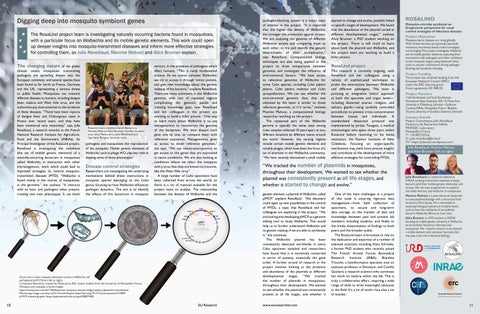
RosaLind team members Sarah Benlamara, Maxime Mahout, Alice Brunner, Camille Gauliard (top row), Mateo Jarry, Julie Reveillaud, and Ugo Verzi Borgese (bottom row).
pathogens and manipulates the reproduction of the mosquito. Mobile genetic elements of Wolbachia, such as phage WO, play key roles in shaping some of these phenotypes”
Disease control strategies Researchers are investigating the underlying mechanisms behind these interactions in mosquito species belonging to the Culex genus, focusing on how Wolbachia influences pathogen dynamics. The aim is to identify the effects of this bacterium in mosquito
vectors, in the presence of pathogens which affect humans. “This is really fundamental science. As we cannot cultivate Wolbachia, we try to access it through ‘omics analysis, and gain new knowledge about the genetic makeup of the bacteria,” explains Reveillaud. There are many unknowns in the Wolbachia genome, with lots of repeated regions complicating the genomic puzzle and creating knowledge gaps, now Reveillaud and her colleagues in the project are working to build a fuller picture. “One way to learn more about Wolbachia is to use metagenomics to reconstruct the genome of the bacterium. We then dissect each gene one by one, or compare them with reference sequences. Metagenomics gives us access to novel reference genomes,” she says. “We use metatranscriptomics to get access to the genes that are expressed in native conditions. We are also looking at conditions where we infect the mosquito with a virus that they are known to transmit, like the West Nile virus.” A large number of Culex specimens have been collected from across the world, so there is a lot of material available for the project team to analyse. The relationship between the density of Wolbachia and the
Zoom into a Culex mosquito, dissected ovaries, a Wolbachia cell and plasmid pWCP (from left to right). Composite Illustration created by Mateo Jarry, IDIL master student from the University of Montpellier, France. Mosquito and mosquito ovaries images: https://www.jove.com/t/67128/dissection-mosquito-ovaries-midgut-salivary-glands-for-microbiome Microscopy image courtesy of Dr Vincent Raquin: https://doi.org/10.1371/journal.pone.0134069 pWCP scheme graphic: https://pubmed.ncbi.nlm.nih.gov/30837458/
10
EU Research
pathogen-blocking system is a major topic of interest in the project. “It is reported that the higher the density of Wolbachia, the stronger the protection against viruses. We are analysing the genome of different Wolbachia strains and comparing them to each other, to try and identify the genetic determinants of their multiplication,” says Reveillaud. Computational biology techniques are also being applied in the project to draw comparisons between genomes and investigate the influence of environmental factors. “We have access to reference genomes of Wolbachia for some Culex species, including Culex pipiens pipiens, Culex pipiens molestus and Culex quinquefasciatus. We can see whether the environmental genomic data that was obtained by the team is similar to those reference genomes, or if it varies,” outlines Maxime Mahout, a computational biology researcher working on the project. The conserved part of the Wolbachia genome is typically the same, even among Culex samples collected 10 years apart at very different locations by different teams around the world. However, the varying regions include certain mobile genetic elements and notably phages, which have been the focus of a lot of attention in the Wolbachia community. “We have recently discovered a small mobile
started to change and evolve, possibly linked to specific stages of development. We found that the abundance of the plasmid varied at different developmental stages,” outlines Alice Brunner, a PhD student working on the project. There is still much to learn about both the plasmid and Wolbachia, and the project team are working to build a fuller picture.
RosaLind project This research is currently ongoing, with Reveillaud and her colleagues using a variety of sophisticated techniques to probe the interactions between Wolbachia and different pathogens. The team is pursuing an integrative ‘omics’ approach at both the specimen and organ levels— including dissected ovaries, midguts, and salivary glands—using carefully controlled procedures to prevent cross-contamination between tissues and individuals. A standardized dissection protocol was implemented by Jordan Tutagata, a medical entomologist who spent three years within RosaLind before returning to his home institution, the Pasteur Institute of New Caledonia. Focusing on organ-specific mechanisms may yield more precise insights and contribute to the development of more effective strategies for controlling MTDs.
“We tracked the number of plasmids in mosquitoes, throughout their development. We wanted to see whether the plasmid was consistently present at all life stages, and whether it started to change and evolve.” genetic element, a plasmid of Wolbachia, called pWCP,” explains Reveillaud. This discovery could open up new possibilities in the control of MTDs, a topic that Reveillaud and her colleagues are exploring in the project. “We are looking into developing pWCP as a genome editing tool to study Wolbachia. This would help us to further understand Wolbachia and its genetic makeup, if we are able to synthesise it,” she continues. The Wolbachia plasmid has been consistently detected worldwide in every Culex specimen sampled and researchers have found that it is extremely conserved in terms of synteny, essentially the gene order. A further strand of research in the project involves looking at the presence and abundance of the plasmids at different developmental stages. “We tracked the number of plasmids in mosquitoes, throughout their development. We wanted to see whether the plasmid was consistently present at all life stages, and whether it
www.euresearcher.com
One of the main challenges in a project of this scale is ensuring rigorous data management—from field collection of specimens, to secure and long-term data storage, to the transfer of data and knowledge between past and present lab members including students, and finally to the timely dissemination of findings to both peers and the broader public. The RosaLind team is fortunate to rely on the dedication and expertise of a number of talented scientists including Hans Schrieke, a former PhD student who recently joined The French Armed Forces Biomedical Research Institute (IRBA), Blandine Trouche, a bioinformatics specialist now an assistant professor in Denmark, and Camille Gauliard, a research scientist who continues her work on malaria within the lab. This is truly a collaborative effort, requiring a wide range of skills to drive meaningful advances in the field. It’s a lot of work—but also a lot of wonder.
ROSALIND
Mosquito-microbe symbiosis: an Ecogenomic perspective for novel control strategies of infectious diseases
Project Objectives
Mosquito-borne diseases are rising globally. With limited vaccines and growing insecticide resistance, microbiota-based control strategies are emerging. This project investigates Wolbachia and its mobile genetic elements, exploring their interactions with pathogens and other symbionts across mosquito organs using advanced omics tools to uncover mechanisms driving pathogen blocking and symbiotic interplay.
Project Funding
This project has received funding from the European Research Council (ERC) under the ERC Starting grant: Grant agreement ID: 948135
Project Partners
• Seth Bordenstein and Sarah Bordenstein, Pennsylvania State University, USA • A. Murat Eren, University of Oldenburg, Germany • Guillaume Cambray, INRAe, Montpellier, France • Blandine Trouche, University of Southern Denmark, Denmark
Contact Details
Project Coordinator, Julie Reveillaud Directrice de Recherche INRAe MIVEGEC Laboratory Montpellier, France T: +33782722516 E: julie.reveillaud@inrae.fr W: https://juliereve.wordpress.com/
Julie Reveillaud, Maxime Mahout, and Alice Brunner (left to right)
Julie Reveillaud is a research scientist at INRAE studying interactions between animals, bacteria (and their mobile genetic elements), and viruses. Her lab uses ecogenomics to explore microbial diversity and evolution in mosquitoes. Maxime Mahout is a post-doctoral researcher in computational biology with a doctorate from University Paris-Saclay, He is interested in analyzing biological systems at multiple levels, such as how the mobilome of intracellular bacteria Wolbachia affects its host Culex. Alice Brunner is a PhD student at INRAE focusing on mobile genetic elements in Wolbachia, an intracellular bacterium infecting Culex mosquitoes. Her research centers on its plasmid, a mobile element with unknown functions that may play a key role in bacterial biology.
11