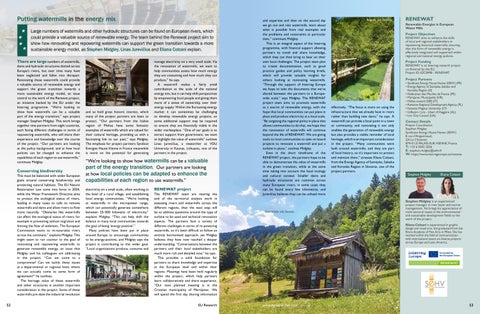
Putting watermills in the energy mix Large numbers of watermills and other hydraulic structures can be found on European rivers, which could provide a valuable source of renewable energy. The team behind the Renewat project aim to show how renovating and repowering watermills can support the green transition towards a more sustainable energy model, as Stephen Midgley, Linas Jurevičius and Eliana Colzani explain. There are large numbers of watermills, dams and hydraulic structures dotted across Europe’s rivers, but over time many have been neglected and fallen into disrepair. Renovating these watermills could provide a valuable source of renewable energy and support the green transition towards a more sustainable energy model, an issue central to the work of the Renewat project, an initiative backed by the EU under the Interreg programme. “We’re looking to show how watermills can be a valuable part of the energy transition,” says project manager Stephen Midgley. This work brings together nine partners from eight countries, each facing different challenges in terms of repowering watermills, who will share their experience and knowledge over the course of the project. “Our partners are looking at the policy background, and at how local policies can be changed to enhance the capabilities of each region to use watermills,” continues Midgley.
Conserving biodiversity This must be balanced with wider European goals around conserving biodiversity and protecting natural habitats. The EU Nature Restoration Law came into force in 2024, while the Water Framework Directive aims to protect the ecological status of rivers, leading in many cases to calls to remove watermills and dams and allow rivers to flow more naturally. “Obstacles like watermills can affect the ecological status of rivers, for example in preventing salmon migration and limiting the flow of sediment. The European Commission wants to re-naturalise rivers across the continent,” explains Midgley. This might seem to run counter to the goal of renovating and repowering watermills to generate renewable energy, an issue that Midgley and his colleagues are addressing in the project. “Can we come to a compromise? Can we tackle these issues at a departmental or regional level, where we can actually come to some form of agreement?” he outlines. The heritage value of these watermills and other structures is another important consideration in the project. Some of these watermills pre-date the industrial revolution
52
Lithuanian mill.
and so hold great historic interest, which many of the project partners are keen to protect. “Our partners from the Italian region of Molise have some fantastic examples of watermills which are valued for their cultural heritage, providing us with a fascinating link to our past,” says Midgley. The emphasis for project partners Syndicat Energies Haute-Vienne in France meanwhile is more on the potential for generating
manage electricity on a very small scale. Via the renovation of watermills, we want to help communities assess how much energy they are consuming and how much they can produce,” he says. A watermill makes a fairly small contribution at the scale of the national energy mix, but it can help shift perspectives by empowering local people and giving them more of a sense of ownership over their energy supply. Within the fluctuating energy market it can sometimes be challenging to develop renewable energy projects, so some additional support may be required to ensure they are financially viable in the wider marketplace. “One of our goals is to attract support from government, we want to highlight the value of watermills” outlines Linas Jurevičius, a researcher at VDU University in Kaunas, Lithuania, one of the partners in the project.
“We’re looking to show how watermills can be a valuable part of the energy transition. Our partners are looking at how local policies can be adapted to enhance the capabilities of each region to use watermills.” electricity on a small scale, often working at the level of a rural village, and establishing local energy communities. “We’re looking at watermills in the micropower range, which can potentially generate somewhere between 25-500 kilowatts of electricity,” explains Midgley. “This can help shift the balance in many local communities towards the goal of being ‘energy positive’.” Many policies have been put in place around Europe to encourage communities to be energy-positive, and Midgley says the project is contributing to this wider goal. “Local organisations produce, consume and
Beaufort Mill, France.
RENEWAT project The RENEWAT team are nearing the end of the territorial analysis work in assessing rivers and watermills across the different regions, then the next step will be to address questions around the type of turbine to be used and technical renovation aspects. The partners face a variety of different challenges in terms of re-powering watermills, so it’s been difficult to follow an entirely harmonised approach, yet Midgley believes they have now reached a deeper understanding. “Conversations between the partners and their local stakeholders are much more rich and detailed now,” he says. This provides a solid foundation for partners to share knowledge and expertise at the European level and within their regions. Meetings have been held regularly within the project, which help partners learn collaboratively and share experience. “Our next planned meeting is in the Croatian municipality of Martijanec. We will spend the first day sharing information
EU Research
and expertise and then on the second day we go out and visit watermills, learn about what is possible from real examples and the problems and constraints at particular sites,” continues Midgley. This is an integral aspect of the Interreg programme, with financial support allowing partners to travel and share knowledge, which they can then bring to bear on their own local challenges. The project team plan to create documentation, such as good practice guides and policy learning briefs, which will provide valuable insights for others looking at renovating watermills. “Through the support of Interreg Europe we hope to take the documents that we’ve shared between the partners to a Europewide scale,” says Midgley. The RENEWAT project team aims to promote watermills as a source of renewable energy, with the hope that local communities can put plans in place and produce electricity at a local scale. “By targeting the regional policy in place that allows communities to do that, we hope that the renovation of watermills will continue beyond the life of RENEWAT. We are giving tools to local communities to take on board projects to renovate a watermill and put a turbine in place,” outlines Midgley. Even in the short timeframe of the RENEWAT project, the partners hope to be able to demonstrate the value of watermills in the green transition, while at the same time taking into account the local ecology and cultural context. Smaller dams and hydraulic structures are common across many European rivers, in some cases they can be found every few kilometres, and Jurevičius believes they can be utilised more
Govc Vršnik mill, Slovenia.
Rogovilc mill, Slovenia.
RENEWAT Renewable Energies in European Water Mills
Project Objectives
RENEWAT aims to enhance the skills of local and regional stakeholders in repowering historical watermills, ensuring that this form of renewable energy is effectively integrated and supported within regional and national energy policies.
Project Funding
RENEWAT is an Interreg research project co-financed by the EU. Project ID: 02C0498 - RENEWAT
Project Partners
effectively. “The focus is more on using the infrastructure that we already have in rivers rather than building new dams,” he says. A watermill can provide a focal point in a town or community, and renovating it not only enables the generation of renewable energy but also provides a visible reminder of local heritage, which is an important consideration in the project. “Many communities were built around watermills, and they are part of local history, so it’s important to protect and maintain them,” stresses Eliana Colzani, from the Energy Agency of Savinjska, Saleska and Koroska Region in Slovenia, one of the project partners.
• S yndicate Energy Haute Vienne (SEHV) (FR) • E nergy Agency of Savinjska, Saleska and Koroska Region (SI) • F édération des Moulins de France (FR) •M artijanec Municipality (HR) •M olise toward 2000 (IT) • Rzeszow Regional Development Agency (PL) • Vytautas Magnus University (LT) •U dhetim i Lire - Liberi di Viaggiare (AL) • L viv City Council (UA)
Contact Details
Project Coordinator, Stephen Midgley Syndicate Energy Haute Vienne (SEHV) 8 rue d’Anguernaud, ZA Le Chatenet 87410 LE PALAIS-SUR-VIENNE, France T: +33 6 0342 2036 E: stephen.midgley@sehv.fr W: https://www.interregeurope.eu/renewat
Stephen Midgley
Eliana Colzani
Stephen Midgley is an experienced project manager in river basin and marine management. He brings his appreciation of multi sectoral issues in the environmental and sustainable development fields to the work of the project. Eliana Colzani is experienced in graphic design and visual arts, she graduated from the Brera Academy of Fine Arts in Milan. She has worked within the field of communication with international teams on diverse projects across Europe and Latin America.
www.euresearcher.com
53