
Piloting urban innovations in the Danube region

Many companies across Central and Eastern Europe are developing new solutions that could improve urban centres, yet they face significant hurdles in bringing them to the marketplace. We spoke to Miroslav Scheiner about how the PilotInnCities project team are using the agile piloting method to accelerate the uptake and upscaling of innovative smart city solutions.
There is a high degree of political fragmentation across Central and Eastern Europe, with large numbers of local municipalities within individual countries, often accountable to relatively small populations. This fragmentation limits the ability of local authorities and public bodies to adapt to emerging technological trends and prepare for the future, says Miroslav Scheiner, coordinator of the PilotInnCities project. “If you think of a municipality with 1,000 inhabitants, there might be only a few people involved in running it. They may not have the capacity to absorb new trends in mobility or AI and to develop plans for the area, as their time is often taken up by everyday maintenance issues, like fixing pavements and solving local disputes, or they simply lack the necessary skills,” he points out. This issue – which also affects larger settlements – lies at the heart of the PilotInnCities project, an initiative dedicated to supporting the adoption of smart city solutions, innovations that can help transform urban centres and improve everyday lives of citizens. “In the Czech Republic and most other countries of the Danube Region, we have a significant potential in start-ups and innovative entrepreneurs developing solutions that could make cities more sustainable, liveable and efficient,” he outlines.
PilotInnCities project
The market for these solutions is however not fully mature, with many public authorities lacking the capacity and skills to look ahead and develop plans to adopt new solutions, an issue that Scheiner and his colleagues in PilotInnCities are
addressing. The project brings together 11 partners from six countries across the socalled Danube Region – including Czechia, Slovakia, Germany, Hungary, Romania and Serbia – looking to stimulate partnerships between local authorities and the business sector, which will help bring new innovations to the market faster. “There needs to be a well-functioning ecosystem to bring technological innovations to market, with people able to recognise their potential and leverage their value, while de-risking the first steps for main protagonists,” says Scheiner. The innovation ecosystem brings together stakeholders from four sectors - academia, industry, government and civil society - in a quadruple helix, and effective collaboration
between them fosters innovation. “There are different stakeholders across these four sectors, and the question is, do they cooperate effectively? Do they work together at all? Do they use all the potential and the synergy that is available in that territory? Or are they isolated from each other?” outlines Scheiner. There are typically very active relations between these stakeholders in countries with a strong culture of innovation, like the Netherlands and Finland, now the project team are looking to take lessons from these examples and apply them in Central and Eastern Europe. One key aspect of this is the agile piloting method first developed in Finland, where the emphasis is not on writing strategies or debating the value of a solution, but rather on trialling it in a ‘living laboratory’ and assessing its impact. “Generally speaking, the idea with agile piloting is to test new solutions quicker and with the power of co-creation. When we have a solution that has potential and can be implemented, let’s go and let’s test it,” explains Scheiner. This approach is now being applied in 27 pilot projects across the six countries, with researchers looking at a variety of different smart city solutions and learning from the process. “Many different fields are contributing to the development of smart cities, so these projects are not just about digital technology, they can also be about social innovation, the circular economy or greenery,” continues Scheiner. “ Very often, the smartest innovation lies in applying an existing technology or solution in scenarios where it hasn’t previously been used.”
A number of projects make a significant contribution to sustainability, ranging from

bike-sharing models to tools for designing energy communities, to green elements with cooling effects for public spaces, to solutions preventing water leakages. Scheiner says AI is also a major topic of interest in the project overall. “We have a pilot on an AI chatbot for municipalities, and we are also looking at a new communication platform that translates and summarises the barely digestible content of public documents through a user-friendly voice-based interface inspired by Instagram principles,” he outlines. However, the central idea of the project is not to support specific solutions but to adapt the agile piloting method per se to the local Danubian context – to set up a universal and lasting channel to accelerate the uptake and upscaling of a high number of innovative smart city solutions over time.
that this could become a regular steering mechanism for innovation ecosystems with dedicated funding and stakeholder roles,” he outlines. There are already plans for a followup project beyond PilotInnCities, which Scheiner says shall focus on governance.
“In PilotInnCities we have conducted real agile pilots to test the process with all its practical nuances, and we’ve seen how this mechanism works in our cultural, administrative and political environment, and how stakeholders react to it,” he continues. “We have taken some practical lessons from this, and in a follow-up project we will look at how this mechanism can be integrated into the governance structure of several model regions.”
“Our methodology is about providing very practical guidelines on how to use agile piloting as a tool to stimulate innovation flows in the ecosystem and increase real innovation output of territories.”
Boosting competitiveness
“We aim to design a system that resolves the main bottlenecks in the innovation process, using the power of the whole ecosystem of stakeholders,” explains Scheiner. “Our methodology is about providing very practical guidelines on how to use agile piloting as a tool to stimulate innovation flows in the ecosystem. There is a series of practical steps that can be taken by any national or regional government to increase the real innovation output of their territory.”
This could in the long run become a more established feature of the public-private landscape, supporting the development of new smart city solutions tailored to emerging needs, although of course the circumstances are different in each country. While the current priority is to refine the methodology, Scheiner is also thinking about these policy-making steps. “The project is not only about providing practical guidance on the implementation of agile piloting, we will also add the layer of how to actually integrate it into the governance system, so
The wider backdrop to this research is the challenge of boosting European competitiveness in the development and adoption of innovative solutions, with an active role for territorial actors.
While Europe is home to many talented entrepreneurs and deep technical expertise, the continent is still often perceived as lagging behind its global rivals in terms of its capacity to develop innovative new solutions and bring them to the market.
“Europe is not keeping pace with the US and Asia for example,” says Scheiner. The project will make an important contribution in this respect by stimulating collaboration between various stakeholder groups and removing major barriers. “We believe that encouraging cooperation between stakeholders will enhance competitiveness,” stresses Scheiner. “Combining the strengths of these stakeholder groups – from business, public administration, academia and civil society – will provide a significant boost to European companies through co-creation.”
Pilot-based Innovation Ecosystems for Smart Cities
Project Objectives
The PilotInnCities project accelerates urban transformation in the Danube Region by applying agile piloting as a practical method for testing new Smart City solutions in real urban environments, strengthening quadruple-helix co-creation, derisking uptake for municipalities, and enabling SMEs to bring innovations to market faster with the perspective of scaling and internationalisation.
Project Funding
80% co-funded by Interreg Danube Region Programme. DRP0200367 PilotInnCities, EUR 2,477,340 budget.
Project Partners
• Ministry of Industry and Trade of the Czech Republic (LP1) • CzechInvest (PP2) • Ministry of Investments, Regional Development and Informatisation of the Slovak Republic (PP3) • Association of Towns and Communities of Slovakia (PP4)
• Neumann János Nonprofit Ltd. (PP5)
• HROD.net Community Development Nonprofit Ltd. (PP6) • Digital Serbia Initiative (PP7) • Danube Engineering Hub Association (PP8) • Technical University of Civil Engineering Bucharest (PP9) • EurA AG (PP10) • ZDE - Zentrum für Digitale Entwicklung GmbH (PP11)
Contact Details
Miroslav Scheiner

Minister’s Envoy for Smart Cities Lead Coordinator - PilotInnCities T: +420 224 852 453 E: miroslav.scheiner@mpo.gov.cz : https://www.linkedin.com/company/ pilotinncities/ W: https://interreg-danube.eu/projects/ pilotinncities


Miroslav Scheiner, with 13 years at the Ministry of Industry and Trade of the Czech Republic, drives strategic projects in innovation, Smart Cities, and international trade. He acts as lead coordinator in PilotInnCities.
Miroslav Scheiner
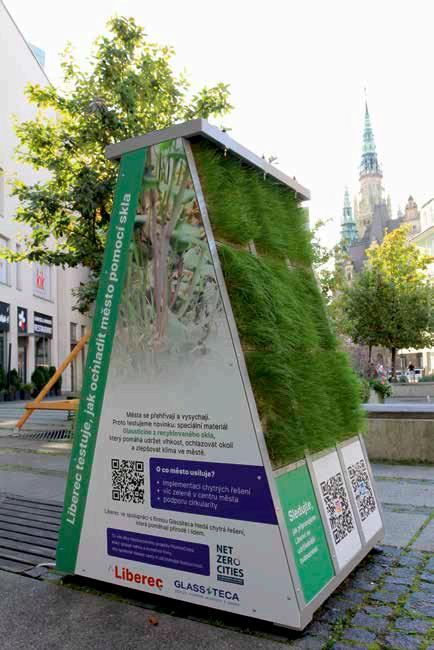
Glassiteca pilot tests porous boards made of circular glass material as platforms for greenery in public space in Liberec, Czechia.
Florescence pilot offers community and public bicycle storage by employing unused urban infrastructure in Kecskemét, Hungary