Examining the influence of AI on music


Artificial intelligence technology is playing an increasingly prominent role in the music industry, from curating personalised playlists to producing tracks. The MusAI research programme brings together researchers from across a wide range of disciplines to look critically, through the lens of music, at the cultural implications of AI, which tend to have been ignored in recent years, as Professor Georgina Born explains.
The way that we experience music is changing, with more and more people using AI-based systems that recommend new tracks based on their previous listening habits, rather than listening to the radio or going to concerts or gigs to encounter new sounds. At the same time, generative AI technology is also being widely used to produce music without the direct input of a composer or artist. “There’s a specialist AI music start-up sector focused on socalled production music, which generates music for TV, films, games and advertising,” explains Georgina Born, Professor of Anthropology and Music at University College London (UCL). Technologies like AIdriven recommendations—either through traditional recommender systems or new conversational agents—increasingly mediate our relationship with music and threaten to undermine the principle of universality, which public service media organisations like the BBC and others are committed to upholding. “Universality is the idea that it is really important for social cohesion as well as for the toleration of difference that people have shared experiences of information and culture, including music, because it generates a sense of shared community and shared cultural knowledge, of pluralistic cultural belonging,” explains Professor Born.
MusAI project
Highly personalised playlists, by contrast, encourage fragmentation rather than shared cultural experiences, one of the issues that Professor Born is addressing as the director of the ERC-backed MusAI research programme, which researches the relationship between AI and music. The MusAI programme encompasses ten research projects, several of which are interdisciplinary in nature, bringing together researchers from very different backgrounds. “In some of our projects, researchers from the humanities and social sciences have been working closely together with computer scientists and data scientists over long periods,” Professor Born adds.
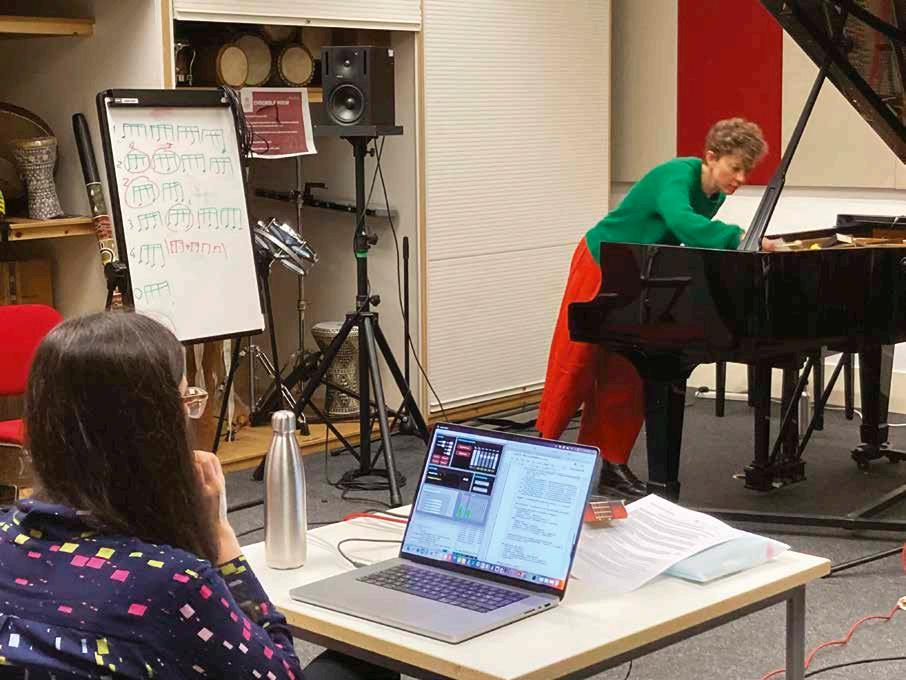
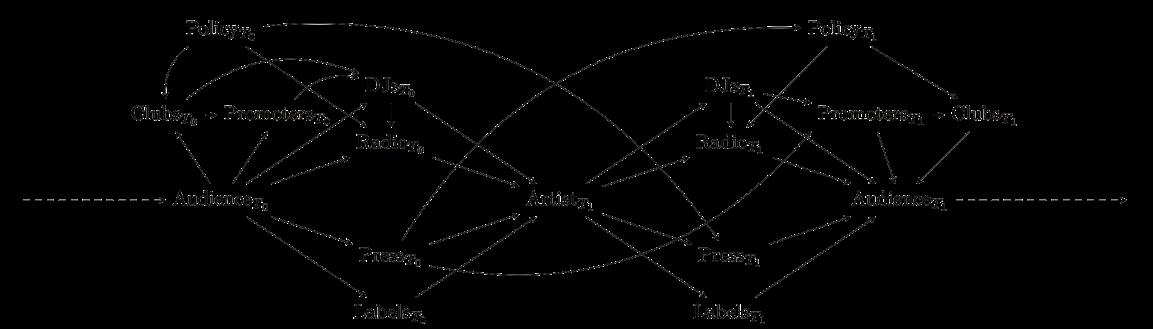
Overlaid Diagram: A directed acyclic graph of temporal interrelations at work in a musical genre, from the MusAI project “Sonic-Social Genre: Towards Multimodal Computational Music Genre Modelling”/ Credit and copyright: Owen Green.
This interdisciplinarity is a feature, for example, of a project centred on investigating the nature of musical genre and how it can be computationally modelled. “Genre is a very well-developed term in the humanities, also in relation to music. We talk often about musical genres and sub-genres; it’s one of the ways in which people describe the history and the experience of music,” says Professor Born. The way that computer scientists have modelled genre has historically been weak. However, through close interdisciplinary collaborations, the project is developing methods that better bridge computer science and the humanities, cultivating mutual understanding and improved forms of modelling of cultural processes. In doing so, the project innovates, identifying new ways for quantitative and qualitative methods to interrelate. It thereby creates new computational approaches to both music and culture, with broader implications for the digital humanities in general.
MusAI researchers are also working across disciplinary boundaries in a project focused on developing alternatives to
the commercial big tech platforms’ recommender systems, a project in which Professor Born has collaborated for several years, sharing knowledge, ideas and insights, with an American computer scientist, Professor Fernando Diaz, an expert on recommender systems based at Carnegie Mellon University. “We’ve been training Fernando in social science ideas, like universality, while he’s been training us in how recommender systems work technically,” she continues. “This radical interdisciplinarity has resulted in an innovative new recommender paradigm based on a new metric, which is designed to encourage more common experiences.”
The MusAI alternative recommender system represents a significant shift from the way conventional, personalised recommender systems work, which is typically based on maximizing a measure of an individual’s satisfaction, based on their previous listening history. This personalised recommender paradigm tends to narrow people’s tastes and limit their musical horizons. “There’s quite a large body of research now showing that
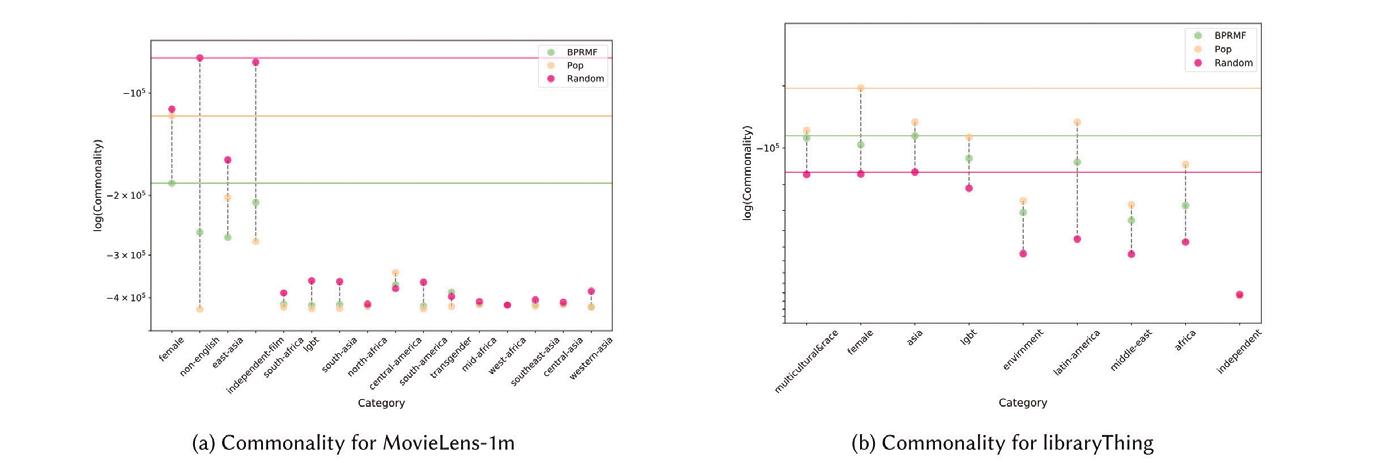
recommender systems have a similar effect in the cultural domain to social media, in terms of producing echo chambers when it comes to cultural and musical tastes. This contrasts with the serendipity and plurality that used to guide how people would encounter music,” says Professor Born. MusAI’s new measure of recommender system quality is designed to encourage a more shared experience – and it has the potential to do this not only for the consumption of music, but for cultural and news content more generally. The results are promising: “We’ve been working with the BBC for the past year, trialling the new recommender system metric on their historical audience data, and the evidence is that it works,” explains Professor Born. Considerable interest in the MusAI ‘commonality’ recommender paradigm has been shown not only by the BBC but also by the Canadian and Australian public service media organisations.
The MusAI recommender system evaluation metric has been trialled on two kinds of BBC content, one of which is the ‘Americast’ current affairs radio show, which covers the highly divisive American political scene. Conventional algorithms tend to direct different audience groups towards different kinds of content, fragmenting the audience’s listening experience; but the ‘Americast’ research shows that the new MusAI metric helps measure the common experience among different audience groups. “We found that editorially pinning specific types of content could achieve a greater degree of universality than happens with personalisation. Instead of only certain demographic groups going to the ‘Americast’ content, all six of the key demographic groups identified by the BBC as making up its core audience converged on this content,” Professor Born explains. The commonality metric has also been tested on content from the BBC Proms, its six-week classical music festival, which has historically
been of interest primarily to older people and those from higher socio-economic groups. However, the BBC collaboration demonstrated that MusAI’s alternative recommender paradigm helps to bring new audiences to the Proms: “With editorial pinning, more young people and lower socioeconomic groups would come together on this Proms content, mitigating audience fragmentation,” she says.
This research holds important implications for public service media organisations, which
– such as social media and distribution platforms – which are currently dominated by the profit-driven global tech industry.
“Our conviction, particularly in this divisive period in history, is that public service media organisations play a vital role and need themselves to create platforms that resist the fragmentation of news, information and culture by bringing different audiences together around the same content, thereby strengthening an informed public sphere,” says Professor Born.
“Universality is the idea that it is really important that people have common experiences of information, knowledge and culture, including music, because it helps to generate shared understanding , social cohesion, and community.”
are under pressure from the rise of streaming services and other online platforms – the main means by which many young people get their music, news, information and other cultural content today. Public service media organisations need to consider emerging trends and how they will reach audiences in the future, and Professor Born believes the new MusAI recommender paradigm can play an important role. “With new algorithms that optimize for commonality, we can bring all the demographics together and interest them in particular kinds of editorially-important content. In principle, we can focus this shared experience on content that’s been editorially curated to progressive ends, such as boosting cultural or informational diversity. We are now in dialogue with a number of public service media organisations, all of which need to reach contemporary audiences and enable them to share common experiences,” she continues. Because of its success and its potential, this research has extended into a wider initiative centred on promoting public service paradigms in other digital sectors
Generative AI
A further strand of research in the MusAI programme centres on the application of generative AI in the music industry, which is increasingly being used to produce short tracks with minimal human input through textual prompts, which are then uploaded onto various platforms. This AI-generated music production raises several acute concerns, one of which is the replacement of human labour. “In future it may no longer be possible to make a living as a musician, composer or producer,” says Professor Born. A second major concern is around the way that generative AI algorithms are trained, which involves using vast datasets.
“There’s a lot of discussion in particular around attribution. The idea is that if you could take an AI-generated track and break down what went into the training set that produced the model, then money could flow back to the artists whose work the model was trained on,” she explains. “However, attribution is a complex task, and many people think it’s not going to be possible to identify the sources of what went into

training the model, which underlies the AI production of a particular track.”
This is the subject of intense debate, and Professor Born and her team have written a paper in which they argue that copyright is unlikely to be viable as a mechanism for protecting musicians’ rights and their ability to profit from their work. The training materials for generative AI are also drawn largely from the popular mainstream, and more marginal artists and works may be neglected, another issue that Professor Born and her team are addressing. “Minority music, lesser-known historical music, is often not included in training sets,” she says. Moreover, AIgenerated music may itself become part of the training materials in future, leading to concerns about a flood of slop, or low-quality music, that becomes selfperpetuating. “Once you get millions of tracks being generated automatically, or by people using generative AI, then the quality of what’s circulating as training data, feeding the large models, is reduced,” explains Professor Born. “This is a big concern in the music domain and, by implication, for the future of culture in general.”
Regulation
The wider picture is the increasing pervasiveness of AI technology in everyday life, alongside a growing concern over its potential impact, which feeds into the debate
about how the AI industry can be regulated.
The globalisation of big tech means this a difficult issue for any national government, and here Professor Born draws a distinction between positive and negative regulation.
“Positive regulation is not about moderating or banning things, as is often discussed in relation to social media, but rather about generating large-scale market interventions that will have socially desirable and productive effects on the wider market. This positive regulation model lies behind growing ideas, led by MusAI, about international collaboration on public service or public interest versions of AI systems to meet our online needs. “We’re in contact with public service media organisations around the world to push this agenda forward,” she says, with conferences upcoming in Australia and London in 2026. In parallel, the team are working to create a new, critical interdisciplinary pedagogy about AI and music based on the programme’s research, and it is being trialled in several universities and research centres with graduate students, post docs and early career researchers. “Our aim is to build a pedagogy that necessarily crosses between the social sciences, humanities, and computational sciences,” continues Professor Born. “We intend to leave this pedagogy as a legacy, an online resource, that will stimulate further critical research and interdisciplinary professional trainings, building on the work of MusAI.”

MUSAI
Music & Artificial Intelligence (MusAI)
Project Objectives
The MusAI programme is formed of 10 complementary projects, with an international team of researchers covering a variety of different topics around the relationship between AI and music. The team brings computer scientists together with scholars in the humanities and social sciences, and this interdisciplinarity enables researchers to examine the cultural influence of AI from different angles and build a fuller picture of its long-term implications.
Project Funding


This project has received funding from the European Research Council (ERC) under the European Union’s Horizon 2020 research and innovation programme Grant agreement No. 101019164. It has received additional funding from the MPIEA and McGill University/Mila, Montreal.
Project Partners
• Max Planck Institute for Empirical Aesthetics, Frankfurt, Germany. • Department of Music, King’s College London, London, United Kingdom.
Contact Details
Principal Investigator, Georgina Born OBE FBA Professor of Anthropology and Music Department of Anthropology & Institute of Advanced Studies University College London E: g.born@ucl.ac.uk W: https://musicairesearch.wordpress.com/

Georgina Born is Professor of Anthropology and Music at University College London. Previously she held Professorships at the Universities of Oxford (2010-21) and Cambridge (200610). Her work combines ethnographic and theoretical writings on music, sound, television and digital media.