Putting microplastics in the picture Large quantities of microplastics are present in the environment, and while the impact of these small polymers on health is not entirely clear, there is growing concern over their effects. Many European countries currently lack the capacity to effectively monitor levels of microplastics in drinking water, an issue that the MicroDrink project consortium aims to address. There is growing concern around the environmental and health impact of microplastics (MPs), generally defined as polymer particles with dimensions equal to or less than 5 millimetres. Large quantities of MPs enter the environment every year and the effects of MPs on human health and the environment are not yet entirely clear. The European Commission is considering whether to include them in its watch list of pollutants, yet many Member States currently lack the capacity to conduct detailed monitoring. “Most countries don’t have a proper procedure for sampling MPs in drinking water,” explain experts of the Croatian Geological Survey (HGI-CGS), a lead partner in the MicroDrink project. Researchers from 11 partners are investigating MP levels in raw and treated drinking water within water supply facilities at nine pilot locations around the Danube River Basin. “We have taken three of the most common resource types for drinking water in the Danube River Basin – karst, intergranular and surface/riverbank filtration,” HGICGS experts say.
To assess the capacity for large-scale implementation of the Delegated Decision supplementing the Drinking Water Directive, the MicroDrink project will employ a harmonized approach to the prescribed sampling and analysis methodology across the nine pilot locations. One sampling campaign is conducted per quarter, covering different seasons and hydrological conditions. Water is sampled using filters comprised of a steelcentred mesh with several layers, that filter the MP particles down to 20 microns, which is the typical cut-off point at which particles can be reliably analysed. The project is currently in its final monitoring campaign. “We want to assess whether this methodology is applicable more widely,” outline HGI-CGS experts. The MicroDrink consortium also aims to gather stakeholder feedback, spread knowledge and raise awareness of the issue. “We have been conducting webinars and workshops for water operators and researchers, where we posed questions related to their capacity to conduct MP sampling
“We are working on a decision-making support tool, and have created the MicroDrink knowledge base, a resource for people to learn more about microplastics (MPs).” MicroDrink project The key priority of the project is to consolidate scattered knowledge on MPs and enhance capacity for the implementation of MP monitoring in drinking water resources across the Danube Region. The project aims to identify both the positive aspects of the sampling and analysis methodologies for MP in drinking water prescribed in Commission Delegated Decision (EU) 2024/1441 as well as determine flaws, which can then guide implementation should the EU decide to make MP monitoring obligatory.
www.euresearcher.com
and analysis. The results largely reflected the lack of available sampling equipment and adequately equipped laboratories, and high-cost concerns, indicating a deficiency in Danube countries capacity.” In the event that EU states are required to monitor MPs in the future, capacity will need to be built up, and the MicroDrink project is making valuable contributions in this respect. “We are working on a decision-making support tool, and have created the MicroDrink knowledge base, a resource for people to learn more about MPs,” continues the lead partner.
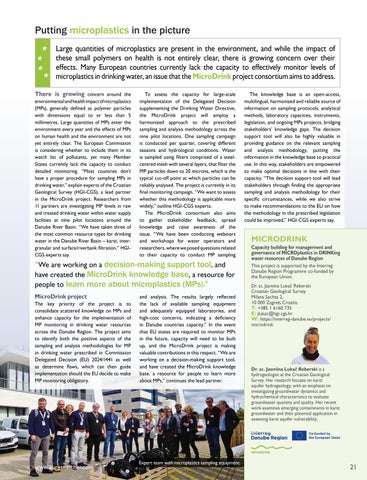
Expert team with microplastics sampling equipment.
The knowledge base is an open-access, multilingual, harmonized and reliable source of information on sampling protocols, analytical methods, laboratory capacities, instruments, legislation, and ongoing MPs projects, bridging stakeholders’ knowledge gaps. The decision support tool will also be highly valuable in providing guidance on the relevant sampling and analysis methodology, putting the information in the knowledge base to practical use. In this way, stakeholders are empowered to make optimal decisions in line with their capacity. “The decision support tool will lead stakeholders through finding the appropriate sampling and analysis methodology for their specific circumstances, while we also strive to make recommendations to the EU on how the methodology in the prescribed legislation could be improved,” HGI-CGS experts say.
MICRODRINK
Capacity building for management and governance of MICROplastics in DRINKing water resources of Danube Region This project is supported by the Interreg Danube Region Programme co-funded by the European Union. Dr. sc. Jasmina Lukač Reberski Croatian Geological Survey Milana Sachsa 2, 10 000 Zagreb, Croatia T: +385 1 6160 735 E: jlukac@hgi-cgs.hr W: https://interreg-danube.eu/projects/ microdrink
Dr. sc. Jasmina Lukač Reberski is a hydrogeologist at the Croatian Geological Survey. Her research focuses on karst aquifer hydrogeology, with an emphasis on investigating groundwater dynamics and hydrochemical characteristics to evaluate groundwater quantity and quality. Her recent work examines emerging contaminants in karst groundwater and their potential application in assessing karst aquifer vulnerability.
21