Exploiting the learning ability of memristors

Memristors have the ability to change their resistance so that they can either facilitate or inhibit communication between two neurons, and so are an important component in neuromorphic computing. Prof Erika Covi is investigating the properties of memristive devices and looking at how they can be exploited to improve computing efficiency in the MEMRINESS project.
A type of two-terminal device that can change its resistance upon the application of an electrical stimuli, the memristor is an important component of neuromorphic computing, an approach inspired by the structure of the human brain. Memristors adapt to the voltages or currents that they’ve been exposed to, broadly comparable to the way that synapses work in the human brain, giving them the ability to effectively learn from past experience. “Memristors essentially are able to change their resistance so that they can facilitate or inhibit the communication between two neurons,” explains Professor Erika Covi, Assistant Professor at the Technical University of Munich (TUM), Germany. Different kinds of memristive technologies are currently available for various applications, all with the common feature of a memristor with a middle layer which is typically an oxide, with metal either side. “The oxide can change its physical, atomic configuration, based on the field that has been applied to this 2-terminal device,” outlines Prof. Covi.
MEMRINESS project
As Principal Investigator of the ERCbacked MEMRINESS project, Prof. Covi is now looking to exploit this behaviour of memristors, with the aim of making computing more efficient. This is not about replacing current technology, which works very effectively, the aim is more to investigate the physical properties behind memristive
periodically few , also because as the patient ages, so their physiology may change,” she points out. “At the same time CIEDs also have to be able to intervene promptly when a patient needs stimulation. So they have to be able to adapt over short timescales, to save lives, and also over longer timescales, to adapt to pathologic or age-related changes.”
A second important property of certain
“Memristive devices do not behave like standard technologies, they all have different properties, and these properties are useful for learning.”
devices. “These devices do not behave like standard technologies, they all have different properties, and these properties are useful for learning,” says Prof. Covi. One example is Cardiac Implantable Electronic Devices (CIEDs), which Prof. Covi says needs to adapt to changes in individual patients over fairly long timescales, while at the same time providing rapid stimulation when needed. “Current CIEDs need to be checked
memristive devices is stochasticity, a property related to randomness which while undesirable in classical electronics, can be helpful in terms of reflecting the nature of the human brain. “Stochasticity can be beneficial in neuromorphic computing,” says Prof. Covi. In seeking to understand how memristors learn and the basis of these properties, Prof. Covi is using neuron models based on the operational
principles of the brain that are useful for computation, and at the same time are also feasible in hardware. “For example, we use the leaky-integrate and fire neuron model in the project, which is among the least biologically plausible of the models that are available in the literature. However, it works well and it’s computationally efficient, so we selected this in the project rather than more complicated models,” she outlines.
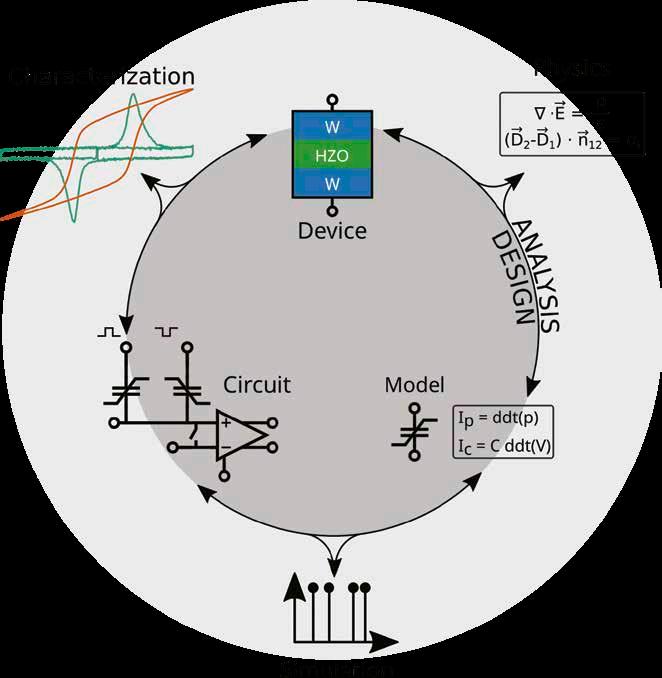
Researchers in Prof. Covi’s team are also looking to use the developed neural networks with the federated learning paradigm, a machine learning method which dates back around a decade or so. This paradigm was conceived to enhance individual privacy and data protection, says Prof. Covi. “The federated learning concept is that we don’t send our data, rather we send certain parameters that describe the network, so data is protected. These parameters coming from different networks are then collected, and used to update the model with the new learnt experiences,” she explains. The overall agenda in the project also includes developing new electronic circuit designs, building on the insights that have been gained during the course of research. “We’re exploring multiple circuit designs, and aim to find out which is the most efficient for different applications, which we will then look to target,” continues Prof. Covi. “These circuits, together with memristive devices, are important elements in the development of neural networks and the federated learning paradigm.”
Circuit designs
The project is now approaching its latter stages, and the circuit designs are currently with several of Prof. Covi’s collaborators around the world, who will fabricate the memristor devices on top and then return them to Groningen. In parallel, Prof. Covi’s team is working on a Field Programmable Gate Array (FPGA), which will be used to simulate part of the network. “We need to simulate part of the network on FPGA; our hardware is necessarily small and complex tasks would require a bigger hardware. We use the FPGA to simulate part of the network so that we can also demonstrate

more complex tasks,” she says. “We will connect it with our circuits. We want to prove that the network works, that it is effective, and that it brings advantages in comparison to what is already available in the literature and on the market.”
Current brain-inspired architectures are typically based on standard memory technologies, which are both fast and durable, yet they do have some limitations.
“The drawback is that as soon as the power supply is off they lose memory. If we want to save memory we need to put it in an external non-volatile flash memory, which
is the same as those found in SSD drives or USB sticks,” explains Prof. Covi. “This flash memory works, but it’s slower than the memristor, and it requires higher voltages, which you need a specific circuit to achieve.” This is one of the areas where memristive devices bring significant benefits over conventional technologies. They have a small size and a high speed, while they also provide non-volatile memory, meaning that once information is stored it stays there; these attributes may be important in some areas, but not in others, says Prof. Covi. “It’s not the case that memristors are invariably superior

MEMRINESS
Memristive Neurons and Synapses for Neuromorphic Edge Computing
Project Objectives
MEMRINESS aims to develop neuromorphic electronic systems for efficient information processing in edge computing tasks by leveraging physical properties of memristive devices and functional circuits based on CMOS technology.
Project Funding
This project has received funding from the European Research Council (ERC) under the European Union’s Horizon Europe research and innovation programme (Grant agreement ID: 101042585).
Project Partners
• Dr. David Kappel, University of Bielefeld (Germany)
• Dr. Francesco Malandrino, National Research Council (Italy)
• Dr. Ole Richter, Denmark University of Technology (Denmark)
• Prof. Dr. Christian Tetzlaff, University of Göttingen (Germany)
Contact Details
Project Coordinator, Professor Erika Covi Assistant Professor Nanoelectronics Circuits and Systems (NCAS) Technical University of Munich (TUM) Friedrich-Ludwig-Bauer-Straße 3, 85748 Garching bei München, Germany
E: erika.covi@tum.de
W: https://www.professoren.tum.de/en/ covi-erika
• Fehlings, Luca et al., “Heracles: A HfO2 Ferroelectric Capacitor Compact Model for Efficient Circuit Simulations,” in IEEE Transactions on Electron Devices, vol. 72, no. 11, pp. 6009-6014, Nov. 2025, doi: 10.1109/TED.2025.3615577.
• Fehlings, Luca, et al. “Millisecond-scale Volatile Memory in HZO Ferroelectric Capacitors for Bio-inspired Temporal Computing.” arXiv preprint arXiv:2508.08973 (2025).
• Gibertini, Paolo, et al. “A ferroelectric tunnel junctionbased integrate-and-fire neuron.” 2022 29th IEEE International Conference on Electronics, Circuits and Systems (ICECS). IEEE, 2022.
The MEMRINESS team: Meysam Akbari, Paolo Gibertini, Erika Covi and Luca Fehlings (left to right)

Erika Covi is an Assistant Professor at the Technical University of Munich, leading the Nanoelectronic Circuits and Systems group. Her research focuses on brain-inspired computing using emerging memory technologies like resistive switching and ferroelectric devices. She took up this position on 1st March 2026. Before she was Assistant Professor at the University of Groningen (the Netherlands).


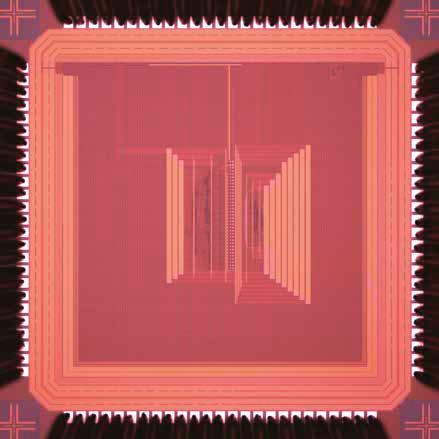
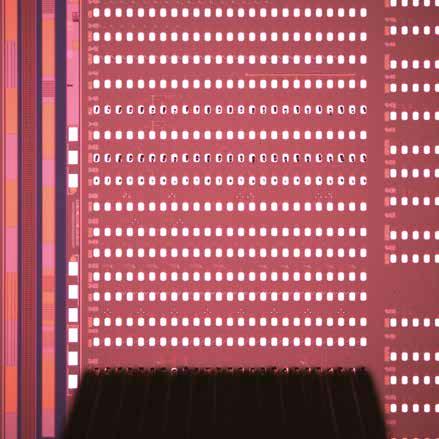
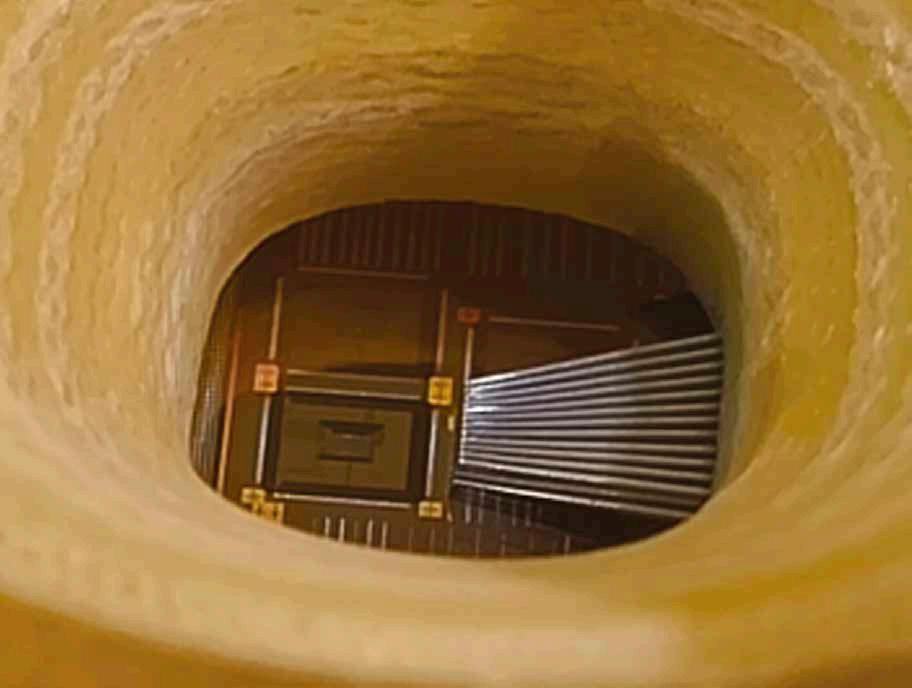
Micrograph of the fabricated 32 neuron array (left) and of the test structures that are used to evaluate subcomponents of the system, such as amplifiers or programming circuits (right).
to current standards in all applications, it depends on what you are looking to use them for. The aim is to use them in areas where it makes sense, where they provide an advantage and extend the functionality of current technology,” she stresses. There are a wide range of potential applications for memristors beyond neuromorphic computing, including in the Internet of Things (IoT) and the healthcare sector, although many hurdles need to be negotiated first. “The standards for the healthcare sector are very stringent, so that’s more of a long-term prospect,” acknowledges Prof. Covi. “Other applications such as robotics or preventive maintenance might be closer, more achievable.”
The project team is still pursuing basic, fundamental research into memristive devices, while at the same time considering potential commercial applications. Prof. Covi has recently been awarded a proof-ofconcept grant for the FELICE project by the ERC, which will allow her to build on the progress achieved in MEMRINESS and develop a new neuromorphic architecture. “We will look to produce a prototype architecture closer to what the market needs,” she says. A 180 nanometre technology is being used in MEMRINESS, which represents a cost-

effective prototyping option, and the proof-ofconcept is on smaller technology, while Prof. Covi is also exploring wider possibilities. “In 180 nanometres, we can buy the whole wafer, and then send it to our partners for postprocessing. However, this is not feasible for smaller scale technologies, for cost reasons,” she outlines. “Alongside the proof-of-concept project, we are also working in partnership with another institute to investigate smaller scale technologies. In the future we would like to explore different models, and potentially move towards machine learning.”
A further feature Prof. Covi aims to unlock in future is continuous, online learning, so that devices are able to learn from their experience, rather than needing a continuous connection with the cloud. These kinds of objectives can only be achieved if different technological components work together effectively, so Prof. Covi is committed to following the system technology co-optimisation methodology. “We don’t develop devices, circuits and algorithms in isolation, they are developed together, in order to remove any kind of bottleneck. This makes the overall system more efficient and improves the probability of success,” she stresses.
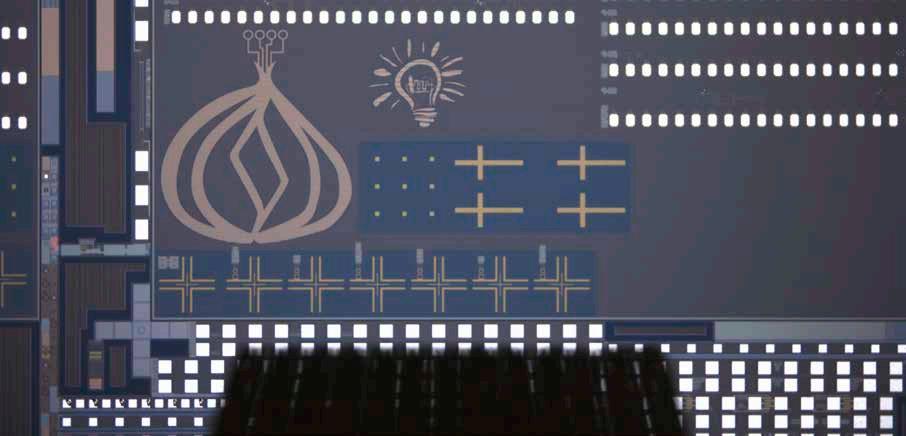
Micrograph of on-chip test structures, the logo of the chip (left), the logo of the team (centre), and the markers used for the fabrication of memristive devices (crosses, bottom).