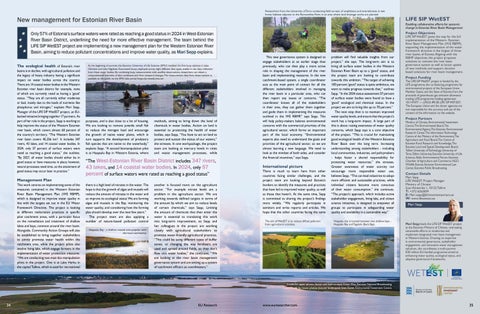
Researchers from the University of Tartu conducting field surveys of amphibians and invertebrates in wet forest habitats adjacent to the Rannamõisa River, in an area where land drainage works are planned.
New management for Estonian River Basin
Enabling collaborative efforts for systemic change in Estonian River Basin Management
Only 57% of Estonia’s surface waters were rated as reaching a good status in 2024 in West-Estonian River Basin District, underlining the need for more effective management. The team behind the LIFE SIP WetEST project are implementing a new management plan for the Western Estonian River Basin, aiming to reduce pollutant concentrations and improve water quality, as Mari Sepp explains. The ecological health of Estonia’s river basins is in decline, with agricultural pollution and the legacy of heavy industry having a significant impact on water bodies across the country. There are 14 coastal water bodies in the Western Estonian river basin district for example, none of which are currently rated as having a ‘good’ status. “They are all currently either moderate or bad, mainly due to the loads of nutrients like phosphorus and nitrogen,” explains Mari Sepp, Manager of the LIFE SIP WetEST project, an EUbacked initiative bringing together 17 partners. As part of her role in the project, Sepp is working to help improve the status of the Western Estonian river basin, which covers almost 60 percent of the country’s territory. “The Western Estonian river basin covers 45,256 km². It includes 347 rivers, 43 lakes, and 14 coastal water bodies. In 2024, only 57 percent of surface waters were rated as reaching a good status,” she outlines. “By 2027, all water bodies should either be in good status or have measures in place; however, natural processes need time, so the attainment of good status may occur later in practice.”
At the beginning of summer, the Estonian University of Life Sciences (EMU) installed the first buoy stations in Lake Ülemiste and Lake Niguliste. Automated buoys, deployed across eight different lake types, enable in situ data collection from these water bodies. By combining buoy measurements with satellite observations, researchers can obtain a comprehensive overview of lake conditions and their temporal changes. The measurement data from these stations is available to the public via the EMU lake portal: https://jarveveeb.emu.ee/
purposes, and is also close to a lot of housing. We are looking to remove juvenile small fish to reduce the nitrogen load and encourage the growth of native water plants, which in turn supports the development of predatory fish species that are native to the waterbody,” explains Sepp. “A second biomanipulation pilot is at Haapsalu Bay in Western Estonia, where
methods, aiming to bring down the level of chemicals in water bodies. Action on land is essential to protecting the health of water bodies, says Sepp. “You have to act on land to protect and sustain the status of our waters,” she stresses. In one workpackage, the project team are looking at mercury levels in cities and waste management processes, while
“The West-Estonian River Basin District includes 347 rivers, 43 lakes, and 14 coastal water bodies. In 2024, only 57 percent of surface waters were rated as reaching a good status”
Management Plan This work centres on implementing some of the measures contained in the Western Estonian River Basin Management Plan (WE RBMP), which is designed to improve water quality in line with the targets set out in the EU Water Framework Directive. The project is looking at different melioration practices in specific pilot catchment areas, with a particular focus on the remediation and treatment of shallow lakes and bays, common around the river basin. Alongside, Community Action Groups will also be established to bring together stakeholders to jointly promote water health within the catchment area, while the project pilots also involve living labs, which engage farmers in the implementation of water protection measures. “We are conducting two main bio-manipulation pilots in the project. One is at Lake Harku in the capital Tallinn, which is used for recreational
there is a high level of nitrates in the water. The hope is that the growth of algae and mussels will reduce the amount of nitrates in the water and so improve its ecological status We are farming algae and mussels in the Bay, monitoring the water quality, and considering how the farming plan should develop over the next few years.” The project team are also applying a number of nature-based pollutant control Haapsalu Bay - a shallow coastal area popular with the local community.
LIFE SIP WetEST
another is focused more on the agriculture sector. “For example nitrate levels are a problem in the agriculture sector. We are working towards defined targets in terms of the amount by which we aim to reduce levels of certain chemicals,” says Sepp. Limiting the amount of chemicals that then enter the water is essential to translating this work into long-term improvement, so Sepp and her colleagues in the project are working closely with agricultural stakeholders to promote water-friendly agricultural practices. “This could be using different types of buffer zones, or changing the way fertilisers are used and spread around fields, so they don’t flow into water bodies,” she continues. “We are looking at the river basin management governance system and are setting up a system of catchment officers as coordinators.”
Project Objectives
This new governance system is designed to engage stakeholders at an earlier stage than previously, who can then play a more active role in shaping the management of the river basin and implementing measures. In the new catchment-based system, a single coordinator acts as the main point of contact for all the different stakeholders involved in managing the river basin in a particular area, who can then report any issues or concerns. “The coordinator knows all of the stakeholders in their area, they can gather them together and guide them in implementing the measures outlined in the WE RBMP,” says Sepp. This will help policy-makers balance environmental concerns with the commercial priorities of the agricultural sector, which forms an important part of the local economy. “Environmental experts also need to understand the goals and priorities of the agricultural sector, so we are almost learning a new language. We need to look at the mindset of both sides, and consider the financial incentives,” says Sepp.
There is much to learn here from other countries facing similar challenges, and the project team are looking beyond Estonia’s borders to identify the measures and practices that have led to improved water quality, as well as those that haven’t. At the same time, Sepp is committed to sharing the project’s findings more widely. “We regularly participate in seminars and write reports and articles. We hope that the other countries facing the same
problem will find valuable insights from our project,” she says. The long-term aim is to bring all surface water bodies in the Western Estonian River Basin up to a ‘good’ status, and the project team are looking to contribute towards this ambition. “The target of achieving 100 percent ‘good’ status is quite ambitious, we want to make progress towards that,” outlines Sepp. “In the 2024 status assessment 57 percent of surface water bodies were found to have a ‘good’ ecological and chemical status. In the project we aim to bring this up to 70 percent.” The next step then is to maintain improved water quality levels, and ensure that the project’s work has a long-term impact. A large part of this is about raising awareness of water quality concerns, which Sepp says is a core objective of the project. “This is crucial for maintaining good ecological health of the Western Estonian River Basin over the long term. Increasing understanding among stakeholders - including local communities, industries, and policymakers - helps foster a shared responsibility for protecting water resources,” she stresses. Greater awareness of water scarcity can encourage more responsible water use, believes Sepp. “This can lead industries to adopt more efficient and sustainable practices, while individual citizens become more conscious of their water consumption,” she continues. “The project’s approach, which includes active stakeholder engagement, living labs, and citizen science initiatives, is designed to empower all groups to participate in safeguarding water quality and availability in a sustainable way.”
The aim of WetEST is to reduce diffuse pollution from agricultural activities.
Haapsalu city is located between two shallow bays Haapsalu Bay and Tagalaht (Back Bay).
International picture
LIFE SIP WetEST paves the way for the full implementation of the Western- Estonian River Basin Management Plan (W-E RBMP), expanding the implementation of the water framework directive in the largest of three river basins of Estonia. Aligning with the RBMP objectives, the project proposes solutions to reinvent the river basin governance system as well as boost uptake of new methods and support decision based solutions for river basin management.
Project Funding
The LIFE-SIP WetEST project is funded by the LIFE programme, the co-financing programme for environmental projects of the European Union Member States, and the State of Estonia from the proceeds of greenhouse gas emission allowance trading. LIFE programme funding agreement 101147477 — LIFE23-IPE-EE-LIFE SIP WET-EST. The European Union and the donor agencies are not responsible for the accuracy and use of the content of the information on the website.
Project Partners
Ministry of Climate, Environmental Investment Centre,The Environmental Board,The Environmental Agency,The Estonian Environmental Research Center,The Information Technology Centre of the Ministry of the Environment,The Agriculture and Food Board,The Centre of Estonian Rural Research and Knowledge,The Estonian Land and Spatial Development Board, Tallinn University of Technology, University of Tartu,Tallinn University, Estonian University of Life Sciences, Baltic Environmental Forum, Estonian Chamber of Agriculture and Commerce, NGO Wildlife Estonia, Estonian Environmental Law Center, Estonian Public Broadcasting.
Contact Details
Mari Sepp LIFE WetEST Project Manager Ministry of Climate Suur-Ameerika 1, 10122 Tallinn T: +372 6262839 E: Mari.sepp@kliimaministeerium.ee W: www.lifewetest.ee
Mari Sepp
Mari Sepp leads the LIFE SIP WetEST project at the Estonian Ministry of Climate, overseeing nationwide efforts to modernise and implement integrated river basin management in Western Estonia. Drawing on expertise in environmental governance, stakeholder engagement, and innovative water management solutions, she coordinates a multi-partner €30 million EU-funded programme aimed at enhancing water quality, ecological status, and adaptive governance frameworks.
Credit for upper photos (buoys and field surveys): Kristo Elias, Estonian National Broadcasting. Credit for lower photos (nature/ landscapes): Sven Začek, Enviromental Investment Centre.
34
EU Research
www.euresearcher.com
35