Meeting the Natura 2000 standards in Moldova Moldova hosts a rich diversity of flora and fauna, encompassing numerous species of ecological significance. The Life Renata project team are now working to align the conservation and management of these sites with the standards of the Natura 2000 network, as Apostolos Karteris, Artemis Margaritidou, Natalia Guranda and Vasiliki Chrysopolitou explain. The Emerald Network of protected sites was established in 1989 to support the conservation of different species and habitats across Europe, part of the wider goal of combatting biodiversity loss and environmental degradation. Currently there are 61 Emerald sites in Moldova, now the team behind the Life Renata project are working towards harmonising the conservation and management of these sites with the standards of the Natura 2000 Network, which spans all 27 EU Member States. “We are studying the current biodiversity status of Emerald sites in Moldova in order to develop recommendations for the transition to Natura 2000,” says Artemis Margaritidou, the project’s coordinator. Some partners of the project consortium have previous experience in this area, having worked on establishing Natura 2000 network sites in Greece, now they aim to help their Moldovan partners succeed in this transition. “We are updating the current Emerald Network database, which contains detailed ecological information on each Emerald site in Moldova, with lists of habitat types and important species,” outlines Vasiliki Chrysopolitou, an experienced biologist in implementing EU Habitats and Birds Directives in Greece and abroad.
and management information, such as the status of management plans per Emerald site. “It will provide a long-term support tool for the effective management of the country’s designated areas and biodiversity goals,” adds Karteris. This geospatial tool forms a key part of the broader Roadmap being developed by Life Renata, providing the data foundation needed to guide recommendations for protected site management, monitoring, and biodiversity conservation across Moldova. The EU released a new, more demanding version of the Natura 2000 database earlier this year, requiring more detailed information while adding further fields, so the project team are aware of the need to adapt to evolving standards. Training will be provided on how to gather information in line with Natura 2000, building on the expertise of the project’s Moldovan partners. “Within the consortium there are experts in the local flora and fauna, such as birds and fish experts, as well as habitat experts,” explains Chrysopolitou. The aim here is to provide strong foundations and a set of tools for the Moldovan authorities to monitor biodiversity in future. “We are trying to set a basis to improve the conservation and management of protected sites in the future. If you don’t know exactly what species occur at a protected site and the condition of the habitats, you cannot design the management measures properly,” points out Chrysopolitou.
“We are developing two main tools in the project, a GIS (Geographic Information System) Database and a Knowledge Repository Hub, which will be designed and operated within the framework of the project.” A clear, detailed picture of the current biodiversity status of the Emerald sites is essential to their ongoing conservation and management and for ensuring compliance with Natura 2000 standards. A team of Moldovan and international experts are also working on the Knowledge Repository Hub, aiming to provide an accessible, reliable resource that can guide conservation work, while collaborative events have been held.
is already a part of various international agreements and, as a country, they place a high priority on environmental protection and conservation.”
Roadmap for Natura 2000 Transition The Life Renata project is developing a comprehensive roadmap to support Moldova’s transition towards the Natura 2000 network. This strategic document will include recommendations to improve national legislation, as well as monitoring and management tools for biodiversity protection. “The roadmap will have several different categories, covering a number of
“We are now updating the current Emerald Network database, which contains detailed ecological information on each Emerald site in Moldova, with lists of protected
habitat types and species.”
“We’ve had specialised working groups looking at different aspects of biodiversity monitoring, and we’ve also held capacity building events,” says Karteris. This will help set a path towards full compliance with the Natura 2000 standards, which is an essential requirement for Moldova’s future integration within the EU as a full Member State, following the start of accession negotiations in 2024. “Our Moldovan partners need to adjust their operational framework in line with EU legislation and directives,” outlines Margaritidou. “Moldova
activities. It will outline priorities for the management of protected sites, biodiversity inventory, monitoring, and habitat protection,” says Karteris. A key focus is habitat mapping, which forms the foundation of effective biodiversity conservation. “The boundaries of protected areas depend on the extent of the habitat types that require protection. There is still no national inventory of habitat mapping in Moldova, based on EU legislation,” stresses Chrysopolitou. The team is identifying essential steps and specifications to continue habitat mapping
Ardeola ralloides (Scopoli, 1769) – squacco heron, Emerald site Lacurile Prutului de Jos, Brinza pond.
Life Renata Project Database This database provides a lot of information on the Emerald sites, yet it doesn’t always meet the level of detail required under Natura 2000 standards, an issue that the project team is working to address. The database is being updated to reflect the current situation on the Emerald sites in Moldova, which Chrysopolitou says is a complex, challenging task. “Much of the information is widely scattered, and in many cases even the responsible authorities are facing issues,” she explains. Information on protected areas is being gathered together in the project, with researchers looking to iron out any anomalies and produce a consistent and reliable database. “We’ve seen that there were several inconsistencies in the baseline information, and we have spent quite a lot of time reviewing files and correlating data. The final result will be a
36
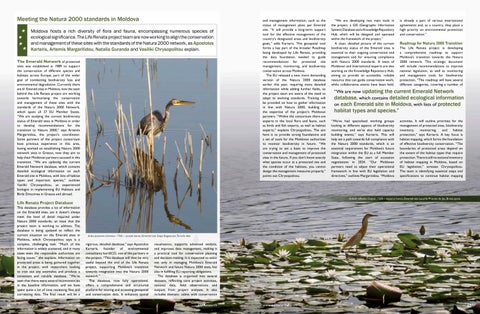
Ardea purpurea (Linnaeus 1766) – purple heron, Emerald site Stepa Bugeacului, Taraclia lake
rigorous, detailed database,” says Apostolos Karteris, founder of environmental consultancy kartECO, one of the partners in the project. “This database will then be very useful beyond the end of the Life Renata project, supporting Moldova’s transition towards integration into the Natura 2000 network.” The database, now fully operational, offers a comprehensive and structured platform for storing and accessing geospatial and conservation data. It enhances spatial
visualisation, supports advanced analysis, and improves data management, making it a practical tool for conservation planning and decision-making. It is expected to assist not only in managing Moldova’s Emerald Network and future Natura 2000 sites, but also in fulfilling EU reporting obligations. The database is organised into several datasets, reflecting core project activities, national data, field observations and outputs from project analyses. It also includes thematic tables with conservation
EU Research
www.euresearcher.com
37
LIFE RENATA
Roadmap for the alignment of EMERALD network establishment and management to NATURA 2000 standards in Moldova
Project Objectives
The primary aim in the Life Renata project is to help Moldova align the management of its protected Emerald Sites with EU standards, as accession talks progress. The project team aim to help their Moldovan partners build a deeper understanding of EU Habitat Directives, and to provide effective tools to monitor different species.
Project Funding
LIFE Renata is co-funded by the European Union under the LIFE Programme: Grant Number: 101148675.
Project Partners
The project is coordinated by Lever Development Consultants S.A., member of “Samaras & Partners” Group of Companies, with the participation of five (5) beneficiaries from Greece and Moldova: the Institute of Forestry Research and Development (ICAS) (Moldova), the Goulandris Natural History Museum – Greek Biotope/Wetland Centre (EKBY), the consulting company for environmental and energy engineering kartECO (Greece), the NGO EcoContact (Moldova) and the Ministry of Environment of the Republic of Moldova. https://liferenata.eu/partners/
Contact Details
Project Coordinator - Artemis Margaritidou, Urban Planning and Development Engineer, MA Director of Research and European Projects Department T: +30 6985 552 597 E: artemis.margaritidou@lever.gr W: https://www.lever.gr/ W: https://liferenata.eu
Artemis Margaritidou, Apostolos Karteris, Vasiliki Chrysopolitou, and Natalia Guranda (left to right)
Artemis Margaritidou is Director of the Research and European Projects Dept. at Lever S.A. Apostolos Karteris is the Co-founder and Head of Business Development at kartECO, Greece. Vasiliki Chrysopolitou is Head of Conservation and Networking at the Department for Biodiversity Research and Protection of the Goulandris Natural History Museum – Greek Biotope/Wetland Centre (EKBY). Natalia Guranda is an Environmental Expert at EcoContact with extensive experience in environmental governance.
38
Egretta garzetta (Linnaeus, 1766) – little egret, Emerald site Prutului de Jos, Beleu lake
and biodiversity management beyond the project’s conclusion. According to Natalia Guranda, Environmental Expert at EcoContact and one of the lead authors of the roadmap, these actions are directly aligned with the national priorities established under the National Programme for the Republic of Moldova’s Accession to the European Union 2025–2029: “Ensuring the effective management of protected natural areas, conserving biodiversity and adapting to climate change through the establishment of a Protected Areas Agency; the development of the Automated Information System Register of Protected Natural Areas, and the preparation of a roadmap for aligning Emerald sites with Natura 2000 standards. According to the European Commission’s 2023–2024 Report, the Republic of Moldova must further strengthen its management capacity in the field of nature protection,
continue preparations for the identification and pre-designation of sites to be covered by the Natura 2000 network, and establish an independent service for protected areas in this regard.” Guranda emphasises that the Life Renata roadmap is designed precisely to respond to these national commitments, offering technical guidance, priority actions, and a clear pathway for future EU-aligned biodiversity governance in Moldova. Alongside Moldova, the neighbouring country of Ukraine is being considered for EU membership. Towards this transition, Life Renata is collaborating with sister project ConNaturLIFE Ukraine, to address common challenges regarding the protected areas which share borders. This synergy allows the teams to exchange information and knowledge, and among other efforts, develop a joint list of species and habitat types that could be proposed for inclusion in the EU habitats directive.
“The boundaries of protected areas depend on the
extent of the habitat types that require protection. There is still no national inventory of habitat mapping in Moldova, based on EU legislation.” Lanius collurio (Linnaeus 1758) – red-backed shrike, Emerald site Padurea Domneasca, Padurea Domneasca Reserve.
EU Research