© Phonic lips
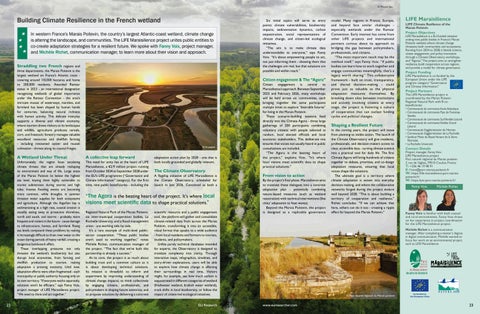
Building Climate Resilience in the French wetland In western France’s Marais Poitevin, the country’s largest Atlantic-coast wetland, climate change is altering the landscape, and communities. The LIFE Maraisilience project unites public entities to co-create adaptation strategies for a resilient future. We spoke with Fanny Voix, project manager, and Michèle Richet, communication manager, to learn more about their vision and approach. Straddling two French regions and three departments, the Marais Poitevin is the largest wetland on France’s Atlantic coast covering around 110,000 hectares and home to 200,000 residents. Awarded Ramsar status in 2023 - an international designation recognising wetlands of global importance under the Ramsar Convention - the area’s intricate mosaic of waterways, marshes, and farmland has been shaped by human hands for centuries, balancing natural richness with human activity. This delicate interplay supports a diverse and vibrant economy, where tourism draws visitors to its landscapes and wildlife, agriculture produces cereals, corn, and livestock; forestry manages valuable woodland resources and shellfish farming - including renowned oyster and mussel cultivation - thrives along its coastal fringes.
22
Six initial topics will serve as entry points: climate vulnerabilities, biodiversity impacts, sedimentation dynamics, carbon sequestration, social representations of climate change, and citizen-led ecological initiatives. “The aim is to make climate data understandable to everyone,” says Fanny Voix. “It’s about empowering people to act, not just informing them - showing them that the challenges are real, but that solutions are possible and within reach.”
Citizen engagement & The “Agora”
© Kryzalid
A Wetland Under Threat
A collective leap forward
Unfortunately, the region faces escalating climate threats that are already reshaping its environment and way of life. Large areas of the Marais Poitevin lie below the highest sea level, leaving them highly vulnerable to marine submersion during storms and high tides. Intense flooding events are becoming more common, while droughts in summer threaten water supplies for both ecosystems and agriculture. Although the Aiguillon bay is sedimentating at a high rate, coastal erosion is steadily eating away at protective shorelines, north and south, and storms - probably more frequent and violent in the future - cause damage to infrastructure, homes, and farmland. Rising sea levels compound these problems by making it increasingly difficult to drain river water to the ocean during periods of heavy rainfall, creating a dangerous bottleneck effect. These overlapping pressures not only threaten the wetland’s biodiversity but also disrupt local economies, from farming and shellfish production to tourism, making adaptation a pressing necessity. Until now, adaptation efforts were often fragmented - each municipality or public authority focusing only on its own territory. “If everyone works separately, solutions won’t be efficient,” says Fanny Voix, project manager of LIFE Maraisilience project. “We need to think and act together.”
This need for unity lies at the heart of LIFE Maraisilience, a €2.9 million project running from October 2024 to September 2028 under the EU’s LIFE programme (“Governance and Climate Information” category). For the first time, nine public beneficiaries - including the
adaptation action plan by 2028 - one that is both locally grounded and globally relevant.
The Climate Observatory A flagship initiative of LIFE Maraisilience is the Climate Observatory, scheduled for launch in late 2026. Conceived as both a
“The Agora is the beating heart of the project. It’s where local visions meet scientific data to shape practical solutions.” Regional Natural Park of the Marais Poitevin, six inter-municipal cooperation bodies, La Rochelle University, and a flood-management union - are working side-by-side. It’s a rare example of multi-level publicsector cooperation. “These public bodies aren’t used to working together,” notes Michèle Richet, communication manager of the project. “The fact that we’ve built this partnership is already a success.” At its core, the project is as much about building trust and a common culture as it is about developing technical solutions. Its mission is threefold: to inform and experiment by improving understanding of climate change impacts; to think collectively by engaging citizens, professionals, and policymakers in shaping future scenarios; and to propose solutions by delivering a concrete
scientific resource and a public engagement tool, the platform will gather and consolidate climate-related data from across the Marais Poitevin, transforming it into an accessible, visual format that speaks to a wide audience - from local residents and farmers to tourists, students, and policymakers. Unlike purely technical databases intended for experts, the Observatory is designed to translate complexity into clarity. Through interactive maps, infographics, timelines, and story-driven explanations, users will be able to explore how climate change is affecting their surroundings in real time. Visitors might, for example, see how much carbon is sequestrated in different categories of wetland (freshwater wetland, brakish water wetland), track shifts in local biodiversity, or follow the impact of citizen-led ecological initiatives.
EU Research
Citizen engagement is central to Maraisilience’s approach. Between September 2025 and February 2026, many workshops will be held across six communities, each bringing together the same participants multiple times to explore “desirable futures” for living in the Marais Poitevin. These scenario-building sessions feed directly into the Climate Agora - three large gatherings of 200 participants combining voluntary citizens with people selected at random, local elected officials and local economic stakeholders. This deliberate mix ensures that voices not usually heard in public consultations are included. “The Agora is the beating heart of the project,” explains Voix. “It’s where local visions meet scientific data to shape practical solutions.”
From vision to action By the project’s final phase, Maraisilience aims to translate these dialogues into a concrete adaptation plan - potentially combining nature-based measures (such as wetland restoration) with technical interventions (like cities’ adaptation to heat waves). Beyond the Marais Poitevin, the project is designed as a replicable governance
model. Many regions in France, Europe, and beyond face similar challenges especially wetlands under the Ramsar Convention. Early interest has come from other LIFE projects and international partners curious about its approach to bridging the gap between policymakers, professionals, and citizens. “The most important result may be the method itself,” says Fanny Voix. “If public bodies can learn how to work together and engage communities meaningfully, that’s a legacy worth sharing.” This collaborative framework - built on trust, transparency, and shared decision-making - could prove just as valuable as the physical adaptation measures themselves. By breaking down silos between institutions and actively involving citizens at every stage, the project is fostering a culture of cooperation that can outlast funding cycles and political changes.
Shaping a Resilient Future In the coming years, the project will move from planning to visible action. The launch of the Climate Observatory will give residents, professionals, and decision-makers access to clear, accessible data - turning climate science into a practical tool for daily life. The first Climate Agora will bring hundreds of citizens together to debate, prioritise, and co-design adaptation measures, ensuring that local voices shape the solutions. The ultimate goal is a territory where climate adaptation is woven into everyday decision-making, and where the collaborative networks forged during the project endure well beyond 2028. “This is about building a territory of cooperation and resilience,” Richet concludes. “If we can achieve that here, others can do it too - creating a ripple effect far beyond the Marais Poitevin.”
LIFE Maraisilience LIFE Climate Resilience of the Marais Poitevin
Project Objectives
LIFE Maraisilience is a EU-funded initiative uniting nine public bodies in France’s Marais Poitevin wetland, where climate change threatens both communities and ecosystems. Running from 2024 to 2028, it blends science, citizen engagement, and policy innovation through a Climate Observatory, workshops, and “Agoras.” The project aims to strengthen resilience, build cooperation across regions, and provide a model for climate governance.
Project Funding
LIFE Maraisilience is co-funded by the European Union under the LIFE program category “Governance and Climate Information.”
Project Partners
The LIFE Maraisilience project is coordinated by the Marais Poitevin Regional Natural Park with 8 cobeneficiaries: • Communauté de communes Aunis Atlantique • Communauté de communes Pays de FontenayVendée • Communauté de communes Sud Vendée Littoral • Communauté de communes Vendée Grand Littoral • Communauté d’agglomération du Niortais • Communauté d’agglomération de La Rochelle • Syndicat Mixte du Bassin Versant de la Sèvre Niortaise • La Rochelle Université
Contact Details
Project manager, Fanny Voix LIFE Maraisilience project Parc naturel régional du Marais poitevin 2 rue de l’église, 79510 Coulon, France T: +336 46 19 98 91 E: f.voix@parc-marais-poitevin.fr W: https://life-maraisilience.parc-maraispoitevin.fr/ W: https://pnr.parc-marais-poitevin.fr/
Fanny Voix
Michèle Richet
Fanny Voix is familiar with both coastal and rural environments, Fanny Voix draws on her experience in project coordination for the LIFE Maraisilience project. Michèle Richet is a communication manager. After completing a master’s degree in digital communication, Michèle wanted to focus her work on an environmental project such as LIFE Maraisilience.
© Parc naturel régional du Marais poitevin
www.euresearcher.com
23