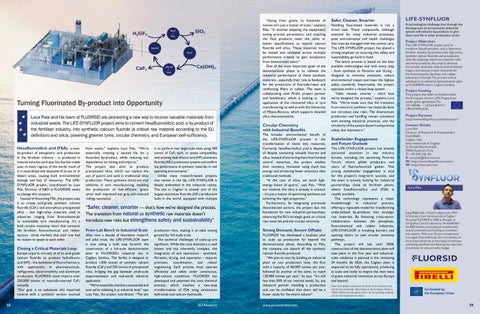
Turning Fluorinated By-product into Opportunity Luca Pala and his team at FLUORSID are pioneering a new way to recover valuable materials from industrial waste. The LIFE-SYNFLUOR project aims to convert hexafluorosilicic acid, a by-product of the fertiliser industry, into synthetic calcium fluoride (a critical raw material according to the EU definition) and silica, powering greener tyres, circular chemistry, and European self-sufficiency. Hexafluorosilicic acid (FSA) - a toxic by-product of phosphoric acid production in the fertiliser industry - is produced in massive volumes each year but has few viable uses. In many regions of the world, much of it is neutralised and disposed of at sea or in desert areas, causing both environmental damage and loss of resources. The LIFESYNFLUOR project, coordinated by Luca Pala, Director of R&D at FLUORSID, seeks to change this situation. Instead of discarding FSA, the project uses it to create acid-grade synthetic calcium fluoride (CaF 2) and amorphous precipitated silica - two high-value materials used in industries ranging from fluorochemicals to sustainable tyre manufacturing. It’s a bold circular economy vision that connects the fertiliser, fluorochemical, and rubber sectors - three markets that until now had no reason to speak to each other.
Closing a Critical Materials Loop Europe imports virtually all of its acid-grade calcium fluoride to produce hydrofluoric acid (HF) - the backbone of fluorochemistry, with applications in pharmaceuticals, refrigerants, electromobility and aluminium production. FLUORSID alone imports over 250,000 tonnes of naturally-sourced CaF 2 annually. “Our goal is to substitute this imported mineral with a synthetic version sourced
58
“Going from grams to hundreds of tonnes isn’t just a matter of scale,” explains Pala. “It involves adapting the equipment, tuning process parameters, and ensuring the final products meet the same or better specifications as natural calcium fluoride and silica. These materials must be tested and validated across multiple performance criteria to gain acceptance from downstream users.” One of the most important goals of the demonstration phase is to validate the industrial performance of these synthetic materials - especially their role as feedstock for the production of fluoroderivates and reinforcing fillers in rubber. The team is collaborating with Pirelli, project partner and beneficiary, which is looking at the application of the recovered silica in tyre manufacturing, as well as with the University of Milano-Bicocca, which supports detailed silica characterisation.
Circular Chemistry with Industrial Benefits
“Safer, cleaner, smarter — that’s how we’ve designed the process. The transition from natural to synthetic raw materials doesn’t introduce new risks but strengthens safety and sustainability”
The broader environmental benefit of the LIFE-SYNFLUOR process is the transformation of waste into resources. Currently, hexafluorosilicic acid is disposed of despite containing valuable fluorine and silica. Instead of extracting them from limited natural resources, the project enables their recovery, moreover using much less energy and producing fewer emissions than traditional methods. “In the case of silica, we avoid highenergy fusion of quartz,” says Pala. “With our method, the silica is already in solution - it’s just a matter of optimising synthesis and achieving the right properties.” Furthermore, by integrating previously disconnected sectors, the project lays the foundation for new industrial partnerships, advancing the EU’s strategic goals on critical raw materials and the circular economy.
From Lab Bench to Industrial Scale
Strong Demand, Secure Offtake
from waste,” explains Luca Pala. “We’re essentially creating a second life for a discarded by-product, while reducing our dependence on mining and imports.” The project also aims to produce precipitated silica, which can replace the use of quartz and sand in traditional silica production. These synthetic silicas are vital additives in tyre manufacturing, enabling the production of fuel-efficient ‘green tyres’ with improved wet grip and reduced rolling resistance.
After over a decade of laboratory research and pilot trials, the LIFE-SYNFLUOR team is now taking a bold step forward: the construction of a full-scale demonstration plant at FLUORSID’s industrial site in Cagliari, Sardinia. This facility is designed to produce 1,000 tonnes of synthetic calcium fluoride (CaF2) and 250 tonnes of precipitated silica, bridging the gap between small-scale experimentation and real-world industrial application. “We’ve tested the chemistry extensively and now we’re validating it at industrial level,” says Luca Pala, the project coordinator. “The aim
is to perform two large-scale tests using 500 tonnes of CaF2 each, to assess compatibility with existing hydrofluoric acid (HF)-aluminium fluoride (AlF3) production systems and confirm the performance of synthetic materials in real operating environments.” Unlike many research-based projects that remain in the lab, LIFE-SYNFLUOR is deeply embedded in the industrial reality. The site in Cagliari is already one of the largest aluminium fluoride (AlF3) production hubs in the world, equipped with multiple
production lines, making it an ideal testing ground for full-scale trials. The technical challenges of scale-up are significant. While the core chemistry is well known and not inherently complex, the integration of unit operations - synthesis, filtration, drying, and separation - requires precision, coordination, and robust engineering. Each process must operate efficiently and safely under continuous, high-volume conditions. FLUORSID has developed and patented the core chemical process, which involves a two-step transformation of FSA using ammonium hydroxide and calcium hydroxide.
EU Research
FLUORSID has developed a business plan to scale up production far beyond the demonstration phase. According to Pala, the company can absorb all the synthetic calcium fluoride produced. “We plan to start by building an industrial plant on two production lines: the first with a capacity of 60,000 tonnes per year, followed by another of the same, to reach 120,000 tonnes per year,” he says. “It’s still less than 50% of our internal needs. So, any industrial partner installing a production unit can be confident that there will be a buyer ready for the entire volume”.
www.euresearcher.com
Safer, Cleaner, Smarter Handling fluorinated materials is not a trivial task. These compounds, although essential for many industrial processes, pose environmental and health challenges that must be managed with the utmost care. The LIFE-SYNFLUOR project has placed a strong emphasis on ensuring that safety and sustainability go hand in hand. The entire process is based on the best available technologies and with every step - from synthesis to filtration and drying designed to minimise emissions, reduce environmental impact and meet the highest safety standards. Importantly, the project operates within a closed-loop system. “Safer, cleaner, smarter - that’s how we’ve designed the process,” explains Luca Pala. “We’ve made sure that the transition from natural to synthetic raw materials does not introduce new risks. The downstream production and handling remain consistent with existing industrial practices, and the circularity of the system doesn’t compromise safety, but improves it.”
Stakeholder Engagement and Future Outlook The LIFE-SYNFLUOR project has already attracted attention in key industry forums, including the upcoming Fluorine Forum, where global producers and users of fluorochemicals gather. This strong stakeholder engagement is vital for the project’s long-term success, and the team is actively looking for industrial partnerships close to fertiliser plants, where hexafluorosilicic acid (FSA) is readily available. The technology represents a major breakthrough in industrial practice, offering a replicable model for transforming underutilised by-products into strategic raw materials. By fostering cross-sector collaboration between the phosphate, fluorochemical and rubber industries, LIFE-SYNFLUOR is breaking barriers and opening doors to new circular economy pathways. The project will last until 2028: construction of the demonstration plant will take place in the first year and industrialscale validation is planned in the remaining 24 months. By 2026, the Cagliari plant is expected to be fully operational, producing at scale and ready to inspire the next wave of green industrial innovation across Europe and beyond.
LIFE-SYNFLUOR A technological challenge that through the development of an innovative industrial system will enhance by-products to give them new life in other production cycles
Project Objectives
The LIFE-SYNFLUOR project aims to transform hexafluorosilicic acid, a hazardous fertiliser industry by-product, into high-purity synthetic calcium fluoride and precipitated silica. By replacing mined raw materials with recovered products, the project advances the circular economy, reduces environmental impact, and secures critical resources for the fluorochemical, fertiliser, and rubber industries in Europe. The process will be validated at an industrial demonstration plant at FLUORSID’s site in Cagliari, Sardinia.
Project Funding
This project has been co-funded under the European Union’s LIFE Programme under grant agreement No. 101148346 — LIFE23-ENV-ITLIFE-SYNFLUOR.
Project Partners
https://www.lifesynfluor.com/en/partner/
Contact Details
Luca Pala Director of Research & Development FLUORSID Cagliari, Italy Area Industriale di Cagliari 2a Strada Macchiareddu 09032 Assemini (CA) T: +39 070 246 321 E: luca.pala@fluorsid.com W: https://www.lifesynfluor.com/en/ W: https://fluorsid.com/
Luca Pala
Luca Pala holds a Master’s degree and a PhD in Chemistry from the University of Cagliari. He joined FLUORSID in 2006 as Manager of the Quality Control Laboratory. He established the R&D division, promoting partnerships with several universities and focusing on innovation and research. With over 18 years of experience in inorganic fluorochemicals, he is the inventor of the process and serves as the project coordinator, overseeing workflows and ensuring that objectives are achieved on time and within budget.
Views and opinions expressed are those of the author(s) only and do not necessarily reflect those of the European Union or CINEA. Neither the European Union nor the granting authority can be held responsible for them.
59