Greener Pharma, Smarter Chemistry Angelini Pharma is leading the EU-funded LIFE-GREENAPI project to reduce the environmental footprint of active pharmaceutical ingredient (API) production. Anna Codazzi, William Herbert Gazzo, and Tommaso Iacoangeli explain how combining batch and flow chemistry, life cycle assessment, and collaboration with universities can help the pharmaceutical industry become more sustainable while staying globally competitive. The pharmaceutical industry plays a vital role in improving and saving lives. Yet behind every medicine lies an intensive manufacturing process, particularly in the production of APIs - the biologically active components of drugs. API production is resource-heavy, consuming large volumes of solvents, water, and energy, and generating substantial waste. For a company like Angelini Pharma, which operates a large fine chemicals plant in Aprilia, near Rome, the question became pressing: how could such processes be reimagined to reduce their environmental footprint while maintaining the highest quality standards? In 2022, Angelini Pharma began a structured reflection on how it could contribute to the European Green Deal, which calls for a 55% reduction in greenhouse gas emissions by 2030 and climate neutrality by 2050. The company identified the LIFE Programme as the natural partner - the EU’s only funding scheme dedicated entirely to environment and climate action, with an annual focus on greening the chemical sector. The answer took shape in LIFE-GREENAPI, a three-year, €2.5 million project co-funded
18
by the EU LIFE Programme. Launched in June 2023, the project set out to explore whether APIs could be produced with significantly lower environmental impacts. As Anna Codazzi, Global R&D Open Innovation Lead at Angelini Pharma, recalls: “The question we asked ourselves was simple: can we produce APIs with a smaller impact on the environment? That was the starting point for LIFE-GREENAPI.”
Smarter chemistry At the heart of LIFE-GREENAPI lies chemistry itself. For decades, pharmaceutical production has relied on batch chemistry, a well-established but resource-intensive method. In this approach, all reactants are loaded into a large vessel, the reaction is run to completion, and the finished product is discharged before the vessel is cleaned and prepared for the next cycle. It is a tried-andtested system, valued for its flexibility, but it also comes with drawbacks: large volumes of solvents, long reaction times, and high energy requirements, often leading to considerable waste generation. An increasingly attractive alternative is flow chemistry, where reactants are
continuously pumped through a narrow reactor, with the reaction occurring as they move along the system. This technique offers a number of advantages: greater control over reaction conditions, faster throughput, enhanced safety, and improved resource efficiency. Heat and mass transfer are far more effective in a flow reactor than in a large batch vessel, making it easier to run reactions under conditions that boost yield while cutting solvent and energy use. Long established in the petrochemical sector, flow chemistry has only recently begun to gain wider acceptance in pharmaceuticals - a shift supported by updated regulatory guidance and the industry’s growing sustainability commitments. Yet the project’s key insight was not to choose between batch and flow. Instead, it demonstrated that the most sustainable and competitive path often comes from combining the two. As Tommaso Iacoangeli, Fine Chemicals Business Project Manager at Angelini Pharma, explains: “It’s not enough to say you are more sustainable. You must also remain competitive. The innovation is learning when to use batch, when to use flow, or even when to adopt other methods
EU Research
like mechanochemistry. The best results come from choosing the right technology for each step.” The project is anchored in Angelini Pharma’s fine chemicals plant in Aprilia - a 70,000 square meter site with an annual capacity of 350–400 tons of output. Here, APIs, advanced intermediates, and original Angelini molecules are produced at scale, making it the ideal site to test greener processes with real-world impact. By “opening the box” on a historic API process, the team redesigned its multi-step synthesis, optimising traditional batch stages while introducing flow reactors where these offered advantages in energy use, solvent reduction, or yield.
Measurable impact In order to include additional outside experience, the project partnered with Leiden University in the Netherlands, which brought expertise in Life Cycle Assessment (LCA) - a rigorous method of quantifying environmental impacts across the entire production process. Key indicators included greenhouse gas emissions, electricity and methane consumption, water use, chemicals use, and waste generation. Preliminary results are striking: LIFEGREENAPI shows the potential to cut environmental impacts by up to 60% compared with baseline processes. While final numbers will be released at the project’s conclusion, improvements are already clear across solvents, water, waste, and energy. For example, solvent volumes - which can
account for up to 80% of material inputs in organic synthesis - were reduced through both optimisation and substitution with biobased, recyclable alternatives. Water usage was minimised not only by lowering volumes but also by treating and reusing process water. Energy efficiency was improved by exploiting flow chemistry’s ability to run under pressure, shifting reaction equilibria and cutting reaction times. “We discovered the best results came not from replacing batch with flow, but from combining the two approaches,” says Codazzi. “This hybrid process reduces emissions, saves resources, and creates cost advantages. It proves sustainability and competitiveness can go hand in hand.”
through green procurement, favouring partners with recognised sustainability certifications. “To tackle complex challenges like sustainability, you cannot act alone. Partnerships with academia, providers, and policymakers are essential,” notes Codazzi. As William Herbert Gazzo, R&D Funding Manager at Angelini Pharma, adds: “European projects like LIFE-GREENAPI are not only about technical results. They also build ecosystems where knowledge and resources can flow between companies, universities, and institutions. That is the real strength.” This collaborative ethos also extends to knowledge sharing. By demonstrating practical examples of sustainable chemistry, Angelini Pharma hopes LIFE-GREENAPI
“It’s not just about being greener. We need to prove that greener processes can also be efficient and cost-effective. That is what will convince companies to adopt them widely.” Collaboration matters No company can deliver a green transition alone. From its inception, LIFE-GREENAPI was designed as an open innovation project, engaging with universities, suppliers, and wider stakeholders. Collaboration with Leiden University was central, embedding environmental assessment into every stage of development. Industrial PhD programmes with Italian universities are exploring advanced fields such as mechanochemistry, which uses mechanical force rather than solvents to drive reactions. Suppliers are evaluated
can inspire others in the sector, helping to spread best practices across Europe’s pharmaceutical landscape.
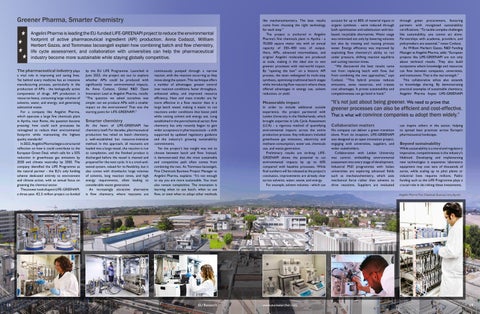
Beyond sustainability While sustainability is a moral and regulatory imperative, competitiveness is the industry’s lifeblood. Developing and implementing new technologies is expensive: laboratory equipment may cost tens of thousands of euros, while scaling up to pilot plants or industrial lines requires millions. Public funding such as the LIFE Programme plays a crucial role in de-risking these investments. Angelini Pharma Fine Chemicals Business Unit, Aprilia.
www.euresearcher.com
19
LIFE-GREENAPI Development & demonstration of low environmental impact innovation and optimization practices in pharma production
Project Objectives
LIFE GREENAPI, a three-year project led by Angelini Pharma in collaboration with Leiden University, is pioneering greener production of active pharmaceutical ingredients (APIs). Combining continuous flow chemistry with traditional methods, it seeks to optimise energy and resource use, improve safety, and promote sustainability in a highly regulated, hard-to-decarbonise industry.
Project Funding
LIFE-GREENAPI is co-funded by the European Union under Project Number: 101114152 (LIFE22-ENV-IT-LIFE-GREENAPI). Views and opinions expressed are however those of the author(s) only and do not necessarily reflect those of the European Union or CINEA. Neither the European Union nor the granting authority can be held responsible for them.
Project Partner
Institute of Environmental Sciences, University of Leiden.
Contact Details
Anna Codazzi Global R&D Open Innovation Lead Angelini Pharma S.p.A. Viale Amelia, 70, 00181 Rome, Italy T: +39 3 42769 8693 E: anna.codazzi@angelinipharma.com W: www.angelinipharma.com
Tommaso Iacoangeli, Anna Codazzi, and William Herbert Gazzo (left to right)
Angelini Pharma Fine Chemicals Business Unit, Aprilia.
As Iacoangeli stresses, “It’s not just about being greener. We need to prove that greener processes can also be efficient and cost-effective. That is what will convince companies to adopt them widely.” This dual challenge - of being both sustainable and competitive - echoes broader European debates. As Codazzi points out, “Funding for research and innovation is fundamental, but it must dialogue with the goal of competitiveness. Europe is moving in this direction, but we know other economies are not following the same path. For us, it is not just about impacts, but also about ensuring Europe remains competitive.” Reducing bureaucratic burdens is also part of the equation. In a heavily regulated sector like pharmaceuticals, companies can spend more time reporting than researching. Mid-sized firms, such as Angelini Pharma, are particularly vulnerable. Simplifying administrative processes could accelerate innovation and level the playing field.
Future vision Tommaso Iacoangeli, chemist with an Executive MBA, is Angelini Pharma’s Fine Chemicals Business Project Manager, supporting CDMO projects, funded initiatives, LIFE-GREENAPI, and sustainability efforts since 2022. Anna Codazzi, with a background in International Sciences, leads Angelini Pharma’s Funding and Innovation strategy, driving digital and green transitions, LIFE-GREENAPI, Open Innovation, sustainability, and scientific communication initiatives. William Herbert Gazzo is the R&D Funding Manager at Angelini Pharma. With an economic background, he oversees funding for multi-disciplinary projects, particularly in the pharmaceutical sector, across several production plants.
20
Looking ahead, Angelini Pharma sees API production evolving into a toolkit of green technologies rather than relying on a single method. Batch and flow will remain central, but new approaches are emerging. Mechanochemistry uses mechanical force to drive reactions without solvents, while electrochemistry and photochemistry harness electricity and light to enable
reactions that generate fewer emissions and less waste. Together, these tools could significantly cut the environmental footprint of pharmaceutical production. Another enabler is artificial intelligence. By analysing data, AI can optimise reaction conditions, predict failures, and monitor impacts in real time - turning sustainability into not just an obligation, but a strategic advantage. Yet innovation does not happen in a vacuum. The team stresses the importance of a regulatory environment that supports experimentation and scale-up. As Iacoangeli underlines: “The frameworks are crucial - we need a balance that allows innovation while maintaining safety and quality standards.” Without this, even the most promising technologies could stall before reaching industrial maturity. For Codazzi, the future is about more than technical advances; it is also about a cultural shift in how the industry views its role in society. “At the end of the day, sustainability is not just ethics - it is competitiveness, innovation, and legacy for future generations.” By showing that environmental responsibility can align with efficiency and profitability, LIFE-GREENAPI is not only greening one company’s production lines but also pointing the way toward a pharmaceutical industry that is more resilient, innovative, and sustainable across Europe.
Angelini Pharma Fine Chemicals Business Unit, Aprilia.
EU Research