Tailored building blocks for tomorrow’s materials


The team behind the ERC-backed Heteroplates project are able to precisely control the size and structure of nanocrystals, which can then act as the building blocks of new materials with exciting properties. We spoke to Principal Investigator Professor Yehonadav Bekenstein about the project’s work and its wider implications.
Materials today can be built from the bottom up, with researchers able to precisely tune the size and structure of individual parts down to the atomic scale, which opens up new horizons in terms of controlling their electronic structure. The team at Professor Yehonadav Bekenstein’s lab at the Israel Institute of Technology hold deep expertise in growing nanocrystals, which can act as the building blocks of new materials. “We have been very successful in making these nanocrystals and controlling their size, which we have designed to be as similar as possible. As they’re so similar to each other, these nanocrystals stack into very ordered superlattices when they are assembled together,” he outlines.
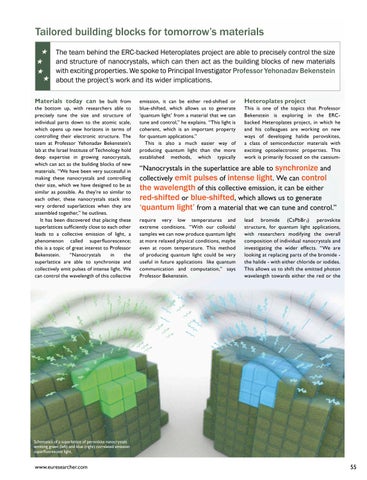
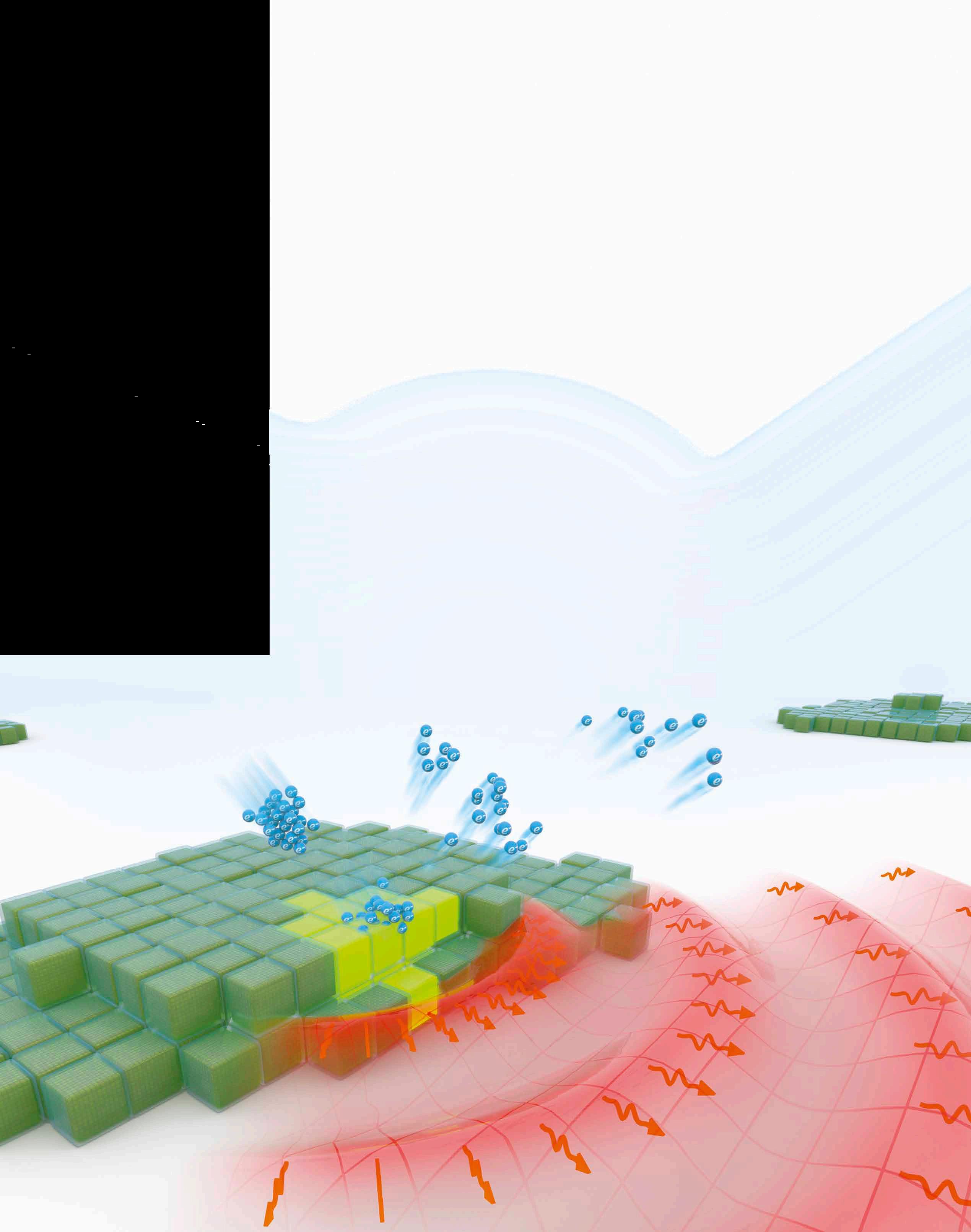
It has been discovered that placing these superlattices sufficiently close to each other leads to a collective emission of light, a phenomenon called superfluorescence; this is a topic of great interest to Professor Bekenstein. “Nanocrystals in the superlattice are able to synchronize and collectively emit pulses of intense light. We can control the wavelength of this collective
emission, it can be either red-shifted or blue-shifted, which allows us to generate ‘quantum light’ from a material that we can tune and control,” he explains. “This light is coherent, which is an important property for quantum applications.”
This is also a much easier way of producing quantum light than the more established methods, which typically
Heteroplates project
This is one of the topics that Professor Bekenstein is exploring in the ERCbacked Heteroplates project, in which he and his colleagues are working on new ways of developing halide perovskites, a class of semiconductor materials with exciting optoelectronic properties. This work is primarily focused on the caesium-
“Nanocrystals in the superlattice are able to synchronize and collectively emit pulses of intense light. We can control the wavelength of this collective emission, it can be either red-shifted or blue-shifted, which allows us to generate ‘quantum light’ from a material that we can tune and control.”
require very low temperatures and extreme conditions. “With our colloidal samples we can now produce quantum light at more relaxed physical conditions, maybe even at room temperature. This method of producing quantum light could be very useful in future applications like quantum communication and computation,” says Professor Bekenstein.
lead bromide (CsPbBr 3) perovskite structure, for quantum light applications, with researchers modifying the overall composition of individual nanocrystals and investigating the wider effects. “We are looking at replacing parts of the bromidethe halide - with either chloride or iodides. This allows us to shift the emitted photon wavelength towards either the red or the
explains. “The resulting higher surface energy holds the nanocrystal intact, and prevents it from falling apart. The volume of these particles is very small and the surface energy extremely large, which serves to essentially stabilise these crystals.”
Heterostructures
blue,” says Professor Bekenstein. This changes the interactions between excitons in these materials, and they interact in either a repulsing or attracting way, which will then influence superfluorescence.
“This is something that we discovered in my lab. We found that this red-shift is not an inherent property of the superfluorescent light, but rather something that is influenced by the interaction between excitons and can be controlled,” continues Professor Bekenstein.
A second pillar of the Heteroplates project is the team’s work in synthesising the actual building blocks themselves, the nanocrystals. While researchers are able to make halide perovskites with a very consistent size and structure, Professor Bekenstein says there is still more to learn in terms of tuning the halide part. “Mixing the two extremes, the iodide and the chloride, is not allowed by nature. The iodide anion is large, and the chloride is small, so the sizes do not match inside the unit cell. If you do not balance the sizes carefully a crystal will become thermodynamically unstable and fall apart,” he explains. A robot is being used to conduct high-throughput experiments, which will help researchers identify which particle compositions are stable and which are not. “We’ve been able to run 3,000 experiments with this robot, looking at halides with different proportions of chloride, bromide and iodide,” continues Professor Bekenstein.
“We’ve been able to learn a lot about the quality of the different particles that we’ve created, about their stability.”
The established Hume-Rothery rules state that halides of different sizes cannot be mixed together, that the end result will not be stable, but Professor Bekenstein has found that these rules actually break down at the nanoscale. The large dataset generated with the robot experiments played a crucial role in this respect. “We’ve been able to repeatedly run large numbers of experiments, each time with smaller and smaller nanocrystals,” outlines Professor Bekenstein. Established theory did not explain all the observations from these experiments, as some compositions which it was predicted would not be stable were shown to in fact be forming stable crystals.
“We suspected this was due to a nanosize effect, meaning that the nanocrystals have much more surface area in relation to their volume than bulk material, which enhances stability,” continues Professor Bekenstein.
Researchers used the robot to experimentally test this hypothesis, which showed that the Hume-Rothery rules do not hold when it comes to very small nanocrystals, and Professor Bekenstein has developed an accompanying theory to explain why. “As you go from 20 nanometre crystals down to a few nanometres, the surface-to-volume ratio changes significantly. With smaller particles, there’s more surface in relation to volume,” he
This opens up new possibilities in terms of engineering these very small building blocks and tuning their properties, which is an active area of research in Professor Bekenstein’s lab. Alongside, researchers are also working to create heterostructures, which are formed of combinations of different materials. “We’re looking to essentially take a nanocrystal and grow another material on it,” says Professor Bekenstein. One avenue of investigation involves taking perovskite nanocrystals and growing chalcohalides on top, which Professor Bekenstein says leads to some highly interesting effects. “By growing an additional material, this heterostructure actually changes its optoelectronic properties. Growing this material changes the physical properties of the whole structure,” he outlines. “The original material, the perovskite, may have been very emissive. However, if you grow this additional material on it, the absorption and the emission characteristics will change. It
will not emit in the blue any longer, it will emit in the yellow or in the red.”
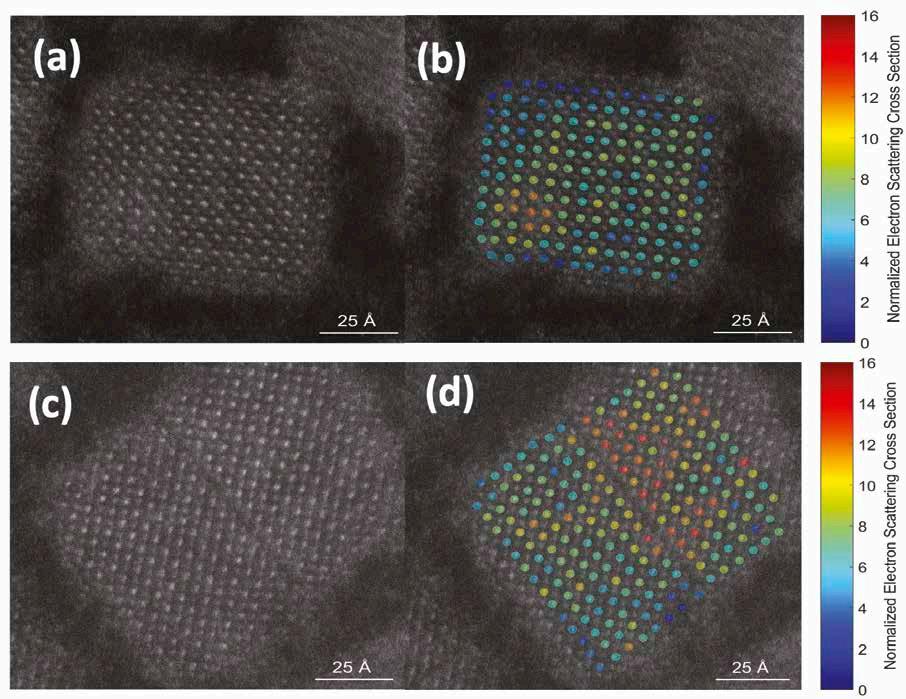
These materials also have the ability to self-heal, another interesting property that Professor Bekenstein is keen to highlight. Perovskite nanocrystals are sensitive to radiation, and if they are exposed to sufficiently high levels of radiation they will essentially break down over time and holes will develop; Professor Bekenstein and his team discovered that holes in some crystals behave in unexpected ways. “We
continues Professor Bekenstein. “They don’t have exactly the same composition as before, but they retain a very similar crystal structure.”
This work is primarily motivated by scientific and intellectual curiosity, with the project team taking these nanocrystals then self-assembling them into larger structures and relating their overall composition to their properties. At the same time, Professor Bekenstein is also considering the potential applications of these materials; one
“We have been very successful in making perovskite nanocrystals and controlling their size, which we have designed to be as similar as possible. As they’re so similar to one another, these nanocrystals stack into very ordered superlattices.”
took hundreds of videos, enhanced them for contrast, and then did some analysis. We found that these holes actually move in the crystal, which is not conventionally supposed to happen,” he explains. They move in a very specific way, which is related to the chemical properties on the surface of these crystals. “If we tune the surfaces in a certain way, we’re able to get crystals that will self-heal. They will re-crystallise to a perfect crystal, without the hole. However, they will be a little bit smaller, because some atoms will have been lost,”
prominent possibility is in the green energy sector, for example in energy storage devices, or in photovoltaic panels. “There is a lot of interest in using these halide perovskites in solar cells,” he stresses. There are a wide range of other potential applications of halide perovskites beyond the energy sector, from neuromorphic computing to healthcare, reinforcing the wider importance of the project’s work. “Caesium-lead bromide crystals have been shown to improve the performance of x-ray detectors for example,” says Professor Bekenstein.
Heteroplates
Halide perovskite heterostructures based on 2D nanoplates building blocks for next generation optoelectronics
Project Objectives
This research aims to engineer and understand collective quantum phenomena in halide perovskite nanocrystal assemblies by combining controlled superlattice design, quantum confinement tuning, and compositional engineering. Leveraging AI-driven self-driving laboratories and robotic high-throughput anion exchange, the work explores emergent excitonic interactions, tunable superfluorescence, accelerated radioluminescence, and novel nanoscale-stabilized compositions beyond conventional materials rules.
Project Funding
This project has received funding from the European Union’s Horizon 2020 research and innovation program under grant agreement No 949682- ERC- HeteroPlates.
Project Collaborators
• Ido Kaminer kaminer@technion.ac.il
• Nini Pryds nipr@dtu.dk
• James Utterback james.utterback@sorbonne-universite.fr
Contact Details
Project Coordinator, Professor Yehonadav Bekenstein Department of Materials Science & Engineering, Technion, Israel E: bekenstein@technion.ac.il W: https://bekenstein.net.technion.ac.il/ research/perovskites-heterostructures/

Dr. Yehonadav Bekenstein is an Associate Professor at the Technion, where he serves as the lead investigator of Heterplates and heads a research group focused on advancing optoelectronic materials. His notable scientific achievements include: The discovery of perovskite nanoplatelets. The development of superfluorescence in confined nanocrystal superlattices. Advancements in high-energy detection. In addition to founding the Ultrafast Quantum Microscopy Lab, Dr. Bekenstein is promoting an AI-driven, self-driving laboratory dedicated to materials discovery. He is also the co-founder and CTO of Cheel, a startup focused on thermal management solutions for next-generation energy storage systems.