Forests

As adolescent mental health services across Europe face growing pressure, the Interreg NorthWest Europe project Forest4Youth is exploring how real forests and immersive virtual nature can support young people during and after psychiatric care. We spoke with project leader Vinciane de Moffarts and members of the research team about evidence, access and policy impact.
Across Europe, adolescent mental health services are under unprecedented pressure. While contact with nature is widely recognised as beneficial for mental wellbeing, existing research does not consider adolescents who are already on a psychiatric path. Forest4Youth responds to this overlooked gap, investigating how real forests - and, where access is limited, immersive virtual nature - can be integrated into evidence-based mental health pathways for young people during and after hospitalisation.
Led by the Centre Neuropsychiatrique SaintMartin (CNP) in Belgium and funded through Interreg North-West Europe, Forest4Youth brings together psychiatric hospitals, universities, forest managers, and technology experts. The project focuses on adolescents aged 12 to 18 who are hospitalised or recently discharged following a mental health crisis - a group that remains largely absent from existing nature-based health research. Within the consortium, The Royal College of Surgeons In Ireland (RCSI) and Free University of Brussels (ULB) are leading the research activities, ensuring a strong scientific and clinical foundation for the project’s approach.
Adolescents, crisis, and a missing research population
“Much of the research on nature and mental health focuses either on adults or on healthy populations,” explains Kate Brassington,
PhD researcher at RCSI University of Medicine and Health Sciences, a member of the Forest4Youth consortium. “There is surprisingly little evidence when it comes to adolescents who are already in psychiatric care - particularly those transitioning back to everyday life after hospitalisation”.
This gap is critical. Adolescence is increasingly recognised as a distinct developmental stage, marked by heightened vulnerability but also significant potential for recovery. Yet mental health research often struggles to capture this complexity. Diagnostic categories can take months or years to establish, and young people are frequently admitted to hospital based on acute symptoms rather than formal diagnoses.
At CNP Saint-Martin, where Forest4Youth is coordinated, adolescents are hospitalised
during moments of crisis, when outpatient care is no longer sufficient. “They arrive because something in their life has become a danger, either for themselves or for their family environment,” explains Vinciane de Moffarts, the project manager. “Hospitalisation enables a comprehensive assessment of the patient’s condition but the immediate focus is on stabilisation. Many arrive without a diagnosis, but with severe anxiety, suicidal thoughts, or a sense of complete emptiness”.
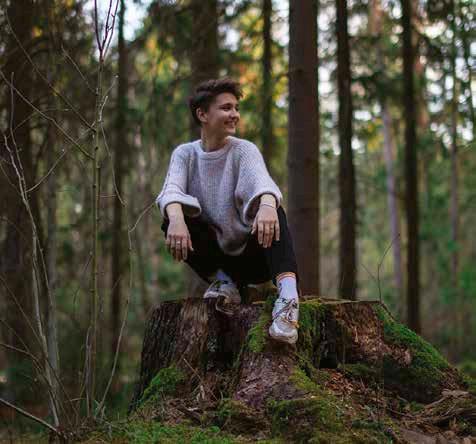
Clinicians involved in the project have observed a marked shift since the COVID-19 pandemic. “Before, adolescents in crisis were often seen as troublemakers,” de Moffarts notes. “Now, many are not making trouble at all. They are withdrawn, disconnected, and struggling to find purpose or perspective.”
The idea that nature can support mental wellbeing is not new. Studies from Japan, South Korea and China have long explored shinrin-yoku or “forest bathing”, while European research has shown associations between green space exposure and reduced stress. What remains unclear is how these benefits translate into structured therapeutic interventions - particularly for vulnerable adolescents.
“What we know is that being in a forest is generally good for you,” Brassington says. “What we don’t yet understand is why, for whom, and under what conditions it works best.”
Existing studies vary widely. Some interventions last just 12 minutes, others involve multi-day stays in woodland settings. Outcomes are typically measured immediately before and after a single visit, with very few longitudinal follow-ups. “Short-term benefits are clear,” Brassington explains. “But we lack evidence on whether these effects last weeks or months after the intervention.”
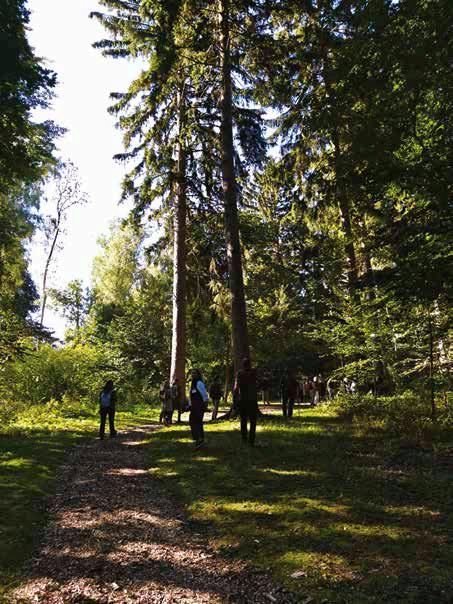
Forest4Youth aims to move beyond the question of whether forests are beneficial, and instead investigate how forests can be meaningfully integrated into care pathways. This includes examining the role of group versus individual activities, guided versus unstructured experiences, and the importance of sensory engagement, autonomy and perceived safety.
“There’s something powerful about forests as spaces where adolescents can regain a sense of agency,” Brassington notes. “They can make decisions, take small risks, engage their senses - things that are often limited in clinical environments.”
Designing forest-based care
Rather than imposing a one-size-fits-all model, Forest4Youth is developing a flexible forestbased care protocol that can adapt to different clinical settings, forest types and cultural contexts. This protocol is being co-created through a participatory research process involving adolescents, families, mental health professionals and forest managers.
When access to forests is limited Despite the potential benefits of real forests, access remains uneven. Many adolescents - particularly those in hospital or urban settings - cannot easily reach woodland environments. Transport, mobility issues, safety concerns and staffing constraints all create barriers.
This is where Forest4Youth introduces a second, innovative strand: immersive virtual reality (VR).
virtual nature can support emotional regulation, stress reduction and preparation for real-world forest experiences. In some cases, VR may be used before forest visits to familiarise adolescents with the environment; in others, it may support reflection and reintegration afterwards.
Importantly, the project does not frame VR and real forests as competing interventions.
“The goal is not comparison,” Brassington stresses. “The goal is accessibility. Many young people simply don’t have the option to go into a forest regularly. VR can help bridge that gap.”
One of the project’s central challenges is evaluation. Psychological questionnaires remain the most common tools, alongside physiological indicators such as heart rate variability or cortisol levels. Yet no single biomarker reliably captures mental wellbeing, particularly in adolescents.
“There is no textbook that tells you the right measure for forest-based mental health,” Klass notes. “That uncertainty is part of the field and part of what makes this research necessary.”
Forest4Youth plans to use a mixedmethods approach, combining quantitative measures with interviews and longer-term
“There is surprisingly little evidence when it comes to adolescents who are already in psychiatric care - particularly those transitioning back to everyday life after hospitalisation”.
“We are not trying to replace real forests,” emphasises Malgorzata Klass, Professor at Université Libre de Bruxelles- member of the Forest4Youth consortium- and lead for the VR research. “VR is a complementary tool, designed for situations where access to nature is limited or temporarily impossible”
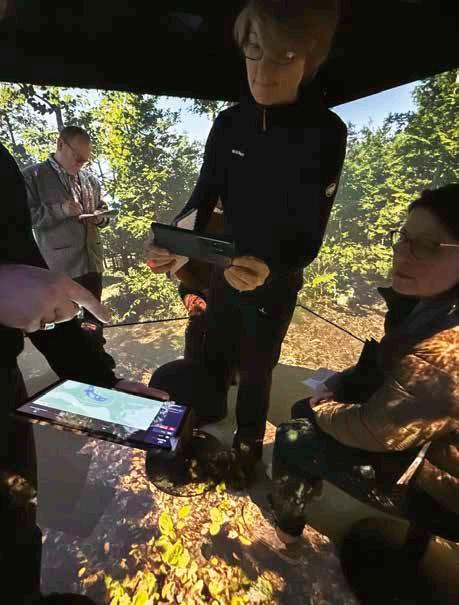
Unlike headset-based VR commonly used in research, Forest4Youth employs an immersive VR room, where forest environments are projected onto all four walls. Participants can see their own bodies, interact with others, and move freely - creating a shared, embodied experience rather than an isolated one.
“This setup allows group interaction and collaboration,” Klass explains. “It also avoids some of the discomfort and disorientation associated with head-mounted displays, which is especially important for adolescents with mental health vulnerabilities.”
Research on virtual nature is even more limited than studies on real forests. “Most existing VR studies involve healthy university students,” says Mostafa El Madani, PhD researcher at ULB. “Clinical populations and adolescents are largely absent.”
Forest4Youth will explore how immersive
Forest-Based Therapies for Adolescent Mental Health Recovery in NorthWest Europe
Project Objectives
The project will deliver a joint synthesis of forest-based initiatives and research on adolescent mental health and co-design a shared care protocol through a consultative process involving relevant stakeholders, combining real and VR forest experiences. It will pilot eight therapeutic forests and immersive VR activities across NWE, implement targeted actions for teenagers, and develop guidelines and tailored training for practitioners from the forestry and mental health sectors, while establishing five reference centres to support long-term sustainability.
Project Funding
The Forest4Youth project is funded under INTERREG North West Europe NWE0400643.
Project Partners
Forest4Youth is implemented by a transnational consortium of nine partners: the lead partner Oeuvres des Frères de la Charité – St Martin Neuropsychiatric Centre (Belgium); Brussels Environment – Forest and Nature (Belgium); Association Elan Argonnais (France); Forest Service and Energy GmbH (Germany); Free University of Brussels (ULB) (Belgium); Public Mental Health Establishment of Marne (France); Royal Forestry Society of Belgium (Belgium); The Royal College of Surgeons in Ireland –Centre for Positive Health Sciences (Ireland); and UNature (Luxembourg).
Contact Details
Project Coordinator, Vinciane de Moffarts
follow-ups. By tracking outcomes beyond the immediate intervention, the project hopes to contribute robust evidence to a field currently dominated by short-term studies.
In the project’s later stages, partners plan to engage directly with public authorities to advocate for the recognition of green care within mental health systems.
“Research often takes 10 to 15 years to influence practice,” de Moffarts says. “Here, we are involving policymakers, clinicians and service users from the start. That shortens the distance between evidence and implementation.”
If successful, Forest4Youth could help reframe forests not only as recreational or environmental assets, but as integral components of public health infrastructuresupporting some of Europe’s most vulnerable young people at a critical stage in their lives.
As Brassington puts it: “Yes, we’re doing careful, complex research, but at the same time, there’s a simple message. Nature matters: and for many adolescents, it may be one of the most powerful places to begin healing.”
International Projects Manager Centre Neuro Psychiatrique St-Martin T: +32 471 706 543
E: vinciane.demoffarts@saintmartin.ofc.be W: https://forest4youth.nweurope.eu/

Jocelyn Deloyer is a social and occupational psychologist with over 15 years’ experience leading European projects in the psychiatric sector. As European project lead at CNP St-Martin, he has built strong transnational networks advancing mental health innovation, non-pharmaceutical interventions, professional training, and social inclusion across EU programmes.