
One-stop shops: making home energy renovation simple

As Europe struggles to accelerate home energy renovation, the EU Peers project is strengthening the systems that help citizens act. We spoke with Jenny-Claire Keilmann and Marcus Andreas, senior project managers at Climate Alliance, the organisation coordinating EU Peers, about onestop shops, trust, and why simplifying renovation is key to Europe’s climate and housing goals.
Across Europe, buildings sit at the heart of two urgent and interconnected challenges: climate action and affordable housing. Buildings account for around 40% of the EU’s final energy consumption, while approximately 75% of the building stock remains energy inefficient, according to the European Commission. Despite ambitious targets under the Renovation Wave and the European Green Deal, renovation rates hover stubbornly around 1% per year – far below what is needed to meet climate neutrality by 2050. To address this gap, many one-stop shops (OSS) for home energy renovation are emerging across EU Member States, often established by local authorities, energy agencies, or private actors to provide homeowners with a single entry point for advice and support throughout the renovation process. The problem is not a lack of technology. Solutions for insulation, heating, ventilation and renewable energy are widely available. Instead, the real bottleneck lies elsewhere: for most homeowners, renovating a home remains a complex, fragmented and intimidating process.
This is where EU Peers, a LIFE-funded project coordinated by Climate Alliance and implemented by a consortium of eleven partner organisations across Europe, is stepping in – not by reinventing renovation technologies, but by strengthening the systems that help people actually use them.
From “mission impossible” to one trusted entry point
For homeowners, especially those attempting a deep energy renovation – combining several energy-efficiency measures across the building rather than a single upgrade – the journey can quickly feel overwhelming. The renovation market is fragmented across auditors, architects, installers, banks and public authorities. Coordinating contractors, navigating subsidies, securing financing and supervising works often falls on individuals with limited time, technical knowledge or financial capacity.
“Renovation is not something people do every day,” explains Jenny-Claire Keilmann, senior project manager at Climate Alliance. “It’s more like organising a wedding – something that happens once in a lifetime, with high stakes and a lot of stress if you’re left alone.” In this sense, one-stop shops have been compared to wedding planners, guiding homeowners step by step
through a complex process and coordinating the many actors involved.
To reduce this burden, numerous one-stop shops across Europe have been developed – also known as Integrated Home Renovation Services (IHRS). In simple terms, a one-stop shop is a place homeowners can go to get help with renovating their home, without having to contact multiple experts themselves. These services bring together technical advice, financial guidance, administrative support and project coordination under one roof, offering homeowners a single, trusted entry point.
One-stop shops can take different forms. Some focus mainly on advice and orientation, while others accompany homeowners throughout the entire renovation journey, from the first energy assessment to contractor selection, quality control and post-renovation follow-up. They can be run by municipalities, regional energy agencies, non-profits or private actors, depending on national and local contexts. What they share is a common goal: making ambitious home renovation simple, accessible and trustworthy.
A concept gaining momentum
While one-stop shops in this field are not new – some have existed for more than 15 years –their role is now being formally recognised at EU level. Recent revisions of the Energy Performance of Buildings Directive (EPBD) and the Energy Efficiency Directive (EED) explicitly call on Member States to ensure wide territorial coverage of one-stop shops as technical
assistance facilities for residential renovation, including, under the EPBD, the establishment of one one-stop shop per 80,000 inhabitants or at least per region, with particular attention to vulnerable and energy-poor households.
“This creates a unique moment,” says Marcus Andreas, senior project manager at Climate Alliance. “For the first time, bottom-up initiatives on the ground are being matched by a strong topdown policy push.”
Yet translating EU directives into effective national and local systems is far from straightforward. One-stop shops differ widely across countries, face similar operational challenges, and often work in isolation, with limited visibility or long-term funding.
Rather than creating new one-stop shops itself, EU Peers acts as a meta-community: a European community of practice designed to connect, strengthen and scale existing and emerging services.
The project brings together a rapidly growing community of around 550 members – including one-stop shop operators and supporters from local authorities, energy agencies, service providers and other organisations from across Europe – a number that continues to increase as the network expands. Through national and transnational platforms, members exchange experiences, share mistakes and learn what works in different contexts.
“When we started establishing the community of practice, we often found one-stop shops isolated with their challenges,” Jenny-Claire
Keilmann explains. “They were all facing similar questions – about business models, citizen outreach, financing and energy poverty – but without a space to talk to each other.”
EU Peers provides that space through regular peer-learning meetings, an online collaboration platform, annual summits in Brussels and a structured capacity-building programme known as Learning Labs, alongside mentoring schemes and a growing multilingual knowledge repository. Community exchanges are practical on many levels. Many OSS have benefited directly from participation in the EU Peers network. Oktave, a third-party financing company in France’s Grand Est region, is one example. Offering complete renovation support including zero-interest loans, Oktave has shared its experience on business model sustainability and vulnerable household engagement across the network, helping newer OSS in other Member States learn from a decade of French practice.
In addition to practitioners, the community offers a platform for exchange at other relevant levels, including the policy level. For example, EU Peers has facilitated direct dialogue between French and Spanish policymakers, including a joint event in Barcelona where public discussions were followed by closed, in-depth policy meetings. This allowed the two countries to compare how their renovation markets work in practice and learn from each other’s strengths – particularly on issues such as summer heat, energy poverty and differing levels of market maturity.
From practice to policy
There is a shared understanding within the community that the social and psychological dimensions are very important in what is supposedly a rather technical renovation process. “One-stop shops only work if people trust them,” says Jenny-Claire Keilmann. “That means being local, human and independent, not just technically competent.”
One-stop shops can be private, public or
hybrid. EU Peers developed a dedicated campaign to raise awareness among local and regional authorities to support the development of onestop shops. The campaign translates practical experience into policy-relevant arguments and materials that help public authorities build political commitment and institutional support for implementation.
EU Peers also plays a growing role in the policy interface. Drawing on surveys, case studies and dialogues in pilot countries including France, Spain, Ireland, Italy and Hungary, the consortium has developed European policy recommendations to support the effective scaling of one-stop shops. These address issues such as stable funding, institutional recognition, workforce skills, consumer protection and access to affordable finance.
“Policy needs to reflect reality on the ground,”
Marcus Andreas notes. “One-stop shops are expected to deliver a lot, but many still operate in fragile conditions. Without long-term incentives for residential renovation and clear roles for onestop shops, they cannot reach their full potential.”
As the project is looking beyond 2026, the focus is shifting from building the community to consolidating its impact. With expanding geographical scope, and stronger practical guidance, EU Peers is designed to continue its activities beyond the current project phase. The stakes are high. Renovation is not only about emissions reductions, but about healthier homes, lower energy bills and social resilience.
“If we want millions of Europeans to renovate their homes,” Jenny-Claire Keilmann concludes, “we need to stop asking them to navigate complexity alone. One-stop shops – and the communities that support them – are about rebuilding trust in the renovation process itself.”, a process supported through the EU Peers community of one-stop shop operators including energy agencies, local authorities and other service providers-with further information available at www.eu-peers.eu.

EU PEERS
European Practitioners for Integrated Home Renovation Services
Project Objectives
EU Peers establishes Europe’s first Community of Practice for One-Stop Shops (OSS) supporting residential energy renovation. Through capacity building, peerto-peer exchange, and policy advocacy, the project strengthens and scales integrated home renovation services across the EU targeting 615 members including 175 active OSS providers by the end of the project to accelerate Europe’s transition to a zeroemission building stock by 2050.
Project Funding
This project has received funding from the European Union’s LIFE Programme under Grant Agreement No. 101120790.
Project Participants
Coordinator • Climate Alliance (Germany) Project Partners / • Energy Cities – European Association of Cities in Energy Transition • FEDARENE – European Federation of Agencies and Regions for Energy and the Environment • ENEA – Italian National Agency for New Technologies, Energy and Sustainable Economic Development (Italy)
Contact Details
Jenny-Claire Keilmann Project Manager, EU Peers Climate Alliance T: +49 69 717 139 -0 E: j-c.keilmann@climatealliance.org W: https://www.eu-peers.eu/
Views and opinions expressed are those of the authors only and do not necessarily reflect those of the European Union or CINEA. Neither the European Union nor CINEA can be held responsible for them.
Jenny-Claire Keilmann

Jenny-Claire Keilmann holds a master degree in empirical social and political sciences (FR/ DE) and a BA in European Studies. She has more than 15 years of professional work experience in supporting local climate actions at the European Secretariat of Climate Alliance. She works with public authorities from several European countries, mainly around topics of energy efficiency in buildings, stakeholder engagement in the field energy renovation, transnational learning between public authorities and regional energy transition. She coordinates the EU Peers project, leading efforts to strengthen and scale One-Stop Shops for residential energy renovation across Europe.

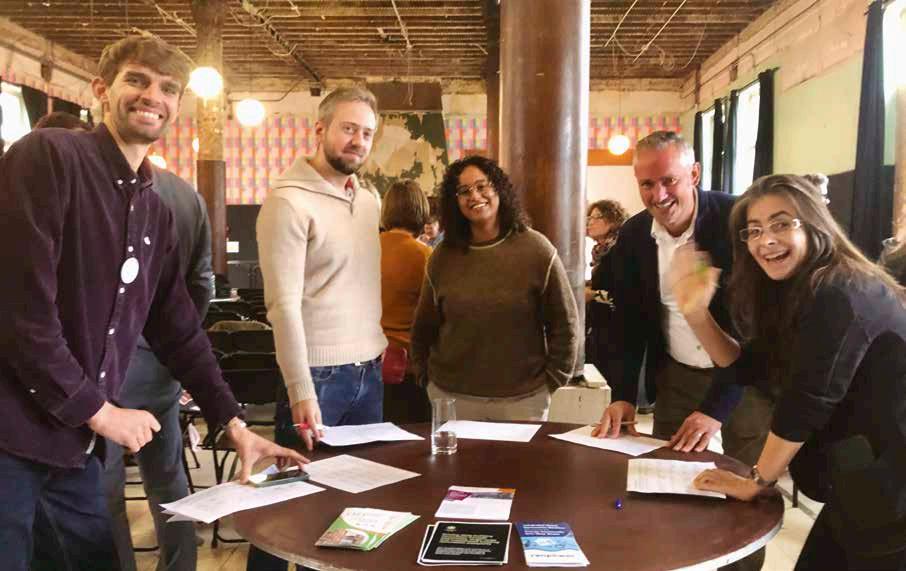
Annual gathering for practitioners in 2025 in Brussels. © Climate Alliance / EU Peers