Professor Nicolai. “However, string theorists haven’t been able to establish a compelling connection with the standard model of particle physics. We need to go beyond string theory to find a unifying or basic principle.”
The different groups of researchers could benefit greatly from sharing their ideas, insights and experience with each other. However, Professor Nicolai says they tend to exist as separate communities. “These communities don’t really talk to each other, they live in parallel universes,” he says. Professor Nicolai and his colleagues are taking a different approach, aiming to maintain an open dialogue with researchers from different areas. “We need to be open, and to listen to other ideas,” he stresses. “As members of the supergravity and superstring community we remain in contact with researchers in other approaches and try to keep up to date with their research.”
The origins of Professor Nicolai’s work in this area can be traced back to earlier research by the physicists Vladimir Belinski, Isaak Khalatnikov and Evgeny Lifshitz (BKL). Their work represents a key discovery in mathematical and theoretical cosmology.
“They studied the Einstein equations very close to the singularity and discovered that as you approach the singularity in four dimensions, chaotic behaviour sets in. These are the so-called BKL oscillations,” explains Professor Nicolai. These oscillations have
The search for a unified theory
Einstein’s general theory of relativity is one of the pillars of modern physics, yet it doesn’t explain what happens when spacetime breaks down at a gravitational singularity. Researchers in the eQG Group are working to develop a new theory of quantum gravity, bringing together general relativity and quantum mechanics, as Professor Hermann Nicolai explains.
The General Theory of Relativity was published over a century ago and it works beautifully to this day, with even modern observations of gravitational waves conforming to Einstein’s field equations. Einstein’s field equations also predict the existence of black holes, which is where the theory starts to break down. “Once you enter a black hole, you invariably run into a gravitational singularity, where spacetime essentially breaks down. It’s completely clear that at that point another theory is needed, because general relativity doesn’t tell you what happens at that singularity,” explains Professor Hermann Nicolai, Director Emeritus of the Max Planck Institute for Gravitational Physics.
Exceptional Quantum Gravity

A new description is required to deal with this problem, a topic at the core of Professor Nicolai’s work. As the head of the Exceptional Quantum Gravity (eQG) Research Group, Professor Nicolai and his colleagues are addressing one of the greatest challenges in modern physics. “We aim to unify general relativity and quantum mechanics,” he says. A new theory of quantum gravity would represent an important step towards resolving singularities; an analogy can be drawn here with the example of the hydrogen atom. “With the hydrogen atom you have a singularity of the Coulomb potential that would destroy the atom within fractions of a second, but
quantum mechanics helps resolve it,” outlines Professor Nicolai. “We aim to bring together general relativity and quantum mechanics in a way that likewise eliminates all singularities.”
The basic building blocks of such a theory have not been identified however, and a wide variety of different approaches to the problem have been put forward. These include approaches based on loop quantum gravity, spin-foam quantum gravity and string theory, the idea that the basic constituents of matter are not point-like particles but rather one-dimensional extended objects, or strings. “The idea is that these strings vibrate, and their vibration modes is what makes up elementary particles,” explains
been known about for around 50 years, but further and much more recent analysis has led to deeper insights. “It turns out that there is an extremely interesting mathematical pattern here which is indicative of a huge infinite-dimensional symmetry,” continues Professor Nicolai.
This symmetry is the Kac-Moody E10 symmetry, which is vastly bigger than anything that has been considered so far in physics. Symmetries like this are an important
The E10 symmetry is now the focus of intense attention in the eQG group, with the aim of developing a unified theory of quantum gravity and the other fundamental interactions that is entirely defined by symmetry principles. E10 is a unique mathematical object, says Professor Nicolai. “It is an infinite prolongation of the known symmetries that have been used in physics so far,” he says. The E10 symmetry is also known to have an extremely complicated structure. “The existence of this particular structure has
organising principle in physics. “The standard model of particle physics is based on a symmetry. Once you have this symmetry, then with a little extra information you can write down all the equations for the standard model,” outlines Professor Nicolai. The idea Professor Nicolai is exploring is that the true symmetry of gravity, of what comes after Einstein’s general theory of relativity, is only revealed as you push further towards a singularity. “A singularity needs extremely short distances – or extremely high energies. These two things are reciprocal,” he continues.
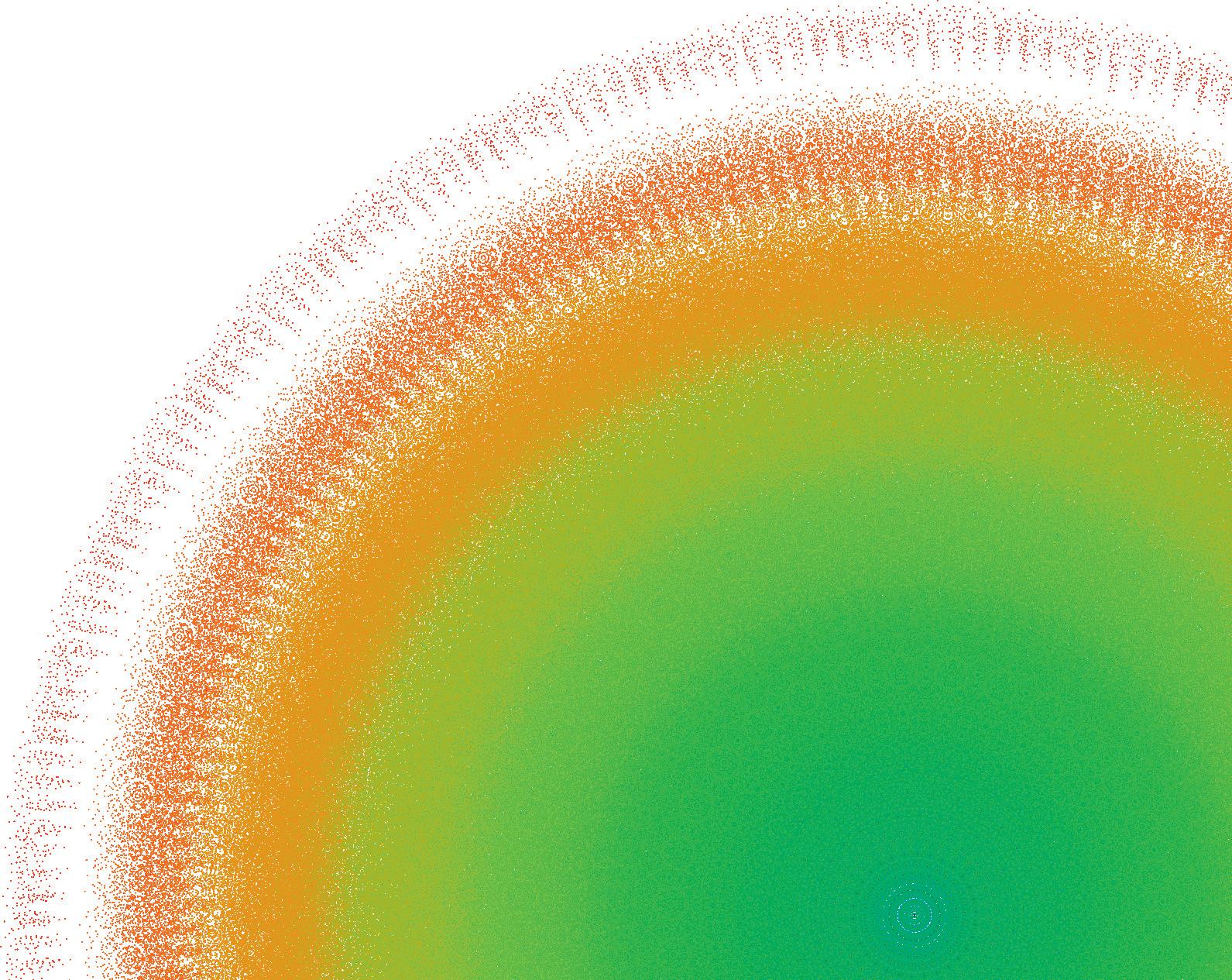
been known about in mathematics for more than 50 years, but there hasn’t been much progress in terms of understanding it,” outlines Professor Nicolai. “Not many mathematicians are currently working on it, because of its extreme complexity.” An impression of this complexity is conveyed by the `pychedelic’ picture on the following page which represents a slice through the root lattice of the E10 algebra. There is also a theory in physics which cannot be extended further, namely 11-dimensional supergravity, which is often mentioned in connection with M-theory.
www.euresearcher.com 75
EU Research 74
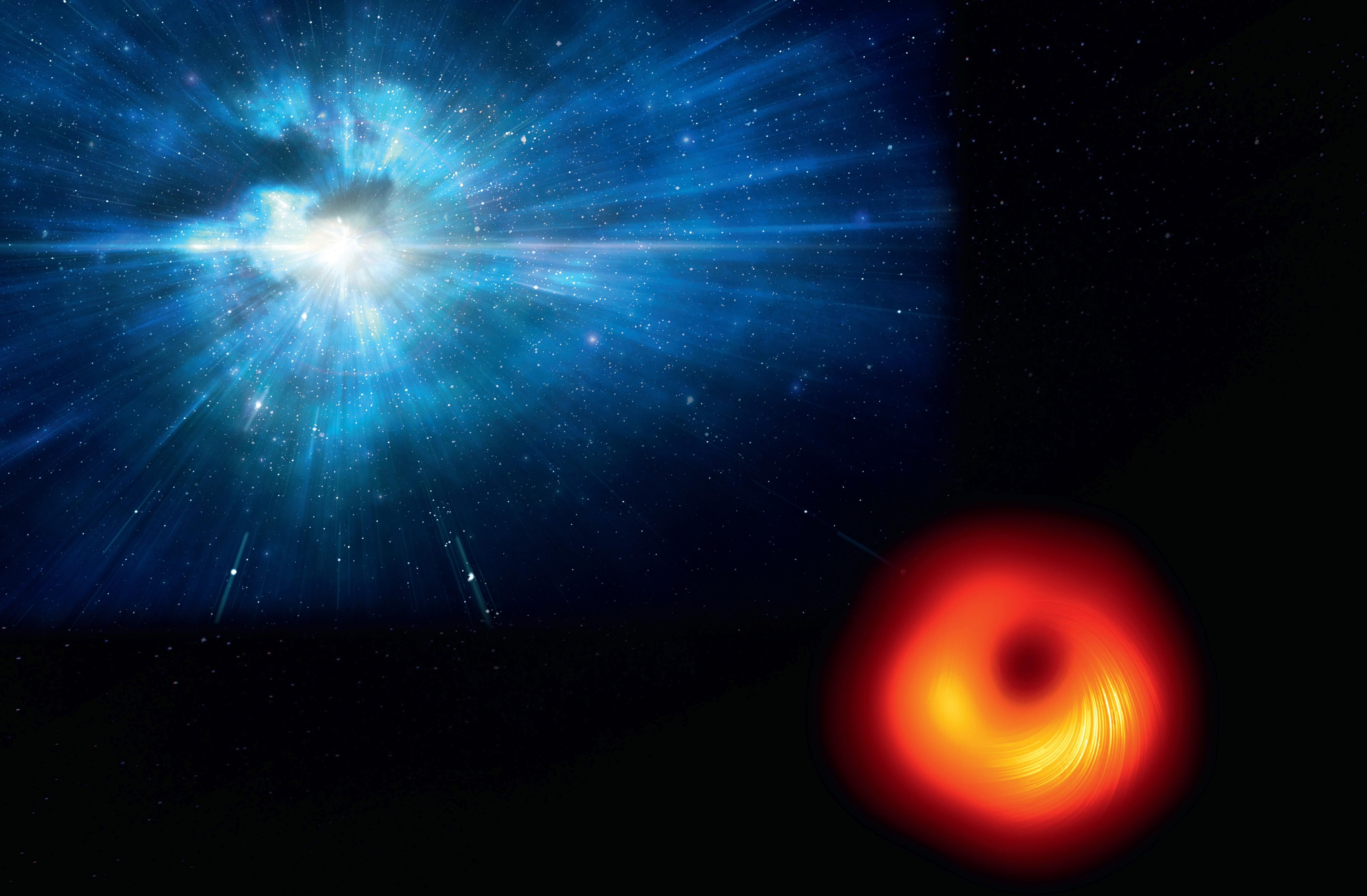
A view of the M87 supermassive black hole in polarised light produced by the Horizon Telescope (EHT) collaboration. However, this picture shows only the “outside” of the black hole. The singularity inside the black hole, whose properties research efforts like eQG are trying to explore and understand, hides behind an event horizon from which no information can escape.
Understanding the Big Bang and how our universe came into being is perhaps the greatest challenge of modern physics -- it will require a new theory reconciling quantum theory and general relativity.
Once you enter a black hole, you invariably run into a gravitational singularity, where spacetime essentially breaks down. It’s completely clear that at that point another theory is needed.
eQG Exceptional Quantum Gravity Project Objectives
The Exceptional Quantum Gravity (eQG) Research Group is working to reconcile quantum mechanics and general relativity, one of the greatest challenges in theoretical physics. This research involves using the Kac-Moody symmetry E10, which is an extremely useful tool in the search for a consistent theory of quantum gravity.
The group is bringing together several different strands of research, with the group aiming to build a deeper understanding of the dynamics of quantum space-time.
Project Funding
This project has received funding from the European Union’s Horizon 2020 research and innovation programme under grant agreement No 740209.


Contact Details
Project Coordinator, Professor Dr. Dr. h.c. Hermann Nicolai Director emeritus at the Max-Planck-Institut für Gravitationsphysik (Albert-Einstein-Institut) Am Mühlenberg 1


D-14476 Potsdam
GERMANY
T: +49 331 567-7216
E: hermann.nicolai@aei.mpg.de
W: https://www.aei.mpg.de/306486/ exceptional-quantum-gravity
W: https://www.aei.mpg.de/190500/ercadvanced-grant-for-hermann-nicolai
M-theory is a sort of overarching framework that aims to bring together different strands of string theory. “If you look at 11-dimensional supergravity in more detail, it turns out that hints of E10 symmetry are hidden in it,” says Professor Nicolai. In a sense, 11-dimensional supergravity already represents a kind of unification. “This is the most super-symmetric field theoretic extension of Einstein’s theory that can currently be written down. There’s nothing beyond it,” stresses Professor Nicolai. “At some point you reach the end of the line, and that’s the theory we have been discussing for the last 45 years. Although it is surely part of the answer, links between this theory and the real world have remained elusive.”
Testing new theories
Researchers in the eQG group have been working to push unification further, using the E10 symmetry. This will eventually lead to new insights, which then have to be analysed, understood, and if possible tested against observational data. “Every physical theory, at some point, has to be tested. That’s the ultimate arbiter of whether a theory is any good,” says Professor Nicolai. One encouraging sign is that this scheme predicts 48 fundamental fermions, in agreement with the number of quarks and leptons in three generations found in the standard model. Another potentially testable prediction centres on dark matter, the nature of which is a major open problem in physics. “The prediction that comes out of our theory is that dark matter is made out of extremely heavy particles, supermassive gravitinos,” outlines Professor Nicolai.
This prediction would be extremely hard to test however because of the extreme rarity of these particles. One possibility is an underground experiment, while another is based on the idea of palaeo-detectors, where researchers could look for traces of these particles in ancient rock. “In principle we might be able to detect a trace of a particle that sped through old rock in a straight line,” says Professor Nicolai. Testing a quantum gravity theory is a challenging task, and Professor Nicolai says it’s not enough to just match one specific feature, rather everything must fit together. “It’s not just about one aspect of what you can observe in the sky, or see in an accelerator or a dark matter search experiment,” he stresses. “In the end it all has to fit together seamlessly, including particle physics, gravitation and cosmology. It’s a very, very tall order!”
This research is extremely abstract by nature and highly complex, yet it holds deep fascination for many people, including not just scientific specialists but also members of the public who have asked themselves fundamental questions about the origins of the universe. Pretty much every culture throughout recorded history has pondered how the world began, but nowadays rather than relying solely on theological or philosophical ideas to develop theories, we can bring mathematics and scientific instruments to bear on the topic. “We can use the fact that a lot of progress has been made in physics towards understanding large parts of the universe,” says Professor Nicolai. “And perhaps the existence of a uniquely exceptional mathematical structure like E10 can guide us towards the correct answer.”
EU Research
76
Hermann Nicolai is Director Emeritus of the Max Planck Institute for Gravitational Physics. His research interests centre around mathematical physics, in particular relativistic quantum field theory and elementary particle theory.
This picture, which was produced by Teake Nutma,is one of infinitely many slices through the E10 root lattice, where each single dot among a myriad of other dots represents one or more independent symmetry operations.
Photo: sevens+maltry Fotografen
