Ports as Living Laboratories for Clean Energy Ports are among Europe’s largest energy users, but they also hold the key to cleaner seas. Funded by the Interreg Atlantic Area Programme, ENEPORTS tests digital twins, renewable pilots, and smart energy management across ports in Spain and Portugal, creating a blueprint for sustainable and replicable port operations. Ports are more than gateways for trade. They are also major energy consumers. Cranes, refrigerated containers, all industrial players in the port environment, and ships running their engines at berth all require enormous amounts of power. This creates both a challenge and an opportunity. The challenge is clear: heavy energy demand means high emissions, often in urban areas where air quality is of the essence. The opportunity lies in using ports as living laboratories for clean energy and energy management solutions. This is exactly what ENEPORTS sets out to do. Funded by the Interreg Atlantic Area Programme and led by the ITG, the project brings together three Atlantic ports: Ferrol in Spain, Leixões in Portugal, and Granadilla in Tenerife, Spain. The aim is to explore how ports can reduce their carbon footprint and lead the way in renewable integration. By combining traditional renewable sources such as solar and wind with port-specific technologies like wave energy, and by giving ships access to onshore power, ENEPORTS shows how harbours can become pioneers of the green transition. At the heart of the initiative is a simple process: measure, simulate, and then act. Ports first install smart meters and controls to understand how energy is used. They then build a digital twin, a virtual copy of the port grid, to test different scenarios safely. Finally, they apply the most effective energy management solutions in real life, through a monitoring and control platform adapted to every port environment. This results in cleaner air, quieter docks, a higher renewable energies exploitation and a toolkit that any port authority in Europe can adopt alongside their energy transition plans.
From models to twins: building the digital backbone of ENEPORTS Behind every crane movement and every ship at berth is a flow of electricity that must be predicted, measured and managed. For ENEPORTS, the first step is to create a digital layer that makes sense of this complexity. The project begins with simulation models that show how a port grid reacts under stress, from sudden spikes in demand or renewable generation, to changes in frequency and voltage. On top of these models, the team
40
to a five-megawatt station, with expected annual outputs of around 6 gigawatt hours from solar, more than 15 gigawatt hours from wind and almost 19 gigawatt hours from wave. The challenges lie both in installing the technology and designing protection and flexibility into the grid from the start. Granadilla is testing options that push the frontier. The port is preparing a pilot that will compare a hydrogen-fuelled generator for tugboats Onshore Power Supply with conventional systems. Other projects will include offshore wind technology demonstrators and green hydrogen plants, taking the isle of Tenerife to the living laboratory status that ENEPORTS is aiming at. “Each port has a different context, from weather to grid rules, so we forecast production and tailor strategies adapted to each site, and what we build is repeatable - any port authority can reuse our platform, methods and procedures,” explains Samuel Ormaechea.
Ports as testbeds for society Port of Ferrol (APFSC).
builds digital twins, virtual copies of the energy systems in Ferrol, Leixões, and Granadilla. These twins allow engineers to test technical scenarios that would be either risky or impossible to try on the ground and other scenarios demonstrating feasibility of different energy markets, energy management and energy sharing business models. Once the data flows in, it is channelled through a smart energy management platform. Equipped with IoT sensors and artificial intelligence algorithms, the
the transition, getting the ports to embrace renewable energy technologies knowing that they will produce cost-competitive energy for their energy networks without compromising the security of energy supply.
Three ports, three contexts Every harbour comes with its own environment, rules and energy profile. ENEPORTS works with three Atlantic ports that share the same ambition but face very different conditions.
“Each port has a different context, from weather to grid rules, so we forecast production and tailor strategies adapted to each site.” platform can track consumption across terminals, forecast renewable generation, and propose strategies to balance loads. “We are testing monitoring and control hardware, and the software strategies that let ports run their operations within a sustainable, energy-efficient and cost-effective system,” explains Samuel Ormaechea from ITG, the project’s lead partner. This digital backbone enables port authorities to see how an onshore power supply would affect their grid, or how much wave energy or any other renewable energy project could contribute, before investing millions in infrastructure. By testing first in the twin and only then in the real port, ENEPORTS reduces risk while speeding up
Ferrol is exploring how to scale up selfconsumption. The port authority plans more than 30 megawatts of renewables, combining almost 20 megawatts of solar with up to 12 megawatts of wind. Daily energy demand will rise once ships begin plugging into on-shore power. By 2027 the inner and outer ports will improve their electrical infrastructures, giving operators more flexibility to balance supply and demand. At Leixões the focus is port-wide electrification. A new 30 kilovolt backbone grid will allow the phased roll-out of onshore power across terminals. Generation comes from a mix of rooftop and floating solar, onshore wind, and wave energy. A one megawatt wave pilot is planned to expand
EU Research
For ENEPORTS, the pilot sites are more than technical demonstrations. They are laboratories where new technologies and management strategies can be tested under real operating conditions. Partners use their own facilities to push the work further, from ITG’s smart energy laboratory, with microgrids and digital twins in Galicia, to coastal testing environments in Normandy by BUILDERS École d’Ingénieurs, and hydrogen-fuelled OPS systems at the Port of Tenerife. This ensures that results are grounded in practice. The next milestone is the partner meeting and project event presenting the mid-term results in Tenerife on 17–18 November. The team will visit installations, review the first version of the monitoring and control platform, and hold working sessions with the industry. The event follows earlier lab visits in Spain and France, and it will include a visit to ITER’s and Port Authority of Tenerife’s facilities. The meeting will bring project partners together with interested ports and industry to look at the work on the ground,
ENEPORTS Decarbonization and Digitalization of Atlantic Ports
Project Objectives
Signature of the Agreement between ITG - ITER - APSCT.
compare notes and discuss what is practical to reuse elsewhere. By treating ports as living laboratories, ENEPORTS is not only helping to decarbonise shipping and port operations, but also creating pathways for society to benefit from renewable technologies tested at scale. “We are showing that ports can go beyond being gateways for goods,” reflects Samuel Ormaechea. “They can become testbeds where new energy devices are deployed, refined and proven in real conditions. Once this happens, the lessons can be transferred to other ports and even to cities.” The tools and methods developed here are designed to be repeatable, reusable and transferable, so that other Port Authorities and other nations’ Critical Infrastructures can adopt them with confidence. In this way, ENEPORTS extends far beyond the Atlantic seaboard. What is being built in Ferrol, Tenerife and Leixões is a blueprint for how coastal infrastructure can lead the clean energy transition. The aim is clear: to turn ports into active players in Europe’s climate goals while ensuring that the innovations they host ripple outward, supporting industries, communities and the wider shift to a more resilient energy system.
ENEPORTS aims to accelerate ports’ energy transition through decarbonisation and digitalisation, deploying cutting-edge renewable technologies, AI algorithms and a specialized IoT Platform in real environments. The project also aims to enable ports to test and optimize renewable integration by turning them into real-life technology testbeds, apply standardized protocols, and become specialized hubs for innovation, maximizing efficiency and harnessing their own clean energy production.
Project Funding
The project is co-financed (75%) by European Interreg Atlantic Area (IAA) cross-border cooperation programme, funded by ERDF.
Project Partners
https://eneports.eu/about-eneports#partners
Contact Details
Project Coordinator, Elizabeth Giraut Smart Energy Project Manager & Researcher ITG | National Technological Centre Cantón Grande 9, Planta 3 15003 · A Coruña (Spain) E: eneportsproject@gmail.com W: https://eneports.eu/
Elizabeth Giraut
Elizabeth Giraut is an electrical engineer with an MBA and Head of Energy Projects at ITG Technology Centre. She leads initiatives in digitalisation, artificial intelligence, and port decarbonisation. Previously at ACCIONA Energía and ABB, she managed renewable integration, innovation projects and large-scale energy systems.”
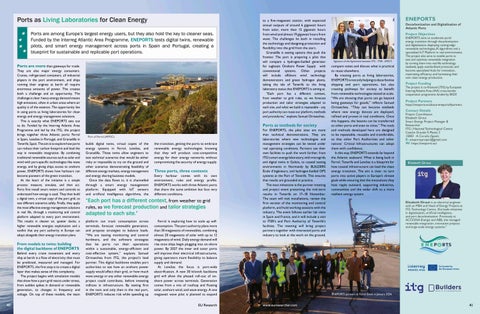
ENEPORTS partners at Ferrol Event in January 2024.
www.euresearcher.com
41