Connecting energy efficiency across the hospitality value chain

Energy use in hospitality is shaped as much by daily routines and external partners as by buildings themselves. In EE4HORECA, Beatrice Marchi and Ivana Rae Almora explain how a value-chain approach, practical tools, and targeted training can help hospitality small and medium-sized enterprises (SMEs) turn energy efficiency from theory into workable action.
Energy is at the heart of every hospitality service, even when it remains largely invisible. From the moment a guest checks in or a kitchen opens its doors, electricity, heat, and hot water are constantly at work, keeping spaces comfortable, food safe, and operations running smoothly. In hotels, restaurants, and catering businesses, these processes rarely slow down, and neither does the energy demand behind them. This makes it a challenge for many small and medium-sized enterprises (SMEs) in the sector to know where to start with energy efficiency and how to make changes that last. Hospitality businesses operate under tight margins and constant operational pressure, often relying on external partners for essential services such as laundry, food supply and transport. Responsibility for energy use is therefore distributed across interconnected processes and facilities, rather than concentrated in a single process or building. Approaches that focus only on on-site upgrades can miss this reality, leaving businesses with recommendations that are technically sound but lacking in reducing energy consumption on a larger scale.
The European project EE4HORECA aims to address this gap. It emerged from a recognition that, across Europe, hospitality SMEs face recurring energy challenges that are rarely addressed by conventional, building-centred approaches. Previous projects and market experience showed that isolated technical advice was rarely enough, particularly in a sector shaped by tight margins, fragmented responsibilities and strong dependence on external services. EE4HORECA therefore approaches the hotel, restaurant and catering sector as a connected value chain, where collaboration plays a central role in reducing consumption and supporting the clean energy transition. By combining research, practical tools and targeted training, the project aims to help hospitality SMEs implement coordinated action in ways that reflect the realities of dayto-day operations.
To build this understanding, the project mapped energy demand across key hospitality services by analysing how interconnected activities and value-chain relationships contribute to a stay or a meal, rather than
focusing on individual technologies or linear process flows. This approach enabled the identification of where energy use is influenced by everyday routines, external services, and shared decisions throughout the value chain. By identifying recurring patterns, EE4HORECA laid the groundwork for prioritising actions that are both technically feasible and realistic for small businesses to implement.
From mapping energy use to practical priorities
At the centre of this approach sits the Sustainable Business Model Canvas. Developed specifically for hospitality SMEs, it sets out, in a single framework, how economic value, environmental impact, and social considerations are intertwined across the value chain:, from key partners, activities, and resources to customer groups and the basic financial logic of cost structures and revenue streams. In practical terms, it turns a complex discussion into a structured conversation: it helps businesses see what depends on whom, where decisions are made, and what would
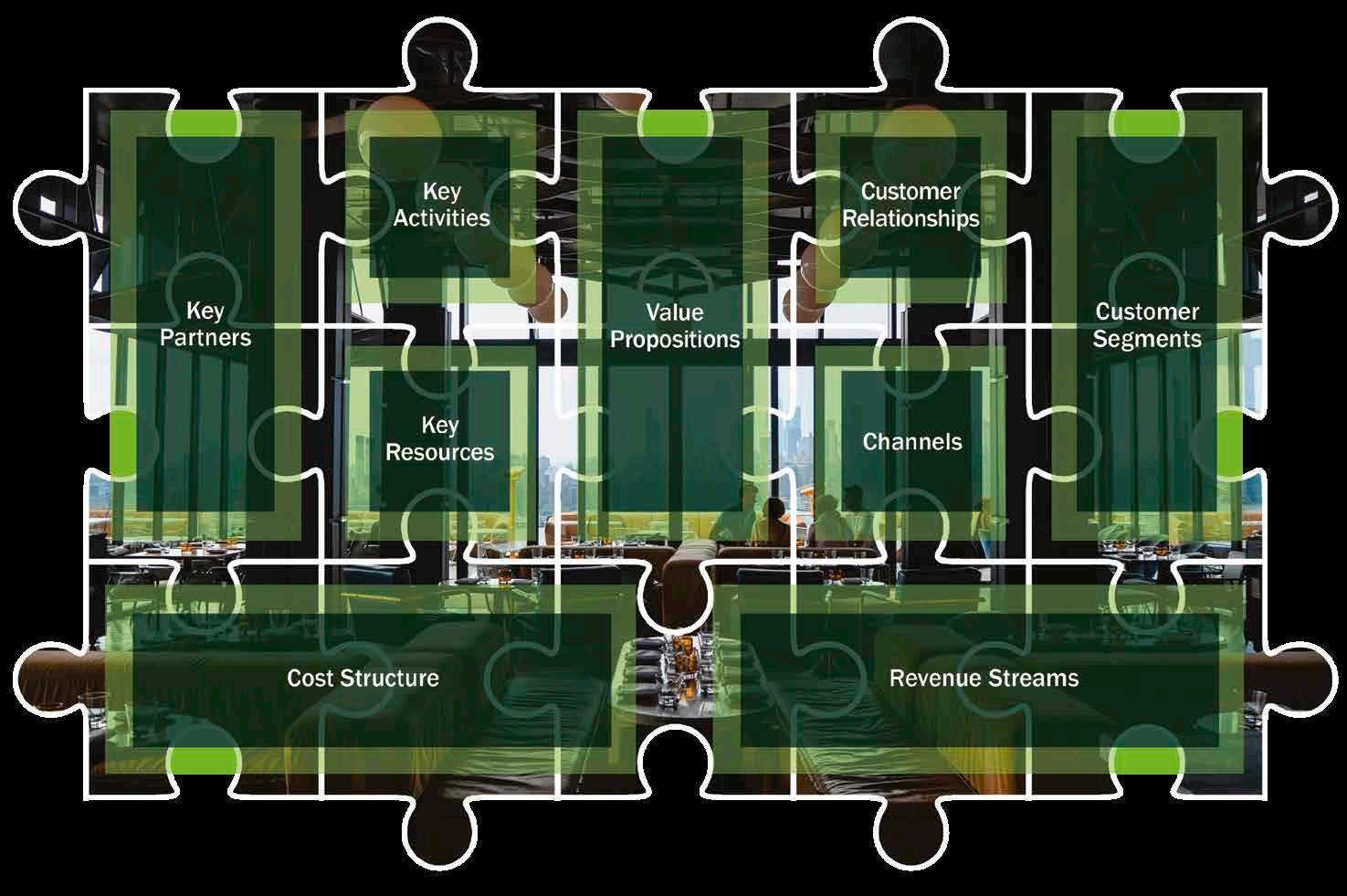
need to change for an energy improvement to work in real operations. What distinguishes the canvas in EE4HORECA is that it integrates sustainability into the same planning exercise. Environmental and social considerations sit alongside commercial ones, and externalities are treated as part of the picture. As Beatrice Marchi, researcher at the University of Brescia and scientific partner in EE4HORECA, explained, the canvas was designed to support “a wider perspective, not only energy efficiency but a broader sustainability view”. It offers a shared basis for deciding what needs to change in practice, who needs to be involved, and how collaboration can be organised. In this way, roles, responsibilities and incentives become clearer for everyone involved.
Another key feature of the canvas is that it looks beyond short-term savings. “Feasibility is often assessed by calculating the amount of energy saved and translating this into costs,” Marchi added, “However, many other benefits should be considered to make a measure strategic”. These include improved comfort for guests, more efficient workflows for staff, reduced maintenance needs, higher reliability and a stronger sustainability profile for the business.
provides reference values that make it easier to see what is typical for the sector and what falls outside the normal range.
As Beatrice notes, the project’s decisionsupport tools were designed to be practical and accessible, built as downloadable Excel files. Users enter aggregated data for different actors in the value chain, including hospitality businesses, suppliers and transport providers, and receive outputs on specific energy consumption and the energy carriers involved. The tool then supports a two-step reading: identifying the stages with the highest consumption, and checking those figures against benchmarking ranges to locate the greatest improvement potential, before moving towards feasibility assessment using additional tools such as life-cycle costing and non-energy benefit tool.
Turning insight into action
Alongside this analytical layer, EE4HORECA has put strong emphasis on training as the bridge between insight and implementation. The project includes training modules that are currently being delivered to SMEs.
“The intention is to support businesses in changing their processes towards more energy-efficient practices.”
By integrating these factors into planning, the Sustainable Business Model Canvas helps businesses move from intention to implementation. It creates space to discuss practical barriers, including financing, and to explore collaborative arrangements that translate resources into sustainable operations across the value chain. As Ivana Rae Almora, project officer at Eurochambres and EE4HORECA coordinator, explained, the intention is to support businesses in “changing their processes towards more energyefficient practices”, using collaboration across the value chain as a practical enabler.
To support these plans with evidence and guidance, EE4HORECA complements the canvas with benchmarking and decisionsupport tools that place performance in context. Rather than relying on absolute figures alone, the project uses specific energy consumption indicators that relate energy use to output. These results are then translated into hospitality-relevant activity units, such as guest nights or food covers. This approach is particularly important for SMEs, as it helps distinguish between genuine inefficiency and high consumption that simply reflects service intensity, and it
EE4HORECA
EnergyEfficiency4HORECA Increasing the uptake of energy efficiency measures within the HORECA value chain
Project Objectives
The EE4HORECA project aims to support hospitality SMEs in improving energy efficiency by addressing energy use across the full value chain. By combining research, practical tools, and targeted training, the project helps businesses identify priority actions, foster collaboration with key partners, and implement energyefficient practices that reflect real operational conditions rather than isolated technical fixes.
Project Funding
Co-funded by the European Union LIFE programme under Grant agreement n° 101120572 LIFE22-CET *
Project Partners
• Eurochambres, (Coordinator) • Energieinstitut der Wirtschaft, Austria • European Cold Storage and Logistics Association, Belgium • Chambre de Commerce et d’Industrie France, France • Chambre de Commerce et d’Industrie Nice Côte d’Azur, France • SEnerCon, Germany • Unione Regionale delle Camere di Commercio, Industria, Artgianato e Agricoltura del Veneto, Italy • Fondazione Fenice ONLUS, Italy • Universita degli Studi di Brescia, Italy • Latvijas Tirdzniecibas un Rupniecibas Kamera, Latvia • Cámara de Comercio de España, Spain • Cámara de Comercio, Industria y Servicios de Terrassa, Spain
As Ivana explained: “We started from the research and organised working groups in each country, where partners, together with their stakeholders reviewed the full list of best practices and discussed those most relevant for their context. These were then translated into training materials, organised into several modules that are currently being delivered to SMEs and companies in the sector. The idea is to leave time after the training for businesses to apply what they have learned across their value chains, before assessing the impact of the programme, both in terms of energy savings and non-energy benefits.”
This training is complemented by the IMPAWATT e-learning and monitoring platform, which brings together training modules and practical resources, from energy management guidance and best-practice examples to monitoring tools that help businesses track consumption and identify where savings are emerging over time.
At this stage, the focus remains on engagement, training delivery, and uptake, with implementation and impact assessment following, as participating businesses begin to test changes across their value chains. Lessons from this work will be shared as EE4HORECA moves towards its final phase, including a closing event planned in Brussels in June 2026.
Contact Details
Ivana Rae Almora
Project Officer
Eurochambres
Avenue des Arts 19 A/D 1000 Brussels
T: +32 (0)2 282 0850

E: ee4horeca@eurochambres.eu : www.linkedin.com/company/ee4horeca/ W: https://www.ee4horeca.eu/
* Views and opinions expressed are however those of the author(s) only and do not necessarily reflect those of the European Union or CINEA. Neither the European Union nor the granting authority can be held responsible for them.

Dr. Beatrice Marchi is a researcher in the Department of Mechanical and Industrial Engineering at the University of Brescia. Her research focuses on the design, management, and simulation of production systems, industrial plants, and supply chains, energy and maintenance management, and sustainable and circular solutions, including industrial symbiosis and renewable energy.
Ivana Rae Almora is a project manager at Eurochambres, with expertise in coordinating international sustainability and energy-efficiency initiatives, and extensive experience in regional development and multi-stakeholder European projects.