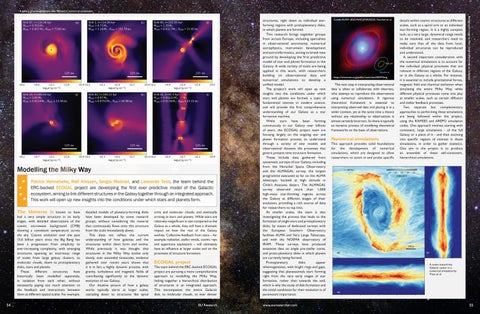


Patrick Hennebelle, Ralf Klessen, Sergio Molinari, and Leonardo Testi, the team behind the ERC-backed ECOGAL project are developing the first ever predictive model of the Galactic ecosystem, aiming to link different structures in the Galaxy together through an integrated approach. This work will open up new insights into the conditions under which stars and planets form.
The Universe is known to have had a very simple structure in its early stages, with detailed observations of the cosmic microwave background (CMB) showing a consistent temperature across the sky. Cosmic evolution over the past 13.6 billion years since the Big Bang has been a progression from simplicity to ever-increasing complexity, with emerging structures spanning an enormous range of scales from large galaxy clusters, to molecular clouds, down to protoplanetary disks, stars and planets. These different structures have historically been modelled separately, in isolation from each other, without necessarily paying too much attention to the feedback and interactions between them at different spatial scales. For example,
detailed models of planetary-forming disks have been developed by some research groups, without considering the material that continuously flows onto this structure from the scale immediately above.
This does not reflect the current understanding of how galaxies and the structures within them form and evolve.
While previously it was thought that structures in the Milky Way evolve only slowly, over extended timescales, evidence gathered over recent years shows that it is in fact a highly dynamic process, with gravity, turbulence and magnetic fields all contributing significantly to the dynamic evolution of our Galaxy.
Our intuitive picture of how a galaxy works typically starts at larger scales, cascading down to structures like spiral
arms and molecular clouds, and eventually arriving at stars and planets. While stars are relatively insignificant in size compared to the Galaxy as a whole, they still have a dramatic impact on how the rest of the Galaxy evolves. Collective feedback from stars – for example radiation, stellar winds, cosmic rays and supernova explosions – will ultimately have an influence at larger scales and on the processes of structure formation.
ECOGAL project
The team behind the ERC-backed ECOGAL project are pursuing a more comprehensive approach to modelling the Milky Way, linking together a hierarchical distribution of structures in an integrated approach. This encompasses the entire Galactic disk, to molecular clouds, to ever denser
structures, right down to individual starforming regions with protoplanetary disks, in which planets are formed.
This research brings together groups from across Europe, including specialists in observational astronomy, numerical astrophysics, instrument development and astroinformatics, aiming to break new ground by developing the first predictive model of star and planet formation in the Galaxy. A wide variety of tools are being applied in this work, with researchers building on observational data and numerical simulations to develop a unified model.
The project’s work will open up new insights into the conditions under which stars and planets are formed, a topic of fundamental interest in modern science, and will provide the first comprehensive understanding of our Galaxy as a star formation machine.
While stars have been forming continuously in our Galaxy over billions of years, the ECOGAL project team are focusing largely on the ongoing star and planet formation process to understand through a variety of new models and observational datasets the processes that govern present-time structure formation.
These include data gathered from systematic surveys of our Galaxy, including from the Herschel Space Observatory and the ALMAGAL survey, the largest programme executed so far on the ALMA telescope, located at high altitude in Chile’s Atacama desert. The ALMAGAL survey observed more than 1,000 high-mass star-forming regions across the Galaxy at different stages of their evolution, providing a rich source of data for researchers to tap into.
At smaller scales, the team is also investigating the process that leads to the formation of single stars and protoplanetary disks, by means of dedicated surveys with the European Southern Observatory facilities ALMA and Very Large Telescope, and with the NOEMA observatory of IRAM. These surveys have produced extensive data on single pre-stellar cores, and proto-planetary disks in which planets are currently being formed.
Protoplanetary disks appear inhomogeneous, with bright rings and gaps, suggesting that planetesimals start forming right from the very early stages of star formation, rather than towards the end, which is why the study of disk formation and the initial conditions for their evolution is of paramount importance.


details within cosmic structures at different scales, such as a spiral arm or an individual star-forming region. It is a highly complex task, as a very large, dynamical range needs to be resolved, and researchers need to make sure that all the data from local, individual structures can be reproduced and understood.
https://www.eso.org/public/news/eso2404/?lang
The next step in interpreting observational data is often to collaborate with theorists, who attempt to reproduce the observations using numerical simulations. A rigorous theoretical framework is essential to interpreting observed data and placing it in a wider context, yet at the same time a theory without any relationship to observations is almost certainly incorrect. So there is typically an iterative process of modifying theoretical frameworks on the basis of observations.
Numerical
simulations
This approach provides solid foundations for the development of numerical simulations, which are designed to allow researchers to zoom in and probe specific
A second important consideration with the numerical simulations is to account for the individual physical processes that are relevant in different regions of the Galaxy, or in the Galaxy as a whole. For instance, it is essential to include gravitational forces, magnetic field and chemical evolution when simulating the entire Milky Way, while different physical processes come into play at smaller scales, such as certain diffusion and stellar feedback processes.
Two separate but complementary approaches to performing these simulations are being followed within the project, using the RAMSES and AREPO simulation codes. One approach involves starting with consistent, large simulations - of the full Galaxy or a piece of it - and then zooming into specific regions of interest in those simulations, in order to gather statistics. One aim in the project is to produce an ensemble of these self-consistent, hierarchical simulations.

ECOGAL
Understanding our Galactic ecosystem: From the disk of the Milky Way to the formation sites of stars and planet
Project Objectives
The ECOGAL project aims to develop a comprehensive, multi-scale understanding of the Galactic interstellar medium cycle, the process of star formation, and the formation of planet-forming circumstellar disks, which is necessary to explain the diversity of observed solar systems. To achieve this, two teams specializing in observations and two in simulations are joining forces to produce an extensive dataset of both observational results and numerical simulations, including synthetic observations derived from the latter.
Project Funding
This project has received funding from the European Research Council (ERC) Synergy grant under the European Union’s Horizon 2020 research and innovation programme under grant agreement No 855130.
Project Partners
Patrick Hennebelle, Ralf Klessen, Sergio Molinari, and Leonardo Testi. http://www.ecogal.eu/indexhtml-page5.php
Contact Details
Project Coordinator,
Patrick Hennebelle
CEA Paris-Saclay - Site de Saclay, D36, 91190 Saclay, France
T: +33 0169089987
E: Patrick.HENNEBELLE@cea.fr W: http://www.ecogal.eu/




Patrick Hennebelle is a researcher at the Department of Astrophysics of the French Alternative Energies and Atomic Energy Commission (CEA). His work focuses on the theoretical modeling of star formation and the formation of protoplanetary disks.
Ralf Klessen is a professor of theoretical astrophysics at Heidelberg University. His research explores the formation of stars both in the present-day Universe and in its earliest epochs.
Sergio Molinari is a researcher at INAF (Italian National Institute for Astrophysics). He conducts observations of the interstellar medium in galaxies, with a particular focus on star-forming regions.
Leonardo Testi is a professor at the University of Bologna. His research involves observing protoplanetary disks to better understand how and when planets form around stars.

The second approach involves prescribing the initial conditions ‘by hand’, then taking an object like a sphere to represent a star-forming region. Researchers then run many of these simulations and vary the parameters, such as the intensity of the magnetic field or the mass of the sphere. This second approach seems simpler than the first, allowing researchers to probe the influence of different parameters.
There may be several hundred parameters at play here, so identifying which are important and what conditions lead to the development of specific types of stars and planets is a highly complex task. Important new insights have been gained within the project in this respect, with researchers now able to identify the most important parameters in a simulation, and how modifying them will change the overall outcome.
properties and evolution of solids around proto-planetary disks that will eventually form planets, as well as the surrounding molecules and chemistry. At the scale immediately above, the star-forming regions, researchers are now able to look at the demographics, building on results from the ALMAGAL survey.
This means it is now possible to determine how many fragments are forming at each observed star formation site, and thus to predict the number of stars that will form out of big clumps of dust and gas. Researchers are also looking to measure the mass of these fragments, to assess the distribution of masses within each site, and also to study how they gain material from their environment. Is it only from their surrounding environment, or does material flow from larger scales?
“The team behind the ERC-backed ECOGAL project are pursuing a more comprehensive approach to modelling the Milky Way, linking together a hierarchical distribution of structures in an integrated approach”
Physical processes
The project team have been able to narrow down the physical processes relevant in different regions of the Galaxy, and with the outcome of every simulation the models can be refined further, as well as the connection between smaller and larger scales. This is an ongoing, iterative process, with researchers continuously refining their understanding, and evaluating the relative influence of different parameters.
Considerable progress has also been made in terms of essentially mapping the distribution of proto-planetary disks, central to understanding when and how planets form, which is an important goal in the project. It is now thought that stars and planets tend to form together, and the project team is one of the first to identify a complete distribution of these proto-planetary disks.
A further important aspect of the project’s work is in deploying new instruments and observing modes for the NOEMA and ALMA observatories, designed to execute observations and critical tests to the models. In particular, in regards to the role of magnetic field in regulating the formation of protoplanetary disks and their chemical composition.
The new instruments and improved models will help researchers understand the


Hierarchical link to larger scales
The answer seems to be the latter, underlining the importance of studying these objects not in isolation but within their environments, as they are continuously being fed by the surrounding scales. The same applies to the link of individual star forming sites to their larger molecular cloud environment as well as the connection of these clouds to the global Galactic flow of even larger scales.
A large set of simulations has been developed that provides a coherent picture of how individual molecular clouds form and condense, and how they connect with different physical processes. All key evolutionary phases of molecular clouds have been captured in a self-consistent way. In parallel, this work has been connected to the Galaxy overall, and the key parameters that lead to the spiral structures we see in the Milky Way have been identified.
The project itself still has over two years to run, and researchers plan to carry on gathering more data and improving the predictive model, alongside developing new instruments to gather data at higher levels of precision.