Digital Tools & Living Landscapes in Rangelands

Across Europe’s rangelands, livestock farmers face economic pressures, climate change, depopulation, predator attacks and a shortage of herders. The DIGI-Rangeland project explores how digital technologies can help address these challenges and support - not replace - traditional farming. Eva Pérez Vidal explains how the project is helping build a more sustainable future.
Europe’s rangelands cover vast areas of countryside, from the mountains of Scotland and Romania to the rangelands of Spain, Greece and Iceland. These landscapes support biodiversity, preserve cultural traditions and provide food and fibre through extensive livestock farming. Yet many of these regions are under pressure. Rural depopulation, an ageing farming population and increasing environmental challenges are making traditional livestock farming more difficult. Many farmers struggle to monitor animals, in large flocks, across large and often remote areas. At the same time, predator attacks from wolves and bears are increasing in several countries. In addition to this, there are also specific challenges related to the multiple uses of the land (tourism, outdoor sports, hunting, etc.), tensions arising from the coexistence of these uses, and even a lack of understanding of their farming practices by civil society.
DIGI-Rangeland - short for DIGItal innovation and data technology network for RANGELAND livestock farming systems - was launched to address these issues. Funded under Horizon Europe, the project brings together researchers, farmers, advisors and local communities from across Europe to explore how digital technologies can make rangeland
farming more sustainable and attractive. It is led by the French Livestock Institute (IDELE).
Rather than promoting technology for its own sake, the project is asking a practical question: which digital tools genuinely help farmers, and how can they be adapted to very different local realities?
“The idea is not to replace farmers and shepherds, but to make their work easier, safer and more sustainable.”, says Pérez Vidal, communication and dissemination leader for the project at the Galician UniversityEnterprise Foundation in Spain (FEUGA).
they had much more in common than expected. Whether they worked with sheep in Scotland, cattle in Spain or livestock in Romania, they described similar concerns. In some regions, wolves are a constant threat. In others, bears create major problems for farmers trying to protect their animals. Traditional methods are still widely used, such as specific breeds of dogs trained to guard flocks, but these are not always enough.
“These younger farmers often become the bridge within the community,” she explains.
Digital support
DIGI-Rangeland is investigating a wide range of digital tools, from GPS tracking and drones to camera traps, sensors and virtual fencing. GPS systems allow farmers to track animals in real time, saving time and reducing the need to travel long distances. Sensors can also monitor grazing patterns and behaviour, helping detect potential health issues early.
while limited infrastructure, such as poor internet access, can also be a barrier. Language differences may further restrict access in some rural areas.
To address this, DIGI-Rangeland has created a network of national facilitators in every participating country. These local experts work directly with farmers and communities, organise meetings and identify the people most interested in participating.
DIGI-Rangeland
DIGItal innovation and data technology network for RANGELAND livestock farming systems
Project Objectives
DIGI-Rangeland aims to identify, test and promote digital tools that can support –not replace – extensive livestock farming across Europe’s rangelands. By connecting farmers, researchers, advisors and local communities, the project seeks to improve animal monitoring, sustainability and working conditions, while helping rural areas adapt to depopulation, environmental pressures and changing agricultural practices.
“We have to find a bridge between both worlds. Between the traditional way of farming and the new digital possibilities.”
Shared challenges
Although the countries involved in DIGIRangeland are very different, many of the challenges they face are surprisingly similar.
“In every country, people talk about predator attacks, depopulation, a general lack of awareness around rangeland farming, increasing land competition, and the difficulty of keeping extensive livestock farming alive,” says Eva Pérez Vidal.
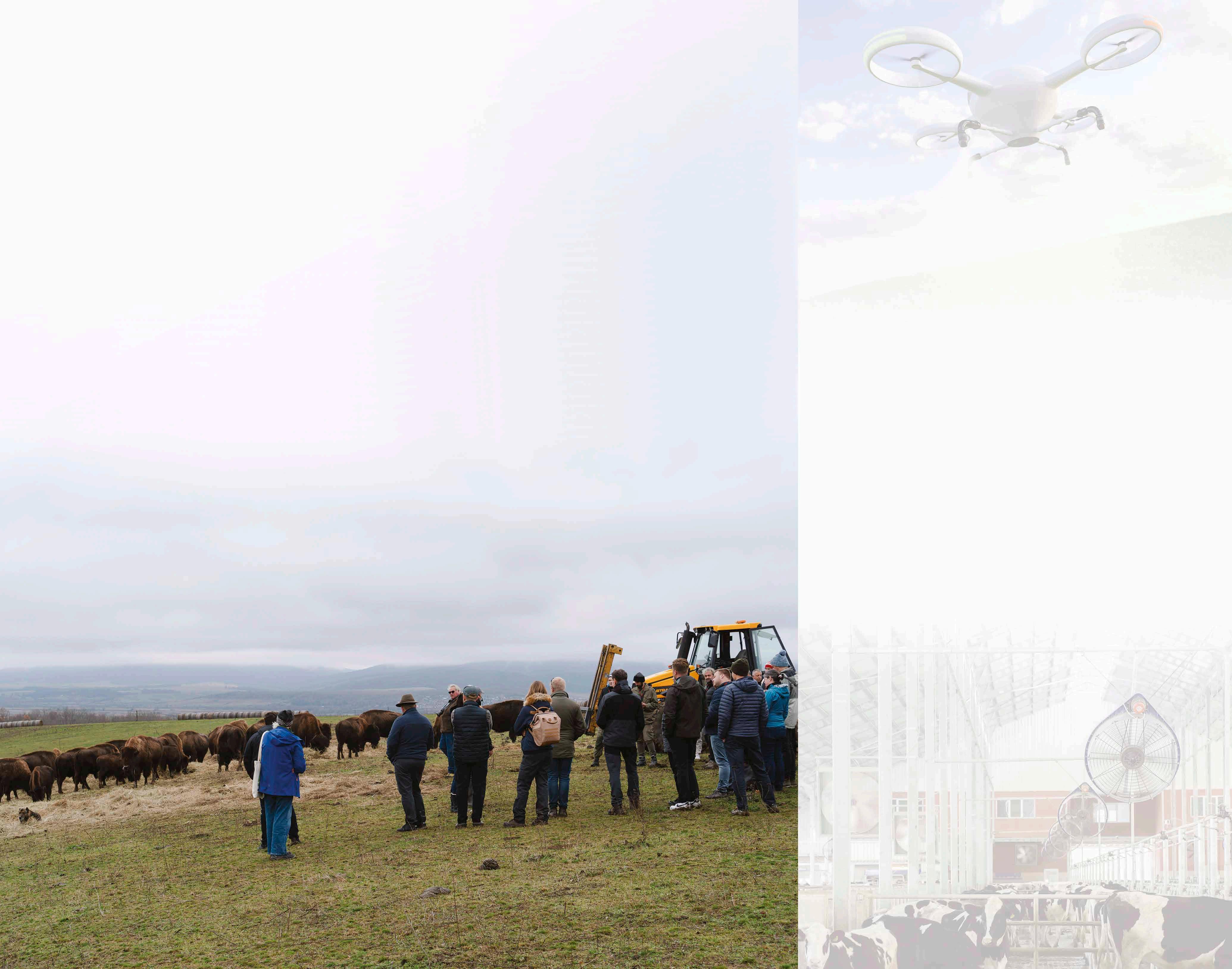
During the project’s first transnational workshop, held in Transylvania, farmers from different countries discovered that
At the same time, fewer people are willing to become shepherds or continue family farming traditions. Younger generations often leave rural areas, while older farmers may be reluctant to adopt new practices. Public awareness of rangeland farming is also limited, making it harder for farmers to gain support. Land competition is another growing issue, with grazing areas under pressure from tourism, development and conservation.
Pérez Vidal notes two main farmer profiles emerging: older, more cautious farmers and younger newcomers who are more open to innovation.
One novel and promising solution discussed by the project partners is virtual fencing. Instead of relying entirely on physical fences, animals wear GPS-enabled collars that create movable invisible virtual boundaries. Animals approaching a virtual fence boundary receive escalating audio cues from the collar, followed by an electric cue if they continue. Animals respond to the sound alone after a short training period.
For farmers managing large areas of land, this could reduce labour and allow grazing patterns to be adjusted more easily. Costs and connectivity are however a major constraint. Other technologies are proving more challenging. In some pilot cases, drones were tested as a way to move sheep from one area to another. However, the animals often ignored them and farmers still had to rely on their dogs.
This reflects one of the central ideas behind DIGI-Rangeland: technology should complement people, not replace them.
“The project does not want a future where everything is automated and nobody works in the countryside,” says Pérez Vidal. “The digital tools are there to support shepherds and farmers, not to substitute them.”
For example, a farmer may no longer need to walk 10 kilometres every day to check where the flock is grazing. Instead, a monitoring system can provide this information remotely, saving time and making the work less physically demanding.
The project is also exploring how these technologies can benefit other rangeland users beyond farmers. Hikers, tourists and local communities may all gain from better monitoring of animals and landscapes. In some areas, this can improve safety, while in others it can support agritourism by helping manage interactions between visitors, animals and the environment.
Building trust
Technology alone is not enough. A key challenge is helping farmers feel confident about trying new approaches. Many tools are costly or require technical knowledge,
The project partners then bring selected participants together at international workshops, where they can exchange experiences and discuss possible solutions.
Communication also plays a central role. The project website has been translated into multiple languages, and all key materials are adapted for local audiences.
“People need to feel that the project is something close to them, not something distant coming from Brussels,” says Pérez Vidal.
The project has already launched surveys in 11 countries to identify the main challenges farmers face, as well as the opportunities and barriers linked to digital tools. A second survey now gathers input from other land users, helping to improve rangeland management and support multiple uses of these areas.
DIGI-Rangeland officially runs until January 2029, so it is still in the early stages. However, 2026 is already an important year for the initiative because the United Nations has declared it the International Year of Rangelands and Pastoralists (YRP2026).
This provides an opportunity to raise awareness of the importance of rangelands and the communities that depend on them.
DIGI-Rangeland partners will participate in a series of events throughout the year, including a major meeting organised by the Spanish Ministry of Agriculture in April and an international conference in Switzerland in June.
By the end of the project, the consortium hopes to leave behind more than a set of digital tools. Its real legacy may be the European network it is creating – one that connects farmers, researchers, advisors and local communities around a shared vision for the future of rangeland farming.
That future is unlikely to look exactly like the past. Yet, according to Pérez Vidal, it should still preserve the people, knowledge and traditions that have always shaped these landscapes.
“We have to find a bridge between both worlds,” she says. “Between the traditional way of farming and the new digital possibilities.”
Project Funding
This project has received funding from the European Union’s Horizon Europe Research and Innovation programme under Grant Agreement No. 101183132 and from the Swiss State Secretariat for Education, Research and Innovation (SERI) Grant No. 24.00530.
Project Partners
https://digirangeland.eu/partners/
Contact Details
Eva Pérez Vidal
EU Projects Manager
Rúa Lope Gómez de Marzoa, s/n Campus Vida Santiago de Compostela · A Coruña
E: eperez@feuga.es
W: www.feuga.es
W: https://digirangeland.eu/
Views and opinions expressed are those of the author(s) only and do not necessarily reflect those of the European Union or Swiss State Secretariat for Education, Research and Innovation. Neither the European Union and Swiss State Secretariat for Education, Research and Innovation nor the granting authority can be held responsible for them.


Germain Tesnière is DIGI-Rangeland Coordinator and Project Manager at IDELE, France, where he leads and supports National and European projects involving digital technologies and innovations for the sheep, goat and cattle sectors.
Eva Pérez Vidal is Communication and Dissemination leader. She is based on Galicia, Spain, and she is Project Manager at FEUGA, with experience in European innovation projects, science communication, stakeholder engagement, and sustainability initiatives linked to rural development.