Bridging Borders for Climate Resilience Climate challenges are shared across borders, therefore adaptation requires shared action. In the Interreg project ClimatePol, researchers and practitioners from Denmark and Germany are working together to build resilience across the border region. We spoke with project coordinator Jessica Baier, researcher Søren Tinning, and policy expert Nicolas Francart about their cross-border approach. In October 2023, a devastating storm surge swept across the Danish-German border region, leaving behind flooded towns, damaged homes, and losses exceeding €300 million. Water levels in some coastal towns rose more than two metres above normal. For local residents, it was a harsh reminder of how vulnerable this region is to the forces of climate change. For researchers and policymakers, it was an urgent wake-up call: adaptation can no longer wait. It is precisely these challenges that ClimatePol is designed to address. Funded by the EU’s Interreg Deutschland - Denmark programme, ClimatePol brings together scientists, policymakers, and municipalities from both sides of the border to strengthen climate resilience through a unique focus on governance, collaboration, and local innovation. “The overall goal is to improve the climate resilience in the area because, basically, the region is affected by the same climate and will continue to be affected by the same climate,” explains project coordinator Jessica Baier, SDU Climate Cluster University of Southern Denmark.
Rising temperatures, shrinking frost The scientific backdrop is clear: the border region is warming fast. Climate assessments led by the SDU Climate Cluster show that since 2011, average annual temperatures have increased by about 1.3°C, with coastal areas warming more steadily than inland areas. Perhaps more striking is the loss of frost days: on average, the region now experiences 26 fewer days per year with temperatures below zero compared to just over a decade ago. This has profound implications for agriculture, ecosystems, and infrastructure. “It may sound small, but losing nearly a month of frost in such a short period is remarkable,” says Baier. “It changes how the land, crops, and water systems behave.” Looking forward, projections suggest that by 2100 the region could warm by another three degrees. With hotter summers, heavier
24
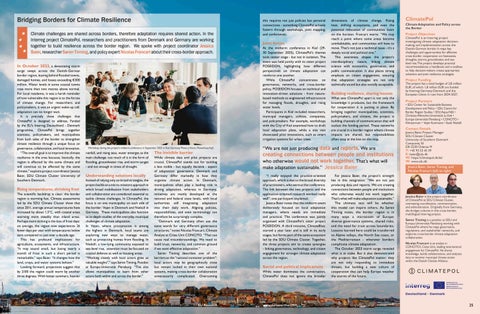
Workshop during the project’s midterm-conference in September 2025 in Kiel, Germany. Photo: J.Vinum, Flowerhaus ApS.
rainfall, and rising seas, water emerges as the main challenge: too much of it in the form of flooding, groundwater rise, and storm surges - and not enough in times of drought.
Understanding solutions locally Instead of relying only on broad strategies, the project builds on a micro-missions approach in which broad mobilisation from stakeholders and collaboration are considered essential to tackle climate challenges. In ClimatePol, the focus is on one municipality on each side of the border: Vejen in Denmark and Niebüll in Germany. These municipalities also function as in-depth studies of the everyday municipal challenges of climate adaptation. In Vejen, where precipitation is among the highest in Denmark, local teams are exploring new ways to manage water, such as protecting homes from flooding. In Niebüll, a low-lying community exposed to sea-level rise, attention must be focused on coastal defence as well as housing areas. “Working closely with local actors gives us valuable insights”,” says Søren Tinning, Postdoc at Europa-Universität Flensburg. “This also allows municipalities to learn from other actors both within and across the border.”
The invisible barrier While climate data and pilot projects are crucial, ClimatePol stands out for tackling a less visible - but equally decisive - aspect of adaptation: governance. Denmark and Germany differ markedly in how they organise climate action. In Denmark, municipalities often play a leading role in driving adaptation, whereas in Germany, initiatives are mainly developed at the national and federal state levels, with local authorities still integrating adaptation into their daily work. Aligning policies, responsibilities, and even terminology can therefore be surprisingly complex. “Denmark and Germany often use the same words for very different governance structures,” notes Nicolas Francart, Climate Analyst at Cities Unit CONCITO. “That can cause real misunderstandings. We need to build trust, networks, and common ground if we want effective adaptation.” Søren Tinning describes one of the barriers as the “national container problem”: local actors may be geographically close but remain locked in their own national systems, making cross-border collaboration unnecessarily complicated. Overcoming
EU Research
this requires not just policies but personal connections - something ClimatePol actively fosters through workshops, joint mapping, and conferences.
Joint forces At the midterm conference in Kiel (2930 September 2025), ClimatePol’s themes took center stage - but not in isolation. The event was held jointly with its sister project POSEIDON, highlighting how different perspectives on climate adaptation can reinforce one another. While ClimatePol concentrates on governance, networks, and cross-border policy, POSEIDON focuses on technical and innovation-driven solutions - from naturebased methods to engineered infrastructure for managing floods, droughts, and rising water levels. Participants in Kiel included researchers, municipal managers, utilities, companies, and policymakers. For example, workshops with the City of Kiel examined how to draft local adaptation plans, while a site visit showcased pilot innovations, such as smart irrigation systems for urban trees.
dimensions of climate change. Rising heat, shifting ecosystems, and even the potential relocation of communities loom on the horizon. Francart warns: “We may reach a point where some areas become uninhabitable, and communities will have to move. That’s not just a technical issue - it’s a deeply social and political one.” This awareness shapes the project’s interdisciplinary nature, linking climate science with economics, governance, and public communication. It also places strong emphasis on citizen engagement, ensuring that adaptation strategies are not only technically sound but also socially acceptable.
Building resilience, sharing lessons What sets ClimatePol apart is not only the knowledge it produces, but the framework for cooperation it is putting in place. By bringing together municipalities, scientists, policymakers, and citizens, the project is building channels of communication that will outlast the funding period. These networks are crucial in a border region where climate impacts are shared, but responsibilities often stop at the line on the map.
“We are not just producing data and reports. We are
creating connections between people and institutions who otherwise would not work together. That’s what will make adaptation sustainable.” Jessica Baier “I really enjoyed the practice-oriented approach, which is due to the broad diversity of practitioners, who were at the conference. The link between the two projects and the application-oriented research worked really well”, one participant explained. Jessica Baier notes that the midterm event deliberately focused on local adaptation managers, where needs are immediate and practical. The conference was jointly organised with ClimatePol’s sister project POSEIDON. A third initiative, ClimateBlue, started a year later and is still in its early stages, but forms part of the same ecosystem led by the SDU Climate Cluster. Together, the three projects aim to create synergies - linking governance, technology, and citizen engagement for stronger climate adaptation across the region.
Social and political implications While water dominates the conversation, ClimatePol does not ignore the broader
www.euresearcher.com
For Jessica Baier, the project’s strength lies in this integration: “We are not just producing data and reports. We are creating connections between people and institutions who otherwise would not work together. That’s what will make adaptation sustainable.” The ultimate test will be whether this model can inspire others. As Søren Tinning notes, the border region is in many ways a microcosm of Europe: diverse governance systems, shared risks, and the need for trust across boundaries. Lessons learned here could be transferred to Alpine valleys, the North Sea coast, or the Mediterranean - wherever borders complicate climate adaptation. The October 2023 storm surge revealed what is at stake. But it also demonstrated why projects like ClimatePol matter: they are not only responding to immediate threats, but building a new culture of cooperation that can help Europe weather the storms of the future.
ClimatePol Climate Adaptation and Policy across the Border
Project Objectives
ClimatePol is an Interreg project investigating climate adaptation decisionmaking and implementation across the Danish-German border. It maps key challenges and opportunities for effective cross-border cooperation on heatwaves, droughts, storms, groundwater, and sealevel rise. The project develops practical recommendations, a handbook, and a toolbox to help decision-makers create appropriate solutions and joint resilience strategies.
Project Funding
The project has a total budget of 2,8 million EUR, of which 1,8 million EUR are funded by Interreg Germany-Denmark and the European Union. It runs from 2024-2027.
Project Partners
• SDU Center for Sustainable Business Development and Policy • SDU Centre for Border Region Studies • SDU Aqua-NbS • Christian-Albrechts-Universität zu Kiel • Europa-Universität Flensburg • CONCITO • Klimatorium • Vejen Kommune • Stadt Niebüll
Contact Details
Jessica Baier, Project Manager SDU Climate Cluster University of Southern Denmark Campusvej 55 DK-5230 Odense M T: +45 93 53 45 39 E: baier@sdu.dk W: https://climatepol.dk/da/ W: www.sdu.dk
Jessica Baier, Søren Tinning, and Nicolas Francart (left to right)
Jessica Baier is the project coordinator of ClimatePol at SDU Climate Cluster, overseeing coordination, communication, and administration. Originally from Germany, she bridges cultures in this cross-border, multilingual Interreg project. Søren Tinning is a postdoc at SDU and Europa-Universität Flensburg working with ClimatePol where he maps governance, regulations, and stakeholder networks, and explores cross-border climate adaptation collaboration. Nicolas Francart is an analyst in CONCITO’s Cities Unit, leading international engagement for ClimatePol. He shares knowledge, builds collaborations, and analyzes data to monitor municipal climate action within the Danish Climate Alliance.
25