Transforming Public Purchasing Power European cities are learning to align procurement with sustainability goals. The ChemClimCircle project equips municipalities to reduce harmful chemicals, support circularity, and cut emissions through smarter public purchasing. Anne Lagerqvist and Heidrun Fammler explain how this cross-border initiative is reshaping procurement from a bureaucratic task into an action tool. Across Europe, public authorities are responsible for procuring a vast range of goods and services, from construction materials and school furniture to cleaning supplies and elderly care products. A critical question arises: what if these purchasing decisions could also help fight climate change, reduce exposure to hazardous substances, and support a circular economy? The ChemClimCircle project argues they can and should. Funded by the Interreg Baltic Sea Region Programme, this cross-border initiative equips municipalities with practical tools and training to embed sustainability into every step of the procurement process. But ChemClimCircle doesn’t just promote “greener” choices. By uniting three often separated goals - climate neutrality, circularity, and non-toxic everyday environments into one clear procurement strategy, the project positions public purchasing not as a bureaucratic formality but as a powerful lever for environmental transformation. Working with municipalities from all EU member states around the Baltic Sea, ChemClimCircle shows that while political support is essential, real change also happens through everyday decisions, like what cities choose to buy. Public procurement, when aligned with sustainability goals, becomes a powerful tool for impact.
Implementation Gaps Despite their significant buying power, many European municipalities still struggle to include sustainability in procurement. Interest in Green Public Procurement (GPP) is rising,
16
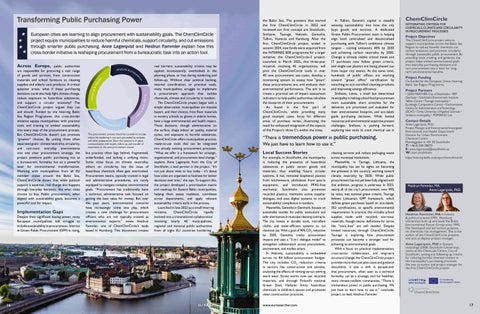
The procurement process should be considered circular, where the tendering is one part preceeded by analyses and other preparations. Once the contract is in place, communication with buyers, follow up, and transfer of experience to the next procurement ensues.
but practice often lags behind, fragmented, underfunded, and lacking a unifying vision. Some cities focus on climate neutrality, others on circularity, but the issue of hazardous chemicals often gets overlooked. Procurement teams, typically trained in legal and administrative procedures, are rarely equipped to navigate complex environmental goals. “Procurement has traditionally been a technical, administrative task focused on getting the best value for money. But over the past years, environmental concerns have increasingly come into play, which creates a new challenge for procurement officers who are not typically trained as environmental experts,” notes Heidrun Fammler, one of ChemClimCircle’s leads based in Hamburg. This disconnect creates
real barriers: sustainability criteria may be applied inconsistently, overlooked in the planning phase, or lost during tendering and follow-up. Without clear political backing, internal coordination, or practical tools, many municipalities struggle to implement a procurement approach that tackles chemicals, climate and circularity in tandem. The ChemClimCircle project began with a simple observation: municipalities are massive buyers, and their choices, from floor materials in nursery schools to gloves in elderly homes, have a huge environmental and health impact. These decisions, though administrative on the surface, shape indoor air quality, material cycles, and exposure to harmful substances. ChemClimCircle offers municipalities practice, ready-to-use tools that can be integrated into already existing procurement processes. “What we offer is a framework for strategic, organisational, and procurement-level change,” explains Anne Lagerqvist from the City of Stockholm, a lead partner in the project. “It’s not just about what to buy today - it’s about how cities are organised to facilitate for better decisions over time,” she says. To support this, the project developed a prioritisation matrix and roadmap for Eastern Baltic municipalities, helping them assess readiness, coordinate across departments, and apply relevant sustainability criteria early in the process. Launched in late 2022 as a small Interreg initiative, ChemClimCircle rapidly evolved into a transnational collaboration involving nearly 40 municipalities, regional and national public authorities from all eight EU countries bordering
EU Research
the Baltic Sea. The pioneers that started the first ChemClimCircle in 2022 and reviewed our first concept are Stockholm, Smiltene, Tauragė, Helsinki, Gentofte, Tallinn, Västerås and Hamburg. After the first ChemClimCircle project ended in autumn 2024, new funds were acquired from the INTERREG BSR programme for a larger initiative: the ChemClimCircle-2 project. Launched in March 2025, this three-year initiative, involving 45 organisations, will pilot the ChemClimCircle tools in over 40 new procurement use-cases, develop a monitoring system to assess how “green” these procurements are, and evaluate their environmental performance. The aim is to create a practical set of impact assessment indicators to help public authorities calculate the footprint of their procurements. As found in the first part of ChemClimCircle, while providing many good example cases, focus for different areas of purchase varies, illustrating the need for enhanced integration of the aspects of the Project’s three C’s within the cities.
In Tallinn, Estonia’s capital is steadily weaving sustainability into how the city buys goods and services. A dedicated Green Public Procurement team is helping align both centralised and decentralised purchasing with Tallinn’s ambitious climate targets - cutting emissions 40% by 2030 and achieving carbon neutrality by 2050. Change is already visible: school meals and IT purchases now follow green criteria, and single-use plastics are being phased out from major city events. At the same time, hundreds of public offices are working toward “green office” certification by switching to eco-certified cleaning products and improving energy efficiency. Smiltene, Latvia, a small but determined municipality is making school food procurement more sustainable; short stretches for the deliveries are prioritised and evaluated for their environmental footprint, and eco-labels guide purchasing decisions. While limited resources and environmental expertise present challenges, Smiltene is pushing forward, exploring new tools to track chemical use in
“There is tremendous power in public purchasing. We just have to learn how to use it.” Local Success Stories For example, in Stockholm, the municipality is reducing the presence of hazardous substances in public sector goods and materials, thus enabling future circular systems. It has removed bisphenol plastics from kitchenware, phthalates from sports equipment, and introduced PFAS-free workwear. Stockholm also promotes recycled plastics, maintains active supplier dialogue, and uses digital systems to track sustainability compliance in tenders. Meanwhile, Gentofte in Denmark, focuses on sustainable textiles for public institutions and safer alternatives in municipal cleaning contracts. The city invests in durable tools, microfibre cloths, and water-efficient systems to cut chemical use. With a goal of 90% CO2 reduction by 2030, Gentofte tracks procurement impacts and uses a “3-in-1 dialogue model” to strengthen collaboration across procurement, environment, and market actors. In Helsinki, sustainability is embedded across its €4 billion procurement budget. The city includes CO2 reduction criteria in sectors like construction and textiles, analysing the effects of renting versus owning work wear. Street works now use recycled materials, and through Finland’s national Green Deal, Helsinki limits hazardous chemicals in children’s spaces and promotes clean construction practices.
www.euresearcher.com
cleaning services and reduce packaging waste across municipal institutions. Meanwhile, in Tauragė, Lithuania, the municipality has set its sights on becoming the greenest in the country, working toward climate neutrality by 2030. While public procurement has not yet been fully aligned with this ambition, progress is underway. In 2023, nearly all of the city’s procurement, over 99% by value, met national green criteria. Tauragė follows Lithuania’s GPP framework, which defines green purchases based on eco-labels, ISO certifications, or specific environmental requirements. In practice, this includes school supplies made with recycled, non-toxic materials, though clearer definitions for terms like “toxic-free” are still needed. Despite limited resources, through ChemClimCircle, Tauragė is exploring how procurement processes can become a stronger tool for achieving its environmental goals. With a focus on practical implementation, cross-sector collaboration, and long-term structural change, the ChemClimCircle project provides more than just pilot cases and guidance documents. It sets a shift in perspective: that procurement, often seen as a technical formality, can be a strategic tool for healthier, more climate-resilient communities. “There is tremendous power in public purchasing. We just have to learn how to use it,” concludes project co-lead, Heidrun Fammler.
ChemClimCircle
INTEGRATING CRITERIA FOR CHEMICALS, CLIMATE AND CIRCULARITY IN PROCUREMENT PROCESSES
Project Objectives
The ChemClimCircle project aims to support municipalities across the Baltic Sea Region to reduce harmful chemicals, cut carbon emissions, and promote circularity through sustainable public procurement. By providing tools, training, and guidance, the project helps embed environmental goals into everyday purchasing decisions and turn procurement into a lever for longterm environmental benefits.
Project Funding
Co-funded by the European Union, Interreg Baltic Sea Region Programme.
Project Partners
• LEAD PARTNER City of Stockholm • BEF Germany • Stockholm Environment Institute Tallinn Centre • Taurage municipality • Ecodesign Competence Centre • Environmental Centre for Administration and Technology (ECAT) • Turku University of Applied Sciences • Smiltene municipality • POMINNO Ltd.
Contact Details
Anne Lagerqvist, PhD, Project Manager and Environmental Investigator Environment and Health Department Division for Urban Environment Chemical Centre Fleminggatan 4, 104 20 Stockholm T: +46-8-508 28870 E: anne.lagerqvist@stockholm.se W: start.stockholm https://interreg-baltic.eu/project/chemclimcircle/
Heidrun Fammler, MA Anne Lagerqvist, PhD
Heidrun Fammler, MA in history & political science (1991, Hamburg University) built up and leads the Baltic Environmental Forum Group since 1995. She developed and led various projects on chemicals risk management. She is the author of the ChemClimCircle projects and acts as deputy project manager. Anne Lagerqvist, PhD in Genetic toxicology (2008, Stockholm University), works at the Chemicals Centre, City of Stockholm, setting and following up criteria for reducing harmful chemical content in the municipality’s purchasing processes. She was co-author and project manager for the first ChemClimCircle project.
17