BrAIn Bringing Artificial Intelligence towards SMEs
Project Objectives
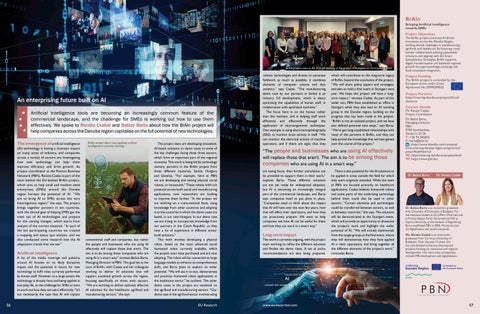
BrAIn project team at the Kick-off meeting of the project in Budapest, on 22nd January 2024.
An enterprising future built on AI Artificial Intelligence tools are becoming an increasingly common feature of the commercial landscape, and the challenge for SMEs is working out how to use them effectively. We spoke to Renáta Csabai and Balázs Barta about how the BrAIn project will help companies across the Danube region capitalise on the full potential of new technologies. The emergence of artificial intelligence (AI) technology is having a dramatic impact on many areas of industry, and companies across a variety of sectors are investigating how new technology can help them improve efficiency and drive growth. As project coordinator at the Pannon Business Network (PBN), Renáta Csabai is part of the team behind the EU-backed BrAIn project, which aims to help small and medium sized enterprises (SMEs) around the Danube region harness the potential of AI. “We aim to bring AI to SMEs across this very heterogenous region,” she says. The project brings together partners in ten countries, with the shared goal of helping SMEs get the most out of AI technologies and prepare for the coming changes, which starts from analysis of the current situation. “In each of the ten participating countries we created a mapping and status quo analysis, and we also conducted some research into the AI adaptation trends that we see.”
Artificial intelligence A lot of the media coverage and publicity around AI focuses on its likely disruptive impact and the potential in future for new technology to fulfil roles currently performed by human staff. However, to a large extent the technology is already here and being applied in everyday life, so the challenge for SMEs is more to work out how they can use it effectively. “It’s not necessarily the case that AI will replace
56
BrAIn project demo case: applying artificial intelligence in precision farming.
conventional staff and companies, but rather the people and businesses who are using AI effectively will replace those that aren’t. The aim is to be among those companies who are using AI in a smart way,” stresses Balázs Barta, Managing Director of PBN. This goal lies at the core of BrAIn, with Csabai and her colleagues working to deliver AI solutions that will support sustained growth across the region, focusing specifically on three main sectors. “We are working to deliver tailored, effective AI solutions for the healthcare, agrifood and manufacturing sectors,” she says.
The project team are developing innovative, AI-based solutions or demo cases to some of the key challenges facing these three sectors, which form an important part of the regional economy. This work is being led by technology owners, partners in the BrAIn project from three different countries, Serbia, Hungary and Slovenia. “For example, here at PBN we are developing and testing physical social robots, or humanoids.” These robots hold rich potential across both social and manufacturing applications, now researchers are looking to improve them further. “In the project we are working on a trans-national basis, using knowledge from other countries and adapting it to the countries in which the demo cases are based, in our case Hungary. In our demo case we are trying to incorporate knowledge from our partners in the Czech Republic, as they have a lot of experience in different sensor build solutions.” This work involves developing a physical robot, based on the most advanced social humanoid robot currently available, which the project team have purchased and are now adapting. The robot will be connected to large language models to enhance its comprehension skills, and Barta plans to explore its wider potential. “We will use it to test, demonstrate and promote humanoid robot applications in the healthcare sector,” he outlines. The other demo cases in the project are centered on the agrifood and manufacturing sectors. “Our demo case in the agrifood sector involves using
EU Research
robotic technologies and drones to automate fieldwork as much as possible, it combines elements of computer science and data analytics,” says Csabai. “The manufacturing demo case by our partners in Serbia is an industry 5.0 development, which is about optimising the capabilities of human staff, in collaboration with optimised machines.” The focus here is on the human rather than the machine, and in helping staff work efficiently and effectively through the application of neuroergonomic techniques. One example is using electroencephalography (EEG) to monitor brain activity in staff. “We can monitor the electrical activity of machine operators, and if there are signs that they
which will contribute to the long-term legacy of BrAIn, beyond the conclusion of the project. “We will share policy papers and strategies, and plan to hold a final event in Stuttgart next year. We hope this project will have a longterm impact,” stresses Csabai. As part of this wider aim, PBN have established an office in Stuttgart while they also lead an AI working group in the Danube region, building on the progress that has been made in the project. “BrAIn is not an isolated project, and we have also defined potential next steps,” says Barta. “We’ve got long-established relationships with many of the partners in BrAIn, and they can help spread the knowledge that we have gained over the course of the project.”
“The people and businesses who are using AI effectively will replace those that aren’t. The aim is to be among those companies who are using AI in a smart way.” are losing focus, then further stimulation can be provided to support them in their work,” explains Barta. These different solutions are not yet ready for widespread adoption, but AI is becoming an increasingly integral part of the commercial landscape, and Barta says companies need to put plans in place. “Companies need to think about the impact that AI will have over the next few years, how that will affect their operations, and how they can proactively prepare. We want to help companies see how AI can be useful for them and how they can use it in a smart way.”
Long-term impact This work is currently ongoing, with the project team working to refine the different solutions and finalise the demo cases. A set of policy recommendations are also being prepared,
www.euresearcher.com
There is also potential for the AI solutions to be applied in areas outside the field for which they were originally intended. While the team at PBN are focused primarily on healthcare applications, Csabai believes humanoid robots and some parts of the underlying technology behind them could also be used in other sectors. “Certain elements and technologies could be transferred between sectors, as well as between countries,” she says. The solutions will be demonstrated at the Stuttgart event, which will provide an opportunity to showcase the project’s work and highlight the wider potential of AI. “We will include testimonials from the target groups at the final event, where they will demonstrate how they have applied AI in their operations, and bring together all the different elements of the project’s work,” concludes Barta.
The BrAIn project promotes AI-driven innovation across the Danube Region, tackling shared challenges in manufacturing, agrifood, and healthcare. By fostering crossborder collaboration, piloting sustainable solutions, and aligning with EU Smart Specialization Strategies, BrAIn supports digital transformation and balanced regional growth through knowledge exchange and local ecosystem integration.
Project Funding
The BrAIn project is co-funded by the European Union under Grant Agreement No. DRP0200025.
Project Partners
https://interreg-danube.eu/projects/brain/ about-us
Contact Details
Ms. Renáta Csabai, Project Coordinator Dr. Balázs Barta, Managing Director PBN 9700 Szombathely, Zanati út 32-36 T: +36 94 505003 E: barta@pbn.hu : https://www.linkedin.com/company/ brain-interreg-danube-region-programme/ posts/?feedView=all W: https://interreg-danube.eu/projects/brain W: https://www.pbn.hu/
Dr. Balázs Barta
Ms. Renáta Csabai
Dr. Balázs Barta is an economist, graduated from University of Economics in Budapest. He had executive studies in US (UPenn Wharton) and in France (Insead, Paris). He earned his PhD at Sopron University, at the Institute of Engineering. Barta established PBN in 2006. His key focuses are digitalization and social humanoids. Ms. Renáta Csabai is an economist, graduated from Corvinus University of Budapest. Over the past 12 years, she has coordinated numerous international projects focusing on innovation and regional development. Her main areas of expertise include SME development and digitalization.
57