Protecting Europe’s Water Future Across the North Sea region, climate change is putting groundwater and soil under unprecedented strain. The EU-funded BLUE TRANSITION project brings together scientists, authorities, farmers and communities to rebalance water systems for the long term. We spoke with project lead Mike MüllerPetke and project manager Ilke Borowski-Maaser about how Europe is redefining water resilience. From
drought-stricken
fields
to creeping saltwater in coastal aquifers, Europe’s groundwater systems are under pressure. Groundwater is the water stored beneath the Earth’s surface in soil and rock layers, supplying Europe’s drinking water and a large share of its irrigation. Climate change is accelerating long-standing environmental stresses, while agriculture, tourism, industry and urban growth continue to compete for the same finite resource: clean groundwater. At the heart of this challenge lies a simple but urgent question - how can Europe protect both the quality and quantity of its groundwater in a warming world? The BLUE TRANSITION project was created to help answer precisely that question. Running under the Interreg North Sea Region Programme and spanning six countries - Sweden, Denmark, Germany, Belgium, the Netherlands and France - BLUE TRANSITION brings together 23 partners. “BLUE TRANSITION is really about how to manage groundwater and soil resources in times of climate change,” explains Mike MüllerPetke, lead partner of the project and Professor at the LIAG Institute for Applied Geophysics jointly with the Leibniz University Hannover. “We look at urban, agricultural and natural landscapes together, and at how human land use changes the water balance within them.” The project emerged from a growing recognition across the North Sea region that groundwater systems were becoming increasingly fragile - affected by droughts, flooding, salinisation, pollution and overextraction. “Most of our drinking water and much of our irrigation water comes from groundwater,” adds project manager Ilke Borowski-Maaser. “Ensuring that it remains clean and abundant is absolutely fundamental to our societies.”
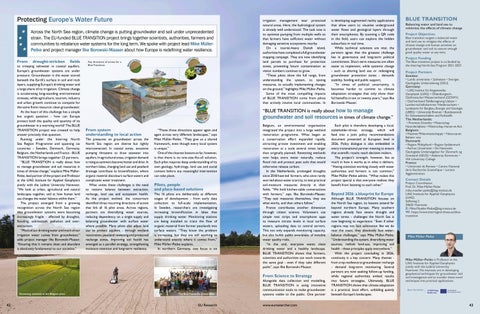
Key directions of action for a Blue Transition.
irrigation management near protected natural areas. Here, the hydrological system is already well understood. The task now is to optimise pumping from multiple wells so that farmers have sufficient water without damaging sensitive ecosystems nearby. On a tourist-heavy Danish island, authorities have completed a full groundwater mapping campaign. They are now identifying land parcels to purchase for protection zones, preventing future contamination as visitor numbers continue to grow. “These pilots show the full range, from understanding the system, to testing measures, to actually implementing changes on the ground,” highlights Mike Müller-Petke. Some of the most compelling impacts of BLUE TRANSITION come from pilots that actively involve local communities. In
“BLUE TRANSITION is really about how to manage groundwater and soil resources in times of climate change.” From system understanding to local action The pressures on groundwater across the North Sea region are diverse but tightly interconnected. In coastal zones, excessive pumping threatens to draw seawater into aquifers. In agricultural areas, irrigation demand is rising as summers become hotter and drier. In northern lakes, changing land use and peatland drainage contribute to brownification, where organic material discolours surface waters and complicates water treatment. What unites these challenges is the need to restore balance between extraction, recharge, land use and ecosystem health. As the project evolved, the consortium identified three recurring directions of action that link all 16 pilot areas. Across regions, partners are diversifying water sources, reducing dependency on a single supply and balancing groundwater with surface water where possible. Many pilots also adjust land use to protect aquifers - through wetland restoration, peatland rewetting and protected recharge zones. Improving soil health has emerged as a parallel strategy, strengthening moisture retention and long-term resilience.
“These three directions appear again and again across very different landscapes,” says Mike Müller-Petke. “They give us a shared framework, even though every local system is unique.” One of the clearest lessons so far, however, is that there is no one-size-fits-all solution. Each pilot requires deep understanding of its own geology, hydrology, land use and social context before any meaningful intervention can take place.
Pilots, people and place-based solutions The 16 pilots are deliberately at different stages of development - from early data collection to full-scale implementation. In Sweden, researchers are investigating increasing brownification in lakes that supply drinking water. Monitoring stations are being installed to trace the flow of organic material from former peatlands into surface waters. “They know the problem is increasing, but they are still working to understand exactly where it comes from,” Mike Müller-Petke explains. In northern Germany, one focus is on
Belgium, an environmental organisation integrated the project into a large wetland restoration programme. What began as a conservation effort expanded rapidly, attracting private investment and enabling restoration at a scale several times larger than originally planned. Rewetting wetlands now helps store water naturally, reduce flood risk and protect peat soils that would otherwise release carbon. In the Netherlands, prolonged droughts since 2018 have led farmers, who once rarely worried about water scarcity, to test practical soil-moisture measures directly in their fields. “We hold kitchen-table conversations with farmers,” says Ilke Borowski-Maaser. “They test measures themselves, they see what works, and then others follow.” France contributes another dimension through citizen science. Volunteers use simple test strips and smartphone apps to measure nitrate levels in local surface waters, uploading data to central servers. This not only expands monitoring capacity, but also builds public awareness of invisible water quality risks. “In the end, everyone wants clean drinking water and a healthy landscape. BLUE TRANSITION shows that farmers, scientists and authorities can work towards the same goal - even if they take different paths”, says Ilke Borowski-Maaser.
From Science to Strategy
Rewetting wetlands at the Belgium pilot.
42
is developing augmented reality applications that allow users to visualise underground water flows and geological layers through their smartphones. By scanning a QR code in the field, users can explore the hidden subsurface in real time. While technical solutions are vital, the partners agree that the greatest challenge lies in governance and long-term political commitment. Short-term measures are often easier to implement, while systemic change - such as altering land use or redesigning groundwater protection zones - demands stability, funding and public support. “In times of political uncertainty, it becomes harder to commit to climate adaptation strategies that only show their full benefits in ten or twenty years,” says Ilke Borowski-Maaser.
The Blue Transition consortium.
EU Research
Alongside data collection and modelling, BLUE TRANSITION is using innovative communication tools to make groundwater systems visible to the public. One partner
www.euresearcher.com
Each pilot is therefore developing a local, stakeholder-driven strategy, which will feed into a joint policy recommendations document presented at European level in 2026. Policy dialogue is also embedded in every transnational partner meeting to ensure that scientific results reach decision-makers. The project’s strength, however, lies as much in how it works as in what it delivers. “Having scientists working closely with water authorities and farmers is not common,” Mike Müller-Petke admits. “What makes this project special is that everyone realises they benefit from listening to each other.”
Beyond 2026: a blueprint for Europe Although BLUE TRANSITION focuses on the North Sea region, its lessons extend far beyond northern Europe. Many southern regions already face severe drought and water stress - challenges the North Sea is now beginning to experience. “Even if other regions may not face salinisation like we do near the coast, they absolutely face waterbalance challenges,” says Mike Müller-Petke. “Understanding the system, diversifying water sources, rethink land-use, improving soil health - these principles apply everywhere.” With the project concluding in 2026, continuity is a key concern. Many themes from crop resilience to groundwater recharge - demand long-term monitoring. Several partners are now seeking follow-up funding, while regional authorities embed results into future strategies. Ultimately, BLUE TRANSITION shows that climate adaptation is a practical, local effort, unfolding quietly beneath Europe’s landscapes.
BLUE TRANSITION Balancing water and land use to minimize the effects of climate change
Project Objectives
Blue transition targets a balanced water and land use to mitigate the effects of climate change and human activities on groundwater and soil to ensure enough good quality water at any time.
Project Funding
The Blue transition project is co-funded by the Interreg North-Sea Program 2021-2027.
Project Partners
Sweden: • Lunds universitet • Sydvatten • Sveriges Geologiska Undersökning (SGU) Germany: • LIAG Institut für Angewandte Geophysik (LIAG) • OldenburgischOstfriesischer Wasserverband (OOWV) • Dachverband Feldberegnung Uelzen • Landwirtschaftskammer Niedersachsen • Landesamt für Bergbau, Energie und Geologie (LBEG) • Universität Bremen • Bundesanstalt für Geowissenschaften und Rohstoffe The Netherlands: • Provincie Drenthe • Waterschap Noorderzijlvest • Waterschap Hunze en Aa’s Belgium: • Vlaamse Milieumaatschappij • Natuurpunt Beheer vzw Denmark: • Region Midtjylland • Region Syddanmark • Aarhus Universitet • De Nationale Geologiske Undersøgelser for Danmark og Grønland (GEUS) • Aabenraa Kommune • VIA University College France: • Université de Rennes • Centre National de la Recherche Scientifique • Lorient Agglomération
Contact Details
Project Coordinator, Prof. Dr. Mike-Müller-Petke mike.mueller-petke@liag-institut.de LIAG Institute for Applied Geophysics (LIAG) Stilleweg 2 30655 Hannover E: Mike.Mueller-Petke@liag-institut.de W: https://www.interregnorthsea.eu/bluetransition
Mike Müller-Petke
Mike Müller-Petke is Professor at the LIAG Institute for Applied Geophysics jointly with the Leibniz University Hannover. His interests are in developing geophysical techniques for groundwater and soil investigation and to transfer these novel techniques into practical applications.
43