
The shape of things to come in computational geometry
Austrian award-winning scientist, Herbert Edelsbrunner, a pioneer of alpha shapes and persistent homology, is taking these ground-breaking ideas in computational geometry, to empower new applications such as cancer detection and modelling, in the ALPHA project.
We are now accustomed to convincing imagery created by three-dimensional geometric modelling software used with computers in a multitude of industries. They help us design engines, create products, plan house builds, model invisible processes such as in microenvironments in nature, and to even create convincing computer-generated images (CGI) in Hollywood movies. However, this world-changing technology is only a few decades old, and its early development came in part from the mathematical imaginings of Herbert Edelsbrunner and his alpha shapes concept, first proposed in 1983, along with his colleagues, David Kirkpatrick & Raimund Seidel. In the field of mathematics, alpha shapes were devised to define a shape around a set of points in the Euclidean plane, reliant on using the radii of circles around the points as a guide to finding form, where they intersect with each other.
Alpha shapes began as a way of determining two-dimensional shapes from a set of data points but much later, in the 90s, Edelsbrunner progressed the methodology to construct shapes in three dimensions, with a polygon boundary. It was a major leap in the potential of alpha shapes for practical applications. In this period of the 1990s, the principles of alpha shapes led to a wrap algorithm for surface reconstruction. This proved highly useful for real-world applications in engineering, manufacturing, dentistry, and medicine, to name a few.
“When 2D alpha shapes appeared, people attempted to implement 3D but it didn’t really work because the numerical error propagates and it spoils the construction. At other times it would give you a wrong result,” explained

Edelsbrunner, when pondering the early challenges that they faced with the transition to 3D. “Then we developed this method called SOS, which stands for Simulation of Simplicity. This is a very important technique because it allows you to do exact computations and only with this is it possible to correctly implement three-dimensional Delaunay triangulations. When that happened, we used the 3D alpha shapes to see how far we could push their implementation, using Simulation of Simplicity. And that’s how we generated this avalanche of different uses and applications on the computation side.”
called persistent homology (PH) useful for topological algorithms and data analysis. Persistent homology finds the essential features by looking at the ones that exist over a range of scales. This method assesses the scale level and reports noise as lowpersistent features. The user of the result may decide to ignore noise by ignoring these low-persistence features, to form a clearer picture.

In effect, these concepts by Edelsbrunner were forming a suite of geometrical calculations that in turn were inadvertently creating a new industry in computational modelling.
What we focused on is this multichromatic data and a starting point was in cancer research. It turns out that the location and the relevant distribution of different types of cells are important when looking at cancer.
Computational order from chaos
This way of making three-dimensional data into three-dimensional shapes has countless real-world practical applications.
“In the early 90s we had the software for alpha shapes, which nobody else had, so we could create these beautiful 3D objects, and we were wondering what we could do with this,” recalls Edelsbrunner. “With one development, we showed it to biochemists, who were working on proteins and they noticed a similarity with protein structures. If you take the protein data, the location of the atoms of the protein as input, then we can construct the protein.”
Another milestone for Edelsbrunner was the development of a mathematical tool
Shaping industrial applications

“It was very lucky because all of a sudden, we could compute things that no one could compute before because they didn’t have the sophistication in geometry or in computation.”
Edelsbrunner’s alpha shapes had advanced technological capabilities. He was one of only three computer scientists to win the National Science Foundation’s Alan T Waterman Award and his ideas were a catalyst for co-founding his own business, Raindrop Geomagic, which creates shape modelling software. The often-cited golden goal for investors and innovation, of turning academic breakthroughs into commercial success, was happening on
a large scale. In turn, for Edelsbrunner, it meant expanding his own knowledge to adapt his computations to real-life applications.
“I have come to learn many different disciplines but it helps to have a mathematical background. Whilst it sounds like learning a lot of different things, in the end, it all distils down to the mathematical essence. That is the place in my mind where I can approach it and is easier to remember.”
Extending alpha shapes
The ALPHA Project is devised to extend, improve and unify the threads of alpha theory. The project is split into four objectives which all link to expand the overall development of the theory. The wrap algorithm is extended to be more sophisticated and handle abstract settings. It allows for more detailed shaping where the data can provide the information, while maintaining the integrity of the reconstruction.
There is also an effort to form a deeper understanding of noise and improve the behaviour of the methods used to analyse noise and find meaningful patterns within it. Ultimately, the project provides a new layer of intricate understanding that can be incorporated into these established techniques and significantly improve knowledge of geometrical shaping.
Marking cancer
Whilst the ALPHA Project has several broad objectives for extending the theories, a practical spin-off from the work will prove to be of benefit to cancer research. Specifically, it is related to the autoimmune cell microenvironment and to analysing the early development of cancer.
“What we focused on is this multichromatic data and a starting point was in cancer research. It turns out that the location and the relative position of cells are important when looking at cancer. In particular, in
order to decide what kind of treatment the patient should get. Nowadays there are many different treatments and it’s important to find the right schedule and find the right treatment for each patient.
“It boils down to having a collection of cells that are labelled so that some are tumour cells and some are immune cells of different types. You must ask ‘how do they relate to each other?’ and ‘how are they located?’ For this, we developed chromatic alpha shapes, and chromatic means that for each type there is a colour. The focus is on how the different colours relate to each other. Maybe a simple way of thinking about it is when you have a soccer game you have two teams and two colours, and how players are distributed and use the space is important, although it’s more dynamic in a soccer situation but it’s that kind of idea. We wanted to develop a topological language to talk about different relationships between the different colours and the different scales.”
The cancer application was a motivation to ask mathematical questions and in this case, it is about geometric location, colours, and multi-chromatic patterns. Whilst the reality of the application is still a fair distance away, the team’s focus is on developing the mathematical tools that will allow healthcare experts to deal with cancer with more sophistication in the future.

“We get tools that can be used by domain experts,” clarified Edelsbrunner. “We use mathematics like a craftsman uses metal or other materials. By combining math with computing, we get tools that can be used by
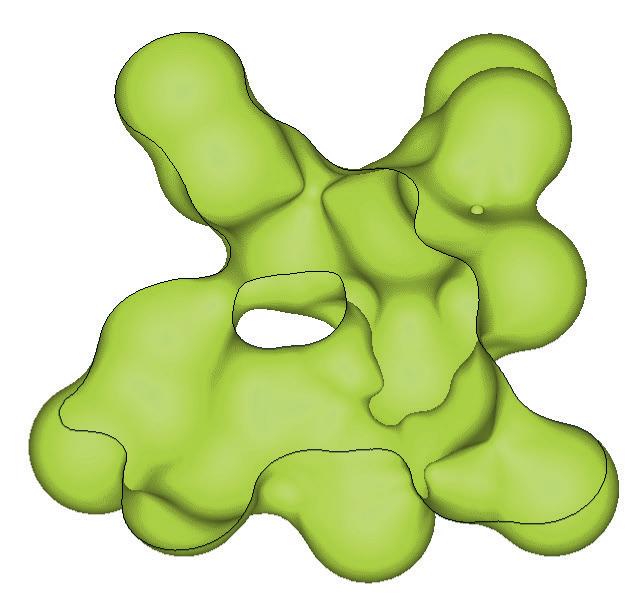
A protein-protein interface in three dimensions. The surface bifurcates, indicating that there are more than two proteins coming together to form a complex.


AlpHA Alpha Shape Theory Extended project Objectives
In the field of computational geometry, the project seeks to extend understanding and further develop the theory of Alpha shapes which was first developed in the 1980s. The research includes work on wrap complexes and persistent homology. This project represents an ongoing effort to improve and build on existing methodologies and ideas, finding new practical applications in the process, specifically in the healthcare context.
project Funding
Funded by the European Research Council under the European Union’s Horizon 2020 research and innovation program, ERC Grant no. 788 183.


Contact Details
Project Coordinator, Herbert Edelsbrunner Institute of Science and Technology Austria (ISTA)


Am Campus 1 3400 Klosterneuburg
Austria
of staying flexible, and nimble and not being too dogmatic with research goals. This way you can objectively see what works first and then after, see how it can be a benefit. In essence, Edelsbrunner thinks of himself as a mathematician first, and a scientist second. “If you talk to scientists who are experimentalists, their investment into a certain direction is stronger but as a mathematician, all I have is in my mind. I can wake up tomorrow and think of something different and nothing prevents it. If I break off a project as a biologist, I need to develop another lab so it’s different and expensive.
We used the 3D alpha shapes to see how far we could push their implementation, using Simulation of Simplicity. And that’s how we generated this avalanche of different uses and applications on the computation side.
others. Our focus is on developing the math that is currently missing to make a difference. In many ways, a mathematician is like an engineer who deals in abstract concepts.”
Being flexible for true progress
With so many applications blooming from the seeds of these mathematical and geometrical design calculations, it’s enlightening to realise that they have grown from a place where there was freedom to think, change direction, reimagine and reinvent. True science is usually simply born from a thought, an idea and creating an experiment. With mathematics, Edelsbrunner is candid about the importance
You don’t move as fast. It’s easier for me to say I will keep an open mind. Although, even if you have an open mind you are pushed into this idea of what you should plan next, to have a purpose. Often the purpose itself has to be adjusted because even the smartest people who predict the future, predict it wrong all the time.”
With the Alpha project, there is a dedication to the ongoing development of working formulas and ideas, to reach the next levels in an established success story. The global reach of the work has made computational geometry a powerful force in a wide range of industries that in some way, will affect us all.

E: Herbert.Edelsbrunner@ist.ac.at W: https://ist.ac.at/en/research/ edelsbrunner-group/#Current%20Projects
H. Edelsbrunner, D.G. Kirkpatrick and R. Seidel. On the shape of a set of points in the plane. IEEE Trans. Inform. Theory IT-29 (1983), 551-533.
H. Edelsbrunner and E.P. Mücke. Simulation of Simplicity: a technique to cope with degenerate cases in geometric algorithms. ACM Trans. Graphics 9 (1990), 86-104.
H. Edelsbrunner and E.P. Mücke. Threedimensional alpha shapes. ACM Trans. Graphics 13 (1994), 43-72.
Herbert Edelsbrunner
Herbert Edelsbrunner is a mathematician, a computer scientist and renowned expert in computational geometry. Edelsbrunner was Arts & Science Professor of Computer Science and Mathematics at Duke University. He is now a Professor at the Institute of Science and Technology Austria (ISTA). He won the National Science Foundation’s Alan T. Waterman Award.