Contributors Abe Asher, Bill Baird, Ron Bechtol, Danny Cervantes, Amber Esparza, Brianna Espinoza, Anjali Gupta, Colin Houston, Kiko Martinez, Mike McMahan, Kevin Sanchez, M. Solis, Dean Zach
The San Antonio Current is published by Chava Communications Group
San Antonio Distribution The Current is available free of charge, limited to one copy per reader. Get listed
1. Visit sacurrent.com
2. Click “Calendar” and then “Submit an Event”
3. Follow the steps to submit your event details
Please allow 48 hours for review and approval. Event submissions are not accepted by phone.
Copyright notice: The entire contents of the San Antonio Current are copyright 2023 by Chava Group LLC. Reproduction in whole or in part without written permission of the publisher is prohibited. Publisher does not assume any liability for unsolicited manuscripts, materials, or other content. Any submission must include a stamped, self-addressed envelope. All editorial, advertising, and business correspondence should be emailed to the addresses listed above.
Subscriptions: Additional copies or back issues may be purchased at the Current offices for $1. Six-month domestic subscriptions may be purchased for $75; one-year subscriptions for $125.
in this issue
Issue 26-07/// Apr 1 - 14, 2026
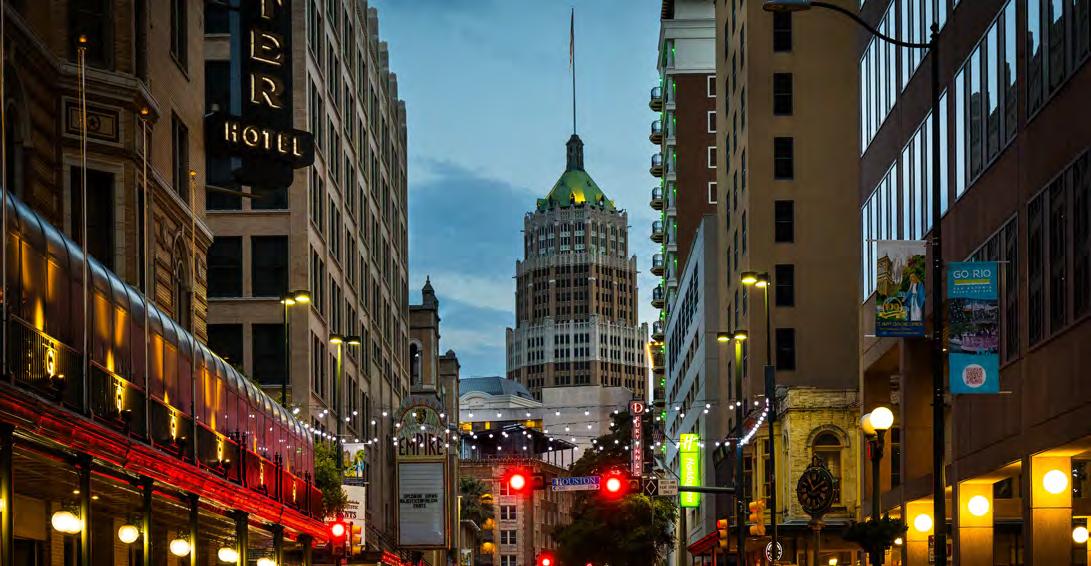
13 Is Downtown Going Dark?
San Antonio’s hotel occupancy is down 14% from 2019, and that’s putting our economy at risk
07
News
The Opener News in Brief
Up in Smoke
Texas' newly enacted ban on smokable THC products creates turmoil for industry and its customers
Detention Outcry
Amid rising public scrutiny, population of controversial Dilley prison camp near San Antonio drops to just 100
Bad Takes
The GOP’s professed love of rural Texans is all hat and no cattle
19 Calendar
Our picks of things to do powerful
Verification Council
Auditor’s Certification:
25 Arts
Looking for the Real Willie
After Willie Nelson’s Fourth of July Picnic used AI art in its poster, a Texas artist is pushing back with love
27 Screens
Cinematic Taste
Former San Antonio chef Jerald Head turns culinary journey into indie rom-com
31Food
Addictive Arepas
Leiah Venezuelan Food’s homey, straightforward fare scores big on flavor
Cooking Up Conversation
Sumi Thu on her journey from buffet cashier to part-owner of Wild Goji Revolving Sushi & Bar
35 Music Still Laying Down the Boogie
Catching up with ZZ Top’s Billy Gibbons ahead of the band’s two nights at the Majestic Theatre
Critics’ Picks
On the Cover: San Antonio’s hotel occupancy rates are down, and that’s spelling trouble for the economy plus projects such as downtown’s sports-andentertainment district. Cover design: Ana Paula Gutierrez.
Building Futures, Breaking Barriers: The Alamo Colleges District Story
Celebrate 80 years of expanding opportunity and strengthening workforce development across the San Antonio region.
Through powerful alumni stories and reflections from community leaders, this inspiring documentary honors the legacy and impact of the Alamo Colleges District — and the students and communities it serves.
Watch the broadcast premiere on KLRN Monday, March 23, 2026 | 9:00 PM
For more information, visit alamo.edu/80/share-your-story.
That Rocks/That Sucks
A spike in measles cases at federal detention facilities in Texas has spread to the general public. Four El Paso residents who work at a detention facility in Hudspeth County caught measles in February and visited numerous public gathering places after their infection, potentially exposing others to the disease. El Paso officials have been frustrated by a lack of information about the outbreaks from federal authorities, the Texas Tribune reports.
U.S. Rep. Greg Casar joined U.S. Sen. Bernie Sanders to introduce a bill last week that would give communities a chance to purchase their pro sports teams before they can relocate to new cities. Casar represents part of San Antonio, where voters last year approved a $1.3 billion package to help fund the construction of a Spurs arena after team officials declined to rule out a move if it didn’t receive public money.
The ICE field office in San Antonio has recorded the agency’s seventh-largest number of arrests since the beginning of last year, a New York Times analysis found. Despite a lack of highly visible immigration street enforcement in the area, the Alamo City office has made more than 22,000 arrests since the start 2025 — with its average number of daily arrests climbing steadily.
After a woman sparked outrage when her texts referencing “Crazy Hispanic fans” at a San Antonio Spurs game were shared across social media, fans of the NBA team have turned the slight into a rallying cry. Some showed up to a late-March game against the Indiana Pacers in shirts featuring the phrase. Meanwhile, other merchandise featuring the phrase is now being sold on Facebook Marketplace. San Antonio is nearly two-thirds Latino — Abe Asher
Playing a tired, racist game with the ‘Sharia Free Texas Caucus’
Assclown Alert is a column of opinion, analysis and snark.
The Texas Legislature has never exactly been a stranger to performative Punch and Judy shows, but its newfound obsession with Sharia law might be one of its more embarrassing entries — a political stunt so unnecessary it practically collapses under the weight of its own bad faith.
This month, when unveiling their list of priorities for the next legislative session, Republican House Speaker Dan Burrows and Republican Lt. Gov. Dan Patrick, who presides over the Texas Senate, both placed “preventing Sharia law” on the list.
Not to be outdone, State Rep. Brent Money, R-Greenville, also minted the “Sharia Free Texas Caucus,” which has now grown to roughly 40 members, all Republican. The name pretty much gives away its agenda.
Let’s get the obvious out of the way first: there’s no looming threat of Sharia law — a body of Islamic laws based on that religion’s scriptures — supplanting the U.S. legal system. Not in Texas. Not anywhere in the country.
The U.S. Constitution, specifically the Establishment Clause, slams that door on that notion with the force of nearly two and a half centuries of jurisprudence. Courts don’t get to swap out constitutional law for religious doctrine, whether it’s Muslim, Christian or found in the Book of Mormon.
That’s not how our justice system works. That’s never been how it works.
Which raises an uncomfortable question: just what the country-style fuck do these lawmakers think they’re doing?
Because most of them are smart enough to know better. They have either been through law school or spent enough years in legislative briefings to have a clue. Which means Sharia law being adopted in the U.S. is no more likely than U.S. Sen. Ted Cruz staying in Texas during really nasty weather.
So, when these jokers rally around something as transparently pointless as a “Sharia Free Texas Caucus,” it’s hard to chalk it up to ignorance. Instead, it reads like something far more cynical — another deliberate attempt to stoke fear of Muslims for cheap political points.
And if — generous interpretation here — some of them don’t understand the most basic foundations of our justice system? Well, they have no business drafting laws that affect 30 million Texans. If you’re confused about whether religious law can override the Constitution, your ass shouldn’t be warming a seat in the Texas House. Full stop.
The very existence of an anti-Sharia law caucus depends on a fantasy threat, one that paints an entire religion as an invading horde or simmering internal menace. That ain’t governance, folks. It’s fear-mongering slapped with a state seal.
Meanwhile, Texas faces profound problems that aren’t paranoid fantasies — underfunded schools, taxes that overburden the poor and middle class, a broken foster care system, the nation’s highest rate of uninsured residents. But instead of taking steps to solve those issues, lawmakers are pearl clutching over a right-wing cable news fever dream.
It’s a tired playbook: find a minority, manufacture a threat, wrap it in pseudo-patriotic language and pretend you’re earning your place in Austin.
Burrows, Patrick and members of the “Sharia Free Texas Caucus” aren’t just lazy; they’re divisive, racist assclowns whom Lone Star State residents need to send packing. — Sanford Nowlin
YOU SAID IT!
“The law is clear: Congress holds the
power to declare war. A war without the people’s consent is unlawful.”
The Federal Election Commission (FEC) is once again asking questions of Attorney General Ken Paxton’s U.S. Senate campaign. This time, the commission wants the campaign’s treasurer to explain nearly $100,000 in contributions that appear to violate federal law by exceeding the limits on individual contributions and also contributions that may flout a ban on contributions from limited liability companies. The campaign, locked in a runoff battle with U.S. Sen. John Cornyn, has until April 29 to respond.
Renaming César E. Chávez Boulevard could cost the city of San Antonio more than $200,000 and spell further costs for that street’s residents, city officials estimate. City Council is considering whether to rename the downtown thoroughfare after the New York
Times published a story earlier this month alleging Chávez sexually abused adolescent girls and sexually assaulted fellow United Farmworkers leader Dolores Huerta. The city canceled César Chávez Day celebrations scheduled for March 31.
U.S. Reps. Greg Casar and Robert Garcia last week called for an independent investigation into the death of Ruben Ray Martinez, a San Antonio man fatally shot by ICE agents on South Padre Island more than a year ago. In a letter to the Department of Homeland Security’s inspector general, Casar and Garcia, who both sit on the House Oversight Committee, asked for the probe into the circumstances of Martinez’s death and requested a briefing by April 6.
Abe Asher
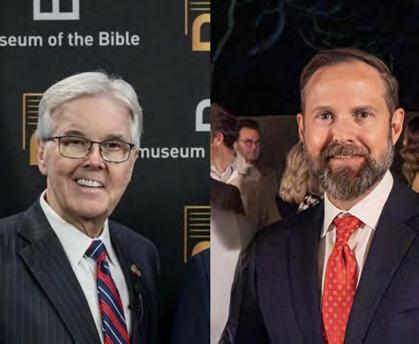
Facebook _ Dan Patrick (left) and Dustin Burrows for Texas (right)
Up in Smoke
Texas' newly enacted ban on smokable THC products creates turmoil for industry and its customers
BY ABE ASHER
When Brook Richie learned that Texas had moved to ban smokable hemp products — something that went into effect March 31 — she wasn’t surprised.
“You could already see it heading in this direction,” said Richie, who owns Bee’s Wellness Cafe, a dispensary in the Thousand Oaks Shopping Center. “It just seems to be unfair for the people of Texas, because [state officials] are basically telling them how they can get their medicine.”
The state’s ban, which went into effect along with a rash of new regulations on purveyors of hemp-derived THC, was months in the making. Even so, it seems to have caught many users of the products off guard.
Last summer, Gov. Greg Abbott vetoed Senate Bill 3 — a piece of legislation pushed by Lt. Gov. Dan Patrick, a fellow Republican, that would have banned most THC-derived hemp products statewide. GOP leaders failed to broker a new deal following the veto, but got a lift when Abbott directed the Texas Department of State Health Services (DSHS) to increase regulations on the industry.
The regulations DSHS responded with included increasing licensing fees, adding a variety of testing and labeling requirements, and, significantly, lowering the allowable amount of THC in products to 0.3%. That last change essentially eliminated all legal sales of smokable hemp products such as joints and flower.
And, yes, those smokable products make up the majority of sales for many of the state’s hemp retailers and distributors. Not surpassingly, that’s frustrated and angered dispensary operators — especially since it comes as they face so many other new regu-
lations.
“I just feel like instead of outright banning it, they should just crack down more on the testing part to make sure it is compliant, regulated, and make sure people are getting what they think they’re getting,” said David Burrow, CEO of San Antonio’s Alamo Botanicals.
Misinformation campaign
Burrow said THC products are largely misunderstood, and he said that problem stems from misinformation spread from the highest level of state government.
Over recent years, Patrick — one of the state’s most outspoken GOP culture warriors — has been particularly outspoken in his objections to THC products, arguing that no one really knows what the products contain. He’s also attempted to link them to youth suicides and suggested they’re responsible for a wider public health crisis.
Understanding of THC’s health effects is still developing, and researchers give Patrick’s claims mixed reviews at best.
Despite the spread of misinformation, and an opposition seemingly baked into the Republican-controlled Texas Legislature, Burrow said business at Alamo Botanicals has been steady in recent years coming out of the COVID-19 pandemic. However, he now worries about the stability of his business. Smokable products accounted for 30-35% of Alamo Botanicals’ sales. Vapes made up for 15-20% until a separate measured banned them statewide last year.
“I’d be lying if I said it wasn’t going to make an impact,” Burrow said of the latest ban. “It is a big part of the business, but not something that is going to impact our ability to take care of our community and stay open.”
Burrow said the wide variety of products Alamo Botanicals offers should allow his venture to weather the loss of revenue from smokable products.
Even so, the industry is already feeling the reverberations of the new regulations.
One dispensary in the Alamo Ranch area is closing, Richie of Bee’s Wellness said. The business’ owners plan to reopen in a state where recreational marijuana is legal.
Even aside from the new ban on smokable products, the uncertainty about what will be legal to sell year-toyear is having an effect on dispensary operators, according to Richie.
“It’s definitely stress-inducing, and it does make people question whether they should stay in this industry,” she said.
Part of the frustration for dispensary operators is the logic of outlawing the smokable products even as other products remain on the shelves.
“It’s the actual plant,” Burrow said. “It’s not a synthetic product, it hasn’t been altered in any way, it’s just the closest you can get to the plant. And it’s the fastest acting too.”
Consumer demand
And there are reasons why some prefer to smoke rather than take an edible or drink an infused beverage.
“One of the most important things is the control that smoking gives the consumer,” Richie said. “Whenever they imbibe with smoking, they are going to be able to control it easier. They are going to be able to stop when they feel relief, and they know the duration is going to last an hour to an hour-and-a-half.”
A considerable number of those who prefer to smoke are going to find ways to continue to do so rather than switching to other THC-infused hemp products, she added.
“They’re probably just going to get illegal [products],” Richie said. “They never know what they’re going to get on the streets … so, actually, the population is now at risk, because a legal version that is safe and traceable is being taken away from them.”
The assertion that people will turn to the black market raises broader public policy questions about whether it’s better to legalize and regulate substances like THC or whether that encourages people who might not otherwise smoke.
It’s a discussion happening at the national level as well. A federal ban on numerous THC-derived hemp products also is scheduled to take effect in November, further raising anxiety for hemp businesses and users.
Nevertheless, Richie said she’s not deterred in her mission at Bee’s Wellness Cafe.
“I still feel like I was put onto this path and that I’m here to help people,” Richie said. “I’m going to stay here and I’m going to stay strong so that I can help support our community.”
Shutterstock _ Jose HERNANDEZ Camera 51
The General Manager of the Edwards Aquifer Authority (“EAA”) proposes to grant applications to convert Base Irrigation Groundwater to Unrestricted Irrigation Groundwater under § 711.342(c) of the EAA’s Rules. A copy of the applications, the technical summaries, the General Manager’s proposed actions, and the proposed amended regular permits are available for public inspection at the EAA’s offices at 900 E. Quincy Street, San Antonio, Texas Monday through Friday, 8 a.m.-5 p.m. Electronic copies may also be obtained by request to Jennifer Wong-Esparza at jesparza@edwardsaquifer.org or (210) 222-2204.
The General Manager proposes to approve the following applications to convert Base Irrigation Groundwater to Unrestricted Irrigation Groundwater under § 711.342(c) of the EAA’s Rules:
SA Rocking in the Free World, LP – Filed application on February 13, 2026. The application seeks to convert 65.909 acre-feet of Base Irrigation Groundwater to Unrestricted Irrigation Groundwater based on the development of the Historically Irrigated Land (“HIL”).
SA Landon Ridge, LP – Filed application on February 13, 2026. The application seeks to convert 12.208 acre-feet of Base Irrigation Groundwater to Unrestricted Irrigation Groundwater based on the development of the HIL.
SA Landon Ridge, LP – Filed application on February 13, 2026. The application seeks to convert 36.800 acre-feet of Base Irrigation Groundwater to Unrestricted Irrigation Groundwater based on the development of the HIL.
SA Rocking in the Free World, LP – Filed application on February 13, 2026. The application seeks to convert 2.907 acre-feet of Base Irrigation Groundwater to Unrestricted Irrigation Groundwater based on the development of the HIL.
Gaylon Trees and Debra Trees, et al – Filed application on February 11, 2026. The application seeks to convert 39.790 acre-feet of Base Irrigation Groundwater to Unrestricted Irrigation Groundwater based on the development of the HIL.
LEC Legacy, Ltd. – Filed application on March 3, 2026. The application seeks to convert 57.609 acre-feet of Base Irrigation Groundwater to Unrestricted Irrigation Groundwater based on the development of HIL; and HIL are no longer practicable to farm.
Slate Creek Ranch, LLC – Filed application on March 3, 2026. The application seeks to convert 10.888 acre-feet of Base Irrigation Groundwater to Unrestricted Irrigation Groundwater based on HIL are no longer practicable to farm.
The applicants or any other Edwards Aquifer permit holder may file a written request for a contested case hearing on the proposed action with the EAA by no later than Monday May 11, 2026, at 5:00 p.m. in accordance with § 707.603 of the EAA’s Rules. The EAA’s Board of Directors will consider approval of the applications and issuance of the proposed amended regular permits within 60 days of publication of this notice unless a request for contested case hearing is timely filed. If no timely requests for contested case hearing are filed, the applications will be presented to the EAA’s Board on the date of the hearing for final action.
This notice is issued pursuant to § 707.525 of the EAA’s Rules.
NOTICE OF PROPOSED ACTION ON APPLICATION FOR CONVERSION OF BASE IRRIGATION GROUNDWATER TO UNRESTRICTED IRRIGATION GROUNDWATER ISSUED THIS 1st DAY OF APRIL, 2026
news Detention Outcry
Amid rising public scrutiny, population of controversial Dilley prison camp near San Antonio drops to just 100
BY STEPHANIE KOITHAN
Only 100 people are currently detained in the federal government’s controversy-plagued family detention center at Dilley, nonprofit news outlet ProPublica reports. That compares to an average daily population of more than 900 in January.
The Current first reported on a sharp drop in the immigrant prison camp’s population on March 10, when U.S. Rep. Joaquin Castro, D-San Antonio, revealed at a press conference that the number had dwindled to 450 people, including 99 children. When Castro visited the site an hour southwest of San Antonio in January, its population was roughly 1,100.
Not only has the population in Dilley dropped, according to ProPublica, so has the rate at which people are being sent to the lockup.
Between April 2025, when President Donald Trump resumed sending families to the South Texas detention center, and this January, the number of people booked into the site averaged 600 monthly. As of mid-March, the number of monthly book-ins has dropped to just 54.
Castro has said he believes public pushback against the detention of children, combined with inmates’ reports of deplorable conditions inside, played a factor in the government reducing the population at Dilley.
“I believe that the public outcry is making a difference. That people are leaving Dilley. That more people are being released,” Castro said at the press conference earlier this month at San Antonio City Hall, where he was joined by a delegation of U.S. House Democrats who accompanied him to Dilley.
However, the Department of Homeland Security (DHS), which oversees Immigration and Customs Enforcement, insisted in a statement to ProPublica that public pressure hasn’t played a role in the detention facility’s dwindling population.
Rather, DHS told ProPublica that decisions are made “daily, on a case-by-case basis,” adding that the “administration does not make immigration decisions based on public opinion. We follow the rule of law.”
CoreCivic, the private prison company operating the facility, told ProPublica in a statement it doesn’t have “any say whatsoever” in whether detainees are deported or released. However, the company said the health and safety of its detainees remains its “top priority.”
Nonetheless, reports from those detained inside reveal unsanitary conditions, including “putrid” drinking water along with mold and bugs in the food. The Current also broke the story nationally of a measles outbreak at the camp on Feb. 1, thanks to a source familiar with conditions inside.
Dilley inmates also have reportedly
been rushed to the hospital after staff there have been unable to provide the care they needed. A two-month old infant named Juan Nicolás choked on his own vomit until he became unresponsive and was rushed to the hospital, where he was diagnosed with bronchitis. A teen boy was told to take pain relievers for life-threatening appendicitis until his condition worsened and he was hospitalized.
Even though the facility has been
reopened for almost a year, staff told Castro’s congressional delegation in early March that the camp is just starting to offer an educational program with a single teacher on staff. Some of the children detained inside had been there for nine months at that point.
“I’ve said very clearly that my goal is to shut down Dilley. I don’t think anybody should be kept in that trailer prison, and most especially children,” Castro said at the press conference.
Stephanie Koithan
U.S. Immigration and Customs Enforcement _ Charles Reed
Feb 28-Apr 19, 2026 Also Open Friday, Mar 20 10 AM To Dusk Rain Or Shine | No Pets (except in campgrounds) -Camping Available-
Location
1883 Old Hwy 20 Mcdade, Tx 78650
35 Miles East Of Austin -Or-
2 Hrs Northeast Of San Antonio
Entertainment
Join Robin Hood & Lady Marian as they host full contact jousting, falconry, swordplay, archery, juggling, comedy, theater & more. Medieval England comes to life in Central Texas.
Artisans + Merchants
We host a grand selection of hand-crafted goods in Central Texas. We offer demonstrations like glass blowing, blacksmithing, pottery spinning, leather armor making, weaving, jewelry & art creation, & others.
Song + Dance
You'll find minstrels, bards, storytellers, magicians, jugglers, & all types of performers strolling our lanes & playing on our stages. If you're lucky, you may spot a faery or two!
Food + Drink
From trenchers weighty with tasty fare to tankards overflowing with foamy mead, there's plenty to eat and drink at Sherwood Forest Faire. You'll discover medieval treats & delicacies.
Is Downtown Going Dark?
San Antonio’s hotel occupancy is down 14% from 2019, and that’s putting our economy at risk
BY MICHAEL KARLIS
Last week, Designated Bidders LLC, the ownership group of the San Antonio Missions minor league baseball team, unveiled renderings of its grand vision for its new downtown ballpark and surrounding economic development.
The publicly financed sports complex northwest of downtown will have capacity for 7,500 fans. The group also expects two apartment towers to be built nearby, along with an eight-story hotel with 160 rooms.
Just three miles southwest of the ballpark, another sports and entertainment district is taking shape at the same time.
Instead of a minor league baseball stadium, the publicly financed Project Marvel complex will be anchored by a new NBA arena for the Spurs. Hotels will feature prominently there too — at least one boutique property is planned, along with a possible new convention center hotel, although specifics remain murky.
And earlier this month, The Monarch, a 200-room luxury hotel managed by Hilton, opened at Hemisfair. That new development is located across the street from the Kimpton San Anto, a 347-room luxury property that opened in 2024.
To be sure, downtown San Antonio is awash in newly built luxury hotels.
There’s just one problem: demand is plummeting.
“We did expect the year [2025] to go better. It started off pretty strong in the first quarter, but a combination of things, and I think the Trump administration has done some things that have been harmful to our local hospitality industry,” Paul Vaughn, who heads data operations for hotel industry consultancy Source Strategies, told the Current.
“You’ve got Canadians actively boycotting the United States,” Vaughn elaborated. “You’ve got European countries who
are issuing travel advisories not to come to the United States. That’s across-theboard bad for our hospitality industry, and it’s not just hotels. It carries on over to restaurants, bars, transportation services and entertainment services.”
The number of hotel room nights in San Antonio has plunged 12.1% since the city hit its 2019 tourism peak, according to Source Strategies’ numbers. Occupancies have dropped 14.4%, while room supply has increased.
Evidence of the downturn can be seen in the fate of the Thompson Hotel, one of San Antonio’s two 5-star hotels. Lenders foreclosed on the property last month after its owners defaulted on a $44 million loan.
That’s bad news for the Alamo City, where the tourism industry employs one in every eight people. Adding to the pain, the public financing for the competing downtown sports and entertainment districts — Project Marvel and the minor league ballpark — depends, in part, on hotels being full.
After all, Project Marvel “will be paid for primarily by visitors, not local residents,” city spokesperson Brian Chasnoff recently reiterated to the Current.
The question is: What if those visitors don’t come?
Breaking down the numbers
San Antonio’s economy has long been heavily dependent on tourism — more so than any other major Texas city.
Not only does our hospitality sector employ nearly 150,000 residents, it had a $21.3 billion economic impact on the city in 2023, generating nearly $300 million in taxes and fees, according to Visit San Antonio.
San Antonio missed out on industrialization in the late 19th century, in part because it was among the last U.S. cities to be connected to the national railroad system, but also because its risk-adverse business elite held a strong disdain for labor unions, according to Pomona College professor Char Miller.
“The entrepreneurial elite in San Antonio did not like labor unions; it didn’t particularly even like labor,” said Miller, whose focused his academic career on analyzing San Antonio’s history. “They needed it, but they liked it in a way that they could exploit.”
Some of that ambivalence came from local leaders’ unwillingness to spend money, some from an aversion to taking risks, but much stemmed from its eagerness to take advantage of a labor force that would work cheap.
“They effectively owned a city that was deeply segregated , and where labor could be exploited easily,” Miller added.
As a result, the business leadership of the era went all-in on tourism.
However, San Antonio’s cash cow is now in trouble.
Only 59% of the hotel rooms in downtown San Antonio were occupied in the final fiscal quarter of 2025, according to the most recent data available from Source Strategies. That’s a 17% drop since 2019. Meanwhile, downtown Revenue Per Available Room, or RevPAR in the industry, for the final quarter of 2025 was down nearly 9% from a year prior.
Vaugn said the consistent post-pandemic decline in San Antonio hotel stays largely comes down to business and convention travel never recovering due to the rise of video conferencing, remote work and Zoom during the COVID era.
“There was a nice boom, especially with leisure travel,” Vaughn said of the post-pandemic world. “What we didn’t get back to that same degree was business travel and group convention travel. San Antonio had been a really good destination for conventions, big business meetings and that kind of stuff — especially in the wintertime. That stuff has not come back as strong now.”
Trump’s draconian immigration crackdowns, which have led to the high-profiled shooting deaths of at least three U.S. citizens, have also forced many international travelers, especially Europeans, Canadians and Mexican nationals, to reconsider travel to the U.S.
That’s rough news for a city that wel-
comed more than 2 million international visitors in 2023.
And, as mentioned earlier, it’s also a major speed bump for San Antonio’s ambitious sports-and-entertainment developments.
Project Marvel
Endeavors such as Project Marvel –which city leaders hope will bring $4 billion into the downtown area around Hemisfair — could help boost downtown tourism, according to Vaughn.
“That’s a fantastic driver for stays in the downtown arena, which we need,” he said.
Even though the convention business has struggled nationally since the pandemic, Vaughn said San Antonio should expand the Henry B. González Convention Center as part of Project Marvel so it can “keep up” with other cities, including Dallas and Austin.
The new arena for the Spurs is projected to cost somewhere around $1.3 billion. About $311 million of the tax dollars funding it are coming from raising the county’s hotel occupancy tax by 0.25% and redirecting the existing 5% car rental tax.
However, with local tourism plunging and gas prices rising due to Trump’s war in Iran, some economists worry that
projected tourism revenue will fall short, leaving the city and its taxpayers on the hook for the bonds.
“Almost always, the bonds that are issued to pay for these are backed by the full faith and credit of the municipality,”
said Kennesaw State University’s economics professor J.C. Bradbury. “So, if there’s not enough money in tourism, well, then some money may come out of your property taxes [to make up the difference]. And they’ll say ‘Well, nobody could have foreseen this’ — even though it happens every single time.”
Bradbury also took issue with Vaughn’s argument that sports arena projects drive tourism.
“It’s been studied pretty extensively,” Bradbury said. “Most people who attend professional sports games are people who live locally in the community. There’s not a big boost in tourism at all.”
Neither outgoing Bexar County Judge Peter Sakai nor Spurs Sports & Entertainment officials responded to the Current’s request for comment on what San Antonio’s dwindling hotel taxes are likely to mean for Project Marvel.
A great destination?
With San Antonio missing out on the
industrial revolution and unable to build any of its other industries into major contenders, it’s more or less stuck with tourism, according to economists. Grand projects such as SeaWorld, Six Flags Fiesta Texas and the Alamodome have extended visitor stays, but they have largely fallen short of promoters’ promises to transform the city into a next-level travel destination. Observers maintain new sports stadiums are likely to prove similarly disappointing.
If San Antonio is stuck with tourism as an economic driver, what can it do to get visitors coming back?
A new president — one that doesn’t make the nation an inhospitable place for travelers — would be a good starting point.
However, beyond the politics, the nature of travel has shifted, Andrea Baigorria, the CEO of the Tourism Lab, a Miamibased consulting firm, told the Current.
“What we’re seeing globally is that travel demand is still very strong – but the behavior has fundamentally shifted,” Baigorria said. “Travelers haven’t stopped prioritizing travel, but they’re approaching it much more intentionally and cautiously.”
In other words, the number of travelers hasn’t necessarily changed. Rather, the
Mforeclosed on downtown San Antonio’s luxury Thompson Hotel last month
market has become hyper-competitive, leaving them with more options. Beyond that, people’s priorities have shifted.
“In 2026, people are looking for value-driven experiences. That doesn’t necessarily mean cheap – it means worth it,” Baigorria said.
Things like meaningful cultural experiences, walkable destinations that let travelers cut down on transportation costs while maximizing time to enjoy and explore, and “blesiure” — a blend of business and leisure travel — have all emerged as trends.
“This is not just about San Antonio,” Baigorria said. “Many destinations are seeing shifts in traveler behavior and stronger competition for discretionary travel spend. The issue is less about whether people are traveling and more about how destinations position themselves to meet changing expectations, preferences and value perceptions.”
Perhaps that means San Antonio should put a moratorium on luxury hotels until it figures out how they fit in with delivering on those new travel priorities.
McKinley Thompson
Lenders
Start a registered apprenticeship program and develop skilled, loyal employees from day one.
Lower hiring costs. Increase retention. Strengthen your team.
Start building your workforce today at: SA.gov/ApprenticeshipSA
Despite pushback, union representation is growing. Let’s elect leaders who understand the importance of organized labor
BY KEVIN SANCHEZ
BadTakesisacolumnofopinionand analysis.
“And I’m not against unions,” then-U.S. Sen. Markwayne Mullin, R-Oklahoma, said in during a March 2023 hearing examining accusations about former Starbucks CEO Howard Schultz’s union-busting tactics.
Last week, Mullin was confirmed as the new Secretary of Homeland Security, replacing Kristi Noem.
“If you want to choose to be in a union, be in a union,” continued Mullin. “But if you choose not to, then you choose not to. And that’s why I’m good with right-towork states. It creates a happy environment, and a good environment, because employees get to choose. What is wrong with choice?”
To date, workers at more than 680 Starbucks stores in the U.S. have chosen to form a union, yet not a single contract has been finalized due to unfair labor practices (ULP) on the part of the $100 billion corporation. That’s not an allegation, that’s the legal determination of the National Labor Relations Board (NLRB), which has found Starbucks guilty of literally hundreds of violations of federal labor law since 2021, the year the first coffeehouse voted to unionize in Buffalo, New York.
By the following December, the higher-ups had shuttered that first union shop, in what an NLRB judge deemed “egregious and widespread misconduct demonstrating a general disregard for employees’ fundamental rights.” The store was ordered to reopen and serves customers to this day.
So there I am, two Saturdays ago outside my local Starbucks near North Star Mall, handing out leaflets as patrons pull up for their morning coffee fix. I ask
them to delete the Starbucks app off their phones and sign the “No Contract? No Coffee!” pledge — sometimes to eyerolls, but mostly to polite indifference.
Selfishly I worry that it may be a long while before I can walk up the street and purchase a coffee there again guilt-free. Good news arrived on March 24, however, as Starbucks Workers United posted that “the company has agreed to resume contract negotiations with us” in response to employees’ ongoing strike. Fingers crossed. Although 7 in 10 Americans say they approve of labor unions, as long as they’re not taking their business elsewhere, corporations including Starbucks and Amazon continue to obstruct, delay, suppress and harass to avoid workers being represented. The pro-labor Economic Policy Institute noted that large employers already spend more than $400 million on “union avoidance” consultants annually to dissuade representation-curious workers.
“What is wrong with choice?” Mullin asked during the 2023 hearing.
In his first year, Victor Wembanyama’s salary was set at roughly $12 million. Why couldn’t he have chosen to not join the players’ union and held out for a salary above the rookie minimum, which the Spurs — or most any other team — would surely have been willing to pay? Texas is a right-to-work state, after all.
That’s because the National Basketball Players Association, founded in 1954, is the exclusive representative for all players in the league. It’s the same for every one of the Big Four sports leagues, and every couple decades or so, the athletes we love go on strike to win a better deal from the owners.
Somehow, this arrangement doesn’t induce fits of cognitive dissonance in advocates of right-to-work laws, who just as unthinkingly as the rest of us root for
their favorite teams.
Wemby no doubt received the highest-quality medical care after doctors discovered a blood clot in his right shoulder last year. Yet despite wearing the same logo on their respective uniforms, the janitors who clean up after games don’t enjoy the union protections of those on the court or the field. Is it any less noble to push a broom than toss a ball around?
As the Current reported in October, unionized hospitality and service industry workers at the UNITE HERE
Local 23 publicly opposed continuing development of the new Spurs arena without demanding better than “market prevailing” wages.
“Concession workers at stadiums often need to work two or three jobs to make ends meet,” the union stated. “If we, as a city, are going to invest millions of dollars into this project, we need to ensure that it doesn’t add to the poverty jobs already available.”
According to UnionStats.com, a database which Trinity University economist David Macpherson helps put together, only 4% of employees in the San Antonio-New Braunfels area are covered by a union contract. That rises to 15% for public sector workers but drops to a meager 2% for the private sector. Across the country, exactly what you would expect remains true: for workers without a college degree, nonunion wages earn you $10 less per hour. Is it any wonder that wealth inequality is skyrocketing?
Those who honestly believed the Trump cabinet would be union-friendly because a union president spoke at the Republican National Convention were quickly dealt a rude awakening. Barely a week into his second term, Trump fired two NLRB officials, defanging the agency.
Predictably, the total number of NLRB-overseen union elections plummeted by 30% last year. Trump Labor Secretary Lori Chavez-DeRemer, despite co-sponsoring the Protecting the Right to Organize (PRO) Act as a congresswoman, pulled a 180 and no longer supports the sorely needed legislation.
Under the guise of “deregulation,” the administration has weakened Occupational Safety and Health Administration protections. And the Federal Trade Commission abandoned the nationwide ban on noncompete agreements — contracts barring employees from working for a competitor or starting their own business after leaving a job. Noncompete agreements “are associated with significantly slower wage growth for low-education workers,” according to a working paper published this month by the Federal Reserve Bank of Chicago.
This in spite of Trump’s professed love for “the poorly educated.”
Faced with myriad challenges, union membership has still grown to its highest level since 2009. Nurses in particular have won historic gains of late.
Workers on the picket line are doing exactly what they’re supposed to be doing — expecting more out of life. It’s up to voters to hire lawmakers who will protect and expand their rights.
A new study from the Center for Working Class Politics revealed, of all congressional candidates between 2010 and 2022, just 4.5% had a union background. Unionized workplaces should not be a fringe phenomenon, but the default setting, as they are in Belgium and the Nordic countries.
To opponents of organized labor, kindly turn off major league football, baseball, hockey and basketball, and enjoy your Starbucks — for now.
Michael Karlis
ONGOING - SUN | 04.26
VISUAL ART
KAREN MAHAFFY: DELUGE
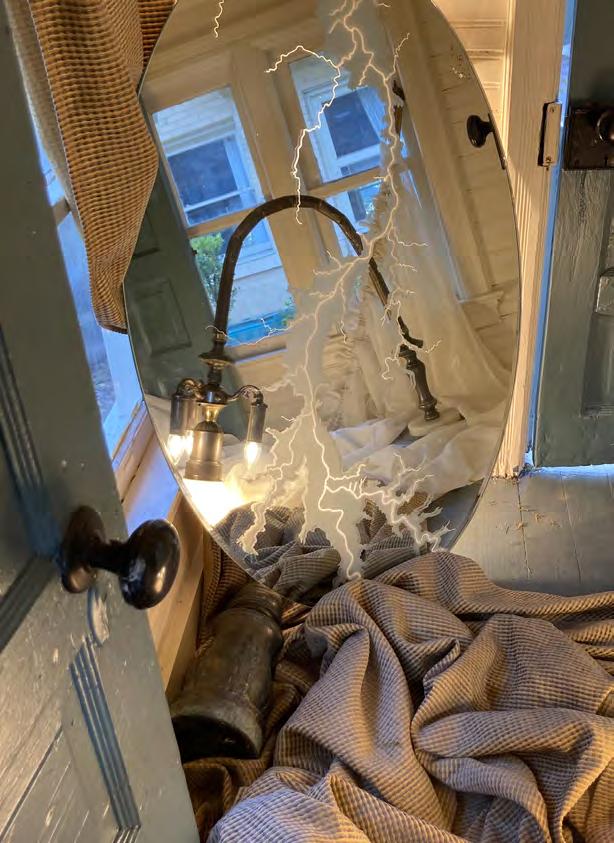
Karen Mahaffy has been making and exhibiting work in San Antonio since her grad student days at UTSA in the mid ’90s. Geometric and exacting, early wall-hung pieces suggest a fascination with architecture and design, and how both bleed into one’s consciousness through proximity. Newer works are video-based exercises in subtlety. Mahaffy’s measured hand creates singular, eerily beautiful explorations of space and place that build an anticipatory tension. In her latest opus, Deluge at The Playhouse Gallery, the artist focuses on real world events — the floods that battered central Texas last summer. She explores tragedy and sentimentality through the objects we hold dear — the artifacts of lives ruined and lost. Free, 1-5 p.m. Saturday and Sunday and by appointment, The Playhouse Gallery, 306 Belknap Place, (210) 842-1314, playhouse.gallery.
— Anjali Gupta
ONGOING - SUN | 07.19
VISUAL ART
SPRING 2026 INTERNATIONAL ARTISTS-IN-RESIDENCE
Artpace’s Spring 2026 International Artists-in-Residence program offers three distinct installations by Violette Bule (Houston), Mel Chin (Burnsville, North Carolina) and Viêt Lê (Ho Chi Minh City, Vietnam) selected by Guest Curator Aleesa Pitchamarn Alexander. It’s a particularly strong grouping that invites contemplation. Hydra by Violette Bule uses architectural elements to force viewers through a space shaped by the constriction and control that mimics U.S. immigration policy. Mel Chin’s Hauntology of Their Labor is a memento mori that references philosopher Jacques Derrida’s concept that the past inhabits the present through absence, just as the faceless workers who once inhabited his space are now represented by empty office chairs. Viêt Lê’s trăng trăng | milk moon is a mashup of metaphysical pursuits and pop culture. Comical but teetering on the precipice of cynical, the artist’s profundity speaks to the banal with the same reverence as the holy . Free, 10 a.m.-5 p.m. Monday-Friday, noon-5 p.m. Saturday-Sunday, 445 N. Main St., (210)212-4900, artpace.org. — AG
Courtesy Image _ Karen Mahaffy
Courtesy Photo _ Artpace
SAT | 04.04
RESILIENCE THROUGH HISTORY: A NATIONAL POETRY MONTH PROGRAM
San Antonio’s The Wyrdd Writers — pronounced “Weird” Writers — are a group of women whose creative output — primarily poetry — offers emotional and practical mentorship, guiding others toward “safe harbors.” By looking at history through the lens of the individual and as a community with equal measure, they offer a micro and macro look at personal and societal resilience. The group’s core values of honesty, knowledge and wisdom drive their shared philosophy that any single event, experience or situation holds many truths — all subjective, all irrefutable and all valid. Their performance will include poetry, song and a special appearance by musical guest. Fancy. Free, 2-4 p.m., San Antonio Central Library, 600 Soledad St., (210) 207-2500, mysapl.org. — AG
SAT | 04.04
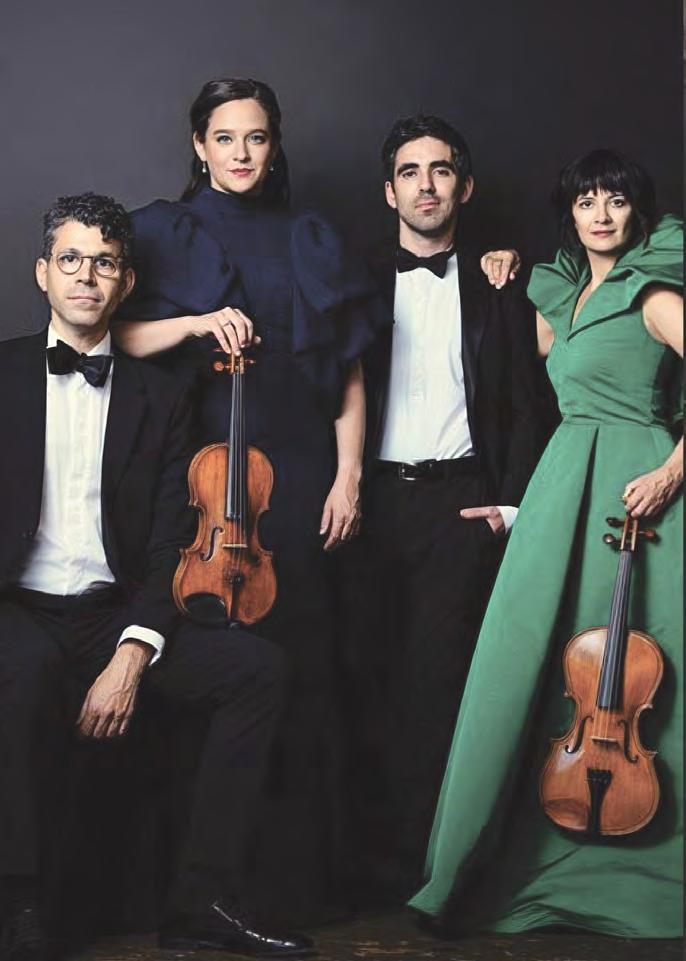
AGARITA + CAROLINE SHAW
In 2013, at just 30 years old, Caroline Shaw became the youngest person to ever win the Pulitzer Prize for Music. A composer, instrumentalist and vocalist, Shaw has also racked up five Grammy Awards. Her genre-bending style seems especially suited to working with small chamber ensembles, which makes San Antonio’s Agarita chamber players the perfect foil to her ever-evolving musical journey. Agarita will accompany Shaw in a one-night-only performance that will include both her award-winning work and compositions by others who inspire her. Also featuring Suliman Tehalli on violin. Free with online registration, 7:30 p.m., Stable Hall, 307 Pearl Parkway, (210) 427-7464, agarita.org. AG
Siggi Ragnar
Courtesy Photo _ Agarita
MON | 04.16
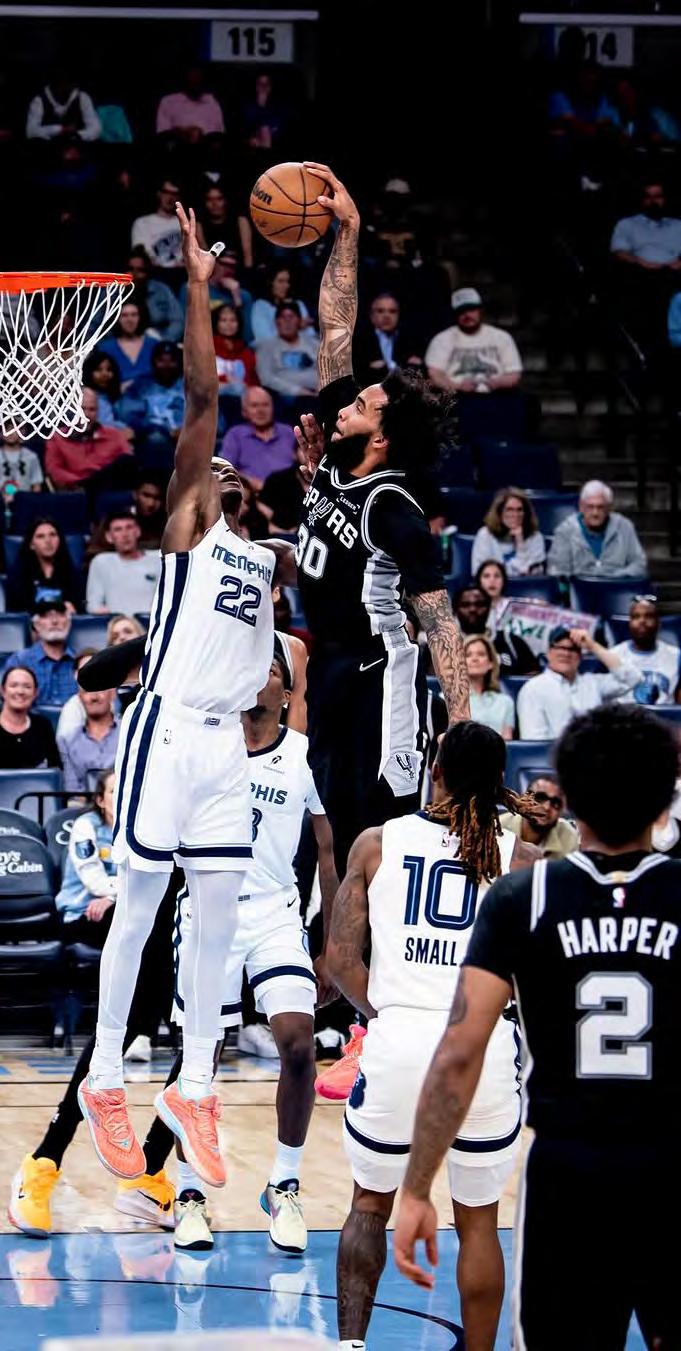
SPORTS SPURS VS. 76ERS
Despite a disappointing season marked by a 25-game suspension of Paul George for violating the NBA’s anti-drug policy and the questionable trade of sharpshooter Jared McCain to Oklahoma City, the Philadelphia 76ers are still in the mix for the league’s Play-In Tournament. The Spurs routed the Sixers by 40 points last month in Philadelphia, with rookie Dylan Harper and veteran Devin Vassell each contributing 22 points. Harper has excelled in a reserve role for San Antonio this season, and recently impressed with 24 points in his first career start versus the Indiana Pacers. “We’re No. 2 in the West,” Harper told reporters following the win. “To me, we’re the best team in the NBA, so just for me to get drafted to an organization that’s so family-orientated, I think any rookie regardless of what role you’re in, you should want to come here.” After ending the longest playoff drought in franchise history, the Spurs now look to secure their spot in the Western Conference. $40 and up, 7 p.m., Frost Bank Center, 1 Frost Bank Center Drive, (210) 444-5140, frostbankcenter.com, Fanduel Sports Network-Southwest. — M. Solis
SPECIAL
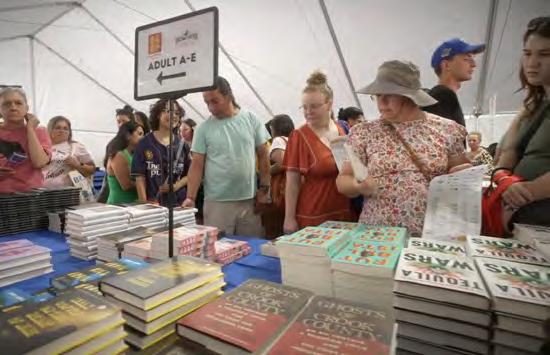
THE SAN ANTONIO BOOK FESTIVAL
Now in its 14th year, the San Antonio Book Festival (SABF) continues to draw award-winning local, regional and national authors to downtown San Antonio for a one-day extravaganza. With more than 110 attending authors confirmed to date, there’s definitely something to engage every attendee: picture books, early-reader, middle-grade and young-adult titles along with adult nonfiction and fiction including creative memoirs, history, poetry, cooking, horror, mystery, thrillers and romance.
This free, family-friendly event drew more than 22,000 attendees last year, spread across the Central Library and UT-San Antonio Southwest campuses. In addition to author presentations, panel discussions and book signings, the festival includes activities for children and teens.
The SABF showcases emerging and established writers, and this year’s featured authors include MacArthur Fellow Reginald Dwayne Betts, Emmy Award-winning actor and San Antonio native Jeff Hiller, National Book Award Finalist Megha Majumdar, Booker Prize winner George Saunders and Pulitzer Prize winner Lawrence Wright, among others. Also showcased are three former San Antonio mayors: Henry Cisneros, co-author of The Austin-San Antonio Megaregion: Opportunity and Challenge in the Lone Star State; Ron Nirenberg, co-author of Nirenberg: The Education of a Texas Public Servant; and Nelson W. Wolff, author of The Elysian Fields of Baseball: The Spiritual Evolution of America’s Game. SABF’s impressive lineup is thanks in no small part to new partnerships and collaborations with UTSA Arts, the Carver Community Cultural Center, Gemini Ink, the Writers’ League of Texas and Ruby City, among others. Each institution selected authors that highlight aspects of their roles in the community. For instance, Ruby City sponsored Ben Luke, contributing editor of The Art Newspaper, to discuss his new book What is Art For?
“We hear so much in the news about the decline in reading for pleasure, even as research continues to show its importance for both health and quality of life,” SABF Executive Director Lisa Ayres said in a statement. “Reading can help reduce stress, improve cognition, strengthen empathy and sharpen critical thinking. We want to welcome both avid readers and those who hope to become avid readers to the festival. Come discover an author, find a new book to love and reconnect with the joy of reading.”
A full, up-to-the-minute schedule is available at sabookfestival.org. Free, 9 a.m.-5 p.m. San Antonio Central Library, 600 Soledad St., (210) 207-2500, mysapl.org and UT-San Antonio Southwest Campus, 300 Augusta St., (210) 200-8200, utsa.edu. — AG
Courtesy Photo _ San Antonio Book Festival
SUN | 04.12
SPORTS
SPURS VS. NUGGETS
The Spurs close out the regular season on Sunday night against three-time league MVP Nikola Jokic and the Denver Nuggets. The Nuggets ended a five-game winning streak for the Spurs when the teams squared off last month in San Antonio. At that game, Jokic notched a 31-point, 20-rebound and 12-assist triple-double in a 136-131 win. Spurs stalwart Stephon Castle finished the night with 30 points, 11 rebounds and 10 assists to claim his third triple-double this season. Castle has recently been nursing a tight right hip, and his presence on both sides of the court will be key for the Spurs in the post-season. Based on the current playoff standings, San Antonio could be hosting the Phoenix Suns or Los Angeles Clippers in the opening round, with the Los Angeles Lakers or Houston Rockets potentially looming in the conference semi-finals. After enduring a six-season playoff drought, including consecutive 20win seasons, the Race for Seis resumes in April. $72 and up, 7 p.m., Frost Bank Center, 1 Frost Bank Center Drive, (210) 444-5140, frostbankcenter.com, Fanduel Sports Network-Southwest, Peacock. — M. Solis
April 9
THURSDAY 2026
6–9 PM
Curated by Vikky Jones ee! & Open to the Public
Participating Artists: Albert Alvarez, Richard "Ricky" Armendariz, Avi Avalos, Andy Benavides, David Blancas, Monica Bosch, María J. Brown, Adrian De La Cruz, Mauro de la Tierra, Hector Garza, PhD, Ovidio Giberga, Raul Rene Gonzalez, Casey Arguelles Gregory, Rafael Fernando Gutierrez Jr., Ana Hernández Burwell, Nain León, Gabi Magaly, Eva Marengo Sanchez, Symone Martinez, Bárbara Miñarro, Juan de Dios Mora, Mauro Murillo, Lee Peterson, Octavio Quintanilla, Joao Quiroz, Andrei Rentería, Martín C. Rodriguez, Rubio, Ivan Salcido, Angeles Salinas, Juan Vallejo, Jose Villalobos, Uri Whitehead, Ursula Zavala
de Artes
Looking for the Real Willie
After Willie Nelson’s Fourth of July Picnic used AI art in its poster, a Texas artist is pushing back with love
BY STEPHANIE KOITHAN
Austin visual artist Taylor W. Rushing is a self-described “lifelong Willie superfan.”
He even has a Willie Nelson tattoo and a dog named Willie.
So when he saw the poster for Willie Nelson’s upcoming Fourth of July picnic, he was crushed to realize it used AI art instead of a design commissioned from a human artist.
Rushing decided to respond with an alternative poster of his own — both an act of protest and a loving tribute to a revered Texas singer, songwriter and icon he simply calls “our oracle.”
His “fan made” art features a young Willie in a cowboy hat smiling wryly in front of a microphone. Rushing’s vintage design is based on a reference photo from a 1977 catalogue called The Mystic Willie Nelson, and is done in homage to the art style of many of his 1970s concert posters. Classic Willie of the analog world. Fittingly, Rushing shared his alternative on Instagram accompanied by a track from Willie’s 1974 album “Phases and Stages” — a lamentation titled “It’s Not Supposed to Be That Way.”
“When I see something, I try to say something,” Rushing told the Current in a phone interview. “Especially when it comes to artists I admire.”
Rushing has worked on numerous projects for Luck Reunion and other Nelson-adjacent organizations in the past and has been “very public” about his love of the musician. “So I was hurt and I was bummed out,” he said. “This is a gig that I would have done for free had someone reached out to me,” Rushing added. “I was bummed that they hired a robot for free instead.”
Nelson’s annual Fourth of July event, a hallowed Texas tradition since 1973, is scheduled to take place this year at Germania Amphitheatre, an outdoor venue located at the Circuit of the Americas in Austin. Other than Shotgun Willie, the stacked lineup includes Billy Strings, Wilco, Sheryl Crow, Lukas Nelson, Margo Price and others. Tickets are on sale now through Ticketmaster.
Though Rushing would like to think Nelson wasn’t involved in the decision, it’s unclear
who was behind the choice to use AI art— something widely derided for its perceived inauthenticity — for a singer-songwriter treasured for his authenticity. Still, Rushing’s been in the music industry long enough to know such a design has to change many hands before it gets the green light.
“I work with major label artists, and I know how many layers of people this stuff needs to go through to get approved,” Rushing said. “And I think that’s what’s most shocking to me is that multiple people said yes to this.”
The Current reached out to Blackbird Presents, the large-scale concert production company behind the event, for a comment on the decision to use AI art. However, we received no response by press time.
Increasingly, AI art has become prevalent on music industry show flyers and posters. While Rushing can see why bands — particularly those that don’t make a lot of money — might take the easy way out, he said the choice comes down to preserving a symbiotic relationship in the ever-evolving dialogue between music and visual art.
“The argument for AI is plain and simple, right? It’s free. And I think that more than anything, especially when you’re putting on a concert of this size, the bottom line is very important,” Rushing said. “And so I can certainly understand why people rationalize their decision to use AI, but I think at the end of the day, you really have to think about whose legacy you’re talking about and whose visual language you might be compromising.”
Beyond professing an undying love for Willie, Rushing believes the visual legacy of Austin is also worth protecting. That includes early Willie posters designed by artists tied to Armadillo World Headquarters such as Jim Franklin, Steve Brooks and Danny Garrett, who are major influences in Rushing’s style of thin single-lines and stippling.
“Willie has one of the best track records of
MArtist Taylor W. Rushing created this hand-drawn poster, left, after getting a look at the AI-generated one on the right
using artists throughout his career,” Rushing said. “I mean, his posters from the early ‘70s by a lot of the Armadillo Art Squad guys are some of the best posters in our history of American poster art.”
While San Francisco artists like the “Big Five” — Wes Wilson, Stanley Mouse, Alton Kelley, Victor Moscoso and Rick Griffin — are credited with creating the visual language of psychedelic rock posters, Rushing argues Austin was a nexus of its own visual tradition. In Austin’s singular milieu, cowboys and hippies mingled together, creating a folksy authenticity perfectly encapsulated in an artist like Willie.
That’s why Rushing described it as a “real drag” when he saw the obvious AI image of Willie Nelson flipping a hamburger, with his signature guitar Trigger erroneously displaying five strings and eight tuning pegs.
After initially sharing the AI poster online, almost all artists on the lineup had deleted it by Friday morning, save guitar virtuoso Billy Strings. However, he deleted it later in the day, replacing it with a hand-written rundown of the information on the flyer, without comment and without art — whether human or robot-made. Before its Friday afternoon removal, comments flooded in on the original post, decrying the use of AI to create the image.
“What happened to hand-drawn posters?” one Instagram user asked. Another took a plaintive tone with the comment, “Please God I do not want this in our community.”
Numerous commenters pointed Billy Strings instead to Rushing’s lovingly crafted alternative, which one user said was “much more outlaw than AI.”
Find more arts coverage every day at sacurrent.com
Instagram _ germaniaamp
Instagram _ twrushing
Art lovers & the art curious are invited to join Ruby City for an evening of engaging conversation with author, art critic and podcaster Ben Luke who will travel from London to discuss his new book, What is art for?
Registration recommended but not required
Cinematic Taste
Former San Antonio chef
Jerald Head turns culinary journey into indie rom-com
BY KIKO MARTINEZ
As an O’Connor High School student, Jerald Head began working in San Antonio restaurant kitchens, including family-owned Italian eatery Guiseppe’s Ristorante and Maggiano’s Little Italy at the Rim.
“I loved the adrenaline and the fast pace and working with my hands,” Head told the Current during a recent interview. “That’s what first drew me in. That turned into the love of cooking and creating flavors and textures.”
After honing his craft at Sustenio Restaurant & Bar as a cook and then opening his own Southeast Asian food stand, Tim Doi, Head relocated to New York City in 2015 to further his culinary career.
Today, he and his wife Nhung Dao own the Vietnamese restaurant Măm in Chinatown and the wine bar Lai Rai. In a few weeks, they plan to open Phê, a coffee and bánh mì sandwich shop.
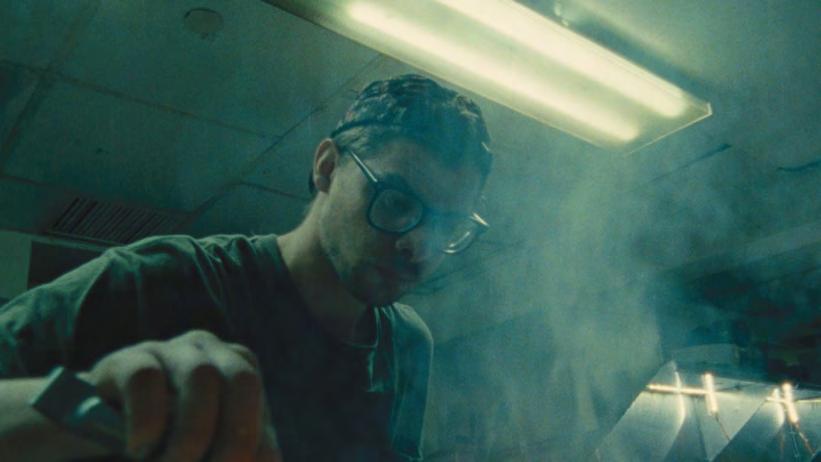
Recently, Head and his Vietnam-born spouse pivoted from culinary arts to the cinematic when they starred in the indie rom-com Mam, inspired by Head’s own culinary journey.
The film, which premiered last month at the SXSW Film & TV Festival, follows Jerald (Head), a self-taught chef from Texas who moves to New York City to open a restaurant. He teams up with Nhung (Dao), a clever waitress, who helps him turn his dream into a reality.
During our interview, Head talked about why he wanted to make a narrative film about his life and what he thinks is the most stressful part of the filmmaking process.
How were you introduced to Vietnamese food?
When I was a young cook, this group of veteran cooks invited me out to eat at a Vietnamese restaurant. At that point, I never had or even could imagine what Vietnamese food was. I was absolutely blown away by the diversity of the cuisine, the freshness, and how different it was to me. It was very similar to how I fell in love with the restaurant business. I just followed my heart and what made me happy.
What led you to play a chef in a movie?
For me, it sounded like a fun idea. It was just another opportunity to open as many doors as I could and see what came out. We did a rehearsal where [co-writer/director] Nan Feix followed me around with a camera as
I shopped for the restaurant. There was no script. It was natural. Later, he presented me with the story. I was excited to be an actor in a film about my life.
Your character is named Jerald too. Did it feel Your character is named Jerald too. Did it feel like you were playing yourself?
Not really. I mean, the emotions and experiences of the character aren’t 100% my life. So, it felt like I was telling a story. I just followed the flow and the energy of the scenes that we were doing that day or in the moment.
What part of the film’s narrative is the closest to your real life?
What is true about Măm is that it did have a very unorthodox and humble start. It was my wife and I starting it up as a pop-up. We had no money or investors. We had no partners, which is still true to this day. It started from a seed, and it grew into a full-fledged restaurant.
Since you had no acting background, was it challenging or did it come naturally?
I just treated it as a job and applied my work ethic. It was cool to be in a different environment and in a different work field. I’ve never known anything other than the kitchen. It was great not having to make decisions like I do every day as a restaurant operator. I just followed the director’s lead. I thought about how my character was feeling and tried to find a way to express the emotion that felt comfortable for me.
Is there anything in culinary arts comparable to cinematic arts?
Teamwork — especially when we were shooting on Super 16mm film. There was some stress to make sure you got the scene right when the director called action. We would rehearse and rehearse and rehearse, and then it was like, “OK, we’re going live!” Super 16mm film is costly, so nobody wanted to mess up the take.
Do you hope a film like this makes people curious about Vietnamese cuisine if they haven’t tried it before?
Sure! I mean, I feel like the story doesn’t strongly highlight the gastronomy of Vietnamese food. But it’s also something I might take for granted because it’s my food. Maybe people have no idea that Vietnamese cuisine has a type of blood sausage. I always hope that people learn more and open their eyes to the world of Vietnamese cuisine.
Well, before I saw the film, I only knew what pho and bánh mì were, so I learned about some new dishes. For people who aren’t familiar with Vietnamese food, what’s some good advice to follow when going into a Vietnamese restaurant?
It depends where you live. I feel like the Vietnamese restaurant scene in San Antonio is kind of stuck in time. You’d have to go to Houston where there’s a huge Vietnamese population to find the food that is being cooked in Vietnam or the food we’re cooking at Măm. I think if you’re trying something new, you should always go in with an open mind.
Courtesy Photo Louella Films
screens
Stamping Out Free Though
Documentary about right wing takeover of Florida college gives clues about future of education in Texas
BY MICHAEL KARLIS
Adocumentary about the right-wing takeover of a public liberal arts college in Florida offers clues about how Texas’ ongoing attacks on academic freedom could play out at colleges and universities here.
First They Came for My College, which premiered at SXSW in Austin this month, followed a group of university students at New College between 2023 and 2024 as Florida’s Republican governor, Ron DeSantis, ramped up his war against Diversity, Equity and Inclusion (DEI) at public colleges and universities.
First, the state appointed six new members to the Board of Trustees at New College, an institution that serves as an honors college for the state. One of those new trustees was right-wing activist and anti-DEI crusader Christopher Rufo.
“We must ensure that our institutions of higher learning are focused on academic excellence and the pursuit of truth, not the imposition of trendy ideologies,” DeSantis said during his second inauguration.
The reshuffled Board of Trustees immediately fired New College President Pat Okker and replaced her with former Republican Florida House Speaker Richard Corcoran. Then, to add insult to injury, DeSantis signed Florida’s anti-DEI bill — designed to eliminate DEI, critical race theory and “identity politics” from public education — on the school’s campus.
In the ensuing months, the Board of Trustees denied tenure to five qualified faculty members and abolished the school’s gender studies program. As the campus closed in preparation for a
hurricane bearing down on the state, officials “weeded” the school library of books that no longer aligned with the board’s goals.
The trustees also poured millions into building a baseball program from the ground up, dishing out generous scholarships to prospective athletes to attend a school that, upon their arrival, had yet to complete its planned stadium for the sport.
“From the very beginning, they were very clear that what they wanted to do was to reset the political and hormonal balance on campus,” Amy Reid, a former New College French professor and Board of Trustees member, said during a panel after the documentary’s SXSW premiere.
Texas parallels
The parallels between DeSantis’ takeover of New College and Texas Gov. Greg Abbott’s attempt to remake the University of Texas and Texas A&M systems are striking.
Similar to the actions surrounding the New College takeover, Abbott signed anti-DEI bills in recent years, leading to large-scale book bans, the firing of faculty and the elimination of diversity departments at public universities.
The UT Board of Regents also replaced UT Austin President Jay Hartzell, who departed for private Southern Methodist University, with Jim Davis. Davis, who previously served as UT
Austin’s chief operating officer, was appointed without a national search. What’s more, Davis, who recently facilitated the abolition of elected faculty senates and the restructuring of seven ethnic and gender studies departments, has also refused to engage with the media.
In a scathing letter, the American Association of University Professors wrote that Texas A&M could “no longer be regarded as a serious institution of higher learning” after it ordered a philosophy professor teaching a “Contemporary Moral Issues” class to remove Plato from the syllabus. The university wanted the works withheld because they included “race ideology and gender ideology.”
“We know that Gender Studies programs, Africana Studies programs or Latino Studies programs are all American Studies programs, and they are under attack here in Austin, across the state of Texas, and across the country,” Reid said during the SXSW panel. “I hope that everybody who sees this movie learns some things from the students here about how you need to stand up in this moment for your community and for the things that matter.”
‘That’s fucking fascism’
As easy as it is to dismiss Florida leaders’ actions around New College as culture war bullshit and bluster, they had real-world consequences.
Beyond ruining a unique and experimental learning community that served as a safe space for intellectuals, oddballs and especially the queer community, New College’s national prestige took a major hit following DeSantis’ so-called reforms. Before the hostile occupation, New College was ranked 76th among National Liberal Arts Colleges by U.S. News & World Report. It now ranks 135th.
During the time covered in the documentary, 30% of faculty left and 60 students transferred out.
There’s reason to suspect Texas’ flagship state schools also could experience a nosedive in rankings as the state continues to impose its ideologies. Professors are reportedly no longer feeling comfortable teaching at UT Austin, and Texas A&M last month cancelled programs in women’s and gender studies.
During the SXSW panel, First They Came for My College producer Patrick Bresnan left no doubt where he sees this kind of meddling leading.
“After recording 300 hours of footage, sitting with interviews with the school psychologist, getting to know the school psychologist, learning how many students were in a suicidal state because of this,” Bresnan said. “These are the most beautiful things we have in our culture, and we’re forcing them into suicidal states. That’s fucking fascism.”
Courtesy Photo First They Came for My College
Cocktail Bar Two Years in a Row! Cheers, San Antonio!
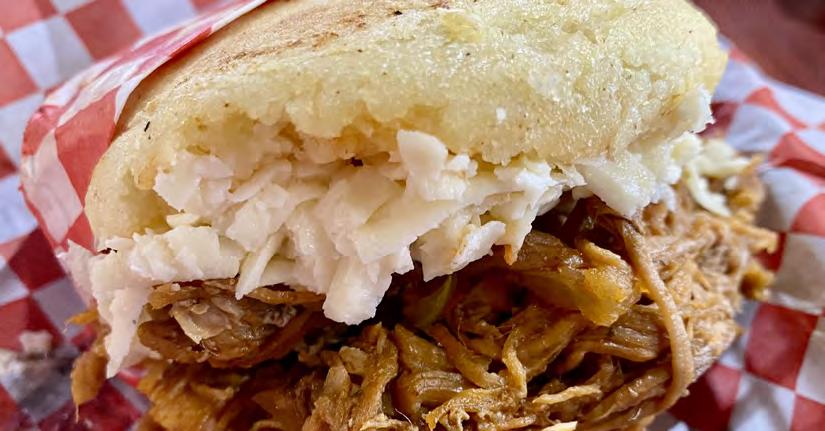
Addictive Arepas
Leiah Venezuelan Food’s homey, straightforward fare scores big on flavor
BY RON BECHTOL
Venezuela’s been in the news a lot lately.
Though our 15 minutes of top-ofthe-news attention span surrounding the ouster of Nicolás Maduro may have already expired, one likely outcome is that the Venezuelan diaspora already in the U.S. and elsewhere will only increase.
Bad for the Texas-sized South American country, but good for us — especially where food is concerned.
A quick Google search of Venezuelan restaurants and food trucks in San Antonio yields at least 15 results, with the latest, Llaneros Grill, having recently taken over the space until recently occupied by Cascabel in Southtown. Open since 2023, Leiah Venezuelan Food on Starcrest seemed as good a place as any to start my exploration.
One origin of the name Leiah comes from the Hebrew where it means “weary” or “delicate” — neither of which describes the food or the surroundings at this restaurant. The space itself could charitably be called “uncomplicated,” with the only color and décor coming from a TV screen, shelving displaying Venezuelan products for sale and a rack of vibrant soccer jerseys.
And for its part, the food could hardly be called delicate. It’s sturdy, homey and straightforward — not bad things at all as an order of empanadas confirmed.
Wrapped in a dough of cornmeal and flour, the generous half-moon pockets are available in eight iterations, all unabashedly fried. Picking one up with your fingers may render them a tad greasy — but it’s worth it.
Pollo mechado is a classic filling in which the chicken is first cooked in flavored bouillon, then shredded and cooked again, typically with bell peppers, onion, garlic and spices such as cumin and annatto. The result is robustly flavored, juicy and is only enhanced by a squeeze or two from one of two bottled salsas.
Equally juicy, though differently spiced, are the seafood empanadas bursting with chopped shrimp, octopus, squid and mussels. It’s a vibrant combo. The arepa filled with black beans and queso paisa, or llanero, delivers exactly what’s anticipated. You can rarely go wrong with bean and cheese, and these don’t disappoint.
Perhaps even more typically Venezuelan — and Colombian — are the arepas. Consisting of
large, gordita-like split discs usually made from a dried, cornmeal-based mix, these are a mouthful and more. One is easily enough for a meal; two are an indulgence, especially following a trio of empanadas. Let out your belt a notch and start with La Peluda, your first introduction to carne mechada, the beefy equivalent of the chicken above.
There’s a little chew to the savory, shredded carne — just enough to let one know that this is serious stuff. Pliant, shredded cheese plays straight man to the boisterous beef, but there’s still room to appreciate the corn-based qualities of the arepa.
The arepa is also a team player in the exuberantly stuffed Pabellon.
In this baroque concoction, the corn cake is filled to the gills with more carne mechada and cheese, but the meat is joined by black beans and fried, ripe plantain. It’s a flavor bomb, and with some effort it can be cut in half to serve two.
But it’s nothing compared to the plate that is the Patacón.
It might help to think of this as a sandwich bracketed not by bread but instead by two, flat and crisp discs of fried, green plantain. The build starts with another disc of boiled ham, which tends to get lost in the crowd. Then, if you opt
LEIAH VENEZUELAN FOOD
for an optional combination of carne and pollo mechada as we did, it will be accompanied by fried plantain, shredded cheeses, avocado and a salad of sorts. No black beans, at least. The end result is enormous and utterly impossible to cut in two with the implements at hand.
And yet, it’s almost irresistible if you pick away at the well-sauced interior a bit before attempting any sharing. The paper-lined basket may look like a trainwreck in the end, but so be it.
Leiah also offers its own Venezuelan version of enhanced perros, or hot dogs — one of the more elaborate versions running $25. It also offers similarly souped-up hamburguesas, including the Leiah Burger, which somehow manages to stuff pork chop, bacon, sausage, egg and chips into a sandwich already sporting chicken and beef. It sounds like a challenge worth returning for.
We did sample the fruit jugos and can confidently say that the sweet-tart parchita (passion fruit) provides a pleasant contrast to the menu’s robust flavors, while the guanabana, tasting like a mix of mango and pineapple, is equally appealing.
There is no beer on Leiah’s menu, but I’d bet that a soccer match featuring Venezuela might draw a boisterous crowd and put that TV to good use. Nothing like perros and partisans.
The lowdown: Leiah’s plain interior belies the variety of the restaurant’s Venezuelan offerings— simple and sturdy for the most part, but full of exuberant flavor. Empanadas and arepas, both formed with un-nixtamalized cornmeal flour, are the backbone of the operation, and each filling has its merits. A truly baroque creation called patacon, its overthe-top stuffing bracketed by discs of fried, green plantain, is a challenge — but then so are the Venezuelan variations on a hamburger and hot dog theme.
Find more food & drink news at sacurrent.com
Ron Bechtol
MAKE A GOOD IMPRESSION
Need a social media marketing solution?
We elevate your brand through targeted social media strategies: expert management, custom content, datadriven paid campaigns, and strategic influencer partnerships that amplify your message to the right audience.
Request For Competitive Sealed Proposal For BIDs For Panel Vans Leasing
• (12) Non – CDL cargo panel vans
• Duration of use: 5/27/26 – 8/7/26
• Awarded vendor must deliver vehicles by Noon on 5/27/26 to the San Antonio Food Bank located at 5200 Historic Old Hwy 90, San Antonio, Texas 78227
• Any vehicle maintenance will require a scheduled appointment and replacement vehicle provided.
• Rental company responsible for vehicle breakdowns and roadside assistance and will require a replacement vehicle as well.
Please provide two pricing options for the bid: one including insurance and one excluding insurance
Note: All vehicle BIDs and contracts are subject to review by TDA.
BID Due Date: Monday 4/20/26 by 10 AM (2 weeks time span from 3/31/26)
BID Opening Date: 4/20/26
Evaluation /Voting Members: George Cox (gcox@safoodbank.org)
Heather R. Guzman (hguzman@safoodbank.org)
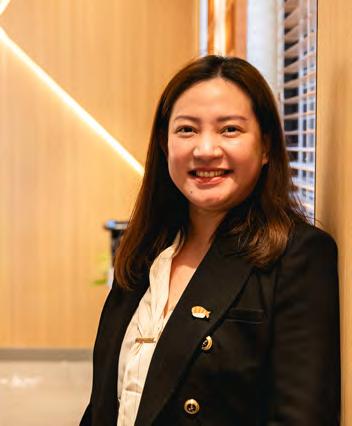
Sumi Thu on her journey from buffet cashier to part-owner of Wild Goji Revolving Sushi & Bar
BY KAT STINSON
Sumi Thu knows San Antonio’s Wild Goji Revolving Sushi & Bar inside and out.
She started off an employee at Wild Goji during the COVID-19 pandemic and worked in positions ranging from curbside pickup to bartending before being offered a chance to become part owner.
Husband-wife duo Stephanie Sun and Nick Zheng debuted the restaurant in 2016 as Wild Goji, and it became known for its sushi and Japanese entrees.
The space eventually underwent a major renovation and reopened in 2024 with a
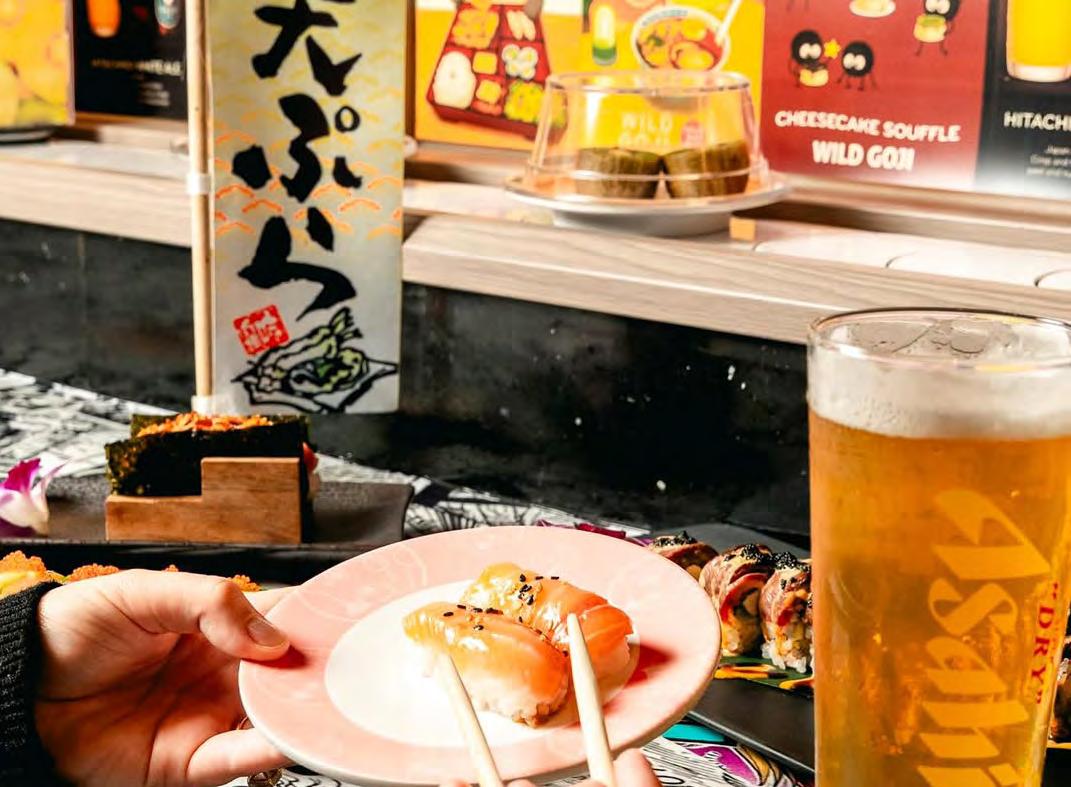
conveyor belt that delivers freshly made sushi to guests. Automated sushi bars have been popular in Japan for years and are gaining popularity stateside.
The same ownership group also runs the Alamo City’s Wild Japanese BBQ & Sushi & Shabu, an all-you-can-eat spot specializing in Japanese-style grilled meats and hotpot cooking.
We spoke to Thu about how she got started in San Antonio’s restaurant business, why it made sense to learn it from the ground up before jumping into ownership and why local diners seem to love conveyor belt sushi.
How did you get involved with Wild Goji and Wild Japanese BBQ & Sushi & Shabu?
I used to work for the owner at Wild Goji, doing various jobs. I really enjoyed creating new cocktails at the bar — and still do — but I also did other jobs like curbside pickup during the COVID-19 pandemic. I ended up doing more bar work when they reopened after the pandemic.
What was your first restaurant job in
San Antonio?
I’m Indonesian. I moved to San Antonio when I was 18. My first job was working as a cashier at a buffet here. Buffets were super popular in San Antonio then. I worked there for about eight to 10 years before I ended up at Wild Goji.
What has it been like at Wild Goji since the renovations?
It’s more like a family restaurant now with the conveyor belt. People come in now just to see sushi arrive on the robot train! They get so excited. It makes me so happy to witness it as someone who’s been here for years.
What’s something you wish more people knew about Wild Goji?
I think sometimes people assume they can only order sushi from the conveyor belt. But you can order rolls and entrees à la carte too! There’s more options than guests realize.
What’s one lesson you’ve learned as a part-owner?
There’s so much competition now. But we
can still say that Wild Japanese, Wild Goji’s sister restaurant, was the first Japanese barbecue outpost in San Antonio — and it’s locally owned. We still try to keep the same quality and low prices as much as we can at both restaurants.
What’s your advice for someone who wants to make it in the industry?
You really have to be passionate about it. It’s challenging, there’s no doubt about that, but I love it. I love eating and cooking. I don’t have time to cook anymore because I’m running a lot of the restaurant right now, which involves consistency, staffing costs and balancing costs. I would suggest working in restaurants too before trying to switch to ownership. It really helped me understand the way operations worked. I wouldn’t have had that knowledge if I didn’t work at Wild Goji in other roles first.
What’s another San Antonio restaurant you love that you feel is underrated? Shiro’s sister restaurant Yozora! I love going there. The Japanese food is stellar.
Instagram _ wildgoji_sat
Courtesy Photo _ GoodFood Branding & Marketing
Your resource for intimacy items in San Antonio since 1998. 281 & Nakoma | I-35 & Thousand Oaks 7am-2am Everyday!
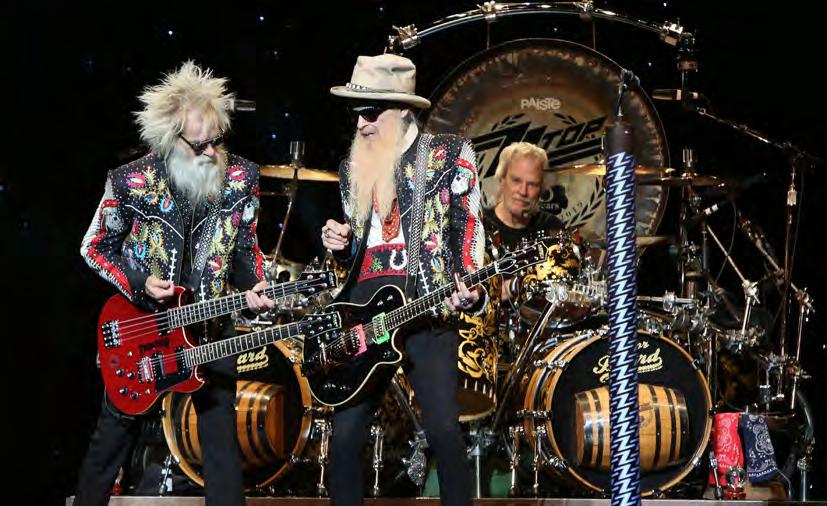
Still Laying Down the Boogie
Catching up with ZZ Top’s Billy Gibbons ahead of the band’s two nights at the Majestic Theatre
BY DAVE GIL DE RUBIO
Billy Gibbons celebrated his 76th birthday in December. And while most of his contemporaries who have hit the three-quarter century mark are kicking back and enjoying retirement, the ZZ Top founding member is racing through 2026 with plenty planned.
The year opened with Gibbons flying solo with help from his own band, The BFG’s, whose current line-up is rounded out by Hammond B-3 organ maestro Mike Flanigin and Chris “Whipper” Layton, one-half of the Texas rhythm section Double Trouble bestknown for holding the bottom down for the late Stevie Ray Vaughan.
With the solo jaunt behind him, Gibbons has returned to his full-time job leading ZZ Top, the band he founded back in 1969, fresh off of playing with Houston psychedelic rockers the Moving Sidewalks. The trio will perform Thursday, April 9, and Friday, April 10, at the Majestic Theatre as part of its latest tour.
While ZZ Top’s debut, the appropriately named ZZ Top’s First Album dropped in 1971, the self-described “Little Ol’ Band from Texas” became a model of longevity. The lineup, rounded out by bassist Dusty Hill and drummer Frank Beard, was unchanged until 2021, when Hill died at the age of 72.
For Gibbons, the death of his longtime friend and bandmate came as a shock.
“We of course miss the Dust,” Gibbons said in a recent interview. “He said while he wanted to do this gig, he said he was really out of sorts,” the guitarist said. “That was kind of the telling tale. I didn’t think much about it that night. I said, ‘Hey man, we’ve got a two-week break. Go home and you’ve got to go see the physician. Check yourself out. I hear you, if you’re not 100%, let’s get to the bottom of it.’ That was that and the poor guy I think was plain and simple worn out.”
Hill’s running buddy and guitar tech Elwood Francis quickly stepped into his late friend’s role, something for which Gibbons was grateful.
“The funny thing is that Elwood had judiciously kept the lid on the fact that him and Dusty were two peas in a pod,” Gibbons
explained. “Elwood was teaching Dusty bass figures and they were trading off stuff. Our willing stand-in, Mr. Elwood Francis, is now holding down the bottom of the Top.”
A big factor in ZZ Top’s longevity has been the band’s willingness to simultaneously cling to its blues roots while infusing a disparate twist into the creative process. The first time came at the dawn of the ’80s, when the band started experimenting with synthesizers, a move that started with 1981’s El Loco and exploded with the 1983 follow-up Eliminator
As Gibbons recalled, a swing through England at the time planted the seeds for a pivot that made ZZ Top fixtures on the then-emerging MTV.
“London set the stage initially when we became pals with the cutting-edge band Depeche Mode,” Gibbons recalled. “On returning stateside, we were confronted somewhat unexpectedly by sequencers, synths and all the allied gear in the town where rock ’n’ roll, blues, rockabilly and everything else worth listening to finds its origin: Memphis, Tennessee. The staff at Ardent studio were always standing at the forefront of the ‘what’s happening’ scene and offered to join in with the experiment of the ‘science project gone wrong’ and liked what we heard. We just engaged the weird gear on hand and made it work for us.”
And while ZZ Top eventually returned to a more guitar-driven sound, experimentation was never completely off the table. The band’s most recent studio outing, 2012’s La Futura, released on Rick Rubin’s American Recordings imprint, found the trio working with Houstonians and hip-hop artists DJ DMD with Lil’ Keke and Fat Pat. For Gibbons, throwing in those creative curveballs all part of ZZ Top’s creative process.
“We just go for it and ZZ fans dig it,” Gib-
bons said.
Currently, the Texas trio are continuing a busy tour schedule, hitting a good portion of the United States. Fans can expect a set list that covers the breadth of the ZZ Top canon.
“[Our show is] just going to be three guys bashing it out loud and proud,” Gibbons said. “In other words, that ZZ thing with songs dating back to the start of the band as well as the ones everyone always wants to hear, along with some random surprises — especially random to us three … gotta shout out those lines!”
Another recent song could be poised to move into the mix, “Livin’ It Up Down In Texas,” a collaboration with longtime friend Billy Bob Thornton for the latter’s recent Paramount series Landman. Also joining in on the song are Thornton’s co-star and country artist Mark Collie.
“Billy Bob called me up and said [creator] Taylor [Sheridan] wants some music,” Gibbons said. “Billy Bob said he had an idea that maybe he and I should do something. He wanted it to be the BFG thing, and I asked if he had any ideas. He said to give me a minute and he’d send me a text. All I got was a text of a picture of an oil well engulfed in flames. He said, ‘Let’s write it to sound like this.’ It’s called ‘Livin’ It Up Down In Texas.’”
While there are rumors Francis recorded some songs with Hill before the latter’s passing, Gibbons is cryptic about whether that might lead to additional ZZ Top studio material.
“We, too, would relish owning an accurate and definitive answer,” he said. “All we know is the dials continue turning in the studio, and… even out down the asphalt with a big, bad batch of our brand of sonic sauces. Always something brewing from our collective mindset.”
$84 and up, 7:30 p.m. Thursday, April 9, and 8 p.m. Friday, April 10, Majestic Theatre, 224 E. Houston St., (210) 226-3333, majesticempire.com.
Jimmy Steinfeldt
critics’ picks
Los Juanos
Thursday, April 2
IV and the Strange Band
Who says nepotism is always a bad thing? In case you hadn’t guessed, IV is the stage name of Hank Williams IV, the great grandson of the country music legend. Sure, he got a leg up in the biz because of his name, but it’s hard not to enjoy his music, which sounds kind of like a redneck version of Motorhead. There’s a country drawl, some banjo and most songs are heavy on the twang before they launch into gut-punchin’ hard rock. $30, 8 p.m., Sam’s Burger Joint, 330 E. Grayson St., (210) 2232830, samsburgerjoint.com. — Bill Baird
The Growlers
The Growlers’ dark and genre-bending combination of surf, psych and more originates from Orange County, California. Since the band’s 2006 inception, it’s released seven studio albums channeling the “California weirdness” of founder Brooks Nielsen. The latest EP Unordinary features previously unreleased material from 2013. $64.00-$75.50, 8 p.m., Aztec Theatre, 104 N. St. Mary’s, (210) 812-4355, theaztectheatre.com. — DC
Saturday, April 4
Leftover Salmon
Leftover Salmon are one of the leading lights of the jam-band scene, where folks imbibe a variety of substances and do variations on hippie noodle dancing. To be fair, Leftover Salmon’s longevity on that scene — decades now — means the group has the songs and chops to back it up. If your tastes run to Colorado bluegrass jam-rock and you enjoy your instrumental solos busy and endless, this is probably right up your alley. $41.50, 8:30 p.m., Gruene Hall, 1281 Gruene Road, New Braunfels, (830) 606-1281, gruenehall. com. — BB
The Toasters, The Skajects, Spies Like Us Third-wave ska powerhouse The Toasters continue to showcase a mashup of ska, pop, rap and calypso. Founding member Robert Hingley relocated to New York City from England and formed the band in 1981 after seeing The Beat. Hingley now makes his home in Valencia, Spain, but a new lineup of Toasters continues to tour the world. $21.36, 8 p.m., Paper Tiger, 2410 N. St. Mary’s St., papertigersatx.com. — Danny Cervantes
Sunday, April 5
Testament, Overkill, Destruction Why spend Easter with your family when you can partake in both the New and Old Testament alongside a congregation of denimand leather-clad metalheads? The legendary thrash band is on the road accompanied by fellow U.S. grinders Overkill and Germany’s Destruction for a mosh-inducing tour aptly named Thrash of the Titans. Testament is one of the few bands from the U.S. first wave that’s taken a more experimental route with the genre, so expect to hear some funk and blast beats amid the blazing riffs. $49.75-$140.40, 7 p.m., Aztec Theatre, 104 N. St. Mary’s St., (210) 812-4355, theaztectheatre.com. —
Brianna
Espinoza
Wednesday, April 8
Ladysmith Black Mombazo
South African vocal group Ladysmith Black Mombazo has won fans worldwide with stunning rhythmic interplay and intricate harmony. After starting in 1960, the ensemble broke through globally after being one of the main contributors to Paul Simon’s groundbreaking 1986 Graceland album. Since then, the group has won an astounding five Grammies and remain one of the most unique and powerful vocal groups in the world, full stop. $42, 8 p.m., Stable Hall, 307 Pearl Parkway, (210) 427-7464, stablehall.com — BB
Thursday, April 9
Ryan Davis and the Roadhouse Band, Water Damage
Interesting lineup, but we mean that in a good way. Ryan Davis and the Roadhouse Band play straightforward Americana with some country tinges, a bit of synth and a David Berman influence — all fine things. However, Water Damage is brutal instrumental drone music, led by a a Who’s Who of members from Austin’s experimental music scene. Though it might confuse folks, this could be one of those unexpected matchups that works. $24, 8 p.m., Paper Tiger, 2410 N. St. Mary’s St., papertigersatx.com. — BB
Friday, April 10
Blues and Soul Fest with Eric Johnson, Ian Moore, Chris Cuevas Project, Will Owen Gage Yes, when you say “blues-rock” these days, you might as well be saying “Dad rock,” but blues can pack real power and grit when it’s done right. Eric Johnson and Ian Moore headline a fest dedicated to some of Texas’ finest blues practitioners. While some folks may prefer their blues a little less slick and rocktinged, there’s no denying the whole lineup is comprised of compelling, talented performers. $45, Sam’s Burger Joint, 6:30 p.m., Sam’s
San Antonio’s Los Juanos creates a special concoction of regional indie music by mixing dream-pop, conjunto, corridos, punk energy and more. It’s already been a big year for the group, which played multiple sets at SXSW and dropped a well-reviewed EP. Local act Vintage Pictures — self-proclaimed “emo primos” — will add alt-Latin flair with their presence on the bill. $10-$15, 8 p.m., Stable Hall, 307 Pearl Parkway, (210) 427-7464, stablehall.com. — BE
Saturday, April 11
Deicide, Rotting Christ, Immolation Deicide emerged in the ’90s when Florida death metal was at its peak and the Satanic panic was still in full effect. Evil growls, heavy riffs and frantic drumming paint Deicide’s discography blood-red. Oh yeah, and vocalist Glen Benton once branded his forehead with an upside down cross. For those who love similarly blasphemy from the black metal genre, Greece’s Rotting Christ is not to be missed. $30-$34.80, 7:30 p.m., The Rock Box, 1223 E. Houston St., (210) 772-1443, therockboxsa.com. — BE
Sunday, April 12
My Life with the Thrill Kill Kult
My Life With the Thrill Kill Kult have been churning out dance floor-ready industrial music since the ’80s, putting it the same company as Ministry and Skinny Puppy. Unlike those peers, TKK blurs the lines a little more, dabbling in funk, exotica and campy B-movie dialogue clips. They’re a little harder to define, but if defining things precisely is your M.O., you might not like these guys anyway. Their live shows often veer toward controversy, including with one striking stage setup featuring a woman mimicking fellatio on a crucified man. Great show for a first date, churchgoers! $41, 7 p.m., Paper Tiger, 2410 N. St. Mary’s St., papertigersatx.com. — BB
Tuesday, April 14
Alice Cooper
Rock’n’Roll Hall of Famer Alice Cooper is making his return with the Alice’s Attic tour. These road dates support the album The Revenge of Alice Cooper, which featured members of the original Alice Cooper Band recording together for the first time since 1973. Expect Cooper’s usual flair for the dramatic in a theatrical spectacle that showcases hits including “No More Mr. Nice Guy” and “School’s Out” along with deep cuts. $72.59-$729.50, 7:30 p.m., Majestic Theatre, 224 E. Houston St., (210) 226-5700, majesticempire.com. — DC