ETNdigi 1-2026

Page 1


1 • 2026

digi

64-BIT MPU FOR MASS MARKET IoT

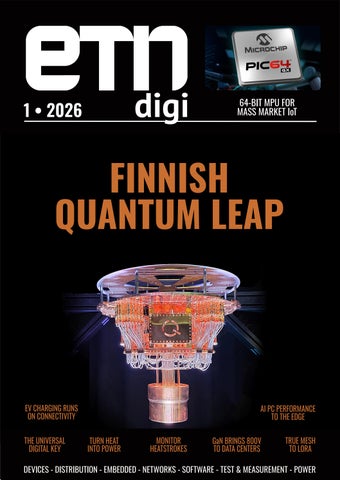
FINNISH QUANTUM LEAP

Can GenAI write embedded code?

BREAKING

BREAKING MOLD THE WITHOUT THE BANK

Youshouldexpectnoless.

Precision,speed,andreliabilityarenotoptional.Theyarethebaseline.

STM32C5deliversallthree,withoutpushingyourbillofmaterials. BuiltontwodecadesofSTM32heritage,itisafamilyaffair,anditshows.

STM32C5givesyouperformance,dependablebehavior,andthe headroomtodesignwithoutworkarounds.

Generative AI has reshaped software development at remarkable speed. In many teams, a significant share of new code is now drafted with AI assistance. Boilerplate, unit tests, peripheral drivers, documentation, even architectural sketches can be generated in seconds. Productivity gains are real, and for general-purpose software the benefits are already measurable.

But embedded systems are different.

Unlike cloud backends or mobile apps, embedded software operates under strict physical constraints. Memory is limited. Timing must be deterministic. Power budgets are finite. In safety-critical domains, standards such as MISRA-C and ISO 26262 define what is acceptable.

A function that “works” is not enough. It must work predictably, within tight resource envelopes, and often under certification requirements.

Most generative models are trained on vast repositories of general-purpose code. They are statistically excellent at reproducing common programming patterns. They are not inherently aware of interrupt latency, stack depth constraints, DMA side effects, or worst-case execution time analysis. An AI-generated driver may compile and even pass superficial tests, yet still violate real-time guarantees or safety assumptions.

That does not make GenAI irrelevant to embedded development. On the contrary, it can accelerate scaffolding, documentation, test generation, and refactoring. It can serve as a powerful co-pilot.

However, in embedded engineering, responsibility cannot be delegated to probability. Determinism, traceability, and verification remain human obligations. Generative AI may write code, but only engineers can certify that it truly belongs in a device that must work every time, under every condition.

ETNdigi

Editor-in-chief

Veijo Ojanperä

vo@etn.fi

+358-407072530

Sales manager Rainer Raitasuo

+46-734171099

rr@etn.se

Advertising prices: etn.fi/advertise

ETNdigi is a digital magazine specialised on IoT and embedded technology. It is published 2 times a year.

ETN (www.etn.fi) is a 24/7 news service focusing on electronics, telecommunications, nanotechnology and emerging applications. We publish in-depth articles regularly, written by our cooperation companies and partners.

ETN organises the only independent embedded conference in Finland every year. More info on ECF can be found on the event website at www. embeddedconference.fi.

The easiest way to access our daily news service is to subscribe to our daily newsletter at etn.fi/tilaa.

In Finland, the electronics sector had a turnover of 20 billion EUR in 2024 and employs 44,000 people. The computer and IT industry had a turnover of 19 billion EUR and employs 81,300 people.

In total, these high-tech industries account for more than 50 per cent of Finnish exports. The technology sector also represents more than 65 per cent of all R&D investments in Finland.

ETN is a Finnish technology media outlet for people working, studying or simply interested in technology. Through its website with daily news and technical articles, as well as newsletters and columns, ETN covers every aspect of high technology.

Join us in 2026. See the media kit here.

6-17 NEWS

• Espoo-based IQM is building superconducting quantum computers to compete with giants like IBM and Google.

• When Finnish startup Donut Lab unveiled its new battery at CES 2026, it quickly became one of the most discussed technologies at the show.

19 RETURNTOGROWTHIN2026

Growth in 2026 will be driven not by volume rebounds but by stronger design activity, AI deployment and more resilient architectures, says Rebeca Obregon, President of Farnell Global.

20 UNIVERSALKEYTOYOURSMARTPHONE

The release of Aliro 1.0 signals that the new industry standard for secure and interoperable access control is ready to conquer the market.

24

EVCHARGINGRUNSONCONNECTIVITY

In the Nordics, EV charging is becoming everyday infrastructure, but the user experience still depends on the data connection behind the charger.

28

64-BITMPUFORMASSMARKETIoT

Since the formulation of the First Law of Thermodynamics, engineers have searched for ways to convert energy into forms that are easier to use.

32 TURNHEATINTOPOWER

Since the formulation of the First Law of Thermodynamics, engineers have searched for ways to convert energy into forms that are easier to use.

38 TECHNOLOGYHELPSPREVENTHEATSTROKES

Biodata Bank’s CANARIA watch predicts dangerous rises in core body temperature before symptoms escalate, using Renesas’ RA0 microcontroller.

42 GaNBRINGS800VTODATACENTERS

Generative AI and power-hungry GPUs are pushing rack power demand from tens of kilowatts to well over 100 kilowatts, with megawatt-per-rack designs expected soon.

46 TRUEMESHTOLoRa

Combining NeoMesh’s distributed routing protocol with LoRa’s physical layer aims to eliminate gateway density constraints in large IoT networks.

50 PANTHERLAKE:AIPCPERFORMANCETOTHEEDGE

Intel’s Core Ultra Series 3 combines CPU, GPU, and NPU acceleration for AI PCs and industrial edge systems..

24 28 34 50 38 38

FINNISH QUANTUM LEAP

IQM of Espoo, Finland is trying something that sounds close to impossible. Build one of the world’s most demanding machines, a superconducting quantum computer to compete with the giants like IBM and Google.

Quantum computing is arguably the hardest technology stack being industrialized today, spanning cryogenics, microwave engineering, quantum chip fabrication, control electronics, software, and an entirely new discipline of error correction. Yet IQM increasingly looks like a company that can challenge for the market lead.

When I meet one of the founders, Chief Global Affairs Officer Juha Vartiainen at IQM’s Espoo headquarters, he does not sell quantum computing as magic. If anything, he pushes the opposite. Quantum machines are not “just faster computers.” They are different computers that can be transformative for a narrow set of problems, while being slow and awkward for most everyday workloads.

- That popular idea that quantum computers are simply faster than classical computers is misleading.. A quantum computer is, as a computer, often slow and poor at what digital computers do well. The value is that for certain classes of problems the complexity changes, ,Vartiainen says

That realism is a recurring theme. Vartiainen is clearly allergic to hype, even though hype would be the easier route in an industry that still lives on promises. IQM’s pitch is more pragmatic: engineering discipline, transparent benchmarking, and a manufacturing ramp that turns research breakthroughs into deliverable systems.

IQM describes itself as the global leader in on-premises quantum systems. By early 2026, the company says it has sold 21 systems to 13 customers and delivered 15 systems, a higher publicly disclosed delivery count than most peers are willing to state openly.

In Vartiainen’s version of the story, the point is not the number itself. It is what the number implies: IQM has moved beyond “one heroic machine” and into a pipeline where systems are assembled, tested, shipped, and supported as products.

The pipeline is also visible in the company’s order metrics. IQM has talked publicly about “bookings” and “revenue visibility”ofat least USD 35 million2025 in revenue (unaudited),and over USD 100 million in bookings/visibility as of yearend 2025.

Revenue is still not the headline, at least not yet. IQM has been building a capitalintensive deep-tech business and has required significant external funding. Vartiainen is candid about the logic of venture-backed quantum. Cash burn is expected, because the product is not a mobile app. It is industrial hardware at the edge of physics.

Scaling in Espoo and Oulu

IQM’s footprint in Finland is now spread across multiple sites. Espoo hosts offices and customer-facing facilities, but also

manufacturing capacity to 30 quantum computers, up from the earlier capacity of around 20 systems per year.

If quantum computing has a “hidden bottleneck,” it is not only qubit fidelity. It is operations. Assembly, calibration, testing, verification, maintenance. A superconducting quantum system is not a laptop you unbox and boot. It is a cryogenic stack built around a dilution refrigerator, with sensitive microwave paths, RF electronics, and a control layer that must remain stable in an environment where tiny disturbances can destroy performance.

Vartiainen also highlights a second Finnish node: Oulu. IQM opened an R&D office there in December 2025, explicitly to tap local expertise and strengthen core development.

- Oulu has exactly the kind of competence we need. We have a core development team there. It goes right into improving the performance of the chip technology, he says.

the manufacturing and test functions that turn fragile quantum hardware into something customers can run. A production expansion in the Mankkaa area is central to the next stage.

In late 2025, IQM announced an investment of more than €40 million to expand its production facility in Finland. The stated goal is to scale annual

He hints that Oulu’s RF heritage could become even more relevant. Quantum processors do not run on digital logic alone. They are driven and measured through microwave control. In that sense, advanced RF engineering remains part of the quantum “engine room.”

The 150-qubit step

The most concrete near-term milestone is a high-qubit-count system for

Finland’s VTT. In May 2025, VTT and IQM announced a joint development project that aims to deliver a 150-qubit superconducting quantum computer in mid-2026, followed by a 300-qubit system in late 2027.

This is not merely a “bigger number” announcement. The VTT systems are framed as testbeds for quantum error correction, the key technology required to move from noisy intermediate-scale quantum computing to fault-tolerant machines.

That distinction matters, because qubit count by itself is a misleading scoreboard.

Vartiainen is quick to point out that the industry has suffered from “number marketing,” where companies advertise large qubit counts even if the effective performance is constrained by error rates, connectivity, calibration drift, or limited programmability.

IQM’s approach, he argues, is to optimize not only the best qubits under ideal conditions, but the worst qubits on a real system on a real day.

- In products we have many qubits, and performance has to be good even in the worst case. The ‘bad qubits,’ when everything is not perfect, still need to be usable. Scaling is where the hard work is, he says.

Million qubits?

At the heart of the machine is a simple question with a non-simple answer: can you preserve a quantum state long enough, and manipulate it accurately enough, to do useful computation?

Vartiainen talks about coherence times and gate fidelities with the caution of someone who knows the numbers are contextual. In the interview, he references demonstrations where qubit lifetimes reach around a millisecond, and mentions that longer times have been shown in laboratory conditions. The point is not to win a single “world record” but to ensure a stable distribution of good qubits across a product.

On the gate side, he uses 99.9% as a bestcase level for one- and two-qubit gates in optimal calibration, then immediately explains why this is not the end of the story. If conditions change, performance drops. So the system must detect drift, recalibrate, and recover quickly.

Importantly, he draws a bright line between calibration and error correction.

- Error correction is a different thing. Here we are talking about keeping the system

calibrated. Errors still happen all the time.

He gives a blunt example: at 99.9% fidelity, one operation in a thousand is wrong. For meaningful algorithms, that is still far too many errors. So the path forward is twofold: push the physical layer to higher fidelity, and then apply error correction techniques that consume additional qubits to suppress remaining errors.

This is where the “million qubits” vision must be decoded. On paper, million qubits sounds like science fiction. In engineering terms, it is a statement about logical computing capacity rather than raw device count.

Vartiainen explains the key idea: in a fault-tolerant quantum computer, you do not use every physical qubit as a “useful” qubit. You spend a large fraction of them on error correction overhead. A simplified rule of thumb is that you may need on the order of 100 physical qubits to create one high-quality, error-corrected logical qubit, depending on the code, the architecture, and the underlying physical error rates.

So a “million-qubit” machine could translate into something like 10,000 truly computation-ready logical qubits, if the physical layer has reached a threshold where error correction becomes efficient.

In other words, scaling is not only about making more qubits. It is about making qubits good enough that adding more begins to compound value rather than compound noise.

The “quantum threat”

No interview about quantum computing avoids security. The idea that a quantum computer will break today’s public-key cryptography is now common enough to influence policy and procurement.

Vartiainen’s view is balanced. The threat is closer than ever in the sense that the physics is progressing, but it remains far from a commodity capability.

He frames it as something that, if achieved soon, would require a large, capable state-level actor. Even then, it would not mean “everything breaks at once.” It would mean targeted attacks on high-value secrets where the attacker is willing to invest extraordinary resources. For most people, it is not a reason to panic.

He does, however, treat post-quantum cryptography as a rational response, especially for data that must remain confidential for a long time. The right move is preparation, not fear.

Too good to be true?

When Finnish startup Donut Lab unveiled its new battery at CES 2026, it quickly became one of the most discussed technologies at the show. The reason was simple: the performance claims sounded almost unbelievable.

According to the company, its fully solidstate battery combines properties that normally conflict with each other. Donut Lab speaks of an energy density of around 400 Wh/kg, the ability to charge in about five minutes, and a lifetime of up to 100,000 charge cycles.

If such a battery were real and scalable, the consequences would be enormous. The global lithium-ion industry has invested hundreds of billions of euros in factories and supply chains. A battery that charges in minutes and lasts decades would disrupt that entire ecosystem.

At CES, Donut Lab presented the technology not as a laboratory concept but as a product already entering real vehicles. The company says its solid-state battery is used in the latest Verge Motorcycles models being delivered to customers.

Those claims immediately triggered both excitement and skepticism. The combination of extremely high energy density, ultra-fast charging and unprecedented cycle life challenges several well-known trade-offs in battery chemistry.

First independent tests

In the weeks after CES, Donut Lab began presenting independent validation. The first report came from Finland’s VTT Technical Research Centre, which tested the charging performance of the company’s Solid-State Battery V1 cell.

The results showed that the cell could reach 80% charge in roughly five minutes when charged at an 11C rate. Charging from empty to full took around 7-8 minutes.

After fast charging, the cell delivered almost all of the stored energy during discharge. However, temperatures rose rapidly. With limited cooling the cell temperature approached 90 °C, highlighting the importance of effective thermal management for extreme charging speeds.

The report verified fast charging behaviour but did not address other claims such as energy density or cycle life.

High-temperature behavior

A second VTT report examined how the battery behaves in high temperatures.

The cell was discharged at +80 °C without visible changes and delivered more than its reference capacity measured at room temperature. For comparison, 80 °C already exceeds the recommended operating range of many conventional lithium-ion cells.

The test was then extended to +100 °C. The battery still functioned electrically and could be recharged after the experiment. However, the pouch casing was no longer under vacuum after the test, indicating that the cell structure had changed under extreme heat.

Many questions remain

The two VTT reports provide the first independent evidence supporting parts of Donut Lab’s claims. They suggest that the battery can tolerate very fast charging

and operate at unusually high temperatures during short tests.

But the evidence remains limited. The tests involved individual cells (and different cell in all three tests), not large sample sets, and long-term cycling or pack-level performance has not yet been demonstrated. The most ambitious claims — 400 Wh/kg energy density and a 100 000-cycle lifetime — still lack independent verification.

The global battery sector has invested enormous sums into lithium-ion manufacturing. Gigafactories are being built across Europe, North America and Asia to supply electric vehicles and energy storage systems.

If a fundamentally better battery architecture were ready for mass production, the implications would be profound. Existing investments could lose value, supply chains might shift and the competitive balance between manufacturers could change rapidly.

A third VTT report, published in early March, examined the cell’s self-discharge behaviour. In the test the battery was charged to roughly 50 % state of charge and left idle for 240 hours at room temperature. After the ten-day period, 97.7 % of the stored energy could still be discharged from the cell.

The result indicates that the device stores energy chemically like a battery rather than electrically like a supercapacitor — one suspicion raised by critics because of the extremely fast charging claims. However, the test again involved a single, different cell and does not yet address the most controversial claims such as energy density or longterm cycle life.

Smart sights to the French armed forces

Finnish company Senop has secured a significant order from the French Armed Forces. France’s defence procurement agency, DGA, has selected the company’s AFCD TI smart sighting system for use by the Army.

The procurement follows a development and evaluation programme that has spanned several years. According to Senop, the order will be delivered over multiple years and will provide long-term workload for the company. The monetary value of the contract and the number of systems to be delivered have not been disclosed.

France is one of NATO’s most operationally experienced member states. Senop notes that the selection serves as an important reference within the Alliance and strengthens the company’s position in the European defence market.

- The DGA’s decision demonstrates confidence in our sighting system and in the ability of Finnish product development to meet strict European operational and technical requirements, says Aki Korhonen, CEO of Senop Oy.

AFCD TI is a thermal imaging-based smart sight designed to operate as part of a fire control system. Unlike traditional sights, the system measures distance, tracks moving targets and automatically calculates lead. The objective is to improve first-round hit probability and accelerate engagement.

The system is designed to minimise the soldier’s cognitive load. Operation is based on two controls: a laser button and a four-way selector. The weapon and the fire-control system sensors automatically feed data to the sight.

AFCD TI identifies the type of ammunition and its temperature directly from the weapon. The system also supports ammunition programming, including AirBurst functionality, without separate manual steps.

- The user can focus on the mission rather than operating the system. The sight is simple and quick to learn, says Product Manager Lasse Elomaa.

The smart sight can be integrated with Saab’s simulation systems. It supports video recording and real-time video streaming from both daylight and thermal cameras. Recorded data can be used for training and performance analysis.

AFCD TI is designed with a modular architecture. The structure enables upgrades of components, subsystems and software. The same sight supports multiple Saab shoulder-fired weapon systems, facilitating deployment in NATO countries and reducing lifecycle costs.

The order also supports Senop’s growth in Finland. The company is investing in new production facilities in Lievestuore.

The approximately 3,000-square-metre facility will increase capacity and improve manufacturing efficiency. The total investment is valued at around €10 million.

According to Senop, the French programme strengthens the position of Finnish optronics expertise in Europe and opens new opportunities for NATO cooperation.

VTT has tested Donut Labs cell. Picture from the test on discharging at high temperatures (80 and 100 degrees).

Your smart phone becomes a universal key

The Connectivity Standards Alliance (CSA) has released the Aliro 1.0 specification, defining for the first time a common protocol for a digital key stored on a smartphone. The goal of the standard is to enable the same mobile credential to work across readers from different manufacturers via NFC, Bluetooth Low Energy and Ultra-Wideband (UWB). Aliro is supported by Apple, Google and Samsung, among others.

Aliro 1.0 defines the NFC and Bluetooth LE interfaces between the user device and the reader. UWB is used alongside BLE to verify proximity and enable hands-free access. The specification does not cover backend systems or the interface between the reader and an access control server. Instead, it focuses specifically on the transaction between the mobile device and the reader.

Aliro defines a two-phase access protocol. First, a fast so-called expedited phase is performed, during which the device proves possession of the correct key. If this is sufficient, the door can be opened immediately. If needed, the process moves to a step-up phase, where a signed Access Document is presented to the reader. The document contains more detailed access rights, time constraints and possible restrictions.

cards. BLE enables longer range connections initiated by the user. UWB adds distance-based protection, helping to mitigate relay attacks.

Aliro is not just a technical specification but an ecosystem initiative. According to the CSA, more than 220 member companies have participated in developing the standard, including Apple, Google, Samsung, ASSA ABLOY, HID, NXP, STMicroelectronics, Infineon and Nordic Semiconductor. A central objective is to integrate digital access credentials directly into mobile

STMicroelectronics was one of the first companies to launch a reference design for Aliro 1.0 development.

Technically, the solution is based on ECC P-256 keys and ES256 signatures. The access credential is a document based structure that can be transmitted and validated even in offline environments.

Aliro is architecturally radio-agnostic, but in version 1.0 the supported transport layers are limited to three options: NFC, Bluetooth Low Energy, and a combination of BLE and UWB. NFC operates in a tap-to-access model, effectively replacing physical

This marks a significant shift from previous approaches. Digital keys have so far largely been manufacturerspecific and application-dependent solutions. Aliro aims to introduce a unified credential model and authentication protocol on which different vendors can build interoperable products.

If widely adopted, access control could move from a card-based model to the operating system level. The smartphone could become a universal key for homes, offices, hotels, campuses and parking

Aliro 1.0 is only the first version, but its architecture has been designed to be extensible. According to the CSA, the standard will continue to evolve to address new use cases and market requirements while maintaining backward compatibility.

For access control, this could represent a transformation comparable to what EMV brought to payment cards: a shift from closed, proprietary solutions to a shared, globally supported standard.

PXI becomes more affordable

Emerson is expanding the National Instruments PXI test platform with new, more cost-effective hardware. The goal is to make modular, scalable automated test systems accessible to smaller development teams and emerging industries without compromising measurement accuracy or synchronization.

For 25 years, PXI has been one of the core architectures in modular test and measurement, particularly in automated test equipment, validation and production test environments. Emerson is now lowering the cost barrier by introducing high-performance hardware at a more accessible price point.

The new portfolio covers the essential PXI building blocks. The NI PXIe-5108 oscilloscope is available in four- and eight-channel versions, offering 100 MHz bandwidth, a 250 MS/s sampling rate and 14-bit resolution. The high channel density within a single module supports mixed-signal measurements and parallel signal analysis.

On the data-acquisition side, Emerson introduces 18-bit multifunction DAQ modules, the NI PXIe-6381 and 6383. They deliver absolute accuracy down to 980 microvolts and provide 16 or 32 channels for low-noise voltage measurements. This level of resolution and channel count is typically critical in

GNSS, 4G and IoT in one module

Iridium Communications has introduced a new IoT module that integrates satellite connectivity, 4G LTE-M cellular, and GNSS positioning into a single 16 × 26 millimeter package. According to the company, the solution reduces PCB space requirements by up to 60 percent compared to designs built from multiple discrete components.

The Iridium 9604 module measures 16 × 26 × 2.4 millimeters, corresponding to an area of approximately 416 square millimeters, clearly smaller than a typical postage stamp. It is mounted directly onto the IoT device PCB as an LGA-type component.

The module combines Iridium Short Burst Data (SBD) satellite connectivity, LTE-M cellular connectivity and GNSS positioning in one package. The satellite link operates in the L-band via Iridium’s global constellation. LTE-M and GNSS

functions are based on the u-blox SARA-R5 platform.

In practice, a device can use LTE-M whenever terrestrial coverage is available and automatically switch to satellite connectivity when cellular service is absent. The integrated GNSS receiver enables location-aware use cases such as network selection, tracking applications, and asset management.

Iridium positions the solution for costsensitive, high-volume IoT applications where combining satellite and cellular connectivity has previously required multiple radio modules, increased board space, and more complex power architectures.

Commercial availability begins in June 2026, when a development kit will be available for testing satellite and LTE-M connectivity.

NEW DESIGN IMPROVES

Huawei has introduced several technical improvements in its new Watch GT Runner 2 sports watch. The most significant innovation is a 3D Floating antenna integrated into the watch bezel, designed to optimize the radiation pattern of the satellite positioning antenna within the watch body. Traditionally, GNSS antennas in smartwatches have been placed inside the device´s housing, where the user’s hand and the metal structure of the watch can weaken the signal. Huawei addresses this by relocating the antenna into the watch bezel. This design gives the antenna more space and allows it to radiate the signal more evenly in different directions.

NOKIA STILL STRONG ON R&D

Nokia invests exceptionally heavily in research. According to the company’s Form 20-F 2025 annual report filed with the U.S. Securities and Exchange Commission (SEC), its research and development spending reached €4.9 billion last year, representing 24.4 percent of revenue. In practice, this means Nokia spends roughly one out of every four euros it earns on research and product development. In total, Nokia says it has invested around €160 billion in research since 2000.

NOW YOU CAN DESIGN TEST SYSTEMS GRAPHICALLY

the validation of analog front ends, sensor interfaces and power electronics.

The chassis architecture is reinforced with the 18-slot NI PXIe-1081 hybrid chassis, offering 2 GB/s system bandwidth. The all-hybrid design enables flexible combinations of different module

types within a single system and simplifies scaling as test requirements grow.

The embedded controllers NI PXIe-8842 and PXIe-8862 support Windows 11 and NI Linux Real-Time. The solution is aimed at teams that do not require a separate GPIB interface and want to maintain a compact, deterministic system architecture.

According to Emerson, the new hardware retains the traditional strengths of the PXI platform: tightly synchronized measurements, high channel density and seamless integration with the NI software ecosystem, including LabVIEW,

InstrumentStudio and TestStand. In practice, this allows hardware, test sequences and analytics to be combined into a unified, software-driven test system.

The company also highlights the role of artificial intelligence in future test environments. High data throughput and a modular architecture create the foundation for real-time analytics and intelligent decision-making during the test process. In this context, a PXI system becomes not only a measurement platform but also a data acquisition and analytics infrastructure. As the entry cost decreases, modular and software-defined testing becomes a realistic option for even smaller development organizations.

Pickering Interfaces has introduced a new Test System Architect tool that allows the entire test system architecture to be designed graphically before the actual hardware is built. The tool is intended for designing automated test systems that combine instruments, switch matrices, cabling, and the device under test (DUT). In TSA, these elements can be modeled within a single view and connected at the signal-path level. According to Pickering, the hardware itself often accounts for less than half of the total cost of a test system. The new tool aims to make these phases visible already at the early stages of the design process.

Battery data gets its own standard

The Battery Data Alliance, operating under LF Energy, has released a new open Battery Data Format (BDF) aimed at standardizing the structure and metadata of battery testing data. The objective is to make battery research and development data portable, reproducible, and directly usable in modeling workflows.

Until now, data generated in battery labs has largely been vendor- and softwarespecific. Different cycler manufacturers, such as Arbin and MACCOR, use proprietary file structures and naming conventions. Even software updates can alter formats. This fragmentation slows down modeling, benchmarking, and cross-laboratory data exchange.

BDF defines a fixed table schema for time-series cycling data, complemented by a machine-readable ontology aligned with BattINFO. This means the format goes beyond column headers and CSV compatibility: it encodes semantic meaning in a structured way. That capability is particularly important for physics-based modeling and machine learning-driven battery development.

The standard has been validated in real research workflows. The tooling from Faraday Institution, including the PyProBE software stack and its optimized BDX binary format, has been aligned with BDF. The format is also compatible with

widely used modeling frameworks such as PyBaMM and BattMo.

The surrounding ecosystem is already taking shape. Microsoft has announced plans to release a reference battery dataset in BDF format. Startup Ohm is contributing a web-based converter that enables users to transform raw commercial cycler data into BDFcompliant files. In addition, a collaboration between Empa, ETH Zurich, EPFL, and SINTEF has published a dataset of nearly 200 coin cells tested over 1,000 cycles in BDF format.

In its initial scope, BDF focuses on timeseries cycler data. Next steps include defining a dedicated metadata storage format and extending coverage to other laboratory data types, such as impedance measurements.

The implications could be significant. A unified data format simplifies model comparison, accelerates AI-driven optimization, and improves lifecycle traceability. It may also support the economics of second-life battery applications, where reliable and comparable test data is essential.

Integrated AI on automotive microcontrollers

STMicroelectronics has unveiled its Stellar P3E microcontroller, bringing AI acceleration directly into an automotive-grade control unit. The launch marks a significant step toward distributed, real-time intelligence in vehicles, where AI computing is no longer confined to centralized SoCs or domain microcontrollers.

At the heart of the Stellar P3E is ST’s Neural-ART Accelerator, a dedicated NPU integrated directly on the microcontroller. The concept is to move machine learning-based decision-making closer to sensors and actuators. This enables microsecond-level response times and always-on AI without high power consumption or the need for a separate processor.

According to ST, the controller delivers up to 30 times greater energy efficiency in AI

inference compared to traditional MCU core-based implementations. In practice, this opens the door to virtual sensors, predictive maintenance, and real-time fine-tuning of engine or battery performance. It can also reduce the number of physical sensors, wiring, and standalone control units.

Stellar P3E is targeted particularly at socalled X-in-1 ECU solutions, where

FPGA responds to quantum threat

AMD’s new Kintex UltraScale+ Gen 2 FPGA family does not attempt to win the performance race with logic cells alone. Instead, it addresses a problem that is already visible but rarely solved. How can devices be protected against quantum-era threats before those threats fully materialize?

Quantum computers are not yet breaking encryption in production environments. Nevertheless, the risk model has already changed. Data collected today can be stored and decrypted later when sufficient computational power becomes available. This is known as the “harvest now, decrypt later” threat. AMD brings a response directly into the FPGA fabric.

Kintex UltraScale+ Gen 2 devices integrate security mechanisms that support postquantum cryptography as well as functionality aligned with CNSA 2.0 requirements. These include strong root of trust, device-level authentication, key management, and secure boot. In many systems, the FPGA is the only component that can be updated in the field. That makes it a natural anchor point for quantum-resistant protection today.

Security, however, is not an isolated addon. It is embedded in the overall architecture of the device. AMD’s core

message is that performance is driven by data movement, not by individual compute units.

The second-generation Kintex UltraScale+ architecture is built for data flows. It combines high-speed serial transceivers, wide parallel I/O, hardened memory controllers, and high DSP density. The goal is to move data in and oput of memory and through computation, and out again without bottlenecks.

This is particularly relevant for test and measurement equipment, machine vision, medical imaging, and AV-over-IP systems.

The new generation delivers up to five times the external memory bandwidth of its predecessor. Multiple hardened LPDDR4X, LPDDR5, and LPDDR5X controllers are integrated. On-chip memory reaches up to 51 megabits.

Affordable performance for ECUs

multiple functions are consolidated into a single controller. This architecture supports the development of softwaredefined vehicles and helps reduce vehicle weight and overall system cost.

The controller is built around 500 MHz Arm Cortex-R52+ cores and a split-lock architecture that balances performance with functional safety. For memory, ST uses its PCM-based xMemory, which offers higher density than traditional embedded flash and enables software growth without hardware modifications.

ST supports the new controller with its Edge AI Suite tools and the Stellar Studio development environment, allowing AI models to be deployed directly to invehicle edge computing platforms. Production of the Stellar P3E is scheduled to begin in the fourth quarter of 2026.

Renesas has expanded its RH850 automotive microcontroller family with the new RH850/U2C device. The new MCU brings the performance benefits of a 28nanometer manufacturing process to a lower price segment.

The RH850/U2C extends Renesas’ U2 generation at the lower end of the lineup. The higher-end RH850/U2B and U2A devices are aimed at more demanding systems, while the U2C offers the same

Finnish quantum-computer developer IQM plans to go public through a merger with the Nasdaq-listed special purpose acquisition company Real Asset Acquisition Corp. (RAAQ). The agreement would result in IQM’s American Depositary Shares being listed on a major U.S. stock exchange. The company is also considering a dual listing in Helsinki after the transaction is completed. IQM designs its own quantum chips and operates an integrated production chain that includes chip design tools, fabrication, assembly and datacentre infrastructure.

FASTER EUV MANUFACTURING

The production of the most advanced semiconductor chips could be accelerated with a surprisingly simple process change. Belgian research institute Imec has demonstrated that increasing oxygen concentration during the postexposure bake step of EUV lithography can reduce the required exposure dose of metaloxide resists by up to 20 percent. In EUV lithography, the exposure dose largely determines how quickly wafers can be processed in the scanner. Lower dose requirements mean that the same EUV system can expose more wafers per hour, effectively increasing tool throughput.

architectural foundation for smaller ECU applications. This also enables an easier migration from older RH850/P1x and F1x microcontrollers to the latest automotive electrical and electronic architectures.

The new controller integrates four RH850 processor cores running at up to 320 MHz. For safety-critical applications, two lockstep cores are used to meet the ASILD requirements of the ISO 26262 functional safety standard. The device integrates up to 8 MB of on-chip flash memory.

A key feature is its broad interface support, covering both current and nextgeneration in-vehicle networks. The MCU supports automotive Ethernet 10BASET1S, deterministic Ethernet TSN (100 Mbps and 1 Gbps), CAN-XL, and I3C. At the same time, it maintains compatibility with widely used interfaces such as CAN-FD, LIN, UART, CXPI, I²C, I²S, and PSI5.

28 NM TO LOWER-COST ECUS

Renesas has expanded its automotive RH850 microcontroller family with the new RH850/U2C device. The chip brings the performance of a 28nanometre process node to a lower price segment and is aimed at applications such as chassis and safety systems, battery management and vehicle body electronics. The RH850/ U2C complements the company’s U2-generation portfolio at the entry level. Higher-end RH850/ U2B and RH850/U2A devices target more demanding systems, while U2C offers the same architecture for smaller ECU designs. This also makes it easier for carmakers to migrate from older RH850/P1x and F1x MCUs.

All new eRedCap takes smart meters into 5G

Nordic Semiconductor and Sequans Communications both showcased 5G eRedCap technologies at MWC Barcelona, signaling that the next phase of low-power 5G for IoT is moving from specification to commercial reality.

The new eRedCap, short for enhanced Reduced Capability, is a streamlined 5G device profile defined in 3GPP Release 18. It builds on the original RedCap concept introduced in Release 17 but pushes optimization further, particularly in terms of power consumption, RF complexity and baseband processing requirements.

Unlike full-scale 5G NR, which can utilize up to 100 MHz of bandwidth in FR1, eRedCap targets significantly narrower bandwidths, typically in the range of a few megahertz. This reduction directly lowers RF front-end demands, ADC/DAC requirements, and digital signal processing load. The result

25 Gbit over 10 kilometers

Taara has unveiled a new wireless connectivity technology based on optical photonics that aims to deliver fiber-like speeds without trenching or spectrum licenses. According to the company, its device, called Taara Beam can reach speeds of up to 25 gigabits per second and operate over distances of up to 10 kilometers.

The system is a line-of-sight free-space optics (FSO) link in which data is transmitted via a narrow beam of light between two points. The key difference compared to traditional FSO systems lies in the architecture. Beam steering is not handled by mechanical mirrors but by an optical phased array implemented on an integrated silicon chip. The chip contains more than a thousand miniature emitters that allow the beam to be electronically steered and shaped.

According to the company, most of the

is a simpler modem architecture with lower silicon area, reduced memory footprint and improved energy efficiency.

The aim is not peak data rates. eRedCap is designed for costand power-efficient 5G connectivity. It bridges the gap between LTE-M and full 5G NR, offering a migration path for IoT devices as networks transition toward 5G core architectures.

This is particularly relevant for smart meters and other massive IoT deployments. Many of these devices currently rely on LTE-M, NB-IoT or even legacy 2G networks that are being phased out. eRedCap allows such devices to remain compatible with evolving 5G infrastructure without incurring the cost and power penalties of a full NR implementation.

From a system perspective, eRedCap enables operators to consolidate IoT traffic within 5G networks while maintaining the long battery life and low bill-of-materials (BOM) cost structure required in high-volume IoT applications.

eRedCap brings smart meters and similar low-throughput devices into the 5G era. Not because they require higher throughput, but because long-term network evolution makes compatibility strategically necessary.

Researchers at the Hong Kong University of Science and Technology say they have developed a novel calcium-ion battery that could offer an alternative to lithiumion technology. The study, published in Advanced Science, is based on a quasisolid-state electrolyte and redox-active covalent organic frameworks (COFs).

Calcium is far more abundant in the Earth’s crust than lithium, making it an attractive raw material for large-scale energy storage. In terms of the electrochemical stability window, calciumion batteries can theoretically approach lithium-ion systems.

In practice, however, development has been hindered by two key challenges: sluggish Ca²⁺ ion transport in the electrolyte and poor cycling stability.

The HKUST research team addressed these issues by developing a COF-based

Taara Beam is targeted at operators, enterprise campuses, data-center interconnects, and backhaul links for 5G and future network base stations. The unit can be installed on rooftops or poles within hours. It operates in the optical spectrum, which does not require spectrum licenses, meaning spectrum fees do not constrain deployment.

The main technical question relates to weather resilience. Fog, heavy rain, and atmospheric turbulence can degrade optical links. Real competitiveness against fiber and millimeter-wave RF will depend on practical availability figures and link budget performance, not just peak data rates.

Taara originated from X, the Moonshot unit of Alphabet Inc. X develops highrisk, radical technologies, some of which are spun out into independent companies. Taara is one of these spin-offs.

Could calsium replace lithium? Goodbye, basic PC!

quasi-solid-state electrolyte containing carbonyl groups. Within the porous framework, Ca²⁺ ions migrate along the aligned carbonyl groups. At room temperature, the material demonstrated an ionic conductivity of 0.46 mS/cm.

The researchers also built a full-cell prototype. It delivered a reversible specific capacity of 155.9 mAh/g at 0.15 A/g and retained 74.6 percent of its capacity after 1,000 cycles at 1 A/g. The results suggest that key bottlenecks in calcium-ion battery development can be mitigated through materials engineering.

The question is whether this is enough to challenge lithium. For comparison, LFP cathode materials in lithium-ion batteries typically offer around 150–170 mAh/g specific capacity, while NMC/NCA cathodes range from roughly 160–220 mAh/g. The reported 155.9 mAh/g is therefore in the same order of magnitude as LFP.

QUALCOMM BRINGS AI TO SMART WEARABLES

Qualcomm has unveiled its new Snapdragon Wear Elite platform, designed to bring true edge-sAI capabilities to smartwatches and other wearable devices. The company describes the concept as “Personal AI”, where wearables act as independent, contextaware devices rather than simple extensions of a smartphone. Wear Elite is Qualcomm’s first wearable platform to integrate a dedicated NPU for AI processing. The Hexagon NPU can run models with up to one billion parameters directly on the device, allowing part of the AI workload to operate without a cloud connection.

FR1 AND FR3 COMBINED IN EARLY STEP TOWARD 6G

Rohde & Schwarz and Qualcomm have demonstrated carrier aggregation between the traditional FR1 band and the emerging FR3 spectrum at MWC Barcelona. The FR3 range is not yet part of commercial 5G networks but is being studied as a potential component of future 6G spectrum architecture. In the demo, a roughly 2.5 GHz FR1 channel was combined with a roughly 7-GHz FR3 channel into a single logical radio link. Both channels used 4×4 MIMO and high-order modulation. Instead of extending a single channel, the setup aggregates carriers operating in two different frequency ranges into one data connection.

AMD TARGETS VRAN WITH NEW EPYC 8005 PROCESSORS

The era of the entry-level laptop may be coming to an end. According to new forecasts from Gartner, rapidly rising memory prices are set to make sub-$500 notebooks economically unsustainable, potentially pushing the basic PC segment out of the market entirely by 2028.

The main driver is a sharp increase in DRAM and SSD prices. Gartner estimates that combined memory prices could rise by as much as 130 percent by the end of 2026. As a result, the average price of PCs is expected to increase by around 17 percent compared with 2025.

Memory components will account for a significantly larger share of a PC’s bill of materials. Gartner estimates that the share will rise from about 16 percent today to roughly 23 percent. This disproportionately affects low-cost devices, where manufacturers have little margin to absorb cost increases.

As component costs rise, most pricesensitive buyers are unlikely to accept higher prices for entry-level laptops. This is why Gartner expects the market for sub-$500 laptops to gradually disappear over the next two years.

AMD has introduced its fifthgeneration EPYC 8005 server processors and is positioning them as a platform for telecom networks. The company argues that baseband processing can be handled by general-purpose x86 CPUs rather than relying on dedicated baseband ASICs or FPGA accelerators. The new EPYC 8005 series, code-named Sorano, is aimed specifically at virtualized RAN (vRAN) deployments. The goal is to run the demanding L1–L2 baseband processing of a base station directly on an x86 server.

Pictured are HKUST Professor Yoonseob Kim (right) and PhD student Yin Zhuoyu, the first author of the study.

SOCAMM2 will take over the data center

Artificial intelligence is pushing a surprising technology shift in data center memory. The low-power LPDDR memory familiar from smartphones is now moving into servers, driven by the need to improve energy efficiency and memory capacity for AI workloads. Micron has now introduced a new 256GB SOCAMM2 module, which the company says is the highest-capacity LPDDR server memory available today.

LPDDR (Low Power DDR) was originally developed for mobile devices where power consumption is critical. Traditional servers, in contrast, have relied on DDR-based RDIMM modules that provide large capacity but consume significantly more energy. As AI servers scale up, memory has become one of the largest contributors to power consumption and heat generation in data centers.

Micron’s new module is based on what the company describes as the industry’s first monolithic 32Gb LPDDR5X memory die. The technology enables a capacity increase to 256GB per SOCAMM2 module, up from the previous 192GB generation.

Higher capacity at the module level allows servers to scale memory capacity much further. According to Micron, an eight-channel server CPU can now support up to 2TB of LPDRAM. This is particularly relevant for AI inference workloads, where large context windows and key-value caches consume significant amounts of memory.

Power efficiency is the main driver behind the shift. Micron says SOCAMM2 modules can consume roughly one-third of the power of comparable RDIMM memory while occupying

only about one-third of the physical footprint in the server. At the same time, AI performance can improve. In longcontext LLM inference workloads, Micron reports that timeto-first-token can improve by more than 2.3 times.

The SOCAMM architecture also solves one of the traditional challenges of LPDDR memory in servers. In mobile devices, LPDDR is typically soldered directly next to the processor. SOCAMM packages LPDDR chips into a small removable module, enabling serviceability and scalability similar to conventional DIMMs.

The technology originated in NVIDIA’s Grace CPU platform, which uses LPDDR5X to improve energy efficiency in AI servers. The newer SOCAMM2 version is currently moving through JEDEC standardization, which could enable broader adoption across the data center industry. Memory vendors including Samsung, SK hynix and Micron are all developing SOCAMM2 solutions as demand for AI infrastructure continues to grow.

Wi-Fi 8 can now be tested at the protocol level

Rohde & Schwarz and Broadcom are demonstrating Wi-Fi 8 RF signaling tests in a live device environment for the first time. The tests are implemented on the CMX500 signaling tester, now extended with support for the upcoming IEEE 802.11bn standard.

This is not just RF measurement in nonsignaling mode, but full protocol-level signaling testing. The tester and Broadcom’s Wi-Fi 8 prototype communicate with each other as they would in a real network. This enables validation of PHY-layer and partially MAC-layer features in realistic operating conditions.

Wi-Fi 8, or 802.11bn, shifts the development focus from peak data rates toward ultra-high reliability (UHR). It

retains the key physical-layer parameters of Wi-Fi 7, including operation in the 6 GHz band up to 7.125 GHz, 320 MHz channel bandwidths, 4096-QAM modulation, and Multi-Link Operation. New features include a distributed resource unit (dRU) approach to work around uplink PSD limits, as well as mechanisms allowing different MIMO

Flash is closing in on RAM speeds

Kioxia has begun shipping evaluation samples of its UFS 5.0-compatible embedded flash devices, marking a significant step toward a new performance class for mobile storage. The driving force behind the shift is clear: large language models and generative AI workloads running directly on devices are redefining storage bandwidth requirements.

The UFS 5.0 standard is currently being developed by JEDEC. It builds on MIPI MPHY 6.0 for the physical layer and UniPro 3.0 for the protocol layer. The new HSGEAR6 mode supports a theoretical interface speed of 46.6 Gbps per lane. With two lanes, total throughput can reach approximately 10.8 GB/s.

That figure is significant. It approaches the practical bandwidth levels of LPDDR5X system memory in mobile devices. While NAND flash latency remains fundamentally higher than DRAM, raw data throughput is increasing to a level where storage is far less likely to become a bottleneck in AI-heavy workloads.

In practical terms, this shifts the role of flash in the memory hierarchy. Large model weights can be streamed more efficiently from storage to CPU and NPU accelerators. Swap-related performance penalties are reduced. Faster data movement also enables processors to return more quickly to low-power idle states, a critical factor in battery-powered devices.

Kioxia’s evaluation samples integrate a newly developed in-house UFS 5.0 controller together with the company’s

8th-generation BiCS FLASH. Capacities are 512 GB and 1 TB, and the package measures 7.5 × 13 mm, supporting compact board layouts in high-end smartphones.

Although UFS 5.0 has not yet been fully ratified, the availability of evaluation silicon indicates that the ecosystem is entering the validation phase. Commercial implementations are likely to appear in next-generation flagship mobile platforms designed for on-device artificial intelligence.

Bluetooth LE data rate nearly quadruples

Rohde & Schwarz and Realtek have validated the first test solution for the Bluetooth LE High Data Throughput (HDT) feature. The new PHY extension increases the maximum data rate of BLE connections from 2 megabits per second to 7.5 megabits per second.

links to use different modulation schemes under challenging reception conditions.

Testing these features requires signaling mode. dRU measurements assess a device’s ability to increase transmit power within spectral density constraints, while UEQM analysis verifies whether the device adapts modulation correctly according to defined MCS combinations.

The joint demo will be shown next week at MWC 2026 in Barcelona. It is worth noting that the 802.11bn standard has not yet been finally ratified. In practice, this means Wi-Fi 8 device development and validation are moving from laboratory and simulation stages toward full system-level testing even before the standard is officially completed.

In practice, the peak data rate of low-power Bluetooth increases by a factor of 3.75. This is not merely an optimization, but a new physical layer implementation combining new modulation schemes with multiple levels of forward error correction. HDT supports five different data rates between 2 and 7.5 Mb/s.

Barcelona, and it is also being presented at Embedded World in Nuremberg.

It is important to note that 7.5 Mb/s is the maximum PHY-layer data rate. Application-level throughput is still affected by the BLE protocol stack

The higher data rate changes the role of BLE. Traditionally, Bluetooth LE has been optimized for small data payloads and ultra-low power consumption. HDT now enables low-latency audio, faster OTA software updates, and higher data density in consumer and PC devices. At the same time, the boundary between classic Bluetooth and LE is becoming less distinct.

The technology was validated using Rohde & Schwarz’s CMP180 radio communication tester together with Realtek’s next-generation chips, the RTL8922D and RTL8773J. chipsets. The companies showcased the solution at Mobile World Congress in

overhead and the selected forward error correction level. However, the key advantage of HDT is not just peak speed, but improved spectrum efficiency, energy efficiency, and link reliability.

In addition to Bluetooth LE testing, the CMP180 supports multiple other radio technologies, including Wi-Fi 8 and 5G NR FR1 frequencies up to 8 GHz. According to Rohde & Schwarz, the instrument is also ready for the upcoming universal test protocol.

Bluetooth LE High Data Throughput is not yet a widely commercialized feature, but the first validation solution indicates that the ecosystem is already preparing for the next performance class.

BLE HDT connectionsa can be validated on Rohde & Schwarz´ s CMP180.

In Focus

War is good business Smarter design will drive growth in 2026

War and the deteriorating security environment are increasingly visible in the financial results of technology companies. Rising defense budgets, a stronger emphasis on European strategic autonomy, and the modernization of command-and-control systems are accelerating investments. Finland’s Bittium is one of the clear beneficiaries, even if the company does not phrase it quite so directly.

CEO Petri Toljamo speaks of a “deterioration of the global security situation” and growing tensions between major powers. In practice, this has significantly increased demand for tactical radios and communication networks.

In January, Bittium took a strategically important step. The company signed an agreement with NATO’s information systems agency, the NATO Communications and Information Agency (NCIA). The agreement is a so-called Basic Ordering Agreement (BSO) procurement framework.

The agreement is not a single purchase order. It makes Bittium a recommended supplier for NATO and its member states. In practice, this gives the company a fast track into NATO procurements, as theproducts can be acquired without lengthy separate tendering processes.

The framework covers commercially available solutions. NATO can procure secure smartphones, encrypted communication software, and related accessories for operational use. The solutions are designed to address growing cyber threats.

The agreement includes Bittium Tough Mobile smartphones as well as SafeMove and Secure Call software. These enable encrypted connections, secure voice communication, and mobile device management. The software supports Android, iOS, and Windows environments.

Interoperability is a key requirement for NATO. SafeMove Mobile VPN securely connects tactical networks with commercial 4G and 5G networks. This addresses NATO’s need to integrate military and commercial networks in a controlled manner.

Restricted level use. The newer Tough Mobile 3 is based on a dual-persona system that fully separates personal and professional use. The agreement does not guarantee an immediate sales spike. However, it gives Bittium a strategically significant position within NATO’s procurement system.

Bittium’s revenue for October–December grew by 62.5 percent to EUR 53.9 million. EBITDA increased to EUR 23.0 million, or 42.7 percent of revenue. Operating profit amounted to EUR 15.4 million.

Growth was driven particularly by the Defense & Security business segment. The share of product-based revenue rose to 84.7 percent.

New orders totaled EUR 97.9 million during the quarter. In December, the company received EUR 15.9 million in orders from the Finnish Defence Forces for Tough SDR radios and related software development. Austria’s Cancom Austria AG ordered tactical data transfer systems worth EUR 18.5 million. In addition, Bittium signed a EUR 50 million licensing agreement with Spain’s Indra Group for its Tough SDR technology.

Revenue for January–December increased by 40.1 percent to EUR 119.3 million. Operating profit rose to EUR 19.4 million. EBITDA amounted to EUR 32.4 million. New orders grew to EUR 153.3 million and the order backlog increased to EUR 77.9 million.

Bittium estimates that revenue in 2026 will be EUR 140–155 million and operating profit EUR 26–32 million. Revenue and profit are expected to be weighted toward the second half of the year.

The shift in the security environment is now clearly reflected in the figures. Bittium’s position is strengthening in both national and NATO-related procurements.

After a prolonged inventory correction cycle, the electronics industry is entering a more disciplined phase. Growth in 2026 will be driven not by volume rebounds, but by stronger design activity, AI deployment and more resilient architectures, says Rebeca Obregon, President of Farnell Global.

The electronics market through late 2025 has been characterized by gradual stabilisation rather than a sharp rebound. Across regions, we've seen customers working through excess inventory, reassessing demand forecasts and refocusing on resilience after a prolonged period of uncertainty. While recovery has not been uniform by geography or sector, the second half of the year has delivered clearer signals that demand is returning in a more sustainable way.

Farnell Global's recent earnings performance reflects this shift. Growth across all regions indicates that customers are beginning to invest again, particularly in areas that support longterm competitiveness rather than shortterm volume. Design activity is increasing, and that is a critical leading indicator. When engineers return to innovationprototyping, evaluation kits and new architectures — it suggests confidence is rebuilding beyond simple replenishment buying.

Looking ahead to 2026, we expect market conditions to remain dynamic. Inventory levels are normalising, but customers are also becoming more disciplined in planning and forecasting. Visibility, flexibility and speed to market are becoming decisive advantages, particularly as supply chains remain exposed to geopolitical pressures, tariffs and shifting trade dynamics. While lead times have stabilised, they are unlikely to remain static as demand accelerates in specific technologies, particularly in memory and AI-related applications.

AI is moving from experimentation toward deployment. We're seeing real

projects across industrial automation, data infrastructure, defence and energy, where processing power, memory and connectivity are central to performance.

This shift is reflected in Avnet's latest Insights Survey, which shows AI adoption accelerating beyond proof-of-concept, with engineers increasingly focused on deployment timelines, performance optimisation and long-term scalability rather than experimentation alone.

This is influencing both component availability and pricing, and it underscores the importance of early engagement among engineers, manufacturers, and distribution partners.

Another important shift we see heading into 2026 is a renewed focus on design robustness. The experience of recent years has highlighted the risks of singlesource dependencies and rigid architectures. Customers are now prioritising designs that allow for component substitution, multi-vendor strategies and longer product lifecycles. This is driving demand for technical support, evaluation platforms and deeper collaboration — areas where Farnell continues to invest.

From a regional perspective, growth drivers will vary. Industrial automation, energy, defence and medical applications remain constructive, while automotive continues to face structural challenges in some markets. What is consistent across regions is the need for partners who can combine global scale with local expertise, ensuring customers have access to both supply continuity and application-level support.

As we move into 2026, our focus at Farnell is on enabling customers to navigate uncertainty with confidence. Through our 'Power of One' approach — combining Avnet's global capabilities with Farnell's digital platform and regional presence — we are committed to supporting customers throughout the whole design and sourcing lifecycle. Innovation, resilience and speed will define the next phase of growth, and we see strong momentum as customers prepare for what comes next.

We'll be continuing these conversations with customers and partners. The focus will be on supporting engineers as they translate renewed design activity into resilient, production-ready solutions.

Bittium Tough Mobile 2C has been approved for NATO
Rebeca Obregon President Farnell Global

ALIRO 1.0 UNLOCKS THE DIGITAL KEY ERA

The full release of Aliro 1.0 by the Connectivity Standards Alliancesignalsthat the new industry standard for secureand interoperableaccess controlis ready toprovideaconvenientalternative to proprietary solutions.

The industry has long envisioned a truly connected world where our mobile devices serve as a universal digital key to allow us freedom of movement between our homes, workplaces, and public spaces. A universal mobile wallet with valid credentials would give users the freedom to make payments, access open-loop transit systems, and unlock doors in residential, commercial or hospitality settings.

Turning this vision of a universal mobile wallet into reality requires a unified standard for access control to guarantee interoperability and meet security requirements considered critical for use cases with high turnover and complex ecosystem integrations. The release of Aliro 1.0 in February 2026 represents a key milestone for device makers who promised their customers interoperable access control experiences and are ready to deliver a fully standardized solution.

A

new industry standard: from the experts behind Matter and Zigbee

The Connectivity Standards Alliance (Alliance), the industry-backed group behind well-known IoT standards Matter and Zigbee, recently released Aliro 1.0: a fully standardized credential format and secure communication protocol that defines how smartphones, wearables, and smartcards securely exchange digital wallet credentials with access control readers to reliably grant or deny access.

The release of Aliro 1.0 follows a proven model: the same experts from leading mobile platforms, silicon

providers, and IoT device makers behind the standards that delivered a unified IoT ecosystem have now released a standard for access control to ensure unified behavior across devices and deployment models. As a member of the Aliro Working Group, STMicroelectronics contributed expertise and application examples to ensure the specification leverages wireless connectivity technologies supported in smartphones already in users’ hands. ST has also made available engineering resources to ease implementation of the Aliro protocol and compliance testing for market-ready products.

In addition to the full Aliro 1.0 specification, the Alliance released comprehensive test suites and implemented a robust certification program to give device makers and integrators a clear path to

validate interoperability and security claims prior to the commercialization of Aliro-compliant designs.

Recent announcements from mobile platform leaders, silicon vendors, and access control device makers about Aliro—ranging from planned digital wallet integration to Aliro-compliant reference designs and commercialization plans--indicate broad industry support for a unified access control standard and cooperation between ecosystem partners to prepare for the first real-world deployments.

A unified access control standard that supports multiple connectivity technologies

To accommodate the widest possible range of user devices and installation scenarios--such as shortterm rentals, commercial venues, or co-working spaces--Aliro 1.0 defines a transport layer that can run over multiple wireless connectivity technologies:

• Near Field Communication (NFC) for secure access with a simple tap from a smartphone, wearable device, or smartcard. This optimized configuration is ideal for close-range “tap-tounlock” use cases.

• Bluetooth Low Energy for longer-range communication, enabling doors to unlock as users approach within a range of up to 100 meters, with NFC technology present as a reliable fallback option when the user device is offline or in areas with poor signal coverage such as parking structures, elevators, or shielded installations.

• NFC and Bluetooth LE combined with Ultrawideband (UWB) for precise localization and hands-free authentication.

The multiple configurations supported by Aliro 1.0 give device makers the flexibility necessary to design solutions for real-world access control scenarios and installation constraints while ensuring ecosystem interoperability.

All Aliro-compliant designs require secure data exchange based on asymmetric key cryptography. This requirement ensures that every transaction between a user device and an access control reader is genuine, confidential, and resistant to cloning or replay attacks. To ensure a high level of security for large-scale IoT deployments, a certified secure microcontroller is strongly recommended to protect stored certificates and credentials for cases where vulnerable installations may be exposed to physical tampering or remote logical attacks.

The flexibility to combine standard connectivity and security building blocks positions Aliro 1.0 as a practical blueprint for engineers who need to design access control readers that are suitable for real-world use cases while ensuring the unified ecosystem remains interoperable.

Accelerate deployment of new access control devices with Aliro 1.0

Aliro-compliant reader designs will be interoperable with user devices that support the access control standard, eliminating the need for engineers to maintain multiple protocol stacks and complex integrations for different customers or regional ecosystems that can delay the rollout of new access control designs.

By standardizing how access control readers and user devices with access credentials communicate,

Aliro offers device makers a common technical foundation that is not based on proprietary technology. Instead of locking solution providers into a proprietary ecosystem based on a closed protocol, Aliro is an industry-backed communication protocol with clear technical requirements that can be implemented by any compliant device.

By mitigating protocol fragmentation and redundant integrations, we can expect Aliro to eliminate some barriers to market entry and help device makers to accelerate their design cycles: design for standard compliance once and scale up fast for deployment across millions of residential, commercial or hospitality installations around the world without compromising security or interoperability.

Device makers who are ready to implement Aliro 1.0 can choose to work with their preferred semiconductor technology partner able to provide everything needed to build Aliro-compliant access control readers: a competitive portfolio of security & connectivity products with long-term availability commitments, a complete ecosystem with hardware development tools and ready-to-use software development kit (SDK), and expert resources to accelerate the validation and certification process. As Aliro moves into the commercial rollout phase, the relationship between access control device makers and semiconductor vendors will play a key role in turning the specification into robust, scalable and interoperable products. ST has already products for both the user and reader devices supporting Aliro 1.0.

PIC64GXMPU

64-bitRISC-V®Quad-ProcessorWithAsymmetricMul�-Processing(AMP)

IntroducingMicrochip’sPIC64GXmicroprocessor(MPU),designedtomeetthedemandsofmodernintelligent edgeapplicationsacrossindustrieslikeindustrial,automotive,communications,IoT,aerospaceanddefense. ThePIC64GXfamilyoffersunparalleledcomputepowerandscalableperformance,enablingengineersto innovatewithconfidence.

SupportedbyourrobustMPLAB®developmentecosystemandanextensivesuiteoflibraries,you’llaccelerate yourdesign,debugandverificationprocesses,significantlyreducingtimetomarket.Discoverthepowerof thePIC64GXseriesforcreatinghigh-performance,real-timeAMPsystemsthatexecuteflawlesslyeverytime.

KeyFeatures

• 64-bitRISC-Vquad-coreprocessorwithAsymmetricMulti-Processing(AMP)anddeterministiclatencies

• AdvancedsecurityfeaturesincludingintegratedNonvolatileMemory(NVM)toimplementsecure bootandmanagesecuritykeys

• AwidevarietyofconnectivityinterfacesincludingEthernetTimeSensitiveNetworking(TSN),USB, PCIe®,SPIandI2C

• MIPICSI-2®,HDMI®2.0andavideopipelineforimagingapplications

• SupportforLinux®,RTOSandcommercialoperatingsystems

EV CHARGING RUNS ON CONNECTIVITY

Across the Nordics, EV charging is turning into everyday infrastructure. For charge point operators, charger manufacturers, and service partners, the user experience still depends on something many people never see: the data connection behind the charge point.

Authentication, billing, monitoring, remote control, diagnostics, load management and software updates all rely on an uninterrupted link to the backend. When

predictable operations as the network grows.

The Nordic reality

is unstable, everything around it becomes harder to operate, harder to scale, and harder to secure.

At Com4, we treat connectivity as a first-class design parameter. When the connection is engineered properly from the start, operators reduce recurring issues like failed transactions, remote actions that don’t reach the charger, updates that never complete, and support cases that end in expensive site visits. The result is higher uptime, smoother commissioning, fewer truck rolls, and more

The Nordics combine high expectations with challenging deployment conditions. Chargers are often installed in indoor parking facilities, underground areas, and dense structures where concrete and steel can turn a strong outdoor signal into an unreliable indoor link. At the same time, charging networks are expanding along highways, in rural

The Com4 CMP interface on laptop, tablet, and mobile — designed for speed, clarity, and large-scale operations.

areas and across long distances where fixed-line access is not always practical.

Weather adds another layer. Cold seasons increase the cost of downtime and the cost of sending technicians on-site, which is why remote diagnostics and over-the-air maintenance are essential for predictable operations. For operators, the goal is simple: keep the network online and keep the payment flow stable, regardless of location, season or traffic peaks.

Designed for uptime

The most effective way to improve availability is to remove single points of failure. In charging, that starts with multinetwork, non-steered roaming. Instead of being locked to one operator, the charger connects to the strongest available mobile network automatically. That reduces dropouts in coverage shadows, accelerates deployments, and supports expansion without connectivity becoming the bottleneck.

Uptime also requires visibility and control at fleet scale. Connectivity must be monitored just as closely as the chargers themselves. Through Com4’s Connectivity Management

Platform (CMP), operators get a real-time view of SIM status, data usage and device performance. This shortens troubleshooting cycles and helps prevent small connectivity issues from turning into operational downtime.

2G/3G sunsets are already underway

Mobile operators across the Nordics are reallocating spectrum from legacy 2G and 3G services to strengthen 4G and 5G. For EV charging, this matters because older charge points, routers, or fallback profiles that still rely on 2G/3G risk losing connectivity when local shutdown milestones are reached. The result is not just “a slower connection” – it can mean lost remote control, failed monitoring, and interrupted service workflows, and chargers that appear powered but can no longer be reliably operated.

The practical takeaway is to treat migration as part of your uptime strategy. Charge points should be deployed with 4G/5G-capable communications from

Com4’s Connectivity Management Platform (CMP) unifies automation, diagnostics, billing, and reporting so you can monitor millions of devices, receive smart notifications, and make data-driven decisions in real time.

the start, and existing fleets should be mapped early so upgrades can happen ahead of regional switchoffs. A good audit looks beyond the charge point itself and checks modem capability, router and antenna setup, any dependency on 2G/3G fallback, and the firmware or backend constraints that can complicate upgrades.

With eSIM/eUICC, multi-network connectivity and centralized SIM management, the transition becomes significantly easier because service continuity can be maintained while networks change underneath you.

Secure by private APN, VPN, OCPP

Charging infrastructure is connected infrastructure. It carries operational commands and frequently supports payment-related traffic, which makes security a baseline requirement. We use Private APN connectivity and VPN encryption to create isolated, controlled communication paths and secure end-toend data transport between charging stations and

Data from the EV charger travels through the cellular network and a Com4 VPN gateway to the internet, where it is securely routed via a VPN tunnel to the operator’s backend server.

backend systems. This reduces exposure to public internet threats and supports clearer segmentation and governance across deployments, including controlled access, consistent routing, and a cleaner operational security model at fleet scale.

Interoperability matters just as much. We support deployments aligned with OCPP 1.6 and 2.0, so charge points can communicate reliably with the central system while operators plan for long lifecycles and evolving requirements.

Global coverage and 24/7 support

Nordic charging networks increasingly expand beyond one country, whether through cross-border traffic, shared platforms or international operators. Com4 provides seamless global cellular IoT connectivity with extensive coverage, supporting consistent rollouts and stable performance across regions.

Reliability is also about architecture. Com4 operates dual core sites so that if one core site experiences an outage, the other can take over to prevent disruptions in IoT connectivity. And because EV charging is a 24/7 service, our expert support team is available 24/7 to help keep deployments running smoothly at all times.

Make connectivity a first-class design parameter

Large-scale charging is not only about installing hardware. It is about operating a distributed, always-

on connected system where uptime, security, and manageability determine the real-world outcome. The strongest networks are built for operational reality from day one: connectivity that holds up indoors and across long distances, secure communications end-to-end, and centralized control that keeps small issues from becoming downtime.

Com4 has more than 13 years of experience delivering managed IoT connectivity, and we build tailored solutions because no two charging rollouts are identical. Today we manage over 500,000 SIM cards in charging stations worldwide, and that scale informs how we design reliability, security and fleet control.

If you want to improve uptime and future-proof your Nordic rollout, we can start with a practical connectivity check: mapping challenging site types such as garages and remote locations, reviewing 2G/3G dependency in the installed base, and designing a secure architecture with Private APN, VPN, and multi-network connectivity. Contact Com4 to plan the next steps and tailor a setup that keeps charging stations online, secure and easier to scale across the Nordics.

For more information, see

A single eUICC platform supporting multiple SIM form factors — from Nano SIM and Micro SIM to MFF2 and embedded eSIM — enabling flexible and remotely managed cellular connectivity for IoT devices.

application-level functions running on Linux on another core.

64-BIT MPU FOR MASS MARKET IoT

Modern systems require increasingly diverse processing architectures. Edge AI and machine learning running on Linux add complexity, while safety-critical control and security applications still require real-time determinism. This combination is driving demand for multi-hart architectures that can run different workloads concurrently.

Symmetric Multiprocessing (SMP) architectures offer the flexibility of running rich operating systems, but they often fall short in delivering the deterministic performance required by real-time systems. In contrast, Asymmetric Multiprocessing (AMP) enables task-specific optimisation by isolating workloads across distinct processing units, though this approach can be more complex to implement. To address this challenge, Microchip uses a proven cluster of RISC-V hardware threads (“harts” in RISC-V terminology) within a single CPU coreplex to support AMP capabilities across a wide range of industrial and edge AI applications.

The PIC64GX MPU integrates a Linux-capable processor with multiple harts (hardware threads) in

a single core complex that is coherent with the memory subsystem, allowing a mix of deterministic real-time systems and the Linux in a single CPU cluster. This enables AMP operation for mainstream industrial vision and edge AI applications, simplifying the development of code that can run on real-time operating systems, Linux or on bare metal.

In real-time processing and control systems, AMP allows developers to dedicate processing units to time-sensitive tasks, ensuring predictable performance and maintaining low latency. Linux process scheduling is usually non-real-time, with notable and unpredictable interrupt latencies. AMP enables workloads with hard real-time needs to run an RTOS for critical control while maintaining

Although caches boost performance, cache misses can cause execution jitter and unpredictable latencies with non-deterministic behaviour. The PIC64GX MPU prevents this by allowing real-time contexts to run in Loosely Integrated Memory (LIM), avoiding cache-related non-determinism. This allows for efficient pipelines, particularly for AI and machine learning workloads that minimise processing times.

The system is based around a 600 MHz E51 64-bit RV64IMAC processor core as the system monitor, with 16 KB memory that can serve as a 2-way L1 error-corrected instruction cache or tightly integrated memory, 8 KB tightly integrated data memory and a PMP unit for memory protection.

But the heart of the system is the core complex of four U54 64-bit RV64GC application processing harts with a maximum operating frequency of 600 MHz, each providing 3.1 CoreMarks/MHz and 1.7 DMIPs/ MHz performance. This is the same cluster used in the PolarFire system-on-chip FPGA, ensuring a reliable, proven multicore subsystem and wellestablished ecosystem of tools.

A fifth hart handles the monitor functions for the chip but is also available for running real-time or bare-metal workloads directly. The L1 memory subsystem includes a 32 KiB 8-way instruction cache or an optional 28 KiB tightly integrated

memory, and a 32 KiB 8-way data cache. Additionally, there is a Physical Memory Protection (PMP) unit and a Memory Management Unit (MMU). The memory subsystem has several features including 2 MiB L2 memory with multiple access modes, an integrated memory controller supporting various DDR versions, a Memory Protection Unit (MPU), and embedded non-volatile memory for secure boot options.

The cache-coherent CPU bus matrix and the flexible 2 MiB L2 memory subsystem are key for AMP operation. The ECC-protected memory is configurable as a 16-way set-associative L2 cache with a Loosely Integrated Memory (LIM) mode for deterministic access and a coherent scratchpad memory mode for shared messages across harts.

An integrated 36-bit DDR4/LPDDR4 memory controller with error correction supports DDR4 at 1.6 GT/s with an 8 GiB address space, together with Memory Protection Unit (MPU) and integrated 128 KiB embedded non-volatile memory (eNVM) for boot. This provides fully flexible configuration at boot for partitioning into real-time operation or Linux harts with L2 cache support.

Implementing AMP

In RISC-V, processing units are called hardware threads, or harts, and each hart in the PIC64GX MPU represents an independent execution context capable of running its own operating system or bare-metal workload. The quad-hart application

Block diagram of the PIC64GX RISC-V MPU, showing the multi-hart CPU complex, cache hierarchy, high-speed interconnect, and integrated peripherals designed for Linux-based and real-time edge applications.

cluster can be configured to run up to two independent software contexts. Each context can have its own operating system, memory regions and hardware resources assigned. Hardware prevents access to resources of other contexts through hardware separation. Violations can be detected and handled by the Hart Software Services (HSS), while the E51 monitor hart is dedicated to running the Hart Software Services firmware.

This HSS is a zero-stage boot loader, a system monitor and a provider of runtime services for applications. The HSS supports early system setup, DDR training and hardware initialization/ configuration. It mostly runs on the E51, with a small amount of machine-mode level functionality running on each U54 hart.It boots one or more contexts by loading an application payload from the boot memory, which can be the on-chip NVM, and provides Platform Runtime Services/Supervisor Execution Environment (SEE) for operating system kernels. It supports secure boot and is an important component in ensuring hardware partitioning and separation for AMP contexts.

This is used to configure the quad-hart complex. For example, the complex could be configured to run Linux on three of the U54 harts and the Zephyr RTOS on the remaining hart. Peripherals can be assigned to either of the contexts.

An open standard software framework called Open Asymmetric Multiprocessing (OpenAMP) provides

Hardware partitioning allows workloads to be isolated across different processor harts, enabling Linux and real-time tasks to run concurrently.

Peripherals

In terms of peripherals, the PIC64GX family of multihart processors includes Gigabit Ethernet MACs for high-speed interconnect, as well as USB 2.0 OTG and SD/SDIO MMC card interfaces. There are two CAN 2.0 ports with five multi-mode UARTs, two SPI and two I2C interfaces as well as execute-in-place Quad SPI flash controller alongside an integrated single x1 or x4 PCIe Gen 2 root port.

Security

the software components for the development of software applications for AMP systems. The key elements are Remote Processor Messaging (RPMsg) and remote processor (remoteProc), which are used to split workloads across the two AMP contexts while enabling communication between them.

Design considerations

AMP workloads support advanced designs and consist of multiple software components working together. Through hardware partitioning, AMP allows mixed-critical workloads to meet real-time requirements and constraints.

Developers need to focus on the memory map and memory layout of PIC64GX MPUs, the RPMsg and RPMsg-lite communication methods, and resource ownership, which covers the exclusive allocation of memory and/or peripherals to a specific context.

Applications need to have a transparent communication channel between contexts using RPMsg through shared memory with a clear definition of what the messages convey. Tasks need to be partitioned to effectively divide workloads into manageable chunks that can be executed efficiently by different processing units. Each hart must have sufficient memory resources and minimal data transfer between them to reduce communication latency and maximise parallelism. The HSS acts as a system monitor and reports bus errors, ECC errors and fatal exceptions encountered by the U54 harts.

Various security features are integrated into the system to provide robust protection against threats. Integrated dual Physically Unclonable Functions (PUFs) provide the basis of a root of trust for encryption keys, with 56 KiB of secure non-volatile memory (sNVM) and 128 KiB of embedded nonvolatile memory (eNVM) on chip. The design also has built-in tamper detectors and countermeasures, integrity checks for the sNVM and eNVM memory blocks and resistance to differential power analysis (DPA) attacks that can be used to capture keys.

Applications

PIC64GX MPUs are aimed at single-board embedded computing, motor control, real-time computing, vision and AI/ML applications. For example, it can be used for sensor aggregation and AI inference by running a real-time operating system in a single context.

Sensors can be easily connected to the PIC64GX MPU using interface peripherals such as SPI and I2C. The real-time operating system can then process sensor data and communication blocks like UART or CAN may be used to transmit data or summary data as required based on edge computing.

For embedded computer vision tasks, a separate Linux context can provide object identification, classification and video streaming over interfaces such as Ethernet, all on the same chip by using the AMP capability. This enables smaller, more costeffective designs in industrial or medical applications. Tools

Using AMP in industrial AI applications is increasingly complex, and the PIC64GX MPU has a toolchain with build systems for Linux and opensource RTOS, VxWorks and other vendors for safetycritical system development.

MPLAB Extensions give configurability and ease migration from other Microchip processors, and this includes the Hart Software Services which provide the source code for the HSS zero-stage bootloader and system monitor.

There is upstream support within the Zephyr RTOS ecosystem and Yocto Project Linux board support package (BSP). A Buildroot-based Linux build system uses the Linux4Microchip kernel, and there is Ubuntu Linux support from version 2024.10. This includes all the drivers and peripherals necessary for development. For tools and systems, visit the GitHub repository

The cluster is part of the established Mi-V ecosystem which includes support from tools from Lauterbach and Ashling. The system includes JTAG debug features with ten hardware triggers per CPU, configurable as breakpoints or watchpoints, and performance counters.

Conclusion

PIC64GX MPUs have been specifically designed for implementing AMP in embedded intelligent edge applications that require mixed criticality. A robust, proven cluster of four 64-bit RISC-V harts within a single coreplex can be configured securely at boot time to run a real-time operating system alongside Linux.

In particular, this allows for a streamlined vision processing pipeline with AI inferencing and realtime performance. With a mature and wellsupported toolchain, the PIC64GX MPU enables embedded developers to build complex applications across industrial, AI/ML and real-time domains while accelerating time to market.

TURN HEAT INTO POWER

In physics 101, we learn that energy cannot be created or destroyed, but it can be converted into different forms. Ever since the formulation of the law of conservation of energy, also known as the first law of thermodynamics, engineers have sought ways to convert energy into forms that are easier to use.

One of those ways is thermoelectric generation, or the conversion of heat energy into electrical energy. First discovered by Thomas Seebeck, the direct conversion of heat into electricity—known as the Seebeck effect—is used today in solid-state devices called thermoelectric generators (TEGs). However, thermoelectric generator technology did not begin to advance significantly until the 20th century with the first commercial applications introduced in 1960. Now, TEGs are used in a wide variety of applications.

What are Thermoelectric Generator Modules?

Thermoelectric generator modules—often called TEG modules or simply TEGs for short, rely on the thermoelectric effect, which is the conversion of temperature differences in a material into an electric voltage or vice versa. The thermoelectric effect

encompasses three related aspects: the previously mentioned Seebeck Effect, where electricity is generated from a temperature gradient between two dissimilar materials; the Peltier Effect, where heat is either released or absorbed at the junction of two dissimilar metals when a current is applied; and the Thomson Effect, where heat is absorbed or produced based on the direction of the current.

Thermoelectric Generators vs. Thermoelectric Coolers?

One common point of confusion in thermoelectric technology is the difference between a thermoelectric generator (TEG), which utilizes the Seebeck effect, and a Thermoelectric Cooler (TEC), which uses the Peltier effect. These thermoelectric effects are employed in different ways in different

devices for current generation and solid-state cooling. The various thermoelectric devices each use different designs but employ similar materials (doped semiconductors) in their construction. While the materials are similar, TEGs are engineered for high-temperature differentials and energy efficiency, focusing on maximizing power output. TECs, conversely, are designed to optimize heat absorption and dissipation, often using advanced ceramics and copper interconnects to improve cooling efficiency. To understand more about Peltier modules, check out our in-depth blog, How to select a Peltier module.

Although the processes are similar, if your goal is to generate power from heat, a TEG module is the best choice. If you are looking for active cooling or temperature stabilization, a TEC module or Peltier module is what you need. Same Sky offers both TEG modules and Peltier modules, depending on your design requirements.

How Does a Thermoelectric Generator Work?

In a modern thermoelectric generator, the temperature difference between the hot and cold sides of a semiconductor material causes charge carriers (electrons) to move from the hot side to the cold side. Inside the TEG module, there are multiple pairs of n-type and p-type semiconductor materials (typically bismuth telluride).

These pairs of semiconductor materials are sandwiched between the hot plate and the cold plate. In an n-type material, electrons move from the hot side to the cold side. In a p-type material, holes (the absence of electrons) also move from the hot side to the cold side. This flow creates an electrical potential (voltage) that can be harnessed as useful electric current. The voltage is proportional to the temperature difference between the two sides of the material.

TEGs are typically used in applications where waste heat is present, such as industrial processes, to recover energy that would otherwise be lost. They are also used in remote applications, such as space probes, to generate electricity from the heat of radioactive decay when solar energy is too weak.

Advantages of Using TEG Modules for Power Generation

From a functional standpoint, the most useful feature of TEG modules is that they take advantage of wasted heat to generate electrical power. This can be beneficial in many situations to reclaim or repurpose energy, making TEGs improving energy efficiency.

TEG modules are also solid-state devices with no moving parts, so they are reliable, quiet, and

Thermoelectric generators are built using alternating n-type and p-type materials.

maintenance-free. Their compact size also allows them to fit in space-constrained designs. Available in a wide range of voltages and currents, TEGs can reliably provide electrical power without connection to a standard power source, making them perfect for remote applications or as replacements for batterypowered systems.

Challenges of Using TEG Modules

While TEGs are robust devices that offer usable electrical current, they are not without design challenges in a project. They are dependent on ambient temperature gradients to function properly at required power outputs, making them useful only in very specific applications. TEGs also have relatively low energy conversion efficiency when compared to other power generation methods, averaging around 10%.

Jeff Smoot Same Sky

Important TEG Specifications and Performance Graphs

Designing TEG modules into a system requires attention to some key device specifications that affect performance. While the temperature difference between the hot and cold sides, often referred to as delta T, is fundamental to how TEGs generate power, it is not typically a listed specification on datasheets. Instead, manufacturers often specify Tmax (maximum operating temperature), which indicates the maximum allowable temperature for safe operation, but not necessarily the optimal operating conditions.

Additional useful specifications for evaluating a thermoelectric generator’s performance include open-circuit voltage, matched-load output voltage, matched-load current, matched-load power, and matched-load resistance. These values give a clearer picture of what to expect when integrating TEGs into a system with appropriate electrical and thermal loads. We go into more detail on these parameters below as we describe how they are commonly graphed in datasheets.

TEG module performance graphs represent the metrics of a TEG plotted against variables comparing the temperature of the hot side, the temperature of the cold side, and various electrical parameters. These graphs enable a designer to identify the optimal operating points or areas requiring improvement in the design. TEG performance graphs are typically used for design optimization when matching a TEG device to an application, comparing different TEG devices, or troubleshooting the final TEG system design being built. Some of the most important performance

graphs are the following, where “Th” represents the hot-side temperature:

1. Open Circuit Voltage vs. Th: This graph represents the unloaded voltage you would see from the TEG module at a specific temperature delta. This represents the maximum voltage produced by a TEG under no load. When there is a load on the TEG module, the voltage drops.

2. Matched Load Resistance vs. Th: This graph shows what the internal TEG module resistance is at a specific temperature delta.

3. Matched Load Voltage vs. Th: This graph shows the loaded output voltage of a TEG at a specific temperature delta.

4. Matched Load Current vs. Th: Similar to the matched-load voltage, this shows the loaded current supplied by the TEG at a specific temperature delta.

5. Matched Load Output Power vs. Th: Similar to load voltage and load current but showing output power. Using Ohm's Law, you can always calculate what is shown in this graph (and vice versa). Essentially, of these three graphs, once you know two, you can always calculate the third.

The point on a performance graph where the TEG produces the highest power output, or peak power, usually corresponds to the optimal load resistance. The efficiency curve on a graph shows how conversion efficiency can change with temperature difference and load resistance. On any particular performance graph, the X-axis shows the hot side temperature of the TEG with several performance

curves plotted to indicate the TEG’s cold side temperature. The Y-axis shows the particular metric being analyzed.

How to Select a Thermoelectric Generator for Your Application

To select the appropriate thermoelectric generator, the designer should start by determining the cold side and hot side temperatures to which the TEG will be exposed. Once these temperatures are determined, the designer can use the matched load voltage, matched load current, and matched load power charts from the datasheet to determine the output of the TEG in the application.

Example

Using Same Sky’s SPG176-56 thermoelectric generator module, whose performance graphs are shown below, a cold side (Tc) temperature of 30°C and hot side (Th) temperature of 200°C, we can calculate the expected output of the TEG.

Step 1: Using the matched load voltage graph, find the Th = 200°C point on the x-axis (Th) and draw a vertical line upward from that point. Note where that line intersects the Tc=30°C curve. From this intersection point, draw a horizontal line to the yaxis (V). Where this intersects is the expected output voltage from the TEG. In this example, this intersects at the 5.9 V mark, so we can expect 5.9 V from the TEG.

Typical performance graphs shown on Same Sky’s TEG datasheets.
Example of Same Sky’s TEG specifications table.

DiscoverthePower ofIoTwithCom4’s ExclusiveFreeTestKit

Com4isthrilledtoinviteyoutoexperiencethefutureofconnectivitywithour FreeIoTTestKit–yourgatewaytoseamlessconnectionsandlimitlesspossibilities. LaunchingyourIoTsolutionhasneverbeenmorestraightforward.WithCom4’s freetestingenvironment,youcaneffortlesslyexploremultiplecarriers andSIMs,puttingyouincontrolofyourconnectivityjourney.Witness theconvergenceofglobalconnectivityunderoneroofwithasingle IoTprovider,unlockingarealmoflimitlessIoTpossibilities.

TheFreeIoT TestKitincludes:

Upto5SIMcardsperapplicant

100MBofdataperSIMpermonth,usablewithintheEU A60-dayvalidityperiod

PossibilitytoincludeeSIMformfactor

com4.no/en/free-iot-test-kit Don’tmissthisopportunityto revolutionizeyourIoTjourneywithCom4. Areyoureadytoembarkon

Supportformultipletechnologies,including2G/3G/4G/5G,LTE-M,andNB-IoT,allwithinasingleSIM

Step 2: Following this same process on the matched load current graph, we see the output current from the TEG will be 1.553 A.

Step 3: Using Ohm's law, the output power of the TEG is 9.16 W. This can also be verified using the matched load power chart and the same process as before.

Step 4: Using the matched load resistance chart from the datasheet and the details from our example above, we can determine that the resistance of the TEG under these conditions is approximately 3.8 ohms. TEGs follow Ohm’s Law, meaning the relationships are linear, so any combination of the graphs and use of the power formula can get the designer to the end result of the expected output from the TEG.

This nominal selection is quite straightforward; however, the real challenge is when the temperature differential is non-ideal, or the load impedance is not an exact match. At these times, the designer can refer to the performance graphs to determine the real-life performance and operating

boundaries. One final note, the performance curves plot a limited number of Tc values; it is acceptable to interpolate for Tc values that are between the curves plotted.

Where Can Thermoelectric Generators be Used?

Thermoelectric generators are used in many applications where remote power is needed, or energy reclamation can add to the efficiency of a system. They are available in two versions: large and micro. Large TEGs provide output power from several to hundreds of watts and are used for industrial purposes. Micro TEGs provide from watts to a few milliwatts. Some of the current applications that use TEGs include consumer low-power wearable devices, space probes and aerospace, industrial waste heat recovery, solar energy generation, sensors, industrial electronic devices, HVAC systems, medical monitoring and tracking, military systems, scientific instruments and telecom.

Summary

TEG modules take advantage of the thermoelectric effect to generate usable electric current from temperature gradients within a device. Like thermoelectric coolers, they can be effective and efficient when closely matched to a particular application. Available in a wide variety of outputs and efficiencies, TEGs can add value to a design by enabling portability, remote operation, or energy recovery. Check out Same Sky’s thermoelectric generator modules product line featuring a range of sizes and output power ratings.

TECHNOLOGY HELPS PREVENT HEATSTROKE

and automotive industries, in addition to emergency first responders.

Takahiro Shiotsu, whose own grandfather lost his life to heatstroke, is Biodata Bank’s vice president of engineering. He observed that treatment options haven’t changed much over millennia and still largely consist of water, salt tablets and resting in the shade.

temperature, it vibrates and triggers a warning light and sound.

- Our patented technology positions multiple temperature sensors in a specific arrangement to measure heat flux – the transfer of heat in and out of the skin surface. By measuring both surface temperature and heat flux, we can accurately predict core body temperature trends, Shiotsu said.

As heatstroke becomes a growing global threat, Biodata Bank’s CANARIA watch predicts dangerous increases in core body temperature before symptoms appear. The device relies on Renesas’ ultra-low-power RA0 microcontroller to enable months of continuous monitoring in a compact wearable.

Heatstroke remains a major global health risk. One of the oldest documented medical conditions, the first recorded heatstroke remedy dates to the works of Hippocrates in 400 B.C. It is especially striking, then, to know that nearly half a million people around the globe still succumb to heatstroke each year. In the summer of 2022, deaths from heat exposure topped 61,500 in Europe alone.

The intensifying effects of climate change are exacerbating what the World Health Organization (WHO) calls a global health hazard, especially among young children and the elderly with chronic illnesses and those who work outdoors.

Biodata Bank was founded in 2018 in Tokyo. With a naturally hot and humid environment, Japan has seen a spike in heatstroke incidents over the past 30 years and now reports about 1,000 deaths annually. In April, Japan’s Cabinet moved to cut heatstroke fatalities in half by 2030 by requiring companies to adopt preventive measures.

Specifically established to develop technology to detect and reduce heatstroke risk, Biodata Bank launched its signature CANARIA heat warning watch in 2020 and has sold more than a million devices to over 2,000 corporate customers, primarily serving businesses in the construction, energy and power,

Shiotsu shared that Takeshi Anzai, the founder and CEO of Biodata Bank, began the company's journey by consulting physicians to gain a deeper understanding of heatstroke symptoms.

According to the WHO, the risk increases when core body temperature rises above 38°C (100.4°F).

The condition has three escalating classifications:

• Dehydration: A decrease in body fluid levels, leading to symptoms such as dizziness and nausea

• Hyponatremia (low sodium levels): Symptoms include muscle cramps, dizziness and nausea

• Heatstroke: An increase in core body temperature that can be fatal in severe cases

- Initially, many professors said it was impossible to measure core body temperature using a noninvasive method, but we kept trying, Shiotsu said.

- Finally, we found a way to predict it by detecting the increase, or fluctuation, in temperature and heat flux at the skin’s surface. Core body temperature can fluctuate by more than 1°C due to individual physiology and time of day. Based on the WHO threshold of 38°C, we’ve developed an algorithm that intelligently assesses each user’s individual condition, detecting core body temperature changes to accurately calculate heatstroke risk.

Global Field Tests Prove CANARIA’s Efficacy

CANARIA, so named because its early warning feature is akin to a canary in a coal mine, is activated with the flip of a switch. When the watch detects an unsafe increase or fluctuation in core body

Biodata Bank tested the watch and compiled data from more than 800 participants across 25 companies in Europe. It opened an office in Paris where it ran field trials with a large French construction firm and more recently has been working with an oil company in Saudi Arabia. Customers include Airbus, Edison Next Spain and Sumitomo Forestry.

French aerospace manufacturer Airbus conducted a trial at Airbus´ Toulouse facility from June to September 2023 with 150 volunteer employees who had a potential risk of heat exposure. The trial, which was overseen by Airbus France in-house physician Dr. Delphine Bouvet, and assisted by Duy Phan, a hygiene and safety specialist, was designed to evaluate CANARIA Watch as part of the company’s prevention and occupational health services program following the searingly hot summer of 2022.

- The results of our trial reinforce the idea that this device is a relevant solution that fully belongs in an

Biodata Banks CANARIA watch with Renesas RA0 MCU inside.

Renesas 32-bit RA0 microcontroller series is based on the Arm Cortex-M23 processor and delivers the industry’s lowest power consumption for general-purpose 32-bit MCUs.

overall approach to heatstroke prevention at Airbus, Airbus said in its statement.

Renesas Lends Expertise Through Low-Power RA0 MCU and Design Support

CANARIA weighs just 30 grams, is heat-resistant to 80°C and uses a single battery with a five-month operating life. Shiotsu said the company worked closely with Renesas to balance performance and power consumption. Ultimately, Biodata Bank became the first customer for the Renesas 32-bit RA0 microcontroller series, which is based on the Arm Cortex-M23 processor and delivers the industry’s lowest power consumption for generalpurpose 32-bit MCUs.

- CANARIA is designed with a strong focus on ease of use. Once powered on, it operates continuously for five months, offering a hassle-free experience, Shiotsu said.

To achieve this, the device must run with extremely low power consumption. This is what attracted us to the RA0 MCU’s low power and fast wake-up feature, which enables the device to stay in sleep mode for longer periods.

- We also received tremendous support from Renesas for both hardware and software. The Renesas FAEs were very knowledgeable and helpful

in accompanying us from component selection to development, which enabled us to smoothly launch the product after only a short period.

CANARIA Takes Flight with Plans for New Device Features

Biodata Bank expects to generate additional interest among governments and educational institutions. Classrooms in the U.S., for example, typically lack air conditioning, while in Japan and many other countries, students often walk long distances to school in extreme heat. Even in colder climates, CANARIA provides relief for those working in hightemperature industries such as metal casting and steel manufacturing.

A future version of CANARIA is expected to incorporate Renesas’ SPI NOR flash memory, which is designed to minimize MCU overhead and delivers an 85 percent reduction in energy consumption compared to typical flash solutions. Future models could enable real-time data collection and analysis using wireless communication such as LPWA. By sending data wirelessly to a central collection point, Biodata Bank said managers in the field could use the information to pause work and protect employees before conditions become unsafe.

Takahiro Shiotsu, VP of Engineering at Biodata Bank.

- At one time, the only available countermeasures in hot environments were drinking water and eating salt candies. There were no scientifically based methods for analyzing and implementing timely interventions. Among the companies that have adopted CANARIA, the severity of heatstroke cases has already decreased significantly, Shiotsu said.

GaN IS THE SOLUTION FOR 800V BUS DATA CENTERS

The rapid adoption of generative AI, driven by power-hungry GPUs, has pushed rack-level power demand from tens of kilowatts just a few years ago to well over 100 kilowatts today, with megawatt-per-rack designs predicted in the near future.

A recent NVIDIA blog states the challenge clearly:

“Delivering this level of power at traditional low voltages, like 54 VDC, is physically and economically impractical.”

To overcome these limitations, the industry is converging on an 800 VDC bus architecture for next-generation AI data centers—or “AI factories,” as NVIDIA now describes them. This high-voltage approach dramatically

improves power delivery efficiency, reduces cable losses, and simplifies rack-level design, paving the way for scalable, cost-effective AI infrastructure.

Key Reasons for 800 V DC Adoption

Higher Power Density and Scalability:

• Distributing power at 800 VDC dramatically reduces current requirements—for example, from 8,333 A

at 48 V to 500 A at 800 V for a 400 kW cabinet.

Improved

Energy Efficiency

• Higher voltage reduces resistive power losses (I²R losses) during transmission, lowering wasted energy and heat generation. It also simplifies the power path by eliminating multiple AC-to-DC and DC-to-DC conversion stages common in traditional data centers, boosting endto-end efficiency by 5% or more.

Reduced

Infrastructure Costs and Complexity

• Lower current means thinner conductors and smaller connectors, cutting copper usage by up to 45% per 1 MW rack. This reduces material costs, simplifies cable management, and frees valuable rack space for additional compute resources.

Enhanced Reliability and Thermal Management

• A streamlined architecture with fewer conversion stages reduces potential failure points and lowers waste heat, easing cooling requirements—critical for high-density AI systems.

Technology Options for 800 VDC Intermediate Bus Conversion

Several approaches exist to step down 800 VDC to intermediate voltages such as 54 V or 12 V for rack-level distribution:

• Silicon Carbide (SiC) Solutions

SiC devices easily handle the 1200 V breakdown voltage required for 800 VDC systems, providing the necessary operating margin. However, SiC is typically limited to lower switching frequencies, which constrains achievable power density compared to GaN-based designs.

• Conventional GaN Solutions (650 V to 750 V)

Most commercially available GaN devices are rated for 650 V to 750 V, insufficient for the proposed 800 V architecture. To overcome this, some manufacturers suggest stacked topologies—using twoin-series half-bridges (four 650 V GaN devices total). While this enables highfrequency operation, it introduces significant drawbacks, including control complexity, reliability risks from input voltage imbalance, increased footprint, and higher conduction losses, which reduces efficiency and increasing cost.

The proposed 800 V architecture is shown in Figure 1.

Figure 1: 800 VDC architecture for AI data centers.

• High Voltage GaN Solutions (1250 V to 1700 V)

GaN HEMTs built by Power Integrations using its proprietary PowiGaN™ technology offer a distinct alternative. They enable practical GaN devices rated up to 1700 V, eliminating the need for stacked designs. This simplifies system architecture while delivering highfrequency operation, robust reliability, and superior efficiency—making PowiGaN an ideal solution for 800 V and higher-voltage DC architectures.

Roland Saint-Piere Power Integrations

PowiGaN-Based IBC Architectures

In Finland, the electronics sector had a turnover of 20 billion EUR in 2024 and employs 44,000 people. The computer and IT industry had a turnover of 19 billion EUR and employs 81,300 people.

In total, these high-tech industries account for more than 50 per cent of Finnish exports. The technology sector also represents more than 65 per cent of all R&D investments in Finland.

ETN is a Finnish technology media outlet for people working, studying or simply interested in technology. Through its website with daily news and technical articles, as well as newsletters and columns, ETN covers every aspect of high technology.

Join us in 2026. See the media kit here.

With the 1250 V PowiGaN cascode switch, power supply designers can confidently specify VDS(PEAK) of 1000 V while maintaining the industry-standard 80% derating for reliability. For applications requiring even higher voltages—up to 1360 VDS(PEAK)—the 1700 V PowiGaN cascode switch enables similarly high-efficiency designs at elevated voltage levels.

The proposed structure of the intermediate bus converter (IBC) using PowiGaN is shown in Figure 2.

The advantages of PowiGaN become clear when comparing architectures.

Table 1 summarizes the differences between a 650 V e-mode GaN stacked approach and a single half-bridge LLC design using 1250 V PowiGaN. The PowiGaN solution eliminates complexity, reduces footprint, and improves efficiency.

Table 1: Comparing a stacked approach with the single half-bridge LLC using 1250 V PowiGaN.

Table 2: Comparing 1250 V PowiGaN and 1200 V SiC MOSFETs.

Table 2 compares 1250 V PowiGaN with 1200 V SiC MOSFETs, showing that PowiGaN enables higher-frequency LLC operation at similar RDS(ON), delivering superior power density and thermal performance.

Device Reliability and Auxiliary Power Applications

Power Integrations’ 1250 V and 1700 V GaN HEMTs are normally-on, depletion-mode devices implemented in a cascode configuration with a low-voltage silicon MOSFET to achieve normally-off operation— essential for safe system design. Because depletion-mode GaN devices do not require a p-type GaN gate layer, they avoid threshold voltage drift and related instability concerns, ensuring long-term reliability in highvoltage applications.

Beyond the IBC, Power Integrations offers a unique solution for auxiliary power supplies in 800 VDC data centers: the 1700 V PowiGaN InnoMux2-EP IC. This device integrates a 1700 V PowiGaN switch capable of supporting a 1000 VDC input, along with primary- and secondary-side control, protection, and safety-rated FluxLink feedback.

Operating in SR-ZVS mode, the InnoMux2 IC achieves greater than 90.3% efficiency for a 12 V system output in liquid-cooled, fanless 800 VDC architectures—ideal for auxiliary rails such as 48 V fans and 12 V standby systems.

Conclusion

The capabilities of 1250 V and 1700 V PowiGaN technology for 800 VDC power architectures are detailed in a new white paper from Power Integrations. These innovations enable high-density, highefficiency power conversion for nextgeneration AI data centers.

Figure 2: IBC structure using PowiGaN.

NEOMESH BRINGS TRUE MESH TO LoRa

LoRa has become one of the world’s most widely deployed IoT connectivity technologies, but most networks still rely on star architectures built around mains-powered gateways. Combining NeoMesh routing with the LoRa physical layer aims to enable long-range, self-healing mesh networks without dense gateway infrastructure.

A fundamental necessity for IoT applications is wireless connectivity. But each IoT deployment has different requirements and operating conditions, therefore several different technologies currently coexist because they address different challenges. Now, for the first time, two major wireless communications technologies for the IoT are offered in combination, enabling designers to enjoy the benefits of both.

The pairing of NeoMesh’s ease of installation, massive scalability and low power consumption with LoRa modulation’s proven ability to perform well at very long range and in noisy environments significantly enhances the value proposition of both technologies, resulting in a solution that delivers excellent performance across a wider range of applications.

LoRa (from “Long Range”) traces its history back over 20 years and is now one of the most commonly used

wireless connectivity technologies. In its 2024 report, issued in February 2025, the LoRa Alliance stated that “as of June 2024, over 350 million end nodes and 6.9 million gateways with LoRa ICs have been deployed worldwide.”

LoRa offers several benefits for IoT applications, including long-range communication, the ability to function in noisy environments, and relatively low power consumption. LoRa excels at transmitting data across large distances, outperforming technologies such as Wi-Fi and Bluetooth, making it ideal for wide-area networks. Importantly, whereas other technologies are prone to electrical noise, LoRa uses a broadband modulation scheme that sweeps the frequency, enabling the receiver to detect the signal even when noise is present.

When using the LoRaWAN protocol stack, LoRa technology is configured as a network of gateways with associated nodes—forming a topology

resembling a network of overlapping stars. This can create challenges with power consumption. Although the nodes themselves consume little power, the gateways require mains power, which is difficult to provide in remote environments.

This is where the true mesh approach of NeoMesh becomes valuable. Essentially, each NeoMesh node is both a transmitter and a receiver, and signals route through the mesh back to a single gateway (or multiple gateways if power is available). Nodes are precisely synchronized so they know when information will be transmitted. They therefore turn on and off exactly when required, minimizing power consumption. This means that nodes—perhaps communicating data from sensors—can run for years on small batteries.

NeoMesh’s ease of installation, massive scalability and battery-powered routing nodes are among its most attractive features. Mesh networks are created simply by placing nodes within transmission distance of each other. The optimal route back to the gateway is automatically established. Additional nodes can be added as required.

Each time a signal transmission occurs, the network automatically reconfigures the best possible route, so minimal setup is required. Many thousands of nodes can be supported in a network. If one node fails, the mesh automatically reroutes traffic to find

the best path back to the gateway, ensuring the entire system remains operational and that inefficiencies are minimized.

NeoMesh on LoRa modulation

The combination of the LoRa physical layer and the NeoMesh protocol stack is an example where the result is greater than the sum of its parts. LoRa enables significant distances to be covered without the high density of nodes that a mesh network would normally require. It also enables communication where there is significant signal attenuation or substantial interference.

Meanwhile, NeoMesh simplifies installation and enables networks to scale without requiring large numbers of expensive and power-hungry gateways.

LoRa also enables 2.4 GHz operation, which can be advantageous because antenna sizes are smaller and a single SKU can be used worldwide— something that is not possible with sub-gigahertz systems.

Applications

This pragmatic approach—recognizing that a single technology is not always the best solution for every scenario—is already enabling a number of applications.

NeoMesh brings very good resilience to noise for both 2.4GHZ and sub GHz frequency bands.

In Australia, for example, farmers are already employing mesh networks to deploy sensors across vast areas. farmIT specializes in remote monitoring solutions that are both reliable and cost-effective, with no subscription fees. Its sensors support a wide range of applications, including monitoring water tanks, troughs, dams, farm gates, rainfall, vaccine refrigerators, soil temperature, soil moisture and pump controllers. The LoRa physical layer reduces the number of communication nodes required to cover these large distances while still achieving reliable connectivity.

Mining is another example. Sensors play a crucial role in improving safety and efficiency in mining operations, ultimately minimizing risks and downtime. Sensors can detect hazardous gas leaks (such as methane or carbon monoxide) and mine fires, while vibration sensors can provide early warning of a tunnel collapse.

It is possible to deploy a LoRaWAN communications network for such applications, but this would require many expensive, high-power gateways to achieve adequate coverage. NeoMesh operating on LoRa eliminates the need for mains power, removing the requirement for costly and disruptive wired infrastructure while also providing coverage in potentially noisy environments.

A paper published in Sensors—the international, peer-reviewed, open-access journal on sensor science and technology published by MDPI—entitled “Sensors for Digital Transformation in Smart Forestry” notes:

“Thermal imaging sensors are pivotal in detecting forest fires, monitoring wildlife, and assessing tree health, identifying areas of heat stress in trees or early stages of forest fires.”

A NeoMesh network would appear to be an obvious choice in such environments because of its ease of installation and the lack of power availability for gateways in forests. However, trees can significantly attenuate radio signals, potentially interrupting communications. The LoRa–NeoMesh combination is therefore particularly well suited to such environments.

Smart buildings represent another major market.

Sub-gigahertz NeoMesh can be used, but as mentioned earlier, the antennas required for these frequencies are relatively large. In addition, subgigahertz frequency bands are not globally standardized. Europe uses 868 MHz, while the United States uses 915 MHz.

Furthermore, in Europe the power limit is lower and duty-cycle restrictions apply to transmission activity. As a result, different versions of equipment must be developed for different regions.

For this reason, smart building system designers are interested in moving to the more universal 2.4 GHz frequency band. However, buildings are often very noisy radio environments, with Wi-Fi and Bluetooth systems widely deployed, while internal walls and partitions further attenuate higher-frequency signals.

Once again, the combination of LoRa and NeoMesh addresses these challenges. LoRa enables communication in noisy environments, while NeoMesh adds scalability, simplified installation— particularly important when retrofitting smart building technology into existing premises—network self-healing, and lower power consumption.

Availability

The NeoMesh software stack is now available in a LoRa module manufactured by Embit S.R.L., enabling designers to evaluate the new approach. Fully compliant with worldwide sub-GHz and 2.4 GHz frequency band regulations and suitable for global deployment, the EMB-LR1121-e/mesh module is based on Semtech’s LR1121 long-range transceiver paired with an STM32 MCU.

SameSkyoffersarangeofacfans,dcfans,heatsinks,Peltierdevices, thermoelectricgenerators,andthermalaccessoriestokeepyoursystem runningatitspeakpotential.

PANTHER LAKE BRINGS

AI PC PERFORMANCE TO THE EDGE

cycles were primarily architecture-driven, this generation demonstrates that manufacturing technology has once again become a strategic differentiator.

Advanced Hybrid Architecture

At the architectural level, the Intel Core Ultra Series 3 features a refined hybrid structure:

• Performance cores (P-cores)

• Efficiency cores (E-cores)

• Low-power efficiency cores (LP-E-cores)

With up to 16 CPU cores in the top models, high multithreading performance can be achieved without unnecessarily increasing power consumption. Intelligent workload distribution ensures that latency-critical tasks are prioritized while background processes are handled in an energy-efficient manner.

The platform distributes AI workloads across:

• The CPU for flexible control tasks

• The Intel Arc GPU for highly parallel compute operations

• The NPU for energy-efficient inference in continuous operation

This enables AI functions such as image processing, speech models and digital assistants to run locally without permanent cloud connectivity. For industrial edge applications, this results in lower latency, improved data sovereignty, reduced network load and enhanced real-time capability.

Designed for scalable AI systems: From entry-level PCs to high-performance platforms

The Intel Core Ultra Series 3 covers a wide performance spectrum:

Intel’s Core Ultra Series 3 introduces the Panther Lake platform built on the company’s new 18A process node. By combining CPU, GPU and NPU acceleration, the architecture targets high-performance AI PCs and industrial edge systems.

The Intel Core Ultra Series 3 is the first production implementation of the Panther Lake architecture.

Technically, it is based on a modular tile design in which multiple specialized functional blocks are integrated using Intel’s Foveros 3D packaging technology.

This chiplet approach enables:

• Optimized manufacturing processes for each functional unit

• Flexible scaling across different performance segments

• Higher integration density with controlled power consumption

Intel 18A: Process Technology as an Efficiency Driver

A key innovation of the Core Ultra Series 3 is the use of Intel’s 18A process technology. With RibbonFET transistors (gate-all-around architecture) and PowerVia backside power delivery, Intel introduces fundamental changes to transistor design.

These technologies improve current flow and switching speed, enhance energy efficiency under load, and increase signal stability.

CPU, GPU, NPU and I/O tiles are manufactured separately according to their specific requirements and then combined at the package level. For system developers, this results in a high-performance yet thermally manageable platform architecture, particularly relevant for compact AI PCs and edge systems.

In practice, this translates into a significant improvement in performance per watt, an essential factor for mobile systems as well as continuously operating edge systems. While previous innovation

This heterogeneous structure proves particularly advantageous in AI PC scenarios involving parallel AI inference, multimedia workloads and traditional productivity applications.

Dedicated AI Acceleration

A defining characteristic of the Series 3 is the integrated Neural Processing Unit (NPU). In the highest-performance variants, AI acceleration reaches up to 50 TOPS.

• Ultra 3 models for entry-level systems

• Ultra 5 / 7 / 9 for mainstream and business applications

• Ultra X7 / X9 for performance-intensive workloads with enhanced graphics

With support for DDR5 up to 7,200 MT/s, LPDDR5X up to 9,600 MT/s, Thunderbolt 5 (up to 120 Gbit/s) and Wi-Fi 7, the platform is designed to meet the I/O and memory bandwidth requirements of AI-intensive applications.

Intel Core Ultra Series 3 processors use the Panther Lake architecture and Intel’s 18A process,
Torsten Maßholder Rutronik

Intel Core Ultra Series 3 integrates Intel Arc graphics, providing the parallel compute performance needed for AI workloads, media processing, and modern PC graphics.

Relevance for Embedded and Edge Designs

For the first time, processors in this performance class have been specifically tested and qualified for embedded and industrial edge applications. This positions the Core Ultra Series 3 as a bridge between traditional PC design and industrial system architecture.

Developers benefit from:

• Architectural continuity from AI PC to edge node

• Simplified software porting

• Scalability across multiple performance tiers

• Long-term viability enabled by advanced process technology

unifies performance, efficiency and AI acceleration.

At the same time, this level of integration increases system design complexity. Memory bandwidth, thermal management, power architecture, workload partitioning between CPU, GPU and NPU, and long-term availability must be considered early in the development process, particularly in embedded and industrial edge environments.

This is where a technically focused distribution partner becomes increasingly important. Rutronik supports the evaluation and integration of the Intel Core Ultra Series 3 within application-specific system concepts. Through its RUTRONIK EMBEDDED initiative, the company provides expertise in x86 architectures, AI acceleration, memory and connectivity solutions, as well as lifecycle management.

From Silicon to IndustrialGrade System Platforms

With Panther Lake manufactured on Intel 18A, the Intel Core Ultra Series 3 represents more than just another CPU generation. The combination of a new transistor architecture (RibbonFET), backside power delivery (PowerVia), chiplet integration via Foveros and a heterogeneous compute structure results in a platform that

The Panther Lake processors are manufactured on Intel’s 18A process technology, featuring RibbonFET transistors and PowerVia backside power delivery to improve performance and energy efficiency.

The focus extends beyond component availability to system-level optimization: selecting the appropriate memory architecture (DDR5 or LPDDR5X), ensuring thermal stability under AI workloads, defining suitable peripheral configurations and scaling from evaluation platforms to volume production.

Intel Core Ultra Series 3 combines manufacturing and architectural innovation with practical deployability in industrial designs—from AI PCs to high-performance edge nodes.

Intel introduced the Core Ultra Series 3 at CES fair in Las Vegas. See here for a product video.

Embedded Conference Finland will return in autumn 2026 with a strong focus on one of the fastest-changing areas in electronics: embedded software development in the era of artificial intelligence.

ECF26 will explore how modern programming tools, AIassisted development and emerging AI agents are transforming the way embedded systems are built. As devices become more complex and edge AI moves into everything from industrial equipment to consumer devices, the role of software — and the tools used to create it — is becoming central.

The event focuses on embedded code, modern programming tools, and the growing role of AI and AI agents in the development process. As edge AI moves into industrial systems, devices and infrastructure, software complexity is increasing rapidly. ECF26 will bring together developers, tool vendors, semiconductor companies and researchers to discuss how new tools and AI-assisted workflows are reshaping the way embedded systems are designed, coded and optimized.

The goal is simple: understand how the next generation of embedded systems will be built — and who will build them.

For more information see www.embeddedconference.fi or contact

ETN editor-in-chief Veijo Ojanperä vo@etn.fi +358-407072530 or Sales manager Rainer Raitasuo +46-734171099

rr@etn.se

WANT TO JOIN US?

ETNdigi is a specialized digital magazine from ETN. We cover components, test & measurement, radios & networks, and the entire scope of embedded software. To put it simply: everything related to electronics and embedded design.

Want to join us? Just contact ETN editor-in-chief Veijo Ojanperä at vo@etn.fi or our sales manager Rainer Raitasuo at rr@etn.se. More info about the pricing can be found at etn.fi/ advertise.

Turn static files into dynamic content formats.

Create a flipbook
ETNdigi 1-2026 by ETN - Issuu