Editor: Ethan Schaerer, Greentech Capital Advisors
Contributors: Greentech Capital Advisors Partners, David Medoff, Ayanna Nibbs
Interviews conducted by: Alexandra Heidemann, David Medoff, Ethan Schaerer
Images: All images have been used with permission of license holders: SBB, Philipp Böhlen Still & Motion Pictures, Solar Impulse, NextGenAmerica, Climeworks, The Institute of Public & Environmental Affairs (IPE)
It’s not everyone who wants to change the world, save the world.
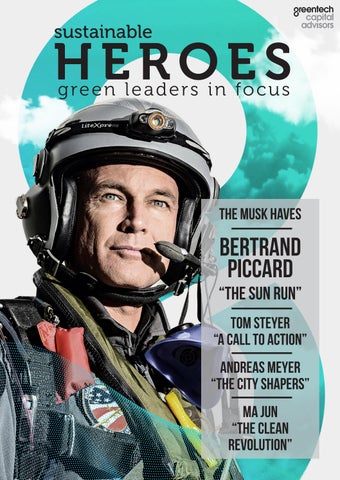
This edition features Bertrand Piccard, the first person to complete a round-the-world flight in a solar-powered plane, pushing the limit of human imagination and technology to fight climate change. Next, we shine a light on Tom Steyer and his motivation to leave the hedge fund business in order to champion environmentally-sound policy at the state and national level. Additionally, Andreas Meyer, CEO of SBB, offers insight into how the Swiss national transport company is re-thinking and changing how people connect with the world in a smarter and greener way. Lastly, we share our interview with Ma Jun—one of Time Magazine’s 100 Most Influential People—who spoke with us about how to galvanize governments and companies to eliminate pollution and protect natural water assets, and in turn, build a more sustainable economy.
This is about the call of the hero. Heroes of our time, heroes that transcend generations.
Join us on a journey into the hearts and minds of some of today’s greatest heroes, who have dedicated themselves to positively impact tomorrow’s world. We invite you to explore with us what makes these heroes tick, what drives them to overcome arduous trials and immense challenges, known and unknown.
Our clients are our heroes. They are investing in new energy, water, waste and food technologies that form the building blocks of a low-carbon, resilient and integrated sustainable economy. Our heroes take risks and drive innovation to fight climate change and global resource depletion.
This is a story of spirit and purpose, adventure and camaraderie; of a blossoming community of thought leaders in systems infrastructure, technology innovation and sustainable entrepreneurship. For those who do heed the call to go the distance, plumb the depths and soar the heights, anchored and emboldened by values, vision and mission, we salute you and express our gratitude for your invaluable energy. We’re immensely proud of your successes and of our own role as individuals and as a team in attaining the common goal to heal the world, while growing profitable businesses.
In the following pages and future volumes we aim to share the inspiring stories of friends and trusted associates, with the hope that their experiences inspire readers in similar pursuits.
Some of the pioneers in this issue find themselves in the limelight as established thought and impact leaders, while others are less well-known, heralding a new generation of tomorrow’s trailblazers challenging the status quo. It is part of our aim to identify and nurture these future sustainable heroes.
The hero’s journey involves a cycle of experience and action, of reaching and climbing and enduring. It is marked by turning points and tipping points. Most of all, our heroes achieve, and in the process transform themselves and the world around them for the better.
Welcome to the journey!
Managing Partner
On behalf of the entire Greentech family
The haves Musk
Pioneers are like shooting stars, blazing trails across the sky.
People are naturally attracted to the sparkling energy and extraordinary success of a pioneer. Greentech resonates with heroes, and beyond supporting them and their communities, we ourselves aim to inspire others as we illuminate and execute ground-breaking opportunities in sustainable infrastructure.
Sustainable Heroes shines light on the key qualities—’Musk haves’—of a hero as seen through the lens of visionaries like Elon Musk, for example.
This issue is an opportunity to discover who our ‘Sustainable Heroes’ are, where they come from and where they are going. Why are these extraordinary individuals our heroes? They are highly driven, imaginative, and unafraid to disrupt the status quo.
Our heroes have accomplished more than most, driven by relentless commitment to a singular vision. They are set apart by these qualities. Our heroes put everything they have into their vision. They walk the talk, without limits or compromise.
Like many, our heroes hope for fundamental, systemic change. Unlike many, however, our heroes have demonstrated the passion and skill necessary to realize such deep change. Ultimately, they possess an ability to integrate scientific and technological innovation with intuition and compassion. Indeed, these are the qualities we need most as we move toward unknown, uncharted horizons. To the future.
Walk the Talk
Work and play as a living example of your goals and aspirations. Act according to top standards and stated commitments.
Think Long-term and Act Accordingly
Have the confidence to know your mission and stick to it. Leverage the power in other voices, while knowing that responding to many voices may be counterproductive. Know you are on the right path.
Be Fearless and Have Fortitude
Enjoy the Mission
The journey makes the
and there is joy in the process of discovery and evolution. Learning new experiences over time is something every hero must undergo. Enjoy your purpose and higher calling as it unfolds.
Maintain courage, strength and determination. Perseverance and tenacity. Work long and hard, with extreme focus.
hero,
The SUN RUN
At 28,000 feet above sea level, things are clear for Bertrand Piccard.
Flying high above Earth, Bertrand Piccard, the world-renowned explorer and environmentalist, refines his vision for global sustainability. At this altitude, Piccard is free to think broadly. It is a freedom he embraces. “The problems of the world come from the fact that people focus far too much on the problems in their own fields, and they lose the general vision,” said Piccard, 59, when GCA spoke with him in October 2017. “They forget the systemic approach.”
Piccard’s ability to see the big picture—to dream big—combined with an inherited attraction to record-setting challenges, has led him repeatedly to the limelight in the last twenty years. He first made headlines in 1999 by completing the first ever non-stop round-the-world balloon voyage. For 19 days, 21 hours and 47 minutes, Piccard and his co-pilot traversed the stratosphere, 36,000 feet above sea level. A full circumnavigation.
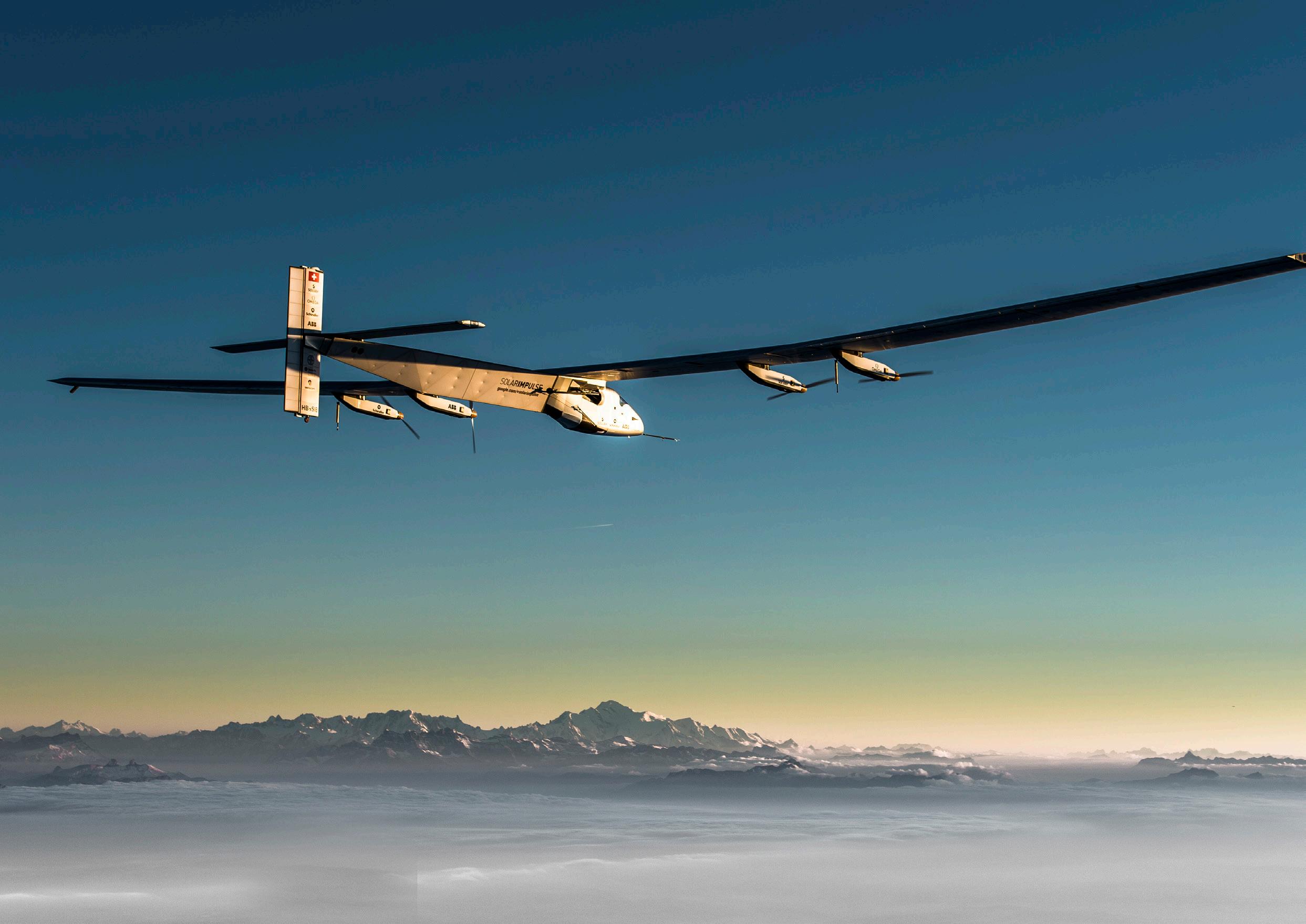
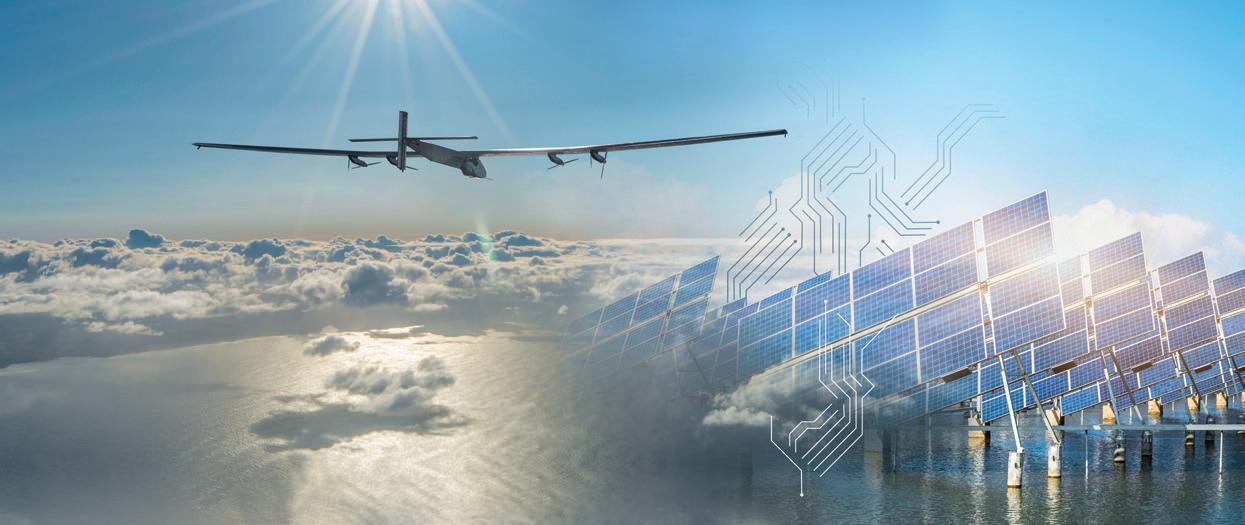
Sixteen years later, in 2015, Piccard embarked on yet another global expedition, this time trading in the balloon for a solar-powered plane. The voyage, “Solar Impulse,” was a resounding success. Without a drop of fuel, Solar
Impulse 2 circled the globe in 23 days of flying time. Indeed, it is an accomplishment worthy of his pedigree: Piccard’s father, Jacques, was the first person to explore the 10,916m deep Mariana Trench and his grandfather, Auguste, was the first to breach Earth’s stratosphere.
“All the people that influenced me in my life, like my father and my grandfather, but also the astronauts and explorers I grew up with— they all faced very big challenges. They were never afraid of having a global vision or doing something difficult and ambitious. This has pushed me to do the same.”
In recent years, Piccard’s “global vision” has
530 HOURS TRAVELLED
43,000Km DISTANCE
11,000Kw PRODUCED
pushed his ambition beyond record books, driving him to tackle the “much more difficult” task of realizing a sustainable global economy. Using Solar Impulse as his launching pad, Piccard has leveraged newfound fame to lead an international environmental campaign. In between TED talks and meetings with Presidents and Prime Ministers, he has been busy building the newly inaugurated World Alliance for Efficient Solutions, an organization dedicated to promoting clean technology. At its core, the Alliance hopes to create a global network through which sustainable innovators can connect with inspired investors and industry incumbents.
With the intrepid Swiss pilot at the helm, the Alliance will present a list of 1,000 profitable solutions for a sustainable economy at COP 24 next December. In true Piccard fashion, it is a lofty goal anchored in a pragmatic approach. “The most exciting thing is to be useful, to bring another vision of what can be done and to stimulate people to do better,” Piccard says.
“For the Alliance, this means you need to have profitable solutions to protect the environment and allow industry to continue.”
A trained psychiatrist, Piccard’s perspective affords him a unique view on catalyzing such change. “My experience with patients in psychotherapy has shown that people will never change something in their lives if they don’t either face a crisis or find a personal advantage,” he observes. With respect to climate action, “once you demonstrate the personal and communal advantages, you see that it is possible to take action because you will stop thinking of problems to solve and start thinking of solutions to implement.”
With that in mind, Piccard is determined to crack the inertia that binds world leaders— political and corporate—to business-as-usual thinking. He is doing it the best way he knows how. “What I love is to promote the pioneering spirit, the spirit of exploration. Which means to free ourselves from certitudes, and from our habits, that keep us prisoners of old ways of thinking, in order to do things differently, to be more efficient. Today, it is not a question of being only ecological, it is a question of being logical. And logical today is to have clean growth that is better than the dirty status quo.”
Interview:
Where does your focus on sustainable economic growth come from?
The problems of the world come from the fact that people focus far too much on little details, sectors, fields and lose the general vision. Lose the systemic approach. When I was trained as a psychiatrist and psychotherapist, I was always interested in the systemic approach more than the individual approach. And in the systemic approach, you don’t try to solve just one problem. You try to address the entire system. You try to have the entire vision and you understand before you act.
In our world, we need to change what has brought the problems of today: the gap between ecology and industry. On the one hand, you have the ecology contingent, who for 50 years has said we have to protect the environment, and the only solutions they had were to threaten mobility, threaten modern lifestyle and growth, which does not work. And on the other side, you have industry who is providing a good quality of life but at the cost of environmental destruction and depletion of natural resources. So, if you see the systemic approach—if you have the global vision—you understand that you have to put them both to-
gether. You need to have profitable solutions to protect the environment and continue with industry.
It is easier to solve the big problem with a general vision and a general understanding than to solve small problems individually and separately.
What has been the most exciting aspect of building the Alliance thus far?
The most exciting thing is to be useful. To stimulate people to do better. What I love is to promote the pioneering spirit, the spirit of exploration. This means departing from our certitudes, from our habits, out of our normal
Innovation makes pioneering a reality
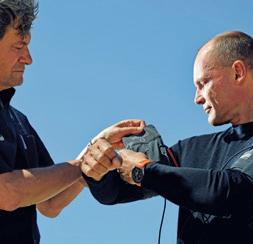
Anytime Solar Impulse 2 banks its wings more than 5 degrees, an instrument by Omega transmits a vibration in the pilot’s sleeves. To withstand long duration flights lasting several days and nights, the stabilization augmentation system designed by Altran lets him sleep for 20 minutes every 5 hours while custom alerts warn him of safety concerns. On the pilot’s body are matchbox-sized electrocardiograms from EPFL (Swiss Federal Institute of Technology) to track his fatigue as he flies, while smart nylon fibers by Solvay stabilize his body temperature, re-injecting infrared heat onto his skin when it’s cold and preventing him from sweating when it’s hot.
way of thinking in order to do things differently, to be more efficient.
It is so exciting to present the goal of 1,000 solutions (submitted by companies around the world) to heads of states and CEOs, and observe how thrilled and desperate they are to receive the list. They need the work that we are doing.
What are the largest challenges for the World Alliance? Compared to the solar impulse project?
Both seemed impossible at the beginning. Solar Impulse was considered to be impossible by the experts. The aviation industry refused to build the plane, for example, so we had the plane built by a shipyard.
For the Alliance, we want to present 1,000 profitable solutions that will protect the environment. You also have to think completely differently in this situation.
With the Alliance, we must mobilize the worlds of finance, ecology, industry and politics. We need to bring all these people together. In other words, we need to bring the solution-providers together with the people who can fund and people who are seeking solutions.
If we aim to fly around the world in a solar airplane and we only get 75% of the way, it might already be an incredible feat, but it’s still a failure. If we bring 1,000 profitable sustainability solutions to heads of states but we change nothing in the world, it’s also a failure. We have committed ourselves to do something difficult and we accept the risk of failing be-
cause if we don’t accept that risk we will never succeed.
Which solutions, technological or otherwise, are you most excited about?
There are two fields in which I see a lot of hope. The first is the production of renewable energy and, in particular, its decrease in costs. When I speak with different heads of states, they tell me, ‘in my country the public bids to produce electricity are won by renewables against fossil fuels.’ This is fantastic!
The other part relates to energy efficiency. It’s useless to produce new energy if we continue to waste half of it. In the world of energy efficiency, you have hundreds and hundreds of little pieces, individual solutions, which are part of a larger puzzle. Putting silica in tires, for example, saves 6% of fuel consumption. New composite materials are emerging for use in wind turbines. New systems for heat transport. And so on. If you combine all energy efficiency solutions and put them to work, you can divide CO2 emissions by two! That is why bringing these solutions to light, through the World Alliance, can have such a big impact.
The motto for the Solar Impulse was, “exploration to change the world.” The motto for the World Alliance is, “solutions to change the world.”
Attaching the wearable tech instrument
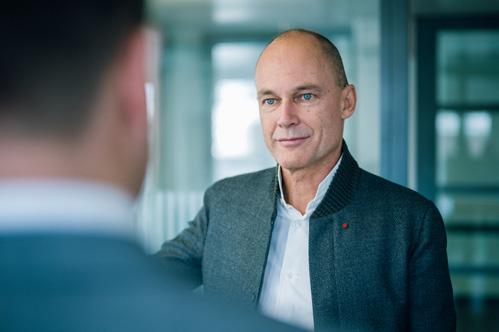
Staying focused on the goal is key
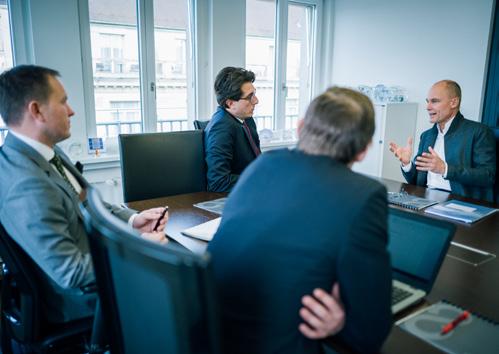
Bertrand Piccard meets with Greentech in Zurich
The future of energy is in our hands
A call to action
From
microphones to megaphones, from boardrooms to street rallies, Tom Steyer is at the heart of change.
For a man who once relied on compounding to turn a $15 million investment into a $30 billion fund, Tom Steyer is remarkably impatient. In the last five years, since leaving the hedge fund world, Steyer has campaigned tirelessly and spent millions to focus the political agenda on climate change solutions. His patience is running out. “If you believe what I believe, what are you doing playing golf today?”
Steyer’s activism stems from something more resolute than goodwill alone. The former manager of Farallon Capital speaks with unapologetic candor in a manner that conveys a plain-old sense of duty. “When I left Farallon five years ago, I was under the impression that there was a very high likelihood that, for political reasons, society was putting the globe at risk,” explained Steyer in a November phone conversation with GCA. “Therefore, how could I not try and do something to make sure that people were safe and healthy moving forward?”
Well before Steyer left Farallon in 2012, he held deep-seated beliefs about the need to address the risks posed by climate change.
For the then hedge fund manager, the question wasn’t whether to act, but rather how. “I started to pay a lot of attention to this over ten years ago,” Steyer explained. “I approached it in a bunch of different ways I thought might be helpful. In the end, my conclusion was that the actual problem was political rather than technological or scientific.”
Still busy managing $30 billion AUM, Steyer began backing environmental and climate related policy, both through large donations and direct legislative campaigns. His first well-publicized political engagement came in 2008 when it was discovered that he donated large sums to the Obama campaign, galvanized by the candidate’s embrace of renewable energy. Then in 2012, he co-led the campaign to protect California’s clean energy law, AB 32, from
a potential repeal. Since then, his leadership as a climate policy champion has made him a regular name in the public sphere. He was the largest donor on either side in the 2016 U.S. Presidential election and he continues to leverage his press coverage to speak out against regressive climate policy (among other issues).
In his discussion with GCA, Steyer also acknowledged the importance of private sector innovation as “the engine of change” capable of mitigating climate change. Perhaps, most importantly, Steyer explained, “Business is particularly important in understanding what [solutions] are possible.” However, “in the absence of setting up the right political framework, we can cause a degree of suffering that is unimaginable.”
That conclusion motivated Steyer to found NextGen Climate, an organization that has spent upwards of $170 million (much of it Steyer’s own money) advocating for policies and politicians that help the environment and support clean energy. Officially, NextGen is dedicated to “act politically to prevent climate disaster, promote prosperity, and protect the fundamental rights of every American” (the organization changed its name to NextGen America in July 2017).
As Steyer’s motivation to take political action has grown, so has his scope of activism. Increasingly, he views the consequences of climate change as part of a much larger environmental and social equity problem. “I don’t think you can separate environmentalism from a much broader justice agenda,” Steyer stated. “For a lot of people, understanding climate science is not something they want to spend time on. What they do want to think about is what is going to impact themselves, their families, their communities and the people they love.”
Ultimately, it seems Steyer’s innate sense of justice implicates his own responsibility to fight for sustainable policy. “I am an extremely lucky person for a whole bunch of reasons. This is an opportunity for me, and also for society at large, to participate in doing the right thing for the most important issue of our time. I would like to feel like I am part of the large group of people who can see the right and insists on acting in the right in the clutch. Assuming we win this fight, I will take great pleasure and great pride in having been part of it.”
ENVIRONMENT
EQUALITY
Providing clarity on sustainable investments
HEALTH CARE
IMMIGRATION
PROSPERITY
The City Shapers
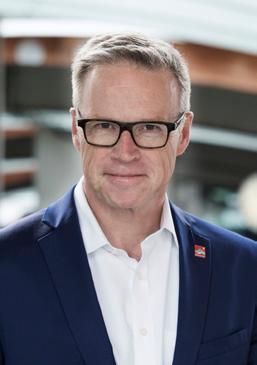
As CEO of SBB (Swiss Federal Railways), a company with a public service mandate, Andreas Meyer is responsible for managing day-to-day operations with his 33,000-strong crew while preparing the organization for the future. These tasks require him to move between the now and the next, never losing sight of his public mandate.
GCA spoke with Andreas and took a deep dive into the future, exploring how concepts such as smart cities, systems to support train operators, connected mobility and renewable energy sources will address the demands of the not-so-distant future traveler.
As Chief Public Mobility and Transportation Officer, you are responsible for the strategic development of the railway and its infrastructure. SBB claims to be “shaping the mobility of the future - simple, personal, connected.” What exactly does this mean?
We invest in identifying and anticipating customer preferences and articulating future mobility needs, with the objective to provide a safe and simple door-to-door journey. The scope of SBB and its role as a traditional railway system operator is undergoing a significant transformation as new mobility patterns are being discovered.
We anticipate that technological advances are likely to accelerate these developments and continue to shape the future role of SBB. As we embark on the next phase of this exciting journey, we are laying the foundation to meet the growing need for personalized, intermodal mobility and innovative logistics solutions.
Whereas in the past each mobility provider (train, bus, car, air-travel, tram, bicycle, etc.) was viewed as an individual transportation
element, future mobility systems will be fully integrated into the homogenous and seamlessly connected mobility chain.
Andreas Meyer (CEO of SBB)
From a physical perspective, we will continue to operate and rely on the strengths of the railway system. However, to cater to future needs, we are investing vast amounts in infrastructure, enabling technology and digital services to meet our customers’ evolving mobility needs and preferences. For example, we developed a mobile app and turned it into a trip app which our clients can use to plan their journey from A to B while considering all mobility service providers. With the SBB Green Class, we’re testing a sustainable offering across the entire mobility chain. With our SmartRail 4.0 initiative, we are increasing the capacity of the
existing infrastructure without significantly adding to or changing our existing infrastructure. As a result, we’re able to save significant costs. In addition, we’re adding sensors to our cargo containers and automating transport and related processes. This will not only enable the envisaged transportation systems to work more efficiently; it will also enhance the quality of life of millions of people while supporting economic growth.
Our mission is to become the preferred mobility service provider for our customers, irrespective of time and place, and to manage all of their travel needs as efficiently as possible. This means that SBB is evolving into more and more of a digital and personal mobility service provider without losing our traditional
strengths of a railway operator with a long history. That is the essence of “simple, personal and connected”.
It is encouraging to see that you are preparing your organization for the future while at the same time taking the opportunity to define the future of mobility. What does it look like?
SBB is the backbone of the Swiss Economy since we transport over 1.2 million travelers and 200,000 tons of cargo on an average day. We are proud to say that we are able to transport our customers with a 90% on-time arrival rate within a 3-minute tolerance, which is world-class from an international perspective. We focus and build on our strengths, which means providing attractive means of transportation at reasonable costs. In the process, we also increase our competitive edge.
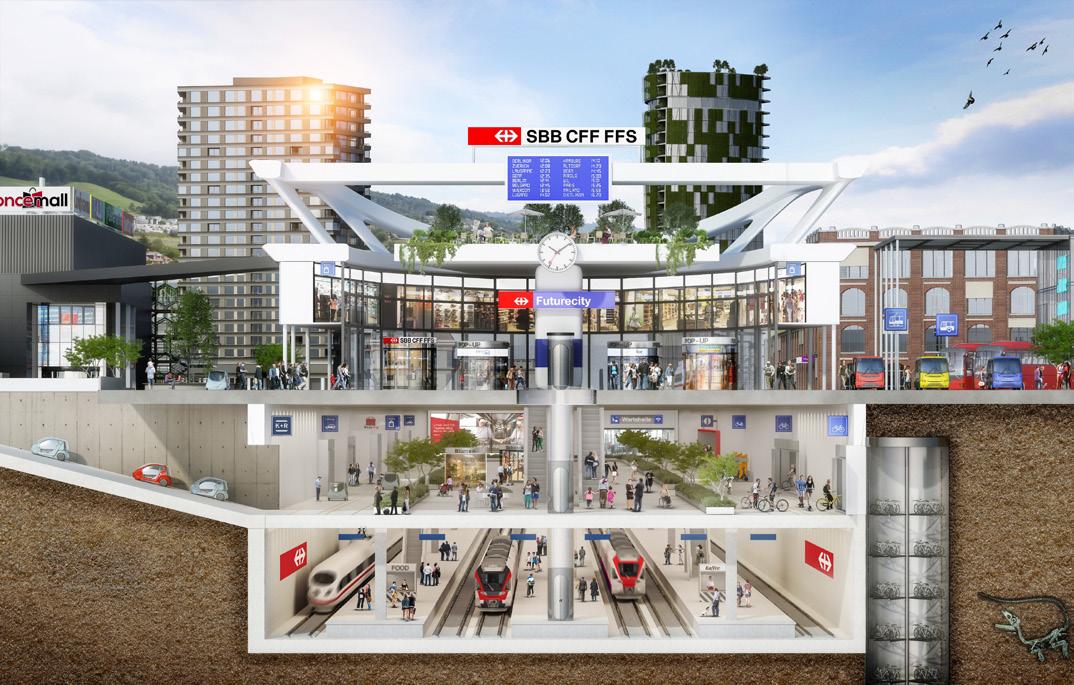
The second aspect of the future of mobility is connections between multiple mobility service providers. While the term “train stations” is still widely used, train stations will develop into “mobility platforms” or “regional and urban mobility hubs” that connect and combine with all other auxiliary transportation systems. In a third dimension, we have become a trust-
ed mobility data services provider, in order to provide personalized mobility experience for our clients. In order to provide the most pleasant travel experience, the use of customer data will enable us to proactively identify and address customer needs. We adhere closely to the rules of data protection. Our goal is to increase the quality of life, and we view ourselves as a critical element in keeping a competitive edge as a country within a greater European context. We want to ensure growth is both smart and broad-based, by drawing on digitalization and new technologies and reflecting the various strengths of rail travel. We aim to be digital and personal at the same time.
The entire mobility chain is becoming more complex and interconnected. SBB as an organization must continually define its role as a key transportation/mobility provider. What are some of your initiatives to address these challenges?
SBB is committed to driving innovation by making substantial and strategic investments, with the aim of providing compelling mobility service offerings at a reasonable price. In addition to building new, or enhancing our already existing infrastructure, we invest in systems
to support our train operators, green mobility, electric car sharing and other attractive personalized mobility solutions, thus combining and incorporating all relevant means of travelling into one flexible, easy-to-use transportation offering.
For example, we now offer E-bikes in combination with electric cars with our annual Green Class mobility pass, allowing our customers to seamlessly access all available transportation systems, promoting a sustainable and genuine door-to-door travel experience.
Additional inputs for innovation and inspiration are derived from our own innovation fund, designed to foster ideas and fund pilot projects, and from frequent exchanges with technology leaders and other leading mobility providers in Japan, Singapore, Silicon Valley and Tel Aviv.
All of this allows us to observe and experience best practices, learn, and identify areas we need to further invest in. This exchange on an international level proves extremely useful. These elements provide a real competitive edge and enable us to define a common vision and tangible possibilities regarding the future of mobility needs.
Can you please share what SBB is doing in the area of sustainability?
Ecological sustainability is one of the central objectives of SBB Group. Today the SBB trains are powered with 90% environmentally-friendly hydroelectric power. By 2025, this level will increase to 100%, purely relying on renewable energy. Thus, our carbon footprint is approaching zero. This is quite unique for Switzerland, while other European railway service providers are also leveraging alternative and renewable energy sources which are seen as an attractive unique service proposition to customers compared to other means of transport.
Previous long-term investments in sustainable infrastructure were critical, allowing us today and in future generations to benefit from these sustainable energy sources. This is why it’s critical that we continue to invest with a long-term view, ensuring the attractiveness of SBB in providing relevant, safe and efficient mobility solutions.
Since SBB has long-standing and strong relationships with various energy partners in Switzerland, these partnerships have proven extremely valuable for our current operating model.
In addition, we are also working on sustainable service concepts, testing innovative mobility solutions, and enhancing the environmental advantage that the railway holds over other forms of transportation.
What are smart cities and what do they mean for SBB? To what extent are you leveraging this opportunity?
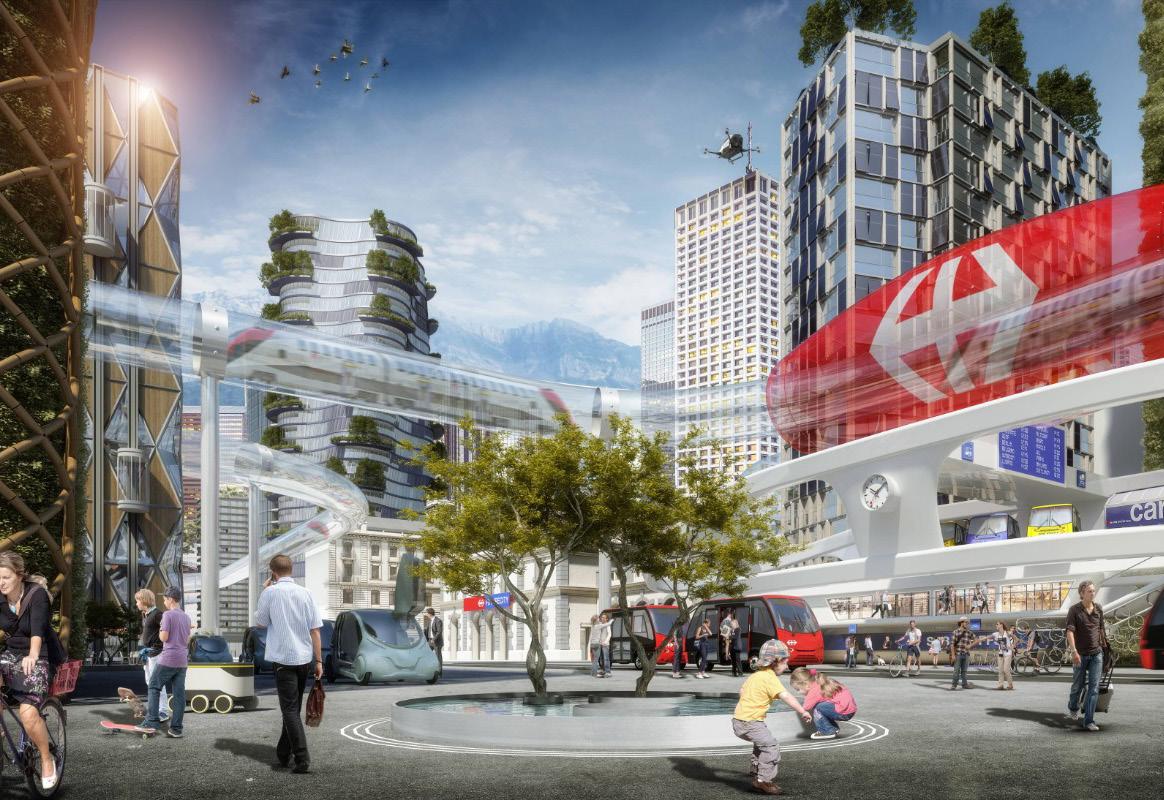
A smart city offers its inhabitants the highest quality of life using as few resources as possible. This can be achieved by linking different infrastructures such as transport, energy and communications, for individual buildings, districts or whole cities. New technologies form the foundation of these connections.
A smart city offers an opportunity for us to define the infrastructure needs of future cities and to effectively integrate these physical infrastructures with new technologies meeting the ever-changing needs of travelers. Because SBB is intimately connected with infrastructure and people, the concept of smart cities is already becoming a reality.
Today we are running large-scale pilot projects to transform our hub in Zurich into the smartest place in Switzerland, working with some of the world’s renowned technology leaders, innovative building developers, and other partners from the worlds of business and academia.
Evidence suggests the Swiss population will continue to increase by approximately 25% to 10.2 million in 2045, with a majority living in larger cities. These demographic shifts and developments present great challenges and create valuable opportunities. The concept of the smart city will allow us to cope with the challenges of urbanization and its associated effects, such as increasing volume of traffic and number of travelers (expected to increase 25% - 30% by 2040), the concurrent increase in energy consumption, and the overall impact on supply and waste management.
SBB future city concept
Already today, 2/3 of the energy is consumed by these larger city hubs. All of these changes will have a profound impact on our mobility system and our society, and must be addressed within a sustainable, smart city context.
What does SBB do in the area of digitalization and what are the advantages for the customers?
New technology will enable us to do more with less. We strive to do more with less, better and faster. Our goal with SmartRail 4.0 is to increase efficiency by 30%, add more transportation capacity, reduce costs, and enhance safety of the already safest transportation systems by 90%. Digitization will be the key in improving interaction with customers, increasing internal efficiency, and capacity management.
In order to cater to the changing travel preferences and requirements of our customer community, digitalization is an important element in realizing the idea of smart cities and managed mobility. Advances in technology will empower the “Internet of Everything” by connecting all transportation means such as remote buses, autonomous vehicles, pooling and sharing driven by smart data, creating new opportunities and thus enhancing our entire mobility system.
The transition to “smart city” and “managed mobility” has already begun and the advantages of these interconnected mobile and highly personalized services are enormous.
What is your wish or hope for SBB in the future?
It is my hope that the next generation of leaders continue to invest in strategic initiatives such as infrastructure and technology-related projects, applying a bold and visionary perspective. A long-term view coupled with an innovative approach will allow a public transportation organization like SBB to continue to play a critical role in serving our society, ensuring the competitiveness of Switzerland, while providing seamless connectivity to other European countries.
Second, as a mobility leader, we need to keep our pioneering spirit and our willingness to be bold to invest in our future. We need to remain courageous, accept the challenges, and dare to fail - within reason and a safe environment - in
order to succeed as we set ambitious goals for the future of mobility.
Greentech’s Perspective
Our observation in terms of increased market activity from both incumbents and the emerging industry disruptors suggests the transformation within the mobility space will occur more quickly and on a broader scale than many anticipate.
Collaboration among physical and digital services, enabling seamless and intuitive doorto-door transportation, is key to adding value within today’s and, even more importantly, tomorrow’s mobility ecosystem.
The anticipated growth in traffic volume coupled with the need to provide safe and sharedyet personalized and highly modular - mobility preferences will require a well-planned and orchestrated physical and technology infrastructure supported by sustainable energy sources. Individual and seamlessly connected transportation needs will undoubtedly add additional layers of complexity. However, while the competitive landscape is evolving, vast growth opportunities (seamless connectivity, traffic flow management, data security, mobile data collection, user control, smart energy, etc.) are emerging as infrastructure and data providers position themselves to play dominant roles in the future mobility chain.
As the largest, purely focused advisory institution working with industry-leading firms who have unique visions to build sustainable technology and infrastructure businesses, Greentech is well-positioned to support you on your journey to the future.
Bringing future ideas to light
The Clean Revolution
Bringing back blue skies and clear water
Ma Jun is a soft-spoken, widely influential environmentalist with a mission to shape a more sustainable China. As the Founding Director of the Institute of Public and Environmental Affairs (IPE), Jun has dedicated his career to holding industry accountable for its environmental externalities. Through IPE, he created the China Pollution Map, a publicly available pollution database that actively monitors corporate environmental performance and facilitates public participation in environmental governance. Under Jun’s leadership, IPE has also played a leading role advising global corporations on improving environmental performance.
Jun has been named among Time Magazine’s 100 Most Influential People, received the Goldman Environmental Prize, and made the list of Foreign Policy Top 100 Global Thinkers
What first brought your attention to China’s environmental issues?
During my research trips as an investigative journalist almost 20 years ago, I observed an unprecedented level of pollution in Shanxi province. The extent of the pollution I witnessed included soil erosion, discolored rivers, diminishing water flow, and toxic fumes from factories which made it hard to breathe.
This left me no choice but to focus on these issues since they posed a serious health risk and threatened the very existence of the Chinese people and economy. So, I had to act.
As one of the most recognized environmental voices, you have been successful in working
with multinational corporations (MNCs), as well as their local manufacturing partners in China to foster positive environmental change. What has your experience been working with MNCs?
Realizing that public participation was the missing link in China’s environmental governance processes, IPE began collecting and analyzing public government data on industrial pollution, and launched the China Pollution Map Database in 2006.
10 years ago, we launched Green Choice, a program that encourages consumers to use their buying power and public opinion to influence corporations in implementing more sustainable sourcing policies and manufacturing methods. While we have made significant progress,
many manufacturers claim they cannot comply with already existing environmental standards, since clients only focus on price. Consistent enforcement of the policies remains weak, and since the cost of violation is lower than the cost of compliance, those in the market who cut corners are effectively rewarded.
In the world economy, the influx of, and continuous demands on the large multinationals to provide cheap products and services further reinforced this behavior and was used to add an incentive to cut corners. Forced to lower costs to win contracts, local manufacturers were incentivized to violate their environmental laws.
Because of the inefficiencies and challenges of the jurisdictional system, we decided to use the power of data and thus make information public, to increase transparency and to educate. The public and the consumers need to be informed, effectively empowering them to pressure the MNCs and use their knowledge as leverage to make their supply chain more green.
Throughout the years, we have been able to engage with big companies with our data, scientific research and economic reasoning to improve their business practices. Fortunately, we
managed to influence an increasing number of companies to review their sourcing methods, including 30 MNCs implementing more sustainable business practices. Some of the largest brands, such as Apple, Nike, Coca-Cola, Siemens, and even Wal-Mart have started to review their supply chain, and begun to implement changes. The companies seek to deploy green power purchasing methods (removing coal-based suppliers from their production chain), while at the same time experiencing the quality of the products improving through their decision to go greener.
It seems China is finally taking serious measures to enhance environmental quality standards. Do you see this as a sustained transition towards environmentally sound development?
China’s ability to grow is directly linked to more sustainable business practices. We have not yet seen the environmental quality improve. There is clearly an environmental tipping point, and China has come to realize that this is not sustainable.
Whereas in the past we embraced growth at all costs, today future economic growth no longer trumps all other interests. The impact of the past and its effect on public health has put the use of sustainable resources in peril, because
social stability has been threatened.
China is the world’s largest polluter, which affects its relations globally. The negative implications associated with this reputation are being recognized, and the government admits that the past (and current) business practices are a real threat to systemic economic growth.
These sentiments are confirmed by recent surveys and observations that clearly indicate the risk of environmental issues and hazards as the top concerns of the people. Regularly occurring toxic smog levels also triggered a public debate demanding actions which address these issues, since the people recognized the importance of clean air and water.
Regardless of social and economic status, pollution has a significant impact on the health of the people and these are the issues people care about the most. While the environmental problems remain massive, we are witnessing a remarkable transition and renewed focus on environmental governance, spurring emission reduction. Most recent data points suggest emissions are no longer increasing but leveling off. This may suggest that we are at a tipping point.
The ‘Blue Sky Map App’, officially launched by the IPE, enables the public to monitor air and water quality and local sources of pollution, and scrutinize emissions from companies. Raising public awareness is critical. Is the app also linked to actual solutions?
The app led to some solutions and change. The reason we developed the app in 2013 was to provide access to accurate real-time data, to enable people to get involved. Integrating the social media function is critical so people can access and engage in real time. For example,
in 2006 there were 2,000 violations recorded. Today we have over 500,000 violations recorded and the level of transparency is increasing.
While we have yet to see widespread environmental improvements, the ability to enforce the laws will play an important role in companies motivated by a green transformation, and they are looking for solutions while facing the challenge of increasing transparency.
Pressure from public opinion led to the closure of one of the largest steel manufacturers, which was gravely violating environmental laws. This is an example of local involvement leading to these positive results. The app facilitated transparency and change, and was used as a tool for people to engage. While enforcement is necessary, the participation of the public plus voluntary involvement of the companies is key to building a more sustainable future. Responsibility must be shared by all corporate citizens and the investment community. Thus, empowerment is critical to active participation. The power of mobile internet access, combined with social media, gives us a chance to reach all citizens.
Rather surprising to us was the fact that the government agreed to disclose emissions data from major cities across all Chinese provinces, signaling their commitment to monitor and address these issues.
What is your vision and hope for the future?
I hope our efforts will help clean up and restore the water, coastal sea, the air, and our soil, as China is going through this massive industrialization and urbanization.
While it seems ironic, China has been put in the driver’s seat on the climate change issue. The U.S. has withdrawn from the Paris Agreement, leaving China no choice. We also see a lot of interest from neighboring countries since economies are becoming increasingly global, yet leaving very real local issues which need to be addressed.
One could even argue that China will drive the transition to a more sustainable future. We are helping to map this out.
Ma Jun in the field
The Future Heroes
info@greentechcapital.com This
www.greentechcapital.com
Jeff McDermott
Robert Schultz
PJ Deschenes
Kareen Laton
Damien Sauer
David Smith
Stephen Megyery
Michael Horwitz
Duncan Williams
Jim Long
Derek Bentley
solarimpulse.com
Solutions to change the world
Following the success of the first solar flight around the world, the Solar Impulse Foundation has launched the second phase of its plan: selecting #1000solutions that can protect the environment in a profitable way, and bring them to decision makers to encourage them to adopt more ambitious environmental targets and energy policies.
Through the World Alliance for Efficient Solutions, Bertrand Piccard wants to mobilize the actors in clean technologies and shed light on existing efficient solutions to fast-track their implementation.
A new innovative and pioneering adventure has begun. Together we can improve the quality of life on Earth.
bertrandpiccard.com Greentech is excited to announce its collaboration with