City of Tamarac, Florida
This page Intentionally left blank

This page Intentionally left blank
For Fiscal Year Ended September 30, 2025
Prepared by
FINANCIAL SERVICES
Priscilla Moxey, CPA, CFE, MAcc, Interim Director of Financial Services
Ann Harris Wynter, CGFO, MAcc, Accounting Manager
Jackie Colon, Accountant II
Rizalina Garcia, Accountant II
Keisha Lawson, Payroll Specialist


Honorable Mayor and Members of the City Commission City of Tamarac, Florida
Opinions
We have audited the financial statements of the governmental activities, the business-type activities, each major fund, and the aggregate remaining fund information of the City of Tamarac, Florida (the City), as of and for the year ended September 30, 2025, and the related notes to the financial statements, which collectively comprise the City’s basic financial statements as listed in the table of contents.
In our opinion, based on our audit and the report of the other auditors, the accompanying financial statements referred to above present fairly, in all material respects, the respective financial position of the governmental activities, the business-type activities, each major fund, and the aggregate remaining fund information of the City, as of September 30, 2025, and the respective changes in financial position, and, where applicable, cash flows thereof for the year then ended in accordance with accounting principles generally accepted in the United States of America.
We did not audit the financial statements of the City of Tamarac Firefighters’ Pension Trust Fund, which represent 43%, 44%, and 32%, respectively, of the assets, net position/fund balances, and revenues/additions of the aggregate remaining fund information as of September 30, 2025. Those statements were audited by other auditors whose report has been furnished to us, and our opinion, insofar as it relates to the amounts included for the City of Tamarac Firefighters’ Pension Trust Fund, is based solely on the report of the other auditors.
We conducted our audit in accordance with auditing standards generally accepted in the United States of America (GAAS) and the standards applicable to financial audits contained in Government Auditing Standards, issued by the Comptroller General of the United States (Government Auditing Standards). Our responsibilities under those standards are further described in the Auditor’s Responsibilities for the Audit of the Financial Statements section of our report. We are required to be independent of the City and to meet our other ethical responsibilities, in accordance with the relevant ethical requirements relating to our audit. We believe that the audit evidence we have obtained is sufficient and appropriate to provide a basis for our audit opinions.
As discussed in Note 3 to the financial statements, the City adopted the recognition and disclosure requirements of Governmental Accounting Standards Board (GASB) Statement No. 101, Compensated Absences, as of October 1, 2024. As a result of the adoption, the City restated certain beginning net position and compensated absence balances. Our opinions are not modified with respect to this matter.


Management is responsible for the preparation and fair presentation of the financial statements in accordance with accounting principles generally accepted in the United States of America, and for the design, implementation, and maintenance of internal control relevant to the preparation and fair presentation of financial statements that are free from material misstatement, whether due to fraud or error.
In preparing the financial statements, management is required to evaluate whether there are conditions or events, considered in the aggregate, that raise subs tantial doubt about the City’s ability to continue as a going concern for 12 months beyond the financial statement date, including any currently known information that may raise substantial doubt shortly thereafter.
Our objectives are to obtain reasonable assurance about whether the financial statements as a whole are free from material misstatement, whether due to fraud or error, and to issue an auditor’s report that includes our opinions. Reasonable assurance is a high level of assurance but is not absolute assurance and therefore is not a guarantee that an audit conducted in accordance with GAAS and Government Auditing Standards will always detect a material misstatement when it exists. The risk of not detecting a material misstatement resulting from fraud is higher than for one resulting from error, as fraud may involve collusion, forgery, intentional omissions, misrepresentations, or the override of internal control. Misstatements are considered material if there is a substantial likelihood that, individually or in the aggregate, they would influence the judgment made by a reasonable user based on the financial statements.
In performing an audit in accordance with GAAS and Government Auditing Standards, we
Exercise professional judgment and maintain professional skepticism throughout the audit.
Identify and assess the risks of material misstatement of the financial statements, whether due to fraud or error, and design and perform audit procedures responsive to those risks. Such procedures include examining, on a test basis, evidence regarding the amounts and disclosures in the financial statements.
Obtain an understanding of internal control relevant to the audit in order to design audit procedures that are appropriate in the circumstances, but not for the purpose of expressing an opinion on the effectiveness of the City’s internal control. Accordingly, no such opinion is expressed.
Evaluate the appropriateness of accounting policies used and the reasonableness of significant accounting estimates made by management, as well as evaluate the overall presentation of the financial statements.
Conclude whether, in our judgment, there are conditions or events, considered in the aggregate, that raise substantial doubt about the City’s ability to continue as a going concern for a reasonable period of time.
We are required to communicate with those charged with governance regarding, among other matters, the planned scope and timing of the audit, significant audit findings, and certain internal control-related matters that we identified during the audit.
Accounting principles generally accepted in the Unit ed States of America require that the management’s discussion and analysis, budgetary comparison information, and other post-employment benefits and pension related schedules as listed in the table of contents be presented to supplement the basic financial statements. Such information is the responsibility of management and, although not a part of the basic financial statements, is required by the Governmental Accounting Standards Board who considers it to be an essential part of financial reporting for placing the basic financial statements in an appropriate operational, economic, or historical context. We and other auditors have applied certain limited procedures to the required supplementary information in accordance with GAAS, which consisted of inquiries of management about the methods of preparing the information and comparing the information for consistency with management’s responses to our inquiries, the basic financial statements, and other knowledge we obtained during our audit of the basic financial statements. We do not express an opinion or provide any assurance on the information because the limited procedures do not provide us with sufficient evidence to express an opinion or provide any assurance.
Our audit was conducted for the purpose of forming opinions on the financial statements that collectively comprise the City’s basic financial statements. The accompanying supplementary information, which includes the combining and individual nonmajor fund financial statements and schedules, is presented for purposes of additional analysis and is not a required part of the basic financial statements. Such information is the responsibility of management and was derived from and relates directly to the underlying accounting and other records used to prepare the basic financial statements. The information has been subjected to the auditing procedures applied in the audit of the basic financial statements and certain additional procedures, including comparing and reconciling such information directly to the underlying accounting and other records used to prepare the basic financial statements or to the basic financial statements themselves, and other additional procedures in accordance with GAAS. In our opinion, the combining and individual nonmajor fund financial statements and schedules are fairly stated, in all material respects, in relation to the basic financial statements as a whole.
Management is responsible for the other information included in the Annual Comprehensive Financial Report. The other information comprises the introductory and statistical sections but does not include the basic financial statements and our auditor’s report ther eon. Our opinions on the basic financial statements do not cover the other information, and we do not express an opinion or any form of assurance thereon.
In connection with our audit of the basic financial statements, our responsibility is to read the other information and consider whether a material inconsistency exists between the other information and the basic financial statements, or the other information otherwise appears to be materially misstated. If, based on the work performed, we conclude that an uncorrected material misstatement of the other information exists, we are required to describe it in our report.
In accordance with Government Auditing Standards , we have also issued our report dated June 3, 2026, on our consideration of the City’s internal control over financial reporting and on our tests of its compliance with certain provisions of laws, regulations, contracts, and grant agreements and other matters. The purpose of that report is solely to describe the scope of our testing of internal control over financial reporting and compliance and the results of that testing, and not to provide an opinion on the effectiveness of the City’s internal control over financial reporting or on compliance. That report is an integral part of an audit performed in accordance with Government Auditing Standards in considering City’s internal control over financial reporting and compliance.
Fort Lauderdale, Florida
June 3, 2026
City of Tamarac, Florida CITY COMMISSION

CITY OF TAMARAC, FLORIDA • SEPTEMBER 30, 2025
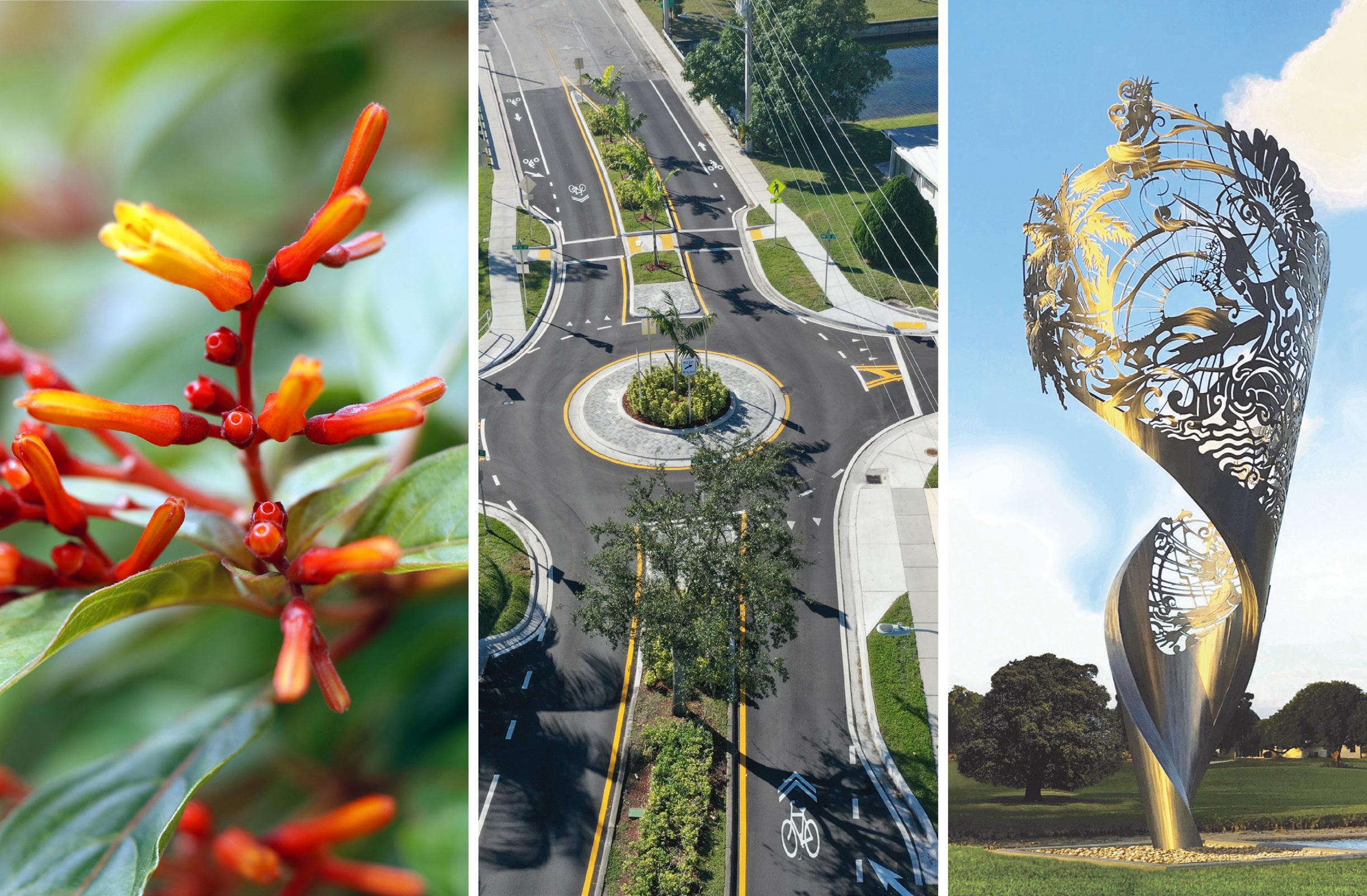
This page Intentionally left blank

Leading the nation in quality of life through safe neighborhoods, a vibrant economy, exceptional customer service and recognized excellence.
It is our job to foster and create an environment that
n n n Responds to the Customer Creates and Innovates Works as a Team n n Achieves Results Makes a Difference
Goal #1: Tamarac is Home
n Inclusive and Equitable n Well Maintained
n Parks and Infrastructure n Quality of Life n Convenient Transportation n ADA Accessibility n Great Education
Goal #2 : Tamarac is Safe and People Know It
n n Quick Emergency Response Low Crime Rate n Engaged First Responders
n n Police, Fire and Medical Services n Visibility and Crime Prevention Security Technology n Preparedness
Goal #3: Tamarac is Economically Resilient
n Business-Friendly n A Place to Thrive
n Development and Permitting n Economic Growth n Market Opportunities
Goal #4: Tamarac is Vibrant
n Attractive n Active and Fun n Green and Sustainable
n Appearance and Image n Resilient n Healthy Lifestyle
Goal #5: Tamarac is Smart and Connected
n Tech Savvy n Neighborly
n Effective Communication n Smart City n Engaged n Celebrating Community
Goal #6: Tamarac is a Dynamic Workplace
n Attract and Retain Skilled Workforce n Promote a Culture of Excellence
n 5-Star Customer Service n Professional Development n Supportive Environment n Optimal Organization
Mayor
Vice-Mayor
Commissioner
Commissioner
Commissioner
List of Principal Officers
September 30, 2025
Michelle J. Gomez
Marlon D. Bolton
Kicia Daniel
Krystal Patterson
Morey Wright, Jr.
City Manager
City Attorney
Assistant City Manager
Chief Building Official
City Clerk
Director of Community Development
Interim Director of Financial Services
Director of Information Technology
Director of Parks and Recreation
Director of Human Resources
Interim Director of Public Services
Fire Chief
Levent Sucuoglu
Hans Ottinot
Maxine Calloway
Tony Palacios
Kimberly Dillon
Kent Walia
Priscilla Moxey
James Twigger
Melissa Petron
Danielle Durgan
Earl Henry
Jonathan Frasher
This page Intentionally left blank








This page Intentionally left blank
CITY OF TAMARAC, FLORIDA • SEPTEMBER 30, 2025
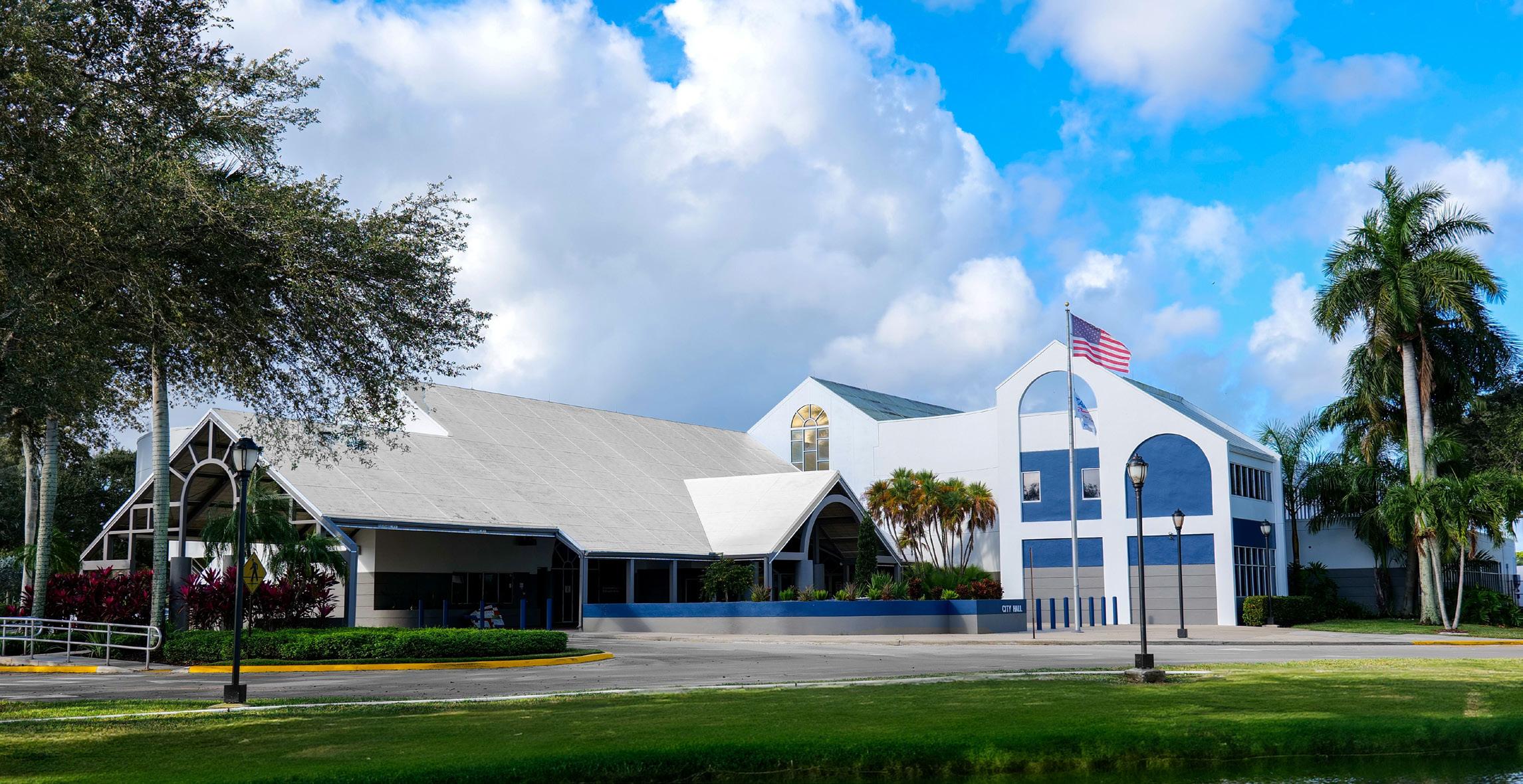
This page Intentionally left blank
CITY OF TAMARAC, FLORIDA • SEPTEMBER 30, 2025
June 3rd, 2026
Honorable Mayor, City Commissioners, Pension Trustees and Residents
Honorable Mayor, City Commissioners, Pension Trustees and Residents
City of Tamarac, Florida
Dear Mayor, Commissioners, Pension Trustees and Residents:
We are pleased to present the Annual Comprehensive Financial Report (ACFR) of the City of Tamarac, Florida (the “City”) for the fiscal year ended September 30, 2025. This report has been prepared by the City’s Financial Services Department in accordance with accounting principles generally accepted in the United States of America (GAAP) and in compliance with Chapter 218.39, Florida Statutes, and the City Charter, which require that a complete set of financial statements be prepared and published within 270 days following the close of the fiscal year and those standards applicable to financial audits performed in accordance with Government Auditing Standards by licensed independent certified public accountants.
Responsibility for the accuracy of the data presented and the completeness and fairness of the presentation, including all disclosures, rests with the management of the City of Tamarac. To the best of our knowledge and belief, the enclosed data is accurate in all material respects and is presented in a manner designed to fairly set forth the financial position and results of operations of the City. All disclosures necessary to enable the reader to gain an understanding of the City’s financial activities have been included.
The Annual Comprehensive Financial Report is designed to provide citizens, taxpayers, investors, and creditors with a clear and transparent overview of the City’s financial condition and operations.
Management of the City is responsible for establishing and maintaining internal controls structure designed to ensure that the assets of the City are protected from loss, theft, or misuse and that sufficient, reliable, and accurate accounting data are compiled for the preparation of financial statements in conformity with accounting principles generally accepted (GAAP) in the United States of America. The internal control structure is designed to provide reasonable assurance that financial
statements are free from material misstatement and that financial transactions are properly recorded and executed in accordance with management authorization. The concept of reasonable assurance recognizes that: (1) the cost of a control should not exceed the benefits likely to be derived; and (2) the evaluation of costs and benefits requires estimates and judgments by management. Management believes that the City’s internal control structure adequately safeguards assets and provides reasonable assurance that financial transactions are properly recorded.
In addition, the City maintains budgetary controls. The objective of these controls is to ensure compliance with legal provisions embodied in the annual budget approved by the City Commission. The City also maintains an encumbrance system that is employed as an extension of formal budgetary integration in governmental funds. Encumbrances outstanding at fiscal year-end are reported as restricted, committed, or assigned fund balance depending on the process by which the amounts are encumbered.
In compliance with the laws of the State of Florida, the City’s financial statements have been audited by RSM US LLP, a firm of licensed certified public accountants. The independent auditors have issued an unmodified (“clean”) opinion stating that the City’s financial statements for the fiscal year ended September 30, 2025 are fairly presented in conformity with accounting principles generally accepted in the United States of America. The independent auditors’ report is presented as the first component of the financial section of this report.
Management’s Discussion and Analysis (MD&A) immediately follows the independent auditors’ report and provides a narrative introduction, overview, and analysis of the basic financial statements. The MD&A complements this letter of transmittal and should be read in conjunction with it.
Created in 1963 by the Legislature of the State of Florida, the City of Tamarac occupies approximately twelve (12) square miles in the northwestern portion of Broward County, the second most populated county in the State. With its population of 75,147 people, the City ranks twelfth in population among the thirty-one (31) municipalities in the County. The City is primarily residential with a diverse population with 56.3% of the population between the ages of 18 and 65.
The City is located on the semi-tropical coastal ridge between the Everglades and the Atlantic Ocean. The terrain is generally flat, with developed land elevations varying from approximately four (4) to twenty-two (22) feet above sea level. The sub-tropical climate provides comfortable living year-round.
The City provides many recreational facilities for residents. It is also home to the 500-acre Tamarac Commerce Park along with high density commercial corridors serving the local population. Additionally, nearby access to super-highways, railways, airways, and waterways gives the City an ideal location in the expanding and dynamic tri-county commercial market.
The City operates under the Commission/City Manager form of government. The policy-making body of the City is a City Commission composed of five members, four members elected by district on a nonpartisan basis and the Mayor. The Mayor is elected at-large on a nonpartisan basis and has one (1) vote. All terms run for a four (4) year period with the Mayor and two (2) Commissioners being elected at one election and two years later, the remaining two (2) Commissioners are elected. The City
Commission is responsible for all policy-making functions of the government and retains the services of a City Manager and City Attorney. The City Manager is responsible for the administration of the City.
The City provides a comprehensive range of municipal services including general government, public safety (police and fire), public works, parks and recreation, community development, and utilities (water, sewer and stormwater).
For additional information concerning our City, please visit our website at www.tamarac.org. additional information concerning please visit our website at
The City Commission is required to adopt a final budget no later than September 30th of the preceding fiscal year to which the budget applies. The annual budget serves as the foundation for the City of Tamarac’s financial planning and control. The budget is prepared by fund, function (e.g. public safety), and department (e.g. police). Amendments to the City’s operating budget in which appropriations are increased or decreased, transfers between departments, or transfers between funds must be approved by the City Commission. The amendments are presented in ordinance form and allow for public input. The City Charter authorizes the City Manager to transfer appropriations within an operating department of the general fund and within the fund as a whole for all other funds. Transfers are requested by the relevant operating managers through the department director. Transfers are reviewed and processed by the budget staff and approved by the City Manager. For additional budgetary information, please refer to the Notes to the Budgetary Comparison Schedule in the Required Supplementary Information Section.
The City of Tamarac continues to benefit from stable economic conditions supported by steady population growth and continued residential and commercial development. The Fiscal Year 2026 General Fund budget was crafted with a sense of cautious optimism, recognizing that while revenues are projected to rise, they are accompanied by equal or greater increases in expenditures. Fortunately, growth in taxable property values enabled the City to sustain its existing millage rate, helping to balance fiscal responsibility with essential service delivery.
According to demographic data presented in the Statistical Section of this report,
The City’s population increased from 66,712 residents in 2020 to 75,147 residents in 2025, reflecting continued residential growth and redevelopment activity within the community. representing growth of approximately 12.6 percent over the five-year period. Median household income for the City was $59,216 in 2025, while total personal income reached approximately $2.68 billion and per capita income totaled $35,666.
Demographic trends also reflect changes in the City’s age profile. Tamarac’s median population age was approximately 42.7 years in 2025, compared to 48.3 years in 2024, reflecting continued diversification of the City’s residential population as new households and families move into the community.
The City’s unemployment rate was approximately 4.2 percent in 2025, reflecting continued stability in the regional labor market.
The City has focused its financial strategy on sustainability in the provision of services in the challenging economic climate that has affected Southeast Florida. This year continued to be challenging, however, there was some increase in taxable property values in comparison to previous years.
The total taxable assessed property value in Tamarac was $4,125,766,354, $4,426,234,361, $4,748,952,933, $5,332,804,719, $5,925,235,436, and $6,566,530,353 in fiscal years 2019, 2020, 2021, 2022, 2023, and 2024, respectively.
The total taxable assessed value increased approximately 59.16 percent from fiscal year 2019 through fiscal year 2024, with fiscal year 2024 reflecting a 10.83 percent increase over fiscal year 2023. New construction, remodeling, and the build-out of commercial spaces during that same period totaled $330,657,580, of which $97,319,720 was added in calendar year 2023.
Reliance on ad valorem taxes increased slightly compared to prior years. For fiscal year 2025, ad valorem tax receipts totaled $44,183,160 and represented 48.09% of General Fund revenue, compared to 45.83% in fiscal year 2024. At the end of fiscal year 2025, ad valorem taxes represented 27.25% of governmental fund revenues compared to 25.84% in 2024.
Global, national, and state economics continue to be key factors in assessing the City’s future fiscal picture. Changes in the global, national, state and local economies can affect both revenues and expenditures due to the impact on tax receipts, revenue sharing, and the costs of providing city services. The 2020 census has had little, although positive, impact on revenue sharing for the City with the shift of population internally within Broward County.
The City has made and continues to make significant progress in supporting its mission to promote and enhance the City’s economic vitality by attracting new businesses and providing a positive business environment. Business Tax Receipts provide a snapshot of new business activity in the City.
Tamarac has made significant progress in supporting its mission to promote and enhance the City’s economic vitality by attracting new businesses and providing a thriving environment for large corporations as well as small businesses.
The City continues to be the home of several major corporate headquarters, while fostering an influx of medical practices, salons, and several notable restaurants. The City welcomed Culvers, Cali Coffee, and Raising Cains, which will be opening soon. There were 250 new Business Tax Receipts issued, bringing the total of new, transferred, and renewals Business Tax receipts to 1934 for the 2025 fiscal year.
The City continues to market itself as a community of choice and we foster key economic development partnerships by serving on the Boards of the Tamarac North Lauderdale Chamber of Commerce and with the regional economic development agency, the Greater Fort Lauderdale Alliance (formerly the Broward Alliance).
In addition, the City provides funding assistance to low- and moderate-income households through the Owner-Occupied Home Rehabilitation, First-Time Homebuyer Purchase Assistance, and Public Services Programs. These initiatives support the City’s strategic goal of building and maintaining a Vibrant Community by preserving affordable housing stock, expanding homeownership opportunities, and enhancing the quality of life for Tamarac residents.
During FY2025, the Owner-Occupied Minor Home Repair Program assisted eleven (11) low- and moderate-income households and was funded through the State Housing Initiative Partnership (SHIP), Community Development Block Grant (CDBG), and HOME Investment Partnerships (HOME) programs. The First-Time Homebuyer Purchase Assistance Program supported eight (8) income-eligible households and was funded through SHIP, Community Project Funding (CPF), and the City of Tamarac Affordable Housing Trust Fund.
The Public Services Program, funded with Community Development Block Grant (CDBG) resources and implemented through qualified subrecipient partnerships, provided services to low- and moderateincome persons under eligible public service activities during the FY program year. Accomplishments include:
● Eleven (11) elderly persons received home-delivered nutritious meals under a senior nutrition program administered by Meals on Wheels South Florida.
● Seventy-three (73) individuals were served through programs supporting victims of domestic violence, providing critical intervention and support services.
● Seventy-four (74) at-risk youth—meeting low- and moderate-income criteria and identified through Broward County dependency programs—received advocacy and intervention services through Voices for Children of Broward County.
● Ninety-nine (99) households benefited from residential assistance activities funded through Community Project Funding (CPF), supporting housing stability and community development objectives.
The City of Tamarac has a long-term Vision that represents the collective aspirations of the City Commission, the Executive Team, our employees and residents. Our Vision is:
“The City of Tamarac, our community of choice - leading the nation in quality of life through safe neighborhoods, a vibrant economy, exceptional customer service and recognized excellence.” Our Mission is: “Committed to Excellence … Always”.
The City has developed a Tamarac 2040 Strategic Plan to establish a uniform direction toward achieving its mission, vision and values through the implementation of its long-term strategic goals.
Goal #1:
Tamarac is Home - Under this goal we focus on being an inclusive and equitable community and ensuring well-maintained infrastructure (parks, water, sewer, transportation etc.)
Goal #2:
Tamarac is Safe and People Know It - Under this goal we focus on low crime rate, quick emergency response, and community engagement with first responders.
Goal #3:
Tamarac is Economically Resilient - Under this goal we focus on being a business-friendly city (ensuring that permitting and development process facilitates business growth and redevelopment) and a place where businesses can thrive (investing in business attraction, retention, workforce development, and partnerships).
Goal #4:
Tamarac is Vibrant - Under this goal we focus on being a community that is fun, healthy, active and attractive in terms of brand and appearance, as well as green and sustainable.
Goal #5:
Tamarac is SMART and Connected - Under this goal we focus on being tech savvy and prepared for the future, but also neighborly, bringing community together through our events.
Goal #6:
Tamarac is a Dynamic Workplace - Under this goal we focus on attracting and retaining skilled workforce, promoting the culture of excellence and 5-star customer service.
The City Commission and the Executive Team reviews the City’s Strategic priorities on an annual basis and updates the action plan based on the community priorities, socio-economic, fiscal and legal environment. These actions and tasks assigned to individual departments comprise the departmental annual work plans. The City then allocates resources through its budget process and regularly monitors the plan implementation progress. In addition, the implementation progress reports are published on our website for the public to view to ensure transparency and accountability, all of which ensures organizational alignment and progress towards achieving the Tamarac 2040 strategic goals.
A significant measure of the City’s financial strength is the level of its fund balances, which represent the accumulation of revenues exceeding expenditures over time. The City’s General Fund balance has demonstrated positive trends over the past several years, reflecting prudent financial management and conservative budgeting practices. Encumbrances are carried forward from the prior fiscal year and reencumbered to ensure that previously approved expenditures are properly recorded and funded.
As of the end of fiscal year 2025, the General Fund reported an unassigned fund balance of approximately $36.5 million, which represents approximately 31.9 percent of the fiscal year 2026 adopted General Fund operating expenditures, including recurring transfers. This reserve level places the City in a strong financial position to respond to changing economic conditions, address unforeseen circumstances, and support future capital improvements and infrastructure needs.
City staff is responsible for managing daily operations while implementing initiatives that support the City’s Strategic Plan. The fiscal year 2026 budget focuses on maintaining high-quality core services for residents, completing projects currently underway, improving operational processes and efficiencies, replacing aging infrastructure and equipment, and strengthening the City’s financial position. Through the annual budget process, the City Commission establishes priorities that address the evolving needs of the Tamarac community.
The City continues to invest in infrastructure improvements and operational enhancements through its Capital Improvement Program (CIP). These investments support the maintenance of critical infrastructure, enhance public facilities, and improve service delivery for residents and businesses throughout the community. As of September 30, 2025, the City had approximately $20.7 million in active construction commitments, reflecting continued investment in roadway improvements, utility system upgrades, park enhancements, and other infrastructure initiatives. Current and planned initiatives include the following:
• Continued implementation of high-performance initiatives through the City’s Foundation Development Program, focusing on organizational efficiencies, innovation, and workforce training.
• Ongoing development and redevelopment initiatives associated with the Tamarac Village concept along the NW 57th Street corridor, supporting economic development and mixed-use opportunities within the community.
• Administration of developer incentive programs designed to encourage commercial redevelopment and business investment within the City.
• Maintenance of a comprehensive vehicle and equipment replacement program for the City’s fleet and Fire Rescue apparatus to ensure operational reliability and safety.
• Implementation of a citywide roadway resurfacing program, including resurfacing improvements in several residential neighborhoods.
• Median landscaping and streetscape enhancement projects designed to improve the visual character and safety of major transportation corridors.
• Construction of a new Water Treatment Plant Control Building to modernize operational systems and enhance the reliability of the City’s water treatment infrastructure.
• Expansion of water distribution infrastructure through the East Side Water Distribution System Expansion project.
• Continued expansion of the City’s fiber network to support communication systems, operational efficiency, and technological capacity.
• Public art improvements and beautification initiatives that enhance the City’s cultural identity and public spaces.
• Improvements and upgrades to park facilities throughout the City to support recreational opportunities and community engagement.
These projects reflect the City’s ongoing commitment to maintaining and improving infrastructure, enhancing service delivery, and supporting long-term economic and community development goals.
The City has adopted a comprehensive set of financial management policies that guide operating management, financial planning, debt administration, investment practices, and risk management activities. These policies are approved annually through the budget process, with the most recent approval by the City Commission on September 24, 2025.
Economic conditions may affect the City’s ability to realize budgeted revenues in the areas of franchise fees, utility taxes, and state-shared revenues. To mitigate potential revenue fluctuations, the City conducts quarterly monitoring of revenues and applies conservative budgeting practices, including budgeting certain revenue sources at approximately 95 percent of anticipated collections.
The annual budget is maintained in a manner designed to avoid operating fund deficits and to demonstrate fiscal restraint. Expenditures are managed to ensure that each fund maintains a positive cash balance (surplus) at the end of the fiscal year.
The City maintains a prudent cash management and investment program designed to meet daily cash requirements, maximize the availability of funds for investment, and earn an appropriate rate of return while ensuring the safety and security of principal.
The City maintains sufficient reserves in accordance with established financial policies to ensure fiscally sound fund balance levels across all funds.
The City also maintains adequate protection against potential losses related to property damage or liability exposures. A risk management fund is maintained to support workers’ compensation and property and liability programs and to ensure adequate resources are available to cover incurred but not reported (IBNR) claims.
The City is in compliance with its comprehensive debt management policy and its adopted investment policy.
The Government Finance Officers Association of the United States and Canada (GFOA) awarded the City of Tamarac a Certificate of Achievement for Excellence in Financial Reporting for its Annual Comprehensive Financial Report for the fiscal year ended September 30, 2024. The Certificate of Achievement is a prestigious national award recognizing conformance with the highest standards for the preparation of state and local government financial reports. In order to receive this award, a government must publish an easily readable and efficiently organized Annual Comprehensive Financial Report whose contents conform to program standards. Such reports must satisfy both generally accepted accounting principles and applicable legal requirements. A Certificate of Achievement is valid for a period of one year only. This was the 37th consecutive year that the City of Tamarac has received this prestigious award. We believe that this report continues to meet the Certificate of Achievement
Program’s requirements, and we are submitting it to the GFOA to determine its eligibility for another certificate.
In addition, the City received the GFOA Distinguished Budget Presentation Award for its fiscal year 2024 budget. This award is presented to governments whose budget documents meet program criteria as a policy document, operations guide, financial plan, and communications device. This represents the 28th consecutive year the City has received the Distinguished Budget Presentation Award.
These awards reflect the City’s continued commitment to transparency, fiscal accountability, and excellence in financial management.
ACKNOWLEDGEMENTS
The preparation of this report would not have been possible without the professionalism and dedication of the employees of the Financial Services Department and the cooperation of departments throughout the City organization. We would also like to acknowledge the Mayor and City Commission for their continued support in maintaining the highest standards of financial management and reporting.
This page Intentionally left blank




























This page Intentionally left blank
This page Intentionally left blank
The City of Tamarac, Florida’s (the “City”) management’s discussion and analysis is a narrative overview and analysis of the financial activities of the City for the fiscal year ended September 30, 2025. It is designed to (a) assist the reader in focusing on significant financial issues, (b) provide an overview of the City’s financial activity, (c) identify changes in the City’s financial position, (d) identify any material deviations from the financial plan (the approved budget), and (e) identify individual fund issues or concerns.
Since the Management’s Discussion and Analysis (MD&A) is designed to focus on the current year’s activities, resulting changes and current known facts, please read it in conjunction with the City’s financial statements (beginning on page 54) and letter of transmittal.
● At September 30, 2025, the City’s total net position was $494.7 million, reflecting its overall financial condition on a government-wide basis. Net position increased $30.7 million during fiscal year 2025, after restatement (see Note 3, Accounting Changes and Restatements, on page 83), with governmental activities contributing $22.6 million, and business-type activities contributing $8.1 million. This increase reflects continued growth in property tax revenues, stable intergovernmental revenues, and strong investment earnings, partially offset by increases in personnel-related and pension costs.
● Of the City’s total net position, $210.0 million (42.4%) represents net investment in capital assets (net of related debt); $100.3 million is restricted for specific purposes; and, $184.4 million is unrestricted and may be used to meet ongoing obligations to citizens and creditors.
● Government-wide revenues totaled $171.4 million an increase from $162.2 million in the prior fiscal year. Government-wide expenses totaled $140.7 million compared to $123.9 million in the prior fiscal year.
● Governmental activities reported total expenses of $100.5 million, financed in part by charges for services of $33.4 million and operating and capital grants of $3.3 million, with the remaining cost of services funded by general revenues such as property taxes, sales taxes and unrestricted intergovernmental revenues.
● Business-type activities generated total revenues of $48.4 million during the fiscal year 2025. Charges for services accounted for $43.4 million. Investment income is reported as a general revenue rather than a program revenue. For fiscal year 2025, total investment income was $14.1 million, including $9.4 million from governmental activities and $4.7 million, reflecting earnings on enterprise fund cash and investments. Investment income exceeded budget due primarily to higher short-term interest rates and increased yields on the City’s investment portfolio during the fiscal year. These revenues exceeded total expenses of $34.8 million, resulting in an increase in net position of $8.1 million for business-type activities.
● The City’s governmental funds reported combined ending fund balances of $193.3 million, an increase of $8.8 million from the prior fiscal year. The General Fund ended the year with a total fund balance of $73.6 million. In accordance with GASB standards, fund balance is classified as nonspendable, restricted, committed, assigned, and unassigned. The unassigned General Fund balance of $36.5
million represents 31.9% of the FY2026 adopted General Fund expenditures of $114,370,279. This level exceeds the City’s reserve policy and provides financial flexibility to respond to economic fluctuations, emergencies, and future capital or service needs.
● The City’s total bonded debt decreased by $5 million during the fiscal year due to scheduled principal repayments. At year-end, outstanding long-term obligations totaled approximately $51.1 million. The City maintains manageable debt levels relative to assessed valuation and continues to adhere to conservative debt management policies.
This annual report consists of four parts— management’s discussion and analysis (this section), the basic financial statements, required supplementary information and an additional section that presents combining statements for nonmajor governmental funds and internal service funds. The basic financial statements include two kinds of statements that present different views of the City:
● Within the governmentwide financial statements, the first two statements are governmentwide financial statements that provide both longterm and shortterm information about the City’s overall financial status.
● The remaining statements are fund financial statements that focus on individual parts of the City government, reporting the City’s operations in more detail than the government-wide statements.
● Governmental funds statements show how general government services such as public safety were financed in the short term as well as what remains for future spending.
● Proprietary funds statements offer short-term and long-term financial information about the activities the government operates like businesses; such as the stormwater operations and the water and wastewater systems.
● Fiduciary funds statements provide information about the financial relationships in which the City acts solely as a trustee for the benefit of those parties outside of the government.
● Custodial funds statements include amounts held by a government because it bills and collects taxes and/or fees on behalf of another organization.
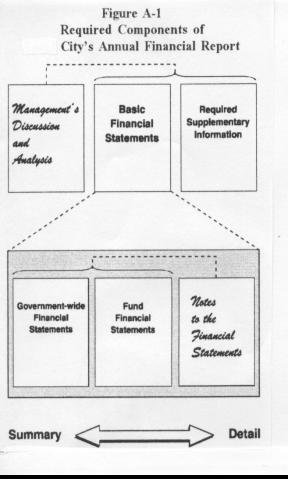
The financial statements also include notes that explain some of the information in the financial statements and provide more detailed data. The statements are followed by a section of required supplementary information that further explains and supports the information in the financial statements. Figure A-1 shows how the required parts of this annual report are arranged and are related to one another. In addition to these required elements, we have included a section with combining statements that provides details about our nonmajor governmental funds and internal service funds, each of which is added together and presented in single columns in the basic financial statements. The individual internal service fund is also included, reflecting balances prior to their elimination from the government wide financial statements, to avoid a “doubling-up” effect within the governmental and business-type activities columns of said statements.
The government-wide financial statements (statement of net position and statement of activities found on pages (54-55) are designed in a manner similar to a private-sector business in that all governmental and business-type activities are presented in separate columns which add to a total for the Primary Government. Fiduciary funds are not included in the government-wide statements.
The focus of the Statement of Net Position (the “Unrestricted Net Position”) is on governmental and business-type activities of the City. This statement combines and consolidates governmental funds’ current financial resources (short-term spendable resources) with capital assets, including infrastructure, and long-term obligations. Net position is the difference between the City’s assets and deferred outflows and its liabilities and deferred inflows. Increases or decreases in net position may serve as a useful indicator of whether the financial position of the City is improving or deteriorating over time.
The Statement of Activities reflects the expenses of a given function, which are offset by program revenues. Program revenues are defined as charges for services, operating grants and contributions, and capital grants and contributions directly associated with a given function.
Governmental activities are supported by taxes and intergovernmental revenues whereas the businesstype activities are primarily supported by user fees and charges for services. The governmental activities of the City include general government, public safety, public works, community development, parks and recreation, and transportation. The business-type activities of the City reflect private sector type
operations (water and sewer, stormwater utility and golf course) where the fee for service typically covers all or most of the cost of operation, including depreciation.
Government resources are allocated to and accounted for in individual funds, based upon the purposes for which they are to be spent and the means by which spending activities are controlled. The accounts of the City are organized on the basis of funds, each of which is considered a separate accounting entity. The operations for each fund are accounted for with a separate set of self-balancing accounts that comprise its assets, liabilities, deferred inflows/outflows, fund balance, revenue, and expenditures or expenses, as appropriate.
The City’s funds are presented in separate fund financial statements. These funds are presented in a Governmental Fund Financial Statement and a Proprietary Fund (Business-type) Financial Statement and Fiduciary Fund Financial Statements. The City’s major funds are presented in separate columns on the fund financial statements. The funds that do not meet the criteria of a major fund are considered nonmajor funds and are combined into a single column on the fund financial statements.
The total columns on the Governmental Funds and Proprietary Funds (Business-type) Financial Statements (see pages 56-60) are not the same as the Governmental Activities column and the Business-type column on the Government-wide Financial Statements. The Governmental Funds Total column requires reconciliation because of the different measurement focus (current financial resources versus total economic resources) which is reflected on the page following each statement (see pages 57 and 59). The flow of current financial resources will reflect bond proceeds and interfund transfers as other financial sources as well as capital expenditures and bond principal payments as expenditures. The reconciliation will eliminate these transactions and incorporate the capital assets and long-term obligations (bonds and others) into the Governmental Activities column in the Government-wide Statements. The Proprietary Funds (Businesstype) total column requires reconciliation because the internal service fund is consolidated as part of the governmental activities, but a portion of the internal service funds is for business-type activities. This reconciliation is a result of the surplus elimination (see pages 60 and 62).
The City maintains two different types of proprietary funds. Enterprise funds are used to report the same functions presented as business-type activities in the government-wide financial statements. Internal service funds are an accounting device used to accumulate and allocate costs internally among the City’s various functions. The City uses internal service funds to account for its risk management and health insurance. Because these services predominantly benefit governmental rather than businesstype functions, they have been included within governmental activities in the government-wide financial statements.
Proprietary Fund Financial Statements (see pages 60-63), like government-wide financial statements, are prepared on the full accrual basis. Proprietary funds record both operating and nonoperating revenues and expenses. Operating revenues are those that are obtained from the operations of the proprietary fund.
The proprietary fund financial statements provide separate information for the utilities, stormwater and golf course operations, the utilities and stormwater funds are considered to be major funds of the City.
The notes provide additional information that is essential to a full understanding of the data provided in the government-wide and fund financial statements. The notes to the financial statements can be found on pages 69-139 of this report.
In addition to the basic financial statements and accompanying notes, this report also presents certain required supplementary information concerning the City of Tamarac’s progress in funding its obligation to provide pension benefits and other post-employment benefits to its employees and budgetary comparison schedules.
The combining statements referred to earlier in connection with non-major governmental funds are presented immediately following the required supplementary information. Combining and individual fund statements and schedules can be found beginning on page 160 of this report.
The Government-wide Financial Statements were designed so that the user can determine if the City is in a better or worse financial condition from the prior fiscal year. The City’s overall financial condition improved during fiscal year 2025, as evidenced by the $30.7 million increase in total net position. Growth in governmental and business-type activities reflects sustained revenue performance and disciplined expenditure management.
As of September 30, 2025, the City’s total net position was approximately $494.7 million, reflecting the City’s overall financial condition on a government-wide basis, compared to $465.4 million at September 30, 2024. Governmental activities accounted for approximately $307.3 million, while business-type activities accounted for approximately $187.5 million of total net position.
City of Tamarac, Florida
Summary Schedule of Net position (in millions)
Note: Amounts are presented in millions and rounded to the nearest tenth. Totals may not add due to rounding. Amounts reconcile to the Government-wide Statement of Net Position.
The Summary Schedule of Net Position presents the City’s financial position on a government-wide basis as of September 30, 2025. Total net position was $494.7 million, reflecting an increase of approximately $30.7 million from the beginning of the fiscal year, as restated. The City’s net position is heavily concentrated in net investment in capital assets, (see the Statement of Net Position on page 54 and see Note 5 - Capital Assets, on pages 95-96) reflecting long-term investment in infrastructure such as roadways, public safety facilities, parks, utilities, and stormwater systems. Restricted net position represents resources restricted for specific purposes, including public safety, debt service, and capital projects. Unrestricted net position represents the portion available to support ongoing operations.
During fiscal year 2025, capital asset additions included roadway resurfacing, park improvements, water system upgrades, stormwater infrastructure enhancements, fiber network expansion, and security technology improvements. These investments support the City’s long-term infrastructure maintenance strategy and enhance the reliability and quality of services provided to residents. Depreciation and amortization expense totaled $11.8 million for fiscal year 2025, including $6.4 million related to governmental activities and $5.4 million related to business-type activities.
Net investment in capital assets represents the City’s capital assets, net of accumulated depreciation, reduced by outstanding debt attributable to the acquisition, construction, or improvement of those assets. Although these assets provide essential services to the community, the resources needed to repay the associated debt must be provided from other revenue sources, since the capital assets themselves cannot be used to liquidate these liabilities.
At the end of the current fiscal year, the City of Tamarac reported positive balances in all three categories of net position, for the government as a whole and for business-type activities. The same situation held
true for the prior fiscal year. Maintaining a positive net position overall is an indication that the government is not spending down all of its available resources and is able to fund future temporary shortfalls or emergencies.
The following table compares the Revenues and Expenses for the current and prior fiscal years. City
Tamarac, Florida
Note: Beginning net position reflects restatement related to the implementation of GASB Statement No. 101. Amounts reconcile to the Government-wide Statement of Activities.
The Summary Schedule of Changes in Net Position summarizes the results of the City’s operations for fiscal year 2025. Total government-wide revenues were $171.4 million, while total expenses were $140.7 million, resulting in an increase in net position of $30.7 million before transfers. Governmental activities generated a $22.6 million increase in net position, reflecting higher property tax revenues and investment income,
while business-type activities generated a $8.1 million increase. This increase reflects the relationship between revenues generated during the year and the cost of providing governmental and business-type services. These results reflect disciplined fiscal management and continued investment in essential City services and infrastructure. These investments support the City’s long-term service delivery goals and enhance the infrastructure necessary to support continued residential and commercial growth.
The City’s restricted net position increased by $10.1 million during the current year due to commitments for capital projects.
The City’s unrestricted net position increased by $1.9 million during the current fiscal year due to the net results of activities.
Net position for governmental activities increased by approximately $22.6 million, during fiscal year 2025. This increase was driven primarily by increases in revenue resulting from higher taxable property values, stable intergovernmental revenues, and strong investment earnings. The City continues to monitor economic conditions, including inflationary pressures and personnel costs, while maintaining prudent financial management practices to ensure long-term fiscal sustainability.
• Property tax revenue growth, resulting from higher taxable assessed values and new construction activity.
• Stable intergovernmental revenues, reflecting predictable shared revenue streams.
• Investment income growth, attributable to higher interest rates and improved market performance.
These positive trends were partially offset by increases in public safety and personnel-related costs, including pension and OPEB expenses, and inflationary pressures in operating and contractual services
The following is a chart of revenues by source of governmental activities by percent of total revenues.
Government-wide revenues for fiscal year 2025 totaled approximately $171.4 million, an increase compared to the prior fiscal year. Revenues are derived from both program revenues, which are directly associated with specific functions and services, and general revenues, which support overall governmental operations.
Program revenues consist primarily of charges for services and operating and capital grants. Charges for services increased during fiscal year 2025, reflecting higher service activity levels and rate adjustments in certain enterprise operations. Operating and capital grants remained relatively consistent with the prior year.
General revenues include property taxes, intergovernmental revenues not restricted to specific programs, franchise fees, utility taxes, and investment income. Property tax revenues increased primarily due to growth in taxable assessed values and new construction. Intergovernmental revenues remained stable at approximately $10.3 million.
Investment income is reported as a general revenue and is not included in program revenues. For fiscal year 2025, total investment income was approximately $14.1 million, consisting of $9.4 million attributable to governmental activities and $4.7 million attributable to business-type activities. Investment income exceeded prior year levels primarily due to higher short-term interest rates and improved yields on the City’s investment portfolio during the fiscal year.
The City’s governmental activities expenses cover a range of services with 54.8% related to public safety. The expenses for governmental activities increased by $14.8 million to $100.5 million. This is a 17.3% increase compared to 2024.
Expenses also increased, primarily due to higher personnel-related costs and inflationary pressures impacting operations. These cost increases affected multiple departments.
There was an increase of $1.9 million in the expenses for general government. Governmental activities expenses increased across most functional areas in fiscal year 2025 and were driven primarily by pensionrelated costs, the City-wide cost-of-living adjustment (COLA), and rising insurance and operating costs.
General government expenses reported in governmental activities increased by $1.9 million, or 8.9%, the increase reflects the impact of the City’s union agreements, including an 8 percent cost-of-living adjustment (COLA) for Fire Union and non-represented employees in 2025, as well as a 4 percent COLA under the General Employees’ union agreement, which resulted in overall increases to salaries. In addition, the City’s Health insurance cost increased by 18.9% resulting in the benefits increasing across City departments.
Public Safety expenses reported in governmental activities increased by $9.1 million, or 20.3%, in comparison to prior year. The key drivers included: an increase in the pension expense related to the net pension liability for the City’s pension plans as determined by actuaries and increases in the cost of
services, the effects of the (COLA) which resulted in an overall increase to the salaries and benefits to the City, and rising life and health insurance costs for Fire Department personnel.
Physical environment expenses reported in governmental activities increased by $0.7 million, 14.3%, compared to the prior year. The increase primarily reflects higher spending on landscaping, signage, and recycling initiatives supporting the City curb-appeal efforts. In addition, salary and benefit costs increased due to the fiscal year 2025 compensation adjustments, including the 8% COLA under the FIRE Union and Non- Represented agreements and the 4% COLA under the General Employees union agreement.
Culture and Recreation expenses reported in governmental activities increased by $0.7 million or 9.0% primarily due to the (COLA), which resulted in higher salaries and benefits across the City workforce.
Economic Environment expenses for governmental activities increased by $1.8 million, or approximately 90.0%, reflecting expanded economic development initiatives and related contractual services. This was due to an increase in Housing Grant programs and the recognition of an allowance expense related to loans in the State Affordable Housing Assistance fund. In addition, the remaining ARPA funds were used to provide housing assistance.
The following table presents the cost of each of the City’s various public services—public safety, general administration, economic environment, culture and recreation, physical environment, transportation and human services—as well as each service’s net cost (total cost less fees generated by the activities and intergovernmental aid). The net cost shows the financial burden on the City’s taxpayers by each of these services.
● The cost of all governmental activities this year was $100.5 million. Some of that cost was financed by:
○ Those who directly benefited from the programs through charges for services $33.4 million, and
○ Other governments and organizations that subsidized certain programs from operating and capital grants and contributions $3.3 million.
● The remaining net cost of services or “public benefit” of governmental services were financed with $86.3 million in taxes, franchise fees, unrestricted intergovernmental revenues and other revenues.
The business-type activities net position increased by $8.0 million from the prior fiscal year. Revenues of the City’s business-type activities increased by 8.0% to $48.4 million. Expenses increased by $2.0 million to $40.2 million (see Summary of Changes in Net Position on page 42).
The following chart shows the City’s revenues by source for business-type activities.
Revenues by Source - Business-type Activities
Business-type activities including utilities, stormwater operations, and the Colony West Golf Course, generated total revenues of $48.4 million during fiscal year 2025. Charges for services accounted for $43.4 million, of total program revenues, a $3.9 million or 9.9% increase compared to the previous year. Total expenses were $40.2 million, resulting in an increase in net position of $8.1 million. Utility operations remained financially stable and continued to recover operating costs, capital reinvestment, and debt service through user charges. The increase in net position reflects steady rate structures, strong investment earnings, and controlled operating expenditures.
Expenses by Program - Business-type Activities
Water and sewer expenses reported in business-type activities increased by 8.8% to $29.7 million in the current fiscal year, in comparison to the prior year due primarily due to an increase in the salaries & wages, intergovernmental capital grants for generators, and a lower contribution for subdivers cost.
Stormwater expenses were $5.9 million, a 9.2% decrease from prior year, in which the main drivers were the improvements to the drainage system, the debt service interest expense for the 2016A Bond, and overall increases to salaries and benefits as a result of the class and compensation study.
Colony West Golf Course Fund expenses were $4.6 million, a 4.5% increase compared to the prior year due primarily to debt service costs associated with the interfund loan from the stormwater fund to the Colony West Golf Course Fund.
The focus of the City’s Governmental Funds is to provide information on near-term inflows, outflows, and balances of spendable resources. Such information is useful in assessing the City’s financing requirements. In particular, unassigned fund balance may serve as a useful measure of a government’s net resources available for spending at the end of the fiscal year.
As the City completed the year, its governmental funds reported combined fund balances of $193.3 million, a $8.8 million increase compared to last year’s combined fund balances of $184.5 million. The primary reasons for these changes in fund balances are as follows:
The fund balance of the General Fund decreased by $6.3 million, ending the year at $73.6 million. The decrease was primarily driven by stronger recurring revenues (notably property tax collections and other general revenues) and continued positive investment earnings, partially offset by higher operating costs, particularly personnel-related costs and contractual services.
Fire Rescue Fund: The Fire Rescue Fund’s fund balance decreased by $3.6 to $4.5 million. The change was primarily attributable to the relationship between the fund’s dedicated revenues and current-year public safety expenditures, including personnel and operating costs.
General Capital Projects Fund: The General Capital Projects Fund’s fund balance increased by $10.5 million to $38.2 million. The increase was driven largely by transfers in supporting capital activity and the timing of capital expenditures relative to revenues and funding sources.
Tamarac Village Fund: The Tamarac Village Fund’s fund balance increased by $1.8 to $25.3 million. The increase was supported by investment income and other revenues, along with transfers in, and was partially offset by debt service activity (principal and interest) and related expenditures.
Over the course of the year, the City amended the General Fund budget two times. Budget amendments fall into two categories: (1) Amendments are approved for prior year encumbrances; and (2) supplemental appropriations to recognize and appropriate grant revenues which were received after the adoption of the budget, and to provide appropriations for various other needs which had arisen since the adoption of the budget. Even with these adjustments, actual expenditures were $6.8 million below final budgeted amounts. The most significant contributor to this variance was various departmental savings due to staff vacancies and control over operating expenditures.
The fiscal year 2025 amended final budget of $105.8 million increased from the original General Fund budget of $100.6 million by $5.2 million primarily due to increases in capital projects costs, and land purchases and budgeting for developer contributions and contractor related donations. With base revenues of $105.8 million the Adopted Budget is balanced. The final General Fund budget consisted of $71.8 million base expenditures, $33.2 million in operating transfers to the other funds and $0.75 million of contingencies.
The City’s net investment in capital assets for its governmental and business-type activities as of September 30, 2025 amounts to $244.8 million (net of accumulated depreciation), or a 6.2% increase, in comparison to the prior year.
Additional information on the City’s capital assets can be found on pages 95-96 of this report.
At year-end, the City had $51.1 million in bonds notes, leases and SBITAs outstanding, a decrease of $5 million from last year as shown in the following table. Revenue bonds and notes are backed by budgeted appropriations and fee revenues. The debt position of the City is summarized below:
Outstanding
(in millions)
In 2025, the city affirmed its rating for its General Obligation Bonds credit rating to AA+, affirmed the Capital Improvement Revenue (2013 & 2018) rating of AA-, affirmed the Stormwater System Revenue Note credit rating of AA+, and affirmed the City’s Water and Sewer Utility Revenue Bonds credit rating of AA+. These ratings reflect the strong financial position, a low debt burden and low operating risk. The following table shows the latest ratings for the City by the major rating agencies.
General Obligation Bonds
Underlying
Capital Improvement Revenue (2013 & 2018)
Underlying
Water & Sewer Revenue
Underlying
Assessment Revenue
Additional information on the City of Tamarac’s long-term debt can be found in Note 10 beginning on page 105 of this report.
The City’s financial performance during fiscal year 2025 continued to be influenced by broader economic conditions, most notably inflationary pressures affecting labor, materials, and contractual services. The fiscal year 2026 budget process was initiated amid a declining inflationary environment. However, global economic challenges persist, including high prices for gas, diesel fuel, and food, as well as ongoing supply chain disruptions stemming from pandemic-related product shortages. Despite these challenges, the City successfully maintains its millage rate to a stable 7.0000 mills.
According to the U.S. Bureau of Labor Statistics, the unemployment rate for the Broward County area in September 2025 was 4.0%, up from 3.4% in September 2024. The largest sector of employment in Tamarac continues to be in the education and health services sector with the retail and manufacturing industry following. Together these industries account for almost one-third of the employment in the City.
The City relies primarily on property taxes and a limited array of permitted other taxes (sales, communication, gasoline, utility services, local business taxes etc.) and fees (franchise, building permits, etc.) for its governmental activities. There are a limited number of state-shared revenues and recurring and non-recurring (one-time) grants from both the state and federal governments. For the business-type and certain governmental activities (building inspections, recreational programs, etc.) the user pays a related fee or charge associated with the service.
The operating millage for fiscal year 2025 was 7.0000 mills per thousand dollars of taxable value and the rate remained the same for fiscal year 2024. Taxable assessed value increased by 20.8% in the calendar year 2025. The total taxable assessed property value in Tamarac was $4,426,234,361, $4,748,952,933, $5,332,804,719, $5,925,235,436 and $6,565,372,553 in calendar years 2019, 2020, 2021, 2022 and 2023 and for fiscal years 2020, 2021, 2022, 2023 and 2024, respectively. The total taxable assessed value from calendar year 2020 through calendar year 2024, and for fiscal year 2021 through fiscal year 2025, increased by 48.33%. These assessed values continue to increase each year.
Revenues by Source - Business-type Activities
Overall, the adopted budget is an economical and prudent financial plan that will ensure quality public services and needed capital improvements for both today and in the future. Fiscal year 2026 budgeted expenditures and transfers for the General Fund are expected to be $115.9 million, which is $15.3 million or 15.25%, higher than fiscal year 2025 amended budget of $100.4 million. In developing the budget, the primary economic factors considered were revenue growth and the cost of providing existing services.
The City’s financial statements are designed to present users (citizens, taxpayers, customers, investors, and creditors) with a general overview of the City’s finances and to demonstrate the City’s accountability. For questions concerning any information contained in this report or for additional financial information, contact the Financial Services Department, 7525 NW 88th Avenue, Tamarac, Florida 33321.
This page Intentionally left blank
CITY OF TAMARAC, FLORIDA STATEMENT OF NET POSITION SEPTEMBER 30, 2025
The notes to the financial statements are an integral part of this statement.
CITY OF TAMARAC, FLORIDA
STATEMENT OF ACTIVITIES FOR THE YEAR ENDED SEPTEMBER 30, 2025
The notes to the financial statements are an integral part of this statement.
CITY OF TAMARAC, FLORIDA
SEPTEMBER 30, 2025
The notes to the financial statements are an integral part of this statement.
RECONCILIATION OF THE BALANCE SHEET TO THE STATEMENT OF NET POSITION GOVERNMENTAL FUNDS
SEPTEMBER 30, 2025
Fund balances - total government funds $ 193,292,440
Amounts reported for governmental activities in the statement of net position are different because:
Capital assets used in governmental activities are not financial resources and therefore are not reported in the governmental funds. Governmental capital
142,500,070
Other long-term assets are not available to pay for current period expenditures and are therefore reported as unavailable revenue in the funds. 1,185,016
Net pension assets/liabilities of the police, fire, non-represented and general employees pension plans are not reported in the funds as they are not due and payable in the current period and are therefore not reported in the governmental funds.
Net pension asset 24,270,267
Other long-term liabilities, including bonds payable, are not due and payable in the current period and therefore are not reported in the governmental funds.
Governmental bonds, notes, subscriptions and leases payable (31,079,755) Parking lot remediation liability (260,800) (31,340,555) Deferred outflows of resources related to pensions 7,616,807 Deferred inflows of resources related to pensions (19,698,111)
(7,041,455) Internal service fund is used by management to charge the costs of certain activities to individual funds. The assets and liabilities of the internal service funds are included in governmental activities in the statement of net position 2,528,412 Net position of governmental activities $ 307,309,767
The notes to the financial statements are an integral part of this statement.
CITY OF TAMARAC, FLORIDA
STATEMENT OF REVENUES, EXPENDITURES, AND CHANGES IN FUND BALANCES GOVERNMENTAL FUNDS FOR THE YEAR ENDED SEPTEMBER 30, 2025
The notes to the financial statements are an integral part of this statement.
RECONCILIATION OF THE STATEMENT OF REVENUES, EXPENDITURES, AND CHANGES IN FUND BALANCES OF GOVERNMENTAL FUNDS TO THE STATEMENT OF ACTIVITIES FOR THE YEAR ENDED SEPTEMBER 30, 2025
Amounts reported for governmental activities in the statement of activities are different because:
Net change in fund balances - total government funds $ 8,817,176
Governmental funds report capital outlays as expenditures, however, in the statement of activities, the cost of those assets is depreciated over their estimated useful lives.
Expenditures for capital outlays and right to use assets 14,554,323
Less current year depreciation (6,426,403) 8,127,920
Revenues that are not received within the City’s availability period are recognized in the statement of activities when earned and subsequently in the governmental fund financial statements when they become available. The net difference is recorded as a reconciling item.
Ambulance transport fees (61,599)
Issuance of long term debt (e.g. bonds and leases) provide current financial resources to governmental funds, but issuing debt increases long-term liabilities in the statement of net position.Repayment of principal is an expenditure in the governmental funds, but the repayment reduces long-term liabilities in the statement of net position.
from financing related to subscription
Some expenses reported in the statement of activities do not require the use of current financial resources and therefore are not reported as expenditures in governmental funds: Compensated absences (1,808,877)
4,050,787
Amortization of deferred charges on refunding (96,428) (1,763,943)
Revenues in the statement of activities that do not provide current financial resources are not reported as revenues in funds:
The net effect of pension and retirement contributions and expense is to increase (decrease) net position. 3,829,545
The net effect of other post employment contributions and expense is to increase (decrease) net position. (556,213)
Internal service funds are used by management to charge the costs of certain activities to individual funds. The net revenue of certain activities in the internal service fund is reported with governmental activities. 215,077
Change in net position of governmental activities $ 22,658,750
The notes to the financial statements are an integral part of this statement.
CITY OF TAMARAC, FLORIDA
SEPTEMBER 30, 2025
CITY OF TAMARAC, FLORIDA
STATEMENT OF NET POSITION (continued) PROPRIETARY FUNDS
SEPTEMBER 30, 2025
Explanation of difference between proprietary funds statement of net position and the statement of net position
Internal service fund is used by management to charge the costs of certain activities, such as insurance, to individual funds. The portion attributable to business-type activities is reflected here and the residual assets and liabilities of the internal service fund are included in the governmental activities in the statement of net position.
The notes to the financial statements are an integral part of this statement.
CITY OF TAMARAC, FLORIDA STATEMENT OF REVENUES, EXPENSES AND CHANGES IN FUND NET POSITION PROPRIETARY FUNDS FOR THE YEAR ENDED SEPTEMBER 30, 2025
Explanation of difference between proprietary funds statement of revenues, expenses and changes in fund net position and the statement of activities
Internal service fund is used by management to charge the costs of certain activities, such as insurance, to individual funds. The portion attributable to business-type activities is reflected here and the residual assets and liabilities of the internal service fund are included in the governmental activities in the statement of net position. 44,052 $ 8,021,358
The notes to the financial statements are an integral part of this statement.
CITY OF TAMARAC, FLORIDA
STATEMENT OF CASH FLOWS PROPRIETARY FUNDS
FOR THE YEAR ENDED SEPTEMBER 30, 2025
Reconciliation of operating income (loss) to net cash provided by (used in) operating activities
Adjustments to reconcile operating income (loss) to net cash provided by (used in) operating activities
Change in assets and liabilities and deferred inflows/outflows Decrease
investing, capital and financing activities
CITY OF TAMARAC, FLORIDA
STATEMENT OF CASH FLOWS (continued) PROPRIETARY FUNDS FOR THE YEAR ENDED SEPTEMBER 30, 2025
The notes to the financial statements are an integral part of this statement.
CITY OF TAMARAC, FLORIDA
STATEMENT
FIDUCIARY FUNDS
SEPTEMBER 30, 2025
Additions
Deductions
CITY OF TAMARAC, FLORIDA
STATEMENT OF CHANGES IN FIDUCIARY NET POSITION FIDUCIARY FUNDS FOR THE YEAR ENDED SEPTEMBER 30, 2025
The notes to the financial statements are an integral part of this statement.
CITY OF TAMARAC, FLORIDA • SEPTEMBER 30, 2025
This page Intentionally left blank
September 30, 2025
The City of Tamarac, Florida (the “City”) was incorporated in 1963 and is a political subdivision of the State of Florida located in northwestern Broward County. The legal authority by which the City was created and is governed by its charter, which was derived from Ordinance No. 76-4, adopted Jan. 8, 1976, as amended. The City operates under a Commission-Manager form of government, with the legislative function being vested in a five-member commission. The City Commission is governed by the City Charter and by state and local laws and regulations. The City Commission is responsible for establishment and adoption of policy. The City provides the following range of municipal services authorized by its charter: public safety (Police and Fire), highways and streets, sanitation, health and social services, culture, recreation, bus transportation, planning and zoning, water and sewer, stormwater utility services and general administrative services.
The accounting policies of the City conform to Generally Accepted Accounting Principles in the United States of America (GAAP) as applicable to governments. The Governmental Accounting Standards Board (GASB) is the standard-setting body for governmental accounting and financial reporting.
The financial statements were prepared in accordance with GASB requirements, which establishes standards for defining and reporting on the financial reporting entity. The definition of the financial reporting entity is based upon the concept that elected officials are accountable to their constituents for their actions. One of the objectives of financial reporting is to provide users of financial statements with a basis for assessing the accountability of the elected officials. The financial reporting entity consists of the primary government, organizations for which the primary government is financially accountable and other organizations for which the nature and significance of their relationship with the primary government are such that exclusion would cause the reporting entity’s financial statements to be misleading or incomplete. The City is financially accountable for a component unit if it appoints a voting majority of the organization’s governing board and it is able to impose its will on that organization or there is a potential for the organization to provide specific financial benefits to, or impose specific financial burdens on the City. The City reports the pension trust funds as fiduciary component units in these financial statements. These pension trust funds are further discussed in Note 14 - Employee Retirement Systems and Pension Plans.
The government-wide financial statements (i.e., the statement of net position and the statement of activities) report information on all of the non-fiduciary activities of the primary government. The effect of interfund activity has been removed from these statements. Governmental activities, which normally are supported by taxes and intergovernmental revenues, are reported separately from business-type activities, which rely to a significant extent on fees and charges for support.
The statement of activities demonstrates the degree to which the direct expenses of a given function or segment are offset by program revenues. Direct expenses are those that are clearly identifiable with a specific function or segment. Program revenues include 1) charges to customers or applicants who purchase, use, or directly benefit from goods, services, or privileges provided by a given function or segment and 2) grants and contributions that are restricted to meeting the operational or capital requirements of a particular function or segment. Taxes and other items not properly included among program revenues are reported instead as general revenues. Separate financial statements are provided for governmental funds, proprietary funds, and fiduciary funds, even though the latter are excluded from the government-wide financial statements. Major individual governmental funds and major individual enterprise funds are reported as separate columns in the fund financial statements.
The government-wide financial statements are reported using the economic resources measurement focus and the accrual basis of accounting, as are the proprietary fund and fiduciary fund financial statements. Revenues are recorded when earned and expenses are recorded when a liability is incurred, regardless of the timing of related cash flows. Property taxes are recognized as revenues in the year for which they are levied. Grants and similar items are recognized as revenue as soon as all eligibility requirements imposed by the provider have been met.
Governmental fund financial statements are reported using the current financial resources measurement focus and the modified accrual basis of accounting. Revenues are recognized as soon as they are both measurable and available. Revenues are considered to be available when they are collectible within the current period or soon enough thereafter to pay liabilities of the current period. For this purpose, the City considers most revenues to be available if they are collected within 60 days. Expenditure-driven grants are recognized as revenue when the qualifying expenditure has been incurred and all other eligibility requirements have been met, and the amount is received during the period or within the availability period of the revenue source (within nine (9) months of year-end). All other revenue items are considered to be measurable only when cash is received by the government. Expenditures generally are recorded when a liability is incurred, as under accrual accounting. However, debt service expenditures, as well as expenditures related to compensated absences, pension costs, other post-employment benefits, leases, SBITAs and claims and judgments are recorded only when payment is made.
Property taxes, sales taxes, utility taxes, franchise fees, licenses, intergovernmental revenues and interest associated with the current fiscal period are all considered to be susceptible to accrual and so have been recognized as revenues of the current fiscal period. Only the portion of special assessments receivable due within the current fiscal period are considered to be susceptible to accrual as revenue of the current period.
Accounting principles generally accepted in the United States of America set forth minimum criteria (percentage of the assets, deferred outflows, liabilities, deferred inflows, revenue, or expenditures/ expenses of the applicable fund category and the governmental and enterprise combined) for the determination of major funds. The nonmajor funds are presented in one column in the respective fund financial statements.
The City reports the following major governmental funds:
● The General Fund is the City’s primary operating fund. It accounts for all financial resources of the general government, except those required to be accounted for in another fund.
● The Fire Rescue Special Revenue Fund accounts for revenue sources that are legally restricted for fire rescue purposes, including but not limited to Fire Rescue Assessments, EMS fees, transfers from General Fund and other miscellaneous revenues.
● The General Capital Projects Fund accounts for the construction of major capital projects other than those financed by the proprietary funds.
● The Tamarac Village Capital Projects Fund accounts for the proceeds from the 2016 Line of Credit used for various land acquisition projects related to the Tamarac Village Project.
The City reports the following major proprietary funds:
● The Utilities Fund is used to account for the provision of water and sewer services both internal and external to the City.
● The Stormwater Management Fund is used to account for the provision of stormwater maintenance and capital improvements within the City.
Additionally, the government reports the following fund types:
● Debt Service Fund accounts for resources accumulated and payments made for principal and interest on longterm debt, other than bonds which are payable from proprietary funds.
● Special Revenue Funds account for resources that are legally restricted to expenditures for specific purposes.
● Capital Project Funds account for the construction of major capital improvements other than those financed by the proprietary funds.
● Internal Service Funds are used to account for the financing of insurance services provided to other funds of the City on a cost reimbursement basis.
● Pension Trust Funds include the General Employee’s Pension Fund, the Police Officers’ Pension Fund, the Firefighters’ Pension Fund, and the Elected and Appointed and Non-Represented Employees’ Pension Fund, which all account for the accumulation of resources to be used for retirement benefit payments to the City’s employees, Elected Officials, Police Officers and Firefighters.
● Custodial Fund is used to account for the City’s collection of the solid waste fees on behalf of the operator. These fees are remitted to Waste Management Inc. and Win Waste Innovators (formerly known as Wheelabrator Inc.). Tipping fees are remitted to the operators’ net of the City’s Franchise Fee revenue.
As a general rule, the effect of interfund activity has been eliminated from the government-wide financial statements. Exceptions to this general rule are payments-in-lieu of taxes and interfund service payments between the City’s utilities function and various other functions of the City. Elimination of these charges would distort the direct costs and program revenues reported for the various functions concerned.
Amounts reported as program revenues include 1) charges to customers or applicants for goods, services, or privileges provided, 2) operating grants and contributions, and 3) capital grants and contributions, including special assessments. Internally dedicated resources are reported as general revenues rather than as program revenues. Likewise, general revenues include all taxes, whose purpose has not been restricted to a specific program.
Proprietary funds distinguish operating revenues and expenses from nonoperating items. Operating revenues and expenses generally result from providing services and producing and delivering goods in connection with a proprietary fund’s principal ongoing operations. The principal operating revenues of the City’s utilities, stormwater and golf course enterprise funds are charges to customers for services. Operating expenses for enterprise funds and internal service funds include the cost of services, administrative expenses, and depreciation on capital assets. All revenues and expenses not meeting this definition are reported as non-operating revenues and expenses.
When both restricted and unrestricted resources are available for use, it is the City’s policy to use restricted resources first to the extent possible, then unrestricted resources as necessary.
Cash and cash equivalents include cash on hand, investments with Florida Prime and Florida Surplus Asset Fund Trust (FLSAFE) investment pools (Securities and Exchange Commission Rule 2A-7 like Pool) and investments with a maturity of three months or less. Resources of all funds, with the exception of the pension trust funds, and certain other cash and investment accounts, have been combined into a pooled cash and investment system for the purpose of maximizing earnings. Interest earned on pooled cash and investments is allocated monthly based upon equity balances of the respective funds. Each funds’ equity in pooled investments is calculated based on the funds’ pro rata share of equity in pooled cash. The Director of Financial Services for the City of Tamarac is a member of the FLSAFE Board of Trustees. The Florida Prime was created by section 218.405, Florida Statutes and FLSAFE was created pursuant to Florida Statute 163.01 and 218.415. The investment pools operate under investment guidelines established by Section 215.47, Florida Statutes and are reported at net asset value.
For the purpose of the statement of cash flows for the proprietary fund types, cash and cash equivalents mean short term, highly liquid investments with an original maturity of three months or less.
2. Investments
The City’s investments are reported at fair value which is the amount a financial instrument could be exchanged for in a current transaction between willing parties at the measurement date. Generally, these are quoted market prices. Investments, including restricted investments, consist of mutual funds, U.S. Government securities, corporate debt and equity securities, mortgage-backed securities, asset-backed securities and securities of governmental agencies unconditionally guaranteed by the U.S. Government. Investments with Local Government Investment Pools (LIGP) are recorded at net asset value (NAV) per share. This method of determining fair value uses member units to which a proportionate share of net asset is attributed. Investments are categorized according to fair value, the hierarchy is based on the valuation input used to measure the fair value of the asset with Level 1 assets being those where quoted
prices in an active market for identical assets can be readily obtained, Level 2 assets are valued using a matrix pricing technique of quoted prices for similar assets or liabilities in active markets, and Level 3 assets valued using significant unobservable inputs.
Activities between funds that are representative of lending/borrowing arrangements outstanding at the end of the fiscal year are referred to as either “due to/from other funds” or “advances to/from other funds. Any balances outstanding between the governmental activities and business-type activities are reported in the government-wide financial statements as “internal balances.”
All trade and other receivables are shown net of allowance for uncollectibles. In addition to those receivables specifically identified as uncollectible, a general allowance is calculated based on the City’s historic bad-debt experience. Long-term receivables are analyzed for their collectability based on the terms and conditions of the agreements.
The costs of inventories, consisting primarily of expendable supplies held for consumption and assets held for resale, are recorded as expenditures when consumed rather than when purchased. The City’s utilities departments maintain inventories for parts needs for line maintenance and the Golf Course maintains an inventory of equipment. The Community Development Department holds inventory of real property for rehabilitation and resale which is reported at lower of cost or net realizable value (market value).
The City has acquired and developed property with the intention of rendering the property suitable for economic development and then reselling it to private sector purchasers meeting certain criteria. Since these properties are acquired with the express intent of resale and development, they are reported at lower of cost or net realizable value.
Certain payments to vendors reflect costs applicable to future accounting periods and are recorded as prepaid items or deferred charges in both government-wide and fund financial statements. Payments for services that benefit future periods are recorded as prepaid expenses in accordance with the consumption method.
Certain proceeds from revenue refunding bonds, as well as other monies as required by several bond indentures, are classified as restricted assets in the government-wide and proprietary fund statement of net position. Restricted assets are not presented on the balance sheet of the governmental funds; however, fund balance of these funds are restricted as to use, when applicable.
Capital assets, which include land, intangibles, building and improvements, improvements other than buildings, equipment and infrastructure assets (e.g., roads, sidewalks, stormwater culverts, pump stations, water and sewer lines, light poles, catch basins, and similar items), are reported in the applicable governmental or business-type activities columns in the government-wide financial statements. Capital
assets are defined by the City as assets with an estimated useful life in excess of one year and cost at, or exceeding $5,000 for equipment, vehicles, buildings and $50,000 for infrastructure. Such assets are recorded at historical cost or estimated cost if actual historical cost is unavailable except for intangible right- to-use lease assets, the measurement of which is discussed in note E.12. below. Donated capital assets are recorded at acquisition value on the date of donation.
The costs of normal maintenance and repairs that do not add to the value of the asset or materially extend asset lives are not capitalized, they are expensed as incurred.
Capital assets are depreciated using the straight-line method over the following estimated useful lives:
In addition to assets, the statement of financial position will periodically report a separate section for deferred outflows of resources. This separate financial statement element, deferred outflows of resources, represents a consumption of net assets that applies to a future period(s) and so will not be recognized as an outflow of resources (expense/expenditure) until then. The City has three items that qualify for reporting in this category. A deferred charge on a debt refunding is reported in the government-wide and proprietary fund statement of net position. A deferred charge on a debt refunding results from the difference in the carrying value of refunded debt and its reacquisition price. This amount is deferred and amortized over the shorter of the life of the refunded or refunding debt. The City reports deferred outflows from pensions which are further described in Note 14 and deferred outflows related to OPEB, which is further described in Note 15.
In addition to liabilities, the statement of financial position will periodically report a separate section for deferred inflows of resources. This separate financial statement element, deferred inflows of resources, represents an acquisition of net assets that applies to a future period(s) and so will not be recognized as an inflow of resources (revenue) until that time. The City has deferred inflows from leases, which is further described in Note 7, deferred inflows related to pensions, which is further described in Note 14 and deferred inflows related to OPEB, which is further described in Note 15.
Additionally, unavailable revenue (a deferred inflow of resources) is recorded for governmental fund receivables that are not available. For this purpose, the City considers revenues to be available if they are collected within 60 days of fiscal year end.
Unearned revenue represents inflows that do not yet meet the criteria for revenue recognition and are recorded as unearned revenue in the government-wide and the fund statements.
The City provides various forms of compensated absences to its employees, including vacation, sick leave and other forms of paid time off in accordance with the City’s personnel policies and applicable collective bargaining agreements.
The City accounts for compensated absences in accordance with GASB Statement No. 101, Compensated Absences. Under this guidance, a liability for compensated absences is recognized when all of the following criteria are met:
● The leave is attributable to services already rendered by employees;
● The leave accumulates and may be carried forward to future reporting periods; and
● It is more likely than not that the leave will either be used for time off or otherwise paid or settled (for example, through cash payment upon separation or conversion to other benefits).
Compensated absences that meet these criteria are measured at the employees’ rates of pay in effect as of the reporting date, plus salary-related payments that are directly associated with the leave (such as payroll tax amounts) to the extent those amounts are applicable. Amounts that do not meet the recognition criteria above (for example, non-accumulating leave or leave that is not more likely than not to be used or paid) are recognized as expense in the period the leave is taken.
For government-wide and proprietary fund financial statements, the City records a liability for compensated absences for the total amount of leave that is expected to be used or paid in the future. In the governmental fund financial statements, compensated absences are recorded as expenditures and liabilities to the extent they are expected to be liquidated with expendable available financial resources, generally when leave is used or when termination or retirement payments become due.
In the government-wide financial statements and proprietary fund types in the fund financial statements, long-term debt and other long-term obligations are reported as liabilities in the applicable governmental activities, business-type activities, and proprietary fund type statement of net position. In the governmentwide financial statements and proprietary funds, bond premiums and discounts are amortized over the life of the bonds using the straight-line method, which does not result in a material difference from the effective interest method. Bonds payable are reported net of the applicable bond premium or discount.
In the fund financial statements, governmental fund types recognize bond premiums and discounts, as well as bond issuance costs, during the current period. The face amount of debt issued is reported as
other financing resources. Premiums received on debt issuances are reported as other financing sources, while discounts on debt issuances are reported as other financing uses. Issuance costs, whether or not withheld from the actual debt proceeds received, and payments of principal and interest are reported as debt service expenditures.
In the fund financial statements, governmental funds report fund classifications that comprise a hierarchy based primarily on the extent to which the City is bound to honor constraints on the specific purposes for which amounts in those funds can be spent. Amounts that are restricted to specific purposes either by a) constraints placed on the use of resources by creditors, grantors, contributors, or laws and/or regulations of other governments or b) imposed by law through constitutional provisions or enabling legislation are classified as restricted fund balances. Amounts that can only be used for specific purposes pursuant to constraints imposed by the City Commission through an ordinance or resolution are classified as committed fund balances. Amounts that are constrained by the City’s intent to be used for specific purposes but are neither restricted nor committed are classified as assigned fund balances. Non-spendable fund balances include amounts that cannot be spent because they are either (a) not in spendable form or (b) legally or contractually required to be maintained intact. Unassigned fund balance represents fund balance that has not been assigned to other funds and that has not been restricted, committed, or assigned to specific purposes within the general fund. In all other funds, unassigned is limited to negative residual fund balance.
Net position of the government-wide and proprietary funds are categorized as invested in capital assets net of related debt, reduced by accumulated depreciation and any outstanding debt incurred to acquire, construct or improve those assets excluding unexpended bond proceeds. The first category represents net investment in capital assets such as, property, plant, equipment and infrastructure. The restricted category represents the balance of assets restricted by requirements of revenue bonds and other externally imposed constraints or by legislation in excess of the related liabilities payable from restricted assets. Unrestricted consists of the net position balance that do not meet the definition of either of the other two components.
When an expenditure is incurred for purposes for which both restricted and unrestricted fund balance are available, the City considers restricted funds, to the extent possible, to have been spent first. When an expenditure is incurred for which committed, assigned, or unassigned fund balance are available, the City considers amounts to have been spent first out of committed funds, then assigned and finally unassigned funds as needed, unless the City Commission has provided otherwise in its commitment or assignment options. The City Commission, which is the highest level of decision making authority, commits funds via formal action through adoption of a Resolution or Ordinance (which are equally binding as the highest decision making authority). Once adopted, the limitations imposed by such Resolution or Ordinance can only be removed or revised by a similar action. Subsequent to the City Commission action, the Mayor or City Manager or designee depending on the agreement is authorized to contract and sign agreements that are legally binding; these funds are considered commitments for fund balance classification purposes. The City Commission also assigns funds via Resolution or Ordinance which requires a majority vote of the City Commission, however, unlike commitments an additional action does not normally have to be taken to remove an assignment.
Lessee: The City is a lessee for various leases of equipment, and other assets. The City recognizes a lease liability and an intangible right-to-use lease asset (lease asset) in the government-wide financial statements. The City recognizes lease liabilities with an initial, individual value of $5,000 or more.
At the commencement of a lease, the City initially measures the lease liability at the present value of payments expected to be made during the lease term. Subsequently, the lease liability is reduced by the principal portion of lease payments made. The lease asset is initially measured as the initial amount of the lease liability, adjusted for lease payments made at or before the lease commencement date, plus certain initial direct costs. Subsequently, the lease asset is amortized on a straight-line basis over the shorter of it’s useful life or lease term.
Key estimates and judgments related to leases include how the City determines (1) the discount rate it uses to discount the expected lease payments to present value, (2) lease term, and (3) lease payments.
● The City uses the interest rate charged by the lessor as the discount rate. When the interest rate charged by the lessor is not provided, the City generally uses its estimated incremental borrowing rate as the discount rate for leases.
● The lease term includes the noncancellable period of the lease. Lease payments included in the measurement of the lease liability are composed of fixed payments and purchase option price that the City is reasonably certain to exercise.
● Lease payments included in the measurement of the lease liability are composed of fixed payments and purchase option price that the City is reasonably certain to exercise.
The City monitors changes in circumstances that would require a remeasurement of its lease and will remeasure the lease asset and liability if certain changes occur that are expected to significantly affect the amount of the lease liability.
Lease assets are reported with other capital assets and lease liabilities are reported with long-term debt on the statement of net position.
Lessor: The City is a lessor for various leases of land for cell phone towers. The City recognizes a lease receivable and a deferred inflow of resources in the government-wide and governmental fund financial statements.
At the commencement of a lease, the City initially measures the lease receivable at the present value of payments expected to be received during the lease term. Subsequently, the lease receivable is reduced by the principal portion of lease payments received. The deferred inflow of resources is initially measured as the initial amount of the lease receivable, adjusted for lease payments received at or before the lease commencement date. Subsequently, the deferred inflow of resources is recognized as revenue over the life of the lease term.
Key estimates and judgments include how the City determines (1) the discount rate it uses to discount the expected lease receipts to present value, (2) lease term, and (3) lease receipts.
● The City uses its estimated incremental borrowing rate as the discount rate for leases.
● The lease term includes the noncancellable period of the lease.
● Lease receipts included in the measurement of the lease receivable is composed of fixed payments from the lessee.
The City monitors changes in circumstances that would require a remeasurement of its lease, and will remeasure the lease receivable and deferred inflows of resources if certain changes occur that are expected to significantly affect the amount of the lease receivable.
Lessee: The City is a lessee for Subscription-Based Information Technology Arrangements (SBITAs). The City recognizes a subscription liability and an intangible right-to-use subscription asset (software asset) in the government-wide financial statements. The City recognizes subscription liabilities with an initial, individual value of $25,000 or more.
At the commencement of a subscription, the City initially measures the subscription liability at the present value of payments expected to be made during the subscription term. Subsequently, the subscription liability is reduced by the principal portion of subscription payments made. The subscription asset is initially measured as the initial amount of the subscription liability, adjusted for subscription payments made at or before the subscription commencement date, plus certain initial direct costs. Subsequently, the subscription asset is amortized on a straight-line basis over the shorter of it’s useful life or subscription term.
Key estimates and judgments related to subscriptions include how the City determines (1) the discount rate it uses to discount the expected subscription payments to present value, (2) subscription term, and (3) subscription payments.
● The City uses the interest rate charged by the lessor as the discount rate. When the interest rate charged by the lessor is not provided, the City generally uses its estimated incremental borrowing rate as the discount rate for subscriptions.
● The subscription term includes the noncancellable period of the subscription. Subscription payments included in the measurement of the subscription liability are composed of fixed payments and purchase option price that the City is reasonably certain to exercise.
● Subscription payments included in the measurement of the subscription liability are composed of fixed payments and purchase option price that the City is reasonably certain to exercise.
The City monitors changes in circumstances that would require a remeasurement of its subscription and will remeasure the subscription asset and liability if certain changes occur that are expected to significantly affect the amount of the subscription liability.
Subscription assets are reported with other capital assets and subscription liabilities are reported with long-term debt on the statement of net position.
14. Recently Issued Accounting Pronouncements
(a) Recently issued, adopted
GASB Statement No. 101, Compensated Absences. The Statement is effective for fiscal years beginning after December 15, 2023, and all reporting periods thereafter. The adoption resulted in the restatement of beginning net position as described in Note 3.
GASB Statement No. 102, Certain Risk Disclosures. This Statement requires governments to disclose vulnerabilities arising from certain concentrations (for example, reliance on a single major employer, provider, or revenue source) and constraints (such as legal or contractual limitations on raising resources or revenue) when those vulnerabilities could significantly affect the level of services provided. The adoption of this statement did not have a significant impact on the financial statements.
(b) Recently issued, not yet adopted
GASB Statement No. 103, Financial Reporting Model Improvements. The objective is to enhance the clarity, consistency, and usefulness of financial reports for state and local governments. It addresses improvements to key components of the financial reporting model to provide essential information for decision-making and assessing government accountability. This statement will be effective at the beginning fiscal year 2026, and all reporting periods thereafter. Management has not yet evaluated the impact that this pronouncement will have on the City’s Financial Statements.
GASB Statement No. 104, Disclosure of Certain Capital Asset. The objective of this Statement is to provide users of government financial statements with essential information about certain types of capital assets. This Statement requires certain types of capital assets to be disclosed separately in the capital assets note disclosures required by Statement 34. This statement will be effective at the beginning fiscal year 2026, and all reporting periods thereafter. Management has not yet evaluated the impact that this pronouncement will have on the City’s Financial Statements.
GASB Statement No. 105, Subsequent Events. This Statement is effective for fiscal years beginning after June 15, 2026, and all reporting periods thereafter; earlier application is encouraged. The Statement provides a standardized framework for identifying and disclosing subsequent events, transactions or other events that occur after the financial statement date but before the statements are available to be issued and clarifies the types of subsequent events that require recognition versus disclosure only. The City is currently evaluating the potential impact of this guidance on its future financial statements and related disclosures.
The City levies four (4) Special Assessments against benefited property owners to fund specific services that directly benefit those properties. These assessments generate revenue to support the related services provided by the City. The following outlines the Special Assessments currently levied by the City:
1. Fire Rescue Assessments - Accounted and reported in the major fund, Fire Rescue Fund in the gross amount of $17,087,110.
2. Stormwater Management Fees - Accounted and reported in the major fund, Stormwater Fund in the gross amount of $8,158,551.
3. Solid Waste Assessments - Accounted for and Reported in the Custodial Fund in the gross amount of $5,133,460.
4. Nuisance Abatement Assessment - Accounted and reported in the General Fund in the gross amount of $5,724.
The preparation of financial statements in conformity with accounting principles generally accepted in the United States requires management to make estimates and assumptions that affect the amounts reported in the accompanying financial statements. Although these estimates are based on management’s knowledge of current events and actions it may undertake in the future, they may ultimately differ from actual results.
Property taxes are assessed as of January 1st each year and are first billed the following November 1st .
Under Florida law, the assessment of all properties and the collection of all county, municipal, school board and special district property taxes are consolidated in the offices of the County Property Appraiser and County Tax Collector Division, respectively. The laws for the State regulating tax assessments are also designed to assure a consistent property valuation method statewide. State statutes permit municipalities to levy property taxes up to 10 mills ($10 per $1,000 of assessed taxable valuation). The operating millage rate assessed by the City for the fiscal year ended September 30, 2025 was 7.0000 mills.
Tax liens are placed on the property as of January 1st of the calendar year in which the tax levy occurs. Taxes are billed on November 1st, of each fiscal year and taxes are due no later than March 31st following the year in which they were levied. On April 1st, taxes become delinquent if unpaid and each year unpaid taxes are sold through tax certificates at public auction prior to June 1st and the proceeds are remitted to the City.
There were no material delinquent property taxes on September 30, 2025; therefore an allowance for uncollectible taxes has not been recorded.
Note 3 - Stewardship, Compliance, and Accountability
1. Compliance with Finance-Related Legal and Contractual Provisions
City Management believes that they are in compliance with finance-related legal and contractual provisions.
2. Compliance with Bond Rate Covenant Water and Waste-Water Revenues
The Water and Sewer (Utility) Revenue Bond Resolution requires the City to fix, establish and revise the same from time to time, whenever necessary, maintain and collect such fees, rates or other charges for the products, services and facilities of the system, which will always provide in each fiscal year (1) net revenues sufficient to pay one hundred and ten percent (110%) of the annual debt service on all outstanding bonds becoming due in such fiscal year through fiscal year 2046 and (2) net revenues in each fiscal year adequate to pay at least one hundred percent (100%) of (a) the annual debt service on all outstanding bonds becoming due in such fiscal year and (b) any amounts required to be deposited into the Reserve Fund, and the Reserve for Renewal, Replacement and Improvement Fund.
For the fiscal year ended September 30, 2025, the water and sewer 110% test was 730% and the 100% test was 223%.
The Stormwater Revenue Bond Resolution requires the City to fix, establish and revise from time to time whenever necessary, maintain and collect such fees, rates, rentals, and other charges for the use of the products, services and facilities of the system which will provide Net Revenues in each fiscal year through fiscal year 2025, amounts sufficient to pay 125% of the Bond Service Requirement in the applicable bond year, plus 100% of any amount required by the terms hereof to be deposited into the Reserve Fund, and the Reserve for Renewal, Replacement and Improvement Fund.
For the fiscal year ended September 30, 2025, the stormwater 125% test was 1197% and the 100% test was 486%.
Resolutions for the City’s 2013 Capital Improvement Bond, the 2018 Capital Improvement Bond and the 2020 Line of Credit are secured by the Covenant to Budget and Appropriate (CB&A). Additionally, the City’s Stormwater Revenue Bond are covered by a back-up CB&A. Resolutions for the various Bonds and Note require that the average of the Pledgeable Non-Ad Valorem Revenues for the two most recent fiscal years for which audited financial statements of the City are available is equal to or greater than 2.0 times the projected maximum annual debt service for all issues. For fiscal years ended September 30, 2025, the CB&A coverage for the City was 8.68.
Change in accounting principle
The City implemented GASB Statement No. 101, Compensated Absences, effective October 1, 2024. Implementation of GASB 101 is reported as a change in accounting principle in accordance with GASB Statement No. 100, Accounting Changes and Error Corrections
The following tables summarizes the effect of the restatement on the City’s previously reported balances as of September 30, 2024:
Note 4 - Detailed Notes
1. Deposits and Investments
a. Cash and Cash Equivalents
The City, for accounting and investment purposes, maintains a cash and investment pool for use by all City funds, excluding pension funds. This gives the City the ability to invest idle cash for short periods of time to maximize earning potential. Each fund type’s portion of this pool is displayed on the combined balance sheet as cash and cash equivalents and investments. Income earned on pooled cash and investments is allocated to the respective funds based on each fund’s equity balances.
As of September 30, 2025, the City had the following cash and cash equivalents (including the custodial fund):
Deposits
The carrying amounts of the City’s cash deposits were $69,676,397 including petty cash on hand of $550 as of September 30, 2025. Bank balances before reconciling items were $69,687,707 at that date, the total of which is collateralized by the FDIC and State’s pool as discussed below.
Custodial Credit Risk. Custodial credit risk for deposits is the risk that in the event of the failure of a depository financial institution a government will not be able to recover its deposits or will not be able to recover collateral securities that are in the possession of an outside party. All of the City’s deposits are entirely insured by Federal Depository Insurance Corporation (FDIC) or collateralized by the multiple financial institution collateral pool pursuant to Florida Statutes, Chapter 280, “Florida Security for Public Deposits Act.” Under this Act all qualified public depositories are required to pledge eligible collateral having a fair value equal to or greater than the average daily or monthly balance of all public deposits multiplied by the depository’s collateral pledging level.
Section 218.415, Florida Statutes limits the types of investments that a government can invest in unless specifically authorized in an investment policy. On June 9, 2010, the City adopted a comprehensive investment policy pursuant to Section 218.415, Florida Statutes that established permitted investments, asset allocation limits, issuer limits, credit rating requirements, and maturity limits to protect the City’s cash and investments. The City maintains a common cash and investment pool for the use of all funds. The investment policy applies to all cash and investments held or controlled by the City with the exception of Pension Funds and funds related to the issuance of debt.
The City’s investment policy allows for the following investments: Florida Prime, Florida Surplus Asset Fund Trust (FLSAFE), United States Government Securities, United States Government Agencies, Federal Instrumentalities, Non-Negotiable Interest Bearing Time Certificates of Deposit or Saving Accounts, Repurchase Agreements, Commercial Paper, Bankers’ Acceptances, State and/or Local Government Taxable and/or Tax-Exempt Debt, Money Market Mutual Funds, Intergovernmental Investment Pools, Corporate Obligations or Corporate Notes, Mortgage- Backed Securities (MBS), Asset-Backed Securities (ABS), and Bond Funds.
As of September 30, 2025, the City had the following investment types, credit ratings and effective duration presented in terms of years:
The City categorizes its investments in accordance with the requirements of the Governmental Accounting Standards Board (GASB) Statement No. 72, Fair Value Measurement and Application by categorizing its investments according to the fair value hierarchy established by this Statement. The hierarchy is based on the valuation input used to measure the fair value of the asset with Level 1 assets being those where quoted prices in an active market for identical assets can be readily obtained, Level 2 assets valued using a matrix pricing technique of quoted prices for similar assets or liabilities in active markets, and Level 3 assets valued using significant unobservable inputs.
Investments with Local Government Investment Pools (LIGP) are recorded at net asset value (NAV) per share. This method of determining fair value uses member units to which a proportionate share of net asset is attributed.
As of September 30, 2025, the City’s investments were categorized as follows:
Investments Measured at Net Asset Value (NAV)
c. Interest Rate Risk
Interest rate risk is the risk that changes in interest rates will adversely affect the fair value of an investment. Generally, the longer the maturity of an investment, the greater the sensitivity of its fair value to changes in interest rates. As a means of limiting its exposure to fair value losses arising from rising interest rates, the City’s investment policy limits the City’s investment portfolio to maturities not to exceed five years at time of purchase.
d. Credit Risk
Generally, credit risk is the risk that an issuer of an investment will not fulfill its obligation to the holder of the investment. This is measured by the assignment of a rating by a nationally recognized statistical rating organization. State law limits investments in commercial paper to the highest credit rating from a nationally recognized rating agency. It is the City’s policy to limit investments in these types to have at least A1/P1 rating from Standard and Poor’s (S&P) and Moody’s Investor Services, respectively.
Commercial paper of any United States company that is rated, at the time of purchase, “Prime-1” by Moody’s and “A- 1” by Standard & Poor’s (prime commercial paper). If the commercial paper is backed by a letter of credit (“LOC”), the long-term debt of the LOC provider must be rated “A” or better by at least two nationally recognized rating agencies. The credit ratings on City investments are included on the previous page.
e. Concentration of Credit Risk
The City’s investment policy has established asset allocation and issuer limits on the following investments which are designed to reduce concentration of credit risk of the City’s investment portfolio.
A maximum of 100% of available funds may be invested in United States Government Securities, 75% of available funds may be invested in United States Government Instrumentalities, 50% of available funds may be invested in United States Government Obligations and in Intergovernmental investment pools, 25% of available funds may be invested in commercial paper by any US Corporation, bankers’
acceptances, repurchase agreements, registered investment companies (mutual funds) and in bond funds, 20% of available funds may be invested in state and local government debts, and corporate obligations or corporate notes, 15% of available funds may be invested in mortgage- backed securities and 10% of available funds may be invested in certificates of deposits and asset backed securities. There are no investments with individual issuers that represent more than 5% of the City’s investment portfolio that require disclosure.
Custodial credit risk for investments is the risk that in the event of the failure of the counterparty (e.g., broker-dealer) to a transaction, a government will not be able to recover the value of its investment or collateral securities that are in the possession of another party. The City’s investment policy requires that a third party commercial bank’s trust department hold all securities owned by the City in the City’s name. All securities purchased or sold will be transferred only under the “delivery versus payment” (D.V.P.) method through the City’s safekeeping agent. All City investments at September 30, 2025 are being held by a third party commercial trust bank in the name of the City or its agent.
As of September 30, 2025, the City had $80,783,148 invested in the Florida Surplus Asset Fund Trust (FLSAFE), an investment vehicle established under state statute for local government entities in Florida to pool surplus funds. The Board of Trustees, which is primarily comprised of five (5) government officials of participating entities that have investment responsibility for their respective government entity, administers and enforces the requirements of creating and operating the FLSAFE. FLSAFE operates similarly to money market funds and each share is equal in value to $1.00. FLSAFE is rated AAAm by Standard & Poor’s. Investments are limited to those allowed by the Indenture of Trust. A designated custodial bank provides safekeeping and depository services in connection with the direct investment and withdrawal functions. The custodian’s internal records identify the investments owned by the participating governments.
As of September 30, 2025, the City had $88,851,885 invested in the Florida Prime. The Florida Prime is governed by Chapter 19-7 of the Florida Administrative Code and Chapters 218 and 215 of the Florida Statutes. The fair value of the position in the Florida Prime is equal to the value of the pool shares. Florida Prime is rated AAAm by Standard & Poor’s.
In December 2010, the City adopted Resolution R-2010-158 and R-2010-163 authorizing the purchase of real property consisting of eight vacant lots located between 91st and 94th Avenues on the North side of Commercial Boulevard and vacant land located immediately East and West of 91st Avenue on the North side of Commercial Boulevard. Additionally, in September 2013, the City adopted Resolution R-2013-93 authorizing the purchase of real property located at 9399 West Commercial Boulevard.
These were added to two additional parcels previously purchased in August 2008 via resolution R-2007132 and a lot at the corner of NW 91st Ave and 57th street in July 2006 via resolution R-2006-65.
As of September 30, 2025, the fair value of the investment properties described above was estimated to be $18,993,654. The fair value measurement is classified within Level 3 of the fair value hierarchy established by generally accepted accounting principles due to the use of significant unobservable inputs. Fair value was determined using the market approach based on contractual sales prices established in existing lease and development agreements, including scheduled price escalations over the term of the agreements, as well as other relevant market information available as of the measurement date.
These investment properties are subject to land development agreements which are discussed further in note 16C. The measurement for parcels C-1 and C-2 is discussed in note i below.
The City has acquired and developed property (parcels C-1 and C-2) with the intention of rendering the property suitable for economic development and then reselling it to private sector purchasers meeting certain criteria. Since these properties are acquired with the express intent of resale and development, they are reported at lower of cost or net realizable value. The amount recorded for Assets Held for Resale and Redevelopment as of September 30, 2025 is $3,931,553.
The Employee Pension Plans investments are held separately from those of other City funds. As prescribed by the Plans documents, the Plans are authorized to invest Plan assets in obligations of the U.S. Government, stocks, corporate bonds, various mutual and money market funds, local government investment pool, and real estate fund, which are held by the plans and not in the City’s name. The plans investments are being held by Fiduciary Trust International, American Realty Advisors, Fifth Third Bank, Florida Municipal Pension Trust Fund and USB Trumbull Properties LP, which consisted of the following:
Pension Plan investments are categorized as follows according to GASB 72 fair value level hierarchy as of September 30, 2025:
The General Employees’ Pension Trust Fund’s (the Plan) investments in debt type securities mature as follows:
Although the Plan has a formal investment policy, which is established and may be amended by the Board of Trustees, it does not limit investment maturities as a means of managing its exposure to fair value losses arising from increasing interest rates. However, all investment managers are fiduciaries of the fund and must meet the requirements of Florida Statutes, Chapter 112.
The Plan’s investment policy limits investments in corporate bonds and commercial paper to Baa or above, as rated by nationally recognized statistical rating organizations. The Plan’s debt securities were rated by Standard and Poor’s Investors Services as follows:
In accordance with the Plan’s investment policy there was no investment in a single issuer exceeding 5% of Plan assets that require concentration of credit risk disclosures. The American Core Realty Fund Limited Partnership is a real-estate fund whose purpose is to actively manage a core portfolio of primarily equity real-estate investments located in the United States. The fund is a diversified open-end commingled fund invested in high-quality core office, industrial, retail and multi-family properties nationwide emphasizing strong income and the potential for long-term appreciation. The fund targets major metropolitan markets that are innovation hubs, have a concentration of globally competitive industries, and highly educated populations. Requests for redemptions of units in the fund may be made at any time, with 10 business day’s notification by submitting a redemption notice form signed by a representative of the Plan, and are effective at the end of the calendar quarter in which the request is received. Short term investments totaling $2,177,908 are held in a money market fund at Fifth Third Bank, rated A- by Standard & Poors, and $145,969 held in pooled with the City.
The Police Officers’ Pension Trust Fund’s (the Plan) investments in government securities and corporate bonds are held in three bond funds: Baird Aggregate Bond Fund, Dodge and Cox Income Fund, and Pimco Diversified Income Fund. Ratings vary within each mutual fund between AAA and below B with the vast majority of bonds rated BBB or higher and maturities up to 30 years. The American Core Realty Fund Limited Partnership is a real-estate fund whose purpose is to actively manage a core portfolio of primarily equity real-estate investments located in the United States. The fund is a diversified open-end commingled fund invested in high-quality core office, industrial, retail and multi-family properties nationwide emphasizing strong income and the potential for long-term appreciation. The fund targets major metropolitan markets that are innovation hubs, have a concentration of globally competitive industries, and highly educated populations. Requests for redemptions of units in the fund may be made at any time, with 10 business day’s notification by submitting a redemption notice form signed by a representative of the Plan, and are effective at the end of the calendar quarter in which the request is received.
Although the Plan has a formal investment policy, it does not limit investment maturities as a means of managing its exposure to fair value losses arising from increasing interest rates. However, all investment managers are fiduciaries of the fund and must meet the requirements of Florida Statutes, Chapter 112.
In accordance with the Plan’s investment policy, which is established and may be amended by the Board of Trustees, there was no investment in a single issuer exceeding 5% of Plan assets that require concentration of credit risk disclosures. Short term investments totaling $558,785 are held in a money market fund at Fifth Third Bank rated A- by Standard & Poors, and $6,020 held in pooled money market funds with the City. Bond mutual funds in the amount of $2,719,523 are not rated.
The Firefighters’ Pension Trust Fund’s (the Plan) investments in government securities and corporate bonds had maturities as follows:
Although the Plan has a formal investment policy, which is established and may be amended by the Board of Trustees, it does not limit investment maturities as a means of managing its exposure to fair value losses arising from increasing interest rates. However, all investment managers are fiduciaries of the fund and must meet the requirements of Florida Statutes, Chapter 112.
The fixed income portfolio must be comprised of securities rated “BBB” or higher by Moody’s or Standard & Poor’s ratings services. The Plan’s fixed income investments were rated by Moody’s Investors Services as follows:
The following table summarizes investments for which fair value is measured using the net asset value per share practical expedient, including their related unfunded commitments and redemption restrictions.
(1) Real estate fund: The fund is an open-end diversified core real estate commingled fund that invests primarily in core institutional office, retail, industrial and multi-family properties located throughout the United States. The investment is valued at NAV and its redemptions must be received by the fund 10 days prior to quarter end.
(2) Infrastructure mutual fund: Valued at the net asset value of shares held by the Plan at year end.
In accordance with the Plan’s investment policy there was no investment in a single issuer exceeding 5% of Plan assets that require concentration of credit risk disclosures. Short-term investments totaling $8,455,464 are held in a money market fund at Fifth Third Bank.
The Elected and Appointed Officers and Non-represented Employee Retirement Fund’s (the Plan) total investments of $88,534,346 are in a Local Government Investment Pool at September 30, 2025, and money market funds of $625 held in pooled cash with the City.
The Plan’s investment policy is established and may be amended by the Board of Trustees. The Trustees have adopted the same policy as that established by the Board of Trustees of the Florida Municipal Investment Trust, which holds the plans assets.
The Plan’s investment guidelines regarding bond duration states that the Portfolio should maintain a duration equal to the BloomBarc US Aggregate A+ Index plus or minus 30% but no greater than 7 years and maintain a minimum bond fund rating of AA (Fitch).
The Plan holds shares in the Florida Municipal Investment Trust Fund. The Plan participates in the Fund A portfolio, which has an asset allocation as follows:
Interest rate risk exists when there is a possibility that changes in interest rates could adversely affect an investment’s fair value. The Florida Municipal Investment Trust Board Market High Quality Bond Fund mitigates interest rate risk by limiting the duration and maturity of its investments. At September 30, 2025 it reported to its investors a duration of 5.56 years. State law limits investment in debt securities to those with the top 3 ratings issued by the nationally recognized statistical rating organizations. The Florida Municipal Investment Trust Broad Market High Quality Fund had a Fitch rating of AA.
Receivables at year-end for the City’s governmental funds, including the applicable allowance for uncollectible accounts of $844,599, are as follows:
Receivables at year-end for the City’s business-type activities, including the applicable
for uncollectible accounts, are as follows:
Payables at year-end for the City’s governmental funds were as follows:
Payables at year-end for the City’s enterprise funds were as follows:
3. Intergovernmental Revenue
Intergovernmental revenue for the fiscal year ended September 30, 2025 was as follows:
4. Investment Income(loss)
Investment income(loss) for the fiscal year ended September 30, 2025 was as follows:
5. Other Revenue
Other revenue for the fiscal year ended September 30, 2025 was as follows:
Capital assets activity for governmental activities for the year ended September 30, 2025 was as follows:
The following is a summary of capital assets in the business-type activities at September 30, 2025:
Construction Commitments: The City has active construction projects as of September 30, 2025. The projects include infrastructure improvements, park improvements, and water and sewer improvements. At the end of the current fiscal year, the City’s commitments with contractors are as follows:
(1) Project is funded by the corridor improvement fund.
(2) Projects are funded by the general capital project fund. (3) Project is funded by the sales tax surtax fund. (4) Projects are funded by the utilities fund.
Encumbrances: Encumbrance accounting is utilized to assure budgetary control and accountability and to facilitate effective cash planning and control. At year end, the amount of encumbrances expected to be honored upon performance by vendors in the next fiscal year were as follows: Governmental Funds/Activities:
Business-type Funds/Activities:
Amounts related to governmental funds are reported as committed or restricted fund balance in the financial statements.
The City accounts for its leases in accordance with the requirements of GASB Statement No. 87, Leases. This statement provides a single model for lease accounting based on the principle that leases are financings of the right to use an underlying asset. Under this Statement, a lessee is required to recognize a lease liability and an intangible right-to-use lease asset, and a lessor is required to recognize a lease receivable and a deferred inflow of resources. For additional information, refer to the disclosures below.
The City has a 347 month land lease as Lessor with AT&T. As of September 30, 2025, the value of the lease receivable is $2,064,994. The lessee is required to make annual fixed payments of $65,000. The lease has an interest rate of 1.8710%. The value of the deferred inflow of resources as of September 30, 2025 was $1,875,185, and the City recognized lease revenue of $75,057 during the fiscal year. The lessee has 5 extension option(s), each for 60 months.
The City has a 360 month land lease as Lessor with Dish Wireless. As of September 30, 2025, the value of the lease receivable is $1,395,485. The lessee is required to make monthly fixed payments of $4,000. The lease has an interest rate of 2.9067%. The value of the deferred inflow of resources as of September 30, 2025 was $1,246,496, and the City recognized lease revenue of $46,890 during the fiscal year. The lessee has 5 extension option(s), each for 60 months.
The City has a 360 month land lease as Lessor with Dish Wireless. As of September 30, 2025, the value of the lease receivable is $1,630,465. The lessee is required to make monthly fixed payments of $4,000. The lease has an interest rate of 1.7510%. The value of the deferred inflow of resources as of September 30, 2025 was $1,477,087, and the City recognized lease revenue of $55,915 during the fiscal year. The lessee has 5 extension option(s), each for 60 months.
The City entered into a 321 month land lease as Lessor with MetroPCS (T-Mobile). As of September 30, 2025, the value of the lease receivable is $1,891,643. The lessee is required to make annual fixed payments of $69,600. The lease has an interest rate of 1.8510%. The value of the deferred inflow of resources as of September 30, 2025 was $1,811,132 and the City recognized lease revenue of $79,542 during the fiscal year. The lessee has 5 extension option(s), each for 60 months.
The City has a 632 month land lease as Lessor with SBA Tower. As of September 30, 2025, the value of the lease receivable is $1,798,036. The lessee is required to make monthly fixed payments of $2,200. The lease has an interest rate of 1.8823%. The value of the deferred inflow of resources as of September 30, 2025 was $1,641,970, and the City recognized lease revenue of $33,706 during the fiscal year. The lessee has 10 extension option(s), each for 60 months.
The City has a 49 month land lease as Lessor with T-Mobile. As of September 30, 2025, the value of the lease receivable is $0. The lessee is required to make annual fixed payments of $73,563. The lease has an interest rate of 0.4753%. The value of the deferred inflow of resources as of September 30, 2025 was $10,962, and the City recognized lease revenue of $75,888 during the fiscal year.
The City has a 296 month land lease as Lessor with T-Mobile. As of September 30, 2025, the value of the lease receivable is $1,649,194. The lessee is required to make annual fixed payments of $69,600. The lease
has an interest rate of 2.8650%. The value of the deferred inflow of resources as of September 30, 2025 was $1,553,296, and the City recognized lease revenue of $71,462 during the fiscal year. The lessee has 4 extension option(s), each for 60 months.
The City has a 253 month land lease as Lessor with T-Mobile. As of September 30, 2025, the value of the lease receivable is $1,883,445. The lessee is required to make annual fixed payments of $84,751. The lease has an interest rate of 1.7077%. The value of the deferred inflow of resources as of September 30, 2025 was $1,728,618, and the City recognized lease revenue of $101,007 during the fiscal year. The lessee has 4 extension option(s), each for 60 months.
The City has a 32month lease as Lessor for the use of Sprint Spectrum - 3660 W. Commercial Blvd. As of September 30, 2025, the value of the lease receivable is $62,708. The lessee is required to make monthly fixed payments of $2,398. The lease has an interest rate of 2.7560%. The value of the deferred inflow of resources as of September 30, 2025 was $58,849, and City of Tamarac, FL recognized lease revenue of $10,462 during the fiscal year.
The future lease and interest revenues expected to maturity as of September 30, 2025, were as follows:
The City has a 154 month lease as Lessee for the use of Spectrum Park Radio Antenna. As of September 30, 2025, the value of the lease liability is $51,151. The City is required to make monthly fixed payments of $438. The lease has an interest rate of 1.4320%. The value of the right to use asset as of September 30, 2025 of $67,821 with accumulated amortization of $18,884. City of Tamarac, FL has 1 extension option(s), each for 120 months.
The City has a 187 month lease as Lessee for the use of VL BLDG. WEST DBA RAMADA PLAZA - RADIO ANTENNA. As of September 30, 2025, the value of the lease liability is $7,682. The City is required to make monthly fixed payments of $60. The lease has an interest rate of 1.5460%. The Equipment estimated useful life was 60 months as of the contract commencement. The value of the right to use asset as of September
30, 2025 of $10,025 with accumulated amortization of $8,020 is included with Equipment. The City has 3 extension option(s), each for 60 months.
The City has a 60 month lease as Lessee for the use of Yamaha GOLF CARS. As of September 30, 2025, the value of the lease liability is $356,768. The City is required to make monthly fixed payments of $10,565. The lease has an interest rate of 4.2000%. The value of the right to use asset as of September 30, 2025 is $572,865 with accumulated amortization of $224,690.
The City has a 36 month lease as Lessee for the use of Toshiba copiers. As of September 30, 2025, the value of the lease liability is $53,208. The City is required to make monthly fixed payments of $2,426. The lease has an interest rate of 0.3110%. The value of the right to use asset as of September 30, 2025 is $86,933 with accumulated amortization of $33,807.
Right to use assets under the various leases are summarized in Note 5 - Capital Assets.
The City has a 36 month subscription for the use of Win Enterprise Device Platform. As of September 30, 2025, the value of the subscription liability is $0. The City is required to make annual fixed payments of $217,367. The subscription has an interest rate of 3.2380%. The value of the right to use asset as of September 30, 2025 is $631,862 with accumulated amortization of $614,311. The City has 1 extension option for 36 months.
The City has a 72 month subscription for the use of ArcGIS Desktop. As of September 30, 2025, the value of the subscription liability is $62,959. The City is required to make annual fixed payments of $22,400. The subscription has an interest rate of 3.3310%. The value of the right to use asset as of September 30, 2025 is $124,023 with accumulated amortization of $62,012. The City has 5 extension option(s), each for 12 months.
The City has a 36 month subscription for the use of DebtBook Platform. As of September 30, 2025, the value of the subscription liability is $12,634. The City is required to make annual fixed payments of $9,500. The subscription has an interest rate of 2.9010%. The value of the right to use asset as of September 30, 2025 is $32,874 with accumulated amortization of $22,829.
The City entered into a 24 month subscription for the use of ClearPoint Strategy Maintenance and Support. As of September 30, 2025, the value of the subscription liability is $0. The City was required to make onetime fixed payment of $30,413. The subscription has an interest rate of 3.2170%. The value of the right to use asset as of September 30, 2025 is $30,413 with accumulated amortization of $16,474.
The City entered into a 36 month subscription for the use of Cisco Flex Licensing Agreement. As of September 30, 2025, the value of the subscription liability is $15,659. The City was required to make annual fixed payment of $16,146. The subscription has an interest rate of 3.1100%. The value of the right to use asset as of September 30, 2025 is $46,866 with accumulated amortization of $19,224.
On November 1,2024, the City entered into a 36 month subscription for the use of Swagit Web Streaming. As of September 30, 2025, the value of the subscription liability is $104,313. The City is required to make annual fixed payments of $48,792. The subscription has an interest rate of 2.3640%. The value of the right to use asset as of September 30, 2025 is $153,105 with accumulated amortization of $46,782.
On April 19, 2025, the City entered into a 36 month subscription for the use of Palo Alto Networks Maintenance and Subscriptions. An initial subscription liability was recorded in the amount of $336,943. As of September 30, 2025 , the value of the subscription liability is $0, and the value of the short-term subscription liability is $0. The City is required to make one-time fixed payments of $336,943. The subscription has an interest rate of 2.7560%. The value of the right to use asset as of September 30, 2025 is $336,943 with accumulated amortization of $50,540.
The future principal and interest subscription payments as of September 30, 2025, were as follows:
Right to use assets for the various SBITAs are summarized in Note 5 Capital Assets.
Interfund balances at September 30, 2025 consisted of the following:
At September 30, 2025, the General Fund reported $750,572 due from other funds, representing shortterm amounts to be reimbursed for expenditures incurred on behalf of other governmental funds. Of this amount, $721,937 is due from the Community Project Funding Fund for housing assistance payments made by the City, for which reimbursement from the State of Florida has not yet been received and $28,635 due from the Risk Fund.
The General fund has $458,473 due to the Firefighters Pension Plan for fiscal year end 2025. This amount represents proceeds from the Chapter 175 tax that were not distributed to the City until October 2025. These proceeds are contributed to the Plan as part of the City’s annual pension funding obligation.
All such balances are expected to be settled within one year. Differences between the governmental fund balances and the government-wide presentation are reflected in the Statement of Net Position as internal balances.
Interfund transfers for the year ended September 30, 2025 consisted of the following:
Transfers are used to (1) move funds from the fund that the budget requires to collect them to the fund that the budget requires to expend them, (2) move receipts restricted to debt service from the funds collecting the receipts to the debt service fund as debt service payments become due, and (3) use unrestricted revenues collected in the general fund to finance various capital projects accounted for in other funds in accordance with budgetary authorizations. The following transfers are explained below:
1. $6,990,953 was transferred from the General Fund to the Fire Rescue Fund to supplement the cost of fire rescue services;
2. $9,629,925 was transferred from the General Fund to the General Capital Projects Fund to fund various capital projects including Colony West Irrigation System Replacement, Shaker Village, Tamarac Sports Complex Fitness Zone and Tamarac Park Field Lighting, Fence, Pathway;
3. $2,468,738 was transferred from the General Fund to the Tamarac Village fund to pay debt service costs;
4. $13,726,850 was transferred from the General Fund to Nonmajor Governmental Funds as follows: $2,251,199 was transferred to the Revenue Bond Fund to pay the cost of debt service for the 2009 Sales Tax Revenue Refunding Bonds, 2010 Sales Tax Revenue Refunding Bonds and the 2013 Capital Improvement Revenue Bonds; $804,426 was transferred to the Capital Maintenance Fund to fund the cost of maintaining governmental facilities; $4,368,989 was transferred from the General Fund to the Corridor Improvement Fund to fund corridor improvements; $6,302,236 was transferred to the Roadway & Median Improvement Fund to fund the cost for citywide landscaping and beautification projects;
5. $424,444 was transferred from General Fund to subsidize the Stormwater Fund for the annual stormwater fees not collected from properties exempt from the stormwater assessments;
6. $2,910,028 was transferred from the Fire Rescue Fund to the General Fund as an allocation of costs and reassignment of resources;
7. $1,358,475 was transferred from the Fire Rescue Fund to the Nonmajor Governmental Funds as follows: $300,000 to the Revenue Bond Fund to pay the cost of debt service; and $1,058,475 was transferred to the Capital Equipment Fund to fund the replacement of equipment;
8. $5,061 was transferred from Fire Rescue Fund to Stormwater Fund for the reimbursement of expenses;
9. $814,420 was transferred from Nonmajor Governmental Funds to the General Fund as follows: $799,420 was transferred from the Building Fund as an allocation of costs and reassignment of resources; $15,000 was transferred from the Affordable Housing Impact Fee Fund as an allocation of costs and reassignment of resources;
10. $119,139 was transferred from the Local Option Gas Tax Fund to the Roadway and Median Improvement Fund to pay for Citywide Median Landscaping and Road Paving projects;
11. $23,167 was transferred from the Proprietary Fund (Utilities Fund) to the Proprietary Fund (Stormwater Fund) for stormwater fees collected by the Utilities Fund on behalf of the Stormwater Fund;
12. $500,000 was transferred from general fund to Colony West Golf Course to fund capital improvements to the site;
Long-term debt as of September 30, 2025 is comprised of the following:
Activities
Revenue Bonds and Notes
The City issues debt and enters into direct borrowings and direct placements to finance capital improvements and other long-term needs. Debt obligations are secured by specific revenue sources and are subject to various covenants and restrictions. Outstanding
Governmental Activities Balance Public Debt
Capital Improvement Revenue Bonds, Series 2018
Capital Improvement Revenue Bonds, Series 2018 in the original amount of $18,010,000, were issued to finance the constructions of sound walls, a fire station and a parks and recreation facility. The Revenue Bonds bear interest at rates ranging from 3.375% to 5% and mature in varying annual installments through 2048. The bonds were issued at a premium of $988,261. The bonds are secured and payable solely from non-ad valorem revenues appropriated by the City. $ 15,625,000
Capital Improvement Revenue Bonds, Series 2013
Capital Improvement Revenue Bonds Series 2013 in the original principal amount of $13,785,000 were issued to refund the Series 2005 Capital Improvement Revenue Bonds. The Revenue Bonds bear interest at rates ranging from 2% to 5% and mature in varying annual installments through 2027. The bonds are secured and payable solely from non-ad valorem revenues appropriated by the City. 2,830,000
Total Governmental Activities – Public Debt: 18,455,000
Direct Borrowings / Private Placement
Taxable Redevelopment Revenue Note, Series 2020
The Taxable Redevelopment Revenue Note, Series 2020, represents a direct borrowing with TD Bank and was issued to finance the acquisition of real property within the City to be used for development and/or redevelopment purposes and is secured by non-ad valorem revenues. The Revenue Note bears a fixed interest rate of 2.75% per annum and matures on October 1, 2030. The note is payable from and secured primarily by a Covenant to Budget and Appropriate (CB&A), by amendment if necessary, from legally available non-ad-valorem revenues lawfully available in each fiscal year, which shall be sufficient to pay the annual debt service on the 2020 note on a parity with the City’s other CB&A debts. 11,460,000
Total governmental activities bonds and notes $ 29,915,000
Business-type Activities Outstanding Revenue Bonds Balance
Public Debt
Water and Sewer Utility Revenue Bonds, Series 2016A and 2016B
Water and Sewer Utility Revenue Bonds, Series 2016A and 2016B in the amount of $21,465,000 were issued to refund the Water and Sewer Utility Revenue Refunding Bonds, Series 2009 and to provide additional funding to the City. The 2016 Revenue bonds bear interest at rates ranging from 1% to 5% and future savings from the refunding of the Water and Sewer Bond, will be mature in varying annual installments through 2046. The additional funding and future savings from the refunding of the Water and Sewer Bond, will be used for acquisition, construction and equipping certain capital improvements of the City’s water and wastewater facilities. The bonds will be repaid from pledged revenues derived from water and sewer service charges. $ 17,860,000
Total Business-Type Activities – Public Debt: $ 17,860,000
The City has entered into direct borrowings and direct placements of debt, including the Taxable Redevelopment Revenue Note, Series 2020 with TD Bank. These agreements may contain provisions that differ from publicly issued debt, including events of default, termination events, and acceleration clauses. In the event of default, the lender may declare the outstanding balance immediately due and payable or take other actions as permitted under the agreement.
Summary of debt service requirements to maturity are as follows:
September 30,
As of September 30, 2025, City Management believes they are in compliance with all revenue bond and note covenants.
In accordance with Governmental Accounting Standards Board (GASB) Statement No. 88, Certain Disclosures Related to Debt, Including Direct Borrowings and Direct Placements, the City evaluated its outstanding debt agreements for disclosure requirements related to direct borrowings and private placements.
The Taxable Redevelopment Revenue Note, Series 2020 with TD Bank represents the City’s only direct borrowing and is related to the City’s governmental activities. In the event that the City fails to make principal and interest payments or defaults in the performance of any covenant, the interest rate on the note will adjust to a default rate equal to the maximum rate permitted by law or the Prime Rate plus six percent (6%). If the City fails to pay or defaults on any other indebtedness secured by a covenant to budget and appropriate, the entire outstanding balance may become immediately due and payable.
All of the City’s remaining outstanding bonds were issued through public offerings and are governed by bond resolutions and official statements. The City does not have any other direct borrowings or private placement debt arrangements as of September 30, 2025.
The City’s outstanding debt agreements do not contain subjective acceleration clauses, demand features, material termination provisions, or significant penalty provisions beyond standard default and covenant compliance provisions.
No events of default, terminations, or accelerations occurred during the fiscal year ended September 30, 2025.
Management monitors compliance with all debt covenants and contractual requirements on an ongoing basis to mitigate liquidity and credit risk.
As of September 30, 2025, there is a liability for parking lot remediation of $260,800 which was recorded based on the estimated amount necessary to remediate a municipal parking lot from environmental contamination. The City is awaiting instructions from the Florida Department of Environmental Protection before proceeding with clean-up.
Long-term liability activity for the year ended September 30, 2025 was as follows:
balance was restated with the implementation of GASB 101, Compensated Absences.
The Internal Service Fund predominantly serves the governmental funds. Accordingly, long-term liabilities for this fund are included as part of the above totals for governmental activities. Also, for the governmental activities, claims and judgments, other postemployment benefit (OPEB) liabilities, pension liabilities, SBITA, lease liabilities and compensated absences are generally liquidated by the General Fund.
The City has pledged various future revenue sources for various debt issues. For the water and sewer system and the stormwater system, the City has pledged future customer charges for service revenues, net of certain operating expenses. The following table provides a summary of the pledged revenues for the City’s outstanding debt issues. Additional information regarding the City’s pledged revenue can be found in Note 3.
The balances of the restricted asset accounts in the enterprise funds at September 30, 2025 pertains to customer deposits of $1,415,531.00.
As of September 30, 2025, fund balances are comprised of the following:
The City has four defined benefit single-employer pension plans:
● General Employees’ Pension Plan
● Police Officers’ Pension Plan
● Firefighters’ Pension Plan
● Elected and Appointed Officers and Non-Represented Employees’ Pension Plan
The City accounts for all four plans as fiduciary component units of the City; they are accounted for on the economic resources measurement focus and the accrual basis of accounting. Plan member contributions, employer contributions, and contributions from other entities are recognized in the period in which the contributions are due. Benefits and refunds are recognized when due and payable in accordance with terms of the plans. Plan assets are reported at fair value for financial statement purposes as reported within the annual trustee statements.
The defined benefit pension plans do not generally issue stand-alone financial reports and are not included in any other retirement system or entity financial reports. The Firefighters’ Pension Plan is an exception and does issue stand-alone financial statements. Financial information for the individual pension plans is presented below, as separate stand-alone financial statements have not been issued for the remaining plans.
The City also has one employee who is in a defined contribution plan established under the provisions of Section 401(a) of the Internal Revenue Code.
The following table summarizes the net pension asset, net pension liability, deferred inflows and outflows of resources and pension expense (credit) for each defined benefit pension plan:
and Non- Represented
CITY OF TAMARAC, FLORIDA
COMBINING STATEMENT OF CHANGES IN NET POSITION PENSION TRUST FUNDS FOR THE YEAR ENDED SEPTEMBER 30, 2025
Pension Plan Description
Name of the pension plan: City of Tamarac General Employees’ Pension Plan
Legal plan administrator: Board of Trustees of the City of Tamarac Employees’ Pension Plan, which consists of five trustees and three alternate trustees. Three trustees and two alternates are elected by plan participants. One trustee and one alternate trustee is appointed by the City Manager, and one trustee is appointed by the City Manager from members of the City Commission.
Plan type:
Single-employer defined benefit pension plan
Number of covered individuals: 417 (169 inactive employees and beneficiaries currently receiving benefits; 38 inactive employees entitled to but not yet receiving benefits; 210 active employees)
Contribution requirement: Employer contributions are actuarially determined; employees must contribute 7% of pensionable earnings; employee contribution requirement may be amended by City ordinance, but employer contribution requirement is subject to State minimums.
Pension plan reporting: The plan issues a financial report as part of the City’s Annual Comprehensive Financial Report each year which contains information about the plan’s fiduciary net position. The plan’s fiduciary net position has been determined on the same basis used by the pension plan under the accrual basis of accounting.
Employees covered:
Types of benefits offered:
Basic pension formula:
Full-time employees of the City of Tamarac, other than employees directly engaged by the City Commission, temporary general employees, management employees, firefighters, police officers, and certain employees who were previously allowed to opt out of the plan.
Retirement, disability, and pre-retirement death benefits
2.6% of average earnings x service years
Early retirement adjustment: Retirement benefit is reduced by 7/30% for each month by which the participant’s early retirement age precedes age 62.
Disability pension:
Pre-retirement death benefit
Normal retirement age:
Early retirement age:
Vesting requirement:
Larger of basic pension formula and the lesser of: (i) current salary offset by worker’s compensation, social security, and LTD benefits, or (ii) ⅔ of current salary (payable until normal retirement age for a service-connected disability)
Larger of benefit payable prior to normal retirement age and basic pension formula reflecting compensation and service during the period of disability (payable after normal retirement age for a service-connected disability)
Larger of basic pension formula and the lesser of: (i) current salary offset by social security and LTD benefits, or (ii) 20% of current salary (payable until normal retirement age for a nonservice-connected disability if the participant has at least 10 years of service)
Larger of benefit payable prior to normal retirement age and basic pension formula (payable after normal retirement age for a non-service-connected disability if the participant has at least 10 years of service)
Lesser of: (i) current salary offset by social security and LTD benefits, or (ii) 20% of current salary (payable until normal retirement age for a non-service-connected disability if the participant has between two and 10 years of service)
Basic pension formula (payable after normal retirement age for a non-service-connected disability if the participant has between two and 10 years of service)
50% of basic pension formula or 100% of the participant’s 100% J&C annuity at earliest retirement age (payable to the beneficiary of a fully vested participant for life after the participant’s death prior to retirement)
Return of accumulated employee contributions (payable to the beneficiary of a non-vested participant who dies prior to retirement)
Age 55 with at least 30 years of service or age 62
Age 55 with at least 10 years of service
100% vesting with five years of service
Form of payment: Actuarially increased single life annuity; 10-year certain and life annuity;
Any other actuarially equivalent form of payment approved by the Board of Trustees; Single lump sum payment (automatic if the value of the benefit is $3,500 or less; optional if the participant terminates his employment at least 10 years prior to his early retirement age)
Average earnings:
Cost-of-living adjustment:
Average of the highest 60 consecutive months of total cash remuneration from the City, excluding overtime in excess of 300 hours per year earned after November 8, 2011 and payments for unused leave that accrues after that date
None
DROP: A deferred retirement option plan (DROP) is available to those participants who have reached their normal retirement age and individuals may participate in the DROP for up to 36 months; participants may only enter the DROP within five years following their normal retirement age and, if DROP participation is elected more than two years after normal retirement age, the maximum DROP participation period is reduced by one month for each month that the election is deferred; DROP accounts receive an interest credit equal to the return on the
General Employees’ Pension Plan (continued)
market value of assets minus a ½% administrative charge (or the actual investment return for those participants who elect the self-directed option). As of September 30, 2025, the amount held for DROP participants is $94,419.
Early retirement window: Actively employed participants who attain age 55 with at least 25 years of service on or before December 31, 2017 may elect to retire or enter DROP with an unreduced early retirements pension, provided that they make a one-time irrevocable election to terminate their employment or enter the DROP within 180 days of becoming eligible for the unreduced early retirement pension and that they retire or enter the DROP on or before December 31, 2017.
Legal authority: The plan was established effective June 1, 1975 pursuant to City ordinance and has been amended numerous times since that date.
Changes: No significant plan changes were adopted since the prior measurement date.
For the year ended September 30, 2025, the City recognized pension expense of $751,783 and the City reported deferred outflows of resources and deferred inflows of resources related to the plan from the following sources:
Amounts reported as deferred outflows of resources and deferred inflows of resources related to the plan will be recognized in pension expense as follows: Year ended September 30:
Net Pension liability (asset) as of September 30, 2025
Total pension liability $ 67,760,479
Less fiduciary net position (75,169,273)
Net pension liability (asset) $ (7,408,794)
Plan
net position as a percentage of
Information used to determine the net pension liability (asset)
Employer’s reporting date: September 30, 2025
Measurement date: September 30, 2025
Actuarial valuation date: October 1, 2024, rolled forward to the measurement date
Actuarial assumptions
Discount rate:
7.00% per annum (2.50% per annum is attributable to long-term inflation); this rate was used to discount all future benefit payments.
Salary increases: 4.00% per annum; average earnings is loaded to account for unused leave payments.
Cost-of-living increases:
Mortality basis:
Retirement:
Other decrements:
None assumed
Pre-retirement mortality is based on the sex-distinct rates set forth in the PUB-2010 Headcount-Weighted Below Median Employee Mortality Table for general employees, with full generational improvements in mortality using Scale MP-2018 and with male ages set back one year; post-retirement mortality is based on the sexdistinct rates set forth in the PUB-2010 Headcount-Weighted Below Median Healthy Retiree Mortality Table for general employees, with full generational improvements in mortality using Scale MP-2018 and with male ages set back one year.
5% of eligible participants are assumed to retire at each of ages 55 through 61 and 100% of eligible participants are assumed to retire at age 62 or upon the attainment of age 55 with at least 30 years of service.
Assumed employment termination is based on age, ranging from 17.20% at age 20 to 1.10% at age 55; assumed disability is based on age, ranging from 0.07% at age 20 to 1.085% at age 55.
Non-investment expenses: 1.25% of future payroll
Future contributions:
Contributions from the employer and employees are assumed to be made as legally required.
Changes: No assumptions were changed since the prior measurement date.
The long-term expected rate of return on pension plan investments are developed for each major asset class by weighing the expected future real rates of return by the target asset allocation percentage and by adding expected inflation. Best estimates of real rates of return for each major asset class included in the pension plan’s target asset allocation as of September 30, 2025 are summarized in the following table:
The 8.43% money weighted real rate of return (loss) expresses investment performance, net of investment expense, adjusted for the changing amounts actually invested.
Discount Rate. The discount rate used to measure the total pension liability was 7.00% which is the same as the prior year. The projection of cash flows used to determine the discount rate assumes plan members will contribute at the current contribution rate that the City will continue to make future contributions at the actuarially determined contribution rate. Based on those assumptions, the pension plan’s fiduciary net position was projected to be available to make all projected future benefit payments of current plan members. Therefore, the long-term expected rate of return on pension plan investment was applied to all periods of projected benefit payments to determine the total pension liability.
Sensitivity of net pension liability /(asset) to changes in the discount rate. The following presents the City’s net pension liability / (asset) calculated using the discount rate of 7.00%, as well as what the City’s net pension liability / (asset) would be if it were calculated using a discount rate that is 1-percentage-point lower (6.00%) or 1-percentage-point higher (8.00 %) than the current rate.
Name of the pension plan: City of Tamarac Police Officers’ Pension Plan
Legal plan administrator: Board of Trustees of the City of Tamarac Police Officers’ Pension Plan, which consists of five trustees. Two trustees are legal residents of the City appointed by the City Commission. Two trustees are retired police officers, and one trustee is selected by the other four, and appointed, as a ministerial act by the City Commission.
Plan type:
Qualified, governmental defined benefit retirement plan; for GASB purposes it is a single employer plan. The plan status is closed.
Number of covered individuals: 26 retirees and beneficiaries of retirees.
Contribution requirement: Employer contributions are actuarially determined for the remaining amount necessary to pay Normal Cost plus amortization of Unfunded Past Service Liability.; Employees must contribute are 5% of earnings. The City shall “pick-up” and pay participant contributions in lieu of after-tax payroll deductions. However, there are no active employees.
Pension plan reporting:
The plan issues, as part of the City’s Annual Comprehensive Financial Report, a financial report each year, which contains information about the plan’s fiduciary net position. The plan’s fiduciary net position has been determined on the same basis used by the pension plan under the accrual basis of accounting.
Description of the benefit terms
Employees covered: Full time Police Officers who were members of and who elected to remain in the City of Tamarac Police Officers’ Pension Plan after the City contracted with the Broward Sheriff’s Office as of July 1, 1989.
Types of benefits offered: Retirement, disability, and pre-retirement death benefits
Basic pension formula: 3% of average earnings x service
Early retirement adjustment: Eligible at age 50 with 10 years of service. Retirement benefit is reduced by 3% per year and payable immediately.
Disability pension: Service connected disability in the case of permanent incapacity incurred in the line of duty.
Benefit: The following benefits are payable until normal retirement age, at which time the retirement benefit starts, unless the participant had 10 or more years of service or the disability was service connected, in which case the greater of the disability benefit or the retirement benefit will be payable:
The monthly benefit shall equal the greater of:
1. the participant’s accrued benefit, or 2. current monthly base pay minus 100% City Long Term Disability Benefit, 100% Social Security, and 100% Worker’s Compensation, provided the benefit paid does not exceed 75% of the employee’s average monthly salary, or
3. 42% of Average Monthly Compensation.
Normal Form of Benefit: Life Annuity with 120 monthly payments guaranteed; other options are also available.
Subsidy: For participants retiring on or after 10/1/02, $220 per month, with 120 payments guaranteed.
Non-service connected disability in the case of other permanent incapacity incurred after 2 years of service, if not at early or normal retirement age.
Benefit: The following benefits are payable until normal retirement age, at which time the retirement benefit starts, unless the participant had 10 or more years of service or the disability was service connected, in which case the greater of the disability benefit or the retirement benefit will be payable:
2-9 Years of Service - The monthly benefit shall equal the current monthly base pay minus 100% City Long Term Disability Benefit and 100% Social Security, provided the benefit paid does not exceed 20% of participant’s average monthly salary.
10 Years of Service - The monthly benefit shall equal the greater of:
1. the participant’s accrued retirement benefit, or
2. current monthly base pay minus 100% City Long Term Disability Benefit and 100% Social Security, provided the benefit paid does not exceed 35% of police officers average monthly salary, or
25% of Average Monthly Compensation.3.
Normal Form of Benefit:
2-9 Years of Service Life Annuity
10+ Years of Service Life Annuity with 120 monthly payments guaranteed; other options are also available.
Subsidy: For participants retiring on or after 10/1/02, $220 per month, with 120 payments guaranteed.
Pre-retirement death
Eligibility: All vested participants, whether or not still in active employment. Benefit: Greatest of:
1. 100% or the value of the participant’s accrued benefit, or 2. 100% survivorship annuity, or
3. participant’s total accumulated contributions.
Post-retirement death: Determined by the form of benefit elected upon retirement. A lump sum will be made of any excess of accumulated employee contributions over pension payments made.
Normal retirement age: Earlier of age 57 with 5 years of service, age 55 with 10 years of service, or age 52 with 25 years of service
Early retirement age: Age 50 with at least 10 years of service
Vesting requirement:
Form of payment:
Average earnings:
Cost-of-living adjustment:
Share Plan
100% vesting with five years of service
Actuarially increased single life annuity
10-year certain and life annuity
Any other actuarially equivalent form of payment approved by the Board of Trustees
Average of the highest 60 consecutive months of total cash remuneration from the City, or Broward Sheriff’s Office.
Each participant receiving normal retirement benefits shall be eligible for an extra payment of up to 2% of the annual benefit amount paid or payable for the year. Such benefit shall be funded solely by actuarial gains from the corresponding year, if there are accumulated gains.
Excess premium tax revenues from the state are allocated annually among eligible participants on the basis of years of service.
Legal authority: The plan was established effective June 1, 1975 pursuant to City ordinance and has been amended numerous times since that date.
Changes: The benefit terms did not change from the prior measurement date.
For the year ended September 30, 2025, the City recognized pension expense of $167,033 and the City reported deferred outflows of resources and deferred inflows of resources related to the plan from the following sources:
Amounts reported as deferred outflows of resources and deferred inflows of resources related to the plan will be recognized in pension expense as follows:
Net Pension Liability (Asset) as of September 30, 2025
Information used to determine the Net Pension Liability (Asset)
Employer’s reporting date: September 30, 2025
Measurement date: September 30, 2025
Actuarial valuation date: October 1, 2024, rolled forward to the measurement date
Actuarial assumptions
Discount Rate 6.00 %
Actuarial cost method: Entry age normal
Amortization method: Level Dollar, Closed
Remaining amortization period: 5 years
Asset valuation method: 4-year smoothed market
Salary increases: Not Applicable
Investment rate of return: 6.00 %
Retirement age: Not Applicable
Mortality:
PUB-2010 Headcount Weighted Safety Healthy Retiree Mortality Table, with separate rates for males and females and ages set forward one year, with mortality improvements projected to all future years after 2010 using Scale MP-2018. For males, the base mortality rates are based on the Below Median Healthy table. These are the same rates used for Special Risk Class members in the July 1, 2022 Actuarial Valuation of the Florida Retirement System (FRS). Florida Statutes Chapter 112.63(1)(f) mandates the use of the mortality tables used in either of the two most recently published actuarial valuation reports of FRS.
Changes: No assumptions were changed since the prior measurement date.
The long-term expected rate of return on pension plan investments are developed for each major asset class by weighing the expected future real rates of return by the target asset allocation percentage and by adding expected inflation. Best estimates of real rates of return for each major asset class included in the pension plan’s target asset allocation as of September 30, 2025 are summarized in the following table:
The 9.07% money weighted real rate of return (loss) expresses investment performance, net of investment expense, adjusted for the changing amounts actually invested.
Discount Rate. The discount rate used to measure the total pension liability was 6.00%, which is the same as the prior year. The projection of cash flows used to determine the discount rate assumes plan members will contribute at the current contribution rate and the City will continue to make future contributions at the actuarially determined contribution rate. Based on those assumptions, the pension plan’s fiduciary net position was projected to be available to make all projected future benefit payments of current plan members. Therefore, the long-term expected rate of return on pension plan investment was applied to all periods of projected benefit payments to determine the total pension liability.
Sensitivity of the net pension liability to changes in the discount rate. The following presents the City’s net pension liability calculated using the discount rate of 6.00%, as well as what the City’s net pension liability would be if it were calculated using a discount rate that is 1-percentage-point lower (5.00%) or 1-percentage-point higher (7.00%) than the current rate.
Name of the pension plan: City of Tamarac Firefighters’ Pension Plan
Legal plan administrator: Board of Trustees of the City of Tamarac Firefighters’ Pension Plan
Plan type: Single-employer defined benefit pension plan
Number of covered individuals: 170 (54 inactive employees and beneficiaries currently receiving benefits; 4 inactive employees entitled to but not yet receiving benefits; 112 active employees)
Contribution requirement: Employer contributions are actuarially determined; employees must contribute 10.5% of pensionable earnings; employee contribution requirement may be amended by City ordinance, but employer contribution requirement is subject to State minimums.
Pension plan reporting: The plan is included as a pension trust fund in the City’s Annual Comprehensive Financial Report, which contains information about the plan’s fiduciary net position. The plan’s fiduciary net position has been determined on the same basis used by the pension plan under the accrual basis of accounting. The plan issues a stand alone financial report that may be obtained by writing to the City of Tamarac Firefighters’ Pension Trust Fund, 7525 NW 88th Avenue, Room 201, Tamarac, Florida 33321.
Description of the benefit terms
Employees covered:
Full-time firefighters of the City of Tamarac
Types of benefits offered: Retirement, disability, and pre-retirement death benefits
Basic pension formula: 3% of average earnings x first 15 years of service + 4% of average earnings x next 10 years of service + 3% of average earnings x service in excess of 25 years
Early retirement adjustment: Retirement benefit is reduced by ¼% for each month by which the participant’s early retirement age precedes age 55
Disability pension:
Larger of basic pension formula and the lesser of: (i) average compensation minus worker’s compensation and LTD benefits, or (ii) 42% of average compensation (payable until normal retirement age for a service-connected disability)
Larger of benefit payable prior to normal retirement age and basic pension formula reflecting compensation and service during the period of disability (payable after normal retirement age for a service-connected disability)
Larger of basic pension formula and the lesser of: (i) average compensation minus LTD benefits, or (ii) 25% of average compensation (payable until normal retirement age for a non-serviceconnected disability)
Larger of benefit payable prior to normal retirement age and basic pension formula (payable after normal retirement age for a non-service-connected disability)
Pre-retirement death benefit: Basic pension formula (payable to the beneficiary of a fully vested participant for life after the participant’s death prior to retirement)
Return of accumulated employee contributions (payable to the beneficiary of a non-vested participant who dies prior to retirement)
Normal retirement age: Any age with at least 25 years of service, or Age 55 (requires at least eight years of service if hired after 2012)
Early retirement age: Age 55 with at least 10 years of service
Vesting requirement: 100% vesting with five years of service (if hired prior to 2013) or with eight years of service (otherwise)
Form of payment:
Average earnings:
Actuarially increased single life annuity
10-year certain and life annuity
Any other actuarially equivalent form of payment approved by the Board of Trustees Single lump sum payment (automatic if the value of the benefit is $3,500 or less)
Average of the highest 60 consecutive months of total cash remuneration from the City, excluding overtime in excess of 300 hours per year earned after December 31, 2012 and payments for unused leave that accrues after that date.
Retirement subsidy: $25 x service (maximum of $750), payable until age 65
Retirement supplement: 3% of average earnings, reduced for less than 2,496 hours of accrued sick leave
Cost-of-living adjustment: 2.25% per annum (for those who retire after May 31, 2013 and who have been retired for at least five years); 2.50% per annum (applies to the retirement subsidy); no COLA applies to the retirement supplement.
DROP: A deferred retirement option plan (DROP) is available to those participants who have earned at least 25 years of service and individuals may participate in the DROP for up to 60 months; DROP accounts receive an interest credit equal to the return on the market value of assets subject to a 5% to 9% corridor minus a ½% administrative charge (or the actual investment return for those participants who elect the self-directed option). As of September 30, 2024, the amount held for DROP participants is $1,881,009
Legal authority: The plan was established effective June 1, 1975 pursuant to City ordinance and has been amended numerous times since that date.
Changes: Since the prior measurement date, the monthly retirement subsidy was changed from $10.00 for each year of service to a maximum benefit of $300.00 to $25.00 for each year of service to a maximum benefit of $750.00 for those employees who retire after September 30, 2024 and the automatic cost of living adjustment was eliminated with respect to the retirement subsidy for those who retire after September 30, 2024.
*Plan fiduciary net position noted above does not include advanced contributions of $2,023,250 recorded by the Plan and included in the statement of net position subsequent to the production of the actuarial GASB 68 report.
For the year ended September 30, 2025, the City recognized pension expense from pension activities of $2,797,737 and reported deferred outflows and deferred inflows of resources related to the plan from the following sources:
Amounts reported as deferred outflows of resources and deferred inflows of resources related to pensions will be recognized in pension expense as follows:
Year ended September 30: 2026 $ 4,398,311
2027 (4,219,897)
2028 (3,741,043)
2029 311,749
Thereafter (5,817,248) $ (9,068,128)
Net Pension Liability (Asset) as of September 30, 2025
Total pension liability $ 174,903,485 Less fiduciary net position (191,870,439) Net pension liability / (asset) $ (16,966,954) Plan fiduciary net position as a percentage of total pension liability 109.70%
Information used to Determine the Net Pension Liability (Asset)
Employer’s reporting date: September 30, 2025
Measurement date: September 30, 2025
Actuarial valuation date: October 1, 2024, rolled forward to the measurement date
Actuarial assumptions
Discount rate: 7.00% per annum (2.00% per annum is attributable to long-term inflation); this rate was used to discount all future benefit payments.
Salary increases: 4.00% per annum
Cost-of-living increases: 2.00% per annum (for those who retired during the period October 1, 2002 through February 28, 2007) or 2.25% per annum (for those who retire after February 28, 2007 and who have been retired for at least three years) or 2.25% per annum (for those who retire after May 31, 2013 and who have been retired for at least five years); 2.50% per annum (applies to the retirement subsidy); no COLA applies to the retirement supplement.
Mortality basis: For non-retired participants, sex-distinct rates set forth in the PUB-2010 Headcount-Weighted Employee Mortality Table for public safety employees (Below Median table for males), with full generational improvements in mortality using Scale MP-2018 and with ages set forward one year (pre-retirement mortality); for non-disabled retirees, sex-distinct rates set forth in the PUB-2010 Headcount-Weighted Healthy Retiree Mortality Table for public safety employees (Below Median table for males), with full generational improvements in mortality using Scale MP-2018 and with ages set forward one year; for disabled retirees, sex-distinct rates set forth in the PUB-2010 Headcount-Weighted Disabled Retiree Mortality Table (80% general employee rates plus 20% public safety employee rates), with full generational improvements in mortality using Scale MP2018.
Retirement: Retirement is assumed to occur at the earlier of age 55 or upon the attainment of 25 years of service.
Other decrements:
Assumed employment termination is based on age, ranging from 6.00% at age 20 to 0.80% at age 50; assumed disability is based on age, ranging from 0.14% at age 20 to 1.00% at age 50.
Non-investment expenses: 0.20% of the actuarial value of assets
Future contributions: Contributions from the employer and employees are assumed to be made as legally required. Changes: No assumptions were changed since the prior measurement date.
The long-term expected rate of return on pension plan investments are developed for each major asset class by weighing the expected future real rates of return by the target asset allocation percentage and
by adding expected inflation. Best estimates of real rates of return for each major asset class included in the pension plan’s target asset allocation as of September 30, 2025 are summarized in the following table:
The 9.95% money weighted real rate of return (loss) expresses investment performance, net of investment expense, adjusted for the changing amounts actually invested.
Discount Rate. The discount rate used to measure the total pension liability was 7.00%, which is the same as the prior year. The projection of cash flows used to determine the discount rate assumes plan members will contribute at the current contribution rate and the City will continue to make future contributions at the actuarially determined contribution rate. Based on those assumptions, the pension plan’s fiduciary net position was projected to be available to make all projected future benefit payments of current plan members. Therefore, the long-term expected rate of return on pension plan investment was applied to all periods of projected benefit payments to determine the total pension liability.
Sensitivity of the net pension liability(asset) to changes in the discount rate. The following presents the City’s net pension liability / (asset) calculated using the discount rate of 7.00%, as well as what the City’s net pension liability / (asset) would be if it were calculated using a discount rate that is 1-percentage-point lower (6.00%) or 1-percentage-point higher (8.00%) than the current rate.
Name of the pension plan: City of Tamarac Elected and Appointed Officers and Non-Represented Employees Retirement Plan
Legal plan administrator: Board of Trustees of the City of Tamarac Elected and Appointed Officers and Non-Represented Employees Retirement Plan, which consists of five trustees who are members of the plan. Two trustees are elected by the members of the plan, two are appointed by the City Manager, and the fifth is appointed by the other four.
Plan type: Single-employer defined benefit pension plan
Number of covered individuals: 217 (74 inactive employees and beneficiaries currently receiving benefits; 44 inactive employees entitled to but not yet receiving benefits; 99 active employees)
Contribution requirement: Employer contributions are actuarially determined; employees must contribute 10% of pensionable earnings; employee contribution requirement may be amended by City ordinance, but employer contribution requirement is subject to State minimums.
Pension plan reporting: The plan issues a financial report each year, as part of the City’s Annual Comprehensive Financial Report, which contains information about the plan’s fiduciary net position. The plan’s fiduciary net position has been determined on the same basis used by the pension plan under the accrual basis of accounting.
Description of the benefit terms
Employees covered:
Types of benefits offered:
Basic pension formula:
All managerial and non-bargaining employees, as well as charter officers and elected commissioners, of the City of Tamarac may voluntarily participate in the plan. Subject to certain exceptions, those individuals who were hired on and after October 1, 2005 are required to participate in the plan.
Retirement, disability, and pre-retirement death benefits
6⅔% of average earnings x service, limited to 80% of average earnings (for elected officials)
4% of average earnings x service, limited to 80% of average earnings or 90% of average earnings if the City Manager has earned at least 25 years of service with the City prior to his or her appointment to that position (for City manager)
4% of average earnings x service, limited to 80% of average earnings (for City attorney) 3% of average earnings x service, limited to 80% of average earnings (for all other employees)
Early retirement Retirement benefit is reduced by 5% for each year by which the participant’s early retirement age precedes the normal retirement date.
Disability pension: Basic pension formula
Pre-retirement death benefit: 50% survivor annuity based on the basic pension formula (payable to the beneficiary of a fully vested participant for life after the participant’s death prior to retirement)
Return of accumulated employee contributions (payable to the beneficiary of a non-vested participant who dies prior to retirement)
Normal retirement age: Age 55 with at least 25 years of service, or Age 57 with at least 20 years of service, or Age 60 with at least five years of service
Early retirement age: Age 50 with at least five years of service
Vesting requirement: 20% vesting for each year of service, maximum 100% vesting after five years of service
Form of payment:
Average earnings:
Actuarially increased single life annuity
10-year certain and life annuity
Actuarially equivalent joint and contingent annuity
Actuarially equivalent joint and contingent annuity with “pop-up” feature
Actuarially equivalent annuity plus a partial lump sum payment, where the lump sum payment is equal to up to three years of benefit payments with simple interest at 4% per year and a refund of the participant’s contributions during this period
Average of the highest 60 consecutive months of total cash remuneration from the City, excluding bonuses, employer contributions to another insurance program, non-taxable reimbursements, employer contributions to an IRC 457 plan, payments for unused leave, and overtime in excess of 300 hours per year after June 30, 2011.
Cost-of-living adjustment: 2.00% per annum for those who have been retired for at least five years
Legal authority: The plan was established effective October 1, 2005 pursuant to City ordinance and has been amended numerous times since that date.
Changes: Since the prior measurement date, the 80% cap (or 90% cap as applicable) on the benefit formula multiplier was eliminated and a health insurance subsidy was added to the plan.
For the year ended September 30, 2025, the City recognized pension expense from pension activities of $3,140,965 and reported deferred outflows and deferred inflows of resources related to the plan from the following sources:
Amounts reported as deferred outflows of resources and deferred inflows of resources related to the plan will be recognized in pension expense as follows:
Year ended September 30: 2026 $ 1,016,639 2027 (1,659,152) 2028 (1,377,534) Thereafter (244,313) $ (2,264,360)
Net Pension Liability (Asset) as of September 30, 2025
Information used to determine net pension liability (asset)
Employer’s reporting date: September 30, 2025
Measurement date: September 30, 2025
Actuarial valuation date: October 1, 2024, rolled forward to the measurement date
Actuarial assumptions
Discount rate: 6.75% per annum (2.75% per annum is attributable to long-term inflation); this rate was used to discount all future benefit payments.
Salary increases: 5.00% per annum
Cost-of-living increases: 2.00% per annum after participant has been retired for at least five years
Mortality basis:
Pre-retirement mortality is based on the sex-distinct rates set forth in the PUB-2010 HeadcountWeighted Below Median Employee Mortality Table for general employees, with full generational improvements in mortality using Scale MP-2018 and with male ages set back one year; postretirement mortality is based on the sex-distinct rates set forth in the PUB-2010 HeadcountWeighted Below Median Healthy Retiree Mortality Table for general employees, with full generational improvements in mortality using Scale MP-2018 and with male ages set back one year.
Retirement: Retirement is assumed to occur at the rate of 5% at each early retirement age and 100% at normal retirement age.
Other decrements: Assumed disability is based on the Wyatt 1985 Disability Study (Class 1).
Non-investment expenses: 1.00% of covered payroll
Future contributions: Contributions from the employer and employees are assumed to be made as legally required. Changes: Since the prior measurement date, the discount rate was decreased from 7.00% per annum to 6.75%
The long-term expected rate of return on pension plan investments are developed for each major asset class by weighing the expected future real rates of return by the target asset allocation percentage and by adding expected inflation. Best estimates of real rates of return for each major asset class included in the pension plan’s target asset allocation as of September 30, 2025 are summarized in the following table:
per annum
per annum
The 8.5% money weighted real rate of return (loss) expresses investment performance, net of investment expense, adjusted for the changing amounts actually invested.
Comparison of Net Pension Liability / (Asset) using Alternative Discount Rates
Discount Rate. The discount rate used to measure the total pension liability was 6.75%, which is a decrease of .25 from the prior year. The projection of cash flows used to determine the discount rate assumes plan members will contribute at the current contribution rate and the City will continue to make future contributions at the actuarially determined contribution rate. Based on those assumptions, the pension plan’s fiduciary net position was projected to be available to make all projected future benefit payments of current plan members. Therefore, the long-term expected rate of return on pension plan investment was applied to all periods of projected benefit payments to determine the total pension liability.
Sensitivity of the net pension liability (asset) to changes in the discount rate. The following presents the City’s net pension liability (asset) calculated using the discount rate of 6.75%, as well as what the City’s net pension liability (asset) would be if it were calculated using a discount rate that is 1-percentage-point lower (5.75%) or 1-percentage-point higher (7.75%) than the current rate.
Net pension liability (asset) $6,057,879 $(3,178,496) $(10,763,119)
Plan sponsor and administrator: City of Tamarac, Florida
Plan type: Single-employer OPEB plan (unfunded), no trust
Number of covered individuals: 464 (67 inactive employees or beneficiaries currently receiving benefits; no inactive employees entitled to but not yet receiving benefits; 397 active employees)
Contribution requirement: Retirees must contribute an amount determined periodically by the insurance carrier equal to 100% of the applicable health insurance premium; there are no minimum required employer contributions other than the explicit health insurance subsidy that is provided to certain grandfathered retirees after age 65.
Employees covered: Regular, full-time employees of the City
Types of benefits offered: Post-retirement medical, dental, and life insurance
Medical coverage: Post-retirement medical coverage is provided to eligible individuals under the same plan that covers active employees; no explicit subsidy is provided to retirees except certain retirees who were covered by an early retirement window program are eligible to receive subsidized postemployment healthcare coverage which varies by individual depending on the retiree’s election to use his early retirement window “points” to receive a partial or full subsidy towards the regular monthly premium.
Legal authority: Under Florida State law, the City is required to offer retirees health insurance on the same basis as employees provided that the retiree pays the full premium for the relevant coverage.
Changes: The benefit terms did not change from the prior measurement date.
Employer’s reporting date: September 30, 2025
Measurement date: September 30, 2025
Actuarial valuation date: October 1, 2024, rolled forward to the measurement date
Actuarial assumptions
Discount rate: 4.50% per annum; this rate was used to discount all future benefit payments and is based on the return on the S&P Municipal Bond 20-year High Grade index as of the measurement date.
Salary increase: 3.00% per annum
Cost-of-living increases: Retiree contributions, health insurance premiums, and the implied subsidy have been assumed to increase in accordance with the healthcare cost trend rates.
Healthcare cost trend rates: Increases in healthcare costs are assumed to be 7.00% for the 2024/25 fiscal year graded down by 0.50% per year to 5.00% for the 2027/28 and later fiscal years.
Age-related morbidity: Insurance premiums are assumed to increase with each year of age in accordance with the rates set forth in the Society of Actuaries report “Health Care Costs - From Birth to Death” prepared by Dale H.Yamamoto (June, 2013). Rates set forth in Chart 2 (Group Costs by Age for 2009/10) were used to develop the morbidity rates prior to age 65 and the rates set forth in Table 4 (Development of Plan Specific Medicare Age Curve) were used to develop the morbidity rates after age 65. Dental claims are not assumed to increase with age.
Implied subsidy: Because the insurance carrier charges the same monthly rate for health insurance regardless of age, an implied monthly subsidy for the 2024/25 fiscal year based on the age-related morbidity assumption and, for other fiscal years, the implied subsidy was increased in accordance with the healthcare cost trend rates; the implied subsidy has been assumed to disappear at age 65.
Dental and life subsidy: A life insurance subsidy was calculated for current retirees who have elected life insurance coverage, where the subsidy is based on the difference between the premium paid by retirees and a “pure” life insurance premium based on the assumptions used to perform the OPEB valuation; for some individuals there is a negative subsidy; future retirees are not assumed to elect life insurance coverage.
Dental and life subsidy: No implied subsidy has been assumed with respect to dental insurance.
Mortality basis:
For general employees prior to retirement, sex-distinct rates set forth in the PUB-2010 HeadcountWeighted Below Median Employee Mortality Table for general employees, with full generational improvements in mortality using Scale MP-2018 and with male ages set back one year; for general employees after retirement, sex-distinct rates set forth in the PUB-2010 Headcount-Weighted Below Median Healthy Retiree Mortality Table for general employees, with full generational improvements in mortality using Scale MP-2018 and with male ages set back one year; for firefighters prior to retirement, sex-distinct rates set forth in the PUB-2010 Headcount-Weighted Employee Mortality Table for public safety employees (Below Median table for males), with full generational improvements in mortality using Scale MP-2018 and with ages set forward one year; for non-disabled firefighters after retirement, sex distinct rates set forth in the PUB-2010 Headcount-Weighted Healthy Retiree Mortality Table for public safety employees (Below Median table for males), with full generational improvements in mortality using Scale MP-2018 and with ages set forward one year; for disabled firefighters after retirement, sex-distinct rates set forth in the PUB-2010 Headcount-Weighted Disabled Retiree Mortality Table (80% general employee rates plus 20% public safety employee rates), with full generational improvements in mortality using Scale MP-2018.
Retirement: For general employees, 5% of eligible employees are assumed to retire at each of ages 55 through 61 and 100% of eligible employees are assumed to retire at age 62 or at age 55 with 30 years of service; for firefighters, eligible employees are assumed to retire at age 55 or at any age with 25 years of service; for management employees, 5% of eligible employees are assumed to retire at each early retirement age and 100% of eligible participants are assumed to retire on their normal retirement age.
Other decrements:
Coverage election:
Spouses and dependents
For general employees, age-based rates of termination were assumed, ranging from 17.20% at age 20 to 1.10% at age 55, and age-based rates of disability were assumed, ranging from 0.07% at age 20, 0.09% at age 25, 0.11% at age 30, 0.15% at age 35, 0.19% at age 40, 0.35% at age 45, 0.51% at age 50 and 1.085% at age 55; for firefighters, age based rates of termination were assumed, ranging from 6.00% at age 20 to 0.80% at 50, and age-based rates of disability were assumed, ranging from 0.14% at age 20, 0.16% at age 25, 0.18% at age 30, 0.24% at age 35, 0.30% at age 40, 0.65% at age 45, and 1.00% at age 50; for management employees, no termination rates were assumed and assumed disability is based on the Wyatt 1985 Disability Study (Class 1).
20% of eligible employees are assumed to elect medical coverage upon retirement or disability, with 50% of electing retirees also covering their spouse.
Husbands are assumed to be three years older than wives; retirees are not assumed to have any dependent children.
COBRA: Future healthcare coverage provided solely pursuant to COBRA was not included in the OPEB valuation; because the COBRA premium is determined periodically based on plan experience, the COBRA premium to be paid by the participant is assumed to fully cover the cost of providing healthcare coverage during the relevant period.
Changes:
Changes in the Total OPEB Liability
Since the prior measurement date, the discount rate was increased from 4.06% per annum to 4.50% per annum.
Total OPEB liability as of September 30, 2024 $ 8,207,133
Changes for the year:
Demographic experienceBenefit payments (558,480)
Assumption changes (310,949)
Net change (35,611)
Total OPEB liability as of September 30, 2025 $ 8,171,522
For the year ended September 30, 2025, the City recognized OPEB expense of $1,245,184 and reported deferred outflows of resources and deferred inflows of resources related to the plan from the following sources:
Amounts reported as deferred outflows of resources and deferred inflows of resources will be recognized in OPEB expense as follows:
ended September 30:
Sensitivity of the Total OPEB Liability to Changes in the Discount Rate. The following table illustrates the impact of interest rate changes on the Total OPEB liability of the City as of September 30, 2025:
Sensitivity of the Total OPEB Liability to Changes in the healthcare cost trend rates. The following table illustrates the impact of healthcare cost trend rate sensitivity on the Total OPEB liability of the City as of September 30, 2025:
The City is exposed to various risks of loss related to torts, theft of, damage to, and destruction of assets, errors and omissions, injuries to employees, and natural disasters. The risk management program is responsible for administering the City’s insurance, self-insurance, and general safety and loss prevention programs. The City purchases commercial insurance for all types of claims with nominal deductible amounts.
The Florida Legislature pursuant to Florida Statute §768.28, must approve liability awards in excess of $200,000 per person and $300,000 per occurrence against municipalities in the State of Florida.
These limits do not apply to actions brought in federal courts or to claims’ bills approved by the Florida Legislature.
The amount of risk retained by the City is reduced by the purchase of excess liability insurance of $5 million and excess automobile liability insurance of $2 million.
The City adjusts their insurance program limits and deductibles to enhance and refine the protection afforded. Current deductible levels for the primary insurance lines per occurrence are as follows:
Property damage (named storm) - Deductible is equal to 5% of the covered loss or damage caused by the named storm. Property in the Open (PITO) limit of $500,000 and deductible varies based on event.
Liabilities are recorded when it is probable that a loss has occurred and the amount of loss can be reasonably estimated. Liabilities include an amount for claims that have been incurred but not reported. Because actual claims liabilities depend on such complex factors as inflation, changes in legal doctrines and damage awards, the process used in computing claims liability does not necessarily result in an exact amount.
Claim liabilities are reevaluated periodically to take into consideration recently settled claims, the frequency of claims, and other economic and social factors. Interfund premiums are based primarily upon the insured funds’ claims experience and are reported as interfund services provided and used. The claims liability of $675,000 reported at September 30, 2025 in the Risk Management Internal Service Fund is based on GASB Codification Section C50 Claims and Judgements which requires that a liability for claims be reported if information prior to the issuance of the financial statements indicates that a liability has been incurred at the date of the financial statements and the amount of the loss can be reasonably estimated.
Changes in the fund’s claims liability during the past two fiscal years are as follows:
The City has not had a significant reduction in insurance coverage from the prior years’ major categories of risk, and settled insured claims have not exceeded the City’s excess coverage in force in each of the past three years.
The City is partially self-insured for employee’s health insurance. Under the self-insured plan the City pays for medical claims directly based on actual claims submitted by the applicants. The City’s Health Insurance Internal Service Fund is used to account for and finance both uninsured and insured risk of loss related to employee health.
Coverages for health are provided as follows:
All operating funds in the City participate in the program and make payments in the form of premiums to the Health Insurance Fund based on estimates of the amounts needed to pay prior and current claims. As of September 30, 2025 the Health Insurance fund has completed five years of activities.
Changes in the fund’s claims liability during the past two fiscal years are as follows:
The City has not had a significant reduction in insurance coverage from the prior years’ major categories of risk, and settled claims have not exceeded the City’s retention and excess coverage in force in each of the past three years.
At September 30, 2025 the fund has an unrestricted net position of $3,573,923.
1.
The City is defendant in various legal proceedings and claims arising in the ordinary course of operations. Management has instructed legal counsel to vigorously defend these actions and does not expect the ultimate liability, if any, to have a material adverse effect on the financial statements of the City.
Amounts received and receivables from grantor agencies are subject to audit and adjustments by grantor agencies, principally federal and state governments. Any disallowed claims, including amounts already collected, may constitute a liability of the applicable funds. The amount, if any, of expenditures which may be disallowed by the grantor cannot be determined at this time although the City expects such amounts, if any, to not be material.
A contract exists between Broward County Sheriff’s Office and the City, whereby the Broward County Sheriff’s Office provides deputy sheriffs to serve the City. These deputy sheriffs are employees of and are paid by the Broward County Sheriff’s Office. The City of Tamarac pays Broward County for the police services based on an ongoing contract with annual renewals. The City recorded expenses of $21,221,606 under this contract for the fiscal year ended September 30, 2025.
In 1988, the City entered into an agreement with Broward County, Florida (the County) for the transmission, treatment and disposal of wastewater. The charges for service provided by the County include operating, maintenance and debt service charges for the facilities and the County’s Improvement, Repair, and Replacement Fund Surcharge. The charges are adjusted annually based upon actual costs incurred in the prior year. For the fiscal year ended September 30, 2025, the City recorded expenses of $7,570,988 under this agreement. The agreement cannot be canceled on any condition except by a mutual cancellation agreement between the City and the County. Management considers cancellation of this agreement as remote.
In February 2011, the City entered into an agreement with the City of North Lauderdale to provide fleet maintenance and repairs to the City of North Lauderdale’s Fire Department. In September 2011, this agreement was extended to include the City of North Lauderdale’s Public Works Department. Under this agreement, the City of Tamarac provides in-house and contracted service for preventative maintenance and repair services to North Lauderdale’s vehicles and equipment, to include the provision of recommendations on replacement cycles of vehicles and equipment serviced under the agreement. The City of North Lauderdale is charged an annual fee for preventative maintenance and additional charges for all unscheduled repairs to include the cost for labor and parts. The agreement was effective beginning October 1, 2013 and may be terminated by each party with the provision of sixty (60) days’ notice of the intention to terminate. The City recorded revenue of $131,387 under this contract for the fiscal year ended September 30, 2025.
On October 24, 2013, the City entered into a Management Agreement with Troon Golf, LLC for the management and operation of the Colony West Golf Course. The City exercised the three (3) year renewal option that expires on October 23, 2026. The incentive fee is 15% of positive Net Operating Income in excess of $150,000, but not more than 100% of Base Management Fees paid for the fiscal year. Management fees totaled $208,517 for fiscal year 2025.
On June 10, 2013, the City placed approximately +/- 22.00 acres of vacant and improved land into a Florida Land Trust, known as the City of Tamarac Land Trust (the trust) pursuant to Section 689.071, Florida Statutes in order to effectuate the development of the property through the establishment of a Community Development District, pursuant to Chapter 190, Florida Statutes. The City is the sole beneficiary of the Trust.
On June 22, 2018, the Trust entered into three agreements for the development of the land held in trust. Each agreement is effective and commenced June 22, 2018. The term of each agreement is for ninetynine (99) years following the commencement date, unless sooner terminated, including the exercise of any option provided for under the respective agreement. The developer pays the Trust annual rent of $400,000 under each agreement.
The developer constructed a mixed-use, mid-rise, multi-family, lifestyle retail development based upon the adopted site plan as follows:
● Agreement MF1 - approximately 211 multi-family units,
● Agreement MF2 - approximately 190 multi-family units, and
● Agreement C - approximately 44,090 square feet of commercial and/or retail space.
Each agreement provides the developer with an option at any time after the commencement date to purchase the land based on certain terms and conditions set forth in each agreement as follows:
● Agreement MF1 - at any time during the first thirty (30) months, $9,041,911, with a five percent (5%) annual increase in the sales price until sold,
● Agreement MF2 - at any time during the first thirty (30) months, $9,041,910, with a five percent (5%) annual increase in the sales price until sold, and
As the sole beneficiary, the City was paid a total of $1,000,000 in non-refundable deposits for the agreement period in fiscal year 2018, of this amount $926,768 is reported as unearned revenue as of September 30, 2025. The land is reported as an investment in real property valued at $18,993,654 by the City at fiscal year-end. Agreement C was terminated on January 11, 2024.
The following funds expenditures exceeded its budget. Sales Tax Surtax Fund exceeded the budget by $86,879.
CITY OF TAMARAC, FLORIDA • SEPTEMBER 30, 2025
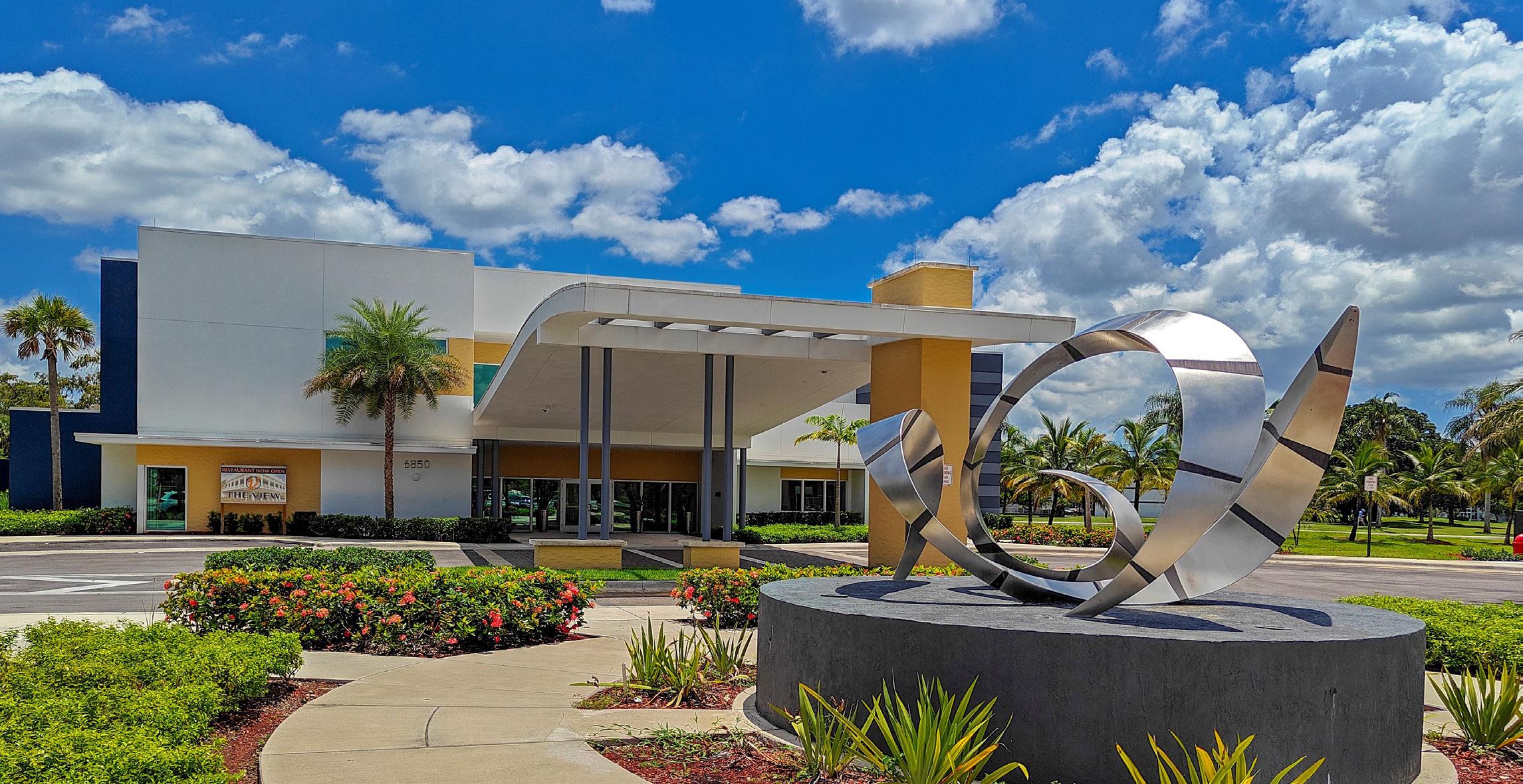
This page Intentionally left blank
Revenues
See notes to
CITY OF TAMARAC, FLORIDA
BUDGETARY COMPARISON SCHEDULE - UNAUDITED
FISCAL YEAR ENDED SEPTEMBER 30, 2025
Revenues
Expenditures
CITY OF TAMARAC, FLORIDA
BUDGETARY COMPARISON SCHEDULE - UNAUDITED FIRE RESCUE SPECIAL REVENUE FUND FISCAL YEAR ENDED SEPTEMBER 30, 2025
See notes to required supplementary information.
SUPPLEMENTARY INFORMATION - UNAUDITED FISCAL YEAR ENDED SEPTEMBER 30, 2025
The following procedures are used to establish the budgetary data reflected in the financial statements:
Annual budgets are adopted on a basis consistent with accounting principles generally accepted in the United States on all governmental funds except for three (3) special revenue funds: Donations and Sponsorship, Streetscape Improvement, and State Affordable Housing Assistance Funds.
1. Prior to July 30 of each year, the City Manager submits to the City Commission a proposed operating budget for the fiscal year commencing the following October 1. The operating budget includes proposed expenditures and the means of financing them.
2. Public hearings are held to obtain taxpayer comments.
3. On or before September 30, the budget is legally enacted by the City Commission through passage of an Ordinance pursuant to Florida Statute.
4. The level of control at which expenditures may not exceed the budget is at the departmental level. The City Commission approves these levels annually by Ordinance. The City Manager is authorized to transfer budgeted amounts within individual departments; any revisions that alter the total expenditures of any department must be approved by the City Commission. See the separately issued budgetary report on the General Fund’s Statement of Revenues, Expenditures and Changes in Fund - Budget and Actual for the departmental legal level of control.
5. Pursuant to financial policy, every appropriation, except an appropriation for capital improvement projects and multi-year grants, shall lapse at the close of the fiscal year to the extent that it has not been expended or encumbered. An appropriation for capital improvement projects or multi-year grants shall continue in force, i.e. not required to be re-budgeted, until the purpose for which it was made has been accomplished or abandoned; the purpose of any such appropriation shall be deemed abandoned if three (3) years pass without any disbursement from an encumbrance of the appropriation unless extended by action of the City Commission.
6. Budgets are adopted on a basis consistent with accounting principles generally accepted in the United States of America. Annual appropriated budgets are adopted for the General, certain Special Revenue, and Debt Service Funds. Project length financial plans and budgets are adopted for the capital project funds.
EMPLOYEES’ PENSION FUNDS REQUIRED SUPPLEMENTARY INFORMATION SCHEDULE OF ACTUARIAL ASSUMPTIONS FOR DETERMINING CONTRIBUTIONS (Unaudited)
The actuarial assumptions presented below were determined as part of the actuarial valuations at the dates indicated to determine fiscal year 2025 contributions.
* Per Actuarial Valuation Report on valuation date.
** The General Employees’, Police Officers’ and Firefighters’ plans provide for a 2% cost-of-living adjustment for any year in which the Plan has an actuarial gain. The General Employees’ did not have actuarial gains in the current year. The Police Officers’ Plan did not have actuarial gains in the current year. The nonrepresented employees’ plan provides a 2% annual cost-of-living adjustment beginning January 1 five years after retirement. The firefighters’ plan provides a 2% annual cost-of-living adjustment for participants retiring on or after October 1, 2008 and a 2.25% cost-of-living adjustment for participating retiring on or after March 1, 2007, beginning January 1 three years after retirement.
*** There is no payroll or employee contributions for the police officers’ plan because it is a closed plan with no active employees. All participants have retired or terminated with vested benefits.
See accompanying Notes to the Basic Financial Statements
City of Tamarac, Florida
City of Tamarac, Florida EMPLOYEES’ PENSION FUNDS
REQUIRED SUPPLEMENTARY INFORMATION
SCHEDULE OF EMPLOYER CONTRIBUTIONS AND RATES OF RETURN (Unaudited)
Elected and Appointed Officers and Non-Represented Employees’ Pension Fund Last Ten Years
Historical Trend Information
moneyweighted rate of return (loss), net of investment expense
Plan fiduciary net position
City of Tamarac, Florida EMPLOYEES’ PENSION FUNDS
Historical Trend Information
City of Tamarac, Florida
EMPLOYEES’ PENSION FUNDS
REQUIRED SUPPLEMENTARY INFORMATION
SCHEDULE OF EMPLOYER CONTRIBUTIONS AND RATES OF RETURN (Unaudited)
General Employees’ Pension Fund Last Ten Years
Annual moneyweighted rate of return (loss), net of investment expense
City of Tamarac, Florida EMPLOYEES’ PENSION FUNDS
City of Tamarac, Florida
EMPLOYEES’ PENSION FUNDS
REQUIRED SUPPLEMENTARY INFORMATION
SCHEDULE OF EMPLOYER CONTRIBUTIONS AND RATES OF RETURN (Unaudited)
Police Officers’ Pension Fund Last Ten Years Historical Trend Information
City of Tamarac, Florida
City of Tamarac, Florida
EMPLOYEES’ PENSION FUNDS
REQUIRED SUPPLEMENTARY INFORMATION
SCHEDULE OF EMPLOYER CONTRIBUTIONS AND RATES OF RETURN (Unaudited)
Firefighters’ Pension Fund Last Ten Years Historical Trend Information
moneyweighted rate of return (loss), net of investment expense
City of Tamarac, Florida
Notes to Schedule:
This schedule is presented to illustrate the requirement to show information for 10 years. However, until a full 10-year trend is compiled, information for those years for which information is available will be presented.
Since the prior measurement date, the discount rate was increased from 4.06% per annum to 4.50% per annum.
There are no assets accumulated in a trust to pay related benefits for the OPEB plan.
This page Intentionally left blank
CITY OF TAMARAC, FLORIDA • SEPTEMBER 30, 2025
This page Intentionally left blank
Special Revenue Funds
Special Revenue Funds are used to account for and report the proceeds of specific revenue sources that are restricted or committed to expenditures for specified purposes other than debt service or capital projects.
Law Enforcement Forfeiture Funds (State) - to account for law enforcement related projects funded by the proceeds from forfeited confiscated property.
Impact Fee Funds: Consist of: Drainage Improvement Fund - used to account for the collection of drainage impact fees to be used for upgrading drainage and drainage retention. Parks and Recreation Improvement Fund - used to account for the collection of parks and recreation impact fees to be used for the acquisition and development of park and recreation facilities and sites. Trafficways Improvement Fund - used to account for the collection of impact fees to be used for construction or improvement of roads, streets, highways and bridges. Affordable Housing Impact Fees - used to account for the collection of impact fees used for the benefit of the provision of affordable housing.
Public Arts Fund - to account for all contributions received from art fees, grants, donations that are restricted for public art projects within the City.
Local Option Gas Tax Fund - to account for the collection of gas taxes used to fund the construction of new roads and sidewalks, intersection improvements and improvements of the City’s existing transportation network.
Building Department Fund - to account for the collection of permit fees, inspection fees, and other fees and charges, and for the operational expenditures related to the Building Department.
Housing Grants Programs: Consist of : Community Development Block Grant Program Fund - used to account for revenue from a grant agreement between the City and the U.S. Department of Housing and Urban Development and expenditures for qualified neighborhood revitalization. The program includes expenditures for housing rehabilitation and public service programs. State Housing Initiative Partnership - used to account for funds received from the State Housing Initiatives Partnership for the purpose of providing affordable housing in the City. Neighborhood Stabilization Program - used to account for funds received from the U.S. Department of Housing and Urban Development to address foreclosures and abandoned properties within the City.
Hurricane Irma - To record revenue and expenses related to Hurricane Irma that occurred in September 2017.
Donations and Sponsorship Fund - to account for private donations and sponsorships received from citizens and corporate businesses.
Streetscape Improvement Fund - to account for the collection of investment income to be used for public roadways including curbing and medians.
State Affordable Housing Assistance Fund - to account for loan programs financed by the State Housing Initiative Partnership grant.
Sales Tax Surtax Fund - to account for ranked municipal surtax capital project funded using the County once cent transportation surtax.
American Rescue Plan Act (ARPA) Fund - to account for funds received from the American Rescue Plan Act.
Community Project Funding - to account for funds received from the U.S Department of Housing and Urban Development for the purpose of providing affordable housing in the City.
Debt Service Fund - to account for the accumulation of resources transferred from other funds and payment of principal and interest and fiscal charges on the City’s general obligation bonds which are payable from ad valorem taxes and the City’s revenue bonds which are payable from sales tax revenue and non-ad valorem revenues appropriated by the City.
2005 Capital Improvement Projects Fund - to account for the proceeds from the Series 2005 Capital Improvement Revenue Bonds used for various construction projects including the Sports Complex Expansion and the Recreation center Demolition/Construction.
Capital Equipment Fund - to budget for and fund purchases of governmental fund vehicles and equipment.
Capital Maintenance Fund - to budget for and fund purchases of governmental fund maintenance equipment.
Roadway and Median Improvement Fund - to budget for roadway and median improvements.
Corridor Improvement Fund - to budget for the execution of arterial corridor study results, specifically sound walls, entryway signage, and streetscape improvements.
See accompanying independent auditors’ report.
See accompanying independent auditors’ report.
See accompanying independent auditors’ report.
CITY OF TAMARAC, FLORIDA
COMBINING STATEMENT OF REVENUES, EXPENDITURES AND CHANGES IN FUND BALANCES
NONMAJOR GOVERNMENTAL FUNDS FOR THE YEAR ENDED SEPTEMBER 30, 2025
See accompanying independent auditors’ report.
CITY OF TAMARAC, FLORIDA
COMBINING STATEMENT OF REVENUES, EXPENDITURES AND CHANGES IN FUND BALANCES
NONMAJOR GOVERNMENTAL FUNDS (continued) FOR THE YEAR ENDED SEPTEMBER 30, 2025
CITY OF TAMARAC, FLORIDA
LAW ENFORCEMENT FORFEITURE
BUDGETARY COMPARISON SCHEDULE FOR THE YEAR ENDED SEPTEMBER 30, 2025
See accompanying independent auditor’s report.
CITY OF TAMARAC, FLORIDA IMPACT FEE FUNDS
BUDGETARY COMPARISON SCHEDULE FOR THE YEAR ENDED SEPTEMBER 30, 2025
Revenues
(uses)
fund balances, October 1 1,147,058 Budgetary fund balances, September 30 $ 1,084,692
See accompanying independent auditor’s report.
Revenues
CITY OF TAMARAC, FLORIDA
BUDGETARY COMPARISON SCHEDULE FOR THE YEAR ENDED SEPTEMBER 30, 2025
See accompanying independent auditor’s report.
Revenues
Expenditures
CITY OF TAMARAC, FLORIDA
LOCAL OPTION GAS TAX FUND
BUDGETARY COMPARISON SCHEDULE FOR THE YEAR ENDED SEPTEMBER 30, 2025
See accompanying independent auditor’s report.
Revenues
Expenditures
CITY OF TAMARAC, FLORIDA
BUILDING DEPARTMENT FUND
BUDGETARY COMPARISON SCHEDULE FOR THE YEAR ENDED SEPTEMBER 30, 2025
See accompanying independent auditor’s report.
CITY OF TAMARAC, FLORIDA
HOUSING GRANT PROGRAMS FUND
BUDGETARY COMPARISON SCHEDULE FOR THE YEAR ENDED SEPTEMBER 30, 2025
Revenues
Expenditures
fund balances, October 1
See accompanying independent auditor’s report.
Revenues
Expenditures
CITY OF TAMARAC, FLORIDA
DEBT SERVICE FUND
BUDGETARY COMPARISON SCHEDULE FOR THE YEAR ENDED SEPTEMBER 30, 2025
See accompanying independent auditor’s report.
CITY OF TAMARAC, FLORIDA • SEPTEMBER 30, 2025
This page Intentionally left blank
Expenditures
CITY OF TAMARAC, FLORIDA
2005 CAPITAL IMPROVEMENT PROJECT FUND SCHEDULE OF REVENUES, EXPENDITURES AND CHANGES IN FUND BALANCES - BUDGET AND ACTUAL FROM INCEPTION AND FOR THE YEAR ENDED SEPTEMBER 30, 2025
See accompanying independent auditors’ report.
financing sources (uses)
CITY OF TAMARAC, FLORIDA CAPITAL MAINTENANCE FUND
SCHEDULE OF REVENUES, EXPENDITURES AND CHANGES IN FUND BALANCES - BUDGET AND ACTUAL FROM INCEPTION AND FOR THE YEAR ENDED SEPTEMBER 30, 2025
See accompanying independent auditors’ report.
CITY OF TAMARAC, FLORIDA CAPITAL EQUIPMENT FUND
SCHEDULE OF REVENUES, EXPENDITURES AND CHANGES IN FUND BALANCES - BUDGET AND ACTUAL FROM INCEPTION AND FOR THE YEAR ENDED SEPTEMBER 30, 2025 Project
Revenues
Expenditures
See accompanying independent auditors’ report.
Expenditures
financing sources (uses)
CITY OF TAMARAC, FLORIDA
ROADWAY AND MEDIAN IMPROVEMENT
SCHEDULE OF REVENUES, EXPENDITURES AND CHANGES IN FUND BALANCES - BUDGET AND ACTUAL FROM INCEPTION AND FOR THE YEAR ENDED SEPTEMBER 30, 2025
See accompanying independent auditors’ report.
CITY OF TAMARAC, FLORIDA
CORRIDOR IMPROVEMENT FUND
SCHEDULE OF REVENUES, EXPENDITURES AND CHANGES IN FUND BALANCES - BUDGET AND ACTUAL FROM INCEPTION AND FOR THE YEAR ENDED SEPTEMBER 30, 2025 Project
Revenues
Expenditures
See accompanying independent auditors’ report.
Expenditures
CITY OF TAMARAC, FLORIDA GENERAL CAPITAL PROJECTS FUND SCHEDULE OF REVENUES, EXPENDITURES AND CHANGES IN FUND BALANCES - BUDGET AND ACTUAL FROM INCEPTION AND FOR THE YEAR ENDED SEPTEMBER 30, 2025
See accompanying independent auditors’ report.
CITY OF TAMARAC, FLORIDA TAMARAC VILLAGE FUND
SCHEDULE OF REVENUES, EXPENDITURES AND CHANGES IN FUND BALANCES - BUDGET AND ACTUAL FROM INCEPTION AND FOR THE YEAR ENDED SEPTEMBER 30, 2025 Project
Revenues
Expenditures
See accompanying independent auditors’ report.
Internal service funds are used to account for services provided to other departments or agencies of the government, or to other governments on a cost-reimbursement basis.
Risk Management Fund - The Risk Management Fund is an internal service fund that accounts for the administration of risk management and various insurance premiums. Property and liability insurance and workers’ compensation are administered through this fund.
Health Insurance Fund - The Health Insurance Fund is an internal service fund that accounts for employee’s health insurance, and related premiums and claims.
CITY OF TAMARAC, FLORIDA
COMBINING STATEMENT OF NET POSITION
INTERNAL SERVICE FUNDS
SEPTEMBER 30, 2025
CITY OF TAMARAC, FLORIDA
COMBINING STATEMENT OF REVENUES, EXPENSES AND CHANGES IN FUND NET POSITION INTERNAL SERVICE FUNDS FOR THE YEAR ENDED SEPTEMBER 30, 2025
CITY OF TAMARAC, FLORIDA
COMBINING STATEMENTS OF CASH FLOWS INTERNAL SERVICE FUNDS FOR THE YEAR ENDED SEPTEMBER 30, 2025
Adjustments to reconcile operating income (loss) to net cash provided by (used in) operating activities Change in assets and liabilities
OF TAMARAC, FLORIDA
Additions
Investment income (loss)
CITY OF TAMARAC, FLORIDA
COMBINING STATEMENT OF CHANGES IN NET POSITION PENSION TRUST FUNDS FOR THE YEAR ENDED SEPTEMBER 30, 2025
CITY OF TAMARAC, FLORIDA • SEPTEMBER 30, 2025
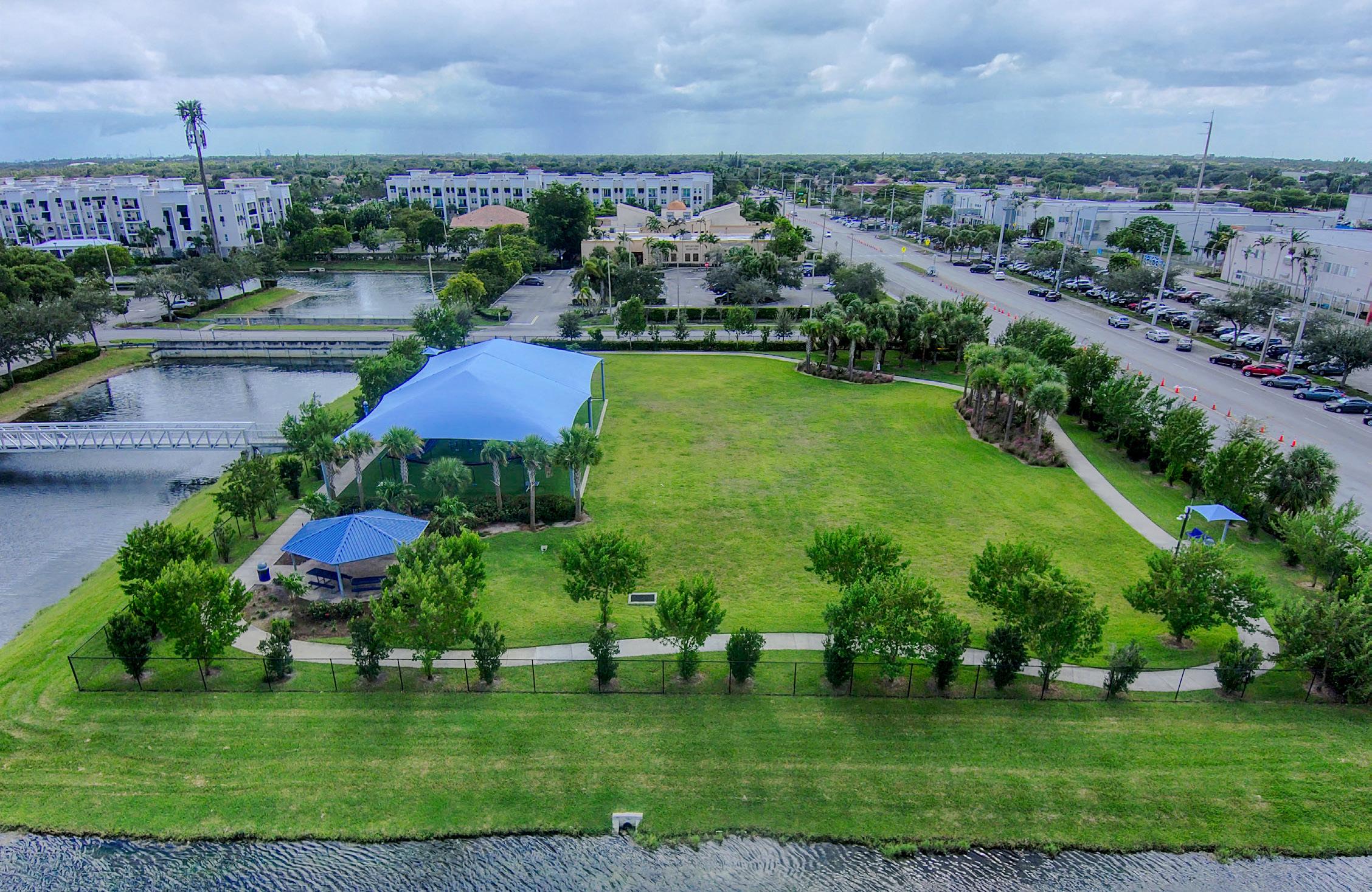
This page Intentionally left blank
This part of the City of Tamarac’s annual comprehensive financial report presents detailed information as a context for understanding what the information in the financial statements, note disclosures, and required supplementary information says about the government’s overall financial health.
Sources: Unless otherwise noted, the information in these schedules is derived from the annual comprehensive financial reports for the relevant year.
Financial Trends
These schedules contain trend information to help the reader understand how the government’s financial performance and well-being have changed over time.
Revenue Capacity
These schedules contain information to help the reader assess the government’s most significant local revenue source, its property tax.
Debt Capacity
These schedules present information to help the reader assess the affordability of the government’s current levels of outstanding debt and the governments’ ability to issue additional debt in the future.
These schedules offer demographic and economic indicators to help the reader understand the environment within which the government’s financial activities take place.
Operating Information
These schedules contain service and infrastructure data to help the reader understand how the information in the government’s financial report relates to the services the government provides and the activities it performs.
Total primary government net position
Source: City of Tamarac, Financial Services Department
Total business-type activities
Program Revenues
Governmental
Business-type activities:
Charges for services:
Total business-type activities
primary government program
Source: City of Tamarac, Financial Services Department
Changes in Net Position
Change in Net Position
Source: City of Tamarac, Financial Services Department
Changes in Net Position
Last Ten Fiscal Years (continued)
Governmental Funds
Fund Balances of Governmental Funds
Source: City of Tamarac, Financial Services Department
The City implemented GASB Statement No. 54 “Fund Balance Reporting and Governmental Fund Type definition” in fiscal year 2010.
Excess (deficiency) of revenues over (under) expenditures $
(Continued on next page)
Source: City of Tamarac, Financial Services Department
Source: City of Tamarac, Financial Services Department
Net Position by Component Last Ten Fiscal Years (continued)
Source: City of Tamarac, Financial Services Department
Tax Revenues by Source - Governmental Funds Last Ten Fiscal Years (modified accrual basis of accounting)
Source: City of Tamarac, Financial Services Department
Source: Broward County Property Appraiser
Assessed Value and Estimated Actual Value of Taxable Property Last Ten Fiscal Years (in thousand of dollars)
Source: Broward County Property Appraiser
Property
Source: Broward County Revenue Collection Division
Source: Broward County Revenue Collection Division
Property Tax Levies and Collections Last Ten Fiscal Years (in thousands of dollars)
Ratios of Outstanding Debt by Type Last Ten Fiscal Years
Notes:
Details regarding the City’s outstanding debt can be found in note 10 of the financial statements.
(a) Presented net of original issuance discounts and premiums
(b) Includes general bonded debt, sales tax increment debt, and business-type activities
(c) Personal Income based on an estimate of 2025 median household income ($59,216) of the City of Tamarac, Florida
(d) Population data can be found on the Demographic and Economic Statistics table within the Statistical Section.
(e) GASB 87, Leases was implemented in fiscal year 2022. The full 10-year trend will be presented when it is available.
(f) GASB 96, SBITAs was implemented in fiscal year 2023. The full 10-year trend will be presented when it is available.
Source: City of Tamarac, Financial Services Department
Direct and Overlapping Governmental Debt
September 30, 2025
Sources:
Assessed value data used to estimate applicable percentages provided by Broward County Property Appraiser. The total debt outstanding provided by Broward County.
Overlapping governments are those that coincide, at least, in part, with the geographic boundaries of the City. This schedule estimates the portion of the outstanding debt of those overlapping governments that is borne by the residents and businesses of the City of Tamarac. This process recognizes that, when considering the government’s ability to issue and repay long-term debt, the entire debt burden borne by the residents and businesses should be taken into account. However, this does not imply that every taxpayer is a resident, and therefore responsible for repaying the debt, of each overlapping government.
(1) The percentage of overlapping debt applicable is estimated using taxable assessed property values. Applicable percentages were estimated by determining the portion of Broward County’s taxable assessed value that is within the government’s boundaries and dividing it by Broward County’s total taxable assessed value.
Source: City of Tamarac, Financial Services Department
Legal Debt Margin Information
September 30, 2025
The Charter of the City of Tamarac imposes no bonded debt limit. Details regarding the City’s outstanding debt can be found in note 10 of the financial statements.
Notes:
Details regarding the government’s outstanding debt can be found in note 10 of the financial statements.
Notes:
(a) Includes stormwater service charges, investment income and other income (b) Does not include depreciation and payment in lieu of taxes expense.
Source: City of Tamarac, Financial Services Department
Source: City of Tamarac, Financial Services
Pledged Revenue Coverage
Sources:
2016 Population based on 2015 Population Estimates (U.S. Census Bureau)
2016 U.S. Department of Labor Local Area Unemployment Statistics
2017 Population based on 2016 Population Estimates (U.S. Census Bureau)
2017 U.S. Department of Labor Local Area Unemployment Statistics
2018 Population based on 2017 Population Estimates (U.S. Census Bureau)
2018 U.S. Department of Labor Local Area Unemployment Statistics
2019 Population based on 2018 Population Estimates (U.S. Census Bureau)
2019 U.S. Bureau of Labor Statistics - Unemployment Statistics
2020 Data is derived from United States Census Bureau Website
2020 U.S. Bureau of Labor Statistics - Unemployment Rate
2021 Data is derived from United States Census Bureau Website
2021 U.S. Bureau of Labor Statistics - Unemployment Rate
2022 Data is derived from United States Census Bureau Website
2022 U.S. Bureau of Labor Statistics - Unemployment Rate
2023 Data is derived from United States Census Bureau Website
2023 U.S. Bureau of Labor Statistics - Unemployment Rate
2024 Data is derived from United States Census Bureau Website
2024 U.S. Bureau of Labor Statistics - Unemployment Rate
2025 Data is derived from United States Census Bureau Website
2025 U.S. Bureau of Labor Statistics - Unemployment Rate
Source: Broward County Revenue Collection Division
* 2016 data provided by Tamarac Chambers of Commerce
* 2025 data provided by Florida Department of Economic Opportunity (DEO), Bureau of Workforce Statistics & Economic Research
Full-Time Equivalent City Employees by Function/Program Last Ten Fiscal Years
Function/Program
Notes:
*The City contracts for police services with the Broward County Sheriff’s Office and in doing so does not maintain a municipal police force.
Sources:
City of Tamarac Adopted Budget Documents with Amendments 2016 through 2025
Sources:
City of Tamarac Building and Code, Fire Rescue, Parks and Recreation, Public Works, Utilities departments; and Broward Sheriff’s Office (District 7)
Sources:
City of Tamarac Fire Rescue, Parks and Recreation, Public Works, Utilities Department; and Broward Sheriff’s Office (District 7)
This page Intentionally left blank
CITY OF TAMARAC, FLORIDA • SEPTEMBER 30, 2025
This page Intentionally left blank


Report on Internal Control Over Financial Reporting and on Compliance and Other Matters Based on an Audit of Financial Statements Performed in Accordance With Government Auditing Standards
Honorable Mayor and Member of the City Commission City of Tamarac, Florida
We have audited, in accordance with the auditing standards generally accepted in the United States of America and the standards applicable to financial audits contained in Government Auditing Standards issued by the Comptroller General of the United States (Government Auditing Standards), the financial statements of the governmental activities, the business-type activities, each major fund and the aggregate remaining fund information of the City of Tamarac, Florida (City), as of and for the year ended September 30, 2025, and the related notes to the financial statements, which collectively comprise the City’s basic financial statements, and have issued our report thereon dated June 3, 2026. Our report has an emphasis of matter for the implementation of GASB Statement No. 101, Compensated Absences. Our report also includes a reference to other auditors who audited the financial statements of the City of Tamarac Firefighters’ Pension Trust Fund, as described in our report on the City’s financial statements. This report does not include the results of the other auditors’ testing of internal control over financial reporting or compliance and other matters that are reported on separately by those auditors.
In planning and performing our audit of the financial statements, we considered the City’s internal control over financial reporting (internal control) as a basis for designing audit procedures that are appropriate in the circumstances for the purpose of expressing our opinions on the financial statements, but not for the purpose of expressing an opinion on the effectiveness of the City’s internal control. Accordingly, we do not express an opinion on the effectiveness of the City’s internal control.
A deficiency in internal control exists when the design or operation of a control does not allow management or employees, in the normal course of performing their assigned functions, to prevent, or detect and correct, misstatements on a timely basis. A material weakness is a deficiency, or a combination of deficiencies, in internal control, such that there is a reasonable possibility that a material misstatement of the entity’s financial statements will not be prevented, or detected and corrected, on a timely basis. A significant deficiency is a deficiency, or a combination of deficiencies, in internal control that is less severe than a material weakness, yet important enough to merit attention by those charged with governance.
Our consideration of internal control was for the limited purpose described in the first paragraph of this section and was not designed to identify all deficiencies in internal control that might be material weaknesses or significant deficiencies and therefore, material weaknesses or significant deficiencies may exist that were not identified. Given these limitations, during our audit we did not identify any deficiencies in internal control that we consider to be material weaknesses. We identified a certain deficiency in internal control, described in the accompanying schedule of findings and questioned costs as item 2025001 that we consider to be a significant deficiency.


As part of obtaining reasonable assurance about whether the City’s financial statements are free from material misstatement, we performed tests of its compliance with certain provisions of laws, regulations, contracts and grant agreements, noncompliance with which could have a direct and material effect on the financial statements. However, providing an opinion on compliance with those provisions was not an objective of our audit, and accordingly, we do not express such an opinion. The results of our tests disclosed an instance of noncompliance or other matters that is required to be reported under Government Auditing Standards and which is described in the accompanying schedule of findings and questioned costs as item 2025-001.
The City’s Response to the Finding Government Auditing Standards requires the auditor to perform limited procedures on the City’s response to the finding identified in our audit and described in the accompanying schedule of findings and questioned costs. The City’s response was not subjected to the other auditing procedures applied in the audit of the financial statements and, accordingly, we express no opinion on the response.
The purpose of this report is solely to describe the scope of our testing of internal control and compliance and the results of that testing, and not to provide an opinion on the effectiveness of the entity’s internal control or on compliance. This report is an integral part of an audit performed in accordance with Government Auditing Standards in considering the entity’s internal control and compliance. Accordingly, this communication is not suitable for any other purpose.
Fort Lauderdale, Florida June 3, 2026
Report on Compliance for the Major Federal Program and Major State Financial Assistance Project; Report on Internal Control Over Compliance and Report on the Schedule of Expenditures of Federal Awards and Schedule of State Financial Assistance Required by the Uniform Guidance and Chapter 10.550, Rules of the Auditor General of the State of Florida
Independent Auditor’s Report
Honorable Mayor and Members of the City Commission City of Tamarac, Florida
Report on Compliance for the Major Federal Program and Major State Financial Assistance Project
Opinion on the Major Federal Program and Major State Financial Assistance Project
We have audited the City of Tamarac’s (the City) compliance with the types of compliance requirements identified as subject to audit in the OMB Compliance Supplement and in the State of Florida’s Department of Financial Services’ State Projects Compliance Supplement that could have a direct and material effect on the City’s major federal program and major state financial assistance project for the year ended September 30, 2025. The City’s major federal program and major state financial assistance project are identified in the summary of auditor’s results section of the accompanying schedule of findings and questioned costs.
In our opinion, the City complied, in all material respects, with the compliance requirements referred to above that could have a direct and material effect on its major federal program and major state financial assistance project for the year ended September 30, 2025.
Basis for Opinion on the Major Federal Program and Major State Financial Assistance Project
We conducted our audit of compliance in accordance with auditing standards generally accepted in the United States of America (GAAS); the standards applicable to financial audits contained in Government Auditing Standards, issued by the Comptroller General of the United States (Government Auditing Standards); the audit requirements of Title 2 U.S. Code of Federal Regulations Part 200, Uniform Administrative Requirements, Cost Principles, and Audit Requirements for Federal Awards (Uniform Guidance); and Chapter 10.550, Rules of the Auditor General of the State of Florida (Chapter 10.550). Our responsibilities under those standards, the Uniform Guidance and Chapter 10.550 are further described in the Auditor’s Responsibilities for the Audit of Compliance section of our report.
We are required to be independent of the City and to meet our other ethical responsibilities, in accordance with relevant ethical requirements relating to our audit. We believe that the audit evidence we have obtained is sufficient and appropriate to provide a basis for our opinion on compliance for the major federal program and major state financial assistance project. Our audit does not provide a legal determination of the City’s compliance with the compliance requirements referred to above.
Responsibilities of Management for Compliance
Management is responsible for compliance with the requirements referred to above and for the design, implementation, and maintenance of effective internal control over compliance with the requirements of laws, statutes, regulations, rules and provisions of contracts or grant agreements applicable to the City’s federal programs and state financial assistance projects.
Auditor’s Responsibilities for the Audit of Compliance
Our objectives are to obtain reasonable assurance about whether material noncompliance with the compliance requirements referred to above occurred, whether due to fraud or error, and express an opinion on the City’s compliance based on our audit. Reasonable assurance is a high level of assurance but is not absolute assurance and therefore is not a guarantee that an audit conducted in accordance with GAAS, Government Auditing Standards , the Uniform Guidance, and Chapter 10.550 will always detect material noncompliance when it exists. The risk of not detecting material noncompliance resulting from fraud is higher than for that resulting from error, as fraud may involve collusion, forgery, intentional omissions, misrepresentations or the override of internal control. Noncompliance with the compliance requirements referred to above is considered material, if there is a substantial likelihood that, individually or in the aggregate, it would influence the judgment made by a reasonable user of the report on compliance about the City’s compliance with the requirements of the major federal program and major state financial assistance project as a whole.
In performing an audit in accordance with GAAS, Government Auditing Standards, the Uniform Guidance, and Chapter 10.550, we:
Exercise professional judgment and maintain professional skepticism throughout the audit.
Identify and assess the risks of material noncompliance, whether due to fraud or error, and design and perform audit procedures responsive to those risks. Such procedures include examining, on a test basis, evidence regarding the City’s compliance with the compliance requirements referred to above and performing such other procedures as we considered necessary in the circumstances.
Obtain an understanding of the City’s internal control over compliance relevant to the audit in order to design audit procedures that are appropriate in the circumstances and to test and report on internal control over compliance in accordance with the Uniform Guidance and Chapter 10.550, but not for the purpose of expressing an opinion on the effectiveness of the City’s internal control over compliance. Accordingly, no such opinion is expressed.
We are required to communicate with those charged with governance regarding, among other matters, the planned scope and timing of the audit and any significant deficiencies and material weaknesses in internal control over compliance that we identified during the audit.
A deficiency in internal control over compliance exists when the design or operation of a control over compliance does not allow management or employees, in the normal course of performing their assigned functions, to prevent, or detect and correct, noncompliance with a type of compliance requirement of a federal program or state financial assistance project on a timely basis. A material weakness in internal control over compliance is a deficiency, or a combination of deficiencies, in internal control over compliance, such that there is a reasonable possibility that material noncompliance with a type of compliance requirement of a federal program or state financial assistance project will not be prevented, or detected and corrected, on a timely basis. A significant deficiency in internal control over compliance is a deficiency, or a combination of deficiencies, in internal control over compliance with a type of compliance requirement of a federal program or state financial assistance project that is less severe than a material weakness in internal control over compliance, yet important enough to merit attention by those charged with governance.
Our consideration of internal control over compliance was for the limited purpose described in the Auditor’s Responsibilities for the Audit of Compliance section above and was not designed to identify all deficiencies in internal control over compliance that might be material weaknesses or significant deficiencies in internal control over compliance. Given these limitations, during our audit we did not identify any deficiencies in internal control over compliance that we consider to be material weaknesses, as defined above. However, material weaknesses or significant deficiencies in internal control over compliance may exist that were not identified.
Our audit was not designed for the purpose of expressing an opinion on the effectiveness of internal control over compliance. Accordingly, no such opinion is expressed.
The purpose of this report on internal control over compliance is solely to describe the scope of our testing of internal control over compliance and the results of that testing based on the requirements of the Uniform Guidance and Chapter 10.550. Accordingly, this report is not suitable for any other purpose.
on the Schedule of Expenditures of Federal Awards and Schedule of State Financial Assistance Required by the Uniform Guidance and Chapter 10.550
We have audited the financial statements of the governmental activities, the business-type activities, each major fund, and the aggregate remaining fund information of the City as of and for the year ended September 30, 2025, and the related notes to the financial statements, which collectively comprise the City’s basic financial statements. We issued our report thereon, dated June 3, 2026, which contained unmodified opinions on those financial statements. Our report has an emphasis of matter for the implementation of GASB Statement No. 101, Compensated Absences. Our report also included a reference to other auditors who audited the financial statements of the City of Tamarac Firefighters’ Pension Trust Fund. Our audit was conducted for the purpose of forming opinions on the financial statements that collectively comprise the basic financial statements. The accompanying schedule of expenditures of federal awards and schedule of state financial assistance is presented for purposes of additional analysis as required by the Uniform Guidance and Chapter 10.550 and is not a required part of the basic financial statements. Such information is the responsibility of management and was derived from and relates directly to the underlying accounting and other records used to prepare the basic financial statements. The information has been subjected to the auditing procedures applied in the audit of the basic financial statements and certain additional procedures, including comparing and reconciling such information directly to the underlying accounting and other records used to prepare the basic financial statements or to the basic financial statements themselves, and other additional procedures in accordance with auditing standards generally accepted in the United States of America. In our opinion, the schedule of expenditures of federal awards and schedule of state financial assistance is fairly stated, in all material respects, in relation to the basic financial statements as a whole.
Fort Lauderdale, Florida June 3, 2026
U.S.
Development Direct:
U.S.
See Notes to the Schedules of Expenditures of Federal Awards and State
Florida
City of Tamarac, Florida
Schedule of Expenditures of Federal Awards Fiscal Year Ended September 30, 2025
Catalog of State Financial Assistance
Florida
See Notes to the Schedules of Expenditures of Federal Awards and State Financial Assistance.
City of Tamarac, Florida
Notes to Schedules of Expenditures of Federal Awards and State Financial Assistance
The accompanying Schedule of Expenditures of Federal Awards and Schedule of State Financial Assistance (the Schedules) includes the federal and state award activity of the City of Tamarac, Florida (the City) under programs of the federal and state government for the year ended September 30, 2025. The information in the Schedules is presented in accordance with the requirements of Title 2 U.S. Code of Federal Regulations Part 200, Uniform Administrative Requirements, Cost Principles, and Audit Requirements for Federal Awards (Uniform Guidance) and Chapter 10.550, Rules of the Auditor General of the State of Florida (Chapter 10.550). Because the Schedules present only a selected portion of the operations of the City, it is not intended to and does not present the financial position, changes in fund balance/net position or cash flows of the City.
The Schedules are presented using the modified accrual basis of accounting for expenditures accounted for in the governmental funds and on the accrual basis of accounting for expenses of the proprietary fund types, which are described in Note 1 to the City’s basic financial statements. Such expenditures/expenses are recognized following the cost principles contained in the Uniform Guidance and Chapter 10.550, wherein certain types of expenditures/expenses are not allowable or are limited as to reimbursement. Negative amounts shown on the schedule represent adjustments or credits made in the normal course of business to amounts reported as expenditures in prior years. Negative amounts shown on the Schedule represent adjustments or credits made in the normal course of business to amounts reported as expenditures in prior years.
Note
Expenditures reported in the Schedule for ALN #97.036, Disaster Grants - Public Assistance, include $53,803 of expenditures incurred by the City in prior years and was awarded during the year ended September 30, 2025.
The City elected not to use the de minimis indirect cost rate as allowed under the Uniform Guidance.
Note
The City did not make subawards of federal awards or state financial assistance during the year ended September 30, 2025.
City of Tamarac, Florida
Schedule of Findings and Questioned Costs
Fiscal Year Ended September 30, 2025
Section I - Summary of Auditor’s Results
Type of report the auditor issued on whether the financial statements audited were prepared in accordance with U.S. GAAP: Unmodified
Internal control over financial reporting:
Material weakness(es) identified?
Significant deficiency(ies) identified?
Noncompliance material to financial statements noted?
Internal control over major federal program:
Material weakness(es) identified?
Significant deficiency(ies) identified?
Type of auditor’s report issued on compliance for the major federal program: Unmodified
Any audit findings that are required to be reported in accordance with Section 2 CFR 200.516(a)?
Identification of major federal program:
State Financial Assistance Project
Internal control over major state project:
Material weakness(es) identified?
Yes XNo
Significant deficiency(ies) identified? Yes XNone Reported
Any audit findings disclosed that are required to be reported in accordance with Chapter 10.550, Rules of the Auditor General ? Yes XNo
state project:
Identification of major state project:
Catalog of State Financial Assistance (CSFA) Number 40.901
Name of State Program or Project Unmodified State Housing Initiatives Partnership (SHIP) Program
Dollar threshold used to distinguish between type A and type B projects: 400,895 $
Criteria:
prior approval from the City Commission and be obtained through a competitive solicitation process in accordance with established procurement procedures. Additionally, City policy requires that employee benefits be administered with the approved Health Insurance Waiver Program in effect during the applicable period, with amendments implemented only as of their stated effective date. Furthermore, the el policy does not include specific provisions governing international travel.
Condition: During the course of the audit, the following matters were identified:
Expenditures related to Done Films LLC exceeded $65,000 in aggregate during the fiscal year; however, these purchases were not procured through a competitive solicitation process in accordance with City procurement policy.
Health Insurance Waiver Program reimbursements were processed during fiscal year ended September 30, 2025, for health insurance premiums from December 2022 through September 2025. While the reimbursements were approved and recorded in fiscal year 2025, they were based on program modifications approved under Resolution R 2025 116, which was effective January 1, 2026, and therefore not applicable to the periods to which the reimbursements relate.
Travel-related expenditures, including international airfare, lodging, and transportation costs, were incurred that appeared excessive and inconsistent with prudent use of public resources.
Cause: The issues identified appear to have resulted from deficiencies in internal controls and oversight. Specifically, there was a breakdown in controls over monitoring procurement thresholds and ensuring compliance with established competitive solicitation requirements. Additionally, updated benefit provisions were applied to periods prior to their effective date, indicating a lack of adherence to policy implementation guidelines. Further, insufficient oversight and the absence of clearly defined guidance
contributed to travel-related expenditures that were not adequately evaluated for reasonableness and alignment with prudent use of public resources.
Effect or potential effect: The identified deficiencies increase the risk of noncompliance with City policies and may result in inefficient use of public resources, reduced transparency, and diminished public trust. Failure to follow competitive procurement requirements limits the C services in the most cost-effective manner. Additionally, the application of benefit provisions to periods prior to their effective date may result in improper expenditures and potential inequities in employee compensation. Further, the absence of clear guidance and oversight over travel-related expenditures may lead to excessive or unsupported costs that are not aligned with prudent fiscal management practices.
Recommendation: We recommend the City strengthen internal controls and oversight to ensure compliance with established policies. Specifically, the City should:
Implement procedures to monitor procurement thresholds and ensure that all applicable purchases are subjected to required competitive solicitation and approval processes.
Establish controls to ensure that benefit program changes are applied only in accordance with their approved effective dates and applicable policy provisions.
Develop and formalize comprehensive travel policies, including specific guidance for international travel, and enhance review and approval processes to ensure expenditures are reasonable, necessary, and in alignment with the prudent use of public resources
Views of responsible officials: City management acknowledges the finding and concurs with the recommendation to strengthen controls and oversight. While existing policies were in place, certain transactions were processed pursuant to executive authorization. Management is committed to enhancing monitoring, documentation, and policy enforcement to improve compliance and transparency going forward.
III Federal Awards and State Projects Findings and Questioned Costs
No matters to report.
The prior year single audit disclosed no findings on the Schedule of Findings and Questioned Costs and no uncorrected or unresolved findings exist from the prior audit s Summary Schedule of Prior Year Audit Findings.

City of Tamarac, Florida
Corrective Action Plan
Fiscal Year Ended September 30, 2025
Condition: During the course of the audit, the following matters were identified:
Expenditures related to Done Films LLC exceeded $65,000 in aggregate during the fiscal year; however, these purchases were not procured through a compe ��ve solicita�on process in accordance with City procurement policy.
Health Insurance Waiver Program reimbursements were processed during fiscal year ended September 30, 2025, for health insurance premiums from December 2022 through September 2025. While the reimbursements were approved and recorded in fiscal year 2025, they were based on program modifica�ons approved under Resolu �on R-2025-116, which was effec�ve January 1, 2026, and therefore not applicable to the periods to which the reimbursements relate.
Travel-related expenditures, including interna�onal airfare, lodging, and transporta�on costs, were incurred that appeared excessive and inconsistent with prudent use of public resources.
Cause: The issues identified appear to have resulted from deficiencies in internal controls and oversight. Specifically, there was a breakdown in controls over monitoring procurement thresholds and ensuring compliance with established competitive solicitation requirements. Additionally, updated benefit provisions were applied to periods prior to their effective date, indicating a lack of adherence to policy implementation guidelines. Further, insufficient oversight and the absence of clearly defined guidance contributed to travel-related expenditures that were not adequately evaluated for reasonableness and alignment with prudent use of public resources.
Corrective Action Planned or Taken: The City acknowledges the finding and will strengthen monitoring and documentation procedures related to procurement thresholds, benefit program implementation, and travel expenditures.
Financial Services currently follows established City policies and procedures and reviews transactions for compliance with applicable procurement, budgetary, and administrative requirements. In the instances identified within this finding, Financial Services communicated policy concerns and compliance considerations to executive management. The transactions were subsequently processed pursuant to executive authorization and approval.
To further strengthen internal controls, management will implement enhanced documentation procedures for transactions approved through executive override, including retention of supporting approvals and rationale. In addition, management will review existing procurement, reimbursement, and travel policies and evaluate opportunities to strengthen oversight, monitoring, and escalation procedures to ensure policy compliance and improve transparency.
Contact Person: Levent Sucuoglu, City Manager
Anticipated Completion Date: 06/01/2026
Management Letter in Accordance With Chapter 10.550, Rules of the Florida Auditor General
Honorable Mayor and Members of the City Commission City of Tamarac, Florida
We have audited the financial statements of the governmental activities, the business-type activities, each major fund, and the aggregate remaining fund information of the City of Tamarac, Florida (the City), as of and for the year ended September 30, 2025, which collectively comprise the City’s basic financial statements, and have issued our report thereon dated June 3, 2026. Our report includes a reference to other auditors who audited the financial statements of the City of Tamarac Firefighters’ Pension Trust Fund, as described in our report on the City’s financial statements. This management letter does not include the results of the other auditors’ testing of compliance and other matters that are reported on separately by those auditors.
Auditor’s Responsibility
We conducted our audit in accordance with auditing standards generally accepted in the United States of America; the standards applicable to financial audits contained in Government Auditing Standards, issued by the Comptroller General of the United States; the audit requirements of Title 2 U.S. Code of Federal Regulations Part 200, Uniform Administrative Requirements, Cost Principles, and Audit Requirements for Federal Awards (Uniform Guidance); and Chapter 10.550, Rules of the Auditor General
Other
We have issued our Independent Auditor’s Report on Internal Control over Financial Reporting and on Compliance and Other Matters Based on an Audit of the Financial Statements Performed in Accordance with Government Auditing Standards; Independent Auditor’s Report on Compliance for Each Major Federal Program and Major State Financial Assistance Project; Report on Internal Control over Compliance; and Report on the Schedule of Expenditures of Federal Awards and Schedule of State Financial Assistance Required by the Uniform Guidance and Chapter 10.550 Rules of the Auditor General of the State of Florida, Schedule of Findings and Questioned Costs; and Independent Accountant’s Report on an examination conducted in accordance with AICPA Professional Standards, AT-C Section 315, regarding compliance requirements in accordance with Section 218.415 Florida Statutes. Disclosures in those reports and schedules should be considered in conjunction with this management letter.
Section 10.554(1)(i)1., Rules of the Auditor General, requires that we determine whether corrective actions have been taken to address findings and recommendations made in the preceding financial audit report. In connection with our prior year audit, there were no findings or recommendations.
Section 10.554(1)(i)4., Rules of the Auditor General, requires that the name or official title and legal authority for the primary government and each component unit of the reporting entity be disclosed in this management letter, unless disclosed in the notes to the financial statements. This information is disclosed in Note 1 of the City’s financial statements.
Sections 10.554(1)(i)5.a. and 10.556(7), Rules of the Auditor General, require us to apply appropriate procedures and communicate the results of our determination as to whether or not the City met one or more of the conditions described in Section 218.503(1), Florida Statutes, and to identify the specific condition(s) met. In connection with our audit, we determined that the City did not meet any of the conditions described in Section 218.503(1), Florida Statutes.
Pursuant to Sections 10.554(1)(i)5. b. and 10.556(8), Rules of the Auditor General, we applied financial condition assessment procedures for the City. It is management’s responsibility to monitor the City’s financial condition, and our financial condition assessment was based in part on representations made by management and review of financial information provided by same.
Section 10.554(1)(i)2., Rules of the Auditor General, requires that we communicate any recommendations to improve financial management. In connection with our audit, we did not have any such recommendations.
As required by Section 10.554(1)(i)6.a., Rules of the Auditor General, City management represented that the PACE program authorized pursuant to Section 163.081 or Section 163.082, Florida Statutes, did not operate within the City’s geographical boundaries during the fiscal year under audit.
Section 10.554(1)(i)5.c., Rules of the Auditor General, requires, if appropriate, that we communicate the failure of a special district that is a component unit of a county, municipality, or special district, to provide the financial information necessary for proper reporting of the component unit within the audited financial statements of the county, municipality, or special district in accordance with Section 218.39(3)(b), Florida Statutes. In connection with our audit, we did not note any special district component units that failed to provide the necessary information for proper reporting in accordance with Section 218.39(3)(b), Florida Statutes.
Section 10.554(1)(i)3., Rules of the Auditor General, requires us to communicate noncompliance with provisions of contracts or grant agreements, or fraud, waste, or abuse, that has occurred or is likely to have occurred, that has an effect on the financial statements that is less than material but warrants the attention of those charged with governance. In connection with our audit, we did not note any such matters.
Our management letter is intended solely for the information and use of the Legislative Auditing Committee, members of the Florida Senate and the Florida House of Representatives, the Florida Auditor General, Federal and other granting agencies, the Mayor, City Commissioners and applicable management, and is not intended to be and should not be used by anyone other than these specified parties.
Fort Lauderdale, Florida June 3, 2026
Independent Accountant’s Report on Compliance with Section 218.415, Florida Statutes
Honorable Mayor and Members of the City Commission City of Tamarac, Florida
We have examined the City of Tamarac, Florida’s (the City) compliance with Section 218.415, Florida Statutes, Local Government Investment Policies, (the specified requirements) during the period October 1, 2024 to September 30, 2025. Management of the City is responsible for the City’s compliance with the specified requirements. Our responsibility is to express an opinion on the City’s compliance with the specified requirements based on our examination.
Our examination was conducted in accordance with attestation standards established by the AICPA. Those standards require that we plan and perform the examination to obtain reasonable assurance about whether the City complied, in all material respects, with the specified requirements referenced above. An examination involves performing procedures to obtain evidence about whether the City complied with the specified requirements. The nature, timing and extent of the procedures selected depend on our judgment, including an assessment of the risks of material noncompliance, whether due to fraud or error. We believe that the evidence we obtained is sufficient and appropriate to provide a reasonable basis for our opinion.
We are required to be independent and to meet our other ethical responsibilities in accordance with relevant ethical requirements relating to the engagement.
Our examination does not provide a legal determination on the City’s compliance with the specified requirements.
In our opinion, the City complied, in all material respects, with the specified requirements during the period October 1, 2024 to September 30, 2025.
This report is intended solely for the information and use of the Florida Auditor General, the Honorable Mayor and Members of the City Commission and applicable management of the City, and is not intended to be and should not be used by anyone other than these specified parties.
Fort Lauderdale, Florida June 3, 2026