Natural limewash paints made by utilising the elemental cycle of earth, fire, water, and air. Suitable for interior and exterior, available in 400 natural colours.
bauwerkcolour.com
Geometry of Life [Chapter 1]. A movie shot at Palazzo Molteni, Milan. moltenigroup.com
mobilia.com.au
Karen
speaks with Flack Studio founder and principal David Flack from
EDITOR'S LETTER
It’s our diamond jubilee, and this 60th issue is special for more reasons than one. While we’ve been publishing for the past 15 years, this is our first official print edition. We didn’t just want to make the milestone tangible—we wanted to call in the global design figures who’ve made est magazine what it is today by featuring five inaugural Hall of Fame recipients.
We hear from Vincent Van Duysen on the need for a fortified vision to design without borders; from John Pawson about why nothing falls outside the remit of architecture, and how Faye Toogood protects the conditions for meaningful work at all costs. “Design is never truly finished,” Norm Architects founding partner Jonas Bjerre-Poulsen says, and for Vincenzo De Cotiis, memory is the structural element that sparks intuitive creation.
This is how Design Instinct informed the title of this issue, and what connects our esteemed 10 for 2026: the most influential voices in Australian residential architecture and design, and the multidisciplinary designers hopscotching between interiors, spatial and product design. We discover what lights them up, what they’d like to see less of in design and why, as designer Olivia Bossy says, “If it doesn’t create an emotion, there’s probably a better version.”
PORTRAIT
SAM BISSO
PICTURED
TOWNHOUSE B BY NICOLAS SCHUYBROEK ARCHITECTS
Designing for feeling is just as potent in this issue’s homes. Our cover story, an art aficionado’s New York townhouse, is designed by Nicolas Schuybroek Architects as a “slow withdrawal from the city”, and a coastal home by Templeton Architecture and Pasquale Cook breathes with the ease of imperfect materials.
Arent&Pyke’s transformation of a family’s home signifies the design studio’s new Melbourne post, and Adam Jordan Architecture and Interiors' brick Michigan home reconceives an American architectural icon. In Melbourne, Kennedy Nolan uses unexpected colour to revisit a modernist home, while in Sydney, Madeleine Blanchfield Architects looks beyond a home’s headland views to how light passes through its floating forms. Antipodean inspiration is found outdoors too, in est garden editor Will Dangar’s conversation with New Zealand studio Suzanne Turley Landscapes.
Making its way out of this issue and into your ears, our latest podcast with Flack Studio founder and principal David Flack, hosted by Karen McCartney, reminds us of this same humility—and why design with soul and the courage to be a little disruptive lasts a lifetime.
SOPHIE LEWIS EST LIVING EDITOR @sophielewis_____
STYLING MARK COOMBES
PHOTOGRAPHY ADRIAN GAUT
Arno
Monolithic Forms Elemental Geometry
Declercq’s new works are deeply rooted in the rigorous language of architectural brutalism.
Carved in solid burnt oak and cast bronze, they exist in the junction between art and functional object. Bold in scale and restrained in detail.
Meticulously handcrafted in Belgium, new works on show at The Front Room.
CONTRIBUTORS
SEAN FENNESSY
PHOTOGRAPHER
Sean Fennessy is a Melbourne-based photographer working across travel reportage, cultural institutions, hotels, interior design and architecture, undertaking commissions both in Australia and abroad. Originally from Tasmania, he retains a strong connection to place, and his background as a newspaper photographer has given him an intuitive, observational approach to image-making. For our 60th issue, Fennessy photographs a weekender on the Victorian coast by Melbourne-based Templeton Architecture, with interiors by Pasquale Cook. He highlights design references that stretch from Mexico to the Mediterranean, and how changing light animates imperfect materials.
GENEVIEVE LUTKIN
PHOTOGRAPHER
Favouring interiors, lifestyle and fashion, Genevieve Lutkin is a visual artist working between photography and moving image. Based in London and collaborating worldwide, her formative years in North Norfolk, England and studies at the Royal College of Art shaped her affinity for capturing the tangibility of her subjects— from objects and people to landscapes. For this issue, Lutkin photographs Hall of Fame recipient Faye Toogood in her studio, offering a window into the designer’s view of furniture as sculpture and her close, curious relationship to the emotive forms she creates.
Aleesha Callahan is a Melbourne-based design journalist, editor and communications strategist. With more than a decade of experience in media and design, she has honed a distinct voice and ability to craft compelling narratives. For our 60th edition, Callahan interviews our inaugural Hall of Fame—five cross-disciplinary architects and designers recognised for their contributions to est magazine and the global design sphere. She explores the hardest lessons they’ve learned, and the advice they’ve carried throughout their careers and across projects beyond their home countries.
ALEESHA CALLAHAN WRITER
COLIN KING
Stylist and founder of his eponymous New York studio, Colin King is credited with redefining modern American interiors through his instinct for composition and feeling. He choreographs spaces with rhythm and stillness—an approach that has informed collections, including for Beni Rugs, where he serves as art director— as well as visual worlds for brands and publications globally. For our cover story, King collaborates with Belgian architect Nicolas Schuybroek on a New York City townhouse made famous by its art-collecting owner. He exalts how the architecture converses with art, sculpture, and collectable furniture.
As est living’s editorial advisor, Karen McCartney is known for her work in the world of interiors and architecture, with an impressive résumé that spans print and digital media. In this issue, the best-selling author and design commentator writes on a home in Mosman, Sydney, designed by Madeleine Blanchfield Architects. McCartney observes how the home lightens in form and material from the sandstone base upwards, as it navigates a steep, sloping site. You can also listen to McCartney’s conversation with Flack Studio founder and principal David Flack as part of our podcast series, This Much I Know, available on Spotify and Apple Music.
PHOTOGRAPHER
Based in New York, Eric Petschek is a photographer known for capturing exceptional spaces worldwide. With a background in interior design, his work is sensitive to detail, intent and the way a space should be framed. Alongside his photography practice, he shares his travels on Instagram—with outtakes from some of the world’s most beautiful hotels, restaurants and private residences. For this issue, Petschek photographs Rathmor, a home by Adam Jordan Architecture and Interiors in Michigan, North America. Having previously documented the studio's residential projects, he was especially attuned to the home’s brickwork—a material less common in Adam Jordan’s portfolio —which points to a nearby mid-century monument.
STYLIST
KAREN MCCARTNEY WRITER
ERIC PETSCHEK
INLAYERED MINERAL SURFACE
SUPERIOR HEAT RESISTANCE A RECYCLED CORE INLAYR® 3D DESIGN FOR INDOOR APLICATIONS
ĒCLOS is the next generation of mineral surfaces, featuring a layered 3D body integrated design and superior heat resistance.
Sara Hibbert, Sarah Pannell, Ritchie Jo Espenilla, Matthew McQuiggan, Stephen K Mack
Linger Longer
Sean Fennessy
esteemed 10 2026: Australian
Anson Smart, Nic Gossage, Shantanu Starick, Timothy
Kaye, Rory Gardiner, Lucas Allen, Courtesy of Room 11 Architects, Maxime Delvaux, Bowen Aricò
Art House
Adrian Gaut
Hall of Fame
Courtesy of Molteni&C, Piet-Albert Goethals, Zeb Daemen, Genevieve Lutkin, Andrea Ferrari, Martin Morrell, Wichmann + Bendtsen Photography, Dan Preston, Monica Grue Steffensen, Oliver Jaist, Jonas Bjerre-Poulsen
Time to Shine
Anson Smart
Modern Love
Courtesy of Kennedy Nolan
esteemed 10 2026: Multidisciplinary
Billal Taright, James Nelson, Courtesy of studioutte, Vilhelm Björndahl, Giulio Ghirardi, Tom Ross, Youmee Jeon, Romily Mount, Sharyn Cairns, Lillie Thompson, Ollie Tomlinson, Thea Caroline Sneve Løvstad, Mathilde Hiley, Christophe Coënon, Nicole England, Blake Azar, Matteo Verzini, Courtesy of Mycoworks, Lasse Kusk
Monument to Masonry
Eric Petschek
North Star
Anson Smart
In Conversation with Suzanne Turley Landscapes
Anson Smart, Simon Wilson
This Much I Know Podcast: Flack Studio
Matthew McQuiggan
WORDS
Aleesha Callahan, Alexandra Gordon, Alexia Petsinis, Carli Philips, Emma Adams, Karen McCartney, Sophie Lewis, Will Dangar
ON THE COVER
Architecture & Interior Design
Nicolas Schuybroek Architects
Architect of Record
FROM Architecture
Styling
Colin King
Photography
Adrian Gaut
Artwork
Fabulous Muscles (2012) by Danh Võ
ISSUE 60 PLAYLIST
Surpass Expectations
even the most elevated
MELBOURNE SHOWROOM , Bank House. 11-19 Bank Place, Melbourne.
SYDNEY SHOWROOM, Foveaux House. 63 Foveaux Street, Surry Hills.
LINGER LONGER
Deliberate contradictions and disciplined nuances are at the core of this coastal home on Victoria’s Mornington Peninsula.
FFor all the adjectives that could be used to describe this home on Victoria’s Mornington Peninsula, there is an equally apt antonym: elevated yet approachable; spacious yet intimate; communal yet private. Paired together, they create conditions for an exact balance of proportion and style.
Interior designers and founders of Melbourne design studio, Pasquale Cook, Sophie Di Pasquale and Sally Cook were engaged first and subsequently recommended Templeton Architecture to the homeowners. Pasquale Cook were admirers from afar, and while the three architects and designers had never met, they fell in sync instantly. “Our vision really
aligned, and we felt like we were working as one team,” Di Pasquale says. “Our client wanted an element of softness for the home and liked the idea of working with two femaleled firms. It really resonated for her, and it became a very collaborative project completely absent of ego.”
Tucked into a sheltered area overlooking the bay on the Mornington Peninsula, the home is less than an hour from Melbourne, but the idea was to create a place that felt worlds apart in spirit, use and aesthetics.
“It’s an escape that’s almost an illusion because it’s still so close to their permanent home,” Templeton Architecture director Emma Templeton says. The clients drew references from places they had travelled, including Spain, Portugal and Mexico; Pasquale Cook looked to Can Lis, the private home Danish architect Jørn Utzon built for his family in Mallorca in the 1970s.
“There must have been an image from every country in the world, but the unifying concept was not about place,” Templeton explains. “They were all speaking a similar
language of authenticity and refined imperfection. Our challenge was to try to take these references and make them feel appropriate for the location.”
As a longstanding and regularly visited weekender, the family were familiar with the site conditions, especially the northeasterlies, which helped inform their brief. Sitting on the edge of an escarpment that falls away to the west, the site is immune to development on one side and from the rear, a walking path leads directly to the beach.
Existing bluestone was repurposed for the fireplace and the front fence, with a hand-trowelled finish applied over the top. Internally, the floor plate was demolished, and a new floor plan was conceived. The view upon entering is directly down a hallway lined with limestone cobblestones and bookended by a sheet of glass framing an arresting vista of the sky and sea, its electric-blue tourmaline water a sharp contrast to the neutral, lime-rendered walls. A staircase off the entrance leads to the first floor, where there are three bedrooms with bathrooms.
Previous spread: Overlooking the bay on the Mornington Peninsula, a path from the garden, with an outdoor shower by Brooklyn Copper, leads directly to the beach. This page: The external recycled-brick walls are trowelled, brushed and tumbled to achieve a distressed finish. Opposite page: Eco Outdoor engineered timber floors and natural recycled beams, alongside lime render by Scanlan & Makers exude low-key rusticity. The fireplace surround is made from existing bluestone pitchers. An Aramis XXL suspension is sourced from Atelier Vime, and a Pixel sofa by Sergio Bicego for Saba Italia is from Bachli Furniture. The cushion, armchair, small side table and plinth objects are from the homeowner’s personal collection. A custom Cadrys rug and wall tapestry by Sundance Studio complete the picture.
This page: The kitchen island base is microcement render from Marius Aurenti Australia, with a bluestone benchtop from RMS Natural Stone and Franke tapware. A custom pendant by Harriet Goodall is above, and the Branco splashback tiles are by Manuel Aires Mateus from Viúva Lamego, Portugal. The cooktop and oven are both Miele. The Le Cèr round table is custom, and the dining chairs and stools are from the homeowner’s personal collection. Opposite page: In the main living space, an Asturias rocking chair by Carlos Motta from Criteria, a Nebula Nine sofa by Diesel Designers for Moroso, a Hattie lamp by Alba Atelier, a Cadrys Tuareg rug, and a Le Cèr coffee table. The timber decking features the C603 dining chairs by Yuzuru Yamakawa from Feelgood Designs and the Inout side table and stools by Paola Navone for Gervasoni.
Avid hosts, the owners wanted a home for entertaining that could also cater to overnight guests. To the right on the ground floor are two bedrooms with bathrooms and a spacious games room. The addition of a sliding door enables the whole wing to be partitioned off for complete privacy.
The hallway bisects the ground floor, with two sets of descending steps that echo the landfall’s gradient. Along the north side is a study, primary suite and gym, while the northeast features a large open-plan kitchen, living and dining area. “The interplay of space became a key driver of the design,” Templeton says. “They’re generous entertainers, and we aimed to create intimacy in a program that’s quite extensive.” This was achieved with sliding doors and hand-woven banana fibre screens by Sundance Studio to close off spaces. Elsewhere, sconces and pendants are lowered for a more human scale and softer glow, and the
sandblasted timber ceiling beams are exposed for a relaxed, relatable rusticity.
Running along the outdoor rear and perimeter of the house are various decks, daybeds and sunken, protected pockets. “The client didn’t want one consistent area, but different places that could be zoned independently,” Di Pasquale says. They also added pergolas rather than adopting engineered solutions such as structural cantilevers. “It may seem less sophisticated and even somewhat primitive, but it was in line with our philosophy. We even spent time with the bricklayer to introduce imperfection to the walls,” Templeton says.
Objects and art are a hybrid of contemporary and vintage, local and global, soft and robust. Cane furniture was brought in from France, stone sinks from Indonesia, and pendants by Australian fibre artist Harriet Goodall were specially commissioned.
To find equilibrium, they introduced polished elements, including sharp aluminium window frames and sleek architectural fixtures, such as Davide Groppi’s MOON pendant suspended over the bath. Natural materials with gentle variations were applied intentionally but with restraint. Tumbled brick, uneven glazed Portuguese tiles and distressed timber were specified for their inherent flaws; ceramics, porcelain and parchment were chosen for their handmade qualities.
To lift the reserved colour palette of oat, wheat and ivory, subtle blemishes were created. A rough-sawn chisel finish was applied to all cabinetry for a weathered appearance, and the grain and texture of the timber surfaces were enhanced. “We used fewer elements to create greater impact,” Di Pasquale says. “This home is not about polished perfection but about creating a space that feels inviting, warm and lived-in.”
Previous spread, from left to right: The powder room is flush with natural light from a window above the vanity. The flooring is Eco Outdoor limestone cobblestones and the wall tiles are Latte Zellige from Tiles of Ezra. Also pictured: Brodware tapware, a basin from Indonesia and a custom parchment wall light by Pasquale Cook. A dining table by Hans J. Wegner for Carl Hansen & Søn with the homeowner's dining chairs. Nearby are two Asturias lounge chairs by Carlos Motta from Criteria and an artwork above the fireplace by Kathy Hui Liu. This page: A netted curtain custom-made by Barlow & Hunt acts as a screen to the den, alongside timber bar joinery topped with custom glazed tiles by The City Tiler, the homeowner's vintage lamp and a Zip HydroTap. Opposite page: A custom timber bench by Fiona Brockhoff and the Float firepit from LifeSpaceJourney feature in the internal courtyard.
This page, clockwise from left: The study at the rear features the Donzelletta chairs by Michele De Lucchi for De Padova, a table by CLO Studios, Daphine Terra floor lamp by Lumina and artwork by Ash Roberts. In the primary en suite, Eco Outdoor limestone tiles line the floor, and the splashback tiles are Branco by Manuel Aires Mateus for Viúva Lamego. The Grigio Argento stone benchtop is from FUM Australia, topped with Rogerseller tapware and a Narciso mirror by Agape from Artedomus. A Waltz coat rack by GamFratesi for Gebrüder Thonet Vienna from Space Furniture, a vintage Audoux-Minet rope sconce from Atelier Vime and a custom parchment light designed by Pasquale Cook all dress the walls. A Sorrento lounge by Paola Navone for Baxter, a Cadrys Sahara rug and a Hattie standing lamp by Alba Atelier. Opposite page: Hanging over the Claybrook Chelsea bath from Winnings, paired with Brodware tapware, is the MOON pendant by Davide Groppi from dedece. The stool and objects on the shelf are from the homeowner's personal collection, and the vintage French cane coat rack is from Angelucci.
This page: Decks, daybeds and sunken, sheltered pockets wrap the home’s rear and outer edge. In place of engineered cantilevers, pergolas were designed to achieve the same effect.
Opposite page: Upon entering the home, the eye is drawn down a hallway paved with limestone cobblestones, framed by a glass panel that lets in the sky and sea. The plaster wall sconces are by artist Leila Ashtiani.
A vintage screen from Atelier Vime features in the corner, with the chair, cushion, round black stool, small timber stool and vase part of the owner's personal collection, on a custom Cadrys rug.
PASQUALE COOK
Waltz coat rack by GamFratesi for Gebrüder Thonet Vienna in stained ash; MOON pendant by Davide Groppi; Cadrys Jute Twine rug in light brown; Charles stool by
Sika Design in teak; Leharoya Marble Scalloped bowl in dusty red; Narciso mirror by Agape; Pixel sofa by Sergio Bicego for Saba Italia in grey; Daphine Terra floor lamp by Lumina; Asturias rocking chair by Carlos Motta; Clay River wall tapestry by Sundance Studio; Bauwerk Colour Caramel limewash paint; FUM Australia Grigio Argento stone; OW150 daybed by Ole Wanscher for Carl Hansen & Søn in oak; Branco tiles by Manuel Aires Mateus for Viúva Lamego.
MOON by David
HOUSE OF BRANDS
The esteemed 10 recognises 10 Australians for their excellence in residential architecture and design in 2026. Each recipient has their own legacy-building approach to homes that enrich and sustain the lives within them, centre those who create them, and magnify design’s indelible impact on the landscape and community.
KENNEDY NOLAN
INTERVIEW
FOUNDING PARTNERS PATRICK KENNEDY & RACHEL NOLAN
My design work is best summed up in the phrase:
PK We design for people; people should feel something, even when they’re not looking.
What aspect of your work are people most curious about?
RN People are curious about how it makes them feel—they sense the engagement with collective memory, they enjoy the colour, they feel reassured by the craft and care, and they are intrigued by the shapes and forms.
What has recently challenged the way you think about design?
PK We are facing an ongoing challenge to design in ways that reduce our impact on our planet. Ultimately, we would like our work to give back rather than take. What person, building, product, or art piece has had a lasting impact on your work?
RN We are a practice inspired by everything in the world around us, which is infinite and infinitely inspiring. Increasingly, we draw on a nascent understanding of the ancient and beautiful First Nations Peoples of Australia and their inextricable and magisterial links to Country.
The three words I would most like people to attribute to my work are:
PK Human, memorable and welcoming. What is the one piece of advice you would share with an emerging designer?
RN Don’t look sideways; spend time getting to know your instincts, tastes and eccentricities, and develop your own voice; listen, wait and find your time. Where do you go to appreciate exceptional design?
PK Australia is a very sophisticated design environment—there is so much nuance, edge and cultivation. As a design community, our eyes are trained to see it, read it and take it into our collective sensibility. One corollary is that the freshness of vernacular and traditional crafts is often arresting and provides real excitement.
What’s one thing you’d like to see more of in design? Less?
RN We would like to see more endurance and less churn.
“People are curious about how it makes them feel—they sense the engagement with collective memory, they enjoy the colour, they feel reassured by the craft and care, and they are intrigued by the shapes and forms.”
PROJECT MILK BAR HOUSE
DECUS
INTERVIEW
DIRECTOR & FOUNDER ALEXANDRA DONOHOE CHURCH
My design work is best summed up in the phrase:
ADC We strive to create spaces that are expressive, resonate deeply with clients and are somewhat unexpected. Our work has evolved from fulfilling the brief in a straightforward way to one that challenges clients to be open to a different way of living from what they are familiar or comfortable with. The creation of narrative is fundamental to this exchange.
What aspect of your work are people most curious about?
ADC Truthfully, what things cost. Everyone wants to understand the financial side of projects: construction costs, fees and consultants. And also, how we arrive at a balance of details, colours and finishes that feel unique yet not ‘screamy’. Process junkies are always disappointed to learn it’s largely intuitive. What has recently challenged the way you think about design?
ADC The suffocating sameness of mass production. Everything’s available, everything's consumable, nothing is special. I yearn for a return to craftsmanship, not as a nostalgic gesture, but as resistance. When you experience something made by hand, with intention, it lands differently; it rewires your brain a little.
PROJECT PATCHWORK HOUSE
What person, building, product, or art piece has had a lasting impact on your work?
ADC Pierre Yovanovitch. He has this shaman-like ability to produce work that is consistently timeless yet surprising and challenging at the same time. I look at the work he produced when I was still a university student, and it fails to feel out of date.
The three words I would most like people to attribute to my work are:
ADC Intuitive, thoughtful and rigorous.
What is the one piece of advice you would share with an emerging designer?
ADC If you have a strong impulse, act on it. Refuse to stay quiet or small; no one will read your mind. Where do you go to appreciate exceptional design?
ADC France. The French have design and art baked into their DNA and culture. It’s an essential part of their experience of the world, not an optional extra. They don’t separate beauty from function. It’s just baked in. What’s one thing you’d like to see more of in design? Less?
ADC More time! And also, collectable design; small batch, low volume, highly crafted. More personal, less mass market. Less throwing every trendy ingredient into the metaphorical pot and stirring to see what happens.
PHOTOGRAPHY ANSON SMART PORTRAIT NIC GOSSAGE
“I yearn for a return to craftsmanship, not as a nostalgic gesture, but as resistance. When you experience something made by hand, with intention, it lands differently; it rewires your brain a little.”
NIELSEN JENKINS
INTERVIEW CO-FOUNDERS LACHLAN NIELSEN & MORGAN JENKINS
Our design work is best summed up in the phrase:
LN If someone walks into one of our projects and the first thing they notice is the tile, tap or light fitting, then we’ve done a terrible job. We want to create spatially memorable buildings from simple, economical materials.
What aspect of your work are people most curious about?
MJ Clients often come to us because they are interested in achieving a meaningful connection between their internal living spaces and the surrounding landscape. We have always placed equal priority on both the built and unbuilt parts of a site.
What has recently challenged the way you think about design?
LN Post COVID, soaring construction prices have meant that it's increasingly difficult to manage clients’ expectations about the brief versus their budget. We have used this process as a way to strip our projects of overt opulence and decoration and spend money on the things that deliver conceptual clarity instead. We are fascinated by reducing the number of trades on a building site to achieve construction clarity and efficiency.
PROJECT YERONGA HOUSE
What person, building, product, or art piece has had a lasting impact on your work?
MJ A tour I did of architect Norman Foster’s office in London in 2017. Seeing how integrated all the design disciplines were in that office’s process made us question whether we could incorporate aspects of design to streamline our own. We had been frustrated by the landscape design in many of our projects previously, and this became the catalyst for bringing landscape designers into our team and often taking on that process ourselves. It has led to a much more integrated design outcome that evolves simultaneously, rather than the landscape design being an add-on, or something that can be simplified or removed.
The three words I would most like people to attribute to our work are:
LN Simple, robust and memorable.
What is the one piece of advice you would share with an emerging designer?
MJ Nothing happens overnight. We hate the way architects talk about “choosing their clients”. It feels like the privileged position of an established firm, but there is a reality to starting a practice that needs to be addressed. Try to find something to love in even the most mundane commission and promote that thing.
PORTRAIT & PHOTOGRAPHY SHANTANU STARICK
You get more of the work that you put out into the world, so be careful that you love the things you share. Where do you go to appreciate exceptional design?
LN We’ve had really formative trips to Europe, Asia, South Africa and South America. We both love the rawness of non-European cities and are inspired by the diverse architectural solutions to similar climatic conditions.
What’s one thing you’d like to see more of in design? Less?
MJ We really appreciate simple, economical buildings. We are attracted to the early work of many practices, as the grapple with budget is a real and present force. We’re drawn to buildings that understand and celebrate the people who assemble them, and detail becomes a way to showcase these skills rather than anything decorative.
“We’re drawn to buildings that understand and celebrate the people who assemble them, and detail becomes a way to showcase these skills rather than anything decorative.”
FLACK STUDIO
INTERVIEW
FOUNDER & PRINCIPAL DAVID FLACK
My design work is best summed up in the phrase:
DF “Materials in conversation.” That curiosity for how elements interact, how texture, colour, patina and light create complexity with depth rather than clutter. It’s about spaces that feel both calming and stimulating, grounded and surprising, intentional and alive. Design is an emotional art form, not just an aesthetic exercise.
What aspect of your work are people most curious about?
DF How we balance boldness without chaos. People see the saturated colours, clashing materials and layered complexity and wonder how it doesn’t tip into a mess or lack sophistication. The answer is research, context, interrogation within the studio and, most importantly, gut instinct. Understanding not just what works visually but why it works, how materials relate historically, culturally and spatially. Each element is intentional. Starting with a strong architectural foundation, then building thoughtfully from there. What has recently challenged the way you think about design?
DF Rising building costs in Australia have pushed exploration into more simplified yet refined detailing while maintaining the layered richness we’re known for. The latest Scanlan Theodore projects we designed exemplify this, finding that balance between edit and
PROJECT DARLING POINT
abundance. It challenges assumptions about where complexity lives. Sometimes projects need less, but better.
What person, building, product, or art piece has had a lasting impact on your work?
DF Gio Ponti is a major influence. I own several of his books—sadly, not any of his vintage pieces— and deeply admire how his work spanned architecture, furniture, lighting, materials, objects, ceramics and, of course, interiors. What’s compelling is how he operated on both macro and micro levels—considering grand architectural gestures alongside the smallest details.
Pierre Chareau’s Maison de Verre taught us so much about light as architecture, and how materials become simultaneously functional and sculptural. The building inspired the design of our Domain project. Lastly, one of my all-time favourite books is Entryways of Milan, exploring incredible residential foyers across the city.
The three words I would most like people to attribute to my work are:
DF Effortless, honest and energetic. What is the one piece of advice you would share with an emerging designer?
DF Trust your instinct, but do the research. Be curious about context and the history of a project’s
PORTRAIT & PHOTOGRAPHY ANSON SMART
location, as everything comes from something. Invest in books as they get you to the heart of design in ways scrolling online can’t. And remember, design once, design well and be yourself.
Where do you go to appreciate exceptional design?
DF Any form of travel or exploration allows you to explore exceptional design. If I had to pick two places where I can satiate my appetite for everything all at once, it would be Los Angeles and Milan.
What’s one thing you’d like to see more of in design? Less?
DF More honest materiality, embracing imperfection, supporting local makers, and spaces that age beautifully. More designers opening their libraries, sharing knowledge and building community through collaborations. Less timidity. We need spaces with soul, personality and courage.
“People see the saturated colours, clashing materials and layered complexity and wonder how it doesn’t tip into a mess or lack sophistication. The answer is research, context,
interrogation within the studio and, most importantly, gut instinct.”
LOVELL BURTON
INTERVIEW
JOSEPH LOVELL & STEPHANIE BURTON
Our design work is best summed up in the phrase:
JL Creating purposeful spaces with atmosphere. What aspect of your work are people most curious about?
SB What’s it like working with your partner, and have you gotten sick of each other yet?
What has recently challenged the way you think about design?
JL Rising costs in the building industry have the potential to be a catalyst for change. Combined with the persistent view of design—particularly in Australia—as a luxury rather than a fundamental consideration, these pressures have shaped our approach. We’re energised by the challenge of making architecture more accessible while maintaining its capacity to inspire.
What person, building, product, or art piece has had a lasting impact on your work?
SB Australia has an exceptional lineage of architects and designers, both past and present. We rarely see design in isolation, but rather as a continuum— ideas that are built upon, refined and shared. That spirit of generosity and collective ambition was particularly present among the early Australian modernists, and it continues to influence how we think about our work.
PROJECT ANGLESEA BEACH HOUSE
The three words I would most like people to attribute to our work are:
JL Curious, robust and enriching. What is the one piece of advice you would share with an emerging designer?
SB Our practice sits within this emerging category, but one thing we’ve learned is the value of taking time to understand the original questions and problems within a brief. That distillation process—on the drawing board and with clients—can take time, but it ultimately brings depth and purpose to the work.
Where do you go to appreciate exceptional design?
JL We find inspiration in both the everyday and the extraordinary. Whether it’s building imaginative structures with our kids at home, spending time in natural landscapes, or visiting a gallery followed by pasta at Melbourne’s Pellegrini’s restaurant, exceptional design reveals itself when we allow ourselves time to observe.
What’s one thing you’d like to see more of in design? Less?
SB More positivity and encouragement to do. There are emerging opportunities across the field—circularity, material and technology innovations, more diverse voices within the design community—that have real potential for positive impact.
PORTRAIT & PHOTOGRAPHY RORY GARDINER
“We rarely see design in isolation, but rather as a continuum—ideas that are built upon, refined and shared. That spirit of generosity and collective ambition was particularly present among the early Australian modernists, and it continues to influence how we think about our work.”
ARENT &PYKE
INTERVIEW
PRINCIPALS JULIETTE ARENT & SARAH-JANE PYKE
Our design work is best summed up in the phrase:
SJP I love the wholesome simplicity of this quote by William Morris: “Have nothing in your houses that you do not know to be useful or believe to be beautiful.”
Across project sectors, it’s important that our interiors aren’t just seen but experienced, so that those encountering them feel a sense of belonging from the moment they enter.
What aspect of your work are people most curious about?
JA From a new client’s perspective, it’s how we work with them. They’re often surprised by how inclusive we are. We supportively guide them to make informed decisions that create spirited spaces and reflect them or their brand. It excites us just as much as it does them to share our ideas, aesthetic insights and discoveries. It’s a highlight of our design process, and watching their reactions when we’re in a space together during handover.
What has recently challenged the way you think about design?
JA Working on our book, Interiors Beyond the Primary Palette, enabled us to distil our design process and principles, as we explored how we physically achieve them. It helped us to define our unique offering, grounded in integrity, beauty and a deep understanding of the psychology of space. In private residences, we’re striving to make interiors feel deeply personal in an age of overexposure and replication. We delve deeply into understanding our clients’ histories
PROJECT HAWTHORN HOUSE
to ensure their homes both accommodate and reflect them. It’s essential that every space emotionally resonates for them on a private and practical level. What person, building, product, or art piece has had a lasting impact on your work?
JA My work is deeply influenced by the bold colour and emotional intensity of the Fauvist movement in early 20th-century France, especially the paintings of Henri Matisse.
SJP I am inspired by artisans, by hands that create pieces shaped by skilled, meticulous and often generational labour—from embroidery to weaving.
The three words I would most like people to attribute to our work are:
SJP Optimistic, confident and bespoke. What is the one piece of advice you would share with an emerging designer?
JA There’s no denying that the younger generation continues to bring savvier technological expertise to their practice, but productivity should not be measured purely in terms of saving time. It’s important to consider things more slowly and enable creative processes to conceive ideas and a fresh new direction. In planning stages, take time ‘off the tools’ to focus on the bigger picture. A sensorial approach is paramount—consider the beauty of sound, touch, colour, lighting and movement, and spend time outside the studio processing ideas through experiences.
Where do you go to appreciate exceptional design?
SJP So many of my best ideas are inspired by artistic influences—from art to stage sets and film scenes. Gallery hops fill my cup on weekends, and I always try to squeeze in a visit to the National Gallery of Victoria when I’m down in our Melbourne studio. Beyond its incredible exhibition program, I love quieter, inspirational moments wandering around the gallery's permanent collections, focusing on fashion and the decorative arts.
What’s one thing you’d like to see more of in design? Less?
JA More hand-crafted approaches that affirm the mastery of centuries-old techniques, but re-interpreted and experimented with new, enquiring ways. We need to nurture the evolution of timber craftsmanship, the creation of woven and dyed textiles and the manipulation of stone into artistic forms. Design should sustain rather than leave us feeling exhausted by the constant thrum of short-term trends.
“We need to nurture the evolution of timber craftsmanship, the creation of woven and dyed textiles, and the manipulation of stone into artistic forms. Design should sustain rather than leave us feeling exhausted
by the constant thrum of short-term trends.”
PORTRAIT & PHOTOGRAPHY ANSON SMART
JOLSON
INTERVIEW FOUNDER & DIRECTOR STEPHEN JOLSON
Our design work is best summed up in the phrase:
SJ A handcrafted response to people, place and possibility. Our work is bespoke by nature and conceived from first principles rather than a predetermined style. Each project emerges from its own context, client and conditions, allowing space, light, material and landscape to work together meaningfully. We are interested in creating environments rather than objects that endure well beyond completion.
What aspect of your work are people most curious about?
SJ Often, it’s the sense of calm the spaces create. Architecture, interiors, furniture, art and landscape are developed cohesively. A strong connection to nature underpins this approach, with biophilic principles informing how light, planting, material and outlook are integrated. People often respond to how balanced our spaces feel, considered without being controlled. What has recently challenged the way you think about design?
SJ Some projects require architecture to step back and serve something larger than itself. Being invited to design a non-denominational temple within a UNESCO World Heritage site in Hampi, India, alongside designing the Memorial Room at the Melbourne Holocaust
PROJECT ARCOS
Museum, reinforced the role architecture can play in honouring memory, reflection, tolerance and shared humanity. Experiencing how they were received and being immersed in the emotion they carried was both humbling and formative.
What person, building, product, or art piece has had a lasting impact on your work?
SJ Carlo Scarpa’s work continues to resonate. Not as a stylistic reference, but as an example of how innovation can emerge through craft, patience and precision. His architecture demonstrates that detail is not decoration, but a way of shaping experience and emotion. Beyond individual figures, ongoing dialogue with artists, clients and collaborators continues to shape how we test ideas and refine spatial outcomes.
The three words I would most like people to attribute to our work are:
SJ Considered, enduring and humane. What is the one piece of advice you would share with an emerging designer?
SJ Allow time for ideas to mature. Architecture rewards patience, curiosity and empathy. Understanding people, context and the realities of building is just as important as creative ambition. Smaller, focused studios can offer an invaluable environment for learn-
PORTRAIT & PHOTOGRAPHY
ing this balance. Meaningful work often comes from listening carefully, refining ideas over time, and seeing projects through with rigour and integrity rather than seeking immediate recognition.
Where do you go to appreciate exceptional design?
SJ Often, it’s found in everyday experience. We are drawn to places where architecture, landscape and life are seamlessly intertwined; where spaces feel intuitive rather than overtly designed, which can be as instructive as visiting celebrated buildings.
What’s one thing you’d like to see more of in design? Less?
SJ More care and imagination. Less sameness. Fewer projects driven purely by speed, efficiency or surface appeal.
“Architecture rewards patience, curiosity and empathy ... Meaningful work often comes from listening carefully, refining ideas over time, and seeing projects through with rigour and integrity rather than seeking immediate recognition.”
LUCAS ALLEN
ATELIER ALWILL
INTERVIEW
CREATIVE DIRECTOR ROMAINE ALWILL
My design work is best summed up in the phrase:
RA We craft deeply personal and enduring spaces that strive to provide sanctuary, joy and nourishment for those who inhabit them.
What aspect of your work are people most curious about?
RA Having a sense of timelessness without being afraid of it, for fear of being boring. We tend to fly under the radar too, prioritising word of mouth and creating bespoke spaces that interest and reflect the client’s narrative, rather than our own aesthetic agenda. As such, our projects are all quite different. We like to think of ourselves as a black orchid. A little elusive.
What has recently challenged the way you think about design?
RA Information overload and the onset of Artificial Intelligence. More and more, I am appreciating a narrower, curated lens for inspiration and imagery. These days I prefer to pull out an old book than look at Pinterest. Also, I appreciate areas of specialist design and handcrafted items. An element of human touch and the handmade is key for us.
PROJECT PALM BEACH
ARCHITECTURE
ALWILL ARCHITECTURE
What person, building, product, or art piece has had a lasting impact on your work?
RA Carlo Scarpa. All of his buildings leave me speechless and always have. Also, living in Japan. My family was there for four years during my adolescence, and it had a significant impact on all of us. It’s a ground force for design.
The three words I would most like people to attribute to my work are:
RA Balance, grace and strength.
What is the one piece of advice you would share with an emerging designer?
RA Get a degree in psychology, too. Where do you go to appreciate exceptional design?
RA Naoshima in Japan.
What’s one thing you’d like to see more of in design? Less?
RA More restraint and minimalism, and less maximalism. This feeling is driven by a responsibility for the impact of what we leave behind. I think you can still have expression through restraint. It’s the quiet pause that is equally as important as the louder moments.
BUILD
ROBERT PLUMB BUILD
PORTRAIT & PHOTOGRAPHY
ANSON SMART
“More restraint and minimalism, and less maximalism. This feeling is driven by responsibility for the impact of what we leave behind.”
ROOM 11 ARCHITECTS
INTERVIEW DIRECTOR THOMAS BAILEY
Our design work is best summed up in the phrase:
TB Our architecture is direct, fundamental and joyful.
What aspect of your work are people most curious about?
TB I like the idea that the work is inevitable. The intentions behind major moves are clear; a building may orient or frame a particular aspect, and it does so unambiguously. I like buildings to be confident; they are not demanding, but neither are they bashful. The focus is always on the site and the users, but at some point, the building must also be present—an assuring, pleasing presence. We don’t pursue ‘nice’; we believe we can create moments that resonate more holistically, moments that are not superficial or easily forgotten.
What has recently challenged the way you think about design?
TB The production of architecture is complex and passes through many hands—that’s the challenge. When we are trying to say something very specific, it might be important that the language used to make the statement is unambiguous. If we say, “concrete starts and ends here, and then there’s glass here, and it’s made of rectangles”, that can go through many people
PROJECT VIPP TUNNEL
PHOTOGRAPHY
COURTESY OF VIPP
and still be created. In line with this, the processes involved in procurement challenge how we design. What person, building, product, or art piece has had a lasting impact on your work?
TB From an early age, I had an interest in Palladio’s Villa La Rotonda, Le Corbusier’s Villa Savoye and Ludwig Mies van der Rohe’s Neue Nationalgalerie. They are certainly totemic works, and I use them as reminders of approaches to creating transcendent buildings.
The three words I would most like people to attribute to my work are:
TB Generous and sincere. I’ll settle on those two.
What is the one piece of advice you would share with an emerging designer?
TB Have something to say. You may not know exactly what that is when you begin, but it should be something that cannot be extinguished. I think it’s also important to know the difference between having something to say and wanting adulation or attention. I think a lot of creative work fails to clear this hurdle, and even great creative people often stumble over this distinction at certain points in their careers.
PORTRAIT
COURTESY OF ROOM 11 ARCHITECTS
Where do you go to appreciate exceptional design?
TB I go back into the minds of the creators of the work; I am interested in why something exceptional exists and what conditions allowed it to be realised. I find a lot of joy in design that is not aesthetically motivated.
What’s one thing you’d like to see more of in design? Less?
TB I think of our work more in the context of art rather than design. Art is primarily concerned with meaning. This is an important distinction. Worthwhile work is about finding an understanding that is unique to the project and expressing it. Make things last. Let architects architect. I think there is greater joy in understanding, sincerity and honesty.
“I think of our work more in the context of art rather than design. Art is primarily concerned with meaning. This is an important distinction. Worthwhile work is about finding an understanding that is unique to the project and expressing it. Make things last.”
BILLY MAYNARD
INTERVIEW
DIRECTOR BILLY MAYNARD
My design work is best summed up in the phrase:
BM Materially rich minimalism.
What aspect of your work are people most curious about?
BM One theme that people are consistently curious about is the ongoing collaborations with artists in our projects. We find that working with artists loosens up and enriches our design process.
What has recently challenged the way you think about design?
BM Having a child. It has allowed me to see smaller details in the world that were previously invisible. What person, building, product, or art piece has had a lasting impact on your work?
BM There are many, of course! If I were to pick just one in each category, then today I would say the person would be Martino Gamper, the building would be Altana Palazzo Pucci by Gae Aulenti, the product would be Eucalyptus plywood, and the artwork would be Harts Range, one of Billy Benn Perrurle's delicate landscapes of the Artetyerre.
PROJECT ELIZABETH BAY APARTMENT
The three words I would most like people to attribute to my work are:
BM Generous, open and inventive.
What is the one piece of advice you would share with an emerging designer?
BM Be unashamedly curious.
Where do you go to appreciate exceptional design?
BM Exceptional design is all around us constantly— it just takes attentiveness to see it. Travelling to new cities consistently sparks curiosity, opening fresh ways of seeing. Outside of Australia, I have been inspired by time spent in Dili, Milan, Mexico City, Porto, Tokyo and Addis Ababa.
What’s one thing you’d like to see more of in design? Less?
BM I’d like to see more soul, risk and re-use in how we design buildings. I think we have all had enough of gratuitous curves, shiny architecture and realtorcome-AI-driven designs. Less of this, please!
“I’d
like to see more soul, risk and re-use in how we design buildings. I think we have all had enough of gratuitous curves, shiny architecture and realtor-come-AIdriven designs. Less of this, please!”
PHOTOGRAPHY
MAXIME DELVAUX
PORTRAIT BOWEN ARICÒ
Where stone, tiles and timber define luxury. www.signorino.com.au
Photography James Geer
ART HOUSE
Calling on the cultural legacy of a New York City townhouse, a Belgian architect designs a travertine temple for art and sculpture.
AA red-brick, turn-of-the-century former carriage house in the Upper East Side has forged its cultural lineage by being passed almost exclusively from one art collector to the next. Previously owned by famed modern and contemporary art dealer Larry Gagosian and renovated by architect François de Menil in the early nineties, the townhouse has seen some of the 20th century’s most significant artworks. Works by Andy Warhol, Roy Lichtenstein, Picasso and Damien Hirst have all graced its walls.
The home’s newest art-collecting resident
sought an outsider’s perspective from Belgian architect Nicolas Schuybroek to expand its spatial potential and create interiors with an enduring, contemplative impact. “The house carried a certain cultural self-awareness,” Schuybroek says. “It knew it had been looked at, inhabited and discussed. I was less interested in referencing Gagosian directly than in respecting the idea that this was never meant to be neutral,” the architect continues. “It has always been a place of taste and intensity, and our task was to recalibrate that energy for a different moment.”
Schuybroek was more concerned with the continuation of de Menil’s decades-old renovation than with its preservation, which had already liberated the home from domestic convention with its ground-floor swimming pool and generosity—300 square metres on each level. “We didn’t imitate his language, but we respected his boldness,” he says. “In a way, we responded with a quieter radicalism.”
The choice of a Belgian architect stemmed
from the client’s desire to see New York with “slightly altered eyes”—the clarity that comes with geographical and cultural distance. Schuybroek set out to design spaces founded in “emotional minimalism”, humanising the architecture’s precise lines and symmetry with a material tactility to “hold the art without competing with it.”
Collaborating with local architect and FROM Architecture founder Matteo Fraticelli, Schuybroek first improved the interiors’ relationship to the central window, a New York City interpretation of Pierre Chareau’s Maison de Verre. This involved “hollowing out” the interiors, so the functional areas on the first floor, such as the kitchen, pantry, elevator, staircase and fireplace, are arranged around the core, and the living spaces remain uninterrupted. The home’s skylights, some of which were pre-existing, work in tandem with the circular floor inserts to let light infiltrate vertically.
Previous spread: Charcoal-clay plaster walls and dark wide-plank Douglas fir floors cocoon the Pierre Paulin Alpha sofa set, vintage rattan, lacquered metal and fabric armchairs by Janine Abraham & Dirk Jan Rol, 1774 low table by Max Ingrand, G1 lamp by Pierre Guariche and artwork Fabulous Muscles (2012) by Danh Võ in the reading room on the first floor. This page: Rounded furnishings in the first-floor living room soften the architecture, including the Rouleaux alpaca sofa and Ours Polaire armchair by Jean Royère, and the Goutte d’eau low table in gilt bronze and lacquered metal by Ado Chale. The painting is Anxious Red (2020) by Rashid Johnson, with the Caryatid table by Diego Giacometti underneath, and the Totem floor lamp in patinated bronze and parchment by Ingrid Donat to the left. Opposite page: The Carlo Scarpa-inspired entrance is clad in travertine with a terrazzo floor and features a marble bench from the Survival Series (1985) by Jenny Holzer alongside a Date Painting (1972) by On Kawara.
The living room is choreographed around the grid window, reminiscent of Pierre Chareau’s Maison de Verre. The shelving exhibits small sculptures by Isa Genzken and Turisti (1997), the pigeons by Maurizio Cattelan and a Prouvé chair adjacent. Gala varnished rattan armchairs by Franco Albini for Bonacina and the Tabouret Berger stools by Charlotte Perriand for Cassina continue the curved forms.
This page: Early (2017) by Lynette Yiadom-Boakye commands attention on the landing before the travertine staircase. A Chaise Cité chair by Jean Prouvé features in the foreground. Opposite page: The dining space is a tribute to Jean Prouvé, combining the French architect's integrated Meudon doors, Standard chairs and Trapèze dining table. Behind, the Bibliothèque Tunisie bookshelf by Charlotte Perriand, Jeff Koons’s Puppy sculpture, Sherrie Levine’s Caribou Skull (2006) and Untitled (2006) on the wall by Wade Guyton.
Taking the townhouse to four storeys, Schuybroek added a new penthouse level with a primary suite and rooftop terrace, both hidden from street view. Placing the private spaces at the top steers the psychological experience of the home, designed to become quieter, lighter and more introspective with each floor. “It’s a slow withdrawal from the city—a recalibration,” he says. “It’s less an addition than a culmination.” The primary bathroom is all white marble with a water-jet finish, down to the double sinks and freestanding bath, while suede coats the his-and-hers dressing rooms, absorbing light and noise. Schuybroek was intent on editing the city out from the entrance—a previously ordinary space. The square antechamber references the work of Carlo Scarpa, who “taught us that arrival is a ritual, not a function,” Schuybroek says, with its terrazzo floors, travertine walls, doors and staircase. A constant in the
architect’s practice, stone “introduces weight, time and seriousness to the home, in particular travertine, which has a quiet authority,” he says. “It’s monumental without being authoritarian.” A marble bench by Jenny Holzer, the Date Paintings series by On Kawara, and rare Chareau sconces complete the soft landing.
Acknowledging the interiors read as a series of scenes, Schuybroek used darkness to heighten intimacy and concentration. Beyond the black marble hallway, the reading room’s charcoal-clay plaster walls and black wide-plank Douglas fir floors enshrine a Pierre Paulin Alpha sofa set, 1950s bamboo armchairs by Janine Abraham & Dirk Jan Rol, a Pierre Guariche lamp, and artwork by Danh Võ, doused in theatrical light from above.
Jean Prouvé, Charlotte Perriand and Jean Royère lead the home’s roll call of revered designers, with Schuybroek maintaining particular pieces were acquired for the home
“because they could hold their own against the house’s spatial rigour,” he says, adding, “Royère’s sofas bring curves, softness and humanity in the living space, Prouvé brings logic and tension—the project’s duality.” Prouvé’s designs are particularly commanding in the dining room, which features the French architect’s Standard chairs, Trapèze table and Meudon glass-and-steel doors; the Meudon doors reappearing by the tin bar.
Like the collectable furniture and design elements, art is embedded in the architecture itself, in its proportions, alignments and places for pause. “The house doesn’t display art so much as converse with it,” Schuybroek explains. “Certain views are composed almost like installations, others deliberately resist framing. Some of the most important works are the ones you feel, rather than see.”
Previous spread, right: Colour enters the home through art, with works by Rashid Johnson on the clay-plaster walls and a sculpture by Mark Grotjahn on the plinth in the hallway. Left: Light enters the lower levels via generous skylights above circular floor inserts, evoking Prouvé’s iconic Door with Portholes. This page, clockwise from top left:
A white Carrara marble kitchen island and La Cornue cooker on travertine floors bring the Belgian architect’s signatures to New York City. Custom 1930s Bauhaus MR 20 armchairs by Ludwig Mies van der Rohe and Lilly Reich sit opposite. Pictured: Hang (2007) by Jim Hodges, vintage Tabouret Berger stools by Charlotte Perriand for Cassina and a Privat Lampe II by Franz West. The primary bedroom is located on the new fourth level, opening onto a rooftop terrace. A custom suede headboard and bench reference the suede-lined walls of the adjacent his-and-hers wardrobe, while Belgian linens enhance the room’s textural language. Also pictured: the Series 3 E table lamp by Christopher Baker and Planting Field (1992) by Emmi Whitehorse. Opposite page: The upstairs study is another space dedicated to Jean Prouvé’s designs, featuring the Standard chair and desk, in the company of a Lampe Tripode by Serge Mouille and vintage Nordic armchairs.
This page: A Cornaro sofa by
upholstered in a rust
a coffee table by Ado
designed by Charlotte
and a
chair in black stained
on Venetian
floors. Summer Solstice (2022) by Howardena
and Rushing Water (2000) by Emmi Whitehorse are displayed above. Opposite page: The custom-designed sheet-metal bar references Prouvé’s architectural elements in the home, topped with Rocchetto vases designed by Ettore Sottsass for Bitossi Ceramiche with stools by Piet
Carlo Scarpa
velvet,
Chale
Cassina 517 Ombra Tokyo
oak,
Perriand,
terrazzo
Pindell
Hein Eek tucked underneath.
HALL OF FAME
There is a shared outlook that unites our inaugural Hall of Fame. This intuitiveness remains a steady bellwether, alongside a trust in the creative process and a propensity to listen to place, light, material and time.
Each of the five cross-disciplinary architects and designers has built a body of work encapsulated by depth and conviction, while all working fluidly across architecture, interiors, products, and far beyond their home base.
WORDS ALEESHA CALLAHAN
“WHAT HAS REMAINED CONSTANT IS A BELIEF IN ESSENCE AND PURITY.
STRIPPING THINGS BACK UNTIL ONLY WHAT IS NECESSARY REMAINS.” VINCENT VAN DUYSEN
Belgian architect Vincent Van Duysen founded his namesake design studio in 1989. He was appointed creative director of Italian furniture company Molteni&C in 2016.
PHOTOGRAPHY COURTESY OF MOLTENI&C, PIET-ALBERT GOETHALS, ZEB DAEMEN
Over more than three decades of practice, Vincent Van Duysen’s work has remained guided by the principle of reduction. What remains constant, even as scale, geography and programme shift, is “a belief in essence and purity”. His architecture and design are shaped by an instinct to strip things back “until only what is necessary remains,” placing trust in restraint, proportion and material honesty. Passion, for Van Duysen, does not reside in excess but in refinement.
Rather than a single defining project, his practice evolves through continual recalibrations, directed by the same underlying question: “What is essential here, and what can be left behind?”
Extending this philosophy across disciplines, Van Duysen does not distinguish
between them. “Design doesn’t stop at architecture or start at an object,” he explains. It begins with intent and resolves through scale and scope. What matters, though, is coherence—ensuring that each space, furniture and detail “all speak the same language”—trusting that when the core idea is clear, the rest follows naturally.
Learning, for Van Duysen, is ongoing and diffuse. Lessons have been unearthed through encounters and friendships, and an inclination for reading and observing the world. “It’s a continuous process that can enrich and empower us human beings,” he says, suggesting a practice shaped by lived experience as well as professional milestones. This open attitude has reinforced his approach to international work. For Van Duysen, designing outside
of Belgium is treated as an invitation—a prompt to listen more carefully to place, culture and people—where each project is “entirely tailor-made”.
Van Duysen speaks of an essential chemistry that manifests from a client and location, where “the soul of the place and the client slowly surface and guide the design.” The alchemy of circumstance and context is what then emerges and shapes the outcome.
The advice that remains direct and unwavering is to: “Stay true to oneself, never give up, be persistent and have a goal.” In Van Duysen’s work, clarity is a disciplined way of seeing, because, as he states, “authenticity is not designed. It is safeguarded.”
“DESIGN
DOESN’T STOP AT ARCHITECTURE OR START AT AN OBJECT. IT BEGINS WITH INTENT AND ENDS WITH SCALE AND SCOPE. WHAT MATTERS IS COHERENCE: A SPACE, FURNITURE AND DETAILS ALL SPEAK THE SAME LANGUAGE.”
Clockwise from left: The Drops by Vincent Van Duysen for The TwentyFour Six (2025); DH Apartment by Vincent Van Duysen Architects, Knokke, Belgium; M Offices by Vincent Van Duysen Architects, New Delhi, India. Opposite page: JNcQUOI Club Comporta by Vincent Van Duysen Architects, Comporta, Portugal.
“LONGEVITY COMES NOT FROM CONSTANT OUTPUT, BUT FROM PROTECTING THE CONDITIONS IN WHICH MEANINGFUL WORK CAN EMERGE.”
FAYE TOOGOOD
Faye Toogood is the British artist and designer behind the London-based practice Toogood, and has moved between furniture, fashion and interiors with her studio since 2008.
PHOTOGRAPHY GENEVIEVE LUTKIN, ANDREA FERRARI, MARTIN MORRELL
Whether working across fashion, furniture, sculpture or interiors, British designer Faye Toogood eschews being boxed into a style or medium. “I don’t experience clear boundaries between disciplines. For me, design, art and making exist on a continuum. A chair can be a sculpture, a garment can be architecture and a drawing can be a tool. What matters is not the category, but the intention behind the object—how it behaves in the world and how the body experiences it,” Toogood explains. Every output comes back to “a belief in making, designing and creating as a form of care.” And this care is intertwined with a connection to the body, and what Toogood reflects is “a need to make things that feel held: emotionally, physically, socially.” It’s an instinct that repeats and returns, responding to the body and to domestic life, or, as she notes, to “the quiet rituals of everyday living”. While materials and forms have shifted over time, “The underlying impulse—to make work that
looks after people—has remained constant.”
For Toogood, the iconic Roly Poly chair, which is now one of her most recognisable works, has become an inflection point. “At the time, it felt like an intuitive, almost playful gesture—exaggerated proportions, softness, humour.” Only later has its significance become clear. “In hindsight, it marked a deeper shift away from design as refinement and towards design as emotional form.” It was this chair that gave her permission to trust instinct as an irreplaceable design tool, and opened a path to where furniture could behave more like sculpture.
Trusting instinct, however, is not without friction. The most difficult lesson of Toogood’s career has been learning “to slow down and to let go of external validation.” The designer notes how much of her early career was focused on deadlines, seasons, expectations and success metrics that sat outside the work itself. Over time, she has learned to pause, to
listen more closely to her own curiosity, and to allow ideas to develop without immediate outcomes. “Longevity comes not from constant output, but from protecting the conditions in which meaningful work can emerge.”
Now often working abroad, she begins in much the same way: by the simple act of listening. “Working in unfamiliar contexts requires humility and an openness to learning rather than imposing a signature.” Her recent focus on Japan has been particularly formative, transforming the way she works and expanding her understanding of how objects can belong across cultures while retaining a personal sensibility.
Through it all, one piece of advice continues to guide her. “Trust the work, it knows more than you do.” Uncertainty is not something to overcome, Toogood says, but something to work alongside—a necessary frame for making with empathy.
“FROM THE BEGINNING, I’VE BEEN DRIVEN LESS BY STYLE THAN BY A NEED TO MAKE THINGS THAT FEEL HELD—EMOTIONALLY, PHYSICALLY, SOCIALLY.”
Clockwise from left: Faye Toogood’s Butter sofa in collaboration with Tacchini; Plot table, part of Toogood’s Assemblage 7 collection (20232025); Roly Poly chair (2014) by Faye Toogood. Opposite page: The designer’s home in rural Hampshire, England.
“MY WORK BEGINS WITH A CRITICAL ACT—A CONSCIOUS ENGAGEMENT WITH MEMORY.”
VINCENZO DE COTIIS
Working from his Milan-based studio and gallery since 1997, Vincenzo De Cotiis is an architect, artist, and interior designer best known for his collectable design.
PHOTOGRAPHY MARTIN MORRELL, WICHMANN + BENDTSEN PHOTOGRAPHY
There are traces that create a path across Vincenzo De Cotiis’ oeuvre. They connect his work to places, periods and emotions. As the multi-faceted designer shares, “I do not see them as isolated episodes, but as trajectories of elements that construct a new identity.” This casting back through the past, while simultaneously designing in the now, is a conscious process, which de Cotiis identifies as a “critical act”. For him, “memory is not nostalgia, it is a structural element that informs intuitive creation.”
Across architecture, interiors, collectable design and art, his practice is sustained by what he describes as “the need to pursue new experimentation and to evolve naturally while following my own identity.” What remains constant is a refusal to become static. “I have always felt the urge to surprise myself, to question myself, and not to let my gaze become contaminated or rigid.” Instead, he allows it
to remain open: “free to move across time, matter and the pulsating life of emotions.” It is this ongoing tension, he says, “that keeps my work alive.”
His work constructs identity slowly, through layered references and material memory. Time, however, does not always move comfortably. The most difficult lesson de Cotiis describes is “to accept slowness”. He attempts to “wait for a project to take shape, to assimilate it, let it settle and often to suffer through its mutation. Time then is an integral part of the creative process. Life itself is filled with exercises and lessons to learn, and each project is one of them.” In this guise, his work is an expression of patience—one of many lessons embedded in life itself.
That depth is increasingly rare, he observes, particularly among emerging designers working in an image-saturated culture. While visibility is easily achieved, he
sees a different challenge at play. “The risk of imitation is very high.” What de Cotiis values instead is originality and the ability to construct new codes, “to affirm an authentic voice that is not conditioned by the continuous flow of images.” Today, he insists, “the challenge is not visibility, it is depth.”
When working outside of Italy, his approach attunes to similarities. “Light is the dominant element. Every place is shaped by light, which transforms it, modifies matter and alters perception. I surrender myself to light, to materials, to atmospheres and to places that speak. It is through this act of listening that the experience becomes enriching and turns into nourishment for my artistic practice.”
Steering it all is a simple but unwavering principle: “to trust my intuition”. For de Cotiis, intuition precedes rationalisation, a deep form of knowledge that preserves identity, even when compromise beckons.
“I HAVE ALWAYS FELT THE URGE TO SURPRISE MYSELF, TO QUESTION MYSELF, AND NOT TO LET MY GAZE BECOME CONTAMINATED OR RIGID.”
Clockwise from left: Palazzo Mazenta by Vincenzo De Cotiis; Palazzo Bonacossa by Vincenzo De Cotiis; Palazzo Giustinian Lolin by Vincenzo De Cotiis. Opposite page: Palazzo Mazenta by Vincenzo De Cotiis.
“IN THE END, THERE IS NOTHING THAT FALLS OUTSIDE THE REMIT OF ARCHITECTURE.”
JOHN PAWSON
English architectural designer John Pawson has led his London practice for more than 40 years, with projects spanning monasteries, retail stores and private residences worldwide.
PHOTOGRAPHY DAN PRESTON, MONICA GRUE STEFFENSEN, OLIVER JAIST
“I find profound comfort and pleasure in environments where it’s all about the light, the proportions, the surfaces and the atmosphere,” John Pawson shares on the motivation that has continued to shape his studio’s work.
Wrapped up in this ethos is what he describes as a “condition of minimum, which is the quality an object or space has when it is no longer possible to improve it by subtraction.” This is not minimalism as a style, but rather a discipline, and for Pawson it’s the necessary prelude to achieving “the sense of ease and stillness that, for me, defines the feeling of being at home.”
This clarity of intent and aesthetic has been sharpened through pivotal moments. One in particular was the commission for Calvin Klein’s flagship store in Manhattan in the early nineties, which opened his work to an international audience and tested the principles of restraint within a commercial context. Just before the turn of the millennium, Pawson
undertook another transformational project: a new Cistercian monastery in the Czech Republic. “We are still developing new architectural components for the monastic community more than two and a half decades later,” he adds.
Across architecture, interiors and objects, Pawson resists distinctions. “I always say that for me it’s all architecture,” he says, elaborating the discipline beyond conventional boundaries. “In the end, there is nothing that falls outside the remit of architecture.”
One of the hardest lessons Pawson reflects on is learning to accept that some projects end unexpectedly. “There are factors that, as an architect, you cannot control, which means that a design narrative in which you have invested all your energy can unexpectedly come to a premature conclusion. While there may be seismic shifts in circumstances, the termination of a project can sometimes feel rooted in causes that are less absolute and more emotional, which can be difficult to
understand and accept. You feel that if you had perhaps done things a little differently, an alternative outcome might have been possible,” he says.
Guiding him through this uncertainty was advice from Japanese designer Shiro Kuramata, which he says, “brought my entire perspective into focus, not least the value of discipline and hard work and the need always to find the ‘sparks’.”
In Pawson’s work, those sparks materialise through international projects, where designing outside the UK becomes a mechanism for deepening attentiveness. Each project begins with “immersion in a site and its context. Each different vernacular is a response to the specifics of local conditions—climate, geology, natural materials, history, the character of the light.” And it’s these new contexts that continue to be invaluable opportunities “to push the thinking quite literally into new territory.”
“FROM THE BEGINNING, MY WORK HAS BEEN SHAPED BY THE PURSUIT OF WHAT I CHARACTERISE AS THE CONDITION OF MINIMUM, WHICH IS THE QUALITY AN OBJECT OR SPACE HAS WHEN IT IS NO LONGER POSSIBLE TO IMPROVE IT BY SUBTRACTION.”
Clockwise from left: A John Pawson bowl for When Objects Work (2001) in the Dinesen Apartment by John Pawson, Copenhagen, Denmark; Haus Tyrol, South Tyrol, Italy. Opposite page: John Pawson’s Home Farm in Oxfordshire, England.
“SIMPLICITY
IS NOT A STYLE BUT AN ONGOING DIALOGUE BETWEEN CULTURES, MATERIALS, LIGHT AND HUMAN PRESENCE.”
NORM ARCHITECTS
Founded in 2008 by architects Jonas Bjerre-Poulsen and Kasper Rønn Von Lotzbeck, Copenhagen-based Norm Architects now extends into the APAC region, specialising in architecture, furniture, photography and art direction.
PHOTOGRAPHY JONAS BJERRE-POULSEN
At the heart of Norm Architects’ work is the noble conviction that design should serve people before it serves form. From the outset, the studio has been attuned to what partner Peter Eland describes as “a deep sense of thoughtfulness toward both the built environment, and the people who inhabit the spaces and use the objects we create.” It’s a line of thinking that can be seen in decisions around materiality, production, longevity, daylight and views of nature. As Eland notes, “We have always sought to respond to real needs rather than create excess, believing that architecture and design should add meaningful value, not noise.”
This belief was sharpened early in the studio’s international work, particularly through exposure to Japanese design principles. Founding partner Jonas Bjerre-Poulsen describes this encounter as transformative. “What felt familiar in spirit also felt profoundly new in expression,” he reflects, revealing an
understanding that restraint is not a universal language but a contextual one. The experience reframed simplicity as something active rather than fixed: “an ongoing dialogue between cultures, materials, light and human presence.”
This rationale finds architectural expression in projects such as Audo House in Copenhagen. Looking back, Eland describes it as “a project that reoriented our practice in ways we didn’t fully realise at the time.”
As a hybrid concept space, it allowed Norm Architects to explore how architecture, interiors and furniture can merge into “one holistic experience”. The project became an early testing ground for principles that later shaped the studio’s hospitality work.
Working across architecture, furniture, photography and art direction, Norm Architects has what Bjerre-Poulsen describes as a “shared way of looking at the world”. While distinct fields in themselves, the team is funnelled by the same pursuit: understanding human
needs and refining until “there is nothing more to add and nothing left to take away”.
The discipline behind this clarity is hardwon. “There’s a common misconception that minimalist, restrained design happens easily. The truth is quite the opposite,” Bjerre-Poulsen says. Stripping away excess requires rigour, patience and a willingness to confront complexity rather than disguise it. Minimalism, for Norm Architects, “is not about the absence of elements, but about the presence of intention.”
When working beyond Denmark, those principles are catalysed. Eland emphasises humility and listening, and observing local traditions, materials and ways of living before designing anything at all. Each context, he explains, sharpens the studio’s sensitivity and reinforces that “while our underlying principles remain the same, each new place teaches us different ways of translating them, often leading to richer, more nuanced outcomes.”
“ONE PIECE OF ADVICE THAT HAS STAYED WITH ME THROUGHOUT MY CAREER IS TO REMAIN CURIOUS. TO NEVER STOP OBSERVING THE WORLD AROUND YOU.”
– NORM ARCHITECTS PARTNER PETER ELAND
Previous page: Norm Architects partners Jonas Bjerre-Poulsen, Katrine Goldstein, Peter Eland, Sofie Thorning, Frederik Alexander Werner and Kasper Rønn Von Lotzbeck. Clockwise from left: Audo House by Norm Architects, Copenhagen, Denmark; Vinhuset by Norm Architects, Tvååker, Sweden; Guest House No. 16 by Norm Architects, North Zealand, Denmark. Opposite page: Guest House No. 16 by Norm Architects, North Zealand, Denmark.
A re you sit ting dow n?
From the beginning, Great Dane has brought a unique blend of Scandinavian - predominantly Danish - furniture to Australia’s most discerning clientele.
We’ve helped to restar t the manufacturing of heirloom Danish lines many thought long gone. We’ve established life -long friendships with some of Denmark’s (and therefore, the world ’s) greatest furniture designers.
And in the process, discreetly, we’ve built a ver y loyal following here in Australia. “ World famous in Denmark”, as we like to say.
Our range has, of necessity, always been focussed.
But , from today (trumpets!) there’s a ne w dimension to Great Dane.
Have we added “mass market product”, to make Great Dane more accessible?
Of course not . We’ve gone in the opposite direction. High end, limited numbers. C all us crazy.
You’ ll see many of the ne w pieces on our website. But - as proud as we are of the photographs - they never quite do justice to seeing these ver y special pieces in the flesh.
Drop in some time. You’ ll probably see a familiar face or two.
We hope to see you soon.
A NEW PERSPECTIVE
OCCHI BY ARTICOLO STUDIOS
Occhi, the Italian word for eye, captures a curiosity for what is seen. Defined by an interplay of circular and linear forms, the collection pairs metal-cased cylindrical bodies with signature solid cast-glass discs, each distinguished by a raised linear strip detail, and a softly tumbled, satin-frosted face.
Now, acclaimed Australian lighting design studio Articolo expands the collection with three new additions, each offering a fresh way to experience the collection’s distinctive geometry and light: the Occhi Horizontal Pendant, the Occhi Fixed Wall Sconce and the Occhi Rotate Wall Sconce.
The Occhi Horizontal Pendant is a madeto-order piece, featuring signature Occhi elements carefully balanced along perpendicular solid brass rods, showcasing Articolo’s refined engineering. “The Horizontal Pendant was conceived to respond to the individuality of each space it inhabits,” Articolo creative director Nicci Kavals says. “The process begins with an understanding of the proportions of the space, the desired presence of the light and how it will interact with its surroundings. From there, the pendant can be tailored in length and suspension height to suit the scale of the project, whether over a dining table or a larger architectural volume.”
Pairing handcrafted glass with fine metalwork, the Occhi Fixed Wall Sconce can function as an up or downlight for interiors
and exteriors alike. “Material selections, finishes and technical detailing are adapted for exterior conditions, though these adjustments are resolved within the same visual language,” Kavals explains. “The intention is that the pieces feel equally at home within an interior setting or against an architectural façade, creating moments of atmosphere and softness regardless of their context.”
Featuring the same elegant silhouette as the Fixed Wall Sconce, the Occhi Rotate Wall Sconce introduces a full 360-degree rotation, ideal for intimate settings. “The engineering of the Occhi Rotate Wall Sconce is complex, yet visually there is a refined simplicity,” Kavals says. “The rotation becomes a considered gesture rather than a technical feature, enabling the light to shift and adapt while maintaining the stillness and restraint that characterise the collection.”
With these additions, Occhi continues to explore volume, texture and illumination, offering adaptable, concentrated pieces that remain true to the collection’s signature geometry and confident presence.
“While the visual expression remains refined and effortless, significant engineering consideration underpins the Occhi Horizontal Pendant, allowing it to maintain its sense of balance, weight distribution, and wiring, regardless of scale.”
– Nicci Kavals
TIME TO SHINE
A Sydney design studio cuts its teeth with a substantial interstate home renovation that delivers multi-generational living with the right balance of classic and contemporary, texture and colour.
TThe transformation of a four-bedroom home in Melbourne’s Hawthorn signals the arrival of award-winning interior design practice Arent&Pyke. After three years of back-andforth on directing this major project, the Sydney studio has set up an outpost in Collingwood. “This was our first big project down there,” Arent&Pyke creative director and co-founder Sarah-Jane Pyke says.
The meandering process kicked off in 2017. “At first we did a very cosmetic facelift,” Pyke says, adding, “paint, lighting, a little tidy
up and lots of curtains—it was full of swags, fussy curtains and lighting.” Behind the humble façade of the Victorian cottage was a deceptively large home with ample space for the family of four. “It was the right home for them to take on the big renovation, and stay and enjoy it,” she says of the more sizeable second stage, which was completed in 2025.
While the bones were solid, the formal style linking the original home to the addition felt out of place. “It had quite traditional design elements, and some of those remain, but when we moved to the extension in the downstairs living space, it didn’t make sense to keep all that frilly detailing.” The reimagined spaces were completely stripped back, with new detailing added to create a more modern, relaxed feel that better suited the owners. “The home is handsome and stately, and we wanted to retain that, but as a family, they are lighthearted and fun,” Pyke explains.
A key move was adding a wall at the bot -
tom of the sweeping staircase. “It was quite disconcerting before because you just arrived in the middle of two vast spaces, so we created a hierarchy with the new vestibule,” she recalls. The softly curved wall is punctuated by two arches framed in stone inlay: one leading into a powder room, the other opening onto the expanded wellness space, which encompasses a sauna, steam room, cold plunge bath, gym and pilates zone.
The children’s changing ages presented new opportunities. “We wouldn’t have added a table behind the sofa nine years ago when the kids were younger, but now it’s perfectly appropriate with a beautiful stack of books and a lamp,” Pyke admits of the custom-designed piece in the living room. A secondary living room within the children’s wing, complete with a custom cabinet concealing a small kitchenette and drinks counter, ensures there’s ample space for everyone. “It’s a home that really works for multi-generational living,” she adds.
Previous page: A Nannai chair by Chiara Andreatti and Pierpaolo Mandis for Pretziada from Origine, a Vitra Akari BB3-33S floor lamp from In Good Company and a sisal runner from Natural Floorcovering Centre. Wall artworks are by Jahnne Pasco-White from Station Gallery. This page: In the living room, a REDUXR pendant, a side table by Michael Gittings Studio, a Womb chair by Eero Saarinen for Knoll, a Rio coffee table by Charlotte Perriand for Cassina and a Diana B side table by Konstantin Grcic for ClassiCon from Anibou. Vases are by Szilvassy and Terunobu Hirata, and the solitaire board game is by Ashley Corbett-Smith from Craft Victoria. Opposite page: An Apparatus Lantern 2 pendant by Gabriel Hendifar from Criteria hangs above the FUM Australia Calacatta Vagli marble benchtop and splashback in Mosaic Biyusai tiles from Artedomus, along with a sculpture from Fletcher Arts. Balmoral Granite Tiger Skin cobble tiles are from Surface Gallery, and the Moca stools by Studio Rig for Collector are from Origine.
This page, clockwise from top left: An ethereal Shoji pendant from TISSILENT hangs in the lobby, behind the leather-wrapped stair balustrades. A Lily Cocktail table with Venetian glass by Tom Faulkner, a vintage rattan nesting coffee table in the style of Vivai del Sud from Castorina & Co, and a Halcyon Lake rug. The powder room features a custom vanity and mirror, wallpaper from Phillip Jeffries and Sarah Nedovic wall lights. Opposite page: In the children’s living room, a vintage armchair from CCSS sits atop a rug from Halcyon Lake. The custom joinery unit conceals a kitchenette and bar counter. On the walls painted in Dulux Salty Seeds is an artwork by Drew Connor Holland from Nasha Gallery.
This page: The hallway in the children’s wing features Schein blossom (mond) by Jonny Niesche from 1301SW Gallery, a Giverny Oushak 5 hall runner from Halcyon Lake and a Hygge bench by Saccal Design House for Collector. Opposite page: In the corner of the primary bedroom is an Elephant chair by Jean-Michel Frank for Ecart from Criteria, together with a lamp from CCSS and a side table by Michael Gittings Studio. Society Limonta bedlinen and throw from Ondene, and a custom-made bedside by Made by Morgen. The walls are painted in Dulux Spanish Olive and on the floor is a custom colour rug by Tappeti.
Finishes were selected to reflect the home’s solidity. “The palette is fresh and contemporary, but it doesn’t feel at odds with the classical proportions of the house,” Pyke notes. The result is anything but staid. The primary en suite exemplifies this, with bands of Verde Guatemala marble inserted between travertine and cream-toned tiles. A marble and hand-carved American white oak custom vanity adds further interest to the layered space. “I love the subtle shifts in colour and materials in this project,” Pyke shares.
The interiors artfully mix existing pieces with new acquisitions. “The furnishing is very much a mix of both projects—everything that was invested in was still perfect and looked amazing,” she says. In the living room, a reupholstered De Padova sofa, a Womb chair by Eero Saarinen, and a new custom sofa in turmeric and cream address the reoriented kitchen. The Apparatus Lantern 2 pendant by
Gabriel Hendifar was moved into the kitchen, while a Tekiò horizontal linear suspension light by Anthony Dickens for Santa & Cole now hangs above the existing table and chairs.
It was a similar story with the art. “From the day we met them, we felt that stairwell needed something soft hanging there,” Pyke recalls, who procured the Jahnne Pasco-White works positioned below the enlarged skylight.
A Jonny Niesche work titled Schein blossom (mond) feels at home in its new location in the hallway outside the children’s bedrooms. “It’s so big and powerful, it just needed its own space with almost nothing else around it,” Pyke says, who cleverly juxtaposed it with a softly coloured Halcyon Lake hall runner and playful Origine bench.
The exterior was far from overlooked. Kate Seddon Landscape Design created a bespoke limestone paving pattern that worked with the interiors, and the pool was retiled in a bold
checkerboard and enclosed with a custom steel fence. Seddon’s choice of southern Mediterranean plants for bespoke pots and balustrade planters brings the garden closer to the home. Pesto-coloured steel-framed doors and green timber shutters enhance the sense of greenery, while Arent&Pyke's considered lighting and furniture transform the underutilised loggia into a well-frequented space.
While the process had been long to date, it has also been both satisfying and pivotal for Pyke and her team. “The success of it for me is how much I know it supports their lifestyle and how much they are enjoying it,” she says. With more residential projects on the horizon, along with some retail, upcoming Melbourne projects continue to reflect Arent&Pyke’s signature style. “This one is just that,” Pyke adds. “It has timelessness and longevity, sits at home in its surroundings, is very suited to the client and is a good example of our design approach.”
This page: The en suite off the main bedroom is centred on a custom vanity featuring a Calacatta Viola top from Artedomus and joinery in solid hand-carved American white oak. Custom mirrors and a Circuit 1 wall sconce by Gabriel Hendifar for Apparatus from Criteria hang on walls that combine Verde Guatemala marble from Euro Marble, Igloo Gloss wall tiles from the Surface Gallery and Travertine Romano Classico from Baasar Stone. Perrin & Rowe tapware in satin brass, a Society Limonta towel from Ondene and a vase from Fletcher Arts complete the picture. Following spread, left: In the loggia are Rio Manso armchairs by Carlos Motta from Criteria, a Fleur Studios Franca Calacatta Viola marble side table and a Cappellini Thinking Man’s chair from Cult Design.
Right: The outdoor dining room consists of a GUBI Atmosfera outdoor dining table from Cult Design and Vincent Sheppard Loop dining chairs from Cotswold Furniture. On the table is a ceramic bowl by Szilvassy, while a Hurricane pendant and a Claude wall light, both from Dunlin, illuminate the space.
A view from the kitchen into the living space, where a Lampampe table lamp by Ingo Maurer rests on a vintage handcarved brutalist sideboard from Tamsin Johnson. First Painting by Morgan Stokes from Oigåll Projects hangs on the adjacent column, while a Cestita table lamp by Santa & Cole, sourced from Mobilia, sits in front.
ARENT&PYKE
Viscontea pendant by Achille and Pier Giacomo Castiglioni for Flos; Tea Trolley 900 by Alvar Aalto for Artek; Cab 412 chair by Mario Bellini for Cassina in tan leather; Vitra Akari BB3-33S floor lamp by Isamu Noguchi; Dulux Salty Seeds paint; Rio low table by Charlotte Perriand for Cassina in oak and cane; Taccia table lamp by Achille and Pier
Giacomo Castiglioni for Flos in silver; Diana B side table by Konstantin Grcic for ClassiCon in yellow; Halcyon Lake Selka rug; Womb chair by Eero Saarinen for Knoll; Circuit 1 wall sconce by Gabriel Hendifar for Apparatus; Hygge bench by Saccal Design House for Collector; Cestita table lamp by Miguel Milá for Santa & Cole.
Rio Tableby Charlotte
The New Standard
In Interior Surfaces
Cosentino continues to shape the future of interior surfaces with the launch of ĒCLOS—new brand added to the current portfolio driven by ingenuity, shaped by material beauty. Designed for contemporary interiors that value both performance and presence, ĒCLOS transforms functional surfaces into a considered design element.
At its essence is Cosentino’s INLAYR technology, a sophisticated production process that fuses minerals and recycled materials within a zero-crystalline silica composition. Guided by robotic precision and layered with integrated decorative techniques, each slab reveals surfaces that are nuanced, tactile and visually rich. It’s a thoughtful intersection between technology and craftsmanship that elevates this surface within interiors.
The Eclectic Veins range—the first in the ĒCLOS family with zero crystalline silica— exemplifies this approach. Its multi-dimensional body presents depth and movement that feels almost organic, mimicking the unpredictability of natural stone while offering a refined, contemporary aesthetic. Soft undulating veins lend each slab its own character, creating surfaces that draw the eye and invite touch. A
considered palette moves from softly layered whites, where delicate veining plays with light and shadow, to richer expressions of muted browns and deep, inky blacks with subtle green undertones.
Beyond its visual allure, ĒCLOS delivers material performance that meets modern interior demands. With exceptional heat resistance and durability, it performs beautifully in everyday spaces, from sculptural kitchen islands to bespoke bathroom vanities. Its versatility makes it a compelling choice for designers and architects, fusing practicality with creative expression.
Sustainably made with recycled content, ĒCLOS proves that innovation and design can coexist; whether in a minimalist kitchen or a layered living space, it offers surfaces that are as hardworking as they are elegant.
“This debut marks a significant milestone for Cosentino Australia setting a new benchmark for zero crystalline silica mineral surfaces that blend high performance, safety, as well as character, contemporary elegance design.”
– Maria del Rocio Rueda, Regional Director, Cosentino
MODERN LOVE
On a hillside that reveals park and riverbend views, this home in Melbourne’s inner south is established in place and filled with local history.
KENNEDY NOLAN ART
SOPHIE GANNON GALLERY PHOTOGRAPHY
LOCATION WURUNDJERI WOI WURRUNG COUNTRY / MELBOURNE, AUSTRALIA
RRenewed by Melbourne architecture and interior design practice Kennedy Nolan, Gunn Ridge House is an exploration of the modern Australian vernacular. One of four brick residences, the house was originally designed by architect Graeme Gunn in 1967 for John Ridge, co-founder of the affordable project home company, Merchant Builders. Embracing its architectural heritage, the split-level designs of the era incorporated courtyard planning, Australian native planting, expressed structural elements, a restrained palette of materials with natural textural qualities and passive solar strategies.
“This was a very well-designed house. It worked well, and our clients loved living there,” Kennedy Nolan principal architect and
co-founder Patrick Kennedy says. “The reason for change arose from several factors—for example, the house wasn’t large enough for a family of five.” Added to this, a series of alterations had “muddied the original intention of the house,” Kennedy informs. “Its amenity in terms of the kitchen and bathrooms had not kept pace with contemporary capacity, so this was an opportunity to correct that.”
The kitchen was originally much smaller. There wasn’t a lot of bench space, and it was tucked away—isolated rather than connected. The new kitchen adds moss- and violet-coloured laminates with a custom stainless-steel benchtop and walk-in pantry, along with an additional prep area. Solid timber and timber veneer in West Australian Jarrah—“chosen for its durability and hardness as much as its luminous, rich colour”—is applied to a new wall of joinery with integrated appliances, and an island topped with veined deep-green and grey stone. The same colours and finishes are repeated in the updated main bathroom. With gardens and courtyards on both sides, the kitchen remains separate yet more connected to the exterior, dining and living areas.
The split-level design, with thresholds
close to natural ground level, facilitates the flow between inside and out while influencing internal volumes, with the roofline also following the terrain. “The original plan is largely intact with minor amendments that maintain the design while adapting it to contemporary use,” Kennedy says. The terrain also shaped the form of the new structures, which were added to create additional space for the family who, having lived in the house for years, understood what aspects worked and what required modification.
Walking through the home, the change in levels with rooms connected to sequestered garden terraces is possibly the most lasting impression—a series of rooms without the open-plan of everything in one space. It’s what the owner shares as a favourite aspect of the home and what the family wanted to retain—a welcome change to adaptive residential forms that typically place a new open-plan structure at the back. Instead, Kennedy Nolan proposed retaining the plan and adding bedrooms on the lower level linked to a rear garden and internal courtyard.
Previous page: Views to the courtyard through a gridded screen door painted in Dulux Red Terra. The existing interior colour scheme devised by Janne Faulkner was restored with putty-coloured bagged walls and rich dark-stained timber. Wombat Creek dam (2021) by Adam Pyett features on the wall by the kitchen. This page: A Le Mura sofa by Mario Bellini for Tacchini from Stylecraft, a Bonky stool by Blomley Cashman Design Office, a La Barca dining table by Piero De Martini for Cassina, Knoll Spoleto chairs, an Oushak rug from Loom Rugs, Signorino terrazzo floor tiles and Design of the Time Helki fabric curtains. Artwork by Laura Jones and a Larrakitj memorial pole by Manini Gumana and Nonggirrnga Marawili are featured. Opposite page: In the foreground of the Pyrenees slate courtyard, a Tribù Tao table by Monica Armani from Cosh Living and Balcony dining chairs by Ronan and Erwan Bouroullec for HAY.
This page, clockwise from left: In the rumpus room, a Knoll Spoleto chair and &Tradition Flowerpot VP1 pendants by Verner Panton. Custom Jarrah cabinetry, an Astoria carpet from Tsar Carpets and a SEM Neolithique Nenet chair by Motta Architecture feature in the primary suite’s walk-in robe. The primary en suite is painted in Dulux Banksia Leaf and features a Jarrah cabinet, a vanity in Gardono stone from Artedomus, Voda tapware by Sussex Taps, a wall light by Makiko Ryujin and sculptures by Judith Wright. Opposite page: In the upstairs living space, set on an Astoria carpet from Tsar Carpets, are a Valley sofa by Jardan, an Utrecht armchair by Gerrit Thomas Rietveld for Cassina from Mobilia and a Stone stool by Marcel Wanders for Kartell. Bamboo blinds are from Life by Shades. The sculpture on the plinth is by Tarryn Gill and the sculpture on the sill is by Esme Timbery.
This page: In the kitchen, Pelleossa stools from Miniforms sit up at the solid Jarrah island with veined deep-green and grey stone from Artedomus, alongside custom Jarrah cabinetry and a Sub-Zero integrated fridge-freezer. Opposite page: The flow between inside and out influences internal volumes, with the roofline also following terrain. Pictured: Charred Shou Sugi Ban addition by Kennedy Nolan to the Graeme Gunn façade. Following spread: The Pyrenees slate garden and pool area was first designed by Ellis Stones and revised by Fiona Brockhoff, combining soft native planting and natural stone surfaces. Metalwork additions by Kennedy Nolan are in Dulux Red Terra.
With original landscape planning by Ellis Stones, who helped pioneer the Australian natural-style bush garden, the courtyards have been updated for the current owners and their family. Revitalised gardens by Fiona Brockhoff traverse natural stone surfaces with soft native planting, respecting Stones’ intent and providing “a platform for new outdoor spaces directly off the living rooms, adding further complexity and amenity.”
Inside, the soft, moody interiors recognise that “light is something to retreat from as well as move towards”. The house manages this with varied internal conditions. “The original interior colour scheme was devised by Janne Faulkner,” and included brick walls painted in a “putty colour” and a “dark-bitter chocolate stain applied to the rough-sawn timbers—all of which are re-instated,” Kennedy explains. “The upshot is a strong sense of the original house despite the significant changes.”
Contemporary additions include a new sitting room with blush-coloured carpet, a bal-
cony with timber balustrading and a circular cutout, alongside a red sliding screen door and outdoor fireplace in the same hue. All new elements that “aim to better connect the house to the rear garden, impose distinct zones to provide degrees of privacy, and clarify entry, cars and outside space.”
In addition to a personal selection of artwork collected and held by the owners, Kennedy notes that the use of colour and a consistent choice of materials throughout help tie everything together. “Our clients love colour as we do, and it was a pleasure to work up a palette derived from a painting in their superb collection.”
For this project, Kennedy suggests that “perhaps the most gratifying aspect of the interiors is the way colours are combined in unexpected and intense ways.” Importantly, he notes, “we were also very careful to protect the majestic tree, which is a link to the deep history and significance of the site on the Birrarung.”
Globally recognised for excellence across spatial, interior and product design, these 10 multidisciplinary designers for 2026 embody the infinite value of creative collision. They stay wide-eyed to the possibilities of collaboration, remain faithful to what they notice others overlook and regard human connection as fundamental to every design.
LUKE EDWARD HALL
INTERVIEW
ARTIST & DESIGNER LUKE EDWARD HALL
My design work is best summed up in the phrase:
LEH My work is shaped by my love of storytelling, mythology and fantasy. Though I strive to make work that is contemporary and alive in feeling, my approach is often inspired by the past, filtered through a lens of vibrant, poetic romanticism.
What aspect of your work are people most curious about?
LEH I think people are often curious about my use of colour and my eclectic approach.
What has recently challenged the way you think about design?
LEH I’m currently redesigning my first home, which is close to the sea on the western tip of England. I want to put lots of ideas into one small building, and am learning to edit.
What person, building, product, or art piece has had a lasting impact on your work?
LEH I’m often thinking about my favourite heroes from the past. There are many: English decorator Sir
LOCATION
LONDON, ENGLAND
PROJECT AMARU
John Fowler, 1st Baronet, and Italian architect and interior designer Renzo Mongiardino, alongside artists like Cecil Beaton, Duncan Grant and John Craxton.
The three words I would most like people to attribute to my work are:
LEH Romantic, poetic and fantastical.
What is the one piece of advice you would share with an emerging designer?
LEH It’s good to listen to advice, but you must follow your heart and gut instinct.
Where do you go to appreciate exceptional design?
LEH Museums, homes and gardens in England. I particularly love the Victoria and Albert Museum in London, Rousham House and Gardens in Oxfordshire and Charleston Farmhouse in East Sussex.
What’s one thing you’d like to see more of in design? Less?
LEH More emotion and character. Less bland design with no personality.
PHOTOGRAPHY BILLAL TARIGHT
PORTRAIT JAMES NELSON
“I’m often thinking about my favourite heroes from the past. There
are many: English decorator Sir John Fowler, 1st Baronet, and Italian architect and interior designer Renzo Mongiardino, alongside artists like Cecil Beaton, Duncan Grant and John Craxton.”
STUDIOUTTE
INTERVIEW
FOUNDERS & DESIGNERS GUGLIELMO GIAGNOTTI & PATRIZIO GOLA
Our design work is best summed up in the phrase: GG Deduction reveals complexity.
What aspect of your work are people most curious about?
PG How to twist dry and sharp design into emotional minimalism.
What has recently challenged the way you think about design?
GG How to emphasise constructive tradition while remaining contemporary. This is constantly happening with every type of design. A house for a special client, a new kitchen presentation or a new tap collection. What person, building, product, or art piece has had a lasting impact on your work?
PG We have a strong connection with the world of cinema. We love the work of the Italians: director and screenwriter Roberto Rossellini, the luxury brand Visconti, and poet and writer Pier Paolo Pasolini. There are also many others in film: from Peter Greenaway to
LOCATION MILAN, ITALY
PROJECT VIGNETTES FOR AM TACHELES
Stanley Kubrick, from Béla Tarr to Andrei Tarkovsky. It’s not only about the cinematography or the scenography, but something more inside the construction of the full film—in someway you recognise that the approach of some master directors is totally similar to an architect’s approach.
The three words I would most like people to attribute to our work are:
GG Subtle, effortless and elegant.
What is the one piece of advice you would share with an emerging designer?
PG Be attentive to the psychological factors in design.
Where do you go to appreciate exceptional design?
GG Our book collection.
What’s one thing you’d like to see more of in design? Less?
PG Greater consistency, less focus on trends.
PHOTOGRAPHY COURTESY OF STUDIOUTTE PORTRAIT VILHELM BJÖRNDAHL
“We have a strong connection with the world of cinema … It’s not only about the cinematography or the scenography, but something more inside the construction of the full film—in someway you recognise that the approach of some master directors is totally similar to an architect’s approach.”
RE dD UO
INTERVIEW
FOUNDERS & DESIGNERS FABIOLA DI VIRGILIO & ANDREA ROSSO
Our design work is best summed up in the phrase:
FDV Design as a ritual, where material, space and daily gestures are in dialogue.
What aspect of your work are people most curious about?
AR How our background in fashion translates into interior design. Our research into colour, for instance, carries a level of precision that comes directly from the fashion world. The same applies to our attention to texture and materials.
What has recently challenged the way you think about design?
FDV Working on hospitality and wellness projects has shifted our perspective. It has pushed us to think beyond immediate impact and aesthetics toward comfort, longevity and emotional balance, designing spaces that support people over time, not just moments.
What person, building, product, or art piece has had a lasting impact on your work?
AR Rather than a single reference, we’re influenced by a constellation of worlds from Japanese architecture to 1970s interiors. We’re drawn to work that bal-
LOCATION MILAN, ITALY
ances rigour with imperfection, a tension that deeply resonates with our own approach.
The three words I would most like people to attribute to our work are:
FDV Timeless, balanced and accurate.
What is the one piece of advice you would share with an emerging designer?
AR Spend time understanding materials and processes. When you know how things are made, how they age and how they’re used, design becomes more grounded, responsible and meaningful. And above all, trust your instinct.
Where do you go to appreciate exceptional design?
FDV We find inspiration across different scales in museums and galleries, where colour and material are explored in their purest form, as well as in homes and everyday environments. Exceptional design, for us, lives where culture and daily life intersect.
What’s one thing you’d like to see more of in design? Less?
AR More attention to durability, care and emotional longevity. Less noise, less trend-driven design.
“Working on hospitality and wellness projects has shifted our perspective. It has pushed us to think beyond immediate impact and aesthetics, toward comfort, longevity and emotional balance, designing spaces that support people over time, not just moments.”
PROJECT ESTEA
PORTRAIT & PHOTOGRAPHY GIULIO GHIRARDI
OLIVIA BOSSY
INTERVIEW
DESIGNER OLIVIA BOSSY
LOCATION SYDNEY, AUSTRALIA
My design work is best summed up in the phrase:
OB Functional filaments of a moment in time.
What aspect of your work are people most curious about?
OB I still get asked if it’s me designing everything. The work is quite variable, and I get bored very easily, so I’m always looking for the next thing that will make my hair fizz a little.
What has recently challenged the way you think about design?
OB What’s going to make people actually slow down for a minute and look at something when everything is so rapidly consumed and spat out? I’m not sure how to deal with it.
What person, building, product, or art piece has had a lasting impact on your work?
OB Noguchi’s playgrounds for their mix of joy, beauty, functionality and purpose.
PROJECT
A NEW ROOM AT MASS PRACTICE, A VESSEL, A MIRROR
The three words I would most like people to attribute to my work are:
OB Calm, joyful and contextual.
What is the one piece of advice you would share with an emerging designer?
OB If it doesn’t create an emotion, there’s probably a better version. Go somewhere different.
Where do you go to appreciate exceptional design?
OB Streetscapes. Functional things like gutters and letterboxes that people have adapted to suit their particular needs.
What’s one thing you’d like to see more of in design? Less?
OB More cross-pollination with food, music, poetry and people. Fewer thesaurus-ed statements.
PHOTOGRAPHY TOM ROSS, YOUMEE JEON
PORTRAIT ROMILY MOUNT
“I still get asked if it’s me designing everything. The work is quite variable, and I get bored very easily, so I’m always looking for the next thing that will make my hair fizz a little.”
FIONA LYNCH OFFICE
INTERVIEW
FOUNDER & ART DIRECTOR FIONA LYNCH
My design work is best summed up in the phrase:
FL Restrained yet sensorial. We explore the expressive potential of materials, tactility and light to create interiors that feel layered, atmospheric and enduring. What aspect of your work are people most curious about?
FL Our process and how we keep pushing materials and crafted details in our projects.
What has recently challenged the way you think about design?
FL Material research and a minimal approach to design to save our planet. Longevity is important, and so is a flexible approach to design.
What person, building, product, or art piece has had a lasting impact on your work?
FL Sculptor Eva Hesse, who was experimental with materials and created the most beautiful sculptural forms.
LOCATION
MELBOURNE, AUSTRALIA
PROJECT HILL HOUSE
The three words I would most like people to attribute to my work are:
FL Soulful, crafted and enduring. What is the one piece of advice you would share with an emerging designer?
FL Travel and collect books to build your understanding of the world and how design and art can positively impact our wellness and joy. Where do you go to appreciate exceptional design?
FL Tokyo. The Japanese live design each day through rituals, materials and an appreciation for craft. What’s one thing you’d like to see more of in design? Less?
FL Less design by AI or inspired by algorithms. We need to step outside the box into new experiences and inspiration away from our phones and computers.
CAIRNS
THOMPSON
“We explore the expressive potential of materials, tactility and light to create interiors that feel layered, atmospheric and enduring.”
CHARLOTTE TAYLOR
INTERVIEW DESIGNER & ART DIRECTOR CHARLOTTE TAYLOR
My design work is best summed up in the phrase:
CT Domestic worlds, familiar fictions. My work sits somewhere between architecture, interiors, furniture and exhibition-making, using the domestic as a lens to build narrative environments. I’m interested in how space holds routine, memory and shapes behaviour; how interiors and objects choreograph everyday life.
What aspect of your work are people most curious about?
CT How my projects move between disciplines without hierarchy or clear definition, how an interior, a chair or an exhibition can all belong to the same world. There’s often a question of where architecture ends and art begins, which I’m intentionally uninterested in defining or spectating.
What has recently challenged the way you think about design?
CT Working more closely with choreography and use has shifted my focus from how things look to how they behave over time. I’m increasingly interested in what happens after the staged photograph, how spaces age, how objects become damaged and worn, and how atmosphere is sustained and the beauty of the chaos of life lived beyond the lens.
LOCATION LONDON, ENGLAND
PROJECT SPACE TALK
What person, building, product, or art piece has had a lasting impact on your work?
CT Writers, like designers, have had a lasting impact, particularly those who treat space as something to be lived in rather than idealised. Writing has such an evocative way of creating an atmosphere and a spatial image without any pictorial means. Writers such as Georges Perec have been hugely influential through their quiet praise of the mundane and their attention to the overlooked.
The three words I would most like people to attribute to my work are:
CT Calm, chaotic and home.
What is the one piece of advice you would share with an emerging designer?
CT Protect your way of seeing, your personal understanding and your passion for design. Technical skills can be learned, but developing a personal logic of how you observe, edit and decide takes time and conviction. Let your references be broad, and your output be specific.
Where do you go to appreciate exceptional design?
CT I’m less interested in spectacle and more drawn
PHOTOGRAPHY OLLIE TOMLINSON
PORTRAIT THEA CAROLINE SNEVE LØVSTAD
to spaces that reveal themselves slowly through use and familiarity. Walking the same streets and finding joy in a wonky tile I haven’t spotted before.
What’s one thing you’d like to see more of in design? Less?
CT More attention to longevity, emotion, material and culture. Less urgency to explain or over-style work for instant consumption. More leading with intuition, less trend-focused.
“Protect your way of seeing, your personal understanding and your passion for design. Technical skills can be learned, but developing a personal logic of how you observe, edit and decide takes time and conviction. Let your references be broad, and your output be specific.”
CORPUS STUDIO
INTERVIEW
FOUNDERS KONRAD STEFFENSEN & RONAN LE GRAND
Our design work is best summed up in the phrase:
KS Posh punk. A collision of brutality and elegance. Where the raw and the refined don’t just coexist but collide to create something unexpected. There is beauty in the shadows between the two. What aspect of your work are people most curious about?
RLG How we design across different disciplines, simultaneously architecture, interiors, decoration and design. For us, these aren’t separate practices but a single, iterative process. Each discipline is a lens to explore the same fundamental questions: How do form, light, shadow and materiality shape human experience? How can design connect the mind, body and our surroundings?
What has recently challenged the way you think about design?
KS Designing the Platane collection. The organic forms pushed against our instinct for orthogonality, forcing us to ask: How much of design is about control, and how much is about surrender? It was a reminder that the most compelling work often emerges when you let the material, or the idea, lead rather than
LOCATION
PROJECT PLATANE COLLECTION
imposing a preconceived order. There’s a kind of productive chaos in that surrender.
What person, building, product, or art piece has had a lasting impact on your work?
RLG The Surrealist movement. Particularly Giorgio de Chirico’s metaphysical paintings and Méret Oppenheim’s subversive objects. Their work embodies a dreamlike logic, a way of seeing the world askew that feels both familiar and alien. It’s this tension between coherence and disruption, between the status quo and the uncanny, that continues to inspire us. Surrealism taught us that design doesn’t have to be functional or decorative—it can be provocative.
The three words I would most like people to attribute to our work are:
KS Rigorous, poetic and timeless.
What is the one piece of advice you would share with an emerging designer?
RLG Design for the sake of the idea itself. Also, slow down. The best work comes from patience, space to mull, to doubt, to revisit, and wait for the right idea to emerge.
PHOTOGRAPHY
Where do you go to appreciate exceptional design?
KS Often to places not labelled as design at all. Historic structures, vernacular buildings, landscapes shaped over time, and industrial sites like dams, bridges and factories. These environments carry a depth, honesty and clarity that contemporary work can learn from.
What’s one thing you’d like to see more of in design? Less?
RLG More conviction, patience, courage to be strange, take risks, and fail in an effort to challenge and provoke. Less noise, less explanation.
“How much of design is about control, and how much is about surrender?… The most compelling work often emerges when you let the material, or the idea, lead rather than imposing a preconceived order. There’s a kind of productive chaos in that surrender.”
DON CAMERON
INTERVIEW
ARTIST & DESIGNER DON CAMERON
My design work is best summed up in the phrase:
DC With object design, my works have an unapologetic physical presence that grounds a space. In my interiors, I treat them as a Gesamtkunstwerk or a comprehensive synthesis of the arts—where light, mood, furnishings, atmosphere and joinery perform complementary roles to create an engaging yet cohesive whole.
What aspect of your work are people most curious about?
DC I would say sourcing—the romantic notion of research and travel to find unique pieces, and the cultural and social aspects of my work that go with it—the cities, the objects, the stories, the relationships.
What has recently challenged the way you think about design?
DC I’ve enjoyed watching European galleries explore and present 1980s German design, such as Hermann Becker, Pentagon Gruppe and their almost DIY punk aesthetics that produced blunt functional forms.
LOCATION
SYDNEY, AUSTRALIA
PROJECT
QUEEN ST INTERIOR
What person, building, product, or art piece has had a lasting impact on your work?
DC My background in film direction has made film an ongoing reference point for mood and atmosphere. Dario Argento’s The Bird with the Crystal Plumage (1970), Elio Petri’s The Tenth Victim (1965) and Nicolas Roeg’s Bad Timing (1980).
The three words I would most like people to attribute to my work are:
DC Emotion, character and currency.
What is the one piece of advice you would share with an emerging designer?
DC Travel. See. Feel. You have to encounter buildings, interiors, objects—experience them in order to fully understand how and why they affect you. Where do you go to appreciate exceptional design?
DC Paris for design, Milan for style, Antwerp for taste.
What’s one thing you’d like to see more of in design? Less?
DC More travels to find unique pieces and fewer big brand re-editions.
PHOTOGRAPHY NICOLE ENGLAND
PORTRAIT BLAKE AZAR
“My background in film direction has made film an ongoing reference point for mood and atmosphere. Dario Argento’s The Bird with the Crystal Plumage (1970), Elio Petri’s The Tenth Victim (1965) and Nicolas Roeg’s Bad Timing (1980).”
RG A subtle blend of layered influences, drawing from distant cultures and historical references, reinterpreted through a modern sensibility, always with a feminine touch.
What aspect of your work are people most curious about?
DH We would say it’s the fusion of oriental and Venetian references layered with 20th-century French design, creating a dialogue between cultures and eras.
What has recently challenged the way you think about design?
RG We are seeking to broaden our creative horizon by integrating new materials and moving beyond what we already know.
What person, building, product, or art piece has had a lasting impact on your work?
DH We are deeply inspired by the singular vision of French artist Serge Roche, Italian designer Carlo Bugatti, and Austrian architect and designer Josef Hoffmann. In architecture and interiors, figures like
Carlo Scarpa and Geoffrey Bawa resonate with us for their ability to converse with the past. We also admire the boldness and theatrical confidence of French decorators such as Jacques Garcia and Madeleine Castaing.
The three words I would most like people to attribute to our work are:
RG Sculptural, timeless and balanced.
What is the one piece of advice you would share with an emerging designer?
DH Trust what makes your work different, and stand by it.
Where do you go to appreciate exceptional design?
RG Travel is the most powerful way to encounter beauty—remaining open to being surprised by singular places, cultures and unexpected details, whether in architecture, urban furniture or everyday objects.
What’s one thing you’d like to see more of in design? Less?
DH Stronger personal vision, less sameness.
“Travel is the most powerful way to encounter beauty—remaining open to being surprised by singular places, cultures and unexpected details, whether in architecture, urban furniture or everyday objects.”
FOUNDERS & DESIGNERS THOMAS LYKKE & ANNE-MARIE BUEMANN
Our design work is best summed up in the phrase:
TL Our design philosophy is best described as compelling minimalism. This approach is not about removing details or richness, but rather deciding what we simply cannot leave out. It embodies a modesty and integrity that allows people to engage with it on an emotional level.
What aspect of your work are people most curious about?
AMB Over the last 22 years, our studio has evolved from a deeply rooted strategic design practice to a full-service architectural and design studio. We believe in forging strong narratives and experiences with purpose and longevity. Our strong bond with Japan, where we have built relationships and a presence over the last 20 years, has inevitably become a significant part of who we are as a studio.
What has recently challenged the way you think about design?
TL The world is in constant motion, and things change rapidly. Technology is a game-changer in
LOCATION
COPENHAGEN, DENMARK
PROJECT THE CENTURIO LAMP
many aspects and industries. There is literally a revolution happening right now, right in front of us. You can either embrace it or be left behind; we have chosen to embrace it, challenge the known and build new relationships. With change also comes opportunity. We try to be optimistic and find ways to create a purposeful bridge between man and machine.
What person, building, product, or art piece has had a lasting impact on your work?
AMB There are too many influences to name, but the greatest designer of all is Mother Nature and the universe—they’re still the biggest source of inspiration in all that we do, by far!
The three words I would most like people to attribute to our work are:
TL Purposeful, inspiring and relevant. What is the one piece of advice you would share with an emerging designer?
AMB Find your raison d’être and purpose. Understand why you want to be a designer and how you will contribute to the world.
PHOTOGRAPHY COURTESY OF MYCOWORKS
PORTRAIT LASSE KUSK
Where do you go to appreciate exceptional design?
TL We find inspiration in nature, regardless of the country or continent. Nature is king. Japan is also a fantastic place to appreciate the harmony of nature and exceptional manmade design.
What’s one thing you’d like to see more of in design? Less?
AMB We would like to see more design with integrity and reason, and less design that lacks soul, purpose and respect.
“Technology is a game-changer in many aspects and industries. There is
literally a revolution happening right
now,
right in front of us. You can either embrace it or be left behind; we have chosen to embrace it, challenge the known and build new relationships.”
MONUMENT TO MASONRY
Inspired by a nearby mid-century modernist landmark, this Michigan family home pays homage to local brickwork traditions, reimagined through a perceptive new architectural language.
SStructure, proportion and singular materiality converge at Rathmor, a family home in Bloomfield Hills, Michigan. Designed by New Yorkbased Adam Jordan Architecture and Interiors, the 4,000-square-foot (371-square-metre) home reflects the area’s historical brick construction and draws inspiration from the nearby Cranbrook Academy of Art.
Designed by Finnish architect Eliel Saarinen in the late 1920s, Cranbrook Academy of Art is considered a national architectural landmark and a foundation of modern American design. Its fusion of functional modernism and heritage craftsmanship embodies what is often referred to as American Bau-
haus. Bricks are used both structurally and for more expressive details across the campus, featuring woven patterns, intricate inlays and variations in coursing depth.
The building became a primary reference point for architect Adam Jordan and his team in designing Rathmor. “It was also an opportunity to explore a material less common in our work,” he says. “When used with care and a high level of skill, we found that brick, an otherwise utilitarian material, can add a sense of warmth and subtle expression that elevates design.”
After several mockups, Jordan selected Roman brick with a warm brown undertone. Laid with exceptional precision by a local master brick mason, the material is set in a coursing pattern across the home’s façade volumes, shifting from a horizontal arrangement at ground level to a vertical expression on the upper walls.
“These patterns are further defined by a continuous reveal in the brickwork that wraps the entire home’s façade, along with select bricks that are projected to create variation and
shadow play throughout the day,” Jordan says. Rathmor’s volumes create clear divisions between entertaining spaces—kitchen, living and dining areas—and private areas such as bedrooms and bathrooms. As a result, a series of protected courtyards between the volumes enables residents to enjoy abundant light and views of the surrounding landscape and nearby golf course while remaining protected from the elements.
Natural materials, which extend from the exterior to the interiors, are key to fulfilling the clients’ visions for both a pared-back, minimal home and a more traditional one. Inside, walls and ceilings are clad in warm, character-grade white oak fabricated by local carpenters. Locally machined natural stone with subtle ribbing is also used throughout the interior spaces as wall cladding, flooring and benchtops—“a reference to the linear patterning of the brickwork that helps to create a consistent material dialogue between inside and out,” Jordan says. The harmony of oak, stone, brick and glass creates a unified, tactile interior palette.
This page: A custom travertine dining table designed by Adam Jordan Architecture and Interiors with Tacchini Dialogo dining chairs by Afra & Tobia Scarpa.
The dining area also includes a Lino brass chandelier by Danke Galerie in the style of Hans-Agne Jakobsson, and is framed with custom drapery by JC Landa.
Opposite page: A camouflage marble island bench, vintage 1950s teak stools by Pierre Jeanneret and surface mount lights by Long Made Co. in the kitchen.
Previous spread: Adam Jordan designed several custom pieces for the home, including the SY coffee table featured in the living room. It is accompanied by a Peanut B. modular sofa by Mauro Lipparini for Bonaldo, custom reproductions of Jeanneret-style lounge chairs, and custom wood-and-metal side tables. This page: Inspired by Cranbrook Academy of Art’s mosaic courtyards, Jordan carved landscaped negative spaces between the brick volumes, including the courtyard pictured, with a kousa dogwood in the centre. Opposite page: In the window-lined primary suite, a custom bed and side tables designed by Adam Jordan Architecture and Interiors are curated with bedside sconces by Apparatus, a rug by Loloi Rugs and a Little Big Chair by NORR11, which emphasises the room’s textural dynamics.
Vintage and custom-made furniture pieces were chosen to reinforce the home’s design rather than stand apart from it. Jordan and his team focused on pieces that share a similar sensibility to the architecture. These include vintage pieces by Harry Bertoia, Carlo Scarpa, Pierre Jeanneret and Isamu Noguchi; a lineup of 20th-century design visionaries whose work enlivens the spaces with cultural intellect and stylistic diversity. The designers were also proponents of a design language that balanced functionality and craftsmanship, expressed through heritage, materiality and detail.
In the entertaining areas, vintage furniture adds a layer of history and a sense of softness to the spaces. Tacchini Dialogo dining chairs by Afra & Tobia Scarpa contrast the custom travertine dining table by Adam Jordan Architecture and Interiors. The kitchen features a camouflage marble benchtop and
1950s vintage teak stools by Pierre Jeanneret, another nod to Cranbrook Academy of Art and its impact on 20th-century design. While in the lounge room, a custom SY coffee table and side tables by Adam Jordan Architecture and Interiors are arranged alongside a Peanut B. modular sofa by Mauro Lipparini for Bonaldo, enhancing the home’s sense of domestic warmth and softening its “restrained architectural language”.
The home’s private spaces carry the same refined yet haven-like atmosphere. The main bathroom combines warm oak and Vancouver quartzite detailing, while a family-sized spa is crafted from slabs of grey Taj Mahal quartzite. The main bedroom feels like a light-filled viewing sanctuary, thanks to an expanse of glass that overlooks the surrounding landscape. A custom bed and side tables are in textural dialogue with a NORR11 shearling lounge chair,
a custom rug by Loloi Rugs and drapes by JC Landa, which feature throughout the home. Guided by the family’s lifestyle, Adam Jordan Architecture and Interiors also designed a series of outdoor porches with teak furniture.
An arrangement of tall grass beds, ornamental trees and canopy trees defines Rathmor’s landscape design by Dul Landscape Architecture, flanking the home in verdant volumes that complement its architectural form.
While Adam Jordan Architecture and Interiors seeks to ground every project in its local context, Rathmor is more than a home that exists in physical harmony with its environment. It is an insightful interpretation of local brickwork traditions through an edited design language, an homage to the pillars of mid-century American modernism.
This page: Rathmor’s landscape features tall grass beds, ornamental trees and canopy trees as part of a design by Dul Landscape Architecture. The home’s outdoor areas enhance Adam Jordan’s vision to make the home feel “familiar to its surroundings”.
Opposite page: Generous outdoor porches are designed to sit and enjoy Bloomfield Hills’ landscapes throughout the day. These porches feature teak armchairs, lounge chairs and a dining table by Restoration Hardware.
roy parete wall light designed by mario nanni
Viabizzuno partner australia
Viabizzuno
NORTH STAR
A sandstone Sydney home floats up through mature angophoras to embrace long, light-filled water views.
TThere are always layers embedded in a client brief: practicalities, ambitions, the functional alongside the desire for the fabulous. For Plinth in Mosman, Sydney, one request was entirely understandable and the other somewhat unusual. The clients had renovated extensively before, yet their south-facing orientation left them starved of light. A condition that, over time, became a daily irritation, and hence, they were determined to harness the sunlight in the new project.
At the same time, they share their lives with four dogs, two of whom had developed
an enduring antipathy to the other pair. The home would need to negotiate both sunlight and separation equally.
For Madeleine Blanchfield Architects, the site itself set the tone from the outset. “We were pretty blown away. It’s got so many different vistas depending on where you are on the site; not only are there deep, layered sea and headland views, but there are impressive city views to the south,” Blanchfield says. It is rare to find a block that offers both expanse and intimacy.
The existing dwelling offered little of architectural merit, and in its place came a home conceived from first principles, beginning not with an image, but with performance. “We’re always designing from that perspective, and by the time you’ve worked out the orientation, the flow of the spaces, the structure and the correct eaves that allow winter sun in but mitigate summer sun, the design of the home is almost there,” Blanchfield explains. Passive solar logic quietly drives an outcome, and the
architectural language responds accordingly.
Like a tree searching for the light, the plan was to anchor the home with a sandstone base and get lighter in form and materials—using glass with fine steel frames—as the home elevated to access the light and views. “We wanted to reduce the visual scale of the home and, for the more delicate floating forms, to make it appear more two-storey than three,” she says. There is a discipline to the massing that tempers what could otherwise have been an overbearing presence.
Arrival is carefully choreographed. A dramatic hallway, articulated by a vaulted arch, introduces sculptural softness against the textured irregularity of limestone crazy paving that runs across the first floor, from the interiors to the exterior. “From the front door, the eye is drawn straight to the view, to the magnificent angophora, which is framed perfectly by the arch and sets up this immediate relationship between the home and its context.”
Previous spread: Looking through the layered arches to the living room and the view beyond. A Thursday sofa in Astrid Spice by Jardan, an &Tradition Wulff armchair by Jørgen Wolff from Cult Design, a small custom stone side table by Madeleine Blanchfield Architects, Pluto coffee tables in walnut and pink cement by Studiopepe for Tacchini from Stylecraft and an &Tradition Bellevue AJ7 floor lamp by Arne Jacobsen from Cult Design. This page: A wicker pendant from Atelier Vime adds a casual note to the predominantly Navona travertine-clad kitchen. Diiva Swivel stools in sheepskin and leather are from Grazia & Co. On the top shelf, For Aimé by Shusaku Arakawa from Nasha Gallery and a vase by Szilvassy. Underneath, an artwork by an unknown artist from 506070, a vintage bowl from The Vault, a ceramic bowl by Terunobu Hirata from Craft Victoria, a vintage sculpture from 506070 and a vase on the kitchen island by Terunobu Hirata from Craft Victoria. Opposite page: The vaulted arch is expressed in a custom Murowash paint from Murobond, while the eye is led outwards to the magnificent tree by the irregular limestone crazy paving from Stone Collective. A custom lacquered brass handrail sweeps around the stairwell wall and was made by Pro Metal Design.
This page: The vaulted hallway and staircase introduce sculptural softness against the textured limestone crazy paving. In the study, a Julep lounge by Jonas Wagell for Tacchini from Stylecraft, a vintage Eros table by Angelo Mangiarotti from e Moderno and the ND Model 175 desk by Nanna Ditzel from Great Dane with a Monk chair by Afra & Tobia Scarpa from Galerie Terminus, all on top of a vintage Tuareg rug. At the back of the room, Earth Gatherings by Janet Laurence and the Nemo Lampe de Marseille by Le Corbusier from Cult Design above a USM Haller unit from Anibou. On the sideboard, a vintage Medusa lamp by Olaf von Bohr for Valenti from 506070. A Tacchini E63 desk lamp by Umberto Riva for Bieffeplast from Galerie Terminus sits on top of the desk, while a Daphine Terra floor lamp by Lumina from Enlightened Living is in the foreground. Opposite page: The Ligne Roset Plumy settee by Annie Hiéronimus from Domo, an Isola side table by ELLISON STUDIOS, a Hase BL floor lamp by J.T Kalmar from Great Dane, a Twenty-Five coffee table by De La Espada from Winnings, a vase by David Collins and a Garden Path rug from Beni Rugs.
This page: Architectural collection pendants by Michael Anastassiades from Mobilia and a Wandlamp Trio wall light by Amande Haeghen from The Invisible Collection, curtains by Simple Studio throughout and a glass vase from Ondene. A Rockwell bath by The Water Monopoly from The English Tapware Company. A Carimate chair by Vico Magistretti from Galerie Terminus sits on top of Carrara marble tiles from Onsite and Navona travertine offcuts from Granite & Marble Works. Opposite page: The Clam chair by Arnold Madsen from Great Dane and the Phantom Hands Teak and Cane bench from Tigmi Trading combine with a Petra rug in Blanc from Armadillo to add warmth to the airy bedroom. With bedding by Society Limonta from Ondene and a headboard in alpaca velvet in camel from Mokum at James Dunlop Textiles, the softness counters the external Antibes limestone paving from Stone Collective with the Massivo engineered oak floorboards internally from Tongue & Groove. The gestural artwork is by an unknown artist from The Vault Sydney and below, the Roy wall lights by Mario Nanni for Viabizzuno.
The hallway functions as a spine and a breathing space. Rooms fall to either side, with a study looking onto the generous, setback garden at the street front. In contrast, opposite, a secondary sitting room has been opened further to light, its glazing extended, and a skylight inserted. “This family has two adult children, and were enamoured with this idea of a second sitting room—a retreat space, a sort of anteroom, that sits off the hall but has no doors,” Blanchfield says.
The kitchen carries particular weight. Keen cooks, the clients sought durability, and a monumental travertine island sits with authority at the centre, its singular materiality creating a calm focus. “With practical clients, we know everything needs to wear well and here we’ve added a sealer on this surface, which is almost like a very thin layer of glass that makes it bulletproof.”
To preserve the clarity of the main space, a hard-working butler’s pantry absorbs the functional intensity with appliances, storage
and preparation tucked discreetly away. At ground level, the plan works equally hard, accommodating a garage, gym, wine cellar, storage and guest suite. Utility is integrated, and every square metre earns its place.
Madeleine Blanchfield Architects also carried the interior furnishing through to completion, with senior associate Amber Lush leading the process. “Often clients run out of steam, but increasingly we are undertaking the whole process to fully integrate the considerations given to furniture scale and tone within the architectural spaces,” Blanchfield says. The result is a holistic sensibility where form, fabric and finish speak the same language.
In the spirit of unity, the walls and ceilings are enveloped in a soft putty-toned Murowash, lending modulation as its surface absorbs light to differing degrees, tempering glare and creating a consistent visual calm. The main bedroom surveys the layered view through slender steel-framed windows that minimise interruption. “As Sydney architects, we always
struggle with how to relate to a view—it’s so important—but you still want the architecture to be rigorous and not rely too heavily on the wow factor it delivers,” Blanchfield says. It is certainly a delicate balance that demands a degree of reverence without surrender.
Ceilings rise to an airy 3.2 metres, amplifying the sense of volume while natural finishes reinforce a feeling of grounded ease. Flooring choices allow for playful moments: a shower room has a marble-fragment floor, while in the main en suite, patterned tiles transitions elegantly from the bedroom’s oak boards.
While this all may appear effortless, the site had its challenges with a very steep slope towards the back of the block, making resolving the pool and the landscaping very complicated. “We also worked hard to create the entrance from the street, curving the steps through hard and soft landscape to a deepset arched door,” Blanchfield says, “which is very much a visual introduction to what unfolds inside.”
The street entrance is via a curved set of stairs that lead to a deeply recessed, arched front door, which sets up the expectation for what is inside.
A pair of GUBI Pacha lounge chairs with arms by Pierre Paulin from Cult Design sit comfortably on a stone-based verandah.
MADELEINE BLANCHFIELD ARCHITECTS
Hase BL floor lamp by J.T Kalmar; Wicker pendant from Atelier Vime; Roy wall light by Mario Nanni for Viabizzuno in brass; Molteni&C Monk chair by Afra & Tobia Scarpa; Plumy large settee by Annie Hiéronimus for Ligne Roset; BZIPPY double hex side table by Bari Ziperstein; Conical wall light by studio HENRY
WILSON in blackened brass; Tacchini E63 table lamp by Umberto Riva; Sideboard E2 by USM Haller in graphite black; Pluto side tables by Studiopepe for Tacchini; Cassina Hommage à Pierre Jeanneret Civil bench in oak-stained dark walnut; Isola side table by ELLISON STUDIOS. in antique white; Lampe de Marseille by Le Corbusier for Nemo in white; &Tradition Wulff armchair by Jørgen Wolff.
Wulff armchair by Jørgen Wolff
Shading, considered as part of the architecture.
For over 25 years, Shade Factor has collaborated with architects and designers to deliver high-performance, custom shading solutions that integrate within the built form.
Sydney, Melbourne, Brisbane
Kuala Lumpur
Erica design Antonio Citterio
SUZANNE TURLEY LANDSCAPES
IN CONVERSATION
est garden editor Will Dangar speaks with Suzanne Turley, director of her Tāmaki Makaurau (Auckland)–based landscape design practice. Leading the studio alongside senior landscape architect Ermanno Cattaneo, Turley realises residential gardens in Aotearoa (New Zealand) and internationally, responding to a diverse range of conditions.
INTERVIEW WILL DANGAR WITH DIRECTOR SUZANNE TURLEY & SENIOR LANDSCAPE ARCHITECT ERMANNO CATTANEO
PHOTOGRAPHY ANSON SMART, SIMON WILSON
Suzanne Turley and Ermanno Cattaneo clearly understand the importance of how landscapes need to be curated—dovetailing into the surrounding natural setting while respecting the architecture of each project. The gardens that they have created to date—both in New Zealand and further afield—are impressive, and it has been a pleasure exploring the way this small practice approaches each project with care and incredible attention to detail.
Suzanne Turley Landscapes has grown into a highly regarded studio. How did the practice come together, and how did you begin working with Ermanno Cattaneo?
ST The practice began quite organically. My background wasn’t in formal landscape training. I came from fashion, which shaped my sensitivity to colour, proportion and composition. Gardening was always part of my life, and over time people began asking for advice and design help. What started with smaller gardens
gradually became larger and more complex projects, and the studio evolved naturally from there. Ermanno joined 15 years ago, coming from an architectural background in Italy. His early training focused on structure, spatial composition and how people move through environments. The studio is shaped by our complementary strengths: Ermanno’s spatial organisation and architectural dialogue, and my intuition for plants and how gardens feel and evolve.
When you are working on early conceptual ideas, what is your typical process?
ST The planting context is often one of the first things I look at. Understanding the wider landscape, climate and what naturally belongs to a place gives the project its direction. Planting isn’t something layered on later. It informs the character of the garden from the beginning. At the same time, through Ermanno’s lens, we look closely at the architecture and
the spatial framework. How the building sits on the land, how people move through the site and how spaces unfold all help establish a garden’s structure. These two readings, landscape and architecture, develop together and guide the concept forward.
For a small country, there is an incredible amount of geographical variance. What strategies do you employ to ensure planting designs are fit for purpose?
EC Conditions in New Zealand vary enormously, so planting is always guided by place rather than a predetermined palette. We spend a lot of time observing what thrives locally. When working in unfamiliar regions, we rely heavily on local knowledge from growers, contractors and specialists. That collaboration is essential to ensuring gardens are resilient and appropriate for the long term.
This page: Olea europaea (European olive), Westringia fruticosa (coastal rosemary topiary ball) and various perennials in the internal courtyard. Disguising Coastal House among the dunes, the rooftop garden features a mix of Spinifex sericeus (hairy spinifex), Poa cita (silver tussock) and Muehlenbeckia axillaris (creeping wire vine). Previous spread: Calamagrostis x acutiflora (feather reed grass), Stachys byzantina (lamb’s ear) and Thymus (emerald carpet thyme) plantings frame views into the Speargrass House kitchen, Queenstown.
This page: Corten reflecting ponds connect the interior and exterior of the Coastal House, surrounded by Olea europaea, bearded iris and Westringia fruticosa Opposite page, clockwise from left: A multi-trunked Acer palmatum (Japanese maple) stands beside Speargrass House, while Stachys byzantina grows around the local schist boulders. Westringia fruticosa and mixed perennials colour the internal courtyard. Pictured: Director Suzanne Turley and architect Ermanno Cattaneo. Following spread: In the Coastal House, Coprosma repens (mirror bush) is closest to the house, cascading down from the roof. Austroderia splendens (coastal toetoe) rises through Ficinia nodosa (knobby club-rush) in the foreground.
You have designed many South Island gardens in landscapes with dramatic mountain views. How does this inform the way you design?
EC In the South Island, the relationship between foreground and middle ground becomes much more important because the wider landscape is always present. You cannot escape the mountain backdrop from almost any viewpoint, so the design has to be constantly aware of that larger composition. These properties are often larger, which allows us to create journeys through the garden. We think a lot about movement and sequence. Moments of enclosure lead you through the landscape before opening up to a mountain or lake view. That contrast heightens the experience. It is less about isolated moments and more about the overall choreography of space.
Topography plays a big role in that process. It can be challenging, but it's also incredibly valuable because the land itself begins to generate the design. Planting is usually more restrained and textural, avoiding decorative gestures to keep the focus on atmosphere and continuity. The aim is that, from every angle, the garden complements the landscape rather than competing with it.
There is a noticeable diversity in your work, from structured gardens to more relaxed landscapes. Is there a style you prefer?
EC That diversity comes naturally from how
we work together. Suzanne’s instinct is often about planting atmosphere and emotional character, how a garden feels and grows, while my instinct leans towards spatial composition and architectural order. Depending on the project, one voice may lead more strongly, but the best results come from the tension between the two.
A coastal project asks for something looser and more ecological, while an urban or highly architectural project may call for stronger geometry and precision. We do not try to make projects look the same. The diversity reflects the places themselves.
Do you have a preference for working in the North or South Island of New Zealand?
ST The North Island is often more challenging for planting, especially now with climate change and increasingly unpredictable conditions. The South Island can be slower-growing due to its colder climate, but plants still grow magnificently. From a horticultural perspective, it can be incredibly satisfying.
You have worked on a number of international projects. Do you enjoy the challenges they present?
ST Working overseas has always been a valuable learning experience. One of the most important lessons has been learning to read the landscape. Noticing which plants are thriving, which are struggling, and understanding why. That instinct became especially import-
ant when working in places like South Africa, Hawaii and Fiji, where climates and growing conditions are very different from those in New Zealand.
Rather than arriving with fixed ideas, I have always tried to let local conditions guide the approach. Even when the context changes dramatically, the principle remains the same. Understanding place first and allowing the design to grow from that.
What interesting projects are you currently working on, and do you have any underway in Australia?
ST In recent years, we have been involved in a number of properties in the sand dunes around Mangawhai in the North Island. They have been fascinating projects because dune landscapes are both fragile and demanding. We have enjoyed the challenge of understanding what will establish and endure in that environment, and we have several more projects there in the near future.
One of the surprises has been the wider palette of plants that can thrive in sand, including hardy Australian species, particularly Westringia fruticosa, which performs exceptionally well in those conditions. We are also currently working on a project in Queensland in a very interesting microclimate. It's allowing for a surprisingly broad range of planting, including tree ferns and more exotic species such as poplars.
Legendary Quality
MELBOURNE SHOWROOM , Bank House. 11-19 Bank Place, Melbourne.
SYDNEY SHOWROOM, Foveaux House. 63 Foveaux Street, Surry Hills.
THIS MUCH I KNOW
FLACK STUDIO
est living Podcast
For our podcast series This Much I Know, design commentator Karen McCartney speaks to architects and designers at the peak of their careers, who’ve gleaned an enormous amount of knowledge and wisdom. Uncovering their practice, philosophy and approach to life in a space of their own design, the podcast explores what a home should feel like, as much as how it looks.
In this episode, McCartney sits down with Flack Studio founder and principal David Flack. From the
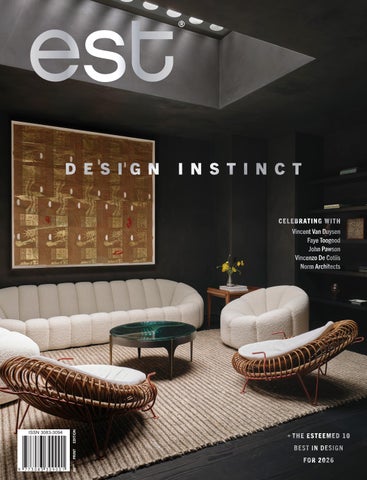
designer’s Fitzroy studio, which he calls “a giant 3D business card,” Flack looks back at the inventive material approach he developed early on—one that remains as relevant as when he established the practice more than a decade ago. Now leading a holistic architecture and interiors studio, Flack’s art-led, nonchalant attitude sees the practice traverse continents to design homes, hotels and hospitality spaces that aren’t afraid to resist the expected.